

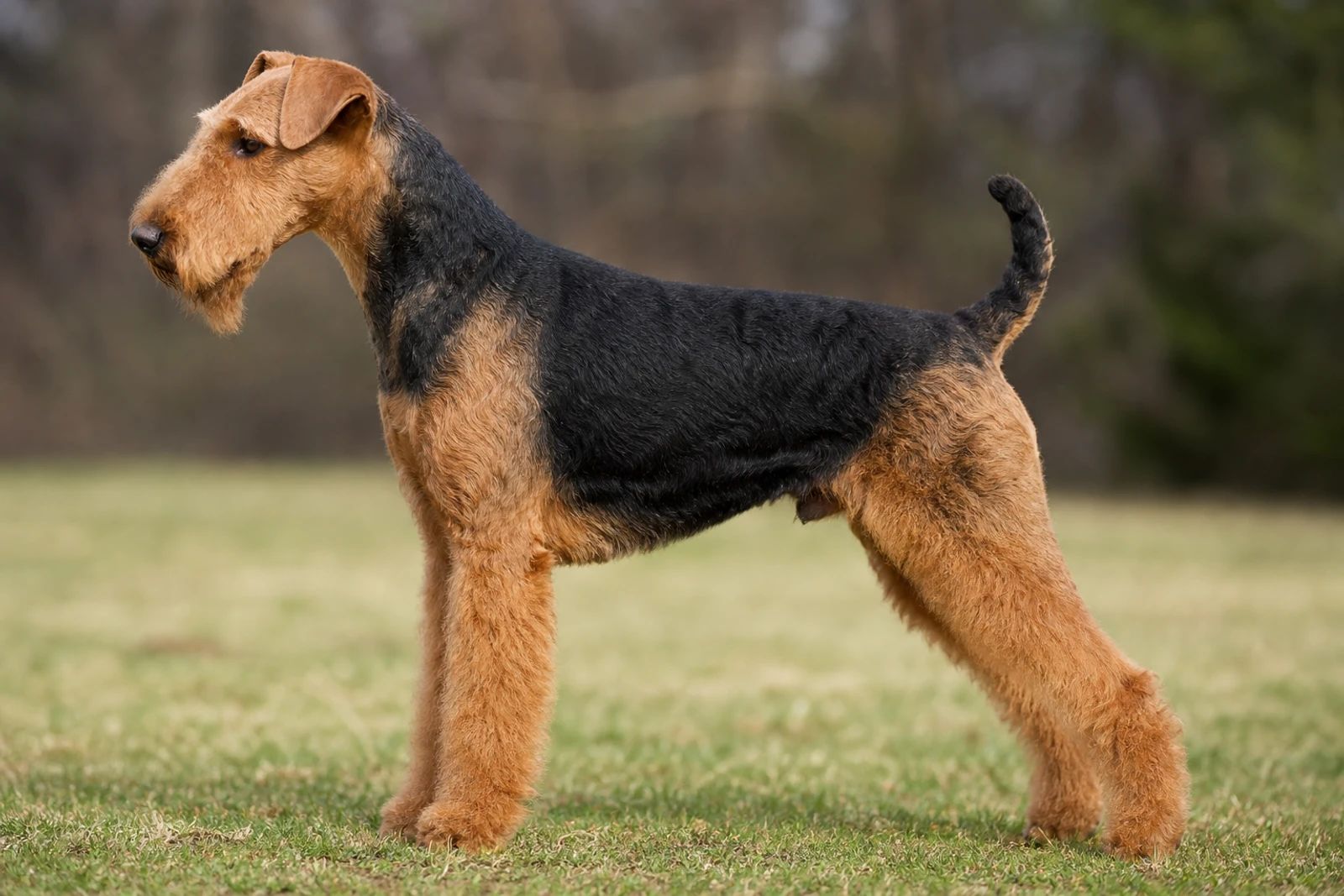
The Airedale Terrier, the largest terrier breed, is a confident, intelligent, and energetic dog. Originally bred for hunting and working, they excel in families that provide plenty of exercise and mental stimulation. Their dense, wiry coat is low-shedding but requires regular grooming. With a playful yet loyal nature, Airedales are protective watchdogs and affectionate companions. They best suit active, experienced owners who can channel their energy and train their independent streak. Not ideal for novice owners or apartment living, these terriers thrive in homes with space to roam and a job to do.
At a glance
- Size
- Large
- Height
- 22–24 in
- Weight
- 40–65 lb
- Life span
- 10–12 years
- Coat colors
- Black and tan
- Coat type
- Dense, wiry double coat
How much does a Airedale Terrier cost?
Adopt / rescue
$100–$450
Usually includes spay/neuter, first shots, and a microchip.
Buy from a breeder
$1,200–$3,000
From a reputable, health-testing breeder.
Approximate USD. Prices vary widely by region, breeder, pedigree, age, and coat colour — adopting is the lower-cost and recommended route. Avoid suspiciously cheap “breeders”; they’re often puppy mills.
Estimate the full cost of a Airedale Terrier →Want the ongoing number? Estimate the monthly food bill for a Airedale Terrier with our dog food cost calculator.
Airedale Terrier photos
Views
Front, side, rear and top — the full silhouette.Poses
How the breed sits, lies, moves and plays.Puppy to senior
The breed across its whole life.Expressions
The breed’s range of moods.Close-up details
Eyes, ears, nose, paws, tail and coat.Coat colors
The breed’s recognized colors.Click any photo to enlarge. We show the Airedale Terrier from every angle — three views, poses, life stages, expressions, close-ups, coat and colors.
Appearance & size
When you first lay eyes on an Airedale, you’re looking at the largest of the terriers—often called the King of Terriers for good reason. He stands 22 to 24 inches at the shoulder and weighs anywhere from 40 to 65 pounds, with males predictably at the upper end of both scales. Everything about his build says “athlete”: a deep, moderately wide chest, a strong, moderately long neck, and a level topline that stays firm whether he’s standing or trotting.
From the side, you notice a slight tuck-up behind the ribs, a short, broad loin, and a high-set tail that he carries gaily but never curls over his back. From the front, his forelegs fall straight and true with plenty of bone, and his feet point directly ahead—no east-west splay. The rear is equally purposeful: thick, well-muscled thighs with a good bend of stifle that propels a ground-covering stride.
The coat is the Airedale’s trademark. You’ll feel a hard, wiry, dense outer jacket that lies close and straight, with a softer, insulating undercoat beneath. The color pattern never varies: a black or dark grizzle “saddle” covers the back, the upper sides, the top of the neck, and the tail, set against a rich tan that fills in the head, ears, chest, legs, and underbelly. Some dogs have a small white patch on the chest, but it’s not universal.
The face is all terrier—long and flat-skulled with a barely perceptible stop, small dark eyes that spark with alertness, and V-shaped ears folded neatly forward. A hallmark is the crisp beard and mustache, which give the muzzle a square, no-nonsense finish. Head, body, and movement all tie together: the Airedale looks balanced and powerful without an ounce of coarseness, a dog that’s equally ready for a day’s work or a family adventure.
History & origin
The Airedale Terrier got its start in the industrial Aire Valley of Yorkshire, where mill workers and factory hands needed a tough, versatile dog that could do a bit of everything. They didn't set out to create a show dog — they needed a ratter, a water dog, a night hunter, and a home guardian all wrapped into one. Sometime in the 1850s, they crossed the now-extinct Black and Tan Terrier with the Otterhound, and later added a dash of other breeds like the Irish Terrier and possibly the Bull Terrier for grit. The result was a large, clever, waterproof terrier that could track an otter upstream, tackle a badger underground, or clear a stable of rats in minutes.
Locals called them “Waterside Terriers” or “Bingley Terriers” early on, but the name settled on “Airedale” for the river valley that shaped the breed. By the 1880s, the dog was formalized enough to appear at shows, and the Kennel Club (UK) recognized the Airedale Terrier in 1886. Breeders emphasized not just utility but temperament — a sharp nose, a level head, and the courage to hang on but the brains to back off when needed.
The breed’s big break came with the First World War. Airedales served as sentries, messengers, and Red Cross dogs, right alongside soldiers in the trenches. Their toughness and trainability made them legends; stories of Airedales delivering dispatches through gunfire weren’t tall tales. After the war, returning soldiers brought a surge of admiration back home, and the breed’s popularity soared in the UK and the United States. U.S. presidents like Warren Harding and Calvin Coolidge owned Airedales, cementing the “King of Terriers” image.
Through the 20th century, the Airedale gradually shifted from a do-it-all working dog to a companion and versatile sporting dog. They still shine in hunting tests, obedience trials, and agility, but they’re just as likely to be found jogging with their owner or policing the backyard for squirrels. That original Yorkshire demand — a level-headed jack-of-all-trades — still lives in the breed’s DNA.
Temperament & personality
The Airedale is a big, brainy terrier with an independent streak a mile wide. You’re not getting a push-button dog here — you’re getting a problem solver who will figure out how to open the fridge, escape the yard, or turn the hose on for a mid-day splash if you don’t stay one step ahead. That quick mind pairs with genuine affection for the family, but it’s a working partnership, not a velcro relationship. They like to be in the same room, maybe leaning against your leg, but they won’t smother you.
Energy runs high, even into middle age. A bored Airedale can dismantle a couch or redecorate with the contents of a trash can in minutes. Expect a solid hour of vigorous exercise — running, swimming, or a long, hilly hike — rather than a leisurely stroll. After that, they’ll happily sprawl out beside you, keeping one ear cocked for anything interesting. That watchfulness makes them a natural alarm system. An Airedale’s posture tells the story: a forward-leaning body with a stiff gaze when a stranger approaches, then a loose, wiggly greeting once you give the all-clear. Soft eyes and a relaxed mouth mean the mood is calm; lip licking and yawning might signal they need a break from rough play or loud kids.
With household members, they’re loyal but not blindly obedient. You’ll get a dog who thinks rules are negotiable. Consistent, respectful handling works far better than heavy-handedness — an Airedale remembers a grudge. Training should be short, positive, and sprinkled with challenges. They shine in activities like agility, tracking, or advanced obedience where they can use their brain and burn energy.
- Affection: Quietly devoted. They show love by bringing you a toy, leaning on you, or herding you toward the door for a walk. They’re not typically lap dogs, though some forget their size and try.
- Watchfulness: Sharp and vocal. They’ll bark at the doorbell, the delivery truck, and the squirrel plotting world domination from the oak tree. Early training teaches them when to quiet down.
- Quirks: The terrier mouthiness is real — they communicate with a gentle nibble on your hand or a tug on your sleeve. Puppy chewing is intense; adult Airedales keep their jaws strong by gnawing on hard chews, so keep a steady supply of appropriate items. Many love to dig, roll in something foul-smelling, or carry objects around just because.
- Around children and other pets: They can be patient and protective with kids they’ve grown up with, but their size and goofy enthusiasm can knock a toddler over. Supervise interactions. With other dogs, some Airedales are easygoing; others, especially males, may challenge same-sex rivals. Their prey drive is high — a fleeing cat or a rabbit in the yard rarely ends well. Secure fencing and early socialization are non-negotiable.
The breed’s mix of courage and cleverness means they don’t do well with neglect. Left alone for long stretches without exercise or company, they can develop anxiety-driven barking or destructive habits. When they’re tired and mentally satisfied, though, an Airedale is one of the most entertaining, devoted companions you can find — a dog who keeps you laughing and on your toes.
Good with kids, dogs & other pets
An Airedale’s patient, steady nature makes him a solid choice for families with children. He’s rarely snappy and genuinely enjoys the hustle of a busy household. The issue isn’t temperament—it’s physics. A 55-pound terrier in full play mode can send a toddler flying, so keep a close eye during rowdy moments. Teach kids to respect his space and never disturb him while eating or sleeping. With that kind of supervision, Airedales often become fiercely loyal shadows who follow the kids from room to room.
With other dogs, early and ongoing socialization writes the playbook. Airedales generally play fair with dogs they’ve grown up alongside or met during puppyhood. Same-sex aggression does show up in some lines, and a bored Airedale may pester housemates relentlessly. Off-leash dog parks can be a gamble—his terrier tenacity sometimes rubs other dogs the wrong way. You’ll get the most reliable results by introducing him to a wide circle of friendly dogs before 16 weeks of age and continuing those positive meetups through adolescence. If you’re bringing an adult Airedale into a home with a resident dog, arrange a series of calm, neutral-territory introductions rather than one tense face-to-face.
Cats and small pets trigger the Airedale’s hardwired vermin-chasing instinct. He’s a hunting terrier, not a lapdog, and that means squirrels, rabbits, and even the family cat can look like prey. A puppy raised alongside a cat might accept it as family. But many adult Airedales still see a fleeing cat as a game—and the cat won’t enjoy the rules. Don’t assume he’ll outgrow the drive. Test him early with short, leashed exposures and always provide escape routes for the cat. If you keep pocket pets or birds, house them in secure enclosures and never leave them unsupervised with the dog.
All of this hinges on the work you put in before 16 weeks. That’s the critical socialization window. During those months, your Airedale puppy needs positive, low-stress exposure to children, other dogs, cats, and the everyday racket of family life. Skip that, and you risk a dog who’s timid, over-reactive around new animals, or spooked by normal sights and sounds. Even after the window closes, dedicated training can help an adult dog feel more at ease, but you’re playing catch-up. Never force a fearful adult into greetings; it adds stress and can backfire.
Trainability & intelligence
Your Airedale can learn almost anything you’re willing to teach — but only if you treat training like a partnership, not a set of orders. These dogs are genuinely clever, often figuring out what you want in just a handful of repetitions. The catch? They’re also independent thinkers with a working terrier’s stubborn streak. If a command feels pointless or you haven’t built enough trust, they’ll find something more interesting to do.
What motivates an Airedale
Food is fine, but real engagement comes from making it fun. A squeaky toy, a quick tug session, a chance to chase — these often trump a biscuit. Mix up your rewards and keep sessions short and unpredictable. Drills bore them; games lock in their focus.
Recall and the independent streak
A reliable off-lead recall demands early, consistent work. Airedales have high prey drive and a nose that can override their ears. Use a long line and practice in progressively distracting places. Never punish a slow return — that’s a fast way to teach your dog to keep their distance when you call. Instead, throw a party (treats, play, praise) every single time they come back.
The training approach that works
- Start early, but stay patient. Puppy classes are essential, not optional. Begin the day your pup comes home, and keep sessions upbeat.
- Build trust before you tighten expectations. An Airedale who trusts you will work his heart out. One who’s been corrected harshly shuts down or gets sneaky. Skip the leash pops and intimidation; you lose credibility fast with this breed.
- Socialize relentlessly. Introduce your puppy to at least a hundred different people, dogs, surfaces, and situations by 16 weeks. A poorly socialized Airedale can become suspicious and reactive, and a reactive 60-pound terrier is a liability.
Even when you do everything right, expect a little creative disobedience around a year old — adolescence hits these guys hard. Stay consistent. Go back to basics if you have to. But never fool yourself into thinking you can force them into compliance. Earn their cooperation, and you’ll have a dog who learns complex tasks eagerly and works with you for the sheer joy of it.
Exercise & energy needs
Plan on two solid outings a day, not a quick spin around the block. An Airedale Terrier typically needs 60 to 90 minutes of vigorous exercise every day, broken into at least a morning and an afternoon session. This is a large, high-energy working dog originally bred to hunt badger and otter—a half-hour leash walk won't touch his gas tank.
What counts as real exercise for an Airedale? A long off-leash run in a safe area, a fast bike ride with a proper attachment, swimming, or a hilly hike. They thrive on activities that push their strong legs and let them problem-solve at the same time. Fetch with a Chuckit, a long game of tug, or 30 minutes of nonstop wrestling with a similarly robust dog pal all fit the bill. They’re also naturals at canine sports like agility, rally, and scent work, which drain a busy brain far better than mindless repetition.
Because they’re large and can be hard-charging, keep a watch on young joints—avoid repetitive high-impact pounding on pavement until growth plates close around 12–18 months. Off-lead play on grass or dirt is gentler during that window. Swimming is excellent exercise with zero joint stress and perfectly suits their water-loving nature.
Mental work is just as critical. Airedales bore easily, and an unoccupied terrier will manufacture his own entertainment—digging craters, dismantling irrigation systems, or barking at the fence line. Puzzle toys, hide-and-seek with a favorite tug, or 10-minute training sessions sprinkled through the day (they’re whip-smart and easily got bored) keep the scheming to a minimum. Nose work classes or backyard scent trails are a fantastic add-on; a 15-minute “find it” game can wipe them out faster than another lap around the field.
Don’t short-change the daily total. If you offer a 20-minute sidewalk amble, the Airedale will find other outlets—often ones that involve loud complaints or landscape diy. Hit that 60- to 90-minute mark with a mix of aerobic exercise and brain teasers, and you’ll have a tired, happy dog sacked out at your feet.
Grooming & coat care
That crisp tan-and-black jacket doesn’t come free. An Airedale’s double coat — harsh, wiry outer guard hairs over a soft, dense undercoat — needs a structured routine to stay hard, weatherproof, and mat-free. Skip it, and that signature look becomes a felted mess.
Brushing & combing
Use a metal slicker brush with rounded pins to work through the topcoat and pull out dead hair without scratching the skin. Follow immediately with a wide-toothed metal comb, going all the way down to the skin. Pay extra attention behind the ears, under the front legs, and around the thighs — those are mat magnets. Aim for 2–3 times a week during normal seasons, and up it to every other day when the undercoat is blowing.
Bathing
Bath every 4–8 weeks unless your dog rolls in something foul. Reach for a harsh-coat or terrier-specific shampoo — moisturizing formulas will soften the wiry texture and undo all that brushing. If you bathe at home, a force dryer gets the dense undercoat dry; dampness left in that wool invites hot spots.
Clipping vs. hand-stripping
You’ve got a real tradeoff here. Hand-stripping preserves the correct harsh texture, deep color, and water-resistant quality. It’s labor intensive, usually done by a professional every 6–8 weeks, but it’s what keeps the Airedale looking like an Airedale. Clipping is quicker and cheaper, yet it will gradually soften the coat and turn the black saddle grey. Plenty of pet owners go that route — just know the look and feel change over time.
Nails, ears & teeth
Clip nails every 3–4 weeks; if you hear clicking on a hard floor, they’re overdue. Airedales grow hair deep inside the ear canal. Pluck it routinely with hemostats or ask your groomer to do it — fewer hair plugs mean less trapped moisture and fewer infections. Clean the visible ear flap with a vet-approved solution and cotton ball, never a Q-tip. Hit those teeth with dog toothpaste daily or at minimum a few times a week, supplemented with dental chews.
Seasonal coat care
When temperatures rise in spring, the soft undercoat loosens in earnest. Work an undercoat rake through the jacket once a week during that blow to clear the dead wool before it mats. The rest of the year, shedding is minimal — a tidy dog when the routine sticks.
Shedding & allergies
If you’re hoping for a dog that doesn’t dust your sofa in fur, the Airedale is a solid bet—but the real trade-off is coat maintenance. Shedding is minimal, not zero. The wiry, dense double coat traps dead hairs instead of raining them onto your floors. That’s the good news. The trade-off is you’ll need to brush a couple times a week and strip (or clipper) the coat every 6–8 weeks to clear those trapped hairs and prevent matting.
Twice a year, typically spring and fall, the undercoat really lets go. A few weeks of daily line brushing with a slicker and comb will keep the tumbleweeds from piling up in corners. Drool isn’t a breed trademark. You might see a damp chin after a long drink or when a treat bag rattles, but Airedales aren’t the type to leave wet spots on your pants.
No dog is truly hypoallergenic—allergens are in dander and saliva, not just hair. That said, many allergy sufferers do better with Airedales because they shed so little dander-carrying hair around the house. And if you hand-strip the coat regularly, you remove dead hair and loose dander at the source. Still, always spend time with the breed before committing if allergies are severe.
Diet & nutrition
An Airedale is an athletic dog that tends to treat mealtime like a job they take seriously. Many will eat whatever you put in front of them — and then turn on the charm for more. That enthusiasm, combined with their size, makes weight management a real priority. Keep your Airedale lean: you should feel his ribs easily under a thin layer of fat, and he should have a visible waist when viewed from above.
How much to feed
There’s no single number that fits every dog. Start with the feeding guide on a high-quality adult kibble — for a 40–65 lb active Airedale, that’s often around 2½ to 3½ cups per day, split into two meals. If you’re feeding a home-prepared diet, a good rule of thumb is about 60% meat (raw or cooked), 20–30% fruits and vegetables, and 10% extras like eggs, plain yogurt, or cooked grains. Adjust portions upward if you’re logging serious miles hiking or doing dog sports; cut back if your dog’s exercise drops. Never eyeball it: use a measuring cup or scale.
Puppy feeding schedule
Young Airedales grow fast and do best on routine. Feed four meals a day until 4 months, then three meals a day until 6 months, then switch to the adult two-meal rhythm. Transition to new foods gradually over a week to avoid stomach upset. Around 12 weeks, some owners introduce raw meaty bones like chicken wings under close supervision — but that’s a personal choice, not a requirement.
Weight-watching and tricks for fast eaters
Extra pounds hit large dogs hard, adding stress to hips and joints. Airedales who inhale their food benefit from puzzle bowls or snuffle mats, which slow them down and engage that busy brain. If you offer leftovers (plain cooked veggies, a bit of canned fish or egg), always put them in the dog’s own bowl — never from the table — to keep begging out of the picture.
Sensitive stomachs and senior years
An occasional digestive flare-up can be tackled with bland, easily digested carbs like white rice or pearled barley mixed with a lean protein. But avoid rich, fatty foods — a holiday ham bone or greasy trimmings can trigger pancreatitis. As your Airedale ages and activity tapers off, switch to smaller, more frequent meals and purge calories to prevent obesity. Purée or soften meals for a senior with dental issues; there’s no need to cut protein unless a vet tells you otherwise. This breed thrives on a meat-based diet, so steer clear of vegetarian or vegan regimens — they simply aren’t built for it.
Health & lifespan
Airedales typically live 10 to 12 years. Some stay strong past 12 when weight stays under control and problems get caught early, but this is a large, active breed, and any extra season is a gift.
Responsible breeders screen the parents for the most common inherited conditions, so when you talk to a breeder, ask to see official hip and elbow evaluations (OFA or PennHIP), a current eye exam from a veterinary ophthalmologist, and thyroid test results. Even well-bred dogs can develop issues, but those clearances lower the odds.
- Hip and elbow dysplasia — Malformed joints cause pain and arthritis over time. Keep a puppy lean during growth, and avoid high-impact jumping on hard surfaces until the growth plates close.
- Bloat (GDV) — That deep chest puts the Airedale at significant risk. Feed two or three smaller meals a day, don’t exercise right after eating, and learn the early signs: a swollen belly, pacing, and unproductive retching. Quick action saves lives.
- Skin allergies — Atopic dermatitis, hot spots, and food sensitivities are common. You’ll often see excessive licking, itching, or recurring ear infections. A high-quality diet, stress management, and a rinse after swimming or romping in mud help keep the skin quiet.
- Eye disease — Progressive retinal atrophy (PRA) and cataracts can steal vision later in life. Annual eye checks catch changes before the dog shows obvious trouble.
- Hypothyroidism — Sluggish metabolism in middle age leads to weight gain, thin coat, and skin problems. Daily medication manages it well once diagnosed.
- Cancer — Airedales have a higher-than-average rate of hemangiosarcoma, lymphoma, and osteosarcoma. Watch for subtle shifts — a drop in energy, sudden weight loss, or a new lump — and don’t put off the vet visit.
Prevention is straightforward. Keep your dog at a healthy weight—that food drive will pack on pounds if you’re not measuring meals. Monthly heartworm prevention during mosquito season and a month after is non-negotiable, and the rabies vaccine is legally required. Schedule a yearly wellness exam, stepping up to every six months once the dog hits seven or eight. Early socialization also plays a quiet role in health: a confident, well-adjusted Airedale without chronic anxiety is less likely to chew his own skin raw or develop stress-triggered gut trouble. In hot weather, exercise in the early morning or late evening—that dense double coat doesn’t mix well with midday heat.
Living environment
An Airedale isn’t a quiet lapdog you can tuck into a studio apartment and forget about. These are big, boisterous terriers with a ton of motor, and a house with a securely fenced yard makes life infinitely easier for everyone. If you’re in an apartment, it’s possible—barely—but only if you’re genuinely up for the kind of daily workout that leaves you winded. We’re talking at least an hour of hard running, sniffing, and brain work each day, split into two sessions, not just a sedate stroll around the block. Without that outlet, you’ll get barking, chewing, and a 60-pound dog climbing the walls.
A yard is a safety valve, not a substitute for your attention. Airedales have a high prey drive and a talent for tunnel escape artistry, so the fence needs to be tall and dig-proof. They’ll rocket around the yard making their own fun, but they still need off-property walks and mental challenges—puzzle toys, scent games, or a few rounds of hide-and-seek indoors.
-
Climate tolerance: Their dense, wiry double coat sheds water and insulates against cold, so they’re tough in rain and snow. But that same coat puts them at risk of overheating in hot, humid weather. Exercise early or late in the day, and always bring water. If you live somewhere scorching, this may not be the breed for you.
-
Noise and barking: Airedales have a deep, resonant bark they’re not shy about using. They’ll alert you to every delivery, squirrel, and suspicious leaf. That’s fine in a detached home, but shared walls can become a problem fast. Boredom amplifies the noise, so a tired Airedale is a quieter Airedale.
-
Being left alone: They bond tightly with their people and don’t handle long, lonely stretches well. Left alone for a full workday without preparation, many will develop separation anxiety—howling, destruction, or pacing. Crate training, a solid routine, and gradually built-up alone time help, as does a midday dog walker or daycare. But if your schedule keeps you gone 10 hours a day, this breed will struggle.
Who this breed suits
If you’re the type who gets stir-crazy by 10 a.m. and your weekends revolve around a muddy trail, a long run, or an agility course, a full-grown Airedale will look at you like you finally speak his language. These dogs stand 22 to 24 inches and carry 40 to 65 pounds of whip-smart terrier muscle. They don’t just want a walk around the block — they need a solid hour of hard running, swimming, or training that stretches their mind as much as their legs. Meet that need, and you’ll have a hilarious, loyal, and remarkably versatile sidekick.
The Airedale shines with an active, confident owner who understands terriers aren’t Labrador people-pleasers. Experience with independent breeds helps, but a first-time owner who’s coachable and committed to positive, structured training can absolutely make it work — just don’t expect the dog to hang on your every word without earning that respect first. Singles with outdoor hobbies, runners, hikers, and cyclists will find a tireless buddy. Families with children do well when the kids are at least six or seven; a 55-pound adolescent Airedale zooming through the living room can accidentally flatten a toddler, and they won’t tolerate rough handling. They’re fiercely devoted to their pack, but you’ll be the one teaching the kids as much as the dog.
Now, who should think twice:
- Couch potatoes and the time-strapped. A bored Airedale dismantles furniture, digs craters, and invents jobs you won’t like. They’re a 10- to 12-year commitment to daily, vigorous activity.
- Someone seeking an obedient lapdog. Airedales are clever to a fault and will negotiate every rule. If you want a dog who instantly obeys without a sense of humor about it, this isn’t your match.
- Homes with small pets. The prey drive is real. An Airedale raised with a housecat might coexist, but loose rabbits, guinea pigs, or the neighbor’s cat are fair game without a solid recall and management.
- Most seniors, unless you’re already the kind who still runs 5Ks. A 65-pound terrier hitting the end of a leash can be a shoulder-jerker, and their energy doesn’t taper off with age the way some breeds’ does.
If you’re ready to be a fair, firm boss who will laugh when your dog outsmarts you, an Airedale will keep you on your toes every single day. If that sounds exhausting rather than entertaining, a different breed will save you both a lot of frustration.
Cost of ownership
Plan on spending $1,500 to $2,500 for an Airedale puppy from a responsible breeder who screens for hip dysplasia and other inheritable conditions. Show or working lines can climb past $3,000. If you adopt an adult through a breed rescue, you’ll usually pay $200–$400.
What keeps the bills coming each month:
- Food: A 50–60 lb Airedale with a terrier’s metabolism eats roughly $60–$80 in high-quality large-breed kibble monthly. Treats and puzzle-food toys add $10–$20.
- Grooming: That wiry, low-shed coat needs a pro every 6–8 weeks. Hand-stripping preserves coat texture and runs $80–$120 per visit; clipper cuts run $60–$80. Between appointments, you’ll still need a slicker brush, a metal comb, and occasional baths.
- Veterinary: Annual exams, core vaccines, and year-round heartworm/flea/tick prevention average $500–$700. Airedales can be prone to hip dysplasia, skin allergies, and bloat — a gastric torsion surgery can instantly hit $3,000–$5,000. Either keep a dedicated emergency fund or carry insurance.
- Pet insurance: Comprehensive accident-illness policies typically run $40–$70 a month, depending on your deductible and your dog’s age.
- Training and supplies: Airedale pups have sharp minds and a stubborn streak. A 6-week group obedience class ($150–$250) saves real headaches later. Upfront gear — a large crate, a tough leash and harness, a raised feeder (to help minimize bloat risk), and sturdy chew toys — easily totals $200–$300.
Realistically, the monthly nut for a healthy young adult Airedale sits between $150 and $300, without factoring in dog walkers, boarding, or major medical curveballs.
Choosing a Airedale Terrier
Decide whether you want to bring home a puppy or adopt an adult through a breed-specific rescue before you start searching. Airedales aren’t overflowing rescues, but there are dedicated groups that understand the breed’s smarts, stubborn streak, and need for real work. An adult from a good rescue comes with known house manners and temperament notes — a huge advantage if your household doesn’t have the bandwidth for landshark puppy months. That said, if you go the puppy route, you need a breeder who health-tests thoroughly and doesn’t just hand you a folder of vet receipts.
Health clearances you should see
Ask for OFA hip and elbow scores — an Airedale’s hips should be rated Fair, Good, or Excellent, and elbows Normal. Request OFA thyroid and a cardiac evaluation (at minimum a basic cardiac exam by a board-certified cardiologist). A yearly eye exam by a veterinary ophthalmologist is standard; you want a clean report, not just “the vet looked at them.” Also check for DNA testing for von Willebrand disease (Type 1) — a bleeding disorder that shows up in the breed. Responsible breeders will share certificates and OFA numbers so you can look the results up yourself. If they hand you a stack of receipts and call it “health testing,” walk.
Red flags that should make you leave
A breeder who breeds dogs before age two — critical screenings can’t be completed earlier. Multiple litters on the ground at once or a website that always lists “available puppies” is a puppy mill sign, even if the photos look cute. A breeder who won’t let you meet at least the dam and see where the pups sleep, eat, and potty is hiding something. You should be asked plenty of questions — about your yard, work schedule, dog experience, and plans for training. If they don’t grill you, they don’t care where that puppy ends up.
Picking a puppy
Ideally, you meet the litter between 6 and 8 weeks old. You want a bold, curious puppy — not the one cowering in the corner, and not the loudest bully either, especially if this is your first terrier. Airedale pups should be solid, clean, and free of eye or nose discharge. Watch them move: no limping, no bunny-hopping. They should investigate you, then maybe wander off to tackle a toy. Ask how the breeder socializes — exposure to household sounds, handling of paws and ears, and brief separations from mom make a measurable difference. A puppy raised in a sterile kennel setup often struggles with normal family chaos later.
Rescue or breeder, you’re committing to a large, long-backed terrier who’ll challenge you. If you can’t visit in person, insist on a live video call showing the whole set-up — and if excuses pile up, trust your gut and move on. A well-bred or well-matched Airedale is worth the wait, but a rushed decision lands you a decade of heartache.
Pros & cons
Pros
- A sharp, thinking partner who shines in obedience, agility, tracking, and even protection work — as long as you keep training sessions varied and upbeat.
- Built for motion: a lean 40–65 pounds with the stamina to hike, run, or swim for hours. Not the breed for a sedate household.
- Deeply bonded to their people and, when raised with children, surprisingly gentle and playful (though no dog should be left unsupervised with toddlers).
- A low-shedding coat that leaves less hair on your sofa than you'd expect from a dog this size — but note it comes with specific grooming demands (see cons).
- Alert and watchful without being a nuisance barker; their size and deep bark make an intimidating deterrent.
Cons
- Demanding exercise needs. An Airedale typically requires 60–90 minutes of real, heart-pumping activity every day. A stroll around the block won't cut it — skip it, and you'll likely find chewed baseboards, shredded cushions, or landscaping "redesigned."
- Independent and strong-willed. They'll question commands and can outlast an inexperienced owner in a battle of wills. Consistent, firm, fair training from puppyhood is non-negotiable.
- High prey drive hard-wired into the terrier brain. Squirrels, cats, and small dogs can trigger an instant chase. Off-leash reliability is an advanced skill that some Airedales never fully master.
- Coat care is labor-intensive. The harsh double coat needs weekly brushing and regular hand-stripping (every 8–12 weeks) to keep its weatherproof texture. Clipping softens the coat, increases shedding, and can lead to skin problems over time.
- Dog reactivity, especially same-sex aggression, can surface without early and ongoing socialization. They aren't typically carefree dog-park regulars.
- Health issues to know: the breed can be prone to hip dysplasia, allergies, and bloat (gastric torsion). Responsible breeders screen for hip health and counsel buyers on feeding strategies to lower bloat risk.
Similar breeds & alternatives
If you’re drawn to the Airedale’s size and terrier edge but aren’t sure it’s the perfect fit, a few other breeds make the short list.
-
Standard Schnauzer. Smaller (17.5–19.5 in, 30–50 lb) but shares the wiry coat and farm-dog work ethic. Standard Schnauzers mature mentally a little faster and can be more biddable, so you’ll likely deal with fewer of the independent shenanigans an Airedale throws your way. They still need a confident owner and a couple miles of brisk walking daily. Lifespan runs 13–16 years. The coat calls for regular clipping or hand-stripping, same drill as the Airedale.
-
Irish Terrier. True terrier fire in a tighter package: 18–20 in tall, 25–27 lb. The red wire coat demands similar upkeep. Irish Terriers are famously reckless and more likely to start a scrap with another dog—more so than a well-socialized Airedale, which often has a softer play style in a multi-dog home. They live 13–15 years. Pick one if you want a big personality without the big-breed grocery bill, but know that dog-directed aggression is a real trade-off.
-
Soft Coated Wheaten Terrier. For a softer temperament that keeps terrier energy, the Wheaten (17–19 in, 30–40 lb) gives you a single, silky coat that sheds very little. They’re cheerful, bouncy, and less headstrong in training than an Airedale, though they still need a solid hour of daily exercise. Wheatens tend to be jumpy greeters and have a 12–14 year lifespan. This breed clicks if you want a terrier that leans into affection and redirects more easily.
-
Giant Schnauzer. Bigger and more intense. Giants (23.5–27.5 in, 55–85 lb) bring a serious guarding drive that an Airedale typically lacks. Expect sharper territorial instincts and a need for advanced socialization. Coat care mirrors the Airedale’s. Lifespan 12–15 years. Consider a Giant only if you actively want a large protection dog and can commit to rigorous daily work; otherwise the Airedale’s more playful, versatile nature will feel simpler.
Fun facts
- The Airedale Terrier is known as the 'King of Terriers' for being the largest terrier breed.
- They served as messenger and ambulance dogs during World War I.
- Their intelligence and problem-solving skills make them excellent at dog sports like agility and obedience.
- Airedales have a unique 'otter' head shape with a long, flat skull and a beard.
Frequently asked questions
- Are Airedale Terriers good with children?
- Airedale Terriers can be good family dogs when properly socialized from a young age. They tend to be patient and playful, but their size and energy may be overwhelming for very young children, so supervision is recommended.
- Do Airedale Terriers shed a lot?
- Airedale Terriers are considered a low-to-moderate shedding breed. They have a short, wiry coat that sheds minimally, but regular grooming helps control loose hair and keep shedding to a minimum.
- How much exercise does an Airedale Terrier need?
- As a high-energy working breed, Airedale Terriers typically require at least an hour of vigorous exercise daily. Without sufficient physical and mental stimulation, they may become restless or engage in unwanted behaviors.
- Are Airedale Terriers easy to groom?
- Airedale Terriers have a high-maintenance coat that needs regular brushing and periodic hand-stripping or clipping. Routine grooming, including nail trims and ear cleaning, helps prevent matting and keeps them comfortable.
- Can Airedale Terriers live in apartments?
- Airedale Terriers can adapt to apartment living if their significant exercise needs are met with long walks and active playtime. However, they may be better suited for homes with a yard, as their size and energy level can make confined spaces challenging.
- Are Airedale Terriers suitable for first-time dog owners?
- Airedale Terriers are intelligent but can be independent and spirited, which may present a challenge for first-time owners. Consistent training and early socialization are important, so they often do best with someone who has previous terrier experience.
Tools & calculators for Airedale Terrier owners
Quick estimates tailored to Airedale Terriers — pre-filled with this breed’s size where it matters.
Articles & stories about the Airedale Terrier
Sources & standards
This profile follows recognized breed standards from the American Kennel Club (AKC) and the Fédération Cynologique Internationale (FCI), along with established veterinary and breed-club guidance. These describe general breed tendencies — every dog is an individual.