

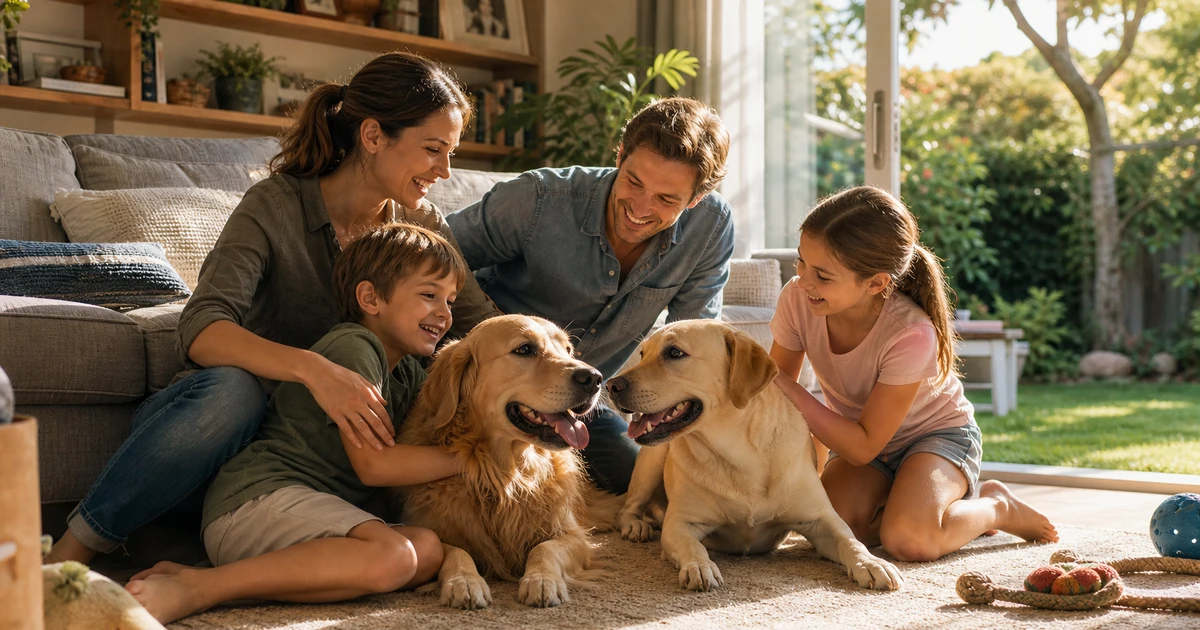
Choosing a family dog is not a search for a universally “safe” breed. A breed label can help you form a shortlist, but it cannot predict one dog’s comfort with children, other pets, visitors, or a busy home.
This guide compares 23 family-dog profiles through the constraints that change ordinary life: children’s ages and handling, size and sturdiness, weekday activity, trainability, shedding, grooming, space, and the adults’ time for care. Use the list to decide what to investigate, then meet the actual dog and ask for a transparent history before you commit.
Quick answer
What are the best dog breeds for families?
Labrador Retrievers, Golden Retrievers, Poodles, Cavaliers, Beagles, Boxers, and Newfoundlands are strong starting points, but which dog breeds are best for families depends on the children's ages, available space, activity level, grooming tolerance, budget, and the adults' training time.
Best Family Dogs With Toddlers
Parents who need steadiness, physical sturdiness, and realistic supervision advice.
Small dogs and childrenSmall Dogs and Kids
Families balancing limited space with gentleness, trainability, and manageable exercise.
Large family dogsBest Large Dog Breeds for Kids
Homes with enough space, exercise time, and adults comfortable managing a powerful dog.
Allergy-aware homesBest Hypoallergenic Dog Breeds for Kids
Allergy-aware households comparing shedding, grooming workload, size, and temperament.
Lower-maintenance homesBest Low-Maintenance Dog Breeds for Kids
Households comparing grooming, exercise, training friction, and realistic daily workload.
Apartment familiesBest Apartment Dog Breeds for Kids
Smaller-space households comparing barking, exercise, size, and indoor adaptability.
First dog with childrenFirst Dog for Families With Kids
New owners who need a forgiving temperament, trainability, and a sustainable care routine.
Busy family schedulesBest Dog Breeds for Busy Families
Busy parents comparing exercise, alone-time tolerance, grooming, and training commitments.
Poodle mixesBest Poodle Mixes for Families
Families comparing size variability, coat care, energy, and the traits of both parent breeds.
Start with the constraint that matters most
These guides answer a different decision than the broad family list, so you can compare the trade-offs before you shortlist a breed.
Best Small Dogs for Families
Families comparing child fit, handling, energy, barking, grooming, and small-home practicality.
Quieter routinesCalm Small Dog Breeds
Homes that want a lower-intensity companion and need to compare indoor energy, barking, and care.
First dogBest Dog Breeds for First-Time Owners
New owners comparing trainability, energy, grooming, size, and the commitments that last beyond puppyhood.
Compare the 23 family-dog finalists side by side
Use the Family Dog Fit Matrix to compare size, energy, shedding, grooming, trainability, apartment fit, and first-time-owner fit, then print the household checklist before you shortlist a dog.
Open the Family Dog Fit Matrix →Decision checkpoint
Use breed as a shortlist, then assess the individual dog
A family-friendly breed label cannot predict one dog's comfort with children, handling, other pets, or a busy home. Use the list and Matrix to narrow your options, then make the final call from observable behavior, a transparent history, and a realistic care plan.
Ask for a real history
Ask a breeder, rescue, or foster how the individual dog has responded to children, gentle handling, food, rest, visitors, other pets, and time alone. “Good with kids” needs that context.
Consider an assessed adult
An adult dog can make size, energy, house training, and everyday temperament easier to observe than they are in a puppy. That reduces uncertainty; it is not a substitute for a careful meeting and honest history.
Keep an adult responsible
Children can help with routines, but an adult must own training, care, and supervision. Never make young children and a dog responsible for managing each other.
For a practical puppy-versus-adult checklist and family-fit questions, see the American Veterinary Medical Association's Selecting a Dog guide.
What makes a dog a realistic family fit?
There is no single “best family dog.” A quiet home with one older child can support a different profile from a busy home with toddlers, close neighbors, or long workdays. The useful question is whether the dog’s hardest need fits the household you actually have.
Individual comfort and adult management
Published breed tendencies are a starting point, not a promise about an individual dog. Ask a breeder, rescue, or foster how the dog responds to calm child contact, visitors, rest, food, other pets, and changes in routine. Adults must manage training, supervision, introductions, feeding, and the dog’s protected resting space; children can participate, but they should not be responsible for managing the dog.
Size, handling, and daily energy
Small is not automatically easy, and large is not automatically gentle. Tiny dogs can be vulnerable to falls or rough handling; larger dogs can knock a child over without intending to. Energy matters just as much: a high-energy profile can suit a family that enjoys regular activity and training, but become a poor match when the schedule cannot support it.
Training, coat care, and home environment
Trainability does not mean self-training, and lower shedding does not mean lower work. Compare who will reinforce household rules, walk the dog, practice calm behavior around visitors, brush the coat, arrange grooming, and pay for care. The most sustainable choice is the one whose ongoing work fits an ordinary weekday, not a perfect weekend.
Compare at a glance
Tap any breed name to jump to its full write-up.
Use these columns to compare trade-offs, not to calculate a universal family-safety score. A published breed tendency cannot replace adult supervision, an individual dog's history, or a careful meeting.
| Breed | Size | Weight | Temperament | Energy | Shedding | Trainable | Kids |
|---|---|---|---|---|---|---|---|
| Large | 55–82 lb | friendly, outgoing, playful, gentle, even-tempered | ✓ | ||||
| Large | 55–75 lb | Friendly, intelligent, devoted, playful, gentle | ✓ | ||||
| Medium | 11–18 lb | Affectionate, Gentle, Sociable, Playful, Adaptable | ✓ | ||||
| Medium | 20–24 lb | friendly, curious, merry, amiable, gentle | ✓ | ||||
| Toy, Miniature, and Standard varieties | Varies by variety | Intelligent, Alert, Active, Affectionate, Trainable | ✓ | ||||
| Large | 55–71 lb | Playful, Loyal, Energetic, Affectionate, Protective | ✓ | ||||
| Giant | 71–120 lb | Gentle, Affectionate, Loyal, Intelligent | ✓ | ||||
| Giant | 110–152 lb | Gentle, loyal, patient, intelligent, devoted | ✓ | ||||
| Large | 51–75 lb | Intelligent, loyal, gentle, sensitive, protective | ✓ | ||||
| Medium | 24–29 lb | affectionate, playful, adaptable, easygoing, alert | ✓ | ||||
| Large | 44–66 lb | Affectionate, Energetic, Intelligent, Gentle, Sensitive | ✓ | ||||
| Medium | 51–55 lb | docile, courageous, friendly, willful, calm | ✓ | ||||
| Small | 11–15 lb | playful, affectionate, cheerful, intelligent, gentle | ✓ | ||||
| Medium | 15–31 lb | Cheerful, Affectionate, Gentle, Playful, Sensitive | ✓ | ||||
| Medium | 11–24 lb | friendly, lively, intelligent, affectionate | ✓ | ||||
P Pug | Small | 13–18 lb | charming, affectionate, mischievous, playful, loyal | ✓ | |||
| Large | 31–40 lb | Energetic, Intelligent, Affectionate, Agile, Enthusiastic | ✓ | ||||
| Giant | 60–71 lb | Energetic, Affectionate, Playful, Outgoing, Mischievous | ✓ | ||||
| Large | 40–65 lb | Intelligent, Energetic, Loyal, Versatile, Exuberant | ✓ | ||||
| Medium | 20–26 lb | Affectionate, Intelligent, Alert, Bold, Playful | ✓ | ||||
| Size varies by parents and generation | Varies by parents/generation | Friendly, Intelligent, Playful, Affectionate, Social | ✓ | ||||
| Medium | 24–37 lb | Affectionate, Courageous, Playful, Loyal, Intelligent | ✓ | ||||
| Giant | 90–130 lb | Loyal, Protective, Affectionate, Docile, Courageous | ✓ |
The 23 best dog breeds for families
Labrador Retriever
A trainable, people-oriented retriever for active homes ready for exercise, training, and adult supervision.
Large · 55–82 lb · 10–12 yr
Drop a tennis ball anywhere near a Lab and you'll understand the appeal in about three seconds flat. This is a big, athletic dog — roughly 22 inches at the shoulder and anywhere from 55 to 82 pounds, with males pushing the heavy end — that turns family chaos into a game. Labs score a perfect 5/5 for both trainability and affection, which is the combination that lands them at the top of nearly every family list. They learn fast, forgive a beginner's mistakes, and genuinely want to be wherever the kids are.
The even temper holds up around other dogs and cats too, so a Lab usually slots into a busy household without drama.
The honest caveat
That 4/5 energy is not optional. A Lab who doesn't get a real workout will redecorate your living room and chew through anything left at floor level. They also shed hard (4/5) — black, yellow, or chocolate hair will turn up on your clothes year-round. Grooming itself is easy (2/5), so it's the vacuuming that costs you, not the brushing.
If you can commit to a daily run, swim, or long fetch session, a Lab pays you back with 10 to 12 years of steady, good-natured company.
Golden Retriever
A people-focused retriever with a substantial size, shedding, and activity commitment to plan for.
Large · 55–75 lb · 12–13 yr
Few dogs greet a houseful of visitors like a Golden Retriever — every guest is treated as a returning relative, and that sunny, low-aggression nature is exactly why families keep choosing the breed. Males stand 22 to 24 inches, females 20 to 22, with weight landing between 55 and 75 pounds once they fill out. They share the Lab's top marks: 5/5 trainability and 5/5 affection, plus a quieter streak (barking just 2/5) that suits homes that don't want a yappy dog.
Goldens are flagged good with kids, dogs, and cats, and they're forgiving enough for first-time owners.
The honest caveat
That gorgeous double coat is a full-time commitment. Shedding rates a 5/5 — the highest on this list — and grooming sits at 3/5, meaning regular brushing if you don't want golden tumbleweeds drifting across the floor. Their 4/5 energy also needs an outlet; a Golden bored indoors gets restless and mouthy.
With a 12 to 13 year lifespan and a temperament built around pleasing people, a well-exercised, well-brushed Golden becomes the kind of steady presence kids grow up alongside.
Cavalier King Charles Spaniel
An affectionate small companion whose gentle handling, grooming, and need for company must fit the home.
Medium · 11–18 lb · 12 yr
If your idea of a family dog is one that naps on the couch beside your kid during movie night, the Cavalier King Charles Spaniel was practically designed for the job. At 12 to 13 inches and a featherweight 11 to 18 pounds, this is a spaniel scaled down into a true companion — affectionate, gentle, and sociable enough to fit households with other dogs and cats. The 5/5 affection score isn't marketing; a Cavalier wants to touch you, follow you, or at minimum keep you in sight.
Energy lands at a manageable 3/5. A couple of 20–30 minute walks plus indoor play keeps one content, which makes the breed apartment-friendly and easy for first-timers.
The honest caveat
That clinginess cuts both ways — Cavaliers don't do well left alone for long stretches and can struggle in homes where everyone's gone all day. The silky coat (grooming 3/5) needs regular brushing to stay tangle-free, and shedding runs middle-of-the-road at 3/5.
For a family that's home often and wants a gentle, quiet (barking 2/5) lap dog rather than a hiking buddy, the Cavalier is a near-perfect match.
Beagle
A sturdy, social hound with energy, barking, and scent-driven independence to plan for.
Medium · 20–24 lb · 13 yr
A Beagle is the family clown that occasionally forgets you exist the instant a rabbit's scent crosses the yard. Compact and muscular at 13 to 16 inches and 20 to 24 pounds, this pack hound is outgoing to its core — flagged good with kids and other dogs, and scoring a full 5/5 for affection. The merry, amiable streak means a Beagle adores everyone, from your children to the mail carrier, which also tells you it makes a lousy guard dog and a great welcoming committee.
Grooming is genuinely low-effort (2/5) and the short coat sheds only moderately (3/5).
The honest caveat
Two things keep Beagles off the easy list. First, that nose: trainability sits at 3/5, and a Beagle locked onto a scent will tune you out completely, so a fenced yard and a reliable leash habit are non-negotiable. Second, the voice. Barking and baying rate 4/5, and the famous howl carries — something to weigh if you have close neighbors.
With a sturdy 13-year lifespan and that endless cheerful curiosity, a Beagle suits active families who can channel its 4/5 energy into walks, sniffing games, and the occasional rabbit-free romp.
Poodle
Highly trainable with a lower-shedding coat that comes with a meaningful grooming commitment.
Small · 7–9 lb · 12 yr
A Toy Poodle at 11 inches and just 7 to 9 pounds packs more brain into a small frame than almost any dog here. This is the family pick for households worried about allergies: the curly single coat sheds a remarkable 1/5 and earns a low-allergen flag, so it's the rare breed that won't blanket your sofa in hair. Add 5/5 trainability — she picks up cues in a handful of repetitions — and a 5/5 affection score, and you get a tiny dog that's both clever and devoted.
The flags read like a family wish list: good with kids, dogs, and cats, plus apartment-friendly and first-timer-friendly.
The honest caveat
Low shedding does not mean low maintenance. Grooming is the most demanding on this list at 5/5 — that curly coat mats without frequent brushing and needs professional clipping every few weeks, which adds up. Energy also runs 4/5, so this is no quiet ornament; a bored Poodle gets pushy and vocal (barking 3/5).
For an allergy-conscious family ready to invest in grooming, a 12-year companion this sharp and affectionate is hard to beat.
Boxer
An energetic, people-oriented dog for families ready to train and manage a powerful body.
Large · 55–71 lb · 10–14 yr
A Boxer stays a 60-pound puppy for most of its life, greeting mealtime, the leash, and a returning family member with full-body wiggles and that famous "kidney bean" curl. Built like a middleweight athlete — males 23 to 25 inches and 65 to 71 pounds, females 21 to 23.5 inches and 55 to 64 — this is a powerful, square dog with a goofy heart. The temperament blends playful and protective, and the breed is flagged good with kids, making it a longtime favorite for families who want a sturdy, devoted guardian.
Trainability is solid at 4/5, the short coat needs almost nothing (grooming 2/5), and shedding stays moderate at 3/5.
The honest caveat
Unlike the Lab or Golden, the Boxer's family flags don't extend to cats or strange dogs — that protective, energetic streak needs early socialization and a watchful eye around smaller pets. And the 4/5 energy is relentless; a Boxer without daily hard exercise turns that enthusiasm into destruction.
With a lifespan stretching 10 to 14 years and an affection score of 5/5, an active family that can match its drive gets a loyal, clowning bodyguard.
Bernese Mountain Dog
A gentle giant that bonds to the whole family.
Giant · 71–120 lb · 10 yr
Few dogs settle into a chaotic living room as easily as a Berner, who'll plant 85 to 120 pounds of warm bulk at the edge of the action and watch your kids tumble around without flinching. Bred on Swiss farms to pull carts and mind the homestead, this giant stands 23 to 28 inches and carries itself with patient, unhurried confidence. The affection runs deep — a 5/5 on our scale — and the steady temperament holds up around children, other dogs, and even cats. With a 4/5 for trainability, a Berner responds well to consistent, fair handling, though there's a stubborn streak that pushes back against heavy-handed correction.
The honest caveat
The lifespan is short. Ten years is typical, and that's the hardest truth families have to weigh before falling for those soulful eyes. The thick double coat sheds heavily (4/5) and needs regular brushing (grooming 4/5), so expect tumbleweeds of black-and-rust fur drifting across the floor.
Energy sits at a moderate 3/5 — daily walks and yard time keep a Berner happy, no marathon required. For a family with space, time for grooming, and clear eyes about the years ahead, this is one of the gentlest giants you can bring home.
Newfoundland
A giant companion profile whose size, cost, supervision, and individual temperament remain decisive.
Giant · 110–152 lb · 9–11 yr
There's a reason Newfoundlands have a reputation for hauling people out of water they weren't drowning in — the instinct to help is wired so deep that a casual pool float can trigger a rescue. These dogs stand 26 to 28 inches and can crest 150 pounds, with a bear-like head and a build that makes them look even bigger than the scale admits. Bred on Canada's rugged coast to work freezing seas alongside fishermen, the Newf brings that same calm courage indoors, scoring a perfect 5/5 for affection and earning the trust flags for kids, dogs, and cats alike.
Living with the gentle giant
Barking sits at a quiet 2/5, so this isn't a dog that sounds off at every doorbell. Trainability is solid (4/5), and the patient temperament makes them forgiving of clumsy young handlers.
The downsides are real: the dense, water-resistant double coat sheds hard (4/5) and demands regular grooming (4/5), and the lifespan runs just 9 to 11 years. Drool and shed fur come standard. Energy is moderate (3/5), so daily walks and a chance to swim cover the bases. If your home has room and your floors can handle the fur, a Newfoundland repays it with steady devotion.
Collie
Smart, sensitive, and watchful over children.
Large · 51–75 lb · 12–14 yr
A Collie reads a room the way a good nanny does — quietly tracking everyone's mood and stepping in where needed. This is the rare large dog that's genuinely first-timer-friendly, and it shows in the numbers: a perfect 5/5 for trainability and the same for affection. Standing 20 to 24 inches and weighing 51 to 75 pounds, the Collie carries an elegant, light-footed frame built for covering Scottish hill country, paired with a sensitivity that makes it tune in to children's needs and get along with other dogs and cats.
What to know before you fall for the looks
That sensitivity cuts both ways. A Collie raised with isolation or rough handling can turn anxious, and the anxiety often spills out as barking — already a fairly vocal 4/5 even in a balanced dog. The double coat, whether rough or smooth, sheds heavily (4/5), though grooming needs are manageable at 3/5.
Energy is moderate (3/5): daily walks and some mental work keep a Collie content without ruling your weekends. The payoff is a 12 to 14 year lifespan — long for a large breed — and a dog that responds to gentle, consistent training faster than almost anything else on this list. For families wanting brains, loyalty, and patience in one package, the Collie is hard to beat.
French Bulldog
Easygoing, apartment-friendly, and a total people-lover.
Medium · 24–29 lb · 10 yr
A Frenchie will follow you into the bathroom, wedge itself onto your lap uninvited, and look genuinely wounded if you leave the room — this is companionship at full contact. Standing just 11 to 13 inches and weighing 24 to 29 pounds, the French Bulldog packs a startling amount of muscle into an apartment-sized frame. It's flagged apartment-friendly and first-timer-friendly for good reason: barking is nearly nonexistent (1/5), grooming is as easy as it gets (1/5), and energy sits low at 2/5, so a couple of short walks satisfy the daily quota.
Easygoing, with limits
The affection score maxes out at 5/5, and Frenchies do well with kids, other dogs, and cats. Training is middle-of-the-road (3/5) — they're smart enough but have an independent streak, so short, rewarding sessions work better than drilling.
The flat face is the catch. That pushed-in muzzle that gives the breed its charm also means heat and hard exercise can be genuinely dangerous, so summer walks need to stay short and shaded. The 10-year lifespan is on the shorter side too. For a family in a flat or anyone wanting a low-energy, devoted shadow that doesn't need acres to roam, the Frenchie fits the brief.
Vizsla
Energetic, affectionate “velcro” dog for active families.
Large · 44–66 lb · 13–14 yr
Nicknamed the "velcro dog," a Vizsla will press its shoulder against your leg while you cook and fold its 44-to-66-pound body into your lap as though it were a quarter of that size. The glowing golden-rust coat is short, smooth, and so close-lying you can see every muscle work underneath it. Standing 21 to 25 inches, this Hungarian hunting dog brings a 5/5 affection score and gets along well with kids and other dogs — but the headline number is energy: a flat-out 5/5.
This is a high-output dog
A Vizsla needs real, sustained exercise — running, fetching, hiking — not a stroll around the block. Skip it and you get a frustrated, anxious dog that finds its own destructive entertainment. That intensity is the single biggest reason this breed isn't for everyone, especially first-timers or families short on time.
The upside is considerable. Trainability is high (4/5), shedding is modest (3/5), grooming barely registers (2/5), and the lifespan stretches a generous 13 to 14 years. For an active family — runners, hikers, weekend adventurers with older kids who can match the pace — a Vizsla is a tireless, deeply bonded partner. For couch-leaning households, it's a mismatch waiting to happen.
Bulldog
Mellow, sturdy, and patient — a low-key family companion.
Medium · 51–55 lb
A Bulldog sprawled across the sofa with soft eyes and a loose, wiggling body is the picture of contentment — there's nothing behind that wrinkled mug but genuine ease. This medium dog stuffs 51 to 55 pounds into a low, broad frame just 15 to 16 inches tall, and despite a brawler's history in the bull-baiting pits, the modern Bulldog is one of the calmest companions you can choose. It's apartment-friendly and first-timer-friendly, scores 5/5 for affection, and earns trust flags for kids, dogs, and cats. Patience with children is a defining trait.
Slow and steady
Energy is low (2/5) and barking is minimal (1/5), so this is a quiet, undemanding housemate that's happy with short walks. Don't expect a star pupil, though — trainability sits at 2/5, and that willful streak means progress comes slowly and rewards work better than pressure.
The short coat is easy on grooming (2/5) with moderate shedding (3/5). As with any flat-faced breed, heat is the enemy: keep exercise gentle and avoid hot afternoons entirely. For a family wanting an affectionate, low-key dog that suits small spaces and forgives a beginner's mistakes, the Bulldog delivers calm in a sturdy, low-slung package.
Bichon Frise
Cheerful, low-shedding, and gentle with children.
Small · 11–15 lb · 12 yr
Pick up a Bichon Frise and you'll be surprised: under that fluffy white powder-puff coat sits a compact, springy little athlete, not a fragile lap ornament. At 9–11 inches and just 11–15 pounds, this is a small dog with a sailor's history of street-performing and keeping pace with people, which shows in a personality that never seems to flag.
For families, the appeal is broad. The Bichon scores a full 5/5 on affection and earns honest flags for being good with kids, dogs, and cats alike. It's gentle enough for households with respectful children and trainable enough (4/5) that first-time owners can teach basics without much frustration. The curly coat sheds barely at all (1/5) and ranks as low-allergen, which matters in homes where someone reacts to dander.
Here's the catch: that same coat is high-maintenance, sitting at 4/5 for grooming. Skip regular brushing and professional trims and you'll be untangling mats fast. Budget for a groomer every few weeks and daily combing in between.
With moderate energy (3/5), a Bichon is happy in an apartment or a house with a yard, as long as it gets play and companionship. Plan the grooming routine before you bring one home, and the rest tends to fall into place.
Cocker Spaniel
Sweet, playful, and eager to please — a classic family spaniel.
Medium · 15–31 lb · 12–15 yr
A Cocker Spaniel greets the world like it's been waiting all day to see you—the whole rear end wagging along with the tail. This is a hunter scaled down for the sofa: 13–15 inches tall, 15–31 pounds, with more muscle under the coat than its soft expression suggests. Lifespans run a generous 12–15 years, so you're signing up for a long companionship.
Few breeds fit a family this neatly. Cockers earn top marks for affection (5/5) and carry flags for being good with kids, dogs, and cats. They're cheerful, sensitive, and want to be in the middle of everything—cooking, TV, the pile-on at the end of the day. With trainability at 4/5 and an apartment-friendly, first-timer-friendly rating, they suit households still learning the ropes.
The honest downside is the coat. That long, silky double coat with feathering on the ears, chest, and legs scores a maximum 5/5 for grooming. Without regular brushing and trims, it mats and picks up burrs and mud. Their sensitivity also means harsh corrections backfire—they wilt under a sharp tone.
Give a Cocker daily activity (energy sits at 4/5), a consistent grooming schedule, and gentle handling, and you get a dog that genuinely wants to be part of family life.
Boston Terrier
Compact, comical, and adaptable — a friendly city family dog.
Medium · 11–24 lb · 13 yr
The tuxedo markings catch your eye, but the Boston Terrier behaves less like a pet and more like a self-appointed household member with opinions. Standing 15–17 inches and weighing anywhere from 11 to 24 pounds, this compact American original packs real muscle into a small frame—breed standards even sort them into weight classes.
For families, the Boston ticks a lot of boxes. Affection runs at 5/5, and the breed is flagged as good with kids and other dogs, apartment-friendly, and first-timer-friendly. They're alert and quietly clever (trainability 4/5), picking up family routines fast and forming intense bonds. Barking is low at 2/5, so neighbors in shared walls won't hate you. The short, smooth coat needs almost nothing—grooming sits at a rock-bottom 1/5 with modest shedding (2/5).
The caveat is the flat face. Like other short-muzzled breeds, Bostons can struggle in heat and humidity, so summer exercise needs to stay early, short, and shaded—their 4/5 energy has to be spent carefully when it's hot.
A Boston suits a family that wants a lively, devoted dog without grooming bills or a constant barker. Keep walks sensible in warm weather and this is one of the easiest small companions to fold into a busy home.
Pug
Charming, sturdy little clown that lives to be with people.
Small · 13–18 lb · 10 yr
A Pug is a little tank wrapped in velvet—square, sturdy, and far heavier in the hand than its toy-dog label suggests. At 10–11 inches and 13–18 pounds, this Chinese breed with a 600-year history follows you room to room and acts personally betrayed when you close a door.
For families, the Pug's draw is its temperament. Affection maxes out at 5/5, and it's flagged good with kids, dogs, and cats, plus apartment-friendly and first-timer-friendly. Energy is genuinely low (2/5), so this is one of the few breeds content with short strolls and long couch sessions—handy for older kids, smaller homes, or anyone who isn't an athlete. The comedic timing alone earns its keep.
Two honest caveats. First, training is a slog: at 2/5, Pugs are stubborn and food-motivated rather than eager to please, so patience beats repetition. Second, that flat face brings real heat sensitivity, and the breed's 10-year lifespan is shorter than most dogs this size—something to weigh before falling for the wrinkles.
The short coat sheds more than you'd expect for its length (3/5), so plan for fur on the furniture. For a family wanting a low-energy, deeply affectionate clown that fits apartment life, few small breeds deliver as much personality per pound.
Brittany
Bright, athletic, and people-focused for active households.
Large · 31–40 lb · 12–14 yr
A Brittany doesn't really have an off switch. Bred by French peasant hunters to point and retrieve woodcock all day, this leggy bird dog stands 19–20 inches and stays lean at 31–40 pounds—enough leg and lung to cover rough country without bulk slowing it down.
For active families, the upside is huge. Energy and trainability both hit a perfect 5/5, meaning a Brittany learns fast and loves having a job. Affection is 5/5, and the breed is flagged good with kids and other dogs. The short-to-medium coat with light feathering keeps grooming low (2/5), so you're not fighting tangles—just dealing with moderate shedding (3/5). Lifespan runs 12–14 years.
Now the caveat, and it's a big one: this is not a dog for a sedentary household. A Brittany needs a solid hour of hard running, swimming, or off-leash exploring every single day, plus mental work like scent games. Skip it and you'll come home to a frustrated, destructive dog rather than a calm one. Note too that the family-friendly flags don't include cats—the hunting drive runs strong.
If your family hikes, runs, or trains for dog sports, a Brittany rewards every minute. Match its energy and you get a brilliant, devoted partner; underestimate it and you'll both be miserable.
Irish Setter
Exuberant, affectionate, and great with energetic kids.
Giant · 60–71 lb · 12–13 yr
The Irish Setter sweeps into a room the way it sweeps across a field—a long, leggy red athlete that greets every person and every morning like the best joke just landed. This is a big dog, standing 25–27 inches and weighing 60–71 pounds, with a mahogany coat and a personality split between class clown and hopeless romantic.
Families who can handle the size get a lot back. Affection is 5/5, the breed is flagged good with kids and other dogs, and trainability sits at a strong 4/5, so this goofy dog actually listens once you've earned its attention. Lifespan runs 12–13 years. The outgoing, playful nature makes it a genuine companion for an energetic household.
The caveats are real. Energy maxes at 5/5—this is a bred-to-work gun dog that needs serious daily running, not a stroll around the block, or it gets restless and goofy in the worst ways. The silky, feathered coat also sheds more than most on this list (4/5) and needs regular grooming (3/5) to stay free of tangles. And at giant size, a bouncing, exuberant Setter can knock over small children by accident.
For a family with space, time, and a love of the outdoors, the Irish Setter pays back the effort with relentless cheer and devotion.
Australian Shepherd
Brilliant and devoted — ideal for active, outdoorsy families.
Large · 40–65 lb · 10 yr
Picture a dog that finishes your sentences. The Australian Shepherd reads a household like a herding problem to solve, anticipating the next move before you've thought of it yourself. Standing 18 to 23 inches and weighing 40 to 65 pounds, this is a solidly built American ranch dog — bred in the Western U.S., not Australia — and it brings a 5/5 work ethic to family life.
For active families, the payoff is huge. Aussies score a perfect 5/5 on trainability and form deep, loyal bonds, often shadowing one favorite person from room to room. They're flagged good with kids and good with other dogs, and that watchdog instinct means you'll always know when someone's at the door.
Here's the honest caveat: this breed runs hot. Energy is a flat-out 5/5, and barking sits at 4/5. A bored Aussie left in a backyard will herd whatever moves — including children — and may invent destructive jobs. The medium double coat sheds at 4/5, so expect tufts on the furniture and a brush in regular rotation.
Give an Australian Shepherd a real outlet — long hikes, fetch, herding games, trick training — and you get a 10-year partner who's tireless, devoted, and genuinely fun to teach. Match its drive, and few breeds give more back.
Pembroke Welsh Corgi
Sturdy, playful, and big-hearted in a small package.
Medium · 20–26 lb · 12–15 yr
That long, low rectangle on stumpy legs hides a thousand-year-old cattle dog. The Pembroke Welsh Corgi stands just 10 to 12 inches tall and weighs 20 to 26 pounds, but it carries itself like a much bigger animal — bold, clever, and convinced it runs the place. For families wanting a small dog with a big personality, the appeal lands fast.
Corgis rate 5/5 on affection and are flagged good with kids, dogs, and even cats — a rare clean sweep. They're sharp (trainability 4/5) and playful, with a 12-to-15-year lifespan that means a puppy bought today can grow up alongside young children. That deep bond shows in how they want to be involved in everything.
The caveats are real, though. This is a herding breed at heart, so the instinct to nip at heels can extend to running kids — early training matters. Barking sits at 4/5 (they're vocal alerters), and energy at 4/5 means daily walks aren't optional. The biggest surprise for many owners: shedding is a maxed-out 5/5. That thick double coat drops hair constantly, with heavier seasonal blowouts.
Keep a Corgi busy with games and short training sessions, embrace the vacuum, and you get a sturdy, funny, fiercely loyal companion in a tidy package.
Goldendoodle
Friendly, low-shedding crossbreed beloved by families.
Large · 51–90 lb · 10–15 yr
If you bred a dog specifically to befriend everyone it meets, you'd get something close to a Goldendoodle. This Golden Retriever–Poodle cross, deliberately created in the 1990s for guide work, pairs the Golden's sunny outlook with the Poodle's quick brain. The standard size is substantial — roughly 24 inches at the shoulder and anywhere from 51 to 90 pounds — so this is a big, soft presence in the home.
Few breeds check more family boxes. Goldendoodles score 5/5 on affection and are flagged good with kids, dogs, cats, and first-time owners. The curly or wavy coat is low-shedding (2/5), with a low-allergen flag that draws families who've struggled with dander. Trainability at 4/5 makes them genuinely teachable, and a 10-to-15-year lifespan rewards the investment.
The honest trade-off is grooming. That non-shedding coat doesn't clean itself — grooming rates 4/5, meaning regular brushing and professional trims every few months, or it mats into felt. Energy sits at 4/5 too, so these are not couch ornaments; they need daily exercise and mental work, or they get bouncy and pushy.
Budget for the groomer, commit to daily activity, and a Goldendoodle becomes the dog that's in the middle of every family moment — calm enough for movie night, game for any adventure.
Staffordshire Bull Terrier
A compact, people-oriented terrier whose training, handling, and individual history need careful assessment.
Medium · 24–37 lb · 10–16 yr
The Staffordshire Bull Terrier is a compact, muscular dog whose people-focused profile can appeal to families looking beyond size alone. In this comparison, it is flagged as good with kids and has a high affection score, but those fields are screening signals rather than a promise about a particular dog.
The practical trade-offs matter. Energy is 4/5, so this is not a low-effort companion; consistent, reward-based training and a real outlet are part of the fit. The short coat keeps grooming simpler than many long-coated options, while strength and enthusiasm mean adults still need to manage greetings, walking, and play carefully.
Meet the individual dog, ask about its current routine and experience around children and other animals, and check local housing or ownership rules before deciding. A good match depends on calm handling, adult consistency, and the dog’s observed behavior—not a nickname or a breed label.
Bullmastiff
Calm, confident, and gently protective of the family.
Giant · 90–130 lb · 10 yr
This is a dog that fills a doorway and then naps in it. The Bullmastiff was bred in 1800s England as a gamekeeper's silent night watchman — built to track and pin poachers without mauling — and that calm, deliberate confidence still defines the breed. At 24 to 27 inches and 90 to 130 pounds, it's a genuine giant, all bone density and hard muscle.
For families who want a gentle protector rather than a live wire, the fit is excellent. Affection rates 5/5, and they're flagged good with kids. Energy is a manageable 3/5 — Bullmastiffs would rather lean against your leg than bounce off the walls — and barking is low at 2/5. The short, weather-resistant coat keeps grooming simple at 2/5. That hard, unblinking stare at a stranger is the breed's whole resume; they rarely need to do more.
The caveats are significant. A 10-year lifespan is short, the reality for most giant breeds, and the sheer size means a Bullmastiff that leans or jumps can knock a small child flat without meaning to — supervision is non-negotiable. Trainability at 3/5 reflects a stubborn streak, so early obedience while they're still liftable is essential.
Raise one with steady boundaries and you get a quiet, devoted, doorway-sized guardian who asks for little beyond your company.
How to compare family dogs before you choose
Start with the constraint that is least flexible. It may be a toddler who is still learning gentle handling, an apartment with close neighbors, a parent who is often away, an allergy-aware household, or a limited grooming budget. That one constraint will usually eliminate more unsuitable choices than a generic “friendly” label can.
Make a short, honest comparison
Compare a few candidates across size, energy, barking, coat care, trainability, and the children’s ages. Do not choose only on appearance or a single trait. A lower-shedding coat can require more grooming; a compact dog can be vocal; a large dog can be calm indoors but expensive and physically difficult to manage.
Meet the individual dog and ask direct questions
For a rescue or adult dog, ask what the dog has experienced around children, visitors, handling, food, rest, and other animals. For a puppy, ask what socialization and health information the responsible source can provide, and be realistic about house training, chewing, interrupted sleep, and adult oversight. A responsible source should welcome these questions rather than promise a guaranteed temperament.
Agree on household rules first
Before a dog arrives, decide who owns walks, training, grooming, veterinary care, and backup care. Give the dog an undisturbed place to rest, and teach children not to climb on, chase, corner, carry, or disturb a dog that is eating or sleeping. Those routines protect both the child and the dog.
Before you decide
A family-friendly shortlist is not a safety certificate. Any dog can become uncomfortable when frightened, tired, in pain, repeatedly handled roughly, or unable to get space. Young children need active adult supervision around every dog, especially during meals, rest, arrivals, and play.
Be realistic about the work you are selecting. Athletic profiles need activity and mental engagement; lower-shedding coats can mean brushing and professional grooming; very large dogs increase food, equipment, handling, and space demands. If one adult cannot sustainably cover those needs during an ordinary week, choose a different profile or wait.
Finally, do not treat a puppy as a blank slate or an adult dog as a shortcut. Puppies require intensive training and socialization. An assessed adult dog can make size and day-to-day behavior easier to observe, but still deserves a careful meeting, a transparent history, and a gradual transition.
Related reading
 tips
tipsThe 8 Best Dog Breeds for Families With Toddlers (Ranked by Temperament)
 tips
tipsBest Small Dog Breeds for Kids: Gentle Options That Still Need Boundaries
 tips
tipsBest Large Dog Breeds for Kids: Gentle Dogs With Big Footprints
 health
Best Hypoallergenic Dog Breeds for Kids: Low-Shedding Family Picks
 tips
tipsBest Low-Maintenance Dog Breeds for Kids: Easy Does Not Mean Effortless
 tips
tipsBest Apartment Dog Breeds for Kids: Family Dogs for Smaller Homes
 tips
tipsBest Dog Breeds for Kids and First-Time Owners
 tips
tipsBest Dog Breeds for Kids When the Parents Are Busy
 tips
tipsBest Poodle Mixes for Families: Cavapoo, Maltipoo, Bernedoodle and More
Dog-owner tools & calculators
Free calculators to help you plan, budget, and care for your dog — here's what each one does:
AI Tools
Compare & choose
Health & breeding
- Dog Heat Cycle CalculatorEstimate the four stages of your dog's heat, her fertile window, and when the next cycle is likely.
- Dog Age CalculatorConvert your dog’s age to human years using the modern, size-adjusted formula.
- Dog Lifespan CalculatorEstimate life expectancy from breed size and weight, with tips to add healthy years.
- Dog Quality of Life CalculatorScore comfort, mobility, appetite and good days vs. bad to support hard end-of-life decisions.
- Puppy Weight CalculatorPredict your puppy’s adult weight from its current age and weight.
- Dog Pregnancy CalculatorEstimate the whelping (due) date and key milestones from the breeding date.
- Dog Vaccination Schedule CalculatorSee your puppy’s DA2PP and rabies dates from birth, and what’s due now and coming up.
- Dog Body Condition Score CalculatorIs your dog a healthy weight? A guided 9-point body check with an ideal-weight range by size.
- Dog Skin Symptom CheckerUpload a skin photo and symptoms for cautious AI triage, red flags, and vet-visit guidance.
- Dog Spay & Neuter Timing CalculatorWhen is the right age to spay or neuter? Get a window by size and sex, with the trade-offs.
Care & feeding
- Dog Water Intake CalculatorHow much water your dog should drink per day, by weight, activity and food type.
- Dog Walking CalculatorHow much daily walking your dog needs by breed and age — and the calories you both burn.
- Dog Food CalculatorEstimate dry-food cups, wet-food containers, or fresh-food grams from daily calorie needs and your label.
- Homemade Dog Food CalculatorEstimate cooked homemade dog food portions, meals, ingredient split, and batch prep by calories.
- Dog Treat Calorie CalculatorUse the 10% treat rule to calculate a safe daily treat budget and food adjustment.
- Dog Veggie Prep CalculatorConvert raw dog-friendly vegetables into cooked yield, freezer bags, and plain cooking notes.
Cost & planning
- Dog Cost CalculatorWhat a dog really costs — upfront, monthly, and lifetime — adjusted for your country and dog size.
- Dog Insurance Cost CalculatorHow much is pet insurance? Estimate a monthly and yearly premium range by size, age, and region.
- Dog Food Cost CalculatorEstimate daily and monthly food cost from calorie needs, package price, and total package calories.
Sizing
Safety
- Onion Toxicity for Dogs CalculatorEstimate whether the amount of onion your dog ate is a toxic dose for their weight.
- Raisin & Grape Toxicity CalculatorGauge the risk after your dog eats grapes or raisins, and when to call the vet.
- Chocolate Toxicity CalculatorEstimate the risk from the type and amount of chocolate your dog ate, by weight.
- Can Dogs Eat It? Food Safety CheckerSearch any human food — chocolate, grapes, xylitol — to see if it’s safe or toxic for your dog.
Frequently asked questions
- What are the best dog breeds for families?
- Labrador Retrievers, Golden Retrievers, Poodles, Cavaliers, Beagles, Boxers, and Newfoundlands can be useful starting points because they present different balances of size, trainability, energy, grooming, and family fit. The best choice is the dog whose ongoing needs fit your children’s ages, home, schedule, budget, and adult supervision.
- What is the best dog breed for families with young kids?
- There is no single best breed for every home with young children. Start with a dog whose individual history, size, energy, and comfort with handling fit the household, then make adult supervision non-negotiable. The small-dog, toddler, and family-fit guides on this site can help you compare the constraint that matters most.
- Are big dogs or small dogs better for families?
- Neither size is automatically better. Small dogs can be physically delicate, while large dogs can be hard to control or may knock over a child accidentally. Compare handling, activity, noise, grooming, cost, space, and the individual dog’s behavior instead of size alone.
- Which family dogs are easier for first-time owners?
- A first-time family should prioritize a realistic fit over a famous breed. Labrador Retrievers, Golden Retrievers, Cavaliers, Bichons, Poodles, and Boston Terriers can be useful profiles to compare, but each brings different exercise, grooming, size, and training demands. Adults still need to plan and consistently support the dog.
- What should a family check before choosing a dog?
- Check who can provide daily care, how the children will be supervised, whether the dog’s energy and grooming needs fit the week, and what is known about the individual dog’s behavior. Meet the dog calmly, ask direct questions of the breeder, rescue, or foster, and make family rules before the dog arrives.
- Which family dogs shed the least?
- Poodles and Bichon Frises are lower-shedding profiles in this comparison. Lower shedding shifts work toward brushing and grooming rather than eliminating care, and no dog can promise an allergy-free home. Compare the coat workload with the rest of the household’s needs.
- Should a family get a puppy or an adult dog?
- A puppy provides more time to build routines but requires intensive adult work with training, socialization, chewing, and sleep disruption. An adult dog can make size and everyday behavior easier to observe. Either route needs a careful match, a transparent history where available, and a realistic household plan.
- How should children interact with a new dog?
- Adults should supervise and teach children to be calm, give the dog space, avoid climbing on or carrying the dog, and never disturb meals or rest. Children can help with simple, age-appropriate routines, but adults remain responsible for care, handling, and decisions about when the dog needs space.
Sources & methodology
This guide is published by the Best Family Dog Breeds Editorial Team. Rankings reflect an editorial assessment of temperament, trainability, and suitability for this use, informed by recognized breed standards and reference materials. They describe general breed tendencies — every dog is an individual, so meet the dog, not just the breed.
We screen published breed information against the practical factors that change family life: child fit, size and sturdiness, daily energy, trainability, shedding, grooming, and apartment fit. The table shows documented breed tendencies in our dataset; it is not a universal safety score, a temperament prediction, or a health guarantee for an individual dog.