

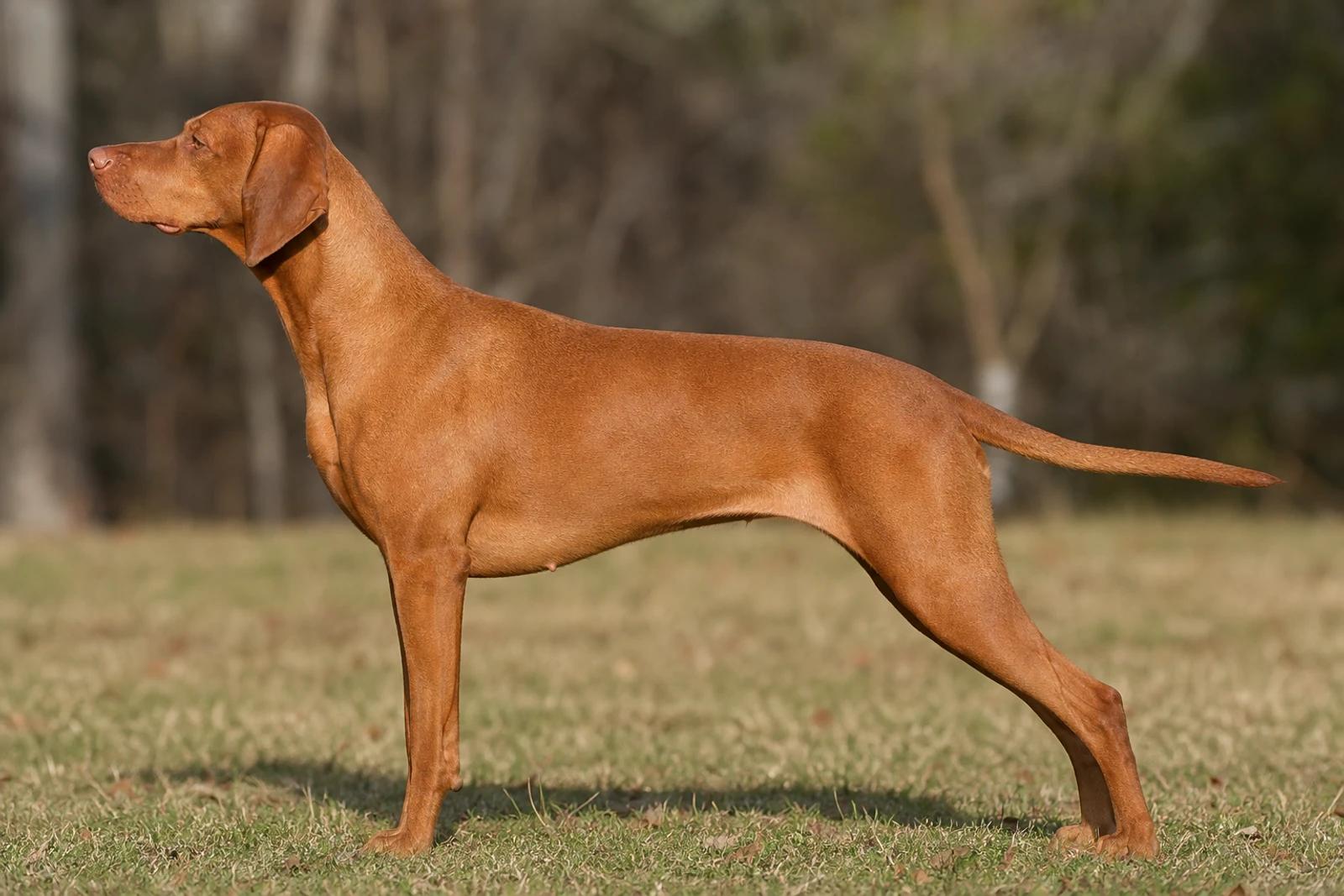
The Vizsla is a versatile, high-energy gundog from Hungary, known for its distinctive golden rust coat and intense devotion to its family. Often called “velcro” dogs, Vizslas form unbreakable bonds with their owners and thrive on constant companionship. They suit active individuals or families who can provide ample daily exercise, mental stimulation, and are often home. With proper training and socialization, they are affectionate, gentle, and great with children and other dogs. Not ideal for novice owners or apartment dwellers, the Vizsla excels in hunting, agility, and as a loyal, ever-present companion.
Family fit
Is the Vizsla a good family dog?
Energetic, affectionate “velcro” dog for active families.
- Children
- Family shortlist
- Energy
- Higher
- First-time owners
- More experience helps
- Grooming
- Lower
Breed tendencies are only a starting point. Supervise children, meet the individual dog, and make sure the exercise, training, grooming, space, and cost fit your household.
Vizsla Sticker Pack
36 cartoon stickers • transparent PNG • no watermark
Pinterest-ready
Share all 36 reactions as one sticker sheet
Pinterest opens with the full pack and a fresh, tailored description. You choose the public board and publish it from your own account.
Save the full pack


Choose one reaction above to share it alone, or use the full-pack button for all 36 together.




































Free full-resolution download — no account, no payment, no watermark.
Includes all 36 transparent PNG stickers in one ZIP. A quick human check is required for each download.
At a glance
- Size
- Large
- Height
- 21–25 in
- Weight
- 44–66 lb
- Life span
- 13–14 years
- Coat colors
- Golden Rust, Red Golden Rust
- Coat type
- Short, smooth, dense
- Group
- Gun
How much does a Vizsla cost?
Adopt / rescue
$75–$400
Usually includes spay/neuter, first shots, and a microchip.
Buy from a breeder
$700–$2,000
From a reputable, health-testing breeder.
Approximate USD. Prices vary widely by region, breeder, pedigree, age, and coat colour — adopting is the lower-cost and recommended route. Avoid suspiciously cheap “breeders”; they’re often puppy mills.
Estimate the full cost of a Vizsla →Want the ongoing number? Estimate the monthly food bill for a Vizsla with our dog food cost calculator.
Vizsla photos
Views
Front, side, rear and top — the full silhouette.Poses
How the breed sits, lies, moves and plays.Puppy to senior
The breed across its whole life.Expressions
The breed’s range of moods.Close-up details
Eyes, ears, nose, paws, tail and coat.Coat colors
The breed’s recognized colors.Click any photo to enlarge. We show the Vizsla from every angle — three views, poses, life stages, expressions, close-ups, coat and colors.
Appearance & size
You see a Vizsla from across a field and the first thing that registers is the color — a solid, glowing golden rust that sits somewhere between a new penny and the last light of a sinking sun. The coat is short, smooth, and dense, lying flat like a second skin. No undercoat to hide behind. You can trace every rib, every muscle fiber, right through it. That’s exactly how it’s supposed to be.
Stand back and you’re looking at a dog built to run, point, and retrieve all day without wasting an ounce of energy. The body is slightly longer than tall, giving it that low, ground-covering stretch. A deep, moderately wide chest reaches down to the elbows, providing room for serious lung power, then sweeps back into a short, tight loin and a distinct tuck-up. From the side, the underline rises sharply behind the ribs — there’s no slab-sided barrel here, just an athletic, calloused grace. The back is short and straight, the tail (often docked to about one-third its length where that’s still practiced, otherwise left long) is carried near horizontal, never curling over the back.
Size stays within a tight window: males stand 22–25 inches at the shoulder and tip the scales at 55–66 pounds; females fall right behind at 21–24 inches and 44–55 pounds. It’s a medium-large, substantial dog, but you’ll never call it heavy. Bone is clean, never coarse. From the front, the legs drop straight and parallel, the shoulders well-laid-back and the elbows tucked neatly against the ribcage. The rear view gives you a strong, well-angulated stance — muscled thighs, strong hocks, and feet that are compact and cat-like.
The head is lean, aristocratic, and free of jowls. You’ll notice a moderate stop between a long, slightly domed skull and a straight, deep muzzle that tapers but never turns pointy or weak. The nose matches the coat in a self-colored brown, and the eyes — amber or a shade lighter — blend right in, with an alert, gentle expression that never looks hard. The ears are thin as silk, set low, and hang in neat, rounded flaps against the cheeks.
You’ll see a little white on the chest or a slash on the toes from time to time — it’s permitted but never preferred. What matters is the whole picture: a sleek, sinewy, not-quite-fragile dog that looks like it could float over rough cover and still have enough fire left to curl up next to you at the end of the day.
History & origin
The Vizsla traces back over a thousand years to the Magyar tribes who settled the Carpathian Basin in what is now Hungary. These early hunters needed a fast, close-working pointing dog that could handle the open plains and still hold its own in dense forest. The sleek rust-colored dogs that accompanied them became the foundation stock, mentioned in written records as early as the 10th century and later illustrated in 14th-century manuscripts.
By the 18th and 19th centuries, the Vizsla was the all-purpose hunting dog of Hungarian nobility. It wasn’t just a pointer — it tracked wounded game, retrieved on land and water, and worked through thick cover alongside falcons and mounted hunters. Hungarian breeders deliberately blended traits from native pointing dogs, the extinct Turkish yellow dog, and later, German Shorthaired Pointers, but held firmly to the distinctive golden-rust coat and the “velcro” temperament we know today.
World War I took a toll, and World War II nearly erased the breed. Soviet occupation and the chaos of the late 1940s left perhaps a dozen Vizslas in Hungary that could be documented as pure. Breed enthusiasts smuggled individuals out of the country, and the breed’s rebound started from that tiny genetic bottleneck. The first Vizsla arrived in the United States in 1950, reportedly with a State Department employee who had been given one as a gift in Austria. The American Kennel Club recognized the breed in 1960.
The Vizsla remains a lean, muscular gun dog built to go all day — weights range from 44 to 66 pounds, with a 13- to 14-year lifespan that’s unusually long for a large breed. That longevity is no accident; responsible breeders have carefully preserved health and working ability without sacrificing structure. Today, you’ll see them excel in field trials, search and rescue, and as family companions who never lose that intense drive to work within arm’s reach.
Temperament & personality
If you’re looking for a dog who keeps a polite distance, the Vizsla is the wrong breed. This is a 44-to-66-pound shadow with rust-colored fur and an unshakable need to be touching you. A Vizsla will follow you from the couch to the kitchen, press a shoulder against your leg while you chop vegetables, and curl itself into a tiny ball on your lap despite being a 22–25-inch-tall hunting dog. The nickname “Velcro dog” isn’t hyperbole — it’s the daily reality.
Energy is the other defining piece. A walk around the block doesn’t even register. This breed needs a solid hour of off-leash running, swimming, or field work every single day, ideally twice a day. Without it, that affectionate shadow turns into a restless, anxious chewer of drywall and sofa cushions. Mental exercise matters just as much: nose work, retrieve games, and trick training give that busy brain something useful to do. A tired Vizsla is a happy Vizsla; a bored Vizsla invents its own jobs, and you won’t like them.
Sensitivity runs deep in this breed. Harsh corrections or an angry tone shut them down fast — you’ll see the head turn away, the lip licks, the yawns that scream anxiety. They work best with calm, clear, and consistent direction, not force. This also means they absorb household stress like a sponge. If your home is chaotic or tense, a Vizsla will reflect it right back in nervous pacing, whining, or even stress-related marking indoors.
With children, they’re gentle and playful when raised together, but their joyous, bounding enthusiasm can accidentally knock over a toddler. Early training to keep four paws on the ground helps. With other dogs, they usually thrive — Vizslas are social creatures — but a strong prey drive toward squirrels, cats, or small fluffies is common. Supervised introductions are non-negotiable.
Watchfulness is moderate. They’ll sound a sharp bark at a strange noise or an unfamiliar car pulling in, but the typical Vizsla follows up with a wagging tail and an invitation to play. Friendliness over ferocity, every time.
The flip side of all that devotion is separation anxiety. Leaving a Vizsla alone for long workdays isn’t just unfair; it often leads to a dog that howls, destroys door frames, or potties indoors from sheer panic. If your lifestyle can’t include this dog at your side for most of the day, a Vizsla will unravel. They’re a 13-to-14-year commitment to being someone’s whole world — and that’s exactly how they like it.
Good with kids, dogs & other pets
A well-socialized Vizsla is famously gentle and patient with children — these dogs don't carry a chip on their shoulder. The real risk has nothing to do with aggression. A 55-pound dog with no sense of personal space can accidentally flatten a toddler during a happy burst of zoomies. Never leave a young child unsupervised with a Vizsla, and teach kids to offer calm, two-handed petting instead of grabbing. This breed hates being isolated; shut a Vizsla in the backyard or leave one alone for eight hours and you'll get a neurotic, destructive shadow. They belong in the middle of the household chaos, often draped across a lap before you can sit down.
Early socialization is what tips the scales between a steady family dog and one that startles at doorbells or cowers around unfamiliar children. The critical window closes hard around 12–16 weeks. Before that, gently introduce your puppy to a rotating cast of calm kids, friendly adult dogs, and the clatter of daily life — vacuum cleaners, skateboards, the works. Skip this and you'll battle timidity or over-the-top excitement later. Even after that window, patient training helps, but the foundation is laid early.
With other dogs, Vizslas read the room well. They were bred to hunt in cooperative packs and tend to defuse tension rather than start it. That said, leashed greetings on a tight sidewalk can short-circuit their social skills; a fenced park or wide-open space gives them room to meet naturally. If you adopt an adult Vizsla who never learned to enjoy strange dogs, respect that boundary. Forcing interactions on a fearful adult backfires and can spark fights, not friendships.
Cats and small pets tap into a different wiring. The Vizsla's pointing instinct doesn't just disappear because you'd like it to. A fleeing cat or a darting hamster can trigger a hardwired chase response, and a larger Vizsla can do real damage in seconds. Some individuals never see the family cat as prey — especially if they grew up together — but that trust doesn't transfer to unfamiliar cats outside. For small pets like rabbits or guinea pigs, assume the dog must be crated or separated whenever you can't actively supervise. Slow, reward-based introductions and a bombproof "leave it" command are your best tools. If the prey drive remains intense despite training, management — separate living spaces — keeps everyone safe and sane.
Trainability & intelligence
A Vizsla doesn’t need a hard hand — she needs a partnership. This is a dog who reads your tone before you finish the sentence, and she’ll shut down fast if you raise your voice or push too hard. Her intelligence isn’t the stubborn, independent sort. It’s wired to please. The catch: that eagerness comes with extra sensitivity, so the training approach you pick either builds trust or breaks it.
What works
- Reward-based training. Treats, a favorite tug toy, or just genuine praise — whatever your dog values most, use it immediately when she gets it right. She makes the connection in a few repetitions.
- Short, upbeat sessions. Two or three 10-minute rounds a day beat one long drill. End on a win.
- Socialization before 16 weeks. Expose her to different people, sounds, surfaces, and calm dogs. It lays the foundation for a confident adult who doesn’t default to fear-based reactivity. Keep those experiences positive; one scary episode can stick with a sensitive dog.
- Consistency from every family member. If one person lets her jump up and another scolds her for it, you’ll get a confused dog who hesitates to offer any behavior at all.
Where people stumble
- Recall around wildlife. A Vizsla’s prey drive is the real deal. She’ll be mid-sprint after a squirrel before you finish saying “come.” Start recall training indoors, then a fenced yard, then a long line in open spaces — and reinforce it every single week, not just in puppy class.
- Punishment backfires. Even a sharp leash pop can erode the bond. A scared Vizsla doesn’t learn faster; she just avoids offering new behaviors or sticks close out of worry, not willingness.
- Separation-driven misbehavior. They’re called Velcro dogs for a reason. Crate training and gradual alone-time from day one aren’t optional — they prevent destroyed door frames and howling that annoys the neighbors.
The upside
When you invest in a relationship-based approach, you get a dog who wants to work with you. That means off-leash reliability on quiet trails, focused attention in a crowded space, and a dog who’s quick to pick up anything from basic cues to advanced nosework. She’ll still test boundaries as an adolescent — expect a phase around 6–18 months where your previously perfect pup “forgets” everything — but patience and the same calm, reward-based structure get you through it.
Exercise & energy needs
If an hour-long ramble around the neighborhood leaves your dog looking at you like, “That was a nice warm-up,” you might have a Vizsla. These 44–66 lb athletes weren’t built to stroll — they were bred to run, point, and retrieve in open fields all day, then turn around and do it again the next morning. Count on at least 60–90 minutes of genuine, heart-pumping exercise every day, broken into two sessions. A single long walk won’t cut it. This is a dog who needs to gallop, swim, or chase a ball until their legs are genuinely tired, not just mentally checked out.
- What “real exercise” looks like: Off-leash trail runs, bikejoring, long hikes, swimming, vigorous fetch, or half an hour of hard field work. A brisk walk on leash is a side dish, not the main course. Because they stick to their people like Velcro, they thrive on activities you do together — think canicross, skijoring, or trail runs where they can match your pace.
- Mental burn: A Vizsla’s brain is just as high-rev as their body. Puzzle toys, hide-and-seek, scentwork, and training sessions that teach new skills all help drain the battery. Boredom manifests fast: chewing, pacing, barking, or frantic shadow-chasing. Pairing physical movement with a job — even a simple “find the toy” game — makes a huge difference.
- Puppies and young dogs: Their joints are still developing until about 18 months, so avoid repetitive pounding on hard surfaces (think marathon fetch on concrete) and forced running on leash. Free, self-paced play on grass or soft trails is your friend. You’re building a lifelong athlete, not trying to win a race this weekend.
- Senior and special needs: At 9 or 10, a healthy Vizsla still wants action, but you may dial back intensity. Swap an hour of hard running for two 30-minute swims or off-leash sniff walks that let them set the pace. Any dog with known hip or elbow issues should stay away from high-impact leaping and stick to low-concussion exercise like swimming.
A tired Vizsla is genuinely pleasant to live with — calm in the house, less likely to bounce off the furniture, and ready to snuggle at the end of the day. Skip their exercise, and you’ll have a velveteen wrecking ball who channels all that pent-up drive into things you don’t want, from shredded couch cushions to reactive whining. Start their day with a solid off-leash sprint or a 3-mile run, then cap it off with an evening hike, swim, or training game, and you’ll both sleep well.
Grooming & coat care
Vizslas are gloriously low-maintenance in the coat department. Their short, sleek, single-layer coat has no insulating undercoat to blow out twice a year — a huge win if you’ve ever lived with a double-coated breed. That doesn’t mean zero shedding, though. Fine, rust-colored hairs will work their way into carpets and car upholstery, so a weekly once-over makes a real difference.
A rubber curry mitt or a hound glove is your best friend here. It grabs loose dead hair, massages the skin, and distributes natural oils that amp up that coppery gleam. Follow up with a few strokes of a boar-bristle brush if you want a show-ring shine, but it’s pure vanity — the mitt alone does the heavy lifting. Skip the slicker or pin brush; the pins can scratch that thin, short coat.
Bathing is a rare occasion. These dogs have a practically wash-and-wear coat. After a muddy run, just hose them down with plain water and towel dry. Only reach for a gentle dog shampoo when there’s a stink that won’t rinse away. Over-soaping strips the skin’s natural protection and can leave the coat dull and flaky.
There’s no trimming needed anywhere — not the tail, not the feathering-free legs, not the tidy ears. The natural outline is the standard.
What you do need to stay on top of: ears, nails, and teeth. Those silky drop ears trap moisture after swimming or a wet hunt, creating a perfect setup for yeast or bacteria. Sniff them once a week and give the outer flap a swipe with a damp cloth. Don’t dig into the canal; just keep it clean and dry. Nails grow surprisingly fast on this high-energy dog, even with miles of pavement running. Check every week and trim as soon as you hear a click-clack on hard floors. Long nails can change their gait and stress toe joints. For teeth, a quick brush a few times a week with dog-safe paste cuts way down on the gum disease Vizslas can be prone to later in life.
Seasonally, you’ll notice a slight uptick in shed hair — usually spring and fall. Just bump that curry mitt session to every other day for a couple of weeks, and you’ll keep the tumbleweeds in check. That’s really the only seasonal adjustment.
A damp cloth, a rubber mitt, and ten minutes a week: that’s about all the grooming overhead you take on with this breed.
Shedding & allergies
Vizslas shed, but their short, single coat makes it a far tidier affair than you’ll get with a double-coated breed. You’ll spot fine, rust-colored hairs on dark clothes and furniture, but you won’t be pulling tumbleweeds out from under the couch. Because they lack an undercoat, there’s no dramatic seasonal blowout — just a steady, light sprinkle of hair year-round that might pick up a touch in spring and fall.
Drool is equally low-key. A Vizsla might leave a small wet spot on your knee while he’s staring down a treat, but you won’t be wiping slobber off walls or changing shirts after a greeting.
No dog is truly hypoallergenic, and the Vizsla is no exception. The breed’s low-shedding, low-dander reputation can make it a better match for some people with mild allergies, but these dogs still produce the proteins in saliva, urine, and skin that trigger reactions. The only reliable test is to spend extended time around adult Vizslas — ideally in a home setting — before you commit to a puppy.
Weekly grooming is simple. A once-over with a rubber curry brush or a hound glove grabs loose hair before it lands on your sofa and cuts down on airborne dander. It’s a five-minute job that keeps the coat sleek and your home noticeably less hairy.
Diet & nutrition
A 55-pound Vizsla that runs hard for an hour every day eats very differently from one whose exercise is a couple of leash walks—so ignore the bag chart and feed the dog in front of you. Most adults stay lean on two measured meals a day. If your Vizsla inhales food in thirty seconds, a slow-feeder or puzzle bowl turns a thirty-second meal into a five-minute thinking game and cuts the risk of bloat or regurgitation.
- Build the bowl: Aim for about 60% raw or cooked muscle and organ meat, 20–30% dog-safe fruits and vegetables, and roughly 10% extras like eggs, plain yogurt, or cooked grains (pearl barley, white rice). Blend or purée the produce—dogs' jaws move only up and down, and they lack salivary amylase, so unlocking those cell walls before meals seriously improves nutrient uptake.
- Puppy rhythm: Four evenly spaced meals until 16 weeks, then three meals until six months, then the adult two-a-day schedule. Transition a new pup gradually with lightly cooked, puréed meats, fish, and veggies, or a high-quality commercial puppy food. Raw chicken wings can be introduced around 12 weeks, with your eyes on every crunch.
- Senior shift: When your Vizsla's daily gallop drops to a casual stroll, shrink portions before the scale climbs. There's no solid case for slashing protein, but smaller, more frequent meals can be gentler on an aging gut. Purée meals for dogs with missing teeth or tender mouths.
The Vizsla's all-in food drive makes obesity a real threat, and even a few extra pounds hammer joints in a breed built for speed and sharp turns. Fat-rich holiday handouts, buttery sides, or a stolen beef trimmings bag can spark pancreatitis terrifyingly fast—lean meats, canned fish in water, cooked eggs, and a batch of plain grains give you safe, quick options. Leftovers that pass the sniff test go into the dog's bowl, never straight from the plate, because a dog who learns that counters and dinner tables pay out is a dog who never unlearns it. Keep meals species-appropriate; a vegetarian or vegan diet deprives a Vizsla of nutrients its whole physiology expects. Bottom line: you should feel ribs easily under a thin fat pad, and if you can't, the food scale—not the puppy eyes—gets the final say.
Health & lifespan
A healthy Vizsla often makes it to 13 or 14 years — a long run for a large, high-energy dog. That longevity doesn’t happen by accident. The breed is generally sturdy, but there are a few conditions you’ll want on your radar from day one.
Inherited conditions responsible breeders screen for
You can sidestep a lot of heartache by choosing a breeder who runs the recommended health tests. Hips are a big one. Vizslas can be prone to hip dysplasia, so breeders should have their dogs evaluated through the OFA or PennHIP. Thyroid function is another — autoimmune thyroiditis shows up in the breed, and undiagnosed low thyroid can cause weight gain, skin problems, and lethargy. Eye exams by a veterinary ophthalmologist check for issues like entropion (inward-rolling lids) or progressive retinal atrophy. Epilepsy also appears in some lines, and while there’s no genetic test for it yet, an honest breeder will talk about any seizure history in the pedigree.
Issues that come with a deep chest and short coat
A Vizsla’s build makes bloat (gastric dilatation-volvulus) a real concern. This is a life-threatening emergency where the stomach twists. Feeding two or three smaller meals instead of one big one, and avoiding hard exercise right after eating, lowers the risk. Their sleek single coat offers zero protection from the cold, so hypothermia can sneak up fast in winter weather. Invest in a good jacket and limit exposure when temps drop.
Allergies and skin trouble
Environmental and food allergies aren’t rare. You might see red paws, ear infections, or itchy skin. Working with your vet on an elimination diet or allergy testing can pinpoint the trigger before it spirals into chronic misery.
Keeping weight in check
A lean Vizsla is a healthy one. These dogs are professional counter-surfers and can pack on pounds if you’re not strict. Excess weight strains joints and raises the odds of arthritis later in life. Keep your 44- to 66-pound athlete well exercised, measure meals, and use training treats sparingly.
Annual bloodwork, heartworm preventatives during mosquito season, and rabies vaccination per local law are all non-negotiable. Pay attention to subtle shifts — a Vizsla who suddenly turns quiet or leaves food in the bowl needs a vet visit, not a wait-and-see approach.
Living environment
A Vizsla doesn’t just appreciate a big, securely fenced yard — it needs one. This is a 44–66 lb athlete bred to hunt all day, and a couple of leisurely leash walks won’t come close to burning that energy. Without room to sprint at full tilt, a Vizsla will redirect that drive into your couch cushions, your drywall, and a barking habit that the neighbors won’t love. Apartment living is a hard no for most. Even a house with a modest yard often falls short; these dogs require daily off-leash running — a solid hour of hard galloping, broken into two sessions if possible — plus mental work like scent games or retrieving drills that match their gun-dog wiring.
A fenced yard isn’t optional, it’s a safety requirement. A Vizsla’s prey drive can override recall in a heartbeat when a squirrel or bird appears, so invisible fences rarely hold them. The yard should be large enough for real speed, not just a patio-sized patch. Climatically, they’re thin-coated and lean, which makes them cold-sensitive. Anything below 40°F often calls for a well-fitted jacket, and they’ll be miserable left outside in winter. Heat is easier to manage, but midday summer pavement can burn their pads. This is an indoor family dog, period — one who will follow you from room to room and whine at a closed bathroom door.
That leads to the real deal-breaker: alone time. Vizslas are famously velcro dogs, and they don’t do “chill while you’re at work” well. Left alone for a full workday, many develop serious separation anxiety — barking, destruction, self-harm. If your household is gone 8–10 hours, this breed will suffer, and you’ll pay for it. They thrive when someone is around most of the day, or at least after the morning run. Gradual desensitization to short absences can help, but expect to invest serious time. Noise-wise, they’ll sound the alarm when bored or anxious, not out of guardiness, but they aren’t silent. A tired Vizsla, though, is a quiet one, curled into your side on the sofa — exactly where they want to be.
Who this breed suits
If your idea of a perfect weekend is a predawn trail run followed by two hours of couch-snuggling, the Vizsla might be your ideal match. These dogs don’t just tolerate an active life—they demand it. At 44–66 lb, they’re lean, fast, and built to cover ground, so they truly click with runners, cyclists, hunters, and anyone who trains for dog sports like agility, rally, or field trials. A Vizsla can keep pace for miles and still have energy left for a play session.
The breed is famously a “Velcro” dog. They want physical contact almost constantly—leaning against your leg, curling up under your desk, sleeping under the covers. That makes them a top choice for singles or families who work from home, have flexible schedules, or can bring the dog along everywhere. Retirees who hike daily and want a constant companion will find a devoted friend; a Vizsla will happily match step for 13–14 years of morning rambles.
Families with older, respectful kids do well. The Vizsla’s bouncy enthusiasm can topple toddlers by accident, so supervise or wait until children are steady on their feet. They also need a soft training hand—this is a sensitive dog that shuts down under harsh corrections and flourishes with positive, consistent guidance. First-timers can succeed if they’re genuinely up for that daily grind and willing to sign up for a training class, but a Vizsla is a rough starter dog for someone who only wants a casual weekend walk.
Think twice if you’re gone 9-to-5. Separation anxiety is a real risk, and a lonely Vizsla will redecorate your house with shredded cushions and howled soundtracks. This isn’t a backyard ornament or a guard dog—they greet strangers with a wagging tail. Apartment living can work only if you’re already logging 90 minutes of hard, off-leash running every day. A bored Vizsla won’t just nap; they’ll dismantle your sofa and eat the drywall. Bring one home only if you’re ready to be their full-time adventure partner, coach, and pillow.
Cost of ownership
A well-bred Vizsla puppy from a responsible breeder who screens for hip dysplasia, eye issues, and thyroid problems typically costs between $1,500 and $3,000. Dogs from field-titled parents or with early socialization programs often land at the higher end. Factor in an additional $300–$600 for the first round of supplies: a crate, martingale collar, long line, and an indestructible chew-toy stash, because this mouthy breed will destroy anything less.
Monthly costs
-
Food: $60–$90
A lean, 50-pound adult eats roughly 3-4 cups of quality kibble daily. Active Vizslas burn through calories, so skimping on nutrition simply means more begging and a less focused dog. Raw or fresh-food plans can push this number past $150. -
Grooming: $10–$30
You won't need pricey clips. Their short, rust-colored coat needs a quick rubber curry once or twice a week and a bath when they roll in something dead. Most owners do this themselves. A professional bath and nail grind every couple of months runs about $40–$60 per visit. -
Vet and prevention: $50–$80
This covers annual exams, vaccinations, heartworm medication, and year-round flea/tick control. As a deep-chested breed, Vizslas are at risk for bloat, so if you choose prophylactic gastropexy during spay/neuter, expect a one-time surgical add-on of $300–$600. -
Pet insurance: $45–$75
Reputable insurers charge more for large, active breeds prone to orthopedic injuries, cancer (particularly mast cell tumors and hemangiosarcoma), and epilepsy. A plan with solid hereditary-condition coverage is smart here, because a single TPLO surgery for a blown knee can hit $4,000.
The numbers that sneak up on you are the lifestyle ones. A bored Vizsla will redecorate your couch, so you'll probably invest in advanced obedience classes ($150–$250 for a six-week session) or a membership at a fully fenced sniff spot. Count on replacing a $20 long line every few months, and never underestimate how fast a 60-pound dog can empty a $12 bag of bully sticks.
Choosing a Vizsla
You have two equally valid paths to a Vizsla: a careful, health-focused breeder or a breed-specific rescue. Both demand homework. A 44- to 66-pound dog built to hunt all day and shadow you the rest of the time can wind up with serious joint, eye, or temperament issues if shortcuts were taken. The goal is a puppy or dog who can hike, run, and snuggle into a 13- or 14-year lifespan without avoidable grief.
Start with the breeder or rescue question
A good breeder doesn’t just hand you a puppy. They ask about your yard, your daily schedule, your experience with high-energy gundogs, and how you plan to exercise a dog that needs a solid off-leash run, not just a couple of walks. Many will have a waitlist. That waiting period is actually a sign they aren’t churning out litters for profit.
If you’d rather skip the puppy stage—and the velociraptor-like mouthiness that comes with Vizsla adolescence—reach out to the Vizsla Club of America’s rescue network or a regional Vizsla rescue. You’ll often find young adults whose families underestimated the breed’s exercise needs. A foster-based rescue knows the dog’s real house manners, prey drive, and whether they can be left alone without shredding a couch. Separation anxiety is common in the breed, so you want that intel up front.
Health clearances that actually matter
Responsible Vizsla breeders test parent dogs and willingly show you the paperwork. The bare minimum isn’t enough. Ask for OFA or PennHIP hip radiographs—Vizslas can be prone to hip dysplasia, and you want to see an OFA rating of Fair or better. Elbow dysplasia is less common but still present; get OFA elbow clearances. Eye exams should be done by a boarded veterinary ophthalmologist annually, not just once, because some inherited eye diseases show up later. Thyroid panels should be within normal range, as hypothyroidism can trigger skin problems and weight gain. Many breeders also screen for von Willebrand’s disease (vWD), a bleeding disorder that pops up in the breed. A DNA test or a vWF factor assay clears that worry.
If a breeder tells you “the line is healthy” but can’t produce actual certificates you can verify on the OFA website, walk away.
Red flags you shouldn’t ignore
- No health clearances or excuses about paperwork.
- Puppies sold before 8 weeks. Vizslas need that extra time with mom and littermates for bite inhibition.
- A breeder who won’t let you meet the mother—and ideally the father—on site. Look for dogs that are friendly, steady, and curious, not shrinking away or snarling.
- Litters raised in a kennel or garage with minimal human handling. A well-bred Vizsla puppy has been underfoot in the house, exposed to vacuum cleaners, doorbells, and kids. If the breeder can’t show you videos of that, it’s a gamble.
- Breeding for trendy traits, like “rare” silver or massive size. Real Vizsla breeders select for temperament, health, and working ability.
- Selling through a pet store, online cart, or “pick your color” website.
- No return clause in the contract. A breeder who won’t take the dog back for any reason, ever, is a warning.
What to look for in a puppy
Visit the whole litter around 6–7 weeks. You aren’t just choosing a puppy; you’re auditing the environment. Watch how the puppies react to a new person. A good Vizsla puppy is curious, wiggly, and will eventually settle in your lap after a little exploration. The boldest pup may be a firecracker you can channel with training; the most timid one cowering in the corner can grow into a fear-responder, and rehabbing that in a sensitive breed takes serious effort. Avoid extremes.
Ask the breeder to show you simple temperament tests—how a puppy recovers from a mild startle, whether they follow a rolling ball or drag a rag toy. You want a pup who engages but isn’t a frantic, nonstop mouther. That balance matters more than a perfect rust-gold coat.
Bring up the parents’ energy levels as adults. Some lines are driven field dogs; others are softer companions that still need tons of running. The breeder should be able to describe which puppies lean more handler-focused or more independent, and match you accordingly.
Going the rescue route
Vizsla rescues commonly see dogs between 1 and 5 years old, often surrendered because they were too much dog for a sedentary household. The advantage is clarity: the rescue can tell you whether the dog is crate-trained, good with cats, or prone to noise phobias. You’ll still need to verify health records and find out if the dog was screened for hip dysplasia, eye issues, or thyroid problems before adoption. Many rescues do that themselves. The transition can take weeks or months, especially if the dog was undersocialized, so plan on a decompression period and being home more than not during that stretch.
Pros & cons
Pros
- A natural-born Velcro dog, a Vizsla bonds intensely with your entire household. This is a dog that will lean on your leg, follow you from room to room, and curl up on the couch the moment you sit down — if you want a constant shadow, you’ve found it.
- They’re versatile, trainable athletes. Bred as close-working gun dogs, they learn quickly and genuinely want to please. That makes them stars in field work, agility, rally, and nose work if you put in the time.
- Their short, sleek single coat is practically wash-and-wear. A quick wipe with a damp cloth handles most dirt, and shedding is moderate and manageable. No clumps of hair on every surface.
- With proper daily exercise, a Vizsla is remarkably calm and gentle indoors. They have an “off switch” that kicks in after a solid run, hike, or vigorous retrieve session — some will sleep draped across you for hours.
- This is a solid, healthy breed overall. Responsible breeders screen for hip dysplasia, epilepsy, and certain eye disorders, but a well-bred Vizsla often lives an active life well into its 13–14 years.
- They’re excellent family dogs for active homes. Patient with respectful kids, up for any adventure, and rarely dog-aggressive when socialized early. Morning jogger, afternoon playmate, evening cuddler — they fill every role.
Cons
- Underestimating their exercise needs will backfire fast. A Vizsla isn’t satisfied with a couple of short leash walks. Expect to provide a full hour or more of hard running, off-leash exploration, or steady retrieving every single day. Without it, you get a restless, destructive, whining mess that chews furniture and claws at doors.
- Separation anxiety is real and intense. They’ve been bred for centuries to work in close partnership with humans, so being left alone for a full workday often triggers panic. Howling, house soiling, and self-harm can result if you don’t plan for crate training, doggy daycare, or a staggered schedule.
- Sensitivity cuts both ways. Yes, they’re biddable, but a harsh tone or impatient correction shuts them down. You can’t “hard train” a Vizsla — you’ll just get a stressed, shut-down dog who avoids you.
- A height of 21–25 inches and a lean 44–66 pounds mean they’re large enough to accidentally knock over a toddler or a frail person during a bout of zoomies. That lanky, wiggly body needs space and a little supervision around very small kids.
- They’re not a dog you can just leave in the backyard with a toy. Mental stimulation is mandatory. Puzzle feeders, hide-and-seek games, and ongoing training sessions are as important as the physical workout — or your shoes and remote controls pay the price.
- That gun-dog instinct doesn’t disappear. Off-leash, a Vizsla’s nose can lead them a half-mile away chasing a scent before you realize they’ve blown off your recall. A solid, reliable recall takes months of consistent work, and even then, tempting wildlife can override it.
Similar breeds & alternatives
If the Vizsla’s whiplash energy and 24/7 people-neediness hit your sweet spot, a German Shorthaired Pointer might be the closest alternative. GSPs bring the same athletic, eager-to-please personality, but they’re a little more independent and often have a stronger prey drive. They’re slightly larger—typically 45 to 70 pounds—and sport a spotted or roan liver-and-white coat that sheds more. You trade the Vizsla’s signature rust-gold sleekness for a sturdier, more rough-and-tumble build and a dog that can self-entertain a bit better.
On the flip side, if you love the Vizsla’s clingy “Velcro” nature and short coat but wish you could dial down the exercise demands, a Rhodesian Ridgeback is worth a look. Ridgebacks often reach 70 to 85 pounds, so they’re a step up in size and strength. They’re still devoted family dogs but with a distinctly more reserved, guarding streak and less frantic daily output. Expect a stubborn streak and a dog that needs a confident owner—these aren’t the lab-like pushovers a Vizsla can be.
The Weimaraner often gets mentioned in the same breath. Both are sleek, short-coated pointing breeds, but the silver-gray ghost tones of a Weim set it apart visually. Weims can tip the scales at 55 to 90 pounds, making them heavier than most Vizslas, and they tend to be more high-strung and vocal. They also lean toward separation anxiety just as hard, so you’re not escaping the shadow-dog habit. The real divider: a Weim often demands a firmer, more experienced hand and can be less forgiving of training gaps than a Vizsla.
For a wire-coated spin, the Wirehaired Vizsla itself is an obvious cousin. Same size and weight range, same pumpkin-seed eyes and nose-into-everything enthusiasm, but a denser, weather-resistant coat that sheds a bit and requires stripping. Their temperament is often described as slightly tougher and more level-headed than the smooth Vizsla, which can be a plus if you hunt in cold, wet cover. Just don’t expect a laid-back house dog—the need for hard, daily off-leash running doesn’t budge.
Fun facts
- The Vizsla is one of the oldest sporting breeds, with origins traced back to the 10th century Magyar tribes in Hungary.
- They are known as 'velcro' dogs because they stick so closely to their owners.
- Vizslas are excellent swimmers and were historically used for retrieving waterfowl.
- The breed almost went extinct after World War I and was revived by dedicated Hungarian breeders.
Frequently asked questions
- Are Vizslas good with children?
- Vizslas tend to be gentle and affectionate with children, making them good family dogs when properly socialized. They are energetic and may accidentally knock over small children during play. Supervision is recommended, especially with young kids.
- How much exercise does a Vizsla need?
- Vizslas are high-energy gun dogs that require at least an hour of vigorous daily exercise. Without sufficient physical and mental stimulation, they can become restless or destructive. Activities like running, hiking, or fetch suit them well.
- Do Vizslas shed a lot?
- Vizslas have a short, smooth coat that sheds moderately throughout the year. Weekly brushing can help manage loose hair, and they are generally considered a low-maintenance grooming breed. They are not heavy shedders compared to many double-coated dogs.
- Can a Vizsla live in an apartment?
- A Vizsla can adapt to apartment living only if given extensive daily exercise and outdoor time. Their velcro nature means they want to be near their people, but their high energy and need for a yard often make a home with space more ideal. Without enough activity, they may develop behavioral issues.
- Is a Vizsla a good choice for first-time dog owners?
- Vizslas are intelligent and eager to please, but their sensitivity and high exercise demands can be challenging for novices. They respond best to positive, consistent training and may become anxious without clear leadership. First-time owners who commit to proper socialization and activity can succeed.
- Do Vizslas bark a lot?
- Vizslas are not excessive barkers by nature, but they can become vocal when bored, anxious, or seeking attention. Proper training and sufficient exercise typically keep nuisance barking to a minimum. Some individuals may bark more than others due to temperament.
Tools & calculators for Vizsla owners
Quick estimates tailored to Vizslas — pre-filled with this breed’s size where it matters.
Articles & stories about the Vizsla
Sources & standards
This profile follows recognized breed standards from the American Kennel Club (AKC) and the Fédération Cynologique Internationale (FCI), along with established veterinary and breed-club guidance. These describe general breed tendencies — every dog is an individual.