

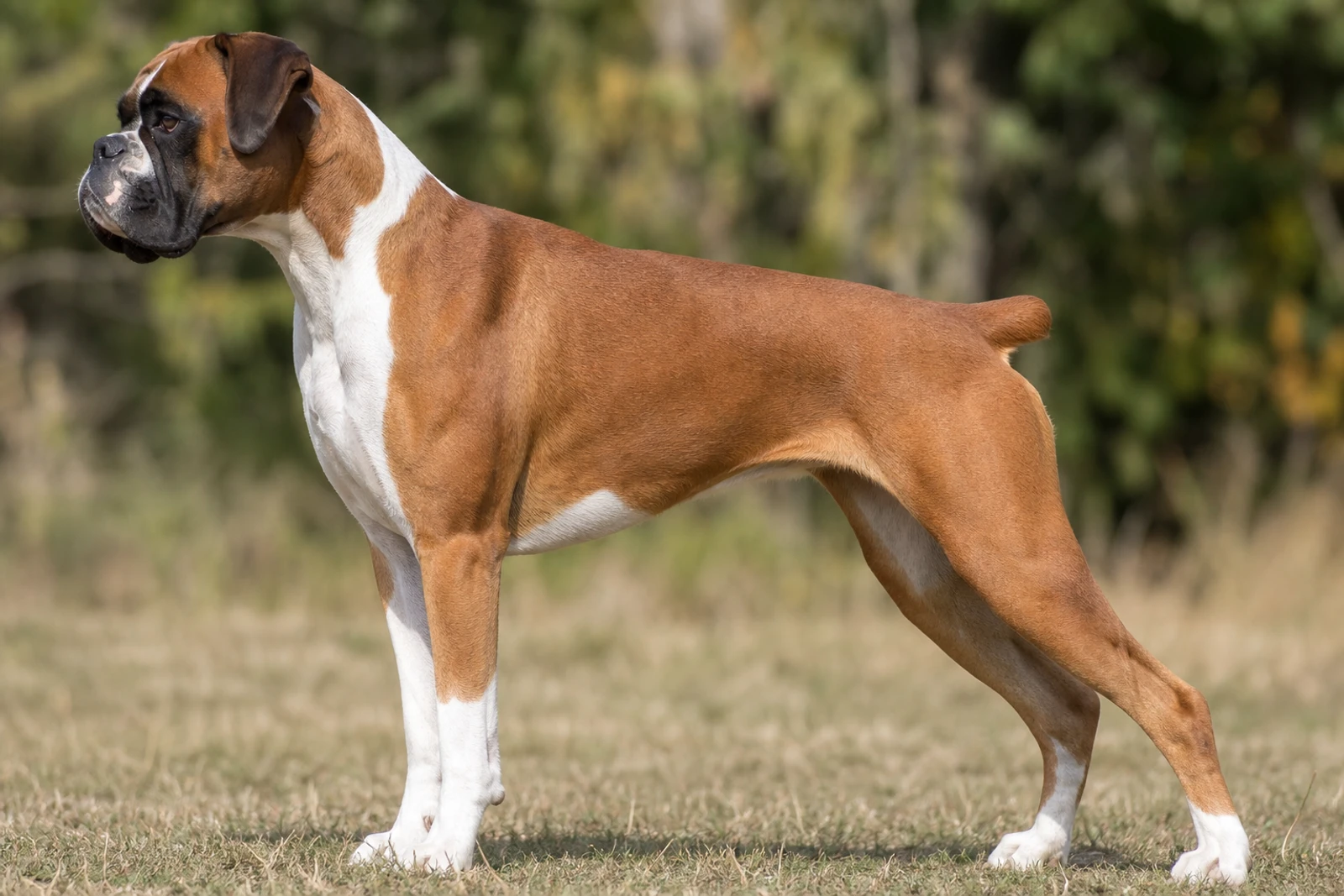
The Boxer is a loyal, playful, and energetic large working breed who thrives in active families. With a muscular build and a clownish personality, they are devoted companions that adore children and make excellent watchdogs. They require consistent training, early socialization, and plenty of daily exercise to channel their exuberance. Their short coat needs minimal grooming, but they shed moderately. Best suited for homes with space to run, Boxers bond deeply with their humans and are happiest when included in family life. Not ideal for sedentary owners or those with small pets.
Family fit
Is the Boxer a good family dog?
An energetic, people-oriented dog for families ready to train and manage a powerful body.
- Children
- Family shortlist
- Energy
- Higher
- First-time owners
- More experience helps
- Grooming
- Lower
Breed tendencies are only a starting point. Supervise children, meet the individual dog, and make sure the exercise, training, grooming, space, and cost fit your household.
Boxer Sticker Pack
36 cartoon stickers • transparent PNG • no watermark
Pinterest-ready
Share all 36 reactions as one sticker sheet
Pinterest opens with the full pack and a fresh, tailored description. You choose the public board and publish it from your own account.
Save the full pack


Choose one reaction above to share it alone, or use the full-pack button for all 36 together.




































Free full-resolution download — no account, no payment, no watermark.
Includes all 36 transparent PNG stickers in one ZIP. A quick human check is required for each download.
At a glance
- Size
- Large
- Height
- 21–25 in
- Weight
- 55–71 lb
- Life span
- 10–14 years
- Coat colors
- Fawn, Brindle
- Coat type
- short, smooth, tight-fitting
- Group
- Working
How much does a Boxer cost?
Adopt / rescue
$75–$400
Usually includes spay/neuter, first shots, and a microchip.
Buy from a breeder
$700–$2,000
From a reputable, health-testing breeder.
Approximate USD. Prices vary widely by region, breeder, pedigree, age, and coat colour — adopting is the lower-cost and recommended route. Avoid suspiciously cheap “breeders”; they’re often puppy mills.
Estimate the full cost of a Boxer →Want the ongoing number? Estimate the monthly food bill for a Boxer with our dog food cost calculator.
Boxer photos
Views
Front, side, rear and top — the full silhouette.Poses
How the breed sits, lies, moves and plays.Puppy to senior
The breed across its whole life.Expressions
The breed’s range of moods.Close-up details
Eyes, ears, nose, paws, tail and coat.Coat colors
The breed’s recognized colors.Click any photo to enlarge. We show the Boxer from every angle — three views, poses, life stages, expressions, close-ups, coat and colors.
Appearance & size
A Boxer is built like a middleweight athlete: square, powerful, and unmistakably balanced. The breed standard calls for a height at the withers roughly equal to the length of the body from the point of the shoulder to the point of the buttock, giving the dog its distinctive silhouette. Males stand 23 to 25 inches tall and weigh 65 to 71 pounds; females range from 21 to 23.5 inches and 55 to 64 pounds. This is a large breed, but the ideal is never clunky or heavy — the Boxer’s muscle is lean and well-defined, wrapped around substantial bone without coarseness.
Coat and color are refreshingly simple. The single coat is short, smooth, and lies tight against the body with a natural sheen. No feathering, no fluff. Colors come in two main patterns: fawn and brindle. Fawn spans a spectrum from light tan to a deep, rich red-mahogany. Brindle overlays a fawn base with dark stripes that can be sparse and distinct or so dense the dog appears nearly black (“reverse brindle”). A black mask is essential — it covers the muzzle and often frames the eyes — and it’s one of the first things you notice. White markings, called “flash,” may appear on the chest, feet, and face; some dogs have a white collar or blaze. While an all-white Boxer can appear in a litter, it’s not part of the breed standard, and responsible breeders don’t select for it because of associated health risks, particularly deafness.
Head and expression are the breed’s signature. The skull is slightly arched, not round, with a distinct stop and a broad, blunt muzzle. The lower jaw is undershot — the lower incisors protrude in front of the upper teeth — and the chin is strong. When the dog is alert, the skin on the forehead wrinkles deeply, giving that trademark quizzical, watchful look. Eyes are medium-sized and dark brown, set for forward-facing focus. Ears may be left natural or surgically cropped where legal. Natural ears are set high, medium in size, and fold forward close to the cheeks, while cropped ears stand erect and sharpen the silhouette.
From the front, a Boxer shows a deep, wide chest and straight, parallel forelegs with tight elbows. The shoulder blades are long and sloping, melting into a well-muscled neck that’s clean without loose dewlap. From the side, the body is compact: a short, straight back, a deep brisket reaching to the elbows, and a noticeable tuck-up at the waist. The hindquarters are strong and angulated, with a long, broad thigh and a well-bent stifle. From the rear, the legs are straight and the hocks are short and parallel — never cow-hocked or bowed. The tail, whether natural or docked, is set high; a natural tail is moderately long and carried upward in a slight curve, but not curled over the back. The whole picture is one of spring-loaded power without wasted bulk, ready to move the instant the situation calls for it.
History & origin
The Boxer you see grinning at the park today is a direct descendant of a line of powerful German grip dogs, built to take on animals much bigger than they were. The breed got its start in the late 1800s, but its roots reach back to the now-extinct Bullenbeisser — a mastiff-type dog that specialized in holding large game like boar, bear, and deer until the hunter could arrive. When bull-baiting was banned across Germany, these dogs lost their main job, and hunters began breeding for a more agile, versatile version.
Around 1895, a Munich dog fixer named Georg Alt brought things into focus. He paired a brindle female Bullenbeisser named Flora with a local dog of unknown ancestry, and one of the pups from that litter became the foundation for the modern Boxer. Alt and others then folded in some English Bulldog to shorten the skull, amplify the natural underbite, and lock in the white chest and feet most Boxers still wear today. The result wasn't just a catch dog — they'd created a breed with quick reflexes, a steady nerve, and an almost theatrical playfulness that owners now know well.
The name “Boxer” likely comes from the breed’s habit of using its front paws with a distinctive, batting motion — whether sparring with other dogs or getting your attention. The first Boxer Club of Munich was established in 1895, and the first breed standard was written in 1902 (then revised in 1904). When World War I broke out, the military took notice. Boxers served as messenger dogs, pack carriers, and guard dogs, earning a reputation for gritty reliability under fire. American soldiers brought the breed back with them, and the AKC registered its first Boxer in 1904. By the 1940s and ’50s, the Boxer had become a fixture in American homes — not as a working hunter or war dog, but as a family guardian with a streak of clownish energy that makes it hard to imagine its boar-hunting ancestors. That working grit is still in there, though, and every Boxer owner sees it the moment a squirrel crosses the yard.
Temperament & personality
You’ll get a dog who acts like a 60-pound puppy for most of its life. Boxers bring an almost ridiculous level of enthusiasm to everyday moments—mealtime, a returning family member, the sight of a leash. That joy doesn’t switch off at maturity. The clowning, the full-body wiggles, the famous “kidney bean” curl (spine bent into a semicircle while that stubby tail whips back and forth) are all part of the package.
Energy and your daily life
This is a Working breed with real stamina. Plan on a solid hour of running, wrestling, or off-leash play, not a couple of strolls around the block. When that need isn’t met, the same drive shows up as chewing, barking, or excavating your sofa cushions. A bored Boxer left alone too long often develops anxiety-driven habits that are loud and expensive. They do best with people who are home for stretches of the day and who genuinely enjoy rough-and-tumble interaction.
Loyalty and affection
Boxers tighten their orbit around the family. They’ll shadow you from room to room, lean their whole weight against your legs, and assume they’re lap-sized despite packing 55–71 lb of muscle. With kids, they tend to be patient and tuned-in, though you should never leave any dog unsupervised with small children. The flip side: that bond can tip into clinginess. Novice owners sometimes misread it as calm cuddliness, but it’s more like a velvet-covered neediness. If everyone works long hours, this isn’t the right fit.
Watchdog radar and “stranger danger”
They notice everything. A strange car in the driveway, a delivery person, a neighbor three houses down moving a trash can—all get announced. Most Boxers are more alert-barker than biter, but you have to read the whole body. A loose, waggly posture and soft eyes mean they’re just filing a report. A stiff stance with a direct stare warrants immediate attention. Socialize them early so the line between “something’s off” and “someone new” stays clear.
Quirks to know
- They talk back. Not nuisance barking but a repertoire of snorts, “woo-woo” rumbles, and dramatic sighs when things aren’t going their way.
- They use their paws like hands. Expect to be batted for attention, and keep breakables out of swatting range.
- Chewing is a lifelong hobby. Puppies gnaw to explore and soothe teething gums; adults keep at it to exercise their jaws and clean teeth. Give them indestructible-grade toys, or they’ll invent their own. A citrus or vinegar spray on furniture helps, but the real fix is a tired dog with something legitimate to shred.
- Stubborn streak. They’re bright but strong-willed. They learn fast and ignore commands just as fast if you rely on repetition over creativity. Respectful consistency works; heavy-handed corrections backfire.
Household rhythms
Boxers mark their world by scent—your scent, the kitchen’s scent, the usual walking route. That’s why they might have an accident in a rarely used guest room that doesn’t smell like “home.” Speed up house training by rewarding outdoor elimination with an immediate treat, and clean indoor mistakes with an enzymatic cleaner that destroys the odor, not just masks it. Never disturb a Boxer while it’s eating, and teach children to leave the dog in peace during meals; a startled dog can develop food guarding that’s hard to undo. When they get the structure they need, they’re incredibly clean and predictable in the house.
You end up with a dog who’s relentlessly funny, protective without being snappy, and so expressive you’ll find yourself having entire conversations with them. Just know they’ll demand every bit of that energy right back.
Good with kids, dogs & other pets
Boxers carry a quiet reputation as one of the staunchest family dogs around. With young children they tend to be patient, playful, and protective without any hair-trigger edge. A well-socialized Boxer will tolerate endless dress-up sessions, noisy playdates, and the occasional ear tug — more likely to lick the offender than snap. But don’t mistake that gentle nature for bulletproof steadiness. A happy Boxer expresses joy with a full-body wiggle that can mow down a toddler like a bowling pin. At 55–71 pounds and 21–25 inches tall, these are solid, enthusiastic dogs. Close supervision around little ones is non-negotiable, especially during zoomies or doorbell chaos.
Other dogs
Boxers are social by nature and usually enjoy the company of other dogs, but early and ongoing exposure makes all the difference. The prime socialization window slams shut around 12–16 weeks; puppies need gradual, positive introductions to people, sounds, surfaces, and a wide variety of calm, friendly dogs before that clock runs out. Skip this and you can wind up with an adult who is overly excitable, fear-reactive, or just clueless about canine body language. Even a well-bred Boxer plays with a thudding, boxer-gloved style that some dogs find rude, so pick playmates thoughtfully and intervene when energy spikes.
Cats and small pets
With cats and pocket pets, a Boxer’s success depends heavily on upbringing. The breed’s working heritage gives many individuals a sharp interest in movement — squirrels, cats zigzagging down the hall, free-range rabbits — but it isn’t a fixed mandate. Puppies raised with a cat from the start, with careful management and zero chance for chase games to become habit, often learn to coexist peacefully. Still, never leave them alone together until you’ve seen months of calm, disinterested behavior. A Boxer who meets a cat for the first time as an adult needs slow, counter-conditioned introductions; forcing the issue almost always backfires.
A Boxer is a high-companionship dog that genuinely needs to live inside with the family. Left alone for long stretches or shut in a yard, they can develop distress behaviors that spill into all their interactions, including with kids and other animals. When someone is usually home and willing to put in the early social reps, this breed slots into a busy household like it was always meant to be there.
Trainability & intelligence
A brain that wants to work — on its own terms
Boxers are quick studies. They’ll nail “sit” in a handful of reps, often before you’ve even opened the treat pouch. But they’re also clever enough to know exactly when you’re distracted and when they can get away with blowing you off. That isn’t stubbornness for the sake of it — it’s a working breed who needs a reason to care. Give him one. Turn training into a game of chase-the-treat, a session of tug, or a chance to show off for a visitor. Positive, relationship-based methods — immediate praise, a squeaky toy, a tiny cube of cheese — wire his brain to repeat whatever earns the reward. Harsh corrections shut a Boxer down and can make him hand-shy or anxious, so skip the old-school intimidation entirely.
The stubborn streak is real
A 55–71 lb dog who decides the squirrel in the yard is more interesting than your “come” call becomes a safety problem fast. Recall is the skill that demands the most work, and it won’t magically improve with age. Start puppy recall indoors with zero distractions, then move to a fenced area, then a long line outdoors. Use high-value currency — freeze-dried liver, a ball he lives for — and never call him to you just to end the fun. Pair the word with something wonderful at least 80% of the time. Even then, expect adolescent setbacks. Around 7–10 months, your Boxer will suddenly “forget” everything he knew. Stay patient, stay consistent, and go back to basics without frustration.
What works, week after week
- Socialize early and often. Between 3 and 14 weeks, introduce your puppy to people of all ages, novel sounds, different walking surfaces, and friendly vaccinated dogs. A well-socialized Boxer is far less likely to greet guests with a frantic body slam.
- Keep sessions short and silly. Five- to ten-minute bursts, two or three times a day, beat a grumpy half-hour drill every time. Always end on a win, even if it’s just a fast “touch.”
- Reward calmness deliberately. Boxers are high-energy comedians, so teaching a rock-solid “settle” on a mat is a lifesaver. Click and treat any moment of four-on-the-floor or quiet resting.
Training a Boxer is a long conversation, not a boot camp. Build trust, be predictably fair, and you’ll end up with an athletic, clownish partner who listens — most of the time — and still makes you laugh every day.
Exercise & energy needs
Plan on a genuine daily workout, not just a walk around the block. A healthy adult Boxer needs 60 to 90 minutes of hard-hitting exercise, reliably split across at least two sessions. One long slog in the afternoon heat does this breed no favors. Their flat face makes them terrible at cooling down, so your job is to front-load activity into early morning or late evening and keep sessions brisk but never punishing.
Think high-intensity play that leans into what they were built for. A 25-minute off-leash sprint with sharp turns, a flirt pole that has them leaping and spinning, a tug session that leaves your arms sore, or a rousing game of fetch where they flat-out run — these burn the kind of energy a Boxer carries. Short, repeated bursts work better than a steady jog for miles. If you do run together, wait until the dog’s growth plates close (closer to 18 months) and stick to soft surfaces.
Physical work alone won’t do it. This is a thinking dog who thrives on interaction. Mental exercise is non-negotiable. Five minutes of focused obedience training, a puzzle toy stuffed with their breakfast, or a 10-minute scent game in the yard will leave them genuinely satisfied. A Boxer left with only a walk will manufacture his own entertainment — usually by pulling everything off your counters or redesigning your couch cushions.
- Good activities: Flirt pole, structured fetch, tug with rules, agility foundation stuff, nose work, rally, trick training.
- Watch the heat: Over 80°F, cut sessions way down. Boxers can overheat in minutes and won’t stop themselves. Keep water and shade close.
- Puppy precautions: No forced running on pavement or repetitive jumping until joints mature. Swimming (supervised, with a life vest) is a safer burn for a young dog.
If you can’t give a Boxer this kind of daily, two-part release, the excess energy will leak out as relentless pawing, barking, or destructive chewing that’ll make you rethink your choices. Meet the need, and you get the clown, not the chaos.
Grooming & coat care
Boxers wear a coat that’s about as low-maintenance as it gets — a short, smooth, single layer that lies flat. That doesn’t mean you can skip grooming entirely, but your primary tool is a soft bristle brush or a rubber curry mitt, not a detangling rake. Once or twice a week, give your dog a quick once-over. This pulls out dead hair, spreads natural skin oils, and leaves the coat gleaming. A hound glove works wonders during seasonal sheds in spring and fall, when you’ll want to step it up to two or three short sessions a week to keep loose fur off the furniture.
Bathing is an occasional affair. Boxers tend to stay fairly clean, and over-washing strips the oils that give their coat that healthy sheen. Aim for a proper bath every two to three months, or when your dog rolls in something truly memorable. Use a gentle dog shampoo; their skin can be sensitive. Between baths, a wipe-down with a damp cloth usually handles dusty paws and light dirt.
Those expressive, floppy ears need regular air to avoid trouble. Check them weekly for wax buildup, redness, or any funky smell. A cotton ball with a vet-approved ear cleaner keeps things dry and clean — never poke anything deep into the ear canal. Nails grow fast on an active Boxer, so a trim every three to four weeks is the norm. If you hear clicking on hard floors, you’re overdue. Teeth benefit from brushing several times a week with dog-formulated paste, because plaque doesn’t care about a good smile.
Grooming is also your built-in health scan. As you brush or rub your Boxer down, pay attention to any new bumps, rashes, or tender spots. Boxers can be prone to skin lumps and sensitivities, so that weekly once-over with your hands is as much a wellness check as a coat polish.
Shedding & allergies
Boxers shed steadily, and it catches a lot of first-time owners off guard. That sleek, short coat is dense, and the individual hairs are stiff and pointy — they weave into upholstery and carpet instead of floating away. Expect to find fawn or brindle glitter on dark pants, couch cushions, and car seats every single week, no matter how often you vacuum.
Seasonal blowouts
Twice a year, usually spring and fall, the shedding ramps up hard. You’ll pull handfuls of hair out during a brisk rubdown. A 10-minute session with a rubber curry brush or hound glove a few times a week makes a real dent, but you won’t stop it entirely. If you hate the idea of hair as a condiment, the Boxer isn’t your dog.
Drool adds to the mess
This is a breed that can drool with enthusiasm. Many Boxers leave long, elastic strings after drinking, after a treat, or when they’re watching you eat a sandwich. The cheeks and jowls trap saliva, so you’ll wipe walls, floors, and sometimes your own clothing. If you’re squeamish about slobber, this is a bigger daily hassle than the shedding.
The hypoallergenic myth
No dog is truly hypoallergenic, and the Boxer sits firmly on the wrong side of the line for allergy sufferers. The short coat sheds dander continuously, and the drool spreads additional proteins that trigger reactions. Someone with moderate dog allergies will likely struggle in a Boxer household, even with meticulous cleaning. Spend time around adult Boxers — not just a clean puppy — before committing, because this is a dealbreaker you want to catch early.
Diet & nutrition
Boxers live for mealtime. That enthusiasm can easily tip into overeating, so how you feed matters just as much as what’s in the bowl. An adult Boxer should stay lean — you’ll never see a healthy one carrying extra pounds — because excess weight puts dangerous stress on the hips and heart, and this breed is already prone to hip dysplasia and cardiomyopathy. For a 55-to-71-pound dog with real muscle, that means measuring every scoop and dialing portions to match actual exercise, not wishful thinking.
Puppy feeding schedule – From weaning to four months, split the daily ration into four evenly spaced meals. At four months, drop to three meals until six months, then move to two meals a day for life. Transition any new food gradually over a week — start with lightly cooked, puréed meats and soft veggies, or a high-quality large-breed puppy kibble that won’t push too-fast growth. Around twelve weeks you can let them gnaw on a raw chicken wing under supervision, but never cooked bones.
Weight management – Boxers are world-class beggars, so set a hard rule: food goes in their bowl, never from the table. If they gulp meals in seconds, use a food puzzle bowl or scatter kibble in a snuffle mat — slow eating reduces choking risk and may lower the chance of bloat in this deep-chested breed. Adjust portions the moment you notice ribs disappearing under a layer of padding. For seniors whose metabolism slows, cut food back by small amounts and watch the scale; there’s no need to slash protein, just fat and total calories. Extra weight is especially hard on aging joints, so keep them on the light side.
What goes in the bowl – A biologically appropriate diet leans heavy on meat. If you home-prepare, target roughly 60% raw or cooked meat, 20–30% dog-safe fruits and vegetables, and the rest from eggs, plain yogurt, or oatmeal-like grains such as pearl barley. Blend or process plant matter — dogs get more out of veggies this way because their jaws don’t grind and they lack salivary enzymes to start carb breakdown. For sensitive stomachs, a bland base of white rice and boiled chicken can settle things. Canned sardines in water (no salt added) and cooked eggs are fast, wallet-friendly additions. Never feed a rich, fatty holiday plate — it can trigger pancreatitis faster than you can say “they only had a little.”
A note on bloat – Boxers have deep chests, which puts them at real risk for gastric dilatation-volvulus (GDV). Split total daily food into at least two meals, preferably more, and avoid vigorous exercise for a full hour before and after eating. Fast eaters especially benefit from puzzle bowls, hand-feeding, or spreading kibble on a baking sheet. If your dog wolfs down food like it owes them money, it’s time to slow the roll.
Health & lifespan
Boxers typically live 10 to 14 years, and that window often comes down to everyday management — weight, heat safety, and catching problems before they snowball.
What your Boxer is up against
A few health issues show up often enough that every owner needs to know them:
- Brachycephalic risks: That pushed-in face limits airflow. Boxers overheat with frightening speed and struggle in humidity. The fix is low-tech but non-negotiable: air conditioning on hot days, walks only in the coolest parts of the morning or evening, and a hard rule against midday sun.
- Heart disease: Boxer cardiomyopathy and aortic stenosis aren’t rare. A dog that faints, tires out suddenly, or just seems “off” during normal play might be dealing with an irregular rhythm. Responsible breeders screen parents with echocardiograms and 24-hour Holter monitors, and they’ll hand you those records without hesitation.
- Cancer: Mast cell tumors and lymphoma are the most common. There’s no single screening test, so your hands become your first line of defense. A weekly once-over — checking for new lumps along the ribs, behind the ears, inside the mouth, between toes — catches changes early.
- Hip dysplasia and hypothyroidism both appear in the breed, as do stubborn skin allergies. If you notice constant licking, paw-chewing, or recurring ear infections, food or environmental triggers are the prime suspects.
Reputable breeders run OFA or PennHIP evaluations on hips, thyroid panels, and cardiac clearances. No clearance guarantees a perfectly healthy dog, but it shifts the odds in your favor.
Weight is everything
A lean Boxer is the only kind that’s healthy. At 55–71 pounds, even an extra 5 pounds stresses the heart and hips. These dogs are powerful, food-driven, and will happily convince you they’re starving. Don’t free-feed. Ask your vet for a precise daily calorie target, and use your hands: you should feel the ribs with light pressure, not have to dig through a layer of padding.
Prevention that actually pays off
- Rabies vaccine is legally required, and it has no cure once symptoms start. No room to skip.
- Heartworm prevention given monthly during mosquito season (and one month after it ends) protects a big, active heart from damage that’s far harder to fix than to prevent.
- Annual wellness exams — twice yearly once your Boxer turns senior — let your vet catch murmurs, thyroid dips, or suspicious skin tags before they become emergencies.
Small changes that signal trouble
A Boxer who normally demolishes dinner but suddenly walks away, or one that lags behind on a familiar route, isn’t being stubborn or lazy. Subtle shifts in energy, appetite, or breathing belong on your vet’s radar immediately. Earliest detection almost always means simpler, cheaper treatment.
Keep your Boxer lean, cool, and checked — and you stack the deck for every one of those 10 to 14 years.
Living environment
A Boxer is a devoted indoor dog first and a yard athlete second. This is a large (55–71 pounds), exuberant breed that wants to be underfoot—and on the couch—with you, not exiled to the backyard. That said, living with one in an apartment takes honest effort. They are not naturally quiet. Along with alert barking, you’ll deal with legendary snoring, snorting, and the occasional woo-woo serenade, which can test thin walls and patient neighbors. A house with a securely fenced yard lets them safely burn off a zoomie burst, but the fence needs to be at least six feet and dig-proof; a bored Boxer with a squirrel on the radar can clear or tunnel under a flimsy barrier in seconds.
Climate matters a lot. That pushed-in face makes them terrible at cooling themselves. Heat and humidity can turn dangerous fast. On an 80°F day, restrict outdoor time to early morning or late evening, keep sessions short, and never skip the air conditioning. In cold weather, their short coat offers little protection, so a jacket makes sense when temperatures drop below freezing.
The elephant in the room is being left alone. Boxers are hardwired to be with their people and can spiral into real separation anxiety if routinely abandoned for a standard workday. You’ll come home to chewed doorframes, drool-covered windows, or worse. They do best in homes where someone is around much of the time or where a dog walker breaks up long stretches. Crate training, food-stuffed puzzle toys, and gradual desensitization help, but this breed is a poor fit for a household that’s gone nine-to-five, five days a week. Mental work—short, upbeat training reps and scent games—takes the edge off their energy just as much as physical exercise, which should total at least an hour a day split into multiple sessions to avoid overexertion.
Who this breed suits
Boxers are not casual dogs. They thrive with an owner who treats vigorous daily exercise as non-negotiable—someone who genuinely looks forward to a solid hour of running, hiking, or focused fetch, not a quick loop around the block. Without it, that 55–71 lb body and whip-smart brain will redirect into redecorating your couch or digging escape tunnels. They’re a commitment to an active, shared lifestyle.
Active families with school-age kids hit the sweet spot. A Boxer’s goofy, protective nature pairs perfectly with a household that’s always up for backyard sprints and wrestling matches. The breed is famously patient with children, but their enthusiasm comes in a muscular, 21–25 inch frame. A hip-check during a game of chase can easily topple a toddler. Sturdy kids who can stand their ground and a fenced yard for full-speed zoomies are ideal. They usually get along with other dogs or cats raised alongside them, but same-sex aggression—especially between females—can surface, so multi-pet homes need an experienced manager.
Singles or couples who want a shadow will find their match. A Boxer bonds intensely and will follow you to the bathroom, snore beside your desk, and lean against your legs at every stop. That loyalty makes them excellent jogging partners and deterrents, but it also means isolation hits hard. Separation anxiety is a real risk if you work long hours. A dog walker, doggy daycare, or a mostly remote schedule isn’t a perk—it’s the price of admission. Apartment living can work if the daily exercise happens outside, but you’ll still share your space with a champion drooler who has no concept of personal space.
First-time owners can absolutely raise a great Boxer, but they need to be eager students. The breed is smart and trainable, yet physically powerful and slow to leave adolescence behind—expect a goofy, bullheaded streak until at least age 3. Enroll in a positive-reinforcement class the week the puppy comes home. A casual, inconsistent approach will yield a 70-lb dog that swipes food off counters and greets guests with a flying headbutt.
Seniors or more laid-back owners should pause. A Boxer’s full-body greetings and relentless energy don’t taper off until well into their senior years. An active retiree who still runs 5Ks or hikes daily might be a perfect fit, but anyone with balance issues or a preference for quiet routines risks a door-knocker takedown every time the delivery arrives.
Think twice if:
- A dog that snoozes after two 15-minute walks sounds ideal. Boxers need to run hard and think hard daily.
- You have frail family members or very young children in the home full-time.
- You’re away 9+ hours without the ability to arrange a midday break.
- A spotless house is a priority. Boxers sling drool, shed, and can go through a remote-control chewing phase.
- You’re not prepared for potential health costs. The breed is predisposed to cancers like lymphoma, heart disease, and hip issues. That 10–14 year life span can include steep vet bills, and responsible breeders screen for what they can, but the risk stays real.
Cost of ownership
A responsibly bred Boxer puppy from health-screened parents typically costs $1,800 to $3,000, with show- or performance-line pups running higher. If you go through a breed-specific rescue, the adoption fee usually falls between $200 and $500 — and the dog often comes spayed or neutered and vetted.
The monthly nut is where you need to be clear-eyed. A 60–70 lb Boxer eats a lot to fuel all that goofy athleticism: count on 3–4 cups of high-quality kibble a day, which pencils out to $70–$100 a month. Treats, dental chews, or the occasional raw topper add another $10–$20. Because Boxers are lean, high-energy dogs, skimping on food quality shows up fast in coat and muscle tone.
Grooming is the easy win. Their short, tight coat needs little more than a weekly rubber curry brush and a bath when they find something stinky. If you pay for nail trims and a rare professional bath, plan on $20–$40 every 4 to 6 weeks. You'll spend more on a decent vacuum for all the shedding.
Veterinary costs are the real budget buster. A standard year of checkups, vaccines, heartworm, and flea/tick prevention runs $400–$700, or roughly $35–$60 monthly. But Boxers sit near the top of the insurance risk charts: the breed is prone to dilated cardiomyopathy, certain cancers, hip dysplasia, and bloat. A single emergency surgery or cardiac workup can run thousands. Because of that, pet insurance for a Boxer usually costs $60–$110 a month, and a solid emergency fund is just as critical.
Don't forget startup and training costs. A puppy class or basic obedience course ranges $150–$250, and it's non-negotiable for a breed this strong and exuberant. Sturdy chew toys, a crate, a decent harness that won't chafe, and a martingale collar will set you back $200–$400 in the first year. All in, expect the first year of Boxer ownership (purchase price, gear, training, spay/neuter, and routine vet care) to land between $4,000 and $5,500, with a normal adult dog month running $200–$350 before any surprise illness. The ongoing cost isn't the kibble — it's staying ahead of the breed's health curve.
Choosing a Boxer
You’ve got two realistic ways to bring a Boxer home: find a breeder who relentlessly screens for the stuff this breed actually struggles with, or go through a Boxer-specific rescue that knows its dogs’ personalities inside and out. Both can work if you don’t cut corners on the paperwork.
Health clearances you must see
Ask for documentation, not promises. A responsible breeder will show you OFA results for hips and elbows (look for “fair” or better), plus a cardiac evaluation from a veterinary cardiologist—not just a regular vet with a stethoscope. Boxers are prone to arrhythmogenic right ventricular cardiomyopathy and aortic stenosis, so you want a 24-hour Holter monitor report or a recent echocardiogram on both parents. Thyroid panels and a DNA test for degenerative myelopathy are standard extras. If a breeder shrugs and says their lines are “healthy,” you leave. No copies of the clearances, no puppy.
Red flags that send you walking
A breeder who doesn’t grill you about your lifestyle, yard, and experience is a breeder who isn’t trying to match puppies carefully. Other danger signs: multiple litters available at once, a website with a shopping-cart button, puppies advertised under 8 weeks old, or someone who insists a natural ear look is “ruining the breed.” A good breeder will often dock tails and crop ears per the standard, but they won’t push you into it or refuse to sell you an undocked, uncropped pup. Dirty kennels, refusal to let you meet the mother, or shipping a puppy to you sight-unseen are deal-breakers.
Picking your puppy
You’re not just picking cuteness—you’re picking a family member with a decade-plus lifespan. Spend time watching the litter together. You want the pup that breaks away to investigate you, not the one cowering behind the whelping box or the bully flattening its siblings. Meet the dam. A fearful, snappy mother often passes those nerves down, and with a 55–71 lb. dog, that’s a liability. Ask the breeder which pup fits a household with your activity level. A good breeder has been watching them for weeks and can steer you toward the calmer one or the one that’ll need a solid hour of daily running, not just leash walks.
The rescue route
Boxer rescues are full of dogs relinquished because the original owner underestimated the breed’s velcro-dog intensity and exercise needs. That’s your gain—you get an adult whose energy level, house-training status, and quirks are already known. Many rescues do a foster-to-adopt trial, so you can see how the dog actually handles your staircase, your cat, or your kids’ noise before you commit. A good rescue will also screen for heart issues and arthritis in older dogs. The same health red flags apply: a rescue that can’t explain the dog’s known medical history or rushes you into adopting isn’t looking out for you or the dog.
Pros & cons
Pros
- An unapologetic goofball — Boxers earn their “Peter Pan” reputation with a 3+ year puppyhood full of bounce, clumsy flops, and wiggly full-body hellos that keep a household laughing.
- Genuinely devoted to their people: properly socialized Boxers are famously gentle and patient with children they know, becoming a tireless playmate who matches a kid’s energy and then crashes on the couch right alongside them.
- A natural deterrent that rarely needs backup. Their big bark, muscled frame, and alert stare make a strong first impression on strangers, but the default is pure clown with invited guests.
- Short, low-maintenance coat — weekly brushing or a quick wipe-down handles the modest shedding, and the sleek, tight fur stays surprisingly clean between baths.
Cons
- Exercise is a daily bill, not a suggestion. A 55–71 lb powerhouse needs a solid hour of running, chasing, or focused training; a leashed stroll around the block does not cut it, and a bored Boxer will redecorate your home.
- Brachycephalic anatomy packs real limits: they overheat quickly, snort and snore, and can go from playful to dangerously winded on a warm, humid day. Swimming is off the table for many.
- Health worries cast a shadow. Responsible breeders screen for hip dysplasia, heart defects, and thyroid issues, but cancers — lymphoma, mast cell tumors, brain tumors — and dilated cardiomyopathy linger in the gene pool, making longevity a bit of a gamble even with a 10–14 year baseline.
- Stubbornness meets sensitivity. A Boxer is clever enough to outmaneuver a half-hearted owner and soft enough to check out under harsh corrections; consistent, reward-based training is non-negotiable.
- Drool, doggy gas, and an ambitious counter-surfing habit come standard. If kitchen counters are sacred or impromptu face licks aren’t your style, this breed will push every button.
Similar breeds & alternatives
If the Boxer’s boisterous affection and watchful streak pull you in, a few other breeds shift the balance in different directions—sometimes less bounce, sometimes more serious guarding, sometimes a smaller package.
Doberman Pinscher
You get a similarly sized, sleek protector (24–28 inches, 60–100 pounds) but with a more serious, handler-focused mind. Dobes are typically easier to train for off-leash precision and bite work, but they lack the Boxer’s long puppyhood and goofy, wiggly greetings. Coats are short and low-shedding, but the breed is brachycephalic-free—a plus if respiratory issues worry you. Expect a higher demand for mental exercise; a bored Doberman unravels fast. Lifespan runs 10–12 years, and responsible breeders screen for dilated cardiomyopathy and von Willebrand’s disease.
Bullmastiff
Think of a Boxer on sedatives with an extra 50 pounds. Bullmastiffs (100–130 pounds; 24–27 inches) retain the guardian instinct and short muzzle but throttle way back on daily play. A couple of 20-minute walks and some yard sniffing often suffice, versus a Boxer’s solid hour of hard running. The trade-off is a lot more drool, a heavier footprint on your floors, and a shorter lifespan of 7–9 years. This is a quiet, imposing deterrent for a homebody who wants a large, devoted shadow without the airborne antics.
Boston Terrier
A pocket-sized alternative for families that love the “tuxedo” look and snorty charm but can’t handle a 65-pound athlete. Bostons weigh 12–25 pounds and stand only 15–17 inches. They’re companion dogs through and through—bred for laps, not protection—so you lose the Boxer’s protective edge and jumping power, but gain portability and a much lower exercise bill. Their flat faces still demand heat caution, and eye issues crop up more often. If your heart wants a clownish, short-faced dog but your living room says “small,” this is it.
Fun facts
- Boxers are named for their tendency to stand on their hind legs and 'box' with their front paws when playing.
- They were originally bred in Germany from the now-extinct Bullenbeisser and Bulldogs.
- Boxers have a distinct underbite and wrinkled forehead that gives them an expressive, almost human-like face.
- They were one of the first breeds used as police and military dogs in Germany.
Frequently asked questions
- Are Boxers good with children?
- Boxers are typically affectionate and patient with children, making them a popular choice for families. Their playful nature thrives with active kids, but supervision is recommended for very young children due to their size and energy. Early socialization helps ensure gentle interactions.
- How much do Boxers shed?
- Boxers have a short, smooth coat that sheds moderately throughout the year. Weekly brushing helps manage loose hair, and they are relatively low maintenance in terms of coat care. However, they are not considered hypoallergenic.
- How much exercise does a Boxer need?
- As a high-energy working breed, Boxers need at least 60 to 90 minutes of vigorous exercise daily. Activities like running, fetching, or long walks help prevent boredom and destructive behaviors. Mental stimulation through training or puzzle toys is also beneficial.
- Are Boxers easy to groom?
- Yes, Boxers are generally easy to groom due to their short coat. A weekly brushing with a rubber curry or hound glove will remove dead hair and keep their coat shiny. They may need occasional baths and regular nail trims, ear cleaning, and teeth brushing.
- Can a Boxer live happily in an apartment?
- Boxers can adapt to apartment living if their substantial exercise needs are met daily. They are indoor dogs who thrive on family interaction, but their size and occasional zoomies mean they need space to move. Access to a nearby park or yard is ideal.
- Do Boxers bark a lot?
- Boxers are not excessive barkers by nature, but they will alert to strangers or unusual noises. They tend to express themselves through other vocalizations like 'talking' or grumbling. Proper training can help manage any unwanted barking.
Tools & calculators for Boxer owners
Quick estimates tailored to Boxers — pre-filled with this breed’s size where it matters.
Articles & stories about the Boxer
Kid-Safe Dog Training Rules Every Family Should Set Before Choosing a Breed
You scrolled through the best dog breeds for kids, but breed alone won't guarantee safety. These household rules come first.
Training a Boxer: How to Work With (Not Against) Their Goofy Energy
Boxers are equal parts athlete and clown, but channeling that goofy energy takes the right approach. Discover how short sessions, positive games, and a sense of humor turn chaos into a well-mannered family dog.
Best Large Dog Breeds for Kids: Gentle Dogs With Big Footprints
Looking for a big, kid-friendly dog? These gentle giants bring love and loyalty — but they also need space, training, and a good vacuum. Find your match.
Best Dog Breeds for Kids: 10 Family Dogs Ranked by Real Fit
A parent's honest guide to the 10 best breeds for children, ranked by real-world kid compatibility — not kennel-club clips. Real caveats included.
The 8 Best Dog Breeds for Families With Toddlers (Ranked by Temperament)
Any parent who’s seen a toddler grab a dog’s ear knows the cold sweat. Our honest, parent-tested ranking of the 8 best breeds for toddlers weighs patience, size, and real-world chaos.
Sources & standards
This profile follows recognized breed standards from the American Kennel Club (AKC) and the Fédération Cynologique Internationale (FCI), along with established veterinary and breed-club guidance. These describe general breed tendencies — every dog is an individual.