

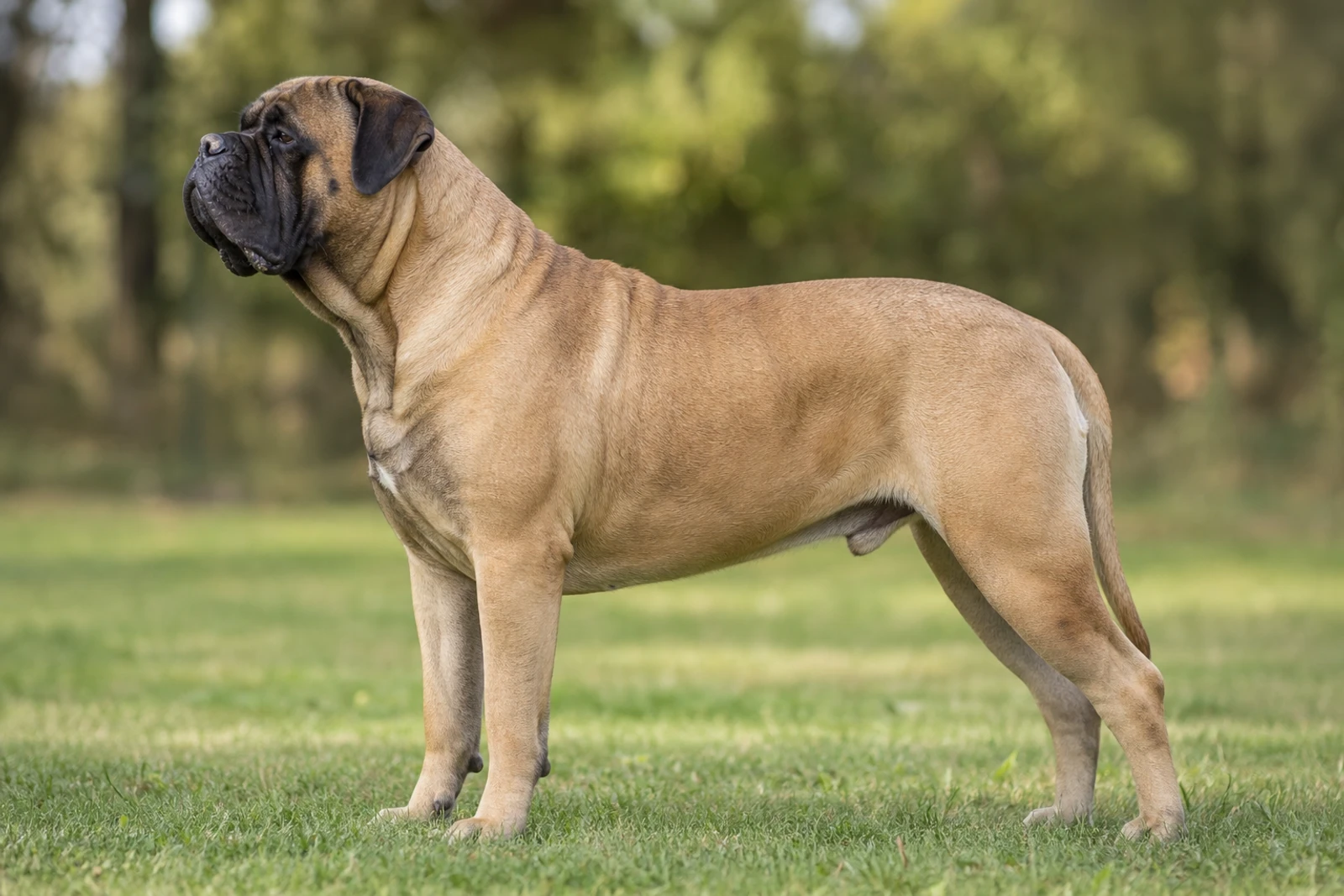
The Bullmastiff is a powerful, loyal guardian breed originally developed in the United Kingdom to protect estates from poachers. Standing up to 27 inches and weighing up to 130 pounds, this giant but gentle dog suits experienced owners who can provide consistent training and firm leadership. Calm and affectionate with family, the Bullmastiff is naturally protective and aloof with strangers. With moderate exercise needs and minimal grooming, this breed thrives in homes with space, making an excellent companion for those seeking a devoted, watchful presence.
Family fit
Is the Bullmastiff a good family dog?
Calm, confident, and gently protective of the family.
- Children
- Family shortlist
- Energy
- Moderate
- First-time owners
- More experience helps
- Grooming
- Lower
Breed tendencies are only a starting point. Supervise children, meet the individual dog, and make sure the exercise, training, grooming, space, and cost fit your household.
At a glance
- Size
- Giant
- Height
- 24–27 in
- Weight
- 90–130 lb
- Life span
- 10 years
- Coat colors
- fawn, red, brindle
- Coat type
- Short, dense, and weather-resistant
- Group
- Working
- Origin
- United Kingdom
How much does a Bullmastiff cost?
Adopt / rescue
$100–$450
Usually includes spay/neuter, first shots, and a microchip.
Buy from a breeder
$1,200–$3,000
From a reputable, health-testing breeder.
Approximate USD. Prices vary widely by region, breeder, pedigree, age, and coat colour — adopting is the lower-cost and recommended route. Avoid suspiciously cheap “breeders”; they’re often puppy mills.
Estimate the full cost of a Bullmastiff →Want the ongoing number? Estimate the monthly food bill for a Bullmastiff with our dog food cost calculator.
Bullmastiff photos
Views
Front, side, rear and top — the full silhouette.Poses
How the breed sits, lies, moves and plays.Puppy to senior
The breed across its whole life.Expressions
The breed’s range of moods.Close-up details
Eyes, ears, nose, paws, tail and coat.Coat colors
The breed’s recognized colors.Click any photo to enlarge. We show the Bullmastiff from every angle — three views, poses, life stages, expressions, close-ups, coat and colors.
Appearance & size
This is a breed that fills a doorway. A Bullmastiff should look like the night watchman’s dog it was bred to be — powerful, alert, and completely unshakeable.
Size and substance
Expect a 90-to-130-pound dog standing 24 to 27 inches at the shoulder, with females typically at the lower end of both ranges. That weight isn’t just bulk; it’s bone density and hard muscle layered over a wide, deep frame. A male in fit condition can reach 130 pounds without an ounce of softness. These dogs take up real estate — a full-grown Bullmastiff sprawled on your kitchen floor will block half of it.
Build and body proportions
The body is nearly square, with the length from breastbone to rump only slightly exceeding the height at the withers. The chest is broad and deep, with well-sprung ribs and a brisket that drops to the elbows, giving the dog a grounded, low-center-of-gravity presence. From the side, the topline is level and firm, the loins short and muscular, and there’s a moderate tuck-up — enough to avoid a slab-sided look, not so much that it appears aero. Rear angulation is moderate, driving a powerful, ground-covering stride rather than flashy reach. The thighs are thick and heavily muscled, and the hocks are straight when viewed from behind. Front legs are set wide apart, dead straight, with strong bone and slightly sloping pasterns that cushion the dog’s weight.
Head and expression
You notice the head first. It’s big — broad and deep, with a distinct stop, a squared-off muzzle, and a black mask that covers the entire muzzle and extends up around the eyes. The muzzle should be one-third the length of the entire head; too short and you lose the workmanlike power, too long and you lose type. When the dog is alert, the forehead shows moderate, symmetrical wrinkles. At rest, the face smooths out. The eyes are dark and medium-sized, set wide apart, with a watchful, intelligent expression — never timid or sharp. Ears are V-shaped, set high and wide on the skull, lying close to the cheeks and darker in color than the body coat. A Bullmastiff’s gaze is the thing that sticks with you: calm, direct, and quietly assessing.
Coat and color
The coat is short, dense, and flat-lying, with a hard texture that provides some weather resistance but isn’t rough. Grooming is wipe-and-go. You’ll see three accepted colors, all with the required black mask:
- Fawn: a clear, sandy gold ranging from light to deep reddish-gold.
- Red: a richer, mahogany-toned red, sometimes with very slight darker shading.
- Brindle: a fawn or red base with dark, clearly defined stripes that are dense enough to read as a pattern, not just a smudge. A small white patch on the chest is allowed but not preferred.
From any angle — front, side, or rear — the Bullmastiff reads as a symmetrical powerhouse made of clean lines and restrained confidence. There’s no exaggeration, no jowly overdone head, no excess weight. When you look at a well-built one, you instinctively trust that this dog could hold a poacher without savaging him, and then walk away the moment you called him off.
History & origin
Sometime in the mid-1800s, England’s sprawling country estates had a serious poaching problem that called for a new kind of dog. Gamekeepers needed a partner that could track trespassers silently at night, close in fast, and pin a man without mauling him bloody until the keeper arrived. The heavy Mastiffs of the day had the size and nerve but lacked the necessary agility and quietness. Bulldogs had the tenacity and drive but were too aggressive for the task. The solution was a custom-built cross of the two—roughly 60% Mastiff, 40% Bulldog—producing a dog that was agile enough to run down a man, calm enough to hold him on command, and physically powerful enough to end a fight if one started.
This early foundation stock became known as the Gamekeeper’s Night Dog. Keepers worked the dogs at night on vast properties, favoring dark brindle coats that blended into the shadows. The dogs were trained to track without a sound, knock a poacher to the ground, and stand over him without biting until the keeper took over. That specific restraint, paired with explosive athleticism, shaped the breed’s temperament right from the start: a Bullmastiff isn’t wired to be a frantic biter; it’s a living deterrent that escalates only when necessary.
As poaching faded in the early 20th century, the breed transitioned into a more generalized guard and companion role. The Kennel Club in the UK recognized the Bullmastiff in 1924, and the American Kennel Club followed in 1933. Through the decades, demand for a large, loyal home protector kept the breed's numbers steady. While their original job has disappeared, a well-bred Bullmastiff still brings that gamekeeper heritage indoors: a silent, watchful presence that sizes up strangers before you even hear a growl, and then settles back down like nothing happened.
Temperament & personality
Calm, quiet, and deliberate—the Bullmastiff would rather lean against your leg than bounce off the walls. With a mature weight of 90 to 130 pounds and a life span around 10 years, this giant settles into a slow-burn affection that shows up every time it follows you from room to room and rests its heavy head on your lap. It will take in a stranger with a hard, unblinking stare long before it growls, making it an unnervingly effective deterrent even though it rarely barks without reason.
A guardian who reads the room
A stiff posture and direct eye contact are the breed’s quiet warning system, so teach everyone in the house to recognize that a statue-still Bullmastiff isn’t just being stubborn—it’s assessing a situation. Yawning, lip licking, or turning the head away, on the other hand, signal the dog needs space. Ignoring those early signals can escalate a protective instinct into a problem, which is why this breed is not a great fit for homes where boundaries around food and rest aren’t respected.
Energy: not a marathoner
Expect a solid hour of daily exercise split into a couple of brisk walks and some low-key romping in a fenced yard. They lack the frantic energy of smaller working dogs, but a bored Bullmastiff will find its own occupation—often chewing furniture or marking territory indoors if old urine smells linger. Clean accidents with an enzymatic cleaner (a simple white or cider vinegar spray works for neutralizing odor and discouraging repeat marking) and reward outdoor elimination immediately with a treat to lock in the habit.
Affection that comes with weight
Affection from a Bullmastiff is a full-contact sport. Leaning, drooling, and a low-key shadowing of its favorite humans are the norm. They mesh well with respectful children who know not to interrupt doggy meals—early training around food guarding prevents a manageable tendency from becoming a hard rule. No matter how relaxed the dog seems, never let a child startle it while eating or sleeping.
Inside the home
Despite its size, the Bullmastiff is a quiet indoor presence that sprawls across floor vents and snores through the afternoon. It can be wonderfully steady with familiar visitors introduced calmly, but its territorial instinct runs deep, and unsupervised fence-running or unannounced guests can trigger a protective response. That guarding tendency means ongoing socialization is not optional; it’s a non-negotiable part of living with one. The breed thrives on respectful, consistent leadership—not force—and a home where the rules are predictable and the person in charge doesn’t yell. You get back a dog that measures every threat with a cool head, then goes back to drooling on your shoe.
Good with kids, dogs & other pets
A Bullmastiff who grows up in a family with kids is often the quiet, steady presence you didn’t know you needed. His patient, non-aggressive temperament and low-key indoor energy make him surprisingly compatible with children — but the math of a 90–130-pound dog moving through a room changes everything. A happy tail at toddler head-height, a body lean against a small child, or a gentle attempt to “herd” a running preschooler can topple them without any ill intent. Supervision is non-negotiable. Stay within arm’s reach, reward the dog for lying calmly while kids play, and teach children to respect his space rather than climb on or startle him. With that groundwork, the bond is genuine: a Bullmastiff often appoints himself a watchful, silent guardian who sleeps by the crib or trails a favorite child from room to room.
With other dogs, everything hinges on early, positive exposure. The critical socialization window slams shut around 14–16 weeks, so a puppy needs gradual, happy meet-ups with friendly, vaccinated dogs well before that. A Bullmastiff raised with this kind of start often enjoys coexisting with housemate dogs and can be politely tolerant of unfamiliar ones. Without it, expect a more reserved or watchful adult — and in some lines, a selective streak, particularly toward same-sex dogs. Don’t force a social life on an adult who’s content solo. Dragging a reluctant Bullmastiff into a rowdy dog park usually backfires, creating anxiety or defensive posturing. Instead, let him meet calm, known dogs on neutral ground, and separate the moment you see stiff posture, a hard stare, or a lifted lip. He’s a guardian breed, not a social butterfly, and that’s perfectly fine.
- Start between 3–14 weeks: introduce your puppy to children, dogs, sounds, and surfaces in short, upbeat sessions.
- Never leave a young child and any dog together unsupervised, regardless of temperament.
- Respect an adult’s comfort zone. If he’s uneasy around other dogs, parallel walks on leash often work better than direct nose-to-nose greetings.
Cats and small pets demand an extra dose of realism. A Bullmastiff puppy raised alongside a household cat — with gates, treat rewards, and slow, leashed introductions — frequently learns to ignore or even nap beside it. His guarding instinct, however, doesn’t auto-magically delete the chase reflex. A cat that darts across the room can trigger a pursuit, even in a dog who previously co-existed peacefully. Never leave a Bullmastiff loose with a free-roaming cat, rabbit, or guinea pig until you’ve watched weeks of boring, reliable calm around that animal. For pocket pets like hamsters or birds, supervision means a physical barrier: a closed door or a sturdy enclosure the dog can’t knock over. The key is habit. Teach the dog that ignoring the smaller creature earns calm praise or a chew, and the tension fades. If you adopt an adult with an unknown history around small animals, assume nothing and introduce as if starting from zero. Patience here isn’t a suggestion — it’s the only path that keeps everyone safe.
Trainability & intelligence
Bullmastiffs are smarter than their laid-back expression lets on — they were bred to work independently, sizing up situations and making quiet decisions about who belongs and who doesn’t. That means they pick up new behaviors quickly when they see a point, but they won’t repeat a command just because you said so. You’re negotiating with a 100-pound partner, not a push-button dog.
What works: short, upbeat sessions that reward with high-value food or a rousing game of tug. Bullmastiffs shut down under repetition or heavy-handed corrections. Use positive reinforcement to build a “sit,” “down,” and “stay” that will eventually stick even when the doorbell rings. The challenge comes when instinct overrides training — a Bullmastiff who thinks the backyard fence is under threat may ignore your recall no matter how good the treats are. That’s why proofing commands around real distractions is non-negotiable.
Start socialization the day you bring the puppy home (ideally before 14 weeks) and keep at it through adolescence. Calm, neutral exposure to delivery people, kids in hats, strange sounds, and different walking surfaces teaches your dog that new things aren’t sneak attacks. Without that slow, positive exposure, a Bullmastiff’s natural suspicion can harden into reactivity — and at this size, mistakes are hard to manage.
Forget punishment-based methods entirely. Yelling or leash jerks make a sensitive, powerful dog anxious and mistrustful, and that can erode the off-switch you absolutely need in a giant breed. Food lures and quiet praise, applied with patience, turn a big, stubborn guardian into a dog who would rather check in with you than charge the gate.
- Train the quiet moments first — eye contact in a boring room, a relaxed “place” on a mat — so you have something to fall back on when the house gets busy.
- Keep sessions under 10 minutes and stop while your dog still wants more.
- Recall isn’t optional but it’s also not a given. Practice on a long line in low-distraction areas, then slowly add people and other dogs, rewarding every single check-in.
Expect a Bullmastiff adolescent (6–24 months) to test every boundary, “forgetting” skills he knew last week. Consistent, calm repetition gets you through that phase — not doubling down on force. The payoff is a dog who respects your judgment and can be trusted off-leash on your property, because he’s decided for himself that staying close is the better deal.
Exercise & energy needs
A Bullmastiff’s exercise needs are surprisingly modest for a 100-plus-pound dog. This is not a breed that will pace and whine for a five-mile run. In fact, overdoing it does more harm than good, especially on growing joints or in warm weather.
Plan on two 20- to 30-minute walks each day, ideally in the cool of early morning or late evening. These dogs overheat quickly—their short muzzles and heavy build make them much less heat-tolerant than leaner working breeds—so skip the midday pavement altogether. The pace should be relaxed; a slow sniffing stroll around the neighborhood often suits them better than a power walk. Multiple shorter outings (a quick potter around the block, a 10-minute backyard play session) work beautifully, especially on days when they’d rather be horizontal.
Mental exercise carries more weight than you might expect. A Bullmastiff can be dead asleep one moment and deeply focused the next, which makes puzzle toys, frozen food-stuffed Kongs, and short scent games excellent energy outlets that don’t pound their joints. Hide treats in a cardboard box or scatter their kibble in the grass—five minutes of nose work can be as tiring as a half-hour walk.
For puppies and adolescents, the rule is no forced, high-impact exercise. No jogging alongside a bike, no prolonged stair climbing, and no jumping onto hard surfaces until growth plates close—usually around 18 months. Even a fenced yard isn’t a substitute for the mental engagement they need; a bored Bullmastiff left alone in a yard often just finds a shady spot and waits for you to come back.
If you want a shared sport, tracking and nose work are right up their alley. Swimming can work for some individuals (always supervised), but the watchword is moderation—these are short-session dogs, not endurance athletes. Done right, you’ll have a calm, content companion who’s perfectly happy to snooze the rest of the day away.
Grooming & coat care
For a giant dog, the Bullmastiff’s grooming routine is refreshingly straightforward — but don’t mistake that for no maintenance. Their short, dense coat sheds year-round, and during spring and fall, they’ll drop enough hair to fill a wastebasket. Your best defense: a quick brushing session two or three times a week with a rubber curry brush or a natural-bristle brush. These tools grab loose undercoat, massage the skin, and spread natural oils to keep the coat hard and gleaming. You won’t need slicker brushes or combs here; the goal is shine and shedding control, not detangling.
Bathing is a rare event. Over-washing strips the Bullmastiff’s natural waterproofing and can dry out the skin, so a bath every three to four months — or when they’ve rolled in something foul — is plenty. Use a mild dog shampoo and rinse thoroughly, then towel dry. Their deep facial folds and pendulous jowls deserve daily attention: a damp cloth wipes away drool, food bits, and grime, preventing skin infections in those creases.
The rest is standard giant-breed upkeep. Nails grow fast and can throw off a 100-plus-pound dog’s gait; trim them every two to three weeks or the moment you hear clicking on hard floors. Floppy ears trap moisture, so check and clean them weekly with a vet-approved solution to avoid yeast or bacteria. Teeth get brushed two or three times a week with dog toothpaste. When the coat blows heavily, increase brushing to daily for a couple of weeks — your vacuum will thank you.
Shedding & allergies
A Bullmastiff’s short, sleek coat fools a lot of people. It won’t carpet your floor in furry tumbleweeds like a Husky, but those stiff, needle-like hairs still end up woven into every sofa cushion, car seat, and pair of dark pants you own. The shedding is moderate year-round, with a distinct seasonal blowout in spring and fall when you can run your palm down their back and come away with a handful of loose fur. Stick to a quick session with a rubber curry brush two or three times a week, then bump it up to daily brushing during those heavy-shed weeks to keep the furniture from wearing a fur coat of its own.
And then there’s the drool—the part that catches even prepared owners off guard. Those loose, generous jowls served a purpose when the breed was holding down poachers, but in a modern home they produce a steady stream of slobber after drinking, eating, or even just a few minutes of excitement. You’ll wipe thick ropes of it off your walls, your coffee table, and the knee of anyone who sits down nearby.
That combo of shed hair, dander, and constant slobber makes the Bullmastiff about as non-hypoallergenic as a dog can be. No amount of brushing or cleanup changes that. If someone in the house has allergies or you simply can’t live with a drippy-jawed giant, look at a different breed.
Diet & nutrition
Your Bullmastiff lives for food, so the biggest job on your plate is managing his weight before it manages him. Those 90–130 pounds put serious stress on hips and elbows, and even an extra five or ten pounds can write a check his joints can't cash. Keep him lean, and he'll move better and hurt less for the decade you have him.
Portion control starts with honesty. A typical adult eats 3–4 cups of high-quality dry food a day, split into two meals, but the bag is just a suggestion. Watch his waist — you want a visible tuck from the side and ribs you can feel without a fat blanket. If he's a master manipulator at mealtime, use a food puzzle bowl to slow him down and make those 60 seconds of gulping feel like a real job.
- Puppies: From weaning to four months, offer four evenly spaced meals. Drop to three meals until six months, then settle into the adult twice-a-day rhythm. Transition any new food slowly — start with lightly cooked, puréed meats, fish, fruits, and vegetables, or a premium large-breed puppy formula that won't fuel too-rapid growth. Raw chicken wings can appear under supervision around twelve weeks, but they're optional.
- Adults: Build meals around roughly 60% meat (raw or cooked), 20–30% fruits and vegetables, and 10% extras like eggs, plain yogurt, or cooked grains. Pearl barley is a great digestible, high-fiber grain that keeps the pipes moving without upsetting a sensitive stomach. If you cook a batch of white rice, vegetables, or lean protein ahead of time, you've got a healthy base for the week.
- Seniors: Older dogs often do better with smaller, more frequent meals. There's no solid reason to slash protein, but you must slash calories as the zoomies fade. Weigh him monthly and trim portions gradually if the scale creeps up.
Never feed from the table, not even once — Bullmastiffs are too smart and train you fast. Scrape leftovers into his own bowl, after you've eaten, to keep begging extinct. And skip rich, fatty scraps, especially after holidays; a greasy ham bone can trigger pancreatitis in a heartbeat. If your dog has missing teeth or a tender mouth, just purée his meals to help him absorb every nutrient.
Health & lifespan
Bullmastiffs typically live about 10 years. That’s a full decade with a big, steady companion — but getting there means being honest about what can trip up a giant, heavy-boned breed.
Bloat tops the must-know list. A deep chest sets the stage for gastric dilatation-volvulus, where the stomach fills with gas and twists. It kills quickly. Watch for pacing, drooling, unproductive retching, or a visibly swollen belly, and get to a vet immediately. Feeding two or three smaller meals instead of one large ration and keeping your dog quiet for an hour after eating lowers the risk.
Hips and elbows carry a lot of weight, literally. Dysplasia is common, and even 5–10 extra pounds grind down cartilage fast. Responsible breeders screen with OFA or PennHIP evaluations and share those clearances openly. Ask for them. Hearts don’t get a pass, either — dilated cardiomyopathy runs in some lines, so an annual cardiac exam becomes part of the routine, especially after age six.
Eyes need screening, too. Entropion (the eyelid rolling inward) and progressive retinal atrophy pop up when breeders skip the ophthalmologist. A CERF or OFA eye clearance from a board-certified specialist tells you someone did the homework.
Cancer — osteosarcoma, lymphoma — shows up more often in Bullmastiffs than anyone wants. No test predicts it, but you know your dog. A new limp, unexplained weight loss, or a dip in energy deserves a prompt vet visit, not a wait-and-see approach.
Hypothyroidism is another occasional issue that’s easy to manage once diagnosed with a simple blood panel. Symptoms like unexplained weight gain, coat changes, or sluggishness should trigger a thyroid check.
That short, pushed-in muzzle makes heat a genuine danger. Bullmastiffs overheat in minutes, not hours. Hot-weather walks happen early or late, and you always have water and shade within reach. Air-conditioning isn’t a luxury for this breed — it’s protection. Never leave one in a parked car, even with the windows cracked.
Preventive care fills in the rest. Heartworm medication given monthly during mosquito season and for one month after is non-negotiable; rabies vaccination is legally required. A yearly wellness exam with bloodwork and a hands-on joint-and-heart check catches trouble while you still have options. Senior dogs (around age seven) benefit from twice-a-year visits.
Weight management is the single biggest thing you control. A lean Bullmastiff lives longer and moves better. Measure meals with a kitchen scale, ignore the theatrics at the food bowl, and keep treats under strict rationing. Early socialization also pays a quiet health dividend — a dog who isn’t chronically stressed faces fewer stress-related physical problems over time.
A well-bred Bullmastiff from health-tested parents, combined with sharp observation, lean body condition, and prompt vet care, stands the best shot at reaching that ten-year mark comfortably. Start with a breeder who provides full CHIC-level testing — not just a vet check — and you stack the odds in your favor from day one.
Living environment
A 90-to-130-pound dog sounds like a lot for an apartment, but the Bullmastiff is a champion couch potato indoors. Give them a cool, ground-floor spot to sprawl and they’ll happily conserve energy for hours. A house with a securely fenced yard is a nice bonus, but not a requirement—this breed is built to be a quiet house companion, not a backyard athlete. You do need enough square footage to navigate around 24 to 27 inches of solid dog who thinks they're a lap warmer.
Heat and humidity are the real deal-breakers. That short muzzle makes a Bullmastiff a terrible candidate for outdoor living in warm climates. They pant inefficiently and overheat fast, so air conditioning is non-negotiable during summer. Limit walks to early morning or after sunset when it's hot, and never leave them outside unsupervised in the sun.
Don't expect a guard dog that barks at every squirrel. The Bullmastiff is a silent observer, bred to track poachers without giving away position. You might hear a single, deep "woof" when someone approaches the door—an alert, not a nuisance. That low-key vocal nature makes them more neighbor-friendly than most watchdogs.
Alone time requires some honesty. These dogs bond hard with their people and can develop separation anxiety if left solo for 8 to 10 hours daily without practice. Crate training, stuffed puzzle toys, and gradual desensitization from puppyhood help build independence. A midday break from a dog walker goes a long way to keep a Bullmastiff from getting stressed and destructive. They’re not vocal complainers, but they’ll show their unhappiness by redecorating the sofa. A Bullmastiff who gets two short, easy strolls and a cool living room to monitor will be about as low-maintenance as a giant breed gets.
Who this breed suits
A bullmastiff won’t bounce off the walls, but at 90–130 pounds he’ll take up half your couch and drool on the other half. He’s best matched with an owner who values quiet, steady protection over nonstop play and who isn’t squeamish about slobber, snoring, or occasional gas.
Singles and couples who work from home or have a mostly predictable schedule get along well with this breed. A bullmastiff bonds hard to his people and doesn’t do well left alone for 10-hour stretches. He’s naturally reserved with strangers, so a confident, consistent handler who will socialize him early and often gets a steady, watchful companion who rarely barks without cause.
Families can be a great fit, but the dog’s sheer mass matters. A bullmastiff can accidentally flatten a toddler with a happy tail swipe or a lean, so homes with older, sturdy kids fare better. He’s calm indoors—content with a few short walks and a fenced yard to patrol—not a marathon runner. Count on a solid 30–45 minutes of daily exercise, split into relaxed walks and yard time, not intense off-leash sprints.
First-time dog owners should think carefully. A bullmastiff isn’t hard to train but he is independent-minded and physically powerful. Without early leash work and clear leadership, a 24–27-inch, 100-plus-pound dog can pull you off your feet or develop guardy habits that are tough to undo. Seniors face similar challenges; handling a giant breed on a leash or helping him into a vehicle requires real strength, though a calm, well-trained adult might work for a fit, experienced older owner.
Skip this breed if you prize a tidy house (drool ends up on walls and ceilings), need a jogging partner, rent in a building with size or breed restrictions, or expect a long-lived dog—10 years is typical. Also pass if you can’t commit to early, ongoing socialization: a poorly introduced bullmastiff can become suspicious and hard to manage.
If you want a silent, watchful guardian who’s just as happy napping on your feet as he is scanning the yard for anything out of place, the bullmastiff fits—as long as you’re ready for the drool and the responsibility of molding a giant, thinking dog.
Cost of ownership
You’ll budget roughly $1,800–$3,500 for a Bullmastiff puppy from a responsible breeder. That price climbs when both parents hold OFA clearances for hips, elbows, and cardiac, plus a DNA test for the breed’s recessive conditions. Avoid anything under $1,200 — cut-rate pups almost always skip those screenings, and giant-breed vet bills down the road make that upfront savings vanish.
Once the dog is home, the monthly burn lands between $200 and $400 for a healthy adult, not counting emergencies. Everything is bigger with a 90–130 lb animal.
- Food: A high-quality large-breed kibble runs $70–$110 a month. Bullmastiffs do best on a controlled-growth formula to protect joints, and you’ll go through roughly 40–50 lb of food every four to six weeks. Some owners add joint supplements early, which tacks on $20–$40 monthly.
- Grooming: The short coat needs a weekly once-over with a rubber curry brush and a bath every month or two. If you handle it yourself, you’re out maybe $15 a month for shampoo and wipes. A professional bath and nail trim at a groomer who can manage a giant breed will run $40–$60 per visit.
- Vet and preventatives: Routine care — exams, vaccines, year-round heartworm, and flea/tick prevention — costs much more than it does for a smaller dog because doses are weight-based. Expect $50–$90 a month just for preventatives. Annual checkups and bloodwork add another $400–$600 a year. Factor in the breed’s vulnerabilities: bloat (a $3,000–$7,000 emergency surgery), hip dysplasia, elbow dysplasia, lymphoma, and mast cell tumors. Reputable breeders reduce the odds, but they don’t zero them out.
- Insurance: Given those risks, a comprehensive policy makes sense. For a Bullmastiff, premiums typically run $60–$120 a month depending on your deductible and location. Without insurance, a single bloat episode or cruciate ligament repair can hit five figures.
On top of that, initial supplies — a giant-sized crate ($150–$250), raised feeders to lower bloat risk, a 6-ft heavy-duty leash, and a bed that won’t flatten in a month — eat up $400–$600 right from the start. Professional training with a positive-reinforcement class is non-negotiable for a dog this powerful; budget $150–$300 for a group course.
Over a 10-year life, you can easily spend $30,000–$45,000. The biggest mistake people make is pricing the puppy, not the upkeep.
Choosing a Bullmastiff
Responsible Breeder or Rescue?
A responsible breeder puts health and steady temperament above ribbons, but don’t ignore rescue. Bullmastiffs often end up in shelters because their size caught someone off guard — a 120‑lb dog needs an owner who planned for it. With a rescue, you skip the puppy chaos and get a dog whose house manners and personality are already locked in. A solid breed‑specific rescue matches you carefully. Expect to wait months for a puppy from a good breeder; a suitable rescue adult might be available weeks sooner.
Health Clearances to Demand
This giant breed can be prone to hip and elbow dysplasia, bloat, and heart disease (dilated cardiomyopathy). Eye problems surface, too. Insist on seeing OFA or PennHIP hip and elbow clearances for both parents, a cardiac exam by a board‑certified cardiologist, and a current CERF or OFA eye exam. A breeder who shrugs and says “my vet looked at them” without handing you the paperwork is a red flag. A 130‑lb dog with failing hips isn’t just sad — it’s a daily struggle you can avoid.
Spotting a Bad Breeder
Walk away if you see multiple litters on the property, puppies always available, no questions about your home, or pressure to take a pup before 8 weeks. Bullmastiff puppies need that time with littermates to learn bite inhibition — a rude, mouthy 100‑lb adolescent hurts. Also be wary of breeders chasing rare colors like blue or brindle unless they back it with the same rigorous health testing. A breeder who won’t let you meet at least one parent on‑site is hiding something.
Picking the Right Puppy
Spend real time with the whole litter. A steady pup shows curiosity without cowering or steamrolling the others. Don’t reach automatically for the boldest one — that drive often matures into a dog who’ll test you daily. For a family with kids, the middle‑of‑the‑road pup usually fits best. Ask the breeder which one they’d place in a first‑time giant‑breed home; they’ve watched these pups for 8 weeks and know their quirks. A written health guarantee and a contract that says the breeder takes the dog back for any reason are non‑negotiable, no matter how sweet the puppy looks.
Pros & cons
Pros
- A seriously calm house dog: once past puppyhood, the Bullmastiff is content to sprawl at your feet, trading a rumbling snore for bursts of boisterous play.
- Patient and affectionate with children when raised alongside them, often positioning itself as a silent, oversized guardian who rarely startles or snaps.
- Built to be a watchdog without the noise. The breed deters by sheer presence — 24–27 inches tall and up to 130 pounds of muscle — and typically only sounds off when something truly concerns it.
- Exercise needs are refreshingly modest for a giant working breed. Two solid 20–30 minute walks and some tug or mental games meet most adults’ physical quota without turning your living room into a racetrack.
- Grooming is about as simple as it gets: a short, dense coat that benefits from a weekly rubber curry brush and a quick wipe-up when the drool flies.
- Thrives as a close-quarters family companion, adapting easily to indoor life provided you have space for a small pony-sized shadow.
Cons
- A 10-year lifespan is the emotional price tag. You’re making a short-term commitment to a breed that often faces bloat, hip and elbow dysplasia, heart conditions, and a higher cancer rate than many other dogs.
- 90–130 pounds of determined muscle don’t politely wait for your cue. If you can’t physically handle a dog that outweighs some teens, or aren’t ready for firm, consistent training starting at 8 weeks, this breed will run the household.
- The drool is a lifestyle, not a quirk. Strings of slobber will appear on walls, ceilings, and your jeans, accompanied by a soundtrack of snoring, snorting, and flatulence that rivals a fraternity house.
- Stubbornness comes standard. A Bullmastiff’s independent thinker will deliberately test boundaries, and heavy-handed corrections backfire. You need patient, unshakeable leadership without an ounce of temper.
- Natural protectiveness can curdle into liability without early, ongoing socialization. The dog that’s a marshmallow with your kids may decide your neighbor’s barbecue is a threat, making leashed walks in busy areas and off-leash dog parks a lifelong management project.
- Heat is an enemy. That brachycephalic face and heavy build mean overheating occurs fast — even a short run on an 80°F day can push a Bullmastiff into respiratory distress.
Similar breeds & alternatives
If you’re drawn to the Bullmastiff’s quiet guardian nature but want to explore nearby options, a few breeds often come up in the conversation. Each shares some of the Bullmastiff’s core traits, yet tilts in a slightly different direction that might suit your household better.
English Mastiff
Think of the English Mastiff as the Bullmastiff’s larger, even more easygoing cousin. While the Bullmastiff was crafted from roughly 60% Mastiff and 40% Bulldog, the pure Mastiff stands taller (27–32 inches) and can easily hit 160–230 pounds. That extra bulk comes with an even shorter expected lifespan—6 to 10 years is common—and a distinctly lower-energy attitude. A Bullmastiff needs a brisk daily walk and maybe a romp; an English Mastiff is often content with a leisurely stroll and a soft couch. Both are affectionate with family and naturally watchful, but the Mastiff tends to be even more placid. The trade-off: more drool, more space taken up on your floor, and a larger food bill.
Dogue de Bordeaux
The Dogue de Bordeaux (French Mastiff) shares the Bullmastiff’s heavy-boned, wrinkled face and deep devotion to its people. Weight ranges overlap closely—99–145 pounds—though the Dogue is typically lower to the ground, with a broader, more massive head. You’ll notice deeper facial folds that need regular cleaning to prevent irritation. Temperamentally, the Dogue can be a touch more protective and strong-willed, sometimes requiring a firmer hand in training. The lifespan is similar (around 5–8 years on the low end to 10 on the high end), but the breed is more prone to heat intolerance due to its brachycephalic structure. If you love the Bullmastiff’s soulful expression but can commit to extra wrinkle care and a slightly shorter, stockier build, the Dogue is worth a look.
Cane Corso
The Cane Corso is a more athletic interpretation of the mastiff type. Weighing 90–120 pounds and standing 23.5–27.5 inches, it closely matches the Bullmastiff’s height but carries less bulk and more muscle definition. The real divide is energy and drive. Where the Bullmastiff is content with an hour of exercise, a Cane Corso typically needs a solid 60–90 minutes of vigorous activity and real mental work—obedience, agility, or scent games—to stay level-headed. The Corso’s guarding instinct often runs hotter, making early socialization non-negotiable. Both breeds have a short, easy-care coat, but the Cane Corso sheds less. Expect a higher training commitment and a dog that’s quicker to spring into action.
Rottweiler
If you admire the Bullmastiff’s protective streak but want a breed with a longer working history in herding and carting, the Rottweiler is a natural comparison. While technically a medium-large breed, a robust Rottweiler can reach 100–135 pounds, putting it squarely in the same weight class as many Bullmastiffs. The Rottweiler’s temperament is more overtly watchful—they’re more prone to barking an alert—and they typically demand a higher level of daily structure and exercise. Mentally, they’re sharper and often quicker to pick up complex commands, which can be a double-edged sword: you’ll need to channel that intelligence consistently. Additionally, Rottweilers are less prone to the extreme drooling and brachycephalic respiratory issues some Bullmastiffs face, giving them an edge in hot-weather tolerance.
Fun facts
- Bullmastiffs were created by crossing Bulldogs and Mastiffs.
- They were known as the ‘Gamekeeper’s Night Dog’ for their ability to silently track poachers.
- Their black mask helps reduce glare when hunting at night.
- Despite their size, Bullmastiffs are surprisingly agile and quick.
Frequently asked questions
- Are Bullmastiffs good with children?
- Bullmastiffs are generally gentle and protective with children, often forming strong bonds. Due to their large size, supervision is recommended to prevent accidental knocks. Early socialization helps ensure they are patient and tolerant.
- How much exercise does a Bullmastiff need?
- Bullmastiffs have moderate exercise needs, typically requiring daily walks and playtime. They are not overly energetic but benefit from consistent activity to maintain a healthy weight. Avoid strenuous exercise in hot weather due to their brachycephalic tendencies.
- Do Bullmastiffs shed a lot?
- Bullmastiffs shed moderately year-round, with slightly heavier shedding in spring and fall. Their short coat is easy to manage with weekly brushing to remove loose hair. Regular grooming helps keep shedding under control.
- Can Bullmastiffs live in apartments?
- Bullmastiffs can adapt to apartment living if given sufficient daily exercise and mental stimulation. Their calm indoor demeanor makes them suited for smaller spaces, but their size requires enough room to move comfortably. Access to outdoor areas is beneficial.
- Are Bullmastiffs good for first-time dog owners?
- Bullmastiffs can be challenging for first-time owners due to their size, strength, and independent nature. They require consistent training and early socialization to ensure they are well-mannered. An experienced owner can better manage their protective instincts and training needs.
- Do Bullmastiffs bark a lot?
- Bullmastiffs are not excessive barkers; they tend to bark only when necessary, such as alerting to strangers. Their guarding instincts make them naturally watchful, but they are generally quiet dogs. Proper training can minimize unnecessary barking.
Tools & calculators for Bullmastiff owners
Quick estimates tailored to Bullmastiffs — pre-filled with this breed’s size where it matters.
Articles & stories about the Bullmastiff
Sources & standards
This profile follows recognized breed standards from the American Kennel Club (AKC) and the Fédération Cynologique Internationale (FCI), along with established veterinary and breed-club guidance. These describe general breed tendencies — every dog is an individual.