

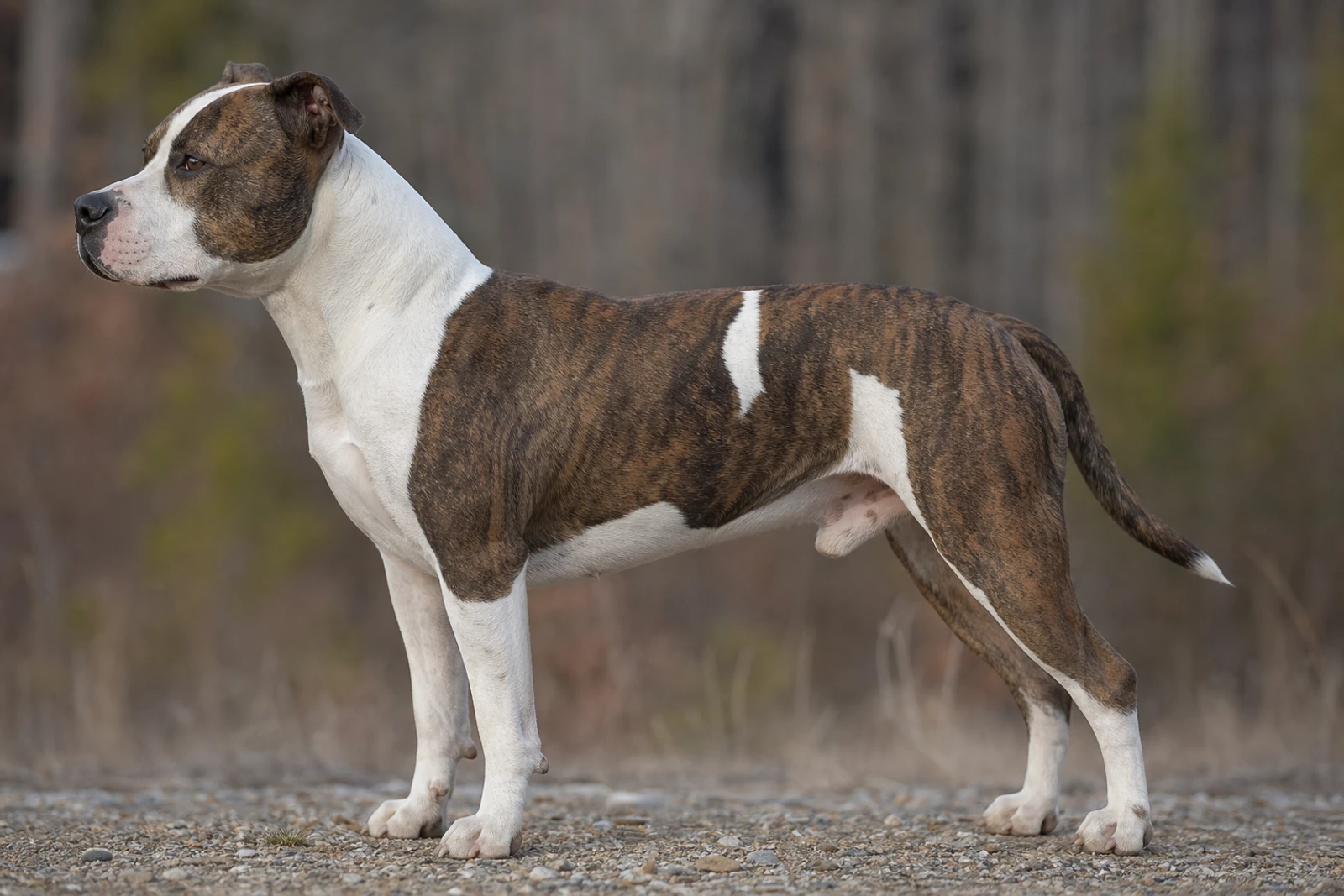
The American Staffordshire Terrier is a muscular, affectionate terrier with a confident nature and a strong need for training and socialization. It can be a loving family dog in the right hands, but it is best for owners who understand strength, management, and breed restrictions.
At a glance
- Size
- Large
- Height
- 17–19 in
- Weight
- 40–70 lb
- Life span
- 12–16 years
- Coat colors
- Many colors and patterns
- Coat type
- Short smooth coat
- Group
- Terriers
- Origin
- United States
Compare American Staffordshire Terrier vs
- American Staffordshire Terrier vs American Pit Bull Terrier →
- American Staffordshire Terrier vs Staffordshire Bull Terrier →
How much does a American Staffordshire Terrier cost?
Adopt / rescue
$75–$400
Usually includes spay/neuter, first shots, and a microchip.
Buy from a breeder
$700–$2,000
From a reputable, health-testing breeder.
Approximate USD. Prices vary widely by region, breeder, pedigree, age, and coat colour — adopting is the lower-cost and recommended route. Avoid suspiciously cheap “breeders”; they’re often puppy mills.
Estimate the full cost of a American Staffordshire Terrier →Want the ongoing number? Estimate the monthly food bill for a American Staffordshire Terrier with our dog food cost calculator.
American Staffordshire Terrier photos
Views
Front, side, rear and top — the full silhouette.Poses
How the breed sits, lies, moves and plays.Puppy to senior
The breed across its whole life.Expressions
The breed’s range of moods.Close-up details
Eyes, ears, nose, paws, tail and coat.Coat colors
The breed’s recognized colors.Click any photo to enlarge. We show the American Staffordshire Terrier from every angle — three views, poses, life stages, expressions, close-ups, coat and colors.
Appearance & size
An AmStaff looks like exactly what it is: a muscular, no-nonsense athlete condensed into a medium-large frame. These dogs carry a surprising amount of weight on a relatively short back — a fit female might tip the scales at 40 to 55 pounds while a well-muscled male can push 70 pounds, all packed onto a 17- to 19-inch shoulder height. That compact ratio gives them a low center of gravity and a stance that says stable.
The head is blocky and broad, with a deep skull, pronounced cheek muscles, and a strong, square muzzle that tapers only slightly. From the front, the eyes are set wide apart, dark and round. Ears can be cropped short (where legal) or left natural; uncropped ears typically fold into a neat rose or half-prick shape. The neck is thick at the base, blending into heavy, laid-back shoulders. A deep, broad chest and well-sprung ribs are the first things you notice from the side, followed by a straight, level topline and a short, slightly sloping croup. The tail is set low, thicker at the root, and tapers to a fine point, never docked. It hangs like a pump handle at rest, then raises in a natural curve when the dog is alert.
Viewed from behind, the rear is equally substantial: muscular thighs, well-let-down hocks, and straight, parallel legs. The feet are round, compact, and arched — no splayed toes here. The coat ties the whole look together. It’s short, smooth, and dense, with a glossy shine that shows off every muscle ripple. You’ll see a wide range of colors and patterns: solid blue, red, fawn, black, brindle, and white with patches of any shade. All-white coats, liver, and black-and-tan are heavily discouraged in the breed standard, but they do pop up now and then. The short coat requires almost zero grooming, but it also means there’s nothing to hide — even a few extra pounds are immediately obvious on this frame, so you’ll always know exactly what you’re looking at.
History & origin
The American Staffordshire Terrier’s story starts not in the show ring, but in the gritty mining and industrial towns of England, where bulldogs and terriers were crossed in the early 19th century to create a dog with the strength and tenacity for bull- and bear-baiting. When those blood sports were outlawed in 1835, the dogs were repurposed for ratting and, unfortunately, dog fighting. But plenty of these tough, intelligent dogs earned their keep as all-around farm helpers—guarding the homestead, catching vermin, and watching over children, a role that soon earned them the nickname “nanny dog.”
When immigrants from Staffordshire, England, headed to America in the mid-1800s, they brought their prized Staffords along. On this side of the Atlantic, the breed diverged. American lines were selected for a taller, heavier build and a more stable temperament suited to a wider range of jobs: still a tenacious farm dog, but increasingly a loyal family companion. By the early 20th century, American fanciers had solidified those traits into a distinct type.
The American Kennel Club took official notice in 1936, recognizing the breed under the name Staffordshire Terrier. That name hinted at the English roots but didn’t fully acknowledge the decades of selective breeding that had created a noticeably different dog. In 1972, the AKC added “American” to the name, distinguishing it clearly from the smaller, more compact Staffordshire Bull Terrier recognized in England. Today’s AmStaff stands 17–19 inches at the shoulder and weighs anywhere from 40 to 70 pounds—substantially larger and rangier than its English cousin. Its path from the pit to the living room couch was gradual, but by the mid-20th century, the breed had become a fixture in American homes, valued for the same unshakeable courage and deep affection for family that its ancestors carried into the mines and fields.
Temperament & personality
An American Staffordshire Terrier is confident, energetic, and built to go all-in on whatever you’re doing. This is not a casual couch companion. The AmStaff brings terrier tenacity to everything — play, training, and guarding the living room window — but also a deep, often goofy affection for people they’ve been raised to trust. That trust doesn’t come free. Socialization is the make-or-break piece: a well-exposed AmStaff leans into your leg and follows you around like a 55-pound shadow; one that’s been underexposed can tip into wariness, stiff body language, and vocal suspicion of strangers.
Expect a dog that reads body language as well as they dish it out. A forward-leaning stance, hard stare, and rigid posture mean something is about to happen, and you need to intervene before it does. In a calm, content dog, the whole body goes loose, the eyes go soft, and the tail wags low and wide. Learn those signals early, because this breed won’t hesitate to take charge of a situation if it thinks nobody else is.
Energy levels are high and so are the exercise demands. A leisurely stroll around the block barely registers. An AmStaff needs a solid hour of running, flirt pole work, or tug sessions daily. Skip it, and they’ll find their own job — typically chewing. Puppies chew to navigate teething, and adults gnaw on hard objects to keep their jaws strong and teeth clean. That means shoes, furniture legs, and remotes are all fair game unless you give them appropriate outlets and clear, patient boundaries. A homemade citrus or vinegar spray can steer them away from off-limits items without eroding the respectful, consistent engagement this breed responds to.
Strong-willed and smart, an AmStaff tunes out heavy-handed corrections and digs in their heels. They work hardest for someone who stays calm, clear, and fair — force only breeds stubbornness. The same dog that ignores a yank on the leash will walk through fire for you once they respect the relationship. Neglect or long periods of isolation, on the other hand, can unravel them into anxious barking, destructive outbursts, or obsessive urine marking. The scent of past accidents functions like a bulletin board for them, so cleaning with an enzymatic cleaner and rewarding outdoor elimination immediately is critical.
Inside the family, an AmStaff can be patient and protective with children they know, but their sheer muscle and enthusiasm can send a toddler flying by accident. Supervision is non-negotiable. With other dogs, many AmStaffs are selective, and their terrier heritage can surface as scrappiness around unfamiliar dogs. Peaceful coexistence with a housemate they grew up with is common, but dog parks and unpredictable off-leash encounters are a gamble. Watch the center of gravity: a forward lean and stiff tail are not a play bow; they’re a warning shot. A relaxed, wiggly approach says you’re in safe territory.
Quirks come with the package. They may roll in foul-smelling stuff to bring home news of an “abundant food source,” and they often mark less-used rooms in the house if those areas don’t carry the family scent. Understand that your AmStaff defines “home” by your smell, not the floor plan. Treat accidents as information, not a grudge match, and you’ll get the clean slate you need.
Good with kids, dogs & other pets
An AmStaff raised with your kids usually turns into a devoted, surprisingly patient sidekick. These dogs tend to be non-aggressive and steady around familiar children, but a 40‑ to 70‑pound dog with a happy, whip‑like tail can accidentally knock a toddler off her feet. Supervise every interaction with young children, and teach small kids not to grab ears or climb on the dog. When the family treats the dog respectfully, the bond is genuine — many AmStaffs will happily tolerate a bit of dress‑up as long as they are part of the household hum.
That need to be near their people runs deep. AmStaffs crave companionship and should never be relegated to the backyard or left alone for long workdays. If your home is bustling with kids coming and going, this breed often thrives. A lonely, isolated AmStaff can develop destructive habits or anxiety, so plan for him to be underfoot, on the couch, and part of the evening chaos.
With other dogs, early socialization is everything — start before 16 weeks, exposing your puppy gently to a wide variety of friendly, well‑behaved dogs. Even then, some adult AmStaffs develop same‑sex intolerance or decide they prefer certain playmates. Never assume a dog‑park greeter; monitor body language during play and separate at the first sign of stiffness. After the sensitive socialization window closes around 4 months, forcing an anxious adult dog to mingle often backfires and can escalate into a fight. It’s okay if your adult AmStaff is content with just her human family and one or two dog friends she meets on neutral ground.
Cats and small pets require clear‑eyed caution. The breed has a terrier’s prey drive, and a darting cat or squeaking guinea pig can trigger a chase instinct that’s hard to override. Puppies raised from day one alongside a cat, with plenty of calm, positive associations, sometimes live peacefully indoors — but separation behind closed doors when you’re not there is a smart backup. Pocket pets like rabbits, ferrets, or rats are rarely safe loose in the same room. Stick to closely supervised introductions and trust your dog’s individual signals over breed generalizations.
Trainability & intelligence
An AmStaff learns fast when you make it worth his while — a quick game of tug, a few high-value treats, or just your genuine excitement sends his tail into overdrive. He’s a terrier at heart, which means you get smarts and tenacity in the same package. You’ll teach a new cue in a handful of repetitions, but the moment training gets stingy with reinforcement, he’ll decide his own agenda is more interesting. Keep sessions short, game-like, and always end on a success.
Socialization in the 3-to-14-week window is non-negotiable. A well-exposed puppy who visits busy parks, meets friendly strangers, and walks on different surfaces grows up to take new situations in stride. Skip this and that terrier wariness can curdle into suspicion or dog-directed reactivity later. Think skateboards, umbrellas, kids on bikes, and calm adult dogs — all before 16 weeks, then keep it going for life.
Leave harsh corrections at the door. A prong collar or a stern scolding doesn’t make a 60-pound powerhouse more reliable; it erodes the trust that keeps him listening when it counts. Instead, build a recall that’s backed by a jackpot — real chicken, a squeaky ball — because his prey drive will override a half-hearted “come” the instant a squirrel streaks by. Proof it in a dozen different distractions before you even think about off-leash freedom.
Impulse control is where a lot of AmStaffs need extra reps. A dog this strong who hasn’t learned “leave it,” “wait” at doorways, and a solid “go to mat” can clear a coffee table with one happy tail swipe. You’re not being strict; you’re keeping everyone safe. Consistency and patience pay off where force fails: he’s sensitive to your mood and will check out if training becomes a battle. With thousands of positive repetitions, you get a confident partner who can nail advanced obedience, rally, or scent work — and who’d rather work beside you than do anything else.
Exercise & energy needs
Plan on two solid 30-minute sessions every day — and I mean real, muscle-burning work, not a couple of leisurely laps around the block. An AmStaff is a terrier through and through, packing serious power and stamina into a 40–70 lb frame. A quick morning pee break won’t cut it; this dog needs to run hard, tug like a freight train, and chase until his tongue lolls.
How to structure those sessions
- Split the hour into two distinct blocks. A typical rhythm is a 30-minute off-leash sprint or flirt-pole session in the morning, then another 30 minutes of brisk walking mixed with structured play in the evening.
- Young, healthy adults often thrive on three shorter, intense hits instead — say 20 minutes apiece — which can prevent overstimulation while still draining the tank.
- If you’re short on time, a single 40- to 60-minute session can work, but you’ll likely see a calmer dog with the split approach.
Activities that fit the breed
AmStaffs were built to grab, hold, and pull, so lean into that instinct. A simple tennis ball may become shredded in seconds, but a thick tug rope or spring pole in the yard gives 15 minutes of full-body engagement. Other go-to options:
- Flirt pole — mimics chasing small prey and burns explosive energy fast in a controlled space.
- Weight pull and spring pole — perfect for a dog that genuinely enjoys hauling weight on a harness. Start light and teach it as a game.
- Scent work and puzzle toys — mental fatigue hits different. Hide a favorite toy or feed meals in a wobble feeder; 10 minutes of nose work can take the edge off as well as a longer walk.
What happens when you skimp
A bored AmStaff becomes an architect of chaos. Digging craters in the yard, chewing doorframes, or barking at every passing squirrel are not “bad dog” behaviors — they’re your dog telling you he needs more. In extreme cases, pent-up energy leaks into leash reactivity or hyperactivity indoors. Consistency matters more than hero workouts; missing a day here and there won’t break your dog, but a chronic shortage will.
Tailor intensity to the individual. A 2-year-old male may happily go for an hour of hard play and still bounce back. A 10-year-old might prefer two shorter bouts of sniffy walks and trick training. The non-negotiable is that this isn’t a low-maintenance couch companion — you’re signing up to physically and mentally exhaust a powerful terrier every single day. If you can do that, you’ll have a relaxed, wiggly, and incredibly devoted partner sprawled across your sofa by 8 p.m.
Grooming & coat care
The AmStaff’s coat is one of the lowest-maintenance features of the breed. It’s a short, sleek, single layer — no insulating undercoat to blow twice a year or turn your couch into a fur bomb. A quick once-over a couple of times a week keeps shedding under control and the coat gleaming.
Brushing
A bristle brush or a rubber curry mitt does the job perfectly. Both lift loose hair, distribute natural oils, and polish that glossy finish without scratching the skin. During spring and fall you might notice a slight uptick in shedding, but it’s nothing a few extra passes won’t handle. Avoid slicker brushes or pin brushes — they’re overkill for a coat this short and can irritate the skin.
Bathing
Bathe only when your dog rolls in something foul. A true bath every two to three months is plenty; more often strips the skin’s natural moisture and can lead to flakiness. Use a mild, dog-specific shampoo and rinse thoroughly. Many AmStaffs stay clean with a wipe-down using a damp cloth or a spray-on coat conditioner between baths.
Nails, ears, and teeth
- Nails: Trim every three to four weeks, or whenever you hear clicking on hard floors. Long nails can crack and change your dog’s gait.
- Ears: The AmStaff’s ears sit high and tend to stay clean, but after a muddy hike or a swim, flip them open and wipe with a soft, dry cloth. If you notice redness, a yeasty smell, or head shaking, suspect moisture buildup or an allergy flare — this breed can be prone to skin and ear issues.
- Teeth: Brush a few times a week with enzymatic dog toothpaste. It keeps tartar down and breath decent without a fight.
Seasonal coat care is mostly a non-event. Expect a handful of extra hair on the floor in spring and fall, but nothing that calls for a deshedding tool. If your AmStaff starts shedding heavily, develops bald patches, or constantly scratches, the culprit is usually food or environmental allergies, not a grooming gap — loop your vet in early. A healthy AmStaff coat stays low-fuss and high-shine with almost no effort.
Shedding & allergies
The American Staffordshire Terrier sheds more than you might guess from that slick, short coat — but it’s a manageable kind of shedding, not the all-over-the-house explosion of a double-coated breed. They carry a single coat, which means no dense, fluffy underlayer. What you get instead is a steady, moderate sprinkle of short, stiff hairs year-round, with a noticeable uptick in spring and fall when the coat adjusts to the seasons. During those seasonal shifts, a quick daily once-over with a rubber curry brush or hound glove keeps the loose fur off your couch and collects it before it ends up in your coffee.
Drool is rarely an issue. An AmStaff might drip a little after a long drink of water or on a hot day, but this isn’t a breed that leaves wet spots on your pants just from hanging out. If you’re fussy about slobber, you’ll be comfortable here.
Now, for allergy sufferers: no dog is truly hypoallergenic, and the AmStaff is no exception. Their single coat does cut down on airborne fluff, but they still produce dander and saliva proteins that trigger allergies. Some people with mild sensitivities do fine with them — especially if you brush outside a couple of times a week, run a HEPA air purifier, and keep the dog out of the bedroom. But if allergies are severe, spend time around adults of the breed before committing; this is a “see how you react” situation, not a guarantee.
Diet & nutrition
Keeping an American Staffordshire Terrier lean is the most direct way to protect those joints. That blocky, muscular build carries real weight, and even a few extra pounds ratchet up strain on hips and elbows. Face it: many AmStaffs are food motivated to the bone, so free-feeding is a bad idea. Use a measuring cup and split the daily ration into two meals, adjusting portions to your dog’s size and true activity level—a 55–70 lb adult with moderate exercise will land somewhere between 3¾ and 5½ cups of quality kibble per day, but you fine-tune by feel, not the bag alone.
Puppies need the rhythm to change as they grow: four evenly spaced meals a day until about four months, then three meals until six months, then settle into a two-a-day adult schedule. Ease a new puppy onto your chosen diet with lightly cooked, puréed meats, fish, fruits, and vegetables, or a high-quality commercial puppy formula. Around twelve weeks, supervised raw chicken wings can enter the picture if you go that route.
Build meals around what that terrier muscle craves—roughly 60% raw or cooked meat, 20–30% fruits and veggies, and 10% extras like eggs, yogurt, or digestible grains such as pearl barley and white rice. Blending or processing the bowl helps absorption, since a dog’s jaw moves up and down without the sideways grind, and saliva lacks the enzymes ours has. Gulpers? A food puzzle bowl turns mealtime into a slower, smarter affair.
Treats and table scraps sneak up fast. Fatty holiday leftovers can kick off pancreatitis, so keep the menu clean year-round. Older dogs often burn fewer calories; switch to smaller, more frequent meals if appetite wanes and dial back the total amount as the hips slow down—no need to cut protein, just watch the scale. Skip vegetarian or vegan plans; a dog’s digestive tract is wired for meat. Keep a stash of pre-cooked grains and vegetables in the fridge, and you’ll always have a healthy base ready in minutes. If you cook veggies, save that unsalted water to moisten the next meal.
Health & lifespan
A healthy American Staffordshire Terrier typically lives 12 to 16 years — a solid span for a dog this size. But like any breed, AmStaffs come with a few health stories worth knowing before you bring one home. Responsible breeders screen for the big ones, which shifts the odds in your favor.
Joints
Hip and elbow dysplasia are real concerns in a muscular, medium-large dog built for power. You’re looking for a breeder who evaluates hips and elbows through the Orthopedic Foundation for Animals (OFA) or PennHIP and shares the results openly. Even with excellent scores, joint stress catches up faster if the dog carries extra weight, so measuring meals and keeping a lean build matters more here than in many breeds.
Skin
Skin allergies rank right up there with joint trouble. AmStaffs can be prone to environmental and food sensitivities — think pollen, dust mites, grass, or specific proteins — that show up as relentless itching, red skin, and recurrent hot spots. You’ll hear owners talk about trial-and-error diets, medicated shampoos, and wiping paws after outdoor romps. A breeder who selects for sound skin and doesn’t breed dogs with chronic atopy gives you a head start, but you’ll still need to pay attention to what goes into the bowl and what touches that short, glossy coat.
Routine care that pays off
Weight management can’t be an afterthought. These dogs love food and will happily train you to hand over extra treats — but even an extra five pounds accelerates joint wear and worsens skin inflammation. A firm feeding routine and daily exercise that actually gets the dog breathing hard (not just a leisurely leash stroll) keep them in working shape.
That short coat doesn’t insulate much against cold, and AmStaffs tend to keep pushing through heat long after they should stop. In summer, exercise early or late, carry water, and watch for heavy panting or lagging behind. A dog jacket makes winter walks less of a sting when temperatures drop.
Heartworm prevention given monthly during mosquito season and for one month after is non-negotiable — especially since many AmStaffs spend a lot of time outdoors. Rabies vaccination is legally required everywhere in the U.S., and there’s no treatment once symptoms appear, so mark the calendar.
Stress and isolation
AmStaffs are intensely people-oriented. Leaving one alone in the yard for hours out of sight isn’t just boring — it can breed anxiety-driven behaviors like barrier frustration, destructive chewing, or relentless barking. Chronic stress takes a physical toll, so early socialization and consistent, positive handling aren’t just training fluff; they’re part of the dog’s long-term health equation.
A yearly vet checkup remains your best early-warning system. AmStaff-specific issues like dysplasia, allergies, and even hereditary eye anomalies can be spotted before they spiral. Treating a skin flare-up or catching joint stiffness early keeps the dog comfortable and lets you run out that full 12 to 16 years with a partner who feels as good as he looks.
Living environment
An AmStaff wants to be where you are, and that shapes every part of where they live. A house with a securely fenced yard is the gold standard — not just for convenience, but because an under-exercised 50-pound terrier looking for a job can turn a living room into a demolition site. If you’re in an apartment, you can make it work, but only if you’re committed to getting that muscle and brain fully tired, often.
Yard Requirements
This is a strong, athletic dog with a terrier’s determination. A 4-foot chain-link fence is a suggestion, not a barrier. Plan on a sturdy 6-foot wooden or privacy fence, and check for gaps at ground level — digging is a hobby when boredom sets in. The yard is for sprinting, tugging, and supervised sniff sessions, not for unsupervised backyard dwelling. These dogs overheat quickly when they’re just lying around, so a shaded spot and fresh water are non-negotiable.
Apartment vs. House
The size of the home matters less than the owner’s schedule. An AmStaff can do well in an apartment if you give them a solid hour of hard exercise split into at least two sessions — think a 30-minute run or flirt pole session in the morning, and a long sniffy walk or hike after work. Without that outlet, pent-up energy turns into loud, anxious behaviors that won’t make your neighbors happy. A house helps buffer sound, but the dog’s real need is movement and mental work, not square footage.
Climate Tolerance
That short, sleek coat leaves them vulnerable. In cold weather, your AmStaff will need a well-fitted jacket or sweater for anything beyond a quick potty break, and their paw pads can get chewed up by ice and salt. They handle moderate heat better than brachycephalic breeds, but you still need to shift walks to early morning or evening once temperatures climb past 85°F — this isn’t a breed you jog with at high noon.
Noise and Barking
A bored AmStaff can become a vocal one, but a well-exercised dog is generally quiet in the house. They’ll alert-bark at a door knock or an unfamiliar sound, and you can’t train that completely out of them. Early socialization keeps that protective instinct from turning into full-blown reactivity at the window.
Time Alone
This is the sticking point. AmStaffs form intense bonds with their people. Left alone for eight or ten hours day after day, many develop separation anxiety — pacing, destruction, nonstop barking. You can build up alone time with gradual desensitization and leave puzzle toys stuffed with food, but this breed isn’t designed for a silent, empty house. A dog walker at midday or come-home-for-lunch schedule isn’t a luxury; it’s what keeps your house intact and your dog sane.
Who this breed suits
This is a powerful, devoted dog that thrives with an owner who treats training as a daily ritual, not a one-and-done class. If you want a casual, go-with-the-flow companion who'll happily snooze while you skip a week of walks, an AmStaff is the wrong fit. But if you’re looking for a driven, affectionate partner to be your shadow on hikes, runs, and training sessions, this breed can be a standout match.
Experienced owners who enjoy a challenge. AmStaffs are whip-smart and eager to please, but they come with the physical strength of a 40–70-pound terrier and a stubborn streak. They’ll walk all over a timid handler. You need the confidence to set clear rules and the consistency to reinforce them every single day. First-time dog owners often underestimate this, which is why the breed isn’t a great rookie choice unless you’re committed to working closely with a trainer who knows terriers.
Active singles and couples. These dogs need a real outlet—think an hour of hard exercise, not just a leashed stroll. A fenced yard is ideal for off-leash sprints, but apartment living can work if you’re honestly providing multiple daily runs, flirt-pole sessions, or bike rides. If your idea of winding down is a weekend on the couch, look elsewhere.
Families with older kids. AmStaffs can be wonderfully patient and gentle with their own family. However, 17–19 inches of solid muscle can accidentally knock over a toddler, and the breed’s high prey drive means a shrieking, running child can trigger a chase. Homes with sturdy, dog-savvy kids who understand boundaries are a safer bet.
Who should think twice. If your life includes frequent dog-park visits or off-leash social hours with strange dogs, you need to know the hard truth: many adult AmStaffs develop same-sex dog aggression, and even well-socialized individuals often become dog-selective by maturity. Managing that tendency is a long-term commitment, not a phase. Likewise, if you live in a municipality with breed-specific legislation, or you aren’t prepared for the liability discussions that come with a powerful breed, this isn’t your dog. Seniors or owners with limited strength should consider the sheer physical management required when a 55-pound terrier decides a squirrel needs chasing.
This dog gives everything to the right person—but it demands everything back. If you can’t meet that contract with daily structure, exercise, and a thick skin, pass.
Cost of ownership
A well-bred AmStaff puppy from parents with health clearances usually costs $1,500 to $3,000. Show-potential pups climb higher. Adoption through a breed-specific rescue runs $200 to $500, and the dog often comes spayed/neutered and vetted.
Recurring monthly costs settle around $150 to $250 for the essentials. Food is the big one: a 40–70 lb athlete eating quality kibble will tear through 35–45 lb a month, or $60 to $90. If you mix in fresh toppers or joint-health chews, budget a little more.
Grooming is a bargain. That short, stiff coat sheds modestly. A $15 curry brush and the occasional bath handle most of it at home. Even if you pay a pro for nail trims and a deep clean every few months, you’re looking at maybe $10 a month.
Vet care needs a real cushion. Routine checkups, shots, and year-round heartworm/flea prevention average $35 to $60 monthly. This breed can be prone to hip dysplasia, stubborn skin allergies, and certain cardiac issues — expenses that don’t always announce themselves. Pet insurance runs $35 to $55 a month for an accident-illness policy with a reasonable deductible. Without insurance, a dedicated emergency fund is non-negotiable.
Don’t overlook one-time startup costs. A crate that can contain a determined chewer, a tough bed, leash, and heavy-duty toys easily eat up $300 to $500 in the first month. Group training classes (a smart move with this powerful terrier) add another $150 to $250 for a six-week session.
Choosing a American Staffordshire Terrier
Deciding between a breeder and a rescue shapes everything else, so start there. Both roads can lead to a rock-solid companion, but they demand different patience and questions.
Where to Start: Breeder or Rescue?
Rescues are full of AmStaffs — often fantastic dogs surrendered because an owner underestimated the breed’s strength and terrier fire, or because of breed bans. Going through a rescue usually means you’ll get an adult dog, which lets you see exactly who you’re bringing home: known temperament, known exercise tolerance, known quirks. Look for a group that houses dogs in foster homes, does thorough behavioral assessments, and is honest about dog selectivity or high prey drive. An adult with a documented history of living peacefully with kids or other dogs can be gold. Ask if they offer a foster-to-adopt period; it proves nothing but gives you a real-world trial.
If you choose a puppy from a breeder, your job is to find someone who treats this as a legacy, not a side hustle. Responsible AmStaff breeders are usually involved in conformation, obedience, weight pull, or therapy work — something that proves their dogs have sound structure and stable nerves. They’ll be active in the Staffordshire Terrier Club of America, and they’ll talk your ear off about pedigrees, health testing, and early socialization protocols. They will also be the first to warn you that a well-bred AmStaff can still develop dog aggression as he matures, no matter how much you socialize. Someone who guarantees a 100% dog-park-friendly dog is either lying or hasn’t been around enough terriers.
Health Clearances You Want to See
Don’t settle for “vet checked.” That phrase means nothing for genetic soundness. A breeder should hand you actual certifications — you can look up the numbers yourself on the OFA website. At minimum, demand:
- OFA hip certification (excellent, good, or fair rating) — hip dysplasia is a known issue.
- Cardiac clearance from a board-certified veterinary cardiologist, not just a regular vet with a stethoscope. AmStaffs can inherit heart conditions like aortic stenosis.
- Thyroid panel — autoimmune thyroiditis pops up in the breed.
- NCL-A DNA test — this is the test for neuronal ceroid lipofuscinosis, a fatal recessive brain disease that exists in AmStaff lines. A carrier bred to a clear dog won’t produce affected pups, but you need to see the paperwork to know.
A breeder who breezes past these tests or says “my line doesn’t have that” without proof is cutting corners you’ll pay for later.
Red Flags to Walk Away From
A few things should make you turn around immediately:
- Selling puppies before 8 weeks. AmStaffs need that extra time with their littermates to learn bite inhibition and dog social skills.
- “XL AmStaff” or “rare blue” marketing. These breeders are often selecting for size and color at the expense of health and temperament. A 90-pound dog is not what the standard calls for and puts unnecessary strain on joints and heart.
- No questions asked. A good breeder wants to know your living situation, your experience with bully breeds, your fencing, and your plan for exercise. If they’ll sell to anyone with a credit card, they’re not invested in where their puppies end up.
- Can’t meet at least one parent on site. You need to see the dam (and ideally the sire) in person. A mother who is calm, friendly, and tolerant of strangers tells you a lot about the early environment. A dog locked away or acting skittish is a huge warning.
Picking Your Puppy
When you visit the litter, watch the pups interact in a familiar room, not just a sterile pen. You’re looking for a puppy that approaches you without hesitation, explores with a loose, wiggly body, and recovers quickly if something startles him (a dropped toy, a loud noise). Avoid the pup who cowers in the corner or the one who stiffens and resource-guards a toy or food at 7–8 weeks — that’s a serious red flag in a breed that can trend toward dog selectivity later. A good breeder will have already started exposing the litter to household racket, different surfaces, and short car rides, so ask about that.
Don’t let a cute face override gut instinct. A solid AmStaff puppy feels like an extroverted, curious little tank — confident but not overbearing, mouthy but responsive to a gentle “no.” If the breeder can’t show you health clearances on paper before you put down a deposit, take your business elsewhere.
Pros & cons
-
Exceptionally loyal and people-oriented. An AmStaff bonds hard with its family and is famously affectionate — this is a dog that wants to be wherever you are, often curled up in your lap despite weighing 60 pounds.
-
Gentle and patient with kids when raised together. The old “nanny dog” reputation isn’t a fluke; many families find them incredibly tolerant and playful with children.
-
Low-maintenance coat. The short, sleek fur needs only a quick weekly brushing and the occasional bath. No professional grooming bills.
-
Biddable and athletic. They’re eager to please and pick up commands fast. You’ll see them shine in obedience, agility, rally, and weight pull when given clear, consistent direction.
-
Confident watchdog, not a nuisance barker. They’ll announce a stranger at the door with a solid bark but typically settle once you acknowledge it.
-
Up for anything active. At 40–70 pounds of solid muscle, they make a tireless hiking, running, or tug-of-war partner — and a 12–16 year lifespan means a long adventure buddy.
-
High prey drive with a terrier’s tenacity. Cats, squirrels, and other small critters can trigger an intense chase instinct. Off-leash reliability around them is rarely a safe bet.
-
Same-sex dog aggression can surface. It’s not a given, but many AmStaffs (especially unneutered males) don’t back down from a scuffle with a dog of the same sex. Careful management and early, ongoing socialization are non-negotiable.
-
Sheer strength on the end of a leash. A 70-pound dog that sees a rabbit and lunges can pull you off your feet. Loose-leash training from day one matters more than with many other breeds.
-
Breed-specific legislation. Apartment complexes, landlords, and entire cities often ban or restrict “pit bull type” dogs. Check local laws and housing rules before you bring one home.
-
Demanding exercise needs. A quick walk around the block won’t cut it. Plan on a solid hour of focused exercise — running, flirt pole, structured play — or expect dug-up flowerbeds and chewed furniture.
-
Wary of strangers if under-socialized. They’re naturally reserved with new people; without consistent, positive exposure as a puppy, that caution can tip into reactivity or fear-based aggression.
Similar breeds & alternatives
If you’re drawn to the AmStaff’s loyalty and muscular build but want to explore close cousins with different trade-offs, a handful of breeds naturally come to mind.
-
American Pit Bull Terrier – These two are often mistaken for each other, but the APBT tends to be leaner and more agile, typically weighing 30–60 lb at a similar height. While both are people-focused, the APBT was historically selected more for dog-on-dog gameness, which can translate to a higher management need around other dogs — something many AmStaff lines have softened. The AmStaff’s broader chest and heavier bone give it a more blocky, substantial look.
-
Staffordshire Bull Terrier – Think of this as the compact, scrappier cousin. At just 14–16 inches and 24–38 lb, the Staffy Bull packs the same clownish, people-adoring personality into a much smaller frame. The size difference is the make-or-break factor: a Staffy Bull can thrive in an apartment with shorter walks, while an AmStaff needs more space and a solid hour of hard exercise. Staffy Bulls also tend to be even more overtly snuggly and determined lap dogs despite their size.
-
Bull Terrier – That unmistakable egg-shaped head sets the Bull Terrier apart immediately. They’re roughly the same weight range (50–70 lb) but stand taller at 21–22 inches, with a barrel chest and a streak of mischievous, sometimes stubborn independence. AmStaffs are typically more biddable and handler-focused; Bull Terriers often bring a “what’s in it for me?” attitude to training, requiring extra creativity and patience.
-
American Bulldog – Larger and more guardian-oriented, American Bulldogs routinely top 70–100 lb and stand 20–28 inches. They share the AmStaff’s athletic power and devotion to family, but they’re generally more territorial and distrusting of strangers. For a home seeking a strong deterrent presence with a higher watchfulness threshold, the American Bulldog makes sense; the AmStaff is usually too friendly to fend off anyone who isn’t actually threatening.
-
Boxer – Boxers deliver that same goofy, people-driven enthusiasm in a taller, lankier package (21–25 inches, 55–80 lb). They’re flat-faced (brachycephalic), so heat tolerance and endurance look different — a Boxer overheats faster but is often more playful and less dog-selective out of the box. An AmStaff is typically more stoic, terrier-tenacious, and requires more deliberate socialization to be reliably easygoing around unfamiliar dogs.
Each of these breeds can work for an active, devoted owner. The AmStaff sits right in the middle: big enough to power through serious exercise, small enough to curl up on the couch, and wired to bond tightly with its people — provided you’re ready to handle breed-specific legislation realities and a confident, fair leadership style. If you need a smaller dog with the same plucky spirit, go Staffy Bull. If you want a softer watchdog who still plays hard, the Boxer deserves a look.
Fun facts
- The American Staffordshire Terrier is often confused with other Pit Bull-type dogs.
- Its short coat needs only basic brushing.
- Structured training is especially important because of the breed strength.
Frequently asked questions
- Are American Staffordshire Terriers good with children?
- They can be excellent family dogs with proper socialization and training. Their loyal and protective nature makes them patient with respectful children, but supervision is recommended due to their strength and high energy. Early exposure to kids is key.
- How much exercise does an American Staffordshire Terrier need?
- This breed has high energy and needs at least an hour of vigorous exercise daily, such as running, hiking, or interactive play. Without sufficient physical and mental stimulation, they may become bored and destructive. A tired AmStaff is a well-behaved companion.
- Do American Staffordshire Terriers shed a lot?
- They shed moderately but have a short, low-maintenance coat. Weekly brushing helps control loose hair, and they are not heavy shedders compared to many breeds. However, some seasonal shedding can occur.
- Is an American Staffordshire Terrier a good fit for apartment living?
- They can adapt to apartments if given enough daily exercise and mental stimulation. Their size and energy make a home with a secure yard ideal, but dedicated owners in apartments often succeed with long walks and play sessions. Barking is typically not excessive.
- Are American Staffordshire Terriers easy for first-time dog owners?
- They are smart and eager to please, but their terrier stubbornness can challenge inexperienced owners. Consistent, positive reinforcement training from puppyhood is crucial. First-timers should be prepared for a strong, energetic dog that needs firm guidance.
Tools & calculators for American Staffordshire Terrier owners
Quick estimates tailored to American Staffordshire Terriers — pre-filled with this breed’s size where it matters.
Articles & stories about the American Staffordshire Terrier
Sources & standards
This profile follows recognized breed standards from the American Kennel Club (AKC) and the Fédération Cynologique Internationale (FCI), along with established veterinary and breed-club guidance. These describe general breed tendencies — every dog is an individual.