

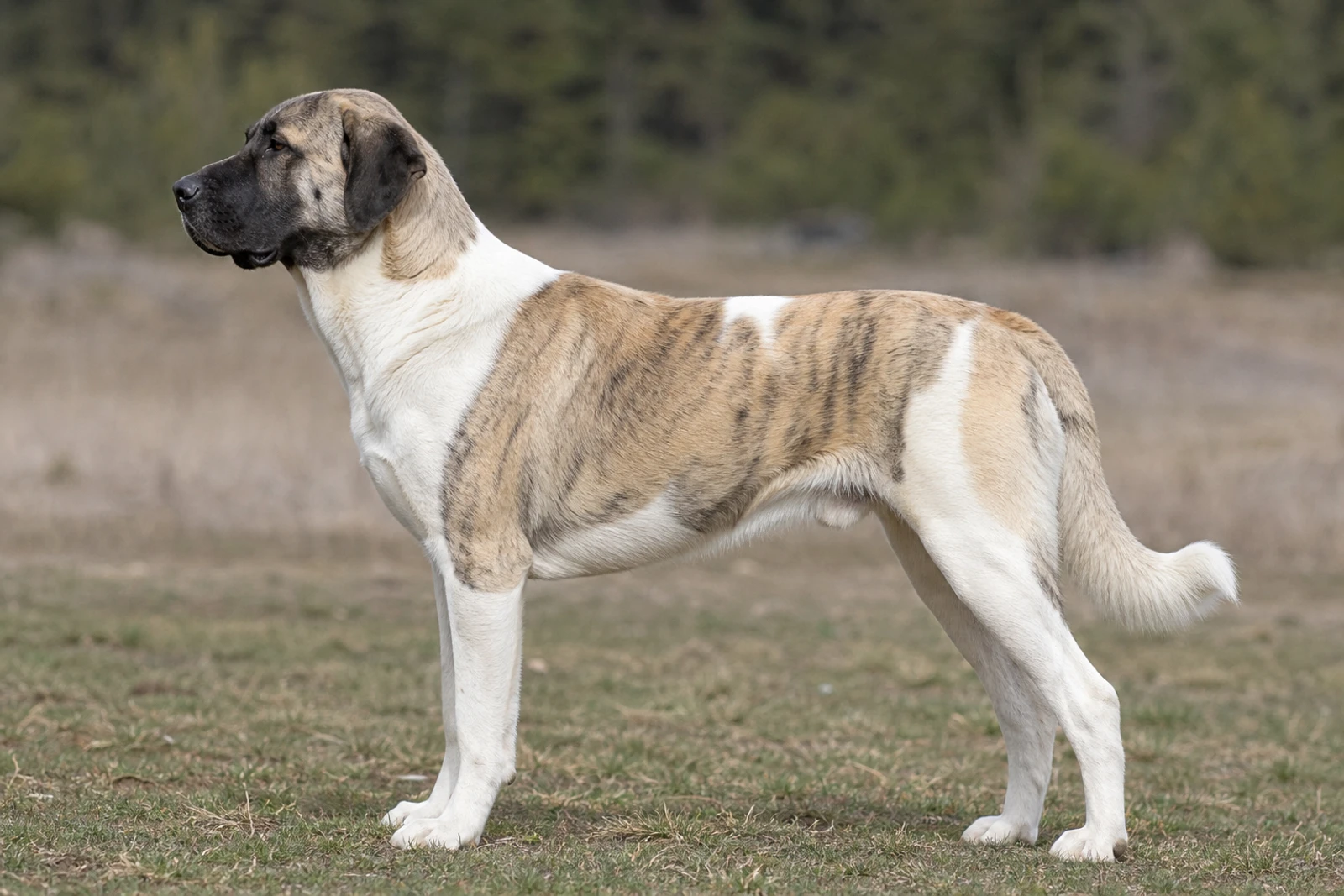
The Anatolian Shepherd Dog is a majestic livestock guardian breed, best suited for experienced owners with ample space. These loyal and protective giants thrive when given a job, excelling at guarding flocks or property. Their independent and calm nature makes them challenging for first-time dog parents. Early socialization is crucial to manage their wariness of strangers and potential dog aggression. With their family, they are devoted but not overly affectionate. Moderate exercise and consistent training help channel their strong instincts. This breed is ideal for rural or suburban homes where they can patrol a large, securely fenced area.
At a glance
- Size
- Giant
- Height
- 28–32 in
- Weight
- 90–141 lb
- Life span
- 12–15 years
- Coat colors
- Fawn, Brindle, White, Pinto, Sesame
- Coat type
- Short to medium double coat
- Group
- Working
How much does a Anatolian Shepherd Dog cost?
Adopt / rescue
$75–$400
Usually includes spay/neuter, first shots, and a microchip.
Buy from a breeder
$700–$2,000
From a reputable, health-testing breeder.
Approximate USD. Prices vary widely by region, breeder, pedigree, age, and coat colour — adopting is the lower-cost and recommended route. Avoid suspiciously cheap “breeders”; they’re often puppy mills.
Estimate the full cost of a Anatolian Shepherd Dog →Want the ongoing number? Estimate the monthly food bill for a Anatolian Shepherd Dog with our dog food cost calculator.
Anatolian Shepherd Dog photos
Views
Front, side, rear and top — the full silhouette.Poses
How the breed sits, lies, moves and plays.Puppy to senior
The breed across its whole life.Expressions
The breed’s range of moods.Close-up details
Eyes, ears, nose, paws, tail and coat.Coat colors
The breed’s recognized colors.Click any photo to enlarge. We show the Anatolian Shepherd Dog from every angle — three views, poses, life stages, expressions, close-ups, coat and colors.
Appearance & size
When you take in an Anatolian Shepherd Dog for the first time, you’re not just looking at a big dog — you’re seeing a purpose-built guardian, all bone, muscle, and dead-serious composure. These dogs stand 28 to 32 inches at the shoulder and tip the scales anywhere from 90 to 141 pounds, with males noticeably larger and heavier-boned than females. Despite that bulk, nothing about them reads clumsy. The body is slightly longer than tall, giving a rectangular silhouette that’s solid but agile — think endurance, not sprint.
The head is broad and only slightly domed between the ears, with a blunt, tapered muzzle that’s roughly half the length of the skull. Dark, almond-shaped eyes sit deep, holding a calm, appraising expression that rarely misses a thing. The ears are V-shaped, set high, and drop flat to the sides; in most dogs they’re solid black, matching the trademark black mask that covers the muzzle and sometimes extends around the eyes. Masking can be a full face shield or just a dusting over the muzzle, but some shade of black pigment around the mouth and eyes is the classic look. A few individuals may lack a mask entirely.
From the side, you see a level topline, a long, muscular neck, and a deep chest that reaches down to the elbows. The ribs are well-sprung but not barrel-shaped, leaving room for a moderate tuck-up. The loin is strong and slightly arched, and the tail is thick at the root, carried low with a loose curl at the tip when relaxed, then flipping high over the back in a spirited curl when the dog is alert. This tail carriage is one of the breed’s most distinct visual signatures in motion.
Viewed from the rear, the hindquarters are substantial and well-angulated without being extreme; the thighs are broad and the hocks slightly let down, which enables the effortless, ground-eating trot a working guardian needs. The front is equally powerful — straight forelegs with heavy bone, wide-set between the shoulders, and a neck that flows cleanly into a deep, prominent sternum.
The double coat varies seasonally. A dense undercoat and straight, harsh outer guard hairs (up to about 4 inches long) give real weather protection. The hair grows longer around the neck and tail, forming a subtle ruff and a feathered tail curtain. Colors run the gamut: every shade of fawn from pale cream to rich mahogany, brindle, solid white, or pinto (white with large colored patches). Not flashy, but strikingly practical — the dog blends into livestock herds and arid landscapes by design.
Shedding is heavy twice a year, and you’ll find fur on everything. That thick coat, combined with the deep chest and upright tail curl when alert, makes the Anatolian silhouette instantly recognizable in any field or yard.
History & origin
The Anatolian Shepherd Dog is a millennia-old livestock guardian from Turkey’s harsh Anatolian Plateau, where shepherds needed a dog that could stand between their flocks and the wolves, bears, and jackals that roamed the region. It’s not a herder — it’s a living fence. For centuries, these dogs were bred for one trait above all others: the ability to work independently, making split-second decisions to protect livestock without a human giving orders. That selective pressure shaped a massive (90–141 lb), 28–32-inch-tall dog with extraordinary endurance and a calm, watchful demeanor.
The dogs are part of a landrace known in Turkey as Coban Kopegi — shepherd’s dogs — with regional variations like the Kangal and Akbash. The Anatolian Shepherd Dog, as we know it today, was developed in the United States from imports that began in the 1950s. A US Department of Agriculture program brought the first dogs to American ranches to test non-lethal predator control against coyotes and feral dogs. The dogs proved so effective that servicemembers and private breeders followed suit, bringing more dogs from Turkey. The Anatolian Shepherd Dog Club of America was founded in 1970, and the American Kennel Club recognized the breed in 1996. Even now, most Anatolians aren’t competing in rings — they’re out on ranches, doing the job they were built for, with a life span that often reaches 12–15 years, a rarity for a giant breed.
Temperament & personality
If you picture a dog that lives to please you, look elsewhere. The Anatolian Shepherd lives to manage threats, and he makes those calls himself. This is a livestock guardian bred to work independently for days without a human in sight, and that legacy shapes every inch of his personality. He is calm, watchful, and utterly convinced he knows best.
A relaxed Anatolian at home can be deceptively easygoing. He often moves with a slow, deliberate weight, saving his energy for when it matters. You might see him sprawled in a doorway, soft-eyed and loose-bodied, tracking the room without moving his head. That quiet stillness is not laziness — it’s a power-saving mode. When he perceives a genuine threat, the shift is instant. A forward lean, a stiffening body, and a locked stare replace the calm in a heartbeat. You need to learn to read that shift, because he won’t bark a warning before he acts on it.
Affection in this breed runs deep but looks nothing like a Labrador’s tail-wagging enthusiasm. He bonds fiercely to his family — his flock — and shows it through proximity and vigilance, not cuddles. He may lean against your leg or follow you from room to room, positioning himself with his back to you and his eyes on the perimeter. Ignore him or isolate him in the yard alone, and you won’t get a sulk; you’ll get anxiety-driven behaviors like nonstop barking, digging, or scent-marking every surface he can find. His sense of territory ties directly to the smell of the people and animals he considers his.
With his own household, a well-raised Anatolian is steady and patient. With strangers, he is politely suspicious at best. He is not a dog who makes instant friends. Guests need a proper introduction and the sense not to loom, stare, or make sudden moves toward family members. His low friendliness score with unfamiliar people and dogs means he is a serious liability in the wrong hands. This is not a dog park dog. It is not a take-to-the-café dog. It is a dog who will independently judge a situation and act, and if you fight him with force, you’ll lose the battle and the trust. He responds to clear, consistent boundaries set with respect — not a heavy hand. Interrupting him while he eats or trying to physically dominate him is a direct route to food guarding or defensive aggression you can’t easily undo.
Around children in his own family, he can be protective to a fault. He often tolerates their noise and movement, but a child’s shriek or rough handling can read as a threat to the flock. Never leave him unsupervised with kids, especially their friends, whom he may not accept as part of his circle. He also tends to view smaller pets as potential charges until proven otherwise, but cats and small dogs need slow, supervised introductions — his instinct to pursue something that runs can override his better judgment.
A few quirks come with the package. He may roll in something foul-smelling, a behavior rooted in scavenger ancestry that likely has nothing to do with disguising his scent and everything to do with him thinking it smells interesting. He marks territory strategically, and if you don’t clean accidents with an enzymatic or vinegar-based spray that kills the odor, he’ll return to the same spot on scent cue alone. Praise him for eliminating outside with an immediate reward, because correcting him indoors after the fact means nothing to a dog who works on his own timeline.
He is brave, possessive of his turf, and almost impossible to out-stubborn. Give him a job — watching a fenced acre, patrolling a quiet rural property — and you see the breed at its finest. Ask him to be a carefree companion, and you’ll spend every day negotiating with a 120-pound strategist who already has a plan.
Good with kids, dogs & other pets
With children
An Anatolian’s patient, watchful temperament can make him a steady presence around kids — but only if you respect his size and instincts. A 90- to 141-pound dog standing 28 to 32 inches tall can knock over a toddler just by turning around. Supervision is non-negotiable. Teach children to approach calmly, never disturb the dog while he’s eating or resting, and avoid screaming or roughhousing that a livestock guardian might read as a threat to his flock.
This is not a breed that naturally bends to a child’s will. Early exposure to gentle, respectful kids helps, and many Anatolians raised alongside children form tight, protective bonds. Still, never leave a young child alone with any giant-breed dog. The dog’s ingrained impulse to guard can kick in if he perceives a visiting child’s play as a scuffle or a stranger as an intruder, so you manage the environment, not just the dog.
With other dogs
Same-household peace with another dog is possible, but it hinges on early, positive socialization and a realistic view of the breed. Many Anatolians — especially males — develop same-sex aggression or selectivity as they mature. If you add a puppy to a home with an existing dog, choose the opposite sex and introduce them on neutral ground. Even then, you’ll need a lifetime of supervision around high-value resources.
Outside the home, this guardian’s default is not to make friends. He was bred to work independently and deter threats, which can translate into intense, silent staring or a swift reaction to an unfamiliar dog who gets too close. Forcing an adult Anatolian who is already uneasy around strange dogs into a dog-park scrum isn’t noble — it’s stressful for the dog and can trigger a fight. Leash walks, distance, and a handler who reads body language keep everyone safer. A dog who is comfortable only with his immediate family often doesn’t need a wider canine social circle.
With cats and small pets
A family cat introduced when the Anatolian is a puppy can become part of the accepted flock. Start introductions behind a baby gate, reward calm behavior, and keep interactions short and supervised for weeks. However, a fleeing squirrel, a stray cat through the fence, or a small pet like a rabbit or guinea pig will likely trigger a hard-wired chase-and-grab response. Never leave your Anatolian unsupervised with pocket pets, and don’t assume indoor acceptance will hold outdoors. Close the puppyhood introduction window and you’ve got a 120-pound dog with a deeply ingrained prey drive — management, not training, becomes your only safeguard.
The socialization clock
What happens between 3 and 16 weeks shapes the adult dog you’ll live with. Puppies from isolated backgrounds — puppy mills, pet store cages — often show fear, anxiety, or reactivity that’s far harder to unwind later. Use the early weeks to introduce your Anatolian to dozens of calm people, leashed neutral dogs, different surfaces, and normal household chaos in positive, low-pressure doses. By the time he hits four months, the window slams shut. After that, you can still improve confidence with steady desensitization, but forcing an under-socialized adult into busy environments adds stress, not resilience.
Respect who your dog actually is. A well-raised Anatolian can be a reliable, unfazed companion around his own family’s children and resident pets, but he’s never going to be a full-time greeter. If your adult dog is content moving through life with just you and a small circle, call that a win — he doesn’t owe the world a meet-and-greet.
Trainability & intelligence
An Anatolian Shepherd Dog is whip-smart — but that intelligence was shaped for independent decision-making, not for jumping at your every command. This is a breed that guarded flocks on remote plateaus, where thinking for themselves without human direction was a survival skill. So typical obedience drills often feel like a negotiation, not a quick back-and-forth of commands and rewards.
You get the best out of an Anatolian by building a genuine partnership. Force, intimidation, or punishment-based methods backfire spectacularly here: they destroy trust and can turn a 140-pound guardian into a deeply anxious or defensive adult. Lean hard into positive reinforcement instead — high-value treats, play, and sincere praise the instant they offer the behavior you want. Even then, don’t expect a slavish desire to please. Your dog needs to understand why your request matters.
Early socialization is non-negotiable. Start before 16 weeks and continue for life. Gradually expose your puppy to a wide variety of people, sounds, surfaces, and safe settings — always at the dog’s pace, never flooding them, and always rewarding calm curiosity. A poorly socialized Anatolian has the size and protective instinct to become a serious liability. The steady confidence you see in a well-adjusted adult is a direct payoff of that early, patient exposure.
Recall deserves a reality check. An Anatolian’s drive to patrol and assess potential threats runs deep. Even a dog with excellent training may weigh your “come” cue against what it perceives as a more pressing issue — a stranger near the fence, a stray animal moving in the distance. You can build a reliable recall with relentless positive work in controlled settings, but off-leash reliability in an unfenced area is never a given. Many owners wisely invest in a rock-solid recall indoors and in safely fenced spaces, and keep the dog on a long line everywhere else.
The training approach that actually sticks is consistency, patience, and a sense of humor. Short, upbeat sessions prevent boredom. End when your dog gets it right, not when you’re frustrated. Your Anatolian will test boundaries; respond with calm, clear limits, not anger. Once they learn a new rule, it’s there for good — they never forget. But getting that buy-in takes time, so measure progress in trust gained, not tricks mastered on a schedule.
Exercise & energy needs
The Anatolian isn’t a dog you can tire out with a jog around the block. You’re living with a giant livestock guardian whose default mode is patrolling for miles at a steady, energy-conserving trot. His physical needs don’t look like a Border Collie’s frantic sprint; they look like a security guard doing rounds—deliberate, focused, and covering real ground.
Plan on 60 to 90 minutes of daily movement, split into at least two sessions. One long forced march often misses the point. He needs to patrol, sniff, and make decisions. A couple of 30‑ to 45‑minute outings, ideally with off‑leash time in a securely fenced area, will settle him far more than a single hour-long leash walk. A solid fence is non‑negotiable—his guarding instinct overrides recall when he spots a perceived threat.
Mental work matters just as much. Puzzle toys, scent games, and short training drills channel that independent problem‑solving brain. Without that, a bored Anatolian will invent his own job: vocalizing at every passerby, excavating the yard, or testing fences.
- Good activities: Long, quiet hikes with room to roam, off‑leash exploration on your own property, carting or draft work, nose work classes, and behavior‑shaping sessions that reward calm thinking.
- Exercise with caution: Repetitive high‑impact stuff—forced running on pavement, fetch on hard surfaces, jumping—can punish growing joints. His growth plates may not close until 18–24 months, so go easy on forced exercise before that.
A tired guardian is a quiet guardian. Skip the structured outlet and daily mental jobs, and you’ll quickly find out just how loud and destructive a 120‑pound independent thinker can be.
Grooming & coat care
The Anatolian’s short-to-medium double coat is built for all-weather livestock work, not for the salon. Most of the year, it’s remarkably self-sufficient. A thorough weekly brushing with a slicker brush or undercoat rake pulls out loose hair and keeps the skin ventilated. For the outer coat, a quick pass with a bristle brush adds back some natural shine, but the real battle is the dense, wooly undercoat.
When the undercoat lets loose
Twice a year, usually in spring and fall, these dogs drop their entire undercoat in a spectacular, tumbleweed-producing blow. For three or four weeks you’ll brush daily — there’s no way around it. During these periods:
- Work outside if you can. A cloud of fine, insulating fuzz will go everywhere.
- Use a long-tooth undercoat rake to gently pull dead hairs from the skin outward, then finish with a slicker.
- A high-velocity dryer (the kind groomers use) flings loose coat out in minutes, but many dogs learn to tolerate it if introduced early.
Outside of shedding season, brushing every three or four days is plenty. Mattes are rare in a correct, harsh-textured coat, but pay attention behind the ears and on the backs of the thighs, where friction can tangle longer guard hairs.
Baths, nails, and the rest
Anatolians have a coat that repels dirt surprisingly well. Bathe them only when they genuinely smell — twice a year is often enough. Overbathing strips the weather-resistant oils and can make the skin dry. Use a gentle dog shampoo and spend a full 10 minutes rinsing; that thick undercoat traps residue.
Nail trims every few weeks prevent foot splay, especially on a giant-breed dog whose weight demands good structure. Check ears weekly for debris, since floppy or semi-prick ears can trap moisture. A wipe with a damp cloth is usually enough; no deep swabbing unless there’s a reason. Daily tooth brushing with a dog-formulated paste heads off the periodontal issues that hit too many large breeds.
Seasonal coat turnover also helps show off what regular feeding should — a harsh, healthy sheen. When you see dry, dull hair hanging on well past spring, it’s often a signal to adjust diet, not grooming frequency.
Shedding & allergies
If you picture a little fur on the couch and a quick weekly vacuum, adjust your expectations — the Anatolian Shepherd Dog is a heavy, year-round shedder with two epic blowouts a year that can fill a trash bag.
Coat basics and year-round fallout
The breed has a dense double coat built for Anatolia’s extremes: a coarse, weather-resistant outer layer and a thick, soft undercoat. The length varies from short to medium, but the shedding output is consistently high. You’ll find short, stiff guard hairs woven into upholstery, clinging to dark clothing, and drifting into corners daily. Most owners run a robot vacuum and still need a proper deep clean every few days.
The seasonal blowout
Twice a year — typically spring and fall — the undercoat comes out in clumps. This two- to three-week event is intense. You can speed it along with an undercoat rake and a high-velocity dryer, but you’ll still pull out enough fluff to stuff a pillow. Outdoor grooming sessions save a lot of indoor cleanup. Between blowouts, a thorough brushing two or three times a week helps keep the hair tumbleweeds manageable, but it never stops the shedding entirely.
Drool adds to the equation
Anatolian Shepherds aren’t the jowliest giant breed, but you will deal with drool. Expect wet spots on floors after a drink of water, and some hanging slobber after meals or on hot days. The combination of shed fur and drool means this is not a clean-coat, tidy-house dog.
The real hypoallergenic picture
No dog is truly hypoallergenic, but an Anatolian is about as far from it as you can get. Allergens are in the dander, saliva, and urine — not just the hair. Regular brushing and baths reduce airborne dander, but they won’t make the breed allergy-safe. If someone in your home has dog allergies, spending at least an hour in close contact with an adult Anatolian before committing is a non-negotiable test. Many allergy sufferers find their symptoms unmanageable with this breed simply because the sheer volume of shed hair spreads dander everywhere.
Diet & nutrition
Feed an Anatolian Shepherd like the giant, working breed he is. What you put in the bowl while he's growing has a direct line to whether those fast-developing bones and joints stay sound, and excess weight later in life will steal years from a dog that can already live 12–15 years.
Puppy feeding schedule
- Four evenly spaced meals a day until 4 months old
- Three meals a day from 4 to 6 months
- Two meals a day from 6 months onward
Transition a new puppy to your chosen diet gradually. Start with lightly cooked, puréed meats, fish, fruits, and vegetables, or a high-quality giant-breed puppy formula. At around 12 weeks you can let him work on a raw chicken wing under supervision — great for mental engagement and jaw strength, but don’t leave him alone with it.
Adult portions and weight management
An adult Anatolian will fall somewhere between 90 and 141 pounds. Feed strictly by his size, body condition, and real exercise load — not by the “recommended” range on the bag. This is not a breed that typically lives for food, which can tempt owners to free-feed. Don’t. Even a few extra pounds multiply the strain on hips and elbows, and obesity quietly creeps up on less active dogs. If your boy eats too quickly, use a food puzzle bowl to slow him down and add mental work; it also helps reduce the risk of bloat in a deep-chested giant.
What a good diet looks like
Aim for roughly 60% raw and cooked meat, 20–30% fruits and vegetables, and the remaining 10% from eggs, plain yogurt, or digestible grains. Because dogs’ jaws shear vertically and they lack salivary digestive enzymes, blending or processing meals improves nutrient absorption. That matters just as much for a senior with worn teeth — purée his food to keep nutrition intake high.
Senior nutrition
Older dogs often do better on smaller, more frequent meals rather than one big daily feed. There’s no solid evidence you need to drop protein, but you do need to watch the scale. As activity tapers off, cut back calories gradually before he gains the weight.
Everyday do’s and don’ts
- Use white rice if his stomach gets upset, or try pearl barley as a high-fiber grain alternative.
- A quick meal can come together from canned fish, cooked vegetables, and scrambled eggs.
- Save the unsalted water from boiling vegetables — it makes a simple, nutritious base for his food when you’re out of stock.
- Never feed him directly from the table. Spoon leftovers into his own bowl to avoid teaching begging, a habit nearly impossible to undo in a dog this size.
- Skip rich, fatty scraps, especially after holidays. A single heavy meal can trigger pancreatitis in a big, deep-chested dog.
If your Anatolian starts treating mealtime like a race, a puzzle bowl or scatter-feeding on a clean patch of grass turns eating into a short problem-solving session — and it’s a lot safer than inhaling his dinner whole.
Health & lifespan
The Anatolian Shepherd Dog typically lives 12 to 15 years — a standout lifespan for a giant breed that can tip the scales past 140 pounds. Hitting those upper years isn't automatic; it hinges on preventive care, smart management, and a breeder who takes health seriously.
Hip and elbow dysplasia top the list of inherited orthopedic concerns. A puppy that grows too fast or carries too much weight early on will pay for it later. Responsible breeders screen breeding dogs with OFA or PennHIP x-rays and share those results openly. They also have a veterinary ophthalmologist examine eyes annually, because entropion — an inward-rolling eyelid that scrapes the cornea — appears in the breed more often than in many others. Mild cases can be managed, but severe ones need surgery. Hypothyroidism can creep in at middle age, bringing weight gain, a dull coat, and lethargy. A simple blood test confirms it, and daily medication usually restores normal energy and metabolism.
Deep chests put Anatolians at risk for gastric dilatation-volvulus (bloat) , a sudden, life-threatening emergency. You lower the odds by feeding two or three smaller meals a day instead of one giant ration, skipping raised bowls, and keeping exercise low-key for at least an hour after eating. Some owners elect a prophylactic gastropexy — tacking the stomach in place — during a spay or neuter surgery, which is worth discussing with your vet.
That thick double coat is built for bitter Anatolian winters, but it can work against the dog in humid summer heat. Full shade, cool water, and access to air-conditioned space aren't optional when temperatures climb. The breed's stoicism is admirable — and dangerous. They often hide pain until a problem is advanced. Watch for subtle shifts: a dog that starts moving stiffly, limps intermittently, or skips a meal is telling you something. Schedule an annual wellness exam, bump it to twice a year for seniors, and don't skip the basics: monthly heartworm prevention during mosquito season (and one month after) and the legally required rabies vaccine.
Weight management matters enormously here. A lean, muscled dog puts far less stress on forming joints and aging spines than a heavy one, so measure meals and resist those big, pleading eyes.
Finally, an Anatolian that's isolated, chained, or handled harshly can tip into chronic stress, which suppresses the immune system and fuels anxiety-driven barking or pacing. Early, positive socialization and calm, consistent boundaries aren't just training — they're a genuine health investment for a strong-willed guardian who needs to feel like a trusted partner, not a prisoner.
Living environment
An Anatolian Shepherd Dog belongs on property, not in an apartment, condo, or any home with shared walls. These are giant (90–141 lb), independent guardians bred to patrol flocks across miles of harsh Turkish plateau. They need a similar setup in modern life: a house with a large, securely fenced yard they can work — patrolling the perimeter is their default activity. A yard measured in acres, not square feet, is ideal. Underground electronic fences are useless; a dog this powerful and driven will blast through one if he decides a threat is on the other side. A 6-foot solid wood or chain-link fence, dug in at the base, is the bare minimum.
This is an outdoor-living breed by design. Their thick double coat insulates them against bitter cold and fierce sun alike, so they can handle a wide range of climates when given shelter and shade. Many Anatolians choose to stay outside even in freezing weather, though they’ll often insist on a vantage point where they can see their entire domain. The coat also means they shed heavily twice a year — a minor detail compared to the barking.
Anatolians are serious noise-makers. They bark deeply, loudly, and at length to warn off anything they perceive as a trespasser, whether it’s a squirrel, a delivery truck, or a neighbor’s barbecue three houses down. Expect barking at night — that’s when a livestock guardian does his best work. If you have close neighbors or noise ordinances, this breed will create constant friction.
Because they were developed to work independently for long stretches, they tolerate being left alone better than many breeds. They won’t panic if you’re gone for a workday, provided they have a secure territory to monitor. What they won’t tolerate is being locked in a small room or a tiny yard with nothing to do. That’s a fast track to digging craters, fence pacing, and nonstop barking. Mental stimulation comes naturally from surveying their property, not from puzzle toys alone — skip the treat ball and give them a window with a view, or better, a flock to guard. If you don’t have livestock, your property itself becomes the flock, and they’ll guard it with unnerving intensity.
Who this breed suits
This breed needs an owner who thinks like a security director, not a pet owner. An Anatolian Shepherd is a 90–141 lb guardian, originally bred to make independent decisions about threats to the flock. If you’re looking for a dog that lives to please you, keep moving. If you’re a confident, experienced handler with a serious property and a job for a dog to do, you’re on the right track.
Who’s a Good Match
The ideal home sits on acreage — a working farm, a ranch, or at least a large, securely fenced yard with a 6-foot dig-proof barrier. Anatolians patrol. They need a territory to own and a purpose, whether it’s watching livestock, protecting a perimeter, or simply being the family’s nighttime sentinel. You’ll do best if you’ve handled an independent working breed before and understand that “no” might be met with a thoughtful pause, not instant obedience. Families with older kids who respect a dog’s space often suit this breed; the dog’s natural protectiveness extends fiercely to its human flock. The 12–15 year lifespan means you’re signing up for a long-term partnership with a calm, watchful, and deeply loyal animal — one that’s quiet indoors and rarely hyperactive, as long as it gets its daily patrol time.
Who Should Think Twice
First-time dog owners should look elsewhere. This is not a dog that forgives training mistakes — a 110-lb guardian that decides the mail carrier is a threat isn’t something you want to manage without serious skill. Apartment living, townhouses, or any home without a proper yard is a non-starter. The Anatolian’s bark is a full-throated alarm, and containing a dog this size in close quarters will make everyone miserable. If you picture off-leash hikes and dog park socialising, this breed will disappoint you. They are reserved with strangers and can be dog-selective, especially between two unneutered males. People who struggle to enforce consistent rules or who want a submissive, snuggly companion should also reconsider. Anatolians bond hard but express affection on their own terms — you won’t get a Labrador-level tail wag for every visitor.
This is a breed that sees a home without a fence as an open invitation to expand its territory. If you can’t provide that physical boundary and the calm, clear leadership that comes with it, you’ll be outmatched.
Cost of ownership
A well-bred Anatolian Shepherd puppy from a breeder who screens for hip and elbow dysplasia typically costs $1,200 to $2,500. Working-line pups from proven livestock guardians can push toward the upper end. Adoption through a breed-specific rescue usually runs $200 to $500 — but you’re still signing up for a giant breed budget.
Ongoing expenses land heavily on food and preventive care. An adult Anatolian (90–141 lb) needs 4 to 5 cups of high-quality dry food per day, costing $80 to $120 a month depending on brand and protein content. You’ll want a large-breed formula to support joint health, not a generic bag from the big-box store.
Grooming is straightforward: a thick double coat that sheds heavily twice a year. A weekly brush handles most of it, with maybe two professional deshedding baths a year (about $40 to $60 each). Nail trims and ear checks are DIY for many owners.
Vet care for a giant with a 12–15-year lifespan requires a bigger cushion. Annual exams, vaccines, and heartworm prevention run a baseline $30 to $50 a month, but the real cost is preparing for emergencies — bloat, cruciate tears, or hip issues. Pet insurance for a giant breed often falls between $60 and $100 a month, less if you build a dedicated savings account. Many owners bank at least $100 monthly total for medical expenses just to stay ahead.
The real upfront gut-punch is infrastructure. Anatolians are escape artists who patrol relentlessly. You need a 6-foot, securely buried fence that can cost several thousand dollars before the puppy even comes home. Factor that in early.
Choosing a Anatolian Shepherd Dog
Start by deciding whether you want a puppy from a breeder or an adult from a rescue — and be brutally honest about your experience level. A 90–141 lb livestock guardian bred to work independently isn't a casual addition to a suburban home. Rescues often place dogs that have already been assessed with families, giving you a clearer picture of temperament and any guarding intensity. If you need the predictability of early socialization and a known health background, a responsible breeder is the better route.
Health clearances you should see
This giant breed can carry a long 12–15 year lifespan, but only if breeders stack the deck in the puppy's favor. Ask for written proof, not just a nod. At minimum:
- OFA or PennHIP evaluation for hips — hip dysplasia is common in giants.
- OFA elbows — elbow dysplasia is another hidden time bomb.
- Eye clearance from a board-certified veterinary ophthalmologist (OFA Eye or CERF) — Anatolians are prone to entropion and other inherited eye issues.
- Cardiac and thyroid screening from a specialist when possible; many good breeders include them.
Bloat (GDV) can run in lines, too. Ask bluntly if any close relatives have died from it. A breeder who can't produce the paperwork for hips, elbows, and eyes is a hard pass.
Red flags you can't afford to ignore
- The breeder won't let you meet at least the mother on-site. A mother who is aggressive, shut down, or completely absent is a warning.
- Puppies are raised in clean kennel runs but never inside a household. Early exposure to human noise, handling, and household chaos matters enormously in a guardian breed that can become wary of strangers.
- Anyone marketing "extra protective" or "naturally aggressive" pups. A sharp, fearful Anatolian is a liability, not a feature.
- Multiple litters on the ground at once, no health guarantee in writing, or pressure to decide that day.
Picking a puppy
When you visit, ignore the one that hangs back frozen or the one that barrels over you without thinking. You're looking for a pup that notices you, investigates with a loose body, and recovers quickly after a startle. Ask how the litter was socialized from day one — crate familiarization, meeting kids, different floor textures. An Anatolian pup raised in a bubble will not suddenly become a stable adult around your neighbor's children. If you're not ready to raise a giant, independent thinker who needs firm, consistent boundaries from eight weeks on, an adult rescue with a known temperament is the safer match.
Pros & cons
-
A deeply loyal guardian with an off switch indoors. Bred for millennia to protect flocks from wolves and bears, an Anatolian reads situations instantly and acts without waiting for a command. You get a dog who will put themselves between your family and anything they deem suspicious, then curl up calmly inside the house once the perimeter is secure.
-
Surprisingly long-lived for a giant breed. With a typical lifespan of 12–15 years, many individuals outlive other dogs their size. Responsible care and screening for hip dysplasia and bloat help them reach those later years in good shape.
-
Clean and low-odor for a working dog. Their short, dense coat repels dirt and sheds mud easily. You won't be scrubbing a wet-dog smell out of your couch, and a quick brush once or twice a week keeps the loose hair manageable outside of shedding season.
-
Independent thinker who doesn't shadow you for direction. This is a breed designed to make decisions alone on a remote hillside. For an experienced owner, that means a dog who won't panic when left alone and won't pester you for constant attention.
-
Massive physical presence and strength, from 90 to 141 pounds. A 32-inch-tall Anatolian who plants their feet is immovable without training. They can pull you off balance on a leash or flatten a screen door if they decide something outside needs investigating.
-
Deeply suspicious of strangers, always. This is not a social butterfly. Expect reserved, aloof behavior with anyone outside the immediate family, and a zero-tolerance response to unfamiliar dogs of the same sex. Management means solid fences, a leash at all times off your property, and a willingness to tell visitors to ignore the dog.
-
Heavy seasonal shedding that catches newcomers off guard. Twice a year, they blow their undercoat in clouds. During those weeks, daily vacuuming and a blower or rake become non-negotiable if you value clean floors.
-
Stubborn to the core when they see no point. Basic obedience feels like a negotiation. Harsh corrections backfire; you need a patient, consistent hand and a reason—real or invented—for them to comply. A 90-pound dog who decides a recall isn't worth it will ignore you without a flicker of guilt.
Similar breeds & alternatives
If you’re drawn to the Anatolian’s rugged independence but want to scope out the other livestock guardians out there, start with three breeds that often come up in the same breath—and understand where they part ways.
Kangal Dog
In Turkey, the Kangal is a distinct regional strain and effectively the same stock that contributed to the Anatolian Shepherd we know in the US. You’ll see a more uniform look: solid tan or dun with a jet-black mask, often a bit heavier-boned. Temperamentally, the overlap is huge. Both are serious, low-to-the-ground guardians that think for themselves. The distinction matters mostly if you’re looking at a registered Kangal from Turkish lines versus an Anatolian from American working lines, so ask the breeder what their dogs are selected for—predator defense on open rangeland versus a general farm guardian can shape drive and sharpness.
Great Pyrenees
This is the breed people often pivot to when they want a guardian who’s a bit more forgiving indoors. A male Pyrenees hits a similar 100–130+ lb and 27–32 inches, but you’re getting a thick double coat in white, often with badger or gray markings. Compared to the Anatolian, the Pyr leans more toward slow, deliberate patrolling and an almost zen-like calm inside the home. That said, they’re notorious nocturnal barkers and shed on an industrial scale. The Anatolian’s shorter coat, leaner build, and sharper suspicion toward strangers make him a more athletic, harder-edged protector. If you need a dog that’s more likely to accept visitors once you give the okay, the Pyr usually wins. If you need a zero-nonsense deterrent that’s quicker on its feet and more naturally aloof, the Anatolian is the call.
Kuvasz
A white Hungarian guardian in a slightly sleeker package: 70–115 lb, 26–30 inches. The Kuvasz is fiercely bonded to its family and can be more demonstrative with known people than the typically stoic Anatolian. That extra warmth comes with a catch—it often means deeper separation anxiety if left alone for long stretches. Both breeds are whip-smart and will overwrite your commands if they think you’re wrong, but the Kuvasz tends to be a bit more agile and upright in its guarding style. Coat care is heavier than the Anatolian’s easy-care dense coat, but less than the Pyr’s. Expect the same high bar for early, relentless socialization, and the same reality that off-leash reliability in public is a coin toss.
Fun facts
- Ancient livestock guardian breed originating from Turkey.
- Their keen hearing and sight make them excellent flock protectors.
- They can thrive in harsh climates thanks to their dense double coat.
- Known for their loyalty and strong bond with livestock and family.
Frequently asked questions
- What is the temperament of an Anatolian Shepherd Dog with children?
- Anatolian Shepherds tend to be loyal and protective of their family, but their independent and reserved nature can make them less interactive with children. Supervision is advised, especially with unfamiliar kids, and early socialization helps them develop tolerance. Their large size and guarding instincts require careful management around young children.
- How much does an Anatolian Shepherd Dog shed?
- Anatolian Shepherds shed heavily, especially during spring and fall coat blows, due to their dense double coat. Regular brushing can help manage loose fur, but prospective owners should be prepared for significant hair around the home. They are not considered hypoallergenic.
- How much exercise does an Anatolian Shepherd Dog need?
- They have moderate energy levels and require daily exercise, such as long walks or time in a securely fenced yard. Mental challenges and tasks are important to keep them satisfied, as they are intelligent and independent workers. A bored Anatolian may develop unwanted behaviors.
- Are Anatolian Shepherd Dogs good for apartment living?
- These dogs are generally not suited for apartments due to their giant size, protective nature, and tendency to bark at perceived threats. They need space to move and secure outdoor areas to patrol. A home with a large, fenced yard is ideal.
- Are Anatolian Shepherd Dogs suitable for first-time dog owners?
- Anatolian Shepherds can be challenging for novice owners because they are independent, strong-willed, and require consistent leadership. Without proper training and socialization, they may become overprotective or difficult to handle. Experienced owners who understand working breeds are typically a better match.
- What are the grooming needs of an Anatolian Shepherd Dog?
- Grooming is low maintenance overall, as their coat resists dirt and only needs occasional brushing to remove loose fur. More frequent brushing during shedding seasons helps control hair, but baths are rarely necessary. Regular nail trims and ear checks should be part of routine care.
Tools & calculators for Anatolian Shepherd Dog owners
Quick estimates tailored to Anatolian Shepherd Dogs — pre-filled with this breed’s size where it matters.
Articles & stories about the Anatolian Shepherd Dog
Sources & standards
This profile follows recognized breed standards from the American Kennel Club (AKC) and the Fédération Cynologique Internationale (FCI), along with established veterinary and breed-club guidance. These describe general breed tendencies — every dog is an individual.