

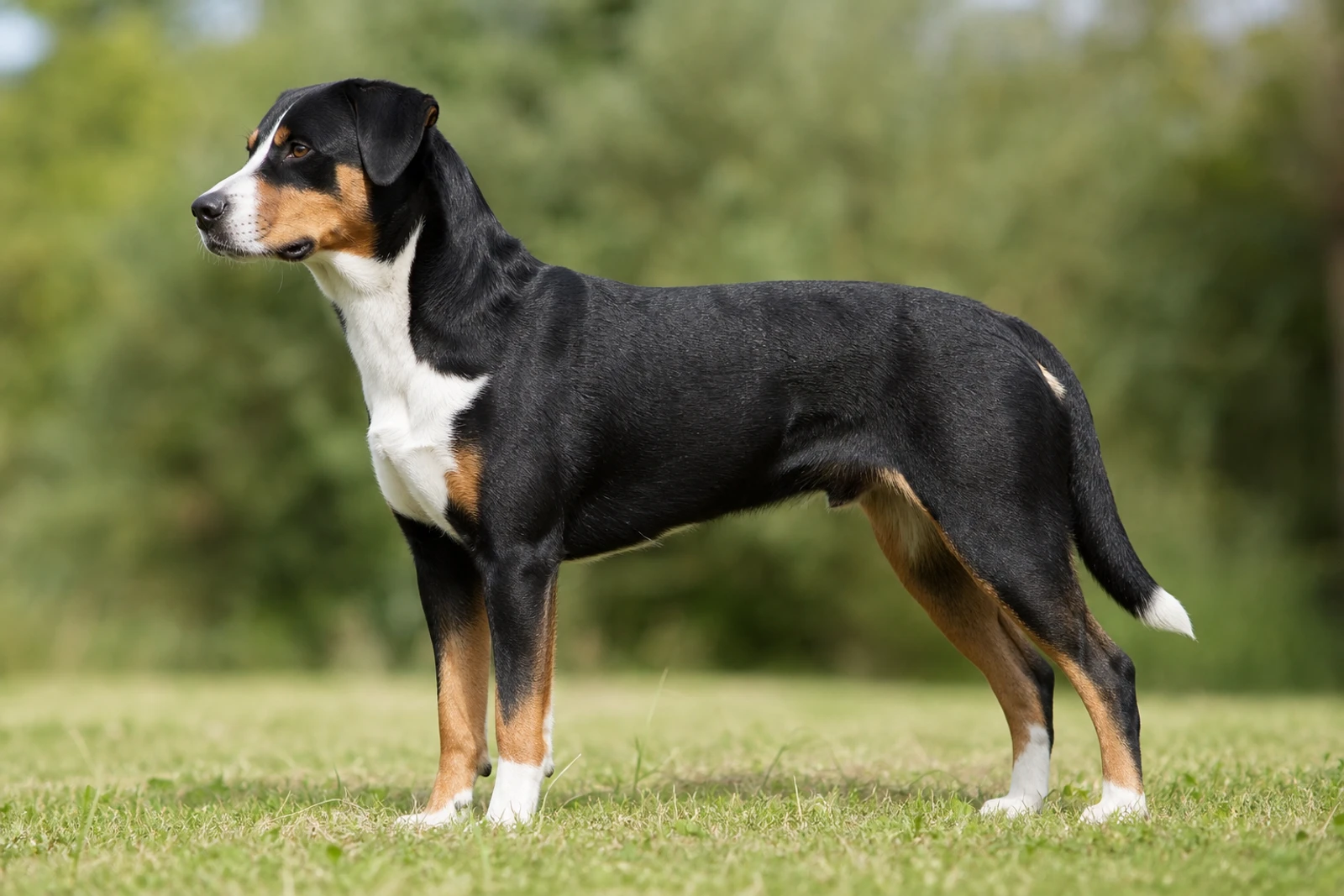
The Appenzell Cattle Dog is a versatile working breed, excelling in herding, guarding, and dog sports. This medium-large Swiss mountain dog forms strong bonds with its family and thrives in active households that can provide ample daily exercise and mental stimulation. Loyal and alert, it makes a vigilant watchdog and a devoted companion for experienced owners. With proper socialization, it gets along well with children and other dogs, though its herding instincts may require supervision around cats and small pets.
At a glance
- Size
- Large
- Height
- 20–22 in
- Weight
- 49–71 lb
- Life span
- 12–13 years
- Coat colors
- Tricolor (black, tan, and white), Havana brown tricolor
- Coat type
- Short, dense double coat
How much does a Appenzell Cattle Dog cost?
Adopt / rescue
$75–$400
Usually includes spay/neuter, first shots, and a microchip.
Buy from a breeder
$700–$2,000
From a reputable, health-testing breeder.
Approximate USD. Prices vary widely by region, breeder, pedigree, age, and coat colour — adopting is the lower-cost and recommended route. Avoid suspiciously cheap “breeders”; they’re often puppy mills.
Estimate the full cost of a Appenzell Cattle Dog →Want the ongoing number? Estimate the monthly food bill for a Appenzell Cattle Dog with our dog food cost calculator.
Appenzell Cattle Dog photos
Views
Front, side, rear and top — the full silhouette.Poses
How the breed sits, lies, moves and plays.Puppy to senior
The breed across its whole life.Expressions
The breed’s range of moods.Close-up details
Eyes, ears, nose, paws, tail and coat.Coat colors
The breed’s recognized colors.Click any photo to enlarge. We show the Appenzell Cattle Dog from every angle — three views, poses, life stages, expressions, close-ups, coat and colors.
Appearance & size
An Appenzell Cattle Dog stands 20 to 22 inches at the shoulder and weighs anywhere from 49 to 71 pounds — a solid, square-shouldered athlete. He’s built more for agility and quick turns on a mountainside than for plodding bulk. The body is slightly longer than tall (roughly a 10:9 ratio), which gives him a compact, stretched-ready look without falling into a low-slung herder silhouette.
The coat is a short, dense double layer: a hard, close-lying topcoat over a thick undercoat. It’s not fuzzy or long — you can clearly see the dog’s musculature underneath. The breed comes in two base colors: black or Havana brown (a rich, chocolate-walnut shade), always with crisp, symmetrical rust-red markings and clean white trim.
- Tan markings sit over each eye (forming the classic “four-eye” spot), on the cheeks, down the legs, under the tail, and often as small triangles on the chest.
- White markings break out as a narrow to medium-width blaze up the center of the forehead and muzzle, a full white chest, white on all four feet, and a white tail tip. Some dogs also show white on the chin or neck. A completely missing blaze or all-white head is a fault.
The head is well-proportioned, not overly broad, with a flat skull and a moderate stop. The eyes are small, almond-shaped, and dark brown — they give a keen, alert expression that never looks hard or suspicious. Ears are medium-sized, heavy-set triangles that hang down close to the cheeks and lift slightly at the base when the dog is paying attention.
From the front, the Appenzeller strikes you with that high-contrast white blaze splitting a dark head, the rust spots glowing above the eyes like little eyebrows. The forechest is pronounced and well-muscled, with straight, sturdy forelegs set under the body. From the side, you’ll notice a deep chest reaching to the elbows, a level back, and a slight tuck-up at the belly — a picture of a dog built for explosive movement. The signature feature from any angle is the tail: it’s carried in a tight, crisp curl over the haunch, never loose or hanging. From the rear, that tail sits high, the hindquarters show a clean, muscular second-thigh, and the rear pasterns are parallel, adding to the impression of a dog who can turn on a dime.
The whole package is a medium-boned, sinewy climber’s dog — neat, tidy, and unmistakable once you’ve seen that tail curl and bright white blaze coming up a trail.
History & origin
The dog you see today — a compact, muscular tri-colored cattle driver with a tail curled tight over its back — grew straight out of the steep green pastures of Appenzell, Switzerland. This corner of the Alps, divided into two half-cantons, is where a farm dog had to do everything: drive stubborn dairy cows up and down mountain paths, guard the homestead from strangers, and even haul small carts loaded with milk cans or cheese. The Appenzell Cattle Dog was built for that life.
Its deeper ancestors are the heavy molosser-type dogs that the Romans marched across the Alps more than 2,000 years ago. Those mastiff-like herders and guardians crossbred with local Alpine dogs, eventually splitting into the four Swiss Sennenhund breeds you may know: the Greater Swiss Mountain Dog, the Bernese Mountain Dog, the Entlebucher Mountain Dog, and the Appenzeller. What sets this one apart is right there in the high-set, tightly curled tail — it’s the only Sennenhund that carries its tail like that. That feature, along with the breed’s trademark “Herr, geh voraus!” bark-and-dash herding style, got cemented in farmyards long before anyone wrote a standard.
For centuries the dogs worked without much written record. By the late 1800s, however, the breed was in real trouble. Farming practices changed, and the Appenzell Cattle Dog nearly vanished. In the early 1900s a Swiss forestry official named Max Siber scoured the Appenzell countryside and found only about 50 specimens worth saving. He led a systematic revival, and in 1906 the first breed club was founded in Altstätten. The standard was finally put on paper, and a studbook began.
- Original jobs: driving and guarding cattle, protecting the farm, pulling small carts (earning the old nickname “poor man’s horse”)
- Region: Appenzell Ausserrhoden and Appenzell Innerrhoden, Switzerland
- Recognition gap: The breed gained Swiss national acceptance relatively late compared to the Bernese or Greater Swiss, largely because of its small, isolated population.
Even today, the Appenzell Cattle Dog remains rare outside Switzerland. A dedicated handful of breeders have exported dogs to Europe and North America, but global numbers are still measured in the low thousands. Most still live on working farms in their home cantons, where they earn their keep the old-fashioned way: trotting alongside dairy cows, barking directions, and watching over the place with a sharp eye. That deep working heritage is why an Appenzeller in a pet home needs a job — not just a short walk, but a real mental and physical outlet that nods to those mountain roots.
Temperament & personality
An Appenzell Cattle Dog is a thinking, working machine wrapped in a medium-large, tri-color package. He doesn’t just want a task—he needs one, every day. A quick walk around the block barely registers. Count on 60–90 minutes of real exercise: running, hiking, herding games, or advanced training sessions that tire out his agile brain as much as his body.
Energy and purpose
This dog was built to drive cattle over Swiss mountain passes. That drive stays with him. If you’re looking for a low-key cuddler, look elsewhere. He settles indoors only after his work quota is met. Puzzle feeders, scent games, and trick training help burn the mental fuel that otherwise turns into obsessive chewing, fence pacing, or barking at every leaf that falls.
Territorial by nature
He takes property lines seriously. You’ll notice him watching the front window, sounding the alarm at a distant car door, and deciding which strangers deserve a deep-chested warning. Intact males especially may urine mark fences, sheds, and new objects around the yard—scent cues they recognize later as “mine.” If marking drifts inside the house, clean the spot with an enzyme cleaner or a vinegar spray (white vinegar and water) to break the odor cue. Many Appenzells won’t re-soil a spot once the signature is truly gone.
Family life and affection
With his own people, he’s deeply loyal and can be surprisingly gentle, though he’s never a pushover. He’s affectionate on his terms, often choosing to lie near you rather than on top of you. Small children he knows are usually safe, but his herding instinct may put him at heel level with a running kid, and a quick nip can happen. Supervise, and teach kids to be still when the dog gets excited. With guests and unfamiliar dogs, he defaults to suspicion. Early, continuous socialization—to dozens of people, dogs, and situations—is non-negotiable. Without it, wariness can tip into aggression, especially with same-sex dogs. A first-time owner or a home that hosts frequent parties will find him a hard fit.
Training the strong-willed Appenzell
He’s smart, independent, and not impressed by heavy-handedness. Force backfires. He responds to a calm, consistent handler who makes the rules clear and gives him a reason to cooperate. Short, positive sessions that feel like a job rather than a chore hold his attention. You’re earning his respect, not demanding it. When you do, he becomes a fast, inventive partner who watches your every move.
Odd behaviors and quirks
Don’t be shocked if he rolls in something foul—dead worms, manure, garbage. No one fully knows why dogs do this, but theories range from masking their own scent to advertising a tasty discovery to the pack. To him, it may just smell like a great cologne. A strong leave-it cue and a ready hose will be your allies. You’ll also see intense chewing from puppyhood through old age; it’s not mischief for its own sake but a jaw-strengthening, tooth-cleaning drive. Offer durable rubber toys and raw marrow bones to spare your furniture.
Watch the way he carries himself. A forward-leaning posture with a fixed stare signals confidence and a possible challenge. A backward lean, lip lick, or yawn means he’s uncomfortable and wants out of a situation. When his body is loose and his eyes are soft, you’ve got a content dog.
Leave him alone for long stretches and you’ll pay the price. Isolation breeds anxiety that spills into nonstop barking, shredded drywall, or indoor elimination. He’s built for partnership and proximity. A tired Appenzell who knows his job and trusts his leader is quiet, reliable, and fiercely devoted. That version comes from daily commitment, not a contented accident.
Good with kids, dogs & other pets
The Appenzell Cattle Dog’s steady, patient temperament gives them a real edge with kids — but that comes with a built-in need to manage their herding instincts. At 49–71 pounds and up to 22 inches at the shoulder, they’re sturdy enough to handle rowdy play, yet a young child can be easily knocked over by a full-speed dog navigating a tight corner. Always supervise interactions, especially with toddlers, and teach kids not to run screaming through the yard around a breed that has “cattle” in its name. A well-bred Appenzell isn’t aggressive, but chasing and heel-nipping are part of their wiring. Redirect that energy into fetch or structured herding games, and you’ll have a family dog that’s both tolerant and engaged.
-
Other dogs: Early and broad socialization — starting between 3 and 14 weeks — makes the difference between an adult who greets other dogs calmly and one who reacts out of insecurity. Puppies should meet a wide variety of friendly, healthy dogs on neutral ground, and those positive exposures need to continue into adulthood. If you’re adopting an adult who missed that window, don’t force dog-park meetups. Some Appenzells are content with their human family and an occasional known dog friend; forcing unwanted interactions can spark fights and amplify fear, not fix it.
-
Cats and small pets: Their background as a working farm dog means instinct often overrides intention. A cat who stands its ground and was raised alongside the puppy can coexist peacefully, but a sprinting cat or a fluttering guinea pig quickly triggers a chase response. Keep pocket pets securely housed and introduce dogs to cats gradually, using a leash and high-value treats to reward calm behavior. Even a dog who “grew up with” a rabbit shouldn’t be left alone with one — it takes a split second for play to flip into prey drive.
-
Household rhythms: Appenzells are deeply companionable. They don’t do well left alone in the backyard or crated for ten-hour stretches. Isolation can breed noise, destructive chewing, and full-blown separation distress. Build in daily mental work — puzzle toys, scent games, obedience drills — and practice short, positive departures early so the dog learns that alone time ends.
The hard truth is that the prime socialization period slams shut around 12–16 weeks. Every person, sound, floor surface, and animal you introduce during that stretch becomes a building block for a confident adult. Miss it, and you’ll be swimming upstream against noise phobias, over-excitement around new dogs, and a dog who freezes on the vet table. That doesn’t mean you can’t help an older, under-socialized Appenzell feel more at ease — it just means you’ll never get those easy, malleable puppy weeks back.
Trainability & intelligence
The Appenzell learns fast — often after just a handful of repetitions — but “fast” doesn’t mean “automatic.” This is a thinking dog bred to make independent choices while herding cattle on mountain slopes. If training feels predictable or flat, he’ll check out and start writing his own rulebook. Keep sessions short, varied, and genuinely challenging. A dog that nails a “sit” in the kitchen is the same dog who might completely ignore you when a bicycle zips past out on a walk. Work commands in different places, with increasing distractions, and make every correct choice worth his while.
What actually motivates him
Food rewards work, but for many Appenzellers a squeaky tug toy, a thrown ball, or an excited “Yes! Good dog!” hits harder. Figure out your dog’s currency and use it. Praise alone isn’t enough for a breed that thrives on active partnership — he needs to see that listening to you leads to something better than whatever he was about to do on his own. That independent streak means you negotiate, not dictate. When you build the habit of paying attention to you being the most rewarding part of his day, his responses become snappy and reliable.
Why recall can’t be an afterthought
A strong recall is possible, but it will never be a given. An Appenzeller who spots a squirrel, a runner, or another dog might weigh your “come” against that prize and decide the prize wins. You’re up against centuries of genetic wiring that told this dog to notice and manage movement — without waiting for a human’s okay. Use a long line in open areas until your recall proofing is solid. Reward recalls with over-the-top jackpots: a full handful of chicken, a wild game of tug, never a correction for taking too long. If coming back predicts something unpleasant, you’ll teach him to keep his distance.
The pressure points you’ll face
- Suspicion of strangers. Without early and ongoing socialization, his natural wariness can curdle into reactivity. Introduce him to a wide variety of people, sounds, and surfaces between 3 and 14 weeks, and keep up the exposure through adolescence.
- Herding hardwiring. Nipping heels, circling kids, and chasing fast-moving objects are all normal, but not acceptable in a pet home. Redirect to a toy or a structured game, and teach a rock-solid “leave it.”
- Sensitivity. Appenzellers shut down under harsh voices or physical corrections. Punishment buys you little progress and a big trust debt. You’ll get far more cooperation with calm, clear consistency and endless patience.
The training approach that sticks
Start from day one in your home. Use positive reinforcement to shape everything from house manners to advanced cues. Puzzle toys, scent work, and agility-type challenges give his brain a real workout and prevent the destructive creativity that boredom triggers. Set boundaries fairly and enforce them with compassion — every family member should handle commands the same way, because this dog will notice and exploit inconsistency in a heartbeat. When you treat training as a two-way conversation instead of a lecture, the Appenzeller puts his whole self into the job. Once you’ve built that trust, the real challenge isn’t getting him to listen — it’s keeping up with how much he’s capable of learning.
Exercise & energy needs
Plan on giving this dog a real job every day, or it’ll invent one—and you probably won’t like what it comes up with.
An Appenzell doesn’t take a walk; a casual leash stroll around the block barely registers. These are medium-large, tireless drover’s dogs, built to move cattle across Swiss mountain slopes. That means they need 60 to 90 minutes of vigorous, whole-body exercise daily—split into at least two sessions. A morning 45-minute off-leash hike with elevation, an evening 30-minute game of fetch or flirt-pole chase, or a hard run in a safely fenced field gets close to what they require. Anything less, and you’ll see the fallout: barking marathons, furniture restructuring, and attempted herding of the kids, cats, and delivery trucks.
Intensity matters as much as duration. This is a breed that wants to gallop, pivot, and think while in motion. They excel at sports that tap both stamina and brains. Herding trials are the gold standard, but agility, treibball (urban herding with large balls), scent work, and advanced obedience give them the same mental-physical combo. On days when a long outdoor session isn’t doable, use puzzle toys, frozen Kongs, and indoor nose games to work their mind—but these are supplements, not replacements.
Consistency beats weekend warrioring. These dogs thrive on a predictable rhythm. Puppies under 12–18 months need a careful cap on repetitive high-impact moves (no endless ball-chasing on hard surfaces) to protect growing joints, but unstructured free play in the yard is fair game.
A realistic target day: a 45-minute morning off-leash hike or trail run, a 30-minute evening session with a herding ball or a new trick-training challenge, and a meal-dispensing puzzle toy at midday to keep the gears turning.
Grooming & coat care
You’re dealing with a true double coat here — a dense, insulating underlayer and a harsh, weather-shedding outer coat. It’s practically designed for mountain cattle drives, which means it’s built to handle mud and brush with minimal fuss. The trade-off: this coat sheds a lot, and it does it on schedule. Twice a year, usually spring and fall, the undercoat comes out in clouds. Outside those peak blowouts, you’ll still find stray black, white, and tan hairs on your floors.
Brushing routine
For most of the year, two or three solid brushings a week keep things under control. Reach for a metal slicker brush with rounded pins first — it cuts through the topcoat and pulls loose undercoat free without scratching skin. Follow up with a boar‑bristle brush; it spreads natural oils through the outer hairs and brings up a clean, glossy shine on that tri‑color pattern. During shedding season, you’ll want to swap that schedule for daily 5‑to‑10‑minute sessions. A wide‑toothed undercoat rake is your best friend then; it grabs dead fuzz that a slicker misses and dramatically reduces the tumbleweeds migrating across your house.
Bathing
These dogs aren’t prone to that “doggy” smell, and frequent washing strips the weather‑resistant oils that keep the coat functional. Bathe only when they’ve rolled in something truly foul or the coat feels grimy — every three to four months is plenty. Use a mild dog shampoo and rinse thoroughly; trapped soap residue can irritate that dense undercoat. Between baths, a quick wipe‑down with a damp cloth and a brush‑out handles most dust.
Nails, ears & teeth
Monthly nail trims are a must. If you hear clicking on hard floors, you’re overdue. Check those drop ears weekly for dirt or redness, especially after weekend hikes, and give them a gentle wipe with a vet‑approved cleaner. Daily tooth brushing (or dental chews on off days) rounds out the routine — the breed’s lifespan is a healthy 12 to 13 years, and keeping those teeth in shape supports that longevity. When the winter coat starts blowing in late spring, you’ll be glad you’ve got the rhythm down.
Shedding & allergies
If you're looking for a dog that keeps your dark trousers clean, the Appenzell Cattle Dog will humble you fast. This breed sheds heavily, all year long. The coat is a short, tight double layer built for Alpine weather, and it drops a steady rain of hair onto floors, furniture, and every piece of clothing you own. Twice a year — usually spring and fall — the undercoat blows out in earnest. During those weeks you can expect to fill a brush (or three) every day and still find pale, wispy fluff clinging to rugs and baseboards. A good slicker brush, an undercoat rake, and a powerful vacuum are not optional gear, they’re survival tools.
Drool is less of a headline than the shedding, but it’s not zero. Most Appenzellers will wipe a wet chin on your knee after a long drink, and many get slobbery when they’re watching you prepare a meal. A few individuals are genuinely wet-mouthed, so ask the breeder what their lines tend to produce.
Hypoallergenic? No. This breed is about as far from allergy-friendly as you can get. The constant shedding spreads dander and hair throughout the house, and that’s exactly what triggers reactions. If someone in your household has dog allergies, don’t rely on a “maybe.” Spend multiple hours visiting adult Appenzellers in a home setting — not just a brief meeting at a kennel — before you even think about bringing one home. The reality is that daily antihistamines and a HEPA filter in every room may still not be enough when a dog sheds this much.
Diet & nutrition
Food motivation runs high in the Appenzell — these dogs were bred to work, but their appetite can easily outrun their actual calorie burn. An adult female commonly sits between 49 and 60 pounds, a male 60 to 71. That frame needs to stay lean and muscular, because extra weight hammers joints that are already working hard. Feed two measured meals a day, not a bottomless bowl. Start with the bag’s chart for your dog’s target weight, then tweak based on ribs you can feel under a thin fat cover. A dog running fence lines for hours burns through way more fuel than a weekender on leash walks.
Puppies under four months thrive on four small meals; drop to three meals by six months, then settle into the adult two-meal rhythm. Transition a new pup slowly — lightly cooked, puréed meats and veggies or a quality large-breed puppy formula that won’t push growth too fast. Raw chicken wings can be introduced around 12 weeks, always supervised.
For home-cooked eaters, a rough split works well: about 60% muscle and organ meat, 20–30% dog-safe fruits and vegetables, and 10% extras like eggs, plain yogurt, or grains. Since dogs lack salivary enzymes and their jaws only move vertically, steaming and puréeing vegetables makes the nutrients way more accessible. Adding a scoop of blended pumpkin or green beans to kibble bulks up a meal without empty calories — helpful for a dog who acts starving no matter what. Fast eaters benefit from a puzzle bowl to slow things down and reduce bloat risk.
Weight sneaks up fast if exercise dips. When an Appenzell is sidelined by injury or a slow season, cut portions the same day. Seniors often need smaller, more frequent meals as they slow down, but don’t slash protein — they still need muscle maintenance. Never free-feed, and keep fatty table scraps (holiday ham, gravy, skin) out of reach; a single rich meal can trigger pancreatitis. Serve any leftovers strictly in the dog’s own bowl to sidestep begging.
Health & lifespan
An Appenzell Cattle Dog typically lives 12 to 13 years, and a thoughtfully bred dog with consistent care often stays mobile and mentally sharp right into early old age. That’s not a guarantee, but knowing what responsible breeders screen for lets you stack the deck.
Joint issues are the first thing to ask about. Like many mid-to-large working dogs, Appenzellers can be prone to hip and elbow dysplasia. A reputable breeder will have both parents’ hips and elbows scored through OFA or PennHIP and will share those results without hedging. Eye health matters too—progressive retinal atrophy and hereditary cataracts appear in the breed. Annual eye exams by a veterinary ophthalmologist on any dog used for breeding are a strong sign you’re dealing with someone who cares about the long haul. Some lines also carry a risk for dilated cardiomyopathy, so ask directly about cardiac clearances.
Bloat is a real, scary threat in deep-chested dogs like the Appenzeller. You can lower the odds by feeding two or three smaller meals a day and keeping your dog quiet for at least an hour after eating—no hard running or wrestling. Combine that with a serious tendency toward food motivation, and weight management becomes a daily priority. An extra 10 pounds on a 55- or 60-pound frame puts unnecessary strain on joints and can quietly shorten that 12- to 13-year lifespan. Measure meals, ration treats, and match calories to real output: this is a dog that needs a solid hour of purposeful movement, not just a sniff around the yard.
Routine preventive care catches problems early. Monthly heartworm prevention during mosquito season—plus one extra month after it ends—is straightforward and essential. The rabies vaccine is law, and there’s no effective treatment once symptoms develop, so you don’t skip it. Schedule an annual wellness exam, then every six months once your dog turns seven. Your vet can spot subtle eye changes or a stiff gait long before you notice them at home. Appenzellers carry a dense double coat that shrugs off cold weather, but it also means they overheat faster than you’d expect. Watch for excessive panting on warm days, and always have shade and water handy. Skin issues are usually minor—a hotspot, some seasonal itching—but a suddenly greasy coat or constant scratching is a cue to review diet and environment.
Stress hits this breed harder than many realize. Early socialization and fair, consistent handling reduce the anxiety that can spiral into barking fits or repetitive behaviors. A bored, isolated Appenzeller isn’t just loud—he’s more vulnerable to stress-related illness. When you notice shifts in energy, appetite, or that trademark stubborn spark, call the vet. Often it’s nothing, but this is a dog that hides discomfort well, so small signals deserve your ear.
Living environment
An Appenzell Cattle Dog needs elbow room and a job, not just a yard. This is a large, powerful working breed—20 to 22 inches tall, 49 to 71 pounds—bred to drive cattle across Swiss mountain slopes. A house with a securely fenced, generously sized yard is the baseline. These dogs can scale or dig under flimsy fencing, and they’ll patrol every inch of it, so plan on six-foot barriers and buried wire if needed. Even with a yard, the real outlet is the off-property work you do together: long hikes, farm chores, or vigorous herding games.
Apartment living rarely works. The combination of size, energy, and a strong instinct to sound the alarm makes them a tough fit. They’re naturally vocal guardians—you’ll get a booming bark for every delivery truck, squirrel, or neighbor walking past. Without consistent training, that can turn into nuisance barking that puts a strain on close-quarters living.
They shrug off cold weather thanks to a dense double coat, and they’ll happily bound through deep snow. Heat and humidity are a different challenge. Keep outdoor exertion to early mornings or evenings in summer, watch for signs of overheating, and provide plenty of shade and cool water.
Time alone is a real pain point. Appenzells bond intensely and can slide into separation anxiety if left for a full workday with nothing to do. A bored, isolated dog will dig, chew, or bark nonstop. Plan on a midday dog walker, doggy daycare, or a schedule that folds them into your daily rhythm. Two solid sessions of hard exercise—think an hour of running and mental work each morning and evening—are not optional; they’re what keeps the dog calm and sane indoors. Puzzle toys and scent games between those outings help settle a brain that’s always scanning for something to manage. If you can weave that level of activity and company into your life, you’ll have a sharp, biddable partner. If not, a more easygoing breed is a fairer fit.
Who this breed suits
The right owner
You already run, hike, or bike hard at least five days a week — and you want a dog who’ll sprint alongside for six, eight, ten miles without missing a stride. That’s the Appenzell. This dog isn’t a weekend warrior’s companion; he needs a solid hour or more of intense, moving exercise daily, plus mental work that wears out his sharp herding brain. If your sport is canicross, skijoring, agility, or mountain treks, you’ve found a four-legged partner who treats every outing like the best day of his life.
He clicks with experienced owners who genuinely enjoy a dog that thinks for himself — and occasionally out-thinks you. You’ll need to be faster than his cleverness, because an underemployed Appenzell invents his own job description: excavator, fence climber, alarm system that ignores the off switch. He’ll test your consistency, so this suits people who already run a structured household and aren’t rattled by a dog with strong opinions.
Active families with sturdy, dog-savvy kids (think grade-school age and up) can do well, as long as everyone respects that the cattle-driving instinct is real. That means nipping at heels, herding runners, and policing rowdy play — manageable if you channel it into directed work, but a serious liability around toddlers or visiting squealing little ones who dart unpredictably.
Singles or couples with a large, securely fenced yard and a passion for dog sports will get the most out of this breed. A rural or suburban setting with space to patrol and a job — whether it’s moving livestock, practicing advanced obedience, or learning tracking — keeps his mind quiet. Without that daily mental drain, the intensity that makes him brilliant curdles into destructive restlessness.
Who should think twice
First-time dog owners will find the Appenzell punishing. He doesn’t forgive beginner mistakes gently; he’ll run the house if you let him. Seniors or anyone with limited mobility risks getting knocked over or cornered by a 55-pound dog who still herds by body-slamming and ankle-grabbing when overstimulated. Apartment living is a non-starter — his piercing alert bark and need to patrol a territory will fray nerves fast.
Think long and hard if you work full-time away from home. Separation anxiety and boredom in this breed translate to chewed baseboards, shredded couches, and a vocal performance that alienates neighbors. Even a dog walker midday rarely suffices; this is a dog who needs you present and engaged, not just briefly exercised before you leave for nine hours. He’s not the dog who greets all strangers with a wag — his natural reserve and protective streak mean you’ll manage a guardian who watches the delivery driver like a potential cattle rustler. If your lifestyle is quiet, sedentary, or built around spontaneous houseguests, you’re signing up for a mismatch you’ll both feel every single day.
Cost of ownership
Buying an Appenzell Cattle Dog in the United States typically costs between $1,800 and $3,500 from a breeder who screens for health and temperament. The breed is rare here, so expect a waitlist and possibly a road trip — puppies don’t pop up on every corner. Avoid the temptation of a lower price from an unverified source; cutting corners upfront often leads to expensive behavior or health fixes later.
Monthly costs stack up fast for a 49–71 lb dog bred to work all day. Food will be your biggest regular bill: a high-quality diet runs $70–$110 a month, and an active Appenzell on raw or fresh food can push that higher. Grooming is minimal — a double coat that sheds heavily twice a year. You’ll spend maybe $20–$40 every month or two on a self-wash and a good undercoat rake, plus the occasional professional deshedding session.
Vet care runs $500–$800 annually for checkups, vaccines, and preventatives, but budget for surprises. These dogs throw themselves into physical work; ACL tears and paw injuries aren’t uncommon. A good pet insurance policy ($35–$55 a month) blunts that risk.
- Initial supplies: crate, sturdy harness, puzzle toys, elevated bowls, and a long training lead — $300–$500 one-time.
- Training: group obedience ($150–$250 for a 6-week course) is non-negotiable, and many owners end up in ongoing agility, herding, or nosework classes at $25–$50 a week.
- Hidden damage costs: an under-exercised Appenzell will remodel your drywall, baseboards, and garden. Factor in the price of a good trainer or dog walker ($20–$30 per walk) if your schedule ever slips.
Realistically, year one can hit $4,000–$5,500 including purchase, and a typical year after that lands between $2,000 and $3,500. The real cost isn’t just money — it’s the daily 90 minutes of hard exercise and problem-solving this breed demands before it settles at your feet. Skip that, and you’ll pay in chewed door frames and dug-out irrigation lines.
Choosing a Appenzell Cattle Dog
Choosing an Appenzell Cattle Dog means tracking down one of the few responsible breeders in North America — or getting lucky with a breed-specific rescue. This is not a breed you find in a pet store or a Craigslist ad, and the wait for a well-bred litter can stretch months. That filter alone weeds out most bad sources.
Health clearances you can verify
A reputable breeder screens breeding stock for the problems that can affect a working mountain dog. Demand paperwork, not promises. For Appenzellers, that means:
- Hips and elbows: OFA or PennHIP results. Scores should be in the normal or excellent range. The breeder should give you the actual numbers, not just “vet checked.”
- Eyes: A current exam from a veterinary ophthalmologist — CERF or OFA eye certification, not a regular vet glance. Inherited eye diseases like progressive retinal atrophy can show up in the breed, and an annual exam is the minimum.
- Heart and kidneys: Some lines have a history of cardiac issues or a rare inherited kidney disease. Breeders who know their pedigrees may provide cardiologist reports or DNA test results for familial nephropathy (when available). Ask directly, “Have you seen heart or kidney problems in your dogs’ relatives?”
A breeder who skips any of these, or dismisses the need because “my dogs work all day,” is waving a red flag you shouldn’t ignore.
Red flags in a breeder
- Multiple litters on the ground at once or a fresh litter every month — Appenzeller litters are not a production line.
- No contract that requires you to return the dog if you can’t keep it, and no written health guarantee.
- Refuses to let you meet at least the mother (often in her home environment) or shows puppies in a garage, parking lot, or off-site.
- Ships a puppy without ever speaking to you on the phone or video call; a good breeder interviews you as hard as you interview them.
- Won’t discuss the parents’ working titles, temperament tests, or how long the line has been free of hip dysplasia.
- Pressures you with “just one left” urgency for a 5- or 6-week-old pup — any Appenzeller should stay with its littermates until at least 8 weeks.
Rescue as an alternative
Appenzellers occasionally end up in rescue, often because an owner underestimated their intensity. Breed-specific rescue networks exist, though they are tiny. An adult dog can be a fit if you’re ready for a 50- to 70-lb powerhouse that already knows some commands and needs structure, not leniency. Expect the rescue to ask about fenced yards, dog experience, and daily activity plans — they know what a bored Appenzeller can dismantle.
Picking a puppy from a litter
At 7 or 8 weeks, a healthy Appenzeller puppy looks like a small, plush bear that is already opinionated. The one you want will trot over to investigate you, maybe grab a shoelace, then bounce back. They should recover quickly from a sudden noise or a gentle startle (a clap, keys dropping) — curiosity, not panic, is the normal reaction. Avoid the puppy that freezes, hides, or shows teeth when handled. A little independence is fine; a dog that wants nothing to do with people at this age rarely turns into the steady working partner the breed is meant to be.
Check the obvious: clear eyes, clean ears, a coat free of bald spots, and a belly that isn’t bloated. The breeder should hand you a folder with health records, vaccination dates, and a contract — not just a puppy. That dog will stand 20 to 22 inches tall and carry 49 to 71 pounds for its 12- to 13-year life. Getting this first step right gives the rest of that life the foundation it needs.
Pros & cons
Pros
- Quick, willing learner who picks up new commands fast and genuinely needs a job to stay happy — trainability is off the charts.
- Deeply loyal and protective without tipping into outright aggression; they bond hard with their people and take household watch duty seriously.
- Sturdy, compact athlete — at 49–71 lb and 20–22 in, they’re large enough to handle rough mountain work yet agile enough to turn on a dime.
- Low-maintenance coat: a short double layer that needs only a weekly brushing, though you’ll see heavier shedding a couple times a year.
- Generally robust health, often living 12–13 years. Responsible breeders screen for hip dysplasia and PRA, keeping hereditary trouble low.
- Versatile partner who’ll hike, herd, or crush dog sports like agility, nose work, and competitive obedience.
Cons
- Serious exercise demands — a casual stroll around the block won’t touch it. Count on at least an hour of hard running, off-leash time, or strenuous chores daily.
- Herding instinct runs deep and can show up as chasing, nipping at heels, or body-blocking kids, joggers, and other pets unless you redirect it early.
- Wary of strangers from day one; without ongoing, deliberate socialization they can drift into over-guarding or skittish standoffishness.
- Loud, trigger-happy barker who’ll sound off at every delivery, squirrel, or suspicious leaf — a real test for apartments or close neighbors.
- Needs a purpose, not just a fenced yard — boredom turns into fence-digging, destructive chewing, and Houdini-level escape attempts.
- Independent thinker who may outsmart repetitive drills; training works best when you keep sessions short, creative, and reward-driven rather than rote.
Similar breeds & alternatives
If the Appenzell’s combo of sharp herding brain, top‑gear energy, and no‑nonsense tri‑color coat hits home, but you’re not 100% sure, a handful of breeds sit nearby on the family tree — or at least get thrown into the same conversation. Here’s how they actually compare.
Greater Swiss Mountain Dog
The Appenzell’s much bigger cousin. Where an Appenzell tops out around 70 pounds, a Swissy can easily push 130–140 pounds of draft‑dog power. Same deep chest, same tri‑color markings, but the Swissy is calmer, more deliberate — built for pulling carts and steady property patrols, not a full day of sprinting up mountain slopes. You trade the Appenzell’s hair‑trigger watch‑bark and constant motion for a heavier, quieter, more easygoing dog that still needs room and early training. Better fit if you want a big, confident presence without the Appenzell’s relentless battery.
Bernese Mountain Dog
Long, silky coat; heavy‑boned; famously sweet with kids. A Bernese can weigh 80–115 pounds and stands taller than the Appenzell. But here’s the real fork in the road: the Bernese’s average lifespan is just 6–8 years, often cut short by cancer. The Appenzell often reaches 12–13. Energy level is another split — a Bernese will happily hike but won’t herd the children all afternoon. You get a softer mouth, a more bombproof family temperament, and a lot more vacuuming. Pick the Bernese if you want a gentle giant and can accept a heartbreakingly short time with it.
Entlebucher Mountain Dog
The smallest of the four Swiss mountain dogs, at 45–65 pounds. Think of an Appenzell condensed into a fireplug frame. The Entlebucher shares the same bright tri‑color coat, same herding instinct, same scorching work ethic — some owners say they’re even sharper and more territorial. If you’re drawn to the Appenzell’s drive but have less physical space, this is the closest sibling. But don’t expect a mini version: the exercise requirement stays sky‑high, and the suspicious streak with strangers can be even more pronounced.
Australian Cattle Dog
People mix up the names, but they’re built from completely different toolboxes. The ACD is lighter (35–50 pounds), blue or red speckled, and was forged in the Australian outback to bite heels and take charge. Both breeds are whip‑smart, need a real job, and will climb the walls without a couple of hard exercise sessions a day. The difference: the Appenzell tends to be more outgoing with family and less of a one‑person shadow; its alert barking is a breed hallmark, not an accident. The ACD’s nipping and velcro intensity are a separate flavor of high‑octane.
If the Appenzell’s lean, weatherproof build and watchful bark appeal but you’d rather skip the herding‑breed motor, the Bernese turns the volume way down. If it’s the motor you actually love, the Entlebucher burns just as hot in a smaller package.
Fun facts
- One of four Swiss Sennenhund breeds, alongside Bernese, Entlebucher, and Greater Swiss Mountain Dogs.
- Historically used as all-purpose farm dogs: herding cattle, guarding property, and pulling carts.
- The breed nearly vanished in the late 1800s but was revived by dedicated enthusiasts.
- Known for their tireless energy and love of dog sports like agility and herding trials.
Frequently asked questions
- Are Appenzell Cattle Dogs good with children?
- With proper socialization, the Appenzell Cattle Dog can be a loyal and playful companion for older children who respect its boundaries. Due to its high energy and herding instincts, it may try to herd young kids, so supervision and early training are important.
- How much exercise does an Appenzell Cattle Dog need?
- As a breed with a very high energy level (5/5), the Appenzell Cattle Dog requires at least 1–2 hours of vigorous daily exercise. Activities like running, hiking, or advanced training sessions help channel its stamina and intelligence.
- Do Appenzell Cattle Dogs shed a lot?
- They have a moderate shedding level (3/5) with heavier shedding typically occurring seasonally. Weekly brushing helps manage loose hair, and more frequent brushing may be needed during shedding seasons to keep the coat healthy.
- How much grooming does the Appenzell Cattle Dog need?
- Grooming needs are relatively low (2/5) thanks to the breed's short, dense double coat. An occasional bath and regular nail trims, ear checks, and tooth brushing are usually sufficient for routine care.
- Can an Appenzell Cattle Dog live in an apartment?
- Apartment living is generally not ideal for this breed due to its high energy, alertness, and tendency to bark. A home with a securely fenced yard and an active owner who provides ample outdoor exercise is much better suited.
- Is the Appenzell Cattle Dog good for first-time owners?
- This breed is often not recommended for first-time dog owners because of its intense energy, intelligence, and need for consistent training. Its alert and sometimes strong-willed nature requires an experienced handler who can provide firm, positive guidance.
Tools & calculators for Appenzell Cattle Dog owners
Quick estimates tailored to Appenzell Cattle Dogs — pre-filled with this breed’s size where it matters.
Articles & stories about the Appenzell Cattle Dog
Sources & standards
This profile follows recognized breed standards from the American Kennel Club (AKC) and the Fédération Cynologique Internationale (FCI), along with established veterinary and breed-club guidance. These describe general breed tendencies — every dog is an individual.