

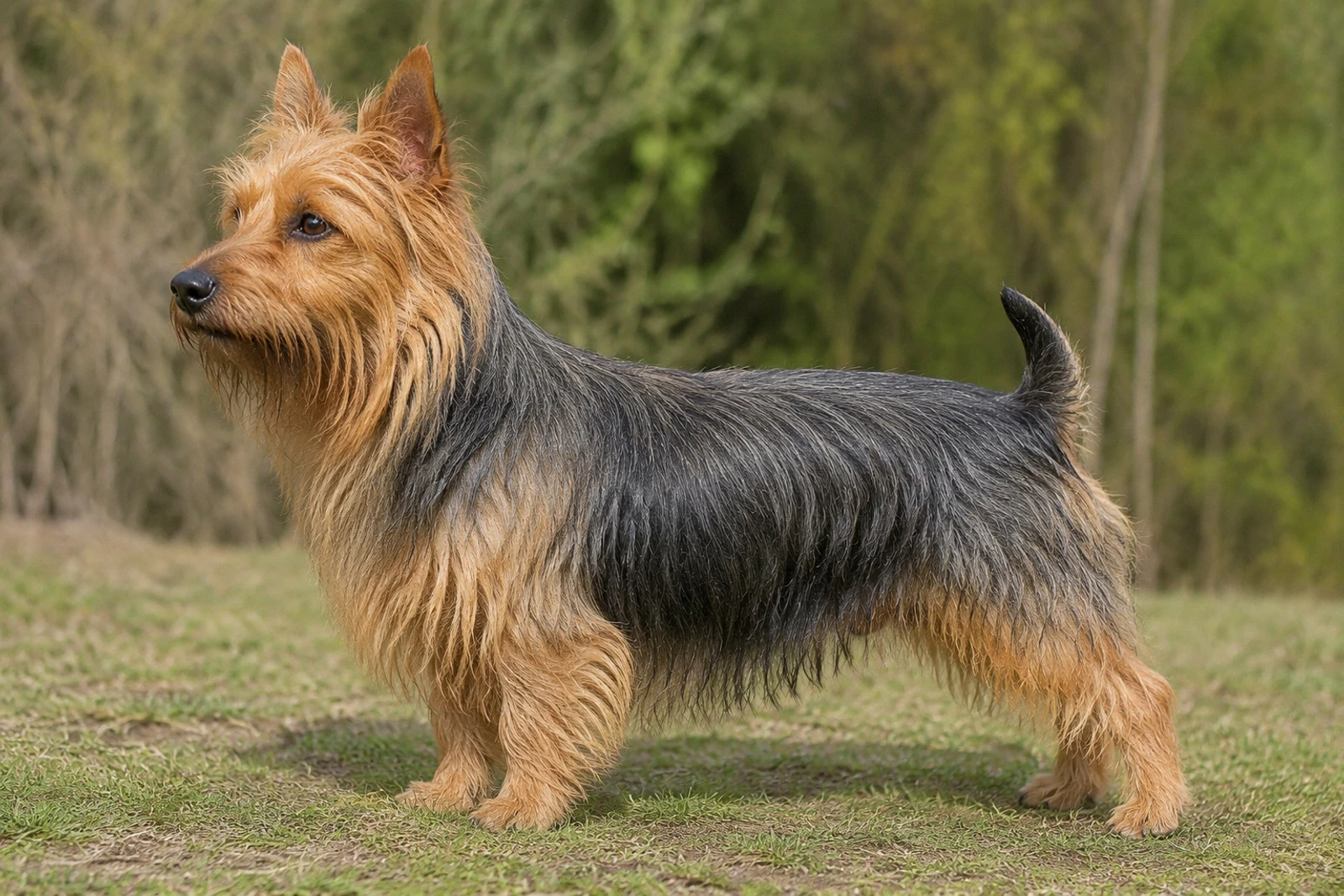
The Australian Terrier is a small, sturdy, and spirited breed that thrives with active individuals or families who appreciate terrier tenacity. They are loyal, affectionate, and make excellent watchdogs, always alert to their surroundings. While they adapt well to apartment living with sufficient exercise, they need consistent training due to their independent nature. Best suited for owners who enjoy interactive play and can provide firm yet positive guidance, they are less ideal for homes with young children or other small pets due to their prey drive.
At a glance
- Size
- Small
- Height
- 10 in
- Weight
- 15 lb
- Life span
- 15 years
- Coat colors
- blue and tan, sandy, red
- Coat type
- harsh, straight double coat
- Group
- Terriers
How much does a Australian Terrier cost?
Adopt / rescue
$75–$400
Usually includes spay/neuter, first shots, and a microchip.
Buy from a breeder
$700–$2,000
From a reputable, health-testing breeder.
Approximate USD. Prices vary widely by region, breeder, pedigree, age, and coat colour — adopting is the lower-cost and recommended route. Avoid suspiciously cheap “breeders”; they’re often puppy mills.
Estimate the full cost of a Australian Terrier →Want the ongoing number? Estimate the monthly food bill for a Australian Terrier with our dog food cost calculator.
Australian Terrier photos
Views
Front, side, rear and top — the full silhouette.Poses
How the breed sits, lies, moves and plays.Puppy to senior
The breed across its whole life.Expressions
The breed’s range of moods.Close-up details
Eyes, ears, nose, paws, tail and coat.Coat colors
The breed’s recognized colors.Click any photo to enlarge. We show the Australian Terrier from every angle — three views, poses, life stages, expressions, close-ups, coat and colors.
Appearance & size
At 10 inches tall and around 15 pounds, the Australian Terrier is built low to the ground but absolutely not delicate. This is one of the smallest working terriers, and every ounce is packed into a sturdy, long-bodied frame that feels surprisingly substantial when you pick one up. The body length runs just a little longer than the height at the shoulder, giving the dog that classic rectangular terrier silhouette.
You’ll spot the breed’s signature feature right away: a soft, silky topknot of lighter hair that falls over the eyes, set against a harsh, weatherproof outer coat. The double coat does a real job—the outer hairs are straight, dense, and about two inches long all over, while the undercoat stays short and soft. The contrast in texture between that plush head fuzz and the rough body coat is a dead giveaway you’re looking at an Aussie Terrier, not a random terrier mix.
Color comes in three accepted varieties. The most recognized is blue and tan: a dark steel-blue saddle over the back and tail, with rich tan on the legs, lower body, and face. You’ll also see solid sandy (think wheaten or fawn) and solid red. A ruff of longer hair frames the neck and chest, and many dogs have a slight apron of hair on the forechest and a soft, silky feathering on the backs of the front legs.
From the front, the chest is deep and the forelegs are dead straight with small, cat-like feet. The head is wedge-shaped with a strong muzzle, a black nose, and dark, intelligent eyes that miss nothing. Ears are small, pointed, and pricked high—they’re set well apart and look alert even when the dog is relaxed. Move to the side view and you’ll see a level topline, well-sprung ribs, and a moderate tuck-up; the tail, whether docked or left natural, is set high and carried at about a 45-degree angle. From the rear, the hindquarters are muscular and the stifles are well bent, showing a dog ready to pivot or charge after a snake in the brush.
History & origin
Most folks don’t realize the Australian Terrier was the first native breed recognized in Australia—and abroad. This little dog with a big-dog attitude grew straight out of the rough-and-tumble pioneer life of the 19th century. Convicts, settlers, and farmers from Britain brought a mishmash of terriers on the long sea voyage to Australia, likely including what we’d now call the Dandie Dinmont, Skye, Manchester, and the old Scotch Terrier (not today’s Scottish Terrier). Those early imports had to earn their keep immediately, culling rats on ships and then tackling snakes, rabbits, and vermin that threatened homesteads from Tasmania to the mainland’s sheep stations.
By the 1820s, folks were already purpose-breeding a compact, hardy all-rounder that could handle Australia’s extremes—think blistering heat, rough scrub, and everything from guarding the chicken coop to going to ground after a fox. They needed a dog that wouldn’t bolt after every kangaroo or bite the postman, but would stand its ground when a snake crossed the verandah. The result was a spitfire terrier with a harsh, dirt-shedding double coat, a handy small size (around 15 pounds and 10 inches tall), and a temperament that mixed grit with loyalty. It hunted, herded sheep, killed vermin, and curled up by the hearth with equal enthusiasm.
Officially, the breed first appeared in shows as the Australian Rough-Coated Terrier in the late 1800s. The name shifted to Australian Terrier, and a written standard took shape around 1896. The Kennel Club (UK) gave full recognition in 1933; the American Kennel Club followed in 1960. Unlike some breeds that splintered into show and working lines, the Australian Terrier stayed refreshingly true to its roots. Today’s dogs still capture that original versatility—a little more polished in the show ring, but just as ready to rid a barn of rats or boss around a household of bigger dogs.
Temperament & personality
You’re not getting a quiet lap dog. At 10 inches and a solid 15 pounds, the Australian Terrier packs the confidence, tenacity, and alertness of a much bigger dog into a compact, wash-and-wear frame. This is a working terrier that still wants a job, even if that job is just keeping the squirrel population in check from the living room window.
A big personality in a small package
The typical Aussie is brave, curious, and just a little stubborn. They adore their people and will shadow you from room to room, but they aren’t clingy in a needy way—they’re supervising. Expect eye contact, a wagging tail, and a head tilt that seems to ask, “What are we doing next?” They can be gentle and devoted with their immediate family, but that affection usually doesn’t extend to strangers right away. Early socialization matters; without it, natural wariness can tip into suspicion.
Unlike some toy breeds, this isn’t a dog that breezes through life with a go-with-the-flow attitude. The breed has a streak of independence and the problem-solving drive of a true terrier. You’ll see it the first time they figure out how to open a cabinet or systematically dismantle a treat puzzle. Respect that cleverness—you’ll get much further with consistent, patient training and a pocketful of high-value rewards than you ever will with a heavy hand.
Vigilance with a bark to match
Aussies are exceptional watchdogs and they take the job seriously. A delivery truck three blocks away, an unfamiliar bird on the fence, or your neighbor’s cat slinking across the yard—it all gets announced. The bark is sharp and persistent. You can teach a “quiet” cue, but don’t expect to extinguish the instinct. If you live in an apartment with thin walls, this is a real consideration.
Their territorial drive shows up in other ways too. Some Aussies, particularly intact males, may urine-mark indoors, especially in new environments or rooms that smell less like “home” than others. The scent of another dog on a visitor’s shoes can trigger a deliberate puddle. Clean accidents with an enzymatic cleaner that fully neutralizes the odor, and reward outdoor elimination with an immediate treat—that’s far more effective than punishing a dog that’s just acting on deeply wired scent cues.
Living with an independent sidekick
The breed does best when it has a predictable routine and a job, even if that job is simply carrying a toy during a walk or running a backyard obstacle course. Left alone for long hours with nothing to do, an Australian Terrier’s busy brain often turns to barking, digging, or creative chewing. And chewing isn’t just a puppy phase; adult dogs gnaw on hard objects to keep their jaws strong and teeth clean. Provide plenty of durable chews, and protect your furniture legs with a homemade citrus peel spray rather than chasing them off—punishment can sour your relationship without fixing the urge.
Mealtime and high-value bones require some house rules. This is a dog that can develop food-guarding tendencies, so teach every family member to let the dog eat in peace. No reaching for the bowl, no teasing, no interruptions. If children are in the household, they need to be old enough to understand that a stiff, staring dog giving a hard side-eye isn’t being “cute”—that posture often precedes a snap. Lip licking, yawning, or turning the head away are earlier signals asking for space. Heeding them keeps everyone safe.
When they’re comfortable, an Aussie’s body language is loose and soft-eyed. They’ll lean into a scratch behind the ears and flop over for a belly rub. Just don’t be shocked when that same dog, on a walk, throws themselves shoulder-first into a rotting carcass or fox scat. Rolling in foul smells is pure terrier logic—some scientists think it’s a way to advertise a new food source, others compare it to a human spritzing on perfume. Either way, it’s a stinky reminder that you’re sharing your life with a dog whose ancestors scavenged and hunted in the Outback.
For the right owner, the Australian Terrier offers roughly 15 years of sharp-witted companionship. They thrive with a person who can appreciate their can-do attitude, redirect their watchdog zeal without stifling it, and laugh when they decide that a dead worm is the finest cologne.
Good with kids, dogs & other pets
Kids
Australian Terriers tend to be patient, non-aggressive little dogs, which makes them a solid match for families with children. Their 15-pound frame is sturdy for their size, but it also means a clumsy toddler can accidentally hurt them. Always supervise interactions between a young child and this breed — teach kids to sit on the floor rather than picking the dog up, and no roughhousing. An Aussie who’s been gently handled from puppyhood usually returns the favor with loyalty and playful energy, but even the calmest dog has limits. Respect the dog’s space when it retreats to its crate or bed.
Other dogs
Early socialization carries the day here. A well-exposed Australian Terrier can get along with other dogs in the household and out on walks, but terrier feistiness runs in the family. Same-sex squabbles or pushiness with larger dogs can crop up if you skip the slow, positive introductions during puppyhood. Off-leash dog parks are a gamble — a 10-inch terrier can provoke a much bigger dog with zero warning. If you raise an Australian Terrier alongside another pup, they often become fast friends; adding a new adult dog later requires careful, neutral-territory meetings and a few weeks of management in the home.
Cats and small pets
Here’s where you meet the terrier heritage head-on. Bred to kill rodents and snakes, Australian Terriers have a built-in drive to chase and dispatch small, scurrying creatures. A cat they’ve grown up with can become part of the pack, but outdoor cats, squirrels, or the neighbor’s free-range rabbit will almost always trigger pursuit. Hamsters, guinea pigs, and other pocket pets belong behind secure lids — don’t count on training to override instinct. Even an Aussie who naps next to the house cat may not be safe around a bird or ferret, so separate them when you can’t supervise.
The socialization factor
Puppies hit their most receptive stretch between 3 and 16 weeks. That’s when your Australian Terrier needs a steady stream of positive experiences: new people, friendly vaccinated dogs, different floor textures, vacuum cleaners, car rides, and everyday neighborhood bustle. By the time your pup is four months old, that window tightens, and a dog who missed it may grow up skittish, noise-sensitive, or snappy around strangers. Even after the prime period, continued exposure to pleasant situations keeps confidence from slipping. If you adopt an adult who’s already uneasy, forcing meet-and-greets adds stress — instead, let the dog set the pace and provide a predictable home where it can decompress. An adult who’s content with just you doesn’t need a social calendar, and there’s nothing wrong with keeping your Terrier close and skipping the dog park scene.
Trainability & intelligence
Smart but independent, the Australian Terrier picks up new commands quickly — and then decides whether they’re worth doing right now. These dogs were bred to work solo, making their own judgment calls on the farm, so don’t mistake their 15-pound frame for inherent biddability. They’ll learn a trick in a handful of repetitions, but drilling the same thing for ten minutes straight? That’s a fast track to a dog who tunes you out. Keep sessions short, 5–10 minutes max, and quit while they’re still eager.
Food motivation runs high in this breed. A pocketful of pea-sized chicken or cheese pieces buys attention, but a squeaky toy or a quick game of tug can work equally well. Figure out what revs your dog’s engine and use that as currency. The trick is to make compliance more fun than ignoring you.
A real training challenge is recall. That terrier prey drive wakes up the instant a squirrel darts across the yard, and the ears shut off. Build a rock-solid “come” by starting indoors, then in a fenced area, with rewards that outshine the distraction. Never chase or punish a slow return — it teaches them to play keep-away. Trust is everything. Rough corrections or yelling damage the relationship fast, and an Australian Terrier can hold a grudge. You want a partner who volunteers cooperation, not one who shuts down.
Early socialization isn’t optional. Pups exposed to new people, dogs, sounds, and surfaces before 16 weeks tend to grow into confident adults. Without it, you risk a reactive or skittish dog who barks at every leaf. Pair each new experience with treats, and don’t flood them. A few positive minutes in a new setting beats an hour of overwhelm.
House training? It generally clicks fast if you stick to a routine and praise heavily for success — but you’ll need that consistency. A bored, under-exercised Aussie will find creative ways to occupy himself that you won’t appreciate. Train daily, but train smart. Think clarity, not drills, and you’ll have a sharp little teammate who loves working with you.
Exercise & energy needs
This little terrier packs a surprising amount of energy into a 15‑pound frame. A bored Aussie will find his own job—usually one you don’t want, like redecorating the baseboards. Plan on 30 to 45 minutes of purposeful exercise every day, split into at least two sessions. A single long walk often isn’t the best fit; shorter, more frequent bursts mirror the way he’s wired to work—a brisk 15‑minute walk in the morning, a lunchtime fetch session, and an evening sniffari around the neighborhood.
Intensity matters more than distance. These dogs were bred to dash into burrows and dispatch vermin, so they thrive on quick, snappy activities. A spirited game of tug, chasing a flirt pole, or racing after a tennis ball in the yard burns off the edge far better than a mile‑long plod. They love to dig, so if you can set up a designated digging pit, it’s a goldmine for satisfying that instinct physically and mentally.
Mental exercise is just as critical. Without it, nuisance barking and obsessive digging can creep in. Puzzle toys, snuffle mats, and scatter feeding turn mealtime into a job. Scent work taps directly into their vermin‑hunting heritage; hide a treat under a blanket and watch them go. Short training sessions—even five minutes of trick training—tire out their brains as much as a walk tires their legs. Australian Terriers are natural competitors in:
- Earthdog trials (perfect for their “go to ground” instinct)
- Rally and novice agility (they’re nimble and quick)
- Barn hunt (a controlled outlet for that terrier drive)
While these dogs are sturdy, avoid high‑impact leaps off furniture or repetitive pounding on hard surfaces, especially as they age, to protect their backs and joints. An Australian Terrier doesn’t need marathon miles, but he does need a daily outlet that’s as scrappy, smart, and quick‑fire as he is.
Grooming & coat care
The Australian Terrier’s weatherproof double coat is one of his best features—a soft undercoat paired with a straight, harsh outer coat about 2–3 inches long. That rough texture sheds dirt and loose hair minimally, so you won’t find tumbleweeds around the house. But the trade-off is a coat that holds dead undercoat until you physically remove it.
Brushing tools and routine
Grab a metal slicker brush with rounded pins and a steel comb. Go over the entire body two or three times a week to clear debris and prevent mats from forming where the undercoat tangles. Focus behind the ears, the ruff, and the feathering on the legs. During a normal week, this quick routine keeps the skin stimulated and the coat lying flat.
Bathing and trimming
Bathe only when he’s legitimately grimy. Too much shampoo strips the protective oils that keep the outer coat wiry and water-resistant. Most pet owners choose to clipper the body every 6–8 weeks for convenience—just be aware that regular clipping softens the texture over time, which can make the coat grab more burrs during walks. If you want to preserve the breed’s natural hard finish, hand-strip instead: pluck dead guard hairs with a stripping knife or your fingers, following the grain.
Nails, ears, and teeth
Small breeds hit the pavement harder, so keep nails short—trim every 3–4 weeks, or the moment you hear clicking on hard floors. Wipe those upright ears weekly with a damp cotton ball to prevent wax buildup, but stop at the opening. Because small mouths crowd teeth, daily brushing with a dog toothpaste helps ward off tartar and gum disease.
Seasonal coat care
Twice a year you’ll hit a heavier shed cycle as the undercoat turns over. For those few weeks, bump brushing up to daily and work through the coat with a comb to lift out dead hair in clumps. A stripping session right after a bath is the easiest time to pull the old coat cleanly, since warm water opens the follicles.
After a walk through tall grass or brush, do a quick comb-through to catch any stickers before they turn into a matted knot.
Shedding & allergies
You won’t find tumbleweeds of hair rolling across the floor with an Australian Terrier. These little dogs are genuinely low-shedding, thanks to a harsh, weatherproof double coat that does most of its shedding directly into a brush rather than onto your sofa. The outer coat is straight, coarse, and about 2 inches long; underneath sits a short, soft undercoat. Minimal loose hair is the norm year-round.
You might notice a slight uptick as seasons change—a minor seasonal blowout in spring and fall when the undercoat decides to let go—but it’s nothing like what you’d get from a heavy shedder. A quick weekly brush with a slicker or pin brush handles the worst of it. Drool is a complete non-issue. These dogs run dry-mouthed, so you won’t be wiping slobber off your walls.
On the allergy front, there’s no such thing as a 100% hypoallergenic dog. What Australian Terriers offer is less dander-trapping shed hair floating around, which can make life easier for some allergy sufferers. The coat itself produces minimal dander, and regular grooming—especially hand-stripping dead hair a couple of times a year—helps keep loose allergens in check. If allergies are a serious concern, spend time with an adult Aussie before committing. What works for one person might not work for another, but this breed stacks the odds in your favor better than most.
Diet & nutrition
An Australian Terrier can pack on the ounces before you even notice—those 10-inch, 15-pound frames hide extra weight easily. Measure every meal with a real measuring cup, not a scoop-and-hope, and stick to two feedings a day for adults. A moderately active 15-pound dog typically needs somewhere around 400–450 calories daily, but check your food’s calorie per cup and adjust for things like how much off-leash time they get. If your Aussie is more of a couch supervisor, drop the portion accordingly.
This is a breed with a solid food drive and a knack for training you into handing over treats. Use that motivation during training, but subtract those calories from meals. Puzzle bowls or snuffle mats slow down a speed-eater, and the mental work burns energy without adding more kibble.
Life-stage tweaks:
- Puppies under four months: four evenly spaced meals per day.
- Four to six months: three meals.
- After six months: transition to the adult two-meal rhythm.
Switch a young puppy to new food gradually. Starting with lightly cooked, puréed meats, fish, fruits, and vegetables alongside a high-quality commercial puppy formula works well. Raw items like a chicken wing can come in around twelve weeks, but only under direct supervision.
Seniors often slow down before you adjust their bowl. At around 10–12 years old, consider smaller, more frequent meals and watch the scale monthly. There’s no strong need to cut protein, but you do need to cut total food as steps get shorter and naps get longer. Keeping a lean body condition—visible waist, ribs you can feel but not see—protects aging joints and adds healthy years to that 15-year lifespan.
What to put in the bowl: A meat-forward diet fits their species’ needs. Whether you feed a premium commercial food or prep meals at home, aim for a foundation of raw or cooked meat (roughly 60%), vegetables and fruit (20–30%), and the rest from eggs, grains, or plain yogurt. Pearl barley and white rice are gentle grain options for sensitive stomachs. Puréeing or blending food—especially for dogs with missing teeth—improves nutrient absorption because dogs’ jaws don’t grind side to side and they lack salivary enzymes to start digestion.
Never go vegetarian or vegan with an Australian Terrier; their gut and teeth are built for processing animal protein, and a meat-free diet shortchanges them of nutrients they can’t efficiently get elsewhere.
What to avoid:
- Free-feeding (the bowl that’s always full) invites obesity in a food-motivated dog.
- Feeding straight from the table. Any leftovers go into your dog’s bowl, served at his feeding spot, not your plate.
- Rich, fatty scraps—especially after holidays. A sudden high-fat meal can trigger pancreatitis, and small breeds aren’t immune.
- Over-relying on treats. Keep them to less than 10% of daily calories.
Balance what goes in the bowl with the energy coming out. A fit, lean Australian Terrier is a healthier companion for all those 15 years.
Health & lifespan
A well-bred Australian Terrier is a long-haul companion. Fifteen years is a realistic expectation, and plenty stay spry past that mark. But longevity doesn’t mean zero maintenance — this is a small dog with small-dog vulnerabilities that deserve a proactive eye.
- Patellar luxation (a kneecap that shifts out of place) shows up in the breed. You’ll spot it as a hop-and-skip step that suddenly goes back to normal. Responsible breeders screen parent dogs and don’t breed ones with grades that cause lameness. Keeping your terrier lean — every extra pound on a 15-pound frame matters — protects those knees.
- Dental disease hits hard in tiny mouths. Crowded teeth trap tartar fast, leading to gum infection and tooth loss. Daily brushing and a veterinary cleaning when needed are the only real prevention. Ignore it, and bacteria from the mouth can quietly damage the heart and kidneys over time.
- Skin issues can be a nuisance, especially allergies that show up as licking, ear infections, or red, itchy bellies. Often it’s an environmental trigger or something in the food. Work with your vet to identify the culprit rather than guessing with shampoos. A harsh outer coat doesn’t insulate against allergens.
- Some lines carry eye conditions like cataracts or progressive retinal atrophy. A breeder who does annual eye exams through a veterinary ophthalmologist is the one you want. Early signs are subtle — a little hesitation in dim light, a slight cloudiness.
- Like many terriers, Aussies tend to be stoic. They might limp only when things hurt enough that they can’t tough it out anymore. Pay attention to the small stuff: a dog who suddenly stops launching off the back of the couch or loses interest in a ball chase may be dealing with a low-grade ache, not just having an off day.
Annual checkups catch the creep of things — a heart murmur, an enlarged joint, a tooth that’s starting to go. Once your dog hits age 8 or 9, bump that to twice a year. Stay religious about monthly heartworm prevention (even a single missed dose during mosquito season can be a gamble) and keep rabies vaccination legal and current. The real payback for this kind of vigilance isn’t just a long lifespan; it’s a terrier who still races around the yard at 14 with clean teeth and clear eyes.
Living environment
Apartment life? Yes, with the right routine
A ten-inch, fifteen-pound Australian Terrier can absolutely thrive in an apartment—but you’re not off the hook with a quick lap around the block. This is a terrier through and through, so expect quick, intense bursts of energy rather than all-day lounging. A couple of 15- to 20-minute brisk walks do the job, but the real secret is mental fatigue. Puzzle toys, snuffle mats, or a lively ten minutes of hide-and-seek inside satisfy the nose and brain that were bred to hunt vermin. Skip those outlets and you’ll see digging at the couch, pacing, or nonstop yapping.
Yard not required, but security matters
You don’t need a yard. A securely fenced patch is a bonus, not a must. If you have one, treat that fence like a vault—these dogs will shimmy under or scramble over anything less than perfect to chase a squirrel. Off-leash time in an unfenced area is a gamble you don’t want to take with a 15-pound dog whose recall evaporates the moment prey runs.
The barking factor
Australians were designed to sound the alarm, and they take the job seriously. Every delivery, neighbor’s footsteps, or suspicious leaf gets a commentary. In close quarters, that can strain neighborly peace. Start rewarding quiet early, and never use a bark collar—it’ll backfire. Manage expectations: you’ll have a vocal watch dog, not a silent shadow.
Weather tolerance
Their harsh double coat shrugs off drizzle and moderate chill easily. In summer, though, pavement heats up fast for a small dog. Walk in the cooler morning and evening hours, and keep water and shade handy. Avoid midday runs when the asphalt is hot enough to burn paw pads.
Handling alone time
This is where many families stumble. An Australian Terrier bonds hard and can tip into separation anxiety when left solo for long stretches. Eight hours alone with nothing to do often leads to barking symphonies, chewing, or frantic pacing. Start small: leave for five minutes, then ten, and build up calmly. If you work full-time outdoors, budget for a midday walker or a neighbor’s visit. A frozen stuffed Kong and a window perch help, but they won’t replace you. Get this right, and you’ve got a steady, devoted housemate. Under-exercised and isolated, the same dog unravels.
Who this breed suits
The Australian Terrier plugs best into a home that treats him like a real working terrier in a compact frame, not a purse dog. He’s 15 pounds of self-assured energy, and owners who thrive with him are the ones who enjoy a little friendly sparring — this is a dog who thinks for himself, learns fast when the reward is right, and will test boundaries just because he can. If you’re a first-time owner with a sense of humor and a willingness to attend a training class or two, he can be a great teacher; just don’t expect blind obedience. He bonds deeply and makes a loyal shadow, but he’s no pushover.
Active singles and couples who hike, jog, or spend weekends outdoors get a tireless, up-for-anything sidekick — provided they keep a leash on. A high prey drive and selective hearing make off-leash reliability a gamble around squirrels or cats, so fenced yards and long lines are your friends. For families, he fits best with older kids who understand that a 10-inch-tall dog isn’t a stuffed toy. Rough handling or toddler chaos can trigger a defensive snap, not because he’s mean, but because he’s a terrier with pride and quick reflexes.
Seniors can do well with an Aussie if their daily routine includes brisk walks and some mental hustle — puzzle toys, hide-and-seek, short training bursts — rather than a long afternoon of TV. A sedentary retirement is the fast track to a bored, barky, hole-digging housemate. Apartment dwellers need to weigh his watchdog instincts: he’ll sound the alarm at every delivery truck, and you won’t train that out of him entirely. If you share walls with noise-sensitive neighbors, it’s a real sticking point.
Pass on the breed if you want a quiet lap dog, a dog that reliably greets strangers with a wag, or a dog you can skip daily walks with. He’s not a potty-pad candidate. What you get instead is a clever, scrappy character who keeps you laughing and on your toes for a solid 15 years.
Cost of ownership
A well-bred Australian Terrier from a responsible breeder typically costs between $1,500 and $2,500. Because the breed is uncommon in the U.S., you may wait longer and pay more than you would for a more popular small terrier. Avoid the temptation of bargain puppies from unverified sources — cutting corners on health screening often leads to much larger vet bills down the road.
Once your Aussie is home, plan on a monthly budget of roughly $100 to $180 for routine care. The terrier’s small size keeps food bills low. A 15-pound dog eating high-quality kibble will run about $25 to $40 a month.
Grooming is the sneaky expense. That harsh, weatherproof double coat needs regular attention. A professional hand-stripping or clipping session every 6–8 weeks averages $50 to $75 — so set aside $30 to $45 monthly unless you learn to do it yourself. Nail trims, ear cleaning, and the occasional bath add another few dollars.
Veterinary costs vary by location, but budget $300 to $500 a year for a young, healthy dog. This covers an annual exam, core vaccines, heartworm prevention, and flea/tick control. Dental cleanings, which many small breeds eventually need, can push a single year higher. Pet insurance for a small terrier generally falls in the $20 to $40 per month range. It’s worth considering early, before any condition becomes a pre-existing exclusion. Australian Terriers can be prone to patellar luxation, Legg-Calvé-Perthes disease, and allergies, and treatment for any of these can easily top a few thousand dollars.
Don’t overlook durable toys and an escape-proof harness (that terrier prey drive is real), plus a secure fence if you have a yard. Initial supplies like a crate, bed, leash, and bowls add another $150 to $250 at the start. Over a 15-year lifespan, the total cost of ownership easily surpasses $20,000, with grooming and insurance being the variables that catch new owners off guard.
Choosing a Australian Terrier
Start by deciding whether a puppy from a breeder or an adult from rescue fits your life better—neither is wrong, but the paths look different. An Australian Terrier is a small, long-lived package (10 inches, 15 pounds, often hitting 15 years), so you’re signing up for plenty of terrier mischief no matter where you find your dog.
If you go the breeder route, health clearances are your first real filter. Even a hardy breed like this can be prone to luxating patellas (slipping kneecaps) and Legg-Calvé-Perthes disease, a degeneration of the hip joint that shows up in small dogs. Ask to see OFA results for patellas, and confirmation that parents have been screened for eye problems and thyroid function. A breeder who waves you off with “the vet said they’re fine” isn’t doing the groundwork. You want someone involved with the Australian Terrier Club of America, showing their dogs, or competing in earthdog events—that’s where a confident, scrappy temperament gets refined without edgy nerves.
Red flags come in bunches: multiple litters always on the ground, no questions about your household, no contract, no lifelong return policy. A responsible breeder grills you and stays available.
When you meet the litter, hang back and watch before handling. The pups should be curious and sturdy, a little bossy but not bullying. Shyness or outright fear in an Aussie pup is trouble. Ask to see the mother—at about 10 inches and 15 pounds, she’ll give you a blunt preview of the adult energy and size you’ll live with. A good breeder matches you based on temperament, not just coloring or who crawls into your lap first.
Rescue Australian Terriers are harder to find, but breed-specific groups do place adults and seniors. You’ll likely get a dog with a known quirk—maybe a dedicated digger or a barker—but a 15-year lifespan means even a 7-year-old has a lot of years left. Just expect to manage terrier instincts from day one.
Pros & cons
Small, self-assured, and built to last, the Australian Terrier packs a lot of terrier into a 10-inch, 15-pound frame. The everyday trade-offs look something like this.
Pros
- Long-lived and sturdy. A well-bred Aussie often cruises past 15 years; responsible breeders screen for patellar luxation and Legg-Calve-Perthes, so you’re stacking the deck for a robust little dog.
- Low-shedding, no-fuss coat. The harsh double coat sheds very little. Weekly brushing and a couple of hand-stripping sessions a year keep it tidy — no daily hair tumbleweeds.
- Portable family shadow. Ten inches tall, 15 pounds — easy to scoop up, travel with, or fit into an apartment. He’s happiest right next to you, whether you’re on the couch or working in the yard.
- Fearless watchdog. This terrier notices everything and announces visitors, delivery drivers, and suspicious squirrels with a surprisingly big bark. You’ll never miss a doorbell.
- Affectionate and game. Once he trusts you, he’s a loyal, comical sidekick who’s up for a walk, a wrestle, or just warming your lap — without the neediness of some toy breeds.
Cons
- Prey drive on a hair trigger. Squirrels, cats, the neighbour’s pet rabbit — anything small and fleeing lights a fire that recall training rarely extinguishes. A secure yard and a leash are non-negotiable.
- Stubborn streak. Training takes patience and consistency. He’s smart but independent; “what’s in it for me?” is a frequent internal monologue. Harsh corrections shut him down, but a clever treat puzzle gets results.
- Vocal by nature. That watchdog bark doesn’t always know when to quit. Without early training, nuisance barking at passersby, birds, or the wind can become a headache.
- Scrappy with other dogs. Same-sex aggression isn’t unusual. Early and ongoing socialization helps, but don’t expect an easygoing dog-park regular — he often prefers to be the only dog in the home.
- Needs real mental work. A quick stroll won’t cut it. Plan on a solid 30–45 minutes of exercise plus a food puzzle or some trick training; otherwise, the digging and destructiveness that terrier jaws can manage will remind you he’s not a lap ornament.
Similar breeds & alternatives
If you're weighing an Australian Terrier against other compact terriers, a few close cousins often come up – and each splits the terrier personality in a slightly different direction.
- Cairn Terrier – Same 10-inch, 13–14-pound frame, same scrappy grit. The key difference is independence: Cairns tend to have a mind of their own and don't shadow their people as closely. An Australian Terrier is more likely to be the dog that follows you from room to room.
- Norwich Terrier – Another 10-inch, 12-pound breed with prick ears and a people-centered temperament. Norwich dogs usually run a shade softer with other dogs; an Australian Terrier’s feistiness around unfamiliar dogs is more pronounced. If a multi-dog household is in the picture, a well-socialized Norwich may settle in with fewer sparks.
- Miniature Schnauzer – A little bigger (12–14 inches, 11–20 pounds), but the real difference is biddability and coat work. Schnauzers are less vocal, more eager to follow a training plan, and their wiry double coat needs regular clipping or hand stripping. The Australian Terrier’s harsh, dirt-shedding coat takes much less effort – weekly brushing and the occasional strip keep it in shape.
- West Highland White Terrier – Same height range (10–11 inches), a few pounds heavier, and that striking white coat comes with a catch. Westies can be more independent and often need frequent bathing to stay bright. An Australian Terrier’s darker, rugged coat hides dirt better and requires less primping.
All these breeds bring the terrier spark – a bold, alert little dog that thinks it’s twice its size. The Australian Terrier carves out its own lane with a famously long lifespan (15 years isn’t unusual), a hard, easy-care coat, and a "wherever you go, I go" loyalty that turns off-road walks and lazy afternoons into a partnership. If you want a portable terrier that sticks close without demanding a standing grooming appointment, the Aussie earns its spot.
Fun facts
- They were the first Australian breed to be officially recognized in other countries.
- Originally called the Australian Rough-Coated Terrier.
- Bred to hunt vermin and snakes, they are fearless despite their small size.
- One of the smallest working terriers.
Frequently asked questions
- Are Australian Terriers good with children?
- Australian Terriers can be affectionate and loyal with older children who respect their small size. Their spirited nature means they may not tolerate rough handling, so supervision is recommended. Early socialization helps them get along well with kids.
- How much shedding and grooming do Australian Terriers require?
- Australian Terriers are low shedders, making them a good choice for tidy homes. Their harsh, weather-resistant coat needs weekly brushing to remove loose hair and prevent mats. Occasional hand-stripping a few times a year maintains coat health.
- Do Australian Terriers bark a lot?
- Australian Terriers are naturally alert and tend to bark to announce unfamiliar sounds or visitors, making them effective watchdogs. This trait can be managed with consistent training from an early age to prevent excessive vocalization.
- Are Australian Terriers suitable for first-time dog owners?
- Australian Terriers are smart and eager to please, but their independent terrier streak can pose a challenge for first-time owners. With patience, positive training, and early socialization, they can be a rewarding companion for dedicated novices.
- How much exercise does an Australian Terrier need?
- Australian Terriers have high energy for their size and need daily exercise and mental stimulation. A couple of brisk walks, playtime, and puzzle toys usually satisfy their needs. They also enjoy exploring a securely fenced area.
- Can Australian Terriers live in apartments?
- Australian Terriers adapt well to apartment living if they receive sufficient daily exercise and mental engagement. Their barking tendency should be considered, but training can help keep it in check. Compact and active, they thrive with regular walks.
Tools & calculators for Australian Terrier owners
Quick estimates tailored to Australian Terriers — pre-filled with this breed’s size where it matters.
Articles & stories about the Australian Terrier
Sources & standards
This profile follows recognized breed standards from the American Kennel Club (AKC) and the Fédération Cynologique Internationale (FCI), along with established veterinary and breed-club guidance. These describe general breed tendencies — every dog is an individual.