

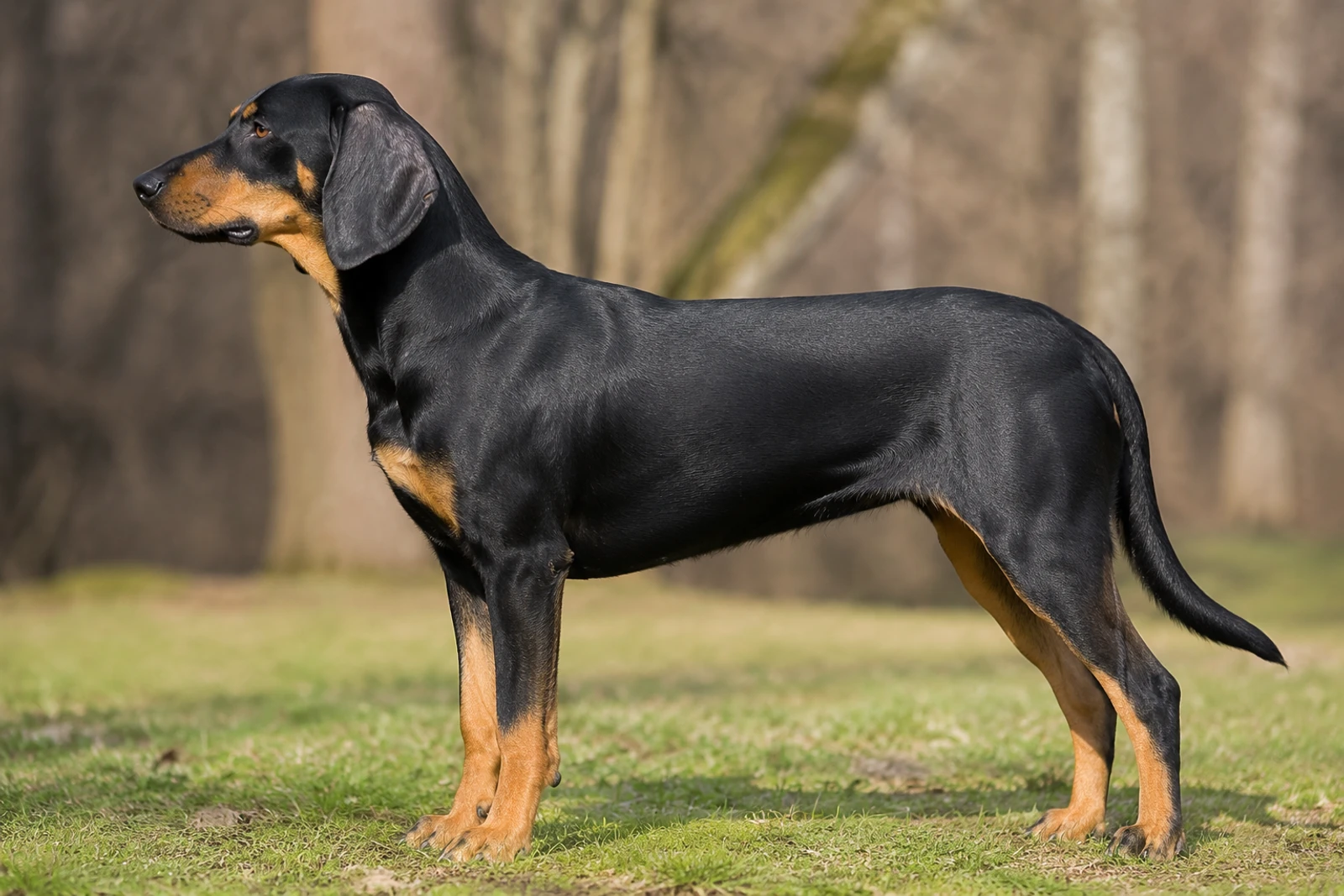
The Austrian Black and Tan Hound is a loyal and versatile scenthound, best suited for active families or individuals who enjoy outdoor adventures. With a keen nose and tireless stamina, this breed thrives on long walks, hikes, and scent work. They are affectionate and gentle at home, making them good companions for children, but their high prey drive requires careful introduction to smaller pets. Their melodious bark and independent streak mean they do best with experienced owners committed to consistent training. Not ideal for apartment living, they flourish in a rural or suburban home with a yard.
At a glance
- Size
- Large
- Height
- 19–22 in
- Weight
- 44–55 lb
- Life span
- 11–13 years
- Coat colors
- Black and Tan
- Coat type
- Short, smooth, dense
- Group
- Scenthounds
How much does a Austrian Black and Tan Hound cost?
Adopt / rescue
$75–$400
Usually includes spay/neuter, first shots, and a microchip.
Buy from a breeder
$700–$2,000
From a reputable, health-testing breeder.
Approximate USD. Prices vary widely by region, breeder, pedigree, age, and coat colour — adopting is the lower-cost and recommended route. Avoid suspiciously cheap “breeders”; they’re often puppy mills.
Estimate the full cost of a Austrian Black and Tan Hound →Want the ongoing number? Estimate the monthly food bill for a Austrian Black and Tan Hound with our dog food cost calculator.
Austrian Black and Tan Hound photos
Views
Front, side, rear and top — the full silhouette.Poses
How the breed sits, lies, moves and plays.Puppy to senior
The breed across its whole life.Expressions
The breed’s range of moods.Close-up details
Eyes, ears, nose, paws, tail and coat.Coat colors
The breed’s recognized colors.Click any photo to enlarge. We show the Austrian Black and Tan Hound from every angle — three views, poses, life stages, expressions, close-ups, coat and colors.
Appearance & size
The Austrian Black and Tan Hound is a lean, long-bodied scenthound put together for covering rugged ground, not for showy curves. Dogs stand 19 to 22 inches at the shoulder, and a hunting-fit weight lands between 44 and 55 pounds—light enough to bound over deadfall without crashing, but substantial enough to hold a scent line through thick brush. You’ll notice right away that the body is longer than tall; a true working rectangle, never a draft-horse block.
Look from the side and that silhouette reads endurance. The chest is deep and reaches right down to the elbows, giving plenty of room for heart and lungs. A straight, firm topline runs back to a strong loin with a very slight arch, and the belly tucks up just enough to keep the outline clean. The tail is a natural extension of that topline—set neither steeply high nor low, carried in a gentle saber curve when the dog is alert. It never gets docked. From the front, the chest shows moderate width, not bulldog-heavy. Forelegs drop straight and parallel, with well-laid-back shoulders and tight elbows. The pasterns have a tiny bit of spring, which you appreciate when you watch the dog absorb miles of trail. Around back, the hindquarters are what you’d expect in a hound that works all day: muscular thighs, good angulation that isn’t overdone, and hocks that drive straight forward without the legs spinning out or cowhocking.
The coat is a short, dense, flat-lying jacket with a bit of gloss. It’s genuinely no-fuss—a toweling-off after a rainy run is plenty. As for color, the name says most of it: a deep black saddle blankets the back and upper flanks, while rich tan fills the legs, chest, cheeks, muzzle, and the little dots above the eyes. The tan should be warm and clear, not pale or muddy, and the line between black and tan stays sharp and deliberate. You’ll also see tan on the underside of the tail and inside the ears.
The head belongs to a keen-nosed tracker, not a couch ornament. It’s long, lean, and chiseled, with a slight stop and a straight muzzle about as long as the skull. Dark brown eyes are oval-shaped, set slightly oblique, and have a calm, attentive expression. The ears are medium in size, set high, and hang flat against the cheeks—broad at the base, with softly rounded tips. No frills, no dewlap, just a clean-lined hound that looks like he’d rather be out following a cold trail than standing around.
History & origin
This is not a breed that was dreamed up in a kennel club boardroom. The Austrian Black and Tan Hound — the Österreichische Glatthaarige Bracke — traces its roots straight back to the soot-stained hearths and steep, forested valleys of the Eastern Alps, where a hound that could follow a cold trail over rock and through all weather was worth more than gold.
The dog’s ancestors were the ancient Celtic hounds that moved through Europe with their people well before the Romans arrived. Over centuries, those dogs were shaped by the landscape itself — crossed, likely, with other Bracke types to sharpen nose and voice, and always selected for one unforgiving job: hunt hare and fox in high, rugged country where the scent washes away fast. By the mid-1800s, the hounds we’d recognize today were already a distinct type, hard-muscled and clean-coated, with that unmistakable black coat marked by rich tan points above the eyes, on the muzzle, chest, and legs. Breeders in Austria began keeping written records and refined the type around a clear standard, and in 1884 the Austrian Black and Tan Hound was officially recognized as a separate breed.
For decades it did exactly what it was bred to do — pull off silent, steady tracking work until game was afoot, then open up with a resonant, bell-like voice that carries through timber and mist, allowing the hunter to follow the chase on foot. That voice, plus a relentless, ground-covering trot, made it indispensable to hunters who had no use for a dog that quit when the trail went cold.
Two world wars nearly erased it. By the mid-20th century, the breed had dwindled to a handful of functional dogs hidden away in isolated Alpine hunting communities. A careful, no-frills revival — led by a few dedicated Austrian hunters and breeders who gathered what remained — pulled the breed back from the brink without sacrificing its working character. Even today, the Austrian Black and Tan Hound remains rare outside its homeland, and you won’t stumble across one at a suburban dog park. It’s still, first and always, a hunter’s partner, quietly doing the job it has done for centuries on the steep slopes of Austria.
Temperament & personality
This hound lives by his nose—bred to track game over steep Austrian terrain for hours, and that inherited drive colors almost everything he does indoors and out. Calm and surprisingly gentle when his exercise needs are met, he can be single-minded and stubborn the moment a scent trail grabs his attention. Ignore that, and a walk becomes a pulling contest, a fenced yard becomes an escape puzzle, and recall vanishes unless you’ve put in months of respectful, consistent training.
With his family, the Austrian Black and Tan is steady and affectionate without being needy. He’ll lean against your legs, rest his head on your lap, and follow you from room to room. He’s watchful, too—a deep, rolling bay announces visitors or unfamiliar smells long before a doorbell rings. That makes him a solid watchdog, but not a guard dog; he’d rather investigate a whiff than confront a threat. Left alone without enough mental and physical work, however, the same voice can turn into anxiety-driven barking or destructive chewing. Adults need at least an hour of vigorous sniffing and trotting, not just a leash stroll. A long hike, a chance to trail a scent line in a safe area—that’s what settles him.
Expect a few quirks rooted in scent obsession. He marks territory indoors if residual urine odors remain; cleaning up with an enzyme cleaner or a simple vinegar-water spray removes the cue that invites a repeat. He may roll in carrion or anything foul—not to gross you out but because hounds often mask their own scent or simply enjoy it. Hard chewing is another given: sturdy, natural chews satisfy his instinct to keep jaws strong and teeth clean. Teach kids never to interrupt him during meals, because even a gentle dog can guard food if startled.
Around the household he does well with other dogs, thanks to his pack-hunting background, but small pets can trigger his prey drive unless raised together. He’s patient with children who respect his space, though a stiff, tense posture or a direct stare means back off—signs that often precede a snap. Learn his calming signals, too: lip licks, yawns, and turning away tell you he’s uncomfortable.
This is a partner, not a push-button companion. Coercion backfires; a fair, patient handler who works with the dog’s instincts gets a loyal, stable housemate. Give him the freedom to use his nose and a predictable routine, and the payoff is a dog who relaxes into a soft-eyed, easygoing friend—even if he does sometimes come home smelling like a swamp.
Good with kids, dogs & other pets
This hound’s calm, patient temperament makes it a naturally steady presence around children. The breed isn’t snappy or high-strung, and most well-socialized adults tolerate clumsy toddler hugs without complaint. That said, a 44–55 lb dog with a sturdy build and a swinging tail can easily knock over a preschooler during an enthusiastic greeting. Supervision is non-negotiable — teach kids to give the dog space when it’s eating or sleeping, and never leave young children and any dog together unattended.
With other dogs, the Austrian Black and Tan Hound typically fits in without drama. Bred to work in packs, it reads canine body language well and rarely starts fights. Playmates are welcome, but structured introductions still matter. A puppy raised with other dogs often becomes a lifelong buddy; an adult who missed early socialization may need slower, low-pressure meet-ups in neutral territory. Don’t force the issue — a hound that’s content with just its human family doesn’t have to be a social butterfly.
The bigger question is cats and small furry pets. That powerful tracker’s nose and the instinct to follow scent trails don’t disappear indoors. Some individuals live peacefully with a household cat they’ve grown up beside, but fast movement from a fleeing rabbit or a strange cat outdoors can flip a switch. Separate feeding areas, baby gates, and a rock-solid “leave it” cue give everyone the best shot at harmony. Never assume a new adult hound will automatically ignore pocket pets — gradual, supervised exposure tells you what’s workable.
Early socialization makes all the difference. The prime window runs from roughly 3 to 16 weeks. During that stretch, a puppy should meet a wide variety of people (including calm, treat-bearing kids), hear everyday noises, and walk on different surfaces. Positive experiences now prevent the fear-based reactivity that can show up later. After that window closes, you’re still building confidence, but go at the dog’s pace — dragging a timid adult into overwhelming situations only backfires.
This is a dog that forms deep bonds with its people. High companionship needs mean it shouldn’t be left alone in a yard for hours or banished to a kennel. In a family that includes the hound in daily life — indoor time, walks, and the comings and goings of kids and other pets — you get a tolerant, easygoing companion who takes the chaos in stride.
Trainability & intelligence
Your Austrian Black and Tan Hound is a sharp, independent thinker, but his brain is wired for solo tracking, not for hanging on your every word. You’ll see him learn a new routine in a handful of repetitions when there’s a payoff he likes — a stinky piece of cheese, a game of tug, a chance to use his nose. The flip side: he can size up a request in a heartbeat and decide it’s not worth his time. That’s not stubbornness for the sake of it. That’s a scenthound prioritizing his own agenda over yours.
The scent drives everything. Once that long, drop-eared nose locks onto an interesting trail, your voice fades into background noise. Recall is the classic wrestling match here. In a safe, distraction-free yard, a well-practiced recall may snap him around instantly. Out in the woods, the same dog who sat politely for a treat five seconds ago will blow past you without a glance as he chases a rabbit line. Manage this with a long line or a sturdy fence, and train recall daily with rewards that beat whatever the ground is telling him. Accept that off-leash freedom in unfenced areas may never be 100% reliable — his breeding says otherwise.
What works (and what doesn’t). Reward-based training is non-negotiable. Harsh corrections or a frustrated tone will make him check out or, worse, erode the trust you need. This is a sensitive hound, and he reads your mood like a trail map. Keep sessions short, upbeat, and honest — work a command for two minutes, then let him sniff out a hidden treat as a break. He thrives on clear, consistent rules. If you let him pull on leash one day and yank him back the next, he’ll assume the rule is optional. Patience wins. He’ll test boundaries, but trying to strong-arm a 44–55 pound dog with a mind of his own is a losing battle.
Socialization is part of the training puzzle. Early, positive exposure to all kinds of people, dogs, sounds, and surfaces cuts the risk of a reserved or reactive adult. Get started between 3 and 14 weeks and keep it going. A well-socialized Austrian Black and Tan Hound is steady and good-natured at home; one that missed those experiences can be overly cautious or startle easily.
Expect a training partner who learns fast but obeys only when it makes sense to him — and only if you’ve built a relationship he values more than the next scent on the breeze.
Exercise & energy needs
An Austrian Black and Tan Hound is built to follow a scent trail for hours, not just amble around the block. Plan on at least 90 minutes of honest exercise every day, split into two sessions—usually morning and evening—that let him move his legs and work his nose simultaneously. A quick 20-minute leash walk on pavement won’t touch his energy. He thrives on long-line hikes, off-leash time in securely fenced woods, or canicross runs where he can zigzag, backtrack, and inhale every scent.
Mental stimulation is just as critical as mileage. These hounds need a job for their nose. Sign up for a structured nose-work or tracking class, lay simple scent trails in a field, or hide a smelly treat in the house and let him unravel the puzzle. Food-dispensing toys are fine for rainy days, but they’re side dishes—the main meal is following a real odor plume outdoors. Skimp on that brain work and you’ll get the full soundtrack: howling, pacing, and resourceful destruction of door frames or fences.
- Great outlets: tracking trials, canine scent work, long unstructured sniffy walks in the forest, canicross, hiking with a pack.
- Proceed with caution: hard-surface jogging and repetitive jumping while joints are still developing. Hip dysplasia can show up, so keep footing soft and condition gradually.
A hound who’s drained his brain and body settles easily inside. Without that daily outlet, you’re living with a loud, problem-solving escape artist who invents his own entertainment.
Grooming & coat care
You’ll spend more time admiring this hound’s glossy black-and-tan coat than maintaining it. The Austrian Black and Tan Hound has a short, dense double coat that lies flat and practically repels light dirt. It’s built for the field, and grooming follows that low-effort logic.
Run a soft bristle brush over him once or twice a week. That’s enough to spread natural oils and keep the black-rich coat gleaming. The bristles will also massage the skin and sweep out any loose surface hair. Skip the slicker or pin brushes — those are for longer coats and won’t add anything here.
Twice a year, when the seasons shift, he’ll blow the insulating undercoat. That’s when you switch tools. Grab a rubber curry brush or a grooming mitt and go over him outside every day or two. The curry lifts dead hair in clumps before it lands on your furniture. If he tolerates a blow dryer, a low-setting high-velocity dryer makes short work of it.
Baths are rare — maybe three or four times a year, or when he’s found something truly stinky. Over-washing can soften the coat’s naturally harsh texture and strip protective oils that keep him weather-resistant. When you do bathe, use a gentle dog shampoo and rinse thoroughly.
There’s no trimming, clipping, or scissoring needed to keep a tidy outline. The breed’s clean silhouette comes naturally. This is one of the easiest hounds to keep looking sharp.
Don’t overlook the extras. Those drop ears trap moisture and debris, so check them weekly. A quick sniff and a wipe with a damp cloth prevent waxy buildup and infections. Trim nails monthly — long nails can alter his gait on hard surfaces. Brush teeth several times a week with dog-safe paste; scenthounds can be prone to tartar, and keeping up at home saves on dental cleanings later.
During heavy shedding weeks, use your curry brush right after exercise when the coat is warm and pores are open. It pulls loose fur more efficiently. The routine also gives you a chance to scan for ticks, cuts, or hot spots — valuable for a dog whose nose stays glued to tall grass and brush.
Shedding & allergies
When you bring an Austrian Black and Tan Hound home, you're signing up for a dog that sheds year-round and leaves a bit of themselves on every surface. Their coat is short, dense, and built for weather resistance—which means dead hair releases steadily, not just during a few dramatic weeks. A quick weekly once-over with a rubber curry brush or hound glove cuts down on what ends up on your couch, but you’ll still find short, dark hairs woven into throw pillows and car upholstery.
Seasonal blowouts in spring and fall ramp things up noticeably. For a few weeks, daily brushing makes a real difference; skimp on it and your floors will show the evidence. Baths during these periods help loosen the undercoat, but don’t overdo it—once every month or two is plenty with their naturally hard, low-odor coat.
Drool is part of the package, too. Not every individual is a slobber fountain like a Bloodhound, but jowly lips mean you’ll deal with wet chin marks after drinking and ribbons of drool during meals or hot walks. Keep a designated drool towel near the water bowl.
For allergy sufferers, there’s no sugar-coating this: the breed is not hypoallergenic. All that shedding spreads dander everywhere, and even short-coated dogs produce the proteins that trigger reactions. Spend time around the breed before committing if allergies run in your household.
Diet & nutrition
An Austrian Black and Tan Hound rarely says no to food. That sharp nose and workmanlike appetite make him an eager eater — and a breed where portion control isn’t optional. A 50-pound adult who gets a solid hour of hard running or scent work may burn 1,400–1,700 calories a day, but the same dog on a couple of leashed walks might only need 1,000–1,200. Use a kitchen scale or a proper measuring cup, not a coffee mug, and adjust based on what you see and feel: you want a visible waist and ribs you can easily locate with your fingertips.
- Adult meals: Most owners feed a high-quality, animal-protein-first kibble. If you prepare food at home, aim for roughly 60% meat (raw or cooked), 20–30% dog-safe fruits and vegetables, and the rest from eggs, grains like pearl barley, or plain yogurt. Blend or purée vegetables — a dog’s jaw moves straight up and down and doesn’t start starch digestion in the mouth, so breaking cell walls helps nutrient uptake.
- Speed eaters: A puzzle bowl or snuffle mat turns mealtime into a short, satisfying brain game and cuts the risk of bloat.
- Puppy rhythm: Four evenly spaced meals until four months, then three meals until about six months, then the adult pattern of two meals a day. If you introduce raw foods like a chicken wing, wait until around twelve weeks and supervise.
- Senior shifts: The breed’s 11–13-year lifespan means you’ll need to dial back calories as the dog slows down. There’s no good reason to slash protein; switch to two or three smaller meals instead, and keep weighing him every couple of weeks so an extra pound doesn’t creep into joint trouble.
- What not to do: Never feed from the table — once begging takes hold, it’s a bear to undo. Put occasional leftovers (cooked egg, canned fish in water, plain grain) into his own bowl after you’ve eaten. And skip rich holiday scraps and fatty trimmings entirely; they can trigger a painful bout of pancreatitis before you realize what happened.
If you notice the ribs vanishing under an even layer of padding, cut daily calories by about 10% and check in with your vet. Weight management here isn’t cosmetic — keeping him lean protects the hips and spine he runs on.
Health & lifespan
A well-cared-for Austrian Black and Tan Hound typically lives 11 to 13 years — a solid run for a medium-large scenthound. You’ll often see these dogs staying vigorous and game for long days in the field into their double-digit years, especially when their weight is kept in check and they get consistent preventive care.
Like any purebred, the breed has a handful of inherited conditions worth knowing about upfront. Responsible breeders don’t guess — they screen.
- Hip and elbow dysplasia can show up in active, larger-framed hounds. Look for breeders who test breeding stock through OFA or PennHIP and can show you those results.
- Ear infections are a practical reality because those long, drop ears trap moisture and debris. A quick, gentle cleaning once a week (and after any swim or heavy rain) prevents most problems.
- Eye issues, including progressive retinal atrophy and cataracts, pop up in some lines. Annual eye exams by a veterinary ophthalmologist and breeders who register with OFA Eye or a similar registry are your best protection.
- Bloat, or gastric dilatation-volvulus, is a risk in many deep-chested breeds. While not as extreme as in some giant breeds, it’s worth preventing: feed two or three smaller meals a day, avoid raised bowls unless recommended for a specific medical reason, and wait a solid hour after eating before hard running.
Weight sneaks up on this breed. They are food-driven and will convince you they’re starving five minutes after a full meal. A lean, muscular body spares their joints over a long lifetime, so measure portions, limit extras, and keep up that daily exercise.
Don’t forget the skin. Some individuals develop allergies that show up as itchy paws, ears, or belly rashes. A high-quality diet and prompt attention to any redness often nip that in the bud.
Climate notes: The short, dense, black-and-tan coat has no undercoat to speak of. In cold weather, they chill fast and appreciate a coat. In hot sun, that black surface absorbs heat — provide shade and water, and exercise during cooler hours.
Standard preventive measures apply: monthly heartworm medication during mosquito season and one month after, a rabies shot on the schedule your state requires, and yearly wellness exams. Encourage a pup to tolerate handling from day one — being able to examine ears, feet, and teeth without a wrestling match makes early detection of small issues much easier. Partner with a vet who knows the breed’s tendencies, and you’ll catch most problems before they turn into big ones.
Living environment
House and Yard
This is not an apartment dog. At 44–55 pounds of driven scenthound, the Austrian Black and Tan Hound needs a house with a large, securely fenced yard—a door to a postage-stamp patch of grass won’t do. Once a scent hits that nose, everything else disappears, so fencing must be physical, 6 feet high, and buried along the bottom to stop digging. Invisible fences or electronic collars are useless against prey drive; a loose rabbit will put this hound in the next county before you can call them back.
Noise Level
They bay. Full-throated, rolling howls that announce a find and echo through walls. Close neighbors in a condo or townhouse will complain, fast. Even in a detached home on a decent lot, you’ll want neighbors who appreciate a hound’s music because boring, exciting, or interesting smells all trigger a concert. This isn’t a nuisance barker you can train away completely—it’s factory-installed.
Climate Tolerance
Their short, dense double coat was built for cold Alpine days and damp underbrush, so they handle snow and rain with gusto. Heat is the real enemy. In warm, humid weather, they overheat quickly. Summer exercise gets pushed to early mornings or late evenings; provide shade, water, and a cool indoor spot during the day. A dog door leading to a shaded, secure yard helps, but never leave them outside in the heat.
Time Alone
Austrian Black and Tan Hounds are pack-oriented and deeply bonded to their people. Being left alone for long stretches—say, a standard 8-hour workday—commonly triggers separation anxiety, which shows up as howling, destructive digging, or chewing walls. Gradual desensitization when they’re young, stuffed puzzle toys, and daily nosework sessions help build some independence, but they are not a good fit if the house sits empty most of the day. A second calm dog can ease the stress sometimes, but it’s no guarantee. If you’re gone long hours, plan on a dog walker or midday check-in.
Exercise Reality
A tired nose makes a sane hound, so plan on at least 60 minutes of physical exercise every day, split into two sessions—a long, off-leash romp (in a safe, fenced area) or a hard run, plus a second vigorous walk. That’s the baseline. Mental work is what actually drains them: scattered meals, scent trails through the house, hide-and-seek with toys. Without that, even a big yard becomes a prison. If you can’t offer a secure property, serious daily outlets, and someone around for much of the day, this breed will be a loud, frustrated handful.
Who this breed suits
If your week already includes long trail runs, rugged hikes, or serious nose work, the Austrian Black and Tan Hound will slot right in. If not, this is a dog who’ll dismantle your couch cushion by cushion. He’s a lean, 44–55 pound scenthound bred to cover miles in the mountains, and a couple of leashed strolls around the block won’t touch his fuel gauge.
Active singles and couples who genuinely enjoy spending 90 minutes or more a day on off-leash rambles in secure areas are the sweet spot. This hound wants to pour his powerful nose into the ground and follow a scent wherever it leads — he’s not the dog you call back in two seconds. Families with older, steady-on-their-feet kids can work well; he’s typically good-natured with his pack, but a 50-pound dog in full bay mode can send a toddler flying. First-time owners can manage only if they’re ready to embrace a stubborn, independent thinker who finds obedience drills boring. He’ll learn “sit” in a heartbeat, then decide the squirrel’s trail is far more interesting. If you take satisfaction in creative training, scent games, and earning cooperation rather than commanding it, you might love the partnership.
Seniors and apartment dwellers should think twice. A 19–22-inch hound with a deep, carrying bay isn’t built for shared walls or quiet neighborhoods. The voice is part of the package — he’ll announce a passing delivery truck like he’s found a wounded boar. A securely fenced yard isn’t a nice-to-have; it’s non-negotiable. He’ll scale or dig under a four-foot fence without blinking if his nose catches a whiff.
Homes with cats, rabbits, or other small pets are a poor fit. Generations of hunting instinct don’t vanish with a treat. He can coexist with other dogs if introduced properly, but expect boisterous play and keep fragile, tiny companions out of reach.
If your weekends look like 10-mile trail runs in all weather, your home has a six-foot fence, and you don’t mind a dog who hears “come” and interprets it as a suggestion, this hound will be your tireless, happy shadow. If you need a quiet, easygoing companion who sticks by your side without a leash, look elsewhere.
Cost of ownership
Bringing an Austrian Black and Tan Hound into your home starts with the reality that you won’t find one on every corner. This is a rare scenthound in North America, and locating a responsible breeder often means a waiting list and potentially working with a breeder who imports foundation stock.
Purchase price from a breeder who screens for health and temperament typically runs $1,200–$2,000. The final figure depends on the pup’s lineage, the breeder’s reputation, and whether you’re paying for imported semen or a puppy flown in from Europe. You may also need to budget for travel if you need to pick the dog up yourself. Rescue opportunities are extremely scarce but can sometimes appear through regional hound groups, often for a $200–$400 adoption fee.
Once the dog is home, the monthly bills level out, but this is a medium-large athlete with a real appetite. Feed a high-quality kibble, and you’ll go through about 2½–3 cups a day. Expect $40–$60 a month on food. The short, sleek coat asks very little — a quick brushing once a week and the occasional bath handle grooming for pennies. Set aside $10–$20 a month for nail trims, ear-cleaning solution, and a good deodorizing spray (scenthounds can carry a musky coat odor).
Routine vet care including annual exams, vaccinations, heartworm, and flea/tick prevention averages $35–$50 per month over the year. This breed’s floppy ears make ear infections an ongoing risk factor, so budget an extra $15–$25 per month for cleaner and potential vet visits if your dog is prone to them. Pet insurance runs another $35–$50 a month, a smart buffer against bloat, hip trouble, or the random backcountry injury. Altogether, a realistic monthly cost sits between $120 and $175, not counting occasional boarding, replacing chewed-up tracking leashes, or that sturdy 48-inch crate a full-grown hound needs on day one.
Choosing a Austrian Black and Tan Hound
If you’re serious about an Austrian Black and Tan Hound, you already know they’re rare in the US, which shapes every step. Breeding stock is limited, so finding a responsible breeder may mean a long wait — a good breeder won’t rush a mating just to fill a demand. Rescues are even less common, but it’s worth checking with breed-specific scenthound rescues or European breed clubs that sometimes place adults. A rescue adult skips the puppy chaos and can be a great fit if you get honest temperament notes.
Health clearances matter more than a cute face. For a large scenthound that hits 19–22 inches and 44–55 pounds, force-free hips are no small thing. Ask for an OFA hip evaluation (at least “fair,” ideally “good” or “excellent”) done after two years of age on both parents. Elbow dysplasia can also surface, so OFA elbows are a plus. Ears are the other big-ticket item — these hounds have long, drop ears that trap moisture. A breeder who talks openly about regular ear care and shows you clean-eared adults is a green flag; one who shrugs off ear infections is not. Eyes should be clear, and any breeder worth her salt will have a vet check them, though a formal CERF exam isn’t universal in this breed.
Red flags to walk away from: a breeder who can’t produce health certificates, offers multiple litters on the ground at once, ships a puppy before 10 weeks, or doesn’t ask you a single question about your home. Run if you meet a frightened, dodgy mother or puppies kept in a kennel with no household exposure. This breed lives 11–13 years, so you’re signing up for a decade-plus — a breeder who doesn’t offer a health guarantee (at minimum 1–2 years for genetic hips/elbows) isn’t standing behind that.
Picking your puppy is about nerve, nose, and noise. A well-bred Austrian Black and Tan Hound pup should be curious without being frantic, willing to waddle toward a stranger after a brief sniff. Watch how they use their nose — a pup that immediately buries its face in new scents and then checks back with you is showing the balanced drive you want. Avoid the pup that hides in a corner or the one that barrels over littermates with no bite inhibition. Ask to see the mother: her calmness and people-friendliness predict a lot. If the pups have been raised in a busy household — kitchen noises, kids, vacuum — they’ll transition far more smoothly. Bring your patience; a well-chosen puppy from this rare hunter will be a steady, affectionate partner for a very long time.
Pros & cons
Pros
- A 44–55 pound frame that’s large enough for mountain work but still easy to manage in the house and car.
- Built-in off switch indoors after a real workout; these hounds are famously calm and clean in the home.
- One of the most easygoing scenthounds with family — typically patient, gentle, and good with children and other dogs.
- Short, dense coat sheds moderately and requires little more than a weekly brush.
- Impressive nose and stamina make them a standout partner for hunters and hiking enthusiasts.
- Generally healthy with an 11–13 year lifespan; few breed-specific exaggerations mean fewer structural problems.
Cons
- A hardwired nose that overrides recall; never trustworthy off-leash in an unfenced area.
- Deep, carrying bay that neighbors will hear. Not a quiet dog, especially when a scent trail is found.
- Needs a daily commitment of at least an hour of off-leash running or long-line hiking — yard play alone won’t cut it.
- Stubborn streak: training is a negotiation, not just a command. They bore easily with repetition.
- High prey drive toward cats, small animals, and wildlife; early socialization helps but instinct is strong.
- Rare breed with limited breeder access; expect a wait and thorough screening.
Similar breeds & alternatives
The Bavarian Mountain Hound is the most direct comparison, but it’s purpose-built for a different job. Smaller at 35–50 lb and 17–20 in, the Bavarian tracks wounded game cold on a leash, so it’s often even more focused and tenacious once it finds a scent. You get a similar calm, clean-coated house dog, just a notch more reserved with strangers and a little harder to redirect off a trail without food. If the Austrian feels a touch too large or independent for your hiking habits, the Bavarian is the next size down.
In the other direction sits the Hanoverian Scenthound. This one packs 80–100 lb onto a heavier frame and brings serious power for big game in rough terrain. The temperament is equally dignified and unflappable indoors, but that extra mass and pulling strength matter when a deer trail crosses the path. You’ll need a handler who can anchor a determined dog without being dragged.
The Bloodhound is the breed people picture, yet it’s a whole different animal. At 80–110 lb, with loose wrinkled skin and constant drool, you trade the Austrian’s tidy, wipe-clean coat for daily skin-fold care and a slower, shuffling exercise style. The nose is legendary, but the drool, the size, and the stubborn, plodding pace don’t suit everyone.
Swiss Hounds—like the Bernese Hound—hang in the same niche. They run 22–23 in, often a few pounds lighter, with a lighter bay and a more independent streak. They’re rare in North America, so finding a responsible breeder and a healthy puppy can be a long wait.
Where the Austrian Black and Tan Hound carves its own spot: a solid 44–55 lb build that handles all-day tracking without the bulk and skin issues, a short coat that sheds moderately but needs almost no grooming, and a steady, family-okay nature once socialized. All these breeds demand a real off-leash workout—think an hour trotting through woods, not a leashed stroll. If you want a scenthound with endurance and an easy-care body, without the drool and wrinkle maintenance of a Bloodhound or the heft of a Hanoverian, the Austrian sits right in the pocket.
Fun facts
- One of the oldest Austrian hound breeds, dating back centuries.
- Renowned for exceptional scenting ability in tracking wounded game.
- Possesses a distinctive, melodious voice used to communicate during hunts.
- Thrives in challenging terrain like the Austrian Alps.
Frequently asked questions
- How much exercise does an Austrian Black and Tan Hound need?
- This breed has a high energy level and requires plenty of daily exercise to stay happy and healthy. Plan for at least an hour of vigorous activity like running or hiking, plus mental stimulation through scent work. Without enough exercise, they can become bored and may develop destructive behaviors.
- Do Austrian Black and Tan Hounds shed a lot?
- Austrian Black and Tan Hounds have a short, dense coat that sheds moderately throughout the year. Regular brushing can help manage loose hair, but they are not considered heavy shedders compared to some breeds. Seasonal shedding may increase, especially in spring and fall.
- Are Austrian Black and Tan Hounds good with children?
- They are known to be gentle and affectionate, which can make them good companions for children when properly socialized. Their loyal nature means they tend to be patient, but as with any dog, interactions should be supervised, especially with younger kids. Early socialization helps ensure they are comfortable around children.
- Is the Austrian Black and Tan Hound a good choice for first-time dog owners?
- This breed's independent streak and high exercise needs can be challenging for novice owners. They are intelligent but may be stubborn, requiring consistent training and a firm, patient handler. Experienced owners who understand scent hounds may be a better match, though first-timers can succeed with dedication.
- What kind of grooming does an Austrian Black and Tan Hound require?
- Grooming needs are low; their short coat requires only occasional brushing to remove dirt and loose hair. Bathing is needed rarely unless the dog gets particularly dirty. Regular ear checks and nail trims are important, and dental care should be part of the routine.
Tools & calculators for Austrian Black and Tan Hound owners
Quick estimates tailored to Austrian Black and Tan Hounds — pre-filled with this breed’s size where it matters.
Articles & stories about the Austrian Black and Tan Hound
Sources & standards
This profile follows recognized breed standards from the American Kennel Club (AKC) and the Fédération Cynologique Internationale (FCI), along with established veterinary and breed-club guidance. These describe general breed tendencies — every dog is an individual.