

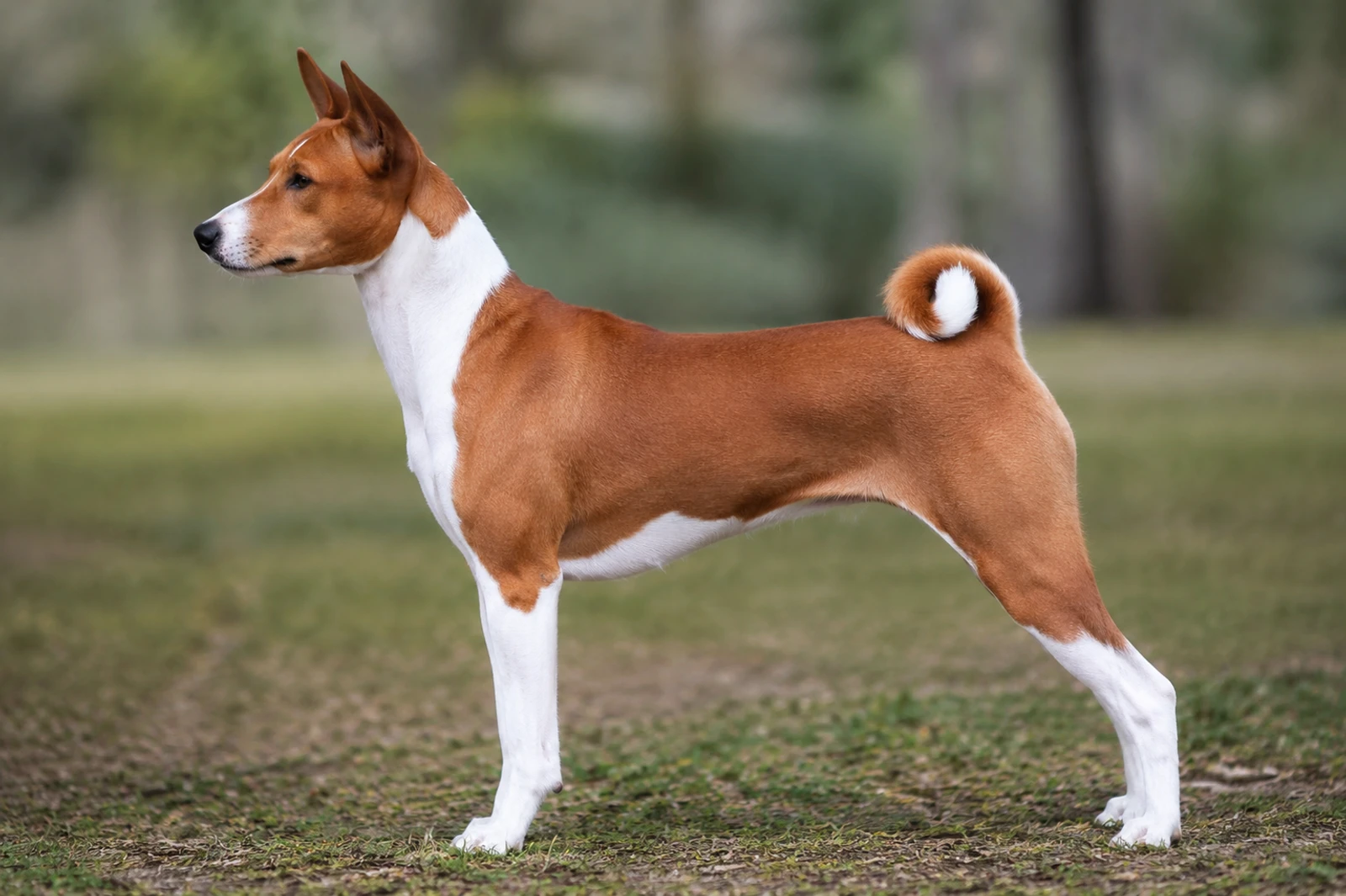
The Basenji is a compact, athletic hound with a quiet voice, quick mind, and catlike independence. It can fit well in an active home that enjoys training games and secure outdoor exercise, but it is usually better for owners who appreciate a clever dog with its own opinions.
At a glance
- Size
- Medium
- Height
- 16–17 in
- Weight
- 22–24 lb
- Life span
- 13–14 years
- Coat colors
- Chestnut red and white, black and white, tricolor, brindle and white
- Coat type
- Short, fine coat
- Group
- Sighthounds
- Origin
- Democratic Republic of the Congo
How much does a Basenji cost?
Adopt / rescue
$75–$400
Usually includes spay/neuter, first shots, and a microchip.
Buy from a breeder
$700–$2,000
From a reputable, health-testing breeder.
Approximate USD. Prices vary widely by region, breeder, pedigree, age, and coat colour — adopting is the lower-cost and recommended route. Avoid suspiciously cheap “breeders”; they’re often puppy mills.
Estimate the full cost of a Basenji →Want the ongoing number? Estimate the monthly food bill for a Basenji with our dog food cost calculator.
Basenji photos
Views
Front, side, rear and top — the full silhouette.Poses
How the breed sits, lies, moves and plays.Puppy to senior
The breed across its whole life.Expressions
The breed’s range of moods.Close-up details
Eyes, ears, nose, paws, tail and coat.Coat colors
The breed’s recognized colors.Click any photo to enlarge. We show the Basenji from every angle — three views, poses, life stages, expressions, close-ups, coat and colors.
Appearance & size
A Basenji carries no extra baggage—just 22 to 24 pounds of compact, square-built muscle on a 16- to 17-inch frame. The length from the front of the chest to the point of the buttocks equals the height at the withers, giving the dog a balanced, leggy silhouette that reads as both elegant and athletic.
The coat is short, fine, and lies flat against the skin. It’s practically drip-dry: low-shedding and famously low-odor. The four accepted colors all share a crisp white trim pattern.
- Chestnut red – deep, clear red with white feet, chest, and tail tip.
- Black – solid black with the same white markings; some individuals show rich tan points on the cheeks, above the eyes, and on the legs (often called tri, though true tricolor is distinct).
- Tricolor – black with tan and white; a black saddle, tan on the face, legs, and chest, and white in the standard spots.
- Brindle – black stripes over a lighter red base, again with the white markings.
White typically covers the feet, the chest—often forming a sharp V—and the tip of the tightly curled tail. Many dogs also have a white collar or white extending up the forelegs.
Look at a Basenji from the front and you see straight forelegs, small oval feet, and a deep chest that’s not overly broad. The head carries a set of fine wrinkles across the brow—especially visible when the ears prick forward—and dark, almond-shaped eyes that look like they’re sizing you up. The ears are a giveaway: small, hooded, and set high on the skull, they swivel toward any interesting sound.
From the side, the neck arches cleanly into a level topline and a flat back. A well-defined tuck-up gives the breed that gazelle-like underline, while the ribs spring gently from the spine without barreling out. The tail sits high and curls over one hip—ideally in a tight ring that presses flat against the thigh, not just a loose loop. A single tight curl is the classic look, though a double curl is permissible.
From the rear, the hindquarters are muscular without bulk, angulated just enough to drive a light, ground-covering trot. The tail set is unmistakable: high and curled so securely that it never unwinds, even when the dog sleeps.
That curled tail and wrinkled forehead aren’t just decoration—they’re hard-wired into the breed’s expression of constant, mischievous alertness.
History & origin
The Basenji didn’t come from a planned breeding program. It is, as far as anyone can tell, a landrace that shaped itself over thousands of years in the dense forests and savannas of central Africa — primarily the Congo basin. Carvings and cave paintings in Egypt show dogs with tightly curled tails and pricked ears that look startlingly like today’s Basenji, suggesting the type was already treasured as a gift for pharaohs 5,000 years ago. But its real development happened in remote villages, where silence, speed, and smarts meant the difference between eating and going hungry.
Local hunters bred for a dog that could work independently in thick undergrowth, using both sight and scent to flush small game — cane rats, duikers, birds — into nets. A noisy dog spooked prey or attracted larger predators, so the Basenji’s most famous trick, a yodel-like chortle instead of a bark, wasn’t a quirk. It was a deliberate survival trait. The unique flat larynx and sturdy, compact frame (22–24 lb of muscle and sinew) let the dogs move like cats, quick and quiet. Tribes in the Congo often tied a wooden bell around the dog’s neck so they could track its location when it went silent on a hot trail.
The Western world stumbled onto the breed repeatedly but couldn’t keep it alive. Early European explorers brought a few back in the late 1800s, but distemper killed every one. The same thing happened in the early 1900s. It wasn’t until the 1930s that Mrs. Olivia Burn, a British breeder, managed to import a viable pair from the Baka people of Sudan, and a separate group arrived in the United States through Mrs. Byron Rogers. Later, additional dogs were brought directly from the Congo, including a famous 1980s expedition that collected breeding stock from remote villages to widen the dangerously narrow gene pool.
Today’s Basenji is still startlingly close to its ancestors — independent, fastidiously clean, and prone to solving problems on its own terms. Those thousands of years as a semi-wild hunting partner didn’t just disappear when the dog stepped into a suburban living room.
Temperament & personality
Living with a Basenji means embracing a dog that acts more like a self-contained roommate than an eager-to-please retriever. They don’t bark—they yodel, chortle, or let out a high-pitched scream when truly excited or frustrated—but they’re far from silent wallflowers. That famous “barkless” label just means you’re in for a different soundtrack.
Energy and mental engagement At 16–17 inches and 22–24 pounds, the Basenji packs a sprinter’s engine into a medium frame. A bored Basenji will dismantle your sofa cushion by cushion, so plan on at least an hour of hard, off-leash running or intense play every day—lure coursing, fast-paced hikes, or running alongside a bike. This isn’t a dog satisfied with a quick lap around the block. Without enough physical and mental work, they redirect that focus toward creative destruction: door frames, shoes, remote controls. Puppies chew relentlessly to explore and soothe teething pain, but adult Basenjis keep those jaws strong through gnawing, so provide tough chew toys, frozen Kongs, or raw bones and expect the battle.
Affection on their own terms With their household, they can be affectionate and clownish, but they write the script. You’ll likely get a snuggly dog who shadows you from room to room—then suddenly decides they’d rather lounge alone in a sun patch. They often bond fiercely with one or two people while treating everyone else with polite, aloof curiosity. Forced cuddling? They’ll simply leave. Their independence means they don’t crumble under gentle, consistent boundaries, but heavy-handed corrections shut them down. Respectful negotiation, not demands, gets a Basenji to engage.
Watchfulness and body language As sighthounds, they miss nothing. A forward-leaning stance, ears up, and locked stare signal they’ve targeted a squirrel or a blowing leaf—and they might bolt before you blink. While they study strangers silently, they rarely intimidate; instead, they observe and categorize. Expect a unique yodeled announcement if someone approaches the door, but don’t expect a guard dog. Learn to read their subtle signals: a relaxed, loose body and soft eyes mean contentment; lip licking, yawning, or turning the head away are stress cues that tell you to back off. Stiffness paired with direct eye contact can precede a snap, especially if a child crowds the dog near food or a favorite resting spot. Teach kids to give the dog quiet meal times and to respect those calming signals.
Quirks and household habits Basenjis groom themselves like cats—licking paws and wiping their faces clean. They tend to have almost no doggy smell and hate soiling their den, which can make house training straightforward if you reward outdoor elimination with a treat immediately. However, that cleanliness coexists with a tendency to urine mark, especially if residual odor lingers. Wipe up accidents with an enzymatic cleaner or a vinegar spray to break the scent cue. Roll in something foul? Some do, possibly to advertise their find or just because they like the stench—it’s less common than with scent hounds, but be ready for the occasional bath.
Left alone too long, a Basenji may howl, chew, or redecorate with urine. They’re notorious escape artists who can scale a 6-foot fence or slip through a cracked door, so containment needs to be fortress-grade. With other dogs, they often coexist peaceably, but same-sex aggression—especially between two females—can flare, and their high prey drive makes cats, rabbits, and small dogs a real gamble unless they are raised together and carefully managed. If a Basenji’s needs are met, you get a clever, fastidious companion who keeps you laughing and guessing for 13–14 years. Meet them halfway, and they’ll be loyal without being clingy, a true partner in the house.
Good with kids, dogs & other pets
Basenjis bond tightly with their people, but they’re not the kind to tolerate clumsy handling or endless roughhousing. A 22–24 lb dog built more like a cat in attitude — quick, graceful, and quick to leave — will only stick around if kids respect its space. If you’ve got gentle school-age children who understand when the dog walks away, that’s a much better fit than a house full of toddlers who grab, chase, and shriek. That high-pitched noise and fast movement can flip a Basenji’s prey drive on, and the dog may react with a snap or a hard stare that parents need to read well before anything escalates. Early socialization with calm, supervised kids makes a world of difference, but this breed will never be a patient teddy bear.
Other dogs
They often do fine with other dogs — especially when raised together or introduced properly during puppyhood. Basenjis are naturally pack-oriented, but they’re also independent and can be same-sex aggressive once they hit maturity. Do not expect an adult Basenji to automatically welcome a new dog at the dog park. Short, structured meet-ups on neutral ground beat forced group play. After the 12–16 week socialization window closes, tossing two unfamiliar adults together can look less like play and more like a turf war. Some Basenjis live happily with another dog in the home; others prefer being the only star. Watch body language, not breed reputation.
Cats and small pets
Here’s where that sighthound lineage kicks in hardest. Cats, rabbits, ferrets, birds — anything small and fast — often register as prey. A Basenji can learn to live peacefully with a cat if they grow up side-by-side and the cat stands its ground, but it’s never a sure bet. Many adult Basenjis can’t be trusted off-leash around any small animal, no matter how much they “seem fine” inside. Secure enclosures, baby gates, and separate spaces are non-negotiable with rodents or rabbits. If your house already has free-roaming guinea pigs or a flighty kitten, this is probably the wrong breed for you.
The real backstop is early life experience
The critical socialization window slams shut around 16 weeks. Puppies raised in isolation — like those from puppy mills or pet store cages — often grow into fearful, reactive adults who panic at loud noises or panic-leash-lunge at other dogs. Basenjis are especially sensitive; lack of early exposure shows up later as extreme timidity or unearned snarkiness. Even after that window, daily, calm exposure to new sights, sounds, and friendly people helps them hold onto confidence. But if you’re adopting an adult who’s already set in his ways and only comfortable with you, don’t force meet-and-greets. That “socialization” just adds stress and can spark a fight. Let that dog live his best life with the one person he trusts — and skip the dog park.
Trainability & intelligence
You’re not training a dog that lives to make you happy — you’re negotiating with a clever, independent thinker who sees every command as a suggestion. A Basenji can learn a new trick in minutes, but she’ll perform it only when she sees a good reason to. That’s not stubbornness for its own sake; it’s a brain built for independent problem-solving, shaped by thousands of years of hunting game in Central Africa without a human shouting directions.
The only path to reliable responses is positive reinforcement with high-value rewards. Treats, a squeaky toy, or a burst of chase play can buy you a sit or a down, but a stern voice or physical correction will backfire spectacularly. Basenjis shut down, hold grudges, and simply opt out of the whole exercise. Sessions need to be short, upbeat, and unpredictable — three or four reps, then move on. Drilling kills any motivation they had.
Recall is the single most difficult skill to proof. A Basenji’s sighthound instinct turns a fleeing squirrel into an irresistible target, and if she’s off leash in an unfenced area, your “come” command becomes background noise. Many experienced owners never trust a Basenji off lead except in securely enclosed spaces. You build what little reliability you can through a lifetime of high-reward games that make coming back more fun than the chase — and you never stop reinforcing it.
House training often takes longer than you’d expect, not because the dog doesn’t understand, but because she’s indifferent to your schedule. Consistency, crate training, and an immediate party (treats + play) the instant she voids outside will get you there. Punishing an accident teaches her to hide from you, not to hold it.
Start socialization between 3 and 14 weeks, and keep it going for life. Calm, gradual exposure to new people, sounds, surfaces, and other polite dogs gives you an adult Basenji who’s aloof with strangers but not fearful or reactive. Rushing the process or flooding her creates exactly the skittish, unpredictable dog you don’t want.
Success with a Basenji isn’t about out-muscling her will. It’s about building enough trust that she decides cooperating is worth her while. You earn the basics — you don’t demand them.
Exercise & energy needs
Plan on a solid hour of real movement every day, split into at least two sessions. A 22–24 lb Basenji isn’t big, but the engine inside is pure sighthound — built for explosive sprints, not a lazy amble around the block. A 15-minute leash walk won’t touch his needs, and a bored Basenji turns into a creative demolition crew.
- Daily minimum: 60 minutes of vigorous exercise, spread across morning and afternoon. Two 30-minute sessions work well for most adults. Young adults may push for more, while seniors often do fine with two shorter outings and less full-tilt sprinting.
- What counts: Off-leash running in a securely fenced area is the gold standard. Flirt poles, fetch with a long throw, and lure coursing — even a backyard DIY setup — let him tear after a moving target the way he was born to. Hikes on a long line can work if you keep the pace up and let him use his nose.
- Mental work is not optional. Basenjis problem-solve constantly. A puzzle toy that pays out kibble, a snuffle mat, or hiding treats around the yard will drain mental battery as fast as a sprint. Scent games indoors (trailing a piece of cheese through the house) are a lifesaver on bad-weather days.
- The off-leash reality: This breed has near-zero recall when prey is moving. Never let a Basenji off-lead in an unenclosed space. A 6‑foot fence is the minimum — they climb, and a determined Basenji can scale chain link. A martingale collar or escape-proof harness is smarter than a flat buckle collar for walks.
Skip the outlet and you get chewing, digging, and houdini-level escape attempts. Pour that energy into daily chasing and sniffing, and you’ll have a quiet, cat-like housemate who naps the rest of the day.
Grooming & coat care
Your Basenji grooms herself like a cat — fastidious, nearly silent, and surprisingly tidy. That instinct means coat care from your end is refreshingly light.
Grab a soft bristle brush or a rubber grooming mitt once a week. A few quick passes remove the few dead hairs, spread natural oils, and leave the short, single coat glossy. (Natural pig-bristle brushes are ideal for putting a glass-like shine on the sleek fur.) There’s no undercoat, so you’ll never battle the dense, seasonal blowouts of a double-coated breed. Skip the slicker brushes and metal combs entirely; they’re overkill for this hair type.
Bathing is strictly an as-needed affair. Many Basenjis go six months to a year between baths, because their coat repels dirt and they carry almost no doggy odor. If she rolls in something foul, use a mild dog shampoo and rinse thoroughly — frequent washing can strip oils and dry out the skin.
There’s no trimming or clipping involved. The coat stays short naturally, so your grooming budget won’t include a clipper.
The real routine lives in the basics. Nails grow fast on this active breed; trim them every three to four weeks. Ears are erect and stay drier than floppy ears, but a weekly peek for wax or debris helps you catch issues early; wipe the outer ear with a damp cloth when needed — never dig deep. Teeth need daily brushing if you can swing it, or at least several times a week, because these small, tidy dogs can still build tartar quickly.
Seasonal shedding is minimal. You might see a slight uptick during spring and fall. A rubber curry brush once or twice a week during those stretches catches loose hair before it finds the sofa. For the other 48 weeks of the year, a quick wipedown with a damp cloth is often enough to keep your Basenji looking show-ring clean.
Shedding & allergies
You’ll find less fur on your couch than you’d expect from a dog. Basenjis have a short, single coat that sheds lightly all year, not in punishing tumbleweed waves. They lack the dense undercoat that makes many breeds “blow coat” twice a year. Run your hand over a Basenji and you’ll pick up a few fine hairs, not clumps.
Seasonal changes might cause a minor uptick in shedding, but it’s rarely dramatic. Weekly once-overs with a hound glove or soft brush are enough to collect loose hair and keep the coat gleaming. These dogs are also fastidious self-groomers — they lick themselves clean like a cat, which helps contain stray fur but can still deposit saliva allergens around the house.
Drool is basically nonexistent. Even after a long drink of water, a Basenji’s lips stay tight. No slobber on your pant leg, no sticky residue on furniture.
The hypoallergenic reality: No dog is 100% hypoallergenic. Allergens come from dander, saliva, and urine. A Basenji’s low-shedding coat does mean fewer airborne hairs carrying dander, so many people with mild allergies live comfortably with one. But you still need to spend time around the breed before committing — some individuals react to the proteins in a Basenji’s dander or saliva. A responsible breeder won’t promise an allergy-free dog; they’ll tell you to visit adult dogs and see how your body responds.
Diet & nutrition
A Basenji’s lean, athletic frame doesn’t need heavy cover. Portion control and the right fuel keep this sighthound moving fast and aging well.
Feeding puppies
From weaning until four months, split the daily ration into four evenly spaced meals. At four months, drop to three meals; at six months, switch to the adult schedule of two meals a day. Transition a new puppy gradually — start with lightly cooked, puréed meat and fish mixed with fruit and vegetable purées, or use a high-quality commercial puppy food. Around twelve weeks, raw chicken wings can be introduced under close supervision to build chewing strength, but always watch for choking. Growing Basenjis burn through calories quickly, so monitor body condition weekly and adjust upward if ribs become too prominent.
Adult portions and weight watch
A 22–24 lb adult typically does well on 1 to 1½ cups of dry kibble per day, divided into morning and evening meals — or the caloric equivalent in home-prepared food. That’s a starting point. Crank it up for a dog that courses regularly, scale it back for a weekend wanderer. Basenjis aren’t famously food-obsessed, but a few extra pounds slow them down and put stress on joints and spine. Check often: run your fingers along the ribcage lightly — you should feel individual ribs without a thick layer of fat. From above, there should be a clear waist behind the ribs. Adjust portions, not just treats, if the waist starts to vanish.
Senior adjustments
As activity naturally declines around age 10, cut back daily calories to prevent sneaky weight gain. There’s no solid reason to drop protein sharply; keeping muscle matters. If teeth wear down or the mouth gets sensitive, purée meals to improve nutrient absorption. Smaller, more frequent feedings can help an older dog digest comfortably without overloading the stomach.
What goes in the bowl
Treat the diet like a rough formula: roughly 60% meat (raw or cooked), 20–30% dog-safe fruits and vegetables, and the remaining 10% from eggs, plain yogurt, or digestible grains such as pearl barley, white rice, or oatmeal. Canned fish (in water, no salt) and cooked eggs mix in for quick meals. Unsalted vegetable cooking water makes a fine broth when stock isn’t on hand. If your Basenji inhales meals, a puzzle bowl slows things down and adds a mental workout.
A few never-do’s: No table scraps fed from your hand — begging is a monster to undo. Instead, put any leftover-safe portion directly into the dog’s own bowl. After holidays, resist the urge to share fatty trimmings, which can trigger pancreatitis. And despite any human dietary choices, a meat-free diet isn’t species-appropriate for a dog; it strips essential nutrients their system counts on. Serve the last meal at least three hours before bedtime to help young dogs and seniors stay clean overnight.
Health & lifespan
A Basenji who stays lean and genetically healthy often reaches 13 or 14 years, and 15 or 16 isn’t unusual with diligent care. The big things that shorten that span are inherited conditions that responsible breeders actively screen out.
What responsible breeders test for
- Fanconi syndrome: This kidney disorder allows glucose and other nutrients to leak into the urine, eventually causing weight loss, muscle wasting, and kidney failure. It typically shows up between 4 and 8 years old. A DNA test is available, and ethical breeders test every potential parent. Always ask for proof that both sire and dam are clear — carriers won’t develop the disease, but they can pass it on.
- Progressive retinal atrophy (PRA): PRA leads to gradual blindness with no cure. There’s a DNA test, and a board-certified veterinary ophthalmologist can also check for early retinal changes. A combination of genetic clearance and annual eye exams gives you the best safeguard.
- Hip dysplasia: While less rampant than in heavier breeds, Basenjis can still develop hip dysplasia. Look for OFA or PennHIP certification on both parents.
- Patellar luxation: A slipping kneecap can cause intermittent lameness. A routine palpation during a vet exam spots it, and breeders should check their stock.
Basenjis also have a breed-specific sensitivity to anesthesia. Their metabolism is unusual, so even routine procedures like spaying or dental cleanings require a lower dose. Find a vet who understands the breed, or at minimum consults the protocols.
Everyday health at home
Keep them lean. A 22–24 pound Basenji should have visible ribs and a defined waist — any extra padding strains those patellas and hips. Measure food, limit treats, and provide real exercise: a fenced yard they can tear around in, or a daily 45-minute off-leash sprint (in a safe area) does more than a leash walk ever will.
That thin, tight coat offers little insulation. In cold weather, they’ll shiver quickly; a coat or sweater is not a fashion statement — it’s practical. In heat, they’re fairly tolerant if you provide shade and water, but never push strenuous exercise when it’s sweltering.
Monthly heartworm prevention during mosquito season (and one month past the first frost) is non-negotiable. Rabies vaccination is legally required everywhere; skip it at your own — and your dog’s — peril.
The stress connection
Basenjis hate isolation. A lonely, under-stimulated Basenji can internalize stress, which often shows up as digestive upset or destructive chewing. They do best when they are part of the daily household rhythm. The more a Basenji’s mental needs are met, the fewer stress-related health complaints you’ll see.
Schedule an annual wellness exam with blood work, and twice yearly once they hit their senior years. Subtle changes in drinking, urination, or appetite are often the first clue that Fanconi or hypothyroidism is brewing. Those yearly labs catch problems before you’d notice a thing.
Living environment
An apartment can work for a Basenji, but only if you treat daily exercise as a non-negotiable chore. These 22–24 lb sighthounds are clean, quiet housemates who nap like cats when their needs are met. Miss a day of hard running, though, and you’ll come home to a scene that looks like a sofa exploded. A house with a securely fenced yard makes life simpler—open the door for a few mad laps whenever the mood strikes—but a yard isn’t a substitute for the structured sprints and scent games that truly settle this breed.
A 4-foot picket fence is a joke to a Basenji. They climb, jump, and dig with a single-minded focus once a squirrel appears. You need at least 6 feet of solid or welded-wire fencing with no horizontal rails to use as toeholds, plus an inward-curved overhang or coyote rollers. Bury hardware cloth 12–18 inches below the ground line to thwart tunneling, and never leave them outside unsupervised, no matter how fortress-like the yard looks.
These dogs trace back to the heat of central Africa, and their short, sleek coats make them comfort-seeking sunbathers. Heat is mostly fine—just watch for pavement burns and provide shade. Cold is a problem. Once temperatures drop below 50°F, a sweater or coat stops the shivers, and walks in snow or freezing rain should be quick bathroom breaks.
The “barkless” tag is only half true. Basenjis don’t bark, but they do yodel, chortle, and, when really put out, produce a piercing, one-note scream that travels through walls. You won’t get the repetitive barking that annoys neighbors, but a single shriek at 2 a.m. will still raise eyebrows. For apartment life, that’s a manageable trade-off as long as you teach a quiet settle early.
Independence isn’t the same as being okay alone. A young Basenji left for 5 or 6 hours without enough mental prep can remodel baseboards or howl long enough to get a noise complaint. Build up alone time gradually, provide frozen food puzzles and nose-work toys, and crate train as a den, not a cage. If your household is gone 8+ hours most days, plan on a midday dog walker or a compatible second dog to keep the peace. Even confident adults can backslide into destructive anxiety if their routine flips overnight.
Who this breed suits
This dog isn’t for someone who wants an eager-to-please shadow. The Basenji is for you if you enjoy a challenge wrapped in a 22-pound, cat-like package, and you genuinely respect independence. You’re a natural problem-solver, not a control-freak, and you find the idea of a dog that uses its paws like hands and outthinks baby gates more amusing than infuriating. First-timers usually struggle here; this breed demands someone who’s already fluent in dog body language and doesn’t mistake “stubborn” for “stupid.”
Who clicks with a Basenji
- Active singles or couples with a sense of humor. A Basenji needs 45–60 minutes of fast, focused movement daily — sprinting in a securely fenced yard, lure coursing, or a long jog. Puzzle toys are non-negotiable; a bored Basenji will dismantle your couch with surgical precision.
- Experienced owners who don’t need a Velcro dog. You’ll get affection on his terms — brief nudges, a forehead press, not endless cuddles. You find the yodeling conversation endearing, not annoying.
- Households with older, dog-savvy kids. Families work if children are taught to respect a dog that hates being grabbed or chased. Young kids who shriek and grab are a bad match — this dog will air-snap or retreat, not tolerate rough handling.
- Clean-freaks with a sense of irony. Basenjis groom themselves like a cat, shed very little, and have almost no typical doggy odor. Your house stays cleaner; your schedule just got more complicated.
Who should think twice
- People who want an off-leash hiking buddy. A Basenji’s prey drive overrides any recall if a squirrel twitches. They’ll be gone — climbing a 6-foot fence, slipping a harness, or shooting through a door crack at 30 mph.
- Sedentary or busy households. This isn’t a low-energy apartment dog you can leave for 10 hours and then stroll around the block. Under-exercised Basenjis scream, chew through drywall, and find creative ways to escape.
- Owners with small pets like rabbits, cats, or guinea pigs. Sighthound instinct is hardwired; a scurrying creature triggers a chase-and-kill sequence that no amount of training can reliably erase.
- Anyone who needs a reliably obedient, please-the-handler dog for therapy work or novice obedience trials. Basenjis evaluate every request before deciding if it’s worth their while. A treat that felt fair yesterday may be beneath them today.
If you’re in the “pass” camp, don’t take it personally. You’d be signing up for a 13–14-year chess match with a dog that can open lever-door handles and will outlast your patience if you aren’t genuinely entertained by the hustle.
Cost of ownership
A well-bred Basenji puppy from a responsible breeder who screens for Fanconi syndrome, PRA, and hip dysplasia typically costs between $1,500 and $2,500. Show- or breeding-prospect pups can push past $3,000. Rescue adoption fees usually land in the $250–$500 range and often include spay/neuter and initial vaccinations. Since Basenjis live 13–14 years, that upfront price spreads out over a long, quirky partnership.
Monthly upkeep runs lean in some areas and spikes in others. A 22–24 lb Basenji eats about 1 to 1.5 cups of high-quality kibble a day — roughly $30–$50 a month, more if you feed raw or a prescription diet for a health condition. Grooming costs are nearly zero: this short, fastidious coat just needs a quick once-over with a hound glove or damp cloth. A professional bath and nail trim every 6–8 weeks adds about $30–$50 per session, but you can easily handle it at home.
Routine vet care — annual exam, vaccines, heartworm and flea/tick prevention — averages $300–$500 a year. That’s the baseline. The breed’s known health issues (Fanconi syndrome, progressive retinal atrophy, thyroid problems) can drive unexpected bills into the thousands, so many owners carry pet insurance. Premiums for a mid-size dog run $35–$55 a month with a solid wellness rider.
The bigger variable is the Basenji mind. Bored dogs will dismantle a couch, climb a bookshelf, or clear a six-foot fence without a running start. Budget for puzzle feeders, sturdy chew toys, and possibly a midday dog walker or daycare ($15–$35 per walk, $300–$600 a month for part-time daycare). If you need to Basenji-proof a yard with dig guards and a tall fence, that’s a one-time cost of several hundred dollars that saves you from losing your escape artist on a whim.
Choosing a Basenji
Responsible Breeder vs. Rescue
A rescue Basenji can slide right into your life if you’re prepared for an intelligent, independent dog with unknown early experiences. You skip the puppy destruction phase, and many adult rescues already have house manners. The trade-off is a blank health history and often a longer adjustment period while they learn to trust you.
A responsible breeder raises puppies with early socialization, predictable temperaments, and documented health screenings. Expect to wait for a litter—Basenjis typically cycle only once a year. A good breeder will interview you as much as you interview them. They’ll want to know about your fencing, your activity level, and whether you truly get a dog that may never fetch on command and will absolutely climb the counters when you’re not looking.
Health Clearances You Should Ask For
Basenjis can be stoic, and hidden disease can steal years from them. Insist on proof of these screenings—not just a verbal “all good.” Ask to see results searchable in public databases like OFA.
- Fanconi Syndrome DNA test: This is non-negotiable. Fanconi is a fatal kidney disorder that can be managed if caught early, but it’s devastating. A breeder who says their lines are “clean by pedigree” without a DNA test is waving a red flag you can’t ignore. Puppies should be directly tested or born from two tested-clear parents.
- Hip evaluation: OFA or PennHIP certification. Hips aren’t the breed’s biggest issue, but laxity and dysplasia still crop up.
- Annual eye exam (CERF/OFA Eye): For progressive retinal atrophy (PRA) and other inherited eye disease. Certification should be current, within the last 12 months.
- Thyroid panel: Autoimmune thyroiditis surfaces in the breed. A full panel (TgAA, T4, TSH) from an approved lab is ideal.
Red Flags to Watch Out For
- No Fanconi testing, period. Turn around and walk away.
- A breeder who always has puppies available or pressures you to buy “right now.” Ethical breeders have waitlists.
- No health guarantee or a guarantee that won’t cover what matters—like a commitment to take the dog back if Fanconi appears later.
- Won’t let you meet at least the mother (and she lives in a clean, not just kenneled, space). Seeing the mom gives you a peek at adult temperament and living conditions.
- Sells puppies under 8 weeks or ships them to anyone with a credit card, no conversation about your home. A Basenji in the wrong hands ends up scaling 6-foot fences or rehomed for “stubbornness” that is just the breed being itself.
Picking the Right Puppy
A well-socialized Basenji pup is curious, not cowering. They’ll trot up to check you out, maybe mouth your shoelace, then wander off to investigate something more interesting. Independence is normal; stark fear or flat avoidance is not. Watch for clear eyes, clean ears, a tightly curled tail, and no squinty, runny nose.
Most serious breeders match puppy to household based on temperament testing rather than a first-come-first-served color pick. Trust that process—it’s how you end up with the pup who will actually handle life in your home. A dog that ghosts you in the yard doesn’t care if she’s perfectly brindle.
Pros & cons
Pros
- Nearly silent: A Basenji doesn’t bark. You’ll hear yodels, chortles, and the occasional shriek instead — a huge advantage in an apartment, but not total silence.
- Cat-like cleanliness: They groom themselves obsessively, rarely smell doggy, and shed hardly at all. Many owners find them virtually odor-free.
- Compact and agile: At 22–24 pounds and 16–17 inches, they’re a manageable medium sighthound that fits smaller living spaces, provided daily exercise happens.
- Long lifespan: With responsible breeding, 13–14 years is routine for the breed.
- Watchful and alert: They notice everything and post up like a little sentry, giving you an early heads-up without the barking fits.
Cons
- Fiercely independent: A Basenji is as likely to ignore a cue as follow it. Training demands patience, creativity, and a sense of humor — they shut down under heavy-handed methods.
- Sky-high prey drive: Squirrels, cats, small dogs — anything that moves triggers an instinct to chase that overrides recall. Reliable off-leash obedience is the exception, not the rule.
- Escape artists: They climb chain-link, slip collars, and dig under fences with impressive speed. A six-foot wooden privacy fence and a locked gate are the minimum security setup.
- Destructive when bored: Leave a Basenji without a mental puzzle or a solid run, and a sofa cushion can become confetti in minutes. This isn’t a dog you can just toss a bone and ignore.
- Reserved and sensitive: They’re aloof with strangers and don’t bounce back from harsh corrections. Early, ongoing positive socialization is non-negotiable if you want a stable companion.
Similar breeds & alternatives
Shiba Inu
The Shiba Inu is slightly more compact (13.5–16.5 inches tall versus the Basenji’s 16–17 inches) but weighs in close at 17–23 pounds. It shares the Basenji’s independence, fastidious grooming habits, and aloofness with strangers. The biggest difference: Shibas bark—and when they do, it’s often a piercing, operatic scream, not the Basenji’s chortles and yodels. Both breeds are escape artists, but the Shiba’s double coat sheds heavily twice a year, while the Basenji’s short, single coat barely sheds. Shibas are slightly less likely to leap a six-foot fence from a standstill, but their stubbornness can rival a Basenji’s on any given day.
Ibizan Hound
An ancient sighthound with the same deer-like elegance, the Ibizan Hound stands 22.5–27.5 inches and weighs 45–65 pounds—more than double the Basenji’s size. Ibizans are also clownish, clean, and fastidious; they’re often described as “cat-like” in their grooming and vertical leaps. They bark, though not excessively, and their prey drive is just as hair-trigger. Sensitive and a bit softer than the hard-headed Basenji, Ibizans respond better to gentle training but can still be independent. The extra size means they need more room to run—a large, securely fenced yard is a practical requirement.
Whippet
If you love the Basenji’s streamlined silhouette and low-shedding coat but want a more demonstrative companion, the Whippet (18–22 inches, 25–40 pounds) flips the personality script. Whippets are quiet, gentle sprinters that crave physical contact and happily curl up on the couch after a short, intense run. They bark rarely and lack the Basenji’s wide vocal range. Where a Basenji entertains itself and may look for ways around a fence, a Whippet is more likely to follow you from room to room. Whippets don’t tolerate being left alone as calmly as a Basenji often does, so separation anxiety can crop up if you’re gone long hours.
Fun facts
- Basenjis are famous for yodel-like vocalizations rather than typical barking.
- The breed has ancient roots in Central Africa.
- Their short coat is easy to maintain.
Frequently asked questions
- Are Basenjis good with children?
- Basenjis can be good with children if properly socialized from a young age, but their independent nature means they may not tolerate rough handling. Supervision is recommended, especially with younger kids, as Basenjis tend to be alert and may react defensively if startled.
- Do Basenjis shed a lot?
- Basenjis are low shedders with a short, fine coat that requires minimal grooming. They shed lightly throughout the year, and regular brushing once a week helps keep loose hair under control. This makes them a relatively tidy breed.
- Are Basenjis easy to train for first-time dog owners?
- Basenjis are intelligent but also independent and strong-willed, which can make training a challenge for first-time owners. They respond best to positive reinforcement and consistent, patient guidance. Without proper leadership, they may become stubborn, so they are often better suited to experienced owners.
- Do Basenjis bark a lot?
- Basenjis are known as the 'barkless dog' because they don't bark like other breeds; instead, they make a unique yodel-like sound called a 'barroo' when excited. They are generally quiet but can be vocal with whines, growls, or that distinctive yodel. So, they are not noisy in the traditional barking sense.
- How much exercise does a Basenji need?
- Basenjis have high energy levels and require at least 45 to 60 minutes of vigorous exercise daily, such as running, play sessions, or long walks. Without adequate physical and mental stimulation, they can become destructive or develop behavioral issues. They enjoy activities that challenge their sighthound instincts, like lure coursing.
Tools & calculators for Basenji owners
Quick estimates tailored to Basenjis — pre-filled with this breed’s size where it matters.
Articles & stories about the Basenji
Sources & standards
This profile follows recognized breed standards from the American Kennel Club (AKC) and the Fédération Cynologique Internationale (FCI), along with established veterinary and breed-club guidance. These describe general breed tendencies — every dog is an individual.