

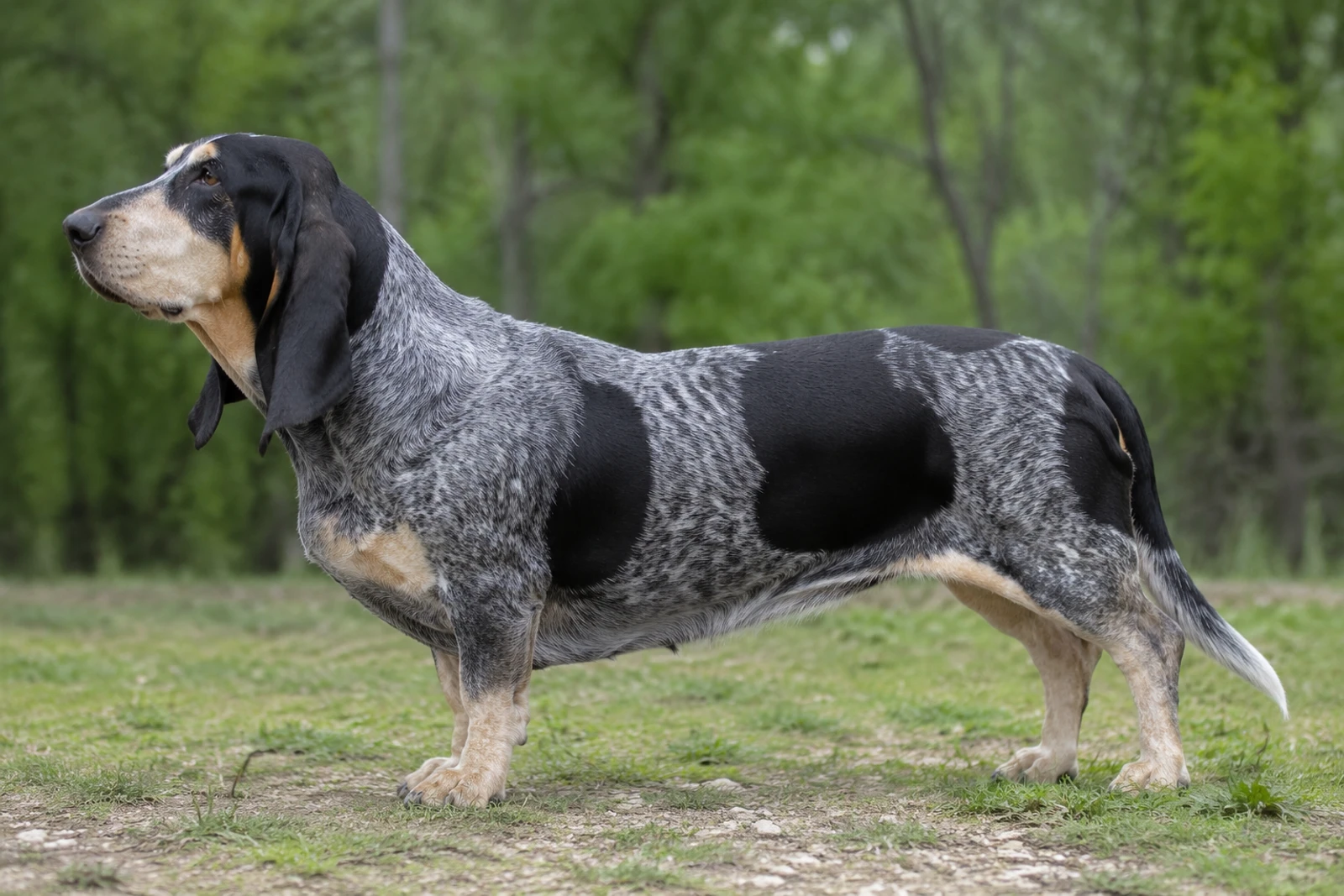
The Basset Bleu de Gascogne is a charming, low-slung French hound known for its striking blue-mottled coat and soulful expression. A tireless hunter on the trail but a relaxed companion indoors, this breed suits active homes that can provide daily walks and scent games. Patient and good-natured with children, they thrive in pack-like settings but may follow their nose into mischief. Their melodic baying is music to a hound lover’s ears but a challenge in close quarters. Ideal for experienced owners who appreciate an independent spirit and don’t mind a bit of slobber.
At a glance
- Size
- Medium
- Height
- 12–15 in
- Weight
- 35–44 lb
- Life span
- 10–12 years
- Coat colors
- Mottled black and white with tan markings
- Coat type
- Short, smooth, and dense
How much does a Basset Bleu de Gascogne cost?
Adopt / rescue
$75–$400
Usually includes spay/neuter, first shots, and a microchip.
Buy from a breeder
$700–$2,000
From a reputable, health-testing breeder.
Approximate USD. Prices vary widely by region, breeder, pedigree, age, and coat colour — adopting is the lower-cost and recommended route. Avoid suspiciously cheap “breeders”; they’re often puppy mills.
Estimate the full cost of a Basset Bleu de Gascogne →Want the ongoing number? Estimate the monthly food bill for a Basset Bleu de Gascogne with our dog food cost calculator.
Basset Bleu de Gascogne photos
Views
Front, side, rear and top — the full silhouette.Poses
How the breed sits, lies, moves and plays.Puppy to senior
The breed across its whole life.Expressions
The breed’s range of moods.Close-up details
Eyes, ears, nose, paws, tail and coat.Coat colors
The breed’s recognized colors.Click any photo to enlarge. We show the Basset Bleu de Gascogne from every angle — three views, poses, life stages, expressions, close-ups, coat and colors.
Appearance & size
At a glance, the Basset Bleu de Gascogne reads as a hound scaled to hunt on foot: low to the ground, heavy-boned, and longer than he is tall, yet far wolfier in silhouette than the Basset Hound most people picture. A male or female will stand 12 to 15 inches at the shoulder and settle between 35 and 44 pounds—solid medium mass packed onto a frame that stays surprisingly athletic.
The coat is short, dense, and close-lying, built to shed brambles and weather. What you’ll register first is the color. The breed’s name gives it away: the body is a wash of “blue,” really a tight mottling of black and white hairs that creates a roan effect with a faint slate shimmer. Across that blue ground, you’ll see solid black patches, often a blanket stretching from shoulders to tail, interrupted by rich tan points. Those points trace a mask above each eye, fill the cheeks, line the inside of the long ears, and mark the legs, the chest, and the underside of the tail.
Seen head-on, the skull is broad with a slightly domed top and a distinct stop. The muzzle is deep and squarely chiselled, with flews that hang just enough to soften the jawline. Dark brown eyes are set wide, framed by a hint of lower lid so the expression lands as quietly mournful, even when the dog is perfectly content. A large, black nose sits at the end, ready to lead, and the ears—low-set, fine as velvet, folded inward—drop well below the eye line and reach at least to the tip of the nose.
From the side, the long body comes into focus. The topline is level and the back strong, supported by well-sprung ribs that carry plenty of lung room. The chest drops deep between the front legs, the underline tucking up only slightly. Legs are straight and short, but with good bone and pronounced knuckles at the pasterns. At the rear, a muscular, well-angled thigh powers a surprisingly smooth, ground-covering gait for such a low-built dog. The tail is carried sabre-like—thick at the base, tapering to a point, and never curling forward over the back. It’s usually in gentle, constant motion, a quiet barometer of whatever scent line the hound is working.
History & origin
This is a hound whose story reads like a rebound—twice. The Basset Bleu de Gascogne traces directly to the much older Grand Bleu de Gascogne, a towering, deep-voiced pack hound that prowled the French countryside for centuries. Hunters in the Gascony region of southwestern France wanted a dog that could work at foot-pace through thick underbrush and rocky terrain where a horse couldn’t follow. So in the early 1800s they began selectively breeding the Grand Bleu down in size, introducing a form of dwarfism that shortened the legs but left the body, nose, and voice of a full-sized scenthound. The result was the Basset Bleu: a low-slung tracker with the same mottled blue-ticked coat, melancholy expression, and tireless nose, built to push through heavy cover after hare and rabbit while a hunter walked comfortably behind.
The breed carved out a steady niche in rural France through the 19th century, working in packs and earning a reputation for methodical, persistent scent work rather than flashy speed. Hunters valued its deep, resonant bay that echoed through the woods—no mistaking when a trail was struck. But the two World Wars gutted French hunting traditions, and by the 1940s the Basset Bleu de Gascogne had virtually disappeared. The breed was considered extinct outside of a few isolated farms until a dedicated revival effort in the 1970s. Enthusiasts scoured the countryside for remnants, cross-bred carefully with related basset types (particularly the Basset Artésien Normand) and even back to the Grand Bleu to restore type and vigor without creating carbon copies. What emerged was a painstaking reconstruction, not a simple continuation.
Today the Basset Bleu de Gascogne remains rare—even in France, registrations hover in the low hundreds per year, and sightings elsewhere are scarce. It’s a working hound first, still used on live game, and most breeders prioritize hunting ability over show-ring polish. The dogs you’ll meet today are a deliberate piece of living history, but not a museum exhibit: they still run, bay, and puzzle out cold trails with the same single-mindedness that made their ancestors indispensable to Gascon hunters two centuries ago.
Temperament & personality
A Basset Bleu de Gascogne is a pack hound through and through—calm and almost languid indoors, but a nose with legs the moment you step outside. Expect a dog who is gentle and steady with his family, yet stubborn enough to pretend he’s gone deaf when a scent trail calls.
Affection comes on his terms. He’ll lean against your leg, follow you from room to room, and happily sprawl across the couch after his walk, but he is not a needy lapdog. That independent streak means he tolerates a workday better than many hounds, provided he’s had a good morning outing and some puzzle toys to occupy his brain between naps.
Energy runs at a moderate, humming pace. A daily 30- to 45-minute walk, with plenty of sniffing detours, keeps him fit and sane. Stifle the sniff time and you’ll quickly have a frustrated, noisy dog. Because his nose erases recall training when a rabbit hops by, a securely fenced yard isn’t optional.
He is watchful without being sharp. A deep, rolling bark announces a stranger or an offending squirrel, but once guests step inside and get a good sniff, they’re likely greeted with a wag. Leave him alone too long and that same bay can morph into an anxious howl. Boredom and isolation fuel the soundtrack, so apartment living calls for genuinely soundproof walls and a neighbor with saintly patience.
Quirks are part of the package. This is a dog who will roll in dead things, badger droppings, and anything with a punch of odor. Some hounds do it to mask their scent; a Basset Bleu often seems to just enjoy the perfume. Keep a good shampoo handy and your sense of humor closer. He also carries a strong territorial marking instinct—unneutered males especially may lift a leg on new furniture or in less-used rooms. Always clean accidents with an enzymatic cleaner that breaks down urine proteins; standard ammonia-based products smell like a challenge to reapply.
Around children and other pets, he’s generally patient and easygoing, but the household rule is ironclad: never bother him while he’s eating. A stiffened body and a hard, direct stare are your early warning. Teach kids to give him space around his bowl and swap chews for a treat instead of grabbing for them. Raised with another dog, he slots in happily; his pack background craves the company.
Training asks for patience, not force. He’s smart, food-motivated, and independent. Short sessions built around scent games—find-the-treat, a snuffle mat, a hidden toy—hold his attention far better than repetition. Bullheaded methods only trigger passive resistance, and you’ll lose that argument every time.
Good with kids, dogs & other pets
A Basset Bleu de Gascogne’s default around children is gentle and forgiving. These dogs lean into patience the way some dogs lean into trouble — it's just how they’re wired. They’ll tolerate a clumsy hug or a toddler’s unsteady pat without making a big deal of it. That doesn't mean you hand over the reins. Small kids and any 35-to-44-pound dog can accidentally knock into each other, so supervision is about preventing the oops moments, not managing an attitude problem. Teach children to give the dog space during meals and when it’s settling in for a nap, and you’ll have a steady, affectionate family member who genuinely likes being in the middle of the household noise.
With other dogs, the Bleu typically falls right in step. This isn’t a breed that wakes up looking for a scrap. But they were built for pack hunting, so they read canine social cues well and tend to enjoy company. If you already have a dog at home, slow, neutral introductions on leash in a neutral space will still pay off. Don’t just toss them together in the yard and hope for the best.
Cats and smaller pets call for a sharper eye. That same world-class nose that makes them a spectacular trailing hound can redirect toward a fleeing rabbit or a cat that runs. Plenty of Bassets Bleu de Gascogne live peacefully with indoor cats, especially when raised alongside them. The trick is not speed — it’s the chase trigger. Early exposure really matters here. Let them have calm, controlled meetings where the cat walks away slowly or stands its ground, so the dog learns that not everything small needs to be pursued. Caged pets like guinea pigs or ferrets should stay securely out of reach, because a hound’s interest isn’t aggression — it’s just too strong an interest to ignore.
Socialization shapes whether all this good nature holds up in real life. The prime window slams shut around 12 to 16 weeks old, so during those early months, let your puppy meet calm dogs, kindly kids, and a variety of people. Walk them on different surfaces, let them hear traffic and appliances. Do it gently, never force, and pair it with treats. If you’re bringing home an adult Basset Bleu de Gascogne, don’t drag them through a crash course in meet-and-greets. A grown dog that’s comfortable with its own circle may not need to be social butterfly, and pushing it can backfire into stress. Work with where they are, not where a textbook says they should be.
Trainability & intelligence
The Basset Bleu de Gascogne isn’t dumb — far from it. He’s just smart in a way that serves his own agenda, not a human’s command list. These hounds were bred for generations to follow a scent trail with bone-deep determination, not to glance back for direction every six steps.
When the nose switches on, the ears close for business
That legendary nose can override everything you’ve taught in a heartbeat. You’ll call him while he’s tracking a rabbit and it’s like shouting into a pillow — he genuinely isn’t listening. This isn’t defiance; it’s a hardwired sensory takeover. Plan on a long, patient road to any sort of reliable recall. A good yardstick: if he won’t whip around and sprint back 90% of the time when a squirrel skitters past, he stays on a long line or in a fenced area. No exceptions.
Positive reinforcement is your only real leverage
He’s sensitive to tone and will shut down if you get harsh. Correction-based methods burn trust fast with a breed like this. What works? Treats that are offensive-level smelly. Think liverwurst, dried fish, or tiny cubes of warm-up cheese. Keep sessions short (five minutes, tops) and quit while he’s still into it. When he discovers that focusing on you pays better than ignoring you, he’ll start offering attention — on his own schedule, but it’ll happen.
- Reward the behavior you want immediately — the moment his butt hits the ground, not two seconds later.
- Use treat scatters to redirect him away from a scent he’s locked onto instead of trying to pull him off physically.
- Avoid repeating cues. A whiny “come, come, come” just teaches him that the word is background noise.
Early socialization is non-negotiable
Hounds that lean independent can slide into aloofness or suspicion if they aren’t carefully exposed to a wide range of people, dogs, and everyday racket between 3 and 14 weeks old. Pair every novel experience with something great (a play session, a jackpot of treats) and you’ll end up with an easygoing adult who handles the vet and the coffee shop patio without drama. Skip this window, and you might spend years undoing a cautious, wallflower temperament.
Stubborn moments will still pop up — a Basset Bleu who decides the kitchen counter surfing is worth investigating will figure out how to nudge a chair over. That’s problem-solving intelligence, just pointed at the wrong target. Manage his environment, set him up to succeed, and keep a stash of the stinkiest reinforcement on hand.
Exercise & energy needs
Plan on about 45 minutes of daily movement, split into two or three short, sniff-forward walks. A 15-to-20-minute amble around the neighborhood is fine — as long as you let that nose lead the way. The Basset Bleu de Gascogne is a scent hound through and through, and tracking an interesting smell burns more mental energy than a mile of forced marching ever will.
A single long walk can bore them or, worse, strain a body built long and low. Multiple short outings spread out the day suit this breed better, keeping their mind busy and their joints safe. Skip the jogging, sudden sprints, and repetitive stair climbing. Those short legs and elongated spine are vulnerable to disc problems, so stick to soft ground when you can and use a harness instead of a collar to take pressure off the neck and back.
Inside the house, a Basset Bleu’s real workout is nose work. Hide kibble in a snuffle mat, scatter treats in the grass on a dry day, or teach a “find it” game with a favorite toy. Puzzle toys stuffed with a meal can turn ten minutes of brain work into the equivalent of a longer walk. These dogs were bred to methodically work a scent trail, not to dash around, so tapping into that instinct tires them out in ways physical exercise alone can't match.
A bored Basset Bleu is a recipe for creative destruction — digging in the yard, howling the blues at the mail carrier, or turning a throw pillow into confetti. Consistent, low-key activity keeps that from happening. If the weather’s awful, a couple of 10-minute indoor scent games can replace one of the outdoor sessions.
- Frequency: 2–3 daily sessions, not one long outing.
- Duration: 15–20 minutes per walk is usually plenty; adjust for age and fitness.
- Intensity: Low. Leisurely pace, lots of sniffing, no high-impact romps.
- Safe activities: Leashed walks on flat trails, scent work, puzzle feeders, hiding treats in a cardboard box.
- Avoid: Jogging, jumping for Frisbees, steep stairs, rough play with much larger dogs.
A ramp or pet steps to the car or sofa can save years of unnecessary spinal wear. Bonus: it only takes a few clicks of training to teach a food-motivated hound to wait for a lift.
Grooming & coat care
The Basset Bleu’s short, dense coat is about as low-fuss as it gets — but don’t let the easy-care fur distract you from those long, floppy ears. They’ll need more attention than the rest of the dog combined.
Brush once or twice a week with a soft bristle brush or a hound glove. This pulls out loose hair, spreads natural oils, and brings up a glossy sheen that shows off the breed’s signature mottled coat. It’s a 5-minute job that cuts down on rogue hairs on your furniture. When the seasons shift in spring and fall, expect a heavier shed. Up the brushing to every other day for a few weeks, switching to a rubber curry brush to grab the dead undercoat before it drifts into every corner.
Bathing can stay rare — every 6 to 8 weeks, or right after a particularly fragrant roll in something unspeakable. Use a mild dog shampoo and rinse thoroughly; over-washing strips the natural oils that keep the coat weather-resistant. No trimming needed for the body, though snipping the hair between the paw pads once a month helps prevent mud clumps and gives better traction on hardwood.
Now the real grooming priority: those magnificent, low-hanging ears. They trap moisture and muffle airflow, so flip them open each week for a sniff and a wipe with a vet-approved ear cleaner on a cotton pad. After a bath or a wet walk, dry the inside of the ear leather gently — damp, dark ears can set off infections fast.
- Nails: Trim monthly, or whenever you hear a click on hard floors.
- Teeth: Brush a few times a week with dog toothpaste to keep that houndy breath in check.
A quick, full-body rubdown after any muddy outing spots debris, ticks, or hot spots before they turn into a bigger deal. It’s the kind of routine care that slides easily into a belly-rub session — and your Basset Bleu won’t complain.
Shedding & allergies
The Basset Bleu de Gascogne is not hypoallergenic. If you need a breed that won’t stir up allergies, this one should not be on your list. The short, flat, dense coat sheds a moderate amount continuously, leaving a fine layer of hair on furniture, floors, and dark clothing. It’s not the heavy tumbleweed-level shedding of a double-coated breed, but it’s a steady, year-round dusting. Expect a noticeable uptick in spring and fall as the coat blows out seasonally. A few sessions a week with a hound glove or rubber curry brush catch most of the dead hair before it gets embedded in your couch.
Drool is the other big factor. The loose, pendulous lips that give this hound its classic expression also make it a generous slobberer. After drinking, eating, or just standing around on a warm day, you’ll wipe strings of saliva off your floors and maybe your walls. That drool isn’t just messy — it’s loaded with the dander and proteins that trigger allergic reactions. So even if the hair shedding were trivial, the slobber alone can set off someone sensitive. Anyone with mild allergies who still considers this breed should spend real time around an adult dog first, not a puppy, to gauge their reaction before committing.
Diet & nutrition
Your Basset Bleu de Gascogne lives for his next meal—he’ll convince you he’s starving within minutes of finishing one. That food drive makes strict portion control the single most important part of his daily care. An adult weighing 35–44 pounds typically thrives on 1.5 to 2.5 cups of high-quality dry food per day, divided into two meals. Think of that as a starting line, not a finish: adjust so you can easily feel his ribs but never see them. Every extra ounce presses on his long back and stubby legs, and this breed is already prone to painful spinal disc issues.
Slow things down with a puzzle bowl or slow feeder—it stops him from gulping air and gives that powerful nose a small job to do. Treats? Keep them under 10% of his daily calories, and never hand him food from your plate. Once a Basset learns begging works, breaking the habit feels like a battle you’ll lose.
Puppy meals
Puppies need four evenly spaced meals daily until 4 months, then three meals until 6 months, then the adult two-meal rhythm. Transition to a new food slowly over a week. Start with a top-notch puppy kibble or lightly cooked, puréed meats, fruits, and vegetables. Some owners introduce supervised raw chicken wings around 12 weeks for chewing and oral health—always clear that with your vet first.
Homemade and raw feeding
If you cook for your Basset, build meals around roughly 60% meat, 20–30% fruits and vegetables, and 10% other ingredients like eggs, plain yogurt, or digestible grains such as pearl barley or white rice. Blend or process everything well. Dogs lack salivary enzymes for starch breakdown and their jaws only move vertically; puréeing mimics the tearing action they need and boosts nutrient absorption. Canned fish (in water), steamed vegetables, and eggs can be combined for a quick, no-fuss dinner. A vegetarian or vegan diet simply doesn’t match a carnivore’s physiology, so keep meat at the center.
Senior dogs and pancreatitis risk
As your dog ages and slows down, switch to smaller, more frequent meals and gradually reduce calories to match his lower output. Purée his food if missing teeth make chewing tough. Rich, fatty morsels—like holiday trimmings—can trigger a dangerous bout of pancreatitis. Serve any safe extras in his own bowl, and use the unsalted water from steaming vegetables as a light, hydrating base when you need to mix up a fresh meal.
Health & lifespan
The Basset Bleu de Gascogne typically lives 10 to 12 years — a solid run for a scent hound, and one you can tilt in your favor by staying ahead of a few known weaknesses. These are generally sturdy, medium-sized dogs, standing 12 to 15 inches at the shoulder and weighing 35 to 44 pounds. Keeping that weight down is priority number one; an extra few pounds puts needless strain on a long back and elbows, and these dogs rarely say no to a second meal.
Ears, skin, and the weekly routine
Those long, low-set ears are part of the breed’s charm, but they also trap moisture and wax. Without a weekly clean and dry-out, chronic ear infections can take hold. Plainly: a hound that shakes its head a lot or carries a musty odor around the ears needs a vet look right away, not a wait-and-see. The same tight, low-hanging skin folds can collect dirt, so a quick wipe-down after a muddy romp prevents hot spots and yeast overgrowth.
Joints, spine, and what responsible breeders screen for
Bassets Bleu de Gascogne can be prone to hip dysplasia, elbow dysplasia, and patellar luxation (a kneecap that pops out of place) — all of which become harder to manage with extra weight. Many good breeders also screen for intervertebral disc disease (IVDD), because the long-backed build shares the same vulnerability as Dachshunds and other basset breeds. A well-bred pup’s parents should have clear hip and elbow scores, and ideally an eye exam to rule out entropion or ectropion — conditions where the eyelid rolls in or out, irritating the cornea.
Bloat and feeding smarts
Deep-chested hounds can bloat, a life-threatening stomach twist that often strikes out of nowhere. Split the daily ration into two or three smaller meals, avoid raised bowls unless your vet specifically recommends them, and never let him run hard right after eating. If your dog ever starts pacing, retching unproductively, or looking at his sides with a tucked-up belly, get him to an emergency vet immediately.
Prevention that actually moves the needle
- Heartworm prevention — a monthly chew or topical, given during mosquito season and for a full month after it ends — is a non-negotiable. Treatment for an active infection is brutal and expensive.
- Rabies vaccination is legally required and has no cure once symptoms appear, so keep that booster current.
- Annual bloodwork and a hands-on exam catch early signs of arthritis, kidney changes, or endocrine disorders before you’d notice anything at home. For seniors (around age 8 and up), twice-a-year visits make sense.
Early socialization does more than shape a friendly temperament — it prevents the kind of chronic anxiety that can suppress the immune system and trigger stress-related colitis or destructive chewing. A hound that learns that vet exams and ear handling are just part of life will age with far less drama. That weekly ear check, along with a measured meal and a keen eye for subtle behavior shifts like hesitation on stairs or a dulled appetite, goes a long way toward keeping your Basset Bleu de Gascogne in the active, baying form he was built for.
Living environment
A Basset Bleu de Gascogne can settle happily into an apartment or a house — provided you manage the one thing that might raise eyebrows: his voice. This is a hound with a deep, melodious bay that carries, and he’ll use it when he catches an interesting scent or when he’s bored. Early training and plenty of mental engagement help keep the opera at reasonable hours, but if you have close neighbors who value silence, factor that in honestly.
You don’t need a sprawling yard. A securely fenced space is a nice bonus for a nose-powered dog to explore, but it won’t replace daily walks. Because of that long back and short legs, the exercise rhythm that fits best is two or three 20–30 minute sniffy walks a day, not a single marathon or hard running. The goal is a tired nose, not a tired set of joints. Swap long pavement walks for grass-and-scent sessions and skip high-impact leaps off furniture or out of SUVs — these dogs can be prone to spinal issues, so install ramps and teach a four-on-the-floor greeting style early.
Mental stimulation matters as much as the physical miles. A 10-minute nosework game inside the apartment (hiding a smelly treat in a cardboard box, working a puzzle toy) often takes the edge off better than an extra loop around the block. Scent is the Basset Bleu’s native language — lean into it.
Tolerance for being left alone is not his strong suit. Bred to work in a pack and deeply attached to his people, he can slide into nuisance barking or anxiety if left for a full 8-hour workday without prep. Gradual desensitization, stuffed Kongs, and a midday dog walker or neighbor drop-in make a real difference. Crate training from a young age gives him a den-like retreat, but it’s the companionship and mental fatigue that keep him quiet.
Climate-wise, the short, dense coat handles moderate heat just fine — always with shade and water. In cold or damp weather he’ll appreciate a waterproof coat on walks, and his low-to-the-ground clearance means you’ll be toweling off a wet belly regularly. Indoors, a spot near you but off chilly drafts is where he’ll curl up, ideally after a good scent session and a meal.
Who this breed suits
This breed clicks with owners who want a devoted, easygoing hound that is equal parts tireless nose and world-class napper. The Basset Bleu de Gascogne is a medium-sized scenthound (35–44 lb, 12–15 in tall) built for long, meandering sniff walks, not high-speed runs. A couple of 30–45 minute walks a day — where the dog gets to follow its nose and problem-solve with that extraordinary scenting ability — hits the sweet spot. After that, it melts into the couch for hours. That makes it a solid fit for active families, singles, or couples who enjoy the outdoors but also want a calm indoor companion.
It genuinely thrives in a pack. The breed is famously friendly with children and other dogs, so a busy household with another pup for company often brings out its best. Seniors who are steady on their feet and can handle a strong opinion on a leash (a scent trail can trigger a determined pull) may also find a loyal, affectionate shadow here — provided someone manages the ear cleaning and the inevitable drool splatters. Apartment life is possible only if you have a ground‑floor door leading straight outside for multiple potty breaks, because this is not a dog you can carry down flights of stairs on a whim. A securely fenced yard is close to mandatory; the nose erases any chance of reliable off-leash freedom.
Who should think twice
- First‑time owners who want a biddable dog. Bassets Bleus are clever but independent. They hear you, calculate the value proposition of the treat, and then decide. You need patience and a sense of humor, not a rigid training plan.
- Anyone who longs for a quiet home. These hounds bay — a deep, rolling, go-to-the-neighbor’s-barbecue kind of bay. It’s charming to some; a non‑starter for others.
- People with zero tolerance for mess. Moderate shedding, the slobber that comes with deep flews, and ears that demand weekly cleaning to dodge infections are all part of the deal.
- Joggers or serious athletes. Those short legs and the long back aren’t built for pounding pavement or high‑impact miles. Pushing exercise too hard risks joint trouble.
- Those who can’t guarantee a secure, fenced space. A scent‑driven hound that catches a whiff of rabbit will tune out everything and follow it — straight into trouble if the gate is open.
If you cannot offer a secure yard, a relaxed attitude toward slobber, and a commitment to go‑at‑their‑pace sniffari walks, this is probably not your dog.
Cost of ownership
Owning a Basset Bleu de Gascogne means budgeting for a rare hound with a nose that tends to locate trouble. A well-bred puppy from a responsible breeder typically runs $1,500 to $2,500, and because the breed is scarce in the US, you may wait longer and pay toward the higher end. Rescue options exist but are uncommon.
Once the dog is home, the predictable monthly bills stack up like this:
- Food: $40–$60 for a high-quality kibble formulated for a medium, deep-chested dog. Treat a Basset Bleu’s appetite with respect — they gain weight easily, so measuring meals matters.
- Grooming: The short, dense coat is wash-and-wear, but those long, floppy ears need weekly cleaning to dodge infections. Nail trims and occasional baths add $30–$50 a month if you use a groomer; you can cut that in half with DIY care and a good ear cleaner.
- Routine vet and preventives: Annual exams, vaccinations, and monthly heartworm, flea, and tick preventives average $50–$80 per month spread over the year. Because the breed can be prone to ear infections, hip dysplasia, and bloat, vet bills climb fast without a cushion.
- Pet insurance: A solid accident-and-illness plan for a medium hound runs $40–$65 per month. Given that a bloat surgery alone can hit $3,000–$5,000, many owners consider this non-negotiable.
Initial supplies — crate, bed, leash, hound-proof fence or secure yard setup — add another $300–$700 up front if you don’t already have them. Realistically, keep $150–$250 a month earmarked for the basics, and stash away an emergency fund for the day those ears or that stomach land you in the vet’s office.
Choosing a Basset Bleu de Gascogne
This is a rare breed, so finding a Basset Bleu de Gascogne takes patience and a little detective work. You’re far more likely to connect with a responsible breeder than to stumble across one in a shelter, but both paths exist.
Going through a breeder
A good breeder isn’t just selling you a puppy — they’re screening you as hard as you’re screening them. Expect plenty of questions about your home, routine, and why you want this particular hound. Because the gene pool is small, ethical breeders are meticulous about health screening. Ask to see OFA or PennHIP results for hip dysplasia, plus elbow, eye (CAER), and patella clearances. Some also test for autoimmune thyroiditis and congenital deafness. The Basset Bleu’s long, low build and drop ears make them prone to joint issues and recurrent ear infections, so a breeder who performs these tests — and freely shows you the paperwork — is gold.
The parents should be on-site or at least visitable, and the home environment should be clean, not a kennel warehouse. Puppies leave no earlier than 8 weeks, with age-appropriate vaccines, deworming, and a solid start on socialization to household sounds, other dogs, and gentle handling of those big floppy feet.
Red flags that should make you walk
- No health testing or vague promises like “the vet says they’re healthy.”
- Multiple litters on the ground at once or a waiting list that never requires an application.
- Selling puppies through a broker or at a retail pet store.
- Breeder dodges the question of genetic issues in the line — every line has something, and honest breeders tell you.
- Won’t let you meet at least one parent, or only offers to ship a puppy with no conversation first.
Adopting or rescuing
Rescues dedicated solely to Basset Bleus are uncommon, but national basset hound rescues occasionally have mixes or purebreds that need a home. Reach out, let them know you’re interested in this specific breed, and be willing to wait. Adult dogs from a rescue can skip the land-shark puppy phase, but you’ll still need to verify any known health history.
Picking your puppy
When you visit a litter, watch how the puppies move — look for a smooth stride, not a hopping or bunny-hopping gait that can signal hip issues. Pick a pup that’s curious and willing to approach you without excessive fear or frantic over-arousal. A Basset Bleu should be confident and nose-first into everything. Floppy ears should smell clean, eyes clear, and the coat that trademark mottled black-and-white with tan points. A puppy that hangs back trembling or comes barreling in with nonstop mouthiness might be harder to live with long-term. Expect a moderate energy pup that, when worn out, collapses into a dead-weight cuddle. The breed’s typical lifespan is 10–12 years, so you’re choosing a decade-long teammate — take your time to get it right.
Pros & cons
Pros
- A calm, steady companion indoors — after a walk, this hound flops onto the couch and rarely pesters you. At 35–44 pounds and 12–15 inches at the shoulder, they fit right into most homes without bowling over small furniture.
- The short, dense coat sheds so little that a weekly once-over with a brush or hound glove handles it. No constant lint rolling.
- Built for pack living, they get along naturally with other dogs and tend to be gentle, patient family dogs when properly socialized.
- That deep, rolling bay is a feature, not a bug, for hound lovers. You’ll never wonder where your Basset Bleu de Gascogne is when a rabbit wanders past the window.
- Daily exercise is modest: a solid 30- to 45-minute walk with plenty of sniffing stops satisfies them. They don’t demand a running partner, just a person willing to let their nose lead.
- Watching them work a scent is free entertainment. The intensity, the tail flagging, the stubborn focus — it’s a window into centuries of hunting instinct that you get to witness every day.
Cons
- Hounds this nose-driven have a legendary stubborn streak. Training a recall or any command that clashes with a scent takes real patience, creative rewards, and a sense of humor.
- Never, ever trust a Basset Bleu de Gascogne off-leash in an unfenced area. A deer trail erases all prior training, and they’ll follow that scent with single-minded determination until they’re miles away.
- That bay can become a neighborhood nuisance if they’re bored or left alone too long. A tired, enriched hound is quieter, but the potential for noise complaints is real.
- Long spine, short legs — this build predisposes them to intervertebral disc disease (IVDD). You’ll need to manage stairs, raise food bowls, and lift them in and out of the car to protect that back over a 10–12 year lifespan.
- Droopy ears trap moisture and debris like nobody’s business. Weekly cleaning and drying are mandatory, and even then, ear infections can pop up as a recurring battle.
- A deep chest and narrow waist raise the risk of bloat (gastric dilatation-volvulus). Splitting meals into at least two servings and keeping them calm after eating are non-negotiable habits.
Similar breeds & alternatives
If the Basset Bleu de Gascogne’s blue-mottled coat and easygoing pack-hound intensity appeal to you, here are a handful of short-legged scenthounds that share a few traits — and where they really differ.
-
Basset Hound
Heavier and more substantial at 40–65 lb, the classic Basset Hound carries more loose skin, more drool, and a couch-potato reputation. You’ll get by with 30–40 minutes of daily walking compared to the Bleu’s need for a solid hour of real running and sniffing. Both breeds bay deeply and are stubborn, but the Basset Hound’s extra weight brings a higher risk of joint trouble and obesity. Coat care is similar, though the Bleu’s shorter, tighter skin means less ear-cleaning and skin-fold maintenance. -
Petit Basset Griffon Vendéen (PBGV)
Same height ballpark—13–15 inches—but a wiry, rough coat that needs regular hand-stripping. At 25–40 lb, the PBGV often feels lighter and bouncier, with a terrier-like spark that can tip into mischief. The Basset Bleu is typically a bit steadier and more reserved with strangers. Both need a job for their nose, but the PBGV’s coat adds a grooming commitment the Bleu’s wash-and-wear smooth coat avoids. -
Grand Basset Griffon Vendéen
A direct cousin with roughly the same weight but a taller frame (up to 16 inches) and that wire-coated Griffon texture. You’ll get the same big voice and pack loyalty, plus a slightly loftier silhouette. The smooth, blue-ticked coat of the Bleu de Gascogne sets it apart visually, and it tends to have a less scrappy attitude at home. -
Beagle
Noticeably smaller — often topping out at 15 inches and under 30 lb — and everywhere in the US. Beagles match the Bleu’s nose obsession and pack mentality but are quicker to sound off and more inclined to wander after a scent. A well-exercised Basset Bleu often settles indoors more calmly than a Beagle, though both will raid a counter given the chance. The Bleu’s rarity means you’ll stand out on the trail, but expect a longer search for a responsible breeder.
Fun facts
- One of the oldest basset breeds, originating in the Gascony region of France.
- Their mottled black-and-white coat gives a distinctive 'blue' sheen, hence the name Bleu.
- Bred to hunt hare in packs, they possess an extraordinary sense of smell.
- Their deep, resonant voice carries for miles and is prized by hunters.
Frequently asked questions
- Are Basset Bleu de Gascognes good with children?
- Yes, their gentle and good-natured temperament makes them typically patient and friendly with kids. As with any dog, interactions should be supervised, especially with young children, to ensure both are comfortable and safe.
- Do Basset Bleu de Gascognes shed a lot?
- They have a short, dense coat that sheds moderately throughout the year. Weekly brushing helps control loose hair, but they are not considered heavy shedders compared to many other breeds.
- How much exercise does a Basset Bleu de Gascogne need?
- With a moderate energy level, a daily walk of 30–45 minutes plus some playtime or sniffing activities is usually enough. They enjoy using their nose, so scent games can be a great way to tire them out mentally and physically.
- Are they easy to train for first-time owners?
- Their independent and sometimes stubborn nature can make training challenging, so they may not be the easiest choice for a novice. Consistent, positive reinforcement and early socialization work best, but patience is key.
- Do Basset Bleu de Gascognes bark a lot?
- They are a vocal breed known for baying and howling, especially when they catch an interesting scent or become excited. While you can train to curb excessive noise, some vocalization is a natural part of their personality.
- Can a Basset Bleu de Gascogne live in an apartment?
- They can adapt to apartment living if their exercise needs are met daily, but their loud voice might disturb neighbors. Early training to manage barking and providing enough mental stimulation are important in smaller spaces.
Tools & calculators for Basset Bleu de Gascogne owners
Quick estimates tailored to Basset Bleu de Gascognes — pre-filled with this breed’s size where it matters.
Articles & stories about the Basset Bleu de Gascogne
Sources & standards
This profile follows recognized breed standards from the American Kennel Club (AKC) and the Fédération Cynologique Internationale (FCI), along with established veterinary and breed-club guidance. These describe general breed tendencies — every dog is an individual.