

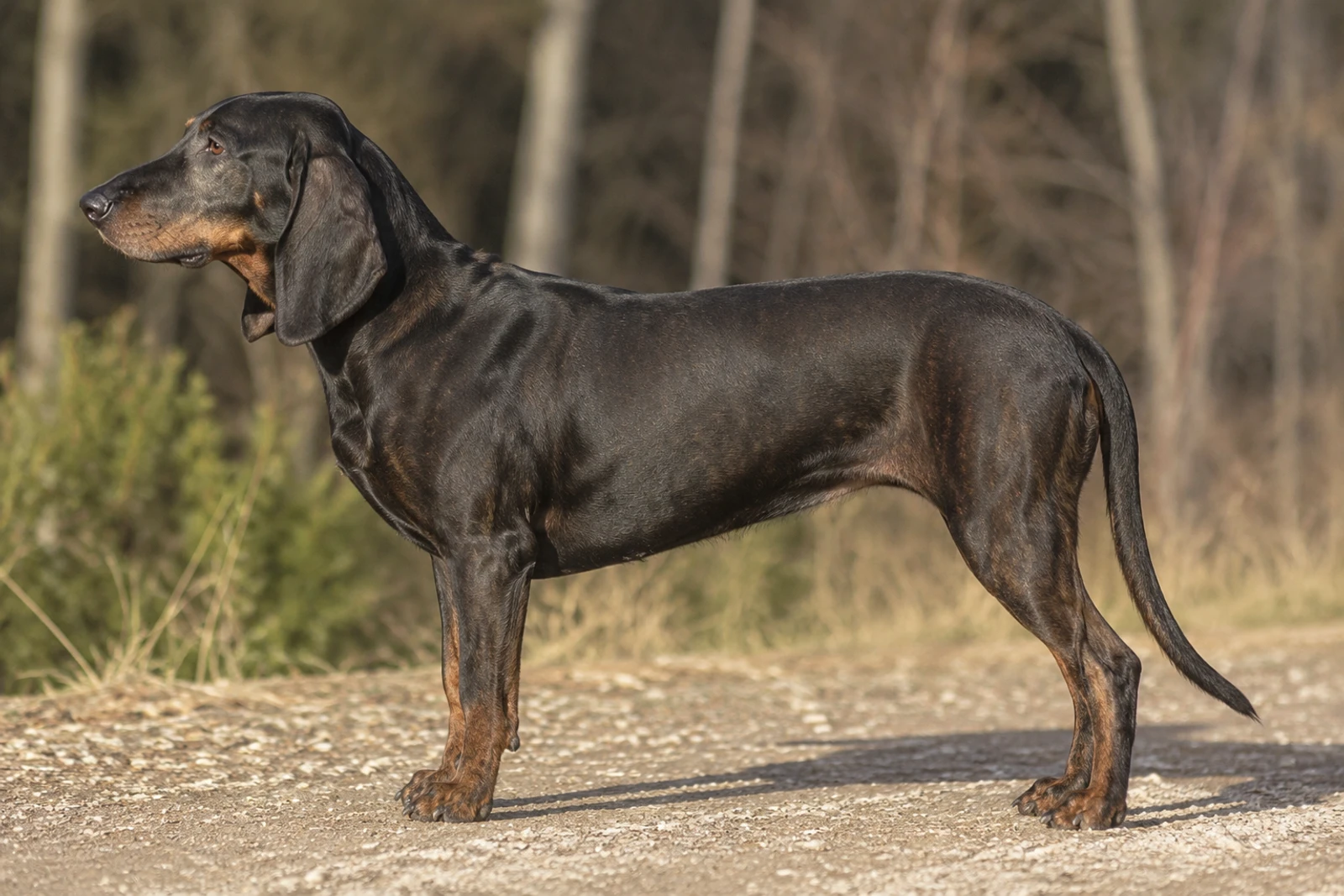
The Bavarian Mountain Hound is a steadfast and intelligent scent hound, originally bred for tracking wounded game in mountainous terrain. This breed suits active individuals or families who enjoy outdoor adventures like hiking or hunting. They form strong bonds with their owners and are gentle and patient with children, but their strong prey drive requires supervision around smaller pets. With a calm and composed indoor demeanor, they need daily exercise to satisfy their energy. Best for experienced owners who can provide consistent training and ample mental stimulation, they thrive in homes with access to outdoor spaces.
At a glance
- Size
- Large
- Height
- 17–20 in
- Weight
- 55–77 lb
- Life span
- 10 years
- Coat colors
- Red, Fawn, Brindle, Red-brown
- Coat type
- Short, dense, and close-lying
How much does a Bavarian Mountain Hound cost?
Adopt / rescue
$75–$400
Usually includes spay/neuter, first shots, and a microchip.
Buy from a breeder
$700–$2,000
From a reputable, health-testing breeder.
Approximate USD. Prices vary widely by region, breeder, pedigree, age, and coat colour — adopting is the lower-cost and recommended route. Avoid suspiciously cheap “breeders”; they’re often puppy mills.
Estimate the full cost of a Bavarian Mountain Hound →Want the ongoing number? Estimate the monthly food bill for a Bavarian Mountain Hound with our dog food cost calculator.
Bavarian Mountain Hound photos
Views
Front, side, rear and top — the full silhouette.Poses
How the breed sits, lies, moves and plays.Puppy to senior
The breed across its whole life.Expressions
The breed’s range of moods.Close-up details
Eyes, ears, nose, paws, tail and coat.Coat colors
The breed’s recognized colors.Click any photo to enlarge. We show the Bavarian Mountain Hound from every angle — three views, poses, life stages, expressions, close-ups, coat and colors.
Appearance & size
A Bavarian Mountain Hound is built for stamina, not bulk. You’ll notice it right away in the dog’s rectangular outline — the body is slightly longer than the height at the withers, creating a low-slung yet athletic stance that lets it cover rough terrain for hours without tiring. Males typically stand 18.5 to 20 inches at the shoulder, females 17 to 18.5 inches; weight runs between 55 and 77 pounds, with a surprising solidity when you run your hands along the ribs.
Build and stance
Look from the side and you’ll see a deep brisket that descends to the elbows, a straight, level back, and a gently sloping croup. The chest is moderately broad — wide enough for lung capacity, but never so heavy that the dog appears squat. The front legs are straight and lean, with tight, well-arched feet. From behind, the rear shows pronounced, dry muscling; the hindquarters angle just enough to drive a ground-eating trot without wasted motion. The tail sits moderately high, extends to the hock, and typically hangs straight or with a slight upward curve at the tip when the dog is relaxed.
Coat and color
The coat is a short, dense, weather-shedding layer. It lies flat and smooth against the skin, feeling slightly harsh to the touch — exactly what you’d expect of a dog bred to push through mountain brush and damp undergrowth. There’s no long fringe or feathering; everything is functional.
Color comes in warm, earthy tones: solid shades of light fawn to rich deer-red, sometimes darkened by a black mask or black-tipped guard hairs on the back and tail. Brindle patterns appear occasionally, with dark stripes breaking up the red base. A small white patch on the chest is allowed but not preferred, and you won’t see flashy white markings elsewhere.
Distinctive details
The head has a slightly rounded crown and a gentle stop, with a muzzle that’s a bit shorter than the skull. Large, soft brown eyes give the dog a thoughtful expression, and the medium-length pendant ears hang flat against the cheeks, framing the face. The nose is broad and black or dark brown, built for sifting scent from cold mountain air. No one feature screams for attention — instead, the whole package reads as quiet, capable, and entirely without exaggeration.
History & origin
The Bavarian Mountain Hound is a purpose-built tracking specialist created in the German Alps during the late 19th century. Hunters needed a lighter, more agile scenthound that could follow wounded game over steep, rocky terrain, often hours or even days after the shot. The heavy-boned Hanoverian Hound already excelled at tracking but was too slow and ponderous for the high country. The solution came from crossing those reliable cold-nose trackers with lighter Tyrolean mountain hounds, producing a dog with a legendary nose and the stamina for long, demanding chases through bad weather and brutal inclines.
Baron Josef von Karg-Bebenburg of Reichenhall is the breed’s founding figure. Around the 1870s, he methodically refined the crossbreedings to lock in a lean, muscular frame standing 17 to 20 inches at the shoulder and weighing between 55 and 77 pounds — substantial enough to hold a wounded boar if necessary, but never so heavy that the dog tired on a 20‑kilometer trail. He also insisted on a calm, biddable temperament. A dog that bayed nonstop or pulled on a leash was useless to a hunter quietly stalking a wounded animal. The result was a hound that works independently on the track but settles indoors without drama.
For more than a century, the Bavarian Mountain Hound has remained Germany’s go‑to tracking dog for foresters and gamekeepers. It specializes in cold trails — scent that is 24 hours old or older, often barely perceptible under rain, snow, or forest litter. The dog’s deep chest, slightly dropped ears that funnel odor toward the nose, and a rock-steady mind allow it to pick that faint path and follow it mile after mile without distraction. Unlike many hounds, it was never meant to run in packs or drive game; its job began after the smoke cleared, locating a single wounded animal so the hunter could dispatch it humanely.
Outside German-speaking Europe, the breed remains uncommon but has a dedicated following. The FCI recognized it in 1912, and it later gained recognition with the United Kennel Club in the United States. Even in show lines, the working character holds strong. A Bavarian Mountain Hound in a suburban home is still a dog hardwired to scent, built for endurance, and deeply tied to one handler. It has always been a hunter’s partner first, which is why a well‑bred dog today is still capable of doing the job it was created for — and then curling up quietly at the end of a long day.
Temperament & personality
This is a dog that moves through the world nose-first. A Bavarian Mountain Hound can be stretched out on the couch like a 60-pound throw rug one minute and locked onto a scent trail the next. Calm and gentle indoors, they save their intensity for the hunt. That quiet, soft-eyed demeanor convinces some owners the dog is low-maintenance — until a deer crossed the path yesterday and the hound lunges after the memory, nearly dislocating a shoulder.
The energy here is deceptive. These dogs aren’t frantic or neurotic; they’ll settle easily when the house is quiet. But mental exercise is non-negotiable. A couple of walks around the block won’t touch their stamina or their need to work a scent. Plan for at least an hour of off-leash hiking in a secure area, or structured mantrailing, nosework classes, or long sessions with a scent drag in the woods. Without that outlet, they’ll create their own jobs — usually involving a chewed doorframe or a systematic urine-marking circuit through the living room.
Scent rules nearly every quirk. Marking is a deeply ingrained habit, and they’ll revisit the same indoor spot the instant a faint whiff of old urine remains. Cleaning accidents with an enzymatic cleaner or a vinegar spray isn’t just tidiness; it’s breaking a scent memory loop. You’ll also discover this breed’s baffling love for perfume made of dead things. Rolling in fox scat or rotting fish is a regular event, likely an ancestral trait to mask their own odor or just because, to a scent-obsessed dog, it smells fascinating. Keep the shampoo handy.
Around the household, a Bavarian Mountain Hound is affectionate without being needy. They bond closely and struggle with long periods of isolation; boredom or loneliness can tip into anxious barking or destructive chewing. They’re generally tolerant with children, but boundaries matter. Teach kids early that the dog eats and chews bones in peace — no interruptions, no reaching for the bowl. These dogs are large and strong-willed, not explosive, but respecting their space around food prevents a calm dog from learning that guarding works.
Training requires a light touch. A harsh correction will be met with the canine equivalent of a shrug. Consistency and rewards that engage the nose — bits of meat, a hidden treat game — get far better results. Work with the natural drive, not against it. Give this hound a scent problem to solve, and you’ll get a dog who flops contentedly on the rug afterward, soft-eyed and ready to do absolutely nothing until the next trail calls.
Good with kids, dogs & other pets
The Bavarian Mountain Hound’s steady, patient nature makes him a solid match for families with kids who understand dog body language. At 55–77 pounds and 17–20 inches tall, he isn’t fragile, but that stocky frame can still accidentally bowl over a toddler when the doorbell rings. Teach children not to hug him around the neck, interrupt his meals, or crowd his bed, and he’ll usually return the favor with a calm, tolerant presence.
Supervision is non-negotiable, no matter how gentle the dog. This is a breed that forms deep bonds with his people and doesn’t do well left alone for long stretches. A Bavarian Mountain Hound who spends hours in the backyard away from the family can develop nuisance howling or separation-driven chewing—problems that quickly sour the household relationship. He thrives on indoor companionship and prefers to be underfoot while you cook or help with homework.
With other dogs, early and frequent positive exposure is everything. Puppies go through a critical socialization window between about 3 and 16 weeks. If you raise a pup alongside a resident dog and keep first meetings calm, they often form a tight, playful duo. Adult Bavarian Mountain Hounds who missed that window can be standoffish or selectively tolerant with unfamiliar dogs. Don’t force dog-park greetings; parallel walks on neutral ground work better. For an adult rescue who’s already comfortable with just you, it’s okay if he never becomes a social butterfly. Forced interactions can backfire badly, triggering defensive reactions.
Cats and small pets require hard honesty. This is a scent hound bred to track game over miles. A running cat or a scurrying rabbit can flip a switch that overrides years of training. Some individuals coexist peacefully with a housecat they’ve known since puppyhood, but that’s the result of consistent, supervised conditioning—never a guarantee. Keep pocket pets securely caged and out of reach, and never leave the dog loose in a room with a free-roaming rabbit or guinea pig. The safest bet is to assume a high prey drive until proven otherwise.
Start socialization early by exposing your puppy to squeaky toddlers, elderly visitors, calm dogs, and the sight of a cat lounging on a windowsill. Keep every encounter short and rewarding. If you’re starting with an older, under-socialized dog, give him weeks of quiet settling time before introducing new people or animals, and let him set the pace.
Trainability & intelligence
A Bavarian Mountain Hound learns fast when she sees what’s in it for her. She’ll nail a new cue in a handful of repetitions if you pay her with stinky liverwurst, a tug session, or genuine praise. But this is not a breed that takes orders for the sake of pleasing you. She was built to work nose-down on cold trails, often at a distance from her handler, making independent judgment calls for hours. That self-reliance is still hard-wired. You can teach a rock-solid “sit” and a beautiful heel in the kitchen, then watch it evaporate the moment a deer track intersects your path during a hike.
- The smart-but-stubborn problem
A hound that weighs 55–77 pounds and trusts her own nose more than your voice can feel like a furry freight train when she locks onto a scent. That doesn’t mean she’s dim or uncooperative—she’s simply been reinforced by centuries of breeding to ignore distractions you can’t even perceive. Expect training to be a negotiation, not a monologue.
What actually works
Skip the heavy hand entirely. Punishment-based methods sour this dog’s trust and can create a bolter who avoids you. Positive, relationship-based training gets you a partner who checks in willingly. Short, game-like sessions hold her attention; drilling the same down-stay for ten minutes will lose her. Reward desired behavior immediately with food, play, or a quick romp. Consistency matters more than perfection. If you sometimes let her pull on leash to sniff and other times correct her, you just taught her that pulling sometimes pays off—and she’ll keep trying.
- Recall is your biggest project
Building a reliable recall takes months, not weeks. Start in boring, fenced spaces and pay her like she won the lottery every time she comes. Gradually add distance and mild distractions. Even then, many experienced owners accept that a Bavarian Mountain Hound on a hot scent trail is deaf to “come.” A long biothane line on walks in gamey country isn’t a training failure—it’s smart management while you continue proofing the behavior. An adult dog in full cry is a 70-pound missile; keeping her safe means being realistic about what she was bred to do.
Socialization is non-negotiable
This breed tends to be reserved with strangers and can become sound-sensitive or reactive if not exposed early. Hit the ground during that critical 3–14 week window. Introduce your puppy—calmly, with plenty of treats—to different people, surfaces, other dogs, and everyday noises. Stack positive experiences week after week through adolescence and beyond. A well-socialized Bavarian Mountain Hound stays steady in a busy vet lobby or on a crowded trail, while an under-socialized one may startle, bark, or shut down. Don’t flood her; let her explore at her own pace and reward curiosity. Trust built through patient, gentle exposure is what transforms a sensitive hound into a confident companion you can take anywhere.
In the end, this is a thinking dog who bonds deeply and works brilliantly when motivation and trust are in place. Just respect that she’ll always have her own opinions, and keep a leash handy for the moments her nose takes over.
Exercise & energy needs
Plan on a solid 60 to 90 minutes of movement every day, split into at least two sessions. A couple of leisurely strolls around the neighborhood won’t cut it for a Bavarian Mountain Hound — this is a large, deep-chested scenthound bred to track wounded game across rough, steep terrain for hours on end. He needs to truly stretch his legs.
Morning and afternoon outings work best. One session might be a long off-leash hike or a vigorous run in a securely fenced area; the other can be a shorter sniff walk where you let his nose lead. His stamina is impressive, so don’t be surprised when 30 minutes at a trot barely puts a dent in his energy. Mix in inclines and varied ground if you can — it mirrors the mountain work his body was designed for.
Mental exercise counts just as much as physical. These dogs live through their noses. Give that incredible olfactory system a job: scatter feeding in the yard, hide scent trails with a drag rag, or work with formal tracking or mantrailing. Puzzle toys and stuffed Kongs are fine for downtime, but real scent games are what flip the switch in his brain. Without that outlet, a bored Bavarian can turn vocal, destructive, or anxious — his drive doesn’t have an off switch just because it’s raining.
They were built to move at a steady, purposeful pace, not sprint and stop like a sighthound. Avoid high-impact jumping or forced running on pavement during the first year while joints are still developing. Responsible breeders screen for hip dysplasia, but it’s smart to keep hard-surface miles moderate and prioritize softer trails or grassy fields for the heavy work. You’ll know you got it right when your hound comes home satisfied, curls up without pacing, and falls asleep with his nose still twitching.
Grooming & coat care
The Bavarian Mountain Hound wears a dense, short double coat that’s built for scrambling through brush and bad weather. That coat is low-maintenance day to day, but it sheds steadily — and twice a year it comes out in clouds.
Brushing
Grab a bristle brush or a rubber curry glove for weekly upkeep. A quick once-over spreads natural oils and pulls dead hair before it lands on the couch. During those seasonal coat blows (spring and fall), bump it up to daily brushing. A shedding blade or undercoat rake slides through the dense undercoat without tearing the guard hairs, slicing the loose fuzz dramatically. The payoff is a shinier dog, fewer hair tumbleweeds, and you’ll catch burrs or skin irritations early.
Bathing
He’s a hound — he’ll roll in something foul. Still, hold off on baths as long as you can. A rinse with plain water handles muddy legs, but soap strips the weather-resistant oils. Aim for two to three baths a year unless he finds something truly rank. Use a mild dog shampoo, and take a minute to double-rinse the thick neck and shoulders.
Ears, nails, and teeth
Floppy, pendant ears are a dark, warm pocket for moisture and crud. Lift each ear once a week and give it a wipe with a damp cotton round — nothing deep, just the outer canal you can see. If there’s a yeasty smell or gunk, get the vet involved early.
Nails grow fast on this active breed; if you hear clicking on the floor, it’s time. Trim every three to four weeks with a grinder or clipper, and sneak in a quick toothbrush session while you’re at it. A chicken-flavored enzymatic paste does the job without a wrestling match.
Trimming
Skip the clippers. This coat isn’t meant to be shaved or sculpted. The only tidy-up you’ll ever do is trimming the fur between the pads and maybe the scraggly hairs on the tail tip or hock feathers if they’re dragging mud. Even that is optional. Leave the coat’s blunt, protective edge alone.
Shedding & allergies
The Bavarian Mountain Hound carries a short, dense, close-lying coat that's built for tracking through thick cover. That practical coat has a downside: it sheds.
You'll deal with steady, moderate shedding all year. Hairs are short and dark, so they show up plainly on light floors and furniture — expect to see a fine peppering across the house. A quick once-over with a rubber curry brush or hound glove once or twice a week pulls the loose hair out at the source and keeps it from migrating to your couch.
The twice-a-year blowout
Like most double-coated breeds, this hound packs on a thicker undercoat for winter and then dumps it in a big way when the seasons shift. Spring and fall, the shedding goes from moderate to heavy for about three to four weeks. During those weeks, daily brushing makes a real difference. A slicker brush or a shedding tool like a Furminator will strip out those undercoat clumps, though you'll still vacuum more often.
Drool factor
Bavarian Mountain Hounds have loose, pendulous flews typical of a scenthound, but they're not extreme. You'll see some drool after drinking or when a particularly interesting scent hits their nose, especially on a warm day. It's not wall-shaking, slobber-everywhere drool — more of a slow drip or a string here and there. Keep a rag handy near their water bowl, and you'll manage just fine.
The hypoallergenic reality
No dog is truly hypoallergenic, and this breed is no exception. A Bavarian Mountain Hound produces the usual dander and saliva proteins that trigger allergies. The short coat doesn't trap dander close to the skin the way a long, silky coat might, so airborne allergens can spread more easily. If someone in your home has mild allergies, spending time around the breed before committing is a must. For a household with severe allergies, this is simply not the right fit.
Diet & nutrition
A Bavarian Mountain Hound is built for stamina, not speed—so his diet needs to match that long-burning, steady-energy lifestyle while keeping him lean. These dogs can tip toward food motivation, and an extra five pounds on a deep-chested, 55–77 lb frame is no small thing. Excess weight stresses joints, and since responsible owners already screen for hip and elbow concerns, you want to stack the deck by keeping him at a working weight.
How much to feed
Portion sizes hinge entirely on workload. A 65-lb adult running the woods all day may need 2,800–3,200 calories in season; a weekend-hiking house dog probably does fine on 1,800–2,200 calories split into two meals. Puppies follow a tighter rhythm: four evenly spaced meals until four months old, then three meals until six months, then the adult two-meal pattern. Don’t rely on the bag chart alone. Run your hands over his ribcage weekly—you should feel ribs without having to dig, and see a tuck behind the ribs when you stand at his side. If his waist blurs, cut back.
What to feed
His digestive system is wired for meat. Aim for a foundation of about 60% raw or cooked meat, 20–30% fruits and vegetables, and the remaining 10% from eggs, yogurt, or digestible grains like pearl barley or white rice. Unsalted water from steaming vegetables makes a nutrient-rich base for homemade meals. At around twelve weeks, raw chicken wings can be introduced under close supervision to get a puppy used to working a bony, species-appropriate food. For adults, a high-quality commercial kibble or a well-planned raw/home-cooked rotation both work, provided you blend or finely process veggies (dogs lack salivary amylase and their jaws only open and close, so unbroken plant cell walls largely pass through).
Avoiding trouble
Fast eaters benefit from puzzle bowls or snuffle mats—it forces them to slow down and adds mental work that this scent-driven breed craves. Feed leftovers in his own bowl on the floor, never from the table, because once begging takes root it’s a nightmare to undo. Skip the holiday tongue-in-cheek: rich, fatty trimmings can trigger pancreatitis in a hot minute.
Senior shifts
Older Bavarians still need plenty of protein to maintain muscle, so don’t dial it back without a vet’s reason. Switch to three or four smaller meals a day, purée the food if teeth are failing, and get pragmatic about calories—obesity in a senior dog amplifies every orthopedic ache. A lean ten-year-old is a happier hound than a well-fed one.
Health & lifespan
A healthy Bavarian Mountain Hound typically lives about 10 years. That number puts them right in line with other large, deep-chested scenthounds — not a surprise, but something to plan for when you bring one home. Excellent care, a lean body condition, and a good dose of luck can tack on a year or two, but a decade is the realistic expectation.
The biggest health concern you’ll hear about with this breed is bloat (gastric dilatation and volvulus, or GDV). Their deep chest is the main reason. Bloat kills fast, so learning the early signs — pacing, unproductive retching, a swollen belly — is non-negotiable. You also want to ask the breeder point-blank whether GDV has shown up in their lines. While there’s no single genetic test for it, a breeder who tracks and openly discusses family history gives you a clearer picture of what you might face. Feeding two or three smaller meals a day and skipping heavy exercise right after dinner are the standard prevention tricks; some owners consider prophylactic gastropexy during spay/neuter surgery, but talk that through with your vet.
Hip and elbow dysplasia crop up in larger hounds, and the Bavarian is no exception. Responsible breeders screen breeding stock with hip and elbow X-rays evaluated through OFA or PennHIP and won’t use dogs with subpar scores. If you’re buying a puppy, you should see those clearances. No test is a 100% guarantee, but it stacks the deck in your favor. Keeping your dog at a working weight — 55 to 77 pounds, with ribs you can easily feel but not see — eases the load on growing joints and helps delay arthritis later.
Those long, floppy ears are begging for trouble if you ignore them. Moisture and limited airflow create a perfect setup for yeast and bacterial infections. A weekly sniff-and-wipe with a vet-approved cleaner prevents most problems, and you’ll want to do it after every run in wet cover. Redness, a funky smell, or head shaking means it’s time for a vet look — catching it early beats a deep, painful infection that takes weeks to clear.
Skin issues aren’t a hallmark of the breed, but hounds can develop food or environmental sensitivities that show up as itching, hot spots, or recurrent ear trouble. If your dog is scratching more than normal, a diet trial or allergy workup can pinpoint the trigger. High-quality nutrition also supports that short, dense coat.
Weight management matters more than most people think. These dogs are food-motivated scent hounds who will convince you they’re starving ten minutes after a meal. Don’t buy it. Extra weight stresses joints, makes bloat riskier, and saps the stamina they need to work a track. Use a measuring cup, limit treats, and keep a critical eye on that waistline.
Annual vet visits are your early-warning system. For a young, active hound, it’s a chance to catch a heart murmur or a slight limp before it sidelines them. Seniors benefit from checkups every six months — subtle shifts like a drop in appetite or reluctance to jump onto the couch are easy to miss in a stoic breed but tell you plenty if you’re paying attention. Routine bloodwork after age seven catches kidney or thyroid issues while they’re still manageable.
No discussion of health is complete without two absolute basics. Heartworm prevention is monthly during mosquito season and for one month after it ends; skipping it isn’t a gamble worth taking. Rabies vaccination is legally required everywhere in the U.S., and there’s no treatment once symptoms appear. Your vet will map out the rest of the vaccine schedule based on your local risks and your dog’s lifestyle.
When you’re talking to breeders, ask to see current OFA or PennHIP hip and elbow certifications, and find out if they do annual eye exams through a veterinary ophthalmologist. A breeder who can rattle off their dogs’ results — and who asks you about your plans for prevention — is one you want to keep talking to. A little extra attention to ears, weight, and those deep-chest precautions keeps a sound, sturdy hound doing the work they were born for.
Living environment
This is not a dog for apartment life—or for owners who dislike noise. A Bavarian Mountain Hound stands 17–20 inches tall, packs 55–77 pounds of muscle, and comes with the kind of booming, far-carrying bay that will echo through thin walls. Unless your neighbors are exceptionally tolerant and you can commit to near-constant outdoor activity, a house with a securely fenced yard is the only realistic setup.
Yard and exercise reality
A yard alone won’t cut it. This is a working scenthound built to course through the mountains, and his nose makes every squirrel trail an obsession. At least 60–90 minutes of purposeful movement a day is the baseline, always split into at least two sessions—a single long walk leaves him bored and pent up. Think vigorous sniff-walks, off-leash romps in safe areas, and scent-tracking games that turn a patch of grass into a puzzle. Without that, you’ll see digging, pacing, and a baying soundtrack that starts at dawn. A sturdy 6-foot fence is non-negotiable; a fleeting scent will erase any recall you thought you had.
Mental work is not optional
Inside, a tired body is only half the equation. A Bavarian Mountain Hound who hasn’t used his brain is a frustrated hound. Hide meals in puzzle toys, teach nosework games, or scatter kibble in the yard so he spends 20 minutes sniffing every blade of grass. Rainy days are no excuse to skip this—a couple of 15-minute scent sessions indoors can take the edge off when outdoor time is limited.
Climate tolerance
The breed’s dense double coat, bred for cold alpine tracking, handles snow and chill easily. Summers are a different story. In hot or humid weather, keep exercise to early morning or after sunset, watch for overheating, and always provide shade and cool water.
Noise and alone time
Loud, ringing baying is a feature, not a bug—he’s meant to let hunters know exactly where he is. You won’t train that out, only manage it. As for being left alone: Bavarian Mountain Hounds form tight bonds and tend to get anxious when the house is empty for long stretches. A full 9-to-5 workday left solo is likely to trigger howling marathons and chewed door frames. If your schedule demands that, look for another breed. Gradual desensitization and enrichment toys help, but this dog thrives when someone is around most of the day—or when a midday break or doggy daycare splits up the silence.
Who this breed suits
A Bavarian Mountain Hound fits best with a hunter — specifically, a tracker who works wounded game on leash through dense cover. That’s the job this breed was built for, and it’s where the dog’s legendary cold-nose tracking and calm focus shine. If you don’t hunt, you can still make a great home if you commit to formal scent work, mantrailing, or search-and-rescue training. This is not a dog who thrives on generic fetch sessions; a 45-minute walk followed by a 20-minute “find the hidden liver” game will mentally drain him far better than an aimless hour on a bike path. His size — 55 to 77 pounds, 17 to 20 inches at the shoulder — makes him manageable in the house without sprawling everywhere, but he’s all lean muscle and endurance when working.
A first-time owner? Probably not. These dogs are gentle and deeply bonded with their people, but they’re independent problem-solvers. They don’t hang on your every whim; they follow their nose. Training asks for patience, consistency, and a clear-headed acceptance that “come” might mean nothing once a whitetail’s scent trail crosses the yard. Experienced owners who understand hound motivation — and won’t take the stubbornness personally — do best.
Family life can work if the household is set up right. Inside, the Bavarian is surprisingly calm and quiet, often described as a couch sleeper after proper exercise. He’s affectionate with his own people and typically polite with strangers, though reserved rather than wildly social. Older kids who can respect the dog’s space and not chase him when he’s nose-down on a scent do fine. Toddlers racing around or grabbing can overstress the dog. And forget apartments or attached condos: a bored or scent-stirred Mountain Hound unleashes a deep, carrying howl that neighbors will hate.
Think twice if you have small pets — cats, rabbits, even tiny dogs — running free. The prey drive is deeply hardwired. While some individuals can learn to coexist with the family cat indoors, outdoor chase instincts often override training. A securely fenced yard is mandatory; an invisible fence won’t stop a nose on a mission.
- You should absolutely own this breed if you’re an active single or couple who hunts, does serious scent sports, and has a fenced property with access to woods or fields.
- Look elsewhere if you want a dog-park social butterfly, need reliable off-leash recalls in unfenced areas, have small animals in the home, or view exercise as a quick walk around the block.
A 10-year lifespan is the realistic window you’ll have with a well-bred dog — not unusually long, and short enough that every hunting season counts. The biggest deal-breaker for most homes isn’t the size or the need for movement; it’s the nose. If you can’t give this dog regular, structured work that lets him track, he’ll find his own quarry, and the resulting excursions can end in a lost dog or a dead cat.
Cost of ownership
The first number that’ll hit your wallet is the purchase price. A well-bred Bavarian Mountain Hound from a breeder who screens for hip dysplasia and other inheritable issues typically runs $1,500 to $2,500. This isn’t a dog you’ll stumble across in a rescue every weekend, so waiting lists are common and you may need to travel or pay for transport.
Once the dog is home, the monthly rhythm of expenses kicks in:
- Food: A 60–70 lb working dog with a fast metabolism will easily put away 3–4 cups of high-quality kibble a day. Expect $50–$80 per month. If you feed raw or premium fresh food, push that closer to $120.
- Routine vet care: Annual exams, vaccinations, heartworm prevention, and flea/tick meds land around $40–$60 a month averaged out. Bloodwork or dental cleanings add spikes you don’t want to be surprised by.
- Grooming: The short, dense coat is blessedly low-fuss. A quick weekly brush and occasional bath at home keeps it in shape. You can bank on $10–$20 a month for shampoo, ear cleaner (those drop ears need a wipe-down after wet outings), and nail trims if you don’t do the nails yourself.
- Pet insurance: With an average lifespan of only 10 years and a breed that can be prone to hip and elbow trouble plus bloat, it’s wise to budget for a comprehensive policy. Expect $40–$70 a month, depending on your deductible and location.
- Training and extras: These hounds are clever and scent-driven. Group obedience classes or a few sessions with a trainer who understands hunting breeds can easily add another $50–$100 monthly during the first year. Don’t overlook replacement costs for chewed leashes or the dog bed your bored adolescent may dismantle.
All told, a reasonable ballpark for ongoing costs sits at $180–$300 a month, not counting emergency surgeries or that pricey GPS tracker you’ll want once you see how far a nose can lead.
Choosing a Bavarian Mountain Hound
Most Bavarian Mountain Hound puppies in the U.S. come from a handful of dedicated breeders—this is not a breed you stumble across on a puppy listing site. Be ready to wait, get on a list, and answer plenty of questions yourself. A responsible breeder will care as much about where the dog goes as you care about what you get.
Health clearances you should see
Ask for written proof; don't settle for “vet checked.” For this breed, the minimum clearances include:
- Hips: OFA or PennHIP evaluation (good or excellent rating, or equivalent).
- Elbows: OFA evaluation to rule out elbow dysplasia.
- Eyes: Annual CERF or OFA eye exam, since some lines can carry heritable eye conditions.
The breed is generally tough, but hip and elbow dysplasia show up, and a 10-year lifespan means joint health matters early.
Red flags in a breeder
- No health clearances on sire or dam, or only “embark tested” DNA panels. DNA alone won’t catch hips.
- Pushing puppies as purely family pets without discussing the dog’s drive, nose, and need for off-leash exercise in safe areas.
- No involvement in hunting, tracking, or scent-work clubs. Even if you never hunt, a breeder who doesn't prove the dog's working ability is skipping the very thing that keeps the breed stable and biddable.
- Multiple litters on the ground at once, or the same pair bred repeatedly with no explanation.
- Defensiveness when you ask about longevity in their lines or about dogs that washed out of hunting homes.
Rescue: rare but real
Good luck finding one in a shelter. Breed-specific rescues occasionally place an adult that didn't take to tracking work or lost its owner. An adult dog can be a shortcut past puppy destruction, but go in with open eyes: these dogs bond hard, and a hound that’s been a working partner may struggle with a quiet suburban routine. Ask about prey drive, recall reliability, and whether the dog has lived indoors before.
Picking a puppy from a litter
You’re not looking for the bounciest, most bulletproof puppy, nor the one cowering in the corner. A good candidate wades into things calmly, comes to investigate you without climbing your legs, and settles quickly after novelty. Watch how the pup uses its nose—that’s your preview of a dog that will spend hours in your backyard tracing every squirrel path. A breeder who lets you see the mother, and ideally the father, in a home setting gives you the most honest picture of temperament. If the breeder chooses the puppy for you based on your lifestyle and experience, that’s not a sales tactic; it’s exactly what you want.
Pros & cons
Pros
- Calm housemate when satisfied. Outdoors they’re all business, but inside a properly exercised Bavarian Mountain Hound is quiet, relaxed, and happy to sprawl at your feet.
- Deeply devoted to family. They form a tight bond, follow you room to room, and are typically gentle with older children who respect their space.
- Born scent-work partner. Their legendary cold nose makes them a top pick for tracking, search work, or just long, meandering sniff walks that tire the brain.
- Easy-care coat. The short, dense double coat sheds moderately year-round and needs only a weekly brush and the occasional bath.
- Less overbred baggage. As a rare breed in the US, many lines are health-focused; a good breeder will openly share hip and elbow scores.
Cons
- High prey drive, no recall. Once they lock onto a scent, they’re gone. A secure, six-foot fence is non-negotiable, and off-leash hikes are simply not safe.
- Serious exercise commitment. Count on 60–90 minutes of steady movement each day — a leisurely stroll won’t cut it. Mental work (puzzle toys, scent games) is just as important.
- Reserved with strangers. They’re not a tail-wagging greeter. Without early, careful socialization, wariness can tip into skittishness or defensive barking.
- Hound stubbornness. Training calls for patience and creativity; they’re food-motivated but will ignore a boring command when a scent trail is calling.
- Shorter life, structural risks. Average lifespan runs about 10 years, and hip dysplasia pops up in the breed. Insist on OFA or PennHIP clearances.
Similar breeds & alternatives
If your ideal day looks more like hiking rugged trails with a dog glued to a scent line than tossing a ball in the backyard, the Bavarian Mountain Hound’s specialized tracking drive likely appeals. But the breed’s intensity and wariness with strangers aren’t for everyone. Here’s how a few other scenthounds stack up.
-
Hanoverian Scenthound — This is the Bavarian’s closest cousin, bred for the same kind of leashed tracking on wounded game. Males run 80–110 lb and stand up to 22 inches, making them substantially bulkier than the lean, 55–77 lb Bavarian. Both are calm and reserved with strangers, but the Hanoverian’s extra mass can feel like a heavier load to manage in dense mountain cover or a small house. If you want the same single-minded nose work in a slightly more manageable package, the Bavarian’s lighter frame often proves the better fit.
-
Bloodhound — The icon of trailing, but scaled way up. Males reach 90–110 lb and 27 inches, with legendary scenting ability and a booming bay. They drool, shed copiously, and are famously stubborn when they catch a scent. A Bloodhound tracks people, not wounded game, and is a far messier, louder roommate than the meticulously quiet Bavarian. You get an even more powerful nose, but you trade the Bavarian’s off-switch indoors and relative tidiness for a lumbering, slobber-prone detective.
-
Beagle — If a Bavarian’s size or intense one-person focus feels like too much, a Beagle shrinks the scenthound package down to 20–30 lb. Beagles are pack hounds, so they’re generally friendlier with strangers and other dogs, but they’re also more vocal escape artists who follow their nose with joyful abandon. You won’t get the calm, watchful demeanor of a Bavarian, and you’ll never leave them off-leash without a fence. It’s a happier, more social hound experience for families who want a big personality in a small body, minus the Bavarian’s quiet, measured tracking intensity.
Fun facts
- They were developed in the 19th century for tracking wounded game in the Bavarian Alps.
- Bavarian Mountain Hounds have an exceptional sense of smell and can follow cold trails for miles.
- They are known as 'Gebirgsschweisshund' in German, meaning 'mountain scent hound.'
Frequently asked questions
- Is the Bavarian Mountain Hound a good family dog?
- They are loyal and calm with their families, but can be reserved with strangers. Early socialization helps them become gentle companions with children. Supervision is always recommended with young kids.
- How much exercise does a Bavarian Mountain Hound need?
- This high-energy breed requires at least an hour of vigorous exercise daily, such as long walks, runs, or scent work. Without enough physical and mental activity, they may become restless. A securely fenced area is important for safe off-leash time.
- Do Bavarian Mountain Hounds shed a lot?
- They have a moderate shedding level that can be managed with weekly brushing. Seasonal shedding tends to increase, but they are not heavy shedders overall.
- Are Bavarian Mountain Hounds easy to groom?
- Yes, their short, dense coat is low-maintenance, typically needing only occasional brushing and baths. This makes grooming straightforward for most owners.
- Can a Bavarian Mountain Hound live in an apartment?
- They are not ideal for apartment living due to their size, energy, and tendency to vocalize. A home with a yard and plenty of outdoor access suits them better.
- Are Bavarian Mountain Hounds good for first-time owners?
- Their intelligence and persistence can be challenging for inexperienced owners. They thrive with consistent training and an owner familiar with hound breeds. Novices may find their independent streak difficult.
Tools & calculators for Bavarian Mountain Hound owners
Quick estimates tailored to Bavarian Mountain Hounds — pre-filled with this breed’s size where it matters.
Articles & stories about the Bavarian Mountain Hound
Sources & standards
This profile follows recognized breed standards from the American Kennel Club (AKC) and the Fédération Cynologique Internationale (FCI), along with established veterinary and breed-club guidance. These describe general breed tendencies — every dog is an individual.