

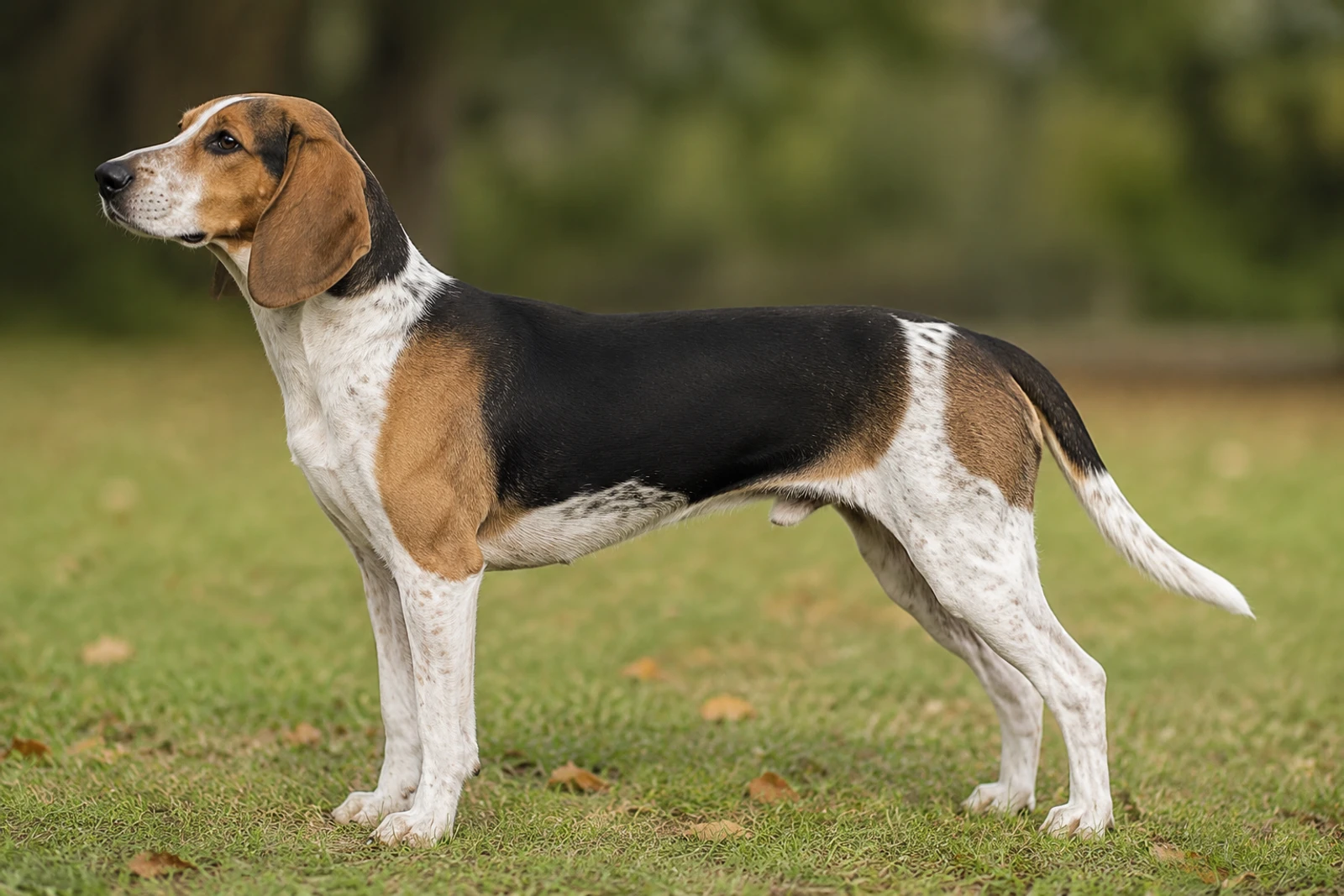
The Beagle Harrier is a rare French scenthound, a harmonious blend of the merry Beagle and the determined Harrier. This medium-large hound is built for endurance, excelling in hunting hare with its outstanding nose and melodious voice. Bred to work in packs, it thrives on companionship and suits active families or hunters who can provide ample exercise. Affectionate and even-tempered at home, the Beagle Harrier is a devoted companion, though its strong prey drive and vocal nature require thoughtful management. Ideal for those seeking a rugged yet amiable hound with a zest for life.
At a glance
- Size
- Large
- Height
- 18–20 in
- Weight
- 42–46 lb
- Life span
- 12–13 years
- Coat colors
- tricolor (black, white, tan), hare color (fawn with black overlay)
- Coat type
- short, dense, weather-resistant
- Group
- Scenthounds
How much does a Beagle Harrier cost?
Adopt / rescue
$75–$400
Usually includes spay/neuter, first shots, and a microchip.
Buy from a breeder
$700–$2,000
From a reputable, health-testing breeder.
Approximate USD. Prices vary widely by region, breeder, pedigree, age, and coat colour — adopting is the lower-cost and recommended route. Avoid suspiciously cheap “breeders”; they’re often puppy mills.
Estimate the full cost of a Beagle Harrier →Want the ongoing number? Estimate the monthly food bill for a Beagle Harrier with our dog food cost calculator.
Beagle Harrier photos
Views
Front, side, rear and top — the full silhouette.Poses
How the breed sits, lies, moves and plays.Puppy to senior
The breed across its whole life.Expressions
The breed’s range of moods.Close-up details
Eyes, ears, nose, paws, tail and coat.Coat colors
The breed’s recognized colors.Click any photo to enlarge. We show the Beagle Harrier from every angle — three views, poses, life stages, expressions, close-ups, coat and colors.
Appearance & size
A Beagle Harrier looks like someone took a Beagle and gave it a serious leg-up — you’re seeing a sturdy, no-fuss scenthound that stands 18 to 20 inches at the shoulder and weighs a solid 42 to 46 pounds. That extra height and muscle separate it from a backyard Beagle almost instantly. From the side, the dog reads as slightly longer than tall, with a deep, well-sprung chest that drops to the elbow and a strong, level topline that stays firm over the loin. There’s enough tuck-up to suggest a real athlete, but nothing wasp-waisted about this hound; it’s built for hours of pushing through brush, not sprinting laps.
The head is all hound — slightly broader than a Beagle’s but still masculine without bulk. Dark, set-apart eyes give a gentle, curious expression, and the low-set, long, rounded ears frame the face, reaching at least the tip of the nose if pulled forward. The muzzle is square-cut, the nose black and wide-open. From the front, the chest appears broad but not slabby, with straight, well-boned forelegs set cleanly under the body. When you step around to the rear, hard pads and tight cat feet show themselves, supporting a moderately angulated hind end that supplies a smooth, ground-covering trot.
The coat is a short, dense, hard double layer that shrugs off weather and thorns with equal disinterest. Tricolor — black, white, and vivid tan — is the classic calling card, usually with a full white collar, a white blaze, and black saddle or mantle markings. You’ll also see hare-colored dogs (sort of a warm, grizzled tan with black overlay) and occasional bicolors that lean heavily into white and orange-tan. One thing not to miss: the tail. It’s set on high, strong at the base, and carried like a saber — firm and up, never rolled over the back. When that tail picks up tempo, you’re about to see a hound who has found his scent.
History & origin
The Beagle Harrier didn’t happen by accident. French sportsmen in the late 19th century deliberately crossed the smaller, methodical Beagle with the leggier, big-striding Harrier. They wanted a pack hound that could push a hare hard enough to make for a thrilling mounted hunt, but not so fast that the dogs outran the horses on foot. The result was a medium-sized scenthound—bigger than a Beagle, smaller than a Harrier—that thrived on teamwork and had a voice you could hear across a valley.
The breed took shape primarily in western France, where hare hunting on horseback with packs was a way of life. Baron de Chézelles is credited with pulling together the foundation stock in the 1870s and 1880s, blending English and French hound bloodlines. The goal was never to create a flashy show dog. Breeders cared about a deep chest for endurance, a nose that wouldn’t quit, and a temperament steady enough for kennel life with a dozen other hounds. The dogs worked in packs, trailing scent with their heads low, giving tongue freely, and driving game in a loop back to the hunters.
By the early 20th century, the Beagle Harrier had a modest following, but two world wars and the decline of traditional mounted hunting gutted its numbers. The breed nearly vanished. A small core of French breeders, unwilling to let the dogs disappear, cobbled together the remaining lines in the 1950s and 1960s. They focused on preserving the original hunting utility rather than conforming to an arbitrary standard.
Today, the Beagle Harrier remains a rarity, even in its home country. The French kennel club (SCC) recognizes it, and the FCI includes it in Group 6, Section 1.2 (medium-sized hounds), but you won’t find it on the AKC roster. Most dogs still live as working pack hounds in French hunting kennels, chasing hare and deer. A handful make their way into active family homes, where they bring the same sociable, nose-driven energy that got them bred in the first place.
Temperament & personality
A Beagle Harrier is, at heart, a big, merry scenthound packed into a 42-pound frame. These dogs live for their noses and their people—usually in that order. Inside the house you’ll typically find a calm, gentle dog who sprawls contentedly at your feet after a solid outing. On a walk or in the yard, that switch flips to determined and brave: a forward-leaning body and an almost pulsating nose on the ground. The breed is famously good-natured, rarely sharp or guarded, but they do have a stubborn streak that can surprise a first-time hound owner. They aren’t pushovers, and they respond far better to respectful, consistent engagement than to a heavy hand. Bribery with high-value treats works beautifully; force shuts them down.
Energy-wise, think endurance, not frenzy. A Beagle Harrier needs a genuinely tiring daily run—an hour of off-leash exploring, a long hike, or a meandering sniff walk where you let them follow their nose. Without it, that brain and nose will get applied to redecorating your baseboards or serenading the neighbors. Isolation or neglect frequently kicks off anxiety-driven barking, howling, or indoor urine marking. This is a pack dog. They do best with another dog or a human who’s around a lot. If you work long hours, this probably isn’t your breed.
With children and other pets, the baseline is affectionate and tolerant, but no dog comes with a guarantee. A relaxed, loose body and soft eyes mean they’re comfortable. Lip-licking, yawning, or turning the head away are your signal to give them a break. Teach kids to respect the dog’s meals—never interrupt a Beagle Harrier while eating, as some individuals can drift into food guarding. The same goes for chew times. Puppies chew to explore and relieve teething pain; adults gnaw on hard things to keep their jaws strong and teeth clean. Provide appropriate outlets and deter forbidden items with a homemade citrus spray (boil peels in water) or a white vinegar spritz. That vinegar trick does double duty: it neutralizes urine odors, which is crucial because residual scent cues will pull the dog right back to the same indoor spot.
Quirks? This is a dog that views the scent world as the main event. They may roll in vile-smelling things just to wear the perfume—think of it as showing off their discovery. They may also define their territory by your family’s scent rather than four walls, leading to accidents in a guest room that doesn’t smell like you. The fix is consistent: reward outdoor elimination immediately with a treat, and clean indoor messes with an enzyme cleaner, never an ammonia-based product. A dog that appears to be sniffing the same spot over and over is probably reading a past message, so remove that graffiti from their perspective. Above all, watch the center of gravity: a Beagle Harrier that leans forward with a stiff body and a hard stare is likely locked on a scent or a challenge, not trying to be friendly. Give that dog space and redirect. In the right home—busy, patient, and game for a little olfactory adventure—the Beagle Harrier is a sunny, steady companion who simply makes life more interesting.
Good with kids, dogs & other pets
The Beagle Harrier’s patient, easygoing temperament makes it a natural around children. This is not a fragile dog: at 42–46 pounds, it can handle a toddler’s clumsy pat or an accidental bump without injury. The flip side is that a zooming, full-grown Beagle Harrier can easily knock over a small child, so adult supervision is non-negotiable. Teach kids not to yank ears or tail, and give the dog a quiet place to retreat when it’s had enough. Because these scent hounds bond tightly with their people, they’ll happily join family games and then crash on the couch for a nap—they’re wired to be part of the pack, not a lawn ornament.
With other dogs, the breed’s pack-hunting heritage usually works in your favor. Most Beagle Harriers read canine body language well and enjoy rough-and-tumble play with a compatible buddy. That sociability still needs an early boost: let your puppy meet calm, vaccinated dogs in controlled settings between 3 and 14 weeks old. This shapes the confidence to greet new dogs politely later in life. If you adopt an adult who’s shy or standoffish, skip forced introductions—patient, positive exposure at the dog’s own pace works better than a crowded dog park. A Beagle Harrier that’s comfortable just with its own human “pack” doesn’t need to be besties with every stranger’s dog.
Cats and small pets are where instinct takes over. Generations of tracking hare and rabbit gave this breed a powerful prey drive. A running cat, a scampering hamster, or even a fluttering bird can trigger a chase that’s hard to call off. Puppies raised alongside a confident cat from puppyhood often learn to coexist indoors, but that same cat dashing across the yard may still flip a switch. Small caged animals should never be left unsupervised around the dog. Outdoors, a harness and leash are non-negotiable—a nose on a hot trail will ignore even the most reliable recall.
Early, varied socialization is the glue that holds it all together. Expose your puppy to kids, strangers, different surfaces, car rides, and everyday sounds well before four months old. Keep the experiences positive and brief. A thoroughly socialized Beagle Harrier handles vet visits, house guests, and busy sidewalks without skittishness or drama. Avoid leaving this people-oriented dog alone for long stretches; isolation can breed howling, digging, or anxiety. Include the dog in daily life, give its nose and brain a workout, and you’ll have a steady, good-natured family member that fits into a multi-pet, multi-kid household with minimal fuss.
Trainability & intelligence
A Beagle Harrier picks things up fast when the lesson involves food, a puzzle, or a scent trail. If you’re looking for a dog that hangs on your every word for sheer love of obedience, this isn’t that breed. Think of them as an independent problem-solver who cooperates best when it clearly benefits them. That’s not stubbornness in a belligerent sense — it’s a deeply ingrained scenthound drive. The nose wins every tiebreaker.
Motivation is rarely the problem. Most Beagle Harriers will work enthusiastically for small, smelly treats, a favorite squeaky toy, or a few seconds of tug. The real test comes outdoors. Once a rabbit or deer track floats by, the brain shifts modes. Commands that were solid in the kitchen vanish. Recall, in particular, demands a lifetime of proofing. Even dogs with years of reward-based training may blow you off when prey scent is heavy. Keep a long line on in unenclosed spaces, and never bank on off-leash reliability just because they’ve been good for a week.
Short, varied sessions work better than drilling the same sit-stay sequence daily. This is a dog that bores easily with repetition. Weave in nose games — hide a treat under a box, teach a “find it” cue, let them use their natural talent. That kind of mental exercise often tires them out more effectively than an extra walk.
What truly backfires is a heavy hand. Corrections, collar pops, or yelling can erode trust and amp up anxiety or avoidance. Because Beagle Harriers can be sensitive underneath the tough exterior, you get far more mileage out of a gentle, consistent approach rooted in positive reinforcement. Reward the behavior you want immediately. Use the treat pouch as a contract, not a bribe.
Early socialization carries extra weight here. Expose a puppy to different people, sounds, dogs, and ground surfaces before they’re 16 weeks old, and keep up low-key positive exposures afterward. A well-socialized Beagle Harrier grows into a confident adult, less prone to fear-based barking or shutdown around new things. Skipping that window often leaves you with a dog who reacts first and thinks later. Build that trust early, keep training upbeat, and you’ll earn something closer to a willing teammate — one who still follows his nose, but checks back in more often than not.
Exercise & energy needs
A Beagle Harrier won’t settle for a quick potty walk around the block. These dogs were bred to hunt hare across miles of French countryside, and that stamina is alive and well in the family room. Plan on at least 60 minutes of real exercise every day, broken into two sessions. We’re talking off-leash running, hiking, jogging, or a hard game of fetch — not a meandering stroll on a six-foot lead.
If they don’t burn that energy, you’ll know. A bored Beagle Harrier gets loud (their baying carries), destructive, and surprisingly creative about escaping. That nose is going to work one way or another, so give it a job. Mental work counts just as much as physical: scatter-feed in the yard, hide smelly treats for a search, or sign up for a nose-work class. Even 15 minutes of intense sniffing games can take the edge off a rainy day.
Activities that fit the breed:
-
Scent work and tracking — absolute winners. They light up when following a trail.
-
Hiking and trail running — sturdy legs and endurance let them go for miles. Just watch for overheating in warm weather; their drive often outpaces their cooling system.
-
Canicross or bikejoring — if you’re a runner or cyclist, they make great pulling partners once conditioned.
-
Lure coursing or structured fetch — satisfies the chase instinct without the actual rabbit.
-
Puzzle toys and frozen Kongs — help settle a busy brain after the physical workout is done.
-
A word on off-leash reliability: Beagle Harriers follow their nose, full stop. A scent can lock them in and erase recall in seconds. Practice in fenced areas, and consider a long line until you’re certain — and even then, keep temptation away from busy roads.
As a larger breed with a deep chest, they can be prone to bloat, so skip the hard run right after meals. Joints tend to hold up well, but if you’re jogging on pavement, wait until growth plates close around 12–14 months. A tired Beagle Harrier is a sweet, floppy-eared shadow; an under-exercised one will redecorate your house. If you can’t give them a solid hour of daily movement plus nose work, this isn’t the right match.
Grooming & coat care
The Beagle Harrier wears a short, dense, no-fuss coat that lies flat — basically a wash-and-wear double coat built for weather and bramble. That means you won’t spend weekends detangling, but you will deal with periodic shedding surges that can blanket your couch.
A once-a-week session with a pig-bristle brush is all it takes to keep the coat gleaming and distribute natural oils. The bristles polish the short hairs without scratching the skin. During spring and fall, when he blows his undercoat, swap to a rubber curry brush or a fine-toothed comb. Work it in circular motions outside — you’ll pull out loose fuzz by the fistful before it lands on your floors. On heavy shedding weeks, bump that to every other day.
Bathing stays minimal. Suds him up only when he’s truly muddy or, let’s be honest, has rolled in something foul. A mild dog shampoo does the job; over-washing strips the coat’s natural water resistance and can trigger dry, itchy skin. No haircuts or trimming needed — the Beagle Harrier’s coat looks after itself.
Floppy hound ears need more attention. Check them every week for redness, gritty debris, or a corn-chip smell. Wipe the outer ear flap with a damp cotton pad or a vet-approved cleaner, and keep the insides dry after hikes or baths. Those drop ears trap moisture, making ear infections a real risk.
Nails should be clipped or ground down every three to four weeks. If you can hear click-click on hardwood, they’re too long. Brush teeth two or three times a week with dog toothpaste, and offer dental chews to slow tartar buildup. A quick once-over that includes ears, paws, and teeth also lets you spot small cuts, hot spots, or ticks early — something that’s easy to miss on an active, brush-busting scenthound.
Shedding & allergies
You’ll find short, sleek hairs everywhere — on your couch, your clothes, and floating across the floor — because the Beagle Harrier sheds consistently all year. The coat is a flat, dense double layer designed to protect him in the field, which means he drops a moderate amount of hair constantly, not just during a few weeks in spring and fall. Those seasonal blowouts are real, though. Twice a year you’ll see a sudden, dramatic increase that can fill a brush in a single session.
A quick once-over with a rubber curry brush or hound mitt two or three times a week will keep most of the loose hair under control, but during heavy shedding you’ll want to do it daily. The upside: no professional grooming and very little dirt-trapping, so bath time is rare.
Then there’s the drool. Beagle Harriers have enough jowl to leave a little slobber behind after a drink of water or when they catch a scent and start salivating with excitement. It’s not Saint Bernard-level by any stretch, but if you’re particular about clean floors and dry pant legs, it’s something to know upfront.
If anyone in the house has dog allergies, this breed is a poor match. No dog is truly hypoallergenic, but a shedding, drooling scenthound distributes dander and proteins through hair and saliva more than a low-shedding breed would. Expect a constant low-grade supply of allergens in the home, no matter how much you vacuum.
Diet & nutrition
A Beagle Harrier is built to follow his nose for miles, but he’s even more driven by his stomach. This is a dog who will act ravenous 90 minutes after a meal, and giving in to those eyes is a direct path to obesity. At 42–46 pounds, even an extra few pounds strains joints and the long back, so weight management isn’t optional — it’s the foundation of his everyday care.
- Portion control trumps everything. Start with the feeding guide on a high-quality kibble for a 40–50-pound, active dog, then adjust based on body condition. You should feel ribs easily under a thin layer of fat, not see them jutting out. If he’s getting an hour or more of hard running and sniff work, you’ll feed toward the top of the range; on lazier days, cut back.
- Puppy schedule: Up to four months, split the daily ration into four evenly spaced meals. From four to six months, drop to three meals. After six months, two meals a day serves him for life. Transition a puppy onto new food slowly — lightly cooked and puréed meats, fish, fruits, and vegetables work well — and raw chicken wings can be introduced around 12 weeks with supervision.
- Slow him down. A bowl that’s empty in 45 seconds isn’t doing him any favors. Use a puzzle bowl or snuffle mat to stretch mealtime and burn a little mental energy. It also cuts the risk of bloat from gulping air.
- Lean into variety without letting him run the show. Meals can include cooked eggs, canned fish (in water, no salt), pearl barley, white rice for an upset stomach, and puréed fruits and veggies. Around 60% meat, 20–30% produce, and 10% other ingredients like grains and yogurt is a solid rough framework, but there’s no need to obsess. Just never feed a vegetarian or vegan diet — his digestive system and teeth are designed for meat, period.
- Senior shift: From about age 8 or 9, his metabolism slows. Smaller, more frequent meals can help, and you’ll gradually reduce total food as his daily mileage drops. Keep weighing him every few weeks; a change of more than half a pound either direction calls for a ration tweak.
- Begging is a trainer problem. Never feed directly from the table or your plate. Leftovers, no matter how healthy, go into his bowl — and only after you’ve finished eating. Rich, fatty trimmings (holiday leftovers are classic offenders) can trigger pancreatitis, a painful and expensive emergency.
If you hold firm on portions, he’ll stay a lean, nose-first athlete instead of a couch-bound snacker.
Health & lifespan
A well-bred Beagle Harrier typically lives 12 to 13 years. That’s solid for a muscular scenthound this size, but you’ll get the most years by starting with a breeder who screens for inherited problems and staying consistent with simple preventive care.
Responsible breeders don’t guess — they test. For a Beagle Harrier, that means hip and elbow evaluations (OFA or PennHIP) and a current eye exam by a veterinary ophthalmologist. Dysplasia isn’t universal, but it shows up often enough in larger hounds that skipping screenings is a gamble. Some lines can also carry progressive retinal atrophy or other heritable eye conditions, so ask to see the certificates, not just a verbal assurance.
Those long, drop ears are a signature look and a practical vulnerability. They trap moisture and muffle airflow, turning the ear canal into a warm, damp spot where yeast and bacteria thrive. A quick sniff and wipe with a vet-approved cleaner once a week catches infections before they get painful and costly.
The breed’s deep chest — typical for a chase-hardy scenthound — puts them at some risk for gastric dilatation-volvulus (bloat) , a swift, life-threatening emergency. Feed two or three smaller meals a day instead of one big bowl, and keep exercise gentle for at least an hour after eating. Know the signs: a swollen belly, unsuccessful retching, restlessness. It’s a rare event, but quick action saves lives.
This is a nose-on-the-ground dog with an appetite to match. Obesity creeps up fast if you free-feed or rely on treats. At 42–46 pounds, an extra five pounds stresses joints and can shorten the lifespan. Measure each meal, limit table scraps, and do the rib check: you want to feel the ribs easily under a thin cover of flesh, not buried under padding. Daily runs and scent games help burn calories and satisfy a drive that otherwise finds trouble.
Preventive care is straightforward. Heartworm prevention must be given monthly during mosquito season and for one month after it ends — skipping it isn’t worth the treatment if you’re in an active area. Rabies vaccination is legally required, and there is no effective treatment once symptoms appear, so keep boosters current. An annual wellness exam — more often after age seven — catches subtle changes: a slight limp, weight shift, or clouding eyes you might miss day to day.
Stress-related health problems often fly under the radar. A Beagle Harrier left isolated for long stretches can tip into anxiety-driven barking or destructive chewing. Early socialization and positive, respectful handling build a dog who handles vet visits and daily life without chronic stress, which directly lowers long-term health risks.
Regular ear cleaning, measured meals, year-round parasite protection, and a vet who knows the breed’s weak spots: that routine gives a Beagle Harrier a real shot at a full, active dozen years and beyond.
Living environment
A Beagle Harrier is a large, driven scenthound first and a laid-back house pet second. Apartment living is a tough match — not because of the dog’s size, but because of his nose and his voice. When a compelling scent wafts by, the instinct to bay can override any training, and that ringing howl travels right through walls. If you’re in an apartment, your neighbors will know every time a squirrel passes.
A house with a secure, fenced yard is the real baseline. The fence needs height and a dig-proof base, because this breed was built to follow a trail without a second thought. Invisible fencing rarely impresses a dog whose whole brain locks onto a rabbit’s path. Without a safe off-leash space, you’ll constantly chase him down.
Daily movement isn’t negotiable. Count on at least an hour of real exercise — not one long, lazy walk, but two sessions where he can run, sniff, and puzzle things out. A Beagle Harrier forced to settle for a quick potty break will drain his boredom into barking, howling, and chewing. Scent work (hiding treats, laying a track in the yard) tires him out faster than straight running, so bake that into your routine.
Time alone is a slow-build project. These dogs bond hard to their people and can tip into separation anxiety if left from morning until evening with nothing to do. Short, practiced absences, frozen puzzle toys, and another well-matched dog can help. Even then, a Beagle Harrier is not a “leave all day” breed without a plan.
Climate-wise, the short, dense coat handles moderate heat and cold without fuss — but this is not an all-weather outdoor dog. He needs to be inside with the family, snoozing after his adventures. In extreme heat, shift walks to early morning and evening, because he’ll keep tracking a scent long after he should stop for water.
Who this breed suits
A Beagle Harrier fits an owner who buys in completely to a dog that lives nose-first and isn’t shy about it. At 42–46 pounds, this is an athletic, pack-driven hound built to go all day. You’ll be happiest together if your walks are roaming sniff-fests off the pavement, not tidy heel drills. Figure on at least an hour of hard exercise, with safe off-leash outlets where a fence keeps that nose in check.
The best homes are active, outdoorsy, and unbothered by noise. Families with school-aged kids who understand gate-closing rituals thrive. Runners and hikers gain a tireless teammate, but you’ll hear a booming bay at every interesting scent. First-time owners can manage if they lean into the breed’s food drive and accept that recall is a negotiation, not a guarantee. Seniors need to be honest about handling 45 pounds of sudden prey-driven lunging; an adult rescue with known manners might fit, a puppy rarely will.
Think twice in apartments and tightly packed neighborhoods — the Beagle Harrier’s baying is a feature, not a bug, and it carries. If quiet is a prerequisite, you’ll clash. The same nose that drives brilliant scent work also means zero off-leash reliability unless you’re in a fenced field. If you’re gone long hours without another dog to prevent loneliness, expect howling, digging, and shredded couch corners. This isn’t a dog for a quiet, tidy home; daily mud and a running houndy conversation are part of the appeal, not the compromise.
Cost of ownership
Bringing a Beagle Harrier into your life is a mid-range financial commitment, both upfront and month to month. A well-bred puppy from a breeder who screens for hip and elbow health runs $800–$1,200. You can often find young adults through breed-specific rescues for $150–$400, which typically includes spay/neuter and initial vaccines.
Ongoing costs stack up predictably for a 42–46 lb scenthound.
- Food: Expect to feed 2½–3 cups of high-quality kibble split into two meals daily, landing around $50–$80 a month. Active lines may need a performance formula, pushing that a tad higher.
- Routine vet and prevention: Annual exams, core vaccines, and year-round heartworm, flea, and tick medication run $300–$600 yearly — roughly $25–$50 a month.
- Grooming: The short, dense double coat sheds moderately. A weekly once-over with a hound mitt and the occasional bath keep things tidy at home for pennies. If you outsource nail trims or a deep shed-out, budget $30–$50 every 2–3 months.
- Pet insurance: For a large scenthound, accident-and-illness coverage typically costs $25–$45 a month, though a higher deductible lowers the premium.
Given their floppy ears, ear infections crop up now and then, so keep a bottle of vet-approved drying cleaner on hand (a few bucks a month). Hip dysplasia can appear, which is a big reason to stick with responsible breeders who screen. Realistically, plan on a steady $130–$200 a month after the initial purchase, not counting the odd replacement for a dug-up garden bed or a nose-driven escape attempt. A solid 6-foot leash and a few puzzle feeders are a smart first-year investment.
Choosing a Beagle Harrier
Responsible Breeder or Rescue?
Beagle Harriers are scarce in the U.S., so you may wait months for a puppy from someone who’s actually working their dogs — not just breeding them. Your best bet is a breeder who hunts over the line or titles them in scent work, tracking, or conformation. They’ll grill you about your fenced yard, your tolerance for baying, and exactly how you plan to burn off a hound that was built to cover miles. That’s a green light, not an inconvenience.
Rescue happens through Beagle- or Harrier-specific networks, but don’t count on a blank slate. An adult might arrive with strong pack instincts and a well-practiced escape-artist routine. A foster-to-adopt trial tells you more than any shelter bio.
Health Clearances You Need to See
With a small gene pool, testing isn’t optional. Demand proof of:
- Hips: OFA or PennHIP evaluation on both parents. They should be Fair or better. A 44-pound dog that runs hard puts real stress on joints.
- Eyes: Annual CERF or OFA eye exam, clearing for PRA and cataracts. Don’t settle for a general vet glance.
- Elbows: OFA grading catches early dysplasia that can hobble a young, active hound.
- Cardiac: A veterinarian’s auscultation clearance for murmurs, especially if pedigree health history is thin.
Chronic ear infections are part of the floppy-ear territory. No test prevents them, but a breeder who talks prevention and keeps ears pristine on-site is doing it right.
Red Flags
- Sending pups home before 8 weeks — scent hounds need that extra time to learn bite inhibition and pack signals.
- “Vet checked” instead of actual OFA/PennHIP paperwork.
- You can’t meet the mother on the property, or the transaction happens in a parking lot.
- Always has a litter available. That’s impossible for a genuinely rare breed run by a responsible program.
- Agrees to send two littermates to the same novice home without a serious conversation about littermate syndrome. Reputably, that’s a hard no.
Choosing the Right Puppy
Watch the litter a while. The pup who trots over, sniffs your hand, then settles nearby is your goldilocks. A Beagle Harrier that shrinks from new people or steamrolls littermates nonstop is a risk. Pick each one up gently — they should relax after a second, not stiffen or squeal. Drag a feather on a string across the floor and see who locks on and follows it. That nose is the engine of the dog; you want it engaged, not asleep.
Lift an ear. Pink, clean, and yeasty-smell-free tells you the breeder’s been doing the weekly maintenance these dogs need. The same breeder will hand you a contract that spells out a take-back guarantee for the dog’s entire 12-13 year life. If they hedge on that, walk away.
Pros & cons
Pros
- A cheerful, people-oriented hound that slots into an active household with minimal fuss — this is a dog that genuinely likes kids and other dogs, thanks to a pack-hunting background.
- At 42–46 pounds and 18–20 inches tall, you get a sturdy, medium-large build without the heft that can overwhelm older children or smaller adults on a leash.
- The short, dense coat is practically self-cleaning. A quick weekly brush handles most shedding; baths are infrequent.
- With a life expectancy of 12–13 years, you’re signing up for a long stretch of companionship from a generally healthy scenthound.
- That nose turns every outing into an adventure. A Beagle Harrier follows scent trails with single-minded joy, making walks feel like an unfolding story.
Cons
- Exercise demands are serious. An hour of fast-paced running, long sniffy hikes, or off-leash play in a secure area is the daily minimum — back-to-back short walks will leave you with a restless, destructive hound.
- This breed bays, and it can be loud. Expect a rolling, carrying voice when a rabbit streaks across the yard or when boredom sets in. Apartment neighbors won’t be fans.
- Prey drive is off the charts. Cats, rabbits, squirrels, and even tiny dogs can trigger an instant chase. A physical fence at least 5 feet tall is non-negotiable; invisible fences fail with a nose this motivated.
- Independent thinking comes baked into a scenthound. Training sessions need short, interesting, treat-heavy repetitions — drill-sergeant methods crash into selective hearing.
- Separation sensitivity is real. Bred to work in a pack, a Beagle Harrier left alone too often may howl for hours, dig craters in the yard, or dismantle couch cushions out of anxiety.
Similar breeds & alternatives
If you’re drawn to the Beagle Harrier’s looks and happy-packhound attitude but want to explore nearby options, these three breeds sit on either side of the same scent-trail.
-
Harrier
The closest relative, and it shows. Harriers stand 19–21 inches and weigh 45–60 pounds — just a notch bigger in every direction. They share the same easygoing, pack-oriented temperament, but that larger engine usually means even more stamina. A Harrier will happily outrun a Beagle Harrier on a long cross-country hike. They’re scarce in the United States, so a puppy search takes patience and you’ll likely deal with a small network of dedicated breeders. -
Beagle
Take the same nose and baying voice, shrink the body to 13–15 inches and under 30 pounds, and you land on the Beagle. That size difference matters for everyday life: a Beagle can do apartment living more realistically, eats less, and is easier to scoop into a car. The trade-off is that every ounce of independent scenthound brain gets packed into a smaller, sometimes noisier frame. If you like the Beagle Harrier’s nature but need something truly portable, the 15-inch Beagle is the obvious downsize. -
American Foxhound
For experienced owners who want a high-mileage hound, the Foxhound is the breed that takes the exercise dial and turns it further right. At 21–25 inches and 40–65 pounds, these dogs were built to go all day alongside horses. They’re sweet and less demanding of one-on-one attention than a Beagle Harrier, but they can be harder to recall and need real galloping room, not just a long leash walk. A Foxhound that’s underexercised will get restless and vocal.
All three share the scenthound hallmarks: a nose that rules every decision, a bay you’ll hear through walls, and a friendly but sometimes stubborn personality. The Beagle Harrier splits the difference — larger and more rugged than a Beagle, less extreme in drive and size than a Foxhound, and easier to find than a Harrier. If you’re on the fence about energy level or apartment fit, sliding one step smaller or one step larger with these two nearest relatives often clears up the picture.
Fun facts
- Developed in 19th-century France by crossing Beagles with Harriers to create a versatile hare hunter.
- Though not recognized by the AKC, the Beagle Harrier has its own breed club and is officially recognized by the United Kennel Club.
- The breed is prized for its 'good voice'—a deep, musical bay that echoes across the countryside during hunts.
- Beagle Harriers are rare outside their native France, with only a few hundred registered worldwide.
Frequently asked questions
- Are Beagle Harriers good with children?
- Yes, their friendly and gentle temperament usually makes them great with kids. They are energetic, so interactions with younger children should be supervised. Early socialization helps them adapt well to family life.
- Do Beagle Harriers shed a lot?
- They are moderate shedders, with shedding tending to increase seasonally. Weekly brushing helps manage loose hair. Their short coat is relatively low-maintenance in terms of shedding control.
- How much exercise does a Beagle Harrier need?
- This energetic breed requires at least an hour of physical activity daily. Long walks, jogging, or play sessions are ideal to keep them fit. Mental stimulation like scent games is also important to prevent boredom.
- Are Beagle Harriers easy to groom?
- Yes, grooming a Beagle Harrier is straightforward due to their short, dense coat. Weekly brushing is usually sufficient to remove dirt and loose hair. Regular ear checks and nail trims are also recommended.
- Can a Beagle Harrier live in an apartment?
- It can be challenging, as they are large, active hounds that need space. They may also be vocal, using a loud bay when following scents. Apartment living is possible only if daily exercise needs are thoroughly met.
Tools & calculators for Beagle Harrier owners
Quick estimates tailored to Beagle Harriers — pre-filled with this breed’s size where it matters.
Articles & stories about the Beagle Harrier
Sources & standards
This profile follows recognized breed standards from the American Kennel Club (AKC) and the Fédération Cynologique Internationale (FCI), along with established veterinary and breed-club guidance. These describe general breed tendencies — every dog is an individual.