

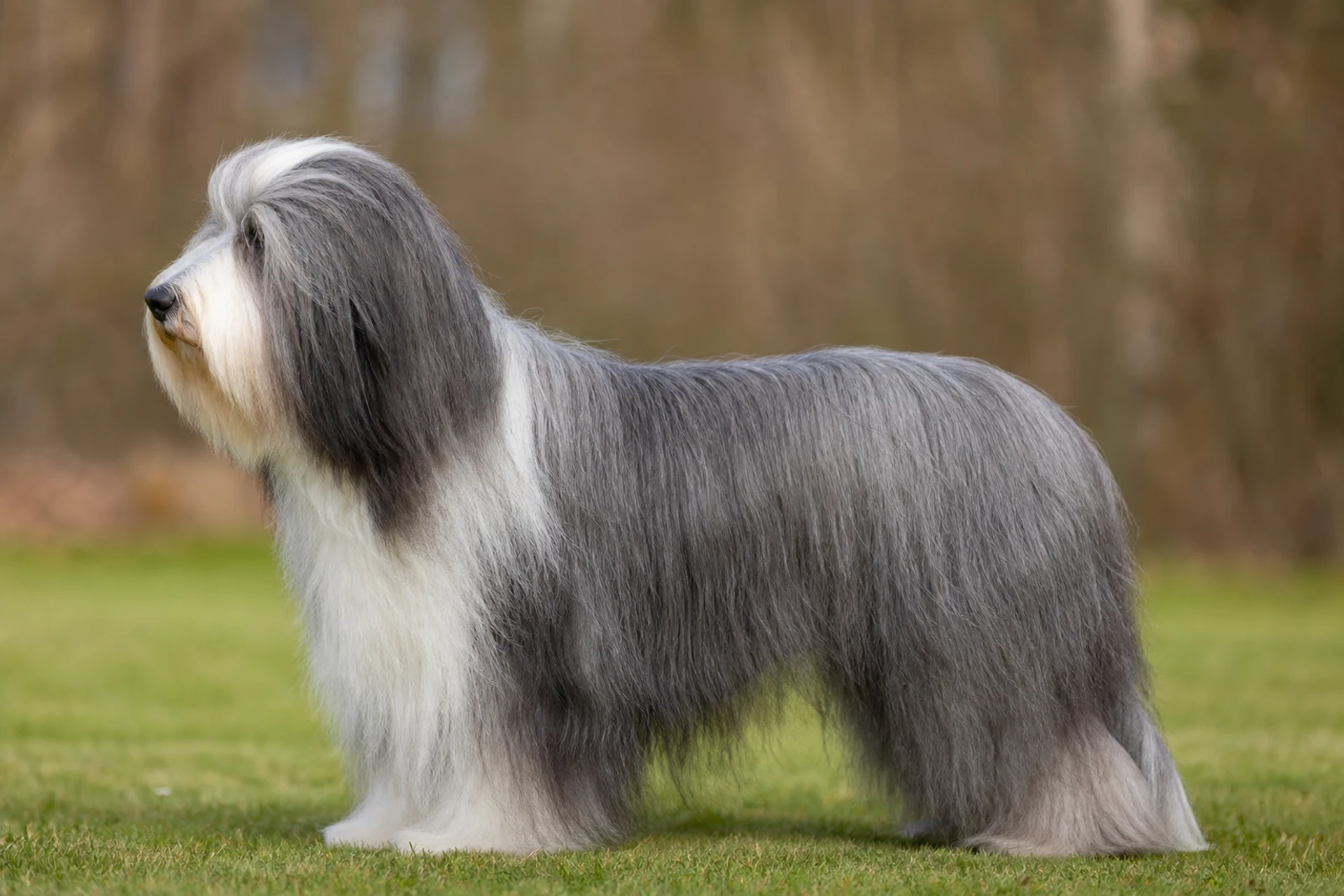
The Bearded Collie is a medium-to-large herding breed with a lively, bouncy personality and a distinctive shaggy coat. Best suited for active families who can provide daily exercise, mental stimulation, and extensive grooming, these affectionate dogs form strong bonds with their humans. While intelligent and trainable, their independent streak requires patient, consistent training. With a life expectancy of around 10 years, Beardies thrive in homes with yards and are generally good with children and other dogs, though early socialization is key.
At a glance
- Size
- Large
- Height
- 20–22 in
- Weight
- 44–55 lb
- Life span
- 10 years
- Coat colors
- Black, Blue, Brown, Fawn
- Coat type
- Long, harsh, shaggy double coat
How much does a Bearded Collie cost?
Adopt / rescue
$75–$400
Usually includes spay/neuter, first shots, and a microchip.
Buy from a breeder
$700–$2,000
From a reputable, health-testing breeder.
Approximate USD. Prices vary widely by region, breeder, pedigree, age, and coat colour — adopting is the lower-cost and recommended route. Avoid suspiciously cheap “breeders”; they’re often puppy mills.
Estimate the full cost of a Bearded Collie →Want the ongoing number? Estimate the monthly food bill for a Bearded Collie with our dog food cost calculator.
Bearded Collie photos
Views
Front, side, rear and top — the full silhouette.Poses
How the breed sits, lies, moves and plays.Puppy to senior
The breed across its whole life.Expressions
The breed’s range of moods.Close-up details
Eyes, ears, nose, paws, tail and coat.Coat colors
The breed’s recognized colors.Click any photo to enlarge. We show the Bearded Collie from every angle — three views, poses, life stages, expressions, close-ups, coat and colors.
Appearance & size
A Bearded Collie should never look square, heavy, or refined. You’re seeing a long, lean dog built for all-day trotting across rough hills, not a flashy showpiece. Height at the shoulder runs 20–22 inches, and weight usually lands between 44–55 pounds — enough substance to work stock, but with a big-dog presence that doesn’t tip into bulk. The body is slightly longer than tall, with a level topline and a deep, well-sprung chest that gives the lungs room to work.
Coat is the breed’s most visible trademark: a double layer that changes with age. Puppies are born dark and slowly lighten. The outer coat is flat, harsh, and shaggy — think weather-resistant, not silky — while the undercoat stays soft and insulating. You’ll see every solid coat color fade into something lighter over the first few years. Common base colors are black, blue, brown, and fawn, usually with crisp white markings on the chest, blaze, feet, and tail tip. Some dogs have tan points as well. A solid-colored adult without white is rare and perfectly acceptable, but most carry some flash. You should expect daily grooming, even in working lines, because that long hair catches burrs and debris like a magnet.
Three things hit you right away when you look at a Beardie face-on: the shaggy eyebrows that arch over the eyes, the full beard and mustache that give the breed its name, and the dark, wide-set eyes peeking through the hair with a bright, inquiring expression. The ears lie close to the head and get lost in all that coat when the dog is relaxed, lifting slightly when something catches attention. From the side, the neck is moderately long and flows into well-laid-back shoulders; the body shows a gentle spring of rib and a moderate tuck-up. There’s nothing extreme — no exaggerated angulation, no wasp waist. From behind, the hindquarters are muscular and rounded under all that hair, with the tail set low and carried with a characteristic upward swirl at the tip, never curled over the back. In motion, the dog appears to float, the coat lifting and falling with a soft, springy bounce that covers ground effortlessly.
History & origin
Long before dog shows and suburban backyards, the Bearded Collie was doing an honest day’s work on the steep, wet hillsides of Scotland. The breed’s exact origin is hazy, but most accounts trace it to the early 1500s, when a Polish sea captain is said to have traded a pair of Polish Lowland Sheepdogs to a Scottish shepherd in exchange for some sheep. Those shaggy, intelligent dogs were crossed with local herding stock, and over centuries the Bearded Collie took shape as one of Britain’s oldest working breeds.
Its job was not just gathering sheep but driving cattle over long, rough distances to market — a “drover’s dog” that needed independence, stamina, and a coat that could shrug off constant rain. The long, harsh outer coat and soft undercoat kept the dog dry and warm while working in weather that would send others hunting for shelter. That trademark beard, formed by hair that grows longer under the chin and along the muzzle, gave the breed its name and added a little extra insulation. The dogs were lean and agile, typically 20 to 22 inches at the shoulder and 44 to 55 pounds — built to cover ground all day, not to loaf near the fire.
For centuries, the Beardie was purely a working dog without a written pedigree, prized by shepherds and drovers but almost invisible outside rural Scotland. By the early 20th century, the breed had dwindled to the point of near extinction. After World War I, only a handful of working Beardies could be found. Then in the 1940s, a determined breeder named Mrs. G. Olive Willison began piecing the breed back together from the last remaining stock, starting with a brown bitch named Jeannie of Bothkennar. Willison’s breeding program, along with a few other dedicated enthusiasts, prevented the Bearded Collie from vanishing entirely.
The breed reached the United States in the late 1950s, but widespread popularity came later. The American Kennel Club recognized the Bearded Collie in 1976, and the breed began its shift from rugged farmhand to versatile family companion and show dog. Today’s Beardies still carry the herding instinct, the bounce in their step, and the love of working alongside people that got them through those hard Highland centuries.
Temperament & personality
The Bearded Collie is a bouncing bundle of smarts and silliness that thrives on connection. Think of him as a 50-pound perpetual puppy: athletic, curious, and always underfoot. He needs at least an hour of real exercise—running, fetch, a long, snuffling hike—not just a quick loop around the block. Without it, that clever brain spins up its own projects, and you’ll find the evidence in shredded pillows and a barking monologue directed at nothing.
Affection is his default setting. A Beardie wants to be where you are, leaning against your leg, nose-nudging your hand, and supervising every household task. He’s gentle with family and forms deep bonds with his people, but his exuberance can topple a toddler during a hallway zoomie session. That herding instinct runs deep: he may circle the kids, nip heels, or attempt to gather the cat. Redirect it early with games that work his mind, like hide-and-seek or trick training.
Alert and watchful, he’ll announce the delivery truck three streets over, but deep down he’s a soft-hearted goofball, not a guard dog. Expect a greeting that involves a full-body wiggle and maybe a stolen shoe paraded proudly around the room.
When a Beardie leans forward, eyes bright, tail sweeping like a metronome, he’s not being pushy—he’s simply vibrating with joy. A stiff, still body and a locked stare, on the other hand, means he’s uncomfortable or resource-guarding; teach children to give him space around food and prized chews. Even this clown can snap if startled mid-bite, so his bowl needs to be a no-go zone for little hands.
Smart and often strong-willed, a Beardie will test boundaries with the same persistence he used to dodge sheep kicks. Harsh corrections backfire; consistent, upbeat training and a good sense of humor get the best results. Isolation is his kryptonite. Left alone for long stretches with nothing to do, he may bark, pace, or dismantle the sofa. He does best in a busy home where someone is usually around and he’s treated like one of the gang—a muddy, grinning sidekick who’s ready for the next adventure.
Good with kids, dogs & other pets
Bearded Collies are that rare mix of bouncy, full-throttle energy and genuine patience, and it’s what makes them such a steady family dog around children. They don’t get snappy or moody when a toddler tugs a handful of coat, and they’re quick to forgive an accidental step on a paw. But keep their size and hustle in mind: at 44–55 pounds and 20–22 inches tall, a playful Beardie can easily bowl over an unsteady preschooler simply by rocketing past. Supervise the chaos when young kids are in the mix, and teach both dog and child some off-switch manners. Their herding roots sometimes surface as a desire to round up running, shrieking kids, but it’s curiosity and instinct, not aggression. A sharp “enough” and a redirect to a toy usually settles it.
With other dogs, they tend toward easygoing sociability—especially if they’ve grown up sharing space. They’re not scrappers. That said, an under-socialized adult Beardie who’s only known a quiet, one-dog existence may feel overwhelmed or anxious when forced into a dog-park gauntlet. Instead of shoving them into a pack, introduce new dogs on a parallel walk where they can sniff and coexist without direct pressure. Overly intense, chaotic play groups can stress a sensitive collie, so read the room before letting everyone loose.
Cats and small pets: this is where upbringing tilts the scales. A Beardie raised with a household cat from puppyhood often considers that cat part of the furniture. But the same dog outside might still fire up at a fleeing squirrel—the chase drive is real. With rabbits, guinea pigs, or chickens, the equation changes. Even a well-socialized Beardie may have a hair trigger on a darting furball. Start introductions early during that 3–14 week window, keep small pets securely contained, and never leave them unsupervised together until you’ve seen repeat calm behavior over months, not days.
The through line for all of this is early, relentless, positive exposure. That critical puppy socialization period slams shut around 12–16 weeks. During those weeks, your Beardie should meet friendly strangers, walk on different surfaces, hear vacuum cleaners and doorbells, see wheelchairs and skateboards, and practice quiet settles near a cat carrier. Skip this, and you risk shaping an adult who startles at loud noises, hides from visitors, or overreacts to other dogs out of sheer inexperience. After that window closes, you can still help an older dog feel safer in the world, but you’re playing catch-up. For a breed that thrives on being in the center of family life—and can develop isolation distress if left alone for long stretches—this social groundwork is what turns a good-natured puppy into a bombproof, all-situations companion.
Trainability & intelligence
A Bearded Collie isn’t going to do something just because you said so — they’re too smart for that. You have to give them a reason. This is a breed that learns fast when a task feels like a game, but they can also size you up and decide the squirrel in the yard is more interesting than your “come” command. Motivation trumps obedience for its own sake every time.
What works: Short, upbeat sessions built on positive reinforcement. Treats, a squeaky toy, a quick game of tug — that’s the currency for a Beardie. Clicker training is a natural fit because it marks the exact moment they made the right choice, something their quick, pattern-seeking mind appreciates. They excel in agility, rally, and herding trials not just because they’re athletic, but because these sports channel their intelligence into a clear, rewarding partnership.
The recall hurdle. Beardies are motion-triggered herders. If a bike, deer, or running kid catches their eye, they can be gone in a heartbeat. Build a rock-solid recall early, using the highest-value rewards you have — real meat, not dry biscuits — and practice it in gradually more distracting environments. Never chase them; that just turns it into a fun game of keep-away. Instead, run the other way and make it exciting when they catch up.
Puppyhood is non-negotiable. Start socialization before 16 weeks, exposing them calmly to different people, surfaces, sounds, and other animals. A poorly socialized Beardie can develop noise sensitivity or reserve that tips into reactivity later. At the same time, work on basic impulse control: a 50-pound adolescent who jumps on guests or herds small children by nipping isn’t cute for long. Reward four-on-the-floor relentlessly, and redirect herding mouthiness onto a tug toy.
Drop the heavy hand. Harsh corrections or punishment-based methods damage the trust this breed needs to cooperate. They’ll shut down, get anxious, or simply find creative ways to ignore you. Patience and consistency shape the dog you want. Expect some days where your otherwise brilliant dog acts like they’ve never heard the word “sit.” Stay calm, shorten the session, and end on a success.
Their independence means you’ll sometimes feel like you’re negotiating with a furry colleague rather than commanding a pet. That’s the deal. Put in the relationship work — clear communication, fair rules, plenty of praise — and a Bearded Collie will throw themselves into learning with the kind of joyful, bouncy enthusiasm that makes training genuinely fun.
Exercise & energy needs
Bearded Collies are built to cover ground all day long, so a quick stroll around the block won’t come close to cutting it. Plan on at least 60 to 90 minutes of real movement daily, split into two or three sessions. One long outing can work if it’s truly strenuous, but a Beardie’s brain runs just as hot as its legs — shorter, focused bursts often hit the mark better.
Intensity matters more than clock-watching. Off-leash running, hiking, or a hard game of fetch are baseline requirements. If you’re a runner or cyclist, a healthy adult Beardie can make a steady, high-mileage partner once fully grown. Avoid repetitive, high-impact pounding on pavement with a puppy under 18 months; those joints are still forming.
Mental exercise belongs in the same bucket as physical. A bored Beardie is an inventive one — you’ll find chew projects, barking marathons, or herding-the-kids behavior. Puzzle toys, scent games, and trick training can wear them out faster than another lap around the park. Even 10 minutes hiding treats in a snuffle mat or teaching a new command can settle a restless dog.
What suits this breed’s wiring best? Herding, of course, plus agility, rally, flyball, and treibball (the “urban herding” sport). They have the stamina for long days outdoors, so if you hike, trail run, or want a camping companion who won’t quit, you’ve found one. Even a couple of daily frisbee sessions in a safely fenced yard can keep your Beardie happy when a sheep farm isn’t handy.
Skip the all-out sprint-on-hard-surface routine if your dog has been diagnosed with hip dysplasia or the beginnings of arthritis — discuss joint-friendly options with your vet. But for a healthy Beardie, underdoing the exercise is the bigger risk. Insufficient daily outlet will surface as reactivity, anxiety, or OCD-like habits that can take months to undo. If you’re not home for big blocks of the day, a midday dog walker or doggy daycare that understands high-energy herders can save your drywall.
Grooming & coat care
That shaggy, flowing coat is the breed’s trademark — and it’s a full-on commitment. A Bearded Collie has a long, harsh outer coat layered over a soft, insulating undercoat, so anything less than daily brushing invites mats that pull painfully at the skin. Grab a pin brush or a slicker brush with rounded pins to work through the outer hair and gently tease out dead undercoat. I follow up with a wide-toothed comb down to the skin, especially behind the ears, under the armpits, and along the hindquarters — those friction spots mat up fast.
Bathing every six to eight weeks keeps the coat clean without stripping its natural weather-resistant oils. Use a gentle dog shampoo and make sure every bit of undercoat is rinsed and dried completely, or you’ll set yourself up for mildew and hotspots. In muddy seasons, a quick rinse with plain water and a thorough towel dry can stretch the time between full baths.
Trimming is minimal but not zero. I keep scissors handy to tidy the long hair on the feet, neaten the hocks, and shape the iconic “beard” if it gets grimy. Some owners also clip a small sanitary area for cleanliness. Leave the overall silhouette alone; a Beardie should look natural, not sculpted.
- Nails grow fast on a large dog if road walks don’t file them down. Clip or grind every two to three weeks.
- Ears flop over, so they trap moisture. Check weekly for wax buildup or redness, and wipe with a dog ear cleaner.
- Teeth benefit from a few swipes daily or at minimum three times a week to push back against periodontal disease, which is common in a breed that only averages 10 years.
Seasonal shedding will humble you. Twice a year, typically spring and fall, the entire undercoat decides to exit at once. You’ll need to brush more than once a day during that blowout, with a rake or de-shedding tool to prevent the loose fluff from felting into the coat. A high-velocity dryer (used outside) after a bath can blast out handfuls of undercoat in minutes and save hours of brushing.
Shedding & allergies
A Bearded Collie doesn’t shed a little every day like a Lab; you get a quiet period, then a dramatic seasonal blowout — usually twice a year — when the dense undercoat releases in fistfuls. For three or four weeks your house gets a fresh coat of hair, and your clothes collect a floating halo of fluff. The rest of the year, shedding is moderate, but the tousled outer coat readily traps dead hair. Skip brushing for a few days and you’ll find dusty hair-tumbleweeds rolling across the floor.
Daily line-combing during a blowout (and a thorough brush two to three times a week otherwise) keeps the indoor fallout manageable. A high-velocity dryer used outdoors does wonders to blast loose coat away before it lands on your sofa.
Drool is a non-issue. A Beardie’s lips are tight, but the trademark beard acts like a sponge after every drink of water. Expect a dripping chin, a wet trail across the kitchen floor, and the occasional water-flick onto your pants.
As for allergies: no dog is truly hypoallergenic, and a heavy seasonal shedder like the Beardie definitely isn’t one. During a blowout, dander levels spike along with the flying fur. If you’re allergy-prone, a visit to a breeder’s home where adult dogs live is the only reliable test. Be honest with yourself — this breed leaves hair on everything, and if that thought makes you twitchy, a Beardie will test your patience every shedding season.
Diet & nutrition
A Bearded Collie is a medium-large, athletic herder — and often an enthusiastic eater. The combination of solid muscle (44–55 lb) and a tendency to really love mealtime means portion control matters from day one. Letting a Beardie get heavy places extra strain on joints that already work hard, especially with a breed that can be prone to hip and elbow issues when lines aren’t carefully screened. Keeping your dog lean is one of the simplest ways to help those 10 years stay active and comfortable.
How much and how often
- Puppies (8 weeks–4 months): four evenly spaced meals a day.
- 4–6 months: drop to three meals daily.
- 6 months and up: switch to two meals a day, which most Beardies do best on as adults.
For a 50 lb adult with a normal activity level, that’s typically 2–2½ cups of high-quality dry food per day, split into morning and evening meals. If your dog herds, runs, or hikes hard daily, you may push closer to 3 cups — and dial back promptly when the exercise dips. Use a measuring cup or a kitchen scale; eyeballing it invites slow, silent weight creep.
- Key sign of a good weight: you can easily feel the ribs under a thin layer of fat, and there’s a visible waist when viewed from above. If the waist disappears or ribs need a search party, cut back and swap in some green beans or cooked pumpkin for bulk.
The weight-management picture
Some Beardies eat like they’re being timed, and that food motivation can push them into obesity without strict guardrails. Extra pounds on a deep-chested, active breed raise the stakes for joint stress and can make them less resilient as seniors. A couple of tools that help:
- Slow-feeder or puzzle bowls — they turn meals into a 10-minute brain game and prevent bolting, which lowers the risk of bloat in deep-chested dogs.
- No free-feeding. Pick up the bowl after 15 minutes.
- Treats count toward total calories. Use tiny training treats (pea-sized) and deduct from the next meal.
What to put in the bowl
A well-formulated commercial kibble for active, large-breed dogs covers your bases without guesswork. If you home-prepare, think roughly 60% animal-based protein (cooked or raw meat, fish, eggs), 20–30% fruits and vegetables, and 10% additions like cooked grains or plain yogurt. Lightly blending or puréeing home-prepared food helps nutrient absorption — dogs don’t have salivary digestive enzymes and their jaw motion is vertical, so unprocessed chunks pass through less efficiently.
Grains that work well: pearl barley (digestible, high-fiber) and white rice (great for a settling stomach). Unsalted water from cooking vegetables makes a quick, nutritious base for wet food.
- Puppy introduction: start with lightly cooked, puréed meats, fish, fruits, and veggies, or a high-quality large-breed puppy food. You can introduce raw chicken wings around 12 weeks under supervision once your pup is chewing confidently.
- Never impose a vegetarian or vegan diet; a dog’s digestive system and teeth are built for meat and cannot thrive without animal-sourced nutrients.
Seniors and lifetime tips
As the Beardie ages and the daily sprint turns into a stroll, reduce calories gradually, not protein — there’s no strong evidence that healthy seniors need a low-protein diet unless a vet diagnoses a specific condition. Smaller, more frequent meals can help an older dog with a sensitive gut. If teeth go missing, puréeing meals becomes an easy kindness.
And avoid the vet visit everyone dreads: rich fatty foods, especially holiday leftovers, can trigger pancreatitis. No table scraps. If you want to share safe leftovers like plain cooked vegetables, lean meat, or eggs, put them directly into the dog’s bowl to keep begging from ever taking root.
Batch-cook grains and vegetables once or twice a week so you have measured portions ready — a practical strategy that keeps you off the slippery slope of guessing how much “a little extra” really was. Then watch your Beardie’s waistline through the seasons. A 2–3 lb gain on a 50 lb dog isn’t a rounding error; it’s a trend you want to reverse early.
Health & lifespan
A healthy Bearded Collie lives about 10 years on average. That’s on the shorter side for a 44–55 lb dog, so the choices you make — from puppyhood onward — pack a lot of weight into a single decade.
Hip dysplasia shows up in the breed often enough that responsible breeders screen for it. Ask for OFA hip certification on both parents. Hypothyroidism and autoimmune conditions, particularly Addison’s disease, are also on the radar. Addison’s can be tricky because the early signs — lethargy, picky appetite, occasional vomiting — look like a dog just having an off day. A vet who knows the breed will run an ACTH stimulation test if those subtle shifts keep reappearing. Eye problems crop up, too. Progressive retinal atrophy (PRA) and cataracts can steal vision gradually, so a yearly eye exam by a veterinary ophthalmologist is smart for any Beardie over six.
The Beardie’s shaggy double coat is built for Scottish weather, not a southern summer. They overheat fast. On hot days, move walks to early morning or late evening, and skip midday romps entirely. That coat also hides body condition; you have to feel through the fluff to make sure ribs are easily palpable. These dogs love food and will pack on pounds if you let them, and extra weight stresses already vulnerable hips.
Preventive care is straightforward but non-negotiable. Keep monthly heartworm prevention going from the start of mosquito season through a full month after it ends. Rabies vaccination is a legal requirement, and there’s no treatment once symptoms hit, so don’t skip a booster. Because Beardies are social herding dogs, isolation or a chaotic home can fuel anxiety-driven behaviors that whittle away at their quality of life. Early, positive handling and consistent engagement matter as much as any vaccine.
Find a breeder who tests for hips, thyroid, and eyes — and who will talk frankly about Addison’s and epilepsy in their lines. Then commit to annual or twice-yearly vet visits, weight checks, and that all-important hand down the ribs.
Living environment
A Bearded Collie does not slot neatly into apartment life. This is a working herding dog with a deep reservoir of energy that a couple of quick leash walks won’t touch. Plan on a bare minimum of 60 minutes of running, romping, or active play twice a day — not just a stroll, but heart-pumping movement. A securely fenced yard is almost a necessity. Without it, you’ll spend your life at the dog park or an open field. These dogs have a powerful chase instinct; a flimsy fence or an unfenced yard is an escape waiting to happen.
Their thick, shaggy double coat makes them surprisingly tolerant of cold, wet weather. They’ll happily bound through snow while you shiver. Hot, humid summers are a different story. You’ll need to shift exercise to early morning or late evening and provide plenty of shade and water to prevent overheating.
Noise is a real consideration. Beardies notice everything — a delivery truck, a squirrel, the neighbor’s cat — and they’ll tell you about it with a loud, persistent bark. This isn't a quiet breed. If you share walls or have noise-sensitive neighbors, you’re in for a headache.
Being left alone for long stretches is where this breed often falls apart. These dogs form intense bonds with their people. A full workday of solitude can lead to howling, chewing through drywall, or obsessive pacing. Mental stimulation (puzzle toys, scent games, trick training) helps tire the brain, but it’s no substitute for company. Gradual alone-time training from puppyhood and a midday dog walker or daycare are survival tools here. If your household is gone 10 hours a day, a Bearded Collie will let you know just how unhappy that arrangement really is.
Who this breed suits
A Bearded Collie fits naturally into a home that treats activity as a shared lifestyle, not a checkbox on a to-do list. This is a 44–55 lb bundle of bounce and brain that wants to be in the middle of whatever you’re doing. Active families who hike, run, or play in the yard daily will see the breed at its joyful best — Beardies thrive on off-leash romps and interactive games, and they’re famously tolerant with respectful kids. That said, the same exuberance that makes them fun can send a toddler flying, so supervision and early training around small children are non-negotiable.
First-time owners can absolutely succeed if they’re genuinely excited about diving into positive-reinforcement training. A Beardie isn’t a push-button dog; he’s clever, sometimes stubborn, and will invent his own entertainment (digging, barking, herding the cat) when bored. You need patience and a sense of humor, not just good intentions. Singles who work from home or have a dog-friendly office hold a trump card: this breed bonds hard and hates being left alone for long stretches. A Beardie who gets a solid hour of running, plus puzzle toys or a sport like agility, will happily curl up at your feet while you work.
Seniors need to take an honest look at physical strength. At 20–22 inches, a Bearded Collie can pull hard on leash and jump with surprising height. A spry, outdoorsy person who still hikes daily and doesn’t mind a dog who bounces alongside can make it work; a quieter retirement with leisurely strolls won’t meet this dog’s baseline.
Who should think twice? Couch-potato households, anyone who can’t commit to daily brushing (that thick, shaggy coat mats instantly if neglected, and a professional groom every 6–8 weeks is essentially mandatory). Also reconsider if you’re bothered by noise — Beardies use their voice to comment on everything from delivery trucks to squirrels. The breed’s lifespan sits around 10 years, so you’re signing up for a shorter, intensely connected chapter. When the match is right, you get a dog who views every puddle, snowbank, and trail as the best thing that ever happened — and insists on bringing you along.
Cost of ownership
A Bearded Collie will likely cost you more at the groomer than at the vet, year after year. That shaggy double coat mats fast — budget accordingly from day one.
Purchase price: A puppy from health-tested parents (hips, elbows, eyes) runs $1,500–$2,500; show or working lines can hit $3,000. Rescue adoption fees usually land between $300 and $600.
Monthly costs, $150–$300:
- Grooming: Professional sessions every 6–8 weeks cost $80–$120 per visit. Between appointments, expect to spend $15–$20 on brushes and detangling spray. If you fall behind, a matted coat can mean a $300–$600 sedated shave-down.
- Food: A 44–55 lb Beardie eats 2.5–3.5 cups of quality kibble daily — roughly $50–$70 a month.
- Vet & preventatives: Routine care averages $40–$60 a month. Bearded Collies can be prone to hip dysplasia, autoimmune hypothyroidism, and progressive retinal atrophy. Responsible breeders screen, but set aside $1,000–$2,000 for an unexpected specialist visit.
- Insurance: $50–$80 a month for a comprehensive plan. With the breed’s immune-mediated disease risk and a 10-year lifespan, it’s a smart investment.
One-time setup (crate, bed, bowls, leash, high-value training treats) adds $100–$200. Group obedience classes or private lessons for their clever, independent mind will run another $150–$300.
Time is the hidden expense. A bored Beardie destroys things, and a neglected coat leads to a shave-down. Daily brushing isn't a suggestion — it's the cheapest insurance you'll buy.
Choosing a Bearded Collie
You’re looking at a bouncy, shaggy herding dog who’ll stand 20–22 inches at the shoulder, top out around 55 pounds, and likely share 10 years of your life. That decade means real grooming commitment, daily hard exercise, and a dog who thrives on work. You can find a Bearded Collie through a responsible breeder or a dedicated rescue — the right path depends on your tolerance for puppy chaos and your willingness to wait.
Responsible breeder vs. rescue
Responsible breeders almost never have puppies sitting around. Expect a waiting list and an application that asks about your fencing, daily schedule, and grooming plan. In return, you get a puppy whose parents have been screened for hereditary problems and whose early weeks were filled with sound, touch, and household noise.
Rescues are a solid alternative if raising a puppy isn’t for you. National groups and regional Beardie rescues place adult dogs into foster homes, so you’ll get real insight into house manners, prey drive, and how the dog handles kids, cats, or alone time. Most Beardies in rescue landed there because of owner life changes — divorce, illness, relocation — not because the dog is broken.
Health clearances to ask for
A breeder should hand over written proof, not just a nod. Ask for:
- Hips: OFA or PennHIP evaluation, with a rating of Fair or better.
- Thyroid: OFA thyroid panel from an approved lab, including autoantibody testing for autoimmune thyroiditis.
- Eyes: A current CERF or OFA Eye exam done by a veterinary ophthalmologist (ideally annually on breeding dogs).
- Addison’s disease: No genetic test exists, but a breeder who tracks lines and will discuss family history shows they’re paying attention.
If you hear “my vet checked them and they’re fine,” walk away. That’s not a breed-specific clearance.
Red flags when searching
Certain signs mean you keep moving.
- No clearances, or “they’re coming” for months with no paperwork.
- Puppies available under 8 weeks of age.
- A breeder who won’t let you meet the dam (video call is bare minimum), runs multiple litter ads year-round, or always has “just one left.”
- Pet-store sales, online broker sites, or shipping a puppy sight unseen.
- Dam or sire who panics, cowers, or growls at strangers — a Beardie can be reserved but should never be fearful.
Beardies aren’t common, so a breeder who never has a waitlist or doesn’t ask you hard questions is prioritizing sales over the dogs.
Picking your puppy
When you visit, watch the whole litter go. Puppies should tumble into your lap, investigate your shoes, grab a toy, then face-plant for a nap. A puppy that hides in the corner, startles at a dropped key, or refuses to approach you likely isn’t wired for the resilience a herding dog needs.
Check eyes for discharge, ears for odor, and movement — no hopping or stiffness. Ask what the breeder does in those first 8 weeks: exposure to vacuum cleaners, kids, clippers, car rides, and crate time all matter. The dam should be friendly or politely aloof, not skittish.
That shaggy puppy or rescued adult is going to depend on you through rain, coat blow-outs, and adolescence. A breeder or rescue who vets you thoroughly isn’t being difficult — they’re stacking the odds for a solid, active ten years.
Pros & cons
-
Lively, affectionate companion that thrives on being part of family life — you’ll recognize the trademark Beardie bounce and happy spinning greeting.
-
Sharp mind and eager to work: they shine in agility, herding, obedience, and trick training when you keep sessions playful and positive.
-
Usually fantastic with children and other dogs, given early socialization; their default is a bouncy, gentle playfulness that wears well in a busy household.
-
That shaggy double coat catches most shed hair before it hits your floor, so with consistent grooming you get a surprisingly low-mess house.
-
Built to move — a genuine up-for-anything buddy for long hikes, runs, or endless rounds of fetch.
-
Coat care isn’t optional: count on daily brushing to prevent painful mats, plus regular trims and a standing appointment with a professional groomer.
-
High-octane energy with a purpose. A bored Beardie will quickly invent his own entertainment — expect digging, destructive chewing, and wall-to-wall barking.
-
They talk, and talk, and talk. An extensive vocal range from alert barks to excitable yodeling can wear thin with close neighbors.
-
The breed faces several serious health concerns, including hip dysplasia, hypothyroidism, and autoimmune diseases; the typical lifespan hovers around just 10 years.
-
Herding instincts never clock out: chase-driving cars, bikes, or nipping at running children are all on the table unless you redirect that drive early and often.
-
Independent thinking can slide into outright stubbornness. Training demands consistency, creativity, and a sense of humor — this is no push-button breed.
Similar breeds & alternatives
If you're drawn to the Bearded Collie's shaggy, grinning charm but want to weigh your options, a handful of herding breeds share that long coat, bright mind, and athletic build—yet each tilts the personality in a slightly different direction.
Old English Sheepdog might come to mind first because of the similar shaggy silhouette. An OES is bigger, usually 60–100 pounds, with a heavier, puffier coat that demands serious grooming or professional clipping if you can't keep up. Where a Beardie is bouncy and effervescent, the OES tends to be more easygoing and stubborn rather than exuberantly agile. You'll trade some of the Beardie's constant motion for a dog that's content with a good walk and then crashes out. Lifespan is comparable: around 10–12 years. Drool and a slightly lower overall intensity level come with the package.
Border Collie shares the herding brain and the stare, but in a smaller, lighter-framed package—typically 30–55 pounds, with a short or medium coat that needs less daily detangling. The difference is intensity. A Beardie is playful and opportunistic; a Border Collie is often hyper-focused and can become anxious without a job to do. If a Beardie's off-switch can be coached, a Border Collie's takes relentless work. Both need a solid hour of running, but the Border Collie will demand more structured mental tasks, whereas the Beardie might be satisfied with a game of flirt pole and some trick training. Border Collies regularly live 12–15 years.
Australian Shepherd comes in around the same height (18–23 inches) and weight (40–65 pounds) as a Beardie, but the coat is straighter, often merle-patterned, and naturally bobbed or docked. Personality-wise, Aussies tend to be more reserved with strangers and slightly more serious about their territory—they can be watchful in a way the Beardie's "hi-everybody" attitude rarely is. Both breeds are vocal, but you'll find many Aussies lean toward protective barking while Beardies bark to announce playfulness or excitement. Grooming is less demanding with an Aussie; a weekly brush usually handles it. Lifespan ranges 13–15 years.
Polish Lowland Sheepdog is the closest relative in looks: a smaller (30–50 pounds), compact herding dog with the same long, shaggy double coat and the same daily brushing requirement. PONs, as they're called, are clever and independent problem-solvers. Compared to a Beardie, they can be a touch more aloof with strangers and a little less reliably bouncy in the backyard. They also live longer, often 12–14 years. The PON is rarer, so you'll likely face a waitlist and a higher upfront cost.
The Bearded Collie's trademark spring-loaded personality—hardly ever walking when it can bounce—is tough to find in a dog that also wants to flop on your feet at the end of the day. If you need a breed that dials back the vocal announcements a notch, the Aussie or PON might fit better. If you want that shaggy silhouette but less nonstop motion, the Old English Sheepdog is the calmer counterpart.
Fun facts
- The Bearded Collie is known for its signature 'bounce' when excited.
- They have a profuse beard and mustache, giving them their name.
- Originally bred in Scotland as a herding dog, they excel in dog sports today.
- Their long coat requires daily brushing to prevent mats.
Frequently asked questions
- Are Bearded Collies good with children?
- Bearded Collies are generally affectionate and good-natured, making them potentially excellent companions for families with children. However, their bouncy and lively personality can be overwhelming for very young kids, so supervision and early training are important to ensure safe interactions.
- Do Bearded Collies shed a lot?
- Bearded Collies have a moderate shedding level, ranking around 3 out of 5. They have a long, double coat that sheds year-round, with heavier shedding during seasonal changes. Weekly brushing helps keep loose hair under control, but some fur around the home is to be expected.
- How much exercise does a Bearded Collie need?
- With an energy rating of 4 out of 5, Bearded Collies need plenty of daily exercise—typically 60 to 90 minutes of vigorous activity. Long walks, runs, or active play sessions are essential to prevent boredom and destructive behaviors. They also benefit from mental challenges like training or puzzle toys.
- How much grooming does a Bearded Collie require?
- The Bearded Collie's long, dense coat requires significant grooming, rated at 4 out of 5. They need thorough brushing at least 3–4 times per week to prevent mats and tangles, and occasional professional grooming is recommended. Regular ear cleaning and nail trimming are also part of their care routine.
- Can Bearded Collies live in an apartment?
- Apartment living can be challenging for a Bearded Collie due to their large size and high energy level. They do best in homes with a securely fenced yard where they can run freely. If an apartment is the only option, the owner must be very committed to providing extensive daily outdoor exercise and mental stimulation.
- Are Bearded Collies good for first-time dog owners?
- Bearded Collies are intelligent and affectionate but can be a handful for first-time owners due to their high energy and grooming needs. While they are trainable, they require consistent, patient training and an active lifestyle. They tend to thrive best with owners who have some previous dog experience.
Tools & calculators for Bearded Collie owners
Quick estimates tailored to Bearded Collies — pre-filled with this breed’s size where it matters.
Articles & stories about the Bearded Collie
Sources & standards
This profile follows recognized breed standards from the American Kennel Club (AKC) and the Fédération Cynologique Internationale (FCI), along with established veterinary and breed-club guidance. These describe general breed tendencies — every dog is an individual.