

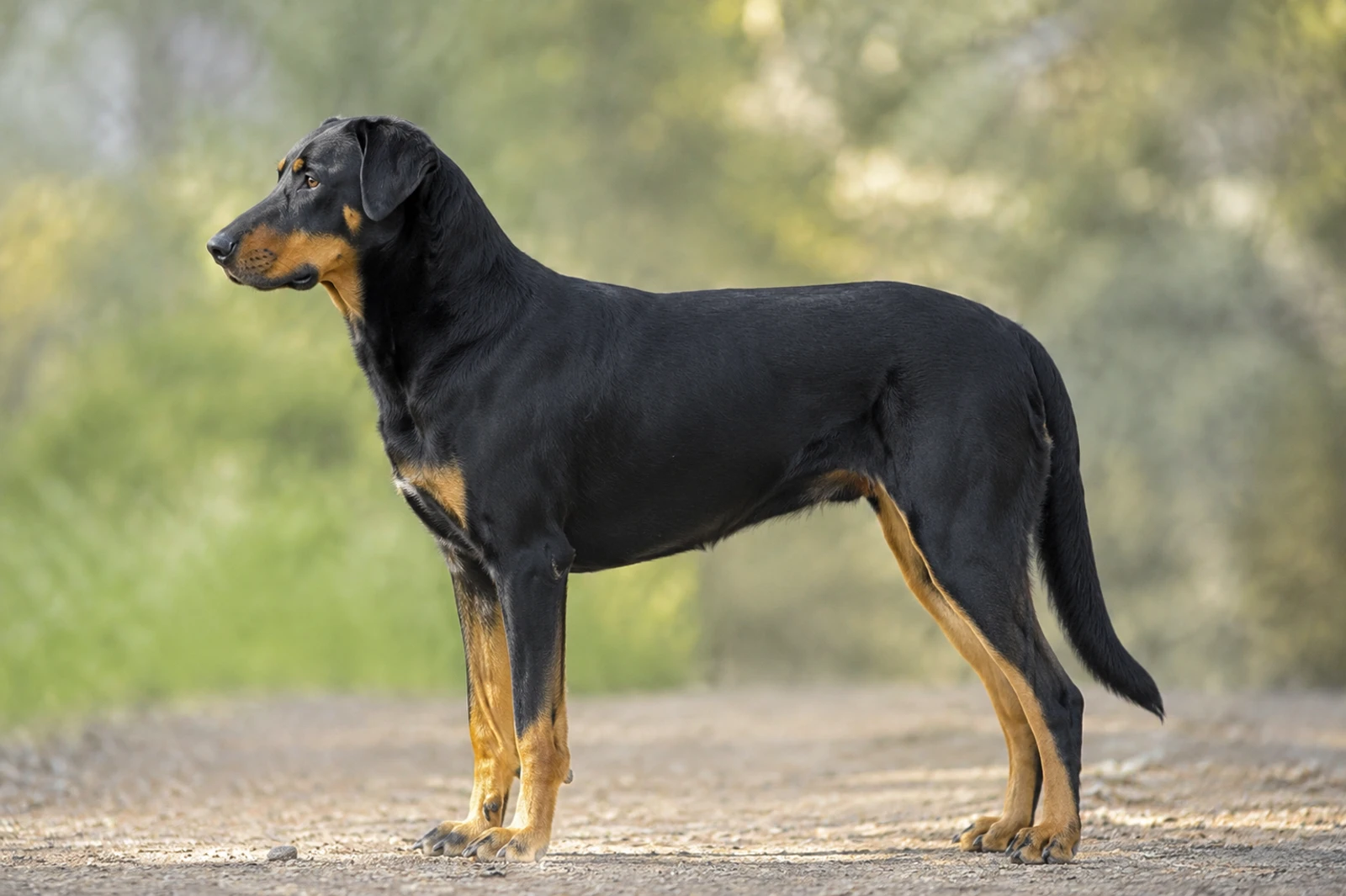
The Beauceron, also known as the Berger de Beauce, is a versatile French herder with a history of guarding, herding, and military service. Standing up to 28 inches tall and weighing up to 85 pounds, this giant breed is best for experienced owners who can meet its high exercise and mental stimulation needs. With a loyal and protective nature, it bonds deeply with its family and is gentle with well-behaved children, though early socialization is crucial. Its double coat sheds moderately and requires minimal grooming. The Beauceron is not apartment-friendly or suited for novice owners, thriving instead in active homes that provide purposeful work.
At a glance
- Size
- Giant
- Height
- 25–28 in
- Weight
- 65–85 lb
- Life span
- 10–15 years
- Coat colors
- Black and tan, Harlequin
- Coat type
- Short, dense double coat
- Group
- Working
How much does a Beauceron cost?
Adopt / rescue
$75–$400
Usually includes spay/neuter, first shots, and a microchip.
Buy from a breeder
$700–$2,000
From a reputable, health-testing breeder.
Approximate USD. Prices vary widely by region, breeder, pedigree, age, and coat colour — adopting is the lower-cost and recommended route. Avoid suspiciously cheap “breeders”; they’re often puppy mills.
Estimate the full cost of a Beauceron →Want the ongoing number? Estimate the monthly food bill for a Beauceron with our dog food cost calculator.
Beauceron photos
Views
Front, side, rear and top — the full silhouette.Poses
How the breed sits, lies, moves and plays.Puppy to senior
The breed across its whole life.Expressions
The breed’s range of moods.Close-up details
Eyes, ears, nose, paws, tail and coat.Coat colors
The breed’s recognized colors.Click any photo to enlarge. We show the Beauceron from every angle — three views, poses, life stages, expressions, close-ups, coat and colors.
Appearance & size
A Beauceron looks like a working dog mean business — tall, balanced, and athletic without an ounce of bulk for the sake of it. They stand 25 to 28 inches at the shoulder and tip the scales at 65 to 85 pounds, putting them squarely in the giant category, but this is a lean, long-limbed giant built to cover ground all day. You can see the endurance in the way everything fits together: deep chest, straight back, and moderate angulation that favors efficient, tireless movement over flash.
The coat is a short, dense double coat that lies flat against the body. The outer hairs are coarse and straight, about 1.5 to 2 inches long, with a soft, downy undercoat that thickens in winter. On the head, ears, and lower legs the coat is shorter and smoother. Around the neck the fur is slightly longer, forming a subtle ruff, and the tail carries a light plume. You won't see feathering or any trace of fluff.
Color comes in two patterns. The classic black and tan has a deep black base with rich tan markings above the eyes, on the muzzle, chest, legs, and under the tail — the same crisp, terrier-like "doberman markings" but on a much larger canvas. The other accepted pattern, harlequin, is a mix of blue-gray and black patches on a white background, with the same tan points; harlequins always have a black nose and dark eyes, never pink skin. White blazes or too much white on the body are faults.
Stand your Beauceron in profile and you'll see a clean, rectangular outline. The head is long and chiseled, with a flat skull, a slight stop, and a muzzle that's neither snipey nor heavy. Dark brown eyes, set slightly obliquely, give a steady, confident expression. Ears can be natural or cropped — natural ears are half-prick or carried drop, often cropped in history, but many owners today leave them as-is. The neck is strong and well-arched, flowing into a deep, broad chest that reaches the elbows. The topline is firm and level from withers to croup, never sloping or swaybacked. The tail hangs in a gentle J-curve, reaching the hock, and lifts slightly when the dog is in motion.
From the front, the chest is wide but not blocky; forelegs are straight and muscular, with thick, round bone. The real talking point, though, is out back. A Beauceron must have double dewclaws on each rear leg, set low and close to the foot, forming a functional extra "thumb." That trait isn't a quirky afterthought — it's a breed signature embedded in the standard and a working feature that helps with scrambling over rough terrain. Look at the rear, and those double dewclaws are the first thing you'll notice, followed by strong, well-muscled thighs and a moderate bend of stifle. Nothing about this dog is exaggerated, just practical power under a short, glossy coat.
History & origin
You’re looking at one of the oldest, most purely French herding breeds still working today. The Beauceron didn’t come out of a Victorian show ring or a single breeder’s project—it was shaped by centuries of farm life on the open plains of northern France, primarily the Beauce region south of Paris. The name is a bit misleading, because the breed wasn’t limited to Beauce; it turned up wherever sheep and cattle needed a strong, level-headed dog to move them and keep predators at bay. The name “Berger de Beauce” stuck after the first French dog show in 1863, but farmers simply called it le chien de la plaine—the dog of the plains.
By the 1500s, manuscripts already describe a large, smooth-coated shepherd’s dog with cropped ears and tan markings—what would become the Beauceron’s signature “red stockings” (bas-rouge). It earned that nickname for the rich rust coloring on the lower legs, a feature that makes the breed instantly recognizable. Unlike many flock guardians, this dog was expected to be a true all-rounder. It herded large flocks, guarded property, and protected the farmer’s family without a second thought. A hands-off approach to woolly sheep? Not here. The Beauceron was known for a quiet, upright working style, using its body to control stock rather than nipping or barking excessively.
A pivotal moment came in the late 1800s, when Professor Pierre Mégnin and other French cynologists separated the country’s native herding dogs into two types: the long-coated Berger de Brie (Briard) and the short-coated Berger de Beauce. A formal standard followed in 1893, and the Club des Amis du Beauceron was founded in 1911 to preserve the dog’s working character. The timing mattered. World War I and later World War II turned the Beauceron into a military asset. They carried messages behind enemy lines, sniffed out mines, and even dragged wounded soldiers to safety. That battlefield grit deepened the breed’s reputation for level-headed courage.
American interest came much later. A handful of imports appeared in the 1960s and 70s, but serious breeding efforts didn’t gain traction until the 1990s. The AKC admitted the Beauceron to the Miscellaneous Class in 2001 and into the Working Group in 2007. Today the breed remains relatively uncommon in the U.S., still largely in the hands of dedicated breeders who emphasize working ability, nerve, and a clear head. That means the Beauceron you meet at the park is very much the same tough, versatile dog the 18th-century drover depended on—just maybe with a modern job like ring sport or search-and-rescue, and a fondness for sprawling on the living-room floor after the work is done.
Temperament & personality
You’re not getting a push-button pet with a Beauceron — you’re gaining a thinking partner who will watch, evaluate, and then act. These dogs carry a calm-but-alert presence that reads almost like a coiled spring. They don’t waste energy on nervous bouncing around the house, but they miss nothing. A loose, soft-eyed posture signals a relaxed dog; a forward lean and a hard stare often mean he’s about to move, not necessarily to threaten, but you’d better be paying attention.
Energy & Drive
A Beauceron with nothing to do will invent a job, and you probably won’t like it. Bred to move livestock across miles of pasture, they need real, focused exertion — a quick leash walk won’t cut it. Count on at least an hour of hard running, herding games, or advanced training daily. Without that outlet, you’ll see anxiety-driven behaviors: relentless barking, chewing that can dismantle chair legs, and compulsive pacing. Even the adult jaws stay powerful; hard chewing helps keep them clean and strong, but boredom turns it destructive. A homemade citrus or vinegar spray can deter gnawing on table legs, but prevention starts with purpose.
Affection & Household Life
Inside his own pack, a Beauceron is steady, devoted, and surprisingly gentle — provided he’s been raised with clear boundaries. He’ll shadow you from room to room, not out of neediness, but because safeguarding his people is non-negotiable. With children he’s patient, though those herding roots mean a running child may get a light nip at the heels. Teach kids never to crowd the dog while he eats; interrupting a meal can trigger food guarding, and a 75-pound giant correcting a small human is no joke.
When the doorbell rings, expect immediate assessment. He won’t shower strangers with tail wags. Well-socialized adults stay aloof but not aggressive, reserving their full welcome for family. Intact males may scent-mark indoors if they detect a new “territory” — they define home by the smell of their people more than by walls. Thorough cleanup with a white vinegar solution removes the cue that invites re-soiling.
The Independent Mind
This isn’t a dog who obeys because you asked; he obeys because he respects you. Strength of will is as central to the breed as the double dewclaws. Fair, consistent handling — never harsh force — earns loyalty. A Beauceron will try to out-think a pushover, and a contest of wills you lose today becomes a pattern tomorrow. Watch for lip-licking or head turns when you’re pushing too hard; those calming signals tell you he’s uncomfortable, not defiant.
Quirks
Expect a dog who uses his mouth to explore, herd, and sometimes to make a point — not biting, but a brief, directed grab of a wrist. And yes, a romp in something foul-smelling may happen. Whether he’s masking his own scent or just reveling in the stink like his scavenger ancestors, he’ll wear it proudly. A relaxed, confident Beauceron with a job to do is a rock-steady guardian who reads every situation before reacting. Give him that, and you’ll wonder how you ever managed without a second set of eyes on the world.
Good with kids, dogs & other pets
A Beauceron’s steady, patient nature makes them a solid family companion, but their sheer size and drive mean you can’t just turn them loose with young kids and hope for the best. An adult can easily top 85 pounds and stand 27 inches at the shoulder — a happy bump from that kind of dog can send a toddler flying. With school-age children who know how to interact respectfully, the bond can be remarkable: these dogs are protective without being sharp, and they’ll often shadow “their” kids around the yard. Always supervise interactions, especially when children are small or unfamiliar, and teach both the dog and the child clear boundaries early on.
Socialization is the big lever here. Start introducing your Beauceron puppy to gentle children, varied people, and new environments well before the 16-week window starts to close. The breed isn’t inherently reactive, but they’re thinkers — if they don’t learn that novel situations are fine, they can default to wariness. That wariness, in a dog this big, is hard to undo later. Keep those early exposures upbeat and never force a fearful dog into meet-and-greets; it backfires.
Other dogs
Beaucerons can get along well with other dogs, especially when raised together. They’re not typically dog-aggressive, but they do have an independent, guardian streak that can read as bossy around strange dogs. Early and ongoing positive experiences — puppy classes, controlled playdates, neutral-territory walks — build the social skills that let them coexist peacefully. Same-sex scuffles aren’t uncommon in large working breeds, so pay attention to body language and don’t let rough play escalate. If you’re bringing an adult Beauceron into a multi-dog household, take introductions slowly; a dog who’s perfectly content being the only canine in your life doesn’t necessarily need a pack of buddies.
Cats and small pets
Here’s the honest downside: that strong herding instinct and alertness can flip into chase-and-grab behavior with smaller animals. A Beauceron who grows up alongside a cat from puppyhood and is taught a solid “leave it” may live peacefully indoors, but the prey drive doesn’t just vanish. Outdoor cats, rabbits, or backyard chickens are moving targets that can trigger an instant bolt. Manage it with sturdy fences, a reliable recall, and never leave the dog unsupervised with a free-roaming small pet. For homes with pocket pets or birds, secure enclosures are non-negotiable. The tendency to herd and control movement is hardwired — you can shape it with training, but you’re unlikely to extinguish it completely.
Trainability & intelligence
A Beauceron doesn’t just learn commands — he studies you. This is a breed that watches, anticipates, and decides whether you’re worth following. When the trust is there, training moves fast. When it’s not, you’ll hit a wall no amount of repetition will break through.
Think partner, not pushover
Smart and independent, a Beauceron responds best when you treat him like a thinking partner. He needs to understand the why behind a request, not just the what. That means clear, consistent communication from day one. Hesitation, unfair corrections, or commands that don’t make sense to him will erode his respect. Use short, upbeat sessions built around positive reinforcement — food, a favorite tug toy, or genuine praise — and you’ll see a dog who throws himself into work with startling focus.
The recall question
A solid recall is not a given with this breed. Beaucerons were bred to guard and herd independently, often making judgment calls away from the handler. That heritage creates a dog who can tune you out when something more interesting is happening. Build the recall early with high-value rewards and never punish a slow return. If he learns that coming back might end the fun or invite a scolding, he’ll calculate the odds and stay put. Maturity and consistent proofing around distractions are what turn a puppy’s “maybe” into a reliable “here.”
Socialization is training
Low natural sociability means that exposure to the world isn’t just a checklist — it’s the foundation of good behavior. Start between 3 and 14 weeks, and keep it going. New people, strange sounds, different surfaces, other dogs — every positive encounter reduces the chance that the adult dog’s wariness tips into reactivity. A fearful Beauceron is a powerful liability; a well-socialized one is a steady, confident protector.
What works
- Reward-based methods only. Force or intimidation will break trust and magnify the breed’s stubborn streak.
- Short, frequent drills that end on a win. Keep it a game, because he’s competitive and craves a job done right.
- Patience with the adolescent phase. An 80-pound teenager will push boundaries around 7–12 months. Calm consistency, not harsh punishment, gets you through it.
- Work with him, not against him. Use his natural drive for movement and problem-solving. Training that feels like a chore to you will feel pointless to him. If you’re both engaged, a Beauceron will run through new concepts in a handful of repetitions and remember them for life.
Exercise & energy needs
A tired Beauceron is a happy Beauceron — but a stroll around the block won't even take the edge off. This is a giant working dog originally bred to herd cattle and guard the farm, and his engine is built for full days, not lazy afternoons.
Plan on at least 60 to 90 minutes of dedicated, vigorous exercise every day, split into two sessions. A single long session rarely releases all that pent-up physical and mental energy. Mornings call for a solid 30- to 45-minute off-leash run, a bike ride alongside you, or hill work. Evenings need another 30 to 45 minutes of focused activity — think retrieving, flirt pole, or swimming. If your schedule can't reliably provide that, a Beauceron isn't the right fit.
What you do during those minutes matters more than the clock. This breed wants to run, chase, pull, and problem-solve. A leashed jog on pavement is better than nothing, but it won't satisfy deep instincts to move livestock or patrol a territory. Give him a soft surface to sprint, a long line to practice directional cues, or a cart to pull.
Mental stimulation isn't optional — it's the other half of the equation. A Beauceron who only runs will still get bored. He needs a job. Daily training sessions, advanced obedience, scent work, puzzle toys, and food-dispensing games keep his sharp mind from cooking up his own entertainment (which often involves counters, couch cushions, or digging). Sports like herding, IPO/protection work, rally, agility, and dock diving are ideal outlets that tap into his working heritage.
- Best activities: Herding trials, protection sports (IPO/Schutzhund), advanced obedience, agility, cart-pulling, long hikes with a pack, scent detection, swimming, tug-and-release games with rules.
- Caution with young dogs: Beaucerons grow rapidly and can be prone to hip and elbow issues. Responsible breeders screen for these, but you still need to protect growing joints. Skip high-impact jumping, forced running on hard surfaces, and repetitive pounding until growth plates close (around 18–24 months). Low-impact endurance on grass or trails is safer.
- The behavioral price of skimping: A bored, under-exercised Beauceron often becomes reactive, anxious, or destructive. You'll see constant pacing, barking, or mouthiness that training alone can't fix. You can't out-train a lack of movement.
If you're looking for a workout partner who can go the distance and then ask what's next, you've found him. Just know that an hour of ball throwing in the backyard won't cut it — he needs a full life of purpose-driven activity, every single day.
Grooming & coat care
The Beauceron’s short, dense double coat does a great job shrugging off weather and dirt, so grooming is refreshingly straightforward — until shedding season arrives. For most of the year, a weekly once-over with a rubber curry brush or a natural bristle brush pulls out loose hairs and spreads the natural oils that give the coat its low-key sheen. The skin-to-coat contact of a curry also massages the skin, which can help minimize dry flakes during dry winter months.
When seasons shift in spring and fall, the undercoat lets go in earnest. You’ll want an undercoat rake or a de-shedding tool for those few weeks, used every other day to stop tumbleweeds of fur from taking over the house. Don’t be tempted to over-bathe; these dogs have a naturally clean, dirt-resistant coat. A bath every two to three months — or after rolling in something truly foul — is plenty, and always use a gentle dog shampoo to preserve the coat’s protective oils.
- Nails: Beaucerons are active and may wear nails down naturally on hard surfaces, but check every couple of weeks. If you hear clicking on the floor, it’s time for a trim to avoid splitting or joint strain.
- Ears: Whether natural or cropped, ears collect grit and wax fast on a working dog. Wipe the outer ear with a damp cloth weekly. A whiff of yeast or discharge signals an infection worth a vet visit.
- Teeth: Aim for brushing two to three times a week with a dog-safe toothpaste. Hard dental chews can supplement, but they’re no substitute for a brush.
All that off-leash time on trails and in fields actually boosts coat turnover and reduces stress-related shedding. A quick post-adventure body check while you brush lets you spot burrs, ticks, or hot spots right away — a practical routine for a breed that lives to work outdoors.
Shedding & allergies
If you picture a short-coated dog and think “low shedding,” a Beauceron will quickly correct that assumption. The breed carries a dense double coat: a harsh, weather-resistant outer layer and a soft, insulating undercoat. That undercoat does a major disappearing act twice a year.
The seasonal blowout is the real event
For about two to three weeks each spring and fall, the Beauceron drops undercoat in tufts you can pinch and pull out by the handful. You’ll find fur drifting into corners, clinging to upholstery, and weaving itself into anything made of fabric. During these blowouts, daily brushing — ideally with a rubber curry or undercoat rake outdoors — is non-negotiable. Between seasons, expect steady background shedding. A solid weekly brush-down keeps loose hair from taking over the house, but you’ll still need a good vacuum and lint rollers.
Drool enters the picture selectively
This isn’t a breed that leaves ropes of slobber everywhere. You’ll notice some drool mainly after drinking, during intense exercise, or when a high-value treat is on deck. For most Beaucerons, it’s a minor annoyance, not a constant drip. Keeping a drool rag near the water bowl handles the usual moments.
The realistic allergy picture
No dog with a thick double coat and seasonal shedding fits anyone’s definition of hypoallergenic. Beaucerons produce dander and shed fur continuously enough to keep allergens airborne. If someone in your home has moderate to severe dog allergies, this breed will keep them wheezing and sneezing. Even frequent baths and air purifiers only do so much when a 75-pound dog unpacks a winter coat in your living room. If allergies are a dealbreaker, this isn’t the breed to gamble on.
Diet & nutrition
A Beauceron’s size and working-drive mean that what you put in the bowl directly affects joint health and performance. This is a 65–85 lb athlete that can pack on pounds quickly if portions aren’t matched to actual activity—obesity puts real strain on hips and elbows. Measure every meal. For a moderately active adult, that often lands at 3–4½ cups of high-quality dry food per day, split into two feedings. A dog running alongside your bike or doing protection work may edge closer to 5 cups, while a more laid-back companion might do fine on the lower end. Skip the free-feeding; use a puzzle bowl if he inhales his food.
Puppies grow fast and need steady fuel without growing too quickly. Give four evenly spaced meals until four months, then three meals until six months, then switch to the adult two-a-day rhythm. Choose a large-breed puppy formula to keep skeletal development in check. Around 12 weeks you can introduce raw chicken wings or necks under supervision for chewing and early nutrition, but always transition new foods gradually—start with lightly cooked and puréed meats and vegetables.
The diet itself should lean heavily on animal protein. A practical mix is roughly 60% raw or cooked meat, 20–30% dog-safe fruits and vegetables, and 10% other bits like eggs, plain yogurt, or pearl barley for fiber. White rice is a gentle fallback during stomach upsets. Never impose a vegetarian or vegan diet; that shortchanges a digestive system built for meat. Avoid rich holiday scraps—a single fatty indulgence can trigger pancreatitis.
Weight watch: Run your hands over his ribs weekly. You should feel them without pressing. As he ages, cut back gradually if his exercise tapers off, but don’t slash protein; older dogs still need muscle support. If teeth go missing, purée meals to keep nutrients flowing. And always serve leftovers in his own bowl—the fastest way to make a begging habit is feeding from the table.
Health & lifespan
Beaucerons typically live 10 to 15 years, and it’s not unusual for a well-bred, active dog to reach the high end of that range. They’re a robust working breed, but like any giant, deep-chested dog, they come with a few health realities you’ll want on your radar from day one.
Start with the orthopedic biggies. Hip dysplasia and elbow dysplasia appear in the breed, and responsible breeders screen breeding stock through OFA or PennHIP evaluations. A puppy from parents with good hip scores isn’t a guarantee, but it stacks the deck in your favor. Keeping a lanky adolescent lean — you should feel ribs easily — reduces stress on forming joints. Extra weight on a dog that will eventually carry 65–85 pounds of muscle is a fast track to joint trouble and a shortened lifespan.
Bloat (gastric dilatation-volvulus, or GDV) is the emergency every Beauceron owner needs to recognize. That deep chest makes the stomach prone to twisting, cutting off blood flow. I feed twice a day instead of one big meal, avoid a full-on sprint right after eating, and know the early signs: retching without bringing anything up, restlessness, a swollen belly. Some owners opt for a prophylactic gastropexy during spay or neuter, which tacks the stomach down. Talk it through with your vet.
The breed can also be prone to dilated cardiomyopathy (DCM), a heart muscle condition that may not show symptoms until it’s advanced. A yearly cardiac exam and an echocardiogram for breeding dogs are standard. Watch for reduced stamina, a soft cough, or unexplained weight loss — small changes, but they matter.
Eye issues like progressive retinal atrophy (PRA) pop up occasionally. A board-certified veterinary ophthalmologist should check breeding pairs annually, and you’ll want that documentation when you pick your puppy.
Year-round, cover the basics without gaps:
- Monthly heartworm prevention during mosquito season and for one month after it ends; a missed dose is a gamble you don’t want to take.
- A legally required rabies vaccine — no treatment exists once symptoms appear, so stay current.
- Regular dental care. While Beaucerons aren’t tiny, tooth and gum infections still put a load on the heart and kidneys.
This is a breed that thrives on routine and respectful handling. Early socialization and positive vet visits head off the kind of chronic stress that can suppress an immune system or fuel anxious behaviors. A shut-down, isolated Beauceron can bark destructively, so keep that brain engaged.
Temperature extremes demand a little thought. A thin summer coat offers zero insulation in cold weather, and the same deep chest that makes bloat a risk also makes heat stroke a real concern during hard work in high temperatures. Provide shade, water, and cut exercise when the humidity spikes.
Last, get into a rhythm of adult wellness exams every year, bumping to every six months once the dog hits seven or eight. A good vet will catch the subtle things — a slight heart murmur, early arthritis, a weird eye reflection — long before you’d notice at home. With smart breeding and that kind of vigilance, a Beauceron can be your unbreakable, sound running partner for a solid decade and a half.
Living environment
A city apartment isn’t just a tight fit — it’s a recipe for a frustrated, destructive Beauceron. These are 65- to 85-pound working dogs that need room to move and a real job. A house with a securely fenced yard is the bare minimum, and even that only works if you’re ready to back it with serious daily effort.
- Yard & space: A large, physically fenced yard is non-negotiable. Fences need to be at least 6 feet; a bored Beauceron can clear shorter ones. Invisible fencing won’t contain a dog that’s keyed up over a squirrel, and it does nothing to keep other animals out. Think of the yard as a decompression zone, not an exercise substitute. True exercise has to happen off the property — running beside a bike, herding drills, long hikes, or scent work. Plan on a solid hour of focused movement twice a day, not just a stroll around the block.
- Climate tolerance: The double coat sheds year-round and handles cold, damp weather easily — a Beauceron will gladly work outdoors in the snow. Heat is a bigger concern. In summer, push exercise to early morning or late evening and provide plenty of shade and water. This breed can overheat fast in high humidity with intense activity.
- Noise and barking: You’ll hear him. A Beauceron barks to alert, and his guarding instinct turns every delivery truck, neighbor, and odd sound into an announcement. You can train a reliable “enough” cue, but if a quiet, invisible dog is the goal, this isn’t the breed.
- Being left alone: A dog bred to stick by a shepherd all day does not handle eight-hour solo stretches gracefully. Alone time without a serious pre-departure workout often leads to anxious chewing, wall destruction, or nonstop barking. They do best with owners who work from home or can bring the dog along. When you must be gone, build up their tolerance gradually, leave interactive puzzle toys, and consider a midday break. Even then, expect a shadow who follows you from room to room the moment you’re back.
Who this breed suits
A Beauceron isn’t looking for a casual walker — this is a serious working dog in a giant, athletic body. The ideal home is with an experienced handler who already knows what it means to own a large, powerful herding breed and is genuinely excited about putting in daily training reps, not just when the dog is a puppy but for years. If you’re the type who jogs five miles before work, hikes on weekends, and still wants a dog that can learn advanced obedience, scent work, or protection sports, you’ll find a fiercely loyal partner.
Active singles and couples who treat dog work as a hobby — tracking, agility, schutzhund — often bond hardest with this breed. Families can work, but the Beauceron is large (up to 85 pounds and 28 inches) and intense, so children need to be old enough to handle a dog that may herd them with a shoulder bump or quick nip if play gets chaotic. This is not a dog that blurs into the background; it wants to manage movement and will take that job seriously.
First-time owners should almost always look elsewhere. A Beauceron’s intelligence can quickly turn into problem-solving (fence climbing, door opening) and pushy behavior if you’re unsure how to give clear, fair boundaries. Seniors and less active households face a steep mismatch: these dogs need an honest 60 to 90 minutes of vigorous exercise daily — running, not strolling — and mental work that wears out that sharp, watchful brain. A bored Beauceron becomes destructive, vocal, and anxious, often in a living room that feels much too small.
Apartment life is a hard no. A securely fenced yard helps, but the real requirement is a handler who will take this dog places and give it tasks. If your life doesn’t already include regular, structured training and outdoor adventure, skip this breed. The Beauceron thrives with someone who finds a Saturday morning nosework seminar genuinely fun. If that sounds like a chore, this dog will make sure you feel it seven days a week.
Cost of ownership
Bringing a Beauceron into your life is a long-haul financial commitment, and that starts with the price of a well-bred puppy. Expect to pay $1,800 to $3,000 from a responsible breeder who does health clearances on hips, elbows, and eyes. Beaucerons aren’t abundant in the U.S., and litters are planned carefully, so you might wait a while and pay a premium. Adoption fees through a breed-specific rescue are far lower — usually $200 to $500 — but these dogs rarely show up and often land in experienced homes first.
Once the dog is yours, the real costs are month-to-month. A 70-pound active working dog eats like one. Budget $60 to $100 a month for a high-quality kibble. You’ll go through close to 40 pounds of food every three weeks or so if you’re fueling a dog that runs fence lines, practices obedience, or hikes daily.
Grooming is straightforward but not zero. Beaucerons have a short, dense double coat that sheds moderately year-round and heavily twice a year. A slicker brush and an undercoat rake will set you back maybe $30 once, then it’s all elbow grease. Unless you’re showing, you won’t need a professional groomer. Factor in $15 to $25 a month for shampoo, nail trims, and the occasional ear-cleaning solution.
Veterinary care is the real variable. Annual exams, vaccines, heartworm prevention, and flea/tick control run $400 to $700 a year. Then you layer on giant-breed reality: Beaucerons can be prone to bloat (GDV), hip dysplasia, and dilated cardiomyopathy. Even if your dog never sees an emergency surgeon, a prophylactic gastropexy at spay/neuter might be something you and your vet discuss. Set aside $50 to $80 a month for routine care and to build a cushion. Pet insurance for a giant breed typically runs $50 to $100 a month, and it’s a decision to weigh before the first limp or midnight bloat scare. Altogether, a Beauceron will often cost $150 to $300 per month to keep healthy, fed, and insured — and that’s without factoring in the heavy-duty crates, training classes, and replacement chew toys.
Choosing a Beauceron
This isn’t a breed you bump into at the dog park. Beaucerons are uncommon in the U.S., so finding one usually means waiting for a thoughtfully planned litter. That wait is your first filter—breeders who always have puppies available are a bright red flag.
Responsible breeder or rescue?
Rescued Beaucerons exist, but they’re rare. The American Beauceron Club maintains a rescue network, and occasionally a young adult or retired show dog needs a home. If you go that route, expect a thorough application and a frank conversation about the dog’s background. Most families, though, will work with a breeder.
A responsible breeder doesn’t just hand over a puppy. They’ll grill you about your dog experience, daily schedule, fencing, and training plans. They breed to preserve working ability and sound temperament—not because they have a male and female and an open weekend. Ask what venues they title their dogs in. You want to hear about herding, IPO/IGP, French ring, conformation, or rally—some proof the dogs can think and work under pressure.
Health clearances to demand
A Beauceron’s sheer size means joints and heart deserve hard scrutiny. The breed’s parent club requires these minimum clearances before breeding:
- Hips: OFA or PennHIP evaluation (OFA rating Fair, Good, or Excellent)
- Elbows: OFA evaluation
- Eyes: Annual CAER exam by a veterinary ophthalmologist
- Heart: Echocardiogram by a veterinary cardiologist (not just a regular vet listening with a stethoscope)
Many breeders also screen thyroid function and test for von Willebrand’s disease. Demand to see the actual certificates—not a verbal “they’re healthy.” Verify them on the OFA website yourself.
Temperament has a health component too. This breed can be anxious or sharp if bred carelessly, so stick to breeders who prioritize nerve strength as heavily as physical structure.
Red flags when contacting breeders
Walk away if any of these pop up:
- No health clearances, or “vet checked” as a substitute.
- Puppies sold without a contract that spells out a return-to-breeder clause.
- Litters without the breed’s signature double dewclaws on each hind leg. (Some unethical breeders will remove them to hide faults—that’s a hard pass.)
- The breeder won’t introduce you to the dam—and ideally the sire, even if via video.
- Multiple litters on the ground at once, or a puppy available immediately because a “buyer fell through.”
- No questions about where and how you’ll raise the dog.
Beaucerons are not a casual purchase. A breeder who treats them like cashmere sweaters isn’t doing the breed any favors.
Picking a puppy
You’re not picking a Beauceron puppy; the breeder is picking for you. That’s the mark of someone who knows the bloodlines. They’ll watch the puppies for weeks and match each one’s drive, confidence, and bounciness to the right home.
If you visit, look for a litter raised indoors with early exposure to household chaos—vacuum cleaners, kids, uneven footing. Puppies should be curious but not frantic, and they should recover fast after a loud noise or a surprise. The one that charges up and then immediately checks in with a person is gold. The one that cowers in the corner or never stops body-slamming littermates will demand a very experienced handler.
A good breeder won’t let you choose based on a coat color preference. They’ll match temperament to your experience and goals, and they’ll stay on the other end of the phone for the dog’s entire life.
Pros & cons
Pros
- Fiercely loyal without being clingy. A Beauceron bonds tightly with its people and reads the household rhythm. They’re watchful, calm guardians — not frantic barkers — but you’ll never walk into an empty room once you have one.
- Top-tier trainability. Ranked among the brightest herding breeds, they pick up new commands in a handful of repetitions and genuinely want to work with you. Boredom hits them differently: they don’t just check out, they invent their own jobs.
- Built to move, quick to settle. At 65–85 lb and 25–28 inches, this is a serious athlete that can hike, run, or herd for hours. Once you’ve met their daily quota, they’ll drop into a quiet, watchful rest indoors — no constant pacing.
- Coat that shrugs off dirt. The short double coat sheds year-round, but a weekly pass with a rubber curry brush handles most of it. Mud and debris dry and brush right out, and they don’t carry the wet-dog smell some water-loving breeds do.
- A decade-and-a-half partnership. A well-bred Beauceron often lives 10–15 years, meaning you invest in a long-term working relationship, not a fleeting stint.
Cons
- This dog will absolutely outsmart an inexperienced owner. That sharp intelligence comes with a dominant, problem-solving streak. If you hesitate, they fill the leadership gap. You need to read subtle body language and enforce rules without heavy-handedness.
- Exercise isn’t optional — it’s the price of entry. A walk around the block won’t touch it. Figure on a solid hour of off-leash running, advanced obedience, or herding drills daily. An under-exercised Beauceron digs, chews through drywall, and expresses opinions loudly.
- Stranger-wary and often dog-selective. Their guarding instinct isn’t cosmetic. They’ll be aloof with guests and can turn reactive toward unfamiliar dogs if you skip early, ongoing socialization. This isn’t a take-anywhere, greet-everyone breed without serious work.
- Shedding that catches owners by surprise. Twice a year the undercoat blows out in enormous clumps. Even outside shedding season, you’ll find hair embedded in upholstery, clothes, and dinner plates. Manageable, but messy.
- Health clearances aren’t a bonus; they’re mandatory. Hip and elbow dysplasia, dilated cardiomyopathy, and eye problems like PRA all run in lines without careful screening. Insist on OFA or PennHIP results and a cardiologist’s exam for both parents.
- Bloat is a genuine, sudden emergency. Their deep chest makes gastric torsion a real threat. Feed two or three smaller meals, avoid exercise right after eating, skip raised bowls, and memorize the symptoms — distension, pacing, unproductive retching.
- Scarcity means waiting and vetting. Reputable breeders are rare, litters small, and waitlists long. You’ll need to verify testing, visit in person, and often wait a year or more for a well-bred puppy.
Similar breeds & alternatives
If the Beauceron intrigues you but you aren’t sure it’s the exact fit, these breeds share some traits but differ in key ways.
Doberman Pinscher
Sleek guardian, not a rustic herder. Dobermans are similar in size (24–28 inches, 60–100 pounds) and seriousness, but they were created for personal protection, not herding. A Doberman is more likely to be a one-person dog, with a short, low-shed coat and no rear double dewclaws. Expect a sharper edge in guarding scenarios and a higher need for constant human contact, whereas the Beauceron’s herding background gives it a more independent problem-solving streak and a steadier off-switch around the house.
German Shepherd Dog
More drive variability, more joint issues to watch. German Shepherds (22–26 inches, 50–90 pounds) are everywhere, but finding a stable, healthy one takes homework. A Beauceron is a relatively uniform, slow-maturing shepherd. The GSD has fractured into working, show, and pet lines with wildly different temperaments—some neurotic, some solid. The Beauceron tends to be calmer around the house and less prone to reactivity, but both need a real job. Shepherds often carry more extreme angulation and a heavier risk of hip dysplasia, though Beaucerons can be affected too. If you want the brain without the constant motion, the Beauceron is a better bet.
Belgian Malinois
A Ferrari to the Beauceron’s diesel truck. Malinois are smaller (22–26 inches, 40–80 pounds) and practically vibrate with intensity. They’re the top choice for military and police work because of that lightning-fast response. The Beauceron is just as trainable but far more off-switch-capable. A Malinois will demand daily hours of focused bite work or agility; a Beauceron is happier with a solid run and then crashing at your feet. If you can’t supply a full-time action sport outlet, skip the Mal and look at the Beauceron instead.
Briard
Double dewclaws and a coat that needs a time budget. Like the Beauceron, the Briard is a French herder with those signature rear double dewclaws. But the Briard’s long, shaggy coat (fawn, black, or gray) demands frequent brushing and professional grooming, whereas the Beauceron’s short double coat is wash-and-wear. Briards are often more aloof with strangers and retain a heavy flock-guarding instinct, which can tip into stubbornness if training is soft. The Beauceron is typically more biddable and a bit more forgiving for an owner who doesn’t want to manage a full-time hair situation.
Fun facts
- Also called Berger de Beauce and Bas Rouge (red stockings)
- Has distinctive double dewclaws on each hind leg
- Served as a messenger and detection dog in both World Wars
- Excels in canine sports like obedience, agility, and herding trials
Frequently asked questions
- Is the Beauceron good with children?
- The Beauceron tends to be loyal and protective, making them generally good with children when properly socialized and supervised. Their large size and high energy mean interactions with small children should be managed to prevent accidental knocks. Early and consistent training helps them channel their calm, confident nature into gentle companionship.
- How much exercise does a Beauceron need?
- With high energy (4 out of 5), the Beauceron typically requires at least an hour of vigorous exercise daily, such as running, hiking, or engaging in dog sports. Mental stimulation through training and puzzle toys is also essential to prevent boredom and potential destructive behaviors. Without adequate activity, they may become restless and challenging to manage.
- Does the Beauceron shed a lot?
- Their shedding level is moderate (3 out of 5), so expect consistent but manageable shedding year-round. Weekly brushing can help control loose fur and minimize hair around the home. During seasonal changes, shedding may increase, requiring more frequent grooming sessions.
- Is the Beauceron easy to groom?
- Grooming needs are relatively low (2 out of 5) due to their short, dense double coat. Weekly brushing with a rubber curry or bristle brush generally maintains coat health. Baths are only needed occasionally, and regular nail trims, ear cleaning, and dental care round out their simple upkeep.
- Can a Beauceron live in an apartment?
- Apartment living is not ideal for this giant breed, which thrives in homes with plenty of space and a securely fenced yard. Their high energy and working heritage demand ample room to move, and inadequate space can lead to frustration. With exceptional dedication to outdoor exercise, some may adapt, but it's rarely recommended.
- Is the Beauceron a good choice for first-time dog owners?
- The Beauceron is often better suited for experienced owners due to their intelligence, protective instincts, and strong-willed nature. They need confident, consistent training and early socialization to thrive as well-mannered companions. First-time owners may find their exercise demands and training requirements overwhelming without prior dog experience.
Tools & calculators for Beauceron owners
Quick estimates tailored to Beaucerons — pre-filled with this breed’s size where it matters.
Articles & stories about the Beauceron
Sources & standards
This profile follows recognized breed standards from the American Kennel Club (AKC) and the Fédération Cynologique Internationale (FCI), along with established veterinary and breed-club guidance. These describe general breed tendencies — every dog is an individual.