

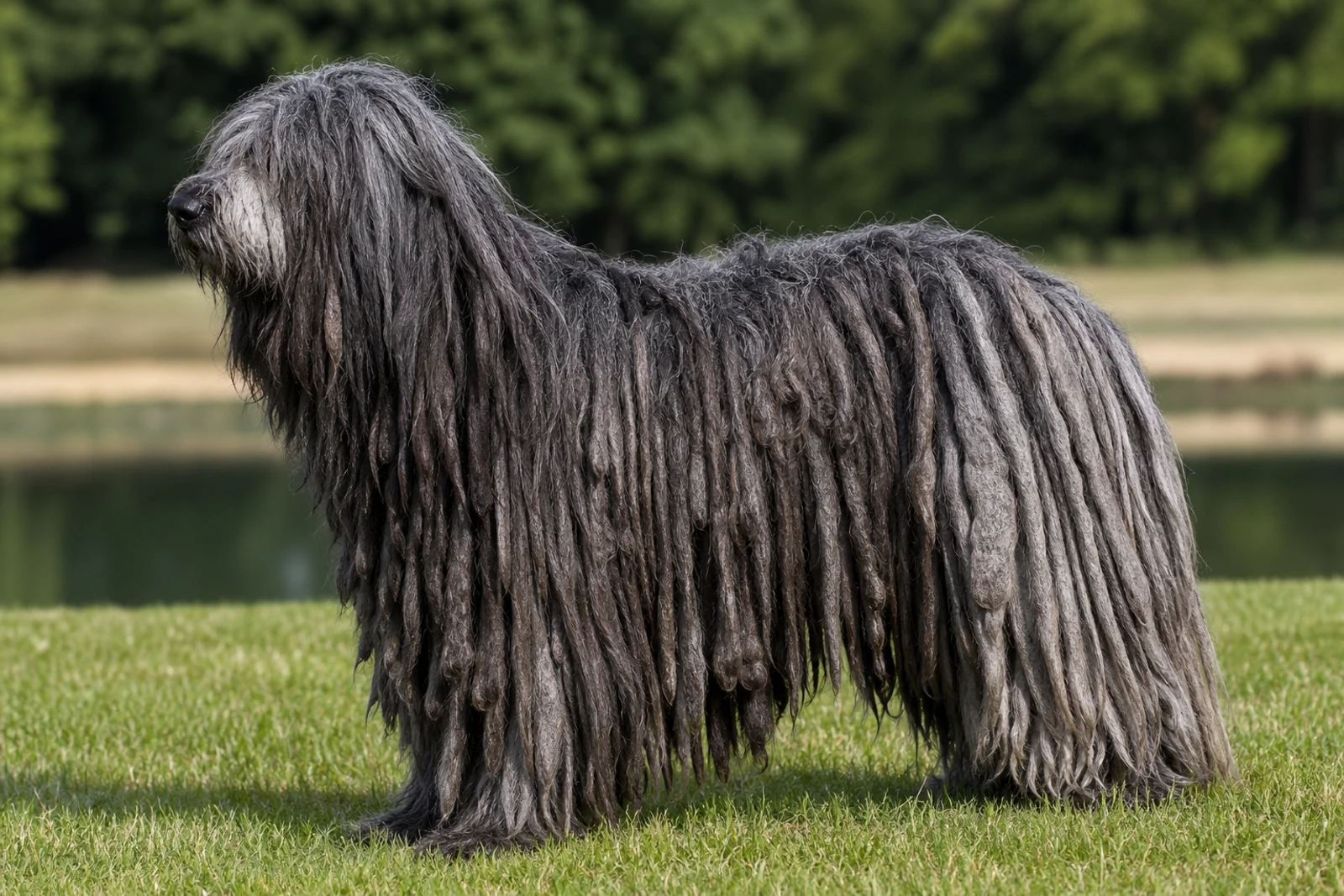
The Bergamasco is an ancient Italian herding breed, known for its unique flocked coat of hair cords. Calm, patient, and highly intelligent, this dog is a devoted family companion and capable working partner. Suited for active families or individuals who can provide mental stimulation and appreciate a dog that thinks for itself. Its protective yet gentle nature makes it excellent with children and other pets when properly socialized. Best for experienced owners who understand the breed's coat care and need for a job.
At a glance
- Size
- Large
- Height
- 21–24 in
- Weight
- 57–84 lb
- Life span
- 10 years
- Coat colors
- Gray, Black
- Coat type
- Flocked coat of dense, corded mats
- Group
- Working
How much does a Bergamasco cost?
Adopt / rescue
$75–$400
Usually includes spay/neuter, first shots, and a microchip.
Buy from a breeder
$700–$2,000
From a reputable, health-testing breeder.
Approximate USD. Prices vary widely by region, breeder, pedigree, age, and coat colour — adopting is the lower-cost and recommended route. Avoid suspiciously cheap “breeders”; they’re often puppy mills.
Estimate the full cost of a Bergamasco →Want the ongoing number? Estimate the monthly food bill for a Bergamasco with our dog food cost calculator.
Bergamasco photos
Views
Front, side, rear and top — the full silhouette.Poses
How the breed sits, lies, moves and plays.Puppy to senior
The breed across its whole life.Expressions
The breed’s range of moods.Close-up details
Eyes, ears, nose, paws, tail and coat.Coat colors
The breed’s recognized colors.Click any photo to enlarge. We show the Bergamasco from every angle — three views, poses, life stages, expressions, close-ups, coat and colors.
Appearance & size
You cannot talk about the Bergamasco without talking about the coat. This is a dog built for centuries of work in the Italian Alps, and the coat is not just a feature — it’s a living, changing record of the dog’s maturity. Puppies are born soft and fluffy, and for the first year or so you’ll wonder if you got the wrong breed. Then the woolly outer coat and the oily “goat hair” start weaving themselves into the undercoat, and mats begin to form. An owner doesn’t brush these out; they hand-tear the mats into flat, overlapping flocks that cover the body like a natural suit of armor. A fully corded adult coat can touch the ground and takes years to develop properly.
Beneath that coat is a solid, muscular working dog with a rectangular build. The body is slightly longer than the height at the withers, which runs 21 to 24 inches for the breed overall — males tend to fill the upper end of that range, females the lower. Weight lands between 57 and 84 pounds, again with males heavier. Bone is substantial without being coarse, and the chest is deep and wide, giving the front a commanding presence when you see the dog head-on.
- Front view: Broad chest, thick neck, and strong, straight forelegs. The coat hangs in heavy sheets from the neck and shoulders, often obscuring the legs entirely. You might just catch the large, oval, expressive eyes peering out from behind the shaggy fall of hair. Ears are set high, semi-drop, and also disappear into the coat.
- Side view: The topline stays level from the shoulders to the croup. The back is firm, the loin slightly arched. What grabs your eye is the length of the coat draping off the dog: it’s not a smooth silhouette at all, but a series of loose, irregular mats that can reach well below the elbows and hocks. The belly is slightly tucked up, though the coat can hide that. The tail is medium-length, thick at the base, and hangs low when the dog is at rest — carried at the hock or a hair above, covered in the same matted cords.
- Rear view: The hindquarters are powerful, with well-muscled thighs and moderate angulation. The profuse coat hangs down the back of the legs, often touching the ground, so the actual outline of the dog stays a little mysterious.
Coat color is a topic that gets more specific than you might guess from a distance. At a quick glance, most Bergamascos look like a weathered gray sheepdog. Up close, the range is wider: solid gray in all shades from pale mercurial silver to deep charcoal is the classic and most prized look. You’ll also see solid black, and merle with gray or black patches. Small white markings on the chest, feet, or belly are acceptable, but a predominantly white coat is a fault. The merle pattern can be subtle, almost hidden within the matted locks, revealing itself only when the light hits.
The overall impression is rustic and unplugged from modern grooming trends — a dog that looks like it just stepped off a mountainside, not off a grooming table. That coat is functional: in the Alps it insulated against cold, deflected rain, and even protected against the bites of wolves. In a living room, it collects hay, leaves, and the occasional twig, which is part of owning one. You don’t brush it; you separate the mats with your hands every week or two, and you bathe the dog maybe three times a year, because the coat takes forever to dry and never smells doggy when it’s cared for properly. The face, with its blunt, slightly tapering muzzle and large, intelligent eyes, is one of the few parts of the dog you’ll consistently see clearly. The rest is a magnificent, ever-growing tangle that defines the breed.
History & origin
The Bergamasco traces back to the upland valleys around Bergamo, in the Italian Alps, where shepherds shaped a dog that could handle brutal winters and long, solitary treks. For centuries—likely well over two thousand years—nomadic pastoralists moved flocks between high summer pastures and lowland winter grazing. Their dogs went with them, driving and guarding the sheep, living among the herd, and facing wolves, bears, and the raw elements without shelter. The breed’s immediate ancestors probably arrived with Eastern herding peoples through the Adriatic basin, carrying bloodlines common to other ancient flock guardians of the Mediterranean and Near East, but the Bergamasco developed its own path once it settled into the Lombardy region.
The dog that emerged was built for endurance, not speed: a muscular, medium-paced mover with a deep chest and a level back, standing 21–24 inches and weighing a solid 57–84 pounds. The real signature, though, is the coat—a three-layered arrangement of dog hair, goat-like hair, and wool that mats naturally into flat, felted flocks. This isn't a brushed-out corded coat like that of a Komondor or Puli; the flocks form over the first year or so, creating an insulating, weatherproof shield that also turned a predator’s bite into a mouthful of hair. Shepherds valued the coat because it required almost no maintenance once the mats set, and it kept the dog functional in snow, rain, and mud.
By the mid-20th century, the breed was in trouble. Postwar changes in agriculture depressed sheep farming, wool demand collapsed, and the dogs’ numbers dwindled to a few scattered kennels. A dedicated Italian breeder, Dr. Maria Andreoli, is widely credited with saving the Bergamasco. In the 1960s she tracked down remaining specimens from remote valleys, standardized the type, and pushed for recognition. The Italian Kennel Club (ENCI) had already registered the breed in 1959, and the FCI followed in 1956, but it was Andreoli’s work that stabilized a reliable population. The Bergamasco joined the American Kennel Club’s Working Group in 2015, and while it remains uncommon, its reputation as a calm, thinking, family-oriented guardian is spreading—still doing what it was bred for, even when the sheep are replaced by children.
Temperament & personality
A Bergamasco thinks before he acts. He’s an old-world herding dog built for long days in the Italian Alps, so his default setting is patient and watchful, not busy or impulsive. You’ll see him scan the room, settle near the door where he can keep an eye on things, and check in with you quietly — a lean against your leg, a brief eye-hold — then go back to his own calm orbit.
Energy that respects your downtime
This is not a dog who’ll ricochet off the furniture demanding a five-mile run. A grown Bergamasco needs a solid hour of exercise daily — a brisk walk, a chance to trot beside a bike, or a good off-leash romp in a safe area. After that, he’s content to sprawl at your feet while you work or cook. Puppies have more go, but even they ramp down faster than many working breeds once they’ve had an outlet. If you skip his exercise, he won’t destroy the couch for sport; he’s more likely to get restless and shadow you with a pointed sigh that says, “Are we going out yet?”
Devotion without the cling
He bonds deeply with his family and takes his self-appointed role as guardian seriously. That means he’ll follow you from room to room, but he’s rarely underfoot pestering for attention. He’s affectionate on his own terms: a nuzzle under your elbow, a heavy head in your lap for exactly two minutes, then back to his spot. With kids he’s steady and tolerant — he’ll absorb the noise and motion without escalating, though you need to teach children to leave him alone when he’s eating. Dogs who are interrupted at meals can develop food guarding, and a Bergamasco’s quiet nature means you might miss the early signs until he’s gone stiff and hard-eyed over a bowl. Give him a peaceful feeding spot and he’ll never give you a reason to worry.
Watchful, not reactive
Stranger at the gate? He’ll let you know with a deep, authoritative bark, then watch for your reaction. A forward lean and a still tail can mean he’s assessing whether to move toward the visitor; a loose body and soft eyes mean he’s already decided everything’s fine. Learn to read those shifts. A rigid body paired with direct staring is the one you don’t ignore — that’s a dog who’s moved from watching to warning. The good news: Bergamascos rarely escalate without cause. They’re brave, not looking for a fight, and they’d rather stand between you and a problem than go looking for one.
The independent streak
He’s a thinker, which means he won’t take orders just because you gave them. Force and heavy-handed corrections backfire with a dog this smart. Respectful, consistent engagement — making the right choice easy and rewarding — gets you a partner who learns fast and retains it. If you slack on rules, he’ll quietly negotiate: “I know you said off the couch, but you’re not here right now, so…” Clear boundaries, applied with patience, work better than a battle of wills.
Strange habits with a purpose
A few quirks come with the package. He may roll in something foul-smelling given half a chance — possibly an old instinct to mask his own scent or broadcast “I found something interesting” to the rest of the pack. His dense, corded coat can trap outdoor smells, so you might get a whiff of damp sheep and hay long after the walk is over. Puppies chew to explore and soothe sore gums; adults chew to keep their jaws strong and teeth clean. Offer sturdy chews, and if he decides to sample a chair leg, a citrus-peel spray or a little vinegar solution on the spot will discourage him without a big drama.
House training and household rhythms
Potty training clicks when you work with his nature. He’ll urinate indoors if he still smells old accidents, because that scent tells him “bathroom here.” Clean up thoroughly with an enzymatic cleaner, not just soap and water. A treat the instant he goes outside seals the lesson faster than any punishment for a mistake. And watch the rooms you don’t use often — a Bergamasco may treat them like neutral territory if they don’t carry enough of the family’s scent. Regular access and a couple of worn t-shirts in those spots can help him understand the whole house is home.
He’s a dog who repays clear communication and a predictable routine with years of quiet presence. Match his calm, respect his mind, and you’ll get a companion who’d rather keep an eye on the driveway than chase squirrels all day.
Good with kids, dogs & other pets
The Bergamasco’s patient, non-aggressive temperament creates a great foundation for family life, but that big, solid frame (57–84 lb) is something you always need to account for around small kids. A joyful Bergamasco can easily bump a toddler over during play or an exuberant greeting, so active supervision and floor-level management are musts. Children should learn to give the dog space while eating or resting, and mutual respect goes a long way. When raised together from puppyhood and given steady positive experiences with gentle children, these dogs often become calm, watchful shadows who enjoy just being part of the action.
Start socialization young — ideally before 16 weeks — and make it consistent. Pair every new person, sound, and surface with something good. A Bergamasco that misses out on early, gradual exposure can become overly wary, which in a dog this size can look intimidating even when there’s no actual aggression. Even adult dogs benefit from patient reintroduction to things that worry them, but the heavy lifting happens in that first critical window.
- With other dogs, they’re usually easygoing if they’ve learned good social skills early. They thrive on companionship and don’t do well in isolation — a Bergamasco left alone for long stretches or housed outdoors away from the family can develop serious loneliness-based distress. Living with a well-matched canine buddy often suits them, provided you manage herding instincts (a little bossiness around playmates isn’t unusual).
- Cats and small pets can coexist peacefully, but that herding drive means you can’t just toss a kitten into the mix without preparation. Controlled, positive introductions, starting when the puppy is 3–14 weeks old, make all the difference. Even with a good history, watch for chase triggers — a running rabbit or a cat skittering across the floor may flip a switch. Separate spaces and a solid “leave it” cue let everyone live together safely, without the dog practicing predatory-type sequences.
Trainability & intelligence
A Bergamasco is sharp — the kind of dog that studies a situation before acting. This isn’t a breed that blindly rushes through obedience drills. They learn fast, often picking up a new command in a handful of repetitions, but they also have an independent streak shaped by centuries of guarding and herding in the Italian Alps. What looks like stubbornness is usually a shepherd’s mind weighing whether your request makes sense in this particular moment.
Your training approach has to match that intelligence. Relationship comes first. A Bergamasco needs to trust you completely before it’ll offer reliable compliance, especially off-leash or around distractions. Without that foundation, you’ll be the person calling a dog who’s already decided the flock over there is more interesting.
What works:
- Short, reward-rich sessions. Use treats, a favorite tug toy, or calm praise — whatever your dog values most. Keep it light and never drill. A bored Bergamasco will simply check out.
- Consistent rules from day one. Everyone in the household needs to use the same cues and boundaries. These dogs notice inconsistency fast and will quietly exploit it.
- Early and ongoing socialization. Expose a puppy to different people, sounds, surfaces, and animals between 3 and 14 weeks, and keep at it through adolescence. A Bergamasco is naturally reserved with strangers. Without thorough exposure, that reserve can harden into fear-based reactivity. Gentle, gradual introductions build the confidence that makes an adult dog steady rather than suspicious.
Where the challenges lie:
- Recall can be a negotiation. If something more compelling is happening — a deer, another dog, a child on a bike — your “come” might get processed and then politely declined. Build a rock-solid recall using high-value rewards and plenty of proofing in low-distraction environments before you bet on it in the park.
- They don’t respond to force. A hard correction or a yank on the leash breaks trust and often increases avoidance. You’ll get much further by showing the dog that cooperating leads to good things happening. A Bergamasco holds a grudge, but it holds loyalty even tighter. Earn that loyalty, and you’ll have a dog that works with you, not just for you.
Exercise & energy needs
A Bergamasco won’t ricochet off the walls, but don’t mistake that relaxed, watchful demeanor for low energy. Bred to cover miles alongside flocks in the Italian Alps, these dogs have deep reserves of stamina. Plan on at least 60–90 minutes of daily exercise, split into two sessions. A quick leash walk around the block barely registers. Long, meandering hikes, off-leash rambles in safe open spaces, or a solid hour of purposeful walking with time to sniff and investigate suit them far better.
Mental work is non-negotiable. The Bergamasco’s independent mind thrives on problem-solving, not just physical miles. Rotate puzzle toys, scent games, hiding treats, and trick training throughout the week. These dogs bore easily with repetition, so swap out activities before they tune you out. Boredom in this breed tends to show up as creative destruction or stubborn refusal, not frantic pacing.
Good fits: herding (they often take to it naturally), carting or pulling, nose work, and advanced obedience. Agility can work, but they’re deliberate movers, not border-collie-speed sprinters. Adjust expectations — they’ll get the job done, just on their own timetable. In warm weather, exercise during cooler hours; that dense coat insulates against alpine cold, making summers feel hotter than the thermometer suggests. Puppies and young adolescents need careful management. Avoid repetitive high-impact exercise like jumping or forced running on hard surfaces until growth plates close, usually around 18 months.
A Bergamasco who spends his day thinking and moving alongside you will be calm and content at home. Skip the mental engagement, and he’ll find his own job — which often involves reorganizing your garden, your shoes, or your peaceful afternoon.
Grooming & coat care
Forget everything you know about daily brushing. The Bergamasco’s coat does the heavy lifting — once it hits maturity. Around 12–18 months, the three distinct layers (a woolly undercoat, a goat-hair middle coat, and a harsh, oily outer coat) begin meshing together into flat, loose mats called flocks. These flocks are functional, not messy: they shed dirt, insulate the dog, and require no brushing. Getting them to form correctly is the whole game.
During the transitional puppy phase, you’ll use a pin brush or wide-toothed comb every day to prevent tight, painful tangles. The moment the hair starts felting, drop the tools. From then on, your hands are the only equipment you need. Gently tear developing flocks apart into panels every couple of weeks. An adult Bergamasco gets no brushing at all — just a regular hand-check to rip apart any flocks that have grown together and to pick out the odd leaf or twig.
Bathing is an event, not a routine. Plan on a real bath once or twice a year, max. The coat repels everyday grime, but when water soaks in, it soaks in. You’ll need a high-velocity dryer and a solid 2–3 hours of forced air to reach the skin between flocks. Trapped moisture turns into mildew and skin trouble fast. Never clip or shave the coat; cutting destroys the felting process, and regrowth often comes back as an unmanageable, matted mess.
Nail trims every 3–4 weeks, a weekly ear check for wax or dirt, and consistent dental care (daily brushing or quality chews) round out the routine. The breed sheds little once flocks set up, so you won’t be vacuuming up hair, though you’ll see some loose undercoat drift during that puppy-to-adult shift.
Shedding & allergies
You’re not going to find dust bunnies of Bergamasco hair rolling across the floor. The breed’s matted, corded coat traps practically every loose strand as it’s shed. Dead hair doesn’t fall out — it stays woven into the flocks. That’s a win for your furniture, but it means you’re the one who has to get that hair out before it turns into a solid, uncomfortable mat. Once a week you’ll sit down and gently tease the cords apart with your fingers, releasing the trapped undercoat. So yes, the dog does shed — it just keeps the evidence to itself until you deal with it.
Because the coat holds onto fur year-round, there’s no big seasonal blowout. You might notice a few extra loose fibers when the weather shifts, but you won’t suddenly be wading through drifts of hair. This is where the “hypoallergenic” reputation comes from, but let’s be straight: no dog is completely allergy-free. Allergens are proteins in dander, saliva, and urine, not just airborne hair. The Bergamasco’s low-shedding design means fewer skin flakes float around the house, which can help some allergic people. Still, if allergies are a deal-breaker, spend time around adult Bergamascos before committing.
Drool isn’t part of the package. These aren’t slobbery dogs. You’ll spot a few drips after a long drink or when a treat is on the way, and that iconic beard can hold moisture — so wiping the muzzle after meals is a smart habit. But your pant legs will stay dry.
Diet & nutrition
Bergamascos carry 57–84 pounds on a 21–24-inch frame, so even an extra pound or two can tax their hips and elbows over a lifespan that hovers around 10 years. Keeping this large working dog lean is one of the simplest ways to protect his joints. A moderately active adult typically does well on two meals a day totaling about 3–4 cups of high-quality dry food, but that’s a starting point — adjust up or down based on his real body condition, not the side of the bowl. You want to feel ribs with a light pad of fat, not see them jutting out.
If your Bergamasco herds all day or works livestock, he’ll need more fuel; a mostly companion dog with a long walk and some play will need less. This breed isn’t notorious for food obsession, but a less-active winter or a slower senior metabolism can still tip the scale. Because weight management is particularly important for large, deep-bodied dogs, skip the “eyes are bigger than his stomach” temptations and measure every meal.
Puppy feeding rhythm
- 0–4 months: four evenly spaced meals a day.
- 4–6 months: drop to three meals.
- 6 months onward: transition to the adult two-meal schedule.
Introduce new foods gradually, especially when you first bring a puppy home. Start with lightly cooked, puréed meats, fish, fruits, and vegetables, or a top-tier commercial puppy formula. Raw chicken wings can join the rotation around 12 weeks, always under supervision.
Senior Bergamascos
As activity declines, shift to smaller, more frequent portions to ease digestion and keep weight in check — no strong evidence says you need to slash protein, but you do need to dial back total calories. Purée meals if he’s missing teeth or has a tender mouth.
A few hard-and-fast rules
- Resist rich holiday scraps; a sudden fatty meal can trigger pancreatitis.
- Use a puzzle bowl if he inhales food; it slows him down and adds a little problem-solving time.
- Never feed from the table. Put leftovers in his own bowl, away from the action, or you’ll spend years undoing a begging habit that starts in three seconds.
Health & lifespan
A well-bred Bergamasco typically lives about 10 years. That’s solid for a large, working dog — but those years depend heavily on how you manage a few known weak spots.
The breed is generally robust, yet responsible breeders screen closely for hip and elbow dysplasia and inherited eye conditions like progressive retinal atrophy (PRA) and entropion. Ask to see OFA or PennHIP scores on both parents, plus a current CERF or OFA eye exam. These aren’t rare in herding breeds, and catching them early makes all the difference.
Bloat is the emergency every deep-chested dog owner dreads. Bergamascos can be prone to gastric dilatation-volvulus (GDV) , so feed two or three smaller meals a day instead of one big one, and restrict activity right after eating. Know the signs — unproductive retching, distended belly, restlessness — because fast vet care saves lives.
That corded coat isn’t just a style statement; it’s a skin-health factor. Mats that trap moisture near the skin invite hot spots and yeast infections. You’ll need to monitor closely, especially in humid weather or after the dog gets wet. Dry the skin thoroughly when you bathe (which isn’t often — every few months is plenty once the cords are formed).
Weight control is huge here. At 57 to 84 pounds, extra weight hammers joints already at risk for dysplasia. You should be able to feel ribs easily beneath the coat. Pair that with early, positive socialization — a stressed dog can develop anxiety-driven behaviors that spill into physical health, so get your pup out into the world calmly from day one.
Basic preventive care still applies. Keep a monthly heartworm preventive going during mosquito season and for a month after it ends. Stay current on rabies (it’s legally required, and there’s no effective treatment once symptoms appear). Schedule annual wellness exams, and if you notice subtle shifts — less willingness to move, a drop in appetite, or a sudden grumpiness — let your vet dig into it. Pain in a stoic herding dog often hides behind small behavior changes.
Living environment
The Bergamasco is a 57–84-pound herder with a famously low-key indoor manner, so don’t let the size fool you. An apartment works as long as you commit to real outdoor exercise — not just a quick pee break. A house with a securely fenced yard is the easier fit, giving this dog a place to stretch out and patrol, but the breed isn’t going to ricochet off the walls if space is tighter.
A daily routine of 45–60 minutes of movement, split into a couple of walks plus a chance to romp or do scent games, keeps a Bergamasco sane. Think brisk long walks, hiking, or drag-free play in a safe open area. They’re not Border Collie-level intense, but a bored Bergamasco will find a job you didn’t assign — usually one that involves reorganizing your belongings. Puzzle toys and quick training sessions indoors work well to burn mental energy when the weather’s rotten.
Climate is a mixed bag. The breed’s corded coat is built for Alpine winters, so cold and snow don’t faze them. Heat, on the other hand, is a genuine risk. Those dense mats trap body heat, making them prone to overheating above about 80°F. In warm months, schedule exercise for early morning or late evening, provide constant shade and water, and run the AC indoors. This is not a dog you leave in a hot yard.
Noise-wise, Bergamascos are quiet around the house. They’ll let out a deep, restrained bark when a stranger approaches — enough to alert you, not enough to antagonize apartment neighbors. They don’t yap or bark at nothing.
Being left alone is doable, but you have to build up to it. These dogs bond tightly with their people and can develop anxiety if suddenly abandoned for 10-hour workdays. Start with short absences in puppyhood, leave stuffed Kongs or long-lasting chews, and you’ll likely end up with a dog who snoozes calmly until you return. If your household is gone from dawn to dusk without a midday break, a Bergamasco isn’t the right fit — no amount of puzzle toys replaces human connection for this breed.
Who this breed suits
The Bergamasco fits best with someone who respects an independent mind and doesn’t mistake aloofness for a lack of loyalty. This is a working shepherd, built to problem-solve without micromanagement, so you’ll need to be comfortable with a dog that doesn’t hang on every word. A fenced yard helps, but yard time alone won’t cut it; count on a solid hour of brisk walking, hiking, or active play, plus daily mental work—puzzle toys, scent games, or herding practice—to keep him satisfied. Without it, that intelligence turns to creative mischief you didn’t ask for.
Families with sturdy, respectful kids often do well because the Bergamasco is calm indoors once exercised and naturally watchful over his household. He’s not a velcro dog or an exuberant greeter; he’s the quiet presence who notices everything and steps in only when needed. That makes him a poor match for people who want a social butterfly that loves every stranger. Early, thorough socialization softens his reserve, but the breed’s default is to hold back and assess.
Senior owners with deep herding-breed experience and the strength to handle a large, powerful dog (57 to 84 pounds) that can suddenly test a leash when a squirrel appears might manage, but a 10-year lifespan and that independent streak demand a long, honest look. First-time dog owners often misread the Bergamasco’s stubborn streak and get frustrated, so they’re better served by a breed with more biddable wiring.
Then there’s the coat. Its iconic cords—flocks—don’t require brushing, but they do need human help to form correctly and stay clean. You’ll spend time pulling apart mats and monitoring for dampness, especially after a swim or a muddy romp. If that sounds like a fascinating ritual, you’ll be perfectly matched. If it sounds like a chore, think twice, because a neglected coat quickly becomes a welfare problem.
Cost of ownership
A well-bred Bergamasco puppy from a responsible breeder typically costs $1,500 to $3,000. The breed is still rare in the U.S., so expect a wait and be wary of bargain listings — those often skip the hip, elbow, and eye screenings that matter in a large working dog.
Monthly costs stack up quickly for a 57–84 lb dog with a one-of-a-kind coat:
- Food: Plan on high-quality large-breed kibble, about 3–4 cups a day. That runs $50–$70 per month. Some owners add joint supplements early as a precaution.
- Grooming: The flocked coat doesn’t need brushing, but it’s not cheap. Professional grooming by someone who actually knows how to handle cords and felted layers will cost $100–$150+ per session, every 4–8 weeks. You can learn to separate mats yourself and bathe/dry the coat completely at home, but it’s a wet, heavy, time-consuming job. Skimping invites mildew and skin infections.
- Veterinary care: Annual checkups, vaccines, and year-round heartworm/flea prevention total $500–$800 for a healthy adult. This breed can be prone to hip dysplasia, bloat, and eye issues. A single emergency bloat surgery often surpasses $5,000, and with an average lifespan of 10 years, age-related conditions can pile up fast.
- Insurance or savings: Premiums for a large working breed land around $40–$70 per month for decent accident and illness coverage. Many owners self-fund by stowing a similar amount in a dedicated account.
- Extras: A large crate, heavy-duty leash, training classes, and occasional boarding add another $300–$600 annually.
Realistically, keeping a Bergamasco costs $1,500 to $2,500 per year in routine expenses, with a solid emergency reserve on top. The coat alone — whether you pay a groomer or invest the hours yourself — quietly makes this one of the pricier family dogs to maintain.
Choosing a Bergamasco
Your first step is to locate a breeder through the Bergamasco Sheepdog Club of America. This is a rare breed; expect a wait. Responsible breeders raise pups in the home, introduce them to household noises, and can explain every stage of the coat’s transformation — a puppy arrives with soft fur, not cords. If a breeder can’t guide you through the messy “turning” phase that starts around a year old, walk away.
Insist on seeing these health clearances for both parents:
- OFA or PennHIP hips (at least “fair”) and elbows (“normal”)
- a current CERF eye exam by a veterinary ophthalmologist
- many also test cardiac and thyroid — ask for the records
Don’t accept a verbal assurance — look up the OFA or PennHIP number yourself.
Red flags:
- The dam is kept off-site or you can’t see where the pups live.
- Multiple litters are available whenever you call.
- A breeder sells an 8‑week‑old puppy with full dreadlocks. That’s neglectful matting, not breed type.
- No health testing on either parent, or they hand you a printout you can’t verify.
When you meet the litter, look for a pup who notices you, then approaches after a moment — not the one hiding or the one bowling over its littermates. A good breeder will already have notes on each puppy’s emerging temperament and help match you.
Adoption is rare but not impossible. The breed club’s rescue coordinator occasionally places adults whose coats need rehab and whose history is known. The dog you choose — whether from a careful breeder or through rescue — is likely to share your next 10 years. Patience now pays off every single day.
Pros & cons
-
Low-shedding, self-cleaning coat — once the flocked mats form, the Bergamasco hair works like a natural, dirt-resistant armor that won’t blanket your house in fur.
-
Devoted family guardian — bonds tightly with its people and naturally watches over children, often positioning itself between family and strangers.
-
Calm indoor temperament — when given adequate exercise, a well-raised Bergamasco is surprisingly mellow inside, content to sprawl near you rather than ricochet off the walls.
-
Intelligent problem-solver — the breed thinks independently and can figure out livestock-guarding decisions on its own, which makes training feel like a real partnership with a dog that actually reads situations.
-
Rugged build and stamina — a large, solid dog (57–84 pounds, 21–24 inches) bred to work all day in harsh mountain weather; it’s not fragile and won’t beg for a sweatshirt in the cold.
-
Coat demands a hands-on flocking stage — you don’t just brush it. You must spend months patiently separating the coat into mats as it transitions from puppy fluff to adult cords; neglect this and the coat becomes a painful, dirty mess.
-
Not for neatniks — those distinctive mats trap debris, hold moisture after rain, and require hours of drying time. The dog will bring the outdoors indoors in a very literal way.
-
Reserved, even suspicious, with strangers — early and relentless socialization is non-negotiable. Without it, the breed’s guardian instinct veers into overprotection that’s hard to manage in a 75-pound dog.
-
Stubborn streak in a smart dog — Bergamascos don’t reflexively obey; they evaluate whether a command makes sense. First-time owners often mistake this for dimness, but it’s just a hardwired need for a reason behind the request.
-
Short typical lifespan of about 10 years — for a large dog, a decade is what you’re likely looking at, and losing a family shadow that soon hits hard.
-
Not a high-energy go-anywhere athlete — while built for endurance, the breed isn’t suited to intense sprint-and-fetch sessions or competitive agility unless you carefully condition for it; their long, heavy coat can overheat them fast in summer.
Similar breeds & alternatives
If the Bergamasco’s calm, watchful presence and one-of-a-kind coat have you curious, a few other breeds scratch similar itches — but the differences matter.
Komondor
Another large, corded livestock guardian. Komondors are heavier (80–100+ pounds, often 25–27.5 inches tall) and more overtly protective. They bond fiercely but need an owner who will match their stubborn, territorial streak with firm, early training. The Bergamasco is more adaptable to family life and less likely to treat every stranger as a threat. The cords are similar, but a Komondor’s coat forms coarser, felt-like mats that take longer to mature and demand careful separation to avoid mildew.
Puli
Small and bouncy, the Puli packs a corded coat into a 16–18 inch, 25–35 pound frame. That means big energy in a compact body — a spirited herder that wants a job and will alert-bark at everything. The Bergamasco gives you the corded look without the constant motion. A Puli needs real mental work; a Bergamasco is content to keep watch and enjoy a long walk, not a marathon.
Maremma Sheepdog
If it’s the quiet, steady guardian temperament you love more than the cords, a Maremma might appeal. Similar weight (65–100 pounds) and height, but with a thick white double coat that sheds heavily year-round. Maremmas are independent to a fault — they’ll patrol the property and make decisions without you. The Bergamasco is a notch more biddable indoors and, crucially, doesn’t coat your house in drifts of white fur. Life span runs about 11‑13 years, a little longer than the Bergamasco’s typical 10, but the trade-off is daily vacuuming.
Briard
Large, wavy-coated French herder with a similar 55–100 pound, 22–27 inch range. Briards are more driven and clownish, needing a solid hour of hard running. Their fine undercoat mats without regular brushing, yet they never form true cords — so you deal with constant grooming instead of the Bergamasco’s hands-off, mature coat. If you want a goofy, higher-octane partner and don’t mind the brush, the Briard fits; if you prize a low-key guardian with a self-contained cord system, stick with the Bergamasco.
Fun facts
- The Bergamasco's coat naturally forms into mats called 'flocks' that protect it from harsh weather and predators.
- They possess three types of hair that weave together to create the felt-like cords.
- This breed is an ancient Italian sheepdog, used for centuries in the Alps for herding and guarding.
- Bergamascos are known for their exceptional problem-solving skills and calm demeanor.
Frequently asked questions
- How much does a Bergamasco shed?
- The Bergamasco is a very low-shedding breed. Its unique coat forms mats that trap loose hair, so you won't find much fur around the house. This can be a plus for allergy sufferers, though no dog is completely hypoallergenic.
- What kind of grooming does a Bergamasco's coat require?
- The Bergamasco's corded coat needs hands-on attention during the matting phase in the first year or so, but once the cords are established, grooming is surprisingly low-maintenance. You should separate the cords occasionally and check for skin issues, but bathing and drying can be infrequent and time-consuming when done.
- Is the Bergamasco good with children?
- Yes, the Bergamasco tends to be patient and good-natured with children, making it a solid family companion. Their protective instinct means they watch over their family, and early socialization helps them interact gently with kids. As with any large dog, supervision is recommended around very young children.
- Can a Bergamasco live in an apartment?
- A Bergamasco can adapt to apartment living if given enough daily exercise and mental stimulation. They have a moderate energy level and are typically calm indoors, but they still need regular walks and playtime. Without sufficient activity, they may become restless or bark.
- Are Bergamascos suitable for first-time dog owners?
- The Bergamasco's intelligence and independent thinking can be a challenge for novice owners, but it is not impossible with dedication. They respond best to consistent, positive training and early socialization. First-time owners should be ready to learn about the breed's unique coat care and need for moderate exercise.
Tools & calculators for Bergamasco owners
Quick estimates tailored to Bergamascos — pre-filled with this breed’s size where it matters.
Articles & stories about the Bergamasco
Sources & standards
This profile follows recognized breed standards from the American Kennel Club (AKC) and the Fédération Cynologique Internationale (FCI), along with established veterinary and breed-club guidance. These describe general breed tendencies — every dog is an individual.