

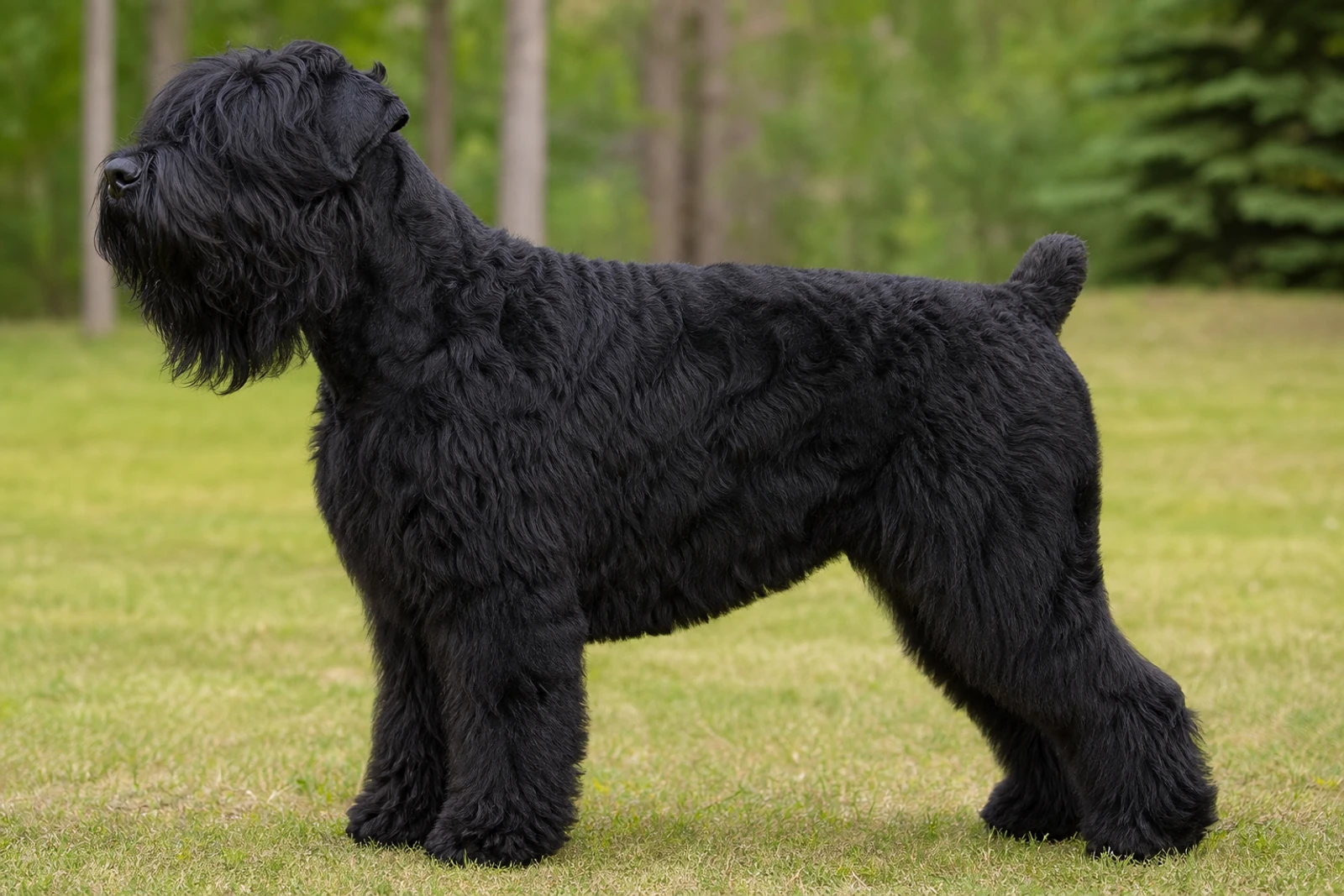
The Black Russian Terrier is a large, powerful guardian breed suited for experienced owners who can provide firm, consistent training and early socialization. This calm yet confident dog is fiercely loyal and protective, making it an excellent watchdog. It thrives with an active lifestyle and mental challenges, not ideal for apartment living or first-time owners. With a low-shedding dense coat, it requires regular grooming. When raised with children, it can be gentle, but its size demands supervision. This breed bonds deeply with its family and is reserved with strangers.
At a glance
- Size
- Giant
- Height
- 26–30 in
- Weight
- 84–143 lb
- Life span
- 10–14 years
- Coat colors
- Black
- Coat type
- Dense, coarse double coat
- Group
- Terriers
How much does a Black Russian Terrier cost?
Adopt / rescue
$75–$400
Usually includes spay/neuter, first shots, and a microchip.
Buy from a breeder
$700–$2,000
From a reputable, health-testing breeder.
Approximate USD. Prices vary widely by region, breeder, pedigree, age, and coat colour — adopting is the lower-cost and recommended route. Avoid suspiciously cheap “breeders”; they’re often puppy mills.
Estimate the full cost of a Black Russian Terrier →Want the ongoing number? Estimate the monthly food bill for a Black Russian Terrier with our dog food cost calculator.
Black Russian Terrier photos
Views
Front, side, rear and top — the full silhouette.Poses
How the breed sits, lies, moves and plays.Puppy to senior
The breed across its whole life.Expressions
The breed’s range of moods.Close-up details
Eyes, ears, nose, paws, tail and coat.Coat colors
The breed’s recognized colors.Click any photo to enlarge. We show the Black Russian Terrier from every angle — three views, poses, life stages, expressions, close-ups, coat and colors.
Appearance & size
You’re looking at a dog built like a fortress with a tousled black coat that was purposely left rough-around-the-edges. The Black Russian Terrier is a giant — one of the few true giants in the terrier group — and everything about his appearance says strength without bulk. Males stand 27 to 30 inches at the shoulder and can weigh anywhere from 110 to 143 pounds; females run slightly smaller, 26 to 28 inches and 84 to 108 pounds. That’s a lot of dog under that shaggy coat, and the breed’s rectangular silhouette — longer than tall, with a deep, wide chest and a short, muscular loin — makes him look even more substantial.
The coat is the first thing you notice. It’s a dense, weatherproof double coat: a soft, insulating undercoat covered by a harsh, wiry outer coat that can be anywhere from 1½ to 4 inches long. The only acceptable color is solid black. A few scattered gray hairs or a small splash of white on the chest are permitted but not preferred. The hair on the head forms a signature scruffy beard, thick eyebrows, and a mustache that partially hides the muzzle, giving the dog a wise, slightly imposing expression that was intentionally cultivated by the breed’s creators.
From the front, you see a broad, massive head with a flat skull and a distinct but not abrupt stop. The eyes are medium-sized, oval, and dark, set well apart under those prominent brows. The ears are small, triangular, and set high — hanging on cartilage with the tip lying close to the cheek, which adds to the alert, intelligent expression. The muzzle is heavy and squared-off, roughly equal in length to the skull, and the nose is large and black. The neck is thick, well-muscled, and carried with a slight arch, flowing into heavy, straight forelegs with substantial bone. The feet are round, compact, with arched toes and thick black pads.
In profile, the dog’s rectangular build is clear. The chest extends to the elbows, with well-sprung ribs. The topline runs level from the withers to a slightly sloping croup. The prosternum is noticeable — a chest that projects a bit forward, giving the dog an air of readiness. The tail is set high and thick at the base. Many countries still dock it to 3 to 5 vertebrae, leaving a short nub that the dog carries jauntily; in places where docking is banned, the natural tail is long and hangs in a slight curve.
From the rear, the thighs are powerfully muscled and the hocks are well let down, positioned parallel to each other when the dog stands naturally. The whole rear assembly is built for an efficient, ground-covering trot that covers a surprising amount of ground for a dog this size. Despite the heavy coat and bone, the BRT should never appear overweight or clunky. Move your hands over that black mop and you’ll find a solid, athletic frame designed for all-weather work. The coat mats easily without regular attention, so the intentional shaggy look takes effort — it’s a working coat, not just a fashion statement.
History & origin
The Black Russian Terrier isn’t some ancient breed with a foggy backstory—it was built to order in the Soviet Union starting in the 1940s. Toward the end of World War II, the Red Army recognized a gap in its working dogs. They needed a rugged, all-weather guardian capable of patrolling borders, guarding prison camps, and facing down intruders across brutal Russian winters. No existing breed ticked all the boxes, so the state-run Red Star Kennel outside Moscow took on the project.
The program’s genetic recipe was more mix-and-match engineering than traditional breed development. Starting with a foundation of Giant Schnauzers for their solid build and harsh coat, breeders layered in Airedale Terriers for quickness and bite, and Rottweilers for unflinching guarding instinct. Later infusions likely included the Moscow Water Dog (a now-extinct Newfoundland cross) and possibly some Caucasian Ovcharka, all to boost size, water resistance, and cold tolerance. The goal wasn’t a terrier in the typical sense; the “terrier” label was a nod to the dog’s tenacity. The result was a 100-plus-pound animal whose dense black coat could shrug off snow, and whose temperament balanced unwavering suspicion of strangers with a steady, off-switch calm around handlers.
For decades, the breed remained largely a state secret, though a few dogs trickled out to civilian breeders under strict control. The first official standard was written in 1958, and the FCI recognized the Black Russian Terrier in 1984. American imports began in the 1980s, with AKC recognition following in 2004 under the Working Group. Today’s dogs are more likely to patrol a fenced yard than a border post, but their origin shows in everything from a wariness of newcomers to a profound loyalty that can tip into overprotectiveness without firm, early guidance.
Temperament & personality
This isn’t a goofy, rough-and-tumble terrier in a giant's body. The Black Russian Terrier is a serious working guardian, bred for military and police roles, and it shows. Expect a dog who is calm, confident, and steady when handled correctly—never frantic or pointlessly yappy. But that calm is not laziness. These dogs are always watching, always running a silent inventory of who belongs and who doesn’t. A 26-to-30-inch, 84-to-143-pound frame means you don’t get a dog who simply “barks at strangers”; you get a formidable deterrent who will follow through if he believes his family is threatened. Novice owners and casual households, take the low friendliness with unfamiliar people as a bright yellow flag: this is not a breed that hands out free passes.
Reserved with outsiders, mush with their own
With their family, BRTs are deeply loyal and often surprisingly gentle. They’ll lean against you on the couch, follow you from room to room, and make steady eye contact that feels less like staring and more like a conversation. Yet that devotion rarely translates into slobbery, everybody-is-my-best-friend greetings. The breed is aloof and watchful with strangers, and some individuals remain selective about who gets close even after proper introductions. This wariness isn’t a flaw; it’s the breed doing exactly what it was designed to do. But it means you can’t leave socialization to chance. Puppies need positive, repeated exposure to a wide range of people, places, and other dogs—and that work continues through adulthood. A poorly socialized BRT can slide from reserved to reactive, and at 140 pounds, that’s a serious liability.
A brain that demands a job
Don’t mistake the dignified indoor demeanor for low energy. These dogs were built to patrol, track, and protect in harsh conditions, and they still need a solid hour of daily exercise that goes beyond leash walks. A fenced yard to make rounds in is ideal, but mental work matters just as much. Training sessions, nose work, puzzle toys, and even learning to carry your backpack on a hike keep their problem-solving minds from turning destructive. A bored BRT left alone in the backyard can become an escape artist or a nuisance barker. They can also be strong-willed thinkers—force or heavy-handed correction backfires here. Respectful, consistent engagement and clear boundaries get you a partner who works with you, not a pushover.
Household quirks and realities
- Food and possessions: Some BRTs have a protective streak around meals or high-value chews. Teach children to give the dog peaceful mealtime space and swap items rather than snatch. Responsible breeders screen for stable temperaments, but you should still actively prevent resource guarding from taking root.
- Territory habits: Intact males, and occasionally females, may urine-mark in new environments or over old accident spots indoors. Clean up with an enzymatic cleaner immediately; even trace scents can cue a repeat performance.
- That… unique perfume choice: Yes, your elegant black giant may decide that rolling in something dead or foul is the pinnacle of self-expression. It likely ties back to ancestral scavenger instincts—masking scent or simply finding the odor delightful in a way we can’t appreciate.
Living with the giant
With children he’s raised alongside, a well-socialized BRT can be patient and protective, but his sheer size means accidental knock-overs happen. Supervise interactions with toddlers and visiting kids who might run and shriek—fast movements can trigger a guardian’s “step in” reflex. With other dogs, same-sex aggression isn’t unheard of, and some adults have low tolerance for rude canine behavior. Early puppy classes and ongoing neutral-to-positive dog encounters help, but a BRT may never be a dog-park regular, and that’s okay.
Pay attention to body language. A stiff posture and direct stare often precede a decision, while a loose, wiggly body and soft eyes say all is well. When you see lip licking, yawning, or a head turn away, slow down—those are calming signals that tell you your dog is uncomfortable or trying to de-escalate. Ignore them and you push a powerful dog toward a louder response.
Socialization isn’t a six-week class; it’s a daily habit. The moment you let it slide, that natural reserve hardens into suspicion. When you keep it fresh, you get the real deal: a clear-headed guardian who can walk through a crowd without overreacting, then flop at your feet like a 130-pound house cat.
Good with kids, dogs & other pets
A Black Russian Terrier who grows up with children tends to be a steady, patient guardian — not a drive-by fur missile — but nobody can ignore the physics here. At 84 to 143 pounds and 26 to 30 inches at the shoulder, even a gentle bump can level a toddler. Direct adult supervision is non-negotiable when small kids are mixing with a dog this size. The breed’s working history means they often attach deeply to their own family and show remarkable tolerance for clumsy hugs and noisy play, yet that same protective instinct can read roughhousing between visiting children as trouble. Put a crib or baby gate into your layout early so the dog learns that baby sounds and fast movement are normal, not a perimeter breach.
With other dogs, the picture gets more nuanced. Black Russian Terriers are not naturally social butterflies. Without heavy early socialization — the 3-to-14-week window is everything — they can mature into adults who are aloof or reactive around strange dogs, especially dogs of the same sex. You’ll get the most reliable results if you start by introducing the puppy to a dozen calm, vaccinated adult dogs in controlled settings before 16 weeks, then keep those positive reps coming through adolescence. An adult BRT who learned early that other dogs are just part of the background noise is far more likely to share a home with a second dog peacefully, though same-sex pairings often require extra management in any guarding breed. A poorly socialized adult who only tolerates his people doesn’t need forced dog-park diplomacy; that kind of pressure can trigger fights, not friendship.
Cats and small pets inside the home are possible if the puppy is raised alongside them and learns to ignore a fleeing rabbit or a hissing cat. Even then, the terrier half of the name means some individuals carry a quiet, serious prey drive. Never leave a BRT unsupervised with a free-roaming guinea pig or a cat that runs, and use baby gates to create safe escape routes. A dog who sees the family cat as part of his pack may still mistake a neighbor’s outdoor cat for an intruder.
The thread that runs through all of this is the breed’s deep need to be near its people. A Black Russian Terrier who is exiled to the backyard or left alone for entire workdays will not only make his own entertainment — usually destructive — but can also slide into hyper-vigilance, barking at every kid on a bike or dog on the sidewalk. The early, positive exposure to kids, dogs, and the daily chaos of a household builds a dog who is watchful without being dangerous.
Trainability & intelligence
Black Russian Terriers are smart enough to figure out which cupboard holds the treats—and stubborn enough to decide they’ll open it only when it suits them. This is a thinking dog, not a push-button retriever. He learns commands in just a handful of repetitions when he respects the person giving them, but blind obedience isn’t in his DNA. The breed was developed to work independently as a guard dog, so he’s wired to assess situations and act on his own judgment. That means training has to be more about building a partnership than issuing orders.
Reward-based methods are non-negotiable here—not just kinder, but more effective. This dog doesn’t forget a harsh correction, and one unfair moment can drain the trust you need for everything else. Use praise, a quick tug session, or high-value food to mark the behaviors you want, and pay him immediately. He’ll start offering those behaviors again because he sees a clear benefit. Punishment-based techniques flip a switch that makes him shut down or push back harder, and with a 100-plus-pound dog, that’s a dangerous game.
The socialization head start
Because Black Russian Terriers carry a natural suspicion of strangers, early and ongoing socialization is the single biggest predictor of a steady adult dog. Start exposing your puppy to different people, sounds, surfaces, and calm dogs between 3 and 14 weeks old. Keep every encounter positive and under threshold. That gradual, reward-heavy exposure rewires the breed’s guardiness into confident neutrality instead of fearful reactivity. Skip this window and you may spend years managing a dog who views every unfamiliar person as a threat, not just a possible one.
Common training hurdles
- Selective hearing: He knows “come” perfectly in your kitchen. Add a squirrel or a person walking past the yard, and the command disappears. Building a reliable recall takes months of layered distraction-proofing and a reward that genuinely competes with the environment.
- Rule testing: That terrier persistence shows up as a daily audit of boundaries. If you let him on the couch once, he’ll argue it’s permanent. Calm, boring consistency is your best tool—enforce the same rules every single time without drama.
- Independent problem-solving: He may decide a closed gate is a puzzle rather than a stop sign. Channel that brain into constructive outlets like nose work, trick training, or structured play so he doesn’t create his own job description.
What actually works
Train in short, game-like sessions and quit while he still wants more. A Black Russian Terrier who’s bored will either check out or get pushy. Use a calm, matter-of-fact tone—excitability often feeds his intensity. Hand-feed part of his meals during walks or training to strengthen your value in his eyes. And expect progress to look uneven; he might nail a down-stay for a week, then suddenly act as if you’re speaking a foreign language. Persistence without frustration is how you get through those plateaus and wind up with a clear-headed, trustworthy dog who can safely navigate a busy street or a quiet home without constant micromanagement.
Exercise & energy needs
This is a working dog through and through. Forget one leisurely walk around the block — a Black Russian Terrier needs serious daily outlets that challenge both body and brain. A bored BRT will invent his own job, and it usually involves excavating your backyard or reorganizing the couch cushions with his teeth.
Aim for at least two dedicated exercise sessions per day, totaling 90 to 120 minutes for a healthy adult. One 45–60 minute session might be a long off-leash hike, a vigorous jog, or a structured flirt-pole session that burns off muscle in a controlled way. The second session should incorporate real mental work — this isn’t optional.
These dogs were built to problem-solve in high-stakes situations, so physical exercise alone won’t take the edge off. Pair every workout with obedience drills, scent games, hidden-toy puzzles, or formal protection-sport training. A short 10-minute session with a bite-roll sleeve or a complex tracking line tires a BRT more deeply than an extra hour of trotting next to a bike. Even on rainy days, indoor nose-work games and trick training can replace a missed walk without creating chaos.
Because this is a giant breed with a deep chest and a heavy frame, you have to guard those joints. Avoid repetitive high-impact stuff — no hours of continuous jumping or hard agility weaving — especially while the dog is growing. Once growth plates close (around 18–24 months), many BRTs enjoy weight pulling, carting, or rally obedience, all of which suit their strength and thinking capacity. Swimming is also a low-impact lifesaver for building endurance without pounding pavement.
Do not skimp and assume a big fenced yard will self-exercise the dog. It won’t. A Black Russian Terrier who doesn’t get his brain and body worked hard enough can become hyper-vigilant, reactive, or pushy indoors. Two solid sessions a day, with plenty of problem-solving mixed in, is the ticket to a calm, steady companion who flops at your feet rather than pacing the halls.
Grooming & coat care
The Black Russian Terrier’s coat is a job, not an afterthought. That dense, double-layered, wiry black coat repels water and weather beautifully, but it also grabs dirt, dead hair, and mats faster than you’d think. Plan on a thorough brushing two to three times a week — and daily during the spring and fall coat blows, when loose undercoat comes out in fistfuls.
Brushing tools and technique
A sturdy slicker brush with rounded pins gets through the harsh outer coat and down into the soft undercoat. Follow up with a greyhound-style metal comb to catch tangles hiding behind the ears, under the legs, and along the belly. If you hit a mat, work from the outside in with the comb’s wider-spaced end, or use a detangling spray to avoid breaking the coat. The texture matters: if you clip the coat short, you lose the breed’s signature wiry grip and waterproofing, so many owners prefer hand-stripping. That’s a skilled task — budget for a professional groomer who knows the breed every 6–8 weeks to keep the coat’s structure.
Bathing
Bathe only when the dog is dirty or starts to smell, roughly every 4–6 weeks. Over-washing strips the natural oils that keep the coat weather-resistant. Always brush out mats before getting the dog wet, or water turns a small tangle into a tight, painful block.
Nails, ears, teeth
Nails on a giant breed wear down less than you’d expect, so trim every 2–3 weeks. Check those heavy, folded ears weekly — moisture gets trapped, leading to infections. A wipe with a vet-approved ear cleaner and a dry cotton ball after baths or long walks in wet grass prevents trouble. Brush teeth two or three times a week; the breed can be prone to tartar buildup.
Seasonal reality
When the undercoat blows, you’ll pull out enough hair to knit a sweater. A rake-style undercoat tool speeds up the process. Don’t skip this — impacted undercoat can cause hot spots and skin infections, especially in a dog this size. The good news: between blows, shedding is minimal. Stay consistent, and the mess stays manageable.
Shedding & allergies
The Black Russian Terrier’s dense double coat sheds lightly year-round — far less than you’d guess from a dog this size. The wiry outer coat catches dead hair, so it doesn’t rain onto your floors, but that means the hair stays in the coat and mats without regular attention. A fast brush-out three times a week, plus a deep line combing during the seasonal undercoat blowout, keeps the hair in the trash and off the furniture.
Twice a year, usually spring and fall, that undercoat lets go in earnest. Expect fistfuls of gray fluff for two to three weeks. Daily grooming during those stretches is non-negotiable if you want a clean house and a comfortable dog.
Drool is manageable: a damp beard after drinking, some slobber on warm days, but not enough to keep a towel on your shoulder.
The hypoallergenic promise is mostly marketing. This breed sheds less, yet its giant body still produces plenty of dander and saliva proteins — the real allergy triggers. If someone in your house has dog allergies, don’t rely on coat traits. Spend a weekend with an adult Black Russian Terrier before committing.
Diet & nutrition
A Black Russian Terrier’s size makes weight management the foundation of everything you put in the bowl. An adult male can easily top 130 pounds, and even a few extra pounds hammer hips and elbows that are already carrying a giant frame. Obesity creeps up quietly because these dogs tend to be highly food-motivated — they’ll keep eating if you let them, so portion control isn’t optional, it’s daily discipline.
What a healthy meal looks like
These dogs evolved to thrive on a meat-rich diet. Skip the vegetarian experiments; their teeth and digestive system are built for animal protein. A practical target you can aim for is roughly 60% raw or lightly cooked meat, 20–30% fruits and vegetables, and the remaining 10% from eggs, plain yogurt, or digestible grains like pearl barley or white rice. Purée-ing or blending meals helps since dogs only chew vertically and don’t have salivary enzymes — it boosts nutrient absorption, especially for seniors with missing teeth or sensitive mouths.
Puppy feeding schedule
A giant-breed puppy grows fast, so consistency matters more than volume per meal.
- Under 4 months: four evenly spaced meals a day
- 4–6 months: three meals a day
- 6 months and up: two meals a day, just like an adult
Start a new puppy on lightly cooked and puréed proteins, fruits, and vegetables, or a high-quality commercial puppy food, and switch diets gradually. Raw chicken wings can be introduced around twelve weeks — but only when you’re right there to supervise.
Day-to-day habits that make a difference
Black Russian Terriers gobble. A puzzle bowl or slow feeder isn’t a gimmick; it slows down a gulper, adds a bit of mental work, and may reduce the chance of digestive upset. Never feed directly from the table, and always serve leftovers — even the holiday trim — in the dog’s own bowl. It sounds simple, but once begging takes hold, it’s miserable to undo.
Adjusting for age and activity
A young, working-bred dog burning through hours of exercise may need significantly more calories than a quiet house companion. Use the dog’s actual size, weight, and energy level to adjust portions, not just the bag instructions.
- Seniors often do better with smaller, more frequent meals — you can split the day’s ration into three instead of two — but there’s no good reason to slash protein just because the dog is aging. Instead, watch the scale: weight climbs when activity drops, so gradually reduce food if the ribs start disappearing under a layer of padding.
- Avoid excessively rich or fatty foods, especially after a holiday, because a sudden high-fat load can trigger pancreatitis.
Keep base ingredients prepped in the fridge — a batch of cooked grains, vegetables, and meat, plus canned fish and eggs — so throwing together a balanced meal takes minutes. The best diet for a Black Russian Terrier is one you can stick to day after day without guessing.
Health & lifespan
With a typical life span of 10 to 14 years, the Black Russian Terrier is a long-lived giant breed — but those years depend heavily on proactive joint care and weight management from day one. A 100-pound dog with even a few extra pounds puts serious strain on developing elbows and hips, so keeping your dog lean is non-negotiable.
What responsible breeders screen for
Because Black Russian Terriers are built big, hip and elbow dysplasia top the list of inherited concerns. Any breeder you talk to should be able to show you OFA (or equivalent) clearances for both parents — and ideally grandparents. Don’t settle for a verbal “they’re healthy”; ask to see the paperwork.
Eye problems are another area where careful breeding makes a difference. Cataracts, progressive retinal atrophy (PRA), and entropion appear in the gene pool often enough that breeders routinely have their dogs’ eyes examined annually by a veterinary ophthalmologist. Look for a current CERF clearance or similar. Some lines also carry risk for hypertrophic cardiomyopathy and aortic stenosis, so cardiac screenings are a plus when they’re available.
Hypothyroidism tends to show up in middle age and is easy to manage once diagnosed — but it does mean a lifetime daily pill. Your vet will check thyroid levels during annual blood work. Allergies and skin issues pop up, too, thanks to that dense double coat; hot spots and recurrent ear infections are common in dogs that aren’t groomed regularly or that have a food sensitivity.
You can’t ignore bloat risk
A deep chest puts the breed firmly in the danger zone for gastric dilatation-volvulus (bloat) , which can kill in hours. Feed two or three smaller meals a day, use a slow-feeder bowl if your dog gulps, and wait at least an hour after eating before any real exercise. Know the early signs — unproductive retching, restlessness, swollen belly — and have an emergency vet’s number handy.
Day-to-day health you control
Monthly heartworm prevention during mosquito season (and one month past it) is essential, along with the legally required rabies vaccination. Beyond that, the biggest thing you can do is watch your dog’s weight. Black Russian Terriers are notorious chowhounds. Use a body-condition score chart, measure meals, and resist those puppy-dog eyes. Annual wellness exams catch subtle shifts in appetite, activity, or lab values that signal trouble early — once your dog hits age 7 or 8, bump those visits to every six months.
Early socialization does more than shape temperament; it lowers the stress that fuels anxiety-driven barking and can dampen immune function over time. A well-adjusted dog is literally a healthier dog. Pay attention to small changes: if a normally eager eater starts leaving food, or a dog that bounds up stairs begins hesitating, don’t chalk it up to “getting older” without a vet check. That kind of early catch often turns a $200 arthritis management plan into something far simpler and kinder than waiting until full lameness sets in.
Living environment
A Black Russian Terrier isn’t the kind of dog you can tuck into a quiet apartment and hope for the best. This is a 84–143 lb guardian bred to think, move, and watch over his family — not to snooze alone for ten hours. A single-family home with a tall, securely fenced yard gives him room to patrol and burn off steam, but the yard alone won’t keep him sane. Count on two solid daily sessions of action — an hour each of brisk walking, jogging, or focused training — plus puzzle toys, nose work, or obedience drills to drain that quick mind. Multiple shorter bursts often work better than one marathon outing, and his giant, growing frame demands soft surfaces. Avoid pounding on concrete until his growth plates close (around 18 months) to protect those heavy joints.
Apartment living only stands a chance if you’re experienced with intense working breeds and can give him the equivalent of a full-time job outdoors. Without that, a bored Black Russian Terrier will find his own entertainment: redecorating drywall, dismantling sofa cushions, and barking a percussive soundtrack that neighbors won’t forgive. Which brings up noise. Alertness is factory-installed. He’ll sound off at the doorbell, the delivery truck, and the squirrel two blocks over. Early training can shape when he barks, but quiet is not his default setting.
That black double coat is pure Russian winter armor. He thrives in cold weather and will happily trot through snow, but heat and humidity flatten him fast. Summer exercise belongs in the cooler hours, with plenty of shade and water, or his heavy coat can turn a walk into an overheating risk.
And here’s the non-negotiable: a Black Russian Terrier needs his people present. He bonds hard. Left alone for a full workday day after day, he’s a prime candidate for separation anxiety, destructive chewing, and wall-penetrating vocal protests. If your household is empty from 8 to 6, you’ll need a trusted dog walker or a daycare arrangement — and even then, puppyhood requires gradual alone-time training built from day one. This breed shines when someone is around most of the time, turning that watchful energy into quiet confidence rather than a 130-pound stress bomb.
Who this breed suits
A Black Russian Terrier is not the dog you pick up on a whim. He’s a 100-plus-pound athlete with the brain of a military sentry and the stubborn streak of a true terrier—calm in the house, quick to assess a stranger, and completely devoted to his own people. If you’re a first-time dog owner, this is not your breed. He needs someone who reads canine body language without a manual and genuinely enjoys training day after day, not just during a six-week class.
Who’s a natural fit
- Experienced handlers who’ve lived with large, strong-minded breeds. You’re comfortable setting rules with quiet consistency, because a BRT will test them.
- Active families, especially with older kids. This dog can easily knock over a toddler with one happy tail swipe, but he’s steady and protective around children he grows up with. Supervise, and teach kids how to interact with a dog that weighs more than they do (84–143 lb is a serious range).
- Singles and couples with a structured routine. He’ll happily settle indoors while you work, provided you give him real exercise before and after. Plan on a solid hour of movement daily—long walks, off-leash runs in a secure area, or a good session with a flirt pole—plus mental work like nose games or advanced obedience. A bored BRT will redecorate your house.
- People who don’t mind grooming hours. The dense, double coat barely sheds, but it mats if you skip brushing two or three times a week and a professional groom every 4–6 weeks. You’ll be wiping a damp beard after every drink, too.
- Homeowners with a securely fenced yard. Apartment life can work if you’re out multiple times a day for long walks and potty breaks, but this breed does best with space to patrol.
Who should look elsewhere
- First-timers or soft-spoken owners. If you hesitate about correcting a 130-pound dog today, you’ll have a pushy teenager who makes his own rules tomorrow.
- Sedentary households. A BRT won’t bounce off the walls, but a couple of short walks won’t cut it. A frustrated, under-exercised dog this large and intelligent becomes a liability.
- Anyone expecting a social butterfly. Bred to guard, not greet, a Black Russian Terrier is naturally reserved with strangers. He needs meticulous, ongoing socialization to be manageable around unfamiliar people and other dogs. If you want a dog who will wag his tail at every neighbor, skip this one.
- Seniors or folks with limited strength. Controlling a dog that can top 140 lb on a leash when a squirrel appears takes real physical ability. Grooming the heavy coat and managing health checks (this breed can be prone to hip and elbow issues, with a lifespan of 10–14 years) also demand agility and stamina.
- Multi-dog homes without solid leadership. Same-sex aggression isn’t a given, but it’s common enough that you need to manage dynamics carefully. A BRT often prefers being the only large breed in the house, or coexists only when raised and trained with a clear pecking order.
If you’re not ready for a serious working dog who will place himself between you and anything he finds questionable—and requires daily proof that you’re worth listening to—look for a breed with a softer guardian instinct.
Cost of ownership
A well-bred Black Russian Terrier puppy from a breeder who screens hips, elbows, heart, and thyroid typically runs $2,500 to $4,000. That price reflects serious health testing, not just a first round of shots. Bargain puppies almost always skip those clearances, and the resulting vet bills can eclipse any savings within a year.
Ongoing costs are what you’d expect for a giant working dog with a dense, high-maintenance coat. Here’s a realistic monthly breakdown:
- Food: $100–$150. A 100- to 140-pound dog eats a lot, and this breed does best on high-quality kibble or a balanced raw diet. Cheap fillers often trigger skin issues or loose stools you’ll regret.
- Grooming: $70–$120. The double coat mats quickly. Most owners use a professional groomer every 4–6 weeks, plus daily combing at home. A single session for a full brush-out and scissor trim runs $90–$160 depending on your area and the dog’s condition.
- Vet and preventives: $80–$130 monthly average. Giant breeds need extra-large doses of heartworm and flea/tick preventives. Routine care (annual exam, vaccines, bloodwork) is more expensive simply because the dog is larger. Add the breed’s reality: hip dysplasia, elbow dysplasia, cranial cruciate tears, and bloat are not rare. An emergency gastropexy or orthopedic surgery can hit $4,000–$8,000 overnight.
- Insurance: $60–$100 per month. A solid accident-and-illness policy with a reasonable deductible is worth every penny for a breed with known orthopedic and cardiac risks. Without it, a single knee surgery covers years of premiums.
All in, budget roughly $300–$500 per month for the dog’s ordinary needs, and keep an emergency fund—or a good insurance plan—ready for the day something big goes sideways.
Choosing a Black Russian Terrier
Breeder or Rescue?
A Black Russian Terrier from a responsible breeder gives you the best shot at a stable temperament and documented health — two things this giant, protective breed absolutely requires. You might find a purebred through a breed-specific rescue, but you’ll likely trade puppies’ early training for an adult dog with an unknown background. If you go the rescue route, look for a group that fosters dogs in homes and can evaluate them around kids, cats, and strangers before you commit. Adult BRTs bond hard with their people but stay naturally wary of newcomers, so be honest about your household’s activity level and handling experience.
Health Clearances You Must See
Don’t settle for a vet check that just says “healthy.” Ask to see the actual, verifiable certificates for both parents, posted on the OFA database or linked through the CHIC program. At minimum, look for:
- Hip dysplasia – OFA or PennHIP evaluation, ideally with a rating of Excellent, Good, or Fair.
- Elbow dysplasia – OFA certification. These dogs put enormous weight on their joints.
- Cardiac exam – An echocardiogram or advanced cardiac screen by a board-certified veterinary cardiologist. Dilated cardiomyopathy and other heart issues can crop up in the breed.
- Eye clearance – A recent CAER exam from a veterinary ophthalmologist, ruling out problems like progressive retinal atrophy and juvenile cataracts.
Some breeders also screen thyroid and run DNA panels for hyperuricosuria given the breed’s Russian heritage. A breeder who shrugs off these tests or says “the parents are just fine” is cutting corners you’ll pay for later.
Red Flags That Send You the Other Way
- No health clearances you can verify online.
- Puppies available immediately, with no wait list, no questions about your home setup.
- You can’t meet at least one parent on site. A dam who won’t let you anywhere near her puppies or is absent “for reasons” is a warning sign.
- Puppies sold younger than 8 weeks. Giant breeds need those extra weeks to learn bite inhibition and social skills from mom and littermates.
- Multiple litters on the ground at once, or a breeder who runs a revolving door of studs. A serious preservation breeder plans one to two litters a year, max.
Meeting the Litter and Picking Your Puppy
Watch the whole litter interact. A well-bred BRT puppy is curious and self-assured without being a bully or a wallflower. Avoid the puppy cowering in the corner or the one body-slamming littermates and growling over a toy — you want the middle-of-the-road pup that investigates you, then settles in for a brief cuddle before wandering off to explore. Check that eyes are bright and clear, ears free of discharge, and coat free of bald patches or crusty skin. A puppy with a potbelly or runny nose might be carrying a parasite load or worse. Ask what early socialization the breeder has done: exposure to household sounds, different surfaces, car rides, and calm handling. A breeder who follows a structured protocol like Puppy Culture or Avidog is putting in the work that makes your first year at home radically easier.
Pros & cons
-
A natural guardian who takes his job seriously without needing constant aggression—he watches, assesses, and acts only if the situation demands it.
-
Exceptionally intelligent and work-driven; BRTs were developed for military and protection roles, so they pick up advanced obedience and task training fast when you make it a thinking game.
-
Calm confidence in a massive, athletic body: 84–143 pounds of steady presence, not a bouncy, chaotic dog. He'll match your energy rather than push constant motion on you.
-
Low-shedding coat means less hair on the furniture, though “black” and “terrier” add up to a surprising amount of dirt visibility.
-
10–14 years is a solid lifespan for a giant breed, especially when you buy from a breeder who screens hips, elbows, and cardiac health.
-
Protective instincts don’t come with an off switch; without early, relentless socialization, wariness of strangers can harden into reactivity or territorial aggression you’ll have to manage for life.
-
Coat upkeep is a part-time job—dense, double-layered hair needs thorough brushing several times a week and a professional groom every 6–8 weeks, or mats set in fast around the collar, legs, and beard.
-
Exercise demands are real: a neighborhood walk won’t cut it. Plan for a solid hour of off-leash running, swimming, or intense tug and fetch, plus daily mental work so he doesn’t redecorate your yard with digging projects.
-
That same sharp intelligence comes with a stubborn terrier streak. He’ll quietly test rules with a slow, deliberate “do I have to?” and walk all over an owner who gives inconsistent boundaries.
-
Dripping beards after drinking, muddy paws on a 120-pound frame, and drool when he’s watching you chop cheese—the clean-house factor is low, and you’ll scrub walls more than you’d like.
Similar breeds & alternatives
If the Black Russian Terrier’s formidable size and watchful nature appeal to you but you’re still sizing up options, a few giant breeds sit in the same shaggy, working-dog lane — each with a different day-to-day feel.
Giant Schnauzer — At 55–85 pounds and 23.5–27.5 inches, the Giant is noticeably lighter than a 100–143-pound BRT. Both were shaped for guard and patrol work and both need frequent coat maintenance, but the Giant Schnauzer typically brings a more wired, higher-octane temperament. They can struggle more with an “off switch” in the house, whereas a well-bred BRT often pivots from protective to calmly observant once the doorbell stops ringing.
Bouvier des Flandres — Stocky, bearded, and roughly 70–110 pounds. The Bouvier was an all-purpose farm guardian, so it shares the BRT’s steady nerve. In practice, Bouviers are usually softer and more biddable; the BRT’s terrier ancestry can surface as a more independent, solve-it-myself attitude that makes training a little less straightforward. If you want a large, shaggy protector that forgives handler mistakes more easily, the Bouvier is worth a hard look.
Airedale Terrier — The Airedale sits at a compact 40–65 pounds but comes with full-throttle terrier instincts: higher prey drive, more vocalization, and a need for creative mental work. It shares the BRT’s confident bearing and bearded face, just in a smaller, more agile package. It’s a fit if you love the terrier spark but can’t commit to maneuvering a 130-pound dog through a busy household.
What separates the BRT is its heavier, drier-mouthed head, its deliberate “watch and wait” response to strangers, and an overall physical presence closer to a canine safe than a sprinter. That means your fence, vehicle, and house routines must handle a dog that can outweigh many adult men — a reality that doesn’t shrink with time.
Fun facts
- Developed by the Russian Red Star Kennel in the 1950s for military and police work.
- Despite its name, it is not a true terrier but a working guard dog.
- Its dense, water-resistant double coat allows it to work in harsh climates.
- The breed is known for its calm confidence and strong protective instincts.
Frequently asked questions
- Are Black Russian Terriers good with children?
- The Black Russian Terrier can be gentle and protective with children when raised alongside them and properly socialized, but its large size and strength require constant supervision. Accidental knocks or bumps are possible, so interactions should always be guided, especially with small kids.
- Do Black Russian Terriers shed a lot?
- This breed has a dense, double coat that sheds minimally year-round, though loose hairs often get trapped in the undercoat. Regular brushing helps control what little shedding occurs and reduces stray hair around the home.
- How much exercise does a Black Russian Terrier need?
- Expect to provide at least an hour of daily physical activity, including brisk walks, play, and mentally stimulating tasks. Insufficient exercise can lead to restlessness and destructive behaviors.
- What grooming is required for a Black Russian Terrier?
- The wiry, water‑resistant coat needs brushing several times a week to prevent mats, plus professional shaping every 6–8 weeks to maintain the breed’s trademark look. Routine ear cleaning, nail trims, and dental care are also essential.
- Can a Black Russian Terrier live in an apartment?
- Apartment living is possible if the dog receives ample daily outdoor exercise and mental engagement. However, its large size and natural guarding instincts mean a home with a securely fenced yard is often more suitable.
- Do Black Russian Terriers bark a lot?
- They are naturally alert and will bark to announce strangers, which makes them effective watchdogs. Consistent training can curb excessive vocalization, but some barking should be expected.
Tools & calculators for Black Russian Terrier owners
Quick estimates tailored to Black Russian Terriers — pre-filled with this breed’s size where it matters.
Articles & stories about the Black Russian Terrier
Sources & standards
This profile follows recognized breed standards from the American Kennel Club (AKC) and the Fédération Cynologique Internationale (FCI), along with established veterinary and breed-club guidance. These describe general breed tendencies — every dog is an individual.