

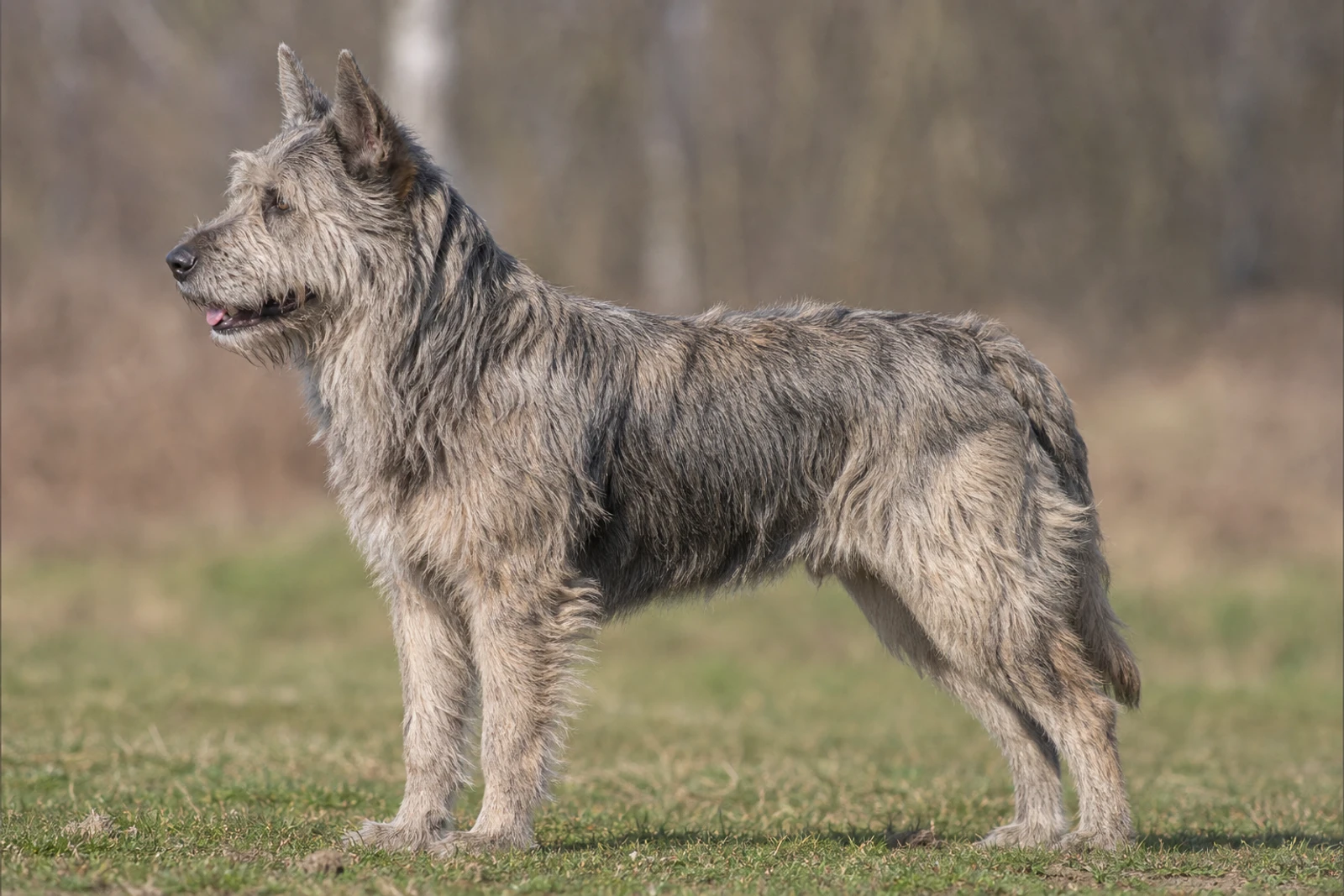
The Bouvier des Ardennes is a versatile, medium-large working dog bred for herding on rugged terrain. This breed suits active, experienced owners who provide ample mental and physical exercise. Loyal and protective, they bond deeply with family and are gentle with children. Their high energy and herding instincts demand consistent training. Best for rural homes with a job, this rare breed thrives when given tasks.
At a glance
- Size
- Large
- Height
- 20–24 in
- Weight
- 49–77 lb
- Life span
- 10 years
- Coat colors
- Gray, Brindle, Black, Fawn, Salt and Pepper
- Coat type
- harsh, tousled double coat
- Group
- Working
How much does a Bouvier des Ardennes cost?
Adopt / rescue
$75–$400
Usually includes spay/neuter, first shots, and a microchip.
Buy from a breeder
$700–$2,000
From a reputable, health-testing breeder.
Approximate USD. Prices vary widely by region, breeder, pedigree, age, and coat colour — adopting is the lower-cost and recommended route. Avoid suspiciously cheap “breeders”; they’re often puppy mills.
Estimate the full cost of a Bouvier des Ardennes →Want the ongoing number? Estimate the monthly food bill for a Bouvier des Ardennes with our dog food cost calculator.
Bouvier des Ardennes photos
Views
Front, side, rear and top — the full silhouette.Poses
How the breed sits, lies, moves and plays.Puppy to senior
The breed across its whole life.Expressions
The breed’s range of moods.Close-up details
Eyes, ears, nose, paws, tail and coat.Coat colors
The breed’s recognized colors.Click any photo to enlarge. We show the Bouvier des Ardennes from every angle — three views, poses, life stages, expressions, close-ups, coat and colors.
Appearance & size
The Bouvier des Ardennes looks like it was built for long days driving cattle through rough terrain — compact, muscular, and decidedly no-fuss. This is a large working dog that carries itself low to the ground, with a sturdy frame that suggests power without bulk.
Males stand 22 to 24 inches at the shoulder, females 20 to 22 inches, and weight ranges from 49 to 77 pounds. That weight sits on a dense, heavy-boned body that’s just slightly longer than tall, creating a rectangular silhouette. The chest is broad and well let-down, with well-sprung ribs extending well back. From the side, you’ll notice a deep brisket reaching to the elbows, a level topline, and a moderate tuck-up that keeps the dog agile. Viewed from the front, the forelegs are straight, set wide apart, and end in round, tight feet. The rear quarters show obvious muscling — broad, well-angulated thighs and hocks that stand parallel, giving the dog a thrusting, ground-covering stride.
Coat is the defining feature. The Bouvier des Ardennes wears a dense, double-layered coat built to shrug off rain, mud, and brush. The outer hairs are rough, tousled, and wiry, about 2 to 3 inches long all over, while the undercoat is thick and woolly. This combination forms a natural protective layer — the dog can look shaggy, even unkempt, but never soft or fluffy. The hair on the head is slightly shorter on the skull but grows long and coarse on the muzzle and chin, creating a trademark beard and bushy, overhanging eyebrows that give the breed its gruff, steady expression.
— Colors: All colors except pure white are acceptable. You’ll see fawn, grey, brindle (dark stripes on a lighter ground), charcoal, and black most often. A tiny white star on the chest or a few white hairs on the toes occasionally pops up but isn’t desirable.
Several details complete the picture. The ears are set high; traditionally they were cropped to a point, but these days many dogs wear them naturally — triangular, folded forward, or semi-erect. The tail is often naturally short or docked at birth; when left full length, it hangs low with a slight upward curve at the tip. The skull is broad and flat, the stop gently defined, the muzzle fairly wide and strong. The nose is always black, the eyes dark and oval.
Altogether, the dog reads as rustic and purposeful. The rough coat, blocky head, and compact stance don’t invite coddling; they tell you this is a partner ready for hard work in bad weather. That dense, tousled coat may need occasional stripping, but it’s exactly what allowed the breed to herd cattle in the Ardennes forests without fuss.
History & origin
The Bouvier des Ardennes is a remnant of a tough, practical dog that once populated the farms and cattle routes of the Belgian Ardennes. For centuries—well before anyone cared about pedigrees—these dogs pulled double duty as drovers and guardians. They drove herds of dairy cattle and pigs from pasture to market, often over rough, wooded hills, while keeping an eye on the property overnight. The name itself tells you the original job: “Bouvier” means cattle driver, and “Ardennes” pins them to the hilly, unforgiving region that straddles Belgium, Luxembourg, and France.
Unlike breeds shaped for show, these dogs were never built to a blueprint. Farmers valued stamina, level-headedness, and a low-maintenance tousled coat over a pretty outline. So the dogs varied a fair bit, but they were always medium-large, muscular, and agile—exactly what you’d need to turn a stubborn bull or navigate tangled thickets. By the late 1800s, as droving work waned, loose populations of Ardennes cattle dogs still existed, but they were rarely recorded. Then two world wars nearly erased them. The Ardennes was a battlefield corridor in both conflicts, and the dogs—along with their families—were displaced or killed. The breed was declared extinct more than once.
Credit for the revival goes to a handful of Belgian breeders who, in the 1980s and ’90s, scoured remote farms for surviving typey dogs. They gathered a small foundation stock and started a deliberate breeding program, aiming to preserve the working character and rugged look. The official standard was published by the FCI in 1963, but serious recovery work came later, and even today numbers are extremely modest. Most Bouvier des Ardennes still live in Belgium or neighboring countries, and you’ll rarely spot one outside a working farm or a specialty show.
The result is a dog that’s come full circle: leaner, cleaner-limbed than the better-known Bouvier des Flandres, with a distinct “dirty-beard” face and zero pretension. You’re basically looking at a living piece of pastoral history that never fully transitioned to a pet-industry favorite. If you meet one, you’re meeting a dog whose entire existence still hinges on function—just as it did a century ago on the windswept plateau.
Temperament & personality
The Bouvier des Ardennes is a steady, undemonstrative farm dog built for work, not for performing tricks on command. He loves his people with a quiet intensity and rarely demands physical affection, but he’ll lean against your leg or follow you from room to room like a shadow. Think of him as a loyal foreman, not a court jester.
At home with the family
With his own household, this breed is calm, watchful, and affectionate on his own terms. He’s fine curling up near you while you read, as long as he’s had real exercise earlier. His size (49–77 lb) and natural reserve mean he may accidentally bump a toddler; supervision and early socialization are non-negotiable if children are in the picture. A well-raised Bouvier is gentle and patient, but he won’t tolerate rough handling or having his food interrupted. Give everyone in the family the same rule: when the dog is eating or settled in his crate, leave him be.
With strangers and other animals
A lifelong guarding instinct keeps him watchful and slow to warm up. He’s not a hysterical barker, but he will alert you to anything out of place with a deep, serious woof. The alert stance—a forward-leaning posture and a direct, appraising stare—can unsettle visitors who don’t know the breed, but a confident, well-socialized Bouvier reads context before acting. Introduce him properly to people and other dogs early, and he accepts them as part of the daily landscape. Neglect that, and his natural wariness can tip into defensive posturing, especially around unfamiliar dogs.
Energy, work drive, and the stubborn streak
Bred to herd, pull carts, and patrol a farm all day, this is a dog with moderate physical energy but enormous mental stamina. A 20-minute stroll won’t cut it; he needs a solid hour of off-leash running, hiking, or focused work—think herding, weight pull, or hide-and-seek games that make him use his nose. Leave that tank half-empty and he’ll burn the excess fuel by digging, chewing, or barking excessively. A lone Bouvier left in the yard all day will manufacture his own job, and you probably won’t like it.
He’s also headstrong in a calm, almost unflappable way. He learns commands quickly but decides whether to obey based on what he’s getting out of it. Heavy-handed corrections only make him dig in his heels. The dog responds to a handler who is consistent, patient, and quietly immovable—respect gets you a partner; force gets you a standoff.
The oddball farm-dog quirk
Like many working breeds, a Bouvier may roll in something foul-smelling out in the yard. It’s not spite. The behavior could trace back to masking his scent, sharing news of a found carcass with the pack, or simply finding the stink irresistible. You’ll need a decent dog shampoo and a sense of humor.
Expect a 10-year partnership with a dog who views you as his full-time job. If you put in the work—clear rules, early socialization, a daily purpose—you’ll get a rock-solid companion who reads your moods, guards the perimeters, and greets you with a slow tail wag and soft eyes rather than a bouncing circus act.
Good with kids, dogs & other pets
This is a dog who reads his family like an open book. A well‑socialized Bouvier des Ardennes raised with children is steady, patient, and surprisingly gentle for a solid 55‑75‑pound cattle driver. The catch? That natural herding instinct doesn’t magically switch off indoors, so expect to guide him away from shoulder‑nudging or heel‑nipping games, especially with toddlers who move fast and make high‑pitched sounds. Close supervision and teaching kids not to grab his thick coat or interrupt his meals are non‑negotiable, but the payoff is a loyal shadow who looks after “his” small people with quiet vigilance.
The foundation for all of this gets poured between 3 and 14 weeks of age. A Bouvier who meets calm, respectful children, hears a vacuum cleaner, walks on different surfaces, and visits a friend’s house during that window is far less likely to grow into an adult who startles or shuts down around new things. Skip that window, and you may wind up with a powerful adolescent who is timid around visiting grandchildren or snappy when a neighbor’s kid runs up the driveway. Once the sensitive period closes around 16 weeks, you’re playing catch‑up with desensitization instead of building easy confidence from scratch.
With other dogs
The Bouvier des Ardennes typically has a live‑and‑let‑live attitude with housemate dogs he knows well, but a strange dog rushing at the fence is a different story. Early and ongoing puppy playdates count heavily here. The goal isn’t a dog‑park social butterfly — many adults settle into a more reserved, no‑nonsense style — but a dog who can walk past another on leash without lunging or freezing up. Prioritize controlled, positive meet‑ups with calm adult dogs during that prime 3‑to‑14‑week period, and keep the experiences upbeat into adolescence. An adult who missed those interactions may never enjoy rough‑and‑tumble play, and forcing greetings on him will only backfire. Respect his limits, and you’ll have a level‑headed partner who coexists easily without needing to be everybody’s buddy.
With cats and small pets
This is where the breed’s working roots demand an honest conversation. The Bouvier des Ardennes was shaped to move livestock, not to lounge beside a rabbit hutch. Some individuals learn to ignore the family cat, particularly if they’re raised with it from puppyhood, but even then a fleeing squirrel or a panicked kitten can flip a switch. Start introductions the day the puppy comes home, rewarding calm behavior near the cat carrier, and never leave a Bouvier unattended with free‑roaming pocket pets. Secure housing for ferrets, birds, and guinea pigs isn’t optional. Expect a sharp, motion‑triggered stare, and manage it with solid impulse‑control training from day one. If your household already has a resident cat, choose a puppy from a breeder who can honestly tell you the dam’s reaction to small animals — a little maternal chill goes a long way.
Trainability & intelligence
The Bouvier des Ardennes is a sharp, independent problem-solver — the kind of dog that figures out gate latches if you’re not paying attention. That intelligence doesn’t mean he’ll hang on your every word. He was bred to move stubborn cattle across rough Ardennes terrain with minimal human direction, so the wiring is: assess, decide, act. You earn reliable obedience by building a working partnership, not by drilling commands like a drill sergeant.
Motivation matters. This breed responds to clear, reward-based training and withers under heavy-handed corrections. Treats, a favorite tug toy, or bent-over praise that sounds genuinely delighted will get you far more than force. He can be calmly stubborn when he doesn’t see the point, so keep sessions short, purposeful, and upbeat. Use the herding brain to your advantage: teach a solid recall by making coming to you the most rewarding thing in the field, but know that if he’s locked onto a deer or stray calf, his recall is a work in progress — plan management accordingly.
Socialization is not a nice-to-have; it’s the foundation. The Bouvier is naturally reserved with strangers and fiercely protective of his people. Start between 3 and 14 weeks, exposing the puppy gradually to different people, kids, dogs, public places, slick floors, and urban racket. Keep every new encounter positive — a piece of chicken dropped near a skateboard or a quiet introduction to a mellow neighbor pays off later. Without it, that wariness can tip into reactivity.
Keep communication consistent and patient. This is not a breed that thrives on repetition for repetition’s sake. If you get a hard stare and zero response to a command he knows perfectly well, he’s not being stupid — he’s weighing your tone, context, and whether the reward on offer beats sniffing that hedgerow. Respect that, stay interesting, and never turn training into a power struggle. Building trust with a Bouvier means you’ll end up with a clear-headed partner who can read a situation and act with sound judgment, not just a robot that sits on cue.
Exercise & energy needs
Plan on at least 90 minutes of purposeful exercise every day, split across two or three sessions. This is a cattle drover’s dog, built to move livestock across rough terrain for hours — a couple of short leash walks won’t touch his physical or mental reserves.
What a good daily routine looks like
- Morning: 45–60 minutes of brisk walking, trotting, or off-leash hiking where he can cover ground. A long, casual sniff walk won’t cut it; he needs sustained movement.
- Afternoon/evening: Another 30–45 minutes of active work — fetch on a soft surface, a run in a securely fenced area, or a structured training session that gets his muscles working (heeling patterns, recalls, obstacle courses).
- On days when your schedule can’t manage a full hour-plus block, add a third shorter session of 20 minutes with a flirt pole or tug — but keep this the exception, not the norm.
Puppies and adolescents under 18–24 months should avoid repetitive high-impact pounding (no forced road running, no jumping from heights) because their joints are still developing. Even adults benefit from low-impact alternatives like swimming or walking on trails when surfaces are hard.
Mental engagement counts as part of the picture
The Bouvier des Ardennes is smart, stubborn, and bred to make independent decisions. Without a job, he’ll invent his own — often at the expense of your furniture. Weave in daily brain work:
- Nose work or scent detection games (hide treats, use a snuffle mat, set out a track).
- Puzzle toys that require manipulation, not just pawing.
- Advanced obedience, trick training, or herding instinct tests if you have access to livestock.
- Backpack carries (light load, properly fitted) on walks once he’s mature, so he feels useful.
Skipping this mental outlet can lead to restlessness, compulsive behaviors, or reactivity. A half-hour nose-work session can tire him as much as an hour of running.
If you live in a small space or don’t have a yard, you’ll need to get creative — this isn’t a breed that stays fit with brief indoor play alone. But when consistently exercised and given a task, he’s a steady, content companion who settles indoors without bouncing off the walls. Neglect the routine, and you’ll get a dog who digs, chews, barks, and pulls your arm out of its socket.
Grooming & coat care
That rough, weatherproof coat is deceptively low-maintenance—until the undercoat starts packing tight against the skin, which it can do in a hurry if you skip brushing. Your Bouvier des Ardennes wears a dense double coat: a soft, insulating underlayer covered by a coarse, 2–3 inch outer coat that’s meant to shed dirt and dry quickly. You preserve that hard texture with regular line brushing, not endless baths.
Brushing and tools
Aim for a thorough brushing once or twice a week most of the year, and pull him onto the grooming table daily during spring and fall blowout. The right tools matter more than muscle. A metal slicker brush with rounded pins breaks up loose undercoat and snags before they become felted mats. Follow with a wide-toothed steel comb to check your work—run it down to the skin on the ribs and behind the ears, where mats start silently. An undercoat rake is a back-saver during heavy shedding. Skip the bristle brush; it polishes a short, smooth coat but won't reach the dense fluff this dog carries.
Bathing
Over-bathing is the quickest way to ruin a Bouvier’s natural dirt-shedding ability. Harsh shampoos and frequent soaking strip the coat oils, softening the guard hairs and leaving you with a fuzzy, water-logged dog that picks up every burr. Bathe only when truly necessary—every couple of months, or after he’s rolled in something unmentionable. Use a degreasing or harsh-coat shampoo designed for terriers and wire-haired breeds, and rinse it down to the skin while lifting the coat so water penetrates. Towel dry well; a high-velocity blow dryer on a cool setting can blast out dead coat without cooking the skin.
Stripping vs. clipping
If you want to keep that crisp, weather-resistant jacket, hand-stripping a couple of times a year—or just working a stripping knife along the back and ruff every 4–6 weeks—pulls out dead outer hairs at the root so new, harsh growth fills in. Many pet owners opt for tidying with thinning shears or a clip, but beware: clipping the coat repeatedly will turn it soft, dull, and prone to tangling. It also flattens the signature endearing scruff. At minimum, trim the hair between the pads and around the vent for cleanliness, and neat up the edges of the ears if the coat gets shaggy.
Nails, ears, and teeth
This is a big, active dog, so don’t let the nails ride—long nails torque the toes and change his comfortable gait. Trim every 3–4 weeks or whenever you hear clicking on hard floors. Drop ears that hang close need a weekly sniff test and a gentle swipe with a dog-safe ear cleaner to head off yeast buildup in that dark, warm pocket. Brush teeth with enzymatic dog toothpaste at least three times a week; large-breed tartar problems are no one’s idea of a cheap fix.
Seasonal coat care
When the undercoat is blowing, the daily brushing is non-negotiable. A warm bath followed by a thorough blowout can jump-start shedding and get a shocking amount of dead fluff out in one session. You’ll want to do it outside because the sheer volume of hair is enough to stuff a throw pillow. If you notice a sudden spike in matting near the collar or hindquarters, it’s often a sign friction is pressing loose coat into knots—address the rubbing point (a rolled leather collar can help) and stay ahead of it with the comb.
Shedding & allergies
You’re not going to find clumps of hair on every surface, but this dog absolutely sheds. The Bouvier des Ardennes has a dense, wiry double coat — a harsh outer layer and a softer undercoat — that continuously releases a moderate amount of dead hair year-round. It’s less obvious than a smooth-coated dog because the rough texture traps a lot of loose fur until you brush it out. Skip the brushing for a week and you’ll see exactly what I mean when you pull a handful of gray fuzz from the rug.
Twice a year, typically in spring and fall, the undercoat blows out in a heavier shed. During these few weeks, daily line brushing becomes non-negotiable unless you want tumbleweeds of hair drifting across the floor. A good rake or pin brush will pull out the dead fluff before it ends up on your clothes, but expect to empty the brush repeatedly.
Drool isn’t a headline issue with this breed. You might see a few drips after a big drink of water or when he’s eyeing your sandwich, but he’s not a faucet like some jowly working dogs.
Let’s talk allergies. No dog is truly hypoallergenic. People react to dander, saliva, and urine — not just hair. The Bouvier’s coat does hold onto dander close to the skin, and that tight, rough fur can give some allergic owners a false sense of security. If allergies are a dealbreaker, spend time in a real home with adult dogs of this breed before committing. Even then, reactions can change over time. Weekly brushing outside and rinsing the coat occasionally can cut down on airborne particles, but it won’t eliminate the problem.
Diet & nutrition
Feed your Bouvier des Ardennes like the working dog she is—plenty of quality fuel without letting her carry extra pounds that strain the joints. At 49 to 77 pounds, an adult usually does well on two meals a day. Measure portions according to the food’s calorie guide and your dog’s activity, and check her body condition weekly: you want to feel the ribs easily under a thin layer of fat.
Puppies need more frequent meals: four times daily until four months old, three times until six months, then switch to the adult two-meal schedule. Senior dogs, especially those slowing down, often benefit from smaller, more frequent servings. The breed’s 10-year lifespan means keeping a lean frame matters from day one—excess weight can worsen the joint and spinal problems large herders can be prone to.
If your Bouvier inhales his food or always acts hungry, use a puzzle bowl to slow him down and add a little mental work. Don’t free-feed. High-value treats are fine for training, just subtract those calories from the daily total.
A diet built around animal protein best matches a dog’s digestive system. For a homemade approach, many owners aim for roughly two-thirds meat and fish (raw or cooked), with the remaining third split between dog-safe vegetables, fruits, and a small amount of eggs or grains like pearl barley or white rice. Blending or lightly processing meals helps break open plant cell walls since dogs lack salivary enzymes and a grinding jaw motion—mix-ins like pureed pumpkin are more than just fiber. If you’re not going homemade, pick a high-quality commercial food formulated for large, active breeds.
Keep rich, fatty scraps away from your dog; even one heavy holiday meal can trigger pancreatitis. When your Bouvier has an upset stomach, a bland mix of plain white rice and a little cooked chicken often settles things. Leftovers you do share should go into his bowl, never from the table, so you don’t accidentally teach a begging habit that’s hard to undo.
Health & lifespan
A healthy Bouvier des Ardennes usually lives about 10 years. That’s right in line with other large working breeds, but reaching it depends heavily on genetics, weight management, and preventive care—not just luck.
Because the breed’s numbers are small, the list of well-documented inherited conditions is shorter than you’d find for a popular retriever. That doesn’t mean they get a free pass. As a deep-chested, muscular dog, certain structural problems show up often enough that responsible breeders screen aggressively. Expect clearances for hip and elbow dysplasia (OFA or PennHIP), a cardiac exam, and an eye evaluation by a veterinary ophthalmologist. If a breeder can’t hand you those results, find someone who will.
Bloat—gastric dilatation-volvulus—is the emergency you need etched in your brain. A deep ribcage and a tendency to gulp food combine dangerously. Serve two smaller meals instead of one big pile, and enforce at least an hour of quiet before and after eating. Restlessness, a tight belly, and unproductive retching mean drop everything and get to a vet.
Weight hits hard on this frame. The breed is compact and powerful, not rangy; even an extra five pounds grinds away at joints that may already carry dysplasia risks. Measure kibble, skip free-feeding, and adjust for seasonal activity dips. A lean dog is a longer-lived dog.
Routine prevention is just as critical. Monthly heartworm medication during mosquito season and one month beyond it, a legally required rabies vaccine, and annual wellness exams form the baseline. Senior dogs benefit from twice-yearly checkups that catch creeping changes in heart function, eyesight, or mobility. Those rough, double-layered coats need a watchful eye, too—dander, debris, and environmental allergies can trigger itchy skin and hot spots if diet or grooming slip.
This breed thrives on human connection and purposeful activity. Isolation or harsh corrections cause stress that shows up physically: excessive vocalizing, appetite dips, or compulsive habits. Early socialization and a calm, consistent hand reduce that wear and tear. Watch for subtle shifts—sudden stiffness after rest, a drop in energy, new pickiness with food. Often, the quiet signs are the first clues something’s off, long before it’s obvious.
Living environment
The Bouvier des Ardennes is a no-frills working dog who needs space, a job, and a family that doesn’t leave him alone all day. An apartment — even a large one — is a tough squeeze unless you’re genuinely up for vigorous outdoor sessions morning and night, rain or shine. Without room to patrol and burn off his bred-in drive, he’ll redirect that energy into barking, pacing, or creative destruction.
Yard and space: A securely fenced yard ranks high on his wish list, but the fence matters more than the square footage. These dogs can be escape artists and have strong herding instincts; they will self-assign perimeter checks and might try to round up the neighbor’s cat. A yard gives him a place to zoom and sniff, but it doesn’t replace your time together. He still needs structured runs, long-line hikes, or off-leash romps where he can really open up. Plan on two substantial activity sessions — at least 45 to 60 minutes each — built around trotting, fetching, or focused training. Shorter, more frequent bursts work well too, especially when paired with mental work like scent games or feeding puzzles.
Climate sense: His dense double coat laughs at cold, sleet, and mud, making him a solid cold-weather companion. Heat is the real enemy. When summer temperatures push past 80°F, limit hard exercise to early mornings or late evenings, and always have shade and water on hand. He can overheat fast if you push him during the midday sun.
Noise and barking: Like many farm-bred guardians, the Bouvier des Ardennes notices everything. He’ll bark when a stranger approaches or something seems out of place. It’s an alert bark, not incessant yapping, and with early socialization and plenty of daily off-switch training, he learns to settle. If he’s bored or under-exercised, the barking ramps up sharply.
Being left alone: This is where the breed can struggle. He bonds deeply with his people and doesn’t care to be a solo act for eight or nine hours. Without gradual alone-time training from puppyhood, he can tip into howling, chewing, or door-frame demolition. Give him a frozen Kong, a rotation of puzzle toys, and ideally a midday break. If your household is gone all day every day, this likely isn’t the right breed — a dog walker or daycare becomes non-negotiable.
Who this breed suits
This is a working cattle dog through and through — and he shops for his owner accordingly. The Bouvier des Ardennes fits an experienced handler who’s honest about the reality of living with a strong-willed, energetic dog. First-timers, even well-meaning ones, almost always end up in over their heads. This breed needs someone who reads body language before the dog has to shout, and who delivers firm, consistent training without harshness or inconsistency.
Active singles, couples, and outdoorsy families where the dog is woven into daily adventures are the natural match. You work from home, run a farm, or hike off-leash every weekend? Good. The Bouvier needs a solid 60–90 minutes of hard physical work — long trail runs, hill climbs, structured herding or advanced obedience — not just a walk around the block. Toss in puzzle toys, scent work, or learning new tasks, and you’ll have a satisfied partner. Without that mental drain, his problem-solving brain turns to redecorating your baseboards.
He bonds deeply and fiercely; this is not a dog who does well parked in a backyard while you’re gone 10 hours a day. Loyalty runs both ways. His natural guarding instinct makes him aloof with strangers and watchful around the house. You don’t get a golden retriever’s tail-wag for every visitor, and that’s by design. Socialize him early and thoroughly, but accept that he’ll always be a discerning bouncer.
Families with older, dog-savvy children (say, 10 and up) can thrive, because these kids respect boundaries and can participate in training. With toddlers, the breed’s strong herding drive sometimes surfaces as chasing and nipping — not out of malice, but out of a deeply ingrained job description you can’t erase.
Who should think twice
- First-time dog owners. The learning curve on handling a tough-minded, energetic working breed is simply too steep.
- Apartment dwellers or anyone without a securely fenced yard. He’s large-ish (49–77 lb, 20–24 in) and needs off-leash exercise. Boredom fuels barking and destruction.
- Seniors, unless you’re unusually fit and have a working-breed background. His physical demands don’t retire with age; an older Bouvier still expects his daily mission.
- Anyone looking for a social butterfly. He is reserved by nature and never the life of the dog park. Expect selective sociability and zero interest in making friends with every stranger on the sidewalk.
- Owners unwilling to keep up with grooming. The dense, wiry double coat sheds little but needs weekly brushing and hand-stripping a couple of times a year to stay healthy and mat-free.
Life expectancy hovers around 10 years. That’s not long for a dog this size, and it means the years you get are high-intensity. A Bouvier des Ardennes who isn’t given a real job will hand himself one — and you probably won’t like the assignment.
Cost of ownership
Expect to pay more and wait longer for a Bouvier des Ardennes than for a common family breed. This is a rare working dog, and serious breeders are few. A well-bred puppy from health-tested parents typically runs $2,000–$3,500, sometimes higher if you’re importing from European lines. Rescue is an occasional lucky find, but don’t count on it.
Once the dog is home, the real numbers kick in. This is a large, active herder that burns through calories and needs more than a bag of cheap kibble. Plan on $70–$100 per month for high-quality food, plus another $15–$30 for training treats and chews.
Grooming is surprisingly manageable if you do it yourself, but it’s not zero-cost. Their harsh, weatherproof double coat needs weekly brushing and periodic hand-stripping. If you pay a groomer who knows how to handle the breed, expect $80–$130 every 8–10 weeks, or invest in a stripping knife and learn the skill. Neglect it, and you’ll end up with a matted, uncomfortable dog.
Vet care and preventives will be on par with other large breeds. Annual exams, vaccines, and monthly heartworm/flea/tick meds typically average $50–$80 per month. The breed can be prone to hip dysplasia, so you may face additional costs for OFA x-rays or joint supplements down the road. Pet insurance for a large working breed usually lands between $50–$90 a month, depending on your deductible and location — get a quote before you commit to a puppy.
Don’t forget the upfront gear and training. A solid crate, leash, collar, and chew-proof toys can easily hit $300–$500 in the first month. And because these dogs are whip-smart and not always push-button biddable, a group obedience class or a few private sessions ($200–$800) will save you far more in chewed drywall later.
Choosing a Bouvier des Ardennes
The Bouvier des Ardennes is a genuinely rare working dog, especially in North America. You won’t stumble on a litter through a quick online search, and that’s a good thing — it means the breeding pool is small and serious. Your two real routes are finding a preservation breeder who screens for health and temperament, or waiting (often a long time) for a rescue to appear. Shelters barely see the breed, so a rehome through the parent club’s network is the more realistic rescue path.
Health clearances count for everything. A responsible breeder will have the sire and dam screened for joint and eye issues. At minimum, ask to see:
- OFA or PennHIP hip scores (good or excellent; fair hips in one parent should be paired with excellent in the other, never bred without passing scores)
- OFA elbow clearance (no dysplasia)
- CAER eye exam done by a veterinary ophthalmologist within the last 12 months
The breed’s lifespan hovers around 10 years, and poorly structured hips or elbows can cut that short. Because the gene pool is tiny, breeders should also be upfront about any cardiac clearances they pursue, even if not universally required.
Red flags include a breeder who waves off health testing because “the breed is hardy,” advertises dogs as “rare” to jack up price without proof of working ability, or meets you in a parking lot. Run from anyone who offers a puppy younger than 8 weeks, has multiple litters on the ground simultaneously, or pumps out puppies without documenting their lines through an FCI-recognized registry or breed club. A true steward grills you just as hard as you grill them — they’ll want to know your plans for containment, exercise, and how you’ll handle a strong-willed cattle dog that may top out near 77 pounds.
Puppy temperament is non-negotiable. When you visit, the dam (and ideally sire) should be confident but not confrontational. Pups should be curious, bounce up to investigate, and recover quickly from a loud noise — not cower behind furniture or stiffen with suspicion. With an adult height of 20–24 inches, a properly built puppy already looks square, muscular, and well-boned, not long-backed or weedy. Handle paws, ears, and mouth; even an 8-week-old Bouvier should accept it with mild protest, not panic.
Expect a wait. Many breeders only produce a litter when they need a working prospect of their own. Get on a list early, meet the dogs in person if you can, and accept that the extra months are what get you a dog from sound, proven stock — not a gamble.
Pros & cons
Pros
- Part of your daily rhythm: A Bouvier des Ardennes doesn’t just live in the house—he weaves himself into your chores, walks, and quiet evenings. Expect a steady companion who’s affectionate without being needy.
- A no‑nonsense watchdog: He reads situations with a level head. A deep, alert bark announces strangers, but a properly raised dog won’t escalate without reason. That discrimination makes him trustworthy on a farm or in a family home.
- Intelligence you can put to work: If you give him a real job—herding, draft work, scent games, or competitive obedience—he’ll pick it up fast and pour his heart into it. This is a dog bred to problem‑solve alongside you, not just follow rote commands.
- Built for ugly weather: His double coat shrugs off rain, sleet, and brambles. Mud dries and brushes out; the coat has little “doggy” smell when kept reasonably clean. At 49–77 pounds and 20–24 inches, he’s stout enough to work cattle all day yet compact enough to load into a vehicle without a forklift.
- Honest, uncomplicated loyalty: Once you earn his trust, he won’t second‑guess his role. He’s not prone to dramatic mood swings or needless sensitivity—he’s a steady partner through thick and thin.
Cons
- He’s unemployed by default: This is a working breed that cannot coast on neighborhood strolls. Without a solid hour of purposeful exercise and mental work every day, he’ll design his own projects—rearranging irrigation, tunneling under the shed, or barking at every leaf that twitches.
- Slow to warm up: Strangers are met with deliberate suspicion. Socialization must be a lifelong habit, and you’ll need calm, repeated introductions to help him distinguish friend from threat. A solid fence buys you peace of mind.
- Herds whatever moves: Toddlers, cats, bicycles—if it can be gathered and controlled, he’ll try. You’ll spend meaningful time teaching him that the kids don’t need rounding up in the backyard.
- Grooming requires consistency: The rough coat mats if ignored. A thorough weekly brush‑out and a full strip a couple of times a year keep the coat healthy. Skip it, and you’re either shaving him down or paying a groomer for the rescue work.
- A short, intense chapter: The breed averages only about 10 years. For a large dog with such a big presence, that goodbye can arrive before families are ready.
- He reads weakness quickly: Soft, inconsistent handling invites him to make his own rules. You need to mean what you say, every time. He’ll test you just to see if you notice—and the test never ends.
Similar breeds & alternatives
If a rough-and-ready Belgian cattle dog sounds right but you want to weigh the alternatives, a few breeds come up in the same conversations. Each has its own strengths—and the Bouvier des Ardennes is no copy.
-
Bouvier des Flandres: The heavier cousin. A Flandres typically runs 70–110 lb with a thick, high-maintenance double coat and a more pronounced guarding instinct. That extra 20–30 lb means more food, more strength to manage on a leash, and a coat that mats if you skip a few days. The Ardennes stays under 77 lb and its shorter, tousled coat needs a weekly brush, not a daily session.
-
Belgian Malinois: Same height range, but built like a tightly wound spring—40–80 lb of pure drive. An adult Malinois often demands 90 minutes of intense work, plus mental challenges, to keep the peace. The Ardennes is no slacker, but a solid hour of running and a job to do is usually enough. If your day doesn’t revolve around training drills, the Ardennes is the more livable choice.
-
Briard: A taller (22–27 in), lighter-boned herder with a long, wavy coat that needs constant grooming to prevent tangles. Temperamentally, Briards can be protective and reserved with strangers. The Ardennes’s stockier build and practical, weatherproof coat come with less maintenance, and its steady watchfulness rarely tips into aloofness.
-
Polish Lowland Sheepdog (PON): Smaller at 16–20 inches and 30–50 lb, with an adorable shag-dog look—but that coat is a daily commitment, whether you brush it yourself or pay a groomer. The Ardennes’s rough, self-cleaning double coat is far simpler to live with. Both breeds are clever and independent, yet the Ardennes’s cattle-driving roots make it a sturdier worker; a PON might rather charm the neighbors than move stubborn stock.
All these breeds need an owner who respects a dog that thinks for itself. The Ardennes simply wraps that independence in a more manageable package with less coat upkeep and a solid, 49–77 lb frame that won’t pull you off your feet.
Fun facts
- Nearly extinct after World War I, the breed was revived by dedicated breeders.
- An excellent herding dog, originally used for driving cattle in the Belgian Ardennes.
- Known for its weather-resistant double coat and distinctive beard.
- One of the four Belgian herding breeds, but the rarest.
Frequently asked questions
- Are Bouvier des Ardennes good with children?
- They can be gentle and protective with kids when properly socialized from a young age, but supervision is wise due to their herding instincts. Their sturdy build and patient nature often make them good family companions. However, interactions should always be guided, especially with younger children.
- How much exercise does a Bouvier des Ardennes need?
- This breed has high energy levels and requires at least an hour of daily physical activity. Long walks, runs, and mentally stimulating tasks help prevent boredom-related behaviors. They thrive with a job to do, suiting active owners.
- Do Bouvier des Ardennes shed a lot?
- They have a dense double coat that sheds moderately year-round, with heavier shedding during seasonal changes. Regular brushing a few times a week helps manage loose hair. They are not considered hypoallergenic.
- Can a Bouvier des Ardennes live in an apartment?
- Apartment living is possible if their substantial exercise needs are met daily. However, their large size and energy levels are better suited to homes with a securely fenced yard. They also tend to be watchful and may bark at noises, which could disturb neighbors.
- Is a Bouvier des Ardennes suitable for first-time dog owners?
- This breed can be challenging for novices due to its strong will and need for consistent training. They respond best to experienced owners who provide firm, positive guidance. Early socialization is crucial to curb potential stubbornness.
Tools & calculators for Bouvier des Ardennes owners
Quick estimates tailored to Bouvier des Ardenness — pre-filled with this breed’s size where it matters.
Articles & stories about the Bouvier des Ardennes
Sources & standards
This profile follows recognized breed standards from the American Kennel Club (AKC) and the Fédération Cynologique Internationale (FCI), along with established veterinary and breed-club guidance. These describe general breed tendencies — every dog is an individual.