

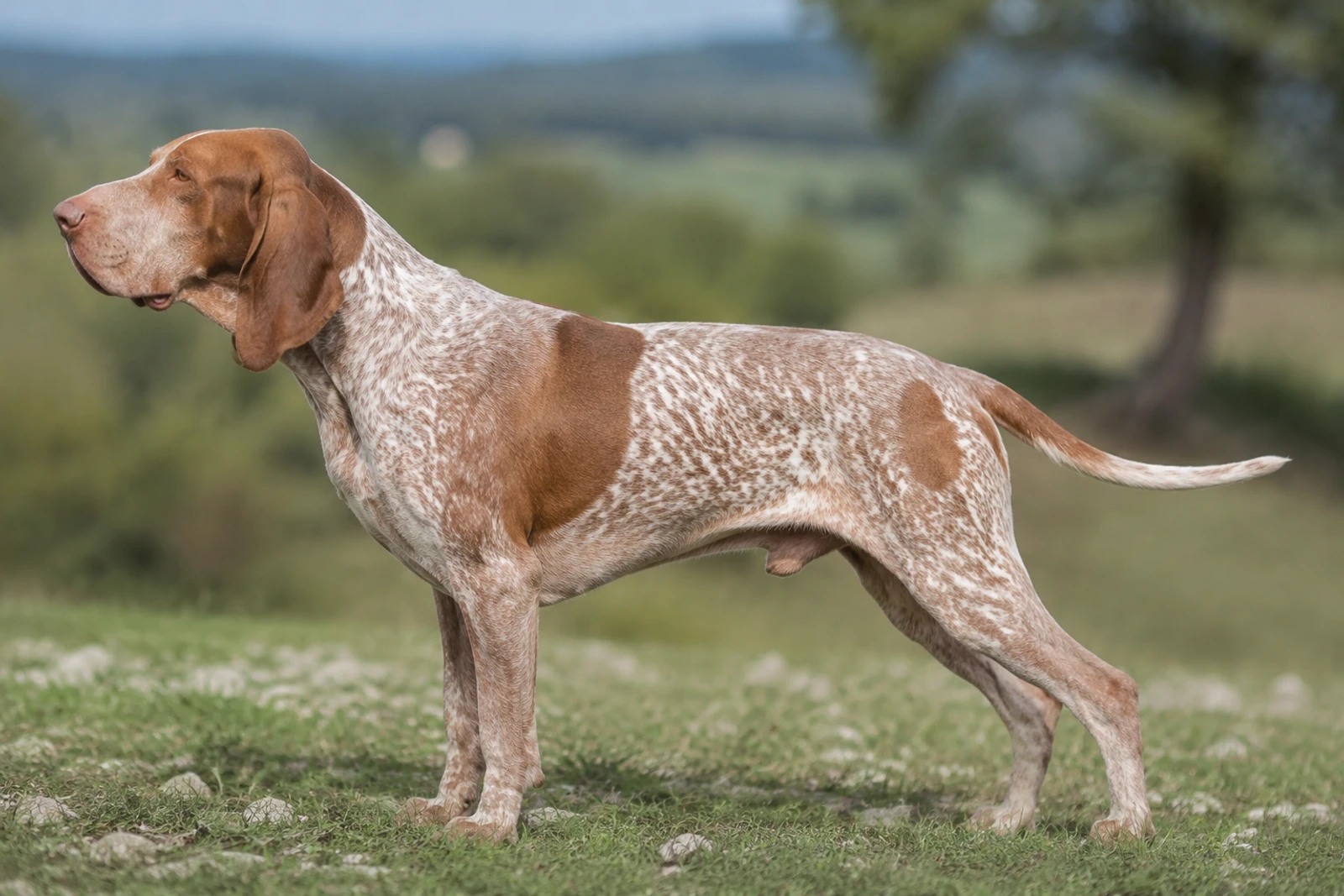
The Bracco Italiano is a noble and affectionate pointing breed, ideal for active families who can provide ample exercise and companionship. Gentle and patient, they form strong bonds with their humans and are excellent with children. Their calm indoor demeanor belies a powerful hunter's drive outdoors, making them a versatile partner for sporting enthusiasts. This rare breed thrives on human interaction and rewards dedicated owners with unwavering loyalty and a loving, dignified presence.
At a glance
- Size
- Giant
- Height
- 22–26 in
- Weight
- 55–88 lb
- Life span
- 12–13 years
- Coat colors
- White, White and orange, White and chestnut, Orange roan, Chestnut roan
- Coat type
- Short, dense, and glossy
- Group
- Gun
How much does a Bracco Italiano cost?
Adopt / rescue
$75–$400
Usually includes spay/neuter, first shots, and a microchip.
Buy from a breeder
$700–$2,000
From a reputable, health-testing breeder.
Approximate USD. Prices vary widely by region, breeder, pedigree, age, and coat colour — adopting is the lower-cost and recommended route. Avoid suspiciously cheap “breeders”; they’re often puppy mills.
Estimate the full cost of a Bracco Italiano →Want the ongoing number? Estimate the monthly food bill for a Bracco Italiano with our dog food cost calculator.
Bracco Italiano photos
Views
Front, side, rear and top — the full silhouette.Poses
How the breed sits, lies, moves and plays.Puppy to senior
The breed across its whole life.Expressions
The breed’s range of moods.Close-up details
Eyes, ears, nose, paws, tail and coat.Coat colors
The breed’s recognized colors.Click any photo to enlarge. We show the Bracco Italiano from every angle — three views, poses, life stages, expressions, close-ups, coat and colors.
Appearance & size
You spot a Bracco Italiano from across the field and there is no mystery about what this dog was built to do. Every line of the body screams “athlete that covers ground,” but it’s the head that makes you stop. Long, angular, and almost sculptural, it’s balanced on a strong, slightly arched neck with a show of loose, elastic skin around the throat. The skull and muzzle are parallel, with a pronounced stop and a distinct occipital crest at the back. The expression is calm and almost solemn, thanks to amber or ochre eyes set well apart and a brow that’s naturally furrowed.
Size-wise, these are big dogs, though not heavy. The standard puts them at 22–26 inches at the shoulder and 55–88 pounds, and you’ll see a wide spread there. Most males land in the upper third of both ranges—a 25-inch, 80-pound dog is common—while females trend toward the smaller end. The build is square: the height at the withers and the length of the body are about equal. A deep, wide chest reaches to the elbows, and the ribs are well sprung. From the side, the topline drops just slightly from the withers to a strong loin, and the underline tucks up without looking wasp-waisted. The tail, naturally thick at the root and tapering, is carried low with a gentle curve; where docking is still practiced, it’s shortened, but you increasingly see full tails sweeping behind them.
Front and rear legs are straight, dry-muscled, and heavily boned, with knuckled-over front pasterns that absorb shock when the dog powers through rough cover. From behind, the thighs are broad and the hocks sit low to the ground, giving the rear assembly that coiled-spring look common to long-distance trotting breeds.
The coat is short, dense, and glossy, with a fine texture that lies close to the body. Color comes in a few distinct patterns, always built around white and orange or white and chestnut. You’ll see solid patches on a white background, flecked roan coats (orange roan or chestnut roan), or roan with darker solid patches on the head and chest. A white blaze on the face and a white tip on the tail are cherished markings. The skin pigment matches the coat color, so an orange dog has pinkish-brown skin, while a chestnut dog leans toward liver.
The ears are the sensory centerpiece—long, soft, and set low, hanging well past the jawline with a rounded tip. They frame the face and contribute to the somewhat melancholy expression that is unmistakably Bracco.
History & origin
Walk into a Renaissance painting, and you might lock eyes with a dog that looks startlingly like today’s Bracco Italiano. Artists such as Titian and Mantegna worked them into their canvases as far back as the 1400s, but the breed’s roots dig even deeper. Often called the oldest European pointing breed, the Bracco likely descends from ancient coursing and scent hounds that crossed paths in northern Italy — think Segugio Italiano blended with heavier molosser types brought by traders and armies. The combination produced a dog with the nose of a hound, the stamina for long days in the field, and a solid, muscular frame.
By the Renaissance, noble families in Lombardy and Piedmont had already shaped a distinct working type. The Bracco was bred to do the full job: find birds with that deep, methodical nose, freeze into a steady point, and then retrieve to hand over any terrain — marsh, mountain, or open plain. What set it apart then, and still does, is the gait. Unlike the hyperkinetic dash of some pointing breeds, the Bracco works at a ground-covering trot, head high, always in contact with the handler’s pace. That deliberate, almost contemplative style let hunters on foot keep up without exhausting the dog.
The breed’s survival is a close-run thing. Two world wars, shifting agriculture, and the mechanization of hunting nearly wiped it out. By the early 1900s, two distinct regional varieties existed — the lighter, leggier Piedmontese type and the heavier, roan-colored Lombard type — but numbers crashed to dangerous lows. Dedicated Italian breeders rebuilt the population from what remained, unifying the two strains into a single standard focused on health and working ability first. Even so, the Bracco stayed a well-kept secret outside Italy for decades.
In the United States, serious importation began in the 1990s, and the breed slowly found a foothold with hunters who valued a close-working pointer and families who could handle a big, affectionate dog. The American Kennel Club brought the Bracco Italiano into the Sporting Group in 2022, making it the 200th recognized breed. Today’s Bracco is still a capable, all-day bird dog, but you’re just as likely to hear owners talk about the goofy, velcro nature that fills up a living room.
Temperament & personality
The Bracco Italiano pours every ounce of his 55 to 88 pounds into being a devoted family shadow. He’s a gentle, soulful giant who prefers soft eyes and a relaxed body to any kind of bluster — a calm, affectionate housemate who’s often found leaning against your leg or draping his head across your lap. He’s not a guard dog. He might announce the doorbell with a deep bark, but the intruder will get a wagging tail, not a threat display.
Indoors, you'll see a laid-back dog who can snooze for hours after a solid run. Outdoors, that changes: this is a powerful gun dog with a nose that never quits. Plan on a daily hour of off-leash trotting, sniffing, and sprinting, not just a leash stroll. Bred to cover ground with a distinctive ground-covering trot, he’ll happily follow scent trails for miles, then come inside and melt onto the couch.
With his own family, the Bracco is famously gentle. He’s patient with children who are taught to respect his size and give him peaceful, uninterrupted mealtimes — as with any dog, barging in on dinner can spark guarding. He typically gets along well with other dogs, though that keen nose can turn a cat or small animal into a chase target if he wasn’t raised alongside them.
Training this breed calls for respectful consistency, never force. He’s smart but sensitive; a hard correction can cause him to shut down entirely. Praise-based work that lets him figure things out taps into his natural cooperation. Without it, his stubborn streak surfaces, and a bored, solitary Bracco can become an anxious barker or an enthusiastic chewer. That separation anxiety is real — he’s not a dog who thrives when everyone’s away for nine hours straight.
A few quirks to know about. Like many scent-driven breeds, he may feel an irresistible urge to roll in dead worms, fox scat, or any other nasty cologne he finds. Scientists debate why dogs do this — from ancestral scavenger habits to simple enjoyment — but whatever the reason, a Bracco will happily plaster himself in eau de decay and then trot back to you, proud as can be. Drool is part of the deal, too, especially after drinking or sniffing something delicious.
Because he lives for contact and collaboration, this breed fits best in an active home where someone is around most of the day and understands that a Bracco’s forward lean means “let’s go,” not “I’m boss.” Ignore that need for partnership, and you’ll end up with a soulful, unhappy dog who marks his distress on your rug.
Good with kids, dogs & other pets
With children
The Bracco Italiano’s patient, non-aggressive personality is a genuine asset around kids, but his size demands a reality check. At 55–88 pounds, an untrained Bracco puppy or a wagging adult tail can send a toddler tumbling, so you’ll need to supervise every interaction until both dog and child learn the rules. What makes him shine is his need to be near his people—he’s a high-companionship breed who thrives as part of family life, not a backyard ornament. He’ll happily shadow a game of tag or sprawl next to the sofa, providing quiet company. Just don’t mistake that devotion for independence. Hours of isolation can tip him into distress, and an anxious dog is never a safe one. When kids are taught to approach calmly and give him space, you get a steady companion who rarely startles or snaps.
With other dogs
Early, well-managed socialization sets the tone for a Bracco’s relationships with other canines. He’s naturally easygoing; most well-raised Braccos will share their home with another dog without much fuss. The catch is that an undersocialized adult pushed into forced greetings can become fearful or defensive, and a tense meeting between two big dogs can escalate fast. If you’re adding a second dog, let them meet on neutral ground first, keep the mood low-key, and give both animals an escape route. A Bracco who has positively interacted with other dogs from puppyhood usually remains that friendly, unbothered presence at the dog park or on walks.
With cats and small pets
Here you’re up against centuries of bird-dog instinct. A Bracco Italiano was bred to hunt, point, and retrieve, so small, scurrying animals—cats, rabbits, pet rodents—can flash like a neon sign in his brain. Cohabitation is possible, but it’s never a freebie. The most reliable setups involve raising a Bracco puppy alongside a confident, dog-savvy cat, backing that with a rock-solid “leave it” command, and separating them when nobody is home. Even then, a sudden dash across the room can override training, so casual, unsupervised mingling is a gamble. For homes with free-range guinea pigs or birds, a Bracco is usually the wrong match.
The role of early socialization
The critical window slams shut around 16 weeks of age. Before that, a Bracco puppy should be gently, positively exposed to children, other dogs, and any small pet you hope he’ll live with peacefully. Miss that window, and you’re often battling a dog who spooks at loud noises, flips into overdrive around new dogs, or has a hair-trigger chase reflex. Even after four months, daily positive reinforcement and calm exposure to new situations build confidence without the fallout of forced adult interactions—which can trigger fights rather than friendship.
Trainability & intelligence
The Bracco Italiano is a quick study, but he’s not a push-button obedience machine. His intelligence is the cooperative, problem-solving kind you’d expect from a dog bred to work closely with a hunter. What that means for an owner: he learns fast when he trusts you, and shuts down just as fast if you rely on force. You’ll see those expressive eyes light up for a training session that feels like a game — toss in some liver treats or a favorite tug toy, and he’ll offer behaviors before you even ask. Try to bully him through a command, though, and he’ll simply check out, or give you a sad, disappointed look that makes you feel worse than any correction ever could.
That sensitivity is the real key to training a Bracco. He’s so attuned to tone that a harsh word can undo a week’s worth of progress. Positive reinforcement isn’t just a nice idea here; it’s the only fuel his engine accepts. Use praise, food, or a quick romp as your reward, and keep sessions short — five minutes of focused work beats twenty minutes of drilling, because the Bracco gets bored and distracted when repetition doesn’t have a purpose.
Recall deserves a spotlight. A Bracco’s nose rules his brain. If he catches a scent, that big frame can cover ground faster than you’d believe, and the “come” command might get lost in the intoxicating world of rabbit trails. You build a reliable recall by making it the most rewarding thing in his life — think roasted chicken, not dry biscuits — and by practicing it every single day outside the context of calling him away from fun. Start this in puppyhood, before the instinct to follow his nose deepens into a full-blown habit.
The “stubborn” label gets thrown around with this breed, but it’s rarely a refusal — more often, a Bracco is busy processing or simply hasn’t been given a clear enough reason to cooperate. He’s not the kind of dog who thrives on drill-sergeant commands; he needs a partner who communicates with patience, consistency, and a sense of humor. Socialization follows the same rulebook: begin early, ideally before 16 weeks, and keep it positive. Introduce new people, other dogs, and strange surfaces like slick floors or wobbly docks with calm encouragement, never forced exposure. A well-socialized Bracco is a steady, unflappable companion. A poorly socialized one can become timid or reactive, and excavating that trust later is far harder than planting it early.
Exercise & energy needs
A Bracco Italiano isn’t a low-key giant content with a stroll around the neighborhood. Bred to hunt across miles of rugged terrain, this pointing breed needs a daily athletic outlet that matches her build and brain. Plan on 90 minutes or more of real exercise every day, split into at least two dedicated sessions. A 45- to 60-minute morning run or field romp, followed by another 30–45 minutes of active work in the evening, is a solid baseline. On-leash neighborhood walks alone rarely satisfy a Bracco; she wants to stretch her long legs off-leash, follow her nose, and cover ground at a gallop.
Intensity matters as much as minutes. A fenced yard helps for midday zoomies, but it’s no substitute for deliberate outings—hiking hilly trails, swimming, or hunting practice. These dogs have deep stamina and will keep going as long as you let them, so the risk of under-exercising is far greater than overdoing it with a healthy adult.
Mental engagement is equally critical. The Bracco’s powerful nose needs a job. Without scent-based challenges, boredom turns into creative destruction: chewed furniture, endless pacing, or loud, frustrated barking. Work nosework games, hidden-treat puzzles, and ongoing training into each day. Even a 15-minute backyard session of finding a scented dummy counts.
The breed truly thrives when physical and mental demands are combined:
- Field work and hunting trials – their original purpose, and where they’re happiest
- Scent work or tracking – ideal for honing that extraordinary nose
- Dock diving and swimming – low-impact on joints while burning serious energy
- Canicross or skijoring – once joints are mature, they make excellent running partners
- Advanced obedience or rally – keeps a thinking dog from inventing her own rules
With giant-breed growth plates, avoid high-impact jumping and forced pavement running until 18–24 months of age. Responsible breeders screen for hip dysplasia, but you still control exercise safety early on.
Skip a day or two, and a restless Bracco Italiano will let you know—often loudly. This is a soft, affectionate dog with a family-centered heart, but her energy demands are non-negotiable. A predictable, active routine keeps her sound in body and brain.
Grooming & coat care
Your Bracco’s coat is the canine equivalent of a low-fuss Italian suit: short, dense, and naturally glossy. It’s a single coat — no insulating underlayer to blow out twice a year — which keeps shedding manageable. A quick weekly session with a soft bristle brush or a hound glove is all it takes to pull out loose hair and spread the skin’s oils. The result is that rich chestnut-roan or white-and-orange coat gleams without much effort.
Pay an extra minute of attention to the feathering behind the ears and down the backs of the thighs. Those slightly longer hairs can clump if ignored. A fine-tooth comb or a slicker brush worked gently through those spots once or twice a week prevents tangles without scratching bare skin. Don’t overdo it — this isn’t a dog that needs daily detangling.
Baths are a “when dirty” affair, maybe three or four times a year. Too much shampoo strips the natural oils that give the coat its sheen. Use a mild dog shampoo and rinse until the water runs clear. Towel dry vigorously; that alone buffs the coat to a mirror finish.
Ears demand a separate, non-negotiable routine. Those long, pendulous ears are lovely, but they trap moisture and reduce airflow, making them a prime spot for infections. Every week, flip each ear back, take a sniff — if it smells yeasty or looks red, it’s time for a cleaning with a vet-approved ear wash and a cotton ball. After a swim or a rainy day walk, dry the insides thoroughly. While you’re at it, wipe out any deep facial wrinkles with a damp cloth and then dry them, too.
Nails grow fast on a big, active dog. If you hear clicking on hard floors, grab the clippers. A regular trim every few weeks keeps the feet comfortable and prevents a torn nail. Finish with a quick tooth brushing a couple of times a week; the diet and chewing habits won’t do all the work.
Seasonal shedding is minimal but real. You might see a slight uptick in loose hair as the days get longer in spring and shorter in fall. A few extra passes with the bristle brush during those weeks handles it. No stripping cards, no clippers, no complicated coat prep — just steady, simple care that keeps a Bracco looking like a Bracco.
Shedding & allergies
If you’re hoping for a dog that won’t leave hair on the couch, the Bracco Italiano isn’t it. The short, dense single coat sheds moderately all year, and you’ll notice a fine dusting of white hairs on dark pants, furniture, and car upholstery. A quick once-over with a rubber curry brush or grooming mitt two or three times a week keeps most of it under control, but don’t expect a hair-free house.
Twice a year — typically spring and fall — shedding kicks into a heavier seasonal blowout. During those few weeks, daily brushing becomes non-negotiable if you want to stop tumbleweeds of fur from collecting under the kitchen table.
The bigger reality for allergy sufferers: no dog is truly hypoallergenic, and the Bracco is squarely in the “not even close” category. The breed produces normal amounts of dander and saliva proteins that trigger most pet allergies. If someone in your home is allergic, spend time around adult Braccos before committing.
Then there’s the drool. Those long, pendulous lips and loose flews do exactly what they look like they’ll do. After a drink of water, you’ll find a trail across the floor and a wet spot on your leg. Post-meal face wiping is standard. Keep an absorbent rag near the water bowl and embrace the occasional slobber string — it’s part of the package.
Diet & nutrition
Bracco Italianos burn through a lot of fuel, but they also tend to be enthusiastic chowhounds. That means every scoop of kibble or spoonful of home-prepared food needs to be measured — not eyeballed. Extra weight on a deep-chested, 55–88 lb dog stresses joints, worsens bloat risk, and shortens a lifespan that already maxes out around 12–13 years. Start with the feeding guide on the bag, then tune portions by feel: you want to see a waist from above and feel ribs under a thin layer of padding, not buried treasure.
Puppy feeding rhythm
From weaning to four months, split the day’s ration into four evenly spaced meals. Drop to three meals until six months, then settle into the adult routine of two meals a day. Free-feeding a Bracco puppy almost guarantees a chunky adolescent, so pick up the bowl after 15 minutes. Large-breed puppy formulas — or a carefully balanced home-prepared plan approved by a veterinary nutritionist — support steady, not rocket-ship, growth.
Adult portions and the weight tightrope
An adult’s daily intake hinges on size, exercise load, and individual metabolism; a super-active 70 lb dog may easily need 30% more than a laid-back 60 lb housemate. If your Bracco inhales meals, use a puzzle bowl to slow things down and keep that busy nose working. Two meals a day are the minimum, and no romping or long runs for at least an hour after eating — a full stomach plus a deep chest raises the odds of bloat.
Treats count, too. Deduct training nibbles from the main meal, not the daily calorie budget. If the ribs start disappearing, trim meals by a tablespoon or two before adding exercise; obesity creeps up fast in a breed that lives for the next mouthful.
What goes in the bowl
A Bracco Italiano’s teeth and gut are built for meat, so a vegetarian or vegan diet isn’t species-appropriate. High-quality kibble with a named animal protein first usually works well. If you go the home-prepared route, make animal-based ingredients the backbone — muscle meat, organs, fish — then round out the bowl with cooked vegetables (carrots, green beans, spinach), a little fruit, and modest grains like oatmeal or pearl barley. Unsalted vegetable-cooking water makes a decent broth when stock isn’t on hand. Canned fish (packed in water, no salt), scrambled eggs, and plain yogurt all make quick healthy add-ins, but rich, fatty holiday leftovers can trigger pancreatitis, so skip the table scraps entirely. If you do share safe leftovers, serve them in the dog’s own bowl — never from your plate — to keep begging from becoming a permanent habit.
Senior adjustments
Around age 7 or 8, energy starts to taper. Cut total calories slightly every few months while keeping protein quality high; there’s no solid evidence that older dogs need less protein, just fewer calories. Switching to three smaller meals can ease digestion. For a toothless or sore-mouthed senior, purée the food — not because saliva lacks enzymes, but simply to make it easier to swallow and digest.
Health & lifespan
A Bracco Italiano typically lives 12 to 13 years — a solid, healthy run for a dog this size. Many stay active and sharp well into their double digits if you keep them lean and give them regular, moderate exercise.
Like most large, deep-chested breeds, they come with a few health watch-points you’ll want on your radar. Hip and elbow dysplasia can show up, so responsible breeders X-ray hips and elbows and share those scores openly. Eye issues such as entropion or ectropion pop up occasionally, and those long, velvety ears trap moisture, making ear infections a pretty common nuisance. Bloat — gastric dilatation-volvulus — is the one you genuinely have to respect. Feeding two smaller meals a day, using an elevated bowl only if your vet recommends it, and avoiding hard exercise right after eating all help lower the risk. Some owners opt for a preventive gastropexy during spay or neuter surgery to give extra peace of mind.
Skin allergies and food sensitivities crop up in some lines, so you might see itching or recurrent hot spots if an allergen sneaks in. Weight management matters big-time here. These dogs run 55 to 88 pounds; extra weight grinds on already-susceptible joints and can shave years off that 12–13 year lifespan. A lean, well-muscled Bracco is what you’re aiming for.
Prevention goes beyond diet and X-rays. Annual vet checkups catch early signs of heart issues or thyroid shifts. Monthly heartworm prevention during mosquito season (plus one extra month) is non-negotiable, and rabies vaccination is a legal requirement everywhere in the U.S. Those thin, short coats offer practically no insulation, so bitter cold calls for a coat, and summer workouts need to happen in the coolest part of the day to avoid heat stress.
Always ask a breeder point-blank for up-to-date OFA hip and elbow clearances, a current CERF eye exam, and any cardiac screening results specific to the parents. A breeder who sidesteps that conversation isn’t doing the work.
Living environment
A Bracco Italiano is a giant, people-loving shadow who wants to be indoors with you, not left outside alone. This is a house dog through and through — the kind that leans against your leg and follows you from room to room. A securely fenced yard is a real bonus for off-leash sniff sessions, but it doesn't replace daily outings. Without you, the yard is just a lonely patch of grass.
Apartment or house?
A house with a yard is the easiest fit for a 55-to-88-pound dog built to trot and cover ground. Apartment living can work if you're genuinely committed to meeting his exercise needs and don't mind a large dog taking up a lot of floor space. The real dealbreaker isn't square footage — it's whether you're home enough. Braccos bond tightly to their people and get miserable when left alone for long stretches.
Yard needs
A fenced area gives him a safe place to stretch his legs and follow his nose. You'll still need two substantial outings a day — at least 60 minutes total, ideally split into a morning and evening session with real running or off-leash hiking. This is a versatile gun dog with genuine stamina. A quick walk around the block isn't going to cut it.
Noise and barking
Braccos are not chronic barkers, but they have a deep, resonant voice they'll use to announce visitors or express frustration. If you live in shared walls, a bored or anxious Bracco can become a problem. Meeting his exercise and companionship needs usually keeps the volume down.
Time alone
This breed struggles with isolation. More than a few hours alone can trigger whining, drooling, or destructive chewing. If your household is gone for a full workday, you'll need a solid plan — a midday dog walker, doggy daycare, or a trusted neighbor who can break up his day. Gradual desensitization to alone time works, but even then, he'll never be the dog who's fine with being a solo porch ornament.
Climate considerations
His short, dense coat offers minimal protection against extreme cold, so a winter coat is smart when temperatures drop. Heat can be an issue, too — large, deep-chested dogs can overheat if you push them hard on hot, humid days. Shift exercise to early morning or late evening during summer and always bring water.
Who this breed suits
This dog lives for his people. If you want a 60-pound shadow who leans against your leg in the kitchen, follows you from room to room, and then sprawls across your lap like he’s forgotten his size, the Bracco will steal your heart. But that deep attachment comes with daily requirements that narrow the list of ideal homes.
A Great Match For:
- Active outdoorsy types who walk, hike, or trail-run daily and can offer a safe, fenced space for off-leash zoomies. This is a galloping, ground-covering gun dog — not a casual neighborhood stroller. Plan on at least 90 minutes of vigorous exercise every day. A tired Bracco is a well-mannered Bracco.
- Work-from-home singles or couples. Bred to hunt in close partnership, Bracchis hate being left alone. They thrive when someone is around most of the time and will involve them in the daily rhythm. If you’re gone ten hours, a Bracco is the wrong dog.
- Families with older kids (say, 8 and up) who love to play fetch and don’t mind a bit of drool. The breed is famously gentle and patient, but a 70-pound dog with a wildly wagging tail can deck a toddler by accident. With school-age children who understand how to interact with a big, amiable dog, the Bracco is a loyal, soft-mouthed playmate.
- First-timers who truly mean it. A Bracco is more forgiving than many pointing breeds — he wants to please and won’t shut down under a harsh word. But he’s also sensitive and saddled with a stubborn streak. If you’re new to dogs and willing to attend positive-reinforcement classes, keep training sessions short and fun, and stick to a consistent routine, you can absolutely succeed. Just don’t underestimate the exercise commitment.
- Hunters looking for a versatile, close-working pointing dog. The Bracco’s methodical, deliberate search style suits foot hunters who enjoy a deliberate pace over a field trial rocket.
Think Twice If:
- You don’t have a yard or easy access to large, open spaces. Apartment life cheats this breed of the flat-out running he needs to stay sane. A small patch of grass won’t cut it.
- You’re squeamish about drool or seasonal shedding. Bracchis have loose, pendulous lips, and after a drink water will trail clear across the room. The short coat sheds enough to leave a dusting on dark pants.
- You’re looking for a calm, low-energy companion. Seniors who aren’t steady on their feet or who want a quiet lap warmer should look elsewhere. A middle-aged Bracco still needs a daily physical and mental workout to avoid chewing drywall or barking out of boredom.
- You can’t supervise around very small children. It’s not about aggression — it’s physics. An exuberant Bracco can knock over a little one in a heartbeat. If you have toddlers, wait a few years or be ready to manage interactions every second.
- Your training style is heavy-handed. These dogs wilt under frustration or anger. They learn beautifully with food rewards and a patient voice, but they’ll check out entirely if you yell.
The Bracco plugs into family life like a dream when his engine runs hot daily. If you can’t guarantee that hour and a half of off-leash movement — rain, sleet, or sweltering heat — this breed’s sweet nature will turn into restless mischief very quickly.
Cost of ownership
A well-bred Bracco Italiano puppy from a responsible breeder typically costs between $1,500 and $3,000 in the U.S. Expect to pay toward the high end for a pup from proven hunting lines or show stock with full health clearances (hips, elbows, eyes). This is still a rare breed here, so a waiting list is the norm, not the exception. You’ll almost never stumble on one in a shelter, and a low price tag usually signals a puppy-mill red flag.
Monthly upkeep settles into a predictable rhythm. A big, athletic 55–88 lb dog eats a lot. Budget $60–90 a month for high-quality kibble — you’ll go through 30–40 pounds quickly during hunting season or intense conditioning. Preventative vet care, including annual exams, vaccines, and year-round heartworm/flea/tick coverage, averages $40–70 a month when you spread the bills across the year. Grooming is minimal: a weekly once-over with a rubber curry brush and regular ear cleaning (those long, droopy ears trap moisture) keeps things tidy. A professional nail trim and bath every 6–8 weeks runs about $30–50 per visit, so maybe $15–25 a month if you don’t DIY.
Pet insurance is worth a hard look. Bloat, hip dysplasia, and eyelid issues can show up in the breed. A solid accident-and-illness plan will set you back another $40–80 a month, depending on your deductible and coverage. Tack on $20–50 monthly for sturdy chew toys, a comfortable ortho bed to cushion those big joints, and occasional training classes — these are sensitive, driven dogs that thrive with ongoing work.
- Purchase price: $1,500–$3,000
- Food: $60–$90/month
- Routine vet & preventatives: $40–$70/month
- Grooming & ear care: $15–$25/month
- Pet insurance: $40–$80/month
- Toys, treats, supplies: $20–$50/month
All told, you’re looking at a real-world budget of $175–$315 a month for the life of the dog, with a one-time upfront hit of $200–500 for a crate, raised feeder, leash, and bowls. Factor that raised feeder into day-one spending — it’s a practical hedge against bloat and far cheaper than an emergency surgery.
Choosing a Bracco Italiano
Breeder or rescue?
You can find a Bracco Italiano either through a preservation breeder or, less commonly, through a breed-specific rescue. Because the breed is still relatively rare in the US, a well-bred puppy often means a waiting list — but that patience protects you from the heartbreak of an unsound dog. Bracco Italiano Rescue, run under the national parent club, does place adults and the occasional puppy, though availability is limited. An older dog skips the destructive puppy phase, and a good rescue will honestly assess the dog’s temperament around children, cats, and other dogs. If you want a Bracco with proven field instinct or a specific line to hunt over, a breeder is your more direct route.
Health clearances to ask for
Bracco Italianos are generally sturdy, living 12–13 years, but large, deep-chested dogs come with predictable concerns. Any breeder you seriously consider should show you OFA or PennHIP hip scores (fair or better) and OFA elbow clearances. Annual eye exams by a veterinary ophthalmologist (CERF or OFA Eye clearance) matter because the breed can be prone to entropion, ectropion, and cataracts. Responsible breeders also screen for cardiac issues, and many will have a basic cardiac clearance from a cardiologist. Because bloat is a risk with a giant, deep-chested gun dog, ask candidly whether the line has any history of GDV and whether the breeder considers preventive gastropexy for puppies.
The Bracco Italiano Club of America code of ethics requires these health tests, so a breeder who cannot produce documentation — or brushes off the question — is a non-starter. Also, the parent club recommends testing for autoimmune thyroiditis; ask if that’s been done.
Red flags when talking to breeders
Walk away if you see any of these: no independent health testing on the sire and dam, breeding dogs younger than two years old, multiple litters on the ground at once, or a refusal to let you meet the mother and see where the puppies are raised. Bracco Italianos are sensitive, people-oriented dogs. A puppy raised in a kennel with minimal handling often grows into a fearful, shut-down adult. The breeder’s home or puppy room should smell clean, look lived-in, and the adult dogs should be relaxed and curious — never cowering or barking in a panic.
A breeder who doesn’t ask you detailed questions about your lifestyle, yard, and experience is just selling dogs. You want someone who matches a puppy’s drive and boldness to your home. Avoid anyone offering to ship a puppy without a live video call, and never buy from a pet store or a website with an instant “buy now” button.
Picking your puppy
Observe the whole litter for 15 minutes before you interact. You want a pup that approaches without hesitation, investigates your hands and shoelaces, and recovers quickly from a sudden noise — not the one glued to the corner or the one barreling through everyone. A Bracco puppy should feel dense and substantial, not roly-poly fat. Check for clear, wide-open eyes with no discharge, clean ears, and a glossy coat without flaking or red skin. Watch them move at a trot; you’re looking for an easy, fluid stride with no hitch or limp.
A reputable breeder will have done early neurological stimulation and structured socialization, and can show you temperament-test notes. If you’re hunting, they’ll point out the pup with keen nose and moderate drive. For a family companion, the steady, people-focused puppy often fits best. Expect to bring your dog home no earlier than 8 weeks — 10 weeks is even better for a sensitive breed that learns bite inhibition and dog social cues from littermates.
Pros & cons
Pros
- A Bracco is a big, soft-hearted shadow. They’re gentle with kids, get along with other dogs, and want nothing more than to lean against you (all 55–88 pounds) on the couch.
- The coat is wash-and-wear: short, dense, and sheds very little. A quick weekly brushing keeps it clean, and they don’t carry that heavy doggy odor.
- For a giant breed, their lifespan of 12–13 years gives you a good long run together.
- They’re versatile in the field but settle beautifully at home—provided you’ve given them a solid hour of off-leash running, a long sniffy hike, or a vigorous game of retrieve first. A tired Bracco is a quiet Bracco.
- Known for a soft mouth and a cooperative nature in the field, they respond far better to upbeat, reward-based training than to pressure.
Cons
- Drool is a household fact. After drinking, eating, or just watching you slice cheese, expect ropes on the floor, walls, and your lap.
- Without daily physical and mental exercise, that calm indoor demeanor disappears. A bored Bracco can chew furniture, dig craters in the yard, or serenade the neighborhood.
- They don’t do well alone. True separation anxiety is common, leading to howling, pacing, and destructive escape attempts if you’re gone for long workdays.
- Their size (22–26 inches at the shoulder) and deep chest put them at risk for bloat; feed smaller meals and avoid exercise right after eating. Hip dysplasia, ear infections, and entropion also show up in the breed. Responsible breeders screen for these, but the potential bills are real.
- That houndy bay is loud and carries. Apartment life or thin walls can make it tough.
- Stubbornness is part of the package. Training takes consistency and a sense of humor—they’ll think about your request for a second before deciding whether it’s worth their while.
Similar breeds & alternatives
If you’re drawn to the Bracco’s all-day, close-working pointing style but want to explore how other versatile gun dogs compare, a handful of breeds let you fine-tune for energy, drool, size, and off-switch strength.
-
Spinone Italiano: Think of it as the Bracco’s shaggier, slightly softer cousin. A Spinone stands 22–27 inches and 65–85 pounds, so size overlaps heavily. Both are Italian pointing breeds with gentle, patient temperaments, but the Spinone often reads as even more laid-back indoors. You’ll still get the drooly jowls and a rough, wiry coat that needs regular stripping. If you want the “Italian pointer” vibe with a touch less athletic drive in the field, the Spinone leans that way.
-
German Shorthaired Pointer (GSP): A classic alternative that swaps the Bracco’s deliberate, trotting hunt for explosive speed and wider range. GSPs run 21–25 inches and 45–70 pounds, noticeably lighter and more compact. They’re high-octane athletes—figure a solid 60–90 minutes of hard running daily, not just a walk. The big win: practically no drool and a wash-and-wear coat. Downside: if a Bracco’s calm house presence appeals, a GSP’s need for constant mental work can feel relentless.
-
Vizsla: This is the smaller, velcro version. At 21–24 inches and 40–65 pounds, Vizslas are tightly built and thrive on physical contact. They match a Bracco’s loyalty but dial up the cuddle factor to max, while still demanding a full hour of off-leash sprinting. The sleek rust coat is easy, drool is nonexistent, and they’re often more sensitive—thrive on gentle handling.
-
Weimaraner: If you want Bracco-like substance (55–90 pounds, 23–27 inches) but a more streamlined, daredevil temperament, the gray ghost fits. Weimaraners have a higher top-end energy, can be more aloof with strangers, and are notorious for separation anxiety if left alone too long. Exercise requirements edge past a Bracco’s; a bored Weimaraner will redecorate your house. Minimal drool and a short, single coat, though.
-
Pointer (English Pointer): An icon of open-field speed, built to cover immense ground. Leaner and lighter (44–75 pounds, 23–28 inches), this breed lives to run and doesn’t naturally downshift indoors the way a Bracco often will. Pointers are independent thinkers, less prone to drool, and need truly dedicated space and time to stretch their legs daily—thinking several miles.
If the Bracco’s blend of steady field work and living-room loafing feels about right, but the drool or coat gives you pause, the GSP or Vizsla scrub that issue while raising the energy bar. Want something similarly plodding and affectionate but even more coat? The Spinone’s your answer. And if sheer velocity is your thing, a Pointer or Weimaraner will run circles around the Bracco—literally.
Fun facts
- One of the oldest pointing breeds, dating back to ancient Italy.
- Distinctive long head and low-hanging ears give them a recognizable silhouette.
- Nearly extinct after World War II, it was revived thanks to dedicated breeders.
- Known as the 'Italian Pointer,' they combine a gentle nature with formidable hunting skills.
Frequently asked questions
- Are Bracco Italianos good with children?
- They tend to be gentle and affectionate with kids, thriving in family environments. Early socialization is important to encourage a calm, respectful dynamic. Supervision is still recommended around small children due to the breed's large size and exuberance.
- How much exercise does a Bracco Italiano need?
- An active gun dog, the Bracco Italiano requires at least an hour of daily exercise like brisk walks, jogs, or free running in a secure area. Mental challenges such as scent work or puzzle toys can help prevent boredom. Without enough activity, they may become restless.
- Do Bracco Italianos shed a lot?
- They have a short, dense coat that sheds moderately, especially with seasonal changes. Weekly brushing can help control loose hair and keep the coat healthy. They are not a hypoallergenic breed.
- Is a Bracco Italiano suitable for apartment living?
- Because of their large size and exercise needs, they are generally better suited to homes with a fenced yard. Apartment living can be possible if the dog receives ample outdoor exercise and mental stimulation, but the breed appreciates space to move.
- Are Bracco Italianos easy to train for first-time owners?
- Intelligent and eager to please, they can learn quickly with consistent, positive reinforcement. However, an independent streak may require patience, and first-time owners might benefit from puppy classes. With dedication, they can be a rewarding companion for novices.
- Do Bracco Italianos bark a lot?
- As a pointing breed, they may bark to alert or during hunting work, but they are not typically excessive barkers in calm home settings. Good exercise and mental engagement usually keep vocalizations to a minimum.
Tools & calculators for Bracco Italiano owners
Quick estimates tailored to Bracco Italianos — pre-filled with this breed’s size where it matters.
Articles & stories about the Bracco Italiano
Sources & standards
This profile follows recognized breed standards from the American Kennel Club (AKC) and the Fédération Cynologique Internationale (FCI), along with established veterinary and breed-club guidance. These describe general breed tendencies — every dog is an individual.