

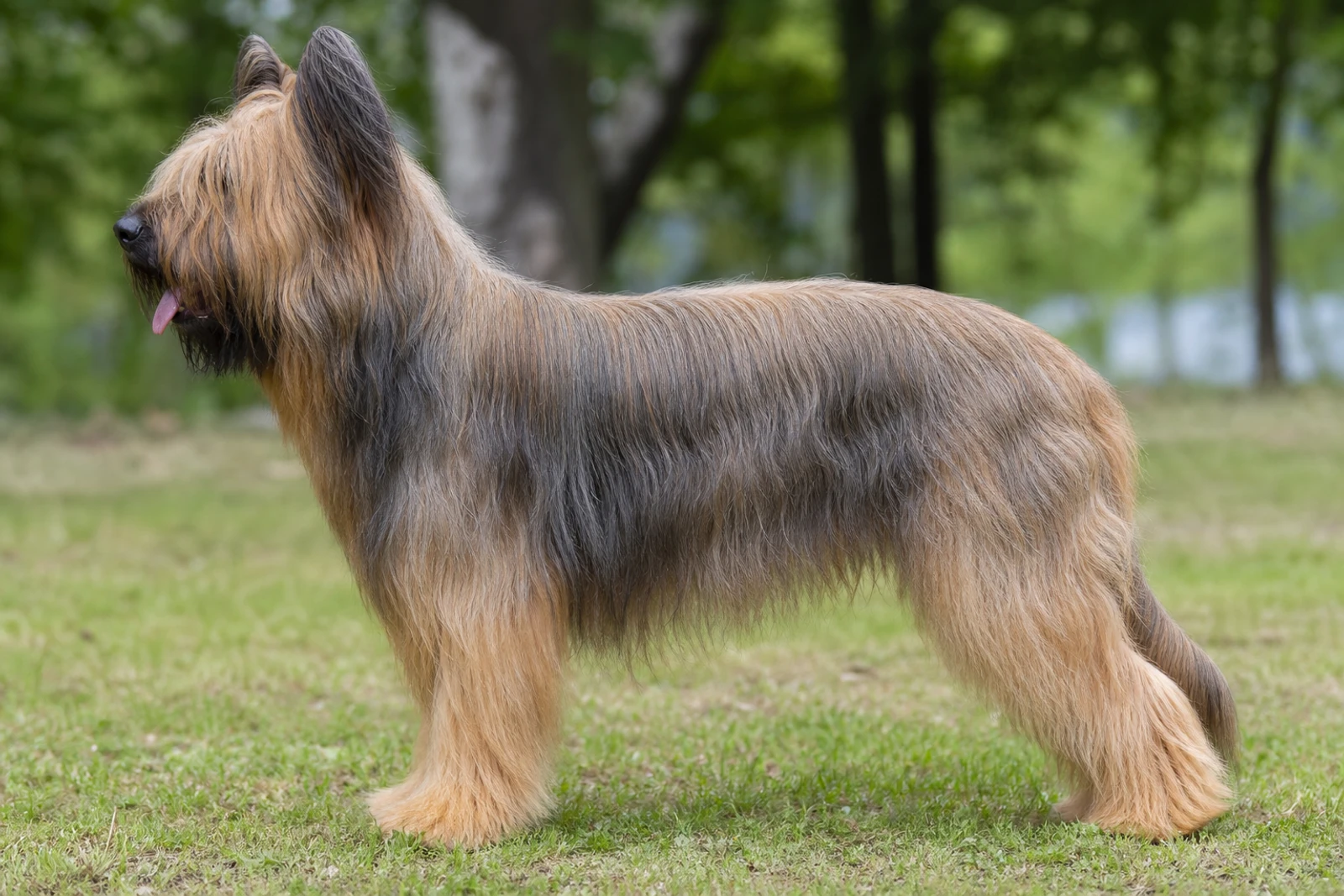
The Briard is a giant, loyal herding breed from France, best suited for active, experienced owners who can provide firm training and ample exercise. With a protective and affectionate nature, they form deep bonds with their families and are gentle with children, but their large size and energy demand a home with space. Their intelligence and independence require consistency; they excel in canine sports and as watchdogs. Requiring regular grooming, they are not ideal for first-time owners or apartment living.
At a glance
- Size
- Giant
- Height
- 23–27 in
- Weight
- 77 lb
- Life span
- 10 years
- Coat colors
- Black, Gray, Tawny
- Coat type
- Long, wavy double coat
How much does a Briard cost?
Adopt / rescue
$75–$400
Usually includes spay/neuter, first shots, and a microchip.
Buy from a breeder
$700–$2,000
From a reputable, health-testing breeder.
Approximate USD. Prices vary widely by region, breeder, pedigree, age, and coat colour — adopting is the lower-cost and recommended route. Avoid suspiciously cheap “breeders”; they’re often puppy mills.
Estimate the full cost of a Briard →Want the ongoing number? Estimate the monthly food bill for a Briard with our dog food cost calculator.
Briard photos
Views
Front, side, rear and top — the full silhouette.Poses
How the breed sits, lies, moves and plays.Puppy to senior
The breed across its whole life.Expressions
The breed’s range of moods.Close-up details
Eyes, ears, nose, paws, tail and coat.Coat colors
The breed’s recognized colors.Click any photo to enlarge. We show the Briard from every angle — three views, poses, life stages, expressions, close-ups, coat and colors.
Appearance & size
A Briard looks like the dog equivalent of a rugged French farmhand — built for work, not for fuss. These dogs are solid, muscular giants without being bulky. A male stands 23 to 27 inches at the shoulder, a female maybe a couple of inches shorter, and you’ll usually see them around 77 pounds, give or take. That weight sits on a rectangular frame: the body is longer than the dog is tall at the withers, which gives it the stretched-out, ground-covering trot you want in a herder that used to move flocks all day.
From the front, straight, heavy-boned forelegs drop down from a deep, wide chest. The neck is thick and well-muscled, carrying the distinctive long head like a battering ram. Eyes are dark and expressive, set under heavy brows that, along with a full beard and sweeping mustache, practically hide the muzzle. The ears are set high; in the U.S. you’ll see natural ears that fold over or cropped ears that stand upright — both are acceptable, but the cropped look used to be far more common in working lines.
Run your hand down the side and you’ll feel a slightly sloping back leading to a well-tucked belly and a low-set tail. The tail is a hallmark: covered in long hair, carried down with a little crook at the end that fans out like a feather duster. A Briard in motion from the side is a picture of easy, elastic power — the topline stays steady, the head stays level, and those long legs eat up ground.
Now walk around behind. The rear is wide and heavily muscled, and this is where you’ll spot the breed’s most famous structural quirk: double dewclaws on each hind leg. These aren’t just extra toes dangling around. A properly built Briard has two well-formed, closely spaced dewclaws placed low on the leg, each with its own toenail. They actually remain functional, giving the foot a broader base for quick turns on rough pasture.
The coat is the final piece. Double-layered, long, and slightly wavy — never curly — it falls flat and forms the beard, mustache, and protective fringe on the legs. The outer hairs are coarse to the touch, a real dirt-shedding coat. Colors come in three basic shades: black, tawny (a warm fawn to deep gold), or gray. A little white on the chest and toes is fine. Some tawnies and grays have a darker overlay across the back and ears, which adds to that rustic, unpolished look. This is a dog that looks hand-built for centuries of rough work, and it hasn't lost that edge.
History & origin
The Briard has been pushing sheep and guarding flocks in northern France for so long that pinning down an exact start date is a fool's errand. We’re talking about a dog that shows up in 8th-century tapestries and gets a shout-out in 14th-century writings from Gaston Phébus, a count who knew his hunting and herding dogs. By the time Napoleon was marching around Europe, the breed was already deeply embedded in the daily life of French shepherds, especially in the plains around Brie — though the name “Briard” came later, and likely from the region’s notoriety for cheese rather than the dog’s sole territory.
These dogs weren’t just pretty coats. They were the real deal: a dual-purpose farmhand that could move stubborn sheep across open ground on voice command and then turn around and take down a wolf or a trespasser without missing a beat. Their long, shaggy coat — often described as “goat-like” — provided serious armor against weather and teeth, and those distinctive double dewclaws on the hind legs weren’t a fashion statement. They acted like extra gripping toes, giving the dog uncanny agility when it needed to pivot fast while herding.
The first meaningful standard got hammered out in 1897 by the French herding dog club, and the Briard was one of the early members of the Société Centrale Canine’s official lineup. World War I nearly gutted the breed in its homeland. The dogs were drafted into service as sentries, messengers, and Red Cross search dogs, carrying medicine and supplies through trenches. They were so effective that their numbers plummeted from the front lines and the overall population took a heavy hit. After the war, dedicated French breeders slowly rebuilt from remaining stock.
In the United States, the Briard trickled in through a mix of returning soldiers and a persistent (if possibly apocryphal) tale that the Marquis de Lafayette shipped a pair to Thomas Jefferson. True or not, the American Kennel Club recognized the breed in 1928. Today, the Briard is still rare on this side of the Atlantic — you won’t trip over one at every dog park — but that scarcity has helped preserve its working temperament and no-nonsense structure.
Temperament & personality
A Briard doesn’t just live in your house — he runs the security detail while making it clear you’re his favorite project. This is a smart, big-hearted herding dog who views the family as his flock, and he takes the job seriously. Expect a dog who notices everything: an unfamiliar car in the driveway, the kids’ roughhousing turning too wild, or the cat sneaking onto the counter. You’ll get a low, rumbling alert bark before you ever hear the doorbell.
At 77 pounds of muscle and shaggy coat, he can be a lot of dog, but his energy is more purposeful than frantic. A Briard needs a solid hour of off-leash running, chasing, or structured play — not just a leisurely stroll — to stay cheerful and out of trouble. When that need is met, he settles indoors with a calm, watchful presence, often positioning himself where he can see the whole room. That protective streak is real, and he can be wary of strangers. Early, upbeat socialization takes the edge off, but don’t expect a tail-wagging greeter at the door on day one.
He bonds deeply with his people and thrives on interaction. A Briard left alone in the yard or ignored for hours may invent his own entertainment — barking, chewing, or even urine marking near doors and windows if he’s anxious. Since these dogs are strong-willed thinkers, heavy-handed corrections backfire. Instead, clear, respectful boundaries delivered with consistency earn you a partner who’s eager to work with you.
Watch his body language: a forward-leaning stance with a fixed stare isn’t curiosity — it’s a sign he’s assessing a potential problem. When he’s loose, soft-eyed, and leaning his shoulder into your leg, you’re in good shape. With kids, he’s naturally gentle but can be pushy with small children if nobody teaches him to ease up. Never let a child interrupt him while he’s eating — food guarding can appear if he feels his meals aren’t safe. Give him a quiet spot to chew a sturdy bone; that jaw strength needs an outlet, and a citrus or vinegar spray on forbidden items (couch legs, shoes) redirects him without drama.
Good with kids, dogs & other pets
A properly raised Briard is patient and gentle with kids — but at 77 pounds and up to 27 inches at the shoulder, that gentleness still needs ground rules. A rambunctious dog can easily knock a toddler flat just by leaning in for attention. Herding instinct adds another layer: circling, nudging, and the occasional heel nip are part of the package, not true aggression. You’ll need to redirect the chase-and-nudge routine from day one so small children don’t get startled or bruised.
Early socialization is the make-or-break piece. The critical window slams shut around 12–16 weeks. Before then, expose your Briard puppy to calm kids, well-mannered dogs, different surfaces, and everyday noises — always in short, positive doses. Without it, a naturally sensitive breed becomes wary and potentially reactive, which is a liability in a dog this size. Keep in mind the Briard’s high need for companionship: these dogs bond hard and don’t do well left alone for hours. In a family where someone is usually around, they settle into the pack role and stay steadier around children.
With other dogs, a well-socialized Briard generally gets along fine. They can learn polite greetings and co-exist peacefully with housemate dogs, especially when raised together. That said, their pushy herding style and size can irritate dogs who don’t appreciate being body-blocked. Same-sex tensions sometimes surface, particularly between intact adults; spaying or neutering helps, but it doesn’t erase the need for watchful introductions. If you’re adding a Briard to a multi-dog home, separate spaces and patient, structured meet-ups are non-negotiable.
Cats and small pets demand extra caution. The herding drive is strong, and a fleeing cat can fire up a chase that’s all instinct and zero malice. Puppies raised with a cat from day one often learn to coexist, but even then a sudden dash might trigger pursuit. With rabbits, guinea pigs, or poultry, always use a solid barrier. A 77-pound dog chasing in play can seriously hurt a small animal without meaning to. Harsh corrections around any pet backfire with a breed this sensitive — keep training upbeat, consistent, and respectful.
Trainability & intelligence
Trainability & intelligence
A Briard learns routines and commands fast—often after just a few reps—but that sharp mind comes with a strong independent streak. For centuries they were bred to guard and herd with minimal human hand-holding, so blind obedience isn’t in their wiring. You’ll have more success framing training as a partnership: clear communication, consistent rules, and a big paycheck of treats, play, or belly rubs when they get it right.
Punishment-based methods backfire badly here. A hard correction can turn a sensitive 77-pound dog anxious or shut down, and once trust is fractured, earning it back takes ten times the work. Instead, lean into positive reinforcement every single time. Mark the exact moment with a treat or a quick tug session, especially during the chaotic puppy phase. Early, reward-based work builds the kind of reliable recall you’ll need once that lanky adolescent body hits full speed.
Socialization has to start early and keep going. Between 3 and 14 weeks, expose the puppy gradually to different people, surfaces, sounds, and calm, vaccinated adult dogs. Don’t stop there—keep the experiences positive and ongoing so the adult dog doesn’t become guarded or reactive around unfamiliar situations. A Briard that missed this window can default to suspicion, which in a giant breed becomes a real management challenge.
Common sticking points you’ll see in training:
- Recall with distractions: The independent herding brain calculates whether coming back is worth it. Make “here” the most rewarding option every time—high-value treats, a squeaky ball, or a play party.
- Stubbornness masked as confusion: Briards sometimes act like they don’t understand a command they mastered yesterday. That’s usually a test of your patience, not a learning gap. Repeat the cue calmly, wait, and reward any small try.
- Sensitivity to tone: They read you like a book. A frustrated sigh or loud voice can make them hesitate. Keep your energy steady and upbeat, and you’ll get a dog who stays engaged rather than one who checks out.
Plan for multiple short sessions throughout the day rather than marathon drills. A two-minute training game using part of their dinner kibble does more for reliability than a high-pressure sit-stay marathon. The goal isn’t a robot; it’s a thinking, loyal dog that chooses to work with you because you’ve made it worth their while.
Exercise & energy needs
Plan on a bare minimum of 60 minutes of real exercise every day, and know that most Briards do far better with 90 minutes or more. These are giant, big-boned herding dogs who were built to cover miles alongside flocks, not stroll the neighborhood. Split the day into at least two deliberate sessions — a brisk 30‑ to 45‑minute morning walk or jog, then a longer off‑leash romp, hike, or active training block in the afternoon. Leaving a 77‑pound working dog to burn off steam alone in the yard almost guarantees you’ll come home to a hole the size of a laundry basket.
What counts as “real exercise” matters more than the clock. A Briard needs to get out of second gear — think running behind a bike, chasing a ball on a long sandy trail, swimming, or pulling a cart. Swimming is especially good because it protects growing joints while still wearing them out. For a dog this large, low‑impact options deserve a permanent spot in the rotation until growth plates close (somewhere around 18 months), and frankly long after that if you want to keep elbows and hips happy.
-
Mental work is not optional. The breed’s history is all about independent decision‑making while protecting a flock. Without that kind of problem‑solving, a Briard invents jobs you won’t like — herding the kids, barking at leaf‑blowers, or dismantling the couch seam by seam. Bake in 15 minutes of focused brain games daily: hide‑and‑seek with a favorite toy, scent trails in the yard, advanced obedience chains, or a stuffed puzzle toy that takes real effort to empty. A tired brain does more to settle this dog than a marathon walk ever will.
-
Dog sports they’ll throw themselves into. Herding trials are the obvious fit, but rally, tracking, carting, and even dock diving all scratch the same itch. Agility can work if you keep jumps low and prioritize tight handling over speed. A Briard won’t quit because you asked for one more rep — they’ll quit when their body gives out, so you have to be the one who reads the signs and calls it.
When a Briard’s exercise tank runs empty, the fallout is loud, creative, and exhausting. You’ll see demand barking, shadow‑chasing, and a hyper‑vigilance that turns quiet evenings into patrol duty. This is not a breed you can tire out on Saturday and coast through Monday. If you can’t offer two solid, active windows every day — rain, snow, or 95‑degree heat — you’re setting both of you up for a lot of frustration.
Grooming & coat care
That gorgeous, shaggy coat is a full-time job – plan on a solid 20–30 minutes of brushing every single day, no exceptions. The Briard’s double coat consists of a long, coarse, slightly wavy outer layer and a fine, dense undercoat that catches everything from burrs to biscuit crumbs. Skip a day and you’ll be cutting out felted mats by the end of the week.
Tools that actually work
- A slicker brush with rounded pins reaches the undercoat to pull out loose hair and prevent tangles from forming against the skin.
- Follow up with a pin brush or a long-toothed metal comb to work through the full length, section by section, from skin to ends.
- Keep a greyhound comb on hand for feathering behind the ears, down the legs, and on the tail – those spots mat the fastest.
Bathing and coat upkeep
Bathe every 4 to 6 weeks using a good canine shampoo. You must brush a Briard completely before they go near water; one wet snarl locks into a near-impossible mat. Towel-dry thoroughly, then use a high-velocity dryer (a human hair dryer won’t cut it) to blast out dead undercoat and prevent mildew in the dense fur. Never let a Briard air-dry while matted.
Trimming and tidy-up
Light trimming around the pads and between toes keeps mud, ice balls, and foxtails from lodging painfully. Otherwise, a Briard’s coat is meant to be left natural – no shaving, no scissor-happy shaping. The natural fall of the hair protects them from sun and weather.
Nails, ears, teeth
Those big paws need monthly nail trims; if you hear clicking on the floor, you’re overdue. Floppy ears trap moisture, so clean them weekly with a veterinarian-approved solution to ward off infections. Daily toothbrushing (or at minimum, 3–4 times a week) prevents the dental disease that cuts short many giant breeds’ lives.
Seasonal shed and skin checks
Twice a year the undercoat blows dramatically. You’ll up your brushing to twice-daily sessions for a few weeks and run a rake through the fleece to get ahead of the fluff tumbleweeds. Use every grooming session as a chance to run your fingers over the skin for lumps, bumps, or hot spots – a Briard’s thick coat hides problems easily, and early detection saves you a vet bill.
Shedding & allergies
Briards don’t leave tufts of fur on the couch the way a Labrador might — but that’s not because they don’t shed. Their long, slightly wavy double coat traps most dead hair against the body, so it stays in the dog instead of floating into the air until you brush it out. Skip the brushing, and that trapped hair forms tight mats that pull on the skin. You’ll keep things under control with a thorough line brushing two or three times a week, and daily sessions during the twice-yearly blowout when the undercoat releases in clumps.
For a giant breed, Briards are fairly dry-mouthed. You’ll notice a few drips after a long drink or on a hot day, but they’re not constant drool factories like some mastiff types. A towel near the water bowl handles it.
- Year-round shedding: low visible fallout, but the dead coat still accumulates and has to be brushed out manually.
- Seasonal blowout: heavy shedding of undercoat twice a year; expect to pull out literal handfuls of fluff during those weeks.
- Drool: low to moderate; mainly situational.
- Hypoallergenic reality: no. The coat holds dander close, which can mean less airborne fluff, but that doesn’t make the breed safe for allergy sufferers. Briard dander, saliva, and urine still contain the proteins that trigger reactions. If you’re allergic, spend time around several adult Briards indoors before you commit — your sinuses will tell you what a label can’t.
Diet & nutrition
What you put in the bowl directly affects this big dog’s joints and waistline. A Briard carries 77 pounds on a frame that works hard—every extra ounce adds strain on hips and elbows over a 10-year lifespan. Getting nutrition right means feeding for lean muscle, not for a food-motivated dog’s appetite.
Portion control and weight management
This is not a breed you can free-feed and trust to self-regulate. Many Briards will eat whatever you offer, and obesity creeps up fast if you don’t measure. Use a scale or accurate cup, split the day’s ration into two meals, and adjust based on how the ribs feel under your hands. A moderately active adult usually does well on roughly 1,800–2,200 calories a day, but your vet can dial that in. If your dog inhales meals, a puzzle bowl slows eating and adds a little brains to breakfast. For joint health, staying lean matters more than any supplement.
What to feed: a species-appropriate foundation
Dogs’ digestive systems are built on meat, so vegetarian or vegan diets won’t cut it. A high-quality commercial food with a named animal protein first is the simplest route. If you home-prepare meals, aim for about 60% raw or cooked meat, 20–30% puréed fruits and veggies, and 10% extras like eggs, plain yogurt, or grains. Puréeing or blending plant matter is worth the extra step—dogs lack salivary amylase and their jaws move vertically, so blending helps them actually absorb nutrients.
- White rice works as a bland carbohydrate for sensitive stomachs.
- Pearl barley adds digestible fiber.
- Unsalted vegetable cooking water can be saved as a meal base instead of plain stock.
Puppy feeding schedule and transitions
Puppy meals are split small and frequent: four times a day until four months, three times until six months, then twice a day like an adult. Start with a top-notch large-breed puppy food or gently cooked, puréed proteins, fruits, and vegetables. Move to a new diet gradually over 7–10 days to avoid upset. Raw chicken wings can be introduced around twelve weeks under close supervision—never leave a pup alone with a raw bone.
Senior years
Around age 7 or 8 your Briard is a senior. Don’t automatically cut protein, but smaller, more frequent meals can ease digestion. If teeth are worn or missing, purée the food to keep nutrients accessible. Watch the scale closely: as activity naturally declines, you’ll need to dial back portions little by little. Even a couple of extra pounds become a heavy burden on aging joints.
Kitchen habits that stick
Never feed directly from the table—begging is almost impossible to unlearn. Put any healthy leftovers into your dog’s own bowl after you eat, not during. Skip rich, fatty scraps; they can trigger pancreatitis. Batch-cook extra grains, vegetables, or lean proteins so you always have a ready-to-go meal foundation.
If your Briard is a food fiend, solid portion habits from day one and a puzzle feeder now will pay off with a decade of sound joints.
Health & lifespan
A Briard’s typical lifespan runs about 10 years, which is right in line with most giant breeds. Some live longer with excellent care, but you’re committing to a dog whose body ages fast. Every decision you make — from what you feed him to how you manage his joints — directly shapes those years.
Briards can be prone to a handful of inherited issues you’ll want on your radar. Hip dysplasia shows up regularly in the breed, as does elbow dysplasia. That 77‑pound frame puts real stress on developing joints, so keeping a puppy lean and avoiding high‑impact exercise on hard surfaces matters. Gastric dilatation‑volvulus (bloat) is a genuine emergency risk in deep‑chested giants like the Briard. Multiple small meals a day, a rest period after eating, and knowing the early signs can save a dog’s life. Eye conditions such as progressive retinal atrophy (PRA) and cataracts also appear, sometimes leading to night blindness or worse. Hypothyroidism is another possibility, often flagged by unexplained weight gain, skin changes, or lethargy.
Responsible breeders don’t guess. They screen breeding stock with OFA or PennHIP x‑rays for hips and elbows, annual eye exams by a veterinary ophthalmologist, and thyroid panels. Many also run cardiac evaluations. Ask to see the actual paperwork — health clearances aren’t optional extras.
Preventive care does a lot of the heavy lifting. Weight management is non‑negotiable; an overweight Briard multiplies joint strain and bloat risk. A thick double coat makes him sensitive to heat, so hot‑weather exercise happens early in the morning or not at all. Keep current on monthly heartworm prevention during mosquito season and for a month after, and stay up on the legally required rabies vaccine. Annual wellness exams give your vet a chance to pick up subtle shifts before they turn into crises — a slight change in gait, a weight dip, a cloudy eye. For senior Briards, bump those visits to twice a year and never ignore small behavior changes like reduced activity or a picky appetite. When you catch issues early, you give yourself options that don’t exist once things are advanced.
Living environment
A Briard does best in a house with a securely fenced yard, not an apartment. At 23–27 inches tall and around 77 pounds, this is a giant-breed herder built for motion, and a quick stroll around the block won’t come close to meeting its needs. Plan on two substantial daily sessions — at least 45–60 minutes each — that combine physical work with real mental engagement: herding games, scent work, advanced obedience, or puzzle toys. If you skimp, a bored Briard will invent its own jobs, and you probably won’t like the results.
The yard itself needs a tall, sturdy fence (six feet isn’t overkill). A strong herding instinct and an independent streak mean a Briard will test boundaries and may decide to patrol the neighborhood on its own. Invisible fencing rarely stops a dog this determined.
That shaggy double coat handles cold, damp weather beautifully — snow and chilly mornings barely register. Heat is the real challenge. In summer, exercise early or late, keep him in air-conditioned spaces, and always have shade and fresh water ready. This isn’t a breed that can safely lounge in a hot yard for hours.
As for noise, Briards are naturally watchful. They will bark when someone approaches the door, and that makes them excellent guardians. Left alone and under-stimulated, however, the barking can swell into a constant backdrop. Consistent training for “quiet” and ample daily exercise keep it to a useful alert rather than a nuisance.
Tolerance for alone time is low. A Briard bonds intensely with his people, shadowing you room to room when you’re home. Long workdays with no one around can trigger real separation anxiety and destructive behavior. Crate training, gradual desensitization, and a midday walker help, but this breed thrives when someone is around most of the day. If your schedule keeps you away from morning to evening, a Briard will struggle deeply. A tired, mentally satisfied Briard with a yard and near-constant company becomes a calm, affectionate partner. Deprive him of that, and you’ll quickly see a stressed, noisy, and destructive side.
Who this breed suits
The Briard fits a narrow but deeply rewarding niche: an owner who wants a giant, thoughtful herding breed and is ready to treat the dog like a full-fledged hobby. This is not a sofa-surfing companion. A Briard needs real work, real training, and a real relationship.
Who should jump in
- Experienced dog people who enjoy a challenge. You’ve raised a working or guardian breed before and understand that “smart” comes with an independent streak. You’re not looking for blind obedience; you respect a dog that evaluates situations and occasionally negotiates.
- Active singles or couples with outdoor routines. A Briard’s minimum is 60–90 minutes of vigorous exercise daily — running off-leash, advanced fetch, herding games, or long hikes, not just a neighborhood walk. They thrive when they can move with you for a solid chunk of the day.
- Families with older, dog-savvy kids. The breed is loyal and protective, but a 77-pound dog with a swift, sweeping gait can accidentally knock over a toddler. School-age children who can follow rules about not startling a sleeping giant fit much better.
- “Do everything together” owners. Briards bond fiercely and will shadow you from room to room. If you work from home, have a large fenced yard, or want a partner for nearly every errand and trip, you’ll get the intense loyalty the breed is known for.
Who should think twice
- First-time dog owners. The Briard’s combination of size, strength, intelligence, and stubbornness is a lot to manage. Without solid timing and consistency in training, you can end up with a pushy, resourceful 77-pound problem-solver who runs the household.
- Apartment dwellers or the house-proud minimalist. The coarse, double-layered coat requires 20–30 minutes of brushing several times a week, plus professional grooming every 6–8 weeks. You’ll also deal with muddy paws on rainy days and a steady supply of nature brought inside on that long, feathery coat.
- People who want an instant off-switch or a dog that’s friendly with everyone. The Briard’s default with strangers is reserved and watchful, not openly hostile but never a tail-wagging greeter. Socialization helps, but expecting a Golden Retriever temperament will leave both of you frustrated.
- Those with small pets or fragile backyard setups. The herding instinct runs deep, and without a trained outlet, you may see circling, nipping at heels, and chasing behavior directed at cats, rabbits, or even other small dogs.
- Anyone unprepared for a shorter lifespan. Ten years is typical for a giant breed. That’s many fewer years than a medium-sized dog, and with size come potential joint issues and the heartbreak of a more compressed timeline.
A Briard won’t suit most households, and that’s the point. If you read this and felt energized rather than deterred, you’re the kind of person who might earn the breed’s wholehearted devotion.
Cost of ownership
Bringing a Briard home means taking on a giant breed with giant-sized ongoing expenses. From the moment you sign the contract, you’re looking at a real financial commitment — one that goes well past the purchase price.
Upfront cost
A puppy from a responsible breeder who screens for hip dysplasia, eye disease, and bloat risk typically falls in the $1,800–$3,000 range. Show-prospect pups or those from exceptional working lines can push higher. Adopting through a Briard rescue usually runs $300–$600 and often includes spay/neuter and initial vaccines. Don’t forget the one-time hit for gear: a crate sized for a 77-pound dog, sturdy bowls, a raised feeder (to help reduce bloat odds), grooming tools, and a few initial training classes will easily total $400–$600.
Monthly food bill
A full-grown Briard eats like the athlete he is. Plan on 4–6 cups of high-quality kibble a day — roughly a 30-pound bag every three weeks. That works out to $70–$90 a month for a premium large-breed formula. Raw or fresh food diets can double that figure. Treats for training and chews to keep those jaws busy add another $10–$20 a month.
Grooming costs you cannot skip
That shaggy double coat is a mud magnet and mat machine. Between professional grooms every 6–8 weeks at $80–$120 a visit, you’re averaging $50–$80 a month. If you learn to do it yourself, the upfront investment in a good pin brush, slicker, greyhound comb, and a high-velocity dryer will sting once, but the long-term savings are real. Either way, you’ll still burn through detangling spray and dog shampoo regularly.
Veterinary and health
Routine care — annual exams, DHPP and rabies shots, heartworm and flea/tick prevention — lands at $600–$800 a year for a giant dog. Add a few hundred more if your vet recommends early gastropexy alongside spay/neuter to lower torsion risk. Briards can be prone to hip dysplasia and eye issues like progressive retinal atrophy; even well-bred dogs can develop them. That’s why pet insurance is worth a hard look. A comprehensive plan for a Briard typically runs $45–$75 a month depending on deductible and coverage limits. Without insurance, set aside at least $1,000–$2,000 in an emergency fund for unexpected diagnostics or surgery.
Training and ongoing enrichment
An untrained, bored 77-pound herding dog is not a cheap problem. A basic group obedience class will be $150–$200, and many owners wisely follow up with an advanced class or private sessions at $75–$125 a pop. Puzzle toys, scent work kits, and replacement chew items add another $20–$40 a month to keep that clever brain happy.
All told, expect your monthly outlay to hover around $200–$300 for a healthy Briard, not counting emergencies or luxury upgrades like doggy daycare.
Choosing a Briard
Breeder or Rescue: Start with Transparency
Decide early whether you want to bring home a Briard puppy from a breeder or give a second chance to an adult through rescue. Both paths work, but they demand different effort. A responsible breeder will grill you harder than you grill them—expect detailed questions about your home, yard, and lifestyle. If you can’t find a breeder who meets the standards below, a Briard-specific rescue is a solid alternative. Just know that adult dogs may arrive with habits you’ll need to untrain, and some have never lived indoors.
Health Clearances You Should Demand
Giant breeds pack a lot of growth into a short window, and the Briard’s 10-year average lifespan means every hereditary screen counts. Ask to see original documentation—never just a vet’s note—for both parents. Minimum clearances for a Briard:
- Hips: OFA or PennHIP evaluation. “Fair” or better rating is the norm.
- Elbows: OFA clearance. Elbow dysplasia sneaks up in fast-growing pups.
- Eyes: Annual CAER exam by a veterinary ophthalmologist, looking for cataracts, progressive retinal atrophy (PRA), and congenital stationary night blindness (CSNB). A one-time DNA test for CSNB is also available and should be clear for at least one parent.
- Thyroid: OFA thyroid panel from a recognized lab. Even borderline values can impact a giant breed.
- Cardiac: Echocardiogram clearance, because dilated cardiomyopathy has been documented in the breed.
A breeder who waves off any of these or claims “my lines are healthy” without paperwork is showing you a red flag.
Red Flags That Send You Elsewhere
Walk away if you see: no health clearances, multiple litters on the ground at once, puppies available for immediate shipping with a credit card, parents you can’t meet (mother on premises, ideally father too), or a contract that reads like a warranty for a toaster. A Briard puppy raised in a sterile kennel without household sounds and handling will struggle in a family home. The breeder should ask as many questions about you as you ask about the dogs.
Picking Your Puppy
You’re choosing a 77-pound dog that will stand knee-high and think independently. Spend at least an hour with the litter. Put the boldest puppy aside and watch the one who hangs back to study you first—that observant, slightly reserved mind is classic Briard. Avoid the extremely shy or fear-reactive pup; nerves in a giant dog are a management nightmare. A solid breeder will have done early neurological stimulation and begun crate and sound exposure. Ask to see those notes, then trust what your gut tells you about the pup who calmly engages with your kids or sits at your feet.
Pros & cons
-
Protective, deeply devoted family guardian: The Briard’s historic job was to guard the flock independently, so he naturally watches over his people with calm, self-assured vigilance. He’s known for forming an almost uncanny bond with his family, especially with children he treats as his charges.
-
Sharp, biddable mind: These dogs solve problems and thrive on training that challenges them mentally. They don’t obey by rote — they want to work with you, which makes them standouts in advanced obedience, herding trials, and dog sports.
-
That unforgettable look: The long, slightly wavy coat, thick beard, expressive eyebrows, and fluid, elegant gait give the Briard a distinctive, almost rustic charm that turns heads even among other large breeds.
-
Moderate exercise needs for a giant: Expect to provide a good run or a brisk 45–60 minute walk daily. Once that’s done, they’re generally calm indoors and happy to lounge — no marathon distances required.
-
Coat care is a serious commitment: That gorgeous hair mats fast. Plan on thorough brushing and combing 3–4 times a week, plus a full line-combing session weekly to prevent painful tangles. You’ll also be picking debris out of that coat after every outdoor adventure.
-
A short life expectancy of about 10 years: As a giant breed, the Briard’s lifespan is limited. Responsible breeders screen for hip dysplasia and bloat, but you’re likely to face heartache sooner than with smaller dogs.
-
Independence with a stubborn streak: The same brains that make them trainable also mean they’ll question commands they find pointless. They respond to firm, consistent, gentle handling; harsh correction can cause them to shut down completely.
-
Not a dog for everyone: Without extensive socialization from puppyhood, they can be reserved and suspicious with strangers and other dogs. That protective instinct can slide into reactivity if introductions aren’t managed carefully.
-
Herding drive can be a handful: Briards often use their body and mouth to “steer” moving kids or pets — a behavior that can startle visiting friends. Teaching a soft redirect is essential, especially in a bustling household.
Similar breeds & alternatives
If you’re drawn to the Briard’s loyal, protective nature but want a different coat or a slightly different temperament, a few other large herding and working breeds are worth a look.
Beauceron
The Beauceron is the Briard’s shorter-coated French cousin, and the two share more than a passport. Beaucerons also have rear double dewclaws, stand 24–27 inches tall, and usually weigh between 70 and 110 pounds. They’re intensely devoted to their people and naturally reserved with strangers, but the Beauceron tends to be more assertive and serious—this is a dog often used in personal protection and police work. The short, dense coat is a huge plus if you’re not up for the Briard’s weekly detangling sessions; a quick weekly brush handles the shedding. Expect a confidence that borders on stubbornness, so early, consistent training is non-negotiable. They’re generally sound, with a lifespan of 10–12 years, and need a job just as urgently as a Briard does.
Bouvier des Flandres
The Bouvier is a rugged, bearded herding dog with a calm-yet-watchful demeanor that can feel like a less reactive version of a Briard. Both breeds have a protective streak and a deep bond with their family, but the Bouvier typically brings a steadier, more even-keeled energy indoors—content to lounge after a good walk, whereas a Briard often stays switched on. Size is similar (23.5–27.5 inches, 70–110 pounds), and the Bouvier’s thick double coat also demands dedicated grooming, though you trade the Briard’s long waves for a rougher, tousled texture. You’ll still spend time with a brush and scissors, and the beard needs regular clean-up. A well-bred Bouvier is biddable and surprisingly gentle with kids, but don’t mistake the calm for low exercise needs; they still require a solid hour of daily activity.
Belgian Tervuren
If you love the Briard’s elegant long coat and alert expression but want a lighter, more agile dog with a little less protective intensity, the Tervuren fits. These dogs are smaller (22–26 inches, 45–75 pounds) and carry a finer, mahogany-and-black coat that sheds heavily year-round. They’re wicked smart and deeply handler-focused, but they lean sensitive rather than hard-headed. A Tervuren will learn a routine in one repetition, but they can shut down under harsh handling—you’ll need a softer touch than a Briard sometimes requires. Energy is extreme; plan for more than an hour of running, not just walking. They often live 12–14 years, longer than the Briard’s typical 10, but that also means managing separation anxiety in a dog that wants to be with you every waking moment.
Giant Schnauzer
For someone who wants the Briard’s imposing presence and protective instincts but prefers a wiry, non-shedding coat, the Giant Schnauzer is a serious alternative. At 23.5–27.5 inches and 55–85 pounds, it’s comparable in size. The difference is in drive: a Giant Schnauzer tends to be more territorial, more intense, and less forgiving of an unstructured home. They need exhaustive daily work—think advanced obedience, protection sports, or herding—to stay sane. The Briard can be willful, but a Giant will run the house if you’re not a step ahead. The wiry coat requires hand-stripping or clipping every 6–8 weeks, but it doesn’t leave hair on the furniture. With a lifespan of 12–15 years, they’re a longer commitment than the Briard, and not a breed for a first-time owner looking for an easygoing guardian.
Fun facts
- Bred in France for herding and guarding sheep.
- They have double dewclaws on each hind leg.
- Thomas Jefferson owned and brought the first Briard to America.
- Served as messengers in World War I.
Frequently asked questions
- Are Briards good family dogs with children?
- Briards are known for their affectionate and protective nature, making them excellent family companions when properly socialized. They tend to be gentle and patient with children, but due to their large size and herding instincts, supervision is recommended, especially with very young kids. Early training and consistent boundaries help them integrate well into family life.
- Do Briards shed a lot?
- Briards have a long, double coat that does shed moderately, but their hair tends to be less allergenic than many other breeds. They require regular grooming to manage loose hair and prevent matting, so shedding can be controlled with consistent brushing. Expect some shedding year-round with heavier seasonal blows.
- How much exercise does a Briard need?
- As an active herding breed, Briards need at least 60–90 minutes of vigorous exercise daily to stay happy and healthy. They thrive on activities like running, hiking, agility, or obedience work, and mental stimulation is equally important. Without sufficient exercise, they may become bored and potentially destructive.
- What grooming routine is typical for a Briard?
- Their long, coarse outer coat and fine undercoat need thorough brushing several times a week to prevent mats and tangles. Many owners opt for a professional grooming session every 6–8 weeks to maintain coat health. Regular ear checks, nail trims, and teeth brushing are also part of the care routine.
- Can Briards live comfortably in an apartment?
- Briards are not ideally suited to apartment living due to their large size and high energy levels; they do best in a home with a securely fenced yard. However, with an exceptionally dedicated owner who provides multiple daily outdoor excursions and mental enrichment, they can adapt. Even then, their protective barking might disturb close neighbors.
- Are Briards a good choice for first-time dog owners?
- Briards can be a challenging breed for first-time owners because they are independent thinkers with strong guarding instincts that require experienced handling and consistent training. They bond deeply with their families but need a confident leader to manage their stubborn streak. A first-timer may find their grooming needs and exercise demands overwhelming.
Tools & calculators for Briard owners
Quick estimates tailored to Briards — pre-filled with this breed’s size where it matters.
Articles & stories about the Briard
Sources & standards
This profile follows recognized breed standards from the American Kennel Club (AKC) and the Fédération Cynologique Internationale (FCI), along with established veterinary and breed-club guidance. These describe general breed tendencies — every dog is an individual.