

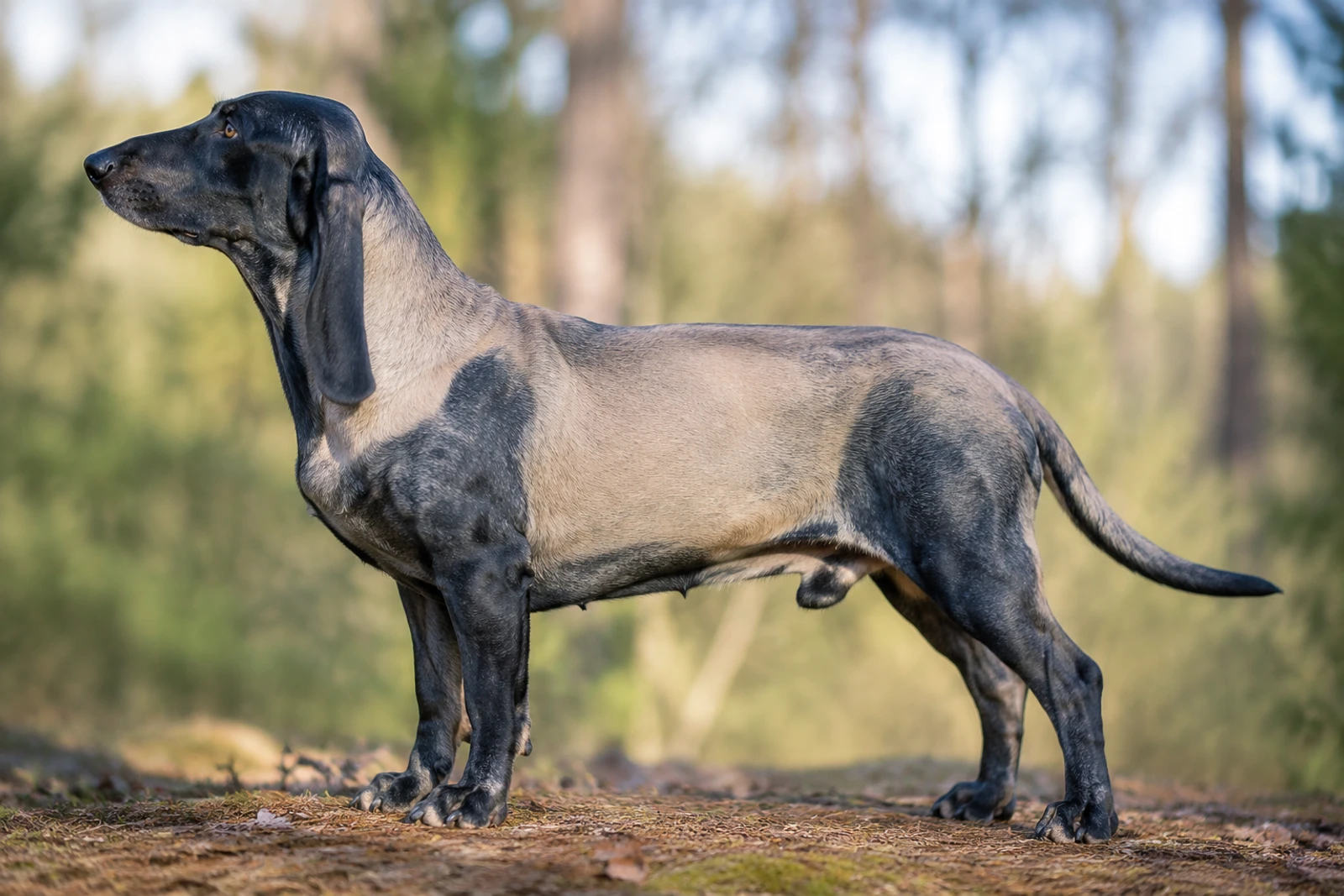
The Bruno Jura Hound is a Swiss scenthound bred for hunting, ideally suited to active individuals or families with outdoor lifestyles. This breed thrives with plenty of exercise and mental stimulation, making it a poor fit for apartment living. Calm and affectionate indoors when sufficiently worked, it bonds closely with its people but retains an independent streak. Its strong prey drive demands a secure yard, and while it's generally good with children and other dogs, cats may not be safe. Best for experienced owners who can manage its vocal nature and need for routine.
At a glance
- Size
- Large
- Height
- 18–22 in
- Weight
- 35–44 lb
- Life span
- 10–11 years
- Coat colors
- Black and tan
- Coat type
- Short, dense, smooth
- Group
- Scenthounds
How much does a Bruno Jura Hound cost?
Adopt / rescue
$75–$400
Usually includes spay/neuter, first shots, and a microchip.
Buy from a breeder
$700–$2,000
From a reputable, health-testing breeder.
Approximate USD. Prices vary widely by region, breeder, pedigree, age, and coat colour — adopting is the lower-cost and recommended route. Avoid suspiciously cheap “breeders”; they’re often puppy mills.
Estimate the full cost of a Bruno Jura Hound →Want the ongoing number? Estimate the monthly food bill for a Bruno Jura Hound with our dog food cost calculator.
Bruno Jura Hound photos
Views
Front, side, rear and top — the full silhouette.Poses
How the breed sits, lies, moves and plays.Puppy to senior
The breed across its whole life.Expressions
The breed’s range of moods.Close-up details
Eyes, ears, nose, paws, tail and coat.Coat colors
The breed’s recognized colors.Click any photo to enlarge. We show the Bruno Jura Hound from every angle — three views, poses, life stages, expressions, close-ups, coat and colors.
Appearance & size
If you picture the classic tricolor hound from old hunting prints, you’re already halfway there. The Bruno Jura Hound is a medium-framed scenthound that carries itself with a quiet, no-nonsense sturdiness. Males and females stand between 18 and 22 inches at the shoulder; weight lands in a dense, muscular 35 to 44 pounds. That puts them squarely in the “large” category for a hound of this height—you feel the solidity when you put a hand on their ribcage. The back is straight and strong, the chest deep but not barrel-wide, giving them the lung room for hours of tracking without getting rangy or top-heavy.
The coat is a hard, close-lying double layer built to shed brambles and weather. It’s short all over, with no feathering or fringe, which means a quick rubdown after a wet outing is usually enough. The standard color is a rich tricolor: a deep black saddle or blanket across the back, vivid tan markings on the cheeks, chest, legs, and under the tail, and crisp white on the muzzle, blaze, neck, chest, and feet. Some dogs show heavier black, others more open white; all are equally correct.
Two features anchor the look. The head is noble and elongated, with a slight stop and a substantial muzzle that never looks snipey. The eyes are dark and calm, set well apart. The ears are unmistakable: long, set low, and hanging in soft folds that reach at least to the nose tip when pulled forward. They frame the face and funnel scent toward the nose.
From the front, the hound appears balanced and clean, with straight forelegs and tight feet. The white chest blaze and tan eyebrows often give a four-eyed effect. From the side, you see a level topline, a slight tuck-up, and strong, moderate rear angulation—no exaggerated slope. The tail is a saber-like extension of the spine, thick at the base and tapering, carried level or with a slight upward curve when the dog is moving. From behind, the hind legs stand parallel, the hips are broad but not heavy, and the tail hangs down at rest.
Everything about the Bruno Jura Hound’s appearance says functional hunter: no extremes, no flash, just a dog whose body is honestly built for its job.
History & origin
The Bruno Jura Hound doesn’t come from a single dramatic origin story — it was shaped over centuries by hunters working the steep, forested slopes of the Swiss Jura Mountains. This is a pocket of Europe where limestone ridges, deep ravines, and long, hard winters demanded a dog with extraordinary endurance, a faultless nose, and the independence to work out a cold trail without constant direction. The local hounds that eventually became the Bruno type trace back to ancient Celtic running dogs bred by the Helvetii, later crossed with French and St. Hubert hounds brought through Burgundy during the Middle Ages. For generations, no one cared much about uniform looks. What mattered was a deep, ringing voice that carried for miles and a dog tough enough to hunt hare and fox from dawn until the hunter called it off.
The name “Bruno” got pinned to the smooth-coated Jura Hound in the early 20th century, largely thanks to the methodical breeding work of E. Bruno, a butcher and hound enthusiast from Delémont. He aimed to stabilize a short-haired type that handled wet underbrush better than the rough-coated variety and dried off faster in the region’s frequent rain. By selecting for a sleek, close-lying coat — while keeping the long ears, melancholy expression, and that unforgettable bell-like bay — he created a distinct variety that quickly caught on with local hunting clubs. The Swiss Scenthound Club recognized it as a separate breed in 1933, separating it from its rough-coated cousin, the St. Hubert Jura Hound.
Bred to work solo or in small packs, these dogs didn’t rely on speed. They were built to methodically unravel a scent trail for hours, sometimes a full day, over scree fields and through fog so thick you couldn’t see the dog thirty yards ahead. Their remarkably loud, harmonious voice let the hunter track the pursuit even when the hound disappeared into a valley. Today, the Bruno Jura Hound remains a working hunter’s secret, rarely seen in city dog parks or suburban backyards. Its numbers stay low — only a few hundred exist worldwide — and the breed is still primarily owned by Swiss and French hunters who use it exactly as it was meant: a quiet-at-home companion that transforms into a tireless, single-minded tracker the moment it hits a game trail.
Temperament & personality
A Bruno Jura Hound lives inside a smell. The whole world scrolls past his nose first, and when a good scent grabs him, your voice becomes background noise. It’s not disobedience as much as a factory-installed override. You’ll need patience—and a routine that taps that nose daily—to build a reliable partnership. Force doesn’t work well here; a calm, steady hand and rewards that smell interesting (think tiny bits of cheese or sausage) get a lot further.
At home, he’s a solid, even-tempered presence. He bonds tightly with his people and is typically gentle and tolerant around children, though early socialization seals the deal. He won’t shadow you from room to room, but he’ll notice if you’re gone too long. Left isolated, this hound easily reheats anxiety into a loud, throaty baying concert that your neighbors won’t appreciate. A household where someone is around most of the day, along with another easygoing dog, suits his pack-oriented mind best.
He’s a scenthound, so the voice is part of the package—think of it as a built-in doorbell with built-in bass. He’ll announce visitors, interesting squirrels, and the mail carrier’s footsteps three blocks away. If he’s bored, that melodic howl becomes his full-time hobby.
Exercise means more than a leash walk. A Bruno Jura Hound needs a solid hour of purposeful movement where his nose runs the show: a long hike with plenty of snuffle stops, a tracking game in the yard, or a hide-and-seek session with his favorite toy. Physical exhaustion matters less than mental nose-work. Without it, he’ll find his own job, and it might involve rolling in something truly foul. Yes, rolling in dead things is a scenthound’s version of haute couture—ancestral leftovers, maybe, or just a smell he thinks is fantastic. Keep a towel by the door.
Scent rules the bathroom, too. He reads urine marks like a community bulletin board and will gladly post his own. Once a spot smells like a hound bathroom, his spatial memory flags it for a repeat visit. Catch him in the act outdoors, throw a party with a treat, and the problem shrinks. Indoors, clean carefully (his nose will find a molecule you’ll miss), but don’t punish an accident; that only teaches him to hide it, not stop it. He thrives on positive, clear feedback—harsh corrections make him skittish and harder to reach.
Other dogs are usually welcome company; packs run in his blood. A cat he’s raised with can be family, but a fleeing squirrel flips the prey-drive switch instantly. A good fence is non-negotiable.
Get his nose tired, keep him around his crew, and you’ll have a calm, content hound who leans against your leg and sighs at the end of the day. Ignore that massive scent engine, and he’ll sing you a song you weren’t hoping to hear.
Good with kids, dogs & other pets
A Bruno Jura Hound is built for teamwork. Bred to hunt in packs, these dogs tend to be relaxed and tolerant with other dogs and surprisingly patient with children. The flip side is that they crave constant company—leave one alone for long stretches, and you’ll see a dog who paces, howls, or chews the couch. A family where someone is usually home fits them best.
With kids, a 35–44 lb hound is sturdy enough to handle clumsy hugs, but not so big that a happy tail-whip sends a toddler flying. They’re non-aggressive and rarely quick to snap. Still, you’ll want to supervise early interactions and teach children not to yank floppy ears or interrupt a meal. The real risk isn’t aggression; it’s that an overexcited dog might knock a small child over during a game.
Around other dogs, they’re generally friendly and read social cues well. A Bruno Jura Hound raised with another dog often forms a tight bond. If you’re introducing a new adult, go slow and meet on neutral ground first. Because these dogs are sensitive, a harsh scolding from a cranky older dog can linger far longer than you’d expect.
Small pets get tricky. Scenthounds come with strong prey drive, and that nose overrides obedience training when a cat or a pet rabbit dashes by. Some individuals learn to live peacefully with a cat they’ve grown up with, but that’s not a guarantee. Always separate them when you leave the house, and never trust this breed off-leash around a guinea pig or chicken.
Early socialization isn’t just a checkbox for this breed—it’s the foundation for a levelheaded adult. Start between 3 and 14 weeks, gently exposing your pup to kids of different ages, friendly vaccinated dogs, car rides, and the everyday racket of a home. Use treats and upbeat voices, never force a scary situation. A Bruno Jura Hound that misses this window can become timid or sound-sensitive, and pushing an already fearful adult into a dog-park mob only makes things worse.
If you’re away most of the day, this isn’t your dog. The Bruno Jura Hound needs a household where companionship is built into the routine—not something he gets only after work.
Trainability & intelligence
The Bruno Jura Hound is whip-smart in the way all good scenthounds are — she can untangle a cold trail, make independent decisions out ahead of you, and remember where the rabbit turned left three miles back. What she won’t do is hang on your every word waiting for direction. This is a breed built to hunt away from the handler and trust her own nose. Training works when you respect that independence, not fight it.
Start the day you bring that big-pawed puppy home. A 10-week-old who gets to offer a sit for a piece of chicken learns fast that cooperating with you pays. Keep sessions short — five to ten minutes — because a Bruno Jura Hound’s concentration gets hijacked the instant a scent drifts through the window. Use reward-based methods only. High-value treats, a squeaky ball, a cheerful voice — these build the partnership that keeps a 40-pound hound motivated. Harsh corrections or punishment shut her down and erode trust, and a dog who no longer trusts you will simply follow her nose and ignore the recall cue you need most.
The biggest training hurdle is the off-switch you never truly get. Recall, especially, requires lifelong proofing. When a deer pops over the ridge, your voice competes with 10,000 years of olfactory programming. Build a “come” cue that means something irresistible — roast beef, a tug toy, a full-on party — not just a demand. Practice in fenced spaces before ever expecting it to hold up in the woods.
Early socialization belongs right alongside obedience. Between 3 and 14 weeks, gently expose the puppy to different people, friendly dogs, clattering pans, foot bridges, and city streets. A Jura Hound who learns the world is mostly boring and occasionally wonderful shakes off surprise far better than one kept home until six months. Continue those positive introductions into adulthood; this isn’t a breed that automatically loves every stranger, and careful exposure prevents the fearfulness that can harden into reactivity.
Train the dog in front of you, not the one you imagined. You’ll get farther by channeling the nose — teach a “find it” game, hide scent articles, let her track a hot dog slice across the yard for a jackpot — than by drilling stationary commands until you’re both bored. If you accept that perfect off-leash obedience will always be a negotiation with the breeze, you’ll end up with a confident, trusting partner who’s sharp enough to learn whatever you can make worth her while.
Exercise & energy needs
This dog doesn’t just need to stretch his legs — he needs to work his nose. A couple of brisk leash walks around the block won’t cut it. Plan on a solid 60 to 90 minutes of daily exercise, split into at least two sessions. One of those should be a long, meandering walk where he can sniff every bush and fence post without being rushed. Scent tracking burns mental energy just as fast as a run burns physical energy.
- Intensity: Moderate. The Bruno Jura Hound has the steady trot of a true scenthound, not the frantic sprint of a herding breed. He’ll happily keep pace on a long hike or jog alongside a bike, but short bursts of all-out running on hard surfaces aren’t his thing — too much repetitive impact can strain developing joints, especially before growth plates close around 18 months.
- Mental fuel: Thirty minutes of focused nose work can leave a hound more satisfied than an extra mile on pavement. Hide smelly treats in the yard, play “find it” inside the house, or lay out a simple scent trail with a drag rag. Puzzle toys and frozen Kongs help, too, but nothing replaces actual sniffing.
- Good outlets: Long-line walks in a safe open space let him follow scents without the risk of bolting after a rabbit. Hiking on soft trails, canicross at an easy pace, and structured tracking classes all slot right into his natural wiring. On rainy days, indoor nose-work games and short training bursts (5–10 minutes) keep frustration from building.
- What happens without it: A bored Bruno Jura Hound becomes a loud, inventive one. He’ll howl, dig under fences, or shred cushions — not out of spite, but because that drive needs a job. Skipping exercise also dials up anxiety and hyper-alertness at home.
Keep the rhythm consistent. Two 30-minute sniffy walks morning and evening, plus a 15-minute brain game session, lands in the right zone for most adults. Puppies need shorter, age-appropriate bursts to protect growing bones, while seniors still require the mental engagement even if the distance drops.
Grooming & coat care
The Bruno Jura Hound wears a short, dense double coat built for all-weather tracking — and that means he sheds more than you might guess. A weekly pass with a pig-bristle brush or a rubber curry mitt grabs dead hair before it ends up on your couch, and it distributes natural oils for a healthy shine. When the seasons shift, expect a full coat blow that can surprise first-time owners; during those two or three weeks in spring and fall, daily brushing with a slicker or curry keeps the flurries manageable and stimulates fresh coat turnover.
Bathing rarely needs a set schedule. These hounds have a naturally water-resistant coat, so over-washing strips those protective oils. A rinse with clean water after a muddy run, plus a shallow bath every few months — or when he rolls in something truly foul — is plenty. Always dry the ears thoroughly afterward, because floppy, close-hanging ears trap moisture and invite infection.
You won’t ever need scissors or clippers on this coat. It stays the same length year-round, simple and tight. Just check under the collar and arm pits for stray burrs after a walk.
Ears, nails, and teeth demand more attention than the coat itself. Floppy ears need a weekly sniff-and-wipe with a damp cotton ball; any yeasty odor or redness signals a vet visit. Nails grow fast on a dog bred to cover miles — if you hear clicking on hard floors, a trim is overdue, usually every 3–4 weeks. Teeth benefit from a quick scrub two or three times a week to fend off the gum issues large breeds can develop.
Regular outdoor exercise reinforces what good grooming starts. The physical work of a long run in the woods pushes the natural shedding cycle along, reducing the “drifts of hair” that collect behind doors. Make ear checks part of your post-hunt or post-hike ritual, and you’ll catch problems before they take hold.
Shedding & allergies
If you picture a short-coated dog and think "easy on the furniture," the Bruno Jura Hound will keep you humble. This dog sheds. The coat is short, dense, and weather-resistant — perfect for working Alpine trails — but it drops a steady trickle of hair year-round, and twice a year that trickle turns into a confetti cannon.
- Year-round shedding: Expect fine, dark hairs to collect on light-colored fabrics. A weekly going-over with a rubber curry brush or a grooming mitt grabs loose undercoat before it lands on your floor. You’ll still need a lint roller in the car.
- Seasonal blowout: In spring and fall, the undercoat comes out in tufts. During those weeks, daily brushing cuts the mess considerably. A bath with a deshedding shampoo can also loosen dead fur, but you’ll be pulling hair out of the drain catch.
- Drool factor: Not at Bloodhound levels, but these are scent-driven dogs with loose flews. After a long drink, you’ll find damp splashes around the water bowl. When you’re cooking something aromatic, expect a few strands of saliva to decorate the snout. Keep a dedicated “drool towel” near the food prep area.
- Allergies reality: No dog is truly hypoallergenic, and the Bruno Jura Hound is no exception. Dander sticks to shed fur and spreads through the house. If someone in your home reacts to dog allergens, spending time around this breed before committing is non-negotiable. Frequent vacuuming, HEPA filters, and keeping the dog out of bedrooms can help, but shedding and dander are baked into the package.
The coat is low-maintenance in terms of styling — no clipping, no stripping — but managing the hair tumbleweeds is a weekly chore. A rubber curry brush and a robot vacuum will become your best friends.
Diet & nutrition
Puppy feeding schedule
From weaning until about four months, a Bruno Jura Hound puppy does best on four evenly spaced meals a day. That drops to three meals until six months, then you shift to the adult rhythm of two meals daily. No free-feeding — measure every portion with a level cup or scale.
Transition a new puppy gradually. Start with lightly cooked and puréed meats, fish, fruits, and a high-quality large-breed puppy formula if you’re using commercial food. Around twelve weeks, you can introduce raw chicken wings under close supervision, but always watch for gulping. Multiple small meals keep blood sugar steady and cut the risk of a too-fast eater overwhelming his digestion.
Adult portion control and weight management
At 35–44 pounds, most adult Bruno Jura Hounds hold a healthy weight on 2 to 2½ cups of high-quality kibble per day, split into two meals. Exact cups shift with metabolism and true daily exercise — a dog that runs an hour off-leash burns more than the one strolling the block. If you feed a homemade or raw diet, aim for roughly 60% meat and organs, 20–30% fruits and vegetables, and 10% extras like eggs, plain yogurt, pearl barley, or white rice (excellent if his stomach gets touchy).
This is a scenthound that often acts like a food vacuum. High food drive is a training gift, but it also means pudge is one skipped portion control away. Use a slow-feeder bowl or puzzle toy if meals disappear in seconds. Check body condition weekly: ribs should be easy to feel under a thin fat layer, and there should be a visible waist tuck from above. Treats count as calories, so cut back the next meal when training involves a lot of high-value snacks.
A practical trick for fresh-food feeders: blend or process meals to a coarse purée. Dogs’ jaws move only vertically and they lack salivary amylase, so breaking down cell walls helps them extract more nutrients from every spoonful.
Never feed from the table. Scraps go into his own bowl after the meal ends, and skip anything fried, fatty, or rich — pancreatitis can hit hard, especially after holidays. Vegetable cooking water (unsalted) makes a good stock for softening dry food.
Senior adjustments
Around age 8, the Bruno Jura Hound often dials back his activity. Weigh him monthly and reduce portions by small amounts before those extra pounds settle on aging joints. Some older dogs do better on three smaller meals instead of two, but the daily calorie total shouldn’t creep up. There’s no solid evidence to cut protein just because a dog is grey-muzzled, so keep the meat quality high unless a vet pinpoints a kidney issue. If teeth are worn or gums sensitive, purée the same balanced meals — nutrition stays intact, and eating stays comfortable. Soft options like cooked eggs, canned fish, white rice, and steamed vegetables are also gentle on an older stomach.
Health & lifespan
Bruno Jura Hounds typically live 10 to 11 years. That’s a solid run for a 35-to-44-pound dog, but burying the needle at the high end of that range takes a bit of planning and some breed-specific attention.
Like most scenthounds, these dogs come with long, floppy ears that trap moisture and leave them prone to stubborn ear infections. A quick wipe with a vet-approved drying solution after baths or heavy dewfall isn’t fussy — it’s bare minimum. Commit to it weekly, and you’ll skip a lot of vet visits.
Deep chests bring another concern: bloat (gastric dilatation-volvulus). Split their food into two meals instead of one, and keep hard play or a bouncing run on hold for an hour after eating. It’s a simple rule that can save a life.
Joints and eyes Hip and elbow dysplasia show up in the breed often enough that any responsible breeder screens for them. Ask for OFA or PennHIP scores on both parents — and actually look at them. Eyes are on the list, too: progressive retinal atrophy and cataracts can pop up. A current CERF exam or OFA eye clearance for the breeding pair is the minimum standard.
Keeping weight in check A Bruno Jura Hound that clocks in closer to 44 pounds than 35 isn’t necessarily carrying healthy weight. These dogs rarely say no to food, so free-feeding is a direct path to joint strain and a harder-working heart. Measure meals, use low-calorie training treats, and run your hands over their ribs every couple of weeks. You should feel them without pressing.
Preventive care you shouldn't skip Rabies vaccination isn’t optional — it’s law, and there’s no treatment once symptoms appear. Heartworm prevention is a monthly chew during mosquito season and for one month after the last hard freeze. It’s cheap, simple, and far kinder than treating a dog already struggling with heartworm disease.
Schedule a thorough wellness exam once a year; bump that to twice a year once they’re past seven. Bloodwork can catch thyroid imbalances or early organ changes before you’d ever spot them at home. Watch for subtler cues, too: a dog who suddenly skips breakfast or balks at stairs might be signaling pain, not just being stubborn.
The unseen stuff Neglect, rough handling, or long stretches of isolation can crank up stress hormones and lead to digestive upset or anxiety-driven barking. Early socialization and a calm, consistent hand do more for long-term health than most people realize. A stable dog simply weathers life better.
Their short, dense coat sheds dirt easily but doesn’t offer much insulation in freezing rain or biting wind. A fitted waterproof coat on raw winter days keeps them from burning energy just to stay warm. And if you notice dry, flaky skin or obsessive licking, diet and environmental allergens are the first places to investigate — swapping in a food with higher-quality fats often clears things up.
When you’re talking to a breeder, none of this should be news to them. They’ll hand you a folder with health clearances that match the parents by name and microchip number. If that folder doesn’t appear, you’re talking to the wrong person.
Living environment
Apartment living
A scenthound that bays at every interesting scent doesn’t make an easy apartment neighbor. The Bruno Jura Hound’s deep, carrying howl travels through walls, and the instinct to announce a passing dog or a new smell is hardwired, not optional. A well-exercised dog is noticeably quieter indoors, but you still need a buffer. Commit to at least two solid 45-minute sessions daily — off-leash running or long-line scent work — plus puzzle toys that tire out their nose. Without that, frustration barking turns into a constant negotiation with your neighbors. If you’re in a multi-unit building, a detached home with a bit of space is a far better fit.
Yard and outdoor space
A physically fenced yard isn’t a luxury; it’s a safety requirement. When a Jura Hound locks onto a scent, recall disappears — they’ll follow a rabbit trail straight into a road without pausing. The fence should be at least 6 feet high and dig-proof, because these dogs can be determined escapers. They don’t need acreage, but they do need enough room to trot, sniff, and dawdle. Even a modest patch of grass lets them burn mental energy between walks, nose glued to the ground. No yard? Plan multiple daily trips to a safe, long-line area where they can scent-track off your property without risk.
Climate considerations
Bruno Jura Hounds come from the chilly, damp Jura mountains, so they handle cold and wet weather far better than heat. A medium-length, dense coat provides solid insulation against snow and rain, but it’s not a tropical dog’s coat. In summer, walk early or late; midday heat can overwhelm them quickly. Their drive to follow a scent overrides self-preservation, so watch for overheating when it’s warm — provide shade and water if they’re outside during the day, and keep exercise brief.
Noise and barking
Expect a hound that talks — a lot. Baying is the breed’s natural way of communicating on the hunt, and it doesn’t switch off at home. They’ll announce visitors, passing dogs, and intriguing smells with a resonant, echoing howl. You can moderate the noise with consistent training that rewards quiet, but you won’t eliminate it. Noise-sensitive households or close-quarters living with thin walls will find this a daily stressor, not an occasional quirk.
Alone time
Scenthounds are pack-oriented, and this breed bonds tightly with its people. Left alone for a full workday, a Bruno Jura Hound often develops howling, chewing, and escape artistry rooted in isolation distress. Crate training and short, frequent departures during puppyhood build some independence, but eight hours of solitude is never going to be this dog’s normal. If your schedule keeps you away, arrange a midday dog walker or daycare. A Jura Hound left to its own devices makes its misery known — loudly, and for hours.
Who this breed suits
Best-fit owners
If your weekend plans involve a trail run, a long hike, or a day scouting new forest paths, the Bruno Jura Hound will be right there with you, nose to the ground and tail in a steady wag. These are durable, medium-large hounds—18 to 22 inches at the shoulder and a manageable 35 to 44 pounds—built for all-day stamina, not a quick spin around the block. You’ll get the best out of this dog if you can offer a solid hour or more of vigorous, sniffy exercise every day, plus a securely fenced yard where a sudden scent trail won’t lead to a lost dog.
The breed’s pack-hunting heritage means they absolutely love the company of other dogs, so multi-dog homes are a natural fit. They’re also surprisingly gentle with older, dog-savvy kids who understand that a hound’s nose can temporarily short-circuit its ears. First-timers can make it work, but only if you genuinely enjoy a dog with an independent streak and zero need to perform for applause—training is a negotiation, not a command. Active retirees who still log miles on the trails are a better bet than folks looking for a quiet lap warmer. After the day’s adventure, though, expect a Bruno to curl up next to you, content and calm.
Who should think twice
This is not a dog for noise-sensitive households. A Bruno Jura Hound bays. Loudly. That classic hound voice might charm you in the countryside, but in a condo or a neighborhood with close walls, it’ll draw complaints fast. If you already share space with free-range cats, rabbits, or pocket pets, the deeply ingrained prey drive turns every moment into a high-stakes management puzzle. A fenced yard isn’t optional—it’s a safety requirement. These hounds will lock onto a scent and go, and no amount of calling will stop them.
You’ll also deal with steady shedding and the occasional drool string, so fastidious housekeepers may grit their teeth. But the biggest deal-breaker is this: if you need a biddable dog who hangs on your every word, the Bruno Jura Hound will frustrate you. These dogs partner with you, not for you. Skip the breed if you can’t provide daily, heart-pumping exercise—without it, that endurance turns into furniture destruction or drawn-out serenades that the neighbors won’t appreciate.
Cost of ownership
Bringing a Bruno Jura Hound into your life starts with a higher-than-average purchase price, not because the dog is demanding, but because you’re paying for rarity. In the U.S., these Swiss scenthounds are still uncommon. A well-bred puppy from a responsible breeder who health-tests the parents and proves them in hunting or show typically runs $1,500 to $2,500. Show-potential pups or those from imported European lines can push past $3,000. Rescue is a long shot, but breed-specific groups sometimes have adults for a few hundred dollars.
Once you’ve got the dog, the monthly budget stays refreshingly moderate for a 35–44 lb athlete.
- Food: A quality, protein-forward kibble costs about $40–$60 per month. This is a lean, muscular dog that burns energy on the trail; skip the cheap fillers that pack on empty weight.
- Routine vet and preventives: Plan on $50–$70 monthly averaged over a year. That covers annual exams, vaccines, heartworm medication, and flea/tick control. The floppy ears need religious attention because moisture gets trapped easily, so count on a vet-approved ear cleaner as a regular buy.
- Grooming: The short, dense coat sheds dirt but still sheds hair. Weekly brushing and the rare bath keep it in shape. You’ll spend more on lint rollers than on professional grooming. Budget $10–$20 a month mostly for nail trims and the occasional ear-cleaning if you don’t do it yourself.
- Pet insurance: For a breed with a typical lifespan of 10–11 years and potential for bloat (deep chest) or ear issues, a solid policy runs $30–$50 monthly. It softens the blow if emergency surgery or chronic treatment ever hits.
All in, expect to spend around $130 to $200 per month for the basics. Tack on an obedience class or field training sessions early on—$150–$250 for a group course pays off enormously with a scent-driven hound who’d rather follow his nose than your voice.
Choosing a Bruno Jura Hound
Finding a well-bred Bruno Jura Hound takes legwork — this is a rare scenthound outside its native Switzerland, so you’ll likely wait months for the right litter. Your first stop should be the breed’s parent club (or the Swiss kennel club’s directory of approved breeders) to avoid puppy mills hiding behind flashy websites.
Start with a responsible breeder (expect a wait)
Good breeders treat every litter like a carefully planned project. They hunt or trial their own dogs to prove sound structure and a reliable nose, and they’ll interview you just as thoroughly as you interview them. They won’t ship a puppy to the first person with a credit card. Expect a contract that spells out health guarantees, a mandatory return clause, and a spay/neuter agreement for pet homes. If you’re in the U.S., be ready to travel or even work with a European co-owner to get your dog — importing is common.
Health clearances to demand
Bruno Jura Hounds are generally sturdy, but a 10–11 year lifespan in a 35–44 pound dog means you want every health advantage. Ask for OFA or PennHIP hip and elbow evaluations (ideally rated “good” or better) and a recent eye exam from a veterinary ophthalmologist (CERF or OFA eye certification). Because droopy ears trap moisture, discuss what the breeder does to prevent chronic ear infections in their line. No hound is perfect, but a breeder who shrugs off health testing is a red flag.
Rescue is a real possibility
Don’t overlook rescue. Purebred Bruno Jura Hounds rarely land in municipal shelters, but breed-specific rescues, Swiss hound networks, and retired hunting-dog programs occasionally place adults. Reach out to the breed club for rescue contacts — sometimes a older dog whose owner’s circumstances changed makes an ideal low-key family companion. The adoption process will mirror a breeder’s screening, just with less paperwork.
Red flags that should make you walk
Run the other way if you spot these:
- No health clearances available, or “vet checked” is the only proof offered.
- Puppies released before 8 weeks (scenthounds need that extra littermate time for bite inhibition and manners).
- Multiple litters on the ground or a steady stream of “available now” posts.
- The breeder won’t let you see the mother, or the living area smells worse than a wet dog.
Picking your puppy
Spend time watching the whole litter interact. You’re looking for a puppy that investigates new sights and smells with a wagging tail — not hiding in the corner or bullying every sibling. A Bruno Jura Hound should be curious and even-tempered, never flat or frantic. Physically, check for clear eyes, clean ears, and a pup who moves without limping. When a breeder hands you the one who’s been dismantling the cover on the track rail, you’ve probably found the one with the most drive. If the puppy drops his nose on the grass and follows a scent trail without prompting, he’s just aced his first aptitude test.
Pros & cons
-
Steady, affectionate family dog – With their own people, Bruno Jura Hounds are calm and patient, even with respectful kids. They form easy bonds and relax indoors once they’ve had their run, without being needy or anxious.
-
Compact power for serious miles – Weighing 35–44 lb and standing 18–22 inches, they’re strong enough to keep up on all-day hikes but light enough to lift into the car without a second thought. Their stamina outpaces their size.
-
Wash-and-wear coat – A short, dense double coat sheds dirt easily. A weekly brush handles the moderate seasonal shedding; no complicated trims or salon visits required.
-
Honest, melodic voice – When they hit a scent, the deep, rolling bay is unmistakable. It’s a real heads-up in the field, and for the right owner, it’s part of the breed’s charm.
-
Hardy constitution – With a 10–11 year lifespan and few rampant genetic issues, these are robust dogs. Responsible breeders screen hips, elbows, and ears to stack the deck in your favor.
-
Scent tunnel vision – Once the nose locks on, recall vanishes unless you’ve put in relentless, consistent training from puppyhood. Off-leash safety outside a fenced area means a long line or a very secure, high-fenced yard.
-
Independent thinking – They weren’t bred to wait for instructions. Training takes patience, creative rewards, and a light touch; heavy-handed corrections will make them shut down or dig in their heels.
-
Real exercise requirements – A leashed stroll won’t touch their energy. They need at least 60–90 minutes of vigorous off-leash running, hiking, or scent work daily. Without it, you’ll find shredded couch cushions and endless pacing.
-
Loud when the mood strikes – That beautiful bay carries. Neighbors in apartments or dense suburbs won’t share your appreciation, making this a poor match for close-quarters living.
-
High prey drive baked in – Squirrels, cats, and even small dogs can flip the chase switch instantly. You’ll need meticulous introductions and consistent management, especially around smaller pets.
Similar breeds & alternatives
If the Bruno Jura Hound’s blend of mountain-ready stamina and focused nose appeals to you, but you’re weighing whether a dedicated pack-hunting scenthound fits your daily life, a few breeds scratch a similar itch while dialing certain traits up or down.
-
Beagle: The most approachable alternative in terms of size and availability. Beagles stand 13–15 inches and weigh 20–30 pounds, so they’re noticeably smaller and more portable. They share the Bruno’s keen nose, musical voice, and love of company—both breeds thrive in a pack. Where they split: a Beagle’s exercise need is more weekend-warrior—a long walk and a fenced yard for sniffing often suffice, whereas a Bruno Jura Hound typically needs a solid hour of off-leash running in a secure area or a structured hunting outlet to stay sane. Beagles are also more common in rescue and from breeders, so finding one takes less legwork. Expect the same food-motivated, escape-artist tendencies and a baying voice that carries.
-
Harrier: If you want the Bruno’s medium-large stature without quite the same Alpine intensity, the Harrier lands close. They run 19–21 inches and 45–60 pounds, so a bit heavier and sturdier. Harriers are bred for hare hunting in packs, so they’re similarly social and tireless. The practical difference is availability: Harriers are quite rare in North America, often harder to source than a Swiss import. Temperament-wise, Harriers can be slightly more gregarious with strangers, whereas the Bruno Jura Hound tends to be devoted to its family and somewhat reserved with unfamiliar people. Both need a job—scent work, canicross, or long daily runs—and are not a fit for apartment life.
-
Finnish Hound: Nearly a mirror in size (20–24 inches, 45–55 pounds) and tricolor coat, but with a colder-weather pedigree. Finnish Hounds were developed for hare and fox over varied terrain, echoing the Bruno’s endurance. They share the same melodious, far-reaching bay and amiable pack nature. The split is finer: Finnish Hounds are often described as slightly more independent off-leash and can be a touch heavier-bodied. You’ll encounter the same challenge with a vocal, high-drive nose that can override recall if a scent trail fires up. Neither breed is a casual yard dog—secure 6-foot fencing is non-negotiable for both.
Any of these hounds will quickly remind you that life with a scenthound means adopting a certain philosophy: you’re not fighting the nose, you’re managing it. If you’re drawn to the Bruno Jura Hound specifically for its Swiss working heritage and don’t mind a rare breed that may require an import, the Bruno’s slightly lighter frame and specific pack-hunting style set it apart. For a more readily available smaller buddy, the Beagle is the pragmatic choice; the Harrier or Finnish Hound keeps the size and challenges closer to the original but swaps out the mountain-honed stamina for a marginally different hunt style.
Fun facts
- It is one of four Swiss hound breeds, originating from the Bruno breeding station in the Jura mountains.
- They are exceptional scent trackers and emit a deep, melodious bark when following a trail.
- The breed is recognized by the FCI but remains rare outside Switzerland and not registered with the AKC.
- Despite their high energy outdoors, they are calm and gentle companions at home.
Frequently asked questions
- Are Bruno Jura Hounds good with children?
- They tend to be patient and gentle with children, making them good family companions when socialized early. As with any large breed, supervision around young kids is recommended to prevent accidental knocks. Their calm demeanor often suits active households.
- How much exercise does a Bruno Jura Hound need?
- As a scenthound with moderate energy, they require daily exercise like long walks or hikes, usually 1–2 hours. They enjoy sniffing and exploring, so off-leash time in secure areas is beneficial. Without enough activity, they can become bored.
- Do Bruno Jura Hounds shed a lot?
- Their short, dense coat sheds moderately year-round and more heavily during seasonal changes. Weekly brushing helps manage loose hair and keeps the coat healthy. They are not considered heavy shedders compared to some breeds.
- Are Bruno Jura Hounds suitable for apartment living?
- They can adapt to apartments if given sufficient outdoor exercise and mental stimulation, but their size and occasional barking may be challenging. A home with a yard is ideal, though they can live in smaller spaces provided their needs are met.
- Is a Bruno Jura Hound a good choice for first-time dog owners?
- They can be a good match for first-time owners who are prepared for a scenthound's independent streak and exercise requirements. Consistent training and patience are key, as they may follow scents with single-minded focus. Early socialization helps them settle well.
Tools & calculators for Bruno Jura Hound owners
Quick estimates tailored to Bruno Jura Hounds — pre-filled with this breed’s size where it matters.
Articles & stories about the Bruno Jura Hound
Sources & standards
This profile follows recognized breed standards from the American Kennel Club (AKC) and the Fédération Cynologique Internationale (FCI), along with established veterinary and breed-club guidance. These describe general breed tendencies — every dog is an individual.