

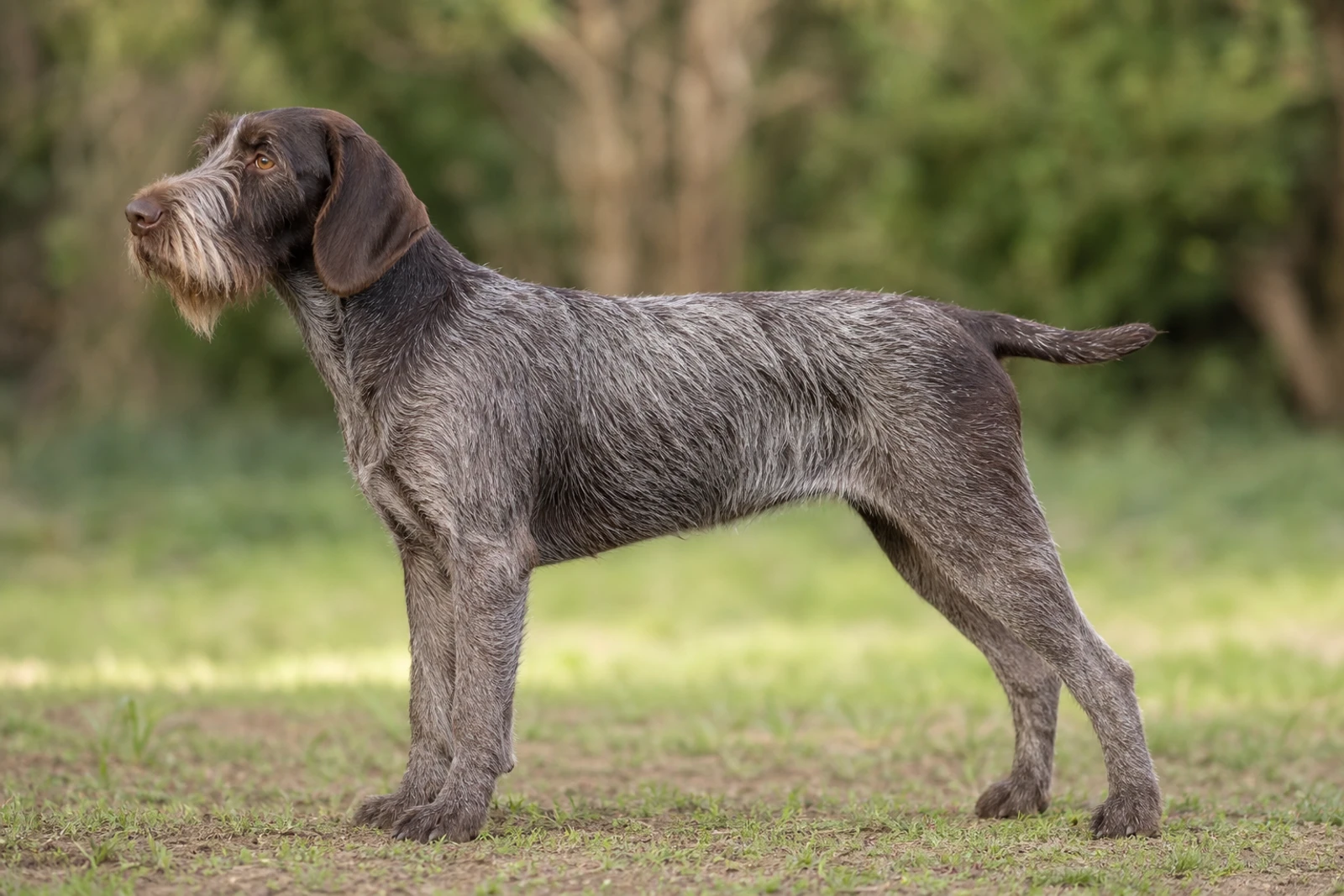
The Cesky Fousek, also known as the Czech Wirehaired Pointing Griffon, is a versatile gun dog bred for hunting on land and water. Standing 23–26 inches tall and weighing 49–75 pounds, this medium-large breed is loyal, intelligent, and affectionate, making a devoted family companion for active households. With its wiry coat and bushy eyebrows, it thrives on exercise and mental stimulation. It's not suited to apartment living or novice owners, but for experienced outdoorsy families, the Cesky Fousek is an eager, tireless partner.
At a glance
- Size
- Giant
- Height
- 23–26 in
- Weight
- 49–75 lb
- Life span
- 12–13 years
- Coat colors
- Liver Roan, Liver, Liver with Ticking
- Coat type
- Medium-length wiry double coat
- Origin
- Czech Republic
How much does a Cesky Fousek cost?
Adopt / rescue
$75–$400
Usually includes spay/neuter, first shots, and a microchip.
Buy from a breeder
$700–$2,000
From a reputable, health-testing breeder.
Approximate USD. Prices vary widely by region, breeder, pedigree, age, and coat colour — adopting is the lower-cost and recommended route. Avoid suspiciously cheap “breeders”; they’re often puppy mills.
Estimate the full cost of a Cesky Fousek →Want the ongoing number? Estimate the monthly food bill for a Cesky Fousek with our dog food cost calculator.
Cesky Fousek photos
Views
Front, side, rear and top — the full silhouette.Poses
How the breed sits, lies, moves and plays.Puppy to senior
The breed across its whole life.Expressions
The breed’s range of moods.Close-up details
Eyes, ears, nose, paws, tail and coat.Coat colors
The breed’s recognized colors.Click any photo to enlarge. We show the Cesky Fousek from every angle — three views, poses, life stages, expressions, close-ups, coat and colors.
Appearance & size
A male Cesky Fousek stands 24 to 26 inches at the shoulder and weighs between 55 and 75 pounds. Females run slightly smaller, typically 23 to 24 inches and 49 to 62 pounds. Labels can be confusing — some registries list the breed as "giant," but he’s really a substantial, rectangular medium-to-large hunting dog. The body length from breastbone to buttock is just a touch more than the height at the withers, which gives him that efficient, long-striding ground cover you want in a versatile pointer.
The coat is the first thing you’ll notice. It’s a harsh, wiry double coat built to shed weather and thorny cover. A soft, dense undercoat insulates, while the straight, flat topcoat feels rough to the touch. That same rough hair grows into a prominent beard and distinct, triangular eyebrows, framing a look that’s equal parts wise and shaggy. The tail is usually docked to about two-fifths its natural length where the practice is legal; it’s carried level or slightly raised when the dog is alert.
- Colors: liver roan (a tight mix of liver and white hairs that reads as silvery-blue with darker ticking), liver roan with solid liver patches, solid liver, or liver with white markings on the chest and legs. Black coat pigment doesn’t appear. The nose, eye rims, and lips are always a dark liver color, never pink.
The head is noble rather than heavy. The skull arches slightly above a moderate stop. The muzzle is roughly equal in length to the skull, straight-bridged and deep enough to hold game comfortably. Almond-shaped eyes sit deep and alert — amber to dark brown, set well apart, with a keen expression that misses nothing in the field. Ears hang flat, set high and broad at the base, reaching just about to the level of the nose.
A look from any angle shows a dog built for work. The chest drops to the elbows — deep and roomy, but not barrel-chested — and forelegs run straight and well-boned when viewed head-on. The back is firm and slopes gently from the withers toward the tail set without any sway. A short, well-coupled loin follows into a moderate tuck-up. Behind, the hindquarters pack broad, powerful muscle with proper angulation; hocks stay parallel when the dog moves away. Feet are tight, oval, and well-arched, with tough pads that handle everything from icy marsh to rocky ground. That dense, slightly oily coat isn’t decorative — it’s what lets a Fousek break through brambles and slide into cold water without hesitation.
History & origin
The Cesky Fousek didn’t just almost disappear once — it nearly vanished twice. This rough-coated, warm-eyed pointing dog from the heart of Europe was built for serious work in the marshes and forests of Bohemia, and its survival is a testament to a handful of hunters who refused to let it slip away.
Dogs matching the Fousek’s description appear in Bohemian art and hunting records as far back as the 14th century. They descend from old medieval rough-haired water dogs and land pointers, shaped by Czech nobility and professional hunters to handle a bit of everything: pointing feathered game, tracking furred game, retrieving from icy water, and working quietly in thick cover. The wiry, weather-resistant coat and a calm, methodical temperament were prized long before any written standard existed.
By the late 1800s, changing land use and the influx of specialized British breeds pushed the old Bohemian wirehair toward obscurity. World War I then scattered what little breeding stock remained. In the 1920s, a small circle of dedicated cynologists scoured the countryside for any surviving dogs that fit the traditional type. They built a foundation from those remnants, likely incorporating German Wirehaired Pointers and Slovakian Rough-haired Pointers to restore genetic viability without losing the dog’s original working character. In 1931, the first official breed standard was published, giving the breed its modern name — Cesky Fousek (Czech rough-haired) — and marking its formal recognition.
Barely a decade later, World War II flattened the population again. Only a handful of dogs lived through the occupation. Breeders after the war started almost from scratch, working from those few survivors and once again leaning on similar wirehaired breeds while meticulously selecting for the calm, versatile hunting style and the distinctive bearded face.
Today, the Cesky Fousek remains a well-kept secret outside its homeland. Its numbers in North America are tiny; the first U.S. litter wasn’t whelped until 2012. Dedicated hunters who prize a soft-mouthed retriever that can point birds all morning and track a wounded deer into the evening are the breed’s strongest advocates. If you meet one, you’re looking at a piece of living medieval hunting history — a dog that outlasted two global wars by being quietly indispensable.
Temperament & personality
A Cesky Fousek forms a deep, working partnership with his people. This is not a casual pet — it's a versatile hunter bred for long days in the field, and that drive shows up in every part of his personality. He's loyal to the core, often shadowing a single person more intently than others, and he reads human body language with unsettling accuracy. That loyalty doesn't translate into easygoing affection for everyone; expect a reserved, watchful demeanor around strangers. He won't melt into a puddle of wags for just anyone.
The Fousek runs on a motor of purposeful energy. He needs a solid hour of hard running, swimming, or off-leash work — not a couple of short walks — or he'll find his own job, and you probably won't like the results. Chewing through drywall, excavating the yard, or obsessive urine marking in the house are not acts of spite; they're the fallout from a sharp mind with nothing to do. You'll notice scent drives everything. He memorizes the smell of familiar dogs and people, and he may re-mark spots indoors if even a trace of old urine odor lingers. A vinegar spray on cleaned accidents helps break the cue.
Within his household, he's gentle and steady when his needs are met. A relaxed, loose body and soft eyes are typical when he's settled beside you at the end of the day. But he's not a foolproof nanny dog. Never let children interrupt him while he's eating or gnawing a bone — food guarding can flicker even in otherwise patient dogs. Teach kids to read the subtle signals: a yawn, a lip lick, or a head turn away means he's asking for space. He's not aggressive by default, but he's also not the kind of dog who tolerates being crawled on or having his bowl poked.
Early and continued socialization softens his aloofness without diluting his sharpness. He's often strong-willed, so heavy-handed corrections backfire. You'll get way more mileage out of a calm, consistent approach that respects his intelligence. Give him clear rules and a job — even if it's just retrieving a bumpers in the yard or learning new scent games — and you'll have a partner who falls in line because he wants to, not because he has to.
Good with kids, dogs & other pets
Cesky Fouseks are naturally patient and non-aggressive, which gives them a real edge in households with kids — but their size and sensitivity mean you need to be deliberate about early training. A full-grown Fousek weighs 49–75 pounds and can accidentally bowl over a toddler with a happy tail wag. Always supervise interactions and teach children not to climb on, hug tightly, or disturb the dog while it’s eating or sleeping.
Other dogs
Start socialization early, during the 3–14 week window, and keep it positive. Puppies who meet a variety of calm, friendly dogs in those first months usually grow into adults who handle canine company without drama. An unsocialized adult Fousek may become fearful or over-reactive, so introductions to new dogs should happen gradually, on neutral ground. Not every adult needs a houseful of dog buddies; a single compatible companion often fits this breed’s temperament better than a crowded pack. Forced interactions with unfamiliar dogs can backfire and trigger defensive snapping, so respect what your dog is telling you.
Cats and small pets
As a versatile hunting breed, the Cesky Fousek can have a strong chase instinct. Raise a puppy alongside a cat or small animal with careful, positive introductions, and you’ll greatly improve the odds of peaceful coexistence. Never leave them unsupervised, and accept that some individuals may never be safe around rabbits, guinea pigs, or free-roaming birds. The prime socialization period closes around 16 weeks — after that, teaching restraint around small critters gets much harder.
Alone time and companionship
These dogs bond closely with their people and don’t do well in isolation. A Fousek left alone for long stretches or banished to the yard can develop distress behaviors like nonstop barking, digging, and chewing. Begin short, calm separations in puppyhood, and use puzzle toys or food-dispensing games to build tolerance. Mental exercise alongside gradual alone-time training helps, but this is a breed that thrives when included in daily life — not one you can park in a corner when company arrives.
When you honor their need for companionship and early, gentle exposure to all kinds of people and animals, you end up with a steady, affectionate family dog. Push an adult Fousek into scary social situations, and you’ll damage the very trust that makes them shine.
Trainability & intelligence
The Cesky Fousek carries a 4/5 trainability rating for good reason — this is a sharp, responsive dog that genuinely wants to work with you. However, that intelligence comes wrapped in an independent streak you can’t ignore. A Fousek learns commands quickly, but whether he chooses to perform them when a more interesting scent wafts by is another matter. Early, consistent training isn’t optional; it’s what channels that drive into reliable behavior.
Start the day your puppy comes home. Short, upbeat sessions using treats, a favorite tug toy, or excited praise lock in attention and build the partnership this breed craves. Reward-based methods keep him engaged — force or intimidation backfire, damaging the trust that fuels his willingness to obey. You’ll see better long-term compliance when you focus on clear communication rather than corrections. For a dog that can top 70 pounds, that trust is non-negotiable.
Recall is the make-or-break skill. The Fousek’s nose can override his ears in the field, so proofing a solid “come” takes months of patient, high-value reinforcement. Practice in low-distraction environments first, then gradually add distance and scents. He’s not typically hard-headed for the sake of it; he just needs to learn that returning to you pays off better than chasing that rabbit.
Socialization runs parallel to obedience. Expose your pup to varied surfaces, sounds, people, and other dogs before 16 weeks of age, and keep those experiences positive. A poorly socialized Fousek can become watchful or reactive, while a well-socialized one handles new situations with calm confidence. Treat every new person or place as a training opportunity — reward him for checking in with you instead of fixating. This consistent, relationship-first approach turns an intelligent hunting partner into a sane, steady family dog who listens when it counts.
Exercise & energy needs
A Cesky Fousek isn't a casual stroller. This is a driven, medium-framed pointing breed built to cover rough ground for hours—and that heritage shows up in your daily routine. Count on providing two solid 60-minute exercise sessions every day, not just a quick morning trot around the block. One session alone won’t cut it; he’ll still be staring at you, restless, by mid-afternoon.
Think vigorous off-leash running, field hikes, swimming, or long fetch sessions in a safe, fenced area. A brisk 30-minute leash walk barely registers for this dog. He needs to stretch his legs at a gallop, use his nose, and problem-solve on the move. That’s where the mental gear kicks in: plain physical exhaustion skips half the equation. Weave in scent games, hidden retrieve dummies, or a few rounds of nosework. Even a frozen puzzle toy or a stuffed Kong after a workout helps settle his brain.
For a Fousek, the sweet spot pairs movement with purpose. He’ll thrive on hunting-style training, upland fieldwork, or canine sports like tracking, hunt tests, and rally. Agility and dock diving can be great outlets too, but use some sense—avoid repetitive, high-impact jumping on hard surfaces, especially while he’s growing. This breed isn’t fragile (a healthy 50–75 pound frame handles a lot), but smart pacing during puppyhood and screening for hip dysplasia in breeding lines are both worth your attention. Older dogs may appreciate swapping one high-intensity session for a long, snuffly hike with plenty of stops to investigate.
Split the two hours roughly into morning and late afternoon chunks. If your schedule blows up one day, aim for a shorter blast of hard exercise plus a longer, sniff-heavy walk—but make up for it the next day. Skip it completely and you’ll see the fallout quickly: a bored Fousek can turn vocal, chew through drywall, or pace nonstop. Meet his needs, and you get a calm, steady companion indoors who’s ready to do it all again tomorrow. That’s the trade.
Grooming & coat care
A Cesky Fousek’s wiry double coat is built for brambles and cold water — not for a hands-off grooming schedule. You’ll stay ahead of mats and odors with a quick twice‑weekly brush‑out, but the real key is learning to hand‑strip or finding a groomer who will, because clipping strips away that harsh, protective texture and leaves the coat soft and dirt‑magnet prone.
-
Brushing – Reach for a metal slicker with rounded pins and a greyhound‑style steel comb. Work in sections, paying extra attention to the dense furnishings on the legs, beard, and eyebrows. During spring and fall, the undercoat turns over more heavily; bump sessions to every other day to keep loose hair off the furniture. Brushing also spreads natural oils through the coarse outer guard hairs, keeping the coat weather‑resistant.
-
Bathing – Soap too often and you’ll strip those oils, leaving the coat dry and flat. Bathe only when your Fousek rolls in something truly foul — three or four times a year is plenty. Always use a mild dog shampoo and rinse thoroughly; that thick coat traps residue near the skin.
-
The beard and face – The iconic mustache and beard collect water, mud, and half of breakfast. Wipe the muzzle daily with a damp cloth and check for skin fold irritation underneath. A quick comb‑through after meals prevents tangles.
-
Nails and ears – Those long, floppy ears are a two‑edged sword: great for scenting, a magnet for moisture and debris. Lift them weekly, sniff for any yeasty odor, and clean with a vet‑approved drying solution. Nails grow fast on an active dog; trim every three to four weeks, or as soon as you hear clicks on hardwood. Don’t skip the dewclaws — they can curl into the pad on a working breed that rarely walks pavement.
-
Teeth – A daily brush beats a dental cleaning under anesthesia. Use a dog‑specific enzymatic toothpaste and a soft brush. Even three times a week will keep tartar at bay on a breed that routinely lives into the early teens.
Hand‑stripping the dead outer coat two to three times a year — plucking it out by the root, not slicing it with clippers — preserves the correct harsh feel and keeps the skin breathing. If that sounds like too much, ask around for a breed‑savvy groomer before defaulting to a shave‑down. You’ll trade a few hours of work for a coat that repels burrs instead of grabbing them.
Shedding & allergies
A Cesky Fousek’s wirehaired double coat sheds more than you’d guess from all that rough texture. Hair lands on your floors year-round, and the real situation hits during the seasonal blowout — twice a year, the undercoat lets go hard. For a few weeks each spring and fall, expect tumbleweeds of gray-brown fuzz coasting across every room.
Regular brushing keeps it manageable. Off-season, a slicker brush or undercoat rake run through the coat a couple of times a week catches dead hair before it becomes furniture decor. During a blowout, daily brushing isn’t optional; it’s the only way to stay ahead of the shedding and prevent mats in that dense undercoat. A bath can help loosen dead fur, but dry-brushing a wet dog is a fast track to a clogged drain.
If you’re allergic to dogs, do not count on this breed cooperating. Their skin produces the same dander as any other, and the wiry coat traps allergens near the dog’s body — only to release them in a puff when the dog shakes or you finally brush. The Cesky Fousek is not hypoallergenic, and responsible breeders won’t pretend otherwise.
Drool is the one bright spot. These dogs aren’t heavy jowlers. You might get a few stray drops after a long drink or when dinner comes into view, but you won’t be wiping ropes of saliva off your walls.
If you hate vacuuming, a Cesky Fousek will test your patience. Budget for a good pet vacuum and accept that your dark pants will carry a permanent dusting of hair.
Diet & nutrition
Feed this athletic breed like the athlete it is — but don’t let those pleading eyes talk you into overfilling the bowl. The Cesky Fousek ranges from 49 to 75 pounds, and carrying extra weight stresses the hips and elbows that already put in hard work during a day in the field. A lean dog runs cooler, lasts longer, and is far less likely to develop joint trouble.
Adult portions: Start with about 2½ to 3½ cups of a high-quality dry food daily, split into morning and evening meals. That’s a baseline — bump it up if your dog is running upland game for hours, pull it back if he’s on light duty. Watch the waistline: you should feel ribs with a light cover of fat but not see every ridge.
Puppy feeding: From weaning to four months, serve four evenly spaced meals. Drop to three meals until six months, then settle into the adult two-meal routine. Transition onto a new food gradually, using lightly cooked and puréed meats, fish, and vegetables, or a premium large-breed puppy formula that supports steady, not explosive, growth.
What’s in the bowl: Many Fousek owners blend kibble with fresh ingredients. A practical ratio is roughly 60% animal protein (lean meat, fish, eggs), 20–30% vegetables and fruit, and the rest from digestible grains like pearl barley or plain white rice, plus occasional yogurt. Raw chicken wings can appear around 12 weeks if you’re comfortable with raw feeding and supervise first.
The breed isn’t uniformly prone to obesity, but some individuals are chowhounds. If your dog inhales meals, use a puzzle bowl to slow him down and give his brain a quick workout. Never feed from the table — transition table scraps, if any, to his own dish so begging never takes root. Rich, fatty foods (holiday ham, greasy trimmings) can trigger pancreatitis, so keep meals clean and predictable.
As your Fousek moves into his senior years, adjust portions before the weight creeps up. Older dogs often do fine with the same protein levels but may appreciate three smaller meals instead of two. For those with missing teeth or tender mouths, puréeing the food makes nutrients easier to absorb.
Health & lifespan
Life expectancy runs 12 to 13 years for this rugged Czech pointing breed. That’s solid for a dog this size, and many stay active and birdy into their senior years. Still, a few health issues show up often enough that you’ll want to know about them going in.
Eye disease is the concern that comes up most in the breed. Responsible Cesky Fousek breeders have their dogs’ eyes examined annually by a veterinary ophthalmologist and can screen for hereditary conditions like progressive retinal atrophy and cataracts. Don’t be shy about asking for those clearances.
- Bloat (GDV) is a real risk. The Fousek has a deep chest, and gastric dilatation-volvulus can kill a healthy dog in hours. Feed two or three smaller meals instead of one big bowl, and avoid hard exercise right after eating. Know the symptoms—restlessness, a distended belly, unproductive retching—and have an emergency plan.
- Hip and elbow dysplasia aren’t rampant, but they pop up in some lines. Reputable breeders evaluate hips and elbows through OFA or PennHIP. Keep your dog lean, because even mild dysplasia gets dramatically worse under extra weight.
- Weight management matters more than most people realize. At 49–75 pounds, a Fousek who carries just five extra pounds is stressing joints, heart, and lifespan. This is a food-motivated hunter who will happily act like he’s starving—measure his meals, limit treats, and keep him at a working weight you can feel ribs through.
That thick, harsh coat handles cold and wet brush without a problem, but in heat it becomes a liability. Don’t run him hard in the midday summer sun; provide shade, water, and a cool spot to flop after exercise.
Preventive care is straightforward but non-negotiable. Monthly heartworm prevention during mosquito season (and for 30 days after) is a must. Rabies vaccination is legally required—there’s no effective treatment once symptoms start, so don’t skip a booster. Annual vet visits catch murmurs, eye changes, or joint creaks early, and a well-socialized Fousek who’s been handled positively since puppyhood tolerates exams without shutdown, which makes those early catches possible.
When you’re talking to a breeder, ask for documentation on:
- Recent CERF or OFA eye clearances on both parents
- Hip and elbow scores (OFA, PennHIP, or equivalent)
- Anything they’ve seen in their lines—honest breeders will tell you about bloat history or an occasional skin issue without flinching
Living environment
If you live in an apartment, the Cesky Fousek is the wrong dog for you. This robust, versatile hunting breed needs elbow room — think a house with a large, securely fenced yard. An underground electronic fence won’t cut it; a 49–75-pound dog bred to quarter rough terrain at a gallop requires a real physical barrier. He’s built to cover ground all day, and a cramped space will leave him miserable.
Plan on at least an hour of hard exercise twice a day — not a casual leash stroll, but off-leash running, swimming, or focused retrieving. Without it, that drive goes straight into your drywall or turns into pacing and whining. Mental work is just as critical. Scent games, puzzle toys, and training sessions that challenge his nose and brain are non-negotiable. Split the activity into multiple sessions: a long morning run and an afternoon hunt-style workout often suit him better than one endless slog.
His dense double coat is built for foul weather. He shrugs off snow, sleet, and freezing mud, so cold climates are no problem. In heat, be sensible — exercise in the early morning or late evening, provide shade and water, and never push him during the hottest part of the day. He adapts, but he’s not a desert dog.
Barking is moderate and purposeful. He’ll announce a stranger with a deep, carrying bark, but if he’s well-exercised, he usually settles. The bigger concern is being left alone. This breed bonds intensely and can develop serious separation anxiety when isolated for long stretches. You’ll need to build independence gradually — short absences, stuffed Kongs, and a crate routine — or you’ll come home to complaints you can hear from the driveway and a dog who’s eaten the door frame.
Who this breed suits
If you can hand a Cesky Fousek a genuine working life — upland bird hunting, daily off-leash runs over rough terrain that stretch past an hour — you’ll get a focused, all-in partner. This versatile gundog from the Czech Republic isn’t a backyard ornament. The right owner runs or hikes real trails, not pavement loops, and treats training as an ongoing project rather than a six-week class.
First-time owners usually should pass. His intelligence and independent streak let him outmaneuver someone still learning timing. A rare committed novice with a hunting-dog mentor might succeed, but the learning curve is steep. Active families with older, dog-savvy kids can thrive; toddlers underfoot when the dog is revved up after a run are a mismatch. Single hunters or serious endurance athletes find a tireless companion. Leave him alone for a full workday with just a block walk, and you get a destructive digger and a self-employed barker.
Seniors and casual walkers can’t keep up: this 70-pound athlete demands 90 minutes of hard exercise daily plus nose work that tires his brain. Apartments and small yards without nearby open land are a non-starter — even a tired Fousek explodes after a squirrel, so off-leash freedom needs a fenced area or very remote space.
Think twice if you want a wagging greeter. You get a reserved guardian who needs early, ongoing socialization to keep wariness from tipping into suspicion. Strong prey drive endangers cats and small pets unless raised together with painstaking management. Weekends revolving around muddy boots, empty fields, and the silent teamwork a pointing dog was made for mark the owners who truly suit this breed.
Cost of ownership
Bringing home a Cesky Fousek is a long-term investment, and the numbers deserve a realistic look before you start searching for a puppy.
Purchase price
These dogs are still uncommon in the United States, so you won’t find them on every corner. From a responsible breeder who screens for hip dysplasia, eye issues, and other hereditary conditions, expect to pay $1,500 to $3,000. The price climbs if both parents have working titles and full health clearances. Because the gene pool is small, litters are infrequent—many breeders maintain waitlists, and you may need to factor in travel or shipping if the pup isn’t local. Rescue Cesky Fouseks pop up rarely; adoption fees typically land around $300 to $500.
Monthly food bill
A 60-pound adult with an active hunting life burns a lot of fuel. Plan on roughly 3 to 4 cups of high-quality kibble daily, which translates to $50 to $80 per month. If you go the raw or fresh-food route, that can easily double. Add $15 to $30 for training treats, joint supplements, and the occasional dental chew.
Grooming
That wiry, dense coat doesn’t shed much, but it does need to be stripped a couple of times a year to stay harsh and weather-resistant. Many owners learn to hand-strip at home, which costs nothing but time. If you rely on a professional groomer, a stripping session runs $60 to $90 and is needed every 6 to 8 weeks—budget around $30 to $45 monthly when averaged out. Between sessions, a weekly brush-through and an ear check take five minutes.
Vet care and insurance
Routine wellness—annual exams, vaccines, heartworm and flea/tick prevention—will set you back about $400 to $600 per year ($35 to $50 a month). Because Cesky Fouseks are hard-charging dogs, injuries in the field aren’t uncommon, and the breed can be prone to hip dysplasia. Pet insurance that covers both accident and illness runs $45 to $75 a month, depending on your deductible and reimbursement level. Skipping it is a gamble you may not want to take with a dog bred to work off-leash in rough cover.
Other odds and ends
These are thinking dogs that need a job. Budget $30 to $60 a month for puzzle toys, training classes, or entry fees for hunt tests and nose work if you compete. Add a sturdy crate, a solid leash set, and quality hunting gear upfront, and you’re all in for around $200 to $350 per month once the routine settles in.
Choosing a Cesky Fousek
Finding a Cesky Fousek almost always starts with a breeder — rescues exist through the breed club’s network but are rare. If you go the breeder route, expect a waitlist. That’s your first sign of a responsible program, because no one should churn out pups to meet casual demand.
Health clearances you need to see
Both parents should have current, verifiable clearances posted on a public database like OFA. Demand hips scored (OFA or PennHIP) — hip dysplasia shows up in the breed. Ask for annual eye exams by a veterinary ophthalmologist; look for results free of progressive retinal atrophy or cataracts. Some breeders also screen elbows and thyroid, and many large, deep-chested dogs can bloat, so ask whether gastric torsion appears in the line. If a breeder waves off clearances with “my dogs are healthy,” walk away.
Red flags that matter
- The breeder never asks about your hunting experience, training plans, or how you’ll exercise a 50–75 lb athlete that stands 23–26 inches tall.
- Puppies are raised in a kennel with minimal household noise, visitors, or handling — this sets you up for a neurotic adult.
- You can’t meet the dam (at minimum) on-site, see where the litter sleeps, or watch the pups interact.
- The breeder ships a puppy to you without ever meeting you.
- They always have puppies or multiple litters on the ground.
- No hunt tests or fieldwork titles on the parents. A Fousek without proven working drive is a gamble.
Picking a puppy
A good breeder does the matching, not you. They’ve watched the litter for weeks and know which pup is the steady navigator, which is the independent scrapper, and which may struggle in a busy household. Explain exactly what you want: a hard-charging upland partner, a biddable dog to dabble in waterfowl and shed hunting, or a high-energy family companion who’ll log an hour of off-leash running daily. Let the breeder pick a pup whose temperament fits. What you can observe: a pup that startles at a novel sound but bounces back quickly, engages with you, and isn’t cowering in the corner. Avoid the extreme — the bully or the wallflower — and trust the breeder’s read. That matchmaker relationship often becomes your troubleshooting lifeline for the next 12–13 years.
Pros & cons
Pros
- Built for real work: A pointing breed through and through — eager to hunt, retrieve, and track across water and rough cover. If you want a dog that turns a morning hike into a serious adventure, this is it.
- Loyal family dog with an off-switch: Once exercise needs are met, the Cesky Fousek typically settles indoors. They form tight bonds and are gentle with kids who respect their space.
- Tough, weather-ready coat: The dense, wirehaired double coat shrugs off mud, cold water, and heavy brush, making them a three-season partner without needing a doggy jacket.
- Sharp nose and problem-solving brain: You get a dog that’s quick to learn, thrives on positive training games, and has the scenting ability that makes hide-and-seek a legit workout.
- Moderate size for a “giant” class: At 49–75 pounds and 23–26 inches tall, they’re substantial without being cumbersome. Fits a vehicle crate or a crowded duck blind without hogging all the space.
- Long-lived for a large breed: A 12–13 year lifespan means you’ll likely share a decade-plus of hunting seasons and porch-sitting with the same dog.
Cons
- Exercise demands are non-negotiable: A walk around the block won’t cut it. Expect to provide 60–90 minutes of hard running, field work, or vigorous off-leash exploration every single day, or face torn-up furniture and manic barking.
- Prey drive rules the yard: Squirrels, cats, and even neighborhood chickens trigger chase mode instantly. A securely fenced yard (6-foot minimum) and rock-solid recall training are absolute musts — and even then, there’s little room for error.
- Independent streak can frustrate: They were bred to problem-solve at a distance, so they’ll question a command they don’t see the point of. First-time owners or those who prefer a biddable “what’s next?” dog will find the Cesky Fousek’s stubborn side exhausting.
- Coat maintenance is hands-on: That wiry jacket doesn’t just shed out neatly. Stripping by hand or a skilled groomer is required several times a year to keep the coat weatherproof and skin healthy — it’s a chore, not a quick brush-out.
- Slow to mature and long puppyhood: They’re mentally puppylike for two years or more, which means chewing, mouthing, and impulsive decisions well into adulthood. You’ll need patience and a crate for when you can’t supervise.
- Reserved with strangers, vocal about it: Protective instincts run deep, and without constant early socialization, they can slip into aloofness or suspicion. They’ll also alert-bark at every delivery truck and passing stranger — not a quiet apartment breed.
Similar breeds & alternatives
If you’re drawn to the Cesky Fousek’s wire coat and all-around hunting ability, the breeds you’d naturally cross-shop are other European versatile pointers. Each splits off in a slightly different direction, so the choice often comes down to temperament edge, size, and how much “family dog” wiring you want baked in.
-
German Wirehaired Pointer (Deutsch Drahthaar) – The most obvious doppelgänger. The GWP matches the Fousek’s 23–26-inch height and 50–75-pound range, but the personality leans harder: sharper, more protective, and often more territorial. The Fousek tends to be a touch softer in the house, more willing to turn off and snuggle after a hunt, whereas a GWP stays sharper and needs a firmer hand to prevent over-guarding. Both have dense, harsh outer coats, but the Fousek’s double coat is often noted as marginally silkier and warmer for cold-water work.
-
Wirehaired Pointing Griffon – A bit lower to the ground (20–24 inches, 50–70 pounds) with a shaggier, more disheveled appearance. Griffons typically bring a clownish, eagerly cooperative attitude that’s hard to resist. The Fousek, at 49–75 pounds, is a touch larger and carries more of a serious working-drive edge, but still holds onto a soft family-off switch. If you value comedy and a slightly more biddable nature over size and a harder wire coat, the Griffon fits that slot.
-
Slovak Rough-haired Pointer – A sibling breed from the same gene pool that separated from the Fousek in the mid-20th century. Looks nearly identical: 22–27 inches, 55–75 pounds, same wiry coat and deep chest. Behaviorally, they’re almost interchangeable, though Slovak lines are sometimes described as a hair more driven and aloof. Both share a 12–13-year lifespan and a rare-by-any-standard availability in the US.
-
Pudelpointer – A pointer-poodle composite with a dense, woolly coat instead of the Fousek’s stiff guard hairs. Smaller (44–66 pounds, 20–26 inches) and thoroughly water-crazy. The Pudelpointer’s biddability shines, but its coat requires more stripping to stay functional and it lacks the classic, stylish point that Fousek enthusiasts prize. The Fousek’s larger frame and harsh double coat handle icy marshes with less trimming.
Because the Cesky Fousek is still relatively scarce outside Central Europe, you’re more likely to stumble on a GWP or Griffon at a local training day. Still, the Fousek carves its own niche: a sensitive, medium-to-large pointer that hunts like a machine but melts into a calm house companion—without the edge some other wirehaireds carry.
Fun facts
- The Cesky Fousek is the Czech Republic's oldest native hunting breed.
- It nearly went extinct after World War II, but dedicated breeders revived it.
- Its name means "Czech whiskered dog" due to its distinct facial furnishings.
- This breed is a versatile hunter, excelling in pointing, retrieving, and tracking on land and water.
Frequently asked questions
- Are Cesky Fouseks good with children?
- Cesky Fouseks can be excellent family dogs when raised with children, as they are generally gentle and patient. Their protective instincts and playful nature make them affectionate companions, but early socialization and supervision are important, especially given their large size.
- How much exercise does a Cesky Fousek need?
- This breed has high energy levels and requires at least an hour of vigorous daily exercise, such as running, hiking, or retrieving games. Without adequate physical and mental stimulation, a Cesky Fousek may become restless or develop unwanted behaviors.
- Do Cesky Fouseks shed a lot?
- Cesky Fouseks have a dense, wiry coat that sheds moderately, with seasonal increases in shedding. Regular brushing a few times a week helps manage loose hair, and occasional hand-stripping can maintain coat texture and reduce shedding.
- Is the Cesky Fousek suitable for apartment living?
- Due to their large size and high exercise needs, Cesky Fouseks are not ideally suited for apartment living. They thrive in homes with a securely fenced yard where they can roam, and they may become frustrated in confined spaces without ample outdoor activity.
- Are Cesky Fouseks easy to train?
- Cesky Fouseks are intelligent and eager to please, but they can also be independent thinkers, so training requires consistency and positive reinforcement. They respond well to patient, firm guidance and benefit from early obedience training to channel their energy productively.
- What is the typical lifespan of a Cesky Fousek?
- Cesky Fouseks typically live between 12 and 13 years, which is relatively long for a giant breed. Providing proper nutrition, regular veterinary care, and sustained physical activity can help them reach the upper end of this range.
Tools & calculators for Cesky Fousek owners
Quick estimates tailored to Cesky Fouseks — pre-filled with this breed’s size where it matters.
Articles & stories about the Cesky Fousek
Sources & standards
This profile follows recognized breed standards from the American Kennel Club (AKC) and the Fédération Cynologique Internationale (FCI), along with established veterinary and breed-club guidance. These describe general breed tendencies — every dog is an individual.