

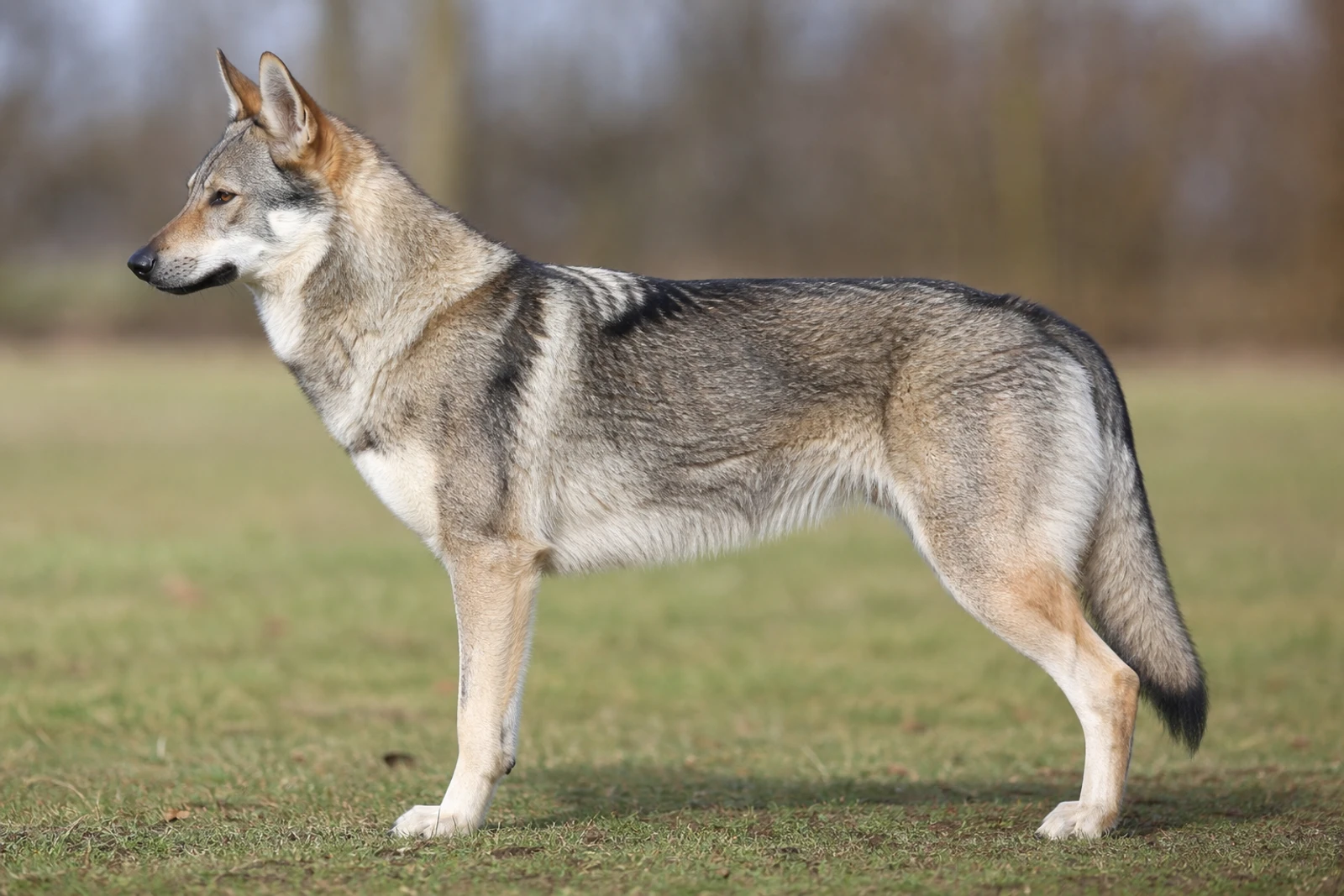
The Czechoslovakian Wolfdog is a powerful, wolf-like breed developed for military service. Standing up to 29 inches and weighing up to 145 pounds, this giant working dog requires an experienced owner who can provide firm leadership, ample exercise, and mental stimulation. They are fiercely loyal to their family but aloof with strangers, with a high prey drive making them unsuitable for homes with small pets. Not recommended for first-time owners or apartment living, they thrive in active, structured environments where their intelligence and stamina are channeled constructively.
At a glance
- Size
- Giant
- Height
- 25–29 in
- Weight
- 90–145 lb
- Life span
- 10–11 years
- Coat colors
- Yellow-gray, Silver-gray, Wolf-gray
- Coat type
- Thick double coat, straight and dense
- Group
- Working
How much does a Czechoslovakian Wolfdog cost?
Adopt / rescue
$75–$400
Usually includes spay/neuter, first shots, and a microchip.
Buy from a breeder
$700–$2,000
From a reputable, health-testing breeder.
Approximate USD. Prices vary widely by region, breeder, pedigree, age, and coat colour — adopting is the lower-cost and recommended route. Avoid suspiciously cheap “breeders”; they’re often puppy mills.
Estimate the full cost of a Czechoslovakian Wolfdog →Want the ongoing number? Estimate the monthly food bill for a Czechoslovakian Wolfdog with our dog food cost calculator.
Czechoslovakian Wolfdog photos
Views
Front, side, rear and top — the full silhouette.Poses
How the breed sits, lies, moves and plays.Puppy to senior
The breed across its whole life.Expressions
The breed’s range of moods.Close-up details
Eyes, ears, nose, paws, tail and coat.Coat colors
The breed’s recognized colors.Click any photo to enlarge. We show the Czechoslovakian Wolfdog from every angle — three views, poses, life stages, expressions, close-ups, coat and colors.
Appearance & size
You’ll notice the wolf first — not in some diluted, domesticated way, but in the long, lean silhouette and the way this dog carries itself. The Czechoslovakian Wolfdog is a giant built for steady ground-covering movement, not bulk. Stand a male next to you, and his shoulder might hit 27 to 29 inches; females usually fall between 25 and 27 inches. Weight runs 90 to 145 pounds, with males packing more muscle and bone, but even a heavy dog here stays leggy and athletic, never soft.
Look at him from the side and you see a rectangular frame — the body is slightly longer than the height at the withers, with a deep, oval chest reaching to the elbows and a visible tuck-up through the belly. The back is straight and firm, sloping just a little from the withers toward the croup. No exaggerated angulation, just the functional geometry of a trotter that can lope for miles without tiring. From the front, the chest is muscular but not wide as a mastiff’s; the forelegs fall straight and close to the body, and the paws turn neither in nor out. The neck rises cleanly out of the shoulders, thick at the base and dry, without loose skin. From the rear, you get powerful, well-muscled thighs and hocks set low enough to drive the dog forward with economy. The tail hangs straight down at rest; when the dog moves or focuses, it might come up in a slight sabre curve, but it never curls over the back.
The head is where the wild heritage really lands. Wedge-shaped from any angle, it tapers toward a blunt muzzle that’s not too narrow — strong enough to grip, but not blocky. The stop is sloping and subtle, not a cliff. The nose is black. The eyes are set slightly oblique, amber or light brown, and ringed by tight black lids that sharpen the expression. Ears are a dead giveaway: short, triangular, and carried erect, pointing forward like little radar dishes.
Coat is double and straight. Guard hairs lie flat along the body, coarse to the touch, while the undercoat is dense and soft, shedding massively when the seasons flip. Color is wolf-grey to silver-grey, with the characteristic light mask, a pale underside, and a darker dorsal stripe that runs along the spine. You’ll see yellowish-grey tones in some dogs, and white patches on the chest are a common but not disqualifying quirk. In winter, the coat grows thick and plush, and the dog looks even bigger than the scale says. In summer, it blows coat and can look almost lean for a few weeks — a pattern that surprises first-time owners but is perfectly normal.
History & origin
The Czechoslovakian Wolfdog didn’t appear by accident. It began in 1955 as a directed military experiment inside the former Czechoslovakia, on the border of the Cold War. A Czech breeder and biologist, Karel Hartl, launched the project with a single cross: a working-line female German Shepherd and a male Carpathian wolf. The idea was not to create a pet, but to engineer a dog with the shepherd’s biddability and the wolf’s raw stamina, sharper senses, and unforgiving resilience.
That first litter produced pups that could be handled and trained. Encouraged, Hartl systematically developed the line over the next two decades. The program included backcrosses to additional German Shepherds and, in some branches, a second and third wolf infusion to lock in traits without tipping into unmanageable wildness. Every pairing was measured, recorded, and evaluated for working character. The ultimate goal was a border patrol dog that could track, chase down, and detain a human in harsh terrain and extreme weather, with minimal support.
By 1982, the breed was recognized as a national breed of Czechoslovakia under the name Československý vlčiak. It had already proven itself in border guard kennels, military units, and later in search and rescue. In 1999, the FCI officially recognized it in Group 1 (sheepdogs and cattle dogs), Section 1 (sheepdogs), cementing its status alongside its German Shepherd foundation stock.
The dog that emerged from those decades of work looks strikingly like a wolf — grey to silver-grey coat, amber eyes, a lean frame built for distance rather than bulk, despite the given weight range of 90 to 145 pounds and a height of 25 to 29 inches. It remains a niche working breed outside its homeland. Imports to the United States have been sparse, and even today, a well-bred Czechoslovakian Wolfdog sits squarely in the hands of a few dedicated breeders. The breed still works search and rescue, tracking, and protection sport, but it also demands an owner who understands that this was built to run patrols, not curl up on the couch. The 10- to 11-year lifespan reflects the reality of a large, hard-charging dog that packs a lot of living into its years.
Temperament & personality
You don't so much own a Czechoslovakian Wolfdog as negotiate a working partnership with one. This is a big, sharp, independent animal that inherited the problem-solving drive of a wolf and the stamina of a German Shepherd. The personality isn't "difficult" — it's foreign to someone expecting a Lab-like eagerness to please. A Wolfdog gives loyalty, but he demands you earn it every day through calm, consistent boundaries. If you're a pushover or rely on force, he'll outmaneuver you, and the result is a 100-pound dog who makes his own rules.
Affection here is quiet and on his terms. He may choose to lean against your leg or follow you from room to room, but effusive cuddling isn't the norm. With his immediate family he forms a deeply bonded pack; with strangers he's aloof to suspicious. That wariness, combined with a forward-leaning, steady gaze, makes him an excellent watchdog — he notices everything and won't back down from a perceived threat. But a dog who routinely stiffens, stares, or shifts his weight over his front legs isn't bluffing, so early socialization is non-negotiable. You need to teach him that the delivery driver isn't an intruder, and you need to do it before his protective instincts harden into aggression.
Inside the household, this breed often scores low on open friendliness, which means caution around small children and other animals is just common sense. A running, squealing toddler can trigger prey-drive reflexes before the dog thinks twice. If you already have a cat or a smaller dog, know that a Wolfdog's idea of hierarchy can be swift and physical. Packs operate on clear roles, and he'll test where he stands constantly — not out of malice, but out of a need to know who's in charge. This extends to everyday habits: never interrupt him while he's eating, and teach kids to leave him in peace during meals. Food guarding isn't a character flaw here; it's a deeply ingrained survival behavior that respectful management prevents.
His sensory world also shapes his quirks. A Wolfdog's nose runs his life. He may urine-mark inside not from a lack of house-training but because an unfamiliar scent (a guest's shoes, a new piece of furniture) makes his brain scream define this territory. If you've cleaned up a spot with ammonia-based products, you've basically put up a neon sign inviting him to re-mark. A vinegar spray kills the odor properly and discourages a repeat. Outdoors, don't be surprised if he rolls in something dead; it's not a rebellion. He's either masking his own scent or simply reveling in a stink his scavenger ancestry finds fascinating. You'll never convince him otherwise.
Mentally, a bored or isolated Wolfdog unravels fast. Anxiety-driven howling, destructive chewing, and attempts to dig through drywall aren't revenge — they're the fallout of leaving a high-octane working animal alone with nothing to do. Puppies chew to explore, adults crush bones to keep jaws strong, and both phases require an outlet. A bitter citrus spray on furniture legs can redirect his teeth while you provide what he actually needs: raw marrow bones, puzzle feeders, and a solid hour of hard exercise. This is not a backyard ornament. He lives 10 to 11 years if you're lucky, and every one of those years will test your patience and your leadership. But if you speak his language — reading the soft eyes of a relaxed dog versus the lip lick and head turn that say I'm uncomfortable — you'll have a partner who matches your commitment drop for drop. Most homes aren't right for him, and he won't pretend otherwise.
Good with kids, dogs & other pets
A Czechoslovakian Wolfdog is not a low-risk choice around small children, other dogs, or pocket pets. This is a giant, high-drive breed — 90 to 145 pounds of power, intelligence, and deeply ingrained pack instinct — and everything hinges on relentless early socialization and lifelong management. If you’re picturing an easygoing dog that melts into a busy household by default, look elsewhere.
With kids, the biggest honest hurdle is sheer size and energy. Even a playful, well-meaning adult can send a toddler flying. A Wolfdog who has been raised with gentle, supervised handling from puppyhood often develops a patient, watchful bond with its family’s children. But they are not innately tolerant of clumsy ear-grabs or sudden shrieks. Never leave a child unattended with a dog of this caliber, and teach kids to respect the dog’s space long before the dog has to enforce it. The breed thrives on companionship and can become unsettled if relegated to the backyard for hours; that sensitivity means a chaotic, noisy home with young kids may overwhelm them unless you provide a quiet retreat.
Around other dogs, the picture is mixed. A well-socialized Czechoslovakian Wolfdog can coexist peacefully with canine housemates, especially opposite-sex pairs. Same-sex rivalry can surface in maturity. Their wolf ancestry makes them keen readers of body language, and rough or rude dogs often provoke a sharp, no-nonsense correction. Early, positive exposure — starting at 3 to 4 weeks and peaking before 16 weeks — is critical. Pups need gradual, calm meets with dozens of friendly, stable dogs to avoid becoming fearful or reactive as adults. Forced adult-dog introductions, on the other hand, backfire badly and can mimic predatory stalking. If your adult dog prefers just your company, honor that.
Cats, rabbits, and other small pets trigger a hardwired prey chase. Some individuals raised alongside a cat from puppyhood learn to accept that specific animal, but the impulse to chase and grab is rarely fully extinguished. Assume any small creature that dashes is in danger. Secure separation is non-negotiable, and off-leash yard time with a cat on the other side of a fence is asking for heartbreak. The breed’s high companionship need also means they don’t cope well alone for long stretches; mental stimulation and desensitization to alone time help, but a Wolfdog that becomes lonely may redirect frustration into destructive chewing or vocalizing, which is a real nuisance in a multi-pet home.
Trainability & intelligence
How They Learn
This dog isn’t sitting by the door waiting for your next command. Czechoslovakian Wolfdogs are fiercely smart — they can decode a new routine in a handful of repetitions — but that brain works on a partnership model, not eagerness to please. They watch you, test patterns, and quickly learn exactly what gets them the outcome they want. If you wobble on rules, they’ll exploit the gap. Consistency from puppyhood isn’t optional; it’s the whole game.
- They read your tone and body language with unnerving precision. A handler who raises their voice or gets frustrated will see trust evaporate in seconds.
- Positive reinforcement — treats, a favorite tug, or an excited “yes” — anchors learning. Punishment or intimidation shuts them down and can flip their natural wariness into full-blown anxiety.
Recall Reality Check
A Wolfdog off-leash is a serious project. With a 90–145 lb dog bred from working lines and wild canids, prey drive can override any command in a heartbeat. A squirrel darting across a field can trigger a chase you won’t call off with a whistle. Building a reliable recall means hundreds of rewarded repetitions in increasingly distracting settings, starting in puppyhood. Even then, many owners never trust them fully off-leash in unsecured areas — and that’s smart.
The Right Training Approach
You’re not “breaking” this dog; you’re building a working relationship. Short, game-based sessions keep their problem-solving mind engaged. Calm, patient instruction lands far better than drilling or force. If you get stuck, professional help from someone fluent in primitive-type breeds pays off fast.
- Start simple: a mark (clicker or word) followed by an immediate high-value reward.
- Weave commands into daily life — sit before the leash clips on, wait at doors — so it’s never a separate chore.
- Use real-life praise and play, not just food, to keep motivation high.
Socialization Is Non-Negotiable
A Wolfdog who misses early, positive exposure turns into a massive, fearful liability. The window between 3 and 14 weeks is critical. Calmly introduce your pup to a wide variety of people, sounds, surfaces, and other animals, pairing each new thing with treats or play. Rushed or forced greetings backfire; gentle, gradual exposure builds the confidence that stops reactivity before it starts. Without that foundation of earned trust and early world-building, even the sharpest Wolfdog will default to suspicion — and at this size, that’s not a gamble you take.
Exercise & energy needs
A half-hour stroll on a leash won’t take the edge off a Czechoslovakian Wolfdog. These dogs were built to move across rugged terrain for hours at a stretch, and their exercise needs reflect that lineage. Plan on at least two vigorous sessions daily, totaling 90 to 120 minutes of hard physical work — not just a walk, but sustained running, pulling, or climbing that makes them breathe.
Break that time into two outings. A single marathon can over-tire joints, while two dedicated sweat-fests let the dog recover and still sleep soundly. Morning could be a 4- to 5-mile run or a bikejoring session; afternoon, a steep off-leash hike with a weighted pack or a serious bout of fetch on varied ground. These dogs thrive when they can stretch out at a lope, so access to a securely fenced area for full-speed zoomies is almost non-negotiable.
Physical exertion is only half the equation. This is a sharp, problem-solving breed with low tolerance for boredom. Daily mental work — scent tracking, complex obedience chains, advanced puzzle toys that require multiple steps — needs to be woven into every day. A 20-minute nose-work session in the woods will drain mental energy as thoroughly as the run itself. Without it, you’ll see pacing, howling, and destructive creativity that a tired body alone won’t stop.
Because they mature slowly and can carry wolf-like intensity, watch joint strain in youngsters. Avoid repetitive high-impact pounding on concrete until growth plates close, usually around 18–24 months. Stick to natural surfaces, swimming, or long uphill walks during that window. Even adults benefit from a mix: pair hard-charging runs with lower-impact activities like drafting or mushing on soft trails.
If you’re a runner, skijorer, or long-distance hiker, you’ll find a tireless partner. As a housebound companion, this dog will dismantle your world. A Czechoslovakian Wolfdog without enough to do invents his own occupation — and it rarely matches your interior-design scheme.
Grooming & coat care
The Czechoslovakian Wolfdog blows its entire undercoat twice a year — and “blows” really is the right word. When those seasonal sheds hit, expect grey tumbleweeds of fur to drift through your house, cling to your clothes, and line your vacuum canister in a single pass. The rest of the year, the shedding is steady but manageable.
Brushing routine
Outside of heavy shedding weeks, two or three brushings a week do the job. Use a slicker brush with rounded pins or, better yet, an undercoat rake to reach through the harsh outer guard hairs and pull out the loose fluff underneath. A pin brush works for feathering behind the ears and tail, but the rake is your everyday hero. During spring and fall coat blows, step it up to a daily session — ten minutes that save you an hour of lint-rolling later.
Shedding seasons
Plan on a three-week blizzard when the weather shifts. A forced-air dryer after a bath can loosen the spent undercoat dramatically, cutting the shed cycle short. The dense, double-layered coat insulates the dog from both heat and cold, so never shave a Czechoslovakian Wolfdog hoping to keep them cool. You’ll only damage the regrowth and rob them of their natural thermostat. A sanitary trim around the paws or tidying up straggly hairs is fine; a full haircut is not.
Bathing and skin
This coat is practically self-cleaning if you let it work. Baths every two to three months—or only when the dog rolls in something truly foul—preserve the natural oils that repel dirt and water. Overbathing strips those oils and can make the skin dry and flaky. A good rinse with plain water followed by a thorough brush often does the trick between baths. While you’re brushing, run your hands over the skin to check for ticks, hot spots, or any lumps; you’ll catch trouble early.
Nails, ears, and teeth
Big, active dogs sometimes wear their nails down on pavement or rocky trails, but don’t rely on that. Check monthly — if you hear a click-clack on hard floors, it’s time to trim. The erect ears are dust and debris funnels, so wipe the inside of the ear flap and the visible outer ear canal with a damp cloth or a vet-approved cleaner once a week. Brush those teeth several times a week; large breeds can pack tight teeth that trap plaque, and tartar doesn’t care how wild your dog looks. A high-velocity dryer and a quality undercoat rake will pay for themselves faster than you think.
Shedding & allergies
This dog sheds. A lot. The thick double coat — a harsh, straight outer layer over a dense, woolly undercoat — drops fur 365 days a year, and twice a year the shedding turns into a full-scale event. During the spring and fall blowouts, you’ll pull fistfuls of gray-tan fluff from the dog, the couch, and your clothes for three to four weeks straight. Daily brushing outside with an undercoat rake helps, but tumbleweeds still collect in corners the same day you vacuum.
Drool won’t be a problem. The Czechoslovakian Wolfdog runs dry-mouthed, so you won’t be wiping slobber off the walls. The real issue is dander and airborne hair. A heavy shedder like this is about as far from hypoallergenic as you can get. The sheer volume of discarded fur spreads dander everywhere — carpets, curtains, air ducts. If anyone in the family has dog allergies, this is not the breed to gamble on. No amount of air purifiers or frequent grooming will make it a comfortable home for a sensitive person.
Expect to invest in a high-velocity dryer and a robot vacuum, but understand they only trim the mess, not eliminate it. This dog puts a permanent “hair happens” stamp on your life.
Diet & nutrition
Because a Czechoslovakian Wolfdog can tip the scales at 90–145 pounds and has a working dog’s engine, his daily plate needs to deliver dense, animal-based nutrition without padding his frame. Extra weight hits a giant breed hard—joints, hips, and elbows pay the price. Feed him like the athlete he is: a diet built around roughly 60% meat, fish, and organs, 20–30% fruits and vegetables, and a sliver of digestible extras like eggs, yogurt, or grains such as pearl barley or white rice (the latter being a good bland option for a sensitive stomach). Many Wolfdogs thrive on a raw or home-prepared plan, but you have to blend or purée ingredients properly—a dog’s jaw moves only up and down and he lacks salivary amylase, so whole chunks of vegetables often pass through undigested. Use a food processor to help him absorb the goods.
Puppies demand a disciplined schedule. From weaning to four months, split his food into four evenly spaced meals, then three meals until six months, and finally settle into two meals a day as an adult. Transition him gently: start with lightly cooked, puréed meats, fish, fruit, and vegetables, or a high-quality large-breed puppy kibble. Around twelve weeks you can offer a raw chicken wing under close supervision—it teaches chewing and satisfies a gnawing instinct, but never leave him unattended.
Portion control makes or breaks this breed’s health. Don’t eyeball it. Use the feeding guide on your food’s label based on your dog’s ideal weight, then adjust for honest exercise levels. A 120-pound Wolfdog who runs for an hour off-leash needs more fuel than a 90-pounder who trots around the block. But even active dogs can overeat; some are shockingly food-driven and will pack on pounds if you keep the bowl full. Measure every meal, scale back on treats, and reach for a puzzle bowl if he inhales dinner in thirty seconds.
As a senior, his knees and back will thank you for keeping him lean. Cut back gradually as his activity dwindles—obesity in an older giant breed is a quiet crippler. You can split his ration into three smaller meals if his appetite flags, and purée everything if missing teeth or a sore mouth make chewing tough. Don’t slash protein; older dogs still need it to hold onto muscle. Just keep a hard eye on his waistline. Unsalted vegetable-cooking water makes a hydrating, low-calorie topper if he’s picky.
Steer clear of rich, fatty table scraps—pancreatitis can flare up fast in big dogs after a one-time feast. Put leftovers in his own bowl, never straight from your plate, unless you want a 130-pound beggar nailing you with drool for life. When you run your hands over his ribs, you should feel them easily but not see them. That’s the line.
Health & lifespan
The Czechoslovakian Wolfdog typically lives 10–11 years, right in line with a giant, deep‑chested working breed. Those years can be vigorous and mostly healthy if you pick a pup from a breeder who tests for the handful of conditions the breed can carry.
Like many large dogs, a Wolfdog’s joints bear a lot of force. Hip dysplasia and elbow dysplasia show up often enough that responsible breeders won’t skip OFA or PennHIP screening. Ask to see those clearances on both parents. Eye problems, particularly progressive retinal atrophy (PRA), also crop up in some lines, so an annual exam by a veterinary ophthalmologist and a DNA test for PRA are sensible.
The wolf ancestry brings a practical quirk you and your vet need to know: some Czechoslovakian Wolfdogs metabolize certain drugs — anesthesia, some dewormers, sedatives — differently than a pure domestic dog. Always alert your clinic to the breed’s hybrid background so they can adjust drug choices and dosing. This isn’t a daily worry, but it’s critical before any surgery or even a routine dental.
Weight management hits harder here than on many other dogs. At 90–145 lb, a lean build saves the joints years of wear. You can’t always see ribs under that thick double coat, but you should be able to feel them with light pressure. Pair an active life with a measured diet and skip the mindless treats. This breed is generally not a chowhound, so obesity isn’t epidemic, but a lazy, overfed Wolfdog will pack on pounds fast.
That dense coat handles cold and snow beautifully, yet turns into a liability in summer. Provide shade, cool water, and a shallow pool or hose-down when temperatures climb. Overheating can come on quickly during a mid‑day run. Schedule hard exercise for mornings or evenings.
- Preventive care that pays off: keep up with rabies (required by law) and monthly heartworm prevention during mosquito season, plus one extra month after frost. Because the breed often runs and works off‑leash in tick country, a reliable flea‑and‑tick protocol and a yearly Lyme/anaplasmosis test make sense.
- Skin and coat: some dogs develop food or environmental allergies that trigger itchy skin or hotspots. A solid diet with omega‑3s and a quick brush‑down after wet outings keeps most problems in check.
- Stress and health: early, positive socialization isn’t just good manners — it cuts anxiety‑related stress that can suppress immunity and trigger digestive upset. A stable, well‑adjusted Wolfdog bounces back faster from illness.
Plan on an annual wellness exam until age 7, then shift to twice‑yearly visits so your vet can catch the slow creep of arthritis, eye changes, or early organ decline while it’s still manageable.
Living environment
An apartment is a non-starter for the Czechoslovakian Wolfdog. This is a giant, driven working breed that needs room to move on its own terms — not just a couple of leashed walks around the block. A house with a large, securely fenced yard is the bare minimum, and even that only works if you’re ready to supply serious daily exercise and mental challenge.
Yard and Space
Plan for a 6-foot fence at minimum, with dig-proof skirting or buried mesh. A Wolfdog can clear a 4-foot barrier with a running jump and will tunnel under anything shallower when boredom hits. The yard gives them a place to sprint and sniff, but it’s not a substitute for structured activity. Left alone back there, they’ll dig craters, climb out, or start howling to call in the pack. A rural property with space to roam beats a tight suburban lot every time.
Climate
Their dense double coat — inherited from Carpathian wolves — loves cold and snow. These dogs will happily spend hours outside in freezing weather. Heat is the real enemy. In warm climates, you’ll be fighting their built-in radiator: provide shade, cool water, and shift exercise to early morning or late evening. They can cope with moderate heat if you’re meticulous about monitoring for overheating, but they’re fundamentally built for cooler conditions.
Noise and Howling
Don’t expect non-stop barking. Wolfdogs rarely bark without a reason, but they do howl — often and loudly — when lonely, anxious, or just answering a siren. That sound carries, and it will travel straight through walls and across neighbors’ yards. If you live in a noise-sensitive space or thin-walled building, this one trait can make the breed impossible.
Alone Time
A Czechoslovakian Wolfdog is not a dog you can leave home for a full workday. They bond deeply with their people and are prone to severe separation anxiety when isolated. Having another balanced, confident dog in the household helps, but you’ll still need to build alone time slowly through desensitization training. If your schedule keeps you away all day, the dog will suffer — and your house will pay. Chewed drywall, destroyed doors, and frantic howling are common outcomes. The solution isn’t longer crate sessions; it’s a lifestyle that keeps the dog moving, thinking, and connected to you for most of the day.
Who this breed suits
This dog is for the tiny slice of owners who already know they want a wolfdog—and have the hands-on breed experience to back it up. If you’ve spent years handling primitive, high-drive working breeds (German Shepherds, huskies, Malinois) and you’re still listening, you’re in the right conversation. Everyone else should honestly walk away.
Who fits this breed best
- Active singles or couples who treat dog-work as a central part of daily life, not an hour squeezed in after dinner. You run, hike, or train seriously—think canicross, advanced scent work, protection sports, or long off-leash wilderness excursions on a 6+ foot securely fenced property. The dog goes with you, not stays home alone for eight hours.
- Experienced handlers comfortable with a giant (90–145 lb), intensely smart animal that will question you. You don’t just give commands; you read subtle body language and correct with perfect timing. This is a dog that punishes inconsistency with escape artistry, chewing, and guarding behavior.
- Homes with older, dog-savvy children (12+) who respect the dog’s space and can follow strict household rules. The wolfdog bonds hard with its human pack but is naturally reserved and physically overwhelming for toddlers. Even then, it’s a management lifestyle, not a free-range playmate.
- Rural or semi-rural owners with a large yard built like a fortress. Buried fencing, 8-foot-plus height, dig guards. This breed patrols and challenges boundaries; apartment life or a suburban patio is a disaster waiting to happen.
Who should think twice
- First-time dog owners. The learning curve isn’t steep—it’s a cliff. High prey drive, same-sex dog aggression, extreme sensitivity, and a wolf’s talent for reading human emotion make a novice’s mistakes dangerous.
- Sedentary households and seniors (unless you’re an ultra-fit exception who still hikes 10 miles a day). This dog needs 2+ hours of hard, purpose-driven exercise daily, not a couple of leash walks. Without it, you get a stressed, destructive, 130-lb shadow that will dismantle your home.
- Families with young kids or small pets. The prey drive is real and fast. A running toddler or a cat can trigger an instinctive chase that training may never fully extinguish.
- Anyone wanting a friendly, social dog for dog parks and patio brunches. Properly socialized Czechoslovakian Wolfdogs typically remain aloof or wary with strangers and often intolerant of unfamiliar dogs—especially of the same sex. This isn’t a flaw; it’s the breed working as intended. If that description makes you uneasy, the breed does not suit you.
Owning one means committing every day for its 10–11 year lifespan to meet a demanding, sharp, and deeply loyal animal on its own terms. If you’re not able to give that, pick a more forgiving partner.
Cost of ownership
A well-bred Czechoslovakian Wolfdog puppy from parents with solid hip and elbow clearances typically costs $2,500–$4,500. Add another $300–$500 upfront for a giant escape-proof crate, a double-ended leash, and chews that can survive those jaws.
Ongoing monthly costs settle in like this:
- Food: A 90–145 lb dog with a working metabolism goes through a lot of calories. A quality high-protein kibble runs $130–$200 a month; raw or performance diets push higher.
- Veterinary & prevention: Routine checkups, vaccines, and year-round heartworm/flea/tick meds average $80–$120 a month.
- Insurance: Given the breed’s real risk for hip dysplasia and bloat, a comprehensive plan that doesn’t cap hereditary conditions will cost $70–$130 a month. A single bloat surgery without it can top $5,000.
- Training: Wolfdogs aren’t satisfied with a puppy class. An ongoing group class or periodic private sessions runs $75–$125 a month for at least the first year.
- Grooming & supplies: Weekly brushing with a sturdy undercoat rake handles most of the heavy shedding. Add $20–$40 a month for replacement rakes, nail trims, and puzzle toys.
For the first year, plan on $400–$700 a month all in. Once training tapers and you’ve settled into a routine, costs often land around $350–$500. The biggest surprise expense many new owners hit is a fence upgrade—these dogs jump, climb, and dig with a purpose. Raising a fence or installing a dig barrier can set you back $1,500–$3,000 if that independent streak turns into escape artistry.
Choosing a Czechoslovakian Wolfdog
If you’re serious about a Czechoslovakian Wolfdog, prepare to hunt for the dog and be investigated in return. This breed walks a very fine line — bred from German Shepherds and Carpathian wolves, it demands a handler who understands primitive drives, stamina, and containment. Most people should start with a responsible breeder, not a rescue, because the breed is rare and rarely enters the shelter system unless something has already gone badly wrong. When a rescue dog does surface through a specialized working-dog or Wolfdog network, expect a thorough home check and a long waiting list. Don’t fall for any seller peddling a “low-content wolfdog” as a shortcut — the Czechoslovakian Wolfdog is a standardized UKC working breed, not an exotic hybrid, and buying from someone who markets it as a wild animal is an immediate red flag.
-
Health clearances to demand. Hips and elbows take a pounding in a 90–145 lb athlete. Ask for OFA or PennHIP ratings — look for “Good” or better on hips, with elbows clear of dysplasia. A current eye exam from a board-certified veterinary ophthalmologist (CAER) should be on file, and while not a universal requirement, cardiac and thyroid screens show a breeder who goes the extra mile. Because bloat can steal a giant, deep-chested dog in hours, the breeder should be able to discuss any history of gastric torsion in their lines. Get the paperwork, not a promise.
-
Red flags that should send you walking. Any breeder who doesn’t drill you about fencing, previous dog experience, and your plan for managing a high-drive 25–29‑inch working animal is doing this for the wrong reasons. Run from anyone selling “rare wolf-content” puppies for a premium, advertising more than one or two litters a year, or letting you pick a puppy based on coat color alone. A real breeder will choose the puppy whose temperament fits your life — and may refuse to sell if you’re not ready. No contract with a take-back clause? Walk.
-
Picking a puppy who can thrive in a home. Visit the litter at 6–8 weeks and watch the dam. She should be aloof but not skittish, confident enough to approach on her own terms. Look for a puppy that notices you, investigates, and recovers fast after a loud noise or dropped pan — not the one glued to your legs or the one hiding in the corner. A solid Czechoslovakian Wolfdog pup is curious, mouthy, and a little sharp. The breeder should have already spent weeks handling paws, introducing crate time, and exposing the litter to household chaos. A kennel-raised Wolfdog puppy sets you up for a lifetime of fearfulness you cannot out-train. Insist on seeing vaccination and deworming records, and ask exactly what early socialization the puppy has had with strangers, cars, and different floor textures — these details tell you whether the puppy’s first critical weeks were wasted or well-spent.
Pros & cons
-
Tremendously loyal and pack-driven. Once you earn their trust, these dogs form an intense, lifelong bond with their family. They want to be part of every hike, chore, and quiet evening — aloofness isn’t in their vocabulary with their own people.
-
Striking, wolf-like appearance. With a lean, athletic frame standing up to 29 inches and weighing 90–145 pounds, their wild look is a natural deterrent. Amber eyes, a thick double coat, and fluid movement make them unforgettable.
-
Exceptional intelligence and trainability for the right handler. Bred from German Shepherds and Carpathian wolves, they think on their feet, pick up commands quickly, and thrive in dog sports like tracking, obedience, and protection work. They don’t need repetition — they need a reason.
-
Outstanding endurance and versatility. Built to cover miles alongside border patrol, a Czechoslovakian Wolfdog can be a tireless running or hiking partner. They handle rough terrain and cold weather easily, making them a match for seriously active owners.
-
Not for novice or passive owners. This is a high-drive, high-intelligence breed that requires an experienced, consistent handler. Mistakes in early socialization or training stick fast, and they’ll out-reason a soft owner in a heartbeat.
-
Intense exercise demands fall on you, period. A stroll around the block won’t cut it. They need a solid hour or more of off-leash running, mental work, and purpose daily — otherwise they get destructive, vocal, and escape-prone.
-
Strong prey drive and same-sex selectivity. The wolf heritage runs deep. Small running animals (including neighborhood cats) can trigger a lightning-fast chase, and many adults won’t tolerate strange dogs of the same sex. Early, ongoing socialization is non-negotiable.
-
Escape artists with high fencing requirements. A bored Wolfdog can clear a six-foot fence, dig out, or unlatch gates. Secure containment is a must, and invisible fences are useless.
-
Heavy seasonal shedding and year-round patrolling. Their dense double coat “blows” twice a year, blanketing your home, and they tend to be vocal — howling, whining, and “talking” more than barking.
-
Legal and insurance hurdles in some areas. Due to recent wolf ancestry, this breed is restricted or outright banned in multiple states and cities. You may face rental denials, extra liability insurance costs, or even confiscation. Check local laws before getting your heart set.
Similar breeds & alternatives
If you’re drawn to the Československý vlčiak’s raw, wolfish presence but the thought of managing a 90–145 lb escape artist with a genuinely primitive brain gives you second thoughts, a handful of breeds deliver much of the look and drive in a more predictable package.
-
Tamaskan Dog – Purpose-bred to look like a wolf from Husky, Malamute, and German Shepherd lines with zero wolf ancestry, the Tamaskan typically stands 24–28 inches and weighs 55–99 pounds—smaller and lighter than the CSW. You still get an athletic, sled-pulling engine and that haunting amber stare, but the temperament skews more social, forgiving, and biddable. They’re still high-needs dogs that require serious daily running, yet they bounce back from handler mistakes faster and rarely carry the same degree of stranger-wariness or legal baggage.
-
Alaskan Malamute – If sheer size and endurance matter more than the wolf-dog mystique, a heavy-boned Malamute (often 75–100+ pounds, 23–25 inches) gives you a true giant with a sled dog’s work ethic. They share the CSW’s cold-weather toughness, pack loyalty, and talent for destroying furniture when bored, but they lack wolf genetics completely—so regional bans usually aren’t an issue. The trade-off is that Malamutes are stubborn class clowns who can be just as escape-minded, and their high prey drive still makes off-leash reliability a project.
-
German Shepherd Dog – For someone who wants a trainable, protective working breed without the hair-trigger independence, the GSD is a far smoother day-to-day partner. Weights land between 50 and 90 pounds, and a 9–13-year lifespan edges out the CSW’s 10–11. You give up the wild, leggy silhouette, but you gain a dog that locks onto commands, thrives on clear structure, and channels its drive into protection and play rather than testing every latch in the house. If you’re not ready to live with a dog that constantly challenges your perimeter, the Shepherd is the more grounded alternative.
Fun facts
- Originally bred from German Shepherds and Carpathian wolves for border patrol in Czechoslovakia.
- They possess remarkable endurance and can run up to 60 miles in a day.
- Their wolf-like appearance includes amber eyes and a distinctive light facial mask.
- They are known for their strong pack instincts and require consistent socialization.
Frequently asked questions
- How much does a Czechoslovakian Wolfdog shed?
- The Czechoslovakian Wolfdog sheds heavily due to its thick double coat, with increased shedding during seasonal changes. Daily brushing is often necessary to manage loose fur and reduce the amount of hair in the home. This breed is not ideal for those with allergies or a low tolerance for pet hair.
- How much exercise does a Czechoslovakian Wolfdog need?
- They require a very high level of daily exercise, including long walks, runs, and mentally stimulating activities. Without several hours of physical and mental engagement each day, they can become bored and destructive. This breed best suits active owners who enjoy outdoor adventures.
- Can a Czechoslovakian Wolfdog live in an apartment?
- Apartment living is generally not suitable for this large, high-energy breed. They thrive in homes with large, securely fenced yards where they can move freely. Confined spaces can lead to restlessness and behavioral problems.
- Are Czechoslovakian Wolfdogs good with children?
- They can be loyal and protective, but their independent and wary nature means interactions with children should always be supervised. Due to their size and high energy, they may accidentally knock over small kids. Early socialization and consistent training are essential to promote positive family relationships.
- Is the Czechoslovakian Wolfdog suitable for first-time dog owners?
- This breed is typically not recommended for first-time owners because of its strong-willed, independent temperament and demanding exercise needs. They require an experienced handler who understands working breeds and wolfdog traits. Without firm, consistent leadership, they can become challenging to manage.
- How much grooming does a Czechoslovakian Wolfdog need?
- They have a moderate grooming requirement, with regular brushing a few times a week to control shedding and maintain coat condition. Occasional baths are needed, along with routine nail trimming and dental care. Extra brushing during shedding seasons helps keep the coat healthy.
Tools & calculators for Czechoslovakian Wolfdog owners
Quick estimates tailored to Czechoslovakian Wolfdogs — pre-filled with this breed’s size where it matters.
Articles & stories about the Czechoslovakian Wolfdog
Sources & standards
This profile follows recognized breed standards from the American Kennel Club (AKC) and the Fédération Cynologique Internationale (FCI), along with established veterinary and breed-club guidance. These describe general breed tendencies — every dog is an individual.