

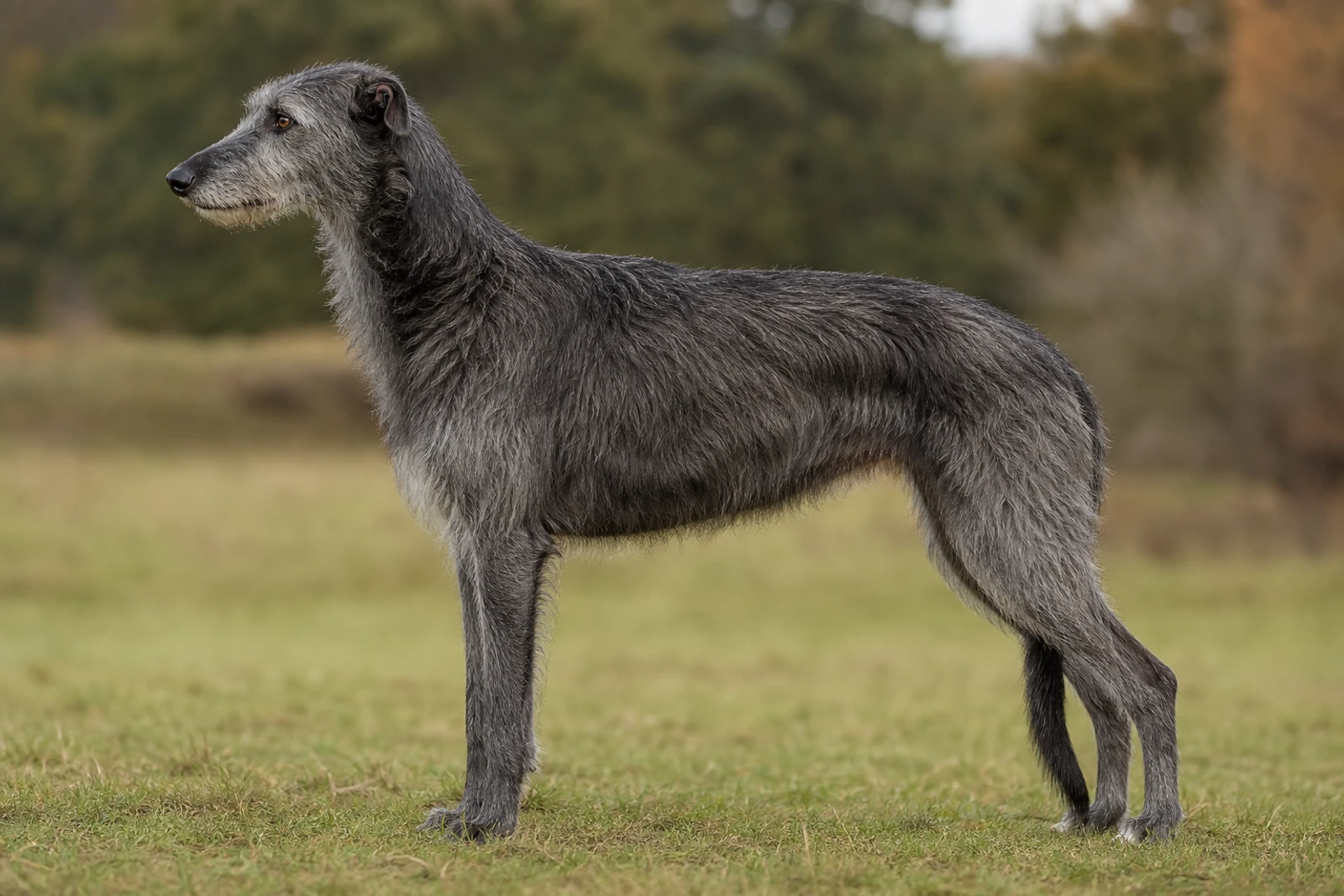
The Scottish Deerhound is a gentle giant, perfectly suited for families or individuals with ample space and a love for the outdoors. This ancient sighthound thrives in homes with a yard, enjoying daily runs but content to lounge indoors. With a calm and dignified nature, the Deerhound is affectionate with its family and generally good with children and other dogs. However, their strong prey drive may make them unsuitable for homes with cats or small pets. Not ideal for first-time owners, they require consistent, positive training and moderate grooming. Their long legs and serene presence make them a majestic companion for experienced dog lovers.
At a glance
- Size
- Giant
- Height
- 28–30 in
- Weight
- 82–101 lb
- Life span
- 10–11 years
- Coat colors
- Blue-gray, Brindle, Fawn, Red fawn, Gray, Yellow
- Coat type
- Wir y, harsh, and dense outer coat with soft undercoat
How much does a Deerhound cost?
Adopt / rescue
$75–$400
Usually includes spay/neuter, first shots, and a microchip.
Buy from a breeder
$700–$2,000
From a reputable, health-testing breeder.
Approximate USD. Prices vary widely by region, breeder, pedigree, age, and coat colour — adopting is the lower-cost and recommended route. Avoid suspiciously cheap “breeders”; they’re often puppy mills.
Estimate the full cost of a Deerhound →Want the ongoing number? Estimate the monthly food bill for a Deerhound with our dog food cost calculator.
Deerhound photos
Views
Front, side, rear and top — the full silhouette.Poses
How the breed sits, lies, moves and plays.Puppy to senior
The breed across its whole life.Expressions
The breed’s range of moods.Close-up details
Eyes, ears, nose, paws, tail and coat.Coat colors
The breed’s recognized colors.Click any photo to enlarge. We show the Deerhound from every angle — three views, poses, life stages, expressions, close-ups, coat and colors.
Appearance & size
Stand a Deerhound next to a Greyhound and the Deerhound will make the racer look slender to a fault. This is a giant coursing hound built for speed over rough Scottish terrain, with a height of 28–30 inches at the shoulder and a typical weight range of 82–101 pounds. Males push the top of both scales; females run a shade smaller and lighter, but neither sex ever looks heavy. The whole frame says “distance runner” — long legs, a deep chest that reaches down to the elbows, and a noticeably tucked waist that pulls up tight behind the ribcage.
The coat is the Deerhound’s signature. It’s a harsh, wiry outer jacket, about three to four inches long over the body, with a softer undercoat for warmth. You’ll see a distinct mane of stiffer hair on the neck, a rough fringe on the backs of the legs, and a beard-and-mustache combo that gives the face its wise, grizzled expression. The hair on the head and muzzle is shorter and softer, while the tail is feathered with a slight curve and carried low, reaching near the ground.
Colors cover a range of weather-beaten earth tones: dark blue-gray, iron gray, brindle, sandy red, red fawn, and yellow. A small white patch on the chest and white toes are allowed, and a faint white tip on the tail sometimes appears. Dark points on the muzzle, ear tips, and tail are common and preferred, adding to that craggy, old-world look.
From the front, the Deerhound’s deep brisket and straight, parallel forelegs frame a long, well-chiseled head with a flat skull and a tapering muzzle. The dark eyes sit under slightly bushy brows, and the ears are small, set high, and folded back like a Greyhound’s — though when the dog is alert, they can rise to a semi-prick that changes the silhouette entirely.
Profiled from the side, the body flows in a series of relaxed curves: the arched loin dips slightly, the chest sweeps back, and the hindquarters angle powerfully into well-let-down hocks. There’s a distinct space between the last rib and the tuck-up; you can count a couple of ribs if the dog is in working condition. From the rear, the thighs are broad and sinewy, with hocks straight and close when the dog is stacked. The tail, thick at the base and tapering, hangs down to the hocks or a bit lower, making the whole backend look balanced and ready to launch.
History & origin
The Scottish Deerhound was made to do one thing with unflinching purpose: course red deer across the unforgiving Highland terrain. This wasn’t a pack hound that barked and held a stag at bay. A Deerhound worked solo or in a pair, sprinting down a 350-pound animal, tackling it, and finishing the job. The job demanded a lanky, deep-chested frame, explosive speed, and the grit to handle sharp hooves and antlers. Today’s dogs — standing 28 to 30 inches at the shoulder and ranging from 82 to 101 pounds — haven’t forgotten that inheritance.
The breed’s outline appears in Scottish stone carvings and written accounts dating back to the 1500s, but its true roots likely go much deeper, possibly arriving with ancient coursing hounds brought by seafaring traders. By the clan era, ownership was strictly a privilege of nobility. An earl or chieftain wouldn’t part with a good deerhound lightly; these dogs were bartered as diplomatic gifts and guarded like heirlooms. The isolation of individual glens produced a consistent type: tall, rough-coated, gray or brindle, with a wiry jacket that shed sleet and heather alike.
Two events pushed the Deerhound to the brink. The collapse of the clan system after Culloden in 1746 dismantled the old stag-hunting estates, and later, the breech-loading rifle made coursing seem archaic. Why send a dog when a bullet could do the work from a safe distance? By the mid-19th century the breed survived in only a few Scottish kennels. The brothers Duncan and Archibald McNeill — later joined by Lord Archibald Campbell — gathered the remaining good specimens and bred them with painstaking care. Nearly every Deerhound alive today traces back to that handful of committed breeders.
The result is a living antique — a sighthound built for a vanished world, now more often found lounging on a hearth rug than racing across a moor. Pure numbers stayed low; the Deerhound remains rarer than many realize, with a typical lifespan of 10 to 11 years. That aloof, gentle giant you see at a lure-coursing meet carries the same silent intensity that once defined a Highland noble’s standing.
Temperament & personality
The Deerhound in your living room and the Deerhound in an open field are almost two different animals. Inside, you get a calm, sometimes comically lazy companion who will claim the softest piece of furniture and stay there for hours. Outside, that same dog turns into a coursing machine — all lean muscle and explosive speed, hardwired to chase anything that runs. Understanding that split is the key to living happily with one.
The indoor couch-owner
Expect a quiet, low-key housemate. A well-exercised Deerhound is content to sprawl across a sofa (or three) for most of the day. They are not a high-energy, fidgety breed indoors. You’ll rarely hear barking; when they do vocalize, it’s more of a low, throaty “woof” than a sharp guard-dog bark. That doesn’t make them watchdogs. A Deerhound might lean against a stranger with friendly curiosity rather than sound an alarm. In fact, “reserved but not suspicious” is a fair description — they’ll accept new people once you do, but they don’t rush to greet everyone like a Lab.
Affection in a Deerhound comes in heavy doses. Literally. These dogs bond deeply with their people and will follow you from room to room, often leaning their full body weight against your leg. That lean is their version of a hug. They can be sensitive to family tension; harsh voices or anger will send them retreating, and prolonged isolation can trigger anxiety behaviors — stress chewing, indoor marking, or depression. You’re dealing with a dog that wants to be part of the household rhythm, not banished to a yard alone.
The outdoor athlete
A fenced area is non-negotiable. A Deerhound’s prey drive is deep and ancient; a running cat, squirrel, or small dog can override every bit of training in a split second. They’ll hit top speed in a few strides and won’t hear you calling. This isn’t disobedience in the usual sense — it’s 500 years of sighthound instinct meeting a 30-mile-per-hour body. Let them stretch that speed in safe, enclosed spaces daily. A solid hour of off-leash running (not just a leash walk) keeps the indoors version sleepy and sane. Without it, you’ll get a restless, counter-surfing giant who knows exactly where you keep the bread.
Living with the family
Their gentleness is real, but size matters. An 85–100-pound dog moving at full play zoomie can bowl over a toddler without meaning to. They’re patient with respectful kids who know not to interrupt meals or climb on the dog when it’s resting. Teach children to let the Deerhound eat in peace; food guarding isn’t typical, but no dog should be tested that way.
With other dogs, they often do well — especially if raised together. Small animals are a different story. A Deerhound that coexists happily with the family cat indoors may still light up and chase the neighbor’s cat outdoors. Don’t mistake indoor truce for universal safety. Puppy-raising with small critters helps, but management is always wiser than trust.
Quirks and honest downsides
- Counter height is dog height. A Deerhound can rest its chin on your dining table. Unattended food vanishes without a sound. Secure trash and keep counters clear, or accept that your roast chicken belongs to the household collectively.
- Stubborn streaks run deep. They aren’t defiant in a flashy, hard-headed way; they just quietly decide they’d rather not. A respectful, consistent approach wins cooperation. Bribery with high-value treats works far better than force.
- Chewing has practical motives. Puppies gnaw to explore and ease teething. Adults chew heavy-duty toys to keep jaws strong and teeth clean. Redirecting that urge to appropriate objects saves your furniture — a bored Deerhound with no outlets will find its own.
- Scent matters more than you think. They mark familiar spots, and leftover urine odors indoors can invite repeat accidents. Enzymatic cleaners break that cycle, and treating immediately after outdoor elimination teaches the right habit fast.
The Deerhound temperament is steady, sweet, and tuned to its people — provided you give the speed a place to go and accept that you’re sharing your home with a 30-inch-tall, sofa-loving shadow.
Good with kids, dogs & other pets
A Deerhound’s default is patience, not pushiness, which makes this breed a surprisingly easy companion for families. With kids, you’re dealing with a dog that stands 28–30 inches at the shoulder and weighs up to 101 pounds but applies almost no pressure. Toddlers can lean on them, and a well-socialized Deerhound usually leans back or just walks away rather than snapping. That said, the sheer size and a long, whip-like tail that clears coffee tables in one sweep mean you’ll want an adult within arm’s reach when a crawling baby or an unsteady preschooler is on the floor. Accidental knock-downs happen, not out of aggression but out of physics.
Around other dogs, Deerhounds are typically low-drama. They’re not wired to guard resources or posture for status in the park. Off-lead walks with familiar dog friends tend to be relaxed, though two intact males of similar age can go from polite to tense if a female in season is anywhere in the neighborhood — something to factor in if you’re considering a multi-dog household. Early, positive exposure to other dogs (ideally between 3 and 14 weeks) goes a long way toward solid, easygoing adult behavior. A Deerhound that missed that window can still learn, but you’ll move at the dog’s pace rather than forcing meet-and-greets.
Small pets are where your management skills get tested. The breed was developed to course and pull down red deer, and that chasing instinct is still very much alive. A cat that lives indoors and was raised alongside the Deerhound from puppyhood often becomes a napping buddy. A strange cat darting across the yard? That’s prey. The same goes for rabbits, guinea pigs, and even small dogs that bolt. Deerhounds don’t necessarily kill what they catch — they may just hold it until you arrive — but the result can still be traumatic for everyone. If you keep free-roaming small animals, separate them with actual doors, not baby gates; a Deerhound steps over those without noticing.
Because this is a breed that bonds hard to its people and can slide into loneliness when left alone too long, including the dog in daily family life — not isolating it in a yard or a separate room — actually makes interactions more stable. A socially integrated Deerhound that gets gradual, no-pressure introductions to visitors, other dogs, and the family cat during the critical 3–16-week period is far less likely to react out of fear or overexcitement later on.
Trainability & intelligence
A Deerhound learns exactly what you teach — but only if the lesson never feels like a power struggle. This is a large, sensitive sighthound, not a blindly obedient retriever. He’s clever enough to figure out patterns quickly, yet independent enough to ask, “What’s in it for me?” before he complies.
Motivation often hinges on relationship, not just food. Soft praise, a quick game with a fleece tug, or a high-value treat can all work, but many Deerhounds get bored if you reach for the same reward every time. Short, upbeat sessions beat repetitive drilling. Think three or four five-minute bursts a day, not a twenty-minute slog.
The biggest training challenge is recall. A Deerhound who spots movement in the distance — a deer, a squirrel, even a windblown plastic bag — can switch into coursing mode and tune out your voice completely. Never trust that recall off leash in an unfenced area, no matter how solid he seems in the yard. Work on it daily with jackpot rewards and practice in safe, enclosed spaces, but accept that his instincts will always win that tug-of-war when prey is real.
Start socialization early, well before 16 weeks, with gradual exposure to different people, dogs, surfaces, and sounds. A poorly socialized Deerhound can tip from politely reserved into fearful, and with a 90- to 100-pound dog, that’s a safety issue. Puppy classes, calm introductions, and positive experiences help him grow into a steady adult.
Harsh corrections or punishment-based methods backfire badly. These dogs shut down or become hand-shy. Gentle, consistent, reward-based handling builds the trust that makes a Deerhound willing to work with you. Teach a solid “settle” and polite greeting early — a 95-pound dog who leans on guests or jumps up isn’t cute for long. Treat his cooperation as something you earn, not something you enforce, and you’ll have a companion who chooses to check in even when his nose and eyes are busy.
Exercise & energy needs
Deerhounds run like their ancestors still chase prey across the Scottish Highlands—explosive, all-out sprints that burn through 35 miles an hour, followed by long stretches of quiet contentment. You’ll satisfy that instinct with two daily outings totaling about 60 to 90 minutes, broken into a morning session and a longer afternoon romp. A stroll around the block won’t cut it. They need one solid opportunity each day to gallop freely in a safe, fenced area—a large yard, a field, or a secure off-leash park where they can hit top speed for a few bursts without running into traffic.
Inside the house, the same dog is a couch-glutton who sprawls for hours. This on/off switch makes them easier to live with than their size suggests, but skipping that daily run invites restlessness, nuisance barking, or a deerhound who suddenly rediscovery the joy of counter surfing.
Mental exercise matters just as much. Short, frequent scent games, puzzle toys, or even hiding treats in the yard channel that coursing brain. Sighthounds often enjoy lure coursing (even an amateur set-up with a flirt pole) and can excel in straight racing or open-field tracking. Long, repetitive road runs or forced jogging on pavement are a bad fit for developing joints, so keep puppies off hard surfaces and limit high-impact leaps until growth plates close around 18 months.
Use a long training leash if you don’t have a fully fenced space—Deerhounds can spot a squirrel a quarter-mile away and will be gone after it before you finish saying “come.” Match the exercise to the dog’s age and health, and you’ll have a relaxed giant who’s happiest flopped at your feet.
Grooming & coat care
A rough, wiry coat that feels crisp to the touch is the Deerhound’s trademark—and it’s far easier to live with than it looks. The outer hairs grow 3–4 inches long, forming a distinct mane, fringes on the legs, and a gentle wave over the back, backed by a softer, insulating undercoat. This combination doesn’t mat as aggressively as a long, silky coat, but it still needs a weekly session with a slicker brush (rounded pins) to pull out dead hair and stop tangles before they start, especially behind the ears, in the mane, and along the feathery thighs. Follow up with a metal comb to confirm you’ve caught every snag.
Bathing is an occasional job—every 2–3 months, or when the dog rolls in something ripe. Too-frequent shampooing strips the coat’s natural oils and softens that prized harsh texture. Between baths, just wipe the legs and belly with a damp cloth. Resist the urge to shave or clip the coat for summer; you’ll ruin the wiry outer layer and lose the weather-resistant quality the breed needs. A little neatening around the feet and sanitary area is fine, but leave the bulk of the coat alone.
Because the Deerhound sports floppy, drop ears, they trap moisture and benefit from a weekly check and wipe with a vet-approved cleaner. Nails grow fast on a giant breed that spends time on soft ground, so plan on trimming every 3–4 weeks—if you hear clicking on the floor, you’re overdue. Dental care follows the usual giant-breed script: brush those teeth 2–3 times a week to stay ahead of tartar.
Seasonally, expect a moderate undercoat blow in spring and fall. The weekly brushing often handles the extra fluff, but you may want to add a second pass with a stripping comb or your fingers to pluck out dead hair and keep the coat lying flat and harsh. The payoff: a rugged, low-odor coat that looks after itself with just a little regular hands-on attention. After a wet, muddy run, always dry those ears and check between the pads for pebbles or snow buildup.
Shedding & allergies
Deerhounds have a harsh, wiry outer coat that grips dead hair instead of letting it float onto your furniture. That means you won’t see constant tumbleweeds across the floor, but when you finally take a brush to them, you’ll pull out handfuls of gray-brown wool at once. Once-a-week brushing with a slicker or undercoat rake keeps things tidy. Skip it, and the loose undercoat stays trapped until the next time it releases — often all over your clothes.
Twice a year, typically in spring and fall, they go through a full-blown undercoat blow. For a couple of weeks, fur comes off in tufts every time the dog turns around. Daily brushing during that window makes a real difference, and a good bath helps loosen the dead hair.
Drool is a non-issue for most Deerhounds. They’re naturally dry-mouthed, though the signature beard will drip water across the kitchen floor after a drink. A towel by the bowl handles that.
No breed is hypoallergenic, and Deerhounds are no exception. The proteins that trigger allergies live in dander and saliva, both of which this breed produces in spades. Their wiry coat does tend to hold dander closer to the skin, so less wafts into the air than you’d get from a soft, shedding-heavy dog. That sometimes makes them tolerable for people with mild allergies, but it’s a gamble — not a promise. The only way to know is to spend real time around adult Deerhounds before committing. If your household needs a genuinely low-allergen dog, this one won’t be a safe bet.
Diet & nutrition
A Deerhound’s long, lanky build hides a stomach that’s unusually sensitive for a dog this size. The twin dangers to watch are bloat (gastric dilatation-volvulus) and extra weight on growing or aging joints. Even a few extra pounds shorten a giant breed’s already limited years.
Feed adults two meals a day — never one huge portion — and keep your dog quiet for at least an hour after eating. If your Deerhound wolfs down food, a puzzle bowl or slow feeder turns mealtime into a mental exercise and cuts the amount of air he swallows.
Puppy feeding starts small and frequent:
- Up to 4 months: four spaced-out meals daily.
- 4–6 months: three meals.
- After 6 months: twice a day like an adult.
Choose a large-breed puppy formula that slows growth to protect developing joints, and transition to adult food gradually around 12–18 months.
Portion control matters more than chasing an exact number on a scoop. Start with the bag’s recommendation for an 82–101 lb dog, then adjust so you can easily feel ribs under a light cover of flesh. Many Deerhounds are naturally lean and self-regulate well, but food motivation varies; some individuals will gorge if given the chance. In a breed prone to hip dysplasia and spinal issues, keeping a waistline visible is non-negotiable.
If you feed raw or home-cooked, aim for a composition roughly 60% meat (raw and cooked), 20–30% fruits and vegetables, and 10% additions like eggs, plain yogurt, or digestible grains such as pearl barley or white rice. Puréeing or light processing helps nutrient absorption because dogs lack salivary amylase and their jaws only shear vertically. Raw chicken wings or necks can be introduced around 12 weeks, always under supervision.
Never feed directly from the table — it teaches begging that’s nearly impossible to undo — and avoid dumping rich holiday leftovers into the bowl; sudden high-fat meals can trigger pancreatitis. Use the dog’s own dish for any dog-safe scraps, and keep meals boring and predictable.
Senior Deerhounds (around 8 years and up) often do better with three smaller meals rather than two larger ones. Don’t arbitrarily cut protein; there’s no solid evidence it harms older kidneys. Do cut calories as activity drops, and purée meals for a dog with worn or missing teeth. At every stage, what you feed matters less than the weight you see on the scale and the outline of ribs under your hand.
Health & lifespan
Deerhounds typically live 10–11 years, a respectable window for a giant breed. Hitting the high end of that range comfortably hinges on catching a few serious conditions early and managing risks that come with that deep, lean frame.
Health conditions worth knowing about
- Bloat (gastric dilatation‑volvulus): The deep chest makes a Deerhound a prime candidate. The stomach can twist on itself, cutting off blood flow. Minutes matter. Know the signs — a distended belly, retching without bringing anything up, pacing, and sudden collapse — and have the nearest emergency vet’s number saved. Prevention means feeding two or three smaller meals, not one big one, avoiding heavy exercise for an hour after eating, and skipping raised feeders unless your vet recommends them for another reason. Some owners consider a prophylactic gastropexy during spay/neuter, which tacks the stomach in place so it can’t twist.
- Dilated cardiomyopathy (DCM): A weakening of the heart muscle that shows up silently at first. Responsible breeders screen breeding stock with annual echocardiograms and can show you those results. In your own dog, watch for episodes of coughing, tiring sooner than expected on walks, or a pot-bellied look. A cardiologist can catch changes before they cause real trouble.
- Osteosarcoma: Bone cancer hits large and giant breeds more often, and Deerhounds are no exception. A persistent limp, especially in a leg, that doesn’t respond to rest or anti‑inflammatories needs an X‑ray immediately. Early detection doesn’t reverse it, but it opens up more treatment options.
- Hypothyroidism: An underactive thyroid can lead to unexplained weight gain, a dull coat, and lethargy. It’s straightforward to manage with daily medication and periodic blood tests once diagnosed.
Everyday health and the vet
Keep a Deerhound on the lean side — rib-feel lean, not just “not fat.” Excess weight amplifies joint strain and likely increases bloat risk. Heartworm prevention given monthly during mosquito season and for one month afterward is non‑negotiable; rabies vaccination is legally required and 100% fatal once symptoms appear, so never let that lapse.
Sighthounds handle anesthesia differently than other dogs, often needing lower doses and avoiding certain drug classes entirely. Any vet working on your Deerhound should be comfortable with sighthound-specific protocols. Make that clear before a dental cleaning or any procedure.
Annual exams catch silent problems. Starting at around age seven, bump that to twice‑yearly visits with senior bloodwork that includes a thyroid panel and cardiac listen. Watch for subtle shifts — drinking more than usual, a coat thinning, a hesitation before jumping into the car — and report them immediately.
When you look for a puppy, ask the breeder pointed questions: “Can I see the cardiac echo results for the sire and dam?” and “How old are the dogs in your lines typically living?” A breeder who can’t answer comfortably or doesn’t do cardiac screening isn’t doing enough to stack the odds in your favor.
Living environment
A Deerhound is a giant sighthound built for short bursts of speed, not convenience, so a house with a physically fenced yard is nearly always required. Apartment life falls apart fast with a dog that stands 28–30 inches at the shoulder and weighs upwards of 100 lb — even a spacious apartment feels cramped when a Deerhound decides to stretch out or play. The yard must be securely fenced at least 6 feet high, because these dogs can clear lower barriers and will bolt after anything small and fast. They’re not reliable off-leash outside a contained area.
Climate-wise, their rough, wiry coat gives them decent tolerance for cool, damp weather, but heat is a real risk. Limit strenuous exercise during the hottest parts of the day; always provide shade and fresh water. Early morning or evening sprints in the yard are safer matches for their physiology.
On the noise front, you’re in luck. Deerhounds are typically quiet house dogs. They rarely bark without reason, so they won’t set off the neighbors — a small win if you do have close quarters, though the space issue still dominates.
Being left alone for long stretches doesn’t suit them. They bond deeply with their people and can move into anxiety or destructiveness if routinely isolated for a full workday. An adult Deerhound who gets a proper run (not just a walk) and some mental work — puzzle toys, scent games — might handle 4–6 hours, but a second dog often helps more than any training. If your household is empty most of the day, this breed will struggle. Plan for multiple daily exercise sessions, and build alone time gradually from puppyhood with enrichment and a calm environment. A Deerhound isn’t high-maintenance in noise or energy, but its size and emotional wiring demand space, a secure yard, and a person who’s around more often than not.
Who this breed suits
A Deerhound fits best with someone who has room — not just square footage, but a large, securely fenced yard where this 28–30 inch, 82–101 lb sighthound can stretch out and hit top speed for a few minutes a day. Inside the house, he’s a polite couch companion who dozes for hours. That split personality works beautifully for an owner who can offer focused, safe sprinting opportunities and then enjoy a calm, undemanding presence at home.
Best fit
- Active families with older children. The Deerhound is gentle and patient, but his sheer size and a happy tail sweep can topple a toddler without meaning to. Kids who are steady on their feet and understand how to treat a dignified dog do well here.
- Singles or couples with space and a routine. If you have a fenced acre or regular access to a securely enclosed field, a Deerhound will thrive. He needs a daily gallop, not just leash walks. Plan to get him out for a good 20–30 minute run, ideally off-lead in a safe area.
- Experienced owners who appreciate an independent streak. This isn’t a Labrador who lives to please. Training requires patience, consistency, and a soft touch — harsh corrections shut him down. You’ll get a loyal, quiet companion who knows his own mind.
- Active seniors with a fenced yard. A Deerhound can work for an older person who stays mobile, provided the dog is well leash-trained early. In the house, he’s low-key and not demanding, and his grooming needs are minimal — a quick brush once a week.
Think twice if…
- You live in an apartment or lack a tall, solid fence. A four-foot picket won’t cut it; Deerhounds can easily clear six feet if something small and furry darts by. They’re sighthounds with a deeply ingrained chase instinct.
- You have cats, rabbits, or tiny dogs free-roaming the home. Some individuals can learn to coexist if raised with them, but it’s not the natural starting point and requires lifelong management.
- You want a dog for off-leash hiking in open country. Recall can be unreliable when prey is in sight. A Deerhound who spots a deer may be a county over before you can blink.
- You’re a first-time owner looking for an easy, “plug-and-play” breed. While Deerhounds are generally amiable, they’re also sensitive and can be stubborn about training. You’ll need to understand and work with sighthound nature, not against it.
- You need a guard dog. These dogs tend to greet strangers with a wag or a polite aloofness, not suspicion. Alarming barkers they are not.
A Deerhound gives you about 10–11 years of unassuming companionship — provided you can give him the space, safety, and soft leadership he needs. If you can’t commit to that securely contained running room right outside your door, a different breed will keep everyone happier.
Cost of ownership
Owning a Deerhound is a serious financial commitment, not just because of the initial price tag. A well-bred puppy from health-tested parents typically costs between $1,500 and $3,000, with show-prospect pups from top lines occasionally fetching more. Waitlists are common; expect to plan a year or more ahead.
Ongoing monthly costs
- Food: These giant hounds put away 4–6 cups of high-quality dry kibble daily. Budget $80–$120 per month depending on the brand and whether you supplement with raw or canned food.
- Routine vet care: Annual exams, vaccines, and heartworm/flea prevention run roughly $500–$800 a year. Because of their size, medication doses (and prices) are always on the high end.
- Insurance: With a lifespan of 10–11 years and known risks for bloat, dilated cardiomyopathy, and osteosarcoma, pet insurance is a smart move. Premiums for a giant breed typically fall between $60 and $100 monthly, depending on coverage and deductible.
- Grooming: The wiry coat is low-shedding but needs hand-stripping a couple times a year to stay healthy. A professional stripping session runs $50–$70. Between appointments, regular brushing at home keeps things tidy.
- Emergency fund: Even with insurance, keep a reserve. Gastric dilatation-volvulus (bloat) surgery can hit $5,000 or more in an emergency hospital.
Those figures add up quickly; plan on at least $200–$300 in predictable monthly outlays, with the real wildcard being the kind of surprise vet bill a deep-chested giant can generate.
Choosing a Deerhound
A Deerhound isn’t a spur-of-the-moment dog. They’re a rare giant, so you’ll likely wait for a well-bred puppy or move quickly if a rescue surfaces. The choice shapes the next decade.
Rescue or breeder: either can work, but you’re shopping for a unicorn either way.
Deerhound-specific rescues occasionally place adults, and a few mixed-breed giants end up in shelters labeled “Lurcher.” The advantage: you bypass the destructive puppy phase and often get a dog that’s already house-trained. The trade-off: health and lineage are unknowns. Many rescues carry heart or bone cancer in their lines without documentation. You’ll need a vet check with an echo the first week home, no exceptions.
A responsible breeder is your best shot at a long-lived, stable dog.
They breed to the Deerhound Club of America’s code of ethics, which means they don’t churn out litters. Expect to fill out a detailed application and get grilled in return. A good breeder owns the sire or dam, or co-owns, and raises pups underfoot — not in a kennel. They’ll talk your ear off about bloat prevention, late neutering, and why their line’s average lifespan really is 10–11 years, not a marketing number.
Health clearances: demand the paperwork. Don’t settle for a vet “check-up.”
Deerhounds can be prone to dilated cardiomyopathy, osteosarcoma, bloat (GDV), and hypothyroidism. Responsible breeders screen with:
- A board-certified cardiologist’s echocardiogram within the last year. Normal results don’t guarantee a dog won’t develop DCM later, but it weeds out active disease.
- OFA thyroid panel (not just a T4).
- DNA test for Factor VII deficiency — a usually mild bleeding disorder common in the breed. Knowing is important before any surgery.
- Ask about gastric torsion history in the direct line. Some breeders now do prophylactic gastropexy on puppies during spay/neuter.
Red-alert red flag: a breeder who argues “heart testing is optional” or blames early deaths solely on food or vaccines. Walk away.
Red flags that should send you running.
- More than one litter per year, or multiple breeds in the same house.
- No involvement in lure coursing, racing, or conformation — breeders who don’t prove their dogs can move and work aren’t preserving sound structure.
- Puppies sold at eight weeks without a contract spelling out health guarantees and a return-to-breeder clause.
- They won’t introduce you to the mother on site. Father may be a stud off-site, but you should see video and his health clearances.
- They push a “rare blue” or “rare brindle” for extra cash. Color is irrelevant in Deerhounds.
Picking your puppy: look for a calm, curious homebody, not the wild child.
A Deerhound pup is all legs and oversized ears, but shouldn’t be trembling or hiding. Watch the litter interact — a middle-of-the-road pup who investigates your shoelaces then flops in your lap is gold. The one ricocheting off walls may be a future handful, and the wallflower may struggle with confidence. The breeder should have done early neurological stimulation and will match temperament to your home based on weeks of observation. Trust their pick if you’ve done your homework on them.
Finally, take a hard look at your fence. A 30-inch-tall dog that hits 40 mph needs six-foot boundaries, no gaps. If a breeder doesn’t ask about your fencing, that’s your cue to leave.
Pros & cons
Pros
- Gentle dignity that fits into family life — despite standing 28–30 inches and weighing 82–101 lb, a Deerhound is famously calm indoors and quietly affectionate. They’re patient with respectful kids and typically get along with other large dogs, especially sighthounds.
- Low-maintenance coat — the rough, wiry double coat barely sheds. A quick weekly brushing and the occasional bath handle it, with no doggy odor and minimal trimming.
- A serene, quiet presence — these aren’t barkers. A Deerhound will alert you to something unusual but won’t fill your house with noise. They settle easily after exercise.
- Graceful sprinter, content lounger — give them a safe place to run full-out for 30–40 minutes (a fenced field is ideal), and they’ll sprawl on the sofa the rest of the day. They don’t need relentless, structured training; they thrive on free gallops.
Cons
- A 10–11 year lifespan — that’s short, even for a giant breed. Responsible breeders screen hearts and watch for osteosarcoma, but you have to accept a compressed timeline with this gentle friend.
- Prey drive that overrules recall — a fleeing squirrel, cat, or small off-leash dog ignites a 30–40 mph chase. Off-leash walks in unfenced areas are a gamble you can’t take; you’ll need sturdy, tall fencing at home.
- Bloat risk and deep-chested sensitivity — like many giant breeds, Deerhounds can bloat. You’ll feed multiple small meals, avoid exercise right after eating, and learn the warning signs. Also, their system handles anesthesia poorly, so you need a vet who knows sighthounds.
- Big-dog expenses and space — the monthly food bill is real, and a cramped apartment frustrates them. They’ll press against your legs and lean on you (literally) when they feel ignored, which can tip into separation anxiety without practice being alone.
Similar breeds & alternatives
If a Deerhound sounds almost right but the size, coat, or rarity gives you pause, these sighthounds travel similar territory with clear trade-offs.
-
Irish Wolfhound – The obvious giant-sighthound alternative. A Wolfhound typically stands taller (30–34 inches) and outweighs a Deerhound by 20 pounds or more, with a heavier, blockier frame. That extra bone comes with a shorter lifespan of 6–10 years. Temperament is famously sweet and patient; Deerhounds can be a touch more reserved with strangers. Both have rough coats, but the Wolfhound’s is shaggier and mats more readily if you skip brushing. Deerhounds were built to course red deer across rough terrain, so they’re leaner and more agile. If you value a little more longevity and a dog that moves like a long-distance runner, the Deerhound edges ahead.
-
Greyhound – The smooth-coated cousin that scales down the size and grooming. Males run 27–30 inches and 60–70 pounds, so they’re 20–30 pounds lighter than a Deerhound. The short, single coat sheds less and needs a quick wipe rather than the Deerhound’s regular stripping and brushing. Both are quiet indoors and need a fenced sprint a couple of times a week, but a Greyhound is far easier to find through rescues. Expect a Deerhound to be more aloof with strangers and far better suited to cold, wet weather. If you want the sighthound personality without the grooming commitment or the harder-to-find puppy, the Greyhound fits neatly into more homes.
-
Borzoi – An elegant choice when you’re drawn to the Deerhound’s height but want a longer, silky coat. Borzoi stand 26–28 inches at the shoulder (some taller) and weigh 60–105 pounds. Their flowing single coat mats easily and requires thorough daily brushing—a different chore than the Deerhound’s wiry, weatherproof double coat. Where Deerhounds bond closely and can be goofy at home, Borzoi are more cat-like and independent: faithful but rarely needy. Both have a high prey drive and need a securely fenced run. Borzoi typically live 10–12 years, giving you a couple more seasons with your speedster.
Fun facts
- Bred to hunt red deer in the Scottish Highlands
- One of the tallest dog breeds, standing up to 30 inches at the shoulder
- Known as the 'Royal Dog of Scotland'
- They are sighthounds, capable of great speed and endurance
Frequently asked questions
- Are Deerhounds good with children?
- Deerhounds tend to be gentle and affectionate with children, but their large size can accidentally knock over small kids. Always supervise interactions and teach children how to behave around such a big dog. Early socialization helps them develop patience and calmness.
- Do Deerhounds shed a lot?
- Deerhounds shed moderately, with their wiry coat dropping some hair throughout the year. They are not considered heavy shedders, but regular brushing helps manage loose fur. Seasonal shedding can increase, but overall they are fairly low-maintenance in this regard.
- How much exercise does a Deerhound need?
- As a sighthound, the Deerhound needs daily opportunities to stretch its legs in a safe, fenced area, alongside regular walks. They enjoy sprinting but are often calm indoors, settling into a relaxed routine if their exercise needs are met. A balance of free running and leash walks is ideal.
- What are the grooming requirements for a Deerhound?
- The Deerhound's harsh, wiry coat requires weekly brushing to remove dead hair and prevent matting. Occasional hand-stripping or trimming might be needed to maintain coat texture. They are generally clean dogs with little odor, and bathing is only needed when dirty.
- Can a Deerhound live in an apartment?
- Due to their large size and need for regular sprinting, Deerhounds are not well-suited for apartment living unless you have access to a large, secure outdoor space. They may be quiet indoors, but a lack of off-leash running can lead to restlessness. A home with a yard is preferable.
- Are Deerhounds suitable for first-time dog owners?
- Deerhounds can be a challenge for first-time owners because of their independent nature and need for consistent, gentle training. They respond best to positive reinforcement and may not obey commands as eagerly as some breeds. Committed novices can succeed if they learn about sighthound traits and provide proper exercise.
Tools & calculators for Deerhound owners
Quick estimates tailored to Deerhounds — pre-filled with this breed’s size where it matters.
Articles & stories about the Deerhound
Sources & standards
This profile follows recognized breed standards from the American Kennel Club (AKC) and the Fédération Cynologique Internationale (FCI), along with established veterinary and breed-club guidance. These describe general breed tendencies — every dog is an individual.