

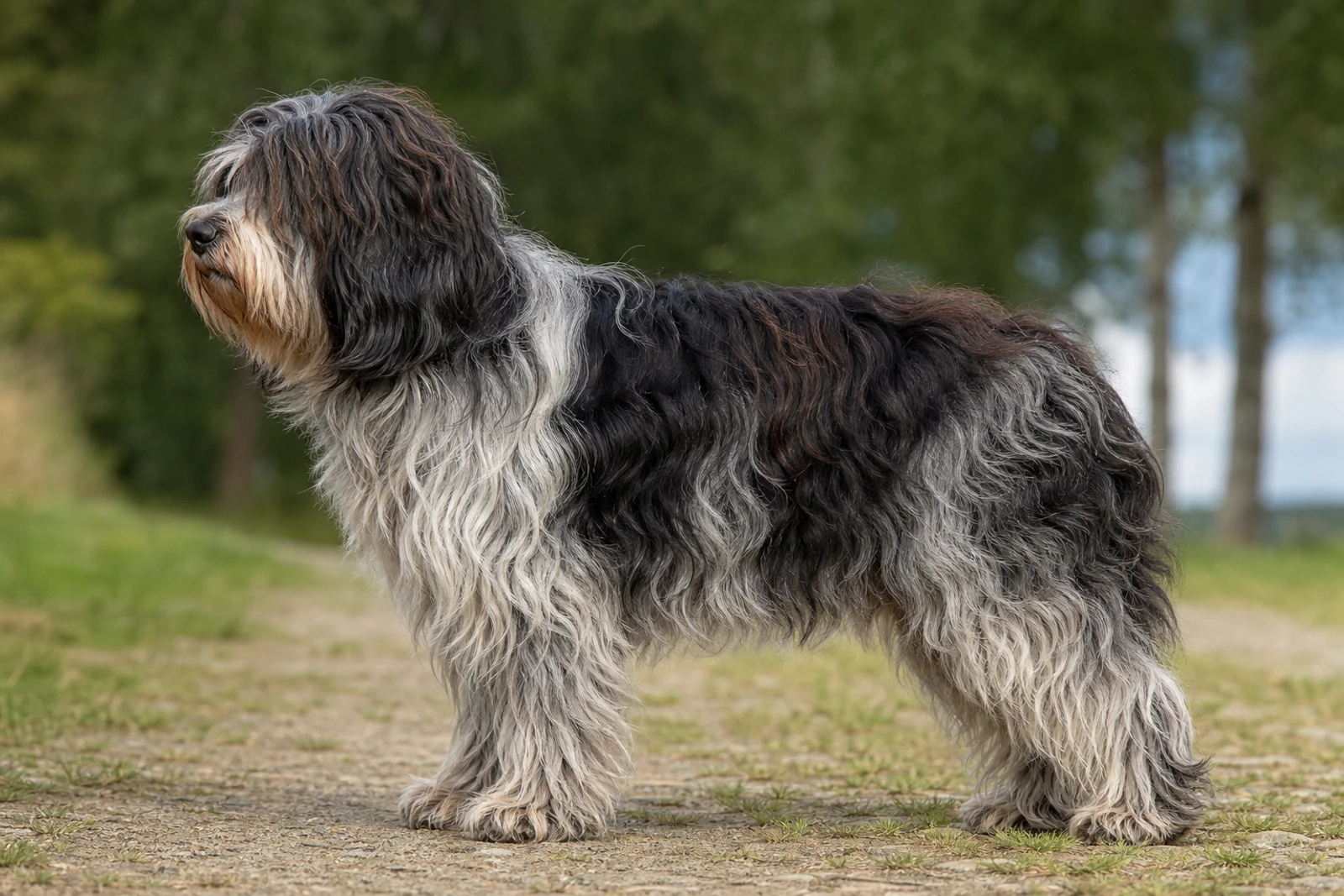
The Dutch Schapendoes is a lively herding dog that thrives in active families who can provide plenty of exercise and mental stimulation. With a shaggy double coat and an ever-wagging tail, this affectionate breed bonds deeply with its people, making it an excellent companion for children. Originally bred for herding sheep, the Schapendoes is intelligent and eager to please, responding well to positive training. While adaptable to various living situations, it needs daily outdoor activity and grooming to keep its coat mat-free.
At a glance
- Size
- Large
- Height
- 16–20 in
- Weight
- 26–44 lb
- Life span
- 13–14 years
- Coat colors
- blue-gray, black, white, brown, particolor
- Coat type
- long, shaggy double coat
How much does a Dutch Schapendoes cost?
Adopt / rescue
$75–$400
Usually includes spay/neuter, first shots, and a microchip.
Buy from a breeder
$700–$2,000
From a reputable, health-testing breeder.
Approximate USD. Prices vary widely by region, breeder, pedigree, age, and coat colour — adopting is the lower-cost and recommended route. Avoid suspiciously cheap “breeders”; they’re often puppy mills.
Estimate the full cost of a Dutch Schapendoes →Want the ongoing number? Estimate the monthly food bill for a Dutch Schapendoes with our dog food cost calculator.
Dutch Schapendoes photos
Views
Front, side, rear and top — the full silhouette.Poses
How the breed sits, lies, moves and plays.Puppy to senior
The breed across its whole life.Expressions
The breed’s range of moods.Close-up details
Eyes, ears, nose, paws, tail and coat.Coat colors
The breed’s recognized colors.Click any photo to enlarge. We show the Dutch Schapendoes from every angle — three views, poses, life stages, expressions, close-ups, coat and colors.
Appearance & size
The Dutch Schapendoes is a light-boned herder that reads as shaggy elegance rather than bulk. You’ll notice the height stays between 16 and 20 inches at the shoulder, and a fit adult rarely tips the scale past 44 pounds — many settle around the mid-30s. That puts this dog in a strange spot: labeled large by some registries but physically medium and surprisingly nimble. The build is square to slightly off-square, meaning the body length matches or barely exceeds the height. Everything about the structure says “all-day trot.” The chest reaches deep to the elbow, ribs are well sprung, and the loin is strong and short-coupled. Front legs are straight and fine-boned without being fragile; rear legs show moderate angulation with a distinct, muscular upper thigh. The topline stays level when standing and on the move, and the tail — never docked — hangs down at rest but lifts in a high, sweeping curve when the dog is alert, a plume of hair fanning out behind.
The coat is the headline act. It’s a double coat: a dense, weather-resistant undercoat topped by a long, harsh outer coat that stands away from the body. Texture is more important than curl. You’re looking for a slightly waved, wiry feel — never silky or woolly — that sheds dirt and dries quickly after a swim. That coat grows in abundance everywhere. Feathering streams off the backs of the legs, the chest, and the belly. The face is a tangle of beard, mustache, and substantial eyebrows, giving the Schapendoes a look of wise, rumpled charm. The hair often sweeps forward over the eyes, creating a natural visor you can push aside to glimpse large, round, dark-brown eyes that are set wide and level. Those eyes are remarkably expressive — watchful and a bit mischievous.
Color is a free-for-all within the breed. You’ll see blue-gray to near-black, silver-fawn, chocolate, tri-color dogs with crisp tan points, pups born black that fade to slate gray by adulthood, and even pure white (though a white ear is frowned upon in some breed standards). The one constant is that solid white patches are allowed practically anywhere else. The nose is black or brown, matching the coat tone. The ears are drop ears — set high, hanging close to the head without being heavy, and covered in long fringe that blends into the neck ruff.
From the front, the dog gives an impression of breadth and softness. The skull is broad and slightly domed, the stop clearly defined. The mustache and beard emphasize depth, not width, and the forelegs are set well under the body. From the side, the deep brisket and moderate tuck-up break up all that hair so you can still see a working dog’s silhouette — balanced, with a clean throatlatch and a neck carried proudly. From behind, the trousers (that heavy feathering on the haunches) and the plumed tail dominate, but the hocks sit low and true, never bowed. The whole animal looks purpose-built for a day on the open range, even if the only thing it herds now is your children.
History & origin
The Dutch Schapendoes didn’t start in a kennel club registry—it grew out of the damp heathlands and small family farms of the Netherlands, especially in the province of Drenthe. For generations, farmers there kept a type of shaggy, tireless sheepdog that was never a formal “breed” but a working landrace, shaped entirely by the job it had to do. These dogs drove small flocks to market along sandy roads, pushed sheep off the dikes, kept vermin down around the barn, and acted as a first-alert watchdog—all with a weatherproof, mop-like coat that shed rain and shrugged off cold. The name says exactly what it was: schaap (sheep) and does, an old local word for a rough-coated, poodle-like dog.
By the late 1800s, the Schapendoes was woven into the rural economy. You’d see them bouncing low to the ground alongside drovers, using a springy, almost stilted trot that moved sheep without panic. But as border collies and other imported herding breeds took hold, and farms increasingly turned to mechanization, the local type started to disappear. World War II nearly finished them off. Only a scattered handful of dogs remained in Drenthe when a dedicated Dutch kennel figure, P.M.C. Toepoel, set out in the 1940s to find every last one.
Toepoel and a few colleagues collected the surviving dogs, pooled them into a reconstruction program, and wrote the first breed standard in 1954. The Dutch Kennel Club recognized the revived Schapendoes soon after. It never bounced back in large numbers, but what mattered did stick: the shaggy coat, the watchful eyes peering through a fall of hair, the bouncy gait, and a work ethic that slides easily from actual herding to agility courses and backyard games. Today the breed is still uncommon, even inside the Netherlands. If you spot one, you’re looking at a living piece of Drenthe’s farming past—a dog that wasn’t built to look pretty in a ring, but to work side by side with people through rain and mud, and keep a clear, steady head while doing it.
Temperament & personality
The Dutch Schapendoes is, above all, a cheerful family member who wants to be in the middle of everything. Expect a bouncy, bright-eyed shadow that follows you from room to room—not out of nervousness, but because life is more fun with you in it. They bond deeply and can become anxious if left alone for long stretches; that anxiety often shows up as barking, chewing, or indoor accidents.
This is a dog with real working roots and the energy to match. Don’t confuse medium size with low needs. A quick walk around the block won’t satisfy a Schapendoes. Plan on a solid hour of running, chasing, or vigorous play every day, plus puzzle toys or training sessions that put that quick brain to work. Without enough mental and physical exercise, they’ll invent their own jobs—like reorganizing your couch cushions or herding the kids.
Speaking of children: these dogs tend to be gentle, patient, and remarkably tolerant, but supervision is still essential. The same herding instinct that makes them delightful can also cause a nose-nudge or a playful chase that knocks a small child off balance. Teach kids to give the dog peaceful meals and never interrupt while eating to prevent any guarding.
Personality at a glance:
- Lively and affectionate—your lap isn’t too small, even if they outweigh a lap dog.
- Watchful without being suspicious; they bark to announce visitors but usually warm up fast once you say it’s okay.
- Playful and a little goofy; many owners describe them as “merry” or “clownish.”
- Quick to learn but occasionally independent-minded. Respectful, consistent handling works far better than force, which can sour that sunny nature.
- Not typically dog-aggressive, but early socialization around other pets and people makes a big difference.
You’ll spot their mood by a relaxed, wiggly body and soft eyes when content, and by a stiff posture or direct stare if they’re uncomfortable. Calming signals like lip licking or turning the head away are normal—give them space when you see them. Most Schapendoes live 13 to 14 years, so you’re signing up for a long-term household partner who genuinely suffers when relegated to the backyard. They belong in the kitchen during dinner prep, on the sofa for movie night, and curled up next to your bed after a full day of adventure. If that sounds like too much togetherness, they’re not your breed.
Good with kids, dogs & other pets
Kids
A Schapendoes is naturally forgiving and patient with children — they genuinely lack the hair-trigger reactivity you see in some herding breeds. That easygoing temperament makes them one of the safer large-dog choices for families. Still, at 26–44 pounds and standing up to 20 inches tall, even a friendly dog this size can flatten a toddler by accident during a game of chase. Supervise interactions with kids under five, not because the dog means harm, but because enthusiasm gets the better of both parties.
Because they were originally bred to move sheep, you will see herding instincts — circling, nudging, light nipping at heels — come out when children run and shriek. Channel that drive early by teaching the dog a "sit" or "down" on cue, and show your kids how to freeze rather than bolt, which turns the game off. The critical socialization window closes around 12–16 weeks, so expose a puppy to gentle handling, strollers, and chaotic kid noises well before that cutoff. An adult who missed that early mix can still build tolerance through patient, positive exposure, but you’ll have to respect its limits; never force it into a crowd of screaming toddlers.
Other dogs
A well-socialized Schapendoes usually integrates into a multi-dog household with minimal friction. They’re bred to work alongside other dogs and tend to read canine body language well. If you’re bringing a puppy home to an older resident dog, neutral, on-leash introductions followed by parallel walks settle things faster than a face-to-face meet in the living room.
Raising two dogs together — or giving a lone adult a compatible companion — often eases the breed’s strong need for company, so you’re less likely to deal with howling or destruction when you head out. That said, an adult Schapendoes who never learned to interact with other dogs as a puppy may be perfectly content keeping to itself. Forcing greetings at the dog park when your dog stiffens or tucks its tail isn’t “socialization” — it’s a recipe for a snap. Respect the individual. Early, ongoing, low-stress exposure to friendly, vaccinated dogs builds confidence; flooding an already nervous adult with strange dogs only adds to the fear.
Cats and small pets
Herding heritage is the wildcard here. A Schapendoes will watch a cat intently, may try to gather it into a corner, or poke it with a paw. Actual aggression is rare, but that doesn’t mean the cat will appreciate the attention. Gradual, off-leash-but-supervised introductions that reward calm behavior around the cat are non-negotiable. Many Schapendoesen do learn to coexist peacefully indoors, especially if they grow up with a confident cat that stands its ground.
Small caged pets — rabbits, guinea pigs, ferrets — present more risk. The motion of a darting small animal flips on a chase drive that’s hard to override with training alone. Keep those enclosures securely out of reach, and don’t leave the dog loose in the same room unsupervised. A solid "leave it" command helps, but management is your best safety net.
Trainability & intelligence
The Dutch Schapendoes is whip-smart, bred to think on its feet while herding sheep across open fields. That independent judgment makes training interesting — this dog learns a new cue in a handful of repetitions, but it will also decide when a request actually makes sense. You're not dealing with a push-button obedience robot. You're negotiating with a lively, opinionated partner.
Set the tone early. Puppies soak up basics like "sit," "down," and "come" fast when you use small soft treats and a happy voice. Keep sessions under five minutes and stop while the dog still wants more. Drill the same thing too long and you'll see dramatic yawns or a sudden interest in the corner of the room — a Schapendoes gets bored fast. Switch between obedience, a quick game of tug, and a trick that makes you laugh. The dog will work hardest for someone who feels like the most interesting thing in the yard.
Recall is where the herding instinct cuts both ways. A Schapendoes flying after a moving bicycle or squirrel can "go deaf" in an instant. Build a rock-solid come cue from day one using rewards the dog never gets elsewhere: real chicken, a squeaky ball tossed the instant it returns. Practice with gradually bigger distractions, never calling when you're just going to end the fun. A long line in open spaces buys you safety while the dog learns that “come” still matters when something fluffy is running away.
This breed shuts down under a hard hand. Raised voices, jerking the leash, or punishment-based corrections erode trust overnight. A Schapendoes remembers unfair treatment and responds with avoidance or stubbornness that looks like defiance. You'll get more reliable behavior — and a dog that looks at you instead of scanning the exits — by quietly showing what you want, then paying generously with praise, play, or a treat. Socialization works the same way: introduce puppies to dozens of new people, surfaces, and friendly dogs before 14 weeks, always keeping the experience light. An under-socialized adult can become spooky and reactive, and undoing that takes far more patience than preventing it.
A 40-pound dog that can leap and spin at a moment’s notice needs early manners, especially around children and doorways. The smartest investment is teaching a solid “settle” on a mat and a default “look at me” when distractions pop up. A Schapendoes that trusts you will throw itself into any activity with infectious joy — but only when it knows you’re a fair, consistent teammate.
Exercise & energy needs
Plan on a solid 60 to 90 minutes of genuine movement every day—this isn’t a stroll-around-the-block breed. The Schapendoes was built to herd flocks across open Dutch countryside, so that energy is still hardwired in. You’ll get the best out of this dog when you split the day into at least two active sessions: a 30–45 minute off-leash run or hike in the morning, and another active game, training, or long sniff walk in the late afternoon.
Sheer distance isn’t the goal. They need to sprint, change direction, and think. A fenced yard is a huge help, but it won’t exercise itself—you need to be out there throwing a frisbee, rolling a herding ball, or teaching them to weave through poles. Without enough hard exercise, the Schapendoes can flip into a restless shadow that barks, herds the kids, and invents its own “jobs” you won’t like.
Mental stimulation hits the same off-switch that running does. These dogs thrive on scent work, puzzle toys that dispense kibble, and hide-and-seek games inside the house. Even 15 minutes of trick training or shaping a new behavior will burn a surprising amount of energy. Because they’re whip-smart and a little independent, you’ll want to rotate activities to keep things interesting.
- Dog sports they typically excel at: agility, flyball, rally, herding instinct tests, disc dog, and advanced obedience. If you’re even slightly competitive, a Schapendoes will happily meet you there.
- A word of caution: while they’re agile, avoid repetitive high-impact jumping on pavement or hard-packed dirt during the growth phase (up to about 18 months). Grass and varied terrain are kinder. As adults they handle vigorous exercise well, but like any dog, a gradual warm-up helps prevent strains.
If your week gets chaotic, aim for at least one good off-leash blast plus several short brain games—but a couple of leash-only 20-minute walks on consecutive days will eventually build up a dog who’s jumpy, vocal, and hard to settle. Keep this dog physically and mentally tired, and you get that easygoing, shaggy companion everyone talks about.
Grooming & coat care
That shaggy, carefree look you love takes daily commitment. The Schapendoes coat is a dense double layer—a woolly undercoat covered by long, slightly wavy guard hairs—and it mats the moment you skip a session. A quick once-over with a pin brush won’t cut it. You need to line brush down to the skin every day with a slicker brush (rounded pins are a must), then follow up with a greyhound comb to catch any tangles you missed behind the ears, under the armpits, and along the belly where mats love to hide. Expect to spend 10–15 minutes daily; count on more during seasonal blows.
- Brushing frequency: Daily, without exception. If you go a couple of days without, you’ll be chiseling felted snarls and possibly reaching for the clippers.
- Bathing: Every 4–6 weeks, or when your dog rolls in something foul. Use a moisturizing, coat-friendly shampoo and be thorough with the rinse—residue turns that feathery hair into a mat magnet. The coat is surprisingly dirt-shedding, so dried mud often brushes right out rather than demanding a bath.
- Trimming: Never shave or buzz the body. You destroy the insulation and the coat may grow back patchy. Instead, tidy the fuzz between paw pads, trim a small “sanitary path” under the tail, and carefully snip hair that obstructs vision. Most owners learn a light scissor trim around the feet and hocks to keep the outline neat without sacrificing the breed’s rustic silhouette.
- Ears: Those floppy, heavily fringed ears trap moisture and debris. Check them weekly for redness or odor, wipe the flap lightly with a vet-approved cleaner, and pluck any excessive hair inside the canal only if your dog is prone to infections.
- Nails: If you hear clicking on hard floors, they’re overdue. Clip or grind every 3–4 weeks.
- Teeth: Brush daily with enzymatic dog toothpaste. The beard can hide tartar buildup, so lift the lip and check.
Twice a year, the undercoat lets go in earnest and you’ll wonder if you accidentally bred a sheep. Increase brushing to twice daily during those weeks, and invest in a good rake-style undercoat tool to speed things up. Staying on top of the fallout keeps your dog comfortable and your furniture only lightly furred.
Shedding & allergies
The Schapendoes sheds. A lot more than that fluffy, carefree look suggests. That long, slightly wiry outer coat and the dense, soft undercoat beneath it let go of hair on a steady year-round basis. You’ll find grey, black, or white wisps on furniture, floors, and your dark pants—so if a spotless house is a priority, this breed will test your patience.
Twice a year, usually spring and fall, shedding ramps up into a full-blown seasonal blowout. During those weeks, enough loose undercoat comes out to stuff a small pillow, and daily brushing becomes non-negotiable just to keep the tumbleweeds under control. The rest of the year, a thorough brush-out two or three times a week catches most of the dead hair before it lands elsewhere.
Drool is essentially a non-issue. You won’t be wiping slobber off walls or changing shirts after a greeting.
As for allergies: no dog with this much hair and dander ever qualifies as hypoallergenic. The Schapendoes produces the same allergenic proteins in saliva and skin as other breeds, and all that shed hair carries those proteins directly into your living space. Someone with mild dog allergies might manage with frequent cleaning, air purifiers, and keeping the dog out of bedrooms, but a person with serious sensitivities should spend time around adult Schapendoes before bringing a puppy home. The false promise of a “low-allergy” longhaired dog has led to far too many rehomings.
Diet & nutrition
A lean Schapendoes is a healthier Schapendoes. Even a couple extra pounds stress the joints of this active herder, and many are surprisingly food-motivated—they’ll eat whatever's in front of them without a second thought.
Most adults weighing 26–44 pounds do well on about 1½ to 2½ cups of high-quality dry food per day, split into two meals. That’s a starting point, not a rule. Match portions to real exercise: a dog who hikes off-leash for an hour burns far more than one who strolls the block. Use your hands—run them over his ribs and look for a visible waistline from above—to fine-tune intake.
Puppies need more frequent meals. Four evenly spaced feedings a day until about four months, then three until six months, then the adult two-meal cadence. Switch diets gradually. Start with lightly cooked and puréed meats, fruits, and veggies, or a premium puppy kibble. If you introduce raw food, supervised chicken wings can come in around twelve weeks.
Weight management is critical. The breed stays sound into its teens when you keep it trim. If your dog inhales his food, a puzzle bowl slows him down and satisfies that brainy, working side. Never free-feed. As a senior’s activity tapers off, reduce daily calories step by step—don’t wait until he’s already heavy.
If you cook at home, aim for roughly 60% raw or cooked meat, 20–30% fruits and vegetables, and 10% eggs, grains, or yogurt. Puréeing or blending aids nutrient absorption, especially for older dogs with dental issues. Pearl barley and white rice are gentle, digestible grains when stomachs get touchy. Canned fish, hard-boiled eggs, and unsalted vegetable-cooking water make quick, healthy additions.
Skip the fatty table scraps. Rich foods, particularly after holidays, can trigger pancreatitis. Put leftovers in his own bowl—never feed from the table—or begging will become a permanent fixture. Dogs evolved on a meat-based diet, so center the bowl on protein; a vegan or vegetarian diet skips nutrients their bodies expect.
Health & lifespan
A well-bred Dutch Schapendoes typically lives 13 to 14 years, and many stay bouncy and sharp well into their senior years. This is a sturdy herding breed without the extreme exaggerations that saddle some purebreds with a laundry list of inherited problems. But that doesn’t mean you skip preventive care — a few key screenings and daily habits make the difference between a dog who just reaches old age and one who really enjoys it.
Hip dysplasia and progressive retinal atrophy (PRA) are the two conditions that show up in the breed often enough for responsible breeders to screen aggressively. PRA causes gradual, painless vision loss and can lead to full blindness; there’s no cure, but breeders can DNA-test for the most common mutation and avoid producing affected puppies. Ask to see current OFA hip clearances and eye certifications from a veterinary ophthalmologist (CERF or OFA Eye exams) — if a breeder hedges or claims “the lines are clean” without paperwork, walk away.
- Hips: OFA excellent, good, or fair on both parents.
- Eyes: Annual screening by a boarded ophthalmologist; genetic test for PRA-prcd if using lines where it’s relevant.
Beyond those inherited risks, these are active, food-motivated dogs who will pack on pounds if you let them. A Schapendoes carrying an extra 5 to 10 pounds stresses those hips unnecessarily and saps the endurance they’d normally have. Keep them lean — you should feel ribs with a light fat cover, no heavy padding. They need real daily movement, not just a trot around the yard; a solid hour of off-leash running, herding games, or a long hike keeps joints mobile and brain quiet.
That shaggy double coat that looks so delightfully unkempt actually gives them solid cold-weather protection, but it turns into a furnace in summer. In hot or humid weather, schedule exercise for early morning or evening, always provide shade and water, and watch for heavy panting. Never shave them down — the undercoat insulates against heat as well, and a chop job can permanently ruin the coat texture.
Like all dogs, your Schapendoes needs monthly heartworm prevention during mosquito season and a month after it ends, plus a legally required rabies vaccine. Annual wellness exams are nonnegotiable; once they hit 8 or 9, bump that to twice-yearly visits so your vet can catch age-related changes early. A dog who suddenly slows down, seems reluctant to jump into the car, or starts bumping into furniture in dim light isn’t “just getting old” — those are signals to check for arthritis or retinal changes.
Early socialization also ties directly to lifelong health. A Schapendoes raised with positive handling and exposure to new people, sounds, and environments is far less likely to develop the sort of chronic anxiety that leads to destructive roaring-bark sessions or stress-related gut issues. A confident, mentally settled dog heals better, recovers faster from illness, and ages more gracefully. Schedule that first eye exam by age one even if everything looks normal — vision loss from PRA sneaks in silently, and spotting it early gives you years to adapt training and home setup.
Living environment
A Schapendoes settles best in a home where movement and togetherness are part of the daily rhythm. This is a bouncy, clever herder built to cover ground — not a dog that's content with a couple of quick leash loops around the block.
Apartment vs. house
An apartment can work, but only if you treat outdoor time like a non-negotiable job. Without a yard, count on at least two solid outings a day (think 45–60 minutes each) that mix running, off-leash romps, and something that works the brain — scent games, herding balls, or trick training. Skip those, and bored restlessness turns into barking or furniture rearrangement. A house with direct outdoor access makes life easier, but the exercise meter doesn't fill itself just because there's grass.
Yard needs
A securely fenced yard is the closest thing to a shortcut with this breed. It gives them space to explode into full-speed zoomies and self-regulate between walks. Underground electronic fences won't cut it — the Schapendoes' shaggy coat and drive to chase anything that moves mean they'll blow right through if a squirrel taunts them. The fence needs to be tall enough and dig-proof, because these dogs can jump and will tunnel if under-stimulated.
Climate tolerance
That thick, weather-resistant double coat is purpose-built for cold, damp Dutch winters. This dog will happily romp in snow and mud while you're reaching for a third layer. Hot weather is the real challenge. In summer, exercise early in the morning or late at night, provide plenty of shade and water, and never push through heavy panting. The coat insulates from heat as well as cold to a degree, but a Schapendoes running hard on an 85°F day risks overheating fast.
Noise and barking
Schapendoesen are enthusiastic watchdogs. They notice everything and don't keep it to themselves. Expect alert barking when the delivery truck arrives, a neighbor's gate clangs, or a strange dog walks by. You can tone it down with training — teach a solid "quiet" cue and reward calm behavior — but you won't eliminate the instinct entirely. Apartment dwellers with thin walls or sensitive landlords should plan for this from day one.
Time alone
This breed forms intense bonds and doesn't do well as a solo act. Left alone for a full workday week after week, a Schapendoes can spiral into separation anxiety: howling, pacing, and destruction aren't spite; they're panic. Gradual desensitization from puppyhood helps, but this is a dog that thrives on company. If your household is empty 8–10 hours daily, arrange for a midday dog walker, doggy daycare, or a neighbor check-in — not as a luxury, as a requirement.
Who this breed suits
An eager, outdoorsy partner who wants a clever dog with a sense of humor will click with a Schapendoes. This breed throws itself into life with a bouncy, whimsical energy that rewards people who genuinely enjoy daily training games, off-leash hikes, or long rambles. They weigh 26–44 lb — big enough for real adventures, small enough to curl up on the couch afterward — and their dense, shaggy double coat tells you upfront that low-maintenance grooming isn’t part of the deal. Count on a thorough brush-out several times a week and seasonal shedding that leaves tumbleweeds of fluff in the corners.
- Active families with slightly older kids get the best match. Schapendoes are naturally gentle and quick to join in backyard soccer or tag, but their herding instinct means they may try to gather running toddlers with a light nip. Kids who understand not to startle a sleeping dog or grab at the coat will do well. The dog’s resilience and playfulness keep up beautifully with school-age children who can participate in trick training or fetch sessions.
- First-time owners who are ready to be the teacher, not just the feeder, can absolutely make this work. The breed is sharp, biddable, and motivated by praise and toys, but they’re also independent problem-solvers. You’ll need consistent, positive training from day one — boredom turns into barking, shoe theft, or redecorating the hallway with mulch. If you enjoy hide-and-seek games, puzzle feeders, and shaping new behaviors, you’ll find a willing pupil.
- Active singles and couples with time to burn thrive with this dog. A Schapendoes bonds hard and wants to be in your orbit, not left alone for a nine-hour workday. Expect them to shadow you from kitchen to garden and to greet every visitor as a long-lost friend. Apartment living can work only if you’re genuinely committed to a good hour of moving exercise daily (a quick potty loop won’t cut it) and you’re okay with alert barking at the door.
- Seniors who still walk briskly, garden, or have a secure yard can enjoy the companionship, especially if they have a dog-savvy friend or family member nearby. The catch: this breed stays puppy-enthusiastic well into middle age. Their bounciness and 13–14-year lifespan mean a 68-year-old adopter needs to think hard about whether their energy level will remain a match a decade from now. A mellower adult rescue might be fine; a young Schapendoes bouncing off the walls is not.
Think twice if you want a calm, quiet dog who stays clean with a wipe-down, or if your household is gone all day. This breed’s emotional volume switch goes to eleven — they notice everything and tell you about it. Their coat picks up burrs, mud, and snow, and they’ll need regular haircuts or serious detangling sessions. If you’re looking for a low-key, low-shed pet that settles quietly in a crate while you work, look elsewhere. A Schapendoes isn’t demanding in a neurotic way, but they ask for your time, your laugh, and your willingness to brush a dog who looks like a muppet and plays like one too.
Cost of ownership
A Dutch Schapendoes puppy from a conscientious breeder typically runs $1,800 to $3,000, and you may wait a while — this is a rare breed in the U.S., and responsible breeders who screen for progressive retinal atrophy (PRA) and hip health don’t crank out litters. The purchase price stings once. The long coat, however, is a line item that follows you every month.
Plan on a recurring budget that looks roughly like this:
- Food: $40–$60 a month for a high-quality adult kibble appropriate for a 26–44 lb dog. Active herding lines will burn more if you’re running them daily.
- Grooming: The Schapendoes’ double coat, if left to its own devices, becomes a matted mess. Daily brushing with a pin rake and slicker is non-negotiable, and a professional groom every 6–8 weeks adds $60–$80 per visit. Averaged monthly, set aside $30–$50 just for pro grooming, plus the cost of your own detangling spray and tools.
- Vet and preventives: A healthy year — wellness exam, core vaccines, heartworm and flea/tick preventives — usually lands between $300 and $450, or $25–$38 per month. The breed can be prone to PRA, so a baseline eye exam with a veterinary ophthalmologist is a smart upfront expense. After age 8 or 9, expect routine senior bloodwork to nudge that monthly figure higher.
- Pet insurance: $35–$65 monthly for a comprehensive policy, depending on your deductible and whether you insure a puppy or an adult. With a lifespan pushing 14 years, insurance helps smooth out the big-ticket surprises.
- Treats, toys, poop bags: $20–$40 a month. These dogs are clever, so puzzle feeders and long-lasting chews earn their keep.
Initial supplies — crate, collar, leash, grooming table, a good dryer — easily top $300–$500 on top of the puppy price. None of it is outlandish for a medium herding breed, but the grooming commitment turns into the quietest, most predictable bill. If you’d rather pay a groomer than spend 20 minutes a night brushing, budget closer to the high end of that monthly range from day one.
Choosing a Dutch Schapendoes
Breeder or Rescue?
The Dutch Schapendoes is still a rare sight in North America. That means you’ll almost certainly need to join a waitlist with a responsible breeder or get lucky with a rescue through the national breed club. There isn’t a stream of dogs needing homes, so if a breeder has puppies available right away, slow down—it’s often a red flag. A rescue Schapendoes can be a wonderful way to go, but expect an adult dog with an unknown history, not a cuddly puppy. The breed’s good-natured, adaptable personality makes rehomed adults settle in quickly, but you’ll still need to commit to training.
Health Clearances to Demand
Any breeder you consider should hand over proof of specific health tests, not just a vet check. Ask to see official OFA or PennHIP scores for hips—Schapendoes can develop hip dysplasia. Elbow dysplasia is less common but worth screening. Eye issues are a bigger concern; a current CAER eye exam from a veterinary ophthalmologist (within the last year) is non-negotiable. Progressive retinal atrophy (PRA) lurks in the breed, so demand DNA test results for prcd-PRA or a clear parentage by test. Some breeders also screen for degenerative myelopathy and patellar luxation. Do not accept “the parents are healthy” without documentation.
Red Flags
Run the other way if a breeder won’t show you where the dogs live, shoves puppies into your arms before you’ve asked questions, or sells multiple litters of different breeds. Any hint that they’ll ship a puppy to a stranger without a conversation, or that they market “teacup” or “rare color” Schapendoes (there’s no such thing), is a dead giveaway. A real breeder will grill you just as hard as you grill them.
Picking Your Puppy
A well-socialized Schapendoes puppy is curious, busy, and bounces back quickly from startles—not cowering or stiff. Expect them to be into everything, but they shouldn’t be frantic. The breeder should have already started handling, exposure to household noises, and crate introductions. They’ll know each puppy’s personality cold and will help match you, rather than letting you pick by cuteness alone. Insist on a contract that spells out health guarantees and the breeder’s willingness to take the dog back at any point in its life. That clause alone separates a trustworthy breeder from the rest.
Pros & cons
Pros
- A playful, affectionate dog that genuinely wants to be in the middle of family life — not a dog that does well left in the yard.
- Sturdy but manageably sized (26–44 lb, 16–20 inches): big enough for a real hike, compact enough to share the couch without taking it over.
- The shaggy double coat barely sheds, so you skip the daily fur tumbleweed situation. (The price is grooming — see cons.)
- Sharp herding intelligence meets real biddability; they pick up obedience, agility, and trick training quickly and with visible joy.
- Typically a robust, active breed with a heartening 13–14 year lifespan when bred responsibly.
Cons
- Needs a solid hour or more of off-leash running, fetch, or active play every day — two short leash walks won’t cut it.
- The coat mats fast without 2–3 brushing sessions a week, and most owners budget for professional grooming every couple of months.
- Alert barking is a feature, not a bug: doorbells, squirrels, and passing cars can all trigger a vocal announcement, which gets old in apartments or close neighborhoods.
- Strong herding drive can turn into chasing bikes, cars, or young children if you don’t channel it with early impulse-control work.
- Prone to separation anxiety when left alone for long stretches; this breed does best in homes where someone is around most of the day.
- Can inherit hip and elbow dysplasia — ask to see health clearances from both parents before committing.
Similar breeds & alternatives
When you're drawn to the Dutch Schapendoes but want to look sideways, a few shaggy herding breeds share a similar core—each with a distinct personality that might tip the scales.
Bearded Collie
Bigger (20–22", 45–55 lb) and usually more relentlessly bouncy, the Beardie is the Schapendoes' exuberant cousin. Both rock long, messy coats and expressive faces, but the Beardie's fur tends to sit flatter and heavier, demanding a thorough line-brushing several times a week to keep matting at bay. Energy-wise, a Beardie often requires a solid hour of hard running or a vigorous agility workout, whereas many Schapendoesen thrive on a slightly shorter, playful fetch session and a long sniff walk. If you crave an always-on athletic partner with extra heft, the Beardie fits. If a lighter, springier dog that won't drag you down the block sits better, lean toward the Dutch breed.
Polish Lowland Sheepdog (PON)
The PON (18–20", 35–50 lb) is arguably the closest in size and function—that shaggy, workmanlike coat and full beard mirror the Schapendoes almost exactly. The key split is temperament. PONs often carry a healthy guarding streak and can be notably reserved with strangers; a Schapendoes usually greets guests with an open, tail-wagging curiosity. Both are whip-smart, but a PON's independent, problem-solving drive can translate to more stubbornness during training. Grooming needs are similarly intense for both—Plan on frequent brushing and a sense of humor.
Australian Shepherd
If you love the herding brain but want a dog without a facial curtain, the Aussie swaps the Schapendoes' shag for a medium-length double coat that still sheds buckets. Size overlaps (18–23", 40–65 lb), but the Aussie is typically a much higher-octane machine. An Aussie needs a job—hours of mental and physical work—and can spiral into anxiety or destruction without it. The Schapendoes offers a gentler, more family-paced herding enthusiasm: ready for adventure, then content to crash on the couch without demanding your next command.
Fun facts
- Often called the 'Dutch Sheepdog', it nearly went extinct during WWII.
- The breed has a distinctive 'shaggy' appearance with a thick, weather-resistant coat.
- They are known for their continuous tail wagging, even when moving.
- Schapendoes excel in dog sports like agility, herding, and flyball.
Frequently asked questions
- Are Dutch Schapendoes good with children?
- Dutch Schapendoes tend to be affectionate and playful with children, often forming strong family bonds. Their herding background can lead them to nip at heels, so supervision and early socialization are recommended, especially with younger kids.
- How much exercise does a Dutch Schapendoes need?
- This active herding breed needs at least 60–90 minutes of exercise daily, including walks, runs, and mentally stimulating games. Without enough activity, they can become restless and may develop unwanted behaviors.
- Do Dutch Schapendoes shed a lot?
- Their long, shaggy double coat sheds moderately year-round, with heavier shedding during seasonal changes. Routine brushing two to three times a week helps control loose hair and prevents mats.
- Is a Dutch Schapendoes suitable for apartment living?
- A Dutch Schapendoes can adapt to apartment life if given sufficient outdoor exercise and mental stimulation, but they are best suited to homes with a securely fenced yard. Their size (16–20 inches tall, 26–44 pounds) and energy level may make spacious environments ideal.
- Are Dutch Schapendoes easy to train for first-time owners?
- They are intelligent and eager to please, which can make training fairly straightforward, but they also have an independent streak that may challenge novices. Consistent, positive reinforcement methods work best, and early obedience classes are beneficial.
- Do Dutch Schapendoes bark a lot?
- As a breed developed to herd and guard, Dutch Schapendoes tend to be alert and may bark to announce visitors or unusual sounds. With proper training and socialization, excessive barking can often be managed.
Tools & calculators for Dutch Schapendoes owners
Quick estimates tailored to Dutch Schapendoess — pre-filled with this breed’s size where it matters.
Articles & stories about the Dutch Schapendoes
Sources & standards
This profile follows recognized breed standards from the American Kennel Club (AKC) and the Fédération Cynologique Internationale (FCI), along with established veterinary and breed-club guidance. These describe general breed tendencies — every dog is an individual.