

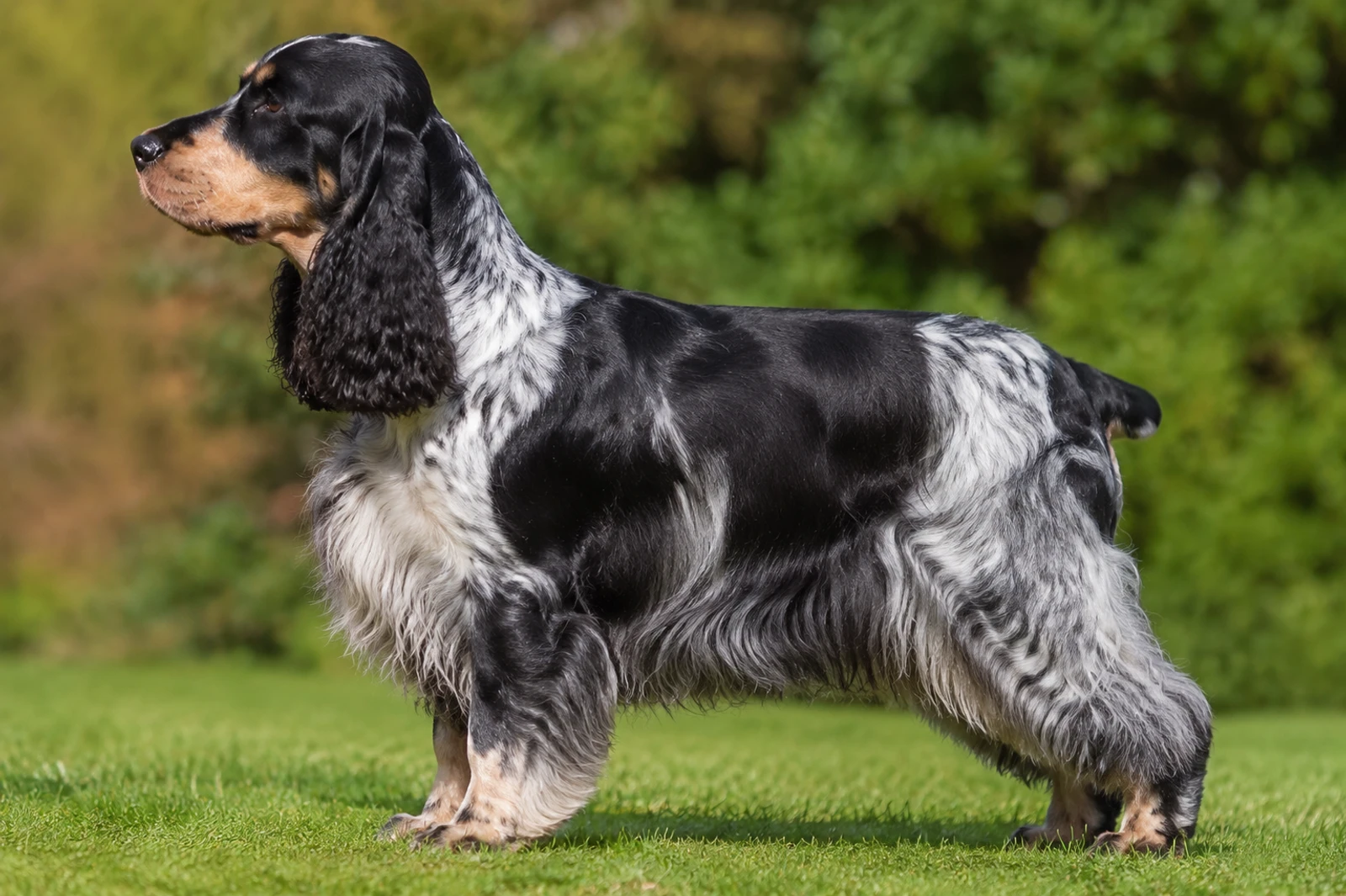
The English Cocker Spaniel is a merry, affectionate companion bred for flushing game. Standing 15–16 inches tall and weighing 29–33 pounds, this medium-sized gun dog thrives in active households that provide ample exercise and mental stimulation. With their silky coat and soulful eyes, they bond deeply with families, especially those who enjoy outdoor adventures. Best suited for owners with time for daily activity and regular grooming, they are gentle with children and generally friendly with other pets, making them excellent family dogs.
At a glance
- Size
- Medium
- Height
- 15–16 in
- Weight
- 29–33 lb
- Life span
- 12–15 years
- Coat colors
- black, red, liver, golden, black and tan, liver and tan, blue roan, orange roan, liver roan, lemon roan, tricolor
- Coat type
- medium-length silky, flat or slightly wavy with feathering
- Group
- Gun
Compare English Cocker Spaniel vs
Compare with any breed →How much does a English Cocker Spaniel cost?
Adopt / rescue
$75–$400
Usually includes spay/neuter, first shots, and a microchip.
Buy from a breeder
$700–$2,000
From a reputable, health-testing breeder.
Approximate USD. Prices vary widely by region, breeder, pedigree, age, and coat colour — adopting is the lower-cost and recommended route. Avoid suspiciously cheap “breeders”; they’re often puppy mills.
Estimate the full cost of a English Cocker Spaniel →Want the ongoing number? Estimate the monthly food bill for a English Cocker Spaniel with our dog food cost calculator.
English Cocker Spaniel photos
Views
Front, side, rear and top — the full silhouette.Poses
How the breed sits, lies, moves and plays.Puppy to senior
The breed across its whole life.Expressions
The breed’s range of moods.Close-up details
Eyes, ears, nose, paws, tail and coat.Coat colors
The breed’s recognized colors.Click any photo to enlarge. We show the English Cocker Spaniel from every angle — three views, poses, life stages, expressions, close-ups, coat and colors.
Appearance & size
You see a dog built for a full day in the field, condensed into a compact, manageable size. The English Cocker Spaniel stands 15 to 16 inches at the shoulder and weighs somewhere between 29 and 33 pounds — substantial enough to push through thick cover, yet small enough to curl up beside you afterward. He’s slightly longer than tall, a silhouette that says endurance without bulk. His body is solid and well-knit, with a deep chest that reaches to the elbows and a level topline that stays steady whether he’s trotting or standing alert.
That coat is one of the first things you’ll notice. It’s silky and flat, sometimes with a light wave, but never curly or wiry. The real drama comes from the feathering: long, soft hair draping the fronts of his legs, his chest, and the underline of his belly. It gives him a soft, fluid outline when he moves. The breed standard allows a whole painter’s palette — solid blacks, livers, reds, and golden shades, often with tan points on the muzzle, over the eyes, and under the tail. Then there are the parti-colors: blue roan, liver roan, orange roan, and combinations with ticking or open white markings. You might also see black-and-white or liver-and-white dogs with flecks of color. All of it requires regular attention to keep free of mat, but the look is undeniably elegant.
His head is distinctly spaniel, with a softly domed skull, a square, deep muzzle, and a well-defined stop. The eyes are dark, expressive, and set wide — they give you that warm, eager-to-please gaze. The ears are long, lobular, and set low, hanging close to the head and covered in silky hair. From the front, his forelegs are straight and well under him, flowing into a deep chest and clean shoulders. Viewed from the side, you’ll note a firm back, well-sprung ribs, and a moderate tuck-up. Moving to the rear, the hindquarters are strong and muscular, with well-bent stifles that drive his trademark ground-covering trot. A docked tail is historically common and carried level, never over the back; if left natural, it’s set low and happily wagging.
History & origin
The name “cocker” tells you almost everything about why this dog exists. Before breeds were rigidly defined, spaniels were sorted by the job they did: larger springers flushed game into the air, and smaller, lighter spaniels specialized in hunting woodcock in dense English hedgerows. Those woodcock dogs became the foundation of the English Cocker Spaniel you see today.
By the 19th century, spaniel breeders in England were deliberately separating land spaniels by size and weight. Dogs under about 25 pounds were recorded as “cocking spaniels” in estate game books. The goal was a compact, tireless flusher that could push through blackthorn and bramble without hesitation, quartering close to the gun and retrieving tenderly from water or heavy cover. The Merseyside and Welsh hill packs refined a particularly gamey, driven type, while estate kennels in southern England produced a slightly loftier, softer-mouthed dog. Both lines fed into the breed we now call the English Cocker.
The turning point came at the 1870s Birmingham dog show and with the formation of The Kennel Club in 1873. By 1892, the English Cocker Spaniel Club was founded, and the breed was being shown in a class of its own, distinct from Field and Springer spaniels. The early show dogs were often dual-purpose — expected to work in the morning and compete on the bench in the afternoon. Even so, a quiet split between working and show lines started to appear, a tension the breed has never fully shaken.
The American story is where things get tangled. Cockers came to the United States in the late 1800s, but American breeders had a different mental picture of the perfect spaniel — smaller, rounder-headed, with a more profuse coat. In 1936, the English and American varieties were shown together for the last time at the Westminster Kennel Club. By 1946, the AKC recognized them as separate breeds: the Cocker Spaniel (American) and the English Cocker Spaniel. That “English” label was added solely to distinguish them from the new American type on this side of the Atlantic; in the U.K., they’re still simply the Cocker Spaniel.
After World War II, the English Cocker became a family favorite, particularly in Britain, while the American Cocker boomed in U.S. popularity. The English Cocker maintained a stronger working presence. Today you’ll find it equally at home in field trials and tracking tests as in agility rings and on the sofa. The breed’s original purpose — a soft-mouthed, merry dog built to hunt thick cover all day — still drives its energy and personality.
Temperament & personality
You won’t find many dogs as genuinely happy to see you as an English Cocker Spaniel. The stubby tail starts wagging at the shoulders and the whole back end gets involved. They often bring a gift — a toy, a shoe, the dish towel — and their soft, pleading eyes are a breed signature. This is a dog built for companionship, bred to work closely with people all day, and that history shows up in every corner of their personality.
At heart, an English Cocker is affectionate, biddable, and remarkably in tune with household moods. They don’t do well as backyard ornaments. Isolation or long hours alone can lead to anxiety-driven barking, chewing, or house-soiling. A bored Cocker left to his own devices will make his own fun, and you probably won’t like his choices. Plan on at least 45 to 60 minutes of active exercise daily — a brisk walk around the block won’t cut it. Off-leash running, retrieving games, swims, or a vigorous game of fetch settle that busy gundog brain.
That brain is sharp. English Cockers crave mental work and pick up on your cues fast. They respond beautifully to positive, reward-based training. Harsh corrections shut them down. A few short sessions each day — whether on obedience, nose work, or trick training — will do more for good behavior than endless repetition. Because they’re naturally food-motivated, a treat pouch and a clicker go a long way.
With family, they’re typically gentle and patient. They’ll shadow you from room to room, preferably with a part of their body touching yours. Kids who can respect a dog’s space get a playful, tireless friend; children need to learn to leave the dog in peace while eating, because even the sweetest Cocker may guard a food bowl. Early socialization with other dogs and new people keeps the breed’s natural friendliness from turning shy. They’ll bark at the doorbell, but a Cocker’s version of guard duty often ends with a wagging tail and a retrieved toy for the intruder.
A few quirks come with the package. Many English Cockers are inveterate rollers in dead things or foul smells — just part of their spaniel heritage. As adults, they need sturdy chew toys to keep jaws strong and teeth clean; puppyhood involves a predictable phase of gnawing on anything within reach. Direct that energy toward acceptable outlets and you’ll save your furniture.
Learn to read their body language: a loose, wiggly body and soft eyes mean contentment. Lip licking, yawning, or turning the head away are signals to back off and give the dog a moment. Like any gundog, they may follow their nose into trouble, so a secure yard is essential. A tired, well-trained English Cocker wakes up every morning convinced today will be the best day ever — and a home that provides consistent affection, clear guidelines, and real exercise gets a merry shadow for 12 to 15 years.
Good with kids, dogs & other pets
Kids
This is a breed that genuinely likes children. The English Cocker Spaniel’s patient, non-aggressive temperament shows up most around kids — a 30-pound dog with enough substance to handle some rough-and-tumble but not so big that a clumsy toddler knocks over furniture. Still, supervision is a must. A young child can inadvertently grab an ear or poke an eye, and any dog will react if it hurts. Teach the kids to pet using an open hand, no hugging around the neck, and use a baby gate to create separate zones when the play energy spikes. That five-minute breather stops overstimulation before anyone gets nippy.
Other Dogs
Well-socialized English Cockers are amiable with other dogs. They were developed as a gun dog that works in packs alongside other spaniels, so the wiring is there. The key is the critical socialization window between roughly 3 and 14 weeks. Aim for your puppy to meet 100 different friendly people and a similar variety of healthy, vaccinated dogs before 16 weeks of age. Puppy kindergarten classes, short visits to a neighbor’s calm adult dog, and walks where you pass strangers on leash all count. Once that window closes, forced introductions can backfire by creating fear. An adult English Cocker that’s already comfortable around familiar dogs doesn’t need to be thrown into a chaotic dog park. Parallel walks on leash let dogs be near each other without the pressure of face-to-face greetings, which often works better for sensitive individuals.
Cats and Small Pets
The same flushing instinct that makes the breed a talented field companion means you’ll need careful, gradual introductions to cats and small animals. Many English Cockers live peacefully with indoor cats, especially if they grow up together. Start with the spaniel on a leash, reward calm behavior, and never let them chase a fleeing cat — that turns into a self-reinforcing game. Pocket pets like hamsters, gerbils, or rabbits should remain in secure enclosures and never be left unsupervised with the dog. A few individuals with high prey drive may never be safe around free-roaming small animals, regardless of early training. Respect what your particular dog shows you, and separate with a secure door when you’re not there to manage interactions.
Trainability & intelligence
English Cockers are whip-smart and genuinely want to work with you — they were bred to quarter ground within gun range, check in, and take direction. That partnership still runs deep. A Cocker picks up new cues fast when the lesson feels like a game, not a chore. Treats, a squeaky toy, or a quick game of tug speak louder than any correction ever could. Harsh handling tends to shut them down; these are soft, intuitive dogs that read your tone more closely than the words themselves.
Start the day you bring the puppy home. Short, upbeat sessions — even three to five minutes — build better habits than marathon drilling. Cocker Spaniels can get bored if you repeat the same thing too long, so mix sit, down, and a fun trick with their meals. Because they’re so attuned to scent and movement, distraction training matters. Practice recalls in a backyard first, then a quiet park, and reward every single check-in like it’s the best thing you’ve ever seen.
The recall deserves extra honesty. Even a well-trained English Cocker will, for a time, forget you exist when a rabbit or interesting smell crosses its path. No amount of shouting fixes that — but a high-value treat and a genuinely happy reunion will. Keep a long line in new spaces until you’ve built a consistent, joyful return. Early socialization is not optional. Between 8 and 16 weeks, expose your puppy to friendly strangers, children, vacuum cleaners, umbrellas, different flooring — all paired with something good. Adult Cockers who miss that window can become watchful and noise-sensitive.
Lean into their natural retrieving desire. Tossing a ball or a dummy and sending them after it burns energy and puts those brains to work. They thrive on a mix of physical exercise and mental puzzles — a snuffle mat, hide-and-seek, or a few minutes of trick training before dinner will settle them faster than an extra walk.
You don’t need to be stern; you need to be clear, consistent, and interesting. If you lose your patience, a Cocker will mirror that anxiety and shut down. Build the relationship first — the reliable obedience follows naturally when they trust you.
Exercise & energy needs
Plan on at least 60 minutes of real movement every day, split into two or more sessions. An English Cocker Spaniel is a compact gun dog built to work—trotting through brush, flushing birds, and retrieving—so a single leisurely walk around the block won’t cut it. You’ll see the best behavior when you give him two solid outings: a 30-minute off-leash romp or a vigorous hike in the morning, plus a brisk 30-minute walk or another burst of play later in the day.
Don’t let the medium size fool you; his energy tank is deep. This is a dog who can go from a dead sleep to a full-speed sprint in seconds, so weave in short, high-intensity spurts. A long line in a safe field lets him gallop and quarter the ground with his nose; a flirt pole or a game of fetch in the yard can burn off steam when time is tight. He often takes to water without hesitation—swimming is another excellent, low-impact way to drain his battery.
Physical exercise alone isn’t enough. A bored Cocker will channel unused brainpower into digging, barking, or chewing. Mental work is as crucial as mileage. After a walk, spend 10–15 minutes on a scent game: hide his dinner in a snuffle mat, scatter kibble in the grass for him to sniff out, or teach him to find a hidden toy by name. Puzzle feeders and short training drills (heelwork, retrieve-to-hand, trick training) satisfy his need to collaborate with you and leave him happily tired.
- Good sports and activities: field work/hunting tests, rally, agility (keep jump heights low for young dogs), nose work, dock diving, and long hikes with a pack.
- Watch the joints: puppies and adolescents shouldn’t do forced road-running or repetitive high jumps until growth plates close. Even in adulthood, avoid pounding on hard surfaces all day. Two or three varied outings beat one marathon session.
- Signs you’re shorting him: restlessness, shadow-chasing, demand barking, or a sudden interest in shredding pillows. Usually the fix is an extra 20 minutes of sniffing, not just more running.
If you can give him a morning flush through the woods and an evening brain-teaser, you’ll have a calm, grinning dog under your desk the rest of the day.
Grooming & coat care
The silky, feathered coat that makes an English Cocker Spaniel so beautiful is the same reason this breed needs more hands-on grooming than a Lab or a Beagle. Without regular attention, the long hair behind the ears, on the legs, and across the chest tangles into painful mats almost overnight.
Brushing is a non-negotiable, every-other-day habit — and daily if your Cocker spends real time outdoors or you keep the coat in full, show-style length. A metal slicker brush with rounded pins clears out dead hair and debris from the dense, water-repellent single coat. Follow up with a greyhound comb to work through the thicker feathering, especially behind the ears and in the armpits, where snarls start first. You’ll know you’ve brushed enough when the comb glides through without grabbing.
Bathe every 4 to 6 weeks, or when the dog’s classic “field-scent” tells you it’s time. Use a mild, dog-specific shampoo that won’t strip the natural oils keeping the coat glossy and weather-resistant. After a bath — or a swim — dry the insides of those heavy, low-set ears thoroughly; trapped moisture is a fast track to infections.
Plan on professional grooming every 6 to 8 weeks. A typical pet clip keeps the feathering neat and the feet, tail, and ear edges trimmed back so the dog doesn’t drag mud inside. If you learn to do it at home, invest in quality thinning shears to blend the longer areas without blunt cut lines.
Weekly ear cleaning is just as critical as brushing. Use a vet-recommended liquid ear cleaner, flush gently, and wipe away debris from the outer ear canal. Never use cotton swabs deep inside. Trim nails monthly — Cockers often won’t sit on concrete long enough to wear them down themselves. And while you’re at it, make tooth brushing a daily routine; small mouths with good-feathering hair can hide tartar buildup that leads to early gum trouble.
Seasonal shedding is moderate rather than explosive, but you’ll still see an uptick in loose hair when days get longer in spring and again when the coat thickens for winter. Bump up brushing to daily during those stretches, and you’ll collect the hair in a tool instead of on your sofa.
Shedding & allergies
English Cockers are moderate, year-round shedders — you’ll find fine, silky hairs on dark trousers, couch cushions, and car seats. That glossy double coat (a soft, dense undercoat beneath a longer, flat topcoat) constantly releases hair, and it adds up. Weekly brushing with a slicker brush and a metal comb catches a lot of it, but a little daily “tumbleweed” under the kitchen table is normal.
Seasonal blowouts
Twice a year, usually in spring and fall, the undercoat lets go in earnest. For about two to three weeks, clumps of fluff will come off with every pass of the brush, and you’ll empty the vacuum canister more often. Rake the coat thoroughly with an undercoat tool during these periods, and consider a high-velocity dryer to blast loose hair directly into the yard instead of onto your rugs.
Drool
You won’t be wiping long strings of slobber off the walls. English Cockers are not a heavy-drooling breed. A little bit of dampness after drinking or a polite dribble when a treat bag crinkles is the extent of it.
The allergy reality
No dog is truly hypoallergenic, and English Cockers are no exception. Allergies are triggered by proteins in dander, saliva, and urine — all of which this breed produces normally. Because the coat sheds consistently, dander circulates through your home, settling on surfaces and in fabric. Some people with mild allergies might tolerate a well-groomed Cocker better than a heavy-shedding breed, but if allergies in your household are severe, this is not a safe bet. Spend real time in a home with adult Cockers before committing — that’s your best test, not a breeder’s promise.
Diet & nutrition
An English Cocker Spaniel is almost always going to act like every meal is the best thing that’s ever happened. That’s endearing, but it also means you can’t rely on them to self-regulate. Portion control has to come from you, or you’ll end up with a dog carrying extra weight that strains joints and shortens an otherwise active life.
Daily amounts
For an adult weighing 29–33 pounds, you’re looking at roughly 1 to 1½ cups of high-quality dry food per day, split into two meals. If your dog runs hard in the field, does daily off-leash hikes, or trains for hunt tests, you’ll need to nudge that up. A more laid-back house dog will do fine on the lower end. Always look at the dog in front of you — ribs you can feel but not see, a visible waist from above — and adjust accordingly.
Puppy feeding schedule
Young pups need the calories broken up. Until four months, feed a quality commercial puppy formula (or a balanced homemade equivalent) four times a day, evenly spaced. From four to six months, drop to three meals. At six months, switch to the adult two-meal-a-day rhythm. When you change formulas or introduce new whole foods, go slowly: start with lightly cooked, puréed meats, fish, fruits, and vegetables to give that little digestive system time to adapt. Raw items like chicken wings can come in around twelve weeks, always under supervision, and only if you’re comfortable and the pup is a confident chewer.
What to put in the bowl
You don’t need a gourmet kitchen, just a solid formula where animal protein leads the ingredient list. If you’re cooking or doing raw, aim for about 60% meat or fish, 20–30% dog-safe fruits and vegetables, and the rest from eggs, plain yogurt, or digestible grains such as pearl barley or white rice. That ratio keeps the diet species-appropriate — a dog’s teeth and digestive system are built for meat, not a meat-free menu. Leftovers like unseasoned cooked vegetables, drained canned fish, or extra cooked grains make quick, healthy toppers. Just ladle them into the dog’s own bowl, never from the table, so you don’t train a beggar.
Keeping the waistline
English Cockers are squarely in the “easily gains weight” camp. Even a couple of extra pounds can load up a spine and hips that need to stay sound for a dozen years or more. Use a puzzle bowl or snuffle mat to slow down speedy eaters — it turns a 45-second inhale into a 5-minute mental workout. For seniors, switch to smaller, more frequent meals if they’ll tolerate it, and taper the total daily amount as the step count drops. Obesity is the biggest nutritional threat an older Cocker faces, so keep that scale handy and don’t let treats creep past 10% of the daily calories.
A quick caution on rich food
After holiday feasts or weekend cookouts, resist the urge to toss them a plate of fatty scraps. A single high-fat overload can trigger pancreatitis, and this breed doesn’t need that gamble. Bland white rice and a little plain chicken are always safer if you need to settle a sensitive stomach.
Health & lifespan
A well-bred English Cocker Spaniel typically lives 12 to 15 years — a solid run for a medium-sized dog. Getting there, and making those years good ones, comes down to a handful of predictable health areas you’ll want to keep an eye on from day one.
Like many floppy-eared breeds, English Cockers are prone to ear infections. Those heavy, low-set ears trap moisture and block airflow, creating a perfect environment for yeast and bacteria. A quick weekly sniff-and-wipe with a vet-approved cleaner, and drying thoroughly after a swim or bath, prevents most problems before they start.
Eye issues are another known weak spot. Progressive retinal atrophy (PRA) and cataracts can show up, sometimes leading to blindness. Responsible breeders screen for these and will provide current CERF or OFA eye clearances for both parents. Ask for that paperwork — it’s non-negotiable.
On the joint front, hip dysplasia and patellar luxation (a slipping kneecap) appear in the breed. Again, OFA hip and patella evaluations on the sire and dam are your best early-warning system. Some lines also carry a risk for familial nephropathy, a serious kidney disease. A DNA test exists, and good breeders use it.
Allergies — both food and environmental — can show up as itchy skin, recurrent ear trouble, or paw licking. You may need to work with your vet to pinpoint triggers. And because these are enthusiastic, food-motivated dogs, weight management matters. A 33-pound Cocker who’s even a couple of pounds overweight strains those joints and shortens his life. Measure meals, use treats sparingly, and give him the daily, off-leash romp he was bred for.
Beyond breed-specific stuff, plain common sense applies. Rabies vaccination is legally required — there’s no cure once symptoms hit. Heartworm prevention needs to be given monthly during mosquito season and for one month after it ends. Annual wellness exams become twice-a-year visits once your dog hits the senior years. Watch for subtle shifts — less enthusiasm for a walk, a suddenly picky appetite — and act fast. Early socialization and positive handling also lower the background stress that can contribute to anxiety-driven behaviors and even physical illness.
Keep those ears dry, stay current with screenings, and you’ll stack the deck hard in your favor.
Living environment
An English Cocker Spaniel is first and foremost a social dog — the kind that follows you from room to room and unravels when left out of the action. If your household sits empty for a full workday, this breed will struggle. They bond fiercely and are prone to separation anxiety, which often shows up as barking, destructive chewing, or housetraining accidents.
A house with a securely fenced yard is ideal, giving them space to sprint, sniff, and patrol on their own terms. But a yard alone isn't a substitute for focused time with you. Apartment living can work if you’re home a lot and committed to multiple daily outings. The catch: English Cockers are alert and vocal. Doorbells, squirrels, and strange sounds all get a full-throated announcement. Thin walls and close neighbors can make that a problem.
Expect to provide at least an hour of real exercise, not just a stroll around the block, split into two sessions.
- A couple of brisk 30-minute walks plus a vigorous game of fetch or a chance to follow their nose in a safe open area covers the physical side.
- Equally important is mental work — puzzle toys, hide-and-seek with treats, or a few short training sessions indoors. A tired Cocker brain makes for a much quieter, settled dog.
Their medium-length coat handles cool weather well, but they overheat quickly in hot, humid conditions. Skip midday pavement in summer, keep walks to early morning or evening, and always have water and shade on hand. In freezing temperatures, a short outing is fine; a waterproof coat helps in heavy rain or snow.
Barking won’t disappear completely. You can teach a “quiet” cue and keep vocalization in check with steady exercise and attention, but a silent house is not in this breed’s DNA.
For alone time, even with gradual desensitization and a stuffed Kong, many English Cockers find extended solitude deeply stressful. A midday dog walker or a trusted neighbor who stops in can prevent the slide into panic. If your routine keeps you away 9 to 5 with no break, a more independent breed will be a fairer fit for everyone.
Who this breed suits
An English Cocker Spaniel fits into your life the way a good hiking buddy does — only this one follows you from room to room, wags through dinner prep, and curls up on your feet afterward. He’s not a dog for someone who wants independent, low-maintenance companionship. You’ll need to genuinely enjoy daily hands-on interaction.
Who thrives here. This breed is a solid pick for active first-time owners because he’s medium-sized (29–33 lb), biddable, and motivated by praise and treats. Families with children do well, especially if the kids are old enough to play fetch without knocking him over; his happy-go-lucky nature makes him a willing playmate, though early supervision prevents his enthusiasm from spilling into overexcited nipping. Singles and couples who hike, jog, or spend weekends outdoors get an eager sidekick — a solid hour of off-leash running, retrieving, or a long ramble comes closer to what he needs than a quick lap around the neighborhood. He’s also remarkably portable: his 15–16-inch height and compact build let him settle into apartment life, provided you get outside religiously. Seniors who stay active appreciate the built-in social calendar a Cocker creates (you’ll talk to every neighbor on your walk), but the exercise demand is real; a slow shuffle down the street won’t cut it.
Who should think twice. If your household is empty from 8 to 6 most days, you’re setting the stage for separation anxiety and destructive barking. A Cocker wants to be part of whatever you’re doing, not left to his own devices. That silky, medium-length coat needs brushing several times a week and a professional clip every 6–8 weeks; neglect it and you’ll be untangling mats behind his ears and dealing with the skin issues that follow. His drop ears trap moisture and crud, so weekly cleaning and a watchful eye for infections are non-negotiable. And while he’s generally sociable with other dogs and even cats he’s raised with, his flushing instinct means pet hamsters or free-range chickens are a gamble. If the grooming budget or routine feels like a chore, or you’re away for long hours, consider a lower-maintenance breed that doesn’t require your constant presence.
Cost of ownership
A well-bred English Cocker Spaniel puppy from a breeder who OFA-screens hips, eyes, and patellas usually runs $1,500 to $2,800. Show-potential pups or puppies from strong working lines can land north of that. Avoid the bargain $600 internet listing — you’ll likely pay it back tenfold in ear infections and behavior messes.
Once the dog is home, ongoing costs settle into a predictable monthly rhythm.
- Food: 29–33 lbs of compact muscle needs good kibble. Budget $40–60 a month. If you feed a fresh or raw diet, plan closer to $80–100.
- Grooming: That silky double coat and heavy feathering mat if you blink. A professional groom every 6–8 weeks runs $65–90 per visit. Between appointments, you’ll still buy a pin brush, detangler, and ear cleaner — tack on another $15 monthly.
- Routine vet & preventives: Yearly exams, vaccines, heartworm/flea/tick meds average $45–65 a month. English Cockers can be prone to ear infections and hip dysplasia; even with a well-bred dog, budgeting for an extra sick visit or two annually (another $200–400 total) is realistic.
- Insurance: A solid accident/illness policy for a medium purebred runs $35–55 monthly, more if you pick a low deductible.
- Extras: They’re food-motivated little athletes, so factor in training treats, chews, and the occasional ruined remote — maybe $20–40 monthly.
All in, a healthy English Cocker Spaniel costs roughly $150 to $250 a month, not counting the one-time spay/neuter or that first-year supply burst of leashes, beds, and crates. And plan for a decent vacuum. Those feathered paws and long ears drag half the yard inside twice a day.
Choosing a English Cocker Spaniel
You have two solid routes — a responsible breeder who health-tests every parent, or a breed-specific rescue. Both can land you a merry, tail-wagging English Cocker, but the upfront homework you do now determines whether you get a healthy companion for 12–15 years or face heartbreak early on.
Health clearances you need to see
A good breeder volunteers paperwork before you ask. For English Cockers, that means current OFA hip evaluations (look for “Fair” or better), annual OFA eye exams by a veterinary ophthalmologist, and DNA tests for prcd-PRA (progressive retinal atrophy) and familial nephropathy — a devastating kidney disease that can kill a dog by age two. Many breeders also screen patellas and do cardiac evaluations. If a breeder cannot produce certificates you can verify on the OFA website, walk away. You are not being difficult; you are avoiding a $5,000 vet bill later.
Red flags that should stop you cold
- “We haven’t gotten around to testing this pair yet, but they’re healthy.” No test, no puppy.
- Puppies always available in multiple breeds or colors — this is a commercial kennel, not a preservation breeder.
- Slick website with a PayPal “Buy Now” button. Good litters are placed, not sold to a credit card.
- No spay/neuter contract, no health guarantee, no interest in your living situation. A decent breeder grills you hard about your yard, work hours, and dog experience.
- A breeder who pressures you to take a puppy younger than 8 weeks (10–12 weeks is ideal for this breed).
Picking your puppy
Visit the litter at least once. The dam should be on site, friendly, and clearly in good condition — not cowering in a kennel or missing fur. Puppies should come to you with wagging nubs and bright eyes, no sneezing, discharge, or pot-bellied look (a sign of worms). The shyest puppy often stays shy, which can lead to fear-biting in a family home. The boldest may be a handful. Pick the middle-ground pup that recovers quickly from a startle and wants to engage.
The rescue option
Breed rescues have adult dogs whose personalities are already clear. You skip house-training accidents and teething, and you may get a Cocker who already knows basic commands. Ask about any known health history, heartworm status, and ear condition (chronically infected ears are common in neglected spaniels). A thorough vet check within the first week is non-negotiable. Expect to pay $200–$500 in adoption fees, with the understanding you may still need to address undiagnosed issues like hip dysplasia or eye disease.
A breeder who insists on staying in your life — who texts back at 10 p.m. when your dog eats a sock — is exactly who you want selling you a puppy.
Pros & cons
Merry, affectionate, and built for action — but you’ll pay for that wagging tail with grooming time and a need for constant company.
Pros:
- Deeply bonded family dogs: thrive on being with their people, notoriously cheerful, and gentle with children when socialized early.
- Eager-to-please and quick to learn: they shine in obedience, agility, and field work using positive methods.
- Moderate size that fits anywhere: 15–16 inches tall, 29–33 pounds — easy to load in the car, adaptable to suburban or country life.
- High exercise tolerance: a solid hour of off-leash running, swimming, or retrieving satisfies their gundog engine, yet they settle indoors once exercised.
- Classic good looks: silky coat, expressive eyes, and that unmistakable, never-stopping tail wag.
Cons:
- Coat is a job: feathering mats easily; expect brushing 3–4 times a week, professional grooming every 6–8 weeks, and frequent ear checks to prevent infections.
- Velcro dog tendencies: can develop separation anxiety if left alone too long; not a breed that does well with family members gone all day.
- Prey drive and nose power: the flush-and-retrieve instinct means birds or squirrels may erase your recall, and reliable off-leash control takes real work.
- Ear trouble magnet: heavy, drop ears trap moisture and debris — chronic infections are common without diligent cleaning.
- Health risks: can be prone to hip dysplasia, progressive retinal atrophy, and some heart conditions; only buy from a breeder who screens breeding stock.
Similar breeds & alternatives
American Cocker Spaniel
The American Cocker is the breed most people picture first, but it split from the English Cocker in the 1940s and has become a distinctly different dog. Its smaller frame (13.5–15.5 inches, 20–30 pounds), domed skull, and shorter muzzle give it a toy-like look, while the English Cocker stands taller and more squarely built, bred to cover ground and push through cover all day. The coat tells the same story: the American Cocker’s heavy, floor-length furnishings need near-constant brushing and regular professional trims, whereas the English Cocker’s silky medium-length coat is easier to maintain. Temperament diverges, too. American Cockers lean more toward sensitive, velcro companions, often content with gentle walks and a lap. An English Cocker carries a harder-running, “let’s get into the brush” enthusiasm and needs a solid hour of off-leash exploring daily. Both breeds are affectionate family dogs, but the American Cocker’s delicate nature and tendency toward separation anxiety make it less suited to homes where everyone is gone all day.
- Choose the American Cocker if you want a devoted lap warmer and are prepared for high-maintenance grooming.
- Stick with the English Cocker if you want a sturdier, more athletic buddy who can keep up on hikes and has a wash-and-wear coat.
English Springer Spaniel
If the English Cocker’s merry, can-do attitude hooks you but you’d like a bigger running partner, the Springer is the natural next look. Springers stand 19–20 inches and tip the scales at 40–50 pounds—roughly a third larger. That size comes with a notable jump in exercise needs. A happy English Cocker thrives on a daily hour-long romp with some training thrown in; a Springer often requires 90 minutes or more of hard running, plus mental work, or it will redecorate your house. Both breeds are biddable and eager to please, but the Springer’s stronger hunting drive can translate into more intense chasing of birds, squirrels, and passing bicycles. Grooming is similar, though the Springer’s feathering tends to be heavier.
- Pick the English Cocker for a compact, sporty companion that fits in a smaller yard and car.
- Go with the Springer if long-distance trail runs and serious retrieving practice are already part of your routine.
Boykin Spaniel
The Boykin is the browning-wade-and-retrieve specialist from South Carolina, pulling a similar size range (14–18 inches, 25–40 pounds) to the English Cocker but with a distinct, solid-liver coat. Both breeds are built for flushing game in thick cover, yet the Boykin often brings an unexpected off-switch indoors, settling calmly once the day’s work is done. The English Cocker tends to be a bit more forward and clownish; the Boykin can be more reserved with strangers, though never aggressive. Boykins are equally strong swimmers and excel in waterfowling, whereas the English Cocker traditionally shines on upland birds. Both need about an hour of purposeful exercise a day, but the Boykin’s webbed toes and heavier body make it a slightly more natural retriever in water.
- Look to the Boykin if you hunt waterfowl or want a rich brown spaniel with a steady household temperament, but expect to wait on a breeder list—they’re still uncommon.
- The English Cocker gives you more widespread availability, a wider color palette, and a bounce-off-the-walls personality that never seems to tire.
Fun facts
- Originally bred as woodcock hunters, hence the name 'Cocker.'
- They were considered the same breed as the American Cocker Spaniel until the 1940s.
- The English Cocker is known for its happy, tail-wagging disposition.
- They are excellent swimmers and love water.
Frequently asked questions
- Are English Cocker Spaniels good with kids?
- English Cocker Spaniels tend to be gentle and patient, which can make them good family dogs. Early socialization and supervised interactions help ensure positive relationships with children. Their playful nature often matches well with active kids.
- Do English Cocker Spaniels shed a lot?
- They have a medium-length double coat that sheds moderately year-round, with heavier shedding typically occurring in spring and fall. Weekly brushing helps manage loose hair and reduces the amount that ends up around your home. They are not considered a hypoallergenic breed.
- How much exercise does an English Cocker Spaniel need?
- As a gun breed, they need daily physical activity to stay content, such as a long walk or run. They also enjoy play sessions like fetch or swimming. Without enough exercise, they may become bored or restless.
- What are the grooming requirements for an English Cocker Spaniel?
- Their silky, feathered coat requires regular brushing several times a week to prevent mats and tangles. Professional trimming every few months helps maintain a manageable length. Routine ear cleaning is also important to avoid infections.
- Can English Cocker Spaniels live in an apartment?
- They can adapt to apartment living if provided with sufficient daily exercise and mental stimulation. Their moderate size makes them suitable for smaller spaces, though barking should be managed through training. Access to nearby parks or walks helps meet their needs.
Tools & calculators for English Cocker Spaniel owners
Quick estimates tailored to English Cocker Spaniels — pre-filled with this breed’s size where it matters.
Articles & stories about the English Cocker Spaniel
Sources & standards
This profile follows recognized breed standards from the American Kennel Club (AKC) and the Fédération Cynologique Internationale (FCI), along with established veterinary and breed-club guidance. These describe general breed tendencies — every dog is an individual.