

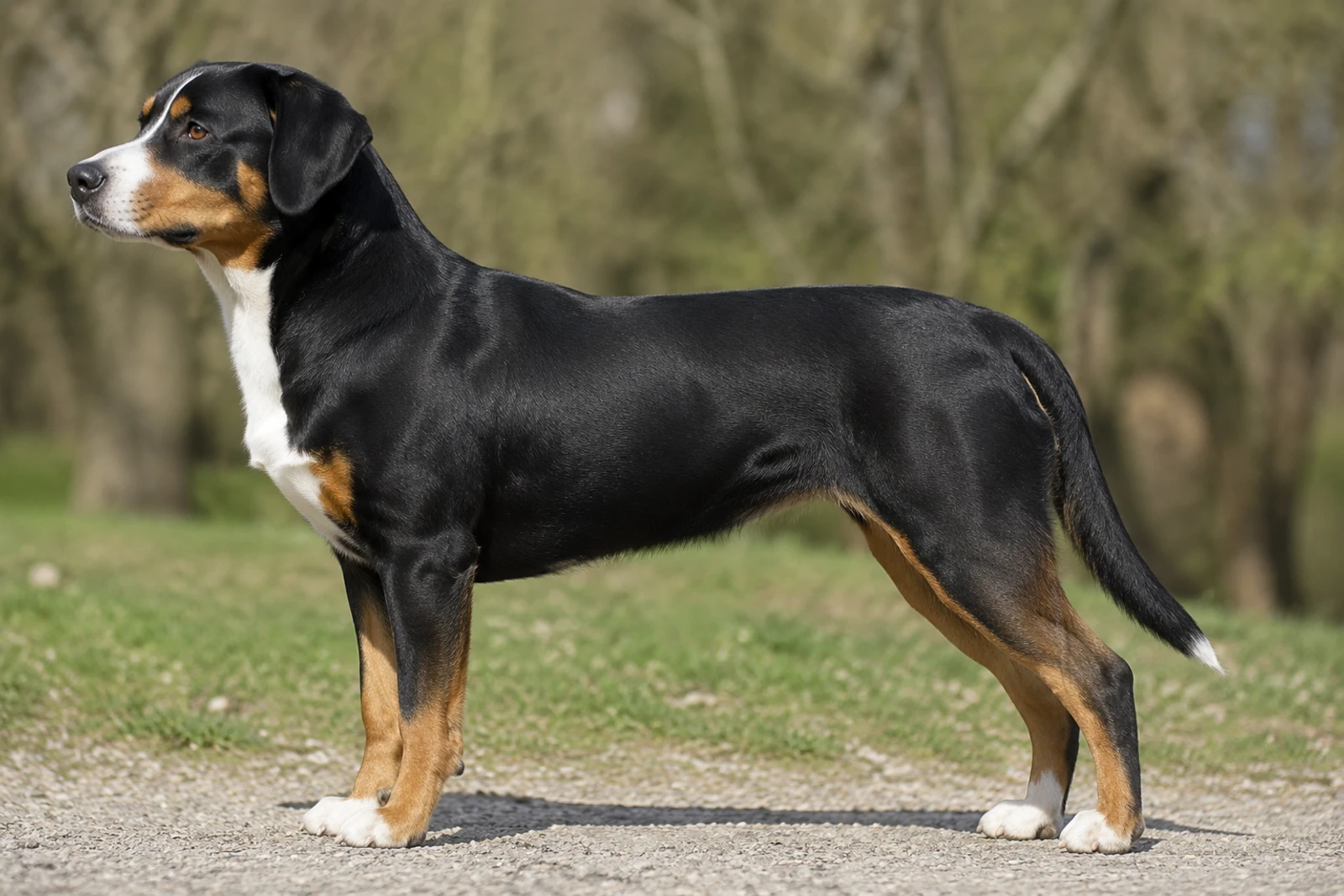
The Entlebucher Mountain Dog is the smallest of the Swiss mountain dog breeds, but packed with energy and intelligence. This herding breed thrives with active owners who can provide vigorous daily exercise and a job to do, making them excellent companions for hikers and dog sports enthusiasts. They are loyal and protective of their family, but their strong-willed nature requires early training and socialization. Best suited to rural or suburban homes with space to run, they bond deeply and do well with older children who can participate in their care. Novice owners may find them challenging.
At a glance
- Size
- Large
- Height
- 17–20 in
- Weight
- 46–62 lb
- Life span
- 11–15 years
- Coat colors
- Tricolor
- Coat type
- Short, dense double coat
How much does a Entlebucher Mountain Dog cost?
Adopt / rescue
$75–$400
Usually includes spay/neuter, first shots, and a microchip.
Buy from a breeder
$700–$2,000
From a reputable, health-testing breeder.
Approximate USD. Prices vary widely by region, breeder, pedigree, age, and coat colour — adopting is the lower-cost and recommended route. Avoid suspiciously cheap “breeders”; they’re often puppy mills.
Estimate the full cost of a Entlebucher Mountain Dog →Want the ongoing number? Estimate the monthly food bill for a Entlebucher Mountain Dog with our dog food cost calculator.
Entlebucher Mountain Dog photos
Views
Front, side, rear and top — the full silhouette.Poses
How the breed sits, lies, moves and plays.Puppy to senior
The breed across its whole life.Expressions
The breed’s range of moods.Close-up details
Eyes, ears, nose, paws, tail and coat.Coat colors
The breed’s recognized colors.Click any photo to enlarge. We show the Entlebucher Mountain Dog from every angle — three views, poses, life stages, expressions, close-ups, coat and colors.
Appearance & size
The Entlebucher is a rugged, squarely built cattle dog — the smallest of the Swiss mountain breeds but still packing a lot of muscle into a compact frame. Stand next to one and you’re eyeing a dog that comes to mid-thigh on most people, with a weight you can feel when it leans into you. Height at the withers runs 17 to 20 inches, and a working-fit adult carries 46 to 62 pounds with no wasted bulk.
Build & proportion
The body is slightly longer than tall (a ratio of about 10:9), giving it that ground-covering trot without the legginess of a herding dog built for sprinting. The chest is deep and broad, reaching down to the elbows, with well-sprung ribs that give the lungs plenty of room for all-day movement. The back is straight and strong, the loin short and muscular, and the croup slopes just a bit. When you look at the dog from the side, the underline rises in a moderate tuck-up, hinting at an athlete that can turn on a dime behind a stubborn steer.
Coat & color
The coat is a short, dense double coat — the topcoat harsh and tight, the undercoat soft and insulating. Tri-color is the only acceptable pattern: a base of jet black with rich tan (often called “rust” or “mahogany”) and clean white markings. The tan shows up as pips above the eyes, patches on the cheeks, on the chest, and on the legs, while the white typically runs from the muzzle up the forehead (a blaze), spreads across the chest, and appears on all four feet and the tail tip. A white patch on the nape or a broken blaze isn’t unusual and doesn’t affect the dog’s working ability, though the show ring has its preferences. The coat is no-nonsense: weather-resistant, quick to dry, and after a good shake, surprisingly free of mud.
Head & expression
The head is well-proportioned to the body — not overly broad but strong through the skull, with a flat forehead, a distinct stop, and a muzzle that’s about as long as the skull. The eyes are small, dark brown, and set slightly obliquely, which gives the Entlebucher an alert, watchful look without any hint of sharpness. Ears are triangular, set high, and when the dog is focused, they tip forward slightly, framing the face. The lips are clean and dark, and a scissor bite is the norm.
Front, side & rear
From the front, the legs are straight and set well under the broad chest; the shoulders are laid back smoothly, so there’s no strutty, wide stance. Looking at the side profile, you’ll notice the neck is sturdy and clean, running into a level topline. The tail is left natural and long in most countries, reaching to the hocks or just below. It hangs low when the dog is relaxed and may rise in a gentle curve when it’s keyed up, but it doesn’t curl over the back. From behind, the hindquarters are muscled and nicely angulated — thighs broad, hocks short — and the feet point straight ahead. The rear drive is where you really see the breed’s origins: the Entlebucher pushes off with a smooth, powerful stride that can cover rough pasture all day without tiring.
History & origin
The Entlebucher Mountain Dog takes its name from the Entlebuch valley in the canton of Lucerne, Switzerland — a rugged patch of the Swiss Alps where only the sturdiest working dogs could earn their keep. It’s the smallest of the four Sennenhund breeds (the others being the Bernese, Greater Swiss, and Appenzeller), yet don’t mistake size for softness; this dog was built to move cattle up and down steep mountain passes long before anyone wrote down a breed standard.
Like its cousins, the Entlebucher likely descends from the heavy-boned Molosser-type dogs that Roman armies marched through the Alps two millennia ago. Over centuries, farmers in the Entlebuch region refined a compact, quick-footed cattle drover, cart puller, and all-around farm sentinel. These dogs worked independently, nipping at heels to steer stubborn dairy cows, guarding property, and barking out clear warnings from barn perches — traits that still live close to the surface.
The breed’s first documented public showing came in 1889, when a dog named Ringi was exhibited as a “short-haired cattle dog from the Entlebuch valley.” Around that time, Swiss canine science was getting organized. Professor Albert Heim, a geologist and dog enthusiast, began studying and categorizing the native mountain dogs. He pushed to separate the short-coated Entlebucher from its wavy-coated Appenzeller relative, and by 1913 they were officially recognized as distinct breeds.
That milestone almost didn’t matter. World War I scattered attention and breeding stock, and the Entlebucher nearly slipped away entirely. Crossbreeding with other farm dogs diluted the type, and by the 1920s the valley held only a handful of dogs that resembled the original working standard. In 1926, a determined Swiss breeder named Franz Schertenleib combed the region, eventually locating a small number of correct Entlebuchers in the Pilatus and Entlebuch areas. His careful breeding effort, combined with the formation of the Swiss Entlebucher Club in 1927 and a formal breed standard that same year, pulled the breed back from the brink.
For decades the Entlebucher remained a Swiss secret, rarely seen beyond the Alps. Exports trickled to other European countries, then gradually to North America. The American Kennel Club added the breed to its Foundation Stock Service in 2000, and earned full recognition in the Herding Group in 2011. Today, it’s still one of the rarest purebreds you’ll meet — and it’s never more at home than when it has a real job to do.
Temperament & personality
The Entlebucher thinks before he acts — and then he acts with purpose. This is not a casual, go-with-the-flow dog. He is a smart, deliberate herding breed built to move cattle on Swiss farms, and that means he brings a sharp mind, serious work drive, and a deeply loyal heart into your home. If you want a couch potato, stop here. If you want a partner who will velcro himself to your side and learn every routine in the house, you’re on the right track.
With his family, the Entlebucher is affectionate, often almost comically devoted. He will follow you from room to room, lean against your legs, and insert himself into whatever you’re doing. That loyalty runs deep, but it’s not a slobbery, needy attachment. He wants to work with you, not just sit on you. He’s famously good-natured with respectful children he’s been raised with, though his herding instinct can kick in — a quick shoulder-nudge or a bark to keep the kids “in line” isn’t aggression, it’s just a dog who’s been programmed for centuries to control movement. You’ll need to redirect that impulse to games or chores, not stifle it.
Around strangers, expect a reserved, watchful posture. The Entlebucher is a natural guardian. He takes note of new people and doesn't hand out instant trust. A stiff body and direct stare from this breed isn't a threat — it's assessment. Early and varied socialization turns that wariness into a confident aloofness rather than fear-based reactivity. Without it, a doorbell can become a full-bore alarm event. This dog will bark; it's part of his territory-patrol job description. A relaxed, loose body and soft eyes at home are the signs you’ve done your part.
Energy is high, but not manic. A 50-pound Entlebucher needs a solid hour of fast-paced exercise every day — off-leash running, hikes, vigorous fetch — plus a puzzle or training session that makes him think. Without that outlet, a smart, under-worked dog will invent his own job, and that often looks like digging, obsessive barking, or shredding whatever he can reach. Puppies chew heavily to explore and relieve teething pain; adults may keep gnawing on hard objects to keep their jaws strong. Redirect, don’t punish. These dogs respond ten times better to consistent, respectful engagement than to force. Stubborn? Yes. He’ll test boundaries if you let him, but a handler who's clear and fair wins his respect for life.
Household behavior comes with a few quirks tied to the breed’s territorial nature. Entlebuchers can be fastidious, but they also define “house” by where the family scent is strongest, not just physical walls. A neglected, rarely used room can become a target for marking, because to the dog it doesn't smell like home yet. Anxiety from isolation — being left alone for long hours — can trigger barking, chewing, or urine marking even in a previously clean dog. This is a breed that wilts when excluded from family life. He thrives as a working partner inside the daily rhythm: helping you in the yard, hiking alongside you, learning trick sequences, or simply supervising from his designated spot in the living room. Leave him in the backyard by himself and you'll get a frustrated, noisy, escape-artist-in-training. Include him in the action and you'll have the steadiest shadow you've ever known.
Good with kids, dogs & other pets
An Entlebucher with proper socialization is remarkably steady and patient around kids, but this is a 50-pound herding dog who may default to nudging, circling, or blocking a stumbling toddler. Supervision is non-negotiable with young children, not because the dog is aggressive, but because a 60-pound shoulder check can flatten a preschooler. With school-age kids who know how to give a dog space, the breed shines — they’ll wrestle, fetch, and tag along on backyard adventures all afternoon.
Start early. The socialization window slams shut around 12–16 weeks. A puppy who meets a parade of calm children, varied adults, and tidy older dogs during that stretch is far less likely to react with fear or overdrawn suspicion later. Without those soft, positive reps, a young Entlebucher can tip into wariness of unfamiliar kids’ shrieks and sudden movements. Once an adult dog has hardwired fear, forcing playdates adds stress, not confidence. If your dog decides he’s happiest as a one-family guardian, respect that.
With other dogs, the picture depends entirely on exposure. An Entlebucher raised alongside a housemate often turns into a devoted packmate. At the dog park, the breed’s upright, pushy herding style can annoy dogs who won’t be moved. Recalls and interruption cues matter lot here — you need to call him off before a game of chase becomes a standoff. Same-sex aggression can surface in some lines, so if you plan a multi-dog household, responsible breeders will be frank about bloodlines and help match temperaments.
Cats and small pets inside the home can work, particularly if the puppy grows up with them. The herding drive doesn’t vanish, though. You’ll likely see the dog try to gather the cat, follow it from room to room, or stare it down. A cat who stands its ground and swats usually earns a grudging respect; a panicked fleeing critter triggers a chase reflex that’s hard to extinguish. Small mammals like rabbits or guinea pigs must have securely elevated enclosures and zero free-roaming access — this is a powerful dog built for controlling livestock. Never leave an Entlebucher loose with pocket pets. Start introductions behind a sturdy barrier, reward calm disengagement, and never mistake tolerance for a guarantee it won’t switch to pursuit when prey scrambles.
Trainability & intelligence
You’re not buying a push-button dog — you’re bringing home a whip-smart herder that was bred to think on its feet and argue with cows twice its size. That brain comes wired with a streak of independence. They learn a new cue in a handful of repetitions, but whether they choose to obey is a different story when something more interesting is happening across the yard.
Motivation and learning style
The Entlebucher lives for a job. Clear, predictable routines and reward-based training tap into that work ethic. Tiny training treats, a favorite tug toy, or a burst of happy praise all work — but your timing has to be spot-on. Mark the exact moment they get it right, or they’ll start improvising. This is not a breed that forgives fumbling; get sloppy and you’ll accidentally teach the wrong thing.
The patience advantage
Force or intimidation backfire fast. An Entlebucher remembers rough handling, and that memory erodes the trust you need for reliable obedience. If you feel yourself getting frustrated, put the leash down and try again later. Short, upbeat sessions three to four times a day beat one long drill session every time.
Recall and common challenges
Herding instinct means motion triggers a chase response — squirrels, bikes, kids on scooters. A solid recall doesn’t happen by accident. You’ll need to build it step by step in a fenced area with zero distractions before you even dream of off-leash trails. Even then, a 62-pound dog with a working background will still blow you off if the reward you’re offering isn’t more compelling than whatever just bolted past.
Socialization is part of training
Begin exposing your puppy to different people, surfaces, and sounds by 8 weeks, and keep that exposure positive and ongoing through the first 16 weeks. A poorly socialized Entlebucher can tip into suspicion or noise reactivity. Gradual, rewarding introductions help the adult dog hold steady around strangers, kids, and other animals.
What works
- Positive reinforcement only — treats, play, access to a toy, or a “yes” marker that means a reward is coming.
- Start puppy kindergarten early and continue with structured obedience classes through adolescence.
- Teach a “watch me” cue to redirect focus away from whatever just triggered that hard stare.
- Use their brain daily — puzzle feeders, hide-and-seek, or learning the names of toys give the mind a workout that tires them out faster than just physical exercise.
Train this dog like you respect its intelligence, and you’ll end up with a biddable partner that can out-think you in the best ways. Take shortcuts with punishment or inconsistency, and you’ll spend the next decade repairing a relationship your commands can’t reach.
Exercise & energy needs
Plan on at least two sweat-breaking sessions a day—this is a dog that still carries the motor of a cattle-driving farmhand. Count on 60 to 90 total minutes of vigorous exercise, split morning and evening. A couple of leash strolls around the block won’t scratch the surface. These compact 46–62-pound athletes want off-leash trail runs with elevation changes, hard-charging games of fetch on grass, or breed-specific outlets like herding trials and agility where they can really open up.
Mental burn matters just as much as physical burn. An Entlebucher was bred to move stock and make independent decisions, so a quick walk without brain work leaves you with a smart, bored dog looking for a project. Scent games, hide-and-seek with toys, advanced obedience drills, or a frozen stuffed Kong after a workout settle that sharp mind. Skip it, and the breed’s famous tenacity gets channeled into redecorating your drywall or alert-barking at every squirrel within a three-block radius.
- Puppies and young adults need a thoughtful ramp-up. Repetitive pounding on pavement or high jumps before growth plates close (around 12–14 months) can stress developing joints. Grass, dirt trails, and short, controlled play sessions are your best friends early on. Switch to longer, structured runs only after your vet clears it.
If you can deliver both physical strain and daily problem-solving, you’ll end up with a content, wickedly loyal partner who flops at your feet instead of searching for his own job.
Grooming & coat care
The Entlebucher’s coat is a dense, short double layer — a harsh outer coat and a soft undercoat — that sheds dirt easily but drops fur onto everything during spring and fall. Most of the year, a quick weekly once-over with a boar-bristle brush or a rubber curry mitt keeps the coat gleaming and moves natural oils through the hair. That’s usually enough to catch loose hairs before they end up on your sofa.
When the undercoat blows out twice a year, the shedding shifts into overdrive. You’ll want to brush every day for a week or two with a de-shedding tool or a slicker brush — something that reaches down past that top layer. Doing this outside saves your floors and helps the dog shed the old coat faster.
Bathing is an occasional job, not a routine one. Soap strips the coat’s natural water resistance, so wash only when the dog truly stinks. A thorough rinse and a towel dry is all he needs afterward. Wet undercoat left to air-dry can mat and cause hot spots, so check behind the ears and at the thighs where fur is thicker.
Nails grow fast on this active breed. If you hear clicking on hard floors, it’s time to trim — roughly every three to four weeks. Ears should be wiped clean with a damp cloth weekly, especially after the dog has been in tall grass or water. A quick peek for redness or gunk catches minor infections before they turn painful. Teeth get the same attention: daily brushing with a dog-formula toothpaste prevents the periodontal disease that shortens lives in too many large dogs.
Because the coat is so low-maintenance, it’s easy to skip the small stuff — but that’s where problems hide. A routine that includes ears, nails, and teeth keeps the dog comfortable and will catch a developing hot spot, cracked pad, or waxy ear before it sidelines either of you.
Shedding & allergies
If you need a dog that doesn’t leave hair behind, the Entlebucher is not your guy. He’s a year-round shedder with two big seasonal blowouts that can catch first-time owners off guard. The coat is short, dense, and double-layered — built for mountain weather — so every spring and fall he drops a surprising amount of undercoat in clumps. A quick weekly once-over with a rubber curry brush or zoom groom keeps the daily drift under control, but during those heavy shedding windows you’ll be brushing him outside every day and still finding tufts floating across the floor.
Drool
Drool is minimal. You’ll get a little wetness after drinking, and maybe a string or two when he’s watching you eat cheese, but he’s not a breed that leaves slobber trails on the walls. If you’re comparing to Saint Bernards or Newfoundlands, this is night and day.
The real hypoallergenic picture
No dog is truly hypoallergenic, and the Entlebucher is no exception. He produces dander and spreads it through shedding, plus his saliva proteins can trigger reactions. If someone in the house has allergies, spend time around adult Entlebuchers before committing — ideally during a heavy shed season. A good HEPA vacuum and a stash of lint rollers will be daily companions, but the hair is part of the package.
Diet & nutrition
Your Entlebucher is a sturdy, high-energy dog who’d happily work all day—and eat all day if you let him. That intense food drive makes portion control non-negotiable. Even a few extra pounds strain joints already predisposed to hip and elbow issues, so keep him lean: you should feel ribs easily with a visible waist when you look down from above.
- Puppies: Feed four evenly spaced meals a day until 4 months, then three meals until 6 months, then switch to the adult two-meal rhythm. Transition from the breeder’s diet slowly, starting with lightly cooked and puréed meats, fish, fruits, and vegetables, or a high-quality commercial puppy food. Around 12 weeks you can introduce a raw chicken wing under supervision—great for jaw strength and mental fun.
For a 46–62 lb adult, start with the manufacturer’s guidelines for his ideal weight, then adjust based on body condition and daily output. A dog running hard for an hour or more needs substantially more fuel than a less active companion; cut back if he starts to soften. Adults do best on two meals a day. If your Entlebucher inhales his food, a puzzle bowl slows him down and engages that sharp brain.
Aim for a diet built around roughly 60% raw and cooked meat, 20–30% fruits and vegetables, and 10% other ingredients like eggs, plain yogurt, and digestible grains (pearl barley is a great high-fiber option; white rice works for sensitive stomachs). Because dogs’ jaws move only vertically and lack salivary digestive enzymes, blending or puréeing meals can improve nutrient absorption—especially helpful for seniors with tender mouths.
- Seniors: As activity naturally drops, switch to smaller, more frequent meals to keep weight in check. There’s no solid evidence to slash protein, so maintain quality meat sources. Monitor the scale and trim portions gradually so he doesn’t go soft.
Keep meals species-appropriate. A vegetarian or vegan diet deprives a dog of what his physiology expects. Avoid excessively rich, fatty foods—the holiday roast drippings can trigger pancreatitis. Never feed from the table; any safe leftovers go straight into his own bowl so begging never takes root.
Health & lifespan
A healthy Entlebucher typically lives 11 to 15 years — solid for a medium-large working dog. That range isn’t a guarantee. How long your dog thrives hangs heavily on genetics, weight management, and the screening a breeder does long before you pick up a puppy.
Entlebuchers are sturdy, but like many herding breeds they can be prone to hip dysplasia and, less frequently, elbow dysplasia. These don’t announce themselves overnight. You’ll notice stiffness after rest, a reluctance to jump into the car, or a bunny-hopping gait. Responsible breeders tackle this by x-raying both parents through the OFA (Orthopedic Foundation for Animals) program and only breeding dogs with passing hip and elbow scores. Ask to see those clearances — they’re the real deal, not a handshake promise.
Eye issues are another watchpoint. Progressive retinal atrophy (PRA) and hereditary cataracts show up in some lines. PRA leads to gradual vision loss with no cure, while cataracts can cloud the lens early. Yearly OFA or CERF eye exams on breeding dogs — ideally within 12 months of breeding — are standard. Make those a non-negotiable when you’re talking to a breeder.
That deep chest also puts bloat on the radar, though it’s less common than in the Entlebucher’s bigger Swiss cousins. Feeding two or three smaller meals instead of one giant bowlful and not letting your dog tear around right after eating are simple, practical habits.
Weight sits at the center of all joint problems. For a dog that runs 46–62 pounds, an extra five pounds is like you hauling a heavy backpack all day. Keep yours lean — you should feel ribs without digging. Entlebuchers are famously stoic about pain, so a subtle drop in their usual drive or appetite often flags a problem before a limp shows up. Annual vet exams, with bloodwork for seniors, help you catch changes early.
You bypass a lot of heartache by choosing a breeder who hands over hip, elbow, and current eye exam results without you having to beg for them. Those documents stack the deck for a long, sound life.
Living environment
An Entlebucher is a compact cattle drover, not a couch ornament. This breed was built to move all day over rugged Swiss pastures. If you live in an apartment without a securely fenced yard and multiple daily outlets for real work, you’ll quickly find yourself with a frustrated, loud, and destructive housemate. The best setup is a single-family home with a tall, dig-proof fence and at least a small yard. He’ll use every inch to patrol, chase off squirrels, and supervise the neighborhood.
These dogs need much more than a casual stroll. Expect to provide 90 minutes or more of vigorous exercise most days, ideally split into two or three sessions—morning sprints, a long off-leash hike, and an evening training session that wears out the brain as much as the legs. A tired Entlebucher will still follow you from room to room, but he’ll be content to chew on a frozen Kong instead of the baseboards. Mental work is non-negotiable: herding balls, scent games, and advanced obedience are where he shines, and a bored Entlebucher will invent his own jobs—like dismantling drywall or barking at every leaf that falls.
Climate tolerance tilts heavily toward cold. A dense double coat lets him happily plow through snow for hours, but the same insulation turns a sunny 80°F day into a slog. In summer, exercise early, provide shade and water, and keep sessions short. He sheds heavily and constantly, so a home with easy-to-clean floors will save your sanity.
Barking is part of the package. These dogs are watchful, sharp, and quick to sound the alarm at a delivery truck or a strange sound. That makes them excellent watchdogs but poor neighbors in a condo with shared walls. Early training can tamp down nuisance barking, but you’ll never eliminate it entirely—he’s hardwired to speak up.
Leaving him alone is the real sticking point. An Entlebucher bonds with his family with an intensity that rivals his herding drive. Extended isolation often triggers howling, destructive chewing, or even attempts to escape the yard. If you work long hours away from home, this breed simply isn’t a good fit. You can build some independence with gradual desensitization, puzzle toys, and a midday dog walker, but this dog wants to be where his people are, doing what they’re doing, pretty much all day.
Who this breed suits
If you work from home on acreage, run trails daily, or have a family that treats weekend hikes like a religion, the Entlebucher slots into your life like a gear you didn’t know was missing. This is a compact 46–62 lb tank of a dog, standing just 17–20 inches tall but packing the drive of a full-size herder. They need a solid hour or more of hard exercise every day — off-leash sprints, hill repeats, agility work, or a genuine job like moving livestock. A couple of leash walks and a stint in the yard won’t cut it, and an under-exercised Entlebucher will redecorate your house with the same creative intensity it’d use to move cattle.
This breed makes the most sense for active families where someone is around much of the day. They bond fiercely, shadow you from room to room, and genuinely want to be included in everything. Kids who can handle a dog that may try to herd them by bumping or nipping at heels are a better fit than toddlers who’d be toppled unintentionally. The Entlebucher’s natural vigilance — a trait that had them guarding property in the Swiss Alps — means they’ll alert-bark at delivery trucks and unfamiliar visitors. Socialization from puppyhood tones this down, but you’ll never own a silent, invisible dog.
Singles and couples who are outdoorsy and want a weekend warrior with a built-in “watchdog” mode will click with this breed, provided you genuinely enjoy training. Entlebuchers are smart and a little headstrong; they work best with an owner who finds that challenging rather than frustrating. They’re not a first-timer’s forgiveness project.
- Good fit if you: Run, hike, or mountain bike regularly; have a securely fenced yard and time for daily training sessions; need a velcro dog that’s up for anything but will bark when the pizza arrives.
- Think twice if you: Live in an apartment without a yard and a plan for multiple daily off-leash outings; work long hours away from home; want a dog that’s gregarious with every stranger; are a first-time owner without a local trainer on speed dial.
The Entlebucher’s 11–15 year lifespan means this is a long-haul commitment to a dog that will never fully mellow into a couch potato. Senior owners who still get out for brisk daily hikes can absolutely keep up, but a truly sedentary retirement won’t match. If you can’t provide a daily outlet for both that big brain and those sturdy legs, you’ll both be miserable — this isn’t a dog you can tire out by tossing a ball from the sofa.
Cost of ownership
A well-bred Entlebucher puppy typically costs between $2,000 and $3,500 in the United States. The breed is uncommon, so you’ll likely wait 6–18 months on a responsible breeder’s list. That price should include health clearances on the parents — OFA or PennHIP hips, annual eye exams for progressive retinal atrophy (PRA), and DNA testing for degenerative myelopathy. Skimping on those cuts the upfront cost but almost guarantees bigger bills later.
Monthly upkeep lands around $150 to $250 for a dog this size and energy level. Here’s where the money goes:
- Food: $50–$70 per month for a high-quality kibble (think 2.5–3 cups a day for a 50–60 lb working dog). Active Entlebuchers burn a lot of fuel; cheap fillers just mean more waste and less stamina.
- Routine vet and preventives: $30–$50 per month averaged over the year. That covers annual exams, vaccinations, heartworm prevention, and flea/tick control for a 46–62 lb dog. Bloodwork as they age adds a little.
- Grooming: $0–$15 per month. The short, dense double coat is wash-and-wear — a weekly brush and the occasional bath is all it needs. Nail trims and ear cleaning are DIY-able.
- Pet insurance: $40–$80 per month for a solid accident-and-illness plan with a breed that can be prone to hip dysplasia and eye issues. Without insurance, a single cruciate ligament repair or emergency bloat surgery can hit $4,000–$7,000 overnight.
One-off costs not to forget: a crate ($60–$150), a few rounds of puppy classes ($150–$300), and neuter/spay ($200–$500 depending on your vet and timing). The Entlebucher isn’t a budget breed, but its maintenance is straightforward as long as you stay ahead of the big-ticket joint and eye problems.
Choosing a Entlebucher Mountain Dog
Finding the right Entlebucher starts by admitting this isn’t a low-maintenance, easygoing companion. These dogs were built to move cattle all day on Swiss alpine farms, and that drive is still hardwired. If you’re picturing a dog content with a couple of leash walks around the block, an Entlebucher will run circles around you — literally. Choose a breeder or rescue that genuinely understands the breed’s intensity, or you’ll spend the next decade managing a frustrated herder who makes up his own jobs.
You have two solid paths: a responsible breeder who proves their dogs’ health and temperament, or a breed-specific rescue that fosters dogs in experienced homes. Skip the pet-store pups and classified-ad “breeders” immediately — those dogs often come with shaky nerves and the very health problems good breeders work hard to avoid.
Health clearances to ask for
Don’t accept a simple “vet-checked.” A breeder who knows what they’re doing hands over actual certificates for both parents (and ideally further back). For an Entlebucher, those need to include:
- Hips: OFA good or excellent, or a PennHIP score with a low distraction index. Hip dysplasia remains the biggest orthopedic worry.
- Elbows: OFA elbow clearance; elbow dysplasia pops up and can wreck an active dog’s life.
- Eyes: Annual exam by a board-certified ophthalmologist, registered with OFA or CERF. Entlebuchers can develop PRA, cataracts, and retinal folds.
- Optional but worth asking: A cardiac exam (some lines) and DNA testing for PRA-prcd if relevant to that family.
If a breeder won’t show those certificates or waves them off as unnecessary, walk.
Red flags
- Puppies available year-round (Entlebucher litters are small; most ethical breeders plan carefully).
- Willing to sell to anyone without asking detailed questions about your lifestyle, yard, and experience with driven dogs.
- Releasing puppies before 8 weeks, no contract, no return-if-it-doesn’t-work clause.
- The dam (or sire) is never on site — or the puppies are raised in a kennel building with minimal household exposure.
- Claiming “champion lines” without pointing to working titles or temperament tests that prove the dog can handle pressure.
Picking the puppy
When you visit, you want to see the dam — calm but watchful, not hiding or snarling. Puppies should be raised underfoot, in a kitchen or family room, hearing vacuums, clattering dishes, and daily chaos. That early foundation builds steadiness.
Watch the litter. A promising Entlebucher puppy is curious, quick to investigate a new toy or person, and recovers fast if startled. Some bossiness is normal in a herding breed, but a puppy that relentlessly bullies littermates or cowers in a corner is a pass. Ask the breeder specific questions: “What did you do to handle the puppies between 3 and 8 weeks? Car rides? Different surfaces? Meeting calm adult dogs?” The answer tells you everything.
Get a written contract with a health guarantee that covers hips, elbows, and eyes for at least two years, plus a rock-solid take-back policy. And if the breeder competes in herding, agility, or obedience with their own dogs — not just showing in conformation — you’re typically getting a sharper, biddable dog that can think on its feet. That’s the kind of temperament you want in a 55-pound powerhouse who will live beside you for over a decade.
Pros & cons
The Entlebucher Mountain Dog packs serious working drive into a 46–62 pound frame. A casual pet home will quickly feel like a mismatch. For the handler who wants a trainable partner, the pros and cons stack up like this.
-
Pros
- Devoted family shadow that engages with you fully—training, hiking, or just patrolling the yard.
- Sharp, eager learner; flies through advanced obedience, agility, tracking, and herding with the right motivation.
- Confident watchdog with a deep, resonant bark that makes a doorbell unnecessary.
- Short, tight double coat needs only a weekly brush to manage shedding.
- Sturdy yet compact at 17–20 inches tall; handles long, rugged treks without needing an SUV-sized crate.
- Lives 11–15 years, giving you a long-term partnership uncommon in a medium-large dog.
- Natural athlete that powers through snow, trails, and steep terrain like a four-wheel-drive machine.
-
Cons
- Exercise is non-negotiable: a solid hour of running, not a leashed stroll, every single day, rain or shine.
- Boredom equals destruction—they’ll dismantle your house, dig craters, or bark obsessively if underworked.
- Strong herding drive; children, joggers, bikes, and small pets get nipped, chased, or “herded” hard.
- Vocal to a fault; alert-barking at every leaf often persists even with dedicated training.
- Not a first-timer’s dog; they read a pushover instantly and become stubborn, bratty, and hard to redirect.
- Same-sex dog aggression surfaces regularly; meticulous and ongoing socialization from puppyhood is mandatory.
- Health risks run to hip dysplasia, elbow dysplasia, and progressive retinal atrophy—responsible breeder clearances are essential, not optional.
Similar breeds & alternatives
If you’re drawn to the Entlebucher’s tricolor good looks and working drive, a few close cousins and one outlier are worth a hard look.
-
Appenzeller Sennenhund is the Entlebucher’s closest relative — same height range, a few pounds heavier on average, and the same dense, short double coat. Appenzellers are typically born with a tail (often carried in a tight curl) while the Entlebucher is naturally bobtailed. Temperament is where they split hardest: the Appenzeller tends to be more intense, more vocal, and consistently higher‑energy. Where your Entlebucher might settle happily after a good run, an Appenzeller often stays revved and demands a job. If you want the Swissy family’s agility star and don’t mind extra noise and edge, the Appenzeller fits; if you want a calmer watchdog that still works hard, stick with the Entlebucher.
-
Bernese Mountain Dog gives you that same black‑rust‑white pattern in a much bigger, softer package. At 80–115 pounds and 23–27 inches tall, Berners are gentle giants with a flowing coat and a famously short 7–10 year lifespan, largely due to cancer. The Entlebucher is the long‑lived compact alternative: 11–15 years, a wash‑and‑wear coat, and far less orthopedic load, but no less intelligence or loyalty. You trade cuddly mass for a more athletic, longer‑lived partner.
-
Greater Swiss Mountain Dog is the Swissy clan’s heavyweight at 85–140 pounds, with a short coat like the Entlebucher’s. Swissies are slower‑moving and can be prone to joint trouble, but they share the steady, devoted nature. If you love the Entlebucher’s intensity but need a lower‑key guardian who’s content with less sprint work, the Greater Swiss is a plausible step up in size — just be prepared for a larger food bill and a shorter stride.
-
Cardigan Welsh Corgi lands here because the Entlebucher is often called the “big brother” to the tricolor Cardigan. Both are long‑bodied, biddable herders with a watchful streak, but the Cardigan stands just 10–13 inches and weighs 25–38 pounds. The Cardigan is a big dog on short legs that adapts surprisingly well to apartment life with solid mental exercise, whereas an Entlebucher typically needs a yard and a serious daily workout. A Cardigan can’t match the Entlebucher’s raw stamina and ruggedness, and its long back makes spinal health a concern. If the tricolor look and a sharp mind appeal but you can’t deliver the Entlebucher’s physical demands, a Cardigan might work — just expect more shedding and a shorter, stumpier stride.
Fun facts
- Smallest of the four Swiss mountain dog breeds.
- Originally used as herding and driving dogs in the Swiss Alps.
- Nearly extinct in the early 1900s, saved by dedicated breeders.
- Known for their expressive faces and tricolor coats.
Frequently asked questions
- Is the Entlebucher Mountain Dog good with children?
- Yes, they can be excellent family dogs when properly socialized. They are typically gentle and playful with kids, but early training and supervision are important due to their herding instincts and size. They tend to be loyal and protective, often forming strong bonds with family members.
- How much exercise does an Entlebucher Mountain Dog need?
- As a high-energy working breed, they require at least 60 to 90 minutes of vigorous exercise daily. This can include long walks, runs, hikes, or play sessions. Without adequate physical and mental stimulation, they may become bored and develop destructive behaviors.
- Do Entlebucher Mountain Dogs shed a lot?
- They have a short, dense double coat that sheds moderately year-round, with heavier shedding during seasonal changes. Weekly brushing helps manage loose hair and keeps the coat healthy. They are not considered hypoallergenic and may not be ideal for allergy sufferers.
- What kind of grooming does an Entlebucher Mountain Dog require?
- Grooming is relatively low-maintenance. A weekly brushing with a firm bristle brush or rubber curry is usually sufficient to remove dead hair and distribute oils. Baths are only needed occasionally, and routine nail trimming, ear cleaning, and dental care are essential for overall health.
- Is an Entlebucher Mountain Dog suitable for apartment living?
- Apartment living can be challenging unless their exercise needs are fully met. They are active and tend to do best in homes with a securely fenced yard. Without enough daily activity, they may be prone to excessive barking and restlessness in small spaces.
- Are Entlebucher Mountain Dogs easy to train for first-time owners?
- They are intelligent and eager to please, but can be independent and strong-willed. Consistent, positive reinforcement training works well, though first-time owners may find their stubborn streak a bit demanding. Early socialization and puppy classes are highly recommended to ensure a well-adjusted dog.
Tools & calculators for Entlebucher Mountain Dog owners
Quick estimates tailored to Entlebucher Mountain Dogs — pre-filled with this breed’s size where it matters.
Articles & stories about the Entlebucher Mountain Dog
Sources & standards
This profile follows recognized breed standards from the American Kennel Club (AKC) and the Fédération Cynologique Internationale (FCI), along with established veterinary and breed-club guidance. These describe general breed tendencies — every dog is an individual.