

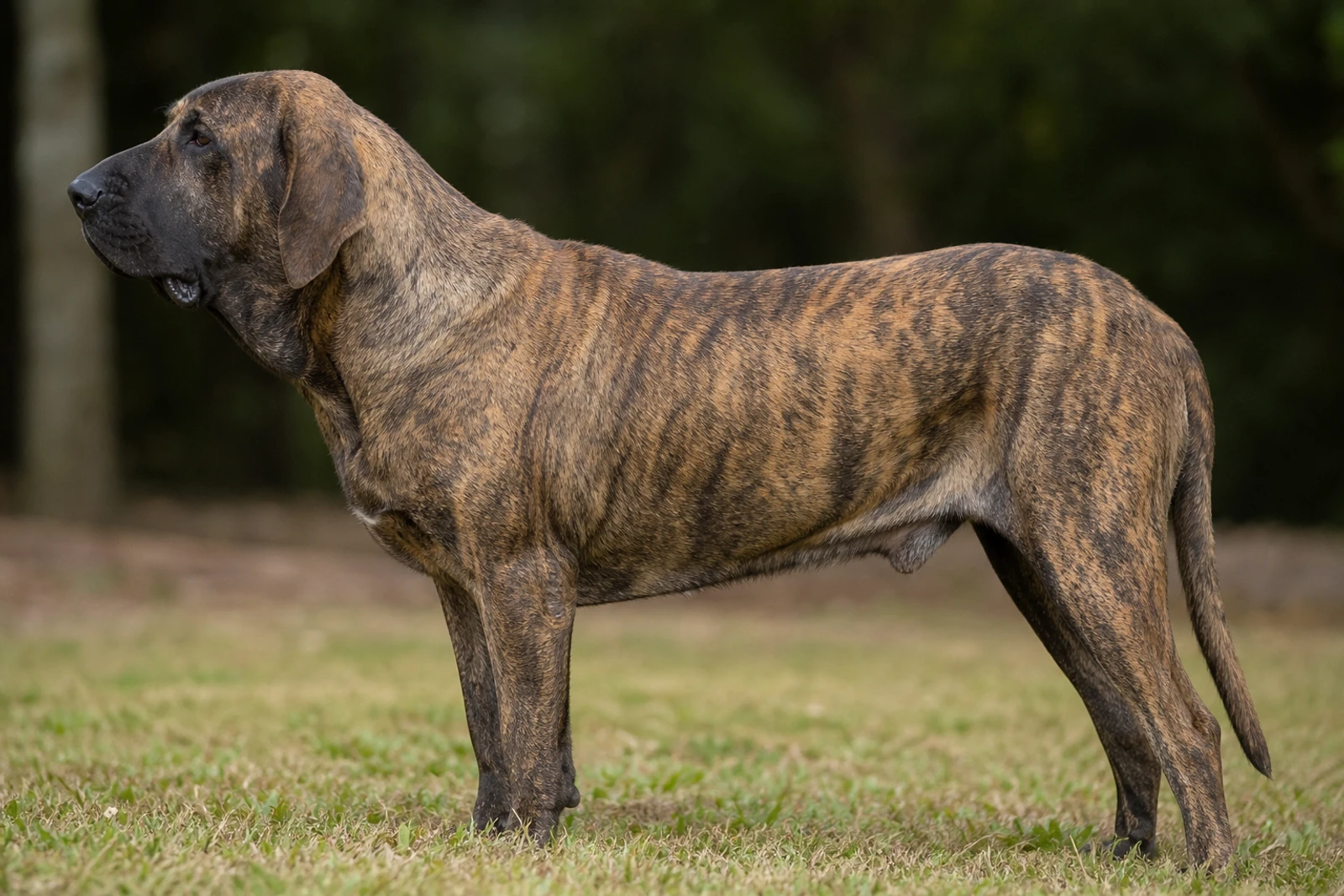
The Fila Brasileiro is a giant breed renowned for its unwavering loyalty and protective instincts. Best suited for experienced, assertive owners in rural or suburban homes, this powerful guardian thrives with early socialization and consistent training. They form deep bonds with their family but are naturally suspicious of strangers, making them excellent watchdogs. Not for first-time owners or those seeking a social butterfly, the Fila requires ample space, moderate exercise, and a job to do. Their short coat needs minimal grooming, but their intense temperament demands a dedicated handler.
At a glance
- Size
- Giant
- Height
- 24–30 in
- Weight
- 88 lb
- Life span
- 9–11 years
- Coat colors
- fawn, brindle, black
- Coat type
- short, smooth coat
How much does a Fila Brasileiro cost?
Adopt / rescue
$75–$400
Usually includes spay/neuter, first shots, and a microchip.
Buy from a breeder
$700–$2,000
From a reputable, health-testing breeder.
Approximate USD. Prices vary widely by region, breeder, pedigree, age, and coat colour — adopting is the lower-cost and recommended route. Avoid suspiciously cheap “breeders”; they’re often puppy mills.
Estimate the full cost of a Fila Brasileiro →Want the ongoing number? Estimate the monthly food bill for a Fila Brasileiro with our dog food cost calculator.
Fila Brasileiro photos
Views
Front, side, rear and top — the full silhouette.Poses
How the breed sits, lies, moves and plays.Puppy to senior
The breed across its whole life.Expressions
The breed’s range of moods.Close-up details
Eyes, ears, nose, paws, tail and coat.Coat colors
The breed’s recognized colors.Click any photo to enlarge. We show the Fila Brasileiro from every angle — three views, poses, life stages, expressions, close-ups, coat and colors.
Appearance & size
The first thing you’ll notice about a Fila Brasileiro is how much dog there is, packed into a surprisingly trim frame. This is a giant breed that doesn’t carry an ounce of unnecessary weight. A big male stands 28 to 30 inches at the shoulder; females generally settle between 24 and 28 inches. Yet the scale rarely tops 88 pounds—a weight that feels almost improbable on a dog this tall. You’re not looking at a bulky, mastiff-style barrel. You’re looking at a long, lean, heavily boned athlete draped in loose skin, built to cover ground on a Brazilian ranch all day.
Build and proportions
Seen from the side, the Fila’s body is rectangular—longer from chest to rump than he is tall at the withers. The back is straight and solid, with the croup (the rump just before the tail) sloping gently. This rear slope, combined with a deep, broad chest that reaches down to the elbows, gives the dog a slightly downhill stance, as if he’s coiled up. The forechest is prominent, the ribs well-sprung. Loin and belly are tucked up just enough to telegraph working endurance, not a showy waistline. Bone is dense and heavy; legs are straight columns, ending in large, tight paws with thick pads.
Coat and color
The coat is a single layer: short, smooth, and dense, lying flat against the body. You’ll feel a slick, almost oily texture when you run your hand over it. That coat sheds, and it sheds year-round. Colors span from solid fawn (ranging from pale sandy to deep red) and solid black to the iconic brindle—dark stripes laid over a lighter base coat, sometimes so heavy the dog looks nearly black. White markings are permissible on the chest, feet, and tail tip, but they’re not required. Black masks on the muzzle are common in fawn and brindle dogs, accenting the face’s serious expression.
Head and distinctive features
The head is nothing short of impressive. Broad and heavy, with a rounded skull, the Fila’s head is covered in thick, loose skin that forms a noticeable dewlap under the throat—sometimes cascading all the way to the chest. Ears are set well back, large, thick, and V-shaped, hanging down at the sides. The eyes are medium-sized, almond-shaped, and set deep beneath pronounced brow ridges, giving the dog a calm but penetrating stare. The muzzle is powerful and square, with flews (upper lips) that hang down in a gentle curve, blending into the dewlap. From head on, the whole picture is one of steady, aloof confidence—never goofy.
From front, side, and rear
- Front: A wide, muscular neck flows into a deep chest and straight forelegs spaced well apart. Shoulders are sloping but muscular, and the elbows sit close to the body. The head carriage is naturally above the back line, making the dog look alert even at rest.
- Side: The long profile shows you the rectangular silhouette, deep brisket, tucked-up belly, and the long, thick tail carried low with a slight upward hook at the tip. You’ll also see the hind legs slightly set back, with a moderate angulation, ready to push off.
- Rear: The hindquarters are powerful, with well-muscled thighs and strong, parallel hocks. That long tail reaches at least to the hock, sometimes below. From behind, the Fila’s unique gait becomes obvious: he moves with long, elastic strides, his hind feet tracking right into or ahead of the front prints.
History & origin
The Fila Brasileiro was forged on the massive cattle ranches and sugar plantations of colonial Brazil, starting as early as the 1500s. Conquistadors and Portuguese settlers brought working dogs — Mastiffs, Bloodhounds, and old-type Bulldogs — that interbred over centuries to produce a dog uniquely suited to the relentless demands of tropical backcountry life. No one planned the breed; necessity shaped it.
Those early dogs had to do everything. A rancher needed a dog that could drive half-wild cattle across enormous distances without scattering them, hold a bull by the nose or ear until a cowboy arrived, and guard the remote homestead with zero tolerance for intruders. In the dense forest, jaguars stalked livestock and people. The dog developed for that job got a local nickname: onceiro, or jaguar hunter. A Fila wouldn’t just bark at a big cat. It would track it silently, seize it by the neck, and pin it until the hunter could finish the job.
The Bloodhound influence poured in legendary scenting ability. That’s where the Fila got its methodical, head-down tracking style and the loose skin that lets it work through thorny underbrush without getting held up. The Mastiff side delivered bone-crushing power, a massive frame, and a deep suspicion of strangers — a trait the Portuguese called ojeriza, a word that still defines the breed’s temperament. The old Bulldog added gameness and relentless grip. Genetically, it all simmered together in a hot, hard country that killed off anything not tough enough.
What a lot of people don’t realize is the Fila also tracked escaped enslaved people, a grim chapter that’s part of the dog’s origin and can’t be glossed over. It could follow a human trail for miles and, once it caught up, would hold the person like it held a bull — not mauling, but immobilizing with its body — until the handler arrived. That ability made the breed valuable and, for many, controversial.
By the mid-20th century, the Fila had a loyal following in Brazil but no official standard. The first breed standard was written in 1946, and the Confederação Brasileira de Cinofilia (CBKC) recognized it in 1970. Around that time, breeders started keeping more careful records, tightening the type without losing the raw functional edge. The dog began trickling into other countries, but it never became a mass-market breed. Many nations still restrict or ban ownership because of the Fila’s intensity.
Today, the Fila Brasileiro is a giant guardian through and through. You’ll still find them on ranches in Brazil’s interior doing the same cattle work their ancestors did 400 years ago. When you look at a solid, brindle Fila standing 28 inches at the shoulder, you’re looking at a living piece of Brazil’s rural history — a dog that never got watered down into a pet for everyone.
Temperament & personality
A Fila Brasileiro doesn’t just love his family — he considers them his whole world and guards them with a seriousness that startles first-time owners. Inside the house, these dogs are famously calm, even lazy. They stretch out in a sunny spot, follow you from room to room, and lean into you with a physical affection unmatched by more aloof giants. But crack the front door to a stranger, and that same dog transforms. The trademark ojeriza — a deep, instinctive distrust of anyone outside the immediate family — defines the breed. It’s not something you train into a Fila. It’s simply there, often by six months old.
That wariness makes them intense watchdogs who don’t need to be told to protect. A Fila won’t bark hysterically at every leaf. He assesses. You’ll see a forward shift in his weight, a stiffening body posture, and a direct, unblinking stare that signals he’s already decided the visitor doesn’t belong. This isn’t a dog that takes cues from you when a threat exists; he trusts his own judgment. Recognizing that body language — the forward lean that spells confidence and intent — is critical to prevent escalation. A Fila in guard mode doesn’t bluff.
Because of that, they are a disastrous choice for a novice owner or a sociable home with constant visitors. Aggression and low “stranger-friendliness” scores aren’t a flaw in the breed; they’re the whole point. But it means you’ll spend a decade managing a 88-pound animal who reads a neighbor’s handshake as a possible assault. Homes with small children or other pets rarely work without extraordinary management. The breed’s guarding drive can surface around food, too; never interrupt a Fila at his bowl, and teach kids to give meals a wide berth.
Energy-wise, they aren’t marathon runners. A solid daily walk, a chance to patrol a secure yard, and problem-solving tasks keep them content. Skip mental exercise, and boredom spills into anxiety-driven behaviors — excessive barking through windows, marking even inside the house, or chewing that targets baseboards and door frames because those powerful jaws need hard work. A bored Fila isn’t destructive out of spite; he’s creating a job where none exists.
Training requires a calm, consistent hand. These are strong-willed dogs that respond to respectful guidance, not heavy-handed corrections. Force makes a Fila shut down or push back. They’ll test boundaries just to see if you mean it, so a handler who wavers will quickly lose ground. If you can offer a quiet, predictable household and read a dog’s subtle signs — a lip lick or head turn that says “back off” — the reward is a loyal shadow who greets you with a wagging, full-body lean. But that loyalty is exclusive. Don’t expect a Fila to forgive an intruder, even one you’ve invited in.
Good with kids, dogs & other pets
The Fila’s fierce devotion to its own household cuts both ways. With the children it considers family, this giant can be remarkably patient and gentle — a 90-pound shadow that tolerates ear tugging and clumsy hugs with a calm, steady temperament. But that same loyalty makes the breed a poor choice for homes where kids’ friends or neighbors regularly drop by. The Fila’s trademark ojeriza — a deep, centuries-old distrust of strangers — doesn’t pause just because a new person is small. Shrieks, sudden sprints, and roughhousing can read as a threat, and a dog that stands 24 to 30 inches tall can do real harm in an instant, even without biting.
- Supervision with your own children is non-negotiable. Never leave a Fila alone with toddlers. The dog’s protective instincts can misfire during normal kid chaos, and its size means a well-meaning body block can knock a child down hard.
- Visiting children often present a real management challenge. Even a well-socialized Fila is likely to view unfamiliar kids as intruders, so separate the dog securely before the playdate starts. This is not a breed you can “crate and hope” while the doorbell rings.
With other dogs, the picture doesn’t soften much. Same-sex aggression runs deep in the breed, particularly between males. A Fila may coexist peacefully with a dog of the opposite sex raised alongside it from puppyhood, but bringing a new adult dog into the home is a gamble. This is a guard dog, not a dog-park dog. Off-leash greetings with strange dogs can trigger fights that look less like play and more like a territorial lesson. Many experienced owners keep their Fila as the only pet.
Cats, rabbits, and other small animals bring out the Fila’s strong prey drive. A puppy raised with a family cat from the start might make an exception, but the breed’s natural response to a fleeing critter is to capture and kill. Outdoor cats, backyard chickens, or visiting pocket pets are in real danger. Plan on secure separation for the dog’s entire 9- to 11-year lifespan.
Early socialization — exposing a puppy to a hundred different people, places, and sounds before 16 weeks — is crucial but won’t erase genetics. It gives the dog tools to cope, not a personality transplant. Forced exposure once the sensitive window closes only adds stress. A Fila that is calm and comfortable with its own people and politely ignores the rest of the world is a success, not a failure. Respect the breed’s nature: this dog needs a quiet, predictable household and an owner who never confuses profound loyalty with universal friendliness.
Trainability & intelligence
The Fila Brasileiro is smart in a way that can make formal obedience feel like a negotiation, not a command performance. This is a breed that learns fast—provided you’ve earned their respect first. They aren’t wired to blindly obey someone they don’t trust, and they’ll read your body language with an intensity that borders on unsettling. Forget shouting or physical corrections; those tactics will either make a Fila shut down or push back harder, and with a 90-pound guardian dog that’s a dangerous gamble.
Motivation hinges on relationships, not just treats. Food rewards and play work, but they’re most effective as a way to reinforce the partnership you’ve been building since day one. Praise that feels genuine to you will read as genuine to them—they’re that attuned. Expect a deliberate, measured response time. They think before acting, which can look like stubbornness, but is really a deeply ingrained habit of sizing up a situation themselves before committing. That independence means a recall is never a guaranteed thing without months—often years—of proofing under increasing distractions. Even then, a Fila’s powerful prey drive or suspicion of a stranger can override years of training in a heartbeat. Off-leash reliability in unfenced public areas is something many experienced owners will tell you is rarely 100% with this breed.
The real work starts with socialization, and it needs to begin the moment your puppy’s vaccination schedule allows—ideally well before 16 weeks. Expose them gently and repeatedly to new people in neutral settings, different floor surfaces, street sounds, and other animals. The goal isn’t to make a Fila indiscriminately friendly; that’s not in their nature. It’s to teach them that “stranger” isn’t an automatic threat, which reduces fear-based reactivity and gives you a dog you can trust to assess situations more calmly. Each positive experience gets banked as evidence that the world isn’t full of challenges needing a defensive response.
For a breed whose default setting is wariness of outsiders, training must be a lifelong pursuit. The same consistent, reward-based approach that teaches a puppy to sit without jumping also teaches an adult that a handshake with your dinner guest isn’t a crisis. Fairness and clarity carry more weight than repetition. If you lose your patience and raise your voice, you’ll see trust erode faster than a loose sit-stay, and rebuilding it is slow. Plan on short, daily sessions that end on a win, and never let your own frustration become the biggest obstacle to your dog’s success.
Exercise & energy needs
A Fila Brasileiro isn’t a dog you can walk around the block and call it done. This is a giant working breed with the muscular heft to pull carts and the independent mind of a livestock guardian. He needs at least 60 to 90 minutes of purposeful daily exercise, broken into two sessions. One long session can lead to boredom and pent-up tension; two distinct outings let you mix physical work with mental challenges in a way that respects his suspicious, thoughtful temperament.
Think beyond leash-only strolls. Filas thrive on scent work, long-line tracking, hiking on uneven terrain, or pulling a cart—activities that engage their nose and their powerful hindquarters. A fenced yard isn’t enough without structured engagement; an under-exercised Fila will redirect that intensity into barrier frustration, leash reactivity, or destructive digging. Mental stimulation is just as critical. Puzzle toys, hidden treats, and daily obedience drills that require self-control burn energy faster than adding another mile to your run.
Joint health is a real concern. This breed’s sheer size and rapid growth rate mean you’ll want to avoid high-impact pounding on hard surfaces, especially before growth plates close around 18–24 months. Stick to grass, dirt trails, and swimming. Two 30- to 40-minute sessions are better than one hour-long forced march on concrete. On days when outdoor activity isn’t possible, indoor scent games (like hiding a favorite toy) can take the edge off, but you’ll still need to get outside the next morning. A bored Fila with no outlet is a recipe for a 90-pound dog who makes his own decisions—and trust us, you won’t like those decisions.
Grooming & coat care
The Fila Brasileiro’s coat is about as low-maintenance as a giant dog gets. You’re working with a short, dense, single-layer coat — no insulating undercoat, so there’s no massive seasonal blowout to manage. That said, they still shed moderately year-round. A weekly brush-down catches most of the loose hair before it ends up on your couch.
For brushing, reach for a pig-bristle brush or a rubber curry mitt. The bristles polish the coat, distribute natural oils, and bring out the rich color — whether your dog is fawn, brindle, or deep black. A curry mitt grabs dead hair while massaging the skin, which is exactly what a 88-pound power-chewer enjoys. In spring and fall, you might notice a little extra shed; just bump brushing to twice a week and watch any itchy patches.
Bathing a Fila is an “only when truly necessary” affair. That single coat dries out fast, and over-shampooing strips the oils that keep the skin comfortable. A rinse with plain water and a wipe-down with a damp cloth handles everyday dirt. When a full bath can’t be avoided, use a gentle, oatmeal-based shampoo and dry thoroughly — especially inside the heavy drop ears, where trapped moisture invites infections.
Those ears demand a weekly once-over. Flip each ear leather, wipe the visible part with a vet-approved cleaner and a cotton ball, and never dig into the canal. Big, floppy ears plus plenty of outdoor time make this non-negotiable.
Nails grow hard and fast on a dog this size. Trim them every two to three weeks, or the moment you hear clicking on hard floors. If you’re not comfortable with giant-breed nails, a grinder is often easier and less likely to hit the quick. Teeth need brushing a few times a week with dog toothpaste; daily is even better for fighting tartar on those massive jaws.
Beyond the brush, daily outdoor exercise naturally loosens dead hair and supports coat turnover. Use grooming time as a quick health scan — that short, single coat hides nothing. Run your hands over your Fila to check for dry patches, hot spots, or new bumps. It’s the simplest way to catch a skin issue before it becomes a problem.
Shedding & allergies
The Fila Brasileiro sheds more than you might guess from that smooth, short coat. The hair is coarse, short, and lies flat, but it drops steadily year-round. You'll find it on furniture, floors, and clothing — especially since this is a giant breed, and more dog equals more dead hair. A quick daily once-over with a rubber curry brush or hound glove pulls out the worst of it before it ends up on your couch, but don't expect a single weekly brushing to keep the house clean.
Twice a year, usually in spring and fall, Filas go through a full seasonal blowout. For a few weeks, the shedding kicks up a notch, and tumbleweeds of hair collect along baseboards daily. During these periods, brushing moves from "helpful" to non-negotiable — plan on a few minutes of vigorous currying every day if you want to stay ahead of it.
What really sets this breed apart in the "clean house" conversation, though, is the drool. Filas have large, loose flews and jowls, and they produce an extraordinary amount of slobber. It drips after drinking, hangs in long ropes after a walk, and gets flung onto walls and ceilings with one good head shake. The drool dries into a saliva residue that carries dander proteins — and that's the real kicker for allergy sufferers.
There is no such thing as a hypoallergenic Fila. Short hair doesn't mean allergy-safe; the primary allergens come from skin dander and saliva, not the hair itself. Combine steady shedding with copious drool, and you have a breed that can be a serious challenge for anyone with dog allergies. If you or a family member react to dander, spend time around adult Filas before you ever consider bringing one home. Realistically, living with a Fila means accepting hair, slobber, and the cleaning routine that goes with them — a robot vacuum and a stack of drool rags in every room are baseline equipment.
Diet & nutrition
A Fila Brasileiro grows from a wobbly pup to a 88 lb powerhouse in roughly 18 months, and every meal either builds sound joints or silently adds stress to hips and elbows. What you feed matters, but how you feed a giant, deep-chested breed directly affects the risk of bloat—a life-threatening emergency. Divide the daily ration into at least two meals, never one huge portion, and keep your dog quiet for a full hour before and after eating.
Puppies need four evenly spaced meals a day until four months, then three meals until six months, then you can settle into the adult two-meal rhythm. A large-breed puppy formula—with balanced calcium and phosphorus—keeps growth steady instead of explosive. Rapid weight gain as a puppy is a direct threat to developing joints, so skip the free-feeding and measure every scoop.
Adult Filas often have a hearty appetite, and many will polish off anything you put down. That food motivation makes portion control non-negotiable. Use a slow-feeder bowl or a food puzzle if your dog hoovers meals in seconds; it burns a little mental energy and cuts the air swallowing that can contribute to bloat. Keep your Fila lean—you should be able to feel ribs without a thick layer of padding. Even a few extra pounds hang heavy on a giant frame, accelerating wear on joints and making movement harder as the dog ages.
A practical starting point is a diet built around roughly 60% high-quality animal protein (raw or lightly cooked meat, plus eggs and canned fish like sardines in water), 20–30% vegetables and fruit, and about 10% other ingredients like plain yogurt, pearl barley, or white rice for easily digestible carbohydrates. Puréeing or finely processing veggies improves nutrient absorption because dogs lack salivary amylase and mostly crunch up and down rather than grinding sideways. If you go the home-cooked route, work with a veterinary nutritionist to avoid deficiencies a giant breed can’t afford.
Senior Filas often slow down and need fewer calories, so watch the scale and gradually reduce portions to prevent obesity. Smaller, more frequent meals can be gentler on an older stomach, and there’s no strong reason to slash protein intake. Steer clear of rich, fatty scraps—especially after holiday meals—that can trigger pancreatitis. Whatever you feed, serve it in your dog’s own bowl, never from the table, and use plain vegetable cooking water as a tasty, low-fat meal base when stock isn’t on hand.
Health & lifespan
A Fila Brasileiro typically lives 9 to 11 years — a respectable window for a giant breed, but one that means the “senior” chapter arrives around age 7 or 8. You’ll get the most out of those years by staying ahead of a few known weak spots and keeping your dog lean.
What can go wrong — and what responsible breeders do about it
- Hip and elbow dysplasia. Joint laxity and malformation are the ghosts that haunt giant breeds. A dog carrying extra weight has no margin for error here. Reputable breeders run OFA or PennHIP screenings on all breeding stock, and you should see those clearances — not just a vet’s nod — before you buy a puppy.
- Gastric dilatation‑volvulus (bloat). A stomach that fills with gas and twists is a big‑dog emergency that kills within hours. Feed two or three smaller meals a day, use a slow‑feeder bowl, and enforce an hour of quiet after eating. Know the early signs: unproductive retching, a tight belly, pacing. If you live far from an emergency vet, map that route now.
- Eye issues. Entropion (inward‑rolling lids), ectropion, and progressive retinal atrophy can crop up. Annual eye exams with a veterinary ophthalmologist catch trouble before it becomes daily discomfort.
- Heart conditions. Dilated cardiomyopathy is something to watch, especially as the dog ages. A baseline cardiac echo early on gives you a reference for later changes.
- Skin and folds. That loose, expressive skin traps moisture and debris. Keep the face and neck folds dry and clean, or you’ll battle recurring dermatitis. A diet with targeted omega‑3s often makes a real difference in skin resilience.
Keeping a giant’s body on track
- Weight is everything. An 88‑lb dog with dysplastic joints shouldn’t carry a single extra pound. Use a body‑condition score — you want to feel ribs easily under a light cover. Portion control and low‑impact exercise (swimming, structured walks) beat joint‑grinding sprints.
- Temperature sense. The short coat handles a Brazilian afternoon, but a Fila can overheat if you push hard exercise in high humidity. In cold weather, they chill fast; a waterproof coat and shorter outings keep them safe.
- Stress and early handling. A Fila who was never properly socialized doesn’t just act out — it can internalize that tension into destructive chewing, pacing, or appetite loss. Calm, consistent handling from puppyhood and early positive exposure to handling (nail trims, ear checks) pay off in fewer stress‑related health issues down the road.
Preventive care you absolutely don’t skip
- Heartworm prevention. Monthly medication during mosquito season, and for one month after it ends. There’s no room for here‑and‑there dosing.
- Rabies vaccination is a legal requirement, and the disease is untreatable once symptoms appear. Don’t mess with it.
- Vet rhythm. Annual exams with bloodwork for adults; twice‑yearly for dogs over 7. Subtle signs like a drop in activity, weight change, or reduced appetite are often all you get with a stoic giant. Track them and speak up.
A Fila’s lifespan isn’t just genetic. It’s built on joint screenings, a precise diet, and catching bloat before you think it’s just a bellyache.
Living environment
A giant guarding breed like the Fila Brasileiro belongs in a detached house with a securely fenced yard — never in an apartment, condo, or townhouse where walls are shared. This dog’s deep, booming bark carries through drywall like it isn’t there, and their territorial distrust of strangers means they’ll announce every delivery driver and neighbor who walks past. Close quarters also magnify the constant drool. If you value quiet or pristine floors, a Fila is going to be a daily challenge.
Yard and space
Solid, six-foot fencing is the bare minimum. An underground electronic wire means nothing to a 90-pound dog who decides a perceived threat is worth investigating. They need room to move, but don’t mistake a large yard for a place to park the dog. A Fila who is left outside alone will grow bored, frustrated, and potentially more reactive. They want to be inside with you, falling asleep at your feet. Plan on multiple short daily walks — two sessions of 20 to 30 minutes are more than enough for this breed’s giant-frame stamina — combined with indoor scent games and puzzle feeders to work their brain. For a Fila, a thinking walk around the property perimeter often tires them out faster than a long run. Curb high-impact stuff like repetitive jumping or hard-surface jogging before growth plates close (around 18–24 months) and keep it light even for adults; giant breeds carry joint vulnerabilities that responsible owners protect.
Climate and comfort
Brazilian roots don’t make this dog heat-proof. The Fila’s heavy, loose skin and substantial body mass make them prone to overheating when the mercury climbs. Air conditioning is non-negotiable in summer heat, and outdoor time should be limited to early morning or late evening when the pavement is cool. The same coat that keeps them warm enough for moderate cold isn’t built for extreme freezing; this is a house dog who should sleep indoors year-round, on a supportive orthopedic bed that cushions those big elbows.
Noise and watchfulness
Barking is baked into the breed. A Fila doesn’t just warn — they deliver a full-throated, chest-rumbling alert that stops visitors cold at the gate. That’s a feature if you want serious property protection, but it becomes a liability in neighborhoods with noise ordinances or tightly packed lots. Early socialization tones down the edge, but never eliminates the instinct. You’ll never train this dog to ignore a stranger at the door.
Being left alone
Filas bond to their people with a fierceness that makes them genuinely miserable when left alone for long stretches. Eight hours alone while you’re at work can trigger destructive chewing, incessant barking, or full-blown separation anxiety. If your household is gone all day, this breed isn’t a fit. For shorter absences, crate training, snuffle mats, and carefully built alone-time tolerance from puppyhood can help — but the ideal home has someone around most of the day. A dog this big and this sensitive can’t just “hold it” emotionally.
Who this breed suits
The right home: experienced, firm, and ready for a constant guardian
A Fila Brasileiro works for someone who wants an imposing, uncanny guardian that lives and breathes loyalty to its family — and who fully accepts that this dog will never, ever be a socialite. The breed’s famous ojeriza, a deeply rooted distrust of strangers, isn’t a training glitch; it’s the core of the dog. You do not socialize it away. You manage it, channel it, and build your life around it. That means an owner who’s handled assertive guardian breeds before and doesn’t mistake the Fila’s stubborn independence for a lack of intelligence. First-time dog owners are not a fit.
You’ll need a home with a massive, securely fenced yard — six-foot solid fencing, no dig spots, double-gated entries — and a household that rarely, if ever, hosts casual visitors. Rural acreage or a quiet single-family house on a large lot suits the breed; apartment living is out of the question. The Fila bonds ferociously with its immediate family and can be remarkably gentle and patient with children raised alongside it from puppyhood. But that same dog will likely read a neighbor kid’s roughhousing as a threat and act decisively. Early, relentless socialization — calm exposure to countless people, sounds, and settings while always respecting the dog’s wariness — is non-negotiable, and even then, a Fila remains a behind-the-gate dog, not a café patio companion.
The ideal owner is a calm, clear-sighted leader who sets rules with consistency and respect. Harsh corrections backfire; this breed remembers unfair treatment and shuts down or escalates. Singles or couples who live quietly, don’t entertain much, and want a devoted shadow that patrols the property can thrive with a Fila. Active families can work if they accept that the dog’s exercise happens via long, leashed walks in controlled spaces and structured play inside safe confines — not off-leash hikes or dog-park outings. Don’t let the 88-pound breed average fool you; a muscular male easily pushes past 130 pounds, and even a smaller female has enough power to yank a grown adult off their feet.
Who should think twice
- First-time dog owners. You’re dealing with a creature whose default is “prove to me you’re not a threat,” packed into 90 to 180 pounds of muscle. Learn the ropes on a more forgiving breed.
- Seniors or anyone without real physical strength. A sudden lunge toward a perceived threat can overpower even a sturdy handler. The Fila’s sheer mass and quickness demand an able body and a plan for emergencies.
- Families who love guests. Frequent playdates, dinner parties, and spur-of-the-moment visits mean a lifetime of crating, separating, or tense supervision. That stress leaches into the dog and the household.
- People wanting a dog-park social butterfly. While a Fila can peacefully coexist with other pets raised alongside it, same-sex dog aggression runs strong, and expecting it to frolic with unfamiliar animals invites disaster.
- Anyone in a jurisdiction with breed restrictions. Many apartments, municipalities, and insurers flat-out ban Filas. Check your local laws and homeowner’s policy before you commit.
This is not a project dog you transform into an easygoing family fixture. It’s a working guardian that will adore you with an intensity few breeds match, and regard nearly everyone else as a problem to watch. If you can’t hand-on-heart promise a decade of vigilant containment, consistent leadership, and the permanent understanding that your dog is hardwired for stranger danger, you need a different breed.
Cost of ownership
Owning a Fila Brasileiro costs more than most giant breeds — not because of fussy grooming, but because you’re feeding a 100-pound guardian with a deliberate, high-maintenance temperament.
Upfront price
A well-bred Fila puppy from a breeder who tests for hip and elbow dysplasia typically runs $1,800–$3,500. Filas are rare in the US, so expect a waitlist and possibly a long drive or flight. That price should include early health clearances and a contract requiring you to return the dog if you can’t keep him. Rescue adoption, when available, is closer to $300–$500, but many rescues insist on giant-breed experience and a home check. Either way, factor in an immediate $300–$600 for crate, leash, collar, a heavy-duty food bowl, and initial supplies that won’t be outgrown in three weeks.
Monthly expenses
-
Food: $90–$140
A young, active Fila eats 4–6 cups of quality large-breed kibble a day. Adult dogs may settle around 4 cups. Cheap fillers are a false economy; the right calcium/phosphorus balance matters for joints. Treats and chews for training and crate time add $15–$25. -
Vet and preventatives: $60–$100 (averaged monthly)
Routine visit, vaccines, heartworm, and flea/tick prevention push this figure. Giant breeds age fast — your first two years include spay/neuter or gastropexy (tacking the stomach to reduce bloat risk), which can cost $500–$1,200 out of pocket. Annual bloodwork and hip x-rays become wise by middle age. -
Insurance: $55–$110
Premiums run high due to breed risks like hip dysplasia, bloat, and OCD. Look for a policy that covers orthopedic conditions without a one-year exclusion window. Without insurance, a bloat surgery alone can hit $3,500–$6,000. -
Grooming: $20–$40
The short, dense coat needs a quick weekly rubber curry and occasional bath. You’re mostly paying for nail trims every 3–4 weeks and a high-velocity dryer if you don’t want fur tumbleweeds inside. -
Training and containment: $200–$400 (first year, ongoing refreshers)
This isn’t optional. An untrained Fila becomes a liability. A board-and-train or series of private lessons with someone who understands livestock guardians runs $1,000–$2,000. A six-foot privacy fence, if not already installed, is a multi-thousand-dollar consideration — this breed does not welcome perceived intruders.
All in, a Fila Brasileiro easily costs $2,500–$4,000 per year just for the essentials. The real gut check is whether you can absorb a surprise $5,000 emergency without hesitation.
Choosing a Fila Brasileiro
A Fila Brasileiro isn’t a casual choice. You’ll be sharing your home with an 88-pound dog whose instinct is to guard, not greet, and choosing the wrong puppy or source can put everyone in a bad spot. The single most useful thing you can do is find a breeder who takes that intensity seriously—or steer clear of this breed entirely if you’re not ready for it.
Responsible breeder vs. rescue Good breeders build your dog’s foundation. They screen for the giant-breed problems that show up when nobody checks: hip and elbow dysplasia, entropion, and bloat. Ask for OFA or PennHIP hip scores (rated good or excellent, not just “vet checked”), elbow clearances, and a current CERF eye exam. They’ll talk bluntly about the 9- to 11-year lifespan and have diet and management advice to lower torsion risk. If a breeder waves off health testing or promises Filas are “big teddy bears,” walk.
Rescue Filas do exist, but most land in rescue because an owner couldn’t handle the guarding. You’ll need a group that’s painfully honest about bite history, resource guarding, and what fence the dog has climbed. Unless you’ve already lived with a guardian breed and have a containment setup designed for a 6-foot-plus escape artist, a rescue Fila is a real gamble.
Red flags to spot early
- Breeder can’t produce health clearances or claims the line is “all healthy.”
- Puppies always available, shipped without an in-person visit.
- You’re not allowed to meet the mother (or the mother seems fearful/skittish and never settles).
- Contract lacks a return-to-breeder clause in case you can’t keep the dog.
- Puppies leave before 8 weeks.
- Anyone who doesn’t ask you hard questions about your fence type, household, and experience.
Picking a puppy The mother’s behavior around strangers is your cheat sheet. She’ll likely bark or hang back, but should relax once the breeder gives her the okay. Steer clear of a pup that cowers in a corner or relentlessly bullies littermates. Aim for the middle pup—the one that sniffs your hand, maybe plays for a minute, then goes about its business. Look for clear, non-squinty eyes, no limping, and a rounded belly that isn’t hard or bloated. A solid breeder already has pups used to household sounds and a crate before you ever show up.
A breeder who interviews you harder than you interview them is exactly what you want. Expect questions about your fencing (wood or block, six feet minimum, not chain link), your plan for ongoing socialization when the dog’s default is suspicion, and why you think a Fila fits your life. If they aren’t at least a little guarded about placing a puppy with you, that’s your final red flag.
Pros & cons
A Fila’s devotion is the real deal — a no-questions-asked loyalty that translates into a guardian who would put themselves between you and anything. That same intensity, however, creates a dog that isn’t a fit for most homes. Here’s the balance in plain terms.
Pros
- Unmatched personal protection — natural wariness of strangers (called ojeriza) means you don’t have to train guarding; it’s already there.
- Gentle and patient with their own children when raised together from puppyhood.
- Surprisingly calm indoors for a giant breed, content to lounge if given proper exercise — a securely fenced yard is non-negotiable.
- Low-maintenance coat — short, smooth, and only needs a quick brush now and then.
- Brave to the point of being fearless; an intruder deterrent just by existing.
Cons
- Not for inexperienced owners. This breed requires a handler who can read canine body language and provide calm, consistent leadership without force.
- Deep suspicion of anyone outside the immediate family can escalate to aggression without intensive, lifelong socialization — even then, it’s hardwired, not trained away.
- Legal liability. Banned or restricted in many countries, cities, and insurance policies; you must check local laws before committing.
- Giant size (88 pounds, up to 30 inches at the shoulder) means they take up real space and can inadvertently knock over small kids.
- Heavy drool — after meals, drinking, or just relaxing, you’ll be wiping walls and clothes.
- Short lifespan of 9–11 years, common in giants, and they can be prone to hip dysplasia and bloat (responsible breeders screen for these).
- Often same-sex dog aggressive and has a high prey drive; off-leash dog parks are a bad idea.
Similar breeds & alternatives
If the Fila’s extreme, hardwired stranger wariness is more than you can manage day to day, a few other large guardian breeds scratch a similar itch without dialing suspicion all the way to eleven. None of these are beginner dogs — they all need an experienced owner, early socialization, and firm, fair handling — but they allow more wiggle room in how they read and react to unfamiliar people.
Cane Corso
This Italian mastiff brings comparable mass (around 90–110 lb and 23.5–27.5 inches tall) and a deep-rooted protective streak. A well-bred Corso is naturally reserved, not hostile, and can learn to accept strangers when you give the all-clear. They’re more biddable than a Fila, generally quicker to work with you rather than make independent security calls. The trade-off: you still get a powerful deterrent and a dog that shadows its people, but you sacrifice the Fila’s legendary, no-exceptions distrust of outsiders. Expect similar exercise needs — a solid hour or more of daily off-leash movement, not just a stroll around the block.
Dogo Argentino
Built for hunting big game and guarding, the Dogo runs 80–100 lb and 24–27 inches, with a sleek white coat and an athletic edge. They’re fearless and loyal, and they’ll hold a line against a threat, but they aren’t preloaded with the same across-the-board suspicion of every unknown human. With thorough socialization, many Dogos remain warm with familiar guests and simply watchful with newcomers. The catch is a high prey drive and same-sex dog intolerance can be real problems. You’ll need to channel that drive into structured work — lure coursing, weight pull, long hikes — and own a very solid recall. The Fila’s heavy, lethargic-to-watchful demeanor isn’t here; the Dogo is a coiled spring.
Presa Canario
A mastiff from the Canary Islands, the Presa weighs 85–110 lb and stands 22–26 inches, with a blockier build. Like the Fila, they’re serious, calm-alert guardians bred to work independently with livestock and property. However, a stable, well-raised Presa can learn to tolerate strangers in controlled settings rather than defaulting to instant rejection. Still, this is a dominant breed that will test boundaries, and poor socialization can push them toward the same hair-trigger reactivity you’d see in an unsocialized Fila. The difference is genetic flexibility: many Presas can dial down, while the Fila’s ojeriza isn’t something you train out — it’s baked in.
Boerboel
The South African farm dog often tips the scales at 110–200 lb and stands 22–27 inches, making many individuals substantially heavier and wider than the Fila’s listed 88 lb. A sound Boerboel is a calm family protector that deters by sheer presence. They’re generally more affectionate with their inner circle and can be trained to accept visitors with a quiet, watchful attitude, though they’ll never be a social butterfly. They still need a confident handler who won’t let the dog call the shots, and territoriality is a given. The Boerboel’s lifespan of 10–12 years edges out the Fila’s 9–11, but you trade the Fila’s singular, legends-are-made-of-this suspicion for a dog that’s a little softer with family while still a hard no to actual threats.
Every one of these breeds, like the Fila, may be restricted or banned in certain cities or countries. Check local laws, meet parent dogs, and be honest about how much stranger-ready you really need versus how much you’re willing to manage daily.
Fun facts
- The Fila Brasileiro is known for its 'ojeriza', an intense mistrust of strangers.
- They were historically used to guard livestock and track fugitives in Brazil.
- The breed is banned or restricted in several countries due to its protective nature.
- Despite their size, Filas are agile and have a unique, cat-like gait.
Frequently asked questions
- Is the Fila Brasileiro good with children?
- The Fila Brasileiro can be deeply loyal and protective of its family members, often forming strong bonds with children it is raised with. However, its imposing size and strong guarding instincts mean interactions should always be supervised, particularly with unfamiliar youngsters. Early and consistent socialization is essential to help ensure safe and gentle behavior.
- How much shedding does a Fila Brasileiro have?
- The Fila Brasileiro has a short, dense coat that sheds moderately year-round. Regular brushing, about once a week, can help manage loose hair and keep shedding under control. They are not considered a heavy-shedding breed, but some shedding is to be expected.
- How much exercise does a Fila Brasileiro need?
- A Fila Brasileiro requires a moderate amount of daily exercise, such as long walks or vigorous play sessions, to stay physically and mentally fit. As a giant breed, they can be prone to joint issues, so exercise should be adjusted for age and condition. Mental stimulation through training or puzzle toys is also beneficial.
- Can a Fila Brasileiro live in an apartment?
- Apartment living is generally not ideal for a Fila Brasileiro due to its large size and need for space to move comfortably. A home with a securely fenced yard is better suited, provided the dog still receives regular walks and family interaction. Their protective nature may also lead to alertness that can be disruptive in close quarters.
- Is the Fila Brasileiro easy to train for first-time owners?
- The Fila Brasileiro is an intelligent but independent breed, which can make training challenging for first-time dog owners. They respond best to confident, consistent leadership and positive reinforcement methods. Novice owners may find their stubbornness and strong will difficult to manage without professional guidance.
- Is the Fila Brasileiro known for barking a lot?
- Fila Brasileiros are not typically excessive barkers, but they will bark to alert their family to anything unusual. This guarding instinct can make them effective watchdogs, though proper training can help curb unnecessary noise. They tend to be more vocal when their protective nature is triggered.
Tools & calculators for Fila Brasileiro owners
Quick estimates tailored to Fila Brasileiros — pre-filled with this breed’s size where it matters.
Articles & stories about the Fila Brasileiro
Sources & standards
This profile follows recognized breed standards from the American Kennel Club (AKC) and the Fédération Cynologique Internationale (FCI), along with established veterinary and breed-club guidance. These describe general breed tendencies — every dog is an individual.