

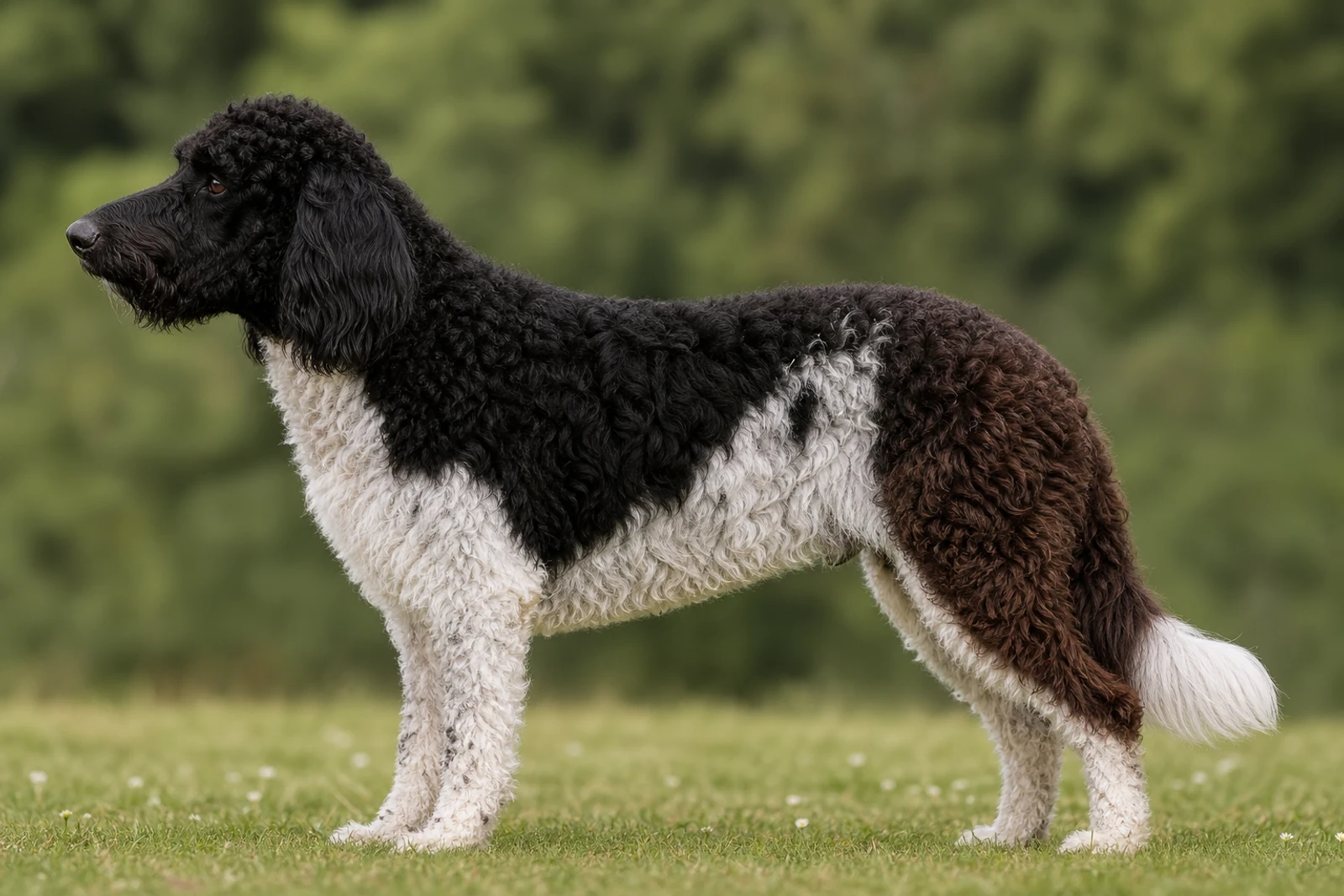
The Frisian Water Dog, also known as the Wetterhoun, is a dedicated and intelligent hunter from the Netherlands, originally bred for waterfowl and otter. This rare breed suits active, experienced owners who appreciate an independent and sometimes stubborn companion. They are loyal and calm at home but need consistent training and daily exercise to thrive. With their dense, curly coat and webbed feet, they excel in water. Not for first-time dog owners, they bond deeply with their family and make excellent watchdogs for those who understand their reserved nature.
At a glance
- Size
- Large
- Height
- 22–23 in
- Weight
- 33–44 lb
- Life span
- 12–13 years
- Coat colors
- Black, Brown, Black and White, Brown and White
- Coat type
- Dense, curly, waterproof double coat
- Group
- Gun
How much does a Frisian Water Dog cost?
Adopt / rescue
$75–$400
Usually includes spay/neuter, first shots, and a microchip.
Buy from a breeder
$700–$2,000
From a reputable, health-testing breeder.
Approximate USD. Prices vary widely by region, breeder, pedigree, age, and coat colour — adopting is the lower-cost and recommended route. Avoid suspiciously cheap “breeders”; they’re often puppy mills.
Estimate the full cost of a Frisian Water Dog →Want the ongoing number? Estimate the monthly food bill for a Frisian Water Dog with our dog food cost calculator.
Frisian Water Dog photos
Views
Front, side, rear and top — the full silhouette.Poses
How the breed sits, lies, moves and plays.Puppy to senior
The breed across its whole life.Expressions
The breed’s range of moods.Close-up details
Eyes, ears, nose, paws, tail and coat.Coat colors
The breed’s recognized colors.Click any photo to enlarge. We show the Frisian Water Dog from every angle — three views, poses, life stages, expressions, close-ups, coat and colors.
Appearance & size
A Frisian Water Dog looks like she was welded together for cold-water work—tightly sprung, low to the ground for her height, and covered in a coat that sheds water like a waxed jacket. She stands 22–23 inches at the shoulder and carries 33–44 pounds on a frame that is sturdy without being heavy. The body is just slightly longer than tall, giving her a compact, balanced silhouette that feels square when you step back, but reveals a little length when she moves.
The coat is the first thing people grab. It’s a dense, oily double coat made up of harsh, crisp curls that stand off the body—never hanging in loose ringlets. The texture is rough to the touch, almost like a scrubbing pad, and when you part the curls you hit a thick, soft undercoat that’s dry even after a long swim. On the head and front of the legs the hair lies flat and short, which creates a sharp contrast with the full beard and mustache that frame the muzzle. Colors break into solids and parti-colors: solid black and solid liver (a deep, warm brown) are common, along with black-and-white or liver-and-white. Many have ticking or roan that blends the white and dark hairs into a blue-speckled or frosted pattern.
From the front, the head grabs attention with its broad, slightly domed skull and wide-set eyes. The stop is deep and distinct, dropping down to a strong muzzle that’s neither snipey nor blocky. The tight, dark, almond-shaped eyes look straight at you, giving her a sober, evaluating expression. Drop ears hang flat and triangular, set high enough that they’re always above the eye line.
In profile, you see a deep, well-sprung chest that reaches the elbows, a level topline with a gentle slope over the croup, and a modest tuck-up that keeps her athletic rather than herring-gutted. The tail—thick at the base and tapering—normally hangs down with a slight curve when she’s relaxed. The second she’s alert or working, it snaps into a tight, high curl over the back, often carried so far forward it nearly touches the croup. From the rear, the hindquarters show plenty of muscle: broad thighs, well-let-down hocks, and a tail carriage that doesn’t flop to the side but stays centered and crisp.
Bone is moderate, not coarse. The feet are round, compact, and webbed—exactly what you’d expect from a dog built to push through mud and retrieve from icy canals. The whole package gives off a working-drill-sergeant vibe: no exaggeration, just functional toughness that holds up under weather and water.
History & origin
The Frisian Water Dog — called the Wetterhoun in its native province — was forged in the cold, reed-choked wetlands of Friesland at least 400 years ago. Farmers and market hunters needed a compact, weatherproof retriever that wouldn’t balk at icy canals or endless muck, and the breed they shaped fit that niche with almost blunt efficiency.
A specialist in the lowlands
Friesland was a maze of shallow lakes, peat bogs, and tidal inlets. Hunting for both wildfowl and fur — ducks, geese, and the robust Eurasian otter — was a practical way to put food on the table and protect fish stocks. The Wetterhoun (literally “water dog” in Frisian) developed as a close-working gun dog that would drive otters from their bank dens, flush waterfowl, and retrieve shot birds from water that would numb a human hand. Old records and breed lore link the dog to the now-extinct Old Water Dog and possibly early rough-coated spaniel types, making it a cousin to the Stabyhoun, Friesland’s other homegrown breed. But where the Stabyhoun became a multi-purpose farm pointer, the Wetterhoun kept its specialty: retrieving in conditions that would sideline most other dogs.
What the original job demanded
The physical blueprint is telling. A Wetterhoun stands 22–23 inches at the shoulder and weighs 33–44 pounds — not so heavy that a boat tips, but dense enough to power through chop. The oily, tightly curled coat sheds water and shields the skin from freezing marsh water. Powerful, webbed feet and a thick, rudder-like tail make it a strong swimmer. Early hunters prized the breed’s tenacity and independence; a Wetterhoun was expected to work at distance, problem-solve around underwater obstructions, and keep at it without constant human direction.
Near loss and quiet revival
Land reclamation, drainage projects, and modern firearms that could drop birds before a dog got near them shrank the Wetterhoun’s role across the 19th and early 20th centuries. By the 1940s, the breed was on the edge of extinction. A handful of breeders — most famously a woman named J. Bos — searched farms and marshlands for surviving dogs after World War II. The Dutch Kennel Club recognized the breed in 1942, and the FCI followed in the 1960s. Recovery has been slow and deliberate; the global population is still counted in the low thousands, with the vast majority living in the Netherlands and a scattering in Germany, Scandinavia, and the UK.
The dog that remains
Today’s Wetterhoun is still a niche breed, seen more alongside hunters and in retrieving competitions than in suburban dog parks. Responsible breeders prioritize working ability alongside health, screening for hip dysplasia and other issues that can appear in a small gene pool. A Wetterhoun from strong lines carries the same quiet intensity its ancestors needed in the Friesian fens — a dog that will head for the water with an almost genetic certainty the moment it scents feathers.
Temperament & personality
The Frisian Water Dog is a working dog through and through — bred to retrieve from water and marsh, and every bit of that heritage shows up in how they think and move through the world. Expect a dog that is smart, purposeful, and wired to have a task, even if that task is just a vigorous game of fetch in the lake. These aren’t couch potatoes. A 33–44 lb, 22–23 inch frame packs serious athleticism and a brain that needs daily exercise. Neglect that need, and you’ll see the fallout: anxiety-driven barking, chewing, and restless pacing.
With the family, they tend to be affectionate but not needy. They bond closely and will shadow you from room to room, yet they also carry a confident, sometimes strong-willed streak. Calm, brave, and gentle are words you’ll hear, but remember these describe observed tendencies in well-raised dogs — not a guarantee. Respectful, consistent training works far better than force. A Frisian Water Dog will simply shut down or push back if you try to muscle him into compliance.
Watchfulness is part of the package. They notice everything and can be vocal about it, making them decent alert dogs. Without early socialization, that alertness can slide into wariness around strangers or new situations. Learning to read their body language keeps everyone safe. A stiff body with direct staring often precedes a challenge, while lip licking, yawning, or turning the head away are signs of stress. A relaxed, loose body and soft eyes? That’s a dog who’s content in his own skin.
Chewing is a life-long hobby, not a phase. Puppies chew to explore and relieve teething pain. Adults keep at it to maintain strong jaws and clean teeth. Redirect them to safe chew items early, or your baseboards will pay the price. A homemade deterrent — boiled citrus peel spray or a mix of white and cider vinegar — can protect off-limits items and neutralize urine odors that invite repeat marking.
Household smarts often surprise owners. These dogs use scent to map territory, and a spot that “smells like bathroom” will get reused if you don’t eliminate the odor completely. The moment your puppy goes outside, offer a treat right there; it works faster than punishment. And because they may define territory by human scent rather than four walls, isolated rooms can get confused as acceptable potty areas. Keep a close eye on less-trafficked spaces until habits stick.
A few hard-and-fast rules to live by: Never mess with a dog while they’re eating — food guarding isn’t something you want to trigger, especially around children. And if your water dog rolls in something foul, don’t overthink it. Some theorize they’re masking their scent for hunting or showing off to the pack, but sometimes a dog just likes the stink. A splash in the lake usually solves it.
Living with a Frisian Water Dog means committing to 12–13 years of an engaged, active partnership. They’re not a beginner’s dog, but for someone who matches their energy and respects their intelligence, they’re a straightforward, down-to-earth companion that rarely has off switches.
Good with kids, dogs & other pets
With children
The Frisian Water Dog’s patient, non-aggressive temperament is what first catches a family’s eye. At 33–44 pounds and 22–23 inches tall, they’re substantial enough to weather the enthusiastic pokes and hugs of a young child without injury, yet not so heavy they’d knock a toddler over by accident. That said, supervision is still a must: even the calmest dog needs a quiet place to retreat, and children must learn to read canine signals like a yawn or a turned head.
With other dogs
Most Frisian Water Dogs get along easily with other canines when they’ve had steady, positive introductions early on. The critical socialization window slams shut around 12–16 weeks, so expose your puppy to a range of healthy, vaccinated dogs well before that if you want easy living-room harmony later. They genuinely enjoy companionship and often thrive with a second dog in the home. Pay attention to body language—a stiff tail or hard stare means back off. Forcing an adult dog to interact just because you think they should can spike anxiety and even trigger a scuffle. A dog who’s perfectly content with her own family doesn’t need to be a dog-park socialite.
With cats and small pets
Their gun-dog history means some individuals carry a flicker of prey drive, but it’s not a universal rule. Raise a Frisian Water Dog puppy alongside a cat with gradual, supervised introductions, and you’ll often end up with two animals that nap in the same sunbeam. Small pets like rabbits or hamsters deserve a higher level of caution—start with the dog on leash, reward calm behavior, and never leave them unsupervised in the same room. Keep routines predictable; a high-energy game of chase indoors can accidentally spill over toward a smaller animal.
The socialization clock
Puppyhood from 3 to 14 weeks shapes who this dog becomes. Introduce your pup to a parade of calm strangers, city streets, crinkly bags, dog-savvy felines, and the sound of a vacuum cleaner. Don’t do it all at once; brief, upbeat encounters stick better than a single overwhelming party. The same deliberate exposure continues to pay off through the first year. Because Frisian Water Dogs form strong attachments, they can develop distress when left alone for long stretches. Build independence gradually with short absences, puzzle toys, and a comfortable crate—never an outdoor kennel as a full-time living situation. If you inherit an adult dog who is already set in their comfort zone, respect it. Forcing a fearful dog into crowded spaces only deepens the worry. A steady, well-socialized Frisian Water Dog who knows her place in the family brings a calm, steady presence that makes the whole household feel more settled.
Trainability & intelligence
This breed isn’t the kind that falls over itself to please you — but that’s not the same as hard to train. The Frisian Water Dog is whip-smart, bred to work wet marshes and make independent decisions while hunting. That independence means you’re negotiating with a partner, not programming a robot.
- Intelligence with an agenda. They pick up new cues quickly when they see a good reason to. If your timing is off or the payoff is boring, they’ll simply do something more interesting. Keep sessions short (5–10 minutes), fast-paced, and loaded with real rewards — diced chicken, a favorite tug toy, or a chance to splash in a kiddie pool after work.
- Positive reinforcement is non-negotiable. Harsh corrections or heavy-handed methods shut these dogs down fast and can create avoidance or anxiety. Their sensitivity runs deep, and trust lost takes far longer to rebuild than a clean recall. Reward what you want immediately, ignore the rest, and you’ll see a dog that actively problem-solves to get the treat.
- Early socialization prevents suspicion later. A natural reserve with strangers and a low threshold for novelty means you need to build positive associations before 16 weeks of age — and keep it up. Expose the puppy gradually to new people, sounds, surfaces, and dogs, always pairing them with something great. Otherwise, that calm aloofness can drift into fear-based reactivity by adulthood.
- Recall requires proofing. A Frisian Water Dog’s prey drive and love of water mean “come” fails unless you’ve practiced it around ducks, puddles, and interesting smells. Use a long line and reward heavily for choosing you over the distraction. A half-hearted “good boy” isn’t enough — you’re bidding against a flushing bird, and your payout needs to beat that.
The real traction comes when you treat training as relationship-building, not command-barking. They’re loyal, clever, and biddable when you earn their respect — just don’t expect blind obedience. Respect that mind, and you’ll get a reliable gundog partner who’s a joy to work with, not a chore.
Exercise & energy needs
This working gundog was developed to retrieve waterfowl all day in marshy terrain, so a casual stroll around the block won’t cut it. Plan on at least an hour of meaningful exercise every day, split into two sessions — one in the morning, one later. Many Frisian Water Dogs thrive on 60 to 90 minutes total, especially if the activities tax both their body and brain. For a young, driven dog, you might need 45–60 minutes of off-leash running, swimming, or retrieving in the morning, topped off with a calmer 30-minute sniff walk and a puzzle session in the evening.
- Daily minimum: Two sessions summing to 60+ minutes. A single long session usually isn’t enough; they do best when movement and mental work are spread out.
- Intensity: They’re strong, springy dogs built for water work, not marathon trotters. Mix higher-output sprints — like a hard swim or fast fetch — with steady trotting on varied terrain. Avoid repetitive high-impact jumping (e.g., hours of disc throws on hard ground) with growing puppies until the joints close, though responsible breeders screen for hips and elbows so you can ramp up sensibly.
What activities fuel a Frisian Water Dog
The breed’s name gives away the best outlet. Swimming and retrieving from water are the closest things to a magical off-switch — it puts their dense, slightly oily coat and sturdy build to work. But dry-land options also shine:
- Retrieving games (water or land): Use bumpers, floating dummies, or tennis balls. Make them wait, send them on a “blind” retrieve, or hide the object briefly to layer in training.
- Scent work: Nose games, trailing a shed antler, or formal tracking sessions satisfy their gundog brain when you can’t get to water.
- Dock diving and field hunt tests: Natural fits if you want a goal-oriented activity.
- Puzzle toys and trick training: Keep them sharp on rainy days. A frozen Kong or a multi-step puzzle won’t replace physical work, but it stops them from spiraling into trouble.
What happens when the tank stays full
Skimp on exercise and you’ll notice quickly. A bored Frisian Water Dog doesn’t just nap more — it creates its own job, often by digging, barking, or obsessively “herding” kids and other pets. These dogs handle steady activity well, but they get edgy and reactive when their output doesn’t match their wiring.
Build exercise into the daily rhythm right from puppyhood, and you’ll have a calm, confident companion who’s ready to settle indoors once the work is done. That doesn’t mean running them ragged — it means meeting the breed’s need for purposeful motion and a wet retrieve whenever possible.
Grooming & coat care
That shaggy, curly coat isn’t just for looks — it’s a dense, water-repellent jacket that traps warmth and sheds water after a swim. But those tight curls can mat against the skin fast if you ignore them, so commit to a hands-on routine. A metal slicker brush with rounded pins is your go-to tool; it pulls out loose undercoat and anything the dog dragged in from the yard. Follow up with a wide-toothed metal comb to work through the curls on the legs, chest, and behind the ears where tangles hide. Count on brushing 2-3 times a week, and daily during the spring and fall shed when the undercoat lets go in earnest — you’ll see tumbleweeds of gray fluff, so don’t be surprised.
Bathing is a low-frequency job. The coat produces natural oils that keep it waterproof and dirt-resistant, so over-washing strips that protection. Every 2-3 months is plenty for a family dog; use a mild dog shampoo only when the dog rolls in something truly foul. Dry thoroughly afterward to avoid damp pockets that can irritate the skin.
Ears need weekly attention. The Frisian Water Dog’s drop ears can trap moisture, especially after a swim or a romp in wet grass. Wipe them out with a vet-approved cleanser on a cotton ball, never dive into the ear canal with a swab. Nails usually wear down somewhat on hard surfaces, but check them monthly — if you hear clicking on the floor, it’s trim time. Dental care rounds out the picture: a quick tooth brushing a couple of times a week with dog-specific paste keeps tartar in check and your dog’s breath tolerable.
The real seasonal push is the undercoat blowout. For 2-3 weeks in spring and again in fall, you’ll be brushing daily and still finding hair on the furniture. Line up your slicker brush and a comb, and you’ll get through the worst of it without mats taking hold.
Shedding & allergies
This dog leaves surprisingly little hair around the house. The Frisian Water Dog’s dense, tightly curled coat holds on to dead fur instead of dumping it onto your floors. You’ll still find a stray curl here and there, but you won’t be vacuuming drifts of it every day.
Seasonal blowouts are mild. When the weather shifts, you’ll pull more hair out with a brush, yet it rarely turns into the dramatic tumbleweed situation you see in double-coated breeds. The real trade-off is matting: those curls tangle easily, and trapped dead hair plus dander can build up fast if you skip grooming. A thorough line brushing with a slicker or pin brush twice a week is non-negotiable. Get down to the skin, because surface brushing won’t reach the loose stuff.
Drool is a non-issue. This isn’t a breed that leaves wet spots on your pants or flings slobber across the room. You might see a little moisture after a big drink of water, but nothing like a Saint Bernard.
Now the hypoallergenic question. No dog is completely allergen-free—proteins in dander, saliva, and urine are the triggers, not just the hair. Because the Frisian Water Dog sheds so little, it spreads less dander-laden fur around your home, which can be a genuine advantage. Many allergy sufferers do live comfortably with them. That said, you won’t know how you react until you spend real time around an adult dog. Regular grooming, wiping the coat with a damp cloth, and keeping the dog out of the bedroom stack the odds in your favor. Plan on that twice-weekly brush-out to put dead hair and dander in the trash, not on your couch.
Diet & nutrition
The Frisian Water Dog will happily convince you it’s starving — don’t fall for it. This breed’s enthusiasm for food can quickly pack on pounds if you aren’t measuring portions and sticking to a schedule. A healthy adult in the 33–44 lb range typically needs 2 to 2½ cups of high-quality dry food per day, split into a morning and evening meal. That number shifts with activity level, age, and whether you add canned food or fresh ingredients. If you’re feeding a raw or home-cooked diet, portion by calorie count and your dog’s body condition, not by volume alone.
What to feed at each stage
- Puppies (up to 4 months): Four evenly spaced meals a day. Start with lightly cooked and puréed meats, fish, fruits, and vegetables, or a top-quality commercial puppy formula. Transition gradually over a week or two. Around 12 weeks, you can introduce raw chicken wings under direct supervision.
- 4 to 6 months: Drop to three meals per day.
- 6 months and older: Two meals a day is standard. Some owners find an adult dog does fine with one larger meal, but splitting it helps prevent bloating and begging.
Homemade and raw pointers
If you go the homemade route, aim for about 60% raw or cooked meat, 20–30% fruits and veggies, and 10% extras like eggs, grains, or plain yogurt. Blend or purée the mix — dogs lack salivary amylase and their jaws only chop vertically, so breaking down plant cell walls ahead of time boosts nutrient absorption. Bland white rice soothes an upset stomach, and pearl barley offers a digestible, high-fiber grain alternative. Cooked vegetables, canned fish (in water, not oil), and scrambled eggs are fast standbys. Save unsalted vegetable-cooking water as a broth base.
Keeping pounds off
Extra weight stresses the joints of a large, active breed, and the Frisian Water Dog’s food drive makes obesity a real risk. Use a food puzzle bowl if your dog inhales meals — it slows them down and gives the brain a workout. Skip rich table scraps, especially after holidays; a sudden fatty meal can trigger pancreatitis. Treats count toward daily calories, so keep them tiny. As the dog ages and activity naturally tapers, gradually cut back portions and consider three or four smaller meals instead of two to keep metabolism steady.
Serve any leftovers in the dog’s own bowl, and never from the table. Begging is a hard habit to undo, and a 40-pound dog can be very persuasive.
Health & lifespan
A healthy Frisian Water Dog often lives 12 to 13 years, a solid working lifespan for a dog this size. Getting there, though, means staying ahead of a few practical concerns.
The most common trouble spots in the breed mirror what you see in other medium-to-large gundogs. Joint wear (hip and elbow dysplasia) and certain inherited eye conditions show up often enough that reputable breeders screen breeding stock before producing a litter. When you talk to a breeder, ask to see OFA hip and elbow certifications, plus a recent CERF or OFA eye exam. No test guarantees a puppy will stay pain-free, but it drops the odds considerably.
Because these dogs were built to work in marshes and canals, moisture management is a daily thing. Damp ears and a thick, water-resistant coat create the perfect setup for ear infections and skin hot spots. After every swim or wet outing, dry your dog’s ears thoroughly and get the coat fully dry — a high-velocity dryer helps. If you notice a musty smell, head shaking, or greasy patches on the skin, have a vet check for yeast or bacterial overgrowth before it gets entrenched.
Heartworm prevention is non-negotiable for a breed that lives around water. Mosquitoes thrive near the same ponds and trenches your dog loves. Give a monthly preventive during mosquito season and for one month after the last frost. Rabies vaccination is state law, but it’s also an obvious lifesaver — once symptoms appear, there’s no treatment.
Weight sits on these dogs faster than you’d think. At 33–44 pounds, even a few extra pounds strain joints and can shorten his working life. These are strong, food-motivated dogs who will convince you they’re starving. Stick to measured meals, cut back on treats, and keep him moving — a solid hour of off-lead running or retrieving, not just a stroll, keeps his body and brain from going soft.
Annual vet checkups with blood work catch subtle shifts — reduced stamina, weight fluctuation, or a slow appetite — before they become expensive problems. Once a dog hits senior status (around age 9–10), twice-yearly exams are smarter.
Living environment
A Frisian Water Dog can adapt to apartment life, but only if you’re truly committed to meeting his exercise needs outdoors. Without a yard, you’ll be trading your living room for daily travel time—this is a 33–44 lb gun dog built for action, not a couch potato.
Space and yard
A securely fenced yard is a huge asset. It gives him a place to burn off steam between walks, sniff, and indulge his natural retrieving drive. If you don’t have one, plan on at least two lengthy sessions outdoors every day, plus potty breaks. Apartments can work if you’re active and near parks or trails, but a tired Frisian is a quiet Frisian—under-exercised, he’ll let you (and the neighbors) know.
Exercise needs
Aim for a total of 60 to 90 minutes of vigorous daily movement, split into two sessions. A single long walk rarely cuts it. Think running, swimming, fetch, and scent games—he thrives when his body and brain are working at the same time. Short, high-intensity play sessions or puzzle toys indoors can supplement outdoor time, but they don’t replace it. Without enough physical and mental outlet, boredom quickly turns into barking, chewing, or restlessness.
Climate tolerance
His water-resistant coat is a clue: he’s built for cool, damp conditions and will happily splash around in chilly water. In hot weather, dial back exercise to early morning or evening, and always provide shade and water. He’s not a heat-hardy breed.
Noise and alone time
Expect some alert barking—he’ll announce visitors or strange noises. Consistent exercise and mental work keep nuisance barking in check, but he won’t be silent. The bigger concern is time alone. This is a dog who bonds tightly to his people. He can develop separation anxiety if left for a full workday without help. A household where someone is usually home, or a plan for a midday dog walker, will save both of you a lot of stress. Gradual alone-time training from day one helps, but he’s never going to be a dog who happily ignores you for nine hours.
Who this breed suits
A Frisian Water Dog fits best with an owner who genuinely enjoys training and isn’t easily out-stubborned. This 33–44 lb retriever is smart and methodical, but he comes with an independent streak that demands consistent, patient leadership. He’ll thrive with a handler who understands that quiet, firm rules—not harsh corrections—bring out his cooperative side.
Active singles or couples with a routine are a strong match. Plan on at least 60–90 minutes of hard exercise daily: a long off-leash run, a swim, or a job like dummy-retrieving in varied terrain. Without that outlet, he’ll redirect his problem-solving brain into creative destruction. He’s a gun dog built to work in water and marshes, so access to safe swimming spots keeps him deeply content.
Experienced, outdoorsy families can work well, provided the dog learns household boundaries early. The Wetterhoun is typically reserved with strangers and naturally protective; extensive puppy socialization prevents that reserve from tipping into reactivity. He’s affectionate with his own people but not a back-slapping, everyone’s-best-friend kind of dog. Kids who can respect his space and join in active games do fine—toddlers who grab or chase are a bad pairing for a breed prone to moving away abruptly or giving a warning growl.
Seniors or first-time owners should think twice. The Frisian’s stubbornness isn’t a training weekend fix; it’s a core personality trait. Polite leash manners, a solid recall, and accepting handling take months of calm consistency, not a few obedience classes. His curly, water-resistant coat sheds little but mats easily against the skin, so brushing every few days and professional trims twice a year are non-negotiable. He’s also a vocal dog—barking at doorbells, strange sounds, and passing wildlife—which rules out most apartment living unless you’re home almost constantly and have understanding neighbors.
- Ruled out: anyone wanting a quiet, low-key house dog, a weekend hiker at most, or a pup that automatically gets along with every stranger and dog.
- Hard no: homes that leave the dog alone for 8-plus hours daily. The Frisian Water Dog bonds tightly and isolation can lead to loud, persistent barking and anxiety that’s tough to undo.
He’s a loyal, capable partner for the person who can match his drive and respect his mind—but a full-time companion lifestyle is what actually makes that partnership work.
Cost of ownership
Purchase price
Frisian Water Dogs are still rare in the U.S., so finding a puppy almost always means a waitlist and a price tag between $2,000 and $3,500 from a breeder who screens hips, eyes, and ears. A pup with titled hunting parents or an unusual coat shade might nudge that higher. Steer clear of anyone selling one for a few hundred bucks—that’s a red flag for skipped health clearances.
Monthly costs: what to budget
Once the dog is home, the bills spread out across the year. Here’s a realistic picture for a young, healthy adult at the top of that 33–44 lb range.
- Food: An active, water-loving dog burns through calories. Count on $40–$60 a month for good-quality kibble. If you go raw or fresh, that figure can easily double.
- Grooming: That dense, curly coat barely sheds but mats fast when it dries after a swim. A professional groom every 6–8 weeks runs $65–$80 per visit. Toss in a slicker brush and a detangling spray, and you’re averaging $45–$55 a month.
- Vet care: Annual exams, vaccinations, heartworm, and flea/tick prevention spread out to roughly $50–$70 a month. Budget extra for ear cleanings—those drop ears and a love of water make infections a common, recurring expense.
- Pet insurance: With a breed prone to hip dysplasia and ear trouble, an accident-and-illness plan costs $30–$50 a month, depending on your deductible.
- Extras: Treats, puzzle toys, a sturdy retrieving dummy, and the occasional replacement for something your dog shredded out of excitement—tack on another $15–$30.
Add it up and you’re looking at a ballpark of $180 to $260 per month for routine care. First-year costs jump higher once you factor in a crate, bed, spay/neuter, puppy shots, and a training class or two. The real budget-wrecker, though, is a trip to the emergency vet because your dog swallowed part of a decoy or a rock it fished out of the lake. Stash a small emergency fund from day one, and you’ll be in good shape.
Choosing a Frisian Water Dog
You’re not going to stumble on a Frisian Water Dog at a pet store, and you probably won’t find one at your local shelter tomorrow. This is a rare breed, even in its native Netherlands. Most new owners get their dog from a dedicated breeder, though occasionally a breed-specific rescue or a mix pops up. If you go the breeder route, be picky — this dog will share your life for 12 to 13 years.
Responsible breeders don’t just churn out puppies. They prove their dogs’ health and work before breeding. For a large breed that can be prone to hip and elbow dysplasia, the breeder should hand you OFA hip and elbow scores without you asking. Eye clearances from a veterinary ophthalmologist are also a must. Ask if the parents have been tested for any other genetic conditions common to water retrievers, like progressive retinal atrophy. They won’t get cagey about it.
You also want to see the parents. Not just a photo — meet at least the dam, see how she acts around strangers and around water if possible. A good breeder wants to know you, too. They’ll ask about your living situation, your activity level, whether you’ve had a stubborn gun dog before. This breed is independent-minded, so they’ll want to match puppies to experienced homes.
Red flags: a breeder who has multiple litters on the ground, no health paperwork, puppies kept in a sterile kennel with no household noise, or one who pressures you with “rare color” upcharges. Run from anyone who says their lines are “health checked” without certificates.
When it’s time to pick a puppy, watch the litter. A sound Frisian Water Dog puppy is curious, muddles through obstacles, and doesn’t flinch at a dropped pan. Steer clear of the one hiding in the corner or the bully rolling his littermates. A breeder who has done early neurological stimulation and raised the litter underfoot will have pups that handle new sights confidently. Trust the breeder’s insight — they’ve watched these pups for eight weeks. The one that plops into the water bowl and then trots over to sniff your boots might be your match.
Pros & cons
Pros
- Bred for rough water work but sized for daily life. At 33–44 lb and 22–23 inches at the shoulder, you get a sturdy retriever that can muscle through marsh grass yet curls up in the house without taking over the couch.
- A tight, waterproof double coat that sheds very little. The dense curls dry fast, repel mud, and leave you with less dog hair on your clothes than many other gun dogs.
- Loyal to the core. This dog bonds hard with its people, offering a quiet, steady companionship. They’re watchful without being yappy, making them a natural, low-key watchdog.
- Thrives on work that feels like play. A Frisian Water Dog lights up for retrieving, scent work, and swimming — pair that with a 12–13 year lifespan, and you’ve got a long-term adventure partner.
Cons
- Not a push-button breed. Their independent streak and territorial instincts can make training a grind if you’re heavy-handed or inconsistent. They read your mood and will dig in if they sense weakness.
- Stranger-reserved to the point of standoffish. Early and frequent socialization is non-negotiable, or you’ll have a dog that patrols the living room like it’s a castle wall.
- Coat care can’t be ignored. The same curls that don’t shed much will mat into solid plates if you skip weekly combing, especially behind the ears and in the feathering. Plan for regular brushing and occasional trimming.
- Driven to be wet and busy. A bored Frisian Water Dog redirects that working drive into excavating your yard or dismantling shoes. Count on a solid 45–60 minutes of exercise, and expect a dog that wants to swim just as much as it wants to breathe.
Similar breeds & alternatives
If you’re drawn to the Frisian Water Dog’s compact athleticism and sharp retrieving instinct, a few other curly-coated water dogs will probably catch your eye. Here’s how they compare when you dig into the details.
-
Portuguese Water Dog — A more common alternative, but with a very different frame. PWDs run 17–23 inches and 35–60 pounds. The Frisian is at the top of that height range (22–23 inches) yet weighs just 33–44 pounds, making it noticeably leggier and lighter on its feet. Both are hardworking retrievers, but the PWD often brings a more independent streak, while the Frisian is famously biddable and intensely handler-focused. Grooming demands are similar: plan on weekly line brushing and periodic trims to keep the coat from matting.
-
Spanish Water Dog — Smaller and stockier at 17–20 inches and 31–49 pounds. The coat sets them apart. SWDs naturally cord if left untouched, giving them a mop-like appearance. The Frisian’s double coat is wavy to curly, with a dense, harsh outer layer that resists cording and needs a different grooming routine. Temperament-wise, Spanish Water Dogs can be more aloof with strangers and need extra early socializing, whereas the Frisian is generally outgoing and all business when it’s time to work.
-
Irish Water Spaniel — Stands 21–24 inches and weighs a heavier 45–65 pounds, with a liver-colored coat and a signature rat tail. That extra bulk means the IWS plows through water with power, but the Frisian’s leaner build gives it a quicker, more agile retrieve. Personality is another divider: IWS are known for a clownish, sometimes stubborn sense of humor. A Frisian channels that energy into a cooperative, no-nonsense work ethic that suits a handler who wants a serious gun dog.
-
Lagotto Romagnolo — The small end of the family at 16–19 inches and 24–35 pounds. Originally a water retriever, now prized for truffle hunting. The Lagotto’s woolly coat is lower-shedding and needs regular clipping, but the dog itself is much less physically demanding—a long walk may cut it. A Frisian needs a solid hour of off-leash running and swimming to stay sane, plus the mental challenge of real retrieving work.
All these breeds share a waterproof coat and a drive to work, but the Frisian Water Dog carves a unique niche: a rare, long-legged retriever built for speed rather than brute force. Its scarcity means most people will face a waiting list for a well-bred puppy, so factor that into your timeline if you’re serious.
Fun facts
- The breed's name 'Wetterhoun' is Frisian for 'water dog'.
- They were used to hunt otters, a job requiring toughness and tenacity.
- Their tight, curly coat repels water and provides insulation in cold.
- They are a rare breed, mostly found in their native Netherlands.
Frequently asked questions
- How much exercise does a Frisian Water Dog need?
- As an active gun dog, the Frisian Water Dog requires daily vigorous exercise to stay happy and healthy. Expect to provide at least an hour of physical activity, such as running, swimming, or fetch, along with mental stimulation. Without sufficient outlets, they can become bored and develop unwanted behaviors.
- Are Frisian Water Dogs good with children?
- Generally, the Frisian Water Dog can be patient and playful with children, especially when raised with them. Early socialization and supervision are important to ensure positive interactions. They tend to form strong bonds with their family and are typically gentle with kids.
- Do Frisian Water Dogs shed a lot?
- The Frisian Water Dog has a medium-length water-resistant coat that sheds moderately year-round, with heavier shedding during seasonal changes. Weekly brushing helps manage loose hair and keeps the coat in good condition. Their grooming needs are not excessive but do require consistent attention.
- Is the Frisian Water Dog suitable for apartment living?
- Due to their size and high energy, Frisian Water Dogs are generally not well-suited for apartment living unless given extensive daily exercise. They thrive in homes with a yard where they can run and play. With a dedicated owner committed to meeting their exercise needs, they can adapt, but it can be challenging.
- Are Frisian Water Dogs easy to train for first-time owners?
- Frisian Water Dogs are intelligent and eager to please, which can make them trainable for first-time owners with a consistent and positive approach. However, their high energy and independent streak may require patience. Early obedience training and socialization are recommended to channel their enthusiasm effectively.
Tools & calculators for Frisian Water Dog owners
Quick estimates tailored to Frisian Water Dogs — pre-filled with this breed’s size where it matters.
Articles & stories about the Frisian Water Dog
Sources & standards
This profile follows recognized breed standards from the American Kennel Club (AKC) and the Fédération Cynologique Internationale (FCI), along with established veterinary and breed-club guidance. These describe general breed tendencies — every dog is an individual.