

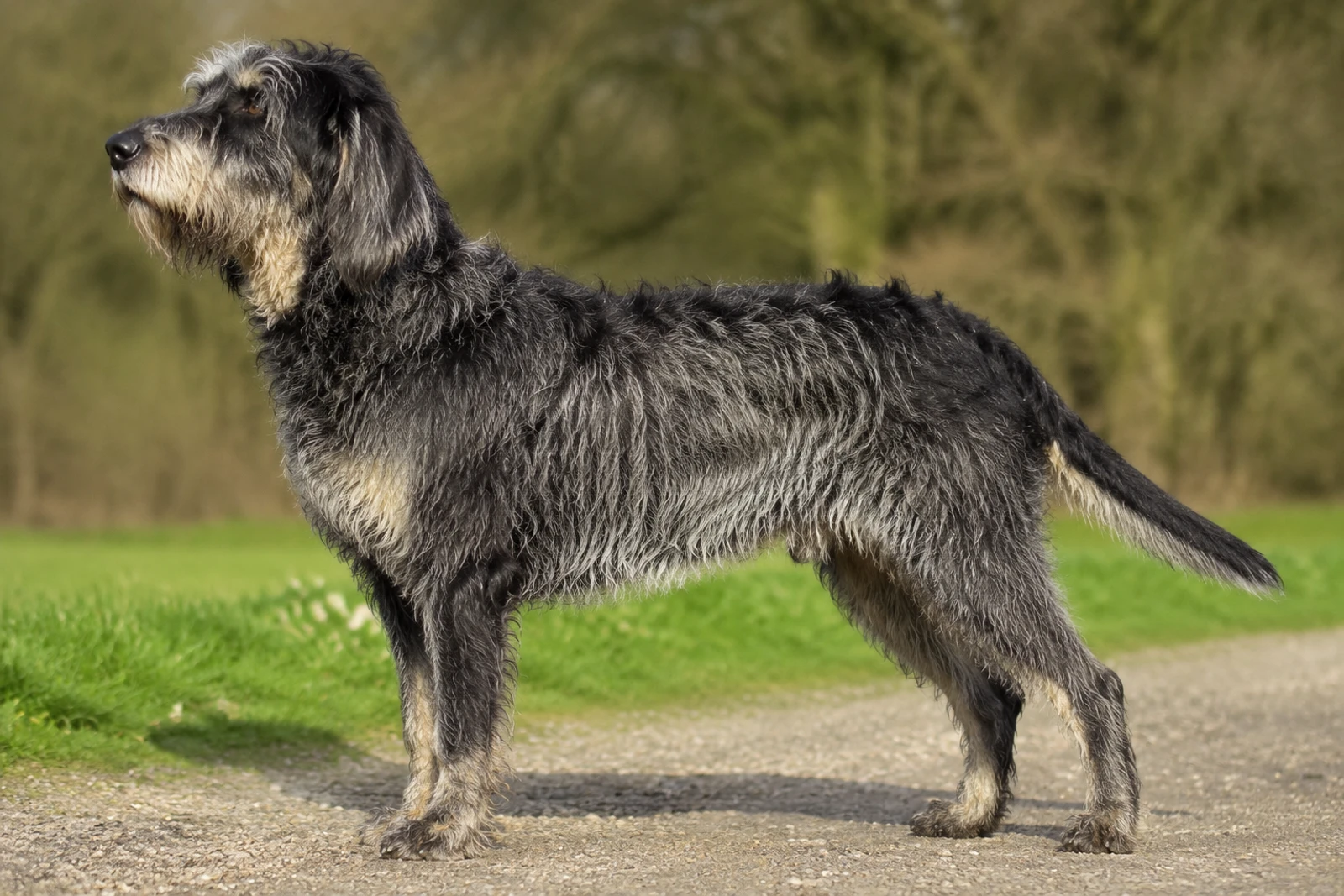
The Griffon Nivernais is a rare French scenthound that thrives with active, experienced owners who can provide firm, patient training and ample daily exercise. This rugged, medium-to-large breed is best suited for rural or suburban homes with securely fenced yards where it can satisfy its strong hunting instincts. Affectionate and loyal to family, it forms deep bonds but may be reserved with strangers. Not ideal for first-time owners or apartment living, this independent hound excels in tracking and makes a devoted companion for those who appreciate its spirited, tenacious nature.
At a glance
- Size
- Large
- Height
- 21–24 in
- Weight
- 51–55 lb
- Life span
- 12–15 years
- Coat colors
- fawn with black overlay, wolf-grey, badger-grey, charcoal
- Coat type
- rough, wiry, medium-length double coat
- Origin
- France
How much does a Griffon Nivernais cost?
Adopt / rescue
$75–$400
Usually includes spay/neuter, first shots, and a microchip.
Buy from a breeder
$700–$2,000
From a reputable, health-testing breeder.
Approximate USD. Prices vary widely by region, breeder, pedigree, age, and coat colour — adopting is the lower-cost and recommended route. Avoid suspiciously cheap “breeders”; they’re often puppy mills.
Estimate the full cost of a Griffon Nivernais →Want the ongoing number? Estimate the monthly food bill for a Griffon Nivernais with our dog food cost calculator.
Griffon Nivernais photos
Views
Front, side, rear and top — the full silhouette.Poses
How the breed sits, lies, moves and plays.Puppy to senior
The breed across its whole life.Expressions
The breed’s range of moods.Close-up details
Eyes, ears, nose, paws, tail and coat.Coat colors
The breed’s recognized colors.Click any photo to enlarge. We show the Griffon Nivernais from every angle — three views, poses, life stages, expressions, close-ups, coat and colors.
Appearance & size
A Griffon Nivernais looks like he just walked out of a thicket — and he probably did. The coat is the first thing you notice: shaggy, rough, and entirely unpolished, exactly what you’d expect from an ancient French scenthound built to hunt wild boar all day in nasty cover.
Build and frame
This is a large hound, but it’s a racy large, not a heavy one. Males stand 22–24 inches at the shoulder, females a touch smaller, with an adult weight of 51–55 pounds. The body is slightly longer than tall, giving the dog a stretched rectangular silhouette that favors endurance over brute power. The chest drops to elbow level, the ribs are well sprung, and the back stays firm and level. Despite the sturdy bone, a Griffon Nivernais in working condition feels lean and athletic — you can slip your fingers across the ribs without pressing.
Coat and color
The double coat is the breed’s trademark. The outer layer is dense, hard, and wiry — never woolly or curled — while the undercoat is fine and thick enough to turn aside weather. Run your hand against the grain and it feels like rough straw. The classic color is a deep golden fawn with a heavy black overlay, which creates a grizzled, wolf-gray effect across the back, neck, and top of the tail. This “charbonné” pattern leaves the lower legs, undersides, and much of the face a warmer fawn. A dark mask around the eyes and muzzle is typical, along with small white markings: a narrow chest star, a few white toes. No piebalds or large white patches here — the breed stays solid and earthy.
Head and expression
From the front, the head reads as rectangular and workmanlike. The skull is slightly domed, the muzzle long and square. Low-set, drooping ears hang in gentle folds, covered with shorter, softer hair. Bushy eyebrows shade the eyes without hiding them, and a full beard and moustache give the whole face a rough, kind-of-rumpled wisdom. The eyes are dark brown, oval, and set well apart — they should look alert and calm, never hard. The nose is black and broad, built for scenting.
In profile, the topline stays level from withers to croup, the tuck-up is moderate, and the tail emerges thick at the base, tapering gradually; it’s carried proudly like a saber, but not curled over the back. From the rear, the hindquarters are muscular and straight, with good angulation and no cowhocks, the rough coat falling evenly over the thighs.
Everything about this dog’s appearance says “all-weather working hound.” The coat shrugs off rain and brambles, the build covers ground without tiring, and the expression adds a dose of good-natured stubbornness that you’ll come to recognize at home.
History & origin
The Griffon Nivernais goes back about 800 years, making it one of France’s oldest hunting breeds. Its story starts in the 1200s near Paris, where a rough-coated grey hound earned a place in royal kennels. King Louis IX — later Saint Louis — kept packs of these dogs, then called the Chien Gris de Saint-Louis, for coursing wolves and wild boar in the thick forests of Île-de-France. They were never blazing-fast sprinters; instead, they relied on deep stamina, an exceptional cold nose that sorted old trails, and a dense, thorn-resistant coat that let them plunge into the heaviest cover.
As France’s forests shrank and wolf populations crashed, the breed’s role shifted. Descendants of the grey hounds migrated to the Nivernais region in central France, where hunters bred them down to a slightly more compact frame and used them on smaller game like hare and rabbit. This line became known as the Nivernais Long-Haired Hound. For centuries, it remained a fixture of local boar and roe-deer hunts, but its numbers were never large. The French Revolution dealt a brutal blow when aristocratic kennels were dispersed, and both World Wars nearly finished what was left.
What stands today is a deliberate reconstruction. In the early 20th century and again after 1945, a handful of breeders scoured rural areas for surviving specimens. They crossed the remnant dogs with other shaggy scenthounds — notably the Otterhound and the Grand Griffon Vendéen — to restore the rugged coat, the keen tracking drive, and the distinctive grey-and-badger coloration. The modern dog is taller than some of its 19th-century forebears, but every physical trait and working instinct is a throwback to that original medieval pack.
The breed remains rare. You’ll still spot Griffon Nivernais working in boar packs across the French countryside, but outside Europe they’re barely known. Responsible breeders in North America only produce a few litters each decade, treating the bloodline as a piece of living history rather than a commercial prospect.
Temperament & personality
The Griffon Nivernais is a calm, brave pack hound who saves his real firepower for the outdoors. Inside, a 51–55 lb dog standing 21–24 inches at the shoulder can fold himself into a surprisingly compact nap spot, often content after his needs are met. But that quiet demeanor masks a famously stubborn mind. If his nose locks onto a scent, your recall command may as well be a whisper in a hurricane. His 12–15 year lifespan means you have plenty of time to negotiate — and you will.
Affection runs deep, but it's delivered on his terms. He leans toward independent rather than clingy, greeting you with a relaxed, soft-eyed wag and then settling nearby, not on top of you. Respectful, consistent engagement is the only currency he accepts. Bully him with harsh corrections and he’ll simply dig in harder. Work with his strong will using treats and scent-based rewards, and you build a partner who willingly checks in even when his ears suddenly become decorative flaps.
This is a nose on four legs, and that reality shapes every quirk.
- An hour-long walk where he can methodically dissect every mailbox, bush, and fire hydrant is far more satisfying than a brisk run around the block. He needs to snorkel through scents, not just burn off energy.
- Urine marking on walks is a feature, not a bug. He’s depositing scent-based spatial notes he’ll recognize later, so yanking him away mid-sniff is like slamming a book shut while he's reading.
- Rolling in foul, stinky things — dead worms, rotted compost, whatever horror he uncovers — is practically a hobby. Theories range from masking his own scent to pure perfume enjoyment, but the practical takeaway is you’ll keep wet wipes in the car.
- His bay carries. When he trees a scent in the backyard or hears an unfamiliar car, the deep, rolling voice alerts the whole block. It’s watchdog enthusiasm, not guard-dog grit; he’s more likely to announce trouble and go back to sunbathing.
Household life with the Nivernais requires a clear understanding of his scent logic. Because he defines “home” by the family’s smell, rooms that carry fewer of your scents may become tempting indoor marking spots. A single forgotten accident can act as a blinking “bathroom” sign if you don’t erase it completely with an enzymatic cleaner. The simplest fix: reward outdoor elimination instantly with a high-value treat, every single time. He’ll get the message much faster than with punishment.
With other dogs, his pack roots show — he’s usually sociable and easy. Small pets like cats or rabbits, though, often get reclassified as prey once his nose locks on. Kids can do fine if taught one iron rule: never approach him while he’s eating. Food-bowl interruptions can provoke resource guarding, and a stiff body, hard stare, and forward-leaning posture are his way of saying back off now. A loose, wiggly body and soft eyes, on the other hand, mean he’s in his calm, content zone and safe to love on.
He’s not a beginner’s dog. The combination of selective hearing, scent obsession, and stubborn independence can exhaust a novice without a sense of humor. But for an owner who embraces the nose and provides daily, nose-first exercise — and who knows exactly when to reward and when to simply laugh — the Griffon Nivernais settles in as a steady, quiet housemate with a singular passion.
Good with kids, dogs & other pets
The Griffon Nivernais has a patient, non-aggressive nature that can make him a steady buddy for older, respectful kids. At 51–55 pounds and standing up to 24 inches, he’s a lot of lanky enthusiasm — a wiggly body and a hard tail that can clear a coffee table or accidentally bowl over a toddler. So supervise closely around small children, not because the dog means any harm, but because his size and joy don’t come with a built-in pause button. Teach children to handle him gently and give him space when he eats or rests, and you’ll see the tolerant, affectionate side of the breed.
With other dogs, much depends on early social experiences. Raise a Griffon puppy alongside another dog and they typically form a solid pack bond. Introduce an unfamiliar adult dog, and you’ll need patience. The breed can be reserved and a little slow to warm up, not out of aggression but out of sensitivity. Crammed into a dog park without a gradual, positive introduction, he may shut down or react poorly. The critical socialization window slams shut around 12–16 weeks, so expose a puppy to varied friendly dogs, people, and environments before then. For an adult rescue, skip forced greetings. If he’s content with just his people, that’s fine — don’t manufacture dog friends he doesn’t need.
Cats and small pets are where the hound brain takes over. Bred to trail game across the French countryside, a Griffon Nivernais sees a fleeing rabbit or a scurrying hamster as a job to finish. Some individuals can learn to live peaceably with a household cat if they’re raised together from puppyhood and the cat stands its ground. But a fluttering pet bird, a free-roaming guinea pig, or the neighbor’s outdoor cat are never a safe gamble. Keep small animals in secure, separate quarters and don’t leave them loose when the dog is around.
The takeaway: start socialization as early as you can — before 16 weeks — with gentle, consistent exposure to children, other dogs, and any cat you expect him to accept. This breed craves companionship and unravels when left isolated for long stretches. An under-socialized, lonely Griffon can tip into fear-based reactivity or distress that’s tough to undo later.
Trainability & intelligence
The Griffon Nivernais gets a 2 out of 5 on most trainability scales — not because he lacks intelligence, but because he’s a scenthound wired to work without human micromanagement. He’s a problem solver, not a people pleaser. That nose-driven independence that made him a reliable boar hunter in the French countryside is the same thing that makes him cheerfully ignore your sit command when a rabbit just darted under the neighbor’s shed.
Motivation is all about what he values: a chunk of hot dog, a squeaky toy, or the chance to follow an interesting scent trail. His prey drive can drown out a treat in a heartbeat, so don’t mistake his selective hearing for stubbornness. It’s genetics in action.
Recall is an uphill project. Many Griffon Nivernais never become reliable off-leash in unfenced spaces. Even a dog with weeks of positive training may blow past you in a flash of fur if a deer breaks from cover. That’s not disobedience — it’s deep instinct. Management (long lines, secure fencing) is your friend while you build a foundation.
The training approach that actually works leans hard on positive reinforcement, short sessions, and sky-high consistency. Harsh corrections and punishment-based methods backfire badly; they erode trust fast and can turn a confident hound into a hand-shy, anxious dog. Work with his brain, not against it.
- Start from the moment your puppy comes home, taking full advantage of the 3–14 week window for socialization.
- Trickle-feed new experiences: kids, men in hats, umbrellas, clanging metal, different flooring. Every calm encounter paired with a treat builds a dog who doesn’t default to fear or reactivity with strangers.
- Teach what you want (a quick "touch," a solid "drop it," a voluntary check-in) with high-value rewards and zero yelling. Keep training games to 5 minutes so he doesn’t tune you out.
A Griffon Nivernais who trusts you will choose to cooperate because it works for him. Expecting a flashy obedience heel will leave you both frustrated. Aim for the skills that keep him safe — a reliable "come" inside the house, a firm "leave it," and a bombproof "wait" at doors — and you’ll have a partnership that both of you enjoy.
Exercise & energy needs
A Griffon Nivernais needs two solid 60-minute exercise sessions each day—anything less, and you’ll wind up with a frustrated, vocal dog who invents his own activity. Bred to trail game for hours over rugged French terrain, this scenthound runs on endurance, not sprints. A leash walk around the neighborhood barely raises his heart rate; he requires off-leash running, steep hikes, or a hard workout alongside a bike to truly burn his fuel.
Break the two hours into a morning and an evening block. Splitting the workload matches the breed’s natural hunt rhythm—long stretches of steady movement punctuated by intense sniffing—and protects developing joints, especially during the first 18 months before growth plates close. Don’t push through summer heat. These dogs will keep going even when they should stop, so watch for heavy panting and adjust timing accordingly.
Mental stimulation is non-negotiable
A Griffon Nivernais lives by his nose. Physical exercise alone won’t settle his brain. Turn mealtime into a scent game: scatter kibble across the yard, stuff a puzzle toy, or hide a stinky treat inside a cardboard box full of paper. Formal nose work or tracking classes are even better and leave him genuinely satisfied. Skip brain work, and you’ll still have a restless dog even after a two-hour run.
Activities that deliver
- Trail running and off-leash hiking on safe, secure ground where he can range and sniff
- Canicross or bikejoring once joints are mature and directional commands are solid
- Long decompression walks where you follow his nose, not a preset route
- Scent detection games indoors or outdoors, starting with simple “find it” cues
Avoid pounding pavement relentlessly, particularly before full maturity, to minimize wear on growing joints. A satisfied Griffon Nivernais has used both body and nose for a couple of hours. Skip that daily ritual, and you’ll quickly discover why these dogs can be as persistent as they are athletic.
Grooming & coat care
The Griffon Nivernais wears a rough, double coat that looks like it just came back from a briar patch — and that’s exactly how it’s supposed to be. The outer hairs are harsh and bristly, while a dense undercoat provides insulation. This combination naturally repels water and dirt, making it one of the more low-maintenance coats in the scenthound world. But low-maintenance doesn’t mean no-maintenance.
Aim for a solid brush-out every week with a metal slicker brush (the kind with rounded pins) to yank out loose undercoat and any debris they’ve collected. During spring and fall, when the undercoat really lets go, you’ll need to swap that weekly session for a daily 5–10 minute pass to keep tumbleweeds of hair from taking over your floors. A stainless steel comb works well around the legs, beard, and ears where tangles like to hide. Skip the pig-bristle brush — it’s made for polishing short, smooth coats, not this rough-and-tumble texture.
Bathing is strictly an “as-needed” event. Two or three times a year is plenty unless your dog has rolled in something truly foul. Over-washing softens the harsh coat and strips the oils that make it weather-resistant. When you do bathe, use a gentle, sulfate-free dog shampoo and towel-dry vigorously to help the hair stand back up.
There’s no elaborate clipping schedule here. A quick trim of the hair between the paw pads and maybe a neatening of the hocks is all most pet owners bother with. If you want to preserve that signature wiry feel, hand-stripping a few times a year by a groomer who knows the breed keeps the coat correct — but plenty of families just let it go shaggy, and the dog doesn’t mind one bit.
Ears are the one area that demands regular attention. Those long, floppy ears trap moisture and dirt, so flip them over once a week, wipe out any gunk with a vet-approved cleaner, and check for redness or odors. Nails need clipping every 3–4 weeks; if you hear them clicking on hard floors, you’re overdue. Teeth benefit from brushing several times a week to keep that 12–15 year life span healthier.
The coat also doubles as Velcro for burrs, stickers, and foxtails after a hike. A thorough post-adventure check — along with a quick slicker pass — prevents mats and skin irritations that can boil up under all that fuzz. The same outdoor time that makes them happy promotes healthy coat turnover, so you’re killing two birds with one walk.
Shedding & allergies
The Griffon Nivernais sheds more than you might guess from that rough, rustic coat. That shaggy outer layer and softer undercoat do a solid job guarding against brambles, but they also drop a steady dusting of hair all year long. Twice a year, usually in spring and fall, you’ll deal with a full-on seasonal blowout — clumps of undercoat coming out fast enough to fill a brush in minutes. During those weeks, daily or every-other-day brushing keeps the tumbleweeds from taking over your floors. The rest of the year, a good going-over two or three times a week handles the baseline shed.
Drool isn’t extreme, but it’s part of the package. These are scenthounds, and their loose lips mean you’ll find a wet spot on your pants after a greeting, or a small puddle under the water bowl. It’s manageable — just not zero.
When it comes to allergies, let’s be direct: no dog is hypoallergenic, and the Griffon Nivernais is not an exception. Dander and saliva proteins are what set most people off, and this breed produces both. Some allergy sufferers report fewer issues with wiry coats, but you can’t bank on it. If anyone in your home has moderate or severe allergies, spend real time in a home with adult Griffons before you commit. You’ll know within an hour whether your sinuses can handle the reality.
Diet & nutrition
Most Griffons will treat the food bowl like a bonus squirrel. This is a breed with serious food motivation, so the biggest nutrition mistake you can make is letting him decide when he’s eaten enough. Carrying extra weight on a 51–55 pound frame isn’t just a cosmetic issue — it adds stress to joints and can shorten a working scent hound’s long, active years. Keep him lean with measured portions, not free-feeding.
Adult feeding and portion control
For a healthy 51–55 lb adult, split roughly 2½ to 3½ cups of high-quality dry food into two meals — morning and late afternoon. That range is a starting point. A dog who runs woodland scent trails for two hours needs more fuel than a weekend walker. Judge by body condition: you should feel ribs under a light cover of flesh, and he should have a visible waist from above. A food puzzle bowl is your friend here; it slows a gulper, adds mental work, and makes a modest meal feel more satisfying.
Puppy and growth stages
- Up to 4 months: four evenly spaced meals a day.
- 4–6 months: drop to three meals.
- After 6 months: switch to an adult-like two-meal schedule.
Introduce a new diet gradually over a week. Lightly cooked, puréed meats, fish, fruits, and veggies work well alongside a premium commercial puppy formula. Some raw chicken wings can come in around 12 weeks, under direct supervision and only if the pup chews properly.
Senior and tooth-poor dogs
Older Griffons may slow down and pack on pounds even as their appetite stays sharp. Switch to smaller, more frequent meals and watch the scale. If teeth are missing or tender, purée their meals — it helps nutrient absorption when chewing is less effective. There’s no real reason to slash protein in a healthy senior; just adjust total calories downward as activity tapers.
What to put in the bowl
Aim for a mix that leans hard into species-appropriate stuff: roughly 60% raw and cooked meats, 20–30% fruits and vegetables, and the rest from things like eggs, plain yogurt, or cooked grains. Pearl barley adds digestible fiber; white rice is an easy, bland option for an upset stomach. Canned fish (water-packed, no salt) and steamed veg make a quick topper you can batch-cook and keep in the fridge. Skip the holiday fatty scraps — a single rich meal can trigger pancreatitis in even the toughest dog.
Serve any leftovers in his own bowl, not from the table. It keeps begging behaviors from taking root and reinforces exactly who controls the kitchen.
Health & lifespan
A Griffon Nivernais typically lives 12 to 15 years, and a lot of that longevity hinges on keeping a few breed-specific quirks from turning into chronic problems. These dogs can be prone to skin and eye conditions, so you’ll want a vet who knows the breed and a breeder who screens for hereditary issues before they hand over a puppy.
Skin trouble often shows up as allergies, hot spots, or recurrent dermatitis. The coarse, double coat does a decent job protecting against weather, but if you’re not brushing out dead hair weekly or if the dog is swimming a lot, moisture gets trapped and a staph infection can follow. Feeding a high-quality diet without common fillers helps, and many owners find that adding omega-3 fatty acids keeps the coat less reactive.
Eyes are the other hotspot. Entropion (where the eyelid rolls inward) and progressive retinal atrophy pop up in the breed now and then. A responsible breeder will have parent dogs certified clear by a veterinary ophthalmologist. At home, watch for squinting, excessive tearing, or a cloudy appearance — and bring those up at your annual checkup instead of waiting.
Weight management is non-negotiable. A full-grown Griffon runs 21 to 24 inches at the shoulder and should stay between 51 and 55 pounds. Even an extra five pounds puts unnecessary strain on joints, especially if the dog is tearing through brambles on a hunt or tackling rough terrain. These are food-motivated dogs, so measure meals and ration treats.
Heartworm prevention matters just as much. Give a monthly preventive during mosquito season and for one month after your first frost — skipping it because you live in the city doesn’t make the dog safe; mosquitoes breed in any standing water.
Don’t underestimate the role of steady socialization. A Griffon Nivernais left in the yard with nothing to do can tip into anxiety-driven barking or pacing, and chronic stress lowers immune function. Make vet visits a neutral experience from puppyhood, and keep the dog confident around people and other animals.
Living environment
Yard and space
A house with a securely fenced yard is the natural setup for this dog — apartment living is a rough match. Your Griffon Nivernais is a scenthound built to course through dense cover for hours, so a cramped space with no outdoor outlet sets you up for frustration on both ends of the leash. If you do try an apartment, plan on a rigid schedule of long outdoor excursions and still expect that the neighbor relationship will be tested by the hound’s voice. The yard itself needs a tall, dig-proof fence (think six feet minimum with buried mesh along the base). His nose will short-circuit any recall when a scent trail cuts across the property line, and a four-foot picket fence just looks like a suggestion.
Climate tolerance
That rough, wiry double coat was made for the damp, cold forests of France. He’ll join you on a snowy hike with genuine enthusiasm when other dogs are shivering at the door — cold rain, frost, and mud simply don’t faze him. The flip side is heat. That same dense insulation turns a warm afternoon into a slog. Keep hard exercise to early mornings or evenings in summer, and always carry water even if you’re just out for a sniff walk. He tolerates cold beautifully, but a midday July run can be dangerous.
Noise and barking
Be direct with yourself on this one: the Griffon Nivernais bays, not barks. It’s a deep, rolling, musical howl that carried across the French countryside to communicate with hunters miles away. In the confines of a duplex, condo, or tight suburban lot, that sound will earn you notes on the door. Even a house with a yard isn’t immune — boredom or a squirrel on the fence can trigger a full performance. You can shape when he vocalizes with training, but you won’t erase the instinct; this is a breed that announces life with theatrical flair.
Tolerance for being left alone
He bonds tightly to his people and was never meant to spend hours alone. Left too long by himself, a Griffon Nivernais can spiral into howling, digging, or chewing that has nothing to do with spite and everything to do with worry. A household where someone is home most of the day, or a setup that includes a reliable dog walker or daycare, prevents that spiral. Start puppyhood with short, positive departures to build independence, but know that this is a dog who genuinely needs company. Stack that with his daily exercise requirement: aim for 60–90 minutes of off-leash running, long sniff-heavy hikes, or vigorous play split into at least two sessions. Equal parts physical work and nose-driven mental games — bury a food-stuffed toy, hide treats in tall grass, work a puzzle in the yard — will do more to settle him indoors than any number of miles on a leash.
Who this breed suits
If you’re the kind of person who believes a walk is just a warm-up, the Griffon Nivernais might be your perfect match. This rare French scenthound was built to hunt wild boar through dense terrain all day, and that drive is still hard-wired. An ideal home has a large, securely fenced yard and owners who can offer at least an hour of hard running, sniffing games, or off-leash hiking—every single day. Without it, you’ll have a bored, loud, and destructively creative housemate.
The breed suits active singles or couples who want a rugged outdoor partner and understand hound independence. You won’t get a Velcro dog that hangs on your every command; you’ll get a clever problem-solver that may decide the scent trail is more interesting than your recall. First-time owners often find this frustrating. Experience with scenthounds or a willingness to work with a positive, patient trainer is a real asset. Families with older children who can handle a sturdy, 50-pound dog that plays rough work well—but small kids can get bowled over by that exuberant, wagging tail.
Think twice if you live in an apartment, have a cat or other small pets, or value a quiet house. The Griffon Nivernais has a booming bay that carries for blocks, and prey drive is deeply ingrained. Seniors seeking a calm lap dog should look elsewhere; at 12–15 years, these dogs need physical activity well into old age. They bond hard with their people but can be aloof with strangers, so early socialization is non-negotiable. If you’re ready to embrace the voice, the stamina, and the single-minded nose, you’ll have a loyal, entertaining companion that’s up for anything.
Cost of ownership
Buying a Griffon Nivernais almost always means getting on a breeder’s waiting list. These French scenthounds are rare in North America, so a puppy from health-tested parents typically costs $1,500 to $2,500, sometimes more if you need to ship from Europe. Adoption is a long shot but worth a look; a few breed-specific rescues may have adults.
Monthly expenses stack up faster than you might think for a 50‑pound dog. Budget for the obvious stuff first:
- Food: A high-energy, 51–55 lb hound eats 2½ to 3 cups of quality kibble a day. That works out to roughly $50–$70 a month. Raw or fresh diets push that higher.
- Grooming: The rough, wiry coat doesn’t mat, but it does need hand-stripping two or three times a year to keep texture and shed dead hair. A professional session runs $60–$100 each time, or you can learn to do it yourself. Between sessions, a weekly brush and the occasional nail trim are all it takes. Spread the pro visits across the year, and grooming averages $15–$25 a month.
- Routine vet & prevention: Annual checkups, vaccinations, heartworm testing, and monthly flea/tick plus heartworm preventives come to around $400–$500 a year for a large dog with a 12–15 year lifespan. That’s $35–$45 a month in normal years, though puppy shots and neuter surgery in year one are extra.
- Insurance: Scent hounds can be prone to ear infections, bloat, and hip dysplasia. A comprehensive policy for a medium-large breed runs roughly $35–$55 a month. If you skip insurance, build a dedicated emergency fund instead — vet bills for a bloat surgery alone can hit several thousand dollars overnight.
Add in the less obvious recurring costs: a sturdy harness and long-line for nose work, enzyme cleaner for potty accidents, replacement chew items, and maybe a few training classes for a hound whose ears turn off when the nose turns on. Most owners land somewhere between $120 and $200 a month for a healthy adult dog, not counting the one-time outlay for a crate, bowls, and a coat that can handle wet bramble runs in November.
Choosing a Griffon Nivernais
Rare Breed, Real Patience
The Griffon Nivernais is uncommon in the United States, so bringing one home usually means getting on a breeder’s waitlist — sometimes months in advance. Reputable breeders are often involved in French hound clubs or hunt trials; their focus is preserving working ability, not churning out pets. Temperament matters more than convenience, so expect real conversations about how you live.
Responsible Breeder vs. Rescue
Purebred Griffons in rescue are extremely scarce, but you can still reach out to breed-specific networks, import rescue coordinators, or national hound rescues. A rescued adult can be a great fit if you’re prepared for a dog that may need patient house-training and a crash course in leashed walks — this is a nose-first hound that wasn’t bred for off-leash suburban living.
Most people, however, will buy from a breeder. A solid breeder raises pups inside the home, not in a kennel run, and introduces them to household noises, visitors, and early outdoor exploration on a long line. They should be able to produce health certificates in seconds, not with a delay while they “find the paperwork.”
Health Clearances to Ask For
This is a generally robust breed with a 12–15 year lifespan, but large scenthounds carry a few hereditary risks. Ask for documentation on both parents:
- Hip dysplasia: OFA or PennHIP evaluation, with a score of Fair or better.
- Elbow dysplasia: OFA evaluation.
- Eye exam: A recent CERF or OFA eye clearance, because some lines can show progressive retinal atrophy or entropion.
- Thyroid panel: Autoimmune thyroiditis occasionally pops up; a normal panel within the last year is a plus.
Beyond paperwork, ask how the parents’ ears are managed. Chronic ear infections are common in drop-eared breeds that hunt wet cover, so a breeder who can talk about cleaning routines and ear health is doing it right.
Red Flags That Send You Walking
Walk away if a breeder says health testing “isn’t needed because the breed is healthy” or has no proof of hip or elbow clearances. Never buy from someone selling a puppy younger than 8 weeks. Other dealbreakers: multiple litters on the ground at once, no written contract or health guarantee, refusing to let you meet at least one parent on-site (or via video call if you’re importing), or pressuring you to take “the last puppy” without a thorough conversation about your experience with driven hounds. Slick websites advertising “rare blue” or “royal” Griffons are pure marketing fluff.
Picking Your Puppy
A good breeder will match puppies to homes based on temperament tests conducted around 7 weeks, not on first-come, first-served color preference. You want a middle-of-the-road pup: curious enough to investigate new people, quick to recover from a startling noise, and not the one cowering behind the whelping box. The 51–55 pound adult frame starts to show in the knobby knees of an 8-week-old — look for clean movement and clear eyes without discharge. Even at this age, they’ll follow any interesting scent. If you can’t imagine keeping your counters clear and your leash hand ready for a determined pull, the independent streak in a Griffon Nivernais puppy will be a rough match.
Pros & cons
Pros
- Built for endurance, not a casual stroll. These dogs were made to trail boar over miles of rough French terrain. A quick walk around the block won’t cut it—expect to provide a solid hour of hard running, biking, or off-leash hiking daily.
- Pack-friendly temperament. Bred to work in packs, they typically get along well with other dogs. If you have a multi-dog household, a Griffon Nivernais often slots right in.
- Low-shedding coat with a catch. The wiry double coat traps dead hair, so you won’t find tumbleweeds on the furniture. The trade-off: weekly brushing and occasional hand-stripping to prevent mats.
- Long lifespan for a big dog. 12–15 years is a real bonus at 51–55 pounds. Responsible breeders screen for hip and elbow dysplasia, but inherited issues are less common than in many large breeds.
- Independent without being aloof. They bond closely with their people but won’t shadow you every second. This is a thinking dog that enjoys your company without demanding constant attention.
Cons
- Prey drive on overdrive. A whiff of deer or rabbit and their ears turn off. Off-leash reliability is hard-won, and even then, a secure, 6-foot fence is mandatory—they’ll scale or dig under anything flimsy.
- Loud enough to raise the dead. Their deep, rolling bay is a core part of the breed, not a quirk you can train away. Close neighbors or thin apartment walls are a fast path to complaints.
- Stubborn streak that tests patience. This isn’t a biddable retriever. Training requires consistency, creativity, and a thick skin. They’ll flat-out ignore a command if they see no point in it, so novice owners often feel outmatched.
- A full-time exercise commitment. A bored Nivernais invents its own jobs—usually digging, chewing, or howling. Without that daily hard run or focused scent work, your yard and your sanity both take a hit.
- Hard to get and slow to grow up. Few breeders exist, so waitlists are common. Puppies stay goofy, mouthy adolescents for two full years, demanding more patience than typical breeds.
Similar breeds & alternatives
If the Griffon Nivernais’s rough coat and determined scenthound brain fit your life but you’re weighing other options, a handful of French breeds offer similar instincts in slightly different packages — and one or two bigger alternatives push the independent-nose personality into a much larger frame.
Briquet Griffon Vendéen
Think of the Briquet as a slightly more compact, square-built cousin. Both breeds share a wiry, double coat and that baying voice, but the Briquet stands 20–22 inches and carries 48–53 pounds, giving it a bit less leg under the chest. The Nivernais tends to be longer-backed and rangier, with a narrower head and a reputation for a more independent, sometimes stubborn streak. Exercise needs are still serious — a solid hour of off-leash running in a secure area, not a couple of laps around the block — but the Briquet often shows a touch more biddability when you’re working on recall, though neither will ever be a herding dog.
Porcelaine
If the rough coat feels like too much grooming, the Porcelaine swaps it for a sleek, short white coat dotted with orange. Size runs almost dead even: 22–23 inches tall and 55–62 pounds, with a lean, elegant build that still covers ground fast. Temperament is social and typically a little softer than the Nivernais, but don’t mistake that for low energy — a bored Porcelaine will sing just as loudly and dig just as creatively. The key difference is coat maintenance (wipe-and-go versus weekly brushing and the occasional hand-strip for the Nivernais) and a slightly less rugged overall presence.
Grand Basset Griffon Vendéen (GBGV)
If you love the tousled, rustic look but need a dog with less vertical ambition, the GBGV drops the height to 15–17 inches while keeping a similar weight range (40–45 pounds). That low-slung body means you get the same nose and pack-hunting mentality in a shorter-legged hound that’s easier to contain in a typical suburban yard, though a securely fenced space is still non-negotiable. The Nivernais is built to trot across large, open territories; the GBGV is just as stubborn and needs serious mental work, but its physical exercise demands are a shade lower purely because it’s not covering as many miles per stride.
Otterhound
On the other end of the scale, the Otterhound takes the shaggy coat, bay, and independent scenthound personality and blows them up to 24–27 inches and 65–115 pounds. You’ll recognize the same “I’ll check in when I’m done” attitude and comical, friendly nature around the family, but the size alone means this is a bigger feeding bill, a stronger pull on leash, and a deeper bark. The Nivernais is the more manageable package for someone who wants a pack-hunting companion without the massive frame. If you’re drawn to the rough-coated French hound specifically, the Briquet remains the closest direct swap; the Porcelaine gives you the same drive with a wash-and-wear coat.
Fun facts
- Originated in the Nivernais region of France, dating back to the 1200s.
- Nearly extinct after World War II, the breed was revived by dedicated French breeders.
- Its rugged, tousled coat gives it the 'griffon' name, meaning rough or hairy.
- Historically used to hunt wild boar and other large game in packs.
Frequently asked questions
- Is the Griffon Nivernais good with children?
- Generally, the Griffon Nivernais can be friendly and patient with children, especially when raised together. However, due to their large size and energetic nature, interactions should always be supervised to prevent accidental knocks.
- How much exercise does a Griffon Nivernais need?
- This breed has high exercise requirements, typically needing at least an hour of vigorous activity each day. They thrive on outdoor adventures like long walks or scent games, and without enough exercise, they may become restless or destructive.
- Does the Griffon Nivernais shed a lot?
- Shedding is moderate; their harsh, wiry coat tends to trap loose hairs rather than releasing them everywhere. A weekly brushing helps remove dead hair and keeps shedding manageable.
- Is the Griffon Nivernais a good apartment dog?
- Not ideally; they are large, active hounds that do best in homes with a securely fenced yard. While they can adapt if given sufficient daily exercise, apartment living may be challenging due to their size and potential for barking.
- Are Griffon Nivernais dogs easy to train?
- They are intelligent but independent thinkers, which can make training a challenge for novice owners. Consistent, positive reinforcement from an early age is key, though they may still have a stubborn streak.
Tools & calculators for Griffon Nivernais owners
Quick estimates tailored to Griffon Nivernaiss — pre-filled with this breed’s size where it matters.
Articles & stories about the Griffon Nivernais
Sources & standards
This profile follows recognized breed standards from the American Kennel Club (AKC) and the Fédération Cynologique Internationale (FCI), along with established veterinary and breed-club guidance. These describe general breed tendencies — every dog is an individual.