

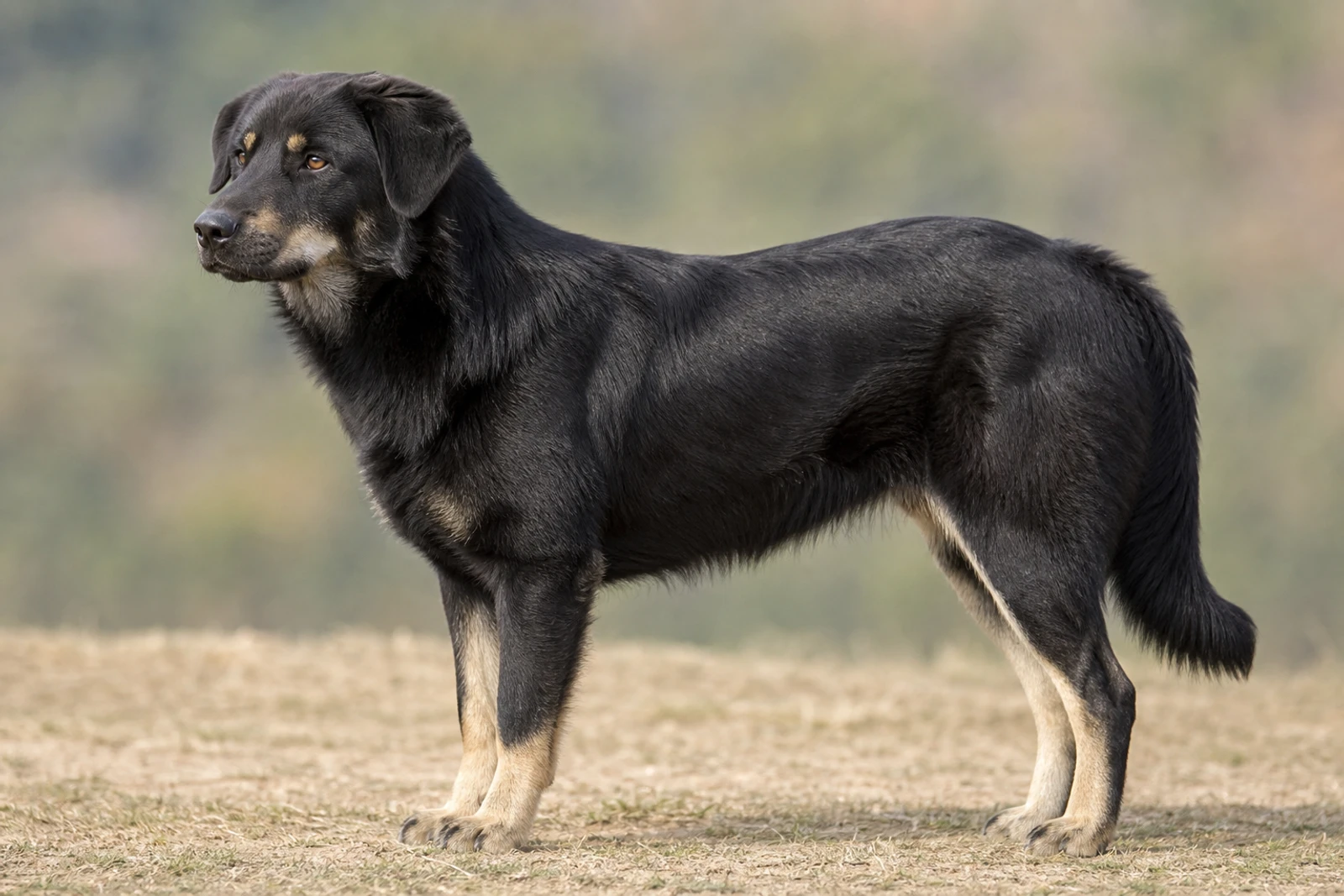
The Himalayan Sheepdog, also known as the Bhote Kukur, is a rare and ancient breed from the Himalayan region. Bred as a livestock guardian, this powerful yet agile dog is fiercely loyal and protective of its family. With a calm and independent nature, it is best suited for experienced owners who can provide consistent training and ample space. Its thick, weather-resistant coat requires regular grooming to manage shedding. While aloof with strangers, the Himalayan Sheepdog forms deep bonds with its human pack and thrives in a home where it has a job to do, making it an ideal choice for rural or active households.
At a glance
- Size
- Large
- Height
- 20–25 in
- Weight
- 51–60 lb
- Life span
- 10–11 years
- Coat colors
- Black, Black and Tan, Red, Sable, White
- Coat type
- Long, dense double coat
How much does a Himalayan Sheepdog cost?
Adopt / rescue
$75–$400
Usually includes spay/neuter, first shots, and a microchip.
Buy from a breeder
$700–$2,000
From a reputable, health-testing breeder.
Approximate USD. Prices vary widely by region, breeder, pedigree, age, and coat colour — adopting is the lower-cost and recommended route. Avoid suspiciously cheap “breeders”; they’re often puppy mills.
Estimate the full cost of a Himalayan Sheepdog →Want the ongoing number? Estimate the monthly food bill for a Himalayan Sheepdog with our dog food cost calculator.
Himalayan Sheepdog photos
Views
Front, side, rear and top — the full silhouette.Poses
How the breed sits, lies, moves and plays.Puppy to senior
The breed across its whole life.Expressions
The breed’s range of moods.Close-up details
Eyes, ears, nose, paws, tail and coat.Coat colors
The breed’s recognized colors.Click any photo to enlarge. We show the Himalayan Sheepdog from every angle — three views, poses, life stages, expressions, close-ups, coat and colors.
Appearance & size
A Himalayan Sheepdog looks like it was carved out of the mountain itself — sturdy, no-frills, and ready to move. The frame is squarely built, with a deep chest, strong bone, and a level topline that doesn’t dip or roach when the dog is standing at ease. This is a working animal, not a show dog, and every part of its body suggests efficiency over flash.
Size and build
At 20 to 25 inches at the shoulder and 51 to 60 pounds, these dogs fall into that deceptive “large medium” category. They’re nowhere near the bulk of a Tibetan Mastiff, but their thick coat and dense musculature often make them look 10 pounds heavier than the scale says. You want a dog that can handle sheer slopes and thin air without burning out — that’s what this weight class delivers. Legs are moderately long and straight, with solid, compact feet built for gripping rock. The body is slightly longer than tall, giving the stride a ground-covering, easy lope rather than a choppy trot.
Coat and color
The coat is a double layer meant for raw weather. The outer guard hairs are coarse and straight, standing slightly off the body, while the undercoat is woolly and dense. It’s heaviest around the neck, where it forms a visible ruff — more pronounced in males — and on the back of the thighs and the tail, creating a flagged, plume-like look. You’ll typically see black with rich tan markings on the cheeks, over the eyes, on the chest, legs, and under the tail. Solid black and dark sable also pop up, and a small white star on the chest isn’t uncommon. This isn’t a breed with wide color variation; most breeders stick to the black-and-tan pattern because it’s historically typical.
Head and expression
From the front, the head is broad and wedge-shaped without being heavy. The skull is flat and wide between the ears, with a distinct stop. Muzzle length is about equal to the skull, strong but not blunted, and the lips are clean. Medium-sized pendant ears hang close to the head and frame a pair of almond-shaped, dark brown eyes. The expression reads as alert and watchful — not hard, but definitely not soft. You won’t see the loose, droopy jowls common in some mastiff types; this is a tighter, more athletic face.
Side and rear silhouette
From the side, the neck flows smoothly into a well-laid-back shoulder, the back is straight, and the croup slopes gently to a high-set tail. That tail is a signature piece: thick, well-furred, and carried in a loose curl or tight ring over the hip when the dog is moving or excited. The plume hangs down to the hock when relaxed. Rear angulation is moderate but functional, with broad, well-muscled thighs that power a strong drive. Viewed from behind, the hind legs stand parallel, and the tail’s thick brush hangs straight or curls to one side. You’ll see a dense, weatherproof coat that almost swallows the outline, making the dog look like a solid block of fur and muscle — exactly what you’d want bedding down in a shepherd’s camp at 12,000 feet.
History & origin
For as long as anyone in the high Himalayan villages can recall, these dogs have been there—working beside nomadic herders, not sitting in a kennel. The Himalayan Sheepdog developed as a true landrace, molded by the brutal altitude, thin air, and the constant threat of predators slipping down from the ridgeline. You won’t find a single founding year or a tidy origin story. Instead, the breed emerged over centuries among the Bhote, Lepcha, and other mountain communities across Nepal, northern India, Bhutan, and Tibet.
What these people needed was a single dog that could do two jobs exceptionally well: herd stubborn sheep and yaks across open, rocky terrain during the day, then turn into a fearless sentinel at night. A Himalayan Sheepdog had to read a flock’s subtle cues to move animals without scattering them, yet possess a jaw and nerve that would make a snow leopard think twice. That dual-purpose working life shaped the dog’s temperament—calm and deliberate on the move, explosively protective when the situation demanded it.
- The isolation of Himalayan trade routes meant the gene pool stayed remarkably pure. Caravans that crossed the high passes by the 1800s relied on these dogs as living alarms, and early British mountaineers noted their deep, echoing barks booming across valleys after dark. The herders fed them what they could spare—barley, buttermilk, scraps—so only the hardiest animals survived and bred. That’s the root of the breed’s legendary weatherproof coat, its 51–60 lb frame that’s lean enough to navigate cliffs but heavy enough to hold its ground, and its fiercely independent mind.
Well into the 20th century, roads and modern fencing barely touched many of the valleys where these dogs worked. While other breeds chased kennel club recognition, the Himalayan Sheepdog remained a practical tool. A handful of exports to the West came labeled as “Bhote Kukur” or “Himalayan Mastiff,” but no major registry formalized a standard. Today, you can still see them in the Annapurna and Mustang regions wearing a bright red wool collar—the shepherd’s way of keeping track of a dog against blinding snow. That collar isn’t a fashion statement; it’s a direct link to an ancient working contract. The breed’s survival still depends on people who understand that this dog needs a genuine job, not just a backyard. Without it, the intelligence honed over centuries can turn into skilled, relentless mischief.
Temperament & personality
This is a calm but fiercely serious flock guardian—not a casual pet, and definitely not a beginner’s dog. Himalayan Sheepdogs bond deeply with their own people and livestock, yet they’re naturally reserved with strangers and quick to assess threats. That independence makes them feel aloof, not cuddly; they show affection on their terms, often by simply staying close. Expect a confident, steady presence that watches everything without making a fuss—until a boundary is crossed.
-
Energy and drive: Moderate daily energy, but a deep need to patrol and monitor. A long, purposeful walk and off-leash roaming in a secure area works far better than mindless fetch. Without a flock to guard, they’ll often redefine “territory” by urine marking along fence lines—sniffing, depositing scent cues they later recognize, and re-asserting the perimeter. Ignore that drive and you’ll get anxiety-driven barking, digging, or pacing. Aim for a solid hour of outdoor engagement split across morning and evening.
-
Watchfulness and body language: These dogs rarely bark without reason, but they will alert you to anything out of place. Learn to read the signals: a forward lean usually means confidence and the intent to move toward trouble; a stiff body and direct stare often precedes aggression. A loose, soft-eyed shepherd with a relaxed tail is genuinely content. Lip licking, yawning, or turning the head away are calming signals—respect them and back off when you see them, especially during handling or training.
-
Strong will and training approach: They’re smart, but not biddable in a retriever sense. Force, harsh corrections, or nagging will harden their resistance. Instead, work with short, respectful sessions that give them a reason to cooperate. Reinforce good choices immediately—a treat right after outdoor elimination teaches house manners faster than any punishment for indoor accidents, because urine smells linger and cue repeat soiling. Use an enzymatic or vinegar-based cleaner (white and cider vinegar) to remove those scent maps entirely.
-
Household fit and quirks: With their own family, they’re typically gentle and patient, but large size (51–60 lb) and guarding instinct mean small children and visiting playmates need supervision and clear rules. Never interrupt this dog while eating—it can trigger food guarding. Teach kids to let him eat in peace. He’s not a dog-park regular; same-sex aggression and suspicion of unfamiliar dogs are common.
Chewing is a lifelong need, not just a puppy phase: adult dogs chew hard objects to keep jaws strong and teeth clean. Provide appropriate raw bones or tough rubber toys, and use a boiled citrus-peel spray to protect furniture. A homemade vinegar spray also neutralizes urine odors outdoors, which helps break the marking loop.
That habit of rolling in foul-smelling rot? It’s straight from his scavenger ancestry—some say it masks scent, others that it’s the dog equivalent of showing off a treasure find. Either way, it’s normal and not something you’ll train out entirely.
Structured routine, a clear job (even if it’s just watching the backyard), and steady, predictable leadership keep this breed steady. With those, you get a dog that’s as watchful and loyal as the mountain flocks he was bred to protect.
Good with kids, dogs & other pets
A well-raised Himalayan Sheepdog is patient and steady around children — not sharp or reactive, but watch the sheer physics of a 51–60 lb dog. Toddlers can get bowled over by a happy tail or a hip-check, so supervision with the under-five set isn’t optional; it’s daily practice. Teach kids to respect the dog’s space, and you’ll see the breed’s tolerant side shine. These dogs form tight bonds with their people and don’t do well parked outside or left alone for hours on end. That need for companionship cuts both ways: they’re far more settled in a home where someone is around, and they’ll mirror the emotional climate of the family.
With other dogs, the Himalayan Sheepdog is usually easygoing if they’ve been socialized early. The critical window slams shut around 14–16 weeks, so before that age a puppy needs calm, positive introductions to a variety of friendly dogs, people, places, and everyday sounds. Miss that window, and you might end up with an adult who is fearful, noise-sensitive, or overly aroused around unfamiliar dogs — and forced playdates with a worried adult backfire badly, ramping up stress instead of building confidence. If you’re bringing an adult rescue into the home, let the dog set the pace; some are happiest as an only dog with their person.
Cats and small pets are a live question that comes down to early exposure and individual prey drive. A Himalayan Sheepdog raised alongside cats from puppyhood often coexists matter-of-factly, but the breed’s herding lineage can awaken a chase instinct around fleeing animals. Introduce slowly, use baby gates or leashes for management, and never leave a new pairing unsupervised. Consistent, gentle socialization from 3 weeks onward — not just one class but a steady stream of neutral-to-positive encounters — is what turns a large, capable dog into a reliable household member who knows how to read the room.
Trainability & intelligence
The Himalayan Sheepdog is a thinker — bred to make independent decisions while guarding flocks on mountain slopes. That means training isn’t about breaking a dog’s will; it’s about building a relationship where the dog wants to work with you. You’ll see this dog learn a new cue in a handful of repetitions, but then you’ll also see him pause to decide whether he feels like complying. Treat that as a feature, not a bug: you’re dealing with a capable partner, not a push-button pet.
What motivates this breed
Food works, but the real currency is your approval and a sense of shared purpose. A quick, sincere “yes!” or a rough play session after a job well done often means more than a pocketful of kibble. Harsh corrections, yelling, or any kind of force corrode the trust you need. This dog has a long memory for unfair handling, and once that trust is cracked, reliable obedience goes out the window.
Start early, stay calm
Puppyhood sets the template. Between 8 and 16 weeks, pour your energy into positive socialization: let your pup meet people of different ages, walk on varied surfaces, hear household clatter, and see other animals at a comfortable distance. A poorly socialized Himalayan Sheepdog can tip from reserved into fear-based reactivity — especially given that 51–60 lb mass. You don’t want a stranger-danger meltdown on leash because the dog never learned that delivery trucks aren’t a threat.
The independence factor
Recall is where you’ll feel that independent streak the most. Your dog might nail “come” inside your kitchen 20 times in a row, then blow you off when a squirrel dashes through the yard. That’s not stupidity; it’s a dog who was bred to scan a horizon and make its own risk assessments. You counter it by making recall absurdly rewarding — reserved high-value treats, a special squeaky toy, a game of tag — paired with long-line practice so the dog never gets a free ticket to ignore you. Over many months, you’ll build a default response, but even then, a Himalayan Sheepdog in full mountain-patrool mode will never be a 100% off-leash robot.
Training pitfalls and practical fixes
- Stubbornness masquerading as boredom. If you drill the same sequence too many times, your dog will check out. Keep sessions under 10 minutes, stop while the dog is still engaged, and mix in new challenges.
- Guarding instincts around strangers. Instead of punishing a growl (which only suppresses a warning), teach an alternative behavior like a solid “go to your mat.” Gradually introduce guests with treats and no pressure to interact. Forced greetings backfire.
- Pushing physical readiness. This isn’t a border collie that needs 90 minutes of frenetic fetch; a 20–25-inch, large-boned pup can damage growing joints. Keep early training low-impact and pair mental work — puzzle toys, scent games — with moderate exercise.
The bottom-line approach: patience, consistency, and the understanding that a Himalayan Sheepdog who trusts you will move mountains for you. A dog trained with force will simply find a way around you.
Exercise & energy needs
This is a working breed with the stamina to cover rough mountain terrain for hours. Aim for at least 60–90 minutes of real exercise every day, split into two sessions. A couple of leisurely walks around the block won’t drain that tank — most Himalayan Sheepdogs need to run, trot, and put their brain to work.
- Morning: 30–45 minutes of off-leash running, a long hike, or a vigorous game of fetch on varied ground.
- Evening: another 30–45 minutes, which could be a training walk mixed with obedience drills, a long sniff walk where the dog sets the pace, or a canicross/trotting session beside a bike.
Mental fatigue matters just as much. These dogs were bred to make decisions guarding or moving flocks. Puzzle toys, nose work games, hide-and-seek, and short clicker training sessions (10–15 minutes) scattered through the day prevent restlessness far better than pure physical wear-down. A hidden handful of treats in the yard or a stuffed frozen Kong will engage their problem-solving instincts when you can’t get outside.
Good activities for the breed:
- Hiking or backpacking (once joints are mature)
- Canicross, skijoring, or bikejoring
- Advanced obedience, trick training, or rally
- Herding trials or instinct tests
- Scent work — they pick up tracking quickly
- Structured play with sturdy tug toys and long-range retrieve
Puppies and young dogs (under 18–24 months) need a softer touch. Avoid repetitive pounding on pavement and high-impact jumping until growth plates close. Stick to free play on grass, moderate walks, and plenty of socializing and training instead of forced runs.
Skipping exercise usually backfires. A bored Himalayan Sheepdog can turn your furniture into chew projects and your backyard into a moonscape. Consistent daily work — physical and mental — is the difference between a calm, reliable companion and a wound-up dog that makes its own rules.
Grooming & coat care
This dog wears a dense, weatherproof double coat that evolved to handle high-altitude cold — and it sheds with enthusiasm. Plan on daily brushing if you don’t want tumbleweeds of fur drifting across your floors. A metal slicker brush with rounded pins does most of the heavy lifting: it reaches through the outer guard hairs to pull loose undercoat and trapped dirt. Follow up with a greyhound comb or a long-toothed comb behind the ears, under the legs, and along the belly where mats like to start. In peak shedding seasons (spring and fall), you’ll brush twice a day for a couple of weeks while the coat blows out.
Bathe only when the dog’s actually dirty or has that unmistakable wet-dog smell. Overbathing strips the natural oils that keep the outer coat somewhat dirt-resistant. Use a gentle dog shampoo, rinse until the water runs clear, and be prepared for drying time — a thick coat can hold water for hours. A high-velocity dryer (the kind groomers use) speeds things up and blasts out more loose undercoat; if you don’t own one, plan baths for a warm, dry day and towel well.
Don’t shave this breed. The double coat insulates against both cold and heat, and shaving can ruin the texture and leave the skin exposed to sun. Instead, focus on hygiene trims: scissor the feathering between paw pads, clip nails every three to four weeks (those large, active feet wear down nails unevenly), and trim any straggly hairs around the eyes or sanitary area if they collect debris.
Ears need a weekly glance and a gentle wipe with a damp cloth — floppy, heavily furred ears trap moisture and are prone to infection. Teeth don’t get a pass just because the dog’s big and rugged; brush them several times a week, or daily if your dog cooperates. A raw, meaty bone or a dental chew can help, but nothing replaces a toothbrush.
All that outdoor time — and this breed craves long hikes — actually helps. Regular exercise stimulates skin oil circulation and pushes out dead hair, so a well-exercised Himalayan Sheepdog often has a cleaner, glossier coat than a sedentary one. Just keep a slicker brush and a comb near the back door for a quick post-adventure once-over to remove burrs, foxtails, and mud before they hit the rug.
Shedding & allergies
If you vacuum daily and lint-roll your clothes before leaving the house, a Himalayan Sheepdog will still outpace you. This dog is a heavy, year-round shedder wrapped in a dense double coat designed for brutal mountain weather. The outer layer is long, coarse, and straight; underneath sits a thick, woolly undercoat that insulates against cold and sun. That undercoat is the culprit behind the constant snowfall of hair on your floors, furniture, and car seats.
Twice a year, usually in spring and fall, the shedding shifts into a full-blown blowout. For a few weeks you’ll pull out clumps of undercoat every time you touch the dog. Daily brushing with a slicker brush and an undercoat rake is non-negotiable during those periods — skip a day and you'll find matting and a dog-shaped drift of hair in every corner. Even outside of blowout season, plan on a thorough brush-out two or three times a week to keep the worst of it in check.
Drool is moderate. You won't see the constant ropes of a Mastiff, but expect wet spots on your pants after a greeting and a drip line on the floor after a big drink of water. On hot days or after exercise, the jowls get damp.
The hypoallergenic picture is straightforward: there isn't one. No dog is truly hypoallergenic, but breeds that shed this much and produce heavy dander are a rough match for allergy sufferers. If someone in the house has dog allergies, spend real time around an adult Himalayan Sheepdog before committing — a quick meet-and-greet won't tell you how your sinuses will handle living inside a permanent cloud of hair and dander. A high-powered vacuum with a pet-hair attachment and a stash of sticky rollers will be daily tools, not occasional backups.
Diet & nutrition
Weight management comes first
A Himalayan Sheepdog is built to move, and his joints have a much easier job when he’s lean. At 51–60 pounds, an extra three or four pounds isn’t just a cosmetic issue — it loads up hips and elbows that already work hard on rough terrain. Measure every meal. Eyeballing a scoop leads to slow creep, and this breed can pack on weight fast if his food motivation is high and his exercise routine slips.
What and how much to feed an adult
Two meals a day, never free-fed. A reasonably active adult usually thrives on 2½–3½ cups of high-quality kibble, split between morning and evening, but dial that up if he’s running livestock all day, and dial it down during an off-season. For a home-prepared diet, aim for roughly 60% raw or cooked meat, 20–30% fruits and vegetables, and the remaining 10% from eggs, plain yogurt, or digestible grains like pearl barley. If your dog inhales his bowl in 30 seconds, switch to a puzzle feeder or slow bowl — it buys you better digestion and a little mental work.
Puppy feeding schedule
- Up to 4 months: four evenly spaced meals a day.
- 4–6 months: drop to three meals.
- After 6 months: switch to the adult two-meal routine.
Transition a pup off the breeder’s diet gradually with lightly cooked, puréed meats, fish, and veggies, or a high-quality commercial puppy food. Around 12 weeks, you can introduce raw chicken wings under close supervision — great for jaw strength, but you need to watch.
Keeping seniors in shape
Metabolism winds down with age. An older dog may do better on smaller, more frequent meals, and you’ll want to cut total calories gently as activity drops. Don’t fall for the myth that seniors need low protein; just keep portions dialed in and his ribs easy to feel.
A few things to avoid
- A meat-free diet doesn’t match their physiology — these are dogs with a carnivore’s digestive setup.
- Rich, fatty holiday scraps can trigger pancreatitis. Lean leftovers? Fine, but serve them in his own bowl, never from the table.
- Blended or puréed meals help dogs with missing teeth or tender mouths absorb more nutrients. The vegetable cooking water (unsalted) doubles as a broth base when you’re out of stock.
Stick to a routine that mirrors his workday — steady meals, not constant snacking — and you’ll keep him fit for the mountain trails he was built for.
Health & lifespan
You’ll likely share 10 to 11 years with a Himalayan Sheepdog, a span that's right in line with a large, active herding breed. How many of those years are healthy ones depends heavily on smart weight management and catching small problems before they snowball.
Because the breed is still rare outside its native region, there isn’t a long list of well-documented genetic diseases. That doesn’t mean it’s free of risk — it means you lean on what we know about similar dogs. Responsible breeders screen for hip and elbow dysplasia with OFA or PennHIP x-rays and don’t breed dogs with poor scores. Deep-chested dogs like this one can also be prone to bloat (gastric dilatation-volvulus), so feed two or three smaller meals a day instead of one big one, and hold off on hard exercise for at least an hour after eating. Eye disorders such as progressive retinal atrophy are another thing a good breeder checks — ask for current eye clearances from a veterinary ophthalmologist.
A thick double coat built for the Himalayas means two things: this dog thrives in cold weather but can overheat fast when the mercury climbs. In summer, limit rambunctious exercise to early morning or late evening, provide shade and cool water, and consider a cooling mat or kiddie pool. That same dense coat demands weekly brushing to prevent mats; neglect it and you’re asking for hot spots and other skin infections, especially if the undercoat stays damp. Dry him thoroughly after a bath or a swim.
Weight is your biggest lever. A Himalayan Sheepdog carries his drive and smarts in a 51-to-60-pound frame. Letting even five extra pounds build up puts needless stress on joints and can shorten that 10–11 year horizon. Measure meals, go easy on treats, and keep the dog moving — this is a working breed that needs a real job or a solid hour of daily exercise, not just a stroll.
Preventive care is straightforward but non-negotiable. Give monthly heartworm prevention from the start of mosquito season through one month after it ends, keep rabies vaccination current (it’s the law, and there’s no cure once symptoms hit), and book annual wellness exams — twice a year once he’s a senior. Your vet can spot subtle signs of arthritis, tooth trouble, or early organ changes before you’d notice them at home. Speaking of teeth, don’t skip daily brushing; large breeds are not off the hook for dental disease.
Temperament ties into health, too. An under-socialized, bored Himalayan Sheepdog can spiral into stress-driven behaviors — excessive barking, chewing, even self-injury. Firm, respectful handling and a steady routine from puppyhood keep that anxiety in check. Watch for quiet shifts: a dog who moves stiffly after a nap, loses interest in food, or suddenly wants to be left alone. Those little flags are often the earliest, most fixable warnings you’ll get.
Living environment
Apartment vs. house
A 51–60-pound mountain-earth herding dog doesn’t belong in an apartment. You need a house with a generously sized, securely fenced yard. These dogs patrol, react to movement, and dig when under-exercised—flimsy fences and tiny patios invite escapes and angry neighbors.
Yard needs
The yard is a job site, not just a toilet spot. They need room to sprint, sniff, and keep an eye on their territory. A tired, mentally satisfied Himalayan Sheepdog barks less at every passing leaf, so a large, hazard-free space is essential. Plan on sturdy fencing at least 6 feet high.
Climate tolerance
The dense double coat was built for freezing passes, not summer heat. Cold weather rarely bothers them; hot weather shuts them down hard. In warm months, walk early or after sunset, and never leave the dog outside without deep shade and cool water. Indoor air conditioning during heat waves is a must.
Barking and noise
These are vocal guardians, bred to sound off at anything unusual. Delivery trucks, stray cats, the neighbor’s kid on a bike—all fair game. Training and steady mental work can take the edge off, but you won’t get a quiet dog. Close-set housing or noise-sensitive situations are a poor fit.
Left alone?
Himalayan Sheepdogs bond intensely with their people. Long, empty days week after week often trigger anxiety—destructive chewing, howling, or accidents in the house. They thrive when someone is home most of the time. If alone hours are unavoidable, begin gradual desensitization early, and arm yourself with frozen Kongs, puzzle toys, and scent games. A mentally tired dog copes far better.
Daily exercise
A couple of short walks won’t cut it. Plan for at least two real work sessions every day—60 minutes of running, hiking, or herding games per session. Add brain burners like hide-and-seek, trick training, or long sniff walks to drain the mental tank. Because large dogs can stress their joints over time, build in low-impact choices like swimming or soft-surface trotting, especially as the dog ages. Without this level of commitment, a bored Himalayan Sheepdog will invent its own job, and you probably won’t like the result.
Who this breed suits
This is not a dog for first-time owners. The Himalayan Sheepdog brings centuries of independent decision-making from guarding flocks on harsh mountain slopes, not from obeying commands in a suburban backyard. You need the timing and confidence to guide a dog that weighs only 51–60 pounds but feels twice as dense on a leash, and you need to be comfortable with a quiet, watchful nature that may not ever be a tail-wagging greeter at the dog park.
Active singles who hike, trail run, or seriously train dogs are the sweet spot. This breed bonds fiercely to one person and becomes a shadow ready to work. Expect to provide at least an hour of off-leash movement daily — not a casual stroll, but a purposeful run, a scramble up a ridge, or a job like advanced obedience or herding. Without that outlet, restlessness slides into destructive behavior you can’t punish away. A securely fenced yard (six-foot minimum) is non-negotiable; the dog does not wander from you, but its guarding instinct can turn a passing jogger into a problem without a physical boundary.
Families can work if children are older and dog-savvy. A Himalayan Sheepdog will protect its household fiercely, but it rarely tolerates clumsy toddlers and won’t be a roughhousing buddy. Early, relentless socialization is your only shot at raising a dog that doesn’t misread every stranger as a threat. Even then, you’ll manage introductions to visitors for the dog’s entire 10–11 years.
Seniors and first-timers should look elsewhere. The breed’s strength, wariness, and need for relentless exercise quickly overwhelm someone who just wants a walking companion. Apartment or city life is a poor fit, too — tight spaces and constant foot traffic amplify the barking and guarding edges. Think twice if you crave off-leash reliability in unfenced spaces; this dog still weighs the cost of recall against what it sees as a threat, and sometimes it will choose the wrong answer. A home with acreage and a patient, experienced hand? That’s the only setup where you get the loyal, hardworking partner this breed can be.
Cost of ownership
Getting a Himalayan Sheepdog isn’t like picking up a common breed at the local shelter. You’re looking at a rare working dog, often imported or from a tiny handful of dedicated breeders. A well-bred puppy typically runs $1,500 to $3,000, sometimes more if you’re dealing with imported lines or proven livestock guardians. Steer clear of anyone offering one for a few hundred bucks — that’s a red flag for missing health clearances.
Once the dog is home, the monthly rhythm of expenses settles in. These are active, medium-large dogs (51–60 lb) with a dense double coat and a work ethic that runs deep.
- Food: Count on $60–$80 a month for high-quality kibble. A raw or fresh-food diet pushes that toward $100–$130. They aren’t giant, but they burn serious calories when they’re working or hiking with you.
- Grooming: Their thick coat sheds heavily twice a year and needs brushing several times a week. DIY tools (undercoat rake, slicker brush) will set you back $40–$80 upfront. If you use a professional groomer every 6–8 weeks for a full deshedding bath, budget another $60–$90 per visit, so roughly $30–$40/month averaged over the year.
- Vet and preventives: Routine checkups, vaccinations, and year-round flea/tick/heartworm medication run about $50–$70 a month. This breed can be prone to hip dysplasia, so it’s smart to set aside a little extra for joint supplements and the occasional X-ray as they age.
- Pet insurance: For a large working breed, a solid accident-and-illness policy typically runs $45–$75 a month, depending on your deductible and location. Skipping it is a gamble — emergency bloat surgery or orthopedic work can hit $4,000 in a heartbeat.
Realistically, you’ll spend $200–$300 per month on the essentials, not counting one-time gear like a crate, sturdy leash, and no-pull harness. Throw in a group obedience class or a few private sessions early on if you’ve never handled a strong-minded guardian breed — that’s another $200–$500 well spent to avoid bigger headaches down the road.
Choosing a Himalayan Sheepdog
Finding a Himalayan Sheepdog isn’t like picking up a Labrador from the neighbor down the street. This is a rare, working breed, and most litters are planned well in advance by a handful of dedicated breeders. Expect to be on a waiting list. That’s not a red flag—it’s a sign that someone is breeding thoughtfully, not producing puppies on demand.
Breeder or Rescue?
A rescue Himalayan Sheepdog is a long shot, but it can happen through a breed-specific network or a herding-dog rescue. You might skip the puppy chaos, but you’ll need to evaluate the dog’s temperament around livestock, strangers, and kids carefully—there’s no background report. With a breeder, you’re buying predictability in health and temperament, plus a mentor who knows the breed’s quirks inside out.
Health Clearances You Should See
Responsible breeders don’t guess about health. For a Himalayan Sheepdog, ask to see these clearances on both parents, ideally through the Orthopedic Foundation for Animals (OFA) or a comparable registry:
- Hip dysplasia: OFA “good” or “excellent,” or PennHIP scores in a tight range. Large, active dogs can break down early if hips are poor.
- Elbow dysplasia: OFA clearance. Elbow trouble is just as crippling as hip issues in a dog that’s meant to move all day.
- Eye exam: A recent CAER certification from a board-certified veterinary ophthalmologist to rule out heritable eye diseases.
- Cardiac evaluation: An echocardiogram clearance adds peace of mind, as some working lines can carry silent heart problems.
Don’t accept a vet’s “healthy” stamp. Get the actual registration numbers and verify them yourself.
Red Flags When Talking to a Breeder
- No health clearances, or “my dogs have never been sick” hand-waving.
- Multiple litters on the ground at once or puppies always available.
- Won’t let you visit, or wants to meet in a parking lot.
- Asks you zero questions about your lifestyle, fencing, or experience with strong-willed herding dogs.
- Pushes for a deposit immediately, no written contract that spells out health guarantees, a return policy, and spay/neuter expectations.
Picking Your Puppy
A good breeder will usually match a puppy to your household based on temperament testing, not just let you grab the cutest one. Still, watch the litter together. You want a pup that approaches confidently, mouths a little but settles when handled, and doesn’t cower or bully the rest. Skip the one that’s frozen in fear or the one that lunges at every moving thing with no off-switch. Check for bright eyes, a clean coat, and smooth movement—no limping or stiffness. Ask about early socialization: pups exposed to different surfaces, sounds, and gentle handling by eight weeks adjust faster to a family home.
A breeder who acts like your questions are a nuisance on day one won’t pick up the phone at 3 a.m. when your yearling suddenly decides the sofa is the enemy. Hold out for someone who stays in your corner for the dog’s whole 10-to-11-year life.
Pros & cons
Pros
- A fiercely loyal guardian who bonds hard. Once you earn this dog’s respect, it will shadow you, watch over your family, and put itself between you and anything it reads as a threat — no hesitation.
- Serious watchdog with a voice that carries. A deep, booming bark announces visitors long before they reach the door, and natural protective instincts mean it won’t need training to sound the alarm.
- Sharp and built for real work. Bred to guard flocks on steep, remote slopes, the Himalayan Sheepdog thrives when given a job. It takes to hiking, off-leash trail running, herding, or agility and brings a quick, problem-solving mind to the table.
- Substantial without being oversized. At 20–25 inches and 51–60 pounds, it’s a muscular, big-boned dog that feels like a much larger guardian but stays manageable enough for an active owner to physically handle.
- Generally robust health. A 10–11 year lifespan is typical, and responsible breeding keeps inherited issues to a minimum in this still-working landrace breed.
Cons
- Absolutely not a starter dog. A centuries-long history of making independent decisions on a mountainside means this dog questions commands. It needs a calm, consistent owner who can lead without harshness — and won’t be out-stubborned.
- Intense wariness of strangers. Without relentless, positive socialization from puppyhood, natural aloofness can curdle into fear-based reactivity or outright territorial aggression. You’ll be managing introductions for the dog’s entire life.
- Hard daily exercise is non-negotiable. A leashed stroll around the block is laughably inadequate. Budget for a solid hour of running, vigorous hiking, or high-intensity play every single day, or you’ll come home to destruction and nonstop barking.
- Shedding you will feel in your soul. The dense double coat that insulates against Himalayan cold dumps fur year-round and blows massively in spring and fall. Your floors, furniture, and clothes will wear a constant layer of hair.
- Same-sex dog aggression and territoriality run deep. Many individuals won’t back down from a challenge with another dog, especially of the same sex. Off-leash areas and multi-dog households demand careful, lifelong management.
Similar breeds & alternatives
If the Himalayan Sheepdog’s balance of livestock-guarding grit and long-distance herding stamina appeals to you but the rarity or landrace variability gives you pause, a handful of other breeds cover similar ground—each with its own trade-offs.
-
Tibetan Mastiff splits the same Himalayan heritage but takes it to a much heavier extreme (70–150 lb). That size brings serious property-guard power and a low daily exercise need, yet it also means a far less portable dog. A Tibetan Mastiff doesn’t travel light across mountain trails the way a 55 lb Himalayan does; it’s built to hold territory, not to push a flock over a 12,000-foot pass. You get less work-drive and more aloof independence, so if you picture a dog that actively moves stock all day, the Himalayan’s lighter frame and sharper endurance are the better match.
-
Kuvasz and Maremma Sheepdog are large, white flock guardians with a similar independent streak, weighing 70–100 lb plus. They bond tightly to their animals and will face down a wolf without hesitation, but they’re not driving dogs. A Kuvasz or Maremma expects to patrol and guard; asking one to channel a flock across miles of broken terrain is a mismatch. The Himalayan Sheepdog was purpose-built for exactly that transhumance work—combining guardian nerve with the agility and willingness to move sheep, which means a higher daily motion requirement and a more interactive handler relationship.
-
Border Collie sits at the opposite end of the herding spectrum. It brings obsessive stock sense, lightning speed, and a need for near-constant commands, but virtually no protective instinct against large predators. If your setup has zero predator pressure and you want a precision herding tool, a Border Collie fits that niche. The Himalayan Sheepdog gives you a protective edge and a more self-directed mind—it won’t stare down a single ewe for minutes on end, but it will make the call to confront a stray dog without waiting for a cue.
For most homes drawn to the Himalayan Sheepdog’s mix, the reality is that a registered breed with predictable size, temperament, and health screening (like a Kuvasz) is easier to source responsibly. The Himalayan remains a true landrace—hard as nails, purpose-shaped, but with the inconsistency that comes from working selection rather than a closed studbook. If you need a dog that can run the mountain all day and stand between a flock and anything that follows it, there’s nothing off-the-shelf that quite replaces what this breed does.
Fun facts
- Also known as the Bhote Kukur, meaning 'dog of the Bhotia people'.
- They were bred to guard livestock from predators like snow leopards.
- Their thick double coat allows them to withstand extremely cold mountain climates.
- Despite their fierce protective instincts, they are gentle and patient with their own flock and family.
Frequently asked questions
- Are Himalayan Sheepdogs good family dogs, especially with children?
- Himalayan Sheepdogs can be loyal and protective family companions, often forming strong bonds with their household. They tend to be patient with children they are raised with, but due to their large size and herding instincts, supervision is recommended around very young kids. Early socialization is important to ensure they are comfortable with visitors and other pets.
- How much exercise does a Himalayan Sheepdog need daily?
- As a working breed, the Himalayan Sheepdog requires moderate to high daily exercise to stay happy and healthy. Long walks, play sessions, and opportunities to roam in a secure area are ideal. Without enough mental and physical stimulation, they may develop undesirable behaviors.
- Do Himalayan Sheepdogs shed a lot?
- Himalayan Sheepdogs have a dense double coat that sheds seasonally, with heavier shedding typically occurring in spring and fall. Weekly brushing can help manage loose hair and reduce shedding around the home. Expect a significant amount of hair, especially during seasonal changes.
- Can a Himalayan Sheepdog live comfortably in an apartment?
- Himalayan Sheepdogs are generally not well-suited for apartment living due to their size, energy level, and need for space. They thrive in homes with a large, securely fenced yard where they can patrol and exercise. Apartment living may lead to restlessness and excessive barking if their needs aren't met.
- Are Himalayan Sheepdogs easy to train for first-time dog owners?
- Himalayan Sheepdogs are intelligent but can be independent and strong-willed, which may pose a challenge for first-time owners. Consistent, positive reinforcement training from an early age is essential. They respond best to experienced handlers who can provide firm yet gentle guidance.
- Do Himalayan Sheepdogs bark a lot?
- Himalayan Sheepdogs have strong protective instincts and can be alert barkers, often vocalizing to warn of perceived threats. This trait makes them excellent watchdogs, but it may require management in noise-sensitive environments. Training and socialization can help moderate unnecessary barking.
Tools & calculators for Himalayan Sheepdog owners
Quick estimates tailored to Himalayan Sheepdogs — pre-filled with this breed’s size where it matters.
Articles & stories about the Himalayan Sheepdog
Sources & standards
This profile follows recognized breed standards from the American Kennel Club (AKC) and the Fédération Cynologique Internationale (FCI), along with established veterinary and breed-club guidance. These describe general breed tendencies — every dog is an individual.