

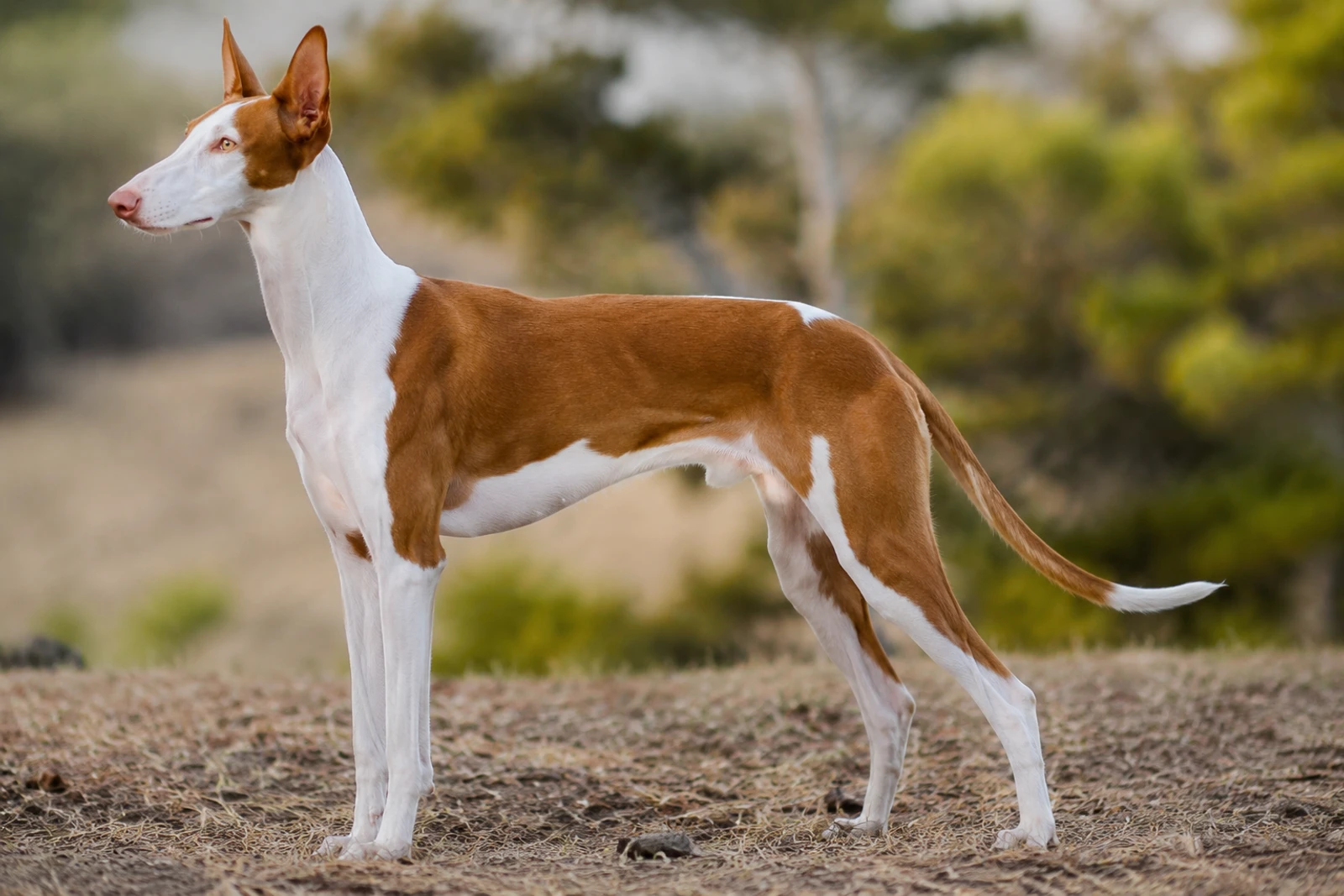
The Ibizan Hound is a lean, athletic sighthound from Spain with big ears, springy movement, and a strong chase instinct. It can be gentle at home, but it needs secure exercise space and careful management around small animals.
At a glance
- Size
- Large
- Height
- 22–28 in
- Weight
- 45–50 lb
- Life span
- 11–14 years
- Coat colors
- Red, white, red and white
- Coat type
- Smooth or wire coat
- Group
- Sighthounds
- Origin
- Spain
How much does a Ibizan Hound cost?
Adopt / rescue
$75–$400
Usually includes spay/neuter, first shots, and a microchip.
Buy from a breeder
$700–$2,000
From a reputable, health-testing breeder.
Approximate USD. Prices vary widely by region, breeder, pedigree, age, and coat colour — adopting is the lower-cost and recommended route. Avoid suspiciously cheap “breeders”; they’re often puppy mills.
Estimate the full cost of a Ibizan Hound →Want the ongoing number? Estimate the monthly food bill for a Ibizan Hound with our dog food cost calculator.
Ibizan Hound photos
Views
Front, side, rear and top — the full silhouette.Poses
How the breed sits, lies, moves and plays.Puppy to senior
The breed across its whole life.Expressions
The breed’s range of moods.Close-up details
Eyes, ears, nose, paws, tail and coat.Coat colors
The breed’s recognized colors.Click any photo to enlarge. We show the Ibizan Hound from every angle — three views, poses, life stages, expressions, close-ups, coat and colors.
Appearance & size
The first thing you notice are the ears — enormous, triangular, and whip-thin, they sit wide at the base and stand fully erect the moment something catches the dog’s attention. Those ears alone make the Ibizan Hound unmistakable, but the rest of the silhouette is just as striking.
Build and proportions
This is a large sighthound, but a decidedly lean one. You’ll see 45 to 50 pounds stretched across a frame that stands 22 to 28 inches at the shoulder. Males typically push closer to that 28-inch upper limit, while females carry a touch less height and a finer, more refined build. The body is long and elegantly angular — think deer, not draft horse. The chest drops deep and narrow, the loins are slightly arched, and the belly tucks up sharply. From the side, the outline forms a flowing S-curve: a long, arched neck flows into prominent shoulder blades, rises subtly over the loin, and then disappears into a low-set, tapered tail that reaches at least to the hock. That tail hangs naturally in a gentle sickle shape and never curls over the back.
Coat and color
You get two coat choices: smooth or wire-haired. The smooth coat is short, dense, and glossy — it lies flat and shows off every muscle. The wire-haired variety is exactly what it sounds like: a rougher, harsher outer coat that can grow up to three inches long, often giving the dog a scruffy beard and eyebrows without hiding the clean lines underneath. Color stays simple — solid white, solid red, or white with red patches (the red can range from a pale fawn to a deep rusty chestnut). You’ll also see red dogs with small white markings. Regardless of the pattern, the nose leather and tight eye rims are always flesh-colored to rosy-brown, blending with the coat rather than looking stark black.
Head and expression
Look at the head straight on, and you’ll understand why owners call them “Beezers.” The skull is long, lean, and slightly domed, with a distinct stop. The muzzle is elongated and tapering, almost Roman-nosed in profile, and the lips are thin and tight. The eyes are small, slanting, and a clear shade of amber — they catch light easily and give the dog an alert, almost smiling expression. Those huge ears aren’t just for show. They swivel independently and telegraph every mood, from curiosity to mischief.
Movement and rear
From behind, the Ibizan is all about drive and suspension. The thighs are well muscled and the hocks are set low with no dewclaws. This breed moves with a light, springy trot — they float over the ground, covering a dozen feet in a single bound. Unlike heavier sighthounds, the Ibizan can turn on a dime even at speed, a reminder that they were developed to hunt rabbits over rocky, uneven terrain. The overall picture is a dog built for explosive, agile galloping, not plodding endurance.
History & origin
The Ibizan Hound’s story reads like a time capsule. For roughly three thousand years, dogs nearly identical to this one lived on the sun-baked Balearic island of Ibiza, largely untouched by the rest of the world. Their ancestors almost certainly trace back to the sleek, prick-eared sighthounds of ancient Egypt—the Tesem, often depicted in pharaohs’ tombs chasing game. Phoenician traders, who established colonies along the Iberian coast and the Balearics around 800–700 BC, are believed to have brought those Egyptian dogs to Ibiza.
Once ashore, the hounds earned their keep in a rugged landscape of limestone cliffs and dense scrub. Local farmers and hunters bred them not for looks, but for a single, demanding job: hunting rabbits and hare over tough, uneven ground. The Ibizan Hound developed a rare triple-threat hunting style. They spot movement at long distance like any sighthound, but they also track quarry by scent and sound—using their oversized, mobile ears to pinpoint hidden prey. This versatility made them priceless for putting meat on the table in a place where every calorie counted.
Centuries of isolation preserved the type. Outside Ibiza, few people had even heard of the breed until the mid-20th century. In the 1950s, Spanish breed enthusiasts began to formalize a standard, and the first Ibizan Hounds trickled out to mainland Europe and the United States. The American Kennel Club recognized the breed in 1979, placing it in the Hound group.
Even its names reflect the journey: Podenco Ibicenco in Spanish, or simply Beezer to those who love one. Today, you’ll see Ibizan Hounds racing in lure-coursing trials or crashing on the sofa after a long run. The frame—22 to 28 inches at the shoulder, a lean 45 to 50 pounds—hasn’t changed much from the dog that once sprinted across Ibiza’s hillsides. When your Beezer vaults a baby gate without a thought or freezes mid-stride, ears swiveling toward a distant sound, you’re watching three millennia of purpose snap into focus.
Temperament & personality
An Ibizan Hound’s look—those batwing ears, the lean, aerodynamic frame—grabs your attention, but the temperament is what you live with every day. Expect a clean, catlike dog who bonds deeply without being needy. They’ll crack you up with bursts of pure clown energy: full-body wiggles, pouncing on invisible prey, racing figure eights around the yard. Then they’ll curl up on the back of the sofa like a deer and nap for hours. These are sighthounds built for speed, and they need a serious physical outlet. A leashed amble around the block won’t touch it. Aim for a solid hour of hard running—a securely fenced field, lure coursing, or a long off‑shore hike with a recall that’s still a work in progress. Without that, the clever brain finds its own work: unmaking the bed or redesigning your baseboards.
With their people, Ibizans are sweet and snuggly without being pushy. Strangers get a polite aloofness, not an effusive tail-wag. You’ll hear a deep, startling bark when someone approaches the house, but it’s a brief alert, not a sustained guard‑dog circuit. They notice everything and file it away.
House manners and handling quirks
- Clean freak tendencies: Many lick themselves like cats and hate wet feet. Housetraining is usually straightforward, but if an accident happens, obliterate the scent with an enzymatic cleaner or a vinegar spray—leftover odor cues invite a repeat.
- The manure roll: Turn your back for a second on a walk and your pristine hound will drop a shoulder onto something dead. That’s ancient scavenger wiring, not spite. A hose and dog‑safe shampoo are your only defense.
- Chewing: It’s a serious hobby those first two years. Provide rugged chew toys and spritz off‑limits furniture with a homemade citrus‑peel spray (boil peels in water, cool, and mist)—most dogs hate the smell.
- Sensitive to tone: Harsh corrections backfire. A sharp word might earn you a lip lick, a yawn, or a head turn—classic calming signals. Dial down the pressure. This dog thrives on respect and positive reinforcement.
- Prey drive reality: Cats, small dogs, and squirrels are often on the quarry list. Some Ibizans live peacefully with a house cat if introduced young; never trust that truce off‑leash outdoors. A fenced yard with a dig‑proof bottom is non‑negotiable.
- Meal respect: The breed rarely guards food, but any dog can startle if a child pokes the bowl. Teach kids to leave eating dogs alone—a single scary episode can linger in this sensitive hound.
- Alone time: Ibizans tend toward isolation distress if left alone for full workdays. A bored, lonely Beezer may howl, chew drywall, or pace. If your house is empty most of the day, plan for doggy daycare or bring in a second sighthound for company.
Reading the lean
An Ibizan’s body language is telegraphic. A forward‑shifted center of gravity, rigid muscles, a locked stare, and a tail held high or wagging only at the tip? That’s a loaded spring about to bolt after prey. A soft, wiggly body, squinty eyes, and a relaxed, sweeping tail say everything is right in the world. Because they’re so emotionally soft, watch for displacement during training: a sudden yawn, lip flick, or head turn means the session is going south. Stop, regroup, and get a happy dog back. Stiff posture combined with unblinking eye contact is a more serious warning—give space and de‑escalate.
Good with kids, dogs & other pets
Ibizan Hounds have a naturally patient, non-aggressive temperament that makes them a solid match for many families — provided you respect their sighthound instincts and sensitivity. They bond deeply with their people and hate being left alone for long stretches, so they thrive in a home where someone is around most of the day. Because they can be reserved with strangers and lightning-fast to notice anything that bolts, early and ongoing socialization is non-negotiable. Start before 16 weeks, exposing your puppy gradually to gentle kids, calm adult dogs, and everyday noises and surfaces in positive, low-pressure doses.
With children
Your Ibizan is likely to be gentle and tolerant, but at 45–50 pounds and up to 28 inches tall, a zoomie in the living room can accidentally topple a toddler. Supervision is a must when small kids are in the mix. These dogs are also sensitive — rough handling or yelling can make them shut down or turn avoidant. Teach children to interact calmly and give the dog a quiet retreat when needed. With early, positive exposure to kids of all ages, an Ibizan often becomes a playful, affectionate companion who’s happy to curl up on the couch after a run.
With other dogs
Early socialization goes a long way here. An Ibizan raised alongside other dogs usually enjoys their company and may develop a playful, pack-like dynamic. But this is a sighthound bred to spot and chase fast-moving objects, so very small dogs that dart and squeal can trigger that instinct. Introductions should be gradual and always supervised. With unfamiliar dogs, the Ibizan can be reserved but is rarely aggressive. Forced interactions can backfire, creating stress rather than friendship — let him set the pace.
With cats and small pets
This is where you need to get brutally honest with yourself. The Ibizan Hound’s prey drive is hard-wired, and a fleeing cat, a pet rabbit, or even a pocket-sized dog can look like game. Some Ibizans coexist peacefully with the family cat if they’ve been raised together from puppyhood, but the risk never drops to zero — especially when you’re not home to supervise. Small caged animals like hamsters, guinea pigs, or ferrets should be housed securely and never allowed to interact freely. Talk to your breeder about the parents’ temperaments and commit to a lifetime of careful management. Many Ibizan owners simply accept that their dog cannot be left alone with non-canine pets, period.
Trainability & intelligence
You’re not training a Labrador. An Ibizan Hound can learn a new trick in three repetitions, then look you straight in the eye and decide not to bother. That’s not stubbornness for its own sake — it’s a sighthound bred to spot, chase, and catch game at 40 miles an hour without waiting for human instructions. A Beezer’s intelligence is real, but it’s paired with an independence that makes the typical obedience-class script fall flat.
What works: relationship over repetition. These dogs are deeply sensitive. A harsh tone, a frustrated leash-pop, or even too many dull drills will shut them down faster than any distraction. You’ll see the ears go back and the eyes go soft — they’ve checked out. Built a bank of trust with gentle, consistent handling, and you get a dog who will eagerly offer you a sit, a spin, or a bow, especially if the payoff is a squeaky toy or a freeze-dried liver treat. Praise and play work just as well as food for many; figure out your dog’s currency.
Recall is the real battleground. When a squirrel bolts, the prey drive overrides everything. A Beezer in full flight is not ignoring you — they literally cannot hear you in that state. Start recall training young, never punish a delayed return, and use a high-value reward you only bring out for this command. Long lines in safe open spaces let you practice without gambling. Even then, expect that off-leash reliability in an unfenced area may never be 100%.
- Keep sessions short and sneaky. Three five-minute bursts scattered through the day stick better than one 20-minute slog. End before they get bored.
- Harness the chase. A flirt pole (a lunge whip with a toy on the end) turns training into a game they were born to play. Use it to reinforce “wait,” “drop it,” and “come.”
- Socialization is critical, not optional. Between 3 and 14 weeks, expose your puppy gently to different people, calm dogs, new surfaces, and everyday sounds. A poorly socialized Ibizan can become fearful, skittish, or reactive — and a scared sighthound is a difficult housemate. Ongoing, positive exposures throughout life keep that anxiety from creeping back.
Punishment-based methods will unravel everything. You’ll get a dog who avoids you, won’t make eye contact, and may even shut down completely. This breed doesn’t bounce back from coercion the way some tough-minded working dogs do.
So, what does a “trained” Ibizan Hound look like? Not a robot. A dog who greets guests without bolting, walks nicely on lead because it’s pleasant, and comes when called at the dog park — maybe, if the squirrels are sleeping. Get there with patience, a sense of humor, and a relationship built on mutual respect.
Exercise & energy needs
Ibizan Hounds are born to run — and they need to run often, safely. A bored Beezer isn’t just unhappy; he’ll redecorate your house with that long, agile body. Plan on at least 60–90 minutes of exercise a day, split into two solid sessions. One of those should give him the chance to sprint flat-out in a securely fenced area. These are sighthounds built for explosive speed over rough ground, not a lazy stroll around the block. A quick leash walk barely registers.
A tired body alone won’t cut it — you have to work the brain, too. Ibizans are clever, independent hunters, and mental outlet is just as critical as the physical stuff. On days when a hard run isn’t possible, lean hard into scent games, puzzle toys, or hide-and-seek with treats. Nosework channels their natural tracking drive and leaves them calmer indoors. Skip this, and you’ll get a restless dog who climbs, digs, or vocalizes more than you’d like.
- Lure coursing is this breed’s ultimate sport — a fast, safe way to satisfy the chase instinct.
- Sprinting in a fenced field (never off-leash in open areas; their prey drive erases recall around moving animals).
- Agility or flyball for owners who want to compete, though training can be a fun negotiation with a dog who thinks for himself.
- Long hikes on a long line in wildlife-free zones, giving them time to stretch their legs and sniff.
Watch out for deep-chest bloat risk: avoid hard exercise right before and after meals. As Beezers age, swap high-impact sprinting for longer sniffy walks and swimming to protect those lean, fast-twitch muscles and joints. They’re natural athletes who stay fit well into their teens — but only if you give them the daily, all-out movement they were built for.
Grooming & coat care
The Ibizan Hound wears a no-fuss coat that takes minimal work, but the exact routine depends on which variety you have. Both the smooth and the wire-haired types share a single layer — no insulating undercoat — so shedding is light year-round. That single coat dries in minutes after a rain or a bath, and it rarely traps the doggy odor some breeds carry.
- Smooth coat: A short, dense, glossy jacket. Grab a bristle brush made from natural pig bristle and give the dog a once-over every week or two. This pulls out loose hairs before they land on the couch and boosts the natural shine. A rubber curry mitt works just as well for a quick massage during heavy spring shedding.
- Wire-haired coat: A rougher, longer outer coat that can mat behind the ears, in the armpits, and along the thighs if neglected. Use a metal slicker brush with rounded pins or a pin brush once a week, then follow up with a comb to catch any tangles. Daily brushing isn't necessary, but a 10-minute session every 5–7 days keeps the coat healthy and prevents irritated skin.
Bathe only when the dog is visibly muddy or has rolled in something unspeakable. Over-bathing strips the natural oils that keep that sleek coat glowing. Use a gentle dog shampoo and rinse thoroughly — soap residue left on thin sighthound skin can trigger itching.
Trimming is minimal. You aren't clipping, stripping, or shaping anything. Some wire-haired individuals may need excessive hair between the toes or around the face tidied up with blunt-tipped scissors, but most need nothing more than a good brush.
Nails grow fast on this athletic breed. If you hear clicking on the floor, it's past time for a trim. Long nails change foot conformation and can lead to toe injuries when a Beezer corners full-speed in the yard. Check and clean the large upright ears weekly with a soft, damp cloth. Those bat-wing ears are magnets for dirt and can trap moisture, so make a habit of peeking inside after runs through tall grass. Teeth get the standard schedule: brush a few times a week, and offer safe chews or raw bones to keep tartar in check.
Seasonal coat swaps are mild. You might see a slight uptick in shedding when the weather warms in spring, but a few extra passes with the bristle brush or slicker handle it in a minute. Because the coat is so short and lies flat, burrs, cheatgrass, and foxtails are easy to spot and remove right after a hike — check between toes and in the armpits. That thin skin also nicks easily, so rough handling during grooming is a no-go. Keep your tools smooth and your touch light, and grooming time stays quick and low-stress for both of you.
Shedding & allergies
An Ibizan Hound won't leave drifts of hair on your furniture. The smooth, short coat sheds lightly but consistently year-round — you'll notice a few fine, almost invisible hairs on dark pants, not tumbleweeds in the corners. A weekly once-over with a rubber curry or hound glove is all it takes to keep loose hair under control, and it's a ritual most Beezers lean into like a massage.
Seasonal blowouts are forgettable compared to double-coated breeds. You might see a slight uptick in spring as the winter coat thins, but nothing that requires changing your vacuum routine. The wire-haired variety (less common in the US) sheds even less, though those wiry hairs may need occasional hand-stripping to stay tidy.
Drool is basically a non-issue. These are clean, fastidious dogs that don't leave slobber trails on your leg or the couch.
On the allergy front: no dog is truly hypoallergenic, but the Ibizan's thin coat and minimal shedding mean less dander floating around the house. Many people with mild dog allergies do well with them. Still, spend real time inside a breeder's home before you commit — sit on the sofa, rub your face in a blanket, and see how your body reacts. That's the only test that matters.
Diet & nutrition
These are lean, athletic dogs, and extra pounds drag on a frame built for sprinting. An adult Ibizan Hound usually lands between 45 and 50 pounds, and you want a waist you can see from above and ribs you can feel with light pressure. Measure meals by the numbers on the bag for that weight, then adjust—every dog's metabolism is different, and a Beezer who runs hard daily burns more fuel than a weekend warrior.
- Puppies: From weaning to four months, split the day's food into four evenly spaced meals. At four to six months, drop to three meals. By six months, settle into the adult rhythm of two meals a day. Transition slowly: start with lightly cooked, puréed meats, fish, fruits, and vegetables, or a premium commercial puppy food. Raw chicken wings can show up around twelve weeks, under your watch.
- Adults: Two meals a day works for most. If your dog inhales food in 30 seconds flat, a puzzle bowl or snuffle mat slows things down and adds a little mental work. A diet built around roughly 60% raw and cooked meat, 20–30% fruits and vegetables, and 10% extras like eggs, plain yogurt, or cooked grains (pearl barley is a solid high-fiber option) lines up with what their teeth and digestive system are built for. White rice can soothe a sensitive stomach. Blend or process meals to aid nutrient absorption, since a dog's jaw works up and down, not side to side, and saliva doesn't start the breakdown the way ours does.
- Seniors: As activity tapers, weight can creep up fast. Obesity in an older Ibizan stresses already aging joints. Switch to smaller, more frequent meals if his appetite dips, and gradually reduce the portion if the scale ticks upward. You don't need to cut protein—there's no strong evidence for that—but you may need to purée meals if teeth are missing.
Ibizans aren't notorious chowhounds, but food motivation varies. Some will self-regulate and leave half a bowl; others treat every meal like a competitive event. Because this breed is tall and deep-chested, carry extra weight can lead to orthopedic strain. Keep a close eye on body condition and be honest about how much exercise your dog actually gets. If life gets sedentary, cut the kibble back by a modest amount and reassess in two weeks.
Avoid the "just this once" trap. Rich holiday scraps, fatty trimmings, or a pan of bacon grease can trigger pancreatitis. Serve leftovers—if they're appropriate—in the dog's own bowl, never from the table. Cooked vegetables, canned fish (in water, no salt), eggs, and a batch of grains you prepped over the weekend make a quick, healthy base. And that unsalted water from steaming green beans? Freeze it in a Kong or use it to moisten dry food.
Health & lifespan
The typical Ibizan Hound lives 11 to 14 years. They’re a generally healthy breed, but a few areas deserve your attention from day one.
What responsible breeders screen for
While the Beezer doesn’t carry a long list of breed-specific genetic nightmares, good breeders still test for issues that can pop up in the gene pool. Hip dysplasia, eye disorders (like progressive retinal atrophy), and autoimmune thyroiditis are the big ones. Ask for OFA or PennHIP results and a recent eye exam from a veterinary ophthalmologist. Reputable breeders won’t breed dogs without these clearances, and they’ll show you the paperwork.
Health quirks that come with the build
That lean, aerodynamic frame comes with a few built-in considerations. Ibizan Hounds have very thin skin and a short, sleek coat — great for warm Spanish afternoons, not so much for cold snaps or coarse brush. They get cold easily and can tear skin on branches or even a rough play session. A coat for chilly walks isn’t just cute; it’s necessary. They’re also deep-chested, which puts them at risk for bloat (gastric dilatation-volvulus). Feed multiple smaller meals instead of one big one and don’t let them run hard right after eating.
Keeping your Beezer sound
This breed stays active well into old age if you protect their joints. Weight management is non-negotiable — even a few extra pounds strain those long legs and increase arthritis risk. Aim for a solid hour of running daily, not just a leash stroll. Thin coats also mean sunscreen on the ear tips and nose during long outdoor days, because skin cancer can develop on exposed pink skin.
Routine care that pays off
- Annual vet checkups catch subtle things — a slight limp, a dull coat, reduced appetite — before they become serious. Ibizans are stoic, so you might miss an ache until a vet puts hands on them.
- Heartworm prevention monthly during mosquito season (and one month after) is a must, especially since they’re often running through tall grass and woods where mosquitoes breed.
- Rabies vaccination is legally required, and there’s no treatment once symptoms appear. Stay current.
- Early socialization and positive handling do more than shape a good companion — they head off the stress-related behaviors (like excessive barking or digestive upset) that neglect can trigger in sensitive dogs.
Ibizan Hounds generally age gracefully when you respect their skin, keep them lean, and stick to a prevention routine. A twice-yearly senior panel after age 8 catches kidney or liver changes early, buying you more good years.
Living environment
Most Ibizan Hounds want one thing from a home: a safe place to sprint until their legs give out, then a sunny patch of couch for a long nap. A house with a tall, securely fenced yard is the ideal setup. These are 45–50 lb sighthounds built to chase at 40 miles per hour; a six-foot fence is the bare minimum, because they can clear shorter ones from a near standstill and rarely think twice about it. Apartment living can work, but only if you’re willing to provide multiple off-leash running sessions every day — a couple of short leash walks won’t cut it. Realistically, you’ll be driving to a fenced field or a quiet dog park in the early morning hours when prey drive won’t get them into trouble.
Indoors, Beezers are famously clean and quiet, often described as cat-like. They’re not nuisance barkers; they’ll yodel, whine, or “roo” when excited or bored, not typically out of territorial instinct. Thin-skinned and lean, they feel the cold deeply. Below about 45°F, expect to layer on a coat. They handle heat well, as long as they have shade and water, but midday pavement can blister their pads.
The bigger challenge is their emotional wiring. These dogs bond hard and hate being left alone for long stretches. A household where someone works from home or dogs aren’t crated for eight hours is a far better fit. Without gradual desensitization and lots of mental work (puzzle toys, scent games, hiding treats in the yard), separation anxiety can turn a sensitive dog into a destructive or vocal one. If your daily rhythm includes long absences, an Ibizan Hound will let you know it’s not the right match — loudly and with a surprising amount of skill at dismantling door frames.
Who this breed suits
An Ibizan Hound fits a home where sprinting room and a sense of humor are non-negotiable. You need a securely fenced yard — at least six feet high — because a Beezer can clear a four-foot barrier from a standstill without thinking twice. If your idea of outdoor time is a leashed stroll around the block, this is not your dog. This sighthound needs to full-out run several times a week, preferably in a safe, enclosed area where he can hit 40 miles an hour and then curl up on your sofa for the rest of the day.
First-time owners can absolutely thrive with an Ibizan, provided they understand independent sighthound wiring. This dog is not a rough-and-tumble retriever. Training requires patience, creativity, and zero reliance on heavy-handed corrections. A Beezer remembers rough treatment and holds a grudge. You will get quicker results with positive reinforcement and a pocketful of high-value treats, but even then, expect a thoughtful delay before he decides your request is worth his time.
- Active families with older, dog-savvy kids are a good match. Young children who shriek, grab, or run unpredictably can trigger a chase response that ends with a knocked-over toddler. An Ibizan is physically thin-skinned and emotionally sensitive — he does not tolerate clumsy handling.
- Singles and couples who hike, lure-course, or do canine sports like Fast CAT will find an eager, athletic partner who crashes hard at home afterward. Inside the house, a well-exercised Beezer is a quiet, clean couch potato who will steal your spot the moment you stand up.
- Seniors can work with an adult rescue Beezer who has mellowed past the velociraptor puppy stage, but only if they can provide off-leash running opportunities. A retired racer or show dog in a quieter home is a realistic scenario.
Who should think twice? Anyone who works long hours away from home. Ibizans bond tightly with their people and can develop serious separation anxiety that manifests in destructive chewing, incessant howling, or scaling furniture you didn't know was climbable. They are also accomplished counter-surfers — no loaf of bread is safe above head height. If you cannot tolerate a dog who uses your kitchen island as a launch pad, steer clear.
Off-leash reliability in an unfenced area is a gamble with any sighthound, and the Ibizan is no exception. A squirrel or rabbit can make your recall command vanish from the dog's brain in an instant. Owners who expect a reliable off-leash hiking companion should look at a different breed. Apartment dwellers without daily, dedicated access to a fenced run will also struggle — this is a large, leggy dog who needs to stretch out flat in a gallop, not just trot politely on a leash.
If your lifestyle provides room to run, a soft place to land, and an appreciation for a dog who thinks independently, the Ibizan Hound is a loyal, clownish, and intensely devoted companion. Just install the taller fence before you bring him home.
Cost of ownership
An Ibizan Hound puppy from a responsible breeder usually runs between $1,500 and $3,000. The price reflects how rare the breed is, plus the health testing a good breeder does — hips, eyes, and sometimes BAER hearing tests. If you’re open to an adult, rescue adoption fees land closer to $300–$600. Because Beezers aren’t common, you may spend months on a waitlist either way.
Once your dog is home, the monthly routine settles in around $100 to $165, not counting any one-time big purchases like a tall fence.
- Food: Plan on a high-quality, performance-oriented kibble for this lean, athletic 45–50 lb sighthound. Two to three cups a day usually costs $50–$75 monthly. Some owners feed raw or add fresh toppers, which bumps the number higher.
- Grooming: The short, smooth coat is about as low-maintenance as it gets — a quick rubber curry once a week handles shedding. The real recurring cost is nail trims. If you don’t do them yourself, a pro will charge around $10–$20 every few weeks.
- Vet and preventives: Annual exams, vaccines, and year-round heartworm/flea/tick medication typically run $300–$500 per year ($25–$42/month). Sighthounds can be sensitive to certain anesthesia drugs, so you’ll want a vet comfortable with the breed — something to price in if your dog ever needs a dental or surgery. Responsible breeders also screen for hip dysplasia, eye disorders, and autoimmune conditions, which helps keep the major health surprises down.
- Insurance: For an Ibizan Hound, accident-and-illness coverage generally falls between $30 and $60 a month, depending on your deductible and location.
One-time costs that matter: Spay or neuter often tacks on $200–$500 if the breeder didn’t already handle it. A properly fitted martingale collar and a long training lead are musts for a sighthound that startles and bolts. And the biggest hidden expense — fencing. A 6-foot wooden privacy fence (or even taller in some cases) isn’t optional; Ibizans can clear five feet from a standstill, and once they take off after prey, they’re gone. If your yard isn’t already secure, budget several thousand dollars for the installation.
Choosing a Ibizan Hound
Ibizan Hounds are rare in the U.S., so your first move is to plug into the breed’s serious fanciers. The Ibizan Hound Club of the United States (IHCUS) maintains a breeder referral list and is your safest starting point. If you prefer a rescue, the same club often coordinates rehomes through breed-specific volunteers—there’s no massive national rescue operation, just a tight network that screens dogs carefully because every Beezer that lands in a home it doesn’t suit tends to bounce back again.
Breeder or rescue
A responsible breeder produces at most a litter or two a year, almost always from dogs they’ve proven in conformation, lure coursing, or other high-speed sports. Expect a wait list and a stack of questions about your fencing (6 feet, non-climbable is the default expectation), your tolerance for a dog that scales furniture, and your plan for off-leash running. An adult rescue Beezer often comes with known house manners and a clear prey-drive intensity, which can save you the land-shark puppy phase. The trade-off: you might inherit separation anxiety or car-chasing habits that need long-haul management. Either route, you want a home visit or video call that feels more like a live-fire compatibility check than a sale.
Health clearances that matter
Ibizan Hounds are long-lived for a large sighthound, but smart choices at the start tip the odds your way. Insist on seeing original paperwork for these tests:
- Hip dysplasia: OFA or PennHIP evaluation on both parents. A rating of Fair or better on an adult dog is standard.
- Eyes: A current CAER (formerly CERF) exam, ideally within the last year, to rule out progressive retinal atrophy, cataracts, and other inheritable eye disease.
- Thyroid: An OFA thyroid panel (not just a T4 snapshot) because autoimmune thyroiditis pops up in some lines and can mimic other behavior or coat issues.
Some breeders also run BAER hearing tests on puppies, particularly in litters with heavy white markings, though congenital deafness is not rampant. A breeder who waves off these tests as unnecessary or says “my line has never had problems” without records is not someone you want to trust with an 11-to-14-year commitment.
Red flags to walk away from
- Perpetually available puppies. A breeder who always seems to have a Beezer ready now is a breeder who’s not placing pups with any real screening—or keeping them too long because nobody vetted will take them.
- No health clearances, but plenty of color talk. You shouldn’t hear “rare red,” “king-sized,” or “mini Ibizan” as a sales pitch. The breed has one correct look; marketing extremes is a shortcut to structural trouble.
- Puppies released before 8 weeks. Sighthound puppies need littermate time for bite inhibition and social cues. A breeder who pushes them out the door at six weeks is ignoring critical development windows.
- Zero performance or breed club involvement. You don’t have to buy from a show-ring star, but a breeder who never lure courses, never shows, and never belongs to IHCUS has no objective way to measure if their dogs even move or think like Beezers.
- No questions about you. If the conversation is all about when you can Venmo a deposit and never touches on your fence height, cat ownership, or daily exercise routine, that’s a puppy producer, not a steward of the breed.
Picking a puppy
A good breeder assigns the puppy to your life, not the other way around. They’ve watched each littermate for 8–10 weeks and can tell you which one recovers fastest from a startle, which one bullies the others over a toy, and which one hangs back to watch before joining the chaos. When you visit, look for a puppy that investigates you with relaxed curiosity, not frantic neediness or wallflower hiding. Beezer ears should be mostly upright by that age (a few tip-flops are normal, but a completely down-ear 10-week-old warrants a question). The pup should come with a health record, microchip, a signed contract that spells out return-to-breeder clauses, and a starter packet that reflects real socialization: exposure to household sounds, crate familiarity, and early potty training begun by the breeder. If the breeder hands you a dog and says “good luck,” you’ve got the wrong breeder. The right one stays on your phone contact list for the next decade-plus.
Pros & cons
-
Lean, fast, and elegant: The Ibizan Hound is built for speed — 45–50 lb of muscle on a 22–28 in frame. Watching one sprint is unforgettable, and they thrive in lure coursing or agility.
-
Quiet housemate: Despite high outdoor energy, a well-exercised Beezer is calm and clean indoors. They’re not barkers by nature and often curl up on a couch without a sound.
-
Wash-and-wear coat: A short, smooth coat that rarely sheds much and has almost no doggy odor. A quick wipe-down or occasional brushing is all it takes.
-
Sweet and goofy with their people: Loyal to their family, often leaning against you or making bizarre, clownish leaps when happy.
-
Long-lived for a large sighthound: 11–14 years is common, and responsible breeders screen for conditions like hip dysplasia and eye issues, so you get a generally hardy dog.
-
High prey drive, zero off-leash reliability: They will chase squirrels, cats, and moving cars. If it runs, the Ibizan will follow — recall evaporates in that moment. Never trust them off-leash outside a fenced area.
-
Fence-climbers and escape artists: Six-foot fences are a suggestion, not a barrier. Bored or under-exercised dogs can scale them, so you need a secure, escape-proof yard.
-
Independent and stubborn: They’re smart but not eager to please like a retriever. Training requires patience, short sessions, and creativity — a heavy hand shuts them down fast.
-
Sensitive to correction: Harsh tones or punishment can make them skittish and distant. They respond best to positive reinforcement and a calm, patient handler.
-
Tall enough to counter-surf: At 26–28 inches, a casually placed roast chicken is fair game. Kitchens need constant surveillance until you train solid boundaries.
-
Reserved with strangers: Early and ongoing socialization is essential to prevent aloofness from becoming fearfulness or shyness.
Similar breeds & alternatives
If the Ibizan’s athletic silhouette and independent mind have caught your eye, a few other sighthounds share some of that same ancient spark — but they each put their own spin on it.
Pharaoh Hound – This breed gets confused with the Ibizan constantly, and it’s easy to see why: the upright ears, the sleek tan coat, the way they both freeze into a statuesque point. The Pharaoh, originally from Malta, is often a touch heavier-boned and a little more squarely built. Temperament-wise, many find them a shade more biddable and less reserved around new people, though they still won’t win any obedience-trial awards. Just like a Beezer, a Pharaoh can clear a four-foot obstacle without a running start, so that six-foot fence is still non-negotiable.
Cirneco dell’Etna – Picture the Ibizan’s scaled-down cousin from Sicily. Standing 16–20 inches and weighing 20–26 pounds, the Cirneco delivers that same prick-eared primitivo charm in a much smaller, apartment-viable package. Exercise needs are lower — a good run and a long walk often suffice — but you still get the sighthound softness indoors and the hair-trigger prey drive outside. If the Ibizan’s 45 pounds and vertical ambitions feel like a lot, the Cirneco tips the scales toward easier management.
Whippet – If the calm indoor lounging and sudden backyard blitz sound perfect, but you could do without the mischievous, problem-solving streak, a Whippet might fit. They run smaller at 25–40 pounds and are famously gentle, quiet housemates. Obedience tends to come more readily, and they’re less likely to teach themselves how to open cabinets or clear the baby gate. The trade-off: you lose the Ibizan’s clownish, bouncy play style and that jaw-dropping vertical leap. A Whippet’s escape route is more about a gap under the fence than a jump over the top.
Greyhound – A retired racing Greyhound is an option when you love the shorthaired sighthound type but want a more relaxed, bulletproof personality at home. At 60–70 pounds they’re larger and less gymnastic than the Ibizan, often content with a couple of short sprints and a whole lot of couch time. They lean toward openly affectionate with strangers, which softens the aloofness some Ibizan owners accept. If you want a dog that will crack you up with independent shenanigans and act more like a velociraptor than a rug, stick with the Beezer.
Saluki – For those drawn to the Ibizan’s ancient, aristocratic bearing, the Saluki wraps the same dignified soul in a silkier, often feathered coat. They tend to be more aloof with outsiders and even more sensitive to household tension, requiring a carefully gentle approach. Both breeds share a spectacular double-suspension gallop and a recall that evaporates the second a squirrel appears. The Saluki, however, generally lacks the Ibizan’s boisterous, playful streak — you’re more likely to get a regal lean than a spontaneous play bow.
Fun facts
- Ibizan Hounds are famous for their large upright ears.
- They can be smooth-coated or wire-coated.
- The breed is known for impressive jumping ability.
Frequently asked questions
- Are Ibizan Hounds good family dogs, especially with children?
- Ibizan Hounds are even-tempered and family-oriented, so they can be wonderful companions in homes with respectful children. However, their size and athletic nature mean interactions with small kids should be supervised to prevent accidental knocks. With early socialization, they tend to be gentle and playful.
- How much shedding should I expect from an Ibizan Hound?
- The Ibizan Hound has a short, smooth coat that sheds very little, so they are a low-shedding breed. Weekly brushing with a soft bristle brush or hound glove can help control loose hair, making them a good choice for people who prefer a tidier home.
- How much exercise does an Ibizan Hound need daily?
- As an athletic sighthound with high energy, the Ibizan Hound typically needs at least an hour of vigorous exercise daily. They thrive on activities like running in safely fenced areas, lure coursing, or long walks, and mental stimulation is also important to prevent boredom.
- Are Ibizan Hounds easy to train for first-time dog owners?
- While intelligent and alert, the Ibizan Hound can be independent-minded, which may pose training challenges for first-time owners. They respond best to positive reinforcement and patience, but their strong prey drive and occasional stubbornness require consistent, experienced handling.
- Can an Ibizan Hound adapt to apartment living?
- Apartment living is not ideal for an Ibizan Hound because they have high exercise needs and appreciate space to sprint. With dedicated daily outings and mental engagement, they might adapt, but a home with a securely fenced yard is generally recommended.
- Is grooming an Ibizan Hound high maintenance?
- Grooming needs for the Ibizan Hound are minimal; their short coat only requires occasional brushing to remove dead hair. Bathing is needed infrequently, and regular ear checks and nail trims are the main maintenance routines.
Tools & calculators for Ibizan Hound owners
Quick estimates tailored to Ibizan Hounds — pre-filled with this breed’s size where it matters.
Articles & stories about the Ibizan Hound
Sources & standards
This profile follows recognized breed standards from the American Kennel Club (AKC) and the Fédération Cynologique Internationale (FCI), along with established veterinary and breed-club guidance. These describe general breed tendencies — every dog is an individual.