

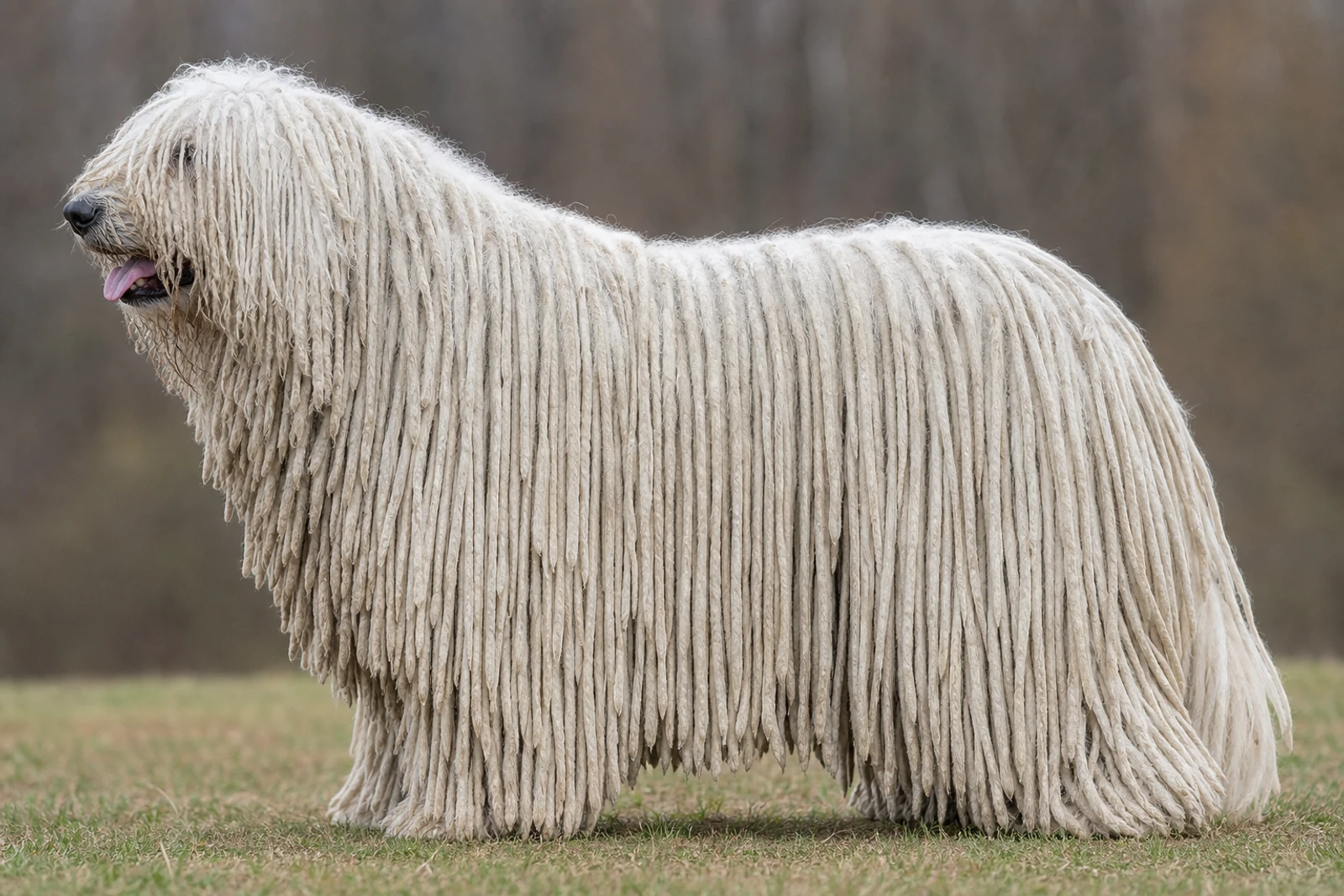
The Komondor is a serious guardian breed, best suited to experienced owners with ample space. This majestic, independent dog was developed to protect livestock, and it carries a calm yet fearless demeanor. With its corded white coat, the Komondor is a unique presence that thrives when given a job and consistent leadership. While devoted and gentle with its family, it is naturally wary of strangers and requires early socialization. Not recommended for novice owners or apartment living, this breed forms deep bonds and offers unwavering loyalty to those it deems worthy.
At a glance
- Size
- Giant
- Height
- 24–31 in
- Weight
- 79–135 lb
- Life span
- 10 years
- Coat colors
- White
- Coat type
- Long, dense, corded coat resembling dreadlocks or a mop
- Group
- Working
How much does a Komondor cost?
Adopt / rescue
$75–$400
Usually includes spay/neuter, first shots, and a microchip.
Buy from a breeder
$700–$2,000
From a reputable, health-testing breeder.
Approximate USD. Prices vary widely by region, breeder, pedigree, age, and coat colour — adopting is the lower-cost and recommended route. Avoid suspiciously cheap “breeders”; they’re often puppy mills.
Estimate the full cost of a Komondor →Want the ongoing number? Estimate the monthly food bill for a Komondor with our dog food cost calculator.
Komondor photos
Views
Front, side, rear and top — the full silhouette.Poses
How the breed sits, lies, moves and plays.Puppy to senior
The breed across its whole life.Expressions
The breed’s range of moods.Close-up details
Eyes, ears, nose, paws, tail and coat.Coat colors
The breed’s recognized colors.Click any photo to enlarge. We show the Komondor from every angle — three views, poses, life stages, expressions, close-ups, coat and colors.
Appearance & size
A full-grown Komondor looks like nothing else in the dog world — a massive, deliberately muscled guardian draped head to toe in heavy white cords. Those cords aren’t brushed-out fur; they’re the breed’s natural double coat matting into felt-like ribbons that form by the time the dog is roughly two years old. Puppies start out with a soft, curly coat that begins clumping into cords around 9–12 months, and the process takes patience. Behind all that hair is a giant, durable working dog.
This is a big animal, no getting around it. Males stand 27½–31 inches at the shoulder, females 24–27½ inches. Weight lands anywhere from 79–135 lb, with males routinely topping 110 lb. A lean, well-conditioned Komondor might surprise you — the mop conceals a broad chest, a deep ribcage, and heavy bone. The body is rectangular, slightly longer than tall, with a level topline and a wide, muscular loin that slopes gently into a rounded rump. The tail hangs straight down to the hocks, often curling up just at the tip when the dog is alert.
From the front, the chest is wide and deep between straight, pillar-like forelegs thrust well apart. The neck is thick, slightly arched, and blends into powerful shoulders. Viewed from the side, the dog has a balanced, no-frills silhouette: a strong underline that tucks up just a little, and legs planted squarely under the body. The rear presents a broad, heavily muscled thigh and a straight hock — nothing leggy or fine-boned.
The head is large and slightly domed, with a short muzzle that’s about one-third of the skull’s length. Almond-shaped eyes are medium size and very dark brown, giving a calm, watchful expression. Ears hang in a soft U-shape, blending right into the coat. The nose, lips, and eye-rims are always black or dark gray. Coat color is invariably white, though some dogs carry a faint cream or ivory cast. You won’t see any patches or ticking; the breed standard doesn’t allow it. The cords themselves can reach the ground when fully mature, but responsible owners often trim them to keep the dog clean and mobile. Under all that, the skin is gray — another quiet detail that separates a true Komondor from a white dog with a trendy haircut.
History & origin
The Komondor arrived in the Carpathian Basin with the nomadic Magyar tribes around the 9th century, making it a truly ancient guardian breed. These dogs were not developed in a structured kennel but shaped by the brutal realities of the Hungarian plains. Their sole job was to protect livestock — primarily sheep but also cattle — from wolves, bears, and human thieves. They worked independently, often miles from any shepherd, and had to make life-or-death decisions without human direction. That demand for autonomous judgment still runs deep in the breed’s temperament today.
The most talked-about feature, the long, felted cords, was an accidental survival tool. The dense, woolly undercoat and coarser outer coat naturally matted together over time, forming a thick, armor-like barrier against wolf bites, extreme cold, and even the scorching sun. The cords also let the dog blend into a flock of sheep, making a predator’s ambush far less likely. Nomadic herders never brushed or combed these dogs; the coat did what it was supposed to do on its own, and selective breeding favored dogs with the most protective matting.
For centuries, the Komondor remained a working tool confined to Hungary, with little interest from the outside world. That changed as modern farming reduced predator threats and the breed’s numbers began to shrink. World War II and the Soviet occupation that followed devastated the Hungarian countryside, and many excellent guardians were killed because they fiercely protected their family’s property. Dedicated breeders inside Hungary and scattered abroad worked to rebuild the population, often starting from just a handful of survivors.
The American Kennel Club recognized the Komondor in 1937, but the breed has never become common. Today, you’ll still find Komondorok guarding flocks on large ranches in the United States, especially in the West, where they’re valued for the same old reasons. They remain a rare, niche breed — one that looks like nothing else but doesn’t exist for looks at all.
Temperament & personality
The Komondor isn’t a low-key family dog that happily greets strangers at the door. This is a serious livestock guardian, hardwired to make independent decisions about threats. You get a calm, steady presence inside the home—often quietly watching from a corner—and a brave, territorial defender the moment something feels off. That “off” can be a delivery truck, a neighbor’s dog, or a friend your dog hasn’t met yet. You have to respect that instinct, not try to train it away completely.
Expect a dog whose default is aloof with outsiders and intensely bonded to its own people. That bond isn’t effusive; Komondors show loyalty by positioning themselves between you and the unknown, not by licking your face. With their own family, they’re typically gentle and patient. With everyone else, assume suspicion. This breed scores low on friendliness to unfamiliar people and dogs, which means early, relentless socialization is non-negotiable. Even then, a Komondor rarely becomes a social butterfly.
The independent thinking that lets them guard flocks all night also makes them strong-willed in training. They bore easily with repetition and will check out if you use force. Respectful, consistent engagement—short sessions, clear boundaries, and plenty of time to make up their own mind—gets you much further. Neglect or isolation is a fast track to trouble. A Komondor left alone in a backyard with no job can develop anxiety-driven barking, destructive chewing, and territorial marking that escalates out of control.
You’ll notice quirky, breed-specific behaviors that make sense once you understand the guarding mind. Urine marking is a sophisticated communication system. You’ll see your dog sniff a spot, mark over it, and check back later—they’re maintaining a scent map of their territory. Don’t punish it; clean accidents with an enzymatic cleaner and vinegar spray to break the cue for repeat marking. Reward outdoor elimination immediately. And because a Komondor defines “house territory” by family member scents, a rarely used guest room may get treated as outside until you teach otherwise.
Body language is direct and worth learning. A relaxed Komondor at rest has a loose body, soft eyes, and a tail that hangs low. A forward lean, stiff posture, and direct stare mean the dog has gone into assessment mode—likely sizing up a perceived threat. Calming signals like lip licking or yawning can appear right before a reaction; you need to read the whole dog, not just the tail.
Chewing is lifelong. Puppies chew to explore and soothe teething gums, but adults keep their jaws strong by working hard objects. Provide heavy-duty chews and spray citrus or vinegar deterrents on off-limits items. Food guarding can be a real issue. Never interrupt a Komondor while eating, and teach children to give the dog a wide berth at mealtime. That rule applies to anyone—if you need to take something away, trade for a high-value treat rather than reaching in.
This is not a breed for first-time owners, homes with small children, or multi-pet households without serious management. A Komondor can live with kids it’s raised with, but visiting playmates who run and scream can trigger a protective response. Same goes for small animals; without early socialization, that prey drive is aimed at anything that moves fast. If you’re ready for the commitment, you get an unshakable guardian who is exactly as steady as you let him be. Plan on socialization that starts early and never stops.
Good with kids, dogs & other pets
A Komondor treats your household like a flock, and that protective instinct shapes every interaction with kids, dogs, and other animals. The breed is naturally patient and slow to anger — a plus around children — but a 100-pound dog who sees a toddler’s wobble as something to brace against can cause a spill without meaning to. Closely supervise all early mingling, and teach kids to respect this dog’s space. Never leave a young child unsupervised with any giant breed.
Socialization is make-or-break here. The critical window slams shut between 12 and 16 weeks. A Komondor puppy who isn’t systematically, positively exposed to children, visitors, and everyday racket during that period can grow into an adult who reacts to strangeness with fear or suspicion. Miss that window, and you’re working against a deeply ingrained guardian brain — forced introductions later often amp up stress rather than calm it. If you’re adopting a mature dog with a patchy background, accept that its circle of trust may stay small, and don’t push meet-and-greets it doesn’t want.
-
With other dogs: A Komondor can form a tight bond with a dog it’s raised alongside. Outside that bubble, don’t count on sociability. Many are aloof or outright intolerant of strange dogs, especially on their own turf. Dog-park free-for-alls aren’t their scene. If you’re bringing a Komondor into a home with an existing dog, plan on calm, neutral-ground introductions over several sessions, and watch body language closely. Even then, same-sex pairings can add tension.
-
With cats and small pets: An indoor cat that stands its ground often earns a pass, particularly if the two grew up together. A fleeing cat, rabbit, or guinea pig is a different story — movement can flip the switch from guardian to chaser. The dog may not intend harm, but its sheer size makes the encounter dangerous. Never leave a Komondor alone with pocket pets or free-roaming small animals.
This breed thrives on being part of the daily rhythms of the home. A Komondor isolated for long hours in a yard or spare room doesn’t just get lonely — it can become hyper-vigilant, second-guessing every sound and stranger. Give this dog consistent, early guidance on who belongs, and you get a steady, watchful companion who navigates family life with surprising gentleness.
Trainability & intelligence
A Komondor can learn almost anything you set out to teach — this is a deeply intelligent breed. The catch is that a thousand years of guarding flocks without human direction has shaped a dog that thinks for itself and weighs your requests against its own judgment. Training isn’t about bending a Komondor to your will; it’s about building a relationship where your dog wants to work with you.
Because these are sensitive, powerful dogs, skip any thought of correction-based methods. Punishment damages the trust you absolutely need and often increases the stubborn vigilance they’re born with. Instead, lean heavily on positive reinforcement: immediate treats, quiet praise, or a quick tug session when you get the behavior you want. Keep sessions short and be more patient than you think necessary — a 100-pound guardian that takes an extra beat to decide to hold a down-stay isn’t being defiant, just deliberate.
The biggest training challenge is typically recall. A Komondor that spots something suspicious 200 yards away doesn’t naturally bounce back to you; millennia of genetics scream “go investigate.” You can build a solid recall, but it demands thousands of rewarded repetitions and never calling the dog unless you’re 90% sure it will come — every ignoring weakens the cue. This is not an off-leash park dog without a fenced area and a long history of reliable responses.
Socialization isn’t optional; it’s the foundation everything else rests on. Expose a Komondor puppy to a wide spectrum of friendly strangers, calm kids, odd surfaces, traffic sounds, and other animals from 3–14 weeks old. Continue that exposure through adolescence — 80 pounds of suspicion without early practice can harden into reactive fearfulness. Pair every new experience with high-value rewards so the dog files the world under “boring” or “paycheck” rather than “threat.”
Expect a slow maturity curve. Even a well-trained yearling will test boundaries, and the full, steady guardian brain doesn’t click in until closer to age three. Approach training as a daily, no-drama habit — consistent cues, same house rules every time, and a calm, confident handler who doesn’t escalate. Do that, and you’ll end up with a dog that reads your family like a book and moves to protect them with astonishing good sense.
Exercise & energy needs
A full-grown Komondor isn’t a dog that paces the fence line craving a five-mile run. This is a giant, deliberate livestock guardian bred to think independently and conserve energy until there’s a threat. You’re looking at 60 to 80 minutes of daily activity, split into at least two sessions—not one marathon outing that overstresses heavy joints. The goal is steady movement that engages his mind as much as his body.
Keep intensity moderate. Leash walks around the neighborhood, long sniffy rambles on a rural trail, or time in a securely fenced area where he can patrol and patrol some more. This breed matures slowly and has a deep chest, so avoid high-impact play on hard surfaces, especially before age two. Adult Komondors can hit 135 pounds; that mass on growing bones is a recipe for trouble if you push him into sprinting after a ball or jumping for a Frisbee.
What a good workout actually looks like
- Two sessions of 30–40 minutes each—morning and evening fit the breed’s natural rhythms.
- Off-leash exploration in a large, safe space counts heavily. He’ll cover ground at his own pace, circle back, and investigate.
- Let him climb gentle hills or navigate uneven terrain. It builds rear-end strength without the jarring impact of pavement running.
- Swimming is fine for some individuals, but don’t force it. Many Komondors are suspicious of water; the corded coat becomes heavy when wet.
Mental work is non-negotiable
A bored Komondor is a destructive, barking liability. He was bred to make judgment calls on his own, so give him a job that simulates that. Scent games, puzzle feeders, and “find it” commands inside the house or yard burn energy fast. Rotate through a few sturdy puzzle toys each week—this is a dog that can dismantle flimsy plastic in seconds. Hide treats in a snuffle mat or under overturned flower pots in the yard. Even a five-minute nose-work session can settle him more effectively than another turn around the block.
What sports and activities fit
- Farm dog duties—herding, guardian work, or simply patrolling acreage—are his ideal.
- Draft work (cart-pulling) suits his size and work ethic once he’s physically mature. Start with light weights and short distances.
- Nose work and barn hunt capitalize on his methodical scenting ability.
- Obedience and trick training provide structure and mental challenge, but keep sessions short and positive. He’s not a retriever that lives to please—he’ll shut down under heavy-handed repetition.
- Skip dog parks entirely. His guardian instinct is territorial and he dislikes strange dogs getting in his space.
Watch for the giant-breed pitfalls
Komondors have a deep, narrow chest, so bloat is a real risk. Never exercise him right after a meal or let him gulp water and then tear around the yard. Schedule activity at least an hour before or two hours after eating. On hot, humid days, cut walks short and go early or late—the thick corded coat holds heat. Puppies under 18 months should stick to free play on grass, not forced jogging or long stair climbs, to protect developing hips and elbows.
If you notice restless pacing, demand barking, or defensive charging at windows, he’s telling you he needs more daily engagement. It’s rarely a cardio deficit—usually a job-to-do deficit. Address that by adding intentional mental work, not by doubling walk length, and you’ll have a calmer, happier guardian at home.
Grooming & coat care
Forget everything you know about daily brushing. A Komondor’s coat doesn’t get brushed — it gets carefully separated into cords, starting when the puppy fluff begins to mat in a predictable way around 8 to 12 months old. Running a slicker or pin brush through this coat will ruin the cording and create one solid, painful pelt.
Instead, you use your fingers to gently split the forming mats into individual strands, working from the skin outward. This manual separation continues throughout the dog’s life, though once the cords are mature (a process that takes about two years), it becomes less frequent — typically a session every couple of weeks to prevent the cords from webbing together at the base. A heavy-duty stainless steel comb can help at the roots, but your hands do most of the real work.
Bathing is a time commitment. You’ll completely saturate the cords down to the skin with a mild dog shampoo, rinse obsessively (any residue encourages mildew), and then squeeze — not rub — water out of each cord by hand. Towel-blotting follows, then air-drying in a warm, well-ventilated space. Even with fans, a full-dry can take 24 hours or more. A damp dog is prone to skin irritation and a musty odor you won’t easily get out. Most owners limit baths to just a few times a year.
Trimming is minimal. Many owners clean up the face, feet, and sanitary area with blunt-tipped shears for hygiene, but the body cords are never clipped short. The cords themselves insulate against heat and cold and don’t require seasonal cutting.
Nails, ears, and teeth follow standard giant-breed care. Keep those heavy nails trimmed to prevent splaying toes, wipe out ears weekly to avoid infections in drop ears that trap moisture, and brush teeth regularly. The real daily check? Run your fingers over the coat to feel for matting at the skin or hidden debris the cords picked up outdoors.
Shedding & allergies
That corded coat looks like a shedding nightmare — but it’s actually the opposite. A Komondor’s hair behaves more like wool than typical dog fur. Loose strands get trapped inside the cords instead of floating off onto your sofa. You’ll find almost zero daily shedding, and seasonal blowouts that coat your house in a carpet of fuzz just don’t happen here.
The trade-off is that all that trapped shed hair, plus dirt and moisture, stays in the cords. You’re trading vacuuming for a serious grooming commitment. Without regular separating and drying, the cords can mat, mildew, or start to smell. Bathing takes hours, and drying takes even longer — sometimes a full day with fans. Neglect that, and you risk skin infections hiding deep in the coat.
Drool is a separate issue. Many Komondorok drip after drinking and on warm days. Expect slobber on floors, walls, and your pant leg. If you’re a neat freak, this can be just as frustrating as loose hair.
Hypoallergenic hopes: Fewer airborne hairs means less dander floating around, so a Komondor can work for some people with mild dog allergies. But no dog is truly allergy-free. Dander still clings to the cords and skin, and saliva proteins in that drool can trigger reactions just as easily. Spend real time around an adult Komondor before you count on it.
Diet & nutrition
A Komondor’s sheer size means every calorie counts — a 100-pound dog packs on extra weight fast, and those joints don’t need the abuse. Feed measured meals, not free-choice bowls, and stay vigilant about body condition. You want to feel ribs under a light cover of flesh, not a padded layer you have to hunt for.
Puppy feeding schedule
- Four meals a day until four months old, then three meals until six months, settling into a two-meal adult rhythm.
- Pick a large-breed puppy formula that moderates calcium and energy density — it lets bones and joints develop without explosive growth that can cause structural trouble later.
- Transition gradually when changing foods. Start with lightly cooked, puréed meats, fish, fruits, and vegetables, or a high-quality commercial puppy food. Raw items like chicken wings can be introduced around twelve weeks, always under supervision.
Adult portions and weight management
- Base the daily amount on the dog’s weight, activity level, and body condition — not the dog’s appetite. A working Komondor burning energy on a farm will need more fuel than a laid-back companion, but even active adults rarely need the top end of the bag’s range without a long day’s work.
- Split the ration into two meals. Deep-chested giants can be prone to bloat, and two smaller feedings plus a rest period after eating may reduce the risk.
- If your dog inhales dinner in seconds, use a puzzle bowl to slow things down and engage that brain.
What to put in the bowl
A balanced homemade diet often breaks down to roughly 60% animal protein (raw or cooked muscle meat, fish, eggs), 20–30% dog-safe fruits and vegetables, and the rest from grains like pearl barley or cooked white rice, plus a spoonful of plain yogurt. Cook extra batches of grains, veggies, or proteins and stash them in the fridge for quick meals. Avoid rich, fatty leftovers — especially after holidays — which can trigger pancreatitis.
Senior adjustments
Older Komondorok slow down, but obesity creeps up even faster. Reduce food gradually as activity drops and weigh your dog monthly. Smaller, more frequent meals (three or even four light feedings) can be easier on aging digestion. There’s no strong evidence to cut protein in healthy seniors, so keep the meat content solid while trimming empty calories. Purée meals if teeth are missing or mouths get sensitive.
No matter the age, never feed from the table or slip treats off your plate — begging is a habit you’ll regret fast. Put leftovers in the dog’s own bowl, if you share at all.
Health & lifespan
A Komondor with solid care can reach the expected 10‑year lifespan — that’s a decent run for a giant breed — but you’re managing a few serious large‑dog risks from day one. The one you never want to learn about in the middle of the night is gastric dilatation‑volvulus (bloat). The stomach fills with gas, twists on itself, and without immediate surgery a dog can die within hours. You’ll see pacing, unproductive gagging, a hard swollen belly, maybe drooling or restlessness. If it even crosses your mind, it’s a straight‑to‑the‑emergency‑vet moment. Prevention helps: feed two or three smaller meals a day, keep your dog calm for at least an hour after eating, and avoid raised bowls unless your vet advises otherwise. Some owners discuss a prophylactic gastropexy — tacking the stomach to the body wall — during a spay or neuter.
Hip dysplasia and elbow dysplasia are the joint problems that show up most in the breed. The ball‑and‑socket fit is poor, and over time that means painful arthritis and stiffness. Responsible breeders screen their dogs through OFA or PennHIP before breeding — ask to see those clearances. Once your Komondor is home, the single biggest thing you control is weight. Even a few extra pounds ramps up stress on growing joints and makes arthritis harder to manage later. Keep him lean; you should be able to feel his ribs without a thick fat pad.
Those expressive eyes can harbor trouble, too. Entropion, where the eyelid rolls inward and the lashes rub the cornea, isn’t rare. A dog might squint, tear, or paw at his face. Surgery corrects it, and breeders who register yearly eye exams through OFA’s Eye Certification Registry (formerly CERF) reduce the odds of passing it on.
The corded coat that defines the Komondor brings its own health checklist. If cords stay damp after a bath or a swim — or just in high humidity — bacteria and yeast bloom quickly. Skin infections and hot spots can fester out of sight. Weekly skin checks beneath the cords are non‑negotiable; you’re looking for redness, odor, or moisture that shouldn’t be there. Ears need the same discipline: floppy, trapped moisture, so clean and dry them regularly.
Heartworm prevention goes by the calendar: a monthly dose during mosquito season and continued for one month after the last mosquitoes. Rabies vaccination is legally required. Annual wellness visits give your vet a chance to catch eye or joint issues early, and as the dog ages pay attention to subtle changes — a reluctance to jump, a slower stair climb, a suddenly fussy appetite — because giant breeds often hide pain until it’s advanced. A well‑socialized, handled‑from‑puppyhood Komondor stands calmly for full exams, which means your vet can spot what a wiggly, stressed dog might hide.
Living environment
This is a livestock guardian giant that takes up real space — 24 to 31 inches at the shoulder and somewhere between 79 and 135 pounds — and needs a job that lets him survey his territory. An apartment simply won’t work. He was never meant to live stacked vertically with neighbors; he was wired to patrol wide-open pastures, sometimes through the night, and everything about his behavior follows from that history.
Yard and space
A house with a large, securely fenced yard is non-negotiable. The fence should be at least six feet of solid material — invisible electric fences mean nothing to a dog bred to charge a wolf. Komondorok aren't sprinting athletes, but they roam constantly, checking perimeter lines they’ve memorized. They do best when they can look out over their domain from a favorite shady spot and move at their own pace across at least half an acre of their own ground.
Climate tolerance
That iconic corded coat works like insulation — it shields them from intense sun and biting cold equally well. A Komondor will happily lie in the snow for hours. In hot weather, however, they can overheat if they don't have deep shade and plenty of fresh water. The cords trap heat, so access to a cool, ventilated area during the hottest part of the day matters more than you'd guess.
Noise and barking
Silence is not part of the package. These dogs use a deep, resonant bark as their primary tool — to warn off coyotes, announce a delivery truck, or alert you that the neighbor's cat looked at the fence wrong. Night barking is a genetically programmed habit you can manage with routine and distraction but never fully extinguish. If you have close neighbors or noise restrictions, this breed will test both.
Being left alone
A Komondor is independent in a way that surprises people used to clingy herding dogs. He doesn't need constant interaction; he needs a meaningful perimeter to guard. Left alone in his yard for a workday, he'll often settle into a comfortable watch position with far less separation anxiety than many breeds. The catch: if his territory is too small or he's shut inside with nothing to monitor, his brain will find its own projects — like digging craters or dismantling outdoor furniture. Puzzle toys and short training sessions help, but they're side dishes. The main meal is having a place to protect.
Who this breed suits
This is a sober-minded livestock guardian tuned for one job: making independent security decisions. An owner who hasn’t managed that kind of brain before will get out-thought daily. The right home is experienced, predictable, and set up with serious fencing—no shortcuts.
Best fit
- Experienced handlers who have lived with strong-willed guardian breeds (Great Pyrenees, Anatolian Shepherd) and read canine body language second nature. Not a first-time project.
- A securely fenced property. A minimum six-foot physical fence is non-negotiable; invisible fences mean nothing to a dog bred to drive off wolves. A half-acre or more to patrol keeps the dog settled—apartments and postage-stamp yards breed frustration.
- A family that treats the dog like a respected employee, not a cuddle toy. A Komondor bonds deeply with its “flock” and accepts calm, supervised children it grows up with. It will not tolerate roughhousing, shrieking chaos, or unfamiliar kids racing through the yard. Manage those interactions, always.
- Someone who commits to the coat—no half measures. The cords take up to two years to form and demand hours of weekly separation, washing, and thorough drying to prevent mildew and skin rot. The only simpler path is keeping the dog clipped short, which changes the look entirely but saves your sanity. Either way, professional grooming bills will be hefty.
- A one-dog household or opposite-sex pairs only. Same-sex aggression runs deep in this breed, and a 100-plus-pound dog that won’t back down is a disaster waiting to happen.
Think twice if…
- You rent, share walls, or have neighbors close by. Nocturnal barking is baked into the breed. A Komondor announces every leaf that looks suspicious, and the bark is a chest-rattling boom that carries a quarter mile.
- You picture off-leash hikes, dog parks, or brewery patios. This dog treats strange dogs and people as potential threats. Socialization won’t turn it into a Labrador. Leash walks happen on your property or quiet backroads, with a handler who can physically manage 135 pounds of sudden acceleration.
- You expect an openly friendly, house-party dog. A well-bred Komondor remains aloof and watchful when guests arrive. Some never warm up, even after hours—and that’s the breed working as designed.
- You’re away from home 10 hours a day. Left alone without a job, a bored Komondor dismantles fences, digs craters, and creates his own security rules. It’s not separation anxiety; it’s a self-employed guard clocking in.
- You want trainability that looks like a Golden Retriever’s. This dog doesn’t fetch, doesn’t perform for applause, and will ignore a command if it contradicts his judgment. Obedience is a negotiation, not a guarantee.
The Komondor’s independence is priceless when you need a sentry that never sleeps, but it becomes a full-time management job if you wanted a biddable companion. Only lean in if your living situation genuinely matches the breed’s original, uncompromising job description—right down to the fence, the early bedtime bark, and the grooming bill.
Cost of ownership
A well-bred Komondor puppy from a breeder who screens for hip dysplasia, eye issues, and bloat lineage typically costs $1,500–$3,000, with some exceptional show-prospect pups running higher. Because the breed is rare in the US, you may wait months for a litter and pay a non-refundable deposit. Avoid any listing below $800 — those almost always skip health clearances.
Once the dog is home, the monthly burn rate can catch first-time giant-breed owners off guard. Plan for:
- Food: $80–130 per month. A 100+ pound adult eats 4–5 cups of high-quality kibble daily, and cheap fillers just accelerate joint problems. Giant-breed formulas and joint supplements add to the bill.
- Grooming: $100–250 per session. That corded coat isn’t brushed — it’s hand-separated and maintained to prevent matting into a solid, painful pelt. Most owners book a professional groom every 4–8 weeks or invest in a sturdy grooming table and learn cord care themselves. Between sessions, budget for drying towels, cord separators, and a high-velocity dryer you can actually stand next to (cheap ones burn out fast).
- Vet and emergency savings: $75–150+ a month, whether you put it in a savings account or toward a premium insurance policy. Gastric dilatation-volvulus (bloat) surgery runs $3,000–7,000, and Komondors are deep-chested. Orthopedic issues like hip dysplasia and cruciate tears are common in giants. Routine preventives for heartworm and flea/tick also cost more simply due to body weight.
- Initial equipment: $200–400. You’ll need an extra-large crate, a heavy-duty leash and properly fitted harness (no neck-collars for a corded dog), elevated feeders to reduce bloat risk, and a bed your dog won’t flatten in a week.
Total first-year costs — including the puppy, spay/neuter, all supplies, and baseline medical work — easily land between $5,000 and $8,000. After that, $200–400 a month is realistic just to keep the dog fed, groomed, and medically covered. A Komondor’s 10-year lifespan means a shorter commitment than many breeds, but the financial density is high. Don’t forget training classes; a determined, guarding 120-pound teenager needs more than a few YouTube videos.
Choosing a Komondor
A Komondor isn’t a casual choice. These giant, white corded dogs were bred to work alone, making life-or-death decisions over a flock. That intensity shows up in your living room. So the way you acquire one matters enormously.
Responsible breeder, not a cash grab. Start with the Komondor Club of America’s breeder referral. A good breeder’s goal is to preserve sound, stable livestock guardians, not to sell you a mop. Expect to be grilled: where will the dog live, what’s your fence situation, do you understand a dog that can’t be bribed with a treat to drop its suspicions. If they don’t ask hard questions, walk away.
Health clearances—verbally “vet checked” doesn’t count. You want to see certificates posted on ofa.org or printed from a testing lab. For Komondorok, demand:
- Hip dysplasia screening (OFA minimum “fair” or PennHIP).
- Eye exam by a board-certified veterinary ophthalmologist, within the last year.
- Many also screen elbows and thyroid.
- Ask directly about gastric dilatation-volvulus (bloat) history in the lines—it’s not a clearance test, but a breeder who can’t speak to it isn’t tracking a leading killer of giant deep-chested dogs.
Red flags: someone who always has puppies available, who offers to ship a pup with a credit card, or who produces dogs that cower at strangers. A stable Komondor is aloof, not a trembling mess. Puppies should be raised underfoot, exposed to household noises, livestock, and visitors, not kenneled in a barn unseen.
Puppy vs. rescue. The breed’s independence means a rescue dog may come with unknown baggage, but a reputable rescue will evaluate the dog in a foster home and be brutally honest with you. If you’ve never owned a guardian breed, starting with a puppy from a breeder who mentors you is often the safer route.
Picking your puppy. Visit between 6 and 8 weeks. A Komondor’s coat at that age is a dense, fluffy cloud, not cords. Cords start to form around 9–12 months. A breeder selling a 10-week-old “already corded” is fooling you or matting the dog. Look for a pup that’s curious but not frantic, that notices a new person and then goes back to playing—not one glued to your leg or hiding. Watch the mother. She should be calm and watchful, not lunging or skulking. Take home a puppy whose temperament matches your setup: a slightly softer pup if you have kids, a bolder one if you’re relying on true guard instincts. Expect a waiting list. These litters are small and planned carefully.
Pros & cons
-
Fiercely devoted guardian: A Komondor doesn’t need a command to protect — it’s hardwired. He’ll assess threats on his own and put himself between you and anything he considers dangerous.
-
Calm house presence: Despite his giant frame, he’s generally quiet indoors, preferring to lounge near his people and conserve energy for when he’s needed.
-
Practically non-shedding coat: Once those cords fully form (around age two), you stop finding hair on the couch. The coat traps loose fur instead of releasing it into the house.
-
Independent thinker: Bred to guard flocks without human direction, he solves problems solo. That means fewer nagging demands for attention compared to many working breeds.
-
Unique, striking appearance: Those heavy dreadlocks aren’t just functional — they turn heads anywhere you go.
-
Extreme coat commitment: The corded coat requires regular separating to prevent solid mats, and a full bath plus drying can take an entire day. If you slack, you get stink and skin trouble.
-
Challenging to train: He’s stubborn and not eager to please in the usual sense. You earn his cooperation through consistency and relationship, not enthusiasm — first-time owners struggle hard here.
-
Sharp wariness of strangers: Early and ongoing socialization is non-negotiable. Without it, his natural suspicion easily tips into defensive aggression toward guests or other dogs.
-
Sheer physical power: Up to 135 pounds of independent guardian means you can’t just drag him out of a tense situation if he locks in.
-
Shorter lifespan and health risks: Expect about a decade together, with a real risk of bloat (GDV) and hip dysplasia — choose a breeder who screens and learn emergency bloat protocols.
Similar breeds & alternatives
If you're drawn to the Komondor’s fearless guardian instincts but not sure about managing a fully corded coat, a handful of other livestock-guardian breeds scratch a similar itch with different trade-offs.
-
Kuvasz — Also a Hungarian flock guardian, built on the same independent, suspicious-of-strangers template. The big difference is the coat: a Kuvasz has a dense, wavy white double coat, not cords. You still get the same serious protector (70–115 pounds, 26–30 inches tall), but grooming is a weekly thorough brushing instead of painstaking cord maintenance. Kuvaszok tend to be a hair more agile and can be even sharper with strangers; early socialization is non-negotiable.
-
Great Pyrenees — A more common choice for families who want a calm, steady livestock guardian with a softer off-switch indoors. Similar weight range (85–100+ pounds, 25–32 inches), but the all-white coat is a thick double layer that sheds heavily. Pyrenees are typically more patient with children and less intense about patrolling every perimeter, though they still bark and roam if not contained. Grooming is a big-time brushing commitment, but you skip the cord-separating chore entirely.
-
Anatolian Shepherd Dog — If you value the Komondor’s rugged, no-nonsense temperament but want a short, tight coat, this is your alternative. Anatolians are leaner but can surpass 130 pounds (27–29 inches), with a fawn-and-black-masked look. They’re fiercely independent thinkers bred to make their own calls against predators, so they can be even harder to manage off-leash and require an owner experienced with hardwired guardian behavior.
-
Maremma Sheepdog — Think of a smaller, less intense Great Pyrenees with a solid white double coat. Males typically 75–100 pounds and 25–29 inches. Maremmas bond deeply with their flock (or family) and tend to be slightly more tractable than a Komondor, making them a reasonable entry point into livestock guardians if you’re not ready for a 135-pound corded giant who treats “come” as a suggestion.
All of these dogs share a low drive for fetch-and-play games and a high drive for perimeter checks and nocturnal barking. The Komondor’s hallmark corded coat is what truly sets it apart — and it’s a lifestyle, not a quick brush. If that coat isn’t a definite yes, one of the smooth or heavily shedding white guardians might save you daily frustration.
Fun facts
- The Komondor's corded coat naturally forms dense dreadlocks that protect it from predators and harsh weather.
- It is an ancient Hungarian breed, originally used to guard sheep and other livestock from wolves and bears.
- A Komondor's coat can take up to two years to fully cord and requires meticulous care to keep clean and healthy.
- Despite its massive size, it is surprisingly agile and can move swiftly to confront threats.
Frequently asked questions
- Does the Komondor shed a lot?
- Komondors are considered a low-shedding breed because their hair becomes trapped in the cords rather than falling out. The corded coat still requires significant grooming to prevent mats and odor, so you may find occasional loose hairs around the home. They aren’t hypoallergenic, but shedding is minimal compared to dogs with standard fur.
- Is the Komondor good with children?
- A Komondor can be gentle and protective with children in its own family, especially when raised with them. Due to their large size and strong guarding instincts, interactions with unfamiliar kids should always be supervised. Early socialization is crucial to help them distinguish between friend and threat.
- How much exercise does a Komondor need?
- Komondors need moderate daily exercise, such as long walks or playtime in a securely fenced yard, to stay physically and mentally content. They are not high-energy dogs but can become bored and destructive without regular activity. Mental challenges like training and puzzle toys are also important for this intelligent breed.
- Is the Komondor suitable for apartment living?
- Komondors are not typically recommended for apartment living due to their giant size and natural guarding instincts. They are territorial and may bark at every noise, potentially disturbing neighbors. A home with a spacious, well-fenced yard is ideal, though they can adapt if given enough outdoor time and training.
- Is the Komondor a good choice for first-time dog owners?
- The Komondor is generally not recommended for first-time owners because of its independent nature and strong protective drive. Consistent, firm training and extensive socialization from puppyhood are required to prevent over-guarding behaviors. A more experienced handler who understands livestock guardian breeds will likely have more success.
Tools & calculators for Komondor owners
Quick estimates tailored to Komondors — pre-filled with this breed’s size where it matters.
Articles & stories about the Komondor
Sources & standards
This profile follows recognized breed standards from the American Kennel Club (AKC) and the Fédération Cynologique Internationale (FCI), along with established veterinary and breed-club guidance. These describe general breed tendencies — every dog is an individual.