

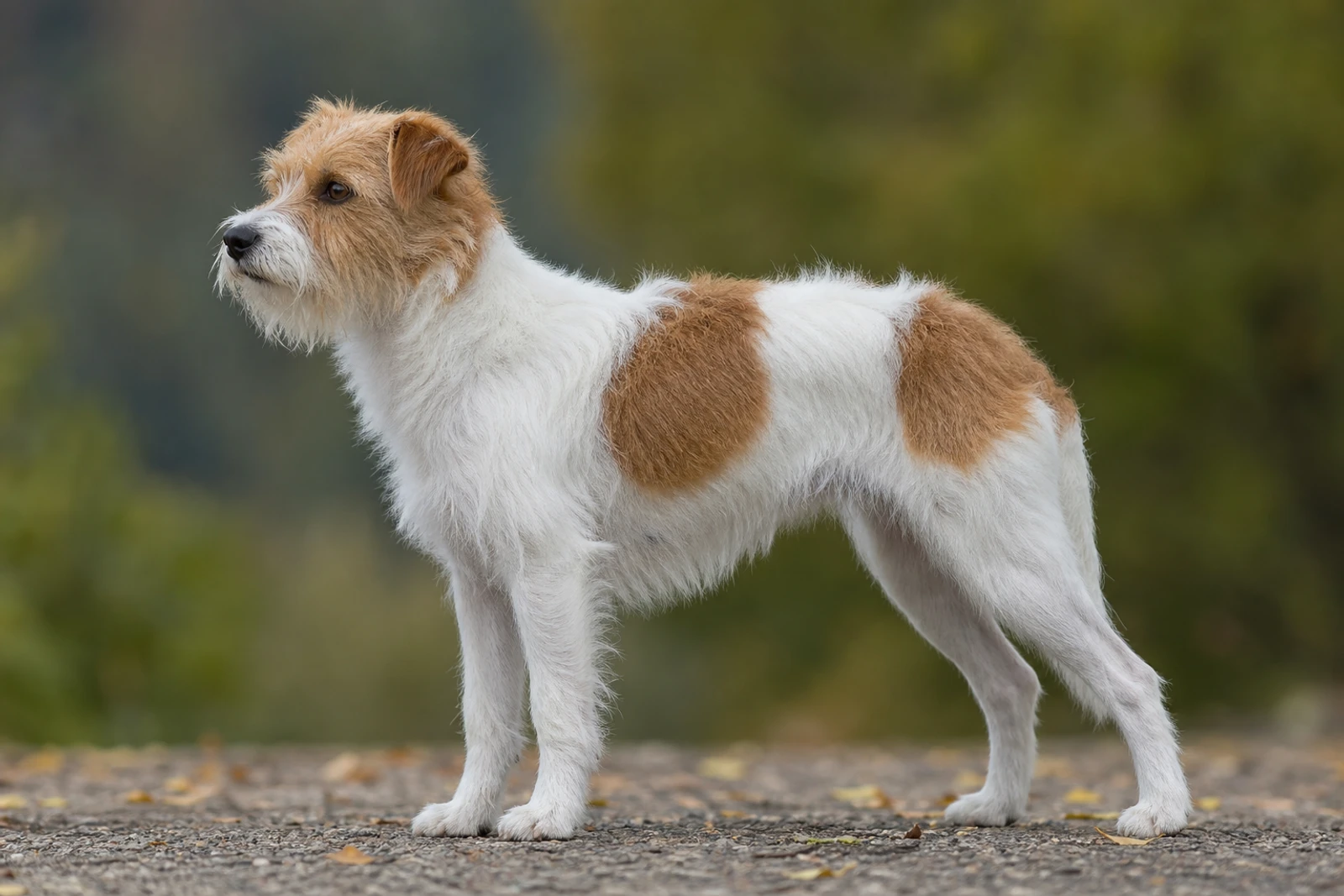
The Kromfohrländer is a rare, medium-sized companion terrier from Germany, celebrated for its cheerful and adaptable nature. This breed thrives in active homes, forming deep bonds with its family and getting along well with children and other dogs. Intelligent and trainable, they respond best to positive, consistent methods. With moderate exercise needs and a low-shedding coat, they fit well into various lifestyles, from apartments to houses with yards. Best suited for owners seeking a devoted, playful friend who enjoys both cuddle time and outdoor adventures.
At a glance
- Size
- Medium
- Height
- 15–18 in
- Weight
- 20–35 lb
- Life span
- 13–14 years
- Coat colors
- White with brown patches, White with black patches, White with tan patches
- Coat type
- Short, dense, and wiry or smooth double coat
- Group
- Terriers
How much does a Kromfohrländer cost?
Adopt / rescue
$75–$400
Usually includes spay/neuter, first shots, and a microchip.
Buy from a breeder
$700–$2,000
From a reputable, health-testing breeder.
Approximate USD. Prices vary widely by region, breeder, pedigree, age, and coat colour — adopting is the lower-cost and recommended route. Avoid suspiciously cheap “breeders”; they’re often puppy mills.
Estimate the full cost of a Kromfohrländer →Want the ongoing number? Estimate the monthly food bill for a Kromfohrländer with our dog food cost calculator.
Kromfohrländer photos
Views
Front, side, rear and top — the full silhouette.Poses
How the breed sits, lies, moves and plays.Puppy to senior
The breed across its whole life.Expressions
The breed’s range of moods.Close-up details
Eyes, ears, nose, paws, tail and coat.Coat colors
The breed’s recognized colors.Click any photo to enlarge. We show the Kromfohrländer from every angle — three views, poses, life stages, expressions, close-ups, coat and colors.
Appearance & size
All Kromfohrländers share the same well-balanced, medium-sized frame, but the first thing you’ll notice is the coat—this breed comes in two distinct varieties that look quite different at a glance. The underlying build is consistent: 15 to 18 inches at the shoulder, 20 to 35 pounds, with males typically landing at the top of those ranges. The body is slightly longer than tall, giving a rectangular, workmanlike silhouette that’s sturdy without ever appearing heavy.
From the front, the forelegs stand straight and parallel, ending in tight, oval feet with well-arched toes. The chest is deep, reaching to the elbows, and the ribs are well sprung. The head is a clean wedge with a moderate stop, carried on a neck of medium length that blends smoothly into laid-back shoulders. The eyes are dark brown, oval, and set apart with a bright, curious expression that strips any severity from the picture.
Viewed from the side, the topline is straight and firm, the loin short, and the tail set high—it’s carried in a gentle sickle curve or like a saber, never curled tightly over the back. The rear matches the front in balance: muscular thighs, well-angled stifles, and hocks that are distinctly let down.
Coat types and color
The smooth-coated variety (Glatthaar) wears a short, dense, harsh coat that lies flat, with virtually no undercoat. It feels crisp to the touch, never soft or silky. The wire-coated variety (Rauhaar) has a medium-length, rough, harsh outer coat with a dense undercoat, forming a distinct beard, bushy eyebrows, and longer furnishings on the legs—but it stays tidy, never fluffy or woolly.
Color is unmistakably Kromfohrländer: the base is always white, with patches of brown (light liver to deep chocolate) or orange (light golden to rich red) on the head and body. The head often sports a symmetrical half-mask or blaze, a white muzzle, and one or two eye patches. A large colored saddle or “cloak” over the back and a spot at the base of the tail are common and desirable. Pigment on the nose and eye rims matches the coat—black with orange or dark brown patches, liver with lighter brown patches. Ticking on the legs or body appears sometimes, but the crisp white background always stays dominant.
The overall impression is of an amiable, athletic terrier with zero coarseness. The wire coat’s eyebrows and beard lend an alert, almost quizzical expression, while the smooth coat reads as a slick, no-fuss working terrier. Either way, you’re looking at a compact, cheerful dog built to go all day without weighing you down.
History & origin
World War II had barely ended when a stray dog with a rough, terrier-like coat and an easygoing nature wandered into an American soldier’s path in France. That dog—later named Peter—didn’t go home with the soldier. Instead, he ended up in the hands of Ilse Schleifenbaum, a German woman who saw something worth preserving. In 1945, she took Peter to her home in the Siegerland region of Germany and, with a smooth-coated Fox Terrier-type female, laid the foundation for an entirely new breed.
Schleifenbaum’s goal wasn’t to create a working terrier or a hunting dog. She wanted a healthy, midsize companion with a rock-solid temperament—a dog that would fit easily into family life. Peter’s pups had the right stuff: friendly, adaptable, and smart, with two distinct coat types (wire-haired and smooth) that showed up right from that first generation. No further outcrosses ever went into the breed. Every Kromfohrländer alive today traces back to Peter and those initial pairings.
The name itself comes from the estate where the first litter was whelped—Krom Fohr, which translates to something like “crooked furrow.” That quirky name stuck, and by 1955 the Fédération Cynologique Internationale (FCI) granted full recognition. While the breed fact sheet lists them under the Terrier group, the Kromfohrländer was never meant to bolt foxes or go to ground. They’re companion dogs through and through, a role they’ve quietly filled for decades without chasing the spotlight.
Outside Germany, the breed remains scarce. Dedicated breeders in Europe and a handful of other countries keep numbers small and carefully managed, with a studbook that’s still closed. A Kromfohrländer today is 15–18 inches tall, 20–35 pounds, and lives 13–14 years, but those are just numbers. The real story is that a single stray, a bit of post-war hope, and a breeder’s vision turned into a steady, affectionate dog that rarely makes headlines—and that’s exactly the way its admirers like it.
Temperament & personality
The Kromfohrländer is a dog that reads the room. These are steady, people-centered companions who watch you more than they watch the door, and they settle into your rhythm without a lot of fuss — as long as you include them. A Kromi left alone in the backyard or ignored for hours can tip into anxious barking or destructive chewing, because this is not a breed built for solitude. They need to be near their humans, soaking up the daily hum of the household.
You get a dog that’s affectionate but rarely needy in a frantic way. Think of a calm, soft-eyed presence that curls up under your desk while you work, then springs to life the moment you grab the leash. Energy is solidly medium: a long walk, a game of fetch, or a short hike satisfies them, but they won’t ricochet off the walls on a rainy day. A 20–35 lb dog with this build can live happily in an apartment if you commit to daily outings.
With family, a well-socialized Kromohrländer is gentle and patient, but you need to teach kids the house rules. Never interrupt the dog during meals; food guarding can surface if they feel cornered. Other canine manners — a stiff, forward-leaning posture, hard staring — are clear red flags that even this sweet-natured dog will use when uncomfortable. Pay attention also to lip licking, yawning, or the turn of a head. Those are a Kromi’s polite way of saying “please back off,” and respecting those signals builds trust.
Training works best when you treat their clever, sometimes willful streak with consistency, not force. Praise and a treat immediately after they potty outside locks in house-training faster than any scolding over an accident. And if you find your Kromohrländer rolling in something unmentionable, you’re witnessing an old scavenger instinct — some dogs simply revel in strong smells the way we enjoy a scented candle. A vinegar spray can neutralize the spot (and the odor) afterward.
This is a watchful breed that announces visitors with a bark but rarely escalates. A relaxed body and soft eyes tell you they’re at ease. If you provide that same feeling — predictable routines, plenty of contact, and no harsh handling — you get a dog that brings calm steadiness to every room they walk into.
Good with kids, dogs & other pets
The Kromfohrländer’s patient, non-aggressive temperament makes them one of the easier terriers to live with around children. They rarely startle or snap, and a 20–35 pound body means they’re sturdy enough for gentle play without accidentally flattening a toddler. That said, always supervise with very young kids. A toddler who lurches, grabs an ear, or trips can overwhelm a dog that’s sensitive by nature. Teach children to use soft hands and give the dog a quiet retreat spot. The breed’s strong people-orientation means they actually enjoy a busy family room, but they’ll shut down emotionally if play gets too rough or chaotic.
With other dogs, a Kromfohrländer is more reserved than rowdy. They are not the dog that instantly romps with every stranger at the park. Low sociability scores mean early and ongoing socialization is non-negotiable. The critical window closes around 16 weeks; before then, gently expose a puppy to well-mannered adult dogs, one calm introduction at a time. Forced greetings with pushy dogs can backfire into fear or defensive snapping. In a multi-dog home, a slow, low-pressure intro and fair supervision around resources (toys, food) usually leads to peaceful coexistence. They can live happily with another dog, but they won’t necessarily crave a canine crowd.
Cats and small pets require a touch of terrier reality. The Kromfohrländer has a mild chase instinct that can kick in when something small darts. A cat who holds its ground often earns respect, especially if the dog grows up with it. For fragile pocket pets like rabbits or guinea pigs, keep enclosures securely out of reach and never leave the dog unsupervised. The drive isn’t manic, but it’s part of the package.
Socialization isn’t a one-and-done puppy class. Start before 16 weeks with a wide net of friendly kids, different surfaces, city sounds, and short, cheerful vet visits. Without that foundation, fear of unfamiliar people and sudden noises can settle in hard. A poorly socialized adult may become chronically skittish or reactive, and while patient desensitization helps, it’s far more work later. This breed also hates being left alone for long stretches—isolation can morph into anxiety that undercuts an otherwise lovely kid-dog bond. If your household is empty most of the day, a Kromfohrländer is not the right fit. They belong under the kitchen table during homework, not alone in the backyard.
Trainability & intelligence
The Kromfohrländer is a terrier through and through: quick on the uptake, intensely tuned in to you, and more than capable of outsmarting a lazy trainer. That brainpower doesn’t mean they’re automatic people-pleasers. These dogs think for themselves, and if the payoff isn’t clear, they’ll find a better offer.
What works
- Short, upbeat sessions that feel like a game. Treats, a squeaky toy, or a quick game of tug all beat a stern voice.
- Clear, patient repetition. A Kromi picks up new cues fast, but you’ll earn reliable obedience only after you’ve built trust. If a request feels arbitrary, they’ll ignore it without breaking eye contact.
- Early impulse-control work. A solid “leave it” and a long-line recall taught in puppyhood go a long way — their terrier nose and prey drive won’t switch off just because you ask nicely.
Where folks slip up
- Getting heavy-handed. Raise your voice or jerk the leash, and a sensitive Kromi may shut down, lose focus, or even duck away from your hand. Trust erodes quickly and takes ages to rebuild.
- Skipping the socialization grind. Low-key wariness of strangers is common. Puppies need gradual, positive exposure to new people, dogs, sounds, and surfaces well before 16 weeks, and continued practice after that. Without it, you risk an adult dog who barks at guests and tenses up on walks.
Recall is an honest challenge. A movement in the hedge can override months of training. Keep a long drag leash in new places until you’re dead certain the dog will peel off a squirrel. And never punish a slow recall — that dog will simply stay out of arm’s reach next time.
In the end, you’re not bargaining with a push-button dog. You’re building a partnership with a whip-smart terrier who watches everything you do. Once that relationship is solid, you can shape all sorts of fun behaviors, from trick routines to reliable off-leash hiking. Just don’t mistake that compact 20–35 lb frame for a dog who doesn’t need daily mental work.
Exercise & energy needs
The Kromfohrländer is an eager, quick-moving companion with a working terrier’s need for daily purpose — not just a quick stroll. Plan on 45 to 60 minutes of real exercise a day, split into at least two sessions. A slow amble won’t cut it. This dog thrives on a mix of brisk walks, off-leash romps in a fenced area, and focused play that works the brain as much as the body.
Because the breed comes from farm stock that hunted vermin and guarded property, they’re wired to notice everything. A walk that lets them sniff, investigate, and problem-solve can tire them out more than doubling the mileage on pavement. Incorporate scent games, puzzle toys, or short hide-and-seek drills into your daily routine. These dogs often shine in nose work, barn hunt, and earthdog trials — activities that channel their terrier instincts constructively.
Intensity matters more than sheer duration. A 20-minute flirt pole session or a game of fetch with commands mixed in does more to satisfy this dog than an hour of passive walking. Kromfohrländers are agile and love to learn, so agility, rally, or trick training are excellent outlets. Just avoid high-impact jumps on hard surfaces while they’re growing; responsible owners protect developing joints.
Without enough engagement, the Kromfohrländer can invent his own jobs — digging, vocalizing, or following a nose over the fence. You’ll see a noticeable lift in contentment and manners when the exercise split leans toward two solid blocks of active, brain-engaging work rather than one forgettable lap around the neighborhood.
Grooming & coat care
The Kromfohrländer’s coat comes in two distinct styles, and which one you live with shapes nearly everything about your grooming routine. The rough-coated variety wears a dense, wiry topcoat over a soft undercoat, while the smooth-coated dog has a short, flat, close-lying jacket with almost no undercoat. Both shed moderately, but they ask for different tools and rhythms.
For the rough coat, a metal slicker brush with rounded pins is your go-to. Work through the coat down to the skin twice a week to pull out loose undercoat and stop tangles before they form. During spring and fall blowouts, bump that to daily brushing; a steel comb behind the ears and under the legs prevents hidden mats. A pin brush can help detangle longer feathering on the legs and tail. Smooth-coated Kromis need much less — a quick once-over with a soft pig-bristle brush once a week distributes natural oils and puts a healthy shine on that sleek coat.
Bathe only when the dog is truly dirty or starts to smell. Overbathing strips the rough coat of its harsh texture and can soften it, which you don’t want. A few times a year is plenty for most. A damp wipe-down or a rinse after a muddy romp often does the job instead.
Trimming is minimal. The rough variety benefits from hand-stripping a couple of times a year to maintain the correct wiry feel and keep dead hair from clogging the coat, but many owners have a groomer do this. You can neaten up straggly hairs around the paws and ears with blunt-tipped scissors if needed. The smooth coat needs no clipping at all.
Nails grow quickly on this active terrier. Check them every three to four weeks and clip or grind as needed — if you hear clicking on hard floors, they’re overdue. Ears deserve a weekly once-over; the breed’s drop ears can trap moisture, so a gentle wipe with a clean, damp cloth keeps things dry and infection-free. Teeth brushing two or three times a week, plus a daily dental chew, will keep tartar at bay.
The right brush makes all the difference, but don’t ignore what’s under the coat. Regular handling during grooming lets you catch small skin issues, hot spots, or the grass seeds these curious dogs pick up outdoors.
Shedding & allergies
If your version of a badge of honor is a black sweater you can wear straight out of the laundry basket, a Kromfohrländer might just let you keep it. But the real story depends on which coat you live with.
The breed comes in two varieties: wire-haired and smooth-haired, and they shed very differently.
- Wire-haired Kromis barely shed in the traditional sense. The harsh, wiry outer coat traps loose undercoat instead of dropping it on the floor. That means you’ll see almost no daily hair tumbleweeds — but you do need to hand-strip the dead coat a few times a year, or the dog becomes a matted mess. If you’re committed to that grooming routine, you’re rewarded with a dog that leaves remarkably little hair behind.
- Smooth-haired Kromis have a dense, plush double coat that sheds moderately year-round, with a real uptick during spring and fall. During those seasonal blowouts, daily brushing with a slicker or deshedding tool keeps the confetti under control, but you’ll still find hair on the couch and in the car. This isn’t a Labrador-level blizzard — it’s a consistent, manageable scatter.
Drool is a non-issue. Neither variety is jowly; you won’t find strings hanging from chins, even after a big drink of water.
Now for the allergy conversation. No dog is truly hypoallergenic — the proteins that trigger reactions are in dander, saliva, and urine, not just hair. Because a well-maintained wire-haired Kromi sheds so little floating hair and dander, some allergy sufferers find them easier to live with. The smooth coat, with its steady shedding, releases more dander into the air. If allergies are a concern, spend a few hours in an actual Kromfohrländer home before committing. The wire-haired coat plus a disciplined stripping schedule gives you your best shot, but a guarantee? That doesn't exist.
Diet & nutrition
Portion control matters more with a Kromfohrländer than you might guess from his medium size. Some lines are real chowhounds, and an extra half-cup a day can quickly nudge a 20–35 lb dog into overweight territory. Once the ribs disappear under a soft layer of fat, the added strain on knees and elbows becomes a long-term worry you don’t want.
A healthy adult usually thrives on two measured meals a day. For a moderately active 25-pounder, that often means about 1 cup of high-quality dry kibble daily, split into two servings; a more driven 35-pound dog who has just logged a solid hour of hard running may need closer to 1½ cups. Always go by body condition, not just the scoop—you should feel the ribs with a light touch and see a visible waist tuck from above.
- Puppies (8 weeks – 4 months): Four small, evenly spaced meals each day. Start with a high-quality puppy food or a gradually introduced blend of lightly cooked, puréed meats, fish, fruits, and veggies. Around 12 weeks, a raw chicken wing supervised on a safe surface is a great tooth-cleaning treat.
- 4 – 6 months: Drop to three meals a day. Portions increase slowly as the frame lengthens, not the waistline.
- 6 months and older: Move to the adult two-meal rhythm. Keep an eye on growth pace; fast, chunky growth is hard on developing joints.
Seniors (around 10 and up) often slow down. Slash the daily ration a bit if the dog isn’t covering the same miles, because obesity gets harder to manage with a creaky body. For an older dog with missing teeth or sensitive gums, purée the meals or soak kibble to improve nutrient absorption; there’s no need to cut protein unless your vet says so.
Kitchen smarts. Kromfohrländers who bolt their food benefit from a puzzle bowl—it turns a 30-second inhale into a mental workout. Keep table scraps out of the picture entirely; even small bits of fatty holiday leftovers can trigger a nasty bout of pancreatitis. If you want to add variety, a spoonful of plain cooked pumpkin, an egg, or some unsalted vegetable water mixed into the food is all the “gravy” they’ll ever need. Cook extra batches of barley, diced sweet potato, or lean ground meat once a week and you’ve got ready-made healthy add-ins that never beg at the table.
Health & lifespan
A well-cared-for Kromfohrländer routinely lives 13 to 14 years, and many stay active right up to the end. This isn’t a breed saddled with a long list of inherited nightmares, but a few issues do crop up often enough that responsible breeders take them seriously.
Screenings that matter
Before you bring a puppy home, ask to see written results for two things: patellar luxation (slipping kneecaps) and a hereditary eye exam. Both can show up in the breed, though they’re far from guaranteed. A breeder who tests through OFA or CERF isn’t being fussy — they’re stacking the deck in your favor. If you notice a hop-and-skip limp or your dog squinting a lot, don’t shrug it off. Catching a trick knee or early lens changes small keeps a manageable problem from turning into an expensive surgery.
Daily habits that add years
Kromfohrländers run 20 to 35 pounds as adults, and they rarely turn down a meal. Weight management is the single biggest lever you can pull for a long life. Extra pounds hammer those knees and set the stage for joint trouble later. Measure the kibble, skip the table scraps, and keep treats tiny. You should feel ribs without digging.
Like many terriers, they can develop dry, itchy skin. A diet with solid omega-3s — fish oil is an easy win — often clears it up. Monthly heartworm prevention during mosquito season (and for a month after it ends) is non-negotiable; heartworm is silent and deadly. Rabies vaccination isn’t optional either — it’s legally required, and there’s no effective treatment once symptoms appear.
The stress connection
A Kromfohrländer who’s handled gently and socialized early doesn’t just behave better — they’re physically healthier. Chronic stress from isolation or harsh training can suppress the immune system and fuel anxiety-driven gut issues. This is a sensitive, people-focused dog that needs to feel like part of the family. Neglect that, and you’ll likely pay for it in vet bills.
Schedule an annual wellness exam, and step it up to twice a year once your dog hits age 10. Subtle shifts — a drop in appetite, less enthusiasm for walks — are often the first clues something’s off.
Living environment
Kromfohrländers adapt to apartment life better than you'd expect from a terrier—but only if you can meet their daily quota of movement and mental work. This is not a dog who can be crated for an eight-hour shift while you’re at the office, then walked around the block. They bond hard to their people and can slide into noisy separation anxiety when left solo for long stretches. A house with a flexible schedule, a midday dog walker, or part-time daycare fits them best.
A fenced yard is a perk, not a requirement. You’ll still need structured outings twice a day, totaling at least 60 minutes—think two brisk 30-minute walks spiced up with fetch or a flirt pole session. Without that outlet, bored energy turns straight into barking. These terriers are sharp little watchdogs; doorbells, hallway footsteps, and street clatter all get a vocal commentary. Apartment dwellers will want to start “quiet” training early and lean on brain games to take the edge off. A snuffle mat, scattered-meal hunts, or 10-minute nosework sessions indoors go a long way toward a peaceful evening.
Climate tolerance is decent but not extreme. Their medium coat shrugs off chilly mornings, yet hot pavement and midday sun knock them down fast. On summer days, walk early and late, keep grass underfoot, and always bring water.
The real must-have isn’t square footage—it’s near-constant togetherness. A Kromfohrländer doesn’t want to be a yard ornament or a separate-room sleeper. Set up a dog bed by your desk or couch, and expect a shadow that follows you room to room.
Who this breed suits
This dog clicks with people who want a medium‑sized, affectionate partner that has a terrier’s sharp brain but not the full terrier stubbornness. At 20–35 lb and 15–18 inches tall, the Kromfohrländer is sturdy without being unwieldy, affectionate without smothering you, and ready for a good daily workout — think a brisk hour of walking, off‑leash fetch, or agility sessions, not just a quick lap around the block.
- First‑time owners get a dog that genuinely wants to please. These Kromis learn fast if you keep training upbeat and consistent. You’ll still need to set clear boundaries, but the breed’s softer nature means you’re less likely to butt heads than with some other terriers.
- Active families will love the dog’s playfulness and steady temperament. The Kromfohrländer is typically gentle with school‑age kids and has the energy to keep up with backyard games. Teach children how to interact respectfully, and you get a loyal, four‑legged playmate who’s just as happy curling up on the couch afterward.
- Singles and seniors who stay moving are a strong match. If your routine already includes daily long walks or you enjoy a canine hiking buddy, a Kromi slots right in. They aren’t hyper machines, but they need real exercise and mental engagement — they’ll let you know if they’re bored by finding creative “projects” around the house.
- People who work from home or have a stay‑at‑home adult get a loving shadow. This breed forms a tight bond and does not do well being left alone for eight‑plus hours day after day. Separation anxiety can surface if the dog becomes isolated, so plan for company or doggy daycare.
Think twice if your life demands a dog that’s undemanding. A Kromfohrländer isn’t a lapdog you can ignore. The wire‑haired variety needs hand‑stripping several times a year to keep its coat healthy and tidy, and the smooth coat still sheds. If your schedule rarely includes a solid hour of outdoor activity, or you want a dog that greets every stranger like an old friend — Kromis are often reserved with new people and need early, positive socialization — you’ll be fighting the dog’s nature. Skip this breed if the idea of daily walks plus weekly coat care sounds like a chore rather than a partnership.
Cost of ownership
A Kromfohrländer isn’t a bargain-bin dog. The breed’s small gene pool means puppies are never plentiful, and a well-bred dog from health-tested parents typically costs $1,500–$3,000. Responsible breeders screen for patellar luxation, eye conditions, and thyroid function, and they rarely have litters available without a waiting list. Rescue placements do happen, though they’re uncommon — budget $200–$500 if you go that route.
Once your dog is home, monthly expenses settle into a predictable rhythm:
- Food: A 20–35 lb dog eating high-quality kibble will run $30–$60 per month. Treats and chews tack on another $10–$20.
- Grooming: The dense, tousled coat resists matting but looks its best with professional attention every 6–8 weeks. Plan on $45–$65 per visit, averaging out to $25–$40 monthly. Between appointments, a slicker brush and a stripping tool handle the shedding (which is minimal).
- Veterinary and preventatives: Annual checkups, core vaccines, and year-round heartworm/flea/tick prevention combine for roughly $30–$50 a month. The first year runs higher due to puppy shots and spay/neuter surgery.
- Insurance: A policy covering accidents and illness for a medium-sized breed typically falls in the $35–$50 per month range. Given that patellar luxation or hereditary eye problems can require surgical correction, it’s a wise hedge.
- Training: Kromfohrländers are quick, independent thinkers. A six-week group obedience class ($120–$200) early on pays off for a decade. Spread that cost over year one, and it adds $20–$30 per month.
Realistically, you’re looking at $130–$230 in routine monthly costs, not counting one-time supplies like a crate, bed, and leash. For a sturdy, 13–14 year companion that won’t coat your house in hair, that’s a fair deal.
Choosing a Kromfohrländer
If you’re set on a Kromfohrländer, your first reality check is that these dogs are still very rare outside Germany and a handful of European countries. Finding one in the U.S. usually means a deliberate search for a breeder, often with a waitlist. Rescue Kromfohrländers exist but are uncommon; when they do appear, it’s often through a breed-specific network or an adult dog whose imported family couldn’t handle the terrier spark. Adopting an older dog gets you a known personality, which can be a real advantage with a lively, clever 20–35 lb dog. Whether you go breeder or rescue, getting a healthy dog starts with thorough health screening.
A responsible Kromfohrländer breeder treats health clearances as non-negotiable. The breed is generally sturdy into the 13–14-year range, but issues can crop up. Insist on seeing current OFA or PennHIP evaluations for hip dysplasia—both parents should score well. Patellar luxation is another concern in a medium terrier, so ask for a patella clearance. Eye exams by a boarded veterinary ophthalmologist are a must; ask about testing for hereditary cataracts and primary lens luxation (PLL), as these can affect some lines. Some breeders also screen for von Willebrand’s disease Type 1, a bleeding disorder. Don’t accept a verbal “the dogs are healthy.” You want the actual documentation, ideally linked to the Orthopedic Foundation for Animals or the Canine Health Information Center.
Red flags aren’t subtle. Walk away from any breeder who can’t produce those clearances, has multiple litters on the ground constantly, or won’t let you meet the dam on-site. A good breeder will pepper you with questions about your lifestyle, yard, and experience with active terriers—and they’ll be equally transparent about challenges. Because Kromfohrländers are scarce, you may encounter importers who aren’t true preservation breeders. Ask how long they’ve been in the breed, whether they’re a member of the parent club (if one exists in your country), and what they do with the dogs beyond producing puppies—showing, performance sports, or therapy work are all good signs. A breeder who ships a puppy without any in-depth conversation? That’s your cue to keep looking.
When you finally visit a litter, watch the whole setup. Puppies should be raised in a household area, not a kennel or basement. At 6–8 weeks, a Kromfohrländer puppy is curious, bouncy, and ready to investigate your shoelaces. Spend time with the mother to gauge her temperament—she should be friendly, confident, and attentive, not skittish or aggressive. Pick a puppy that approaches calmly, plays with littermates without bullying, and recovers quickly from a startle (like a clap). This isn’t a breed for a docile wallflower; you want a pup with a good off-switch but enough nerve to handle new situations.
Don’t overlook rescue just because the breed is rare. A Kromfohrländer might land in a shelter or foster-based rescue after a move, divorce, or an owner who discovered the terrier-level smarts and digging habit too late. A rescue that assesses dogs in a home environment gives you an honest read on housetraining, leash skills, and whether the dog tolerates kids or cats. An adult from a responsible source can slide into your life with far less chaos than a 10-week-old land shark, and you still get the breed’s signature combo of warm family dog and alert watchdog. Wherever you find your Kromfohrländer, the goal is a sound, social dog whose breeder or rescuer stays available with advice long after the paperwork is signed.
Pros & cons
Pros
- Family-first temperament. Bred to be a companion, the Kromfohrländer genuinely likes people and bonds tightly with its household. With early socialization, it’s patient and gentle with kids, often following them from room to room.
- Apartment-friendly size and exercise needs. At 20–35 lb and 15–18 inches tall, this is a dog that fits under a cafe table. A solid 30–45 minute walk plus a couple of fetch sessions or a fenced-yard romp typically scratches the activity itch — no marathon runs required.
- Low-shedding wirehaired variety. The rough-coated type sheds so little you’ll mostly find hair in the brush, not on the furniture. Even the smooth coat sheds only moderately, making this breed a solid choice for tidy homes.
- Sharp but not sharp-edged watchdog. They notice everything and will announce visitors with a bark, but they’re not looking for a fight. Proper socialization teaches them to settle down after the introduction.
- Long-lived and generally robust. A lifespan of 13–14 years is common, and many stay spry well into their teens. Responsible breeders screen for patellar luxation, epilepsy, and eye issues, so you stack the deck in your favor.
Cons
- Stranger wariness is baked in. This is not a “love everyone instantly” breed. Without consistent, positive introductions from puppyhood, they can become timid, skittish, or reactive around unfamiliar people and dogs.
- A voice they aren’t shy about using. Terrier roots run deep. A Kromfohrländer will bark at doorbells, delivery trucks, squirrels, and anything that looks out of place. In shared-wall housing, that means real training work to keep the peace.
- Grooming isn’t set-it-and-forget-it. The wirehaired coat needs hand-stripping every few months and weekly brushing to avoid mats. Smooth coats shed year-round and require regular combing. Skip it, and you’ll have a scruffy, uncomfortable dog.
- Separation anxiety can creep in. This breed attaches hard and doesn’t like being abandoned for eight-hour workdays. Left alone too long, they may howl, chew drywall, or potty indoors — a crate alone won’t fix the root loneliness.
- Smarter than they are obedient. Quick to learn routines and house rules, they’re also independent thinkers who’ll weigh whether a “sit” is really worth the cheese. First-time owners can find the stubborn streak exhausting if they come in expecting a push-button dog.
Similar breeds & alternatives
If the Kromfohrländer’s easygoing size and terrier roots caught your eye, a few other medium breeds often land on the same shortlist — each with a different spin on temperament, coat demands, and day-to-day rhythm.
- Soft Coated Wheaten Terrier: A couple of inches taller and roughly 5–10 pounds heavier, the Wheaten shares that shaggy, cheerful look. But where the Kromfohrländer stays moderate and amiable, the Wheaten leans into full-throttle gregariousness — the famous “Wheaten greetin’” can include jumping and a stubborn streak. They need firmer training consistency and can be more selective with same-sex dogs. Coat: silky, single-layered, and low-shedding, but a high-maintenance grooming schedule. Pick a Wheaten if you want a bigger personality and don’t mind channeling a little terrier sass.
- Tibetan Terrier: Similar weight range, though slightly smaller in height. The Tibetan Terrier’s long, thick double coat barely sheds but demands daily brushing and regular trims. Temperament-wise, they’re intelligent and devoted but often more aloof with strangers and a bit more independent indoors. While a Kromfohrländer warms up and stays biddable, the Tibetan Terrier can be a touch more watchful and less automatically social with other dogs — not a problem, but a different flavor of companion.
- Lagotto Romagnolo: At 25–35 pounds and 16–19 inches, the Lagotto nearly matches the Kromfohrländer’s footprint. Both are sturdy, family-oriented, and naturally reserved with people they don’t know. The big split is drive: Lagotti were bred to hunt truffles and retrieve from water, so they carry a stronger working engine and a nose that never clocks out. Without daily mental work — scent games, puzzle feeders, retrieving — boredom digs literal holes. The curly, wool-like coat sheds very little but requires clipping every 6–8 weeks. The Kromfohrländer is the lower-octane choice with a more forgiving, looser coat that makes do with weekly brushing.
All three live roughly as long (13–15 years) and fit the same medium-dog housing niche. The difference boils down to how much grooming you’ll keep up with, and whether you want a dog that settles into your routine or one that pulls you toward a bit more action or sass.
Fun facts
- The breed descends from a single dog named 'Peter' discovered by a German soldier in France during World War II.
- They come in two coat varieties: smooth and wire-haired, both with a distinctive white base and colored patches.
- Kromfohrländer means 'crooked fur land,' referencing the Siegerland region’s hilly terrain where the breed was developed.
- They are known for their 'smiling' expression, with expressive eyes and a natural grin.
Frequently asked questions
- Is the Kromfohrländer good with children?
- Kromfohrländers tend to be friendly and patient with children, especially when socialized early. Their energetic nature can be boisterous, so supervised interactions with small kids are recommended. With proper training, they often make loving family companions.
- How much does a Kromfohrländer shed?
- Shedding depends on coat type: wire-haired Kromfohrländers shed very little, while smooth-haired ones may shed moderately. Regular brushing can help control loose hair in both varieties.
- How much exercise does a Kromfohrländer need?
- This active breed needs daily physical and mental stimulation, such as a long walk plus play or canine sports like agility. Without adequate exercise, they may channel their energy into undesirable behaviors.
- What are the grooming requirements for a Kromfohrländer?
- Wire-haired coats require brushing a few times per week and occasional hand-stripping to maintain texture, while smooth coats benefit from weekly brushing. Both types need routine nail trims and ear cleaning.
- Can a Kromfohrländer live in an apartment?
- They can adapt to apartment living if given sufficient daily exercise and mental enrichment. However, their alertness may lead to barking, so early training to curb excessive vocalization is helpful in close quarters.
Tools & calculators for Kromfohrländer owners
Quick estimates tailored to Kromfohrländers — pre-filled with this breed’s size where it matters.
Articles & stories about the Kromfohrländer
Sources & standards
This profile follows recognized breed standards from the American Kennel Club (AKC) and the Fédération Cynologique Internationale (FCI), along with established veterinary and breed-club guidance. These describe general breed tendencies — every dog is an individual.