

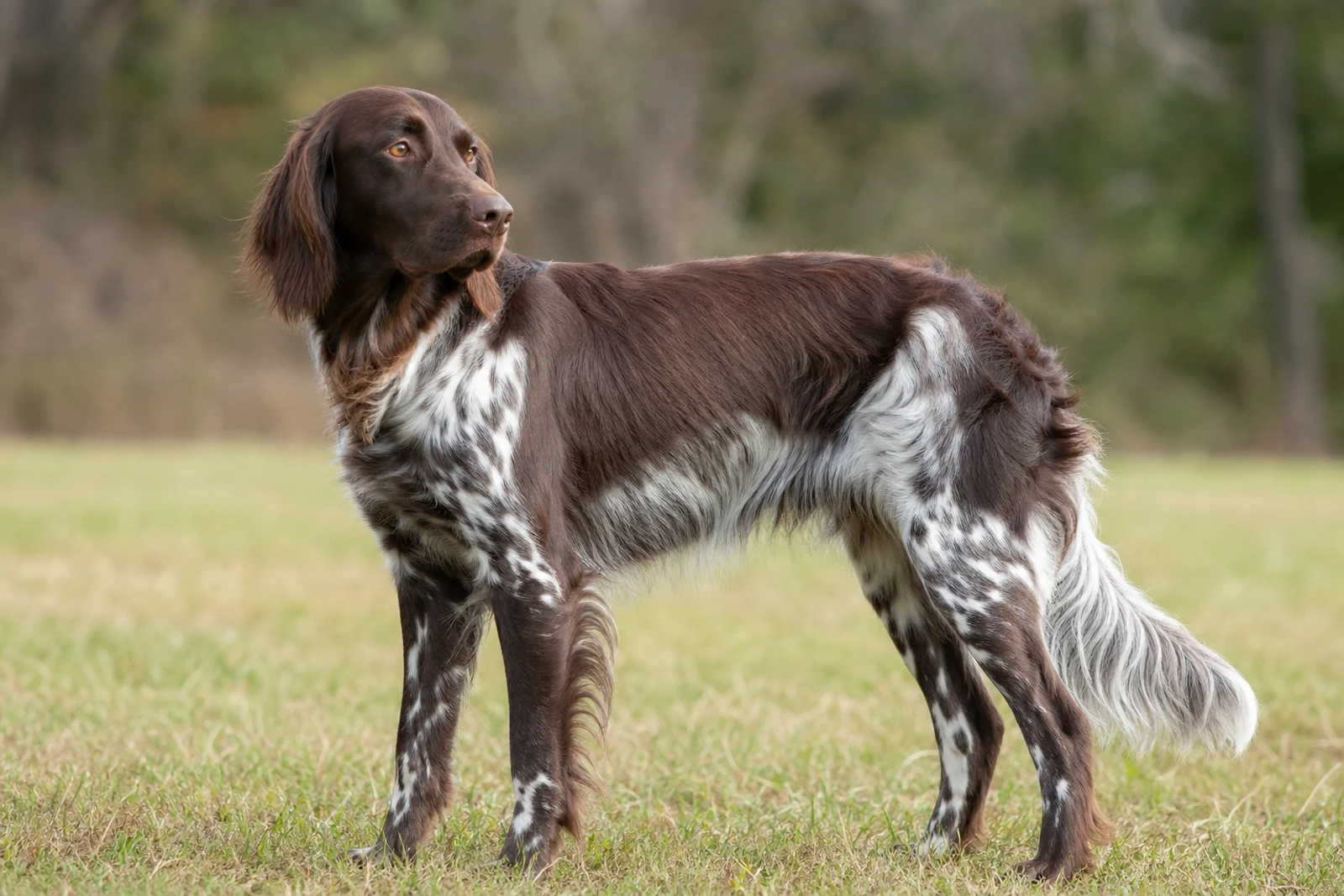
The Large Munsterlander is an athletic, versatile hunting dog who thrives with active families or individuals able to provide ample exercise and mental stimulation. Their gentle, affectionate nature makes them loving companions, but their high energy and strong prey drive demand a job or vigorous daily activity. They excel in canine sports and field work, bonding deeply with their people. Not ideal for apartment dwellers or first-time owners, they suit experienced handlers who appreciate a loyal, intelligent partner both in the field and at home.
At a glance
- Size
- Giant
- Height
- 23–26 in
- Weight
- 65–68 lb
- Life span
- 12–13 years
- Coat colors
- White with black patches or ticking
- Coat type
- Medium-length, dense, water-repellent double coat with feathering
How much does a Large Munsterlander cost?
Adopt / rescue
$75–$400
Usually includes spay/neuter, first shots, and a microchip.
Buy from a breeder
$700–$2,000
From a reputable, health-testing breeder.
Approximate USD. Prices vary widely by region, breeder, pedigree, age, and coat colour — adopting is the lower-cost and recommended route. Avoid suspiciously cheap “breeders”; they’re often puppy mills.
Estimate the full cost of a Large Munsterlander →Want the ongoing number? Estimate the monthly food bill for a Large Munsterlander with our dog food cost calculator.
Large Munsterlander photos
Views
Front, side, rear and top — the full silhouette.Poses
How the breed sits, lies, moves and plays.Puppy to senior
The breed across its whole life.Expressions
The breed’s range of moods.Close-up details
Eyes, ears, nose, paws, tail and coat.Coat colors
The breed’s recognized colors.Click any photo to enlarge. We show the Large Munsterlander from every angle — three views, poses, life stages, expressions, close-ups, coat and colors.
Appearance & size
The first thing you notice is a dog built to cover ground with effortless, flowing strides — a pointer through and through, but draped in a long, silky coat. Males stand 24 to 26 inches at the shoulder; females 23 to 25 inches. Weight hovers between 65 and 68 pounds, with females naturally at the lower end. That’s a lot of dog, but the Large Munsterlander never comes across as heavy or coarse. The frame is rectangular — longer than tall — with a deep chest, strong back, and a lean, athletic waist.
The coat is the breed’s hallmark. It’s long, dense, and either straight or slightly wavy. Feathering flows from the backs of the ears, down the chest and belly, along the backs of the forelegs and thighs, and culminates in a lavish plume on the tail. The color is always some version of black and white. You’ll see solid black patches on a white ground, blue roan, heavy ticking, or dogs that look nearly solid black with white blazes, chest markings, and white feet. A blue-black sheen in the dark areas is prized. There are no liver, no tri-color, no other acceptable colors.
From the front, the chest is broad and well-sprung, but the forelegs are straight and set cleanly under the body — no out-at-elbows stance. The head is aristocratic: long and dry, with a slight stop, a straight muzzle, and dark, almond-shaped eyes that give a gentle, intelligent expression. The ears are set high, lie flat and close to the skull, and are covered in soft waves.
Look at the dog in profile, and you see a level topline with just a hint of arch over the loin. The neck is strong and slightly arched, blending smoothly into well-laid-back shoulders. The tail extends naturally from the topline and is carried horizontally or at a slight upward angle — never curled over the back. That tail’s long, silky feathering and the white tip are classic field marks, easy to spot in tall cover.
From behind, the hindquarters show real power: broad, muscular thighs, well-bent stifles, and distinct hocks. The feathering on the back legs can make the dog look wider than it actually is, but when you run your hands over the dog, the underlying structure is clean and hard. The tail plume completes the picture — a flag held high when the dog is on point or moving out at a ground-eating trot.
History & origin
The Large Munsterlander came into its own when a handful of Westphalian hunters refused to let a dog disappear. During the late 1800s, sleek, fast continental pointers pushed the old German long-haired bird dogs out of favor. Those heavy-coated, versatile workers – dogs that would point, retrieve on land and water, and track wounded game for hours – dwindled to just a few rural pockets. The ones left were mostly brown-and-white. Black-and-white pups, a natural color variation from the same litters, were routinely culled or given away as mongrels because no breed club wanted them.
That changed in the countryside around Münster. Local sportsmen valued what these black-and-white dogs could do, not their coat color. They bred them deliberately, selecting for the same rock-solid nose, calm persistence, and cooperative temperament that made the old long-haired pointers indispensable. In 1919, the first dedicated breed club formed, and the Large Munsterlander was officially named for the region, with a written standard that locked in the striking black head and black patches on a white background. (The smaller brown-and-white version that developed into the Small Munsterlander split off on a parallel path, but the two breeds are distinct, not just size variants.)
For decades the Large Munsterlander remained a working specialist, nearly wiped out again during both World Wars. Postwar breeders rebuilt the population, preserving intense field drive paired with a steady house manner. The breed spread slowly across Europe, and began arriving in North America in the 1960s. The American Kennel Club fully recognized the Large Munsterlander in 2022, placing it in the Sporting Group, though hunters on both sides of the Atlantic had already trusted the breed for generations to handle everything from dense woodcock cover to icy water retrieves.
Temperament & personality
A Large Munsterlander is a gentle giant with a hunting dog’s engine. Expect a dog that’s calm and affectionate indoors, yet almost tireless outside when there’s work or play to do. This is not a breed for someone who wants a casual walk around the block. Plan on a solid 60–90 minutes of off-leash running, retrieving, or structured field work every day, or that laid-back house demeanor will unravel into restlessness.
These dogs form deep bonds with their family. They’re sensitive and eager to please, which makes them highly trainable, but they shut down under harsh handling. A strong-willed streak surfaces when they’re bored or when you ask them to ignore a tempting scent trail — respectful consistency and a sense of humor go further than force. Around children, they’re typically patient and good-natured, though a 65–68 pound dog in full wiggle mode can topple a toddler by accident. Early socialization helps them learn to dial down their enthusiasm.
With strangers, the Large Munsterlander tends to be reserved rather than outgoing. They’ll give a deep, announcing bark when someone approaches, then settle once you welcome the guest. True aggression is uncommon, but that watchful habit makes them a natural alert system without the edge of a guard dog. If left alone for long stretches without mental stimulation, anxiety-driven barking or chewing can develop. Puppies chew to explore and ease teething discomfort, while adults gnaw on hard objects to keep their jaws strong and teeth clean. Direct that instinct toward appropriate chews and keep forbidden items coated with something unappealing — a homemade citrus spray or a wipe-down with diluted vinegar works well and also helps neutralize urine scents that might otherwise invite repeat marking.
Like many versatile hunters, they’re ruled by their nose. You’ll see a heavy reliance on scent memory: a sniffed spot may get urine-marked later on walks, so cleaning indoor accidents thoroughly with an enzymatic cleaner or vinegar breaks that cycle. Their attraction to strong odors also means they’re not above rolling in something truly foul. Whether it’s a scavenger’s holdover, a social signal to the pack, or just a dog’s version of perfume, a Munsterlander in the field will find and wear the stinkiest thing available and look proud of it. A relaxed, loose body and soft eyes tell you he’s content; a forward-leaning posture and stiff stare usually mean he’s locked onto a bird or intent on moving forward. Learn to read those signals — along with the yawns, lip licks, and head turns that say “I’m stressed” — and you’ll have a partner who lives to work beside you, then curls up at your feet at the end of the day.
Good with kids, dogs & other pets
A well-socialized Large Munsterlander is famously gentle and patient, qualities that let it shine in a household with respectful kids. At 65–68 pounds and 23–26 inches tall, this is a big, bouncy dog, and that energy can spell trouble for an unsteady toddler. Supervise play around small children—not because the dog means any harm, but a swinging tail or a jubilant lean can send a little one flying. Teach kids to leave the dog alone while it eats or rests, and you’ll get a calm, watchful companion who’d rather shadow a child than knock them over.
When it comes to other dogs, the Munsterlander is generally easygoing. The catch is that good adult behavior depends almost entirely on early, positive exposure. A puppy raised around a mix of friendly dogs usually matures into a confident, socially smooth adult. Without that, you might see over-excitement on leash or a play style that’s too pushy for some dogs—a trait rooted in the breed’s hunting drive. Supervise introductions, especially with smaller or more reserved dogs, and let your Munsterlander learn the ropes in safe, controlled settings.
Cats and small pets are where things get real. The Munsterlander is a pointing breed with a strong prey drive, and that instinct doesn’t vanish just because a cat shares your sofa. A dog raised from puppyhood with a cat often coexists peacefully indoors, but the same dog may still chase a strange cat outside. With pet rabbits, guinea pigs, or birds, assume it’s not safe.
- Cats: Doable with gradual, positive introductions and lifelong supervision. A cat that runs can trigger the chase instinct.
- Small mammals/birds: Keep cages secure and behind closed doors. Never leave them loose together.
The foundation for all of this is socialization. The critical window slams shut around 16 weeks. From 3 weeks on, calmly expose your puppy to children of different ages, other dogs, and (with care) cats and household pets. Pair every new encounter with treats and praise—forced interactions backfire. A Munsterlander that misses out can grow up timid or hyper-reactive, and trying to push an adult dog into situations that make it uneasy only adds stress. For a breed that is wired to be with its people and hates being isolated in the yard, early work isn’t optional. Put in the time during puppyhood, and you’ll have a steady, adaptable dog who takes the chaos of family life in stride.
Trainability & intelligence
This dog learns fast—really fast. A Large Munsterlander can pick up a new command in a handful of repetitions if you make it worth his while. Bred for generations as a versatile hunting partner, he’s wired to work in tight cooperation with you. That intelligence also means he spots inconsistency or a boring drill in seconds. Keep sessions short, upbeat, and varied, or he’ll check out and find his own entertainment.
Motivation comes easy when you tap into what he already loves: retrieving, sniffing out hidden treats, or a rowdy game of tug. Use high-value rewards—chunks of chicken, a favorite ball, a chance to sprint—and you’ll have razor-sharp focus. Food alone rarely cuts it; he works for the relationship and the shared fun as much as the paycheck.
The real test is recall. With a nose tuned to every scent on the breeze, a Munsterlander locked onto a bird will blow through a half-hearted “come.” Start recall training the day you bring your puppy home, and proof it daily around increasing distractions. A long line in open spaces is your safety net until that response is instant—every single time.
The biggest mistake people make? Using pressure. Harsh voices, leash jerks, or frustration-based corrections shut this sensitive breed down fast. He thrives on patience, crystal-clear rules, and a trainer who treats him like a teammate, not a subordinate. Socialization needs to keep pace with obedience—expose him gradually to new people, sounds, surfaces, and other dogs before 16 weeks to head off fear-based reactivity later. When you lead with trust and consistency, you end up with a dog who reads you almost before you open your mouth.
Exercise & energy needs
Plan on burning serious energy every single day, not just checking the box with a walk around the block. The Large Munsterlander is a 65–68 lb pointing dog bred to quarter fields, mark downed birds, and work cold water without a hint of quit. That drive doesn’t switch off because the weather’s bad or you had a long day.
Aim for at least 90 minutes of active movement, broken into two sessions. A 30-minute leashed stroll won’t touch it. These dogs need off-leash running, hard swimming, and the kind of full-tilt sprinting that leaves them happily panting. Hunters use them all morning, then the dog’s ready to go again in the afternoon—so a 60-to-90-minute total baseline is modest for a pet home.
Mental work is non-negotiable. A tired brain makes a calm Munsterlander. Skip it, and that intelligence turns into redecorating your drywall or digging escape tunnels. Every week should include scent games, blind retrieves, or structured fieldwork. Hide a frozen duck dummy in heavy cover, run tracking lines, or feed meals from a puzzle toy that makes them problem-solve. Even a few ten-minute hide-and-seek sessions inside can take the edge off a rainy day.
- Good outlets: Field training, dock diving, upland hunting, long off-leash hikes with a retrieving vest, scent work trials, and advanced obedience that layers distance commands.
- Watch the joints. A young dog will launch off everything; direct that energy onto soft ground, grass, or water. Avoid repetitive high-impact jumping on concrete while they’re still growing, and keep an eye on hips and elbows as the dog ages. Responsible breeders screen parents, but overdoing it on hard surfaces can still cause trouble later.
Most Munsterlanders settle indoors if they’ve had a real job to do, but they don’t forget an unmet quota. Give them the all-out exercise and puzzle-like training they crave, and you’ll have a quiet companion—not a restless shadow pacing the halls.
Grooming & coat care
The Large Munsterlander’s black-and-white or liver-and-white coat is stunning, but that feathering on the ears, chest, legs, and tail is a magnet for burrs, tangles, and mud if you’re hunting or hiking hard. A quick daily once-over isn’t needed; instead, plan on a thorough brush-out 2–3 times a week with a metal slicker brush or a pin brush to pull out loose hair and prevent mats from forming deep in the longer furnishings.
-
Brushing tools: A slicker brush with rounded pins works through the dense, flat-lying topcoat without scratching skin. Follow up with a metal comb on the feathering — the legs and tail especially — to catch tiny knots before they tighten. During spring and fall shedding seasons, daily brushing for a week or two keeps loose undercoat off your furniture. A deshedding tool or undercoat rake, used gently, speeds up that process.
-
Bathing: These dogs love water, so after a swampy retrieve or a muddy romp, a rinse might be all you need. Full baths with a mild dog shampoo are fine every 2–3 months, or when the dog’s “outdoorsy” smell overstays its welcome. Always dry thoroughly inside the ear flaps to avoid moisture buildup.
-
Trimming: You won’t be scissoring the body coat — it’s meant to lay smooth and protect the dog. Trim the hair between the paw pads to prevent ice balls in winter and improve traction, and tidy up any wispy feathering on the feet for a neat look. No shaving; the double coat insulates against both heat and cold.
-
Ears, nails, teeth: Those drop ears are prime real estate for yeast and bacteria. Check them weekly for redness or odor, and wipe with a vet-approved cleaner after swimming. Nails need a trim every 3–4 weeks — if you hear clicking on the floor, they’re overdue. Brush teeth daily or at minimum a few times a week to stay ahead of tartar in a breed that can live 12–13 years.
Seasonal coat blows are real, but regular brushing and an active outdoor life (plenty of running through cover) actually help loosen dead hair naturally.
Shedding & allergies
Moderate, year-round shedding is the reality here. The Large Munsterlander has a long, silky, dense double coat that was built for cold-water retrieving, and it is constantly shedding a fine layer of hair. You’ll find it on the furniture, the floor, and your dark pants. Twice a year — usually in spring and fall — the undercoat blows out in earnest, and for a few weeks the volume ramps up noticeably. A daily brush-out during those peaks will keep the tumbleweeds manageable, but you’re still going to vacuum more than you’d like.
Drool is the one place you catch a break. This isn’t a jowly breed, so you won’t be wiping slobber off walls or your lap after meals. The hair is the mess.
And no, this is not a hypoallergenic dog. That’s a myth worth squashing straight up. All dogs produce dander, and a shedding double-coated breed spreads plenty of it through your home. If someone in the house has moderate to severe allergies, spend real time with adult Munsterlanders before committing. A responsible breeder won’t promise you an allergy-safe dog, but regular grooming and hepa-filtered air can help dial down the reactions a notch — just don’t count on it to make things comfortable.
Diet & nutrition
A Large Munsterlander who hunts hard or logs serious daily miles burns fuel differently than a weekend walking companion. That 65–68 lb frame carries muscle and drive, so the baseline is always high-quality animal protein, not fillers. A meat-forward diet — roughly 60% raw or cooked meat, 20–30% fruits and vegetables, and the rest from eggs, grains, or plain yogurt — lines up with how their digestive system evolved. Skip vegetarian and vegan plans; they strip out nutrients a dog’s physiology actually needs.
Portion control matters here more than most people expect. These dogs often have genuine appetites, and a few extra pounds quickly add strain to hips and elbows over a 12–13 year lifespan. An adult getting a solid hour or more of real running might need 3–4 cups of a performance large-breed formula split into two meals. A less active dog on the same ration gets soft, fast. Judge by feel: you want to easily find ribs without excess padding.
Puppy pacing
Fast growth in a giant breed spells joint trouble later. Small, even meals spread through the day keep growth steady without spikes.
- Four meals daily until 4 months old
- Three meals from 4 to 6 months
- Two meals thereafter for life
Transition a pup gradually from the breeder’s routine, blending lightly cooked, puréed meats and produce or a high-quality commercial puppy food. Raw chicken wings can appear around 12 weeks, always under supervision. Avoid letting a pup inhale food — a puzzle bowl or slow feeder buys time and mental engagement.
Senior shifts
At 10 or 11, a Munsterlander may slow down just enough that the same old portion packs on weight. Swap to smaller, more frequent meals if appetite dips, but don’t slash protein without reason. Older dogs hold muscle better on adequate protein. Purée meals if teeth become an issue; their jaw motion doesn’t grind sideways, so blending helps absorption.
What to avoid
Rich, fatty holiday scraps and constant table handouts can trigger pancreatitis in any deep-chested dog. Use their own bowl for any leftovers to sidestep begging that’s near impossible to undo. Canned fish, cooked veggies, and prepped grains make quick, safe meal boosters. The water from steamed vegetables (unsalted) can moisten kibble when stock isn’t around. Always, always feed the dog you have today — not the one you imagined — based on their actual waistline and energy output.
Health & lifespan
A healthy Large Munsterlander often lives 12 to 13 years, which is a solid, active stretch for a dog of this size. That lifespan doesn’t happen by accident — it leans heavily on genetics, preventive care, and keeping that lean, athletic body at a working weight.
What responsible breeders screen for
The breed isn’t drowning in inherited problems, but a few conditions show up often enough that good breeders don’t skip the testing.
- Hip and elbow dysplasia. Like many large hunting dogs, Munsterlanders can carry the genes for malformed joints. Reputable breeders run OFA or PennHIP evaluations on both parents before breeding. You want to see scores rated “good” or “excellent.”
- Eye disorders. Progressive retinal atrophy (PRA) and hereditary cataracts are the main concerns. Annual CERF exams or equivalent DNA tests let breeders catch affected dogs early and keep them out of the gene pool.
- Gastric dilatation-volvulus (bloat). A deep chest comes with a real risk of a twisted stomach. It’s not a genetic test, but a structural reality you manage daily — feed two or three smaller meals, avoid heavy exercise right after eating, and know the warning signs (restlessness, unproductive retching). Some owners opt for a prophylactic gastropexy, especially if the dog will be under anesthesia for another procedure.
Daily care that adds years
At 65–68 pounds, even a few extra pounds hammer the joints. These dogs are food-motivated, so portion control and a waistline you can feel easily are non-negotiable.
Floppy ears trap moisture and debris. A weekly sniff-and-wipe routine with a vet-approved cleaner prevents infections that can turn chronic fast.
Preventive care you shouldn’t skip
- Annual wellness exams — and twice a year once the dog hits senior status (around 8–9). Subtle changes in energy, appetite, or gait are your early detection kit.
- Monthly heartworm prevention during mosquito season and for a full month after it ends. Rabies vaccination follows your local law; there’s no cure once symptoms hit.
- Coat and skin don't typically cause trouble, but dry, itchy skin can signal allergies or a dietary gap. Address it before the dog chews a hotspot.
Watch for stiffness after exercise or a sudden reluctance to jump into the car — those are joint red flags in a breed built to hunt all day. Catching things early often means a shorter, cheaper fix and a lot more good seasons together.
Living environment
A Large Munsterlander isn’t built for apartment life. This is a 65–68-pound pointer bred to work all day across open fields, and they need a home that matches that drive. If you’re in a condo or a small city flat, the physical and mental demands will wear on both of you fast.
The right home setup
A single-family house with a securely fenced yard is the baseline. A yard alone, however, isn’t a substitute for exercise—it’s a place for supervised sniffing, short games, and potty breaks. Real exercise happens when you’re moving together. Count on at least two vigorous sessions daily, 45–60 minutes each. That means running, hiking, fetch on a long line, or purpose-bred work like scent training or field trials. Without it, a bored Munsterlander will redecorate your house and invent his own high-volume jobs.
Weather and coat
Their dense, water-resistant coat makes them champions of cold, wet climates. They’ll happily plunge into icy streams and snow. The trade-off: heat and humidity knock them flat. In summer, schedule activity for early mornings or late evenings, and always provide shade and cool water. Watch for panting—these dogs will push themselves past their limits if you let them.
Noise and vocal tendencies
Expect a deep, carrying bark when something interesting happens—a squirrel, a delivery, a bird overhead. It’s not typically a nuisance-bark breed, but under-exercised dogs can become reactive noise machines. A tired Munsterlander is a quiet one.
Time alone
Here’s the hardest part for many families. Large Munsterlanders form intense bonds with their people and suffer when left for long stretches. Four hours alone is pushing it; an eight-hour workday with no one home will likely produce howling, destruction, or pacing. They can learn to cope with gradual alone-time training from puppyhood, puzzle toys stuffed with food, and ideally the company of another dog. But if your household is empty for most of the day, this breed will let you know it’s not working.
Who this breed suits
If the word “versatile” had a mascot, the Large Munsterlander would wear the jersey. This is a working gundog built to point, retrieve, track, and crash through marsh grass from sunrise to sunset — and then do it again tomorrow. That drive isn’t a switch you flip off indoors. It’s a lifestyle requirement.
Who thrives with a Large Munsterlander
- Devoted hunters and field-trial competitors. A Munsterlander lives for the real thing. Upland bird, waterfowl, blood tracking — they have the nose, the soft mouth, and the work ethic to handle all of it. If your freezer fills with game each fall, this dog will be the first one in the truck every morning.
- Ultra-active outdoor nuts. Runners, mountain bikers, backcountry skiers, long-distance hikers: this is your dog. Plan on 90 minutes to two hours of hard, off-leash exercise daily — not a casual stroll. They need to stretch into a full gallop, swim, and cover miles. A backyard potty break is a non-event for them.
- Active families with older kids. A Munsterlander raised with children is patient, gentle, and happy to join in the chaos. But they’re big, lanky, and liable to send a toddler flying with one enthusiastic tail sweep. Best fit is with school-age kids who can throw a ball, hide a bumper, or splash alongside them at the lake. The kids will get tired long before the dog does.
- Work-from-home or flexible-schedule owners. These dogs bond hard. They want to be near you all day, every day. They can spiral into separation anxiety and destructive chewing if left alone for 8–10 hours. A home office, farm life, or a retired owner who’s still clocking serious daily miles works perfectly.
- Dog-sport enthusiasts. Agility, rally, nose work, dock diving — if it involves speed, water, or problem-solving, a Munsterlander will eat it up. They’re quick learners with a soft streak; heavy-handed training will shut them down, but positive, creative handling turns them into stars.
Think twice if…
- You’re a first-time dog owner. Their intelligence and physical intensity can steamroll someone still learning the ropes. Without structure and clear boundaries, that drive morphs into fence-running, counter-surfing, and endless barking. You need a handle on training from day one.
- You live in an apartment or lack a securely fenced yard. Securely is the operative word. These dogs can clear a four-foot fence without a running start. Underground fences rarely contain them when a scent trail calls. A modest townhouse with no yard and shared walls is a recipe for noise complaints and a deeply unhappy dog.
- You work long hours away from home. A bored Munsterlander doesn’t just quietly wait — they dismantle your baseboards, shred your sofa, and vocalize their loneliness to the entire neighborhood. Dog daycare can help, but it often lacks the purposeful work they crave.
- You have limited strength or mobility. At 65–68 pounds of coiled muscle, they can pull a grown adult off their feet if a squirrel darts into view. Their exercise needs aren’t negotiable; if you can’t handle a fast, powerful dog on a leash or keep up with their daily output, this isn’t a match.
- A clean, tidy house keeps you sane. The coat is medium-long, feathered, and loves to collect mud, burrs, and swamp water. They shed consistently. You’ll be wiping down walls, mopping floors, and pulling stickers from their furnishings after every outing. Bring a heavy-duty doormat and lower your standards.
Cost of ownership
Bringing home a Large Munsterlander starts with the purchase price, and because this is a relatively rare breed in the US, expect a responsible breeder puppy to run $1,800 to $2,500. That cost typically reflects health screenings of the parents for hips, elbows, and eyes, plus early socialization and vaccinations. You may find lower prices, but beware of anyone skipping those clearances — hip dysplasia and eye issues can exist in the breed and a cheap puppy often costs far more in the long run.
Once your Munsterlander is home, the real steady expense is food. A 65–68 lb adult with a high energy level will pack away 3–4 cups of quality kibble daily. Budget $70–$100 per month for a good large-breed formula, and maybe more if you opt for fresh or raw diets.
Grooming is pleasantly low-key. Their medium-long coat needs a thorough brushing once or twice a week to stay free of mats and burrs. A professional bath and trim every 8–10 weeks runs about $50–$70 per session, but many owners learn to manage it at home with a decent slicker brush and comb. Don’t forget nail trims and ear checks — those floppy ears need regular cleaning to prevent infections, which can add a few bucks a month in supplies.
Veterinary costs are another line item. Annual exams, shots, heartworm and flea/tick prevention usually land between $400 and $600 per year. Large, deep-chested dogs like the Munsterlander carry a higher risk of bloat, so discuss a preventative gastropexy with your vet; if you do it during spay/neuter, it tacks on $200–$400, but can save thousands and your dog’s life. Pet insurance for a giant breed with a 12–13-year lifespan will likely run $50–$80 per month, depending on your deductible and coverage. It’s worth getting a policy early, before any pre-existing conditions appear.
Factor in the one-time costs, too: a crate sized for a giant breed ($100–$150), a quality leash and harness, training treats, and a few indestructible chew toys. Beyond the numbers, training classes are a smart investment — a large pointing dog with that much drive and affection can overwhelm a household without solid manners. Budget $150–$300 for a group obedience course to set you both up right.
Choosing a Large Munsterlander
Responsible breeder vs. rescue
You’ll find far more Large Munsterlanders through breeders than in shelters. These dogs form tight bonds with their people, and owners who put in the work rarely give them up. Breed-specific rescues do exist, though, and an adult rescue can work beautifully if you’re honest about your activity level and have experience with high-drive gundogs. A responsible breeder, on the other hand, plans each litter with purpose — health-tested parents, proven hunting or competition titles, and a deep interest in where every puppy lands. Expect a waitlist. A breeder who always has a puppy available right now, no questions asked, is a warning sign.
Health clearances to demand
Large Munsterlanders are generally sturdy, but a breeder who skips testing gambles with your dog’s future. Ask for proof of hip and elbow dysplasia screenings — OFA or PennHIP results rated fair, good, or excellent. Both parents need a current eye exam (CAER) from a veterinary ophthalmologist, and many breeders also run a cardiac exam to rule out inherited heart problems. Some lines can be prone to hypothyroidism, so a thyroid panel provides extra peace of mind. Get the actual certificate numbers and look them up on the OFA database yourself. “The vet said they’re healthy” doesn’t cut it.
Red flags that send you elsewhere
- No health clearances, or won’t share the numbers so you can verify.
- Puppies leave before 8 weeks, no exceptions.
- You can’t meet at least one parent on site or see where the dogs live, eat, and sleep.
- Multiple litters on the ground at once, or a website that’s always got “just one left!”
- No written contract or return policy — a responsible breeder will take a dog back at any point if your situation falls apart.
- Sells puppies through a pet store, online cart, or ships a puppy without a real application and conversation first.
Meeting the litter
Show up after the pups are 6 weeks old, when personality differences become clear. Look for a puppy who is curious but not frantic, willing to trot over, sniff your hand, and accept gentle handling without panicking. The shy pup huddling in the corner may need a far more experienced home, and the bold pup charging the gate might steamroll an unprepared family. A good breeder has watched these dogs for weeks and will match you based on your life, not based on which one’s got the cutest markings. If you want a high-octane performance prospect, they’ll steer you toward the driven, birdy one. If you need a hunting companion that also settles indoors with kids, they’ll point to a steadier temperament. Let their guidance count as much as your first impression.
Pros & cons
Pros:
- Thrives on human connection — affectionate, gentle, and eager to please, making them a natural fit for family life if given enough daily interaction.
- Biddable and quick to learn. They shine in positive, reward-based training and pick up field work, scent games, and household routines fast.
- Robust health and a lifespan of 12–13 years means you get a long partnership for a dog this athletic.
- Loves water and retrieving, so a swimming hole or daily fetch session doubles as high-impact exercise and bonding.
- Medium-long coat with feathering is attractive but practical — a quick brush a few times a week handles most shedding.
Cons:
- Runs on a serious motor. Plan on a solid hour or more of off-leash running, not just leash walks; without it, restlessness and destructive chewing arrive fast.
- Intense prey drive. Squirrels, birds, and neighborhood cats trigger a deep-seated chase instinct that can override recall unless you’ve drilled it relentlessly.
- Mouthiness is real, especially in adolescence — they’ll carry, chew, and “hold” hands or sleeves, so you’ll trade bruised wrists for a soft mouth with consistent training.
- Hates being left alone. This is not a dog that naps calmly in an empty house; separation anxiety crops up often, leading to howling, pacing, or shredded furniture.
- Those drop ears trap moisture and debris, so weekly ear checks and cleaning are non-negotiable to dodge infections. Shedding spikes twice a year, blanketing floors in fine white fluff.
Similar breeds & alternatives
Small Munsterlander
The name throws people off, but this isn’t simply a smaller version of the Large Munsterlander. The Small Munsterlander is genuinely a medium dog — 19–22 inches tall and 44–57 pounds. Both share the same long, feathered coat and gentle, biddable nature, yet the Smaller is lighter in bone and often a full notch higher in day-to-day energy. If your home or vehicle can’t comfortably host a 26-inch, 65–68 pound dog, the Small Munsterlander delivers the same devoted, trainable temperament in a more portable frame.
German Shorthaired Pointer
The GSP is the pointing breed most people encounter first. It occupies a similar height bracket (21–25 inches) but at 45–70 pounds it’s usually leaner and wrapped in a slick, short coat instead of the Munsterlander’s flowing feathering. Temperament is where they really diverge. A GSP defaults to “go” — it’s more intense in the field, more demanding of a job, and faster to manufacture chaos when bored. The Large Munsterlander tends to come with a natural off‑switch indoors that a young GSP has to learn. Pick the GSP for maximum athleticism and near-zero grooming; lean toward the Munsterlander if you want a mellower house companion who still hunts all day.
English Setter
At first glance, both look like elegant, long‑haired bird dogs built for family life. The English Setter lands between 45–80 pounds and 23–27 inches, but its silky coat is usually white with flecks of color (belton) rather than the Munsterlander’s black‑and‑white or brown‑and‑white patches. Setter personalities are famously sweet and gentle, sometimes to the point of sensitivity, and they can take longer to mature mentally. A well‑bred Large Munsterlander gives you a more robust worker — slightly harder in the field yet just as soft in the living room — without the heavy coat maintenance a heavily feathered setter demands.
Fun facts
- It is one of the few breeds that must pass a performance test to achieve championship in some registries, emphasizing working ability alongside conformation.
- The breed was nearly lost after World War II; thanks to dedicated breeders, it was revived from a small gene pool.
- They are renowned as versatile gun dogs, proficient in pointing, retrieving, and tracking on land and in water.
- Large Munsterlanders descend from the old German Longhaired Pointer and were once part of the same litters as Small Munsterlanders.
Frequently asked questions
- How much exercise does a Large Munsterlander need?
- They require at least 1–2 hours of daily vigorous activity, such as running, hiking, or retrieving games. Without sufficient physical and mental stimulation, they can become restless or develop unwanted behaviors.
- Do Large Munsterlanders shed a lot?
- They have a medium-length coat that sheds moderately throughout the year, with heavier seasonal shedding. Brushing 2–3 times a week helps control loose hair and keeps the coat healthy.
- Are Large Munsterlanders good with children?
- They tend to be gentle, patient, and affectionate with children, making them excellent family dogs. However, as a large breed, interactions with very young kids should always be supervised to prevent accidental bumps or knocks.
- Can a Large Munsterlander live in an apartment?
- They generally do best in a home with a securely fenced yard where they can run freely. Apartment living is possible only if the owner can provide plenty of daily outdoor exercise and mental enrichment.
- Is the Large Munsterlander suitable for first-time dog owners?
- While they are intelligent and eager to please, they can also be independent and strong-willed. First-time owners can succeed with dedication to consistent training and early socialization, but prior experience with active breeds is helpful.
- Do Large Munsterlanders bark a lot?
- They are moderately vocal and tend to alert bark when strangers approach or they notice something unusual. Training and proper socialization from a young age can help manage excessive barking.
Tools & calculators for Large Munsterlander owners
Quick estimates tailored to Large Munsterlanders — pre-filled with this breed’s size where it matters.
Articles & stories about the Large Munsterlander
Sources & standards
This profile follows recognized breed standards from the American Kennel Club (AKC) and the Fédération Cynologique Internationale (FCI), along with established veterinary and breed-club guidance. These describe general breed tendencies — every dog is an individual.