

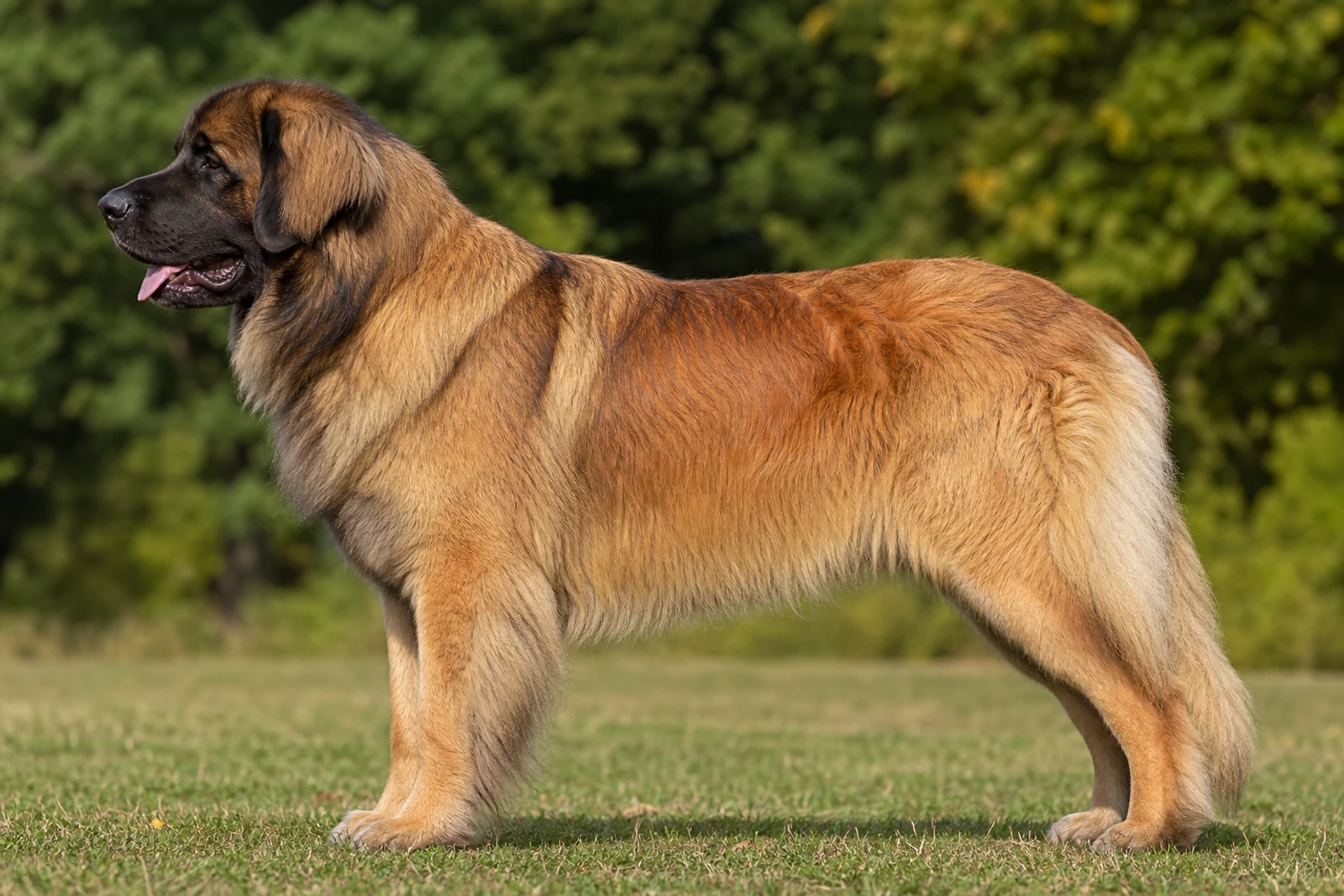
The Leonberger is a majestic giant breed, perfect for active families who appreciate a calm yet playful companion. Affectionate and loyal, these dogs thrive on human companionship and are excellent with children. Originally bred in Germany to resemble a lion, they possess a gentle nature despite their imposing size. Leonbergers need ample space, daily exercise, and consistent training; they are not suited for small living quarters or first-time dog owners. Their thick double coat requires regular grooming to manage heavy shedding. With a love for water and a watchful eye, they make devoted guardians and family members.
At a glance
- Size
- Giant
- Height
- 28–31 in
- Weight
- 99–170 lb
- Life span
- 10 years
- Coat colors
- Lion-yellow, Golden, Red, Red-brown, Sand
- Coat type
- Thick, water-resistant double coat
How much does a Leonberger cost?
Adopt / rescue
$150–$500
Usually includes spay/neuter, first shots, and a microchip.
Buy from a breeder
$2,000–$4,000
From a reputable, health-testing breeder.
Approximate USD. Prices vary widely by region, breeder, pedigree, age, and coat colour — adopting is the lower-cost and recommended route. Avoid suspiciously cheap “breeders”; they’re often puppy mills.
Estimate the full cost of a Leonberger →Want the ongoing number? Estimate the monthly food bill for a Leonberger with our dog food cost calculator.
Leonberger photos
Views
Front, side, rear and top — the full silhouette.Poses
How the breed sits, lies, moves and plays.Puppy to senior
The breed across its whole life.Expressions
The breed’s range of moods.Close-up details
Eyes, ears, nose, paws, tail and coat.Coat colors
The breed’s recognized colors.Click any photo to enlarge. We show the Leonberger from every angle — three views, poses, life stages, expressions, close-ups, coat and colors.
Appearance & size
You see the size first. A male Leonberger can top out at 170 pounds and stand 31 inches at the shoulder; even smaller females rarely dip below 99 pounds and 28 inches. That’s a dog who can rest his head on your kitchen table without stretching. Yet the sheer mass is part of a balanced, rectangular silhouette — a body that’s longer than tall, built for powerful pulling and steady trotting rather than sprints.
The build is muscular without being slab-sided. A deep, broad chest flows into a well-sprung ribcage and a strong, level topline. The loin is wide and slightly arched, and the croup slopes gently. From the side the Leonberger conveys substance, not bulk; from the rear you’ll see well-angulated stifles and straight, heavy-boned hind legs that never look cow-hocked. The front is equally sturdy, with a proud carry of the neck and a head that’s broad but not blocky.
The coat is what people remember. A dense, water-resistant double coat — medium to long, straight to mildly wavy — covers the entire body, with a pronounced mane on the neck and chest, especially in males. Feathering on the backs of the forelegs and the breeches is generous, and the tail is a plume of thick fur carried at half-mast or lower. The color palette stays in the lion-gold range: from pale golden-yellow to rich reddish-brown, typically with black tips on the longer guard hairs that deepen the shade. A black mask on the muzzle and around the eyes is required, often outlined by lighter eyebrow markings. A small white patch on the chest or toes shows up occasionally but isn’t the breed ideal.
Look at the face and the Leonberger’s expression strikes a balance between dignity and easygoing calm. The dark, almond-shaped eyes sit back a bit under moderately arched brows. Medium-sized, drop ears hang close to the head. The stop is defined but not exaggerated, and the muzzle is a hair longer than the skull, giving a clean, noble profile. It’s a dog that looks like a working animal, not a cartoon of one — massive, furry, and without a trace of fragility.
History & origin
The Leonberger didn’t stumble into existence by accident — it was a deliberate creation, dreamed up in 1846 by a German businessman and town councilor named Heinrich Essig in the city of Leonberg, in what is now Baden-Württemberg. Essig wanted a dog that looked like the lion on the town’s coat of arms, so he crossed a black-and-white Newfoundland female with a longhaired Saint Bernard male he’d obtained from the famed Great St. Bernard Hospice. Later, he likely mixed in Pyrenean Mountain Dogs to lock in the thick mane and warm, tawny coat. The result was a giant, noble-looking breed with a lion-like ruff and a steady, confident presence.
Essig didn’t intend to create just a status symbol. He bred the Leonberger to be a versatile working farm dog — one that could pull heavy carts, guard homesteads and livestock, and still settle into family life without a fuss. They quickly earned a reputation as capable water rescue dogs, thanks to their Newfie roots, webbed feet, and a natural affinity for swimming. By the late 1800s, these dogs were turning heads across Europe. Empress Elisabeth of Austria owned several; so did Napoleon III and the Prince of Wales. The breed appeared in kennels from Russia to England, prized for both its working ability and its imposing yet gentle demeanor.
Then came the two world wars, and the Leonberger barely survived them. Food shortages, economic collapse, and the simple fact that keeping a 100-plus-pound dog was nearly impossible during wartime left only a handful of dogs alive. In 1945, an estimated five to eight breedable individuals remained. A group of dedicated enthusiasts, led by men like Karl Stadelmann, painstakingly rebuilt the population from those survivors. Every Leonberger alive today descends from that tiny post-war gene pool.
The breed never returned to the sheer numbers it had in the 19th century, but it found a steady, passionate following among people who appreciate a dog that’s equal parts gentle giant and tireless worker. Leonbergers still excel in water rescue and carting trials, and they’re used as therapy dogs, but most live as devoted family companions. The city of Leonberg hasn’t forgotten its creation: a bronze statue of a Leonberger stands in the town, and a breed club hosts regular celebrations there.
Temperament & personality
A Leonberger’s personality is the definition of a steady, affectionate giant. These dogs are deeply bonded to their families and have a quiet confidence that belies their size. They thrive on being in the middle of household activity—following you from room to room, leaning against your leg, and settling at your feet while you cook. That need for closeness means they do not do well left alone for long stretches. Isolation often triggers anxiety-driven behaviors like nonstop barking, destructive chewing, or indoor accidents. If your schedule keeps you away most of the day, this is not the breed for you.
Energy-wise, a Leo is no couch potato, but neither is he a frantic athlete. Count on providing at least an hour of real exercise—a long walk, a vigorous swim (they are natural water lovers), or a couple of solid romps in the yard. After that, they’re content to sprawl inside, watching the world go by. Without enough physical and mental outlet, they’ll find their own entertainment, and a bored 140-pound dog can do a lot of damage fast.
Around the house, the Leonberger’s default mode is calm and patient. They are famously good with children, but that gentleness comes with a caveat: a giant breed can easily bowl over a toddler just by turning around. Close supervision is non-negotiable. With other dogs and pets, especially those raised alongside them, they’re generally easygoing. A properly socialized Leo extends the family circle to include the cat and the neighbor’s dog.
Don’t mistake that sweetness for a lack of watchfulness. Leonbergers notice everything. They’ll bark an alert if something seems off, and a protective streak will put them between their people and a stranger they’re unsure about. Most, however, lack sharp guard-dog aggression; they’re more likely to welcome a guest with a wagging tail than a snarl. Still, early and ongoing socialization is what shapes an adult who can read a situation correctly rather than react out of fear.
Training a Leonberger reveals a thoughtful, sometimes stubborn streak. They’re smart and want to please, but they won’t respond well to force or heavy-handed corrections. Respectful, consistent engagement—with plenty of treats and praise—gets results. Push too hard and you’ll watch a sensitive dog shut down. Because they can be strong-willed, clear boundaries from puppyhood prevent a 170-pound pain in the neck later.
- Puppy chewing is both an exploration habit and a teething ritual. Give them appropriate, durable chew toys or risk your furniture.
- Adult chewing helps keep jaws strong and teeth clean, so it’s a normal behavior, not a failure. A well-chewed antler or nylon bone saves your belongings and supports dental health.
Quirks are part of the package. They love water to the point of comedy—any puddle, hose, or lake is an invitation. Expect drool after drinking, a wet beard on your lap, and an enthusiastic “conversation” of low grumbles, groans, and sighs. And that full-body lean? It’s not clumsiness; it’s a request for contact. Just brace yourself.
It’s worth remembering that descriptors like calm, brave, and gentle are observed tendencies, not warranties. A Leo from careless breeding or a neglected background may be timid, reactive, or anxious. A well-raised Leonberger, though, is a steady presence that enriches a household without dominating it—a dog that simply wants to be wherever you are.
Good with kids, dogs & other pets
That patient, non-aggressive temperament Leos are famous for makes them a natural fit for families, but sheer size changes the rules. A relaxed 130-pound dog can knock over a toddler with a happy tail swipe or a full-body lean without meaning any harm. With young children, the real risk isn’t teeth — it’s physics. Always supervise floor-level interactions, and teach kids early not to grab fur, climb on the dog, or startle them awake.
Leos are deeply people-oriented and get miserable when isolated. They belong in the thick of family life, not out in the yard alone. A dog who craves this much companionship can develop real distress if left for long stretches, so the breed fits best in homes where someone is around most of the day.
Early socialization is what turns natural steadiness into reliable good judgment. Start exposing a Leo puppy to calm, kind children, neighborhood dogs, and household cats before 12–16 weeks of age. That critical window closes fast. Puppies raised without this variety of gentle, positive exposure often grow up timid or reactive to normal household chaos — a bad match for a dog this large.
With other dogs, Leos are generally social and even-tempered, but size again dictates caution. A full-grown Leo playing with a 10-pound dog can escalate into an accidental injury in seconds. Supervise mixed-size play and teach rock-solid recalls early. Most Leos live peacefully with cats and small pets especially if raised alongside them from puppyhood, though a coursing chase instinct exists in some lines. Never leave a giant breed dog and a rabbit or kitten alone together; one exuberant pounce is all it takes.
Consistent, upbeat introductions during puppyhood and ongoing neutral exposure as an adult are the keys. A well-socialized Leonberger meets the world with unflappable calm — a trait that makes a 150-pound dog feel safe, not scary, around your whole family.
Trainability & intelligence
A Leonberger wants to work with you, not for you — and that changes everything about training. These dogs are sharp and surprisingly sensitive for their size. Harsh corrections or frustration will shut them down fast, while patience and positive reinforcement unlock a partner who learns with real enthusiasm. Because an adult Leo can top 150 lb, you’re not just teaching tricks; you’re building a safe, cooperative member of the household, and that work starts the day the puppy comes home.
What works — and what doesn’t
- Use food, play, or calm praise as rewards. Most Leonbergers are highly food-motivated, but switch things up so they don’t get bored. A quick game of tug or a scratch behind the ears often means as much as a treat.
- Keep sessions short and upbeat. Leonbergers can be deliberate thinkers — they’re not border-collie quick, but they retain what they learn. End on a win before their attention wanders.
- Avoid punishment-based methods entirely. A raised voice or leash jerk undermines the trust that makes a Leo listen. These are emotionally intelligent dogs; they remember who scared them.
The puppy window that really matters
Exposure between 3 and 14 weeks old is make-or-break. During that time, systematically introduce your Leo to:
- Different people, including kids and people wearing hats or carrying umbrellas
- Unfamiliar sounds like garbage trucks, doorbells, and kitchen appliances
- A variety of surfaces: tile, grass, metal grates, shallow water
- Other dogs and animals in controlled, positive encounters
If you skip this, a Leonberger’s natural wariness can tip into fear-based reactivity — a serious problem at this size. Keep socialization going into adulthood, because a teenage Leo testing boundaries (usually right around 6-12 months) will rely on those earlier positive experiences to regain their footing.
Wait, are they stubborn?
They can be. But Leonberger “stubbornness” is usually quiet independence, not loud defiance. It shows up when a command feels pointless or when you’ve been drilling the same thing too long. The fix isn’t to out-stubborn the dog; it’s to make the right choice obvious and rewarding. For recall, that means practicing it in low-distraction settings first, then gradually proofing it around squirrels or other dogs. Expect reliable off-leash reliability to take more time than in a retriever — plan for a solid year of consistent, reward-based reinforcement before you trust that recall in an unfenced area.
Early training that pays off for a decade
A Leonberger lives about 10 years, so invest heavily in the first two. Teach a rock-solid “leave it,” “watch me,” and a settle cue while your puppy is still small enough to redirect physically. By the time they’re 120 lb, you’ll be glad you did. And because Leonbergers often have a goofy side well into maturity, weave play into obedience — they’ll work harder for someone who feels like a teammate, not a boss.
Exercise & energy needs
A Leonberger needs steady daily movement to stay fit and content, but this is not a dog that will bounce off the walls if you skip a morning jog. Plan on two sessions each day, totaling 45–60 minutes at minimum — a couple of 20- to 30-minute walks, a long sniffy meander, or half an hour of swimming. These are giant dogs with a working heritage, so they genuinely enjoy having a purpose, but their energy comes in calm, rolling waves, not frantic bursts.
Split the exercise into at least two outings. A single marathon walk can be hard on developing joints and won't do much to settle a young Leo the way a morning and evening routine will. Leash manners matter early: a 150 lb adult who pulls is no fun. Use a front-clip harness and reward loose-leash walking from puppyhood.
Joint-smart movement
As a giant breed, Leonbergers are prone to hip and elbow dysplasia. Avoid high-impact activities — jumping, forced running on pavement, or endless stair climbing — until growth plates close around age two. Stick to soft surfaces, shallow water wading, and gradual inclines. Even with a fit adult, skip bike-joring and repetitive fetching on hard ground. Let them set the pace; you'll notice they're more sprinter than endurance athlete.
Engage that big brain
A tired Leonberger is a well-behaved Leonberger, but physical exercise alone won't quite get you there. Puzzle toys, frozen Kongs, scent games, and obedience drills burn mental energy fast. These dogs were bred to work alongside people, so daily training — even 10 minutes of reinforcing basics or teaching a silly trick — taps into what they were made for. They’re natural at water rescue and carting, and many excel in therapy work or drafting trials if you want a structured sport.
Watch for boredom signs like nuisance chewing or restlessness, especially in adolescents. That’s usually your cue to swap a walk for a nosework session in the yard.
Good fits
- Swimming (ideal for joints, and they love it — no surprise for a breed that once hauled rescue ropes)
- Hiking on dirt trails with a properly fitted pack, once fully grown
- Carting and draft work (start lightweight only after skeletal maturity)
- Nosework and hide-and-seek games indoors on hot days
Skip intense heat: that thick double coat makes them wilt quickly. Walk early or late in summer and always bring water.
If you can offer two dependable walks, a chance to think, and a soft place to sprawl afterward, you’ll have a settled, steady companion who’s happy to curl up at your feet.
Grooming & coat care
A Leonberger’s coat is a full-time job in the best way — you don’t just brush this dog, you live with the fur. The thick, water-resistant double coat consists of a dense undercoat and a longer, coarse outer coat, plus a majestic mane on males and heavy feathering on legs and tail. To keep the hair where it belongs (mostly on the dog), plan on daily brushing with a quality slicker brush and a steel greyhound comb. Work methodically from the skin out, focusing on mat-prone zones: behind the ears, the armpits, the “pants” on the hindquarters, and the mane. Mats in a Leo aren’t just unsightly — they pull skin, trap moisture, and can lead to hot spots fast.
When it’s bath time
You’ll bathe a Leonberger only when he’s truly dirty or starts smelling like a wet dog that never dried. Every 6–8 weeks is typical. Use a gentle dog shampoo, rinse until the water runs absolutely clear, and then dry completely — not just towel-dry. A high-velocity pet dryer is a game-changer because that dense undercoat can hold moisture against the skin for hours, setting the stage for infections. Blow out the coat until it’s fluffy and bone-dry, which also pushes out loose undercoat ahead of the next brushing.
Nails, ears, teeth
Check and trim nails every 3–4 weeks — with a 120+ pound dog, long nails can change foot posture and add joint stress. Drop ears need a weekly sniff-and-swipe with a vet-approved cleaner; moisture and debris collect easily. Brush teeth 2–3 times a week to keep that big mouth healthy. Start all this as a puppy, and you’ll avoid wrestling with a full-grown giant who doesn’t want his feet touched.
The seasonal furpocalypse
Twice a year, Leonbergers “blow” their undercoat all at once. You’ll see tufts and tumbleweeds that you’d swear came from at least three dogs. During these stretches, brush twice daily — an undercoat rake or de-shedding tool will do the heavy lifting. Do the work outside or in a mudroom, and accept the temporary snowfall. A forced-air dryer helps here, too, blasting out loose fluff in minutes. Never, ever shave a Leonberger to reduce shedding; the double coat insulates against heat and cold, and shaving damages the coat’s natural regrowth pattern, often resulting in a patchy, coarse mess forever. Neatening the hair between the paw pads and a sanitary trim around the rear is all the clipping these dogs need. Keeping up with the routine means the dog stays cool, mats stay rare, and your vacuum works a little less hard.
Shedding & allergies
A Leonberger’s coat is a full-time shedding operation, not a seasonal inconvenience. These giants carry a thick, water-resistant double coat that drops fur year-round — and when they blow coat in spring and fall, the hair comes out in loose tufts you can pull off with your fingers. A 120-pound dog produces a lot of hair, so expect furniture, floors, and clothing to collect a fine layer of fluff no matter how often you clean.
- Daily brushing keeps you from drowning in loose fur. An undercoat rake and a slicker brush are your best tools, especially during a seasonal blowout, when a 20-minute session can fill a grocery bag.
- Even with diligent grooming, you’ll find tumbleweeds of hair drifting across the hardwood a day after vacuuming.
Shedding isn’t the only thing that lands on surfaces. Leonbergers drool — sometimes heavily. After eating, drinking, or just standing in warm weather, you’ll likely wipe slobber off walls, pant legs, and your own arm. Many owners keep “drool towels” stashed in every room.
No Leonberger is hypoallergenic. The same soft undercoat that blankets your sofa also releases dander, and all that saliva carries proteins that trigger reactions. If someone in your home has dog allergies, this breed is a poor match. Spend real time around an adult Leo before making a decision — not a short meeting, but an afternoon in a closed space — so you know exactly what you’re signing up for.
Diet & nutrition
A Leonberger puppy grows from a fuzzy handful into a 100-plus-pound dog in under a year, and what you feed during that sprint sets the stage for sound joints later. Get it wrong and you risk adding stress to hips and elbows that are already vulnerable in giant breeds. Talk to your breeder and vet about a growth plan, not just a feeding schedule.
Feeding a Leonberger puppy
Until four months old, split the day’s ration into four evenly spaced meals. From four to six months, drop to three meals, then switch to the adult schedule of two meals a day. Transition a new pup to your preferred diet gradually over a week. Start with lightly cooked, puréed meats, fish, fruits, and vegetables, or a high-quality large-breed puppy food formulated for slow, steady growth. Overfeeding now doesn’t make a bigger dog; it makes a heavier puppy with more strain on developing cartilage.
Raw meaty bones like chicken wings can be introduced around twelve weeks with supervision, letting the dog learn to chew properly while you watch.
Keeping a healthy weight on an adult
An adult Leonberger lands anywhere from 99 to 170 pounds, so portion sizes aren’t a one-size-fits-all number on a bag. Feed according to the dog’s current weight, build, and actual exercise level, not your wishful thinking about next week’s hikes. This breed tends to be food-motivated and will pack on weight if you go by eye. Even a few extra pounds multiply the load on hips, elbows, and spine. Use a measuring cup and a scale for a week if you need to calibrate, then adjust based on ribs you can feel but not see.
If your dog inhales meals, a food puzzle bowl or slow feeder slows him down and adds a few minutes of mental work — no downside there. Skip the habit of tossing table scraps; once begging takes root, it’s miserable to undo. Serve any leftovers in his own bowl, away from the dinner table.
Food choices and habits
I aim for meals that run roughly 60% meat (raw and cooked), 20–30% fruits and vegetables, and 10% other bits like eggs, grains, or yogurt. That’s not a rigid prescription, just a template that respects a dog’s anatomy. Their jaws move vertically, without side-to-side grinding, and they lack salivary enzymes, so blending or puréeing plant matter helps nutrient absorption — especially useful for a senior mouth with missing teeth.
- Grains: Pearled barley offers digestible fiber; white rice is a bland standby for a sensitive stomach.
- Quick combos: Canned fish (in water, no salt), cooked vegetables, and eggs make a fast, balanced meal. Unsalted vegetable-cooking water works as a moistening base if you don’t have stock on hand.
- What to avoid: Rich, fatty leftovers — post-holiday scraps can trigger pancreatitis, a medical emergency that giant breeds don’t shrug off.
Senior years
With a lifespan around ten years, a Leonberger hits middle age sooner than you’d like. Obesity becomes the biggest daily threat as activity tapers off. Monitor weight monthly and shave back calories before you see a problem. Many older dogs do well on smaller, more frequent meals rather than two big ones. There’s no strong reason to slash protein, but you do need to cut total calories as exercise declines. Purée meals for dogs that lose teeth or develop a sensitive mouth — they’ll get far more out of their food that way.
Health & lifespan
A Leonberger’s typical lifespan is around 10 years. That’s the honest math of a giant breed — huge dogs rarely see the late teens of a small terrier. Your job is to stack the deck in favor of those years being active, comfortable ones, which starts with picking a breeder who screens aggressively and continues with no-nonsense preventive care.
Hips and elbows sit at the top of the worry list. Dysplasia in one or both is common in a dog that can easily weigh 99–170 lb, so good breeders run OFA or PennHIP x-rays on breeding stock and can show you multi-generational clearances. The same weight makes bloat (gastric dilatation-volvulus) a life-threatening emergency. Know the symptoms — a distended belly, unproductive retching, restlessness — and get to a vet immediately. Some owners opt for a prophylactic gastropexy during spay or neuter to tack the stomach.
Reputable breeders also test for conditions that are especially prevalent in Leonbergers. Leonberger Polyneuropathy (LPN1 and LPN2) causes progressive nerve degeneration; a simple DNA test lets breeders avoid producing affected puppies. LEMP (Leukoencephalomyelopathy) is another inherited neurological disease with a DNA test. Expect eye clearances (CERF or OFA Eye) because entropion, ectropion, and cataracts can show up, along with a cardiac evaluation for dilated cardiomyopathy, a silent heart muscle disease that can cut a giant short.
Cancer — particularly osteosarcoma (bone cancer) and hemangiosarcoma — appears in the breed more often than any of us wants to admit. There’s no screening test for that yet, so you watch for unexplained limping, swelling, or sudden lethargy and raise the alarm fast.
Prevention starts at home. Weight management is non-negotiable — every extra pound hammers those hip and elbow joints and strains the heart. An adult Leonberger should have a visible waist and ribs you can feel but not see. Keep him lean, and you lengthen his comfortable years.
Don’t let giant size fool you into skipping routine veterinary care. Annual wellness exams (more often for seniors) catch early signs of hypothyroidism, heart changes, or ear and skin issues before they blow up. Keep up with monthly heartworm prevention during mosquito season and for one month after it ends; heartworm treatment is risky and expensive in a dog this size. A rabies vaccination is legally required, and there’s no treatment once symptoms appear, so don’t lapse.
Finally, a Leonberger that’s well-socialized from puppyhood brings a level of calm confidence that pays off physically. Chronic stress and anxiety suppress the immune system and amplify problem behaviors, so early, positive exposure to handling, other dogs, and new environments isn’t just nice — it’s preventive health.
Living environment
A 99–170 lb Leonberger doesn’t fit into apartment life, period. Even a city townhouse with a postage-stamp yard will feel cramped to a dog this size. They need room to stretch out inside—furniture gets rearranged by a wagging tail—and a securely fenced outdoor space is non-negotiable. That yard isn’t just for bathroom breaks; it’s where they’ll patrol, sprawl in the snow, and supervise your weekend gardening. If you don’t have one, plan on multiple daily trips to a large, open park where they can trot and sniff without being underfoot.
Climate is a real consideration. Leonbergers are built for cold, with a thick, water-resistant double coat that sheds heavily. They thrive in chilly weather and will happily lie in a snowdrift for hours. Heat is a different story. Anything above 75–80°F demands shade, fans, and early-morning or late-evening exercise. Skip the midday pavement walk—those giant joints don’t need the extra pounding, and they overheat fast.
Barking tends to be situational, not chronic. You’ll get deep, alert barks when a delivery arrives or a stranger approaches, which makes them effective watchdogs, but they usually settle once the “threat” is acknowledged. Without enough mental and physical work, however, bored barking can become a problem. A tired Leonberger is a quiet one.
Time alone is the dealbreaker for many families. These dogs bond fiercely and want to be where you are. Left solo for eight-plus hours, they’re prone to destructive chewing, howling, and full-blown separation anxiety. Crate training and gradual desensitization from puppyhood help, but this isn’t a breed you can relegate to the backyard while everyone’s at work and school. They do best in homes with at least one person around much of the day, or with a reliable midday break routine. Expect to provide a solid 60 minutes of daily exercise—think hikes, swims, or long sniffy walks—plus puzzle toys and training sessions to keep that working-dog brain engaged. Skip the joint-jarring ball chasing on concrete; swimming is perfect for burning energy without strain.
Who this breed suits
If the thought of a 150-pound dog leaning its full weight against your legs while you try to cook dinner sounds like a feature, not a bug, a Leonberger might already have your number. This breed is built for people who want a constant, oversized shadow and have the space—and sense of humor—to handle the hair, drool, and sheer size that comes with it.
Homes and families that click
A Leo fits best in a spacious home with a securely fenced yard, ideally in a suburban or rural setting rather than a cramped apartment. They thrive in busy, active families where someone is around during the day. These dogs are famously gentle with children, but you’ll need to supervise simply because a happy tail wag at coffee-table height clears everything in its path. They’re naturally watchful and will bark a deep, serious alarm when strangers approach, making them an excellent deterrent without veering into aggression—provided they’ve had early socialization.
Singles or couples who like weekend hikes, swimming, or long walks and then want a dog who’ll sprawl on the floor for the rest of the day will find a willing partner. The exercise requirement isn’t extreme: a couple of solid 30–45 minute walks and some playtime or mental work keeps them fit. Athletes looking for a marathon running buddy should look elsewhere; Leonbergers prefer steady movement, not sprinting.
Owners who genuinely enjoy grooming—or don’t mind paying for it—are a must. Expect a thick double coat that sheds year-round and blows in clouds twice a year. Daily brushing keeps the fur tumbleweeds manageable, and you’ll still find hair in places you didn’t know you had. Add a love of water and mud, and you’ve got a dog who regularly needs toweling off before coming inside.
Who should pause—and probably keep looking
- First-time dog owners: Leos are sensitive, intelligent, and sometimes stubborn. A 170-pound dog that decides he doesn’t want to move during a walk requires an experienced handler who’s already comfortable with consistent, positive training. You can’t learn leash manners on the fly with a giant breed.
- City dwellers and anyone without ground-level access: Apartment living is a non-starter. Stairs, elevators, and tight hallways are physically hard on growing joints and make daily life a logistical headache. Even a small yard gives them a place to stretch out.
- People who prize a spotless home: Between the drool that flings onto walls and the seasonal fur drifts, your cleaning routine will double. If that stresses you out, this isn’t the dog for you.
- Seniors or physically limited individuals: A playful Leo can accidentally knock over an unsteady adult, and walking one that lunges after a squirrel requires real strength. Plan on a harness and plenty of training, but know your own physical limits before committing.
- Work-away-from-home households: Leonbergers bond intensely and hate being alone for long stretches. A dog left 8+ hours daily is a recipe for separation anxiety, destructive chewing, and a whole lot of heartbreak on both sides.
The lifespan runs about 10 years, which is generous for a giant but still shorter than what many small-dog owners expect. Add in high food bills, potential orthopedic and heart issues screened by responsible breeders, and you’re signing up for a deep—but finite—commitment. If you can give a Leo your time, your space, and a tolerance for leaning, shedding giants, you get back a goofy, devoted guardian who acts like you’re the best thing that ever happened to him.
Cost of ownership
A responsibly bred Leonberger puppy typically costs $2,000 to $4,500, sometimes higher for lines with extensive health clearances and titling. Avoid listings that seem like a bargain; giant breeds with poor health testing often end up much more expensive in the long run.
Month-to-month, the big numbers break down like this:
- Food: Figure on 4–6 cups of high-quality dry food per day. That works out to roughly $80–$150 a month for an adult, depending on brand and weight. Males on the upper end of the 170-lb range can push that higher.
- Grooming: This dense double coat sheds heavily. A professional groom every 6–8 weeks runs $90–$150+, plus you'll need a good slicker brush and undercoat rake at home. Budget around $100–$140 monthly if you use a groomer regularly; about half that if you do it yourself and save the pro for occasional deep cleans.
- Vet and insurance: Giant breeds cost more for almost everything — higher doses of preventives, pricier surgeries, and a real risk of bloat and joint issues. A wellness plan plus comprehensive pet insurance easily runs $70–$130 a month. Set aside extra for a gastropexy if you opt for it during spay/neuter.
- Miscellaneous: Extra-large crates, beds, harnesses, and elevated feeders all come at a giant premium. Throw in $30–$60 a month to cover replacements and routine supplies.
With a 10-year lifespan, a reasonable annual spend lands between $3,000 and $5,000, not counting puppy-year setup costs. Start a dedicated savings cushion early — even a minor emergency with a 130-plus-pound dog gets expensive fast.
Choosing a Leonberger
You are looking at a decade, give or take, with a 100-plus-pound dog whose joints, heart, and nerves can fail early if the breeding isn’t rock-solid. That 10-year average lifespan puts breeder selection at the center of everything. Start by contacting breed-specific rescue through the Leonberger Club of America or regional groups. You will not find litters dumped at shelters, but adults do come up for rehoming — often due to divorce, illness, or a family’s inability to manage the size. An adult rescue lets you sidestep the landshark puppy phase and you already know the dog’s temperament and health status.
If you go the puppy route, responsible breeders are non-negotiable. They hand you a folder of health clearances without being asked, and they talk openly about what goes wrong in the breed.
Health clearances to demand
- Hips: OFA or PennHIP evaluation, graded fair or better. Do not accept a “vet checked them” answer.
- Elbows: OFA elbow dysplasia screening. Leonbergers are prone to elbow issues that can cripple a young giant.
- Cardiac: An echocardiogram by a board-certified veterinary cardiologist, not just a stethoscope listen.
- Eyes: Annual CAER (formerly CERF) exam by a veterinary ophthalmologist.
- DNA tests: LPN1 (Leonberger polyneuropathy) and LEMP (leukoencephalomyelopathy). Reputable breeders test and share results. A carrier bred to a clear dog is fine; two carriers bred together is not.
Red flags that should make you walk
- The breeder cannot produce original certificates on the spot.
- Puppies leave before 10 weeks — giant breeds need that extended time with mom and littermates.
- They have multiple litters available year-round or always seem to have “just one puppy left.”
- They don’t ask about your experience with giant breeds, your fence, your floors, or your tolerance for drool and bucketloads of shedding.
Picking your puppy
Forget picking the cutest fluffball online. You choose the breeder, then the breeder helps match a puppy to your life. Meet the mother on-site — she should be calm, sound, and welcoming, not cowering or absent. Watch the litter interact: you want a puppy that recovers quickly from a startle, approaches you with curiosity, and doesn’t bully or hide from littermates. Expect a detailed contract, a health guarantee that covers the first two years at minimum, microchip, first vaccines, and a take-home guide. The breeder will likely be more persistent than your mother-in-law about staying in touch — that’s exactly what you want.
Pros & cons
Pros
- A true gentle giant with a famously steady, affectionate temperament — this is a dog who genuinely adores children and will lean his full weight against you just to be close.
- Watchful and deep-voiced without veering into aggression; most Leonbergers alert bark when someone approaches, then happily welcome the visitor once you do.
- Surprisingly trainable for a giant breed. They want to work with you and pick up obedience quickly, especially when training involves water or carrying things.
- Loves water in a way that borders on obsession — from splashing in a kiddie pool to serious swimming, it’s built-in exercise and enrichment.
- Calm indoors once mature, content to sprawl nearby as long as daily needs are met. A solid off-switch after a good outing.
Cons
- Shedding is monumental. The dense double coat drops fur year-round and blows out in huge clumps seasonally — you’ll empty a vacuum canister daily.
- Drool is a fact of life. After drinking, eating, or on a hot day, expect wet floors and flung slobber that reaches ceiling height.
- A 10-year lifespan puts a real cap on your time together. Responsible breeders screen hips, elbows, and hearts, but cancers and orthopedic issues still surface frequently.
- Size alone is a management challenge — 99 to 170 pounds of dog can pull you off your feet, counter-surf without stretching, and needs a vehicle and home that accommodate a very large body.
- Heavy grooming goes far beyond brushing. You’re dealing with muddy paws the size of your palm, ear cleaning, beard wiping, and drying a soaked double coat before that wet-dog smell takes over your house.
Similar breeds & alternatives
If you’re drawn to the Leonberger’s big-dog warmth but want to kick the tires on a few close cousins, you’ve got some wonderful options — and a few key trade-offs to weigh.
Newfoundland
A dead ringer in sweetness and size (100–150 lb), but built more for water work. Newfies are heavier-boned, drool more, and shed in ways that will test your vacuum’s will to live. Their coat is dense and oily, whereas a Leonberger’s mane is drier and more dirt-shedding. Both are famously patient with kids, but a Newfoundland is often a touch more couch-potato than the Leo, which tends to be a higher-energy working dog that wants a job. If you love the look of a lion-like ruff but want even more swim instinct and don’t mind the slobber, the Newf might edge ahead.
Bernese Mountain Dog
Think of a Leonberger scaled down to 70–115 lb, wearing a tricolor coat. Berners are equally affectionate and intelligent, but their lifespan (6–8 years) is a gut punch compared to the Leo’s typical 10. They’re less giant, which can be a plus if you’re tight on space, and they’re usually a shade lower-key exercise-wise. The catch: cancer rates are high enough that you’ll want to ask breeders hard questions. You get the mountain-dog devotion in a more medium-large package, but you’ll likely say goodbye far sooner.
Saint Bernard
Where the Leonberger is an athlete in a giant’s body, the Saint (120–180 lb) tends to be a slower, more ponderous companion. Both breeds are gentle giants, but Saints drool enough to require a dedicated towel hook by the door, and their shorter muzzle can mean louder breathing and less heat tolerance. A Leonberger’s longer coat and leggier build give it a more agile, trainable edge for hiking or carting. If you want a dog that’s happy with leisurely walks and unlimited couch time, the Saint is a solid fit, but expect more grooming and a shorter lifespan on average.
Great Pyrenees
A livestock guardian through and through, the Pyr (85–160 lb) shares the Leo’s double coat and noble head, but temperament is the sharpest dividing line. Pyrs are independent, nocturnal barkers bred to make their own decisions. A Leonberger is far more biddable and tuned into people. Both shed like snowfall, but a Pyr’s barking can become a neighborhood issue, and off-leash reliability takes much more work. If you need a cooperative family dog that can still hike and swim without treating your commands as suggestions, the Leonberger is the easier match.
Fun facts
- Bred to resemble a lion, the Leonberger is named after the city of Leonberg, Germany.
- They have webbed feet and are natural swimmers, often used in water rescue.
- Known as 'gentle giants,' they are patient and devoted family companions.
- Their thick double coat comes in lion-like colors with a distinctive black mask.
Frequently asked questions
- Are Leonbergers good with children?
- Leonbergers are known for being gentle, affectionate companions that typically do excellent with children when properly socialized. Their patient and tolerant nature can make them a wonderful family pet, though their large size means supervision around small kids is wise.
- How much do Leonbergers shed?
- Leonbergers shed heavily, especially during seasonal changes, and require regular brushing to manage loose fur. Expect significant hair around the home, so they may not suit those with allergies or a strong aversion to cleaning.
- What are the exercise needs of a Leonberger?
- These dogs have moderate to high exercise needs, enjoying daily walks, play sessions, and mental stimulation. They thrive with access to a secure yard and opportunities to swim, a favorite activity for many Leonbergers.
- How much grooming does a Leonberger require?
- Their thick, water-resistant double coat needs brushing at least two to three times per week, more during shedding seasons. Regular grooming helps prevent matting and keeps their coat healthy, so a commitment to maintenance is essential.
- Can Leonbergers live in apartments?
- Leonbergers are generally not recommended for apartment living due to their giant size and need for space to stretch out. They can adapt if given sufficient daily exercise and attention, but a home with a fenced yard is ideal.
- Are Leonbergers easy for first-time dog owners?
- This breed can be a challenge for first-time owners because of their size, strength, and grooming demands. They are intelligent and eager to please, but early training and socialization are crucial to manage a dog that may weigh as much as an adult human.
Tools & calculators for Leonberger owners
Quick estimates tailored to Leonbergers — pre-filled with this breed’s size where it matters.
Articles & stories about the Leonberger
Sources & standards
This profile follows recognized breed standards from the American Kennel Club (AKC) and the Fédération Cynologique Internationale (FCI), along with established veterinary and breed-club guidance. These describe general breed tendencies — every dog is an individual.