

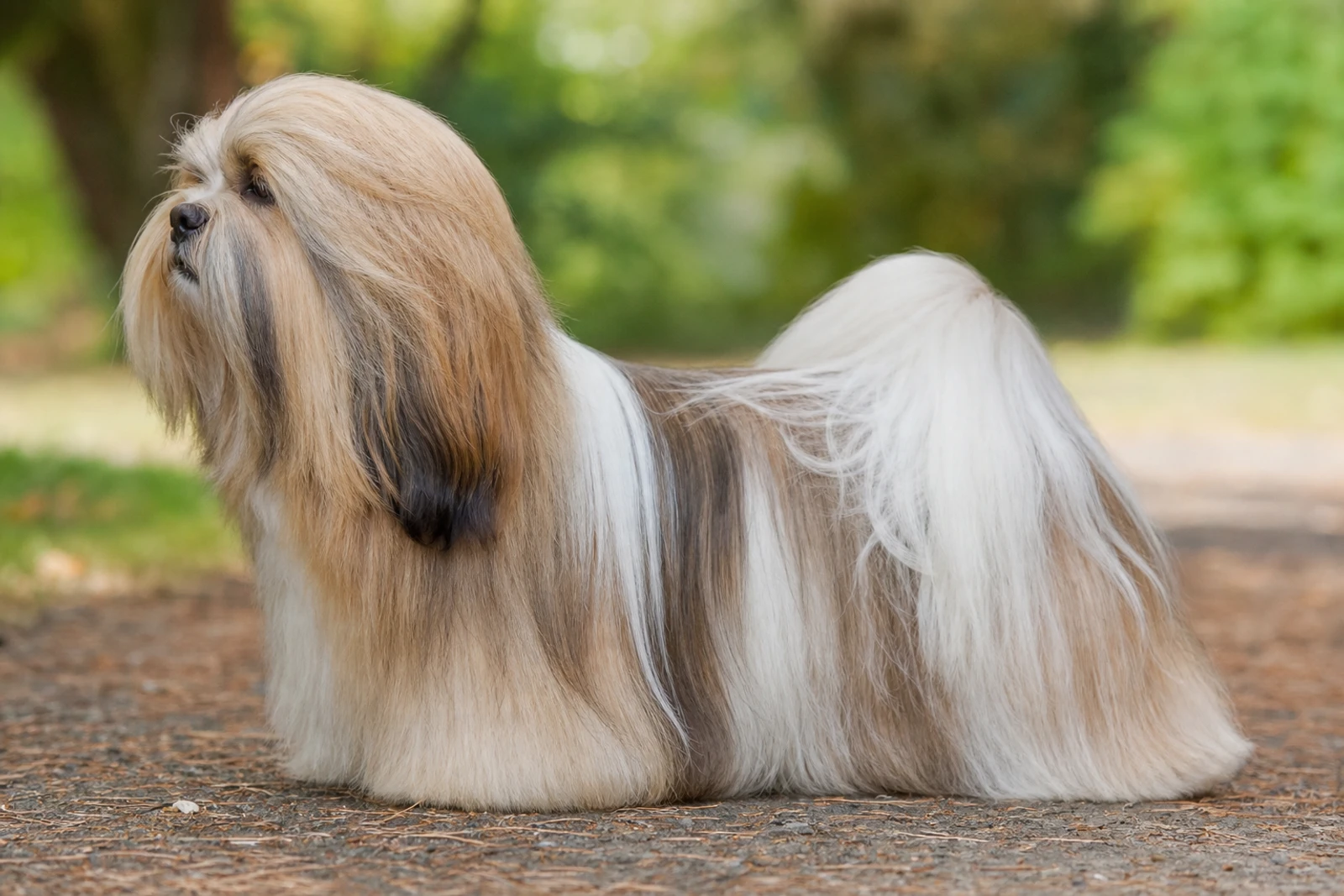
The Lhasa Apso is a small, sturdy breed from Tibet, originally bred as a vigilant temple guard. Their independent and alert nature makes them excellent watchdogs, but they can be stubborn, so training requires patience and consistency. They bond strongly with their families, though they may be reserved with strangers. Best suited for experienced owners who appreciate a dog with character and can commit to high grooming needs. Their apartment-friendly size and moderate energy level make them adaptable, but early socialization is key to prevent behavioral issues.
At a glance
- Size
- Small
- Height
- 10 in
- Weight
- 13–15 lb
- Life span
- 15–18 years
- Coat colors
- Gold, Cream, Honey, White, Smoke, Dark Grizzle, Black, Parti-color
- Coat type
- Long, dense, straight double coat
- Origin
- Tibet, China
How much does a Lhasa Apso cost?
Adopt / rescue
$75–$400
Usually includes spay/neuter, first shots, and a microchip.
Buy from a breeder
$700–$2,000
From a reputable, health-testing breeder.
Approximate USD. Prices vary widely by region, breeder, pedigree, age, and coat colour — adopting is the lower-cost and recommended route. Avoid suspiciously cheap “breeders”; they’re often puppy mills.
Estimate the full cost of a Lhasa Apso →Want the ongoing number? Estimate the monthly food bill for a Lhasa Apso with our dog food cost calculator.
Lhasa Apso photos
Views
Front, side, rear and top — the full silhouette.Poses
How the breed sits, lies, moves and plays.Puppy to senior
The breed across its whole life.Expressions
The breed’s range of moods.Close-up details
Eyes, ears, nose, paws, tail and coat.Coat colors
The breed’s recognized colors.Click any photo to enlarge. We show the Lhasa Apso from every angle — three views, poses, life stages, expressions, close-ups, coat and colors.
Appearance & size
Build and size
The Lhasa Apso is a small dog built long and low — his body is distinctly longer than he is tall. At the shoulder, a typical adult stands about 10 inches and weighs 13 to 15 pounds, with some females naturally on the lighter side. Don’t let those numbers fool you: underneath all that hair is a sturdy, well-muscled frame. The chest is deep enough to reach the elbows, and the ribs are well-sprung, giving the whole dog a sense of substance you wouldn’t expect from a toy-sized breed.
Coat and color
The coat is the first thing you’ll notice. It’s heavy, straight, and dense, with a hard texture — not soft or silky. A medium undercoat adds volume, and the outer coat parts naturally along the spine from nose to tail, falling evenly to the floor on both sides. That floor-length sweep can easily hide the dog’s proportions if you aren’t looking carefully.
Colors run the gamut: solid gold, cream, honey, smoke, slate, dark grizzle, black, white, and many shades of brown. Parti-color dogs (two or more colors in distinct patches) are just as common and just as acceptable. A Lhasa may have black tips on the ears and beard, but no color is preferred over another. The coat is what breeders call “show coat” when left full-length, but most pet owners keep it in a shorter, lower-maintenance clip — the conformation underneath doesn’t change.
Distinctive features
A Lhasa Apso’s head is framed by a heavy fall of hair over the eyes, a thick moustache, and a full beard that together give him the lion-like expression that earned the breed the nickname “Lion Dog.” The eyes themselves are dark brown and medium-sized, neither prominent nor sunken. The ears are pendant, set slightly above eye level, and heavily feathered, so they blend right into the coat.
The tail is another trademark: it’s set high and carried well forward over the back, curling into a plume that cascades down one side. Many Lhasas have a kink at the tip, which is perfectly normal for the breed.
From every angle
- Front: The skull is moderately broad with a distinct stop. The fall of hair can completely veil the face, but if you lift it, you’ll see a straight foreface and a dark nose. The front legs are straight and heavily coated right down to the paws, giving them a column-like look.
- Side: The body’s length from the point of the shoulder to the point of the buttock is noticeably greater than the height at the withers. The topline stays level, and there’s a slight tuck-up at the loin. Because the coat reaches the ground, the legs almost disappear, reinforcing that low-to-the-ground silhouette.
- Rear: Hind legs are well-furnished and moderately angulated; the tail plume arches forward so the tip spills down over the flank. The overall impression is a compact, balanced dog whose outline is as much a frame for that dramatic coat as it is a working dog’s body.
History & origin
For over a thousand years, the Lhasa Apso did a job that still explains a lot about the breed today. Tucked away in the Himalayan monasteries and palaces of Tibet, these small, bearded dogs were the ultimate early warning system. They weren’t pampered lapdogs—they were sharp-eared sentinels, bred to patrol high stone walls and sound the alarm the moment a stranger approached. Their deep, surprisingly loud bark gave the much larger Tibetan Mastiffs chained outside time to react. Think of them as the indoor alarm system the monks relied on before anything got close.
The breed developed in extreme isolation. The rugged terrain and bitter cold of the Tibetan plateau shaped a dog with a dense, floor-sweeping double coat that’s practical, not just pretty. That coat insulated against freezing monastery floors and thin mountain air. Inside, they’d often perch on windowsills, keen eyes scanning for anything out of place. They were never sold—only given as gifts to esteemed visitors. The 13th and 14th Dalai Lamas were known to send Lhasa Apsos as tokens of good fortune to diplomats and foreign dignitaries, which is how the breed eventually slipped out of Tibet.
The name itself is a nod to their roots: “Lhasa” for the sacred capital city, and “Apso” roughly meaning “bearded” or “goat-like” in Tibetan. When the first dogs reached England in the 1920s and 1930s, they were often lumped together with other Tibetan breeds, but fanciers quickly sorted out the distinctions. The American Kennel Club recognized the Lhasa Apso in 1935, and the dogs have been winning people over ever since—not by being needy, but by carrying themselves with the same calm, watchful dignity they learned centuries before.
Temperament & personality
A Lhasa Apso is 13 to 15 pounds of self-assurance packed into a 10-inch frame. He isn’t a lapdog who lives to please — he’s a dignified housemate who decides when to grace you with affection. That independence can be endearing or exasperating, depending on what you want from a dog. If you picture a quiet companion who greets strangers with polite suspicion and adores his own people on his own terms, you’ll appreciate the Lhasa’s old-soul personality.
Energy and affection
Expect a moderate energy level that fits a long, 15- to 18-year life. A daily walk and a few spirited play sessions indoors usually satisfy him. After that, he’s content to nap near you — not necessarily on you — and survey his domain. Affection is genuine but not clingy. A Lhasa may follow you from room to room, then curl up just out of reach, keeping an eye on things. He bonds deeply with his family, often choosing a favorite person, but he won’t smother you.
Watchdog instincts
This breed was developed to serve as an indoor sentinel in Tibetan monasteries and homes, and that history is stamped on his personality. Your Lhasa will notice every delivery truck, squirrel, and neighbor on the sidewalk. His bark is surprisingly big for a small dog, and he uses it freely. Early training can shape his alarm system into a manageable “thank you, I’ve got it” rather than nonstop noise, but the watchfulness never switches off.
Territorial by nature, a Lhasa may urine mark indoors if he feels his space is threatened or if house-training wasn’t rock-solid from day one. Accidents indoors must be cleaned with an enzymatic cleaner — vinegar can help too — because even a faint scent cue draws him back to the same spot. Spatially, he often defines “house” by where his people’s scent is strongest, so a less-used guest room might become a marking target. Consistent outdoor praise and a treat the moment he eliminates outside reinforces what you want.
Training and quirks
A Lhasa Apso learns fast but obeys selectively. He isn’t stubborn for lack of smarts; he simply weighs whether your request is worth his while. Force or harsh corrections backfire dramatically. Respectful, reward-based training wins him over, but you’ll still need patience — and a sense of humor. Keep sessions short and upbeat, and avoid drilling the same command ten times in a row. He’ll just check out.
Because he’s sensitive to tension, watch his body language. A stiff stance and a hard stare are his equivalent of “I’m not comfortable.” Lip licking, yawning, or turning his head away signal unease. Ignoring those cues can push him toward a defensive snap, especially if he’s cornered or handled roughly. That’s not a mean streak — it’s self-respect. Teach children to let him finish meals in peace and to read his signals so everyone stays safe.
Chewing is normal puppy exploration and later a way to keep jaws strong. Give appropriate chews from the start, and use a homemade citrus spray (boiled peels) or a vinegar solution on off-limits items. Redirection works far better than punishment.
Home life
A well-socialized Lhasa can coexist with respectful kids and other dogs, but he won’t tolerate being manhandled or chased by toddlers. Many Lhasas prefer being the only pet or sharing a home with another calm dog of the opposite sex. Separation anxiety surfaces if he’s left alone for long, dull hours — boredom and isolation can trigger barking, chewing, or indoor marking. Mental enrichment (puzzle toys, short training games) goes a long way.
He’s a devoted companion, no doubt. But he’s a thinking dog who expects you to earn his trust, not demand it. Meet him with consistency and a light touch, and you get a fiercely loyal, often hilarious housemate who’ll alert you to the doorbell for the next decade and a half.
Good with kids, dogs & other pets
Kids
Not a stuffed animal. A Lhasa Apso stands just 10 inches and 13–15 pounds—small enough that a clumsy hug can hurt more than you’d think. The groundwork starts with the breeder. Pups who meet calm children, hear vacuums, and experience gentle handling from different people between 3 and 12 weeks of age usually grow into steadier adults. Still, even the best-bred Lhasa has limits. They’re patient and non-aggressive by nature, but patience evaporates when a child corners them, pulls tails, or tries to carry them like a toy. Best fits are homes where school-age kids know the house rules: sit on the floor, don’t pick the dog up, and let the Lhasa come to you. Always supervise—a startle-snap from a 15-pound dog isn’t malice; it’s the only escape route they have.
Other dogs
Lhasa Apsos weren’t built for pack life. Centuries as solitary monastery watchdogs left them independent and a hair suspicious of other canines. Early socialization—starting the day the pup comes home and continuing through 16 weeks—does a lot, but this isn’t a dog who craves doggy BFFs. They can coexist peacefully with one known, low-key housemate of similar size, especially when introductions happen on neutral ground and nobody rushes. Skip the dog park: a Lhasa is more likely to stiffen and grumble than engage in a romp. Same-sex pairings often spark grudges, and a Lhasa won’t back down. If you want a dog who’ll race you to the car for a playdate, this isn’t him. A leashed walk with a familiar neighbor dog is usually more than enough.
Cats and small pets
Raised together from puppyhood, a Lhasa often learns to ignore a cat—particularly a confident feline who doesn’t bolt. You’ll get polite détente, not snuggles. Fast darts and squeaky small pets (hamsters, gerbils, rabbits) can light up that ancient watchdog brain, so house caged animals in a separate room or a sturdy, elevated enclosure. Never leave them loose together, and never assume the dog “just wants to play.” Doors and common sense are your friends here.
Behind all of this is one reality: a Lhasa Apso who misses the sensitive socialization window—roughly 3 to 14 weeks—can turn wary, barky, and quick to startle at new people, other dogs, or sudden sounds. You can’t fully rewind that later, though patient training helps. What you can do is give a puppy dozens of calm, positive encounters early and never force an adult dog into intimidating situations. When you build that foundation, a Lhasa settles into your home’s rhythm as a dignified, quietly watchful presence—not a reactive dog you have to tiptoe around.
Trainability & intelligence
Don’t mistake a Lhasa Apso’s small size for a pushover. These dogs spent centuries thinking for themselves as indoor watchdogs in Tibetan monasteries, and that independent streak shapes every training session.
He’s smart. Very smart. He’ll pick up a new trick in two or three repetitions when you have a treat pouch on your hip. But if he doesn’t see the point—or he senses a whiff of impatience—he’ll simply tune you out. That’s not stubbornness for spite; it’s a dog who needs a reason to cooperate.
The right approach: short, upbeat sessions heavy on positive reinforcement. Tiny pieces of chicken, a squeaky toy, or a happy dance work far better than a stern voice. Punishment or forcing the issue will erode trust fast, and once a Lhasa decides you’re not on his team, training grinds to a halt. He remembers.
Early and ongoing socialization is non-negotiable. Expose your puppy to different people, friendly dogs, kids, and odd surfaces (grooming tables, tile floors) between 3 and 14 weeks. Keep every encounter gentle and reward calm behavior. A poorly socialized Lhasa can tip into wary reactivity—barking at strangers or guarding the sofa—so building confidence early pays off for the dog’s entire 15-to-18-year lifespan.
House training asks for real patience. Even with a consistent schedule, some Lhasas take months to become reliable. Crate training helps, but yelling or rubbing his nose in an accident will teach him to hide from you, not to go outside.
Reliable recall is a stretch goal. Off-leash reliability isn’t a given in a breed bred to patrol and alert, not to range and return. Work on a “check in” command and reward it lavishly, but expect to keep your Lhasa on a long line in unfenced areas.
- Keep sessions brief and upbeat — a couple of three-minute rounds beat a marathon.
- Use high-value rewards, not just kibble; a sliver of boiled chicken speaks louder than your voice.
- Never force or intimidate — a 13–15-pound dog who distrusts you will find a dozen ways to avoid compliance, and you’ll lose the relationship.
The trust account comes first. Spend five minutes a day hand-feeding tidbits with no demands, pairing your presence with good things. That balance in the bank is what turns a “yeah, maybe” into a prompt sit when it counts.
Exercise & energy needs
Your Lhasa Apso was bred to patrol a Tibetan monastery, not run a marathon. He’s a sturdy little dog with a dense double coat, and his exercise needs fall squarely in the “moderate but consistent” category. Plan on 40–50 minutes of total daily activity, split into two or three short sessions — that works much better for his body and attention span than one long walk.
- Typical routine: Two 15–20-minute walks a day, plus a few lively indoor play sessions. A third quick potty break often doubles as a sniffari, which he’ll love.
- Intensity: Keep it low-impact. He has a long back and short legs, so no high jumps, no hard stops, no stair-climbing marathons. A brisk stroll on leash or a meander through the neighborhood fits him perfectly.
- Weather watch: That gorgeous floor-length coat can cause overheating quickly. In warm weather, walk him during cool mornings or evenings, and always carry water.
Mental exercise matters just as much. A Lhasa who’s physically tired but mentally bored will invent his own job — usually alert-barking at every leaf that blows past the window. Give him puzzle toys, frozen Kongs, or a simple game of “find it” with hidden treats to burn off that native watchdog sharpness. He also enjoys short training sessions; teaching a new trick or practicing basic commands counts as a workout for that stubborn, intelligent brain.
If you’re looking for sports, stick to low-key options like novice trick dog titles or indoor scent games. Agility at full height and distance running are a poor fit for a breed that weighs 13–15 pounds and stands 10 inches tall. A couple of short walks, a puzzle feeder, and a game of tug on the living room rug will leave him content, not wired. Ignore those needs, and you’ll hear about it — probably for hours.
Grooming & coat care
That long, beautiful coat is a Lhasa Apso trademark — and it comes with a real daily commitment. If you skip a day, tangles can turn into tight mats against the skin in a matter of hours, especially behind the ears, under the legs, and around the collar.
A pin brush or a metal slicker brush with rounded pins is your go-to tool. Work in sections, line-brushing from the skin outward to catch every bit of loose undercoat. Follow up with a greyhound-style comb to check you haven’t missed a hidden snarl. For a Lhasa kept in full coat, plan on 20–30 minutes of brushing every single day.
Bathe every three to four weeks — more often dries out the skin. Use a moisturizing shampoo and always follow with a conditioner designed for long coats. Never scrub a dry, tangled coat; fully brush out the dog before the bath, otherwise mats will tighten into felt.
Many pet owners opt for a low-maintenance “puppy cut” that trims the entire body down to an inch or so. It still requires brushing twice a week but cuts daily grooming time dramatically. If you keep the coat long, you'll also need to trim the hair around the eyes to prevent irritation and tidy the feet and sanitary areas regularly.
- Nails: Trim every 3–4 weeks. Lhasa Apsos don’t always wear them down naturally, and long nails can mess with their gait.
- Ears: Those drop ears trap moisture. Check weekly for redness or odor and clean with a vet-approved solution.
- Teeth: Small breeds are prone to dental issues. Daily brushing goes a long way in preventing tartar buildup and bad breath.
Seasonal shedding is minimal compared to many double-coated breeds, but you’ll still notice a twice-yearly undercoat blow. Increase brushing during those weeks to keep dead hair from forming a matted underlayer. A high-velocity dryer at bath time can also blast out loose fluff before it ends up on your couch.
Shedding & allergies
You’ll find remarkably little fur on your furniture — the Lhasa Apso’s long, heavy double coat traps shed hairs before they hit the floor. Instead of leaving tumbleweeds around the house, those dead hairs stay tangled inside the outer layer. The trade-off is real: skip a brushing session and you’ll have a matted mess on your hands. Plan on a thorough line-brushing every other day to keep the skin healthy and the coat from turning into felt.
Seasonal shedding is subtle. You might notice a slight bump in undercoat loss in spring or fall, but it shows up more in your brush than on your rug. If you keep the dog in a short pet clip, you’ll see a few more stray hairs because cut ends slip free more easily — still nothing close to a heavy shedder, just a reminder that no dog is truly non-shedding.
Drool is a non-issue here. Lhasa Apsos have tight, dry lips; you won’t find gobs of slobber on your sofa or your clothes. Sudden drooling should make you think of a dental problem or a foreign object stuck in the mouth, not a breed trait.
The “hypoallergenic” picture needs a clear-eyed look. No dog is allergen-free. Reactions come from proteins in dander, saliva, and urine — not from hair itself. A low-shed coat means less dander-laden fur floating around your home, and that can help some allergy sufferers. But it’s not a guarantee.
- What you’re avoiding: airborne hair coated in allergen-heavy dander.
- What you’re still doing: releasing dander every time you brush, bathe, or cuddle the dog.
- The smart move: spend real time around adult Lhasa Apsos before bringing one home, especially if your allergies are strong.
What you’re really signing up for is a dog that keeps most of its hair to itself — as long as you keep up the near-daily grooming. The fur stays on the dog, not on your guests.
Diet & nutrition
A Lhasa Apso’s tiny frame packs on weight fast — and every extra ounce stresses a back that already works hard over a 15- to 18-year lifespan. For a 13–15 lb adult, portion control isn’t fussy; it’s foundational. Measure meals by calories, not guesswork. Most adults do well on roughly 300–400 kcal a day, which on a quality dry food usually lands between ½ and ¾ cup, divided into two meals. If your Lhasa races through the bowl, use a puzzle feeder to slow him down and engage his busy brain.
Life stage shifts those numbers. Puppies need frequent fuel — four evenly spaced meals until 4 months, three meals until 6 months, then the adult two-meal rhythm. Transition a puppy gradually: start with lightly cooked, puréed meats and veggies or a high-quality commercial puppy formula; around 12 weeks raw chicken wings can appear under supervision. Seniors often do better with smaller, more frequent meals, but there’s no reason to slash protein just for age. Watch the scale even more closely as the sprints turn into strolls. A slight calorie rollback now prevents the joint and spinal strain that a long-backed small dog can’t afford.
Avoid the urge to enrich meals with rich, fatty extras. Lhasa Apsos can be passionate beggars, and one post-holiday plate of buttery scraps can trigger pancreatitis. If you want to feed a fresh mix, aim for roughly 60% meat, 20–30% fruits and vegetables, and 10% add-ins like eggs, grains, or plain yogurt — all blended or finely processed to help that vertical jaw action. Cook extra batches of barley or veggies ahead to keep meals fast and consistent. Serve everything in the dog’s own bowl, never straight from the counter. A five-pound weight gain on a Lhasa is a third of its body weight; treat it like the health emergency it is, not a winter layer.
Health & lifespan
A well-cared-for Lhasa Apso often lives 15 to 18 years, and it’s not unusual for them to hit their late teens. That’s a long partnership, which makes preventive care and early screening worth every ounce of effort.
This is a small, sturdy dog—10 inches at the shoulder, 13 to 15 pounds—but a few extra pounds put real strain on those short legs. Weight management matters more here than in many other breeds. Even a pound over ideal weight can worsen joint stress and set the stage for patellar luxation (slipping kneecaps), an issue responsible breeders screen for. Keep them lean, and you take a big swing at keeping them mobile.
Eye health is another area to stay ahead of. Lhasa Apsos can be prone to hereditary cataracts, progressive retinal atrophy (PRA), and dry eye (keratoconjunctivitis sicca). A breeder who tests breeding stock through the Canine Eye Registration Foundation (CERF) or the Orthopedic Foundation for Animals (OFA) Eye Certification Registry is doing their homework. Annual eye exams catch changes early, before discomfort or vision loss becomes obvious.
Renal dysplasia, a developmental kidney malformation, is a known concern in the breed. There’s no cure, but responsible breeders screen parent dogs and avoid breeding affected lines. When you’re talking to a breeder, ask directly about kidney health testing and whether they’ve seen early-onset kidney disease in their lines.
That heavy double coat is gorgeous, but it can hide skin trouble. Allergies, hot spots, and yeast infections flourish underneath if the coat isn’t kept dry, mat-free, and well-groomed. Regular brushing isn’t just about looks—it’s a daily chance to catch red skin, flakes, or lumps before they blow up.
Dental disease hits tiny mouths hard. Overcrowded teeth trap plaque, leading to painful gums and kidney-straining bacteria. Start daily tooth-brushing early and schedule cleanings as your vet recommends. A Lhasa’s long lifespan means those teeth need to last.
Heat sensitivity is worth a mention. That insulating coat that keeps them cozy in cold weather can push them toward overheating in high humidity or direct summer sun. Exercise in the cool parts of the day, provide shade, and never leave them in a parked car.
Preventive care doesn’t need to be complicated. Stay current on heartworm prevention (year-round in many regions, otherwise monthly through mosquito season and a month after it ends), keep rabies vaccination legally current, and don’t skip those annual wellness checks. Subtle shifts—drinking more water, slowing down on walks, a change in appetite—are easy to miss at home, but a vet who knows the breed’s weak spots will dig into them.
Living environment
A Lhasa Apso was bred as an indoor watchdog in Tibetan monasteries, so your apartment? He’ll treat it like his own private temple. No yard required—a 13-to-15-pound dog who spent centuries padding around high lamas’ chambers gets his steps in just fine with indoor play and short, sniff-heavy walks. But this is not a silent breed. He’ll announce every delivery, squirrel, and stray leaf with a sharp, carry-across-the-hall bark. You can dial it back with early impulse-control training, but you’ll never make him mute.
His thick double coat was built for Himalayan cold, so a drafty hallway doesn’t faze him. Heat, however, is a different story. When temperatures push past 80°F, keep walks to early morning or late evening and watch for heavy panting—this is a dog who overheats quickly.
Now, the alone-time reality. A Lhasa bonds hard, often to one person, and being left for a full workday can lead to wall-shaking barking, chewing, or outright panic. If you’re gone eight-plus hours, a midday dog walker or neighbor check-in isn’t optional. A frozen puzzle toy and a window perch with a view help, but he’s happiest when someone’s around. Work-from-home setups or a retired household? Perfect.
For exercise, skip the marathon. Two 10- to 15-minute walks, a couple of indoor nose-work games, and maybe a gentle tug session cover it. The real caution: keep him from launching off furniture. That long back makes spinal injuries a genuine risk, so invest in a set of lightweight dog stairs early. A calm, togetherness-filled rhythm—with a cool spot to nap and a human within earshot—is exactly where a Lhasa thrives.
Who this breed suits
A Lhasa Apso fits someone who wants a small, brainy dog with a big personality—not a docile lap ornament. At 13–15 pounds and 10 inches at the shoulder, this ancient Tibetan watchdog still carries itself like it’s guarding a monastery. If you’re charmed by a dog that thinks for itself, you’re looking at a 15-to-18-year companion.
Seniors, singles, and apartment-dwellers who can be around for a midday walk often hit it off with this breed. A couple of brisk 20-minute walks plus a little indoor play covers their exercise needs—they aren’t wired for endless fetch. The long lifespan means you’re signing up for steady company through life’s quieter chapters.
Families with school-age children who know how to handle a small dog gently can do well. Lhasas don’t tolerate tail pulls or clumsy grabbing; they’ll defend their space. They’re naturally reserved with strangers, so your home won’t feel like a block party. Instead, you get a quietly devoted shadow who patrols the house and alerts you to every delivery truck with a surprisingly deep bark.
When a Lhasa might not be your match
- You want an eager-to-please dog. Lhasas are smart but independent to the bone. Training takes consistency and a sense of humor. A first-timer can manage, but only if they’re ready for a dog that decides whether a command is worth following.
- You have toddlers or frequent small visitors. Quick movements and rough handling can provoke a warning snap. This isn’t a bomb-proof breed for little kids.
- You need a quiet home. Barking at noises is baked in. Thin-walled apartments may become a point of tension.
- You can’t commit to the coat. That long, dense double coat mats if you skip brushing multiple times a week. Many owners opt for a short clip and professional grooms every 6–8 weeks.
- You’re away from home 10+ hours a day. Lhasas bond tightly and can turn to barking or chewing when bored and lonely. They aren’t velcro dogs, but crushing long workdays alone won’t fly.
If you can roll with a little sass and keep a standing grooming appointment, a Lhasa rewards you with fierce, long-haul loyalty.
Cost of ownership
The purchase price is just the opening move. With a Lhasa Apso, the real money flows into regular grooming and a potentially long, healthy life.
- Purchase price: A well-bred puppy from a breeder who screens for progressive retinal atrophy, patellar luxation, and kidney disease typically runs between $800 and $2,500. Show lines or unusual colors can top $3,000. Bargains under $600 usually skip those health clearances, so you risk bigger vet bills later.
- Food: Plan on about 1 to 1.5 cups of quality dry kibble a day for a 13–15 lb adult. That’s roughly $25–$40 per month.
- Grooming: This is the heaviest line item. The floor-length double coat needs brushing several times a week at home and a professional groom every 4–6 weeks. A full bath, blowout, and scissor trim at a salon costs $60–$90+ per visit, which comes out to $50–$75 a month at minimum. Investing in a good home dryer and clippers can soften the long-term hit, but it takes time and practice.
- Veterinary and insurance: Routine wellness — annual exams, vaccines, heartworm and flea prevention — averages $40–$60 monthly. Lhasas can be prone to eye disorders and joint problems, so many owners carry pet insurance; expect $30–$50 a month for a solid plan. Dental cleanings add roughly $300–$700 every year or two, or $25–$50 a month if you set money aside.
- Extras: Replacement harnesses, durable chew toys, occasional daycare or boarding, and a basic obedience class add another $20–$40 per month.
Put it all together and a Lhasa Apso costs roughly $170–$300 per month, with grooming and vet care pushing you toward the upper end. Over a 15–18 year lifespan, that’s a $30,000+ commitment on top of that initial puppy check.
Choosing a Lhasa Apso
Where your Lhasa comes from matters even more than usual because a healthy, well-tempered one routinely sails past 15. That’s close to two decades of a small, opinionated shadow living in your house. A bad start can land you with a dog who’s scared, snappy, or medically fragile for all those years. So you either find a breeder who treats litters like an investment in the breed, or you go through a rescue that knows adult temperaments inside out.
Health clearances you need to ask for
Parent dogs should have documentation you can verify on OFA.org or a similar public database. Non-negotiable clearances:
- Hips – Lhasas aren’t wrecked by hip dysplasia the way big dogs are, but it shows up. Ask for an OFA or PennHIP evaluation.
- Patellas – Luxating kneecaps are common in the breed. A breeder should have a recent OFA patella certification.
- Eyes – Annual exam by a board-certified veterinary ophthalmologist. Look for clear results on progressive retinal atrophy (PRA), cataracts, and other inherited eye disease. DNA testing for prcd-PRA is a bonus; it’s not a replacement for the eye exam.
- Kidneys – Renal dysplasia can hit young Lhasas hard. Some breeders do ultrasound screening; at minimum, ask what they know about kidney health lines.
If a breeder shuffles past the question or says “my vet checks them,” move on.
Red flags that shut down your search fast
- Puppies available constantly, multiple litters on the ground, or a breeder who doesn’t ask you a single question about your lifestyle.
- Won’t let you meet at least the mother on site (the sire may not be there; that’s normal).
- Selling pups younger than 8 weeks, with no health guarantee, no return policy, and no contract.
- Puppies or adults in a dirty, crowded space, or any dog that shies away and won’t recover.
Rescue and adult dogs
A Lhasa in a breed-specific rescue isn’t someone else’s problem; it’s often an adult whose first home wasn’t prepared for the grooming load or the independent streak. The upside: what you see is what you get. You skip the house-training chaos and the adolescent testing phase. You also dodge the puppy markup—rescue fees usually land in the low hundreds. If you go that route, ask about any known kidney or eye problems and get a vet check within the first few days.
Choosing your puppy
A well-raised 10–12-week-old Lhasa will be curious and busy, not clingy or frantic. Pick the pup who checks in with you, then goes back to exploring, tail up. Avoid the one hiding in the corner or growling when handled. Pick up each pup gently and run your hands over its body—the coat should be clean but not greasy, with no bald patches. Eyes need to be bright, no tearing or squinting. Watch them move: a skipping hop on a back leg can signal a luxating patella even at this age.
Never fall for the runt just because it seems sweet. The bold middle-of-the-pack puppy usually transitions into the steadiest house dog.
Pros & cons
Pros
- Exceptional lifespan — 15 to 18 years is routine, so you’re committing to a long-haul companion who stays spry well into old age.
- Apartment-sized without fragility — 10 inches at the shoulder and 13–15 pounds, but solidly built. They’re perfectly suited to condo or city living without feeling delicate.
- Low-shed coat — Lhasas shed very little, which means less hair on furniture and often fewer sniffles for allergy-prone households. (No dog is truly hypoallergenic, but these come close.)
- A natural watchdog — Bred to patrol Tibetan monasteries, they’ll sound the alarm at a door knock or unfamiliar sound. That alertness gives a real sense of security in a small package.
- Modest exercise needs — Two short walks a day and some indoor play keep a Lhasa content. They aren’t demanding athletes, which makes them a fit for owners who can’t commit to vigorous daily runs.
Cons
- Coat commitment is steep — That beautiful floor-length hair mats in a flash. You’ll need to line-brush every day and budget for professional grooming every 4–6 weeks — neglect it, and you’re looking at painful pelts and a shave-down.
- Independent to a fault — Lhasas reason, rather than blindly obey. Training takes patience, consistency, and a sense of humor. They’ll redefine “sit” as a negotiation, not an order.
- Stranger suspicion runs deep — Without thorough, early socialization, a Lhasa can become aloof or even snappy with houseguests and unfamiliar dogs. They’re not the breed for an open-door, everyone’s-a-friend lifestyle.
- Vocal when the mood strikes — That watchdog instinct doesn’t come with a mute button. Expect barking at delivery trucks, squirrels, and the neighbor’s cat, sometimes just for sport.
- Not a rough-and-tumble playmate — Lhasas typically dislike grabby hands, ear-pulling, or loud chaos. Households with very young kids need close supervision and a dog-savvy approach to avoid a growl or snap over a perceived disrespect.
Similar breeds & alternatives
You might love the Lhasa’s independent thinking and luxe coat — but the heavy grooming and reserved nature with strangers aren’t for everyone. Here’s how some close alternatives compare.
-
Tibetan Terrier — don’t let the name fool you; this is a companion, not a working terrier. It’s bigger than a Lhasa (14–17 in, 18–30 lb) with a similar double coat that also needs serious upkeep, but its personality is generally more outgoing with people outside the family. Where the Lhasa holds back and assesses, the Tibetan Terrier often warms up faster. Both have a stubborn streak, but the Tibetan Terrier’s extra size means more dog to handle on walks and a higher food bill.
-
Shih Tzu — the most obvious lookalike. At 9–10.5 in and 9–16 lb, the Shih Tzu is squarely in the Lhasa’s weight class and has a famously heavy coat. The real split is temperament. A Shih Tzu is typically a happy-go-lucky charmer who loves meeting new people; a Lhasa is a more aloof watchdog. Choose the Shih Tzu if you want a portable, short-faced companion who assumes everyone is a friend. Stick with the Lhasa if you want a sharper, “wait-and-see” guardian who doesn’t hand out trust for free. Grooming demands are comparable, though the Lhasa’s coat often runs longer and heavier.
-
Pekingese — another small Tibetan-adjacent breed with a mane-like coat and an independent spirit. Pekes are heavier-boned and lower to the ground (usually 6–9 in, up to 14 lb) with a distinctive rolling gait and brachycephalic face. They share the Lhasa’s aloof dignity, but tend to be even more stubborn and less physically active. If the Lhasa’s long, athletic trot and alertness appeal to you, a Pekingese can feel more like a lap statue who only moves on its own terms. Heat sensitivity and breathing issues also need real consideration with the Peke’s flat face.
One more quick comparison: The tiny Maltese (4–7 lb) gives you an all-white, silky single coat and a totally different social setting. A Maltese lives to be with its person and rarely leaves your side, whereas the Lhasa is perfectly fine supervising from the hallway rug. If you want independence and watchfulness in a small dog, the Lhasa has few matches. If you want a constant shadow, the Maltese flips the script entirely.
Fun facts
- Bred as sentinel dogs in Tibetan monasteries and palaces.
- Their name means 'bark lion sentinel' in Tibetan.
- Their long hair parts down the middle, resembling a cape.
- They are considered sacred and believed to bring good luck.
Frequently asked questions
- Do Lhasa Apsos shed a lot?
- Lhasa Apsos have a long, dense coat that sheds minimally, making them a good option for some allergy sufferers. However, their coat requires regular grooming to prevent matting. They do produce dander, so individual sensitivity may vary.
- Are Lhasa Apsos good with children?
- Lhasa Apsos can be good with older, respectful children who understand gentle handling. They may be wary of rough play or unpredictable movements, so supervision is advised. Early socialization helps them adapt to family life.
- How much exercise does a Lhasa Apso need?
- This small breed has moderate energy and typically thrives on daily walks and indoor play. Around 30 minutes of activity per day is usually sufficient. They are adaptable but can become bored without mental stimulation.
- How often should a Lhasa Apso be groomed?
- The breed's long, flowing coat requires daily brushing to prevent tangles and mats. Many owners opt for a shorter 'puppy cut' for easier maintenance. Professional grooming every 4–6 weeks is also recommended.
- Do Lhasa Apsos do well in apartments?
- Yes, their small size and moderate exercise needs make them well-suited for apartment living. They can be alert barkers, so training to minimize nuisance barking is beneficial. Otherwise, they are generally calm indoors.
- Are Lhasa Apsos easy for first-time dog owners?
- Lhasa Apsos are intelligent but can have an independent streak, which may challenge novice owners. Consistent, positive training is needed to manage their stubbornness. With patience and proper socialization, they can make loving companions.
Tools & calculators for Lhasa Apso owners
Quick estimates tailored to Lhasa Apsos — pre-filled with this breed’s size where it matters.
Articles & stories about the Lhasa Apso
Sources & standards
This profile follows recognized breed standards from the American Kennel Club (AKC) and the Fédération Cynologique Internationale (FCI), along with established veterinary and breed-club guidance. These describe general breed tendencies — every dog is an individual.