

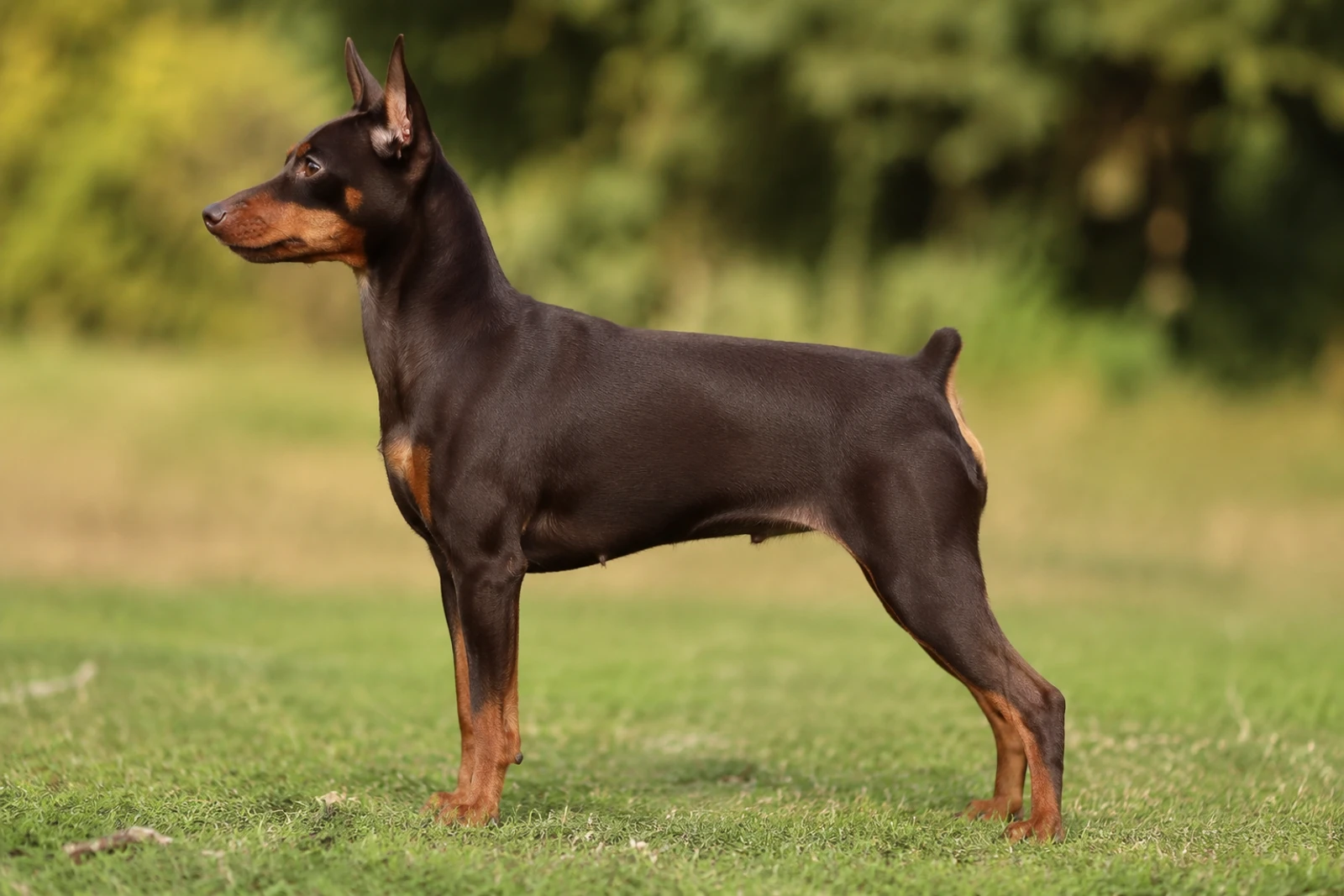
The Miniature Pinscher is a tiny, energetic toy breed with a bold personality and very little coat maintenance. It works best for owners who want a lively small dog and are ready to manage barking, jumping, and a strong independent streak.
At a glance
- Size
- Small
- Height
- 10–13 in
- Weight
- 8–10 lb
- Life span
- 12–16 years
- Coat colors
- Red, stag red, black and rust, chocolate and rust
- Coat type
- Short smooth coat
- Group
- Companion
- Origin
- Germany
How much does a Miniature Pinscher cost?
Adopt / rescue
$75–$400
Usually includes spay/neuter, first shots, and a microchip.
Buy from a breeder
$700–$2,000
From a reputable, health-testing breeder.
Approximate USD. Prices vary widely by region, breeder, pedigree, age, and coat colour — adopting is the lower-cost and recommended route. Avoid suspiciously cheap “breeders”; they’re often puppy mills.
Estimate the full cost of a Miniature Pinscher →Want the ongoing number? Estimate the monthly food bill for a Miniature Pinscher with our dog food cost calculator.
Miniature Pinscher photos
Views
Front, side, rear and top — the full silhouette.Poses
How the breed sits, lies, moves and plays.Puppy to senior
The breed across its whole life.Expressions
The breed’s range of moods.Close-up details
Eyes, ears, nose, paws, tail and coat.Coat colors
The breed’s recognized colors.Click any photo to enlarge. We show the Miniature Pinscher from every angle — three views, poses, life stages, expressions, close-ups, coat and colors.
Appearance & size
A Miniature Pinscher is a small dog built on a square, muscular chassis — think of a tiny athlete who never misses leg day. You won’t mistake the Min Pin for a delicate lap ornament. The whole package is compact, with firm muscle under a tight skin, and it moves like a little deer with an exaggerated, high-stepping trot that breeders call the hackney gait.
Size & build
- Height: 10–13 inches at the withers (shoulder blades)
- Weight: 8–10 pounds, and every ounce is solid The body is short and square-proportioned: the distance from the point of the shoulder to the rear point of the buttock is roughly equal to the height. Deep, moderately wide chest with well-sprung ribs flows into a visible tuck-up at the loin. The topline stands level or slopes ever so slightly down toward the hindquarters.
From the front, you see straight, parallel forelegs set under a deep chest — no splayed elbows or pinched shoulders. The neck arches cleanly into well-laid-back shoulders that allow that flashy, forward-reaching stride. From the side, the square outline jumps out; a short, strong back and a distinct waist accent the agile look. From the rear, the thighs are muscular and the hocks are straight when viewed from behind, never turning in or out.
Coat & color
The coat is short, smooth, and hard to the touch — lying flat and glossy all over. You never have to trim it, and a quick rubdown with a hound glove brings up the gleam.
Three color patterns dominate:
- Stag red — a clear, solid red that can vary from a pale golden red to a deep, rich mahogany. No dark hairs mixed in.
- Black & rust — a deep jet black with sharply defined rust (tan) markings on the cheeks, lips, lower jaw, throat, twin spots above the eyes, chest, lower legs, inside the rear legs, and under the tail. The markings should pop, not bleed.
- Chocolate & rust — a rich warm brown with identical rust points, which gives a softer but equally crisp contrast.
Blue or fawn with tan markings also appear, though those are disqualifications in the show ring. The rust is always a dark, vibrant shade — never washed out.
Distinctive features that grab your eye
The head is an elongated wedge with a flat skull and a tapering muzzle — no coarseness or snipiness. Dark, oval eyes sit high and bright, giving a keen, curious expression. Ears are set high; they can stand erect, half-prick, or fully drop, depending on the dog. (Many pet Min Pins have natural, upright ears without cropping; historically cropped ears are still seen, but the natural ear is increasingly common.)
The tail is set high and often docked in places where that’s still allowed, but natural tails are carried jauntily up or slightly curved. The dog’s whole silhouette — erect ears, arched neck, tight feet, and that flashy, prancing gait — reads as self-possessed and sharp. You’ll hear it called the “king of toys,” and the carriage backs that up: a Min Pin stands and moves like a much larger animal crammed into a 10-pound frame.
History & origin
The Miniature Pinscher wasn’t bred down from Dobermans, no matter how much that sleek, self-possessed silhouette suggests otherwise. This compact firecracker is hundreds of years older. In Germany, where it was originally called the Zwergpinscher (“dwarf pinscher”), the breed had already been earning its keep for centuries before Karl Friedrich Louis Dobermann ever envisioned his larger protection dog in the late 1800s.
What the Min Pin was bred to do was simple and unglamorous: kill rats. On German farms and in stables, a small, quick, sharp-toothed dog was worth its weight in feed savings. Standing just 10 to 13 inches at the shoulder and weighing 8 to 10 pounds, the Min Pin could twist into tight corners and snap a vermin spine before the rat knew what hit it. The breed’s ancestors were likely standard German Pinschers crossed with smaller smooth-coated dogs—Dachshunds and Italian Greyhounds are the usual suspects—to get that fine-boned, high-stepping frame without losing any fire.
That ratting past gave the Min Pin a boldness completely out of proportion to its size. Even as breed fanciers in Germany began refining the look in the 19th century, they prized a dog that was “fearless, alert, and vigorous.” Nobody wanted a timid lap-warmer. When the first examples reached the United States in the early 1900s, they were shown under the name “Pinscher (Miniature)” and the American Kennel Club officially recognized the breed in 1925. After World War II, American soldiers returning from Europe brought more Min Pins home, and the breed’s popularity took off.
Today’s Min Pin still carries that old-world terrier-like drive under a polished, gleaming coat. Breeders don’t call it the “King of Toys” just because it struts—they call it that because this little dog never got the memo that it’s small. The same determination that cleared barns now translates into a dog that will chase anything that scurries and doesn’t back down from a challenge, which is exactly why a securely fenced yard and a solid recall training plan matter more than a fancy bed.
Temperament & personality
Think of a 10-pound dog who struts through the world like he owns it — and means it. The Miniature Pinscher isn’t a scaled-down Doberman, but he’s every bit the fearless, high-energy character you’d expect from that cocky stance and bright, forward-set eyes. Under all the bravado, he’s deeply attached to his people and thrives on being part of the daily action. Ignore that need for connection, and a Min Pin will let you know with piercing, nonstop barking, or by taking out his anxiety on your baseboards.
Bold, nosy, and always on duty
This is a dog who patrols windowsills, monitors every knock and doorbell, and announces visitors with a bark that sounds far too big for his 8–10 pound frame. He doesn’t just watch — he leans forward, weight on his toes, as if he’s about to investigate personally. That watchfulness makes him a superb little alarm system, but unless you teach a “quiet” cue early, you’ll be living with a tiny, repetitive siren. He’s naturally suspicious of strangers, and early, positive exposure to new people and situations is what tips him from “temperamental” to “confidently aloof.”
Affection on his own terms
Once you earn his trust, a Min Pin is a cuddle bug who’ll burrow under blankets and plaster himself to your lap. But he isn’t a passive lapdog — he offers affection enthusiastically and expects you to reciprocate. He reads body language like a pro: a soft eye, a loose wagging tail, and a body that leans into you mean you’re in his inner circle. A stiff posture, direct stare, or lip licking that looks out of context? That’s his way of saying, “Give me space.” Learn to read those signals and you’ll sidestep the snap that can come from a dog who’s been crowded or startled.
Strong-willed with a capital S
Training a Min Pin takes patience, because he’s smart and easily bored. He’ll learn a trick in three repetitions, then decide he’d rather do something else. Respectful, consistent handling — short, game-based sessions, never a heavy hand — gets results. Force triggers his stubborn side and can erode the bond. His brain needs as much exercise as his legs: puzzle toys, hide-and-seek, and trick training keep him from inventing his own “projects,” like shredding couch cushions or unrolling toilet paper throughout the house.
Household realities
That scrappy determination means a Min Pin often isn’t the easiest choice for homes with young children or multiple small pets. He can be possessive of toys and food, and his low tolerance for clumsy handling means kids need clear rules: never bother him while he eats, and don’t hover over him when he’s resting. Many Min Pins will mark territory indoors — especially if they feel insecure or if they smell old accidents. Because they define “home” by your scent rather than physical walls, less-used rooms may become spots for stray urine. Clean accidents with an enzymatic cleaner, not just soap and water, and consider a homemade vinegar spray (a 50/50 mix of white vinegar and water) to neutralize odors that draw him back. Reinforce outdoor potty breaks with an immediate high-value treat; punishment after the fact only teaches him to hide when he needs to go.
A quick look at his quirks
- Chewing: A bored Min Pin will gnaw on chair legs, shoes, electrical cords — whatever’s handy. A spray of boiled citrus peels (steep the rinds in water, cool, and decant) on off-limits items turns him off without harmful chemicals.
- Body language cheat codes: A forward lean with a hard stare often precedes a charge at a perceived intruder — human, squirrel, or vacuum. Yawning, head turns, or lip flicks outside of sleepy moments are calming signals; if you see them during a cuddle session or training, dial back the intensity.
- Territorial marking: Even neutered males sometimes hike a leg on furniture. If you spot him sniffing the same spot obsessively, interrupt with a cheery “outside!” and reward elimination where you want it.
Live with a Min Pin on his terms — fair leadership, mental work, and plenty of close contact — and you’ll have a fiercely loyal, highly entertaining sidekick who keeps you laughing and on your toes. Skimp on any of those, and you’re sharing your home with a tiny tyrant.
Good with kids, dogs & other pets
Min Pins are not plush toys. At 8–10 pounds and barely a foot tall, they forget their size constantly—and that swagger colors every relationship with kids, other dogs, and other animals in the house.
Kids
A Miniature Pinscher can be a bright, velcro-style companion for an older child who reads canine body language and respects space. He likes to burrow under blankets and steal a warm lap, not be carried around like a doll. Toddlers and impulsive huggers are a bad match—a sudden grab or a clumsy step near this lightweight dog can trigger a fear snap. Supervise all interactions and teach kids to let the dog come to them. Early socialization matters enormously here. Pups exposed gently to calm, predictable children before 14–16 weeks tend to develop the patience needed for family life. Without that window, the same dog may default to wariness or quick corrections. A Min Pin chooses his person, so he might tolerate one child beautifully and avoid another. Respect that.
Other dogs
He’ll challenge a Great Dane without blinking. That boldness means careful introductions are non-negotiable. Same-size playmates—other small, sturdy dogs—usually bring out the best play when introduced on neutral ground. A larger, easygoing dog can work if the bigger dog won’t flatten him for posturing, but a single rough correction could break a bone. Off-leash dog parks full of unfamiliar, rowdy dogs are often a fast track to a stressed, reactive Min Pin. Some adults simply prefer their human’s company and don’t need dog friends; forcing the issue undermines their confidence.
Cats & small pets
Many Min Pins have a hardwired chase instinct that lights up when a cat darts. You might get a cautious détente with a confident, dog-savvy cat raised alongside the puppy—introducing them gradually over weeks—but never leave them unsupervised. Pocket pets like hamsters, gerbils, or rabbits read as prey, plain and simple. Secure, separate housing is the only safe route.
Trainability & intelligence
Miniature Pinschers learn fast, but they don’t obey just because you asked nicely. This is a small dog with a big, independent streak — treat training like a negotiation, not a command performance. Heavy-handed corrections will either shut them down or spark a battle of wills you won’t win. Instead, reward what you want: a tiny piece of chicken, a squeaky tug toy, or an excited “yes!” right when their butt hits the floor. They work for payment far more reliably than for praise alone.
Early socialization is make-or-break. The critical window closes around 14–16 weeks. Before that, introduce your puppy to a wide range of people, calm dogs, handling by strangers, weird surfaces (wobble boards, grass, tile), and everyday clatter like doorbells or kitchen timers. Without that foundation, a Min Pin can grow suspicious and reactive. Ongoing, positive outings help prevent that wariness from resurfacing in adulthood.
Training approach: Keep sessions brief — 5 minutes tops — and end before boredom sets in. Use a reward marker precisely, and pay generously for attempted compliance, not just perfect execution. Consistency is everything. If you let them ignore a “down” because they look adorable, they’ll file that away. Expect to re-proof behaviors in new places; a Min Pin who obeys in the living room may blow you off in the backyard the instant a squirrel appears.
Recall is a major challenge. Their high prey drive and curiosity pull them away from you, so build a rock-solid recall using a special reward — diced chicken or a flirt pole chase — and practice it hundreds of times on a long line in boring, fenced areas before you test it off-leash. Even then, many owners find a securely fenced yard is the safest bet.
Smart, sensitive, and occasionally defiant, this breed makes you earn their partnership. If you’re patient, consistent, and pay well, you’ll get a spirited dog who loves the training game. Just don’t expect blind obedience — that’s not what they’re for.
Exercise & energy needs
Think “toy” but forget everything else that label implies. A Miniature Pinscher is 8–10 lbs of coiled spring, not a lap ornament. Plan on two 20-minute sessions of focused activity every day. A single long walk usually won’t do it — your Min Pin’s energy comes in intense bursts, so breaking the day up matches their wiring.
One session might be a brisk, sniff-heavy walk with a pace that gets their little legs truly moving. The other should lean into the stuff a Min Pin was born to do: chase, pounce, and problem-solve. Flirt poles, a game of fetch down a hallway, or a 20-minute session with a puzzle toy that dispenses treats all work. Short, frequent blasts of movement suit a dog this size far better than a one-hour march that leaves them overtired and wired.
Mental work counts as exercise
Don’t skimp on brain games. A Min Pin’s alert, clever mind needs a job. Nose work — hide a smelly treat and let them sniff it out — can burn energy indoors on a rainy day. Rotate puzzle feeders, teach a new trick, or set up a tiny indoor obstacle course with a low tunnel. The mental drain often takes the edge off as much as a run does.
Because these little dogs can be prone to knee issues like patellar luxation, avoid high-impact habits. Repeated jumping off the back of the sofa or flying off a high bed stacks stress on small joints. When you play fetch, keep the throws low and the surface carpeted. If you want to try dog sports like rally or modified agility, lower any jumps and get a vet’s green light first. A tired Min Pin is a quieter, less reactive Min Pin — and that 40-minute daily commitment, split smart, is your best tool for keeping one that way.
Grooming & coat care
A Min Pin’s coat is about as low-maintenance as dog grooming gets. The short, smooth single coat lies flat, repels dirt naturally, and has no insulating underlayer to trap loose hair. Solid black, rich stag red, and chocolate — often with sharply defined rust (tan) markings on the face, chest, and legs — are the breed’s classic looks, and a quick weekly once-over keeps them gleaming.
Brushing
Grab a soft-bristle brush or a rubber curry mitt and give your dog a 5-minute rub-down once or twice a week. The bristles distribute skin oils across the coat to boost shine, while the mitt or curry gently lifts out dead hair before it lands on the furniture. During spring and fall you might see a bit more shedding; add an extra session, but the seasonal uptick is mild compared to double-coated breeds. A brisk daily walk doesn’t just tire them out — it stirs up natural oils that make the coat gleam.
Bathing
Baths are rare. A Min Pin with a healthy coat often needs nothing more than a wipe-down with a damp cloth. When they do roll in something foul, use a mild dog-specific shampoo and rinse until the water runs clear. Bathing every two to three months is plenty; overdoing it strips the oils that keep the coat hard and glossy.
Nails, ears, and teeth
Small dogs burn through nail trims. Check every 3–4 weeks and clip or grind just the tips — letting nails grow too long can alter the Min Pin’s proud, upright stance. The ears stand up, but they still trap wax and grit. Wipe the outer ear weekly with a damp cotton ball or a vet-approved cleaner; never poke into the canal. Dental care is where you’ll really earn your keep. Daily brushing with a dog enzymatic toothpaste is the best defense against tartar buildup and early tooth loss, a common trouble spot in tiny breeds. Dental chews and water additives help, but they don’t replace mechanical scraping.
Seasonal shifts
A single coat doesn’t blow out dramatically. You’ll notice a faint increase in loose hair as daylight hours change; a few extra passes with the rubber mitt handle it. What matters more is the weather. In winter, a fitted jacket or sweater keeps body heat from escaping, and a quick toweling-off after wet walks prevents that sour damp-dog smell on a coat that otherwise stays remarkably clean. Warm months are fine with shade and water, but the short coat offers almost no sun protection — limit midday sunbathing to avoid burns on pale skin.
Shedding & allergies
The Miniature Pinscher’s sleek, single coat is about as low-fuss as it gets, but it still loses hair. These dogs shed a moderate amount year-round — you’ll find short, stiff little hairs on dark pants and light upholstery alike. It’s never the blizzard you’d get from a double-coated breed, but if you expect a zero-hair home, this isn’t your dog.
A weekly once-over with a rubber curry brush or a damp cloth knocks loose coat out before it lands on your floor. During spring and fall, shedding ticks up slightly for a few weeks, though the Min Pin doesn’t go through a dramatic seasonal blowout. The hair is short enough that it doesn’t mat or tangle, and you’ll never need to book a groomer for a trim.
Drool isn’t a factor. Min Pins run dry-mouthed, so you won’t be wiping slobber off your knee or your couch.
On the allergy front: no dog is truly hypoallergenic, and that includes the Miniature Pinscher. They produce dander and saliva proteins just like any other breed. That said, their tiny size, short coat, and minimal drool mean they spread less allergen around the house than many larger or heavily shedding breeds. Some allergy sufferers find them easier to live with, but it’s a gamble. Spend real time with the individual dog, inside a home, before you commit. Responsible breeders won’t promise an allergy-free pup, and anyone who does is selling snake oil.
Diet & nutrition
A Min Pin can tip the scales at just 8 to 10 pounds, so every extra ounce shows. Obesity isn’t just a cosmetic problem — it puts real strain on those fine-boned legs and knees. This breed is already prone to patellar luxation and Legg-Calvé-Perthes disease, so keeping your dog lean is one of the simplest ways to protect its joints long-term. Use a kitchen scale to measure meals; eyeballing a scoop leads to slow, steady weight creep.
How much to feed
An adult Miniature Pinscher typically burns through 150–250 calories a day. Where your dog falls on that spectrum depends on real-world activity. A Min Pin who races along fence lines and does a solid 30–45 minutes of active play may thrive near the upper end. A more sedate house companion — especially one who’s already been fixed — often needs the lower number. Start with the feeding guide on a high-quality small-breed food, then dial it in by feel. You should be able to feel the ribs under a light layer of flesh and see a distinct waist when you look down at your dog.
Puppy feeding schedule
Min Pin puppies run hot and burn through energy fast, so space meals out. Four evenly spaced meals a day until the puppy hits four months, then three meals until six months, then the adult rhythm of two meals a day. Transition a new puppy onto your chosen food gradually over 7–10 days, starting with a lightly cooked, puréed mash of meat, vegetables, and fruit or a premium commercial puppy formula. Raw items like a chicken wing can be introduced around 12 weeks, but only while you supervise directly — not left alone with a bone.
What goes in the bowl
A well-formulated small-breed kibble or wet food gets the job done with no guesswork. If you prefer homemade, look for roughly 60% animal protein (meat, fish, eggs), 20–30% vegetables and fruits, and the rest from digestible extras like pearl barley, plain yogurt, or a little unsalted vegetable cooking water as a base. This is a small dog with a carnivore-adapted digestive tract; a vegetarian or vegan diet deprives it of essential nutrients. Many Min Pins love food and learn to manipulate their people for it. Serve everything in their own bowl, never from the table, to head off begging that’s nearly impossible to undo. If your dog bolts meals in seconds, a puzzle bowl or snuffle mat slows eating and burns a little mental energy at the same time.
Keeping weight in check through the senior years
A Min Pin’s metabolism often downshifts after age 7 or 8, while the desire to eat stays strong. Obesity is a top health threat for older dogs, so monitor weight weekly and trim portions as daily activity eases off. There’s no good reason to slash protein in a healthy senior; they do fine on adult-formula food. Some older dogs do better with three smaller meals instead of two — the total calories stay the same, but smaller portions are easier on an aging stomach. If teeth become a problem, purée meals to make nutrition absorption easier without switching to a carb-heavy mush that packs on pounds. Steer clear of rich holiday trimmings and fatty treats, which can trigger pancreatitis in small breeds. A little canned fish, a cooked egg, or a spoonful of steamed veggies mixed into dinner now and then adds variety without setting off a weight spiral.
Health & lifespan
A well-cared-for Min Pin often lives 12 to 16 years. That’s a long time for a dog who rarely tops 10 pounds, but it means you’ll be managing a few predictable health quirks across more than a decade.
What tends to crop up
- Patellar luxation — A kneecap that pops out of place. You’ll spot a skip or a hop mid-stride. Mild cases may need only joint supplements and lean weight, but severe ones can require surgery.
- Dental disease — Small mouths pack in teeth that trap tartar fast. Without daily brushing and annual cleanings, gum infection can spread and actually shorten that long lifespan.
- Skin issues — Some Min Pins run itchy or develop rashes from allergies, dry air, or the wrong food. You’ll want to notice early, because a constant scratch can lead to raw spots and secondary infections.
- Hypoglycemia — Puppies especially can get dangerously low blood sugar if they go too long without a meal. Keeping kibble available into the first year usually prevents it.
- Inguinal hernia — A soft bulge near the groin. Responsible breeders screen breeding stock and often fix them when a pup is spayed or neutered.
- Tracheal collapse — A honking cough triggered by pulling on a collar. Using a harness from day one takes pressure off the windpipe.
- Eye problems — Progressive retinal atrophy and other inherited eye diseases pop up in the breed. A veterinary ophthalmologist can catch changes before you’d notice a thing.
A short coat has trade-offs
Min Pins run hot and cold — literally. That slick, single coat offers zero insulation against a chill, so a sweater in winter isn’t a fashion choice. In summer, they overheat quickly; skip midday pavement walks and always bring water.
Keep them trim and covered
Extra weight on a 9-pound frame magnifies every joint and breathing issue. Measure meals, go easy on treats, and keep up a daily mental and physical workout. You’ll see it in their zip. Prevention basics matter too: monthly heartworm meds during mosquito season, a legally required rabies shot, and a vet visit at least once a year to listen for heart murmurs and check teeth, knees, and eyes before small things get big.
Living environment
A 10-pound dog with a daredevil streak and a voice far bigger than her size, the Min Pin does surprisingly well in an apartment — if you manage the noise and meet her headstrong energy needs. She doesn’t need a big yard, but she absolutely needs daily, high-engagement outlets: short, intense play sessions, indoor fetch, flirt pole work, or sniffing games. A house with a securely fenced yard is nice, but not essential. Without enough mental and physical work, she’ll burn off that excess brainpower by barking at every noise in the hallway.
Small size makes the Min Pin portable, but fragile. Those spring-loaded legs and reckless leaps put her at risk for fractures and dislocations. Couch-to-floor flying and jumping off high beds are real hazards. Soft rugs, carpeted stairs, and actively teaching “off” help protect her joints. Outside, keep high-impact zoomies on grass rather than concrete.
Thin coat and next to no body fat mean she’s a heat-seeking missile in cold weather. A fleece or quilted coat is non-negotiable once temperatures drop. In summer, stick to early mornings or evenings — she can overheat if you push too hard.
Noise-wise, accept that you’re living with a tiny watch dog. She’ll announce delivery trucks, squirrels, and neighbors with zero hesitation. You can’t train away the instinct, but you can teach a solid “quiet” cue and redirect with a chew or puzzle toy. A bored Min Pin becomes a full-time noise nuisance.
Leaving her alone stretches the bond tight. This breed forms intense attachments and can quickly develop separation anxiety. If your household is empty for nine or ten hours daily, a Min Pin isn’t a great fit. Gradual alone-time training from puppyhood, frozen Kongs, and a predictable routine help, but she’ll still do best with a midday break or a dog walker. Expect to deliver at least two to three active, 15–20 minute sessions a day — plus brain games — or she’ll invent her own entertainment, and it will be loud.
Who this breed suits
A Min Pin is the family comedian and escape artist rolled into a small, polished package. He suits someone who wants a compact dog with a huge personality—not a quiet lap warmer. If you’re looking for a dog that will follow you from room to room, demand a real workout, and make you laugh with his bossy antics, this breed can be a perfect fit.
You’ll thrive together if you:
- Lead an active, engaged lifestyle. Despite standing just 10–13 inches and weighing 8–10 pounds, a Min Pin needs a solid 45–60 minutes of movement daily, not just a leash stroll. He’ll turn your living room into an agility course and expects brisk walks, interactive play, and puzzle toys that work his brain. A fenced yard is non-negotiable—these little Houdinis squeeze through gaps and bolt after squirrels in a heartbeat.
- Appreciate a tiny watchdog with big opinions. Min Pins bark at anything they think you should know about: delivery trucks, a neighbor’s cat, a leaf blowing past the window. If you view this as a feature, not a flaw, you’ll love the alert backup. If you have thin walls or noise-sensitive neighbors, think twice.
- Have older, respectful kids or no kids at all. Families with children who understand gentle handling can do well, but a Min Pin’s small, fine-boned build and low tolerance for clumsy hugs make homes with toddlers a risky match. A quick tumble or an ear tug can lead to injury—and a terrified, defensive dog.
- Are consistent and patient with training. These dogs are whip-smart and just as stubborn. They’ll test you, steal your socks for a chase, and act like they own the place if you let them. They respond beautifully to positive, firm routines, but a first-timer who wants a compliant, easygoing dog will end up exhausted and outmaneuvered.
Who should think twice:
- Couch potatoes and those with minimal time for daily exercise and mental games. A bored Min Pin will dismantle your baseboards and bark enough to alienate the entire block.
- First-time owners whose vision of a small dog is a calm lap companion. The Min Pin is more Ferrari than loveseat.
- Homes with very young children, large rambunctious dogs that might accidentally trample him, or a wide-open unfenced yard where a 10-pound dog can slip away in seconds.
- Anyone unwilling to manage a dedicated escape artist. A Min Pin will dig under, squeeze through, or climb over weak barriers with determination.
Seniors who still take daily brisk walks and want a lively, low-shedding companion can absolutely make it work—just know you’ll be outwitted from time to time. A Min Pin puts a decade and a half of 12–16 years of spicy devotion into the right hands. Choose this dog if you want a partner that acts like a full-sized guardian trapped in a pocket-sized body and gives you a reason to stay active every single day.
Cost of ownership
A well-bred Min Pin puppy from a health-testing breeder typically lands between $1,500 and $3,000. Show-line pups or those from champion parents can push past that, while a young adult from a rescue or shelter often runs $200 to $500, usually already spayed or neutered. Either way, budget for the upfront gear: a crate, a martingale collar and leash, a few tough toys, and a cozy bed. That's roughly $200–$400 right out of the gate.
Month to month, you're looking at a surprisingly affordable roommate. A high-quality kibble formulated for small breeds will run about $25–$40/month — these 8-to-10-pound dogs don't eat much, but they thrive on nutrient-dense food, not filler. Treats for training add maybe $10. Grooming is a breeze: a quick weekly brushing with a rubber curry or hound glove, plus an occasional nail trim. If you do it yourself, the supply cost is negligible; a pro visit every 6–8 weeks might be $40–$60, but many owners handle it at home.
Veterinary care is your real line item. Annual wellness exams, vaccinations, and heartworm prevention sit around $200–$400 per year. Min Pins can be prone to patellar luxation and eye issues, so a good relationship with a vet pays off. Pet insurance — often $25–$50/month for a solid accident-and-illness plan — can blunt the sting of an unexpected emergency. Factor in heartworm and flea preventatives, too ($15–$25/month combined). All told, a realistic monthly budget sits between $80 and $150, not counting a walker or sitter if you work long hours. That's a small price for a big personality that runs the house from the back of the sofa.
Choosing a Miniature Pinscher
Rescue or Responsible Breeder
You’ve got two good paths: a breed-specific rescue or a breeder who puts health testing front and center. Rescues often place adult Min Pins whose personalities are already baked—you’ll know if you’re getting a cuddler or a tiny tyrant right off the bat. Puppies do appear in rescue, but not on demand, so you may need patience. The plus side: you’re giving a dog a second chance and sidestepping the puppy-mill pipeline entirely.
If you go the breeder route, expect a waitlist. Good breeders don’t churn out litters to meet demand. They’ll grill you about your lifestyle, fencing, and dog experience, and they should welcome that scrutiny because they care where their pups land.
Health Clearances That Matter
Don’t just nod when a breeder says “they’re healthy.” Ask for paperwork. For Min Pins, the must-haves are:
- Patellar luxation: OFA certification showing both parents have normal knees. Slipping kneecaps are a common woe in tiny dogs, and surgery isn’t cheap.
- Eye exam: CERF or OFA Eye clearance within the last year. Min Pins can develop progressive retinal atrophy and other eye issues.
- Cardiac: An echocardiogram is ideal. Some lines carry congenital heart defects, and a quick listen with a stethoscope won’t catch them all.
- Legg-Calvé-Perthes disease: A hip joint disorder that can crop up in small breeds. Reputable breeders screen for it.
They may also thyroid test or do a DNA test for mucopolysaccharidosis (MPS VI), though that’s less widespread. If a breeder offers only a vet check as “testing,” walk.
Red Flags That Scream “Stay Away”
- No parent visits. You should meet at least one parent on site and see where the puppies are raised—a living room, not a kennel row.
- Always-available puppies. If they advertise multiple litters year-round and offer same-day pickup, you’re dealing with a mill or backyard breeder.
- “Teacup” or “micro” anything. Min Pins are already small. Intentionally breeding undersized dogs invites fragile bones, organ problems, and hypoglycemia.
- Early release. Puppies leaving before 8 weeks miss crucial bite inhibition and social skills. Many top breeders hold until 10 weeks.
- No contract. A solid breeder provides a health guarantee, a spay/neuter agreement, and a take-back clause for any age.
Picking Your Puppy
Watch the litter without jumping in. You want a puppy that’s inquisitive and confident—approaching you, checking out novel objects, but not relentlessly hounding a littermate. The one trembling under a chair may never fully relax in a noisy home, while the pint-sized wrecking ball might exhaust a first-time owner. A skilled breeder will already have notes on each pup’s emerging temperament and can match you to a companion that fits your energy level and experience.
Ask about early socialization. Puppies raised with household sounds, gentle handling, and short car rides tend to bounce back from scares faster. Don’t choose based on a flashy color or a patch of rust; a sound structure and steady nerve will pay off for the next 12–16 years.
Pros & cons
Pros
- Huge personality in a 8–10 lb, 10–13 in frame — apartment-ready and easy to take anywhere.
- Top-notch watchdog: you’ll always know when someone’s at the door, often with a bark that doesn’t match their size.
- Virtually no coat upkeep. The short, slick coat sheds minimally and needs only a weekly wipe-down and nail trim.
- A 12–16 year lifespan gives you a long stretch of sidekick energy, agility, and mischief.
- Quick to pick up tricks, rally, or obedience when training feels like a game — sharp, food-motivated, and entertaining.
- Intensely people-focused; they shadow you from room to room and snuggle aggressively once the day’s antics are done.
Cons
- Stubbornness is the price of smart. Training requires short, upbeat sessions and zero bribing, or they’ll out-negotiate you.
- Daily exercise isn’t optional — count on a solid 45–60 minutes of off-leash running, flirt-pole sessions, or brisk walks to settle their busy brain.
- Barking can become a full-time hobby. Alert barks easily turn into nonstop noise if you don’t teach a “quiet” cue early.
- Escape skills rival Houdini. Min Pins will climb chain-link, squeeze through tiny gaps, and bolt through doors; a truly secure yard is non-negotiable.
- Their fine-boned legs and fierce independence don’t mix well with young, grabby children. Better suited to homes with older kids who respect small-dog boundaries.
- Ratting heritage means high prey drive — off-leash recall can vaporize when a squirrel or chipmunk appears.
- Many are dog-selective or bossy around larger dogs, which can spark fights if you don’t manage introductions and body language carefully.
- Thin coat plus almost no body fat equals zero cold tolerance. Plan on a coat or sweater during winter walks, even in mild chill.
- Responsible breeders screen for patellar luxation and Legg-Calvé-Perthes disease; dental care is a lifelong commitment, as small mouths are prone to tartar buildup.
Similar breeds & alternatives
If the Min Pin’s outsized confidence and “King of Toys” swagger call to you but you’re sorting through the trade-offs, a few other small breeds draw the same kind of attention—and differ in ways that might fit your household better.
Italian Greyhound
At a similar height (13–15 in) but noticeably lighter and more fragile, IGs are built for sprinting in safe, enclosed spaces, not rough-and-tumble play. They’re quieter and less suspicious of strangers than a Min Pin, bonding intensely with their family but shying away from chaos. Leg breaks and cold sensitivity are real worries; you’ll be juggling sweaters and avoiding high furniture. Expect a Velcro dog that needs you nearby, not the independent problem-solver a Min Pin is.
Dachshund (Miniature)
A Miniature Dachshund and a Min Pin share a certain stubbornness and a bark-first instinct, but the Dachshund’s long back and earth-dog tenacity set them apart. They dig, tunnel under blankets, and follow their nose with a single-minded focus that a Min Pin reserves for squirrel patrol. Weight runs 11 lb or less, yet they pack the same gallon of personality into a pint-sized body. IVDD risk demands vigilance around stairs and jumping, something a springy Min Pin rarely worries about.
Manchester Terrier (Toy)
If you like the glossy black-and-tan look but want a breed that’s often more forgiving with other dogs and less prone to one-person feistiness, a Toy Manchester (under 12 lb) is worth a look. They have a similar sleek, athletic build and a sharp terrier brain, but their energy is more channeled into ratting games and agility than the Min Pin’s cock-of-the-walk posturing. Both can be escape artists, so fence security matters equally.
Chihuahua (Smooth Coat)
A smooth-coat Chihuahua is smaller (usually 4–6 lb), headstrong, and absolutely devoted to its person—but physically far more breakable. That tiny size makes handling around young children a bigger liability, and they tend to be warier of strangers, sometimes crossing into nippy defensiveness more readily than a Min Pin’s bold, curious investigation. Heat-seeking and shivering, they’re lap-sitters first; a Min Pin would rather patrol the windowsill, then curl up under the covers on their own terms.
No small dog here is a pushover. The Min Pin’s edge comes from a combination of hard-headed independence, athletic vertical jumps, and a bark that punches above its weight. The right alternative is often about dialing down that intensity without losing the compact, lively spirit you were after in the first place.
Fun facts
- The Miniature Pinscher is often called the King of Toys.
- It is not a mini Doberman; the breeds have separate histories.
- Its short coat is one of the easiest to maintain.
Frequently asked questions
- Are Miniature Pinschers good with children?
- Miniature Pinschers can be good with children if well-socialized, but their small size and spirited nature mean interactions should always be supervised. They may be nippy if handled roughly, so they tend to do best with older, respectful kids. Teaching children how to properly interact with the dog is essential to prevent accidental injury.
- Do Miniature Pinschers shed a lot?
- No, Miniature Pinschers are moderate shedders, rated 2 out of 5. Their short, smooth coat sheds minimally year-round, with a slight increase during seasonal changes. Regular weekly brushing helps keep loose hair under control.
- How much exercise does a Miniature Pinscher need?
- Miniature Pinschers have high energy and require daily exercise to stay happy and healthy. A couple of brisk walks combined with play sessions usually meet their needs. They also enjoy mental challenges like puzzle toys to prevent boredom.
- Are Miniature Pinschers easy to groom?
- Yes, grooming a Miniature Pinscher is very easy due to their short, low-maintenance coat. Occasional brushing and baths as needed are usually sufficient. Their grooming needs are minimal, making them a low-effort breed in this regard.
- Can Miniature Pinschers live in apartments?
- Yes, Miniature Pinschers can adapt well to apartment living if their exercise needs are met. Their small size is convenient, but they are alert and may bark at noises, which could be an issue in close quarters. Consistent training can help manage their vocal tendencies.
- Are Miniature Pinschers good for first-time dog owners?
- Miniature Pinschers can be a challenge for first-time owners due to their independent and stubborn nature. They respond best to confident, consistent training with positive reinforcement. While they are intelligent, they need an owner who can provide firm but gentle guidance.
Tools & calculators for Miniature Pinscher owners
Quick estimates tailored to Miniature Pinschers — pre-filled with this breed’s size where it matters.
Articles & stories about the Miniature Pinscher
Sources & standards
This profile follows recognized breed standards from the American Kennel Club (AKC) and the Fédération Cynologique Internationale (FCI), along with established veterinary and breed-club guidance. These describe general breed tendencies — every dog is an individual.