

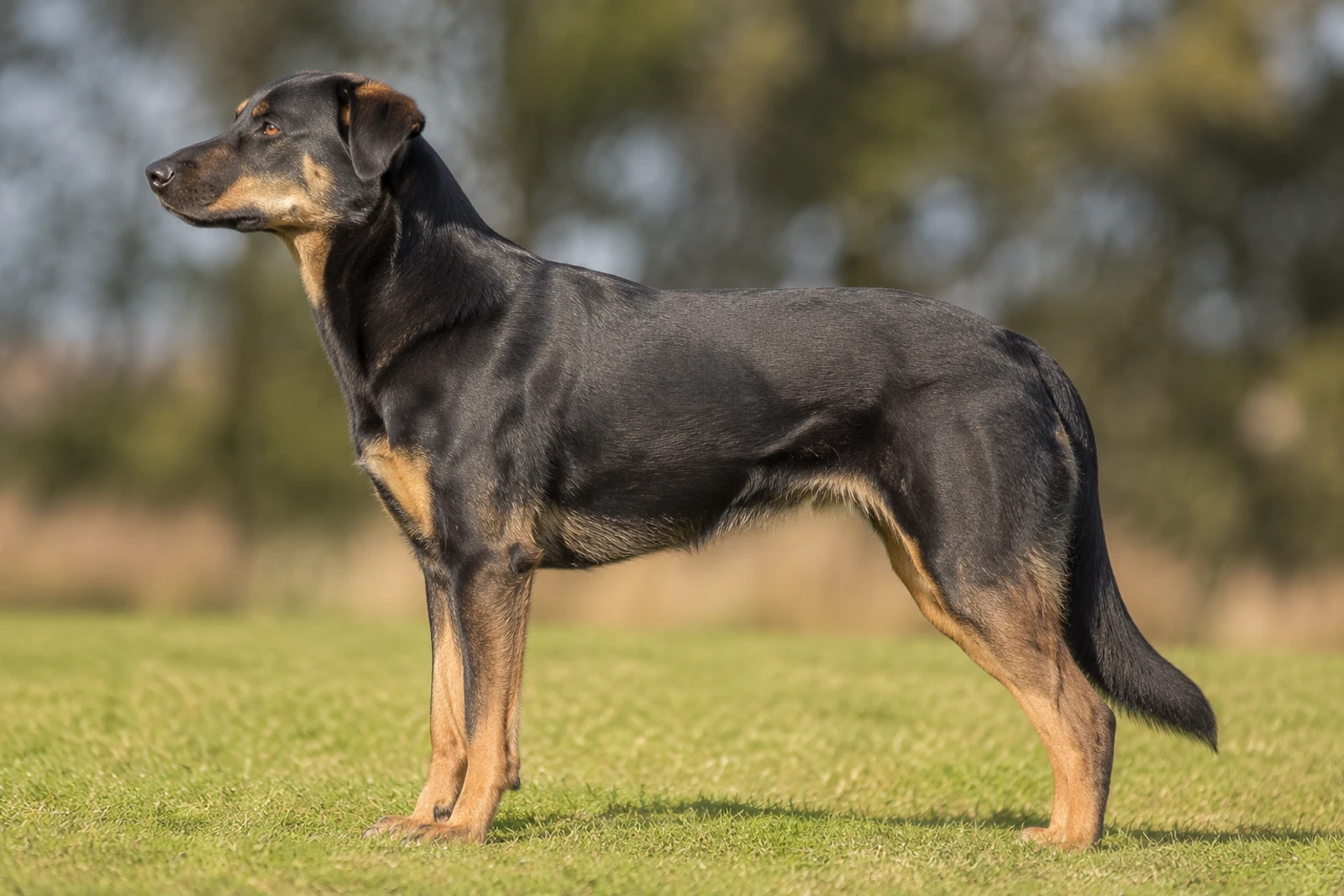
The New Zealand Huntaway is a highly intelligent and energetic herding breed developed to drive sheep across rugged terrain using its distinctive deep bark. This medium-to-large working dog is best suited to active families or farmers who can provide ample physical and mental exercise. With a loyal and devoted nature, the Huntaway thrives when given a job to do, forming strong bonds with its humans. While not a breed for novice owners or apartment living, it excels in canine sports and rural environments, offering endless enthusiasm and a tireless work ethic.
At a glance
- Size
- Large
- Height
- 20–24 in
- Weight
- 40–66 lb
- Life span
- 12–14 years
- Coat colors
- Black and tan, Black, Brindle, Red
- Coat type
- Short, dense double coat
How much does a New Zealand Huntaway cost?
Adopt / rescue
$75–$400
Usually includes spay/neuter, first shots, and a microchip.
Buy from a breeder
$700–$2,000
From a reputable, health-testing breeder.
Approximate USD. Prices vary widely by region, breeder, pedigree, age, and coat colour — adopting is the lower-cost and recommended route. Avoid suspiciously cheap “breeders”; they’re often puppy mills.
Estimate the full cost of a New Zealand Huntaway →Want the ongoing number? Estimate the monthly food bill for a New Zealand Huntaway with our dog food cost calculator.
New Zealand Huntaway photos
Views
Front, side, rear and top — the full silhouette.Poses
How the breed sits, lies, moves and plays.Puppy to senior
The breed across its whole life.Expressions
The breed’s range of moods.Close-up details
Eyes, ears, nose, paws, tail and coat.Coat colors
The breed’s recognized colors.Click any photo to enlarge. We show the New Zealand Huntaway from every angle — three views, poses, life stages, expressions, close-ups, coat and colors.
Appearance & size
The first thing that strikes you about a Huntaway is that nobody designed this dog for a ring. Everything about him says I work for a living. He’s a large, rangy dog with a deep, roomy chest and a body that’s built to cover steep hill country for hours without quitting. Height and weight vary more than you’d expect from a purebred because working lines have always been selected for brains and bark, not a cookie-cutter silhouette. Dogs typically stand 20–24 inches at the shoulder; bitches run toward the lower end. Weight lands between 40 and 66 pounds, with a fit working dog looking leaner than a pet who’s had a lighter schedule.
From the side, the picture is one of balanced power. The chest reaches down to the elbows, the belly tucks up slightly, and the back is level and strong through the loin. The neck is muscular and carried with purpose. From the front, the forelegs are straight and set well apart, ending in round, thick-padded feet with well-arched toes — the sort of foot that shrugs off miles of gravel and tussock. The hindquarters are the engine: broad, heavily muscled thighs and hocks that are well let down. From behind, you see a dog that looks ready to push off hard, not one that lumbers.
The coat is a no-fuss, weather-resistant double coat that comes in two main lengths: a short, smooth variety and a longer, denser rough coat. Neither one demands much from you beyond an occasional brush. Colors run the gamut you’d find in a working collie’s extended family. Black and tan is the classic look, but you’ll also see solid black, brindle (a dark tiger-stripe on a lighter background), black with white markings, and tricolor. A splash of white on the chest, feet, or tail tip is common and perfectly acceptable.
His head is clean and confident, without exaggeration. Dark, alert eyes and ears that flop forward or hang to the side give him a direct, canny expression — this is a dog that misses nothing. The muzzle is moderately long and strong, ending in a black nose. And then there’s the tail: never docked, fairly long, and bushed, carried low with a slight upward curve. It’s not just an ornament. You’ll watch it signal every thought that crosses his mind long before the famous bark kicks in.
History & origin
The Huntaway isn’t a quiet, eye-driven herder like a Border Collie. New Zealand farmers built this breed to do one thing loudly: use a deep, rolling bark to shift mobs of sheep across vast, steep country where a shepherd couldn’t see — or whisper — a command.
A dog shaped by a landscape
When large-scale sheep stations spread across New Zealand’s high-country tussock lands in the late 1800s, imported British herding dogs hit a wall. Silent Heading dogs (the ancestors of today’s Border Collies) worked by stalking and staring, but on a foggy ridge or deep gully, a dog out of sight meant no movement at all. Farmers needed a dog that could keep driving stock away from them — hunting them onward — and report its position nonstop. That need birthed the Huntaway, named for the job it was bred to do.
What went into the mix
No pedigree records tracked the early crosses; working ability was everything. Most agree the foundation came from British working collies, likely Border Collies and other smooth-coated sheepdogs. To add size, stamina, and a far-carrying bark, shepherds probably folded in blood from breeds like the Labrador, Rottweiler, or even hounds — though nobody wrote it down. The goal was always a practical one:
- A dog heavy enough to handle half-wild sheep and rough terrain (40–66 lb) but agile enough to cover miles without breaking down.
- A two-toned, deep-chested bark that cuts through wind and bounces off hillsides.
- An independent problem solver that doesn’t wait for constant direction, yet stays biddable.
From farm tool to recognized breed (sort of)
For a century, the Huntaway remained a landrace: a working type, not a standardized breed. Every shepherd had a slightly different blend, and a dog’s value was measured in weaned lambs, not papers. Huntaway-only sheep dog trials — where dogs run mobs up steep slopes using bark alone — became a grassroots proving ground. In 2013, the New Zealand Kennel Club finally accepted the breed, drafting a standard that describes the moderate, athletic dog you see today (20–24 inches tall, smooth or rough coat). But even now, most Huntaways are born on farms, unregistered, earning their keep miles from any show ring.
The breed remains rare outside New Zealand and Australia. What keeps it going isn’t a club or a fad — it’s the genuine, daily grind of high-country shepherding. In a typical trial, a Huntaway that can shift three hundred ewes up a rocky face with nothing but a steady, booming bark earns more respect than a wall full of ribbons.
Temperament & personality
The New Zealand Huntaway is a working dog through and through—smart, independent, and powered by an almost obsessive need to move livestock with his voice. This breed wasn’t designed for quiet companionship; he was built to think on his feet on steep, sprawling stations, using a unique bark-and-body combination to shift stubborn sheep. That barking isn’t random noise. It’s a deliberate tool, and he’ll expect you to understand that.
Energy lives at the core of the Huntaway’s personality. This is not a dog who thrives on a couple of short leash walks. Plan on at least an hour of hard, purposeful exercise daily—running, hill work, or a long off-leash session where he can really stretch out. When the work stops, he can settle, but he settles best next to his people. He’s affectionate without being velcro; a content Huntaway often leans against your leg or rests his head on your knee, his body loose and eyes soft. Leave him alone for too long with nothing to do, though, and his voice will find a job. Bored Huntaways can become anxious, nonstop barkers—a direct pipeline from his herding instincts.
Around the household, he’s watchful and will announce visitors with a deep, rolling bark. He’s generally good-natured with his own family, including respectful kids, but early socialization matters. With strangers he’s often reserved until he sees you’re okay. With other dogs, he usually gets along, but his herding style—direct eye contact, a forward-leaning stance, and a quick nip at heels—can ruffle feathers at the dog park.
His independence makes him fascinating and occasionally frustrating. A Huntaway doesn’t need micromanaging; he needs a fair, consistent leader who respects his intelligence. Force backfires. Clear, calm direction and a real job—even something as simple as carrying a backpack on hikes or learning complex tricks—keeps him from making up his own rules.
Quirks come with the territory. Many Huntaways will roll in anything vile-smelling they find, a throwback to masking their scent or, perhaps, just their version of cologne. They’re also famous for using their mouths—not just to bark, but to gently steer hands, sleeves, and sometimes small children. Redirect that feel with a toy, and give him his own space at mealtimes; he’s not typically food-aggressive, but all dogs deserve a peaceful meal. The biggest quirk is the talking. A Huntaway groans, grumbles, and mutters under his breath in a running commentary of his day. If you want a silent house, this is not your breed. If you appreciate a dog with opinions and the vocal cords to back them up, you’ll find a loyal, tireless partner who considers every day a chance to work alongside you—and let the whole valley know about it.
Good with kids, dogs & other pets
A Huntaway’s patient, non-aggressive temperament makes them a natural fit for homes with kids—but their size and work style demand some ground rules. A 60-pound dog who’s bred to move sheep with a full-throated bark and a shoulder bump can accidentally flatten a toddler mid-zoom. For older kids who know how to give a dog space, though, they’re steady, affectionate companions that rarely get snappy.
- Supervise all interactions with young children. Teach the dog a reliable “settle” and your kids not to shriek and sprint, which flips that herding switch.
- Huntaways want to be part of the action; they’re not backyard ornaments. Left isolated for long hours, they’ll fill the silence with barking—and that pent-up energy can spill over into overstimulated, pushy behavior around kids.
With other dogs, most Huntaways are easygoing if they’ve been properly introduced. They evolved working in fluid packs on hillsides, so aggression toward familiar dogs isn’t the norm. That said, an under-socialized Huntaway can become a canine traffic cop at the dog park, obsessively circling and barking at any dog who moves too fast. Early, positive exposure is non-negotiable. The critical socialization window closes around 16 weeks; before then, your puppy should meet a dozen calm, vaccinated dogs and learn that not every stranger needs to be rounded up.
Cats and small pets are where the herding brain can short-circuit. Some Huntaways cohabitate fine with an indoor cat they’ve known since puppyhood, but a fleeing rabbit or guinea pig is a chase trigger. Teach a bulletproof “leave it,” and always separate them when you’re not supervising. If you already have a free-range small pet, think hard about whether you can manage that dynamic daily—this isn’t a breed with a natural “off” switch around fleeing fluff.
The glue holding all of this together is early, varied, positive exposure. Do the work before 4 months, and you’ll have a dog who reads the room instead of just reacting to it.
Trainability & intelligence
The Huntaway doesn’t just learn commands — he sizes up the whole situation. Bred to move livestock across New Zealand’s rugged hill country with his brain and his voice, this is a dog who can figure out what you want before you’ve finished asking. That independent problem-solving is a gift, but it also means you’re not just teaching a sequence of cues. You’re building a working relationship where the dog chooses to listen, because past experience has taught him that cooperating with you pays off better than going it alone.
What motivates him
Food, a squeaky ball, a good scratch behind the ears — they all work. But what really lights up a Huntaway is a task that matters. He’s a high-intelligence, high-drive breed who thrives on mental challenge. A training session that feels like a game of “solve this puzzle and something awesome happens” will hold his attention far longer than mechanical drilling. Use praise and play liberally; a quick tug session or a thrown toy can be just as powerful as a treat when you’re shaping a new behavior.
Recall: a real test of teamwork
When a Huntaway’s herding brain locks onto a moving car, a bike, or a runner, recall can evaporate in an instant. He’s not being stubborn — he’s doing the job he was bred to do. That’s why a rock-solid recall takes months of proofing against those high-distraction triggers. Start in the yard, then quiet fields, gradually working up to more exciting environments. A whistle paired with something ridiculously good (think: real meat or a flirt pole session) creates an emergency backup that bypasses the excitement. Never punish a slow return; you’ll just teach him that coming back ends the fun.
Where things get tricky
- The voice. Huntaways are purpose-bred to bark while working. That instinct doesn’t vanish indoors. Channeling the bark into acceptable outlets — a “speak” cue paired with a “quiet” cue — works better than trying to suppress it entirely.
- Independence. He may test your consistency. If you let him blow off a cue three times before enforcing it, he learns that the fourth request is the real deadline. Be clear, be patient, and follow through every single time.
- Sensitivity in disguise. For all his toughness on the farm, a heavy-handed correction can sour his willingness to work with you. Force kills his motivation; reward-based methods keep his partnership drive high.
The training approach that sticks
Begin the day your puppy comes home, ideally before 16 weeks. Flood him with gentle exposure to new people, surfaces, sounds, and other animals — not as a barrage, but as positive, short experiences paired with treats. This socialization window is critical to prevent fear-based reactivity later, especially given a Huntaway’s tendency to take charge when he’s uncertain.
Short, upbeat sessions of 5–10 minutes beat long, repetitive ones. Teach the basics (sit, down, stay, come) using whatever he finds reinforcing in the moment — a handful of his daily kibble, a ball, or a chance to herd a large exercise ball around the yard. Clicker training or a marker word clarifies exactly which behavior earned the reward. As his reliability grows, raise the difficulty: ask for a sit-stay while you bounce a tennis ball or walk around him. He needs to learn that his job is to hold the behavior even when the world gets interesting.
Consistency across the whole household is non-negotiable. If one person lets him jump up and another doesn’t, you’ll get a dog who gambles on people’s moods. A Huntaway will push boundaries, not out of malice but because he’s always looking for the most efficient solution. Show him, with calm, patient repetition, that the fastest path to what he wants is the one you’ve taught him. By the time he’s a 55-pound steering machine, you’ll have a partner who wants to work with you, not a dog you have to wrestle into compliance.
Exercise & energy needs
A Huntaway who’s had a “quick walk around the block” is a Huntaway who’s just getting warmed up. These dogs were bred to herd massive flocks across rugged New Zealand hill country, all while barking commands. Their stamina is staggering. Plan on 90–120 minutes of purposeful exercise every day, split into at least two sessions. One long plod won’t cut it; they need to run, sprint, and change direction—the way a working dog actually moves.
- Morning: 45–60 minutes of off-leash hiking, a canter next to a bike, or a long, hilly game of fetch. Off-leash running is non-negotiable for most Huntaways; they need to open up and burn the edge off.
- Afternoon/evening: Another 30–45 minutes plus a solid mental workout. This could be a mix of sniffy walks and a training session that makes them think.
Mental fatigue is just as critical as physical. A bored Huntaway invents her own job—often one involving redecorating your yard or serenading the neighbors. Their signature bark is part of the package. Without an outlet, that voice becomes a 24/7 soundtrack. Give their brain a real shift: herding trials (the gold standard), agility, advanced obedience, or scent work. At home, scatter kibble in the grass, use puzzle toys, or teach them the names of every toy in the basket. They thrive on tasks with a clear purpose.
Be mindful of joints during the gangly adolescent phase. Avoid high-impact leaps onto concrete or repetitive road-running until growth plates close, usually around 12–18 months. Soft ground, grass, and dirt trails are your friends.
You’ll know you’ve nailed it when your Huntaway sprawls out quietly at the end of the day, not when they’re pacing the fence line at dusk looking for a flock that isn’t there.
Grooming & coat care
The Huntaway’s dense double coat sheds steadily, but a weekly brush-out catches the worst of it and lets you check for cuts, ticks, or grass seeds after a long day outside.
Brushing
One or two sessions a week with a slicker brush or undercoat rake remove dead hair before it coats your house. Work the slicker through the thick undercoat, then use a wide-toothed comb on the longer feathering behind the ears and on the tail. If you hit a mat, tease it apart with your fingers instead of snipping—working dogs collect debris that hides under the surface, so scissors risk nicking skin you can’t see.
Bathing
Bathe only when the dog genuinely smells. The outer coat’s natural oils repel water and dirt; stripping them with shampoo too often leads to dry, irritated skin. After a muddy run, plain water and a towel dry are usually enough. When you do need soap, stick with a mild, oatmeal-based dog shampoo.
Nail, ear, and dental care
Soft ground won’t file nails down, so check weekly and trim when you hear clicking on hard floors. The ears are drop-shaped and trap moisture easily. After swimming or a rainy day, lift each ear flap and wipe it dry. A quick sniff every few days catches infections before they take hold. Brush teeth at least twice a week with dog toothpaste, starting young so the dog accepts it as routine.
Seasonal shedding
Twice a year the undercoat blows out heavily. Expect a few weeks of daily de-shedding—do it outdoors. The fluff volume surprises first-time owners. A quick pass with a bristle brush afterward smooths the outer coat and adds shine. During these heavy shedding windows, extra off-leash exercise in a safe area speeds coat turnover and cuts down on stress-related shedding indoors.
Shedding & allergies
The Huntaway is a double-coated working dog, and that coat was built to shrug off rain, brush, and cold — not to keep your sofa clean. If you’re hoping for a low-shed companion, this breed will disappoint you fast. They shed every day of the year, and you’ll find their medium-length dark hairs woven into rugs, upholstery, and pretty much anything made of fabric.
Twice a year, during the big seasonal shifts, the shedding kicks into a full-on blowout. For a few weeks each spring and fall, clumps of undercoat will come out by the handful, and daily vacuuming becomes non-negotiable. During the rest of the year, a good brushing two or three times a week with a slicker brush or undercoat rake will keep the worst of it in check — but you’ll still need a lint roller in every room.
Drool is less dramatic but still present. Most Huntaways are moderate droolers; you’ll see wet spots on your pants after a greeting, or a string of slobber after they drink water. It’s not Saint Bernard levels, but it’s enough to matter if you’re a neat freak.
As for allergies: there’s no such thing as a truly hypoallergenic dog, and the Huntaway is nowhere near that fantasy. They produce plenty of dander and coat oils, and their seasonal shedding releases even more of it into your home. If someone in your household has dog allergies, spend significant time around an adult Huntaway before committing. The real-world advice is simple: plan for hair everywhere, and budget for a good vacuum cleaner and regular brushing — because this dog won’t compromise its coat for your convenience.
Diet & nutrition
A Huntaway rarely passes up a meal. That food motivation, paired with a drop-off in farm work, can put on unwanted pounds before you notice it — so portion control and feeding measured meals matter just as much as the miles you put on her legs.
Adult Huntaways in the 40–66 lb range do best on two meals a day, with total daily portions dictated by real workload, not a hopeful guess. A dog spending six hours moving stock over steep terrain needs a dense, high-fat, high-protein ration to hold weight. The same dog in a suburban home with a daily hike and a couple of ball sessions probably needs a third less — or fewer calories shift straight to the ribcage. Keep her lean enough that you can feel ribs with a light flat hand; extra weight punishes the joints of a large, athletic breed over a lifetime.
Life stage changes the schedule, not just the scoop.
- Puppies (to 4 months): four small, evenly spaced meals. Switch to three meals from 4–6 months, then down to two.
- Seniors: as activity naturally declines, cut back gradually. Two smaller meals (or even three light ones) can ease digestion and help you stay ahead of creeping weight gain — obesity in an older Huntaway is a bigger threat than any need to slash protein.
What goes in the bowl: The Huntaway’s digestive system is set up for meat. Build meals around high-quality animal protein — muscle meat, organs, eggs, canned fish — with cooked or puréed vegetables for fiber and some dense carbohydrate for sustained energy. Pearl barley and white rice are two useful staples: barley for slow-release energy and gut-friendly fiber, rice as a bland reset if stomachs flare up. Skip the table scraps (rich, fatty leftovers can set off pancreatitis), and if your dog acts like a vacuum cleaner, toss meals into a puzzle feeder or slow-feed bowl to put that food drive to work for a few minutes instead of against her waistline.
Health & lifespan
The typical New Zealand Huntaway lives 12 to 14 years — a solid, working-dog lifespan. They’re a rugged breed without the extreme conformation that plagues some purebreds, but that doesn’t mean you can skip preventive care.
Responsible breeders screen for the big-ticket items that can show up in active, medium-to-large dogs. Always ask for proof of:
- Hip and elbow dysplasia screenings (OFA or PennHIP). Joints take a pounding when a dog spends years sprinting up and down hills.
- Eye exams by a veterinary ophthalmologist. Progressive retinal atrophy and other inherited eye disorders can crop up, and early detection keeps a working dog functional longer.
Weight is a silent saboteur with Huntaways. They’re clever, food-motivated, and can easily charm extra meals out of multiple family members. An extra 5 or 10 pounds on a 55-pound frame adds unnecessary strain to those joints. Feed measured meals, not free-choice, and adjust portions if the ribs start to disappear under a layer of padding.
Skin and coat issues deserve a mention, too. The dense double coat can trap moisture and debris, especially if the dog works in wet brush. Hot spots and yeast infections can flare up if the dog isn’t dried off after a soaking. A quick once-over after a long working day — checking ears, between toes, and under the collar — heads off most problems.
Don’t overlook the mental side. A Huntaway kept in isolation or without a job often slides into anxiety-driven behaviors like nonstop barking, which can spiral into stress-related digestive upset or a lowered immune response. This is a dog that needs respectful, consistent engagement to stay mentally and physically sound.
Standard health maintenance applies: monthly heartworm prevention through mosquito season (and one month beyond), a legally required rabies vaccine, and annual wellness exams. Senior Huntaways benefit from twice-yearly bloodwork to catch creeping endocrine or organ changes before they become obvious.
Living environment
An apartment is a hard no for a Huntaway. This dog was built to move livestock across sprawling New Zealand hill country, and that working drive doesn't switch off indoors. You need a house with a securely fenced yard — not just a postage stamp of grass, but enough room for a 50-plus-pound dog to explode into a full sprint when the mood strikes. A six-foot fence is the baseline; these dogs can clear shorter barriers without much thought if something catches their eye.
The yard is a bonus, not the exercise plan. A Huntaway left alone in a yard will create his own job, and you won't like the landscaping results. He needs you in the mix — at least 90 minutes of hard, purposeful work daily, split into two sessions. Think running alongside a bike, long hikes with a weighted pack, or advanced fetch drills that make him use his brain. Mental fatigue is the real goal here. Puzzle toys and scent games around the house help, but they're side dishes, not the main course.
Now for the noise. Huntaways use their voice as a tool on the job — a loud, deep bay that carries for miles — and they default to it when bored or isolated. Close neighbors and thin walls are a recipe for complaints. You can shape quieter behavior with training, but you'll never mute the instinct entirely.
Getting left alone is another sticking point. These are handler-focused workers that form tight bonds. When a Huntaway's people disappear for a standard eight-hour workday, that's when you see the chewing, the digging, and the relentless barking. Gradual desensitization from puppyhood helps, but this is not a breed that thrives as a solo backyard resident. If your household is empty most of the day, you're looking at the wrong dog.
Climate-wise, the Huntaway's double coat handles wet, cool, and windy conditions as easily as the New Zealand highlands they come from. They'll happily work in a downpour. Extreme heat is the bigger concern — adjust exercise to early mornings or evenings during summer, and always provide shade and water.
Who this breed suits
This is a serious working dog for serious dog handlers. If you need a pet that is satisfied with a daily walk and a quiet evening, the Huntaway will unravel your life. He is built to run, shout, and solve problems — and he needs an owner who actively wants that.
Who thrives with a Huntaway
- Experienced herding-dog owners who read a dog’s pressure and know how to channel drive into constructive work.
- Ranchers, farmers, or acreage dwellers who have real livestock tasks — or a well-designed substitute like advanced herding, treibball, or canicross. A job isn’t optional; it’s the center of the deal.
- Ultra-active singles or couples who already run, hike, or mountain-bike hard. A 40–66 lb dog who covers rugged hill country in a working day won’t tire from a jog — he needs an hour or more of flat-out running, plus a thinking challenge.
- Families with older, dog-savvy kids and a large, securely fenced yard. A Huntaway’s size (20–24 inches at the shoulder) and momentum can knock over a toddler purely by accident, and he will herd anything that moves, kids included.
- Rural or noise-tolerant households. The Huntaway’s signature deep, carrying bark is his primary tool for moving stock. That bark is loud, frequent, and non-negotiable. If you have close neighbors, trouble will follow.
Who should think twice
- First-time dog owners. This breed’s independence, intensity, and sheer volume require a handler who can set boundaries without hesitation. A novice quickly becomes overwhelmed, and a bored Huntaway invents his own entertainment — loudly, and often destructively.
- Apartment or townhouse renters. Space isn’t the main issue; noise is. Even a small yard in a quiet suburb won’t mask the bark if he’s left alone or under-exercised.
- Seniors or people with limited mobility. A 40–66 lb dog bred to run uphill all day can easily pull you off your feet if a sheep (or squirrel) appears. The physical demands are genuine.
- Anyone gone 9-to-5 with no midday outlet. Left alone without physical and mental exhaustion, a Huntaway will redecorate your home with his teeth and voice. He’s not a dog you crate and forget; he needs a handler who structures the entire day around his output.
- Those who want a quiet, low-key companion. The Huntaway’s default volume and relentless work ethic aren’t flaws — they are exactly what makes him brilliant on a hillside. But in a suburban living room, those same traits become a crisis.
If you don’t have a concrete plan to give this dog real work — and the property and schedule to back it up — go a different direction. For the right owner he’s unbeatable. For everyone else, he’s a full-time headache.
Cost of ownership
Bringing a New Zealand Huntaway home usually starts with a waiting list, not a quick purchase, because they’re still rare outside working farm circles in the US. A well-bred puppy from a rancher or trial competitor who health-tests parents and raises pups with purpose generally costs $1,200–$2,500. If you import a pup from New Zealand, expect transport, quarantine, and paperwork to push the total past $3,000. Adoption through a breed rescue is rare but far cheaper — sometimes $200–$400 for an adult dog.
Monthly food is the real budget driver. A 50–60 lb dog that runs miles a day burns a lot of fuel. Plan on $60–$80 a month for a high-quality, protein-rich kibble (around 3–4 cups a day). Grooming is practically a non-issue. Their short, weather-resistant double coat needs a quick brush once a week and a bath when they roll in something foul. If you handle it yourself, the monthly cost is zero; a pro deshedding session every few months might add $30.
Routine vet care — annual exams, vaccinations, heartworm and flea/tick prevention — runs $400–$600 a year. Responsible breeders screen for hip and elbow dysplasia and eye disorders, but Huntaways can be prone to those conditions, so stash away $30–$50 a month for future vet bills or insurance. Pet insurance for a young, healthy large-breed dog costs roughly $35–$55 a month.
The hidden line item is mental and physical work. A bored Huntaway doesn’t just mope — they’ll dismantle your house. Budget for a group obedience class ($150–$200) upfront, then ongoing herding, agility, or advanced training sessions at $100–$200 a month if you go regularly. Add $25 a month for rugged toys and puzzle feeders that survive a driven dog’s teeth. In a normal month, you’ll spend $200–$300 on upkeep, not counting the initial purchase. It’s the price of a partner bred to move stock all day, not a dog content with a few leash walks.
Choosing a New Zealand Huntaway
A New Zealand Huntaway isn’t a dog you’ll stumble across at the local shelter or in a casual online ad. These are purpose-built working dogs, most common in their home country, and bringing one into a family setting means you’re either importing from a specialist breeder or tracking down a rare rescue—often through farm networks. Either path requires patience and a clear-eyed look at whether you can handle a dog wired to run all day and use a booming, directed bark.
The rescue route
Huntaways in need of rehoming usually come from farms where they didn’t quite fit the work, or from owners who underestimated their drive. A rescue can skip the puppy chaos, but expect an adolescent or adult dog who may already have intensely ingrained herding habits—like chasing bicycles, barking at every moving thing, or pacing fences. Ask the rescue or previous owner bluntly about off-switch ability in the house, recall reliability, and whether the dog has lived indoors before. Many farm-bred Huntaways have never seen a couch. A thorough health history is rare, so budget for a vet check that includes hips, eyes, and a hearing screen.
Working with a responsible breeder
A good breeder is your best shot at a healthy, temperamentally sound Huntaway. Because the breed is still primarily selected for work, health clearances aren’t as universally standardized as they are in more show-oriented breeds—but that doesn’t mean you settle. Ask to see OFA hip certifications (or PennHIP) on both parents, with scores that are good or excellent. Huntaways can be prone to hip dysplasia, and a 40–66 lb dog carrying that load on uneven terrain will break down early without sound hips. Eye checks by a veterinary ophthalmologist (through OFA or CERF) for PRA and other inherited eye diseases matter, too. Life span runs 12–14 years—eyesight loss in a young dog is not something you want to gamble on. Be suspicious if the breeder can’t name a specific vet specialist they use.
Red flags
Run if the breeder avoids talking about work titles or actual stock work. Huntaways without a job need an owner who will actively simulate that mental load, and a breeder who sells to anyone with a checkbook isn't screening for fit. Other warning signs: litters always available, puppies kept in a kennel with no household exposure, no mention of eye or hip testing beyond the vet saying “looks good,” and any breeder who downplays the bark. A quiet Huntaway is either a myth or a dog under pressure—the breed communicates by voice, and a breeder proud of that won’t pretend otherwise.
Picking your puppy
Watch the litter interact. A well-bred Huntaway puppy is bold, curious, and pushes into your space without hesitation—but should also briefly check in with a person when a new object appears. Avoid the pup that cowers or hides; fearfulness in a breed this large and intense becomes a management headache. Conversely, the one that immediately begins barking hysterically at a novel ball and never stops may be more work than a first-time owner bargains for. The middle-ground pup—confident, quick to investigate, then okay to settle nearby—is often the sanest bet for a home that isn’t a sheep station. Ask to see the dam (and sire if on site). She should be approachable and capable of resting in your presence, even if she’s eager to work. If she’s a nervous wreck or kennel-bound, walk away.
Pros & cons
Pros
- Built-in work ethic. These are genuine herding dogs that thrive when they have a real job. They stay focused, driven, and ready to move stock all day without constant micromanaging.
- Sharp, independent problem-solver. A Huntaway reads livestock and terrain on its own, which means less hand-holding during chores and a dog that thinks on its feet. That same brain picks up commands fast when training mimics real work.
- Loyal, steady companion at home. Once the day’s work is done, they settle in as affectionate, watchful family dogs that form tight bonds with their people. The 40–66 lb frame is sturdy without being unmanageable indoors.
- Remarkable stamina and durability. Bred to cover steep New Zealand high country, they typically stay sound well into their 12–14-year lifespan and rarely quit before you do.
Cons
- Voice as a full-time feature. Huntaways are bred to bark while working — a deep, carrying bark. That instinct doesn’t switch off in a suburban backyard, so neighbors will know you own one.
- Not a casual walk-around-the-block dog. They need at least 60–90 minutes of hard running or high-intensity herding-style play daily. Without it, restlessness turns into destructive habits fast.
- Herding drive runs deep. The urge to round up moving objects extends to joggers, bicycles, cars, and visiting kids. Managing it requires constant awareness and solid impulse-control work.
- Independent streak can look like stubbornness. They’re bred to make decisions a quarter-mile away from the shepherd. In a pet home, that means they’ll challenge a wishy-washy owner and invent their own rules if boundaries aren’t consistent.
- Hard to truly tire mentally. Puzzle toys and basic obedience won’t cut it. They need complex tasks, like learning directional whistles or participating in treibball or herding trials, to keep their brain occupied.
Similar breeds & alternatives
Border Collie
If the Huntaway’s booming voice and independent problem-solving feel like a handful, a Border Collie gives you a similar work-obsessed brain in a quieter body. BCs move stock with an intense stare and a low, stealthy creep, not their bark. They’re famously sensitive to handler pressure—that softness makes them brilliant at precision sports, but they can shut down under a harsh word. A Huntaway is thicker-skinned and more forgiving of a firm correction. Size overlaps: 30–55 lb and 18–22 inches at the shoulder, though the BC’s longer double coat sheds heavily year-round. While a Huntaway uses an upright, loose-eyed style and barks to drive sheep, a Border Collie is more likely to nip heels and anticipate your next move silently.
Australian Cattle Dog
If the non-stop barking is the dealbreaker, the Australian Cattle Dog delivers a similarly rugged, independent herder that works largely in silence. They weigh 35–50 lb—on par with a lean Huntaway—but are stockier, lower to the ground, and built like a tank. Both breeds are clever escape artists and need early socialization, but ACDs often bond fiercely to one person and stay aloof with strangers, whereas a well-socialized Huntaway tends to be outgoing and personable. The Cattle Dog’s short, dense coat is lower maintenance than a Huntaway’s, though it still blows coat seasonally. Instead of a driving bark, the ACD uses its body—barging and nipping—to move stubborn livestock, so you’ll need to redirect mouthy behavior from day one.
Australian Shepherd
At a glance, Aussies and Huntaways share a similar size envelope (40–65 lb, 18–23 inches) and an enormous need for exercise, but the Aussie’s temperament leans more protective and reserved. An Australian Shepherd will alert-bark at the door, but barking isn’t a primary herding tool the way it is for the Huntaway. Grooming demands differ sharply: the Aussie’s thick double coat needs regular brushing and mat prevention, while the Huntaway’s short-to-medium coat is wash-and-wear. Aussies typically thrive on clear structure and want to please; a Huntaway is just as sharp but more likely to negotiate the rules and get vocal about the negotiation. Both need a solid hour or two of hard running, but if you’re after a close, velcro shadow, the Aussie is far more likely to stick to your side off the job.
One blunt practical difference: Huntaways remain rare outside New Zealand. Border Collies, Australian Cattle Dogs, and Australian Shepherds are much easier to find from responsible breeders across the US.
Fun facts
- Bred to drive sheep using their deep, resonant bark, which can be heard over long distances.
- The Huntaway is one of the few breeds specifically developed for its vocal herding style.
- They are a mix of several breeds, including Border Collie, Labrador, and possibly others, created in New Zealand.
Frequently asked questions
- Do New Zealand Huntaways bark a lot?
- Yes, the Huntaway is known for its loud, deep bark, which was selectively bred to herd sheep over long distances. This breed tends to be vocal, so it may not suit noise-sensitive households without proper training and management.
- How much exercise does a New Zealand Huntaway need?
- As a high-energy working breed, the Huntaway typically requires at least 1–2 hours of vigorous exercise daily. Without enough physical and mental stimulation, they can become restless and develop unwanted behaviors.
- Are New Zealand Huntaways good with children?
- Huntaways can be good family dogs if well-socialized from puppyhood, and they often form strong bonds with children. However, their herding instincts may lead to nipping or chasing, so supervision and training are recommended.
- Can a New Zealand Huntaway live in an apartment?
- Generally not, as they are large, active dogs that need ample space to burn off energy. Without a securely fenced yard and close access to outdoor areas, an apartment lifestyle can be challenging for this breed.
- How big do New Zealand Huntaways get?
- Adult Huntaways typically stand 20–24 inches tall at the shoulder and weigh between 40 and 66 pounds. They are considered a large breed with a lean, athletic build.
- What is the lifespan of a New Zealand Huntaway?
- A healthy New Zealand Huntaway can live 12–14 years on average. Providing proper nutrition, regular veterinary care, and adequate exercise can help them reach the upper end of this range.
Tools & calculators for New Zealand Huntaway owners
Quick estimates tailored to New Zealand Huntaways — pre-filled with this breed’s size where it matters.
Articles & stories about the New Zealand Huntaway
Sources & standards
This profile follows recognized breed standards from the American Kennel Club (AKC) and the Fédération Cynologique Internationale (FCI), along with established veterinary and breed-club guidance. These describe general breed tendencies — every dog is an individual.