

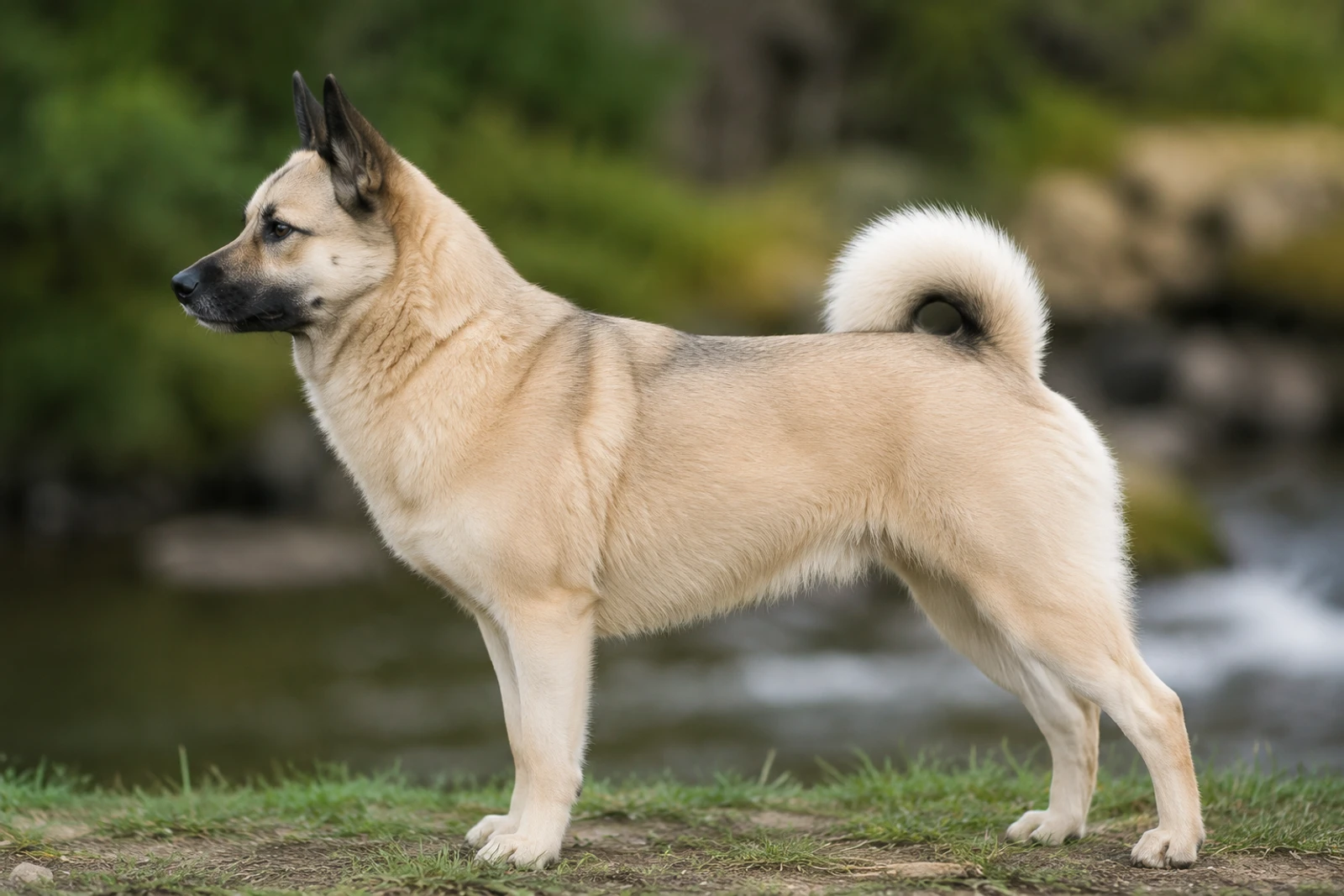
The Norwegian Buhund is a compact spitz herding dog with a bright mind, curled tail, and active working temperament. It suits families who want a medium-sized dog for training, games, and outdoor routines, but barking can be a real management point.
At a glance
- Size
- Medium
- Height
- 16–19 in
- Weight
- 26–40 lb
- Life span
- 13–15 years
- Coat colors
- Wheaten, black
- Coat type
- Medium double coat
- Group
- Spitz-Type
- Origin
- Norway
How much does a Norwegian Buhund cost?
Adopt / rescue
$75–$400
Usually includes spay/neuter, first shots, and a microchip.
Buy from a breeder
$700–$2,000
From a reputable, health-testing breeder.
Approximate USD. Prices vary widely by region, breeder, pedigree, age, and coat colour — adopting is the lower-cost and recommended route. Avoid suspiciously cheap “breeders”; they’re often puppy mills.
Estimate the full cost of a Norwegian Buhund →Want the ongoing number? Estimate the monthly food bill for a Norwegian Buhund with our dog food cost calculator.
Norwegian Buhund photos
Views
Front, side, rear and top — the full silhouette.Poses
How the breed sits, lies, moves and plays.Puppy to senior
The breed across its whole life.Expressions
The breed’s range of moods.Close-up details
Eyes, ears, nose, paws, tail and coat.Coat colors
The breed’s recognized colors.Click any photo to enlarge. We show the Norwegian Buhund from every angle — three views, poses, life stages, expressions, close-ups, coat and colors.
Appearance & size
The first thing you notice is the ears — pointed, upright, and constantly moving. They telegraph exactly what this dog is thinking, which is usually “What’s next?” and “I’m ready.” The Norwegian Buhund is a squarely built, medium-sized spitz, with a look that says capable farm dog without an ounce of exaggeration.
Males stand 17–19 inches at the shoulder; females are slightly smaller at 16–18 inches. Weight lands between 26 and 40 pounds, and a fit Buhund feels dense and muscular under your hands — never delicate, never bulky.
From the front, the head is wedge-shaped with a moderately pointed muzzle. Dark, almond-shaped eyes sit under a well-defined stop, and the black-rimmed lids give them a lively, inquisitive expression. A black nose, tightly closed lips, and a dark mask on wheaten dogs complete the face. The ears are set high, pointed, and so mobile you’ll swear the dog can shift them independently to track a dozen sounds at once.
Move to the side and you’ll see a compact, balanced outline. The neck is strong and arches gently into laid-back shoulders. The chest is deep — reach down and you’ll feel a good spring of rib — but the underline tucks up neatly behind it. The topline stays level, the loin is short and powerful, and the tail is the signature spitz curl: set high, thick at the base, and carried tightly over the back or flank. It’s a bushy, close-lying plume that never droops, even when the dog is relaxed.
From behind, the hindquarters are straight and well-muscled, with a moderate angulation that hints at the breed’s herding agility. The stance is square and ready to drive forward — there’s no slack in the hocks.
The double coat is all business. The outer layer is hard, dense, and smooth to the touch; underneath lies a soft, woolly undercoat. Three main colors are accepted: wheaten (pale cream to deep gold), black, and wolf-sable — banded hairs that give a shaded, almost dusty appearance. Wheaten dogs often carry a black mask, and white markings can appear on the chest, feet, and tail tip. Up close, the coat repels moisture and insulates against cold, but it sheds heavily twice a year, so expect tumbleweeds of fluff in the hallway. Despite the thickness, the Buhund’s outline remains crisp and athletic — you can still see the dog’s structure through the coat, not a shapeless puffball.
History & origin
If you walked through a Viking settlement a thousand years ago, you’d see dogs that looked a lot like today’s Norwegian Buhund. They’re a direct descendant of the spitz-type farm dogs that Norse people kept for centuries, buried alongside their owners in burial mounds and mentioned in old sagas. Those dogs worked: they herded cattle, drove sheep along rocky coastal paths, and stood guard over homesteads tucked into fjords. The modern Buhund carries that same no-nonsense, all-purpose work ethic.
By the early 1900s, though, the old farm dog had almost vanished. Mechanization and changing agriculture made them less common, and nobody had bothered to sculpt a unified breed out of the sturdy local dogs scattered across western Norway. That changed when state agronomist Jon Sæland started tracking down the best remaining examples in the 1920s. He wanted to preserve a capable, medium-sized herder that could handle Norway’s tough terrain. The breed made its show debut in 1920 at an agricultural fair in Hordaland, and that kickstarted a serious breeding effort. In 1939, the Norsk Buhundklubb was founded and the Norwegian Kennel Club recognized the breed. The name “Buhund” itself is plainspoken: “bu” means homestead or mountain hut, and “hund” means dog. It’s the farm dog, plain and simple.
After World War II, the Buhund slowly spread beyond Norway. A few came to the UK in the 1940s and 1950s, and eventually to North America, though numbers have always stayed modest. You won’t see them in every park, but that’s part of their appeal. Today, many Norwegian Buhunds still earn their keep on working farms in Norway, while others do agility, obedience, and just settle in as sharp, watchful family dogs. Their history isn’t a long tale of dramatic rescue — it’s a quiet, stubborn survival of a dog that was never pampered, just valued.
Temperament & personality
The Norwegian Buhund is a bright, people-focused Spitz with a built-in alarm system—he’ll announce delivery trucks, squirrels, and suspicious leaves with real enthusiasm. The flip side is that once you welcome a guest in, the tail wags and he’s ready to make friends. This is a dog who genuinely wants to be part of everything you do, following from room to room and offering a running commentary of grumbles, yodels, and chattering “conversations.”
Energy is the headline here. A stroll around the block barely scratches the surface. Plan on a solid hour of running, off-leash hiking, or focused fetch every day, plus mental work like puzzle toys or scent games. Without that outlet, a Buhund’s clever mind goes looking for trouble—baseboards, shoes, and garden hoses become chew targets, and bored barking can drive neighbors up the wall.
Training taps into two realities: he’s sharp enough to pick up commands in a few repetitions, and he’s independent enough to decide whether he feels like obeying. Respectful, upbeat sessions with plenty of treats and play get far more than force ever will. Harsh corrections make him shut down or dig in his heels. Thanks to a strong herding instinct, he may try to “manage” children or other pets by nipping heels and circling, so early socialization and clear household rules are non-negotiable.
That intense loyalty comes with a catch: this breed hates being left behind. Long hours alone often trigger separation anxiety, which shows up as relentless barking, destruction, or house soiling. If your home is empty most of the day, a Buhund simply isn’t a good match.
With his own family, he’s affectionate, a little goofy, and naturally confident—not a dog who’s likely to shy away from new situations when properly introduced. Still, temperament varies from dog to dog, and a poorly socialized Buhund can become reactive or nippy. Exposure to calm, positive experiences early on lays the foundation for a reliable, friendly adult.
Chewing is a serious hobby here, especially during puppyhood and teething, but adults use hard gnawing to keep jaws strong and minds busy. Supply a steady rotation of durable toys, frozen KONGs, and appropriate rawhides, and you’ll redirect that drive before your belongings pay the price.
A well-exercised, well-socialized Buhund is an upbeat shadow who turns every hike into an adventure and every household routine into a partnership. Give him steady leadership, plenty of purpose, and the near-constant companionship he craves, and he’ll tell you exactly what he thinks—loudly and with a lot of charm.
Good with kids, dogs & other pets
Kids
A Norwegian Buhund’s default is patient and non-aggressive, which makes the breed a surprisingly easy fit for families. At 26–40 pounds, they’re solid enough to weather an eager hug but not so big they’ll send a toddler flying. The real safety net is early socialization — start exposing your puppy to calm, respectful children between 3 and 14 weeks old, and keep it upbeat. Without that, the Buhund’s spitz sensitivity can surface as wariness or noise-shyness. Even a well-adjusted dog has herding instincts that may pop out as circling or a light nip at heels during chase games, so redirect that energy to a tug toy and teach kids to freeze instead of shriek. Never leave young children and any dog alone together, no matter how “bombproof” the temperament. A Buhund who grows up with gentle handling typically becomes a shadow that leans against your leg during story time and patrols the hallway after lights-out.
Other dogs
They’re naturally social, not dog-aggressive, but the window for building that ease slams shut early — around 16 weeks. Pile on puppy play dates, structured classes, and walks with older, stable dogs before that clock runs out. After that, it’s about steady, positive exposure. Pushing an adult Buhund into forced greetings when he’s stiff or looking away can backfire into fear-based reactivity. Some adults turn into one-person dogs who are perfectly content ignoring other canines altogether. That’s fine. A neutral, non-reactive dog on a leash is a win. If you do have multiple dogs at home, mealtime separation and clear boundaries prevent resource tension, especially in spitz breeds that value their personal space.
Cats and small pets
This is the honest part: the Buhund was bred to herd and guard on Norse farms, and a fleeing animal looks a lot like stock. A cat that bolts across the room can spark a chase reflex, so introductions need to start young and move at the cat’s pace. With deliberate, supervised desensitization, many Buhunds learn to coexist indoors with a familiar cat, especially if they’ve grown up together. Small caged pets — guinea pigs, rabbits, hamsters — are a no-go for unsupervised moments. The drive to grab and shake is hardwired and may never fully extinguish. Outdoors, count on a strong prey drive around strange cats and squirrels, so a secure fence and a long-line are your training allies. Know your individual dog, and don’t gamble with smaller lives.
Trainability & intelligence
You’re dealing with a dog that thinks for himself — and that’s exactly what a Norwegian Buhund was bred to do. On a Norwegian farm, he made judgment calls about stray sheep or unfamiliar visitors without waiting for a human’s okay. That independent streak means he learns fast, but he won’t blindly obey. He’ll ask, “What’s in it for me?” once he’s past the puppy stage. The official trainability rating sits at a solid 4 out of 5, but that doesn’t mean he’s push-button. It means he’s sharp, engaged, and deeply capable when you work with his brain, not against it.
What clicks with a Buhund
Reward-based training is non-negotiable. A quick game of tug, a tossed treat, or an excited “Yes!” builds the trust you need before he’ll reliably come when called, hold a stay, or ignore a squirrel. Punishment, corrections, or stern intimidation backfire fast — this is a sensitive spitz that will shut down or find ways to avoid you rather than comply. Keep sessions short and varied. He bores easily, so drilling the same sit fifty times will lose him. Weave obedience into play, use food puzzles, and teach new tricks. A bored Buhund turns into a noise powerhouse (they bark, a lot) and will entertain himself in ways you won’t appreciate.
Start early, move gently
Puppyhood is your window. Between 3 and 14 weeks, expose him — gradually — to all the surfaces, sounds, people, and polite dogs you can. A Buhund who misses that critical socialization often becomes wary or reactive. Make every new thing end with a reward so he learns that strange men in hats, city traffic, and the vet’s lobby predict good stuff. During adolescence, keep up the positives; his independent brain will test boundaries, and patience plus consistency matter more than ever.
The big challenge: recall
His herding background gives him decent focus, but he also has a hair-trigger alertness to motion. Off-leash reliability can be a sticking point. A rabbit darting across the path may override a “Come” if you haven’t built a long, happy history of rewarding the return. Use a high-value reinforcer — freeze-dried liver, a squeaky ball — and practice recalls in low-distraction environments first. Never call him to you to end his freedom or to scold him; always make running back to you the best part of his walk.
He’s a breed that thrives on a clear, kind conversation, not a monologue. Put in the time building that two-way trust, and you’ll get a dog who’s quick to learn, wicked smart, and eager to work alongside you for a decade and a half. Skip the heavy-handed stuff entirely — it erodes the thing that makes him great.
Exercise & energy needs
A brisk walk around the block doesn’t register as exercise for this breed. The Norwegian Buhund is a nimble, medium-sized herding dog bred to work all day on rugged Scandinavian farms. Count on giving yours at least an hour of focused daily movement—split it into two 30-minute sessions unless your dog tells you he needs more. These are dogs built for quick sprints, tight turns, and sustained mental engagement, so simply meandering on leash leaves a lot of gas in the tank.
Off-leash running in a safe area lets a Buhund circle, herd, and stretch out those legs the way his instincts demand. A flirt pole, long-distance fetch, or a herding ball in the yard can burn physical energy fast. But don’t stop there. Your Buhund’s sharp mind is half the equation. Puzzle toys, scent games, hiding treats inside a rolled-up towel, or teaching a new trick for ten minutes after a walk will settle his brain far more than an extra mile of jogging ever could. Without that outlet, you’ll get a dog that finds his own work—which often means alarm-barking at every passing squirrel or reorganizing the contents of your laundry basket.
Formal dog sports are a natural fit. Agility, rally, nose work, and herding instinct tests all play to the breed’s quickness and eagerness to partner with you. Once a Buhund is physically mature (wait until joints fully close, around 18 months), bikejoring or canicross can be a blast for both of you. Puppies and adolescents need a lighter touch—short, frequent play sessions protect growing bones while still satisfying their busy brains. Skip the repetitive jumping and hard turns until they’re fully grown.
Ignore his daily dose of sweat and focus and the friendly Buhund can become a manic, vocal handful. Meet it, and you’ll have a lively, cheerful dog who crashes happily at your feet by evening.
Grooming & coat care
You’ll spot a Norwegian Buhund’s coat shedding before you even notice a bald spot on the dog — this breed loses undercoat in clouds, especially when the seasons flip. Plan on brushing three or four times a week most of the year, and daily during spring and fall blowouts. A slicker brush with rounded pins or an undercoat rake does the heavy lifting: it pulls dead hair from the dense insulating layer without scratching the skin. Follow up with a pin brush to straighten the outer guard hairs, which are short to medium length, weather-resistant, and naturally harsh to the touch. That texture repels dirt, so a Buhund rarely needs a full bath — maybe three or four times a year, or when they’ve rolled in something truly memorable. Over-bathing strips the natural oils that keep the coat shedding dirt and drying quickly after a swim in the fjord (or your backyard pool).
Do not shave this dog. The double coat protects against both cold and heat, and cutting it can ruin regrowth, leaving you with a patchy mess. Between baths, a wipe-down with a damp cloth removes surface mud. And if you spend a lot of time outdoors hiking or running together, you’ll see healthier coat turnover and less stress-related shedding indoors.
Nails grow fast on a 26–40 pound active dog that spends time on soft ground, so clip or grind them every few weeks. If you hear clicking on the floor, you’ve waited too long. Ears stand upright and catch plenty of air, but still check weekly for wax buildup or the faint musty smell that signals an infection. Teeth need the same routine as any medium-sized breed: brushing every other day with a dog toothpaste keeps that Spitz grin healthy well into the 13–15 year lifespan. A quick comb through the softer feathering on the tail and behind the ears prevents hidden mats — often the first spots you overlook until they tighten into a knot.
Shedding & allergies
A Norwegian Buhund’s double coat sheds nonstop, with two massive seasonal blowouts each year. You’ll find a fine layer of fluff on your couch, your clothes, and floating across the floor even between cycles. Twice a year — typically spring and fall — the soft, dense undercoat lets go in clumps. For a week or two you can literally pull handfuls of hair off the dog, and daily brushing with an undercoat rake becomes survival.
- Constant shedder: Light to moderate hair fall every day; it shows up extra well on dark fabrics.
- Seasonal blowout: A tidal wave of loose undercoat that requires thorough, daily grooming. A quick once-over won’t cut it.
- Drool: Almost nonexistent. You won’t be wiping ropes of slobber off your walls.
- Dander and allergies: All that shed hair carries dander with it. No dog is truly hypoallergenic, and a Buhund is a poor choice for allergic households. The undercoat traps dander, then releases it everywhere during a blowout.
- Skin trouble: The breed can be prone to hereditary skin diseases like seborrhea or atopic dermatitis. A dog with itchy, flaky skin will shed even more dander, making an allergy situation worse. Responsible breeders screen for this, but it’s still a risk worth knowing about.
If you’ve got a family member with dog allergies, a Buhund is almost guaranteed to trigger them — this is a breed that sheds heavily, and no amount of vacuuming changes that.
Diet & nutrition
A Norwegian Buhund will work for every calorie you put in the bowl, but that doesn’t mean you can fill it without measuring. These 26–40 lb dogs stay lithe and athletic when food intake matches their real daily output — not the output you wish they got. Many Buhunds are highly food-motivated, so the risk of creeping weight gain is real even in an active Spitz. Obesity silently loads the joints of a medium breed that already twists and turns at speed, so portion control is a long-game health move. Use a puzzle bowl if he inhales meals; it slows him down and gives that busy brain a job.
A practical baseline is roughly 60% raw or cooked meat, 20–30% fruits and vegetables, and the remaining 10% from eggs, grains, or plain yogurt. Blending or puréeing isn’t fussy — it aids nutrient absorption because a dog’s jaw moves only vertically and saliva lacks the digestive enzymes ours has. Pearl barley offers a digestible high-fiber grain alternative; plain white rice soothes a sensitive stomach. Batch-cook grains, vegetables, and lean proteins on the weekend and you’ve got the foundations for quick, balanced meals. Canned fish (packed in water), cooked veggies, and scrambled eggs all mix in easily. Unsalted vegetable cooking water can sub for stock when you need a little moisture.
Puppies eat four evenly spaced meals a day until four months, then three meals until six months, and then you settle into a two-meal adult rhythm. Transition a puppy gradually: start with lightly cooked, puréed meats, fish, fruits, and vegetables, or a high-quality commercial puppy formula. Raw chicken wings can be introduced around twelve weeks under direct supervision. Senior Buhunds — not uncommon at 13–15 years — often do better with smaller, more frequent meals; there’s no good reason to slash protein intake, but you do need to dial back total calories as their trot slows to a stroll. Weigh regularly and adjust downward before you notice the extra padding.
Household habits matter as much as the recipe. Never slide a morsel from the dinner table — begging, once learned, is sticky. If you want to share leftovers, put them directly into the dog’s own bowl, well away from the family meal. Steer clear of rich, fatty foods (holiday trimmings are the usual culprit) because they can trigger an ugly bout of pancreatitis. And skip the vegetarian or vegan turn: a Buhund’s digestive plumbing is built to process meat, and a diet that strips the essentials from his physiology isn’t doing him any favors.
Health & lifespan
Norwegian Buhunds often live 13 to 15 years — a solid run for a medium-sized spitz. Still, there are a few things you’ll want to keep on your radar.
Skin trouble tops the list. Itchy, flaky, or yeasty skin shows up more often in this breed than many others, so pay attention to any licking, scratching, or redness. Often it’s tied to diet or environmental allergies. A high-quality food with plenty of omega-3s, regular brushing to lift out dead undercoat, and prompt treatment when a hot spot appears can keep things under control. Work with your vet to identify triggers instead of just using steroids as a band-aid.
Responsible breeders screen for structural and eye problems that can run in the line. Ask to see OFA or PennHIP scores for hips and elbows, plus a current eye exam from a veterinary ophthalmologist. Inherited cataracts and progressive retinal atrophy are known concerns, so a clean eye certificate is a green flag. Thyroid disease also pops up — a baseline blood panel every couple of years after maturity makes sense.
At 26–40 pounds, a Buhund carries a dense double coat that hides weight gain surprisingly well. A pudgy Buhund isn’t just at risk for joint stress — extra pounds can trigger skin flare-ups too. Keep meals measured, cut out the table scraps, and give them outdoor sessions that are genuine exercise, not just a leisurely stroll. These dogs were bred to herd all day, so a solid hour of running or fast hiking is what keeps them trim and happy. In hot weather, schedule that exercise for morning or evening; their thick coat can cause overheating quickly.
Heartworm prevention is a monthly chew during mosquito season and for a month after it ends. Rabies vaccination is legally required and untreatable once symptoms appear — no wiggle room there.
Early, positive handling pays off with fewer stress-related health hiccups. A Buhund puppy that learns to accept nail trims, ear inspections, and tooth brushing will show up to the vet with a lot less anxiety. Lower stress means fewer cortisol-driven skin and gut complaints down the road. Catch skin flare-ups early, keep them lean, and stay current on those screening tests, and you’ll stack the deck for a long, active life with your dog.
Living environment
A Norwegian Buhund doesn’t just want a backyard—he needs one. This is a practical, high-energy herding dog built to work outdoors all day in Norway’s tough coastal climate. A securely fenced yard gives him room to patrol, sprint, and burn off the kind of energy that a couple of leash walks can’t touch. Aim for at least 60–90 minutes of real exercise daily, split into two sessions: think off-leash running, vigorous fetch, or a long hike, not a stroll around the block. Without that outlet, barking and restlessness can take over fast.
Apartment living is a stretch. Buhunds are famously alert and vocal—barking is in their job description. Close neighbors and thin walls will test everyone’s patience, even with dedicated training. Their double coat laughs at cold and snow, so chilly winters are pure joy. Hot, humid summers are the real challenge; you’ll need to shift exercise to early mornings or evenings and always provide shade and water.
These dogs bond hard with their people and want to be part of everything. Leave a Buhund alone for eight-hour stretches day after day, and you’re likely to see anxiety, nuisance barking, or creative destruction. Short alone-time practice from puppyhood and plenty of mental work—scent games, puzzle toys, trick training—help take the edge off. If your household is gone most of the day and can’t come home at lunch, this isn’t the right fit. A bored, lonely Buhund will make his own fun, and you won’t enjoy the results.
Who this breed suits
A Norwegian Buhund is a working Spitz through and through — sharp, bouncy, and wired to have a job. You’ll click with this breed if you genuinely enjoy daily, active engagement, not just a leash stroll.
Who thrives with a Buhund
- Active singles or couples who run, hike, or play fetch in all weather. This 26–40 lb dog needs at least 60–90 minutes of hard movement — a jog, a long off-leash romp, or a demanding game — not a quick walk around the block. Mental work is non-negotiable: trick training, scent games, or herding lessons keep a Buhund from inventing his own (destructive) fun.
- Families with older kids who can match the dog’s zest. Buhunds are sturdy, playful, and generally patient, but their herding instincts mean they’ll chase and nip at heels if not redirected. Supervise with toddlers, and teach children how to channel that drive into fetch or hide-and-seek.
- First-time owners who are genuinely committed to training. Buhunds are smart, food-motivated, and bond tightly with their person. They respond beautifully to positive, consistent work. The catch? They have Spitz independence. If you treat training as a 10-minute chore, the Buhund will outsmart you. If you treat it as a daily conversation, you’ll have a stellar partner.
- People who want a 24/7 companion. These dogs velcro to their people and don’t do well left alone for long stretches. Working from home, a dog-friendly office, or a flexible schedule fits best.
Who should think twice
- Quiet- or neat-freak households. Buhunds blow their dense double coat twice a year in colossal clouds, and they shed moderately the rest of the time. More challenging: they’re vocal. They bark at squirrels, delivery trucks, strange leaves, and excitement. You can train an “enough” cue, but you won’t extinguish the instinct to sound the alarm.
- Sedentary owners or frail seniors. Even at a modest 16–19 inches, a Buhund can drag you on leash if under-exercised, and their pulsing energy doesn’t fade to couch-potato mode with age. A slow, short walk won’t cut it.
- Those who travel constantly without the dog. Separation anxiety is common. Crate training helps, but a Buhund left alone 9 hours a day will bark, chew, or pace. If your life doesn’t have room for a shadow, look elsewhere.
- Apartment dwellers, unless you’re exceptional. It’s not impossible, but only if you’re committed to hours of outdoor exercise and you have understanding neighbors. A yard isn’t required, but proximity to open space makes life much easier.
Cost of ownership
A well-bred Norwegian Buhund puppy from health-tested parents usually runs between $1,500 and $2,500. Litters aren’t huge and the breed isn’t common in the US, so you may wait and pay a bit more for a pup from a responsible breeder who screens for hip dysplasia and inherited eye conditions.
Monthly expenses settle into a predictable rhythm. Feed a high-quality kibble—plan on 2 to 3 cups a day for this active 26–40 lb dog, which translates to $50–$70 per month. Their dense double coat needs weekly brushing; a professional deshedding bath every 8–12 weeks adds $40–$60 per session if you don’t do it yourself. Routine vet care (annual exam, vaccinations, heartworm/flea/tick prevention) lands around $300–$500 per year, but budget extra for the occasional ear infection or a dental cleaning as they age. Pet insurance for a medium spitz breed with potential hip and eye concerns runs $30–$50 a month, and it’s worth lining up before that first wellness visit uncovers something.
The real expense, though, isn’t the money—it’s the time you’ll spend out in all weathers, meeting those bright, spiraling eyes that demand your next move.
Choosing a Norwegian Buhund
Breeder or Rescue?
Most Norwegian Buhunds in the US and Canada come from a small, dedicated community of breeders, not from shelters. The national breed club’s referral list is the smartest starting point — it puts you in touch with people who show, compete in herding or obedience, and, critically, health-test. Rescue is unusual but possible through BHCA-affiliated volunteers or general herding-dog rescues. If you wait for a rescue Buhund, be ready for an adult dog and a long lead time; don’t count on a puppy showing up.
Health Clearances That Matter
Hip dysplasia and hereditary eye conditions like cataracts and progressive retinal atrophy (PRA) are the big-ticket concerns. Any breeder you take seriously will show you OFA or PennHIP hip scores and a recent CAER eye exam — not just an “our vet said they looked fine” story. Many also test elbows and thyroid. Ask for the CHIC number and look the dog up on the OFA database yourself. A breeder who shrugs at clearances or “doesn’t believe in them” is a hard pass.
Red Flags When You’re Talking to a Breeder
A few things should make you hang up the phone. They won’t let you meet the dam in person or via live video. They have multiple litters on the ground year-round. They push you toward a puppy based on color or rare markings without talking about your experience with vocal, busy herders. A serious Buhund breeder interrogates you — they want to know how you’ll handle the breed’s alert barking, the need for a job, and a fence you cannot skimp on. If no one asks whether you have a plan for alone-time training or mental exercise, walk away.
Choosing Your Puppy
A well-raised litter meets you with a tidy, dry whelping area and a dam who’s relaxed around her people. Watch how the puppies react. A Buhund puppy who makes brief eye contact, trots over to sniff, and recovers fast after a startle noise is showing the steady nerve you want in a family dog. Shyness that looks like hiding under furniture isn’t just a bad day — it can harden into a fear-biting adult. The bossy, pushy pup who never lets up on littermates can be a handful for a first-time spitz owner. A middle-of-the-road puppy who follows you around, offers a playful bark, and then settles with a chew is your safest bet. And if you spot one that tilts its head the instant you speak — that’s a classic Buhund already asking for a job.
Pros & cons
Pros
- A bright, people-oriented spitz that bonds tightly with its family and is surprisingly trainable for an active owner – these dogs love to work with you, not just for you.
- Sturdy medium size (26–40 lb, 16–19 in): large enough for real hikes and herding games, small enough to tuck under your airline seat or fit into a modest home.
- Unflinching watchdog with a piercing alert bark and naturally watchful expression – a Buhund never sleeps through a knock on the door or an unusual sound outside.
- Long, healthy lifespan of 13–15 years; responsible breeders screen hips and eyes, so you can stack the odds for sound joints and clear vision well into old age.
- The dense double coat looks high-maintenance, but it repels dirt and only needs a quick weekly brush during non-shedding months.
Cons
- Heavy seasonal shedding – twice a year the undercoat blows out in tufts. Expect daily vacuuming and deep grooming sessions that fill a trash bag with fluff.
- A serious talker – bred to bark while herding, the Buhund will announce every leaf, squirrel, and delivery truck. Without early training, it becomes a full-time neighborhood alert system.
- Demands a job – 60–90 minutes of off-leash running, hiking, or spirited fetch, plus brainwork like trick training or food puzzles. A bored Buhund dismantles shoes, furniture, and drywall with equal enthusiasm.
- Herding instinct runs deep – unsupervised, a Buhund may chase and nip at running children, bikes, or smaller pets. Clear rules from puppyhood are non-negotiable.
- Aloof with strangers – expect a reserved, watchful posture toward visitors until the dog decides they’re family. Early and ongoing socialization prevents suspiciousness from hardening into fearfulness.
Similar breeds & alternatives
If the Buhund’s working-drive and spitz smarts feel right but you’re weighing other options, these breeds run parallel tracks — each with a different twist.
- Icelandic Sheepdog — The closest Nordic cousin. Slightly smaller at 16.5–18 inches and 20–30 pounds, with the same thick, weatherproof coat and a sunny, yappy nature. Where a Buhund tends to be watchful and reserved with strangers, the Icie greets everyone like a long-lost friend. Both will bark at a leaf falling, so if noise is a dealbreaker, neither is a quiet choice.
- Swedish Vallhund — Think of a corgi in a wolf’s costume. At 11.5–13.5 inches tall and 20–35 pounds, this is a herding dog on stubby legs. They’re just as bright and work-driven as a Buhund, but that low-slung body can mean back trouble if you aren’t careful. Vallhunds bark with equal enthusiasm; their smaller package can work in an apartment if you provide real off-leash runs.
- Finnish Lapphund — Larger and fluffier (16–21 inches, 33–53 pounds), bred to herd reindeer rather than cattle. Indoors, the Lapphund is calmer and more gentle, with a dense coat built for blizzards. They’re still spitz-level intelligent, but tend to be less intense and a little less vocal than a Buhund. If you want a mellower plush toy that still thrives on cold-weather hikes, this one merits a hard look.
Fun facts
- Buhunds are Norwegian spitz-type farm dogs.
- The curled tail and prick ears give the breed a classic northern look.
- They are quick learners but need daily outlets.
Frequently asked questions
- Are Norwegian Buhunds good with children?
- Norwegian Buhunds can be affectionate and playful with children when raised together, but their herding background may cause them to chase or nip. Early socialization and supervision are recommended to ensure positive interactions.
- Do Norwegian Buhunds shed a lot?
- Norwegian Buhunds have a dense double coat that sheds moderately year-round and more heavily during seasonal changes. Regular brushing helps manage loose hair.
- How much exercise does a Norwegian Buhund need?
- As an energetic herding breed, the Norwegian Buhund typically needs at least an hour of vigorous exercise each day. They enjoy activities like running, hiking, and dog sports.
- How often do you need to groom a Norwegian Buhund?
- This breed's coat is relatively low-maintenance, requiring brushing once or twice a week to remove dead hair and prevent matting. During shedding seasons, more frequent grooming may be necessary.
- Can a Norwegian Buhund live in an apartment?
- Norwegian Buhunds are active dogs that thrive in homes with access to a yard, but they can adapt to apartment living if given sufficient daily exercise and mental stimulation. Their tendency to bark may be a concern in close quarters.
Tools & calculators for Norwegian Buhund owners
Quick estimates tailored to Norwegian Buhunds — pre-filled with this breed’s size where it matters.
Articles & stories about the Norwegian Buhund
Sources & standards
This profile follows recognized breed standards from the American Kennel Club (AKC) and the Fédération Cynologique Internationale (FCI), along with established veterinary and breed-club guidance. These describe general breed tendencies — every dog is an individual.