

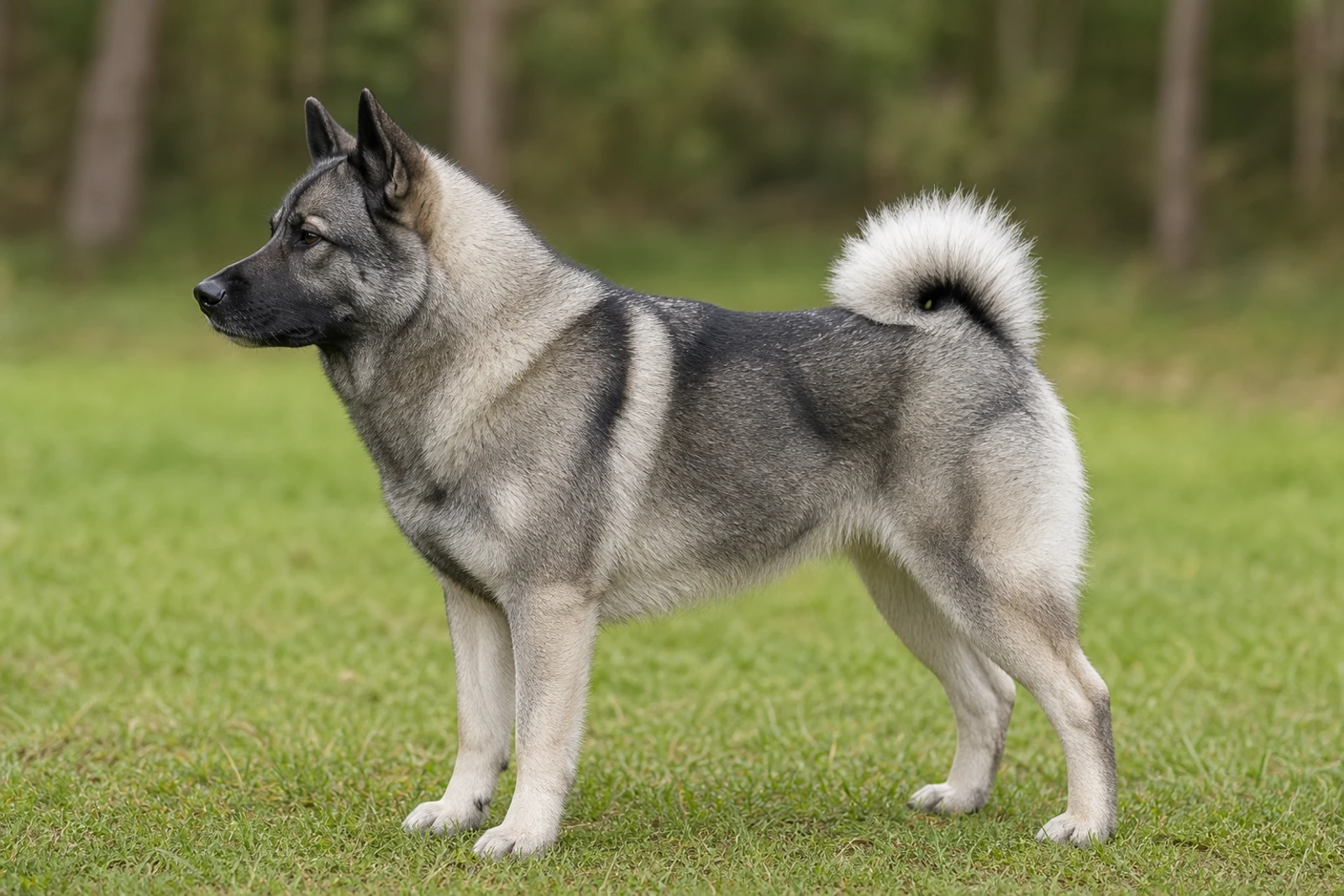
The Norwegian Elkhound is a fearless and loyal spitz breed, historically used for hunting moose in Norway. With a dignified, wolf-like appearance and a thick silver-gray coat, this breed suits active families or individuals who enjoy outdoor adventures. Elkhounds are intelligent but independent, requiring consistent training and plenty of exercise. They thrive in homes with older children and experienced dog owners who can provide firm yet positive leadership. Their strong prey drive and vocal nature make them excellent watchdogs, but they may not be the best fit for novice or apartment dwellers.
At a glance
- Size
- Large
- Height
- 19–20 in
- Weight
- 44–51 lb
- Life span
- 12–15 years
- Coat colors
- Gray, Silver Gray, Wolf Gray
- Coat type
- Thick, weather-resistant double coat with a soft undercoat and coarse outer coat
How much does a Norwegian Elkhound cost?
Adopt / rescue
$75–$400
Usually includes spay/neuter, first shots, and a microchip.
Buy from a breeder
$700–$2,000
From a reputable, health-testing breeder.
Approximate USD. Prices vary widely by region, breeder, pedigree, age, and coat colour — adopting is the lower-cost and recommended route. Avoid suspiciously cheap “breeders”; they’re often puppy mills.
Estimate the full cost of a Norwegian Elkhound →Want the ongoing number? Estimate the monthly food bill for a Norwegian Elkhound with our dog food cost calculator.
Norwegian Elkhound photos
Views
Front, side, rear and top — the full silhouette.Poses
How the breed sits, lies, moves and plays.Puppy to senior
The breed across its whole life.Expressions
The breed’s range of moods.Close-up details
Eyes, ears, nose, paws, tail and coat.Coat colors
The breed’s recognized colors.Click any photo to enlarge. We show the Norwegian Elkhound from every angle — three views, poses, life stages, expressions, close-ups, coat and colors.
Appearance & size
The Norwegian Elkhound is a squarely built spitz — medium in height but dense, muscular, and surprisingly substantial for his size. Males stand 19 to 20 inches at the shoulder, females about the same, and a healthy adult weighs between 44 and 51 pounds. The body is compact: the distance from the point of the shoulder to the rear of the thigh roughly equals the height at the withers. That square outline, combined with a deep chest and short, strong loin, gives him the balance of a dog bred to hold big game at bay.
From the front, you see a broad, wedge-shaped head with a clearly defined stop. The medium-sized eyes are dark brown, slightly oblique, and never protruding — they give a keen, fearless expression. Ears are set high, prick, and remarkably mobile; they’re smaller than you might expect, with pointed tips and firm, upright carriage. The muzzle tapers smoothly from a wide base, never snipey, and the lips close tightly over strong teeth. Forelegs stand straight and parallel on moderate bone.
A side view highlights the deep, ribbed-back chest and only a slight tuck-up. The back is straight and strong, and the tail — one of the breed’s signature features — is set high and curled tightly over the centerline of the back. It’s not a loose, sickle-shaped tail; it’s a compact, rolled curl that touches the back, often described as a “tightly coiled tail.” Around the base, the coat forms a ruff, and the tail itself is heavily plumed with long, coarse hair.
From behind, the hindquarters appear strong and well-angled, with broad thighs and good turn of stifle. The tail’s curl sits squarely over the midline. When moving away, the dog shows no looseness or wobble — the rear legs drive straight, and the tail remains up and centered.
The double coat is the Elkhound’s all-weather armor. The outer coat is harsh, straight, and composed of medium-length guard hairs with glossy black tips. The undercoat is dense, woolly, and shades from pale cream-gray to silver. Together they produce the classic wolf-gray color. The back, neck ridge, and sides are covered in longer, black-tipped hairs that form a darker saddle or “harness.” The chest, belly, legs, and underside of the tail are a much lighter gray or silver, often with a creamy cast. The head features a dark muzzle and a light gray area around the eyes and over the brow, with a thin dark line running from the outer corner of each eye toward the ear. Puppies are born darker and lighten as the guard hairs come in. There’s no black saddle, no white markings, and no brown or red tint — any of those is a fault.
The whole picture is brisk, upstanding, and unmistakably northern: a dog that looks equally capable of a day on a frozen slope and an evening curled by the fire. His tail carriage alone — tight, high, and proud — tells you this is a breed that never slouches.
History & origin
You’re looking at a dog whose ancestors hunted alongside Vikings. The Norwegian Elkhound is a true spitz, tracing back more than a thousand years through the rugged terrain of Scandinavia. Skeletal remains nearly identical to the modern Elkhound have been found in Viking burial sites in Norway, placing the breed’s roots well before the 10th century. These dogs weren’t just companions — they were essential to survival, bred to track, corner, and hold large game in deep snow and dense forest.
The name says it all: “elg” means moose. In Norway this breed is called Norsk elghund, and its primary job was to hunt moose — often alone or in pairs — by silently tracking scent, then using its bark to alert the hunter and keep the huge animal distracted and stationary until the hunter arrived. The Elkhound’s courage and stamina made it equally capable of holding bear and wolf at bay. When not on the hunt, the same dogs guarded remote farms, herded livestock, and slept outside in the cold, developing a dense, weatherproof coat that still defines the breed today.
Selective breeding stabilized the type we recognize by the mid-1800s. The first Norwegian Elkhound standard was written in 1877, and the breed was exhibited at the Norwegian Hunters' Association show that same year. The Norwegian Kennel Club recognized it not long after, viewing the dog as a national treasure.
The Elkhound crossed the Atlantic early in the 20th century, and the American Kennel Club registered its first Norwegian Elkhound in 1913. It remains a relatively uncommon family companion in North America, but its blend of independence and alert loyalty hasn’t drifted far from its original purpose. Today’s Elkhound still thinks like a working dog: watchful, quick to sound the alarm, and built for long days in harsh weather.
Temperament & personality
A Norwegian Elkhound is equal parts devoted family shadow and fearless, independent thinker — and that combination can catch first-time owners off guard. At 44–51 pounds, this is a medium-large dog with a big-dog confidence that doesn’t need to prove itself. They’ll lean against your leg on the couch one minute and take off after a scent the next, deaf to your calls. That streak of stubbornness isn’t personal; it’s centuries of being bred to hold a moose at bay in deep snow, making decisions on their own without waiting for a human’s say-so.
With their own people, Elkhounds are affectionate and steady. They’ll greet you with a curled tail high over their back and a soft, relaxed body — loose muscles, a mouth slightly open, eyes watching you without tension. They typically form a strong bond with every family member and can be good with children they’re raised with, but their size and boisterous play mean you’ll want to supervise closely with toddlers. A stiff body or a hard stare from any dog is a clear “back off,” so teach kids to give the dog space when they see those signals, especially around food bowls. A dog that’s never interrupted during meals rarely develops the need to guard.
Watchfulness is where the breed really shines — and also where it can drive you up the wall. An Elkhound is a natural alarm system. They’ll bark at a leaf that looks at them wrong, the mail carrier, the neighbor’s cat, and the wind. Early training can tone it down, but you’ll never completely silence a dog whose ancestors announced bear tracks to hunters. That vocal nature intensifies if they’re left alone in the backyard for hours with nothing to do; isolation often turns into anxious, non-stop barking.
These dogs carry their ancient scavenger roots right into your home. Given the chance, they’ll follow their nose anywhere — and a walk becomes a slow-motion sniff-fest. Don’t be surprised if they roll in something foul-smelling at the park. In their world, that stench might just be the equivalent of coming home and showing you a prize. Indoors, that same scent obsession means potty training must be thorough. A single indoor accident leaves a scent cue that can trigger repeat marking, so clean up with an enzymatic cleaner or vinegar spray to neutralize the smell completely.
Energy-wise, an Elkhound needs real, daily exertion — a solid hour of activity, preferably off-leash in a secure area or on a long hike. A bored Elkhound creates his own fun by chewing everything from furniture legs to drywall. Puppies will chew to soothe teething gums, but adults maintain a tough jaw by gnawing on hard objects. Provide plenty of appropriate bones and teach the dog what’s off-limits with a simple citrus-peel spray, which most dogs find repulsive.
Nobody will mistake this breed for a pushover. They respond to respectful, fair leadership, not heavy-handed corrections. A forward-leaning posture with a stiff, upright tail often means they’ve locked onto something interesting and are about to surge ahead. Reading that body language lets you redirect them before they bolt. Get the dynamic right, and you’ll have a sturdy, affectionate, 12-to-15-year companion who looks at the world with steady eyes and keeps your whole household on its toes.
Good with kids, dogs & other pets
The Norwegian Elkhound’s even, patient temperament—paired with a sturdy 44–51 pound frame—makes them a natural fit for families with kids. They’re not quick to snap or startle, and they often form a deeply loyal bond with the whole household. That said, any 50-pound dog can accidentally knock over a toddler during a bout of zoomies. Always supervise interactions, especially with children under six, and teach kids to respect the dog’s rest space and food bowl.
Early socialization is non-negotiable if you want an adult Elkhound who’s relaxed around other dogs. The critical window slams shut between 12 and 16 weeks. During that time, expose your puppy slowly and positively to a wide range of friendly, vaccinated dogs in controlled settings. Without those experiences, the breed can become reserved or reactive with unfamiliar canines as adults. Same-sex aggression isn’t a given, but it’s not rare either; many Elkhound owners find that opposite-sex pairs coexist more peacefully. If you’re adding a second dog, a gradual, on-leash introduction over several days is the smart play.
With cats and small pets, you’re dealing with a breed originally used to hunt moose and bear. That prey drive doesn’t just vanish. Elkhounds who grow up with a cat from puppyhood often do fine and may even cuddle, but a visiting squirrel or a neighbor’s bunny in the yard is a different story. Err on the side of caution: never leave an Elkhound unsupervised with small furry pets, and invest in solid barriers and a reliable recall if you have free-range guinea pigs or rabbits.
- Supervision rule of thumb: An adult should always be in the room when an Elkhound and a young child are together, no exceptions.
- Socialization must-haves: By 16 weeks, your puppy should have met at least a dozen different dogs, heard traffic and vacuum noises, walked on bark, tile, and grass, and visited a friend’s house—all with treats and no force.
- The alone-time factor: Elkhounds are high-companionship dogs. Leaving one isolated in the yard or home alone for 10-hour days often creates anxiety-driven behaviors—chewing, barking, pacing—that can spill over into crankiness with kids or pets. If your schedule doesn’t allow someone to be around most of the day, this isn’t the breed for you.
Trainability & intelligence
Norwegian Elkhounds are sharp — confidently solve problems, pick up new commands in a flash, and remember every single thing you’ve ever let slide. Their intelligence isn’t the obstacle; it’s the independent streak baked in by centuries of holding moose at bay in dense forest with no human directing them. You’re working with a dog who knows his own mind and isn’t wired to obey without a reason.
Forget drilling. This is a negotiation, not a lecture. Short, upbeat sessions using high-value rewards — cheese, a squeaky tug, a jackpot of praise — keep him engaged and willing. He’ll check out the moment training feels repetitive or heavy-handed. Switch up locations, add games, and quit while he’s still eager so he comes back ready tomorrow.
The real test is recall. A drifting scent trail or a squirrel’s flicker can short-circuit everything you’ve built unless your bond is stronger. Practice on a long line first, in progressively distracting settings, and reward every single check-in like it’s the best decision he’s ever made — even if it came after a 30-second debate. Punishing a slow return teaches him that coming back ends the adventure, and an Elkhound won’t make that mistake twice.
Corrections that lean on force or intimidation backfire hard. This breed carries a grudge, and cracked trust is tough to reglue. Instead, be consistent enough to out-stubborn him, calm enough to wait out the deliberating, and clear enough that every “yes” means something good. Lay that foundation from the day your puppy comes home. Socialization is non-negotiable: expose him gradually to different people, sounds, surfaces, and other animals before 16 weeks, then keep those experiences positive and routine. A well-socialized Elkhound moves through the world steady and confident; an undersocialized one defaults to aloof watchfulness that can slide into reactivity.
Exercise & energy needs
A quick stroll around the block is background noise to a Norwegian Elkhound — these dogs were built to quarter rough Scandinavian terrain for hours, tracking moose and holding them at bay. Plan on at least 90 minutes of hard daily exercise, split into two sessions. A single long walk rarely cuts it; you’ll just end up with a restless dog who channels that leftover stamina into nonstop barking or landscaping projects in your yard.
Make both sessions count. Elkhounds are tough, cold-proof endurance athletes that thrive on off-leash hiking, trail running, skijoring, and bikejoring. They love to pull and have the strength for weight-pulling or carting. If you’re not in snow country, a long, hilly hike with a pack on the dog’s back works wonders. Off-leash reliability is a mixed bag because their nose can override any recall when a scent trail lights up. A long line or a securely fenced field gives them freedom without the vanishing act.
Mental work is non-negotiable. Boredom quickly turns into digging, door-dashing, or full-volume howling. Feed meals in puzzle toys, hide treats for scent games, and weave 5-minute training bursts into your day. The breed excels at nose work, tracking, and barn hunt — anything that lets that methodical, independent brain run the show. Agility is fine once joints are mature, but keep high-impact jumps limited before 12–18 months to protect developing hips and elbows (responsible breeders screen for dysplasia, yet it’s smart to be cautious).
Even on busy days, a genuine workout beats an hour of aimless pacing in the yard. If you miss a session, expect a loud, creative protest. Give them a job and they’ll be a content, worn-out companion.
Grooming & coat care
Norwegian Elkhound grooming is built around one reality: you’re living with a double-coated breed that sheds enough to knit a second dog twice a year. The thick, woolly undercoat and harsh, weather-resistant outer coat land squarely in the “high-maintenance brushing” category. Plan to work through the coat two to three times a week with an undercoat rake that has rotating teeth—it yanks out dead fluff without tearing the top layer. Behind the ears, around the tail, and the fluffy “pants” on the hindquarters, switch to a metal comb to catch felting before it starts. During the two seasonal blows (usually spring and fall), daily brushing is the only thing standing between you and a house full of silver tumbleweeds. A forced-air dryer used outdoors can send loose hair flying before it hits your floors.
A bristle brush can add shine to the short outer guard hairs, but don’t make that your primary tool—you need to get down into the undercoat. A metal slicker brush with rounded pins is handy for lifting out debris and lint the outer coat picks up.
Bathe sparingly. The outer coat naturally repels dirt, so every three to four months is plenty; more frequent washing strips the oils that keep the dog weather-resistant. Spot-clean with a damp cloth when they roll in something foul.
Never clip or shave the coat—except a neat-up of the paw pads or a sanitary trim if you prefer. Removing the undercoat messes with the insulation that keeps an Elkhound comfortable in both cold and heat, and the texture often grows back poorly.
Nails grow quickly; trim every four to six weeks, or as soon as you hear clicking on hard surfaces. Check upright ears weekly for debris and dry them after a swim. Two to three times a week of toothbrushing keeps gum disease at bay and gives you another chance to notice any skin issues lurking under that gray, black-masked coat. Neglect the rake during a big shed, and you’ll be pulling drifts of fluff from every corner—so treat the brush like a ritual, not a chore.
Shedding & allergies
If you’re picturing a little seasonal fluff you can manage with a quick lint roller, put that image out of your mind. The Norwegian Elkhound is a double-coated breed, and both layers work overtime to cover your home. The soft, woolly undercoat is dense and insulates against Norwegian winters; the outer coat is coarse, straight, and dirt-repellent. Together they produce a constant, all-year drizzle of hair, and then twice a year — usually spring and fall — the undercoat comes out in clouds in a full blowing coat event. During those weeks, you’ll be pulling tufts the size of cotton balls off the dog daily, and you’ll still find drifts of grey fluff in corners an hour after vacuuming.
Drool, at least, isn’t part of the deal. Elkhounds run dry-mouthed, so you won’t be wiping slobber off walls or furniture. That’s the only area where the cleanup is light.
Hypoallergenic? No. Despite what you might hear about “low-allergen” spitz breeds, the Elkhound’s sheer volume of shed fur spreads dander everywhere. Allergies are triggered by proteins in saliva, urine, and skin flakes, not just hair length. When a dog pumps out this much coat, those proteins travel on every floating hair. A person with mild dog allergies should spend extended time around an adult Elkhound before making any decision — a puppy’s coat won’t give you the full picture.
- Year-round shedding: Light but steady. You’ll see hair on dark pants, couch cushions, and floating across hardwood floors.
- Blowout intensity: For 2–3 weeks twice a year, a daily 20-minute brushing session with an undercoat rake is the bare minimum to keep the fur tumbleweeds manageable. Many owners do a bath and blow-dry during this period to accelerate the purge.
- Grooming routine: A thorough brush-out two to three times a week normally keeps things under control, but don’t expect a fur-free house. A robot vacuum and a good pet-hair-specific upright will earn their keep.
- Coat holds an odor? The coat is surprisingly low-odor when dry, but a wet Elkhound smells distinctly woolly. Frequent brushing helps.
If someone in your home has allergies or you simply can’t stand the sight of hair on everything you own, this breed will make you miserable. There’s no shortcut or miracle shampoo that stops the shed — it’s a feature, not a bug, of that magnificent silver-grey coat. Budget for a vacuum that has true HEPA filtration and an extra-long crevice tool for getting hair out from between floorboards.
Diet & nutrition
Norwegian Elkhounds rarely turn down a meal, so the biggest nutrition challenge is keeping them at a healthy weight. An extra few pounds puts real strain on joints, especially in an active dog that may be hiking or trotting alongside you for years.
Plan on roughly 1,200 to 1,600 calories a day for an adult weighing 44–51 lb — that’s about 2½ to 3½ cups of high-quality kibble split into two meals. Every dog’s metabolism is different; let body condition, not the food bag, be your guide. You should feel ribs easily without pressing through a fat layer.
- Puppy feeding schedule: four evenly spaced meals until 4 months, then three meals until 6 months, then the adult two-a-day routine. Measure every portion. Rapid growth in a large-breed frame can stress developing joints, so don’t free-feed or push for early bulk.
- Slow them down: many Elkhounds inhale their food. A puzzle bowl or food-dispensing toy turns mealtime into a mental workout and cuts the risk of bloat, a real concern in deep-chested breeds.
- Senior shift: as the dog slows down around 8 or 9 years, drop calories gradually to prevent middle-age spread. Smaller, more frequent meals often suit older stomachs better, but don’t cut protein — muscle maintenance still matters. If teeth become an issue, purée meals to keep nutrients flowing.
- What goes in the bowl: a diet centered on animal protein (around 60% raw or cooked meat, plus 20-30% fruits and vegetables, and 10% things like eggs, plain yogurt, or pearl barley) supports a thick double coat and working energy. Omega-3s from canned fish like sardines help with coat condition and joint health. Skip rich table scraps, especially after a holiday — a sudden fatty meal can trigger pancreatitis.
Treats count. Keep them under 10% of daily calories and never feed from the table. If your dog stares at you during dinner, serve a few pieces of carrot or green bean in his own bowl, well away from the table, to keep begging from taking root.
Health & lifespan
A well-cared-for Norwegian Elkhound typically stays by your side for 12 to 15 years. That’s a solid run for a medium-large dog, and responsible breeding plus a little daily attention can tip the scales toward the high end.
Inherited conditions to watch
No breed is free of genetic quirks, and the Elkhound is no exception. The big ones that crop up in the bloodlines are hip dysplasia, progressive retinal atrophy (PRA), hypothyroidism, and a skin condition called sebaceous adenitis. A responsible breeder screens for all of them — ask to see OFA hip clearances, a CERF or OFA eye exam dated within the last year, and a thyroid panel. That’s your first line of defense.
- Hip dysplasia can show up as stiffness, a reluctance to jump, or a bunny-hopping gait. Keeping your dog lean from day one takes a tremendous load off those joints.
- PRA causes gradual vision loss and has no cure, but Elkhounds map their world by scent and sound so well that many owners don’t notice until the dog can’t see at all. A stable furniture layout and not moving things around helps a blind dog navigate confidently.
- Hypothyroidism often looks like unexplained weight gain, a dull coat, or low energy. A daily pill brings things back to normal, and it’s screened for with a simple blood draw.
- Sebaceous adenitis shows up as scaly, flaky skin, thinning hair, and a musty odor. It’s a lifelong management process — frequent bathing with specialized shampoos, sometimes fatty-acid supplements — but it doesn’t have to slow them down.
Weight and the Elkhound appetite
These dogs were bred to work in cold, rugged country, and they eat like they still do. A 44-to-51-pound Elkhound should have a visible waist and ribs you can feel without pressing hard. Extra pounds worsen joint pain, shorten lifespan, and make the dog’s dense double coat trap heat even more. Measure meals, don’t free-feed, and use high-value training treats in tiny pea-sized bits rather than bulking up their kibble. If your vet ever gives you that “could stand to lose a few” talk, take it seriously.
Practical prevention
Heartworm prevention is non-negotiable — give it every month mosquitoes are active and one month after the first freeze. Rabies vaccination is legally required everywhere in the U.S. Annual wellness exams are the baseline; once your Elkhound hits age 8 or 9, switching to twice-yearly visits catches age-related stuff like kidney changes or arthritis early. And because Elkhounds run double-thick coats, they overheat fast in summer. Plan walks for early morning or late evening, provide a kiddie pool or a cool tile floor, and never leave one in a parked car even with the windows cracked.
Watch for subtle shifts — if a dog who always inhaled breakfast starts leaving food in the bowl, or a dog who bounced up the stairs now hesitates, get them checked. With this breed, small changes often flag a problem before it gets serious.
Living environment
A Norwegian Elkhound is a high-octane, cold-weather dog built to trot the Norwegian wilderness for hours while barking at moose. A quiet apartment or a sedentary household will make this dog miserable—and loud about it. If you live in a condo with thin walls, expect complaints. That deep, carrying bark is a feature of the breed, not a bug, and they will use it to announce every squirrel, delivery truck, or suspicious leaf.
A house with a securely fenced yard is the practical baseline, but the fence needs to be tall and dig-proof. These are escape artists with a strong hunting drive who won’t think twice about going over or under to chase a scent. The yard alone isn’t enough, either. An Elkhound needs a solid hour of purposeful, off-leash running or hiking twice a day—not just a couple of casual walks around the block. Without that outlet, you’ll see destructive digging, nonstop pacing, and barking that goes from alert to obsessive.
Climate-wise, this is a dog that genuinely thrives in snow and cold. A 20°F day is playtime; 85°F is dangerous. In warm weather, shift exercise to early morning or late evening and keep sessions shorter. This is not a breed to take on a midday jog in July.
When it comes to being left alone, Elkhounds bond hard to their people. They’re not velcro in the cuddly sense—they’re independent thinkers—but isolation for a full workday often triggers howling, chewing, or digging to self-soothe. If you’re gone long hours, you’ll need a plan: a dog walker midday, puzzle toys loaded with food, and gradual desensitization training to teach coping skills. Even then, some individuals simply won’t tolerate it. This is a breed that prefers to be where you are, doing what you’re doing, preferably outside and in the cold.
Who this breed suits
An Elkhound fits your life if you’re an active, experienced dog person who genuinely enjoys a dog with opinions. Bred to hold moose at bay in deep snow, this 44–51 lb spitz brings independence baked into every bone. You’ll get a loyal, alert companion who bonds tightly with the family and makes a natural watchdog — but that means a big, rolling bark at every delivery truck, neighbor, and leaf that dares cross the property line.
You’re the right owner if you have a fenced yard and plan for at least 60 minutes of real exercise daily, not just a leash stroll. These dogs were built to cover rough terrain for hours; a long off-leash hike, a hard run, or a structured sniff walk that works their brain will keep them sane. The payoff is a sturdy, weather-obsessed sidekick who’s ready for any outing, from a snowy trek to a summer backpacking trip, and who lives a robust 12–15 years.
First-time owners often struggle here. Elkhounds are smart but not eager-to-please; they’ll question your commands if the reward isn’t compelling enough. Consistent, patient training from day one prevents a pushy, selective listener. People who use heavy-handed methods will create a resentful, hard-headed dog. The breed does well with respectful kids, but toddlers can be knocked over by a zooming 50-pound body. Cat and small-pet homes are a poor match unless you’re prepared to manage a high prey drive that turns the backyard squirrel into a full-scale emergency.
The coat is a dealbreaker for many. You’ll live with a constant dusting of gray-tipped hair, punctuated by two massive seasonal blowouts that coat your furniture, carpets, and clothes. If your home calm depends on a spotless sofa, look elsewhere. Apartment living rarely works either: without a direct exit to a private outdoor space, the barking and energy can fray neighborly goodwill fast. Think twice if you’re sedentary, gone 10 hours a day, or need a dog that quietly accepts strangers. This breed demands a partner, not just an owner — someone who finds the stubborn humor and the ear-splitting alerts part of the package.
Cost of ownership
A well-bred Norwegian Elkhound from health-tested parents usually runs $1,200 to $2,500. Show-prospect puppies or those from exceptional hunting lines can go higher. Rescue adoption fees are closer to $200–$500, though puppies are rare.
Monthly costs land in the $150–$250 range for a healthy adult, mostly driven by their appetite and shedding.
- Food: An active 45–51 lb dog eats 2 to 2.5 cups of high-quality kibble daily. Budget $50–$70 a month. Raw or fresh feeding will push that figure north of $100.
- Grooming: These dogs blow entire undercoats twice a year. Between those blowouts, you’ll still find fur on every surface. A solid slicker brush, undercoat rake, and a high-velocity dryer saves money long-term, but many owners book a professional deshedding session ($60–$80) once or twice a year. If you outsource the big sheds, figure an average of $20–$30 a month into your budget, plus the cost of lint rollers and vacuum bags.
- Vet and prevention: Annual check-ups, vaccines, and year-round heartworm and flea/tick preventives typically total $500–$700 a year (roughly $40–$60/month). The breed can be prone to hip dysplasia, progressive retinal atrophy, and hypothyroidism – responsible breeders screen for these, but you should still set aside emergency funds.
- Insurance: Accident and illness policies commonly run $30–$50 a month, depending on your deductible and location.
A solid puppy kindergarten or basic obedience class costs $150–$200 upfront, and you'll need a secure crate and sturdy chew toys. These dogs bark with conviction, so an investment in early training pays off every day. The real commitment is time: they want to be with you, and a bored Elkhound is a destructive one. With a 12–15 year lifespan, the total lifetime cost can easily exceed $25,000 before any major medical events. Saving $50 a month into a dedicated pet fund from day one takes the sting out of future surprises.
Choosing a Norwegian Elkhound
Rescue or Breeder?
Rescue is the simplest entry point — you skip teething, housebreaking, and the puppy landshark phase. The Norwegian Elkhound Association of America and regional breed clubs often have adults available because someone underestimated the breed’s independence and exercise needs. You get a dog whose temperament is already on full display, and many rescues come with basic manners. The trade-off is unknown medical and genetic history.
A puppy from a responsible breeder gives you a predictable start and a clear health baseline, but it’s the harder path to navigate because backyard breeders churn out Elkhounds without any screening. If you go this route, your first job is to vet the human.
What a Good Breeder Looks Like
A real breeder will grill you harder than you grill them. They’ll want to know your fence height, your daily schedule, and whether you understand that an Elkhound is a bark-first, independent hunter — not a cuddly retriever. They won’t pressure you to put down a deposit today.
Health testing is the dealbreaker. Ask to see actual results, not just verbal assurances. The bare minimum for the breed includes:
- Hips: OFA or PennHIP evaluation. Look for an OFA rating of Fair, Good, or Excellent. “Normal” from a general vet isn’t the same thing.
- Eyes: A current exam by a board-certified veterinary ophthalmologist. Norwegian Elkhounds can inherit progressive retinal atrophy (PRA) and other eye diseases, and a routine vet check won’t catch early PRA.
- Patellas: Many responsible breeders also screen for luxating patellas because the condition crops up in the breed.
Some also test thyroid or do a DNA panel for Fanconi syndrome, though Fanconi is less common. The Orthopedic Foundation for Animals (OFA) website lists all Elkhounds with public results — a breeder who can point you to their dogs’ OFA page and a CHIC number is doing things right.
Ideally, you meet the dam (and sire, if he’s on site) and see that the dogs live in clean, enriched surroundings. The dam should be at ease — wiggly, alert, not skulking or kennel-crazed. A breeder who won’t show you the rest of the pack or rushes you outside is hiding something.
Red Flags That Mean You Walk Away
- No health clearances — even if they insist “our lines are healthy” or “the vet said they’re fine.”
- Puppies available on the spot, multiple litters at once, or a website that lets you add a dog to cart.
- Puppies released before 8 weeks. Elkhound pups need that extra time for bite inhibition and canine social skills.
- You can’t meet the dam or see where the litter is raised.
- The breeder doesn’t ask you a single question about your home or experience.
Picking Your Puppy
When you visit, watch the litter for 15-20 minutes before interacting. You want a puppy that’s curious and self-assured, not the bossiest pup in the pile or the one frozen in the corner. An Elkhound shouldn’t be a wallflower, but a harsh, overly pushy puppy often grows into a harder dog to manage. A good breeder will have already observed them for weeks and can say, “This one’s more independent, that one lives for food puzzles” — and they’ll guide you to the temperament that fits your household, whether you have kids, other dogs, or a quiet apartment (hint: apartments and Elkhounds are a rough match because of the noise).
Ask for the puppy’s health record: first vaccinations, deworming schedule, the vet’s exam notes. Feel the body — a healthy 8-week-old Elkhound is dense and substantial (adults run 44–51 pounds) with clear, dark eyes, no crusting, and straight legs. Any sign of a limp, a runny nose, or an obviously tucked-up belly warrants a hard pass.
Above all, don’t get charmed into rushing. A responsible breeder will show you the OFA links and the ophthalmologist report before you even visit. Wait for the right litter; a well-bred Elkhound easily lives 12–15 years, and those years are a lot more enjoyable when the dog comes from stock built on documented health, not promises.
Pros & cons
Pros
- Fiercely loyal watchdog: An Elkhound bonds tightly with the family and takes the job of sounding the alarm seriously — you’ll never miss a delivery or an unexpected guest.
- Adventure-ready athlete: Originally bred to track moose through Norwegian forests, this dog thrives on long, rugged hikes. At 44–51 pounds of lean muscle, they pack the stamina and grit for hard outdoor days, not just a quick stroll.
- Clean and low-odor coat: The dense wolf-gray double coat sheds dirt readily, isn’t oily, and rarely gets that “doggy” smell. A bath every few months usually suffices.
- Smart and versatile worker: They solve problems, nose out hidden scents, and genuinely enjoy having a job — whether it’s agility, barn hunt, or pulling a small sled, training clicks once you earn their cooperation.
- Hardy health and long life: With a typical lifespan of 12–15 years and few exaggerated features, a well-bred Elkhound tends to stay active well into its senior years.
Cons
- Prolific barker: This is a vocal breed that announces everything — squirrels, passing cars, a leaf blowing the wrong way. Apartment or close-quarter living often turns into a headache unless you manage it from puppyhood.
- Shedding that runs your household: A thick undercoat releases clouds of fur year-round, with two massive seasonal blowouts. Daily vacuuming, lint rollers in every room, and tolerance for fur on your clothes are non-negotiable.
- Stubborn independence: Centuries of working solo in the wilderness left them with a “what’s in it for me?” attitude. Training demands consistency, creativity, and a calm hand — heavy-handed corrections backfire fast.
- Strong prey drive: Small pets, cats, and neighborhood wildlife aren’t safe from a determined chase. Off-leash reliability is rare unless a scent-free fence contains them; a tied-out Elkhound will test every boundary.
- Serious exercise needs: A quick walk around the block barely registers. Plan on a solid hour of running, hiking, or hard play every day, or you’ll see that energy turn into barking, digging, and nuisance behaviors.
Similar breeds & alternatives
A few breeds share the Norwegian Elkhound’s silver-gray spitz silhouette and thick double coat, but their personalities pull the original in opposite directions. If the Elkhound’s relentless hunting bark and need for a solid hour of daily running make you hesitate, the following dogs give you that ruff-and-scruff look with a different ownership rhythm.
Keeshond
The Keeshond is the friendliest off-ramp. At 17–18 inches and 35–45 pounds, it’s slightly smaller and lighter than the Elkhound’s 19–20-inch, 44–51-pound frame, but the plush gray coat and spectacled eyes are nearly a mirror image. The biggest difference is inside: Keeshonds were barge and companion dogs, not independent big-game hunters. They’re eager to please, quicker to learn a recall, and their exercise needs level out around a brisk 45–60-minute walk instead of a hard run. They still alert-bark, but the prolonged, trilling bay of a dog on a hot scent isn’t part of the package. Shedding is equally heavy.
Finnish Spitz
If the Elkhound’s bark-pointer heritage appeals to you but you’d prefer a smaller package, the Finnish Spitz is the closest functional cousin. Standing 15.5–20 inches and weighing 20–35 pounds, they were bred to tree game birds with a rapid-fire bark and a flashy red coat. They match the Elkhound’s high exercise drive, independence, and noise level — in fact, they can be even louder. Expect a similar need for off-leash woods time, a strong prey drive, and a dog that questions every command. Grooming is slightly less heavy, but the stubborn-hound streak is just as real.
Eurasier
The Eurasier lands on the calm end of the spitz spectrum. They can be larger than an Elkhound — often 19–24 inches and 40–70 pounds — but carry a lower-key, thoughtful demeanor. Bred as a modern companion from Chow Chow, Keeshond, and Samoyed lines, Eurasiers shed profusely and are reserved with strangers, yet they lack the relentless hunting motor. A couple of daily walks and some playtime satisfy them, and their barking is typically less constant and piercing. If you want the majestic spitz presence without the hard-wired need to run down game, the Eurasier is the clearest off-ramp.
Fun facts
- The Norwegian Elkhound is the national dog of Norway and was prized by Vikings for hunting moose.
- Their name comes from the Norwegian 'elghund,' meaning 'moose dog,' not elk as Americans know it.
- They are one of the oldest European breeds, with skeletal remains dating back over 6,000 years.
- Their tightly curled tail is a hallmark of spitz-type breeds and helps keep their face warm when curling up in cold weather.
Frequently asked questions
- How much do Norwegian Elkhounds shed?
- Norwegian Elkhounds have a thick double coat and shed heavily, especially during seasonal changes. Regular brushing a few times a week can help manage loose fur, but expect plenty of hair around the home.
- Are Norwegian Elkhounds good with children?
- They are generally good with children when properly socialized from a young age, as they tend to be loyal and playful. However, due to their size and energy, interactions should always be supervised to prevent accidental knocks.
- How much exercise does a Norwegian Elkhound need?
- This breed is energetic and requires daily vigorous exercise, such as long walks or active play sessions, to stay happy and healthy. Without enough physical and mental stimulation, they can become restless or develop unwanted behaviors.
- Do Norwegian Elkhounds bark a lot?
- Yes, they are known to be quite vocal and will often bark to alert you of strangers or wildlife. Early training can help manage excessive barking, but some level of watchdog behavior is natural for the breed.
- Are Norwegian Elkhounds suitable for first-time dog owners?
- They can be a challenge for first-time owners because they are independent and sometimes stubborn, requiring consistent, patient training. Experienced owners who understand their Nordic heritage often have more success.
- Can a Norwegian Elkhound live in an apartment?
- Apartment living is possible if you provide ample daily exercise and mental stimulation, but it’s not ideal. They are active dogs that prefer space to roam, and their alert barking can be problematic in close quarters.
Tools & calculators for Norwegian Elkhound owners
Quick estimates tailored to Norwegian Elkhounds — pre-filled with this breed’s size where it matters.
Articles & stories about the Norwegian Elkhound
Sources & standards
This profile follows recognized breed standards from the American Kennel Club (AKC) and the Fédération Cynologique Internationale (FCI), along with established veterinary and breed-club guidance. These describe general breed tendencies — every dog is an individual.