

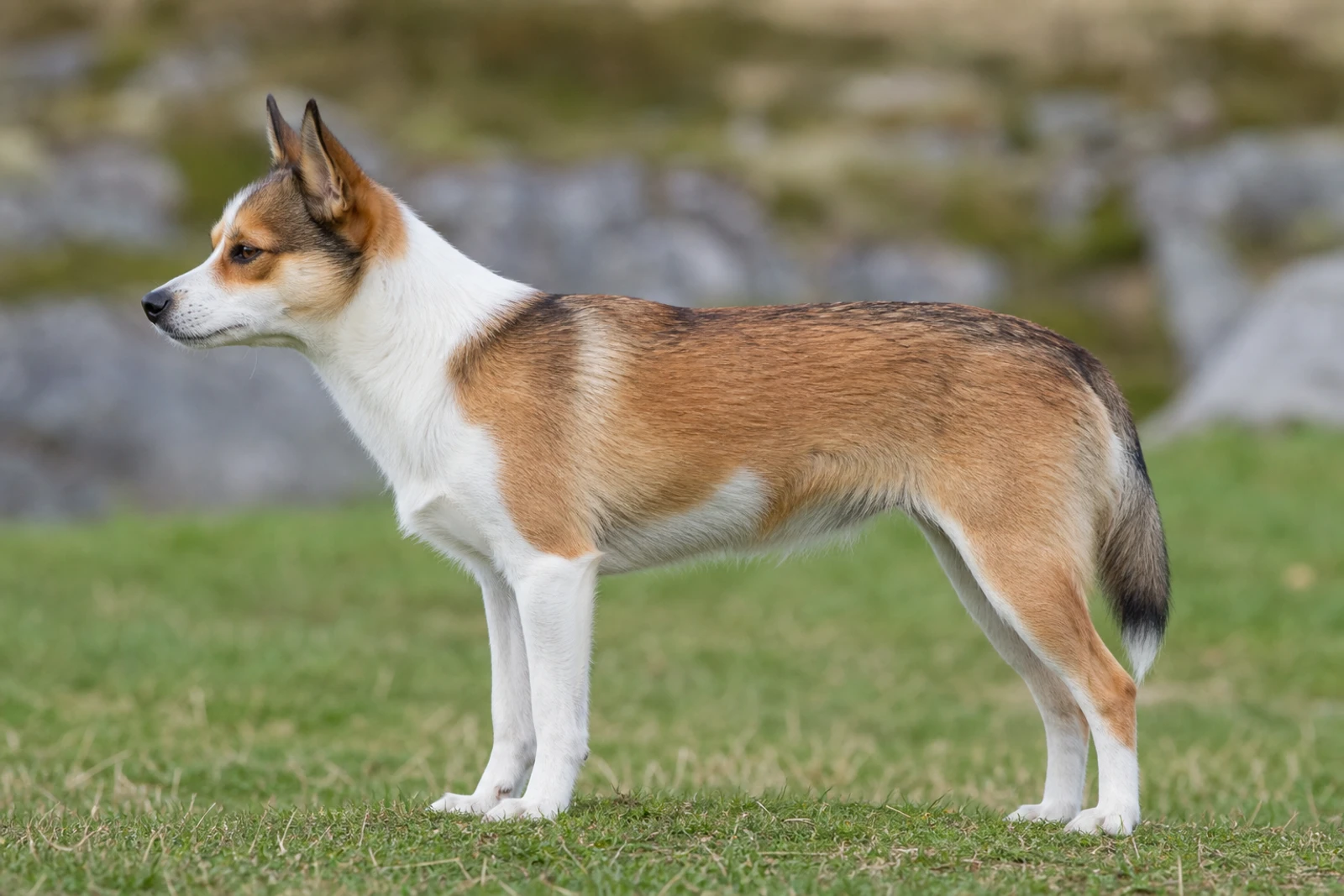
The Norwegian Lundehund is a small, agile Spitz breed originally bred to hunt puffins on steep Norwegian cliffs. Possessing unique physical adaptations like six toes and flexible joints, this dog is alert, playful, and intensely loyal but also independent and wary of strangers. He thrives with an active, experienced owner who can provide firm, patient training and ample mental stimulation. A true enthusiast's breed, the Lundehund is a spirited companion for those who appreciate his quirky, primitive nature.
At a glance
- Size
- Medium
- Height
- 13–15 in
- Weight
- 13–15 lb
- Life span
- 12 years
- Coat colors
- reddish-brown with black tips, fallow with black tips, white with reddish-brown patches, white with black tips
- Coat type
- short, dense double coat with rough outer guard hairs
- Group
- Spitz–Type
- Origin
- Norway
How much does a Norwegian Lundehund cost?
Adopt / rescue
$75–$400
Usually includes spay/neuter, first shots, and a microchip.
Buy from a breeder
$700–$2,000
From a reputable, health-testing breeder.
Approximate USD. Prices vary widely by region, breeder, pedigree, age, and coat colour — adopting is the lower-cost and recommended route. Avoid suspiciously cheap “breeders”; they’re often puppy mills.
Estimate the full cost of a Norwegian Lundehund →Want the ongoing number? Estimate the monthly food bill for a Norwegian Lundehund with our dog food cost calculator.
Norwegian Lundehund photos
Views
Front, side, rear and top — the full silhouette.Poses
How the breed sits, lies, moves and plays.Puppy to senior
The breed across its whole life.Expressions
The breed’s range of moods.Close-up details
Eyes, ears, nose, paws, tail and coat.Coat colors
The breed’s recognized colors.Click any photo to enlarge. We show the Norwegian Lundehund from every angle — three views, poses, life stages, expressions, close-ups, coat and colors.
Appearance & size
The first thing you’ll clock is the paws. A Norwegian Lundehund has six fully formed, functional toes on each foot—not dewclaws tucked out of the way, but real digits with joints and muscles that let the dog grip rock faces like a mountaineer. That extra width shows up from the front and the side, giving the feet a broad, snowshoe look. All four paws work the same way; the rear feet splay just as wide, which explains the surprisingly stable stance on uneven ground.
Size and build
At the shoulder you’re looking at 13 to 15 inches, and a lean adult tips the scale at 13 to 15 pounds—small enough to carry in a daypack if you had to, but with a springy, rectangular frame that reads a lot tougher than the numbers suggest. The body is noticeably longer than tall, with a level topline and a deep chest that tucks up moderately into a clean flank. From the side the silhouette stays low and balanced, never heavy. Viewed from behind, the hindquarters appear well-muscled and moderately angulated; the extra toes on the rear feet give the whole back end a planted, almost bear-like footprint.
Coat and color
A double coat handles the North Atlantic weather. The outer guard hairs are harsh and straight, lying close over a dense, soft undercoat. You’ll see the shortest hair on the head and the front of the legs, with a distinct ruff around the neck and thicker feathering on the backs of the thighs. Color is always some shade of red-brown, ranging from pale amber to deep mahogany, with black tips on the longer guard hairs that create a dusted effect along the back and tail. White markings are standard: a chest bib, a collar that may be full or broken, white feet, a white-tipped tail, and often a narrow blaze on the forehead.
Head and expression
The head is a clean wedge with a medium-length muzzle that tapers just slightly. Dark, almond-shaped eyes sit well apart and won’t be round or prominent—the expression stays alert but soft, never hard. The nose is black. The ears are triangular, erect, and exceptionally mobile; the Lundehund can fold them shut forward or backward to seal out dirt and drips while squeezing into a cliff crack. That same freakish flexibility runs through the whole skeleton, so you’ll occasionally see a dog bend its head straight back over the spine with zero fanfare.
Tail and carriage
A high-set tail is another nod to scrambling on rock. When the dog’s moving or interested, the tail arcs over the back in a loose curl, not a tight spin. At rest, it usually hangs down. From the rear the curl sits off-center enough to let you still see the width of the hind paws working.
History & origin
The Norwegian Lundehund’s story starts on the wind-scoured, rocky islands off Norway’s northern coast — places like Værøy and Røst — where ancestors of the breed likely arrived with early Stone Age settlers after the last Ice Age. Isolated for centuries on these remote archipelagos, the dogs evolved into a supremely specialized cliffside worker, purpose-built for one of the strangest hunting partnerships anywhere: harvesting puffins from sheer rock faces and twisty crevices.
Written records of puffin hunting with these dogs appear as far back as 1600, but the tradition itself is almost certainly older. Farmers and fishermen depended on the seabirds for meat, eggs, and feathers, and the Lundehund’s job was to reach places no human — or other dog — could. The birds nested in burrows deep inside the cliffs, accessible only by squirming through narrow slots and scaling near-vertical walls. Watch a Lundehund work and you see adaptations that make no sense in any other breed: six fully functional toes on each front paw, unusual shoulder flexibility, and ears that can seal shut against dripping moisture and rock dust. Every physical quirk traces directly to those cliff hunts.
For hundreds of years, the little puffin dog remained a best-kept secret of the Lofoten islands. Then, in the mid-1800s, new hunting methods and declining puffin populations made the dogs economically less critical. By World War II, the breed hung by a thread. Distemper swept through, and just a handful of dogs survived — all on Værøy. What followed was one of the quiet, stubborn rescue efforts that define canine history: breeders like Monrad Mostad and later Eleanor Christie scoured the islands, collected the last remaining specimens, and painstakingly rebuilt the population from fewer than six dogs in the 1960s.
Today, the Norwegian Lundehund is still a rare sight outside Scandinavia, but its survival is a testament to a peculiar, isolated life spent chasing birds on the edge of the world.
Temperament & personality
The Norwegian Lundehund packs an enormous personality into a 13–15 pound frame. Originally bred to scale cliffs and hunt puffins, these little spitz-type dogs are agile, curious, and always scanning their surroundings. You’ll quickly notice they watch everything with bright, assessing eyes—a trait that makes them superb watchdogs, but not guard dogs. They’re more likely to sound the alarm with a sharp bark than to challenge a stranger.
Energy & play
Don’t let the small size fool you. A Lundehund needs a solid hour of vigorous exercise daily—running, climbing, or puzzle games that engage both body and brain. A short leash stroll around the block leaves them restless and can trigger nuisance barking or destructive chewing. They’re natural problem-solvers; treat-dispensing toys, hide-and-seek, and short training sessions channel that mental energy and keep them happy.
Affection with the household
Lundehunds tend to be gentle and extremely bonded to their people. They’ll shadow you from room to room, curl up beside you, and thrive on close contact. With older, respectful children they can be playful and patient, but like any dog, they need a quiet place to eat without disturbance—interruptions at the food bowl can lead to guarding behavior. Because they form such tight attachments, long hours alone often trigger anxiety-driven barking or destructive habits. They do best in homes where someone is around most of the day.
Watchfulness & odd quirks
This breed is naturally alert. Expect a bark when the doorbell rings or a squirrel appears on the fence. Their body language is often quick and forward: a forward-leaning stance signals intense interest, not aggression, while a stiff posture and direct stare merit attention. One of their most charming quirks is how their flexible joints and extra toes let them squeeze into improbable hiding spots—you might find them wedged behind a couch cushion or scaling a low climbing structure.
Training & the independent streak
Lundehunds are smart and generally obedient, but they carry a spitz independent streak. Force or heavy-handed corrections backfire. Instead, brief, upbeat sessions built on treats and praise bring out their cooperative side. They respond beautifully to respectful, consistent engagement. Housetraining benefits from immediate outdoor rewards: give a high-value treat the second they eliminate outside, and clean indoor accidents thoroughly with an enzymatic cleaner (vinegar helps neutralize the scent cue) to prevent repeat marking.
Every Lundehund is an individual, but expect a lively, affectionate companion with a watchful eye and a talent for keeping you on your toes.
Good with kids, dogs & other pets
A Norwegian Lundehund’s default setting with people is patient and non‑aggressive, which sounds perfect for a family — but there’s a catch: these are small, sensitive dogs that demand a gentle touch. An adult weighs just 13–15 pounds, so a clumsy toddler can hurt them badly without meaning to. They do best in homes with respectful older kids who understand that a Lundehund isn’t a stuffed animal. Even then, interactions need an adult’s eyes. A sudden yank on the tail or an unexpected shriek can make a Lundehund nervous and hand‑shy around children for a long time.
With other dogs, they’re usually peaceable — not dogs who look for a fight. However, a poorly socialized Lundehund can grow up fearful or reactive, so you need to hit the ground running during that 3‑to‑14‑week sweet spot. Layered, positive exposure to calm, friendly dogs teaches them that new faces aren’t a threat. Many do fine with a familiar household dog, but they aren’t the boisterous dog‑park type. For adult rescues who were never socialized, forcing interactions doesn’t fix things; it just piles on stress. You meet them where they are.
Cats and small pets are where the conversation gets real. The Lundehund was bred to scale cliff faces and retrieve live puffins. That prey drive isn’t theoretical — it’s hard‑wired. Many will fixate on a cat, a rabbit, a parakeet, or even a scurrying hamster with an intensity that makes cohabitation risky. A home with free‑roaming pocket pets is a constant management headache. Some Lundehunds can live peaceably with an indoor cat they were raised alongside, but a fleeing cat often triggers the chase switch. Never leave them unsupervised with small animals you value.
- Bold key point: Early and ongoing, gentle socialization matters more here than with many other breeds. The sensitivity that makes them so attuned to you also means harsh corrections or overwhelming new situations can create a dog who shuts down.
- These are velcro dogs who hate being alone for long stretches; a Lundehund thrives when someone is home most of the day, ideally in the thick of family life.
If you have very young kids, plan to teach both sides how to be soft — and know that you’ll be supervising every second. If your home already has a flock of free‑range guinea pigs or a flighted bird, this probably isn’t the breed for you.
Trainability & intelligence
Think of the Lundehund as a clever problem-solver with a mind of its own — the kind of dog that figures out how to open cabinets, then decides whether it’s worth the effort to come when called. Trainability sits at a moderate 3 out of 5, which isn’t about a lack of smarts. These dogs are intelligent and observant, but they were bred to work independently on steep, remote cliffs, so blind obedience was never part of the job description.
You’ll get the best results by making training a collaboration, not a demand. Reward-based methods build trust and accelerate learning far more than force ever will. Keep sessions short, upbeat, and full of praise, play, or tiny treats right when the dog gets it right. Consistency matters, but so does patience — if you get frustrated, a Lundehund will pick up on that tension and disengage. Punishment or corrections backfire here, damaging trust and often increasing anxiety.
The real challenge often shows up in recall. When a Lundehund’s nose locks onto something interesting, your voice may disappear into the background. Start recall work early — ideally in a fenced area — and reinforce it heavily with high-value rewards, many dozens of times, before you ever need it off-leash.
Early and ongoing socialization is non-negotiable. Between 3 and 14 weeks old, introduce your puppy gradually to a wide variety of people, calm dogs, different surfaces, and everyday sounds. Keep it positive and never flood the dog. This sensitive breed can veer toward fearfulness if under-socialized, so continue those gentle exposures throughout adulthood. The payoff: a more confident dog that trusts your guidance instead of defaulting to suspicion or reactivity.
In the end, training a Lundehund is less about commanding and more about convincing. Build a bank account of trust first, and you’ll have a thinking partner who’s game for anything from trick training to agility — on its own terms, with its own quirky charm.
Exercise & energy needs
A Lundehund doesn’t need marathon miles — but they do need daily, brain-engaged movement that honors their puffin-hunting past. Think quick bursts of scrambling, sniffing, and problem-solving, not a single long slog.
Plan on about 30 minutes of exercise twice a day, broken into shorter sessions if that fits your schedule better. Three 20-minute outings often work beautifully. The goal is to satisfy a curious, agile dog who’d rather explore a rocky trail or zigzag through the backyard than plod along a sidewalk.
- Walk, climb, sniff. A brisk walk is fine, but a hike with uneven terrain, logs to hop onto, or a safe pile of boulders to navigate taps into their instinct to use those extra toes. They adore vertical interest — just keep jumps low and soften landings if you can.
- Low-impact over high-impact. Lundehunds can be prone to joint issues and a genetic gastrointestinal condition (Lundehund syndrome). Avoid repetitive pounding from hard-surface running or high-flying agility until you’ve cleared it with a vet. Off-leash romps on grass or sand give them freedom without harsh shock.
- Mental workouts count double. This breed is whip-smart and wired to hunt puffins on cliff faces. Scent work, barn hunts, hide-and-seek with a favorite toy, and food puzzles drain their brain as much as physical exercise. Even a snuffle mat with breakfast kibble turns a meal into a training session.
- Watch for boredom signals. A Lundehund who’s only physically tired but mentally restless might start pacing, demand-barking, or getting obsessive about small spaces. If you see that, up the nose-work games.
Short, frequent, and varied — that’s the formula. A dog that spends the day sniffing out hidden treats and taking a couple of brisk hillside walks will be calmer, fitter, and far less likely to invent her own amusement. Pay attention to her comfort: if she starts lagging, panting heavily, or moving stiffly, cut the session short and let her rest. Her body will tell you when enough is enough.
Grooming & coat care
The Lundehund wears a dense double coat that’s deceptively low-maintenance most of the year — until it isn’t. A soft, insulating undercoat hides beneath a harsh, weather-shedding outer layer that stands slightly off the body. The breed sheds moderately day to day and then drops the entire undercoat in two heavy seasonal blowouts, usually spring and fall. During those weeks, one quick pass with a brush won’t cut it: expect to pull out clouds of loose hair.
Tools that work
Stay away from slicker brushes that just skim the surface. A metal comb or a pin brush gets down through the outer coat to rake out shedding undercoat without breaking the guard hairs. A bristle brush can add a little shine to the outer coat if you want to buff things up, but it’s optional — not a replacement for undercoat removal. A fine-toothed comb also helps catch tiny mats that can form behind the ears and at the thigh feathering, though this breed tangles far less than long-haired spitzes.
How often
Outside of shedding season, running a comb through the coat twice a week keeps loose hair under control and spreads skin oils. During a heavy blowout, daily grooming for a week or two prevents that dead hair from felting against the skin. Don’t neglect the “pyjama” fringe on the hind legs — it gathers debris on hikes.
Bathing and trimming
Bathe only when the dog is actually dirty or has rolled in something. Overwashing strips the natural oils that make the outer coat shed water and dirt. There’s zero need to clip or trim the body. The breed’s natural outline should stay as-is. Focus your regular maintenance on nail trims every few weeks (those extra toes can grow nails fast and sometimes don’t wear naturally), plus a weekly tooth brushing and an ear check.
Ears that do gymnastics
Lundehund ears fold closed forward or backward — a trait that helped protect them in rocky puffin nests. That same flexibility can trap moisture and a surprising amount of grit. Lift, sniff, and wipe the ears out with a vet-approved cleaner once a week. Moisture trapped in a folded ear breeds infection quicker than you’d expect, so never skip the post-swim or post-rain check.
The upside
For such a double-coated dog, this breed typically carries very little “doggy” odor when its coat is kept dry and brushed. A few minutes of combing keeps your house livable and gives you an easy early inspection of skin health — catching hot spots, scrapes, or the odd tick before they become problems.
Shedding & allergies
If you’re looking for a dog that won’t leave hair everywhere, the Norwegian Lundehund will disappoint you. This little spitz carries a dense double coat designed to shed rain, snow, and — twice a year — just about its entire undercoat onto your floors, furniture, and dark pants. The rest of the year, you’ll still get a steady trickle of fine fur.
A quick daily brush with a slicker or undercoat rake keeps it from becoming a tumbleweed situation indoors, but accept that some shedding is a constant.
Seasonal blowouts are the real event. For a few weeks in spring and fall, tufts of fluffy undercoat release in clouds. You’ll want to brush outdoors and possibly invest in a vacuum with a pet hair attachment. On the plus side, the Lundehund is not a drooler. Even after a long walk or a meal, you won’t need a rag handy.
For allergy sufferers, no dog is truly allergen-free. The Lundehund’s shedding spreads dander throughout your home, and because the breed can be prone to skin issues, a healthy coat needs attention to keep flaking and irritation in check. Responsible breeders screen for inheritable skin problems, but if someone in your household has severe allergies, spend time around an adult Lundehund before committing.
Diet & nutrition
Feed a Norwegian Lundehund as if its stomach is the most delicate part of the dog — because for many, it is. This little Spitz is famously prone to a syndrome that includes protein-losing enteropathy and lymphangiectasia, so a highly digestible, moderate-fat diet is often non-negotiable. Skip rich table scraps, holiday trimmings, and anything fried; a single fatty meal can trigger pancreatitis in a breed that already battles gut inflammation.
With an adult weighing just 13–15 pounds, every extra ounce counts. Free-feeding is a recipe for trouble. A lean Lundehund should have visible waist tuck and ribs you can feel with a light touch. Measure meals strictly — most adults do well on about ½ to 1 cup of high-quality kibble per day, split into two feedings. If your dog inhales food, a puzzle bowl slows her down and provides mental work she craves. Adjust portions based on activity, and if you’re doing a lot of off-leash scrambling or hiking, up the calories slightly, but keep it modest.
For puppies, start with four meals daily until four months, then three meals until six months. Transition gently with lightly cooked, puréed meats and veggies plus a quality puppy formula. Once the adult teeth are in, you can introduce raw chicken wings (supervised) if that fits your plan. Seniors often need smaller, more frequent meals as activity dips; keep protein quality high but cut back total food gradually to prevent the joint-straining weight gain that old Lundehunds can’t afford.
Stick to simple, whole ingredients when you add fresh food. Canned fish (in water, not oil), soft-cooked eggs, puréed pumpkin, or plain yogurt all sit well. If your dog has missing teeth or a tender mouth, purée everything — their vertical jaw motion and lack of salivary enzymes mean blending genuinely helps absorb nutrients. Never feed from the table, and always put leftovers in your dog’s own bowl to avoid begging that’s nearly impossible to undo.
Health & lifespan
A Norwegian Lundehund typically lives around 12 years. That number depends heavily on genetics, proactive care, and keeping your dog at a healthy weight — these little dogs tip the scales at just 13 to 15 pounds, and even an extra pound or two strains joints and organs.
Skin trouble is a known hot spot in the breed. You might see itching, flaking, or recurrent ear infections that trace back to environmental allergies or a food sensitivity. A vet can help you tease apart the triggers, and many owners find that a high-quality, protein-focused diet and frequent bedding washes make a real difference. Some Lundehunds also contend with digestive quirks; responsible breeders screen for inherited gastrointestinal conditions and can show you health clearances on the parents.
Keep a monthly heartworm preventive going during mosquito season and for one month after the last bite. It’s a small habit that blocks a deadly parasite. Rabies vaccination is non-negotiable — legally required and, once symptoms appear, untreatable — so stay current. Your vet will also check for patellar luxation, eye abnormalities, and other issues that can fly under the radar in a busy little dog. Catching them early means simpler management.
This breed is compact and double-coated, but don’t mistake them for a couch potato that thrives in heat. They need shade and water when the weather turns hot, and a warm, dry place to retreat in bitter cold. If you notice a drop in energy, a sudden pickiness about food, or a new habit of hiding, listen to that shift. Lundehunds are historically independent thinkers, so a change in routine or appetite often signals that something’s off.
Body condition matters enormously here. Run your hands along your dog’s ribcage every couple of weeks — you want to feel ribs with a thin layer of fat, not see them jutting out but also not have to dig for them. Adjust portions and treat calories accordingly. A lean Lundehund with strong muscle tone stands a far better chance of reaching that 12-year mark in bright spirits.
Early, gentle handling at the vet’s office and at home pays off, too. Dogs that learn to tolerate — or even enjoy — nail trims, ear exams, and tooth brushing from puppyhood face far less stress later, and that lower anxiety baseline helps keep stress-driven inflammation in check. Pair regular checkups with a trusted vet who knows the breed so any pattern of inherited vulnerability is on the radar from day one.
Living environment
Think “Houdini with an extra toe.” The Norwegian Lundehund’s claim to fame is a body built to squirm into impossibly tight cliff crevices—shoulders that rotate, a neck that tips back to the spine, and at least six toes per foot. For you, that means a secure yard is a non-negotiable puzzle to solve, not a luxury. A standard fence won’t cut it. These dogs can flatten, climb, and worm through gaps you’d swear are too small. Bury wire apron along the base, seal any space wider than a fist, and assume they’ll treat a 4-foot fence like a speed bump.
That contortionist skill set doesn’t rule out apartment living—a 13–15 pound dog fits anywhere—but it shifts the challenge to noise and boredom. Lundehunds are sharp, vocal watchdogs bred to bark at puffins. You’ll hear a running commentary on hallway footsteps, delivery trucks, and neighborhood squirrels. If shared walls worry you, start quiet-command training early and keep their brain tired with indoor scent games or puzzle feeders. Physical exercise leans toward frequent, short bursts rather than marathon runs. Two or three 15–20 minute sniff walks, coupled with a session of hide-and-seek or a treat-dispensing toy, usually meets their needs. Because of that extraordinary flexibility, skip repetitive high-impact jumps on pavement—the joints don’t need the extra wear.
A dense double coat means they shrug off snow and wind without drama. On warm days, they overheat fast, so shift walks to early morning and provide plenty of shade and water inside.
The real deal-breaker is time alone. Lundehunds bond intensely and are notorious for developing separation anxiety if left solo for long stretches. This is not a dog you can crate for a standard workday and come home to a calm house. Gradual desensitization, a predictable routine, and enrichment (a stuffed Kong, a window perch) help. If your schedule rarely includes a mid-day break or work-from-home flexibility, expect a stressed, vocal dog who may direct that anxiety into destructive chewing.
Who this breed suits
If you’re the kind of owner who gets a kick out of a dog that’s more puzzle than pushover, the Norwegian Lundehund might be your match. This isn’t a breed for everyone — and that’s the point. You’ll do well if you’ve lived with independent spitz types before, understand primitive dog quirks, and don’t expect a velcro shadow. The Lundehund thinks for itself (it had to, clinging to cliff ledges for puffins), so you need to be patient, creative, and a little amused by a 15-pound escape artist who can climb chain-link and open lever handles with those six-toed paws.
This dog fits an active single, couple, or small adult household that treats mental work as seriously as a walk. A fenced yard is non-negotiable — and it better be dug deep and angled inward, because Lundehunds can scale near-vertical rock faces in their sleep. They do best with someone who is home a lot or can bring the dog along, because this is a breed that bonds hard and gets bored fast. Apartment living is possible if you’re relentless about outdoor adventures, but the noise level (Lundehunds like to talk) can be a surprise.
Think twice if you’re a first-time dog owner, have a house full of small pets (strong prey drive runs in that puffin-hunter ancestry), or want a reliable off-leash hiking buddy. They’re not generally a great fit for families with toddlers, not because they’re aggressive, but because they’re small, quick, and not endlessly tolerant of clumsy hands. Seniors who are very active and experienced with spitzes might click, but the breed’s daily needs — at least an hour of focused movement, sniffing, and puzzle-solving — don’t bend for a low-energy lifestyle.
The health side matters too. Responsible breeders screen for the gastrointestinal disorder known as Lundehund syndrome, but it’s a reality in the gene pool and can mean a dog with unpredictable, sometimes expensive, digestive trouble. You’ll need a vet who listens and a willingness to manage diet like a science project. If you can take that on, you’ll get a clever, watchful, and remarkably flexible companion that never stops noticing everything — and that’s exactly what the right owner will love.
Cost of ownership
Because the Norwegian Lundehund is one of the rarest dog breeds on the planet, you’ll face a limited and often lengthy breeder search. Expect a responsibly bred puppy to cost anywhere from $2,500 to $4,000, with some dedicated preservation breeders asking more. Rescue is extremely rare, but a Lundehund-specific network occasionally places adults for a few hundred dollars.
Ongoing monthly costs pile up differently than you might guess for a 15-pound dog. Lundehunds are notorious for Lundehund syndrome — a collection of protein-losing enteropathy and other digestive quirks. Many owners end up on a permanent prescription or novel-protein diet that can run $60–$100 a month for food alone. Routine vet care (annual exams, vaccines, heartworm prevention) adds roughly $300–$500 yearly, but budget an extra cushion. An emergency hospitalization for intestinal distress can hit $2,000–$5,000 in a flash.
- Grooming: Minimal. A double coat that sheds seasonally needs just a weekly brush. Professional grooming is optional; you’ll spend maybe $50 every few months if you outsource.
- Pet insurance: Tread carefully. Because breed-specific GI issues are well-documented, many providers exclude them as pre-existing conditions. If you find a plan that covers digestive health, premiums may sit around $40–$70 per month. Otherwise, the smarter financial move is a dedicated savings account with an initial $2,000–$3,000 balance you add to monthly.
- Training and enrichment: A puzzle-obsessed escape artist needs mental work. Budget $50–$100 for treat-dispensing toys and interactive feeders right out of the gate. Basic obedience classes cost $150–$250.
- Miscellaneous: Expect to buy an escape-proof harness and possibly modify fencing — these little contortionists can flatten their ribcage to squeeze through gaps.
Over a 12-year lifespan, a Lundehund can easily surpass $25,000 in total care. The real sticker shock isn’t the purchase price — it’s the ongoing vigilance and the potential for steep, unpredictable vet bills tied to that sensitive gut. Plan for the diet as a fixed cost from day one, not an afterthought.
Choosing a Norwegian Lundehund
Finding a Norwegian Lundehund means tapping into a tiny, dedicated network. With fewer than a few thousand worldwide, you won’t see one at every dog park — and that’s the first reality check. If you’re set on a puppy, you’ll likely wait months or longer for a planned litter from a breeder who knows these dogs inside out.
Health clearances aren’t optional
The breed is famous for a cluster of digestive problems, often called Lundehund syndrome — a set of protein-losing enteropathies that can require lifelong dietary management and medication. A responsible breeder tests breeding stock for intestinal function markers (like fecal alpha-1 proteinase inhibitor) and tracks lines for signs of lymphoma or kidney disease. Ask directly: “What screenings do you do for gastrointestinal health, and may I see the results for both parents?” A breeder who dodges that question or talks only about how “healthy” their dogs seem is a red flag.
Red flags and right questions
Avoid anyone producing pups without a waitlist, offering “rare” colors at a premium, or who can’t explain the breed’s six-toed feet, extreme neck flexibility, and need for a low-stress, routine-driven home. A good breeder grills you, too — they’ll want to know about your yard fencing (digging is an art form), your comfort with a dog that may never house-train perfectly, and your financial cushion for unexpected vet bills. If you hear “just like any other dog,” walk away.
Picking your puppy
When you finally meet a litter, look for bold, busy pups — a shy Lundehund can tip into lifelong fearfulness. But don’t mistake energy for chaos; a puppy that investigates you, then settles into a watchful sit, shows the breed’s native intelligence. Check the extra toes on all four feet (a signature trait) and ask to see the mother. She should be lean, alert, and not hiding.
The rescue route
Lundehund-specific rescues do exist, though supply is sporadic. An adult from a rescue might come with known health history — or none at all. You’ll need a vet who’s willing to learn about the breed alongside you. Either way, budget for a prescription diet and a good relationship with a specialist. The dog you bring home will demand more from your wallet and your patience than the average medium-sized mutt — and that’s exactly what makes the search a filter, not a flaw.
Pros & cons
-
Six fully functional toes on each foot plus an extraordinarily flexible neck and forelegs — anatomical quirks that let them climb, wedge into tight crevices, and turn around in a space barely wider than their body.
-
Compact 13–15 lb frame that’s easy to scoop up and fits into apartment living, yet feels like a bigger dog in attitude.
-
Sharp, curious intelligence makes training sessions fast and fun once you find what motivates them — they love puzzles and nose games.
-
Moderate indoor energy when given enough outdoor movement; a brisk 45–60 minute hike or a couple of vigorous play sessions usually settles them.
-
Naturally bond with their people without being needy lapdogs, offering an affectionate but self-possessed companionship.
-
Straight, weather-resistant coat sheds seasonally and needs only an occasional brushing; it tends to slough off mud and water quickly.
-
Lundehund syndrome — a breed-specific protein-losing enteropathy that can flare unpredictably, demands strict dietary management, and is the primary reason the average lifespan hovers around 12 years.
-
Exceptional escape artists: the extra toes and limber joints turn a bored Lundehund into a Houdini who can pick pockets, open latches, and scale chain-link fences.
-
Independent problem-solving streak that clashes with heavy-handed training; they’ll quietly negotiate their own terms if you don’t stay creative and consistent.
-
Prone to alert barking that can tip into nuisance territory, especially with a solitary, under-stimulated dog.
-
High prey drive meets a puffin-hunter’s climbing instinct — off-leash walks outside a truly escape-proof area are a gamble.
-
Finding a healthy puppy means hunting down a reputable breeder, often with a long waitlist, because litters are small and the gene pool is tight.
Similar breeds & alternatives
If the Norwegian Lundehund’s six working toes and gymnast neck grab you, but you’re not sure you want the breed’s full package, a few other spitz-type dogs scratch a similar itch — with key differences in structure, health, and daily life.
The Icelandic Sheepdog is the closest relative in spirit: same Nordic fox-like grin, same 12–14 inch height, and a cheerful, watchful nature. He’s about 10 pounds heavier on average (20–30 lb) and was bred to herd livestock, not scale cliffs. You get a more sociable, people-oriented dog who still needs a serious outlet — a solid hour of off-lead hiking or quick, brainy tasks — but without the polydactyly, the foldable ears, or the breed-specific digestive disease (Lundehund syndrome) that can make feeding a Lundehund a medical balancing act. The Icelandic Sheepdog sheds just as heavily, so stock up on lint rollers either way.
A Shiba Inu pushes the independence dial further. Slightly larger at 17–23 lb, the Shiba brings the same clean, cat-like habits and a strong “what’s in it for me?” streak, but minus the Lundehund’s pack-oriented flexibility. Exercise needs are similar — 45–60 minutes a day — but the Shiba is far more prone to same-sex dog aggression and a legendary off-leash unreliability. You trade the Lundehund’s cliff-scrambling history for a dog that might simply decide the leash laws don’t apply.
If you want a sturdier, herding-brained spitz that is easier to feed and train, look at the Norwegian Buhund (26–40 lb, up to 18 inches). Buhunds thrive on interaction and have a more forgiving gut. They’re biddable enough for obedience work, yet retain the alert barking and double coat of their rarer cousin. The trade-off is a larger, stronger dog that may try to herd children and needs more vigorous daily exercise — think 60–90 minutes of running, not a stroll.
All three lack the Lundehund’s anatomical oddities, so you avoid the extreme neck rotation and the risk of the severe protein-losing enteropathy that responsible breeders screen for. What you lose in party tricks, you gain in a less medically fragile, more predictable companion.
Fun facts
- Norwegian Lundehunds have six fully functional toes on each foot, aiding grip on rocky cliffs.
- They can close their ears to protect against water and debris while hunting in crevices.
- Their neck is so flexible they can bend their head backward to touch their spine.
- The breed nearly went extinct after WWII, but was saved by a dedicated few.
Frequently asked questions
- Are Norwegian Lundehunds good with children?
- Norwegian Lundehunds can be good with older, considerate children who understand how to interact gently. Their small size and spirited play style may not suit very young kids, and supervision is advised during playtime.
- How much do Norwegian Lundehunds shed?
- They have a dense double coat that sheds a moderate amount year-round. Brushing a few times per week helps control loose hair, and seasonal shedding typically increases in spring and fall.
- How much exercise does a Norwegian Lundehund need?
- This breed is energetic and typically needs 30–60 minutes of daily physical activity like walks or vigorous play. Mental challenges, such as puzzle toys or training, are also important to prevent boredom.
- Are Norwegian Lundehunds suitable for apartment living?
- They can adapt to apartment life provided they receive sufficient daily exercise and mental stimulation. However, they can be alert barkers, which may require training to manage in shared buildings.
- Do Norwegian Lundehunds bark a lot?
- Norwegian Lundehunds tend to be vocal, often barking to alert their owners to something new or unusual. Consistent training from a young age can help moderate excessive barking.
- Are Norwegian Lundehunds easy for first-time dog owners?
- Due to their independent and sometimes stubborn nature, they are often better suited to owners with previous dog experience. A first-time owner may find consistent training challenging without guidance.
Tools & calculators for Norwegian Lundehund owners
Quick estimates tailored to Norwegian Lundehunds — pre-filled with this breed’s size where it matters.
Articles & stories about the Norwegian Lundehund
Sources & standards
This profile follows recognized breed standards from the American Kennel Club (AKC) and the Fédération Cynologique Internationale (FCI), along with established veterinary and breed-club guidance. These describe general breed tendencies — every dog is an individual.