

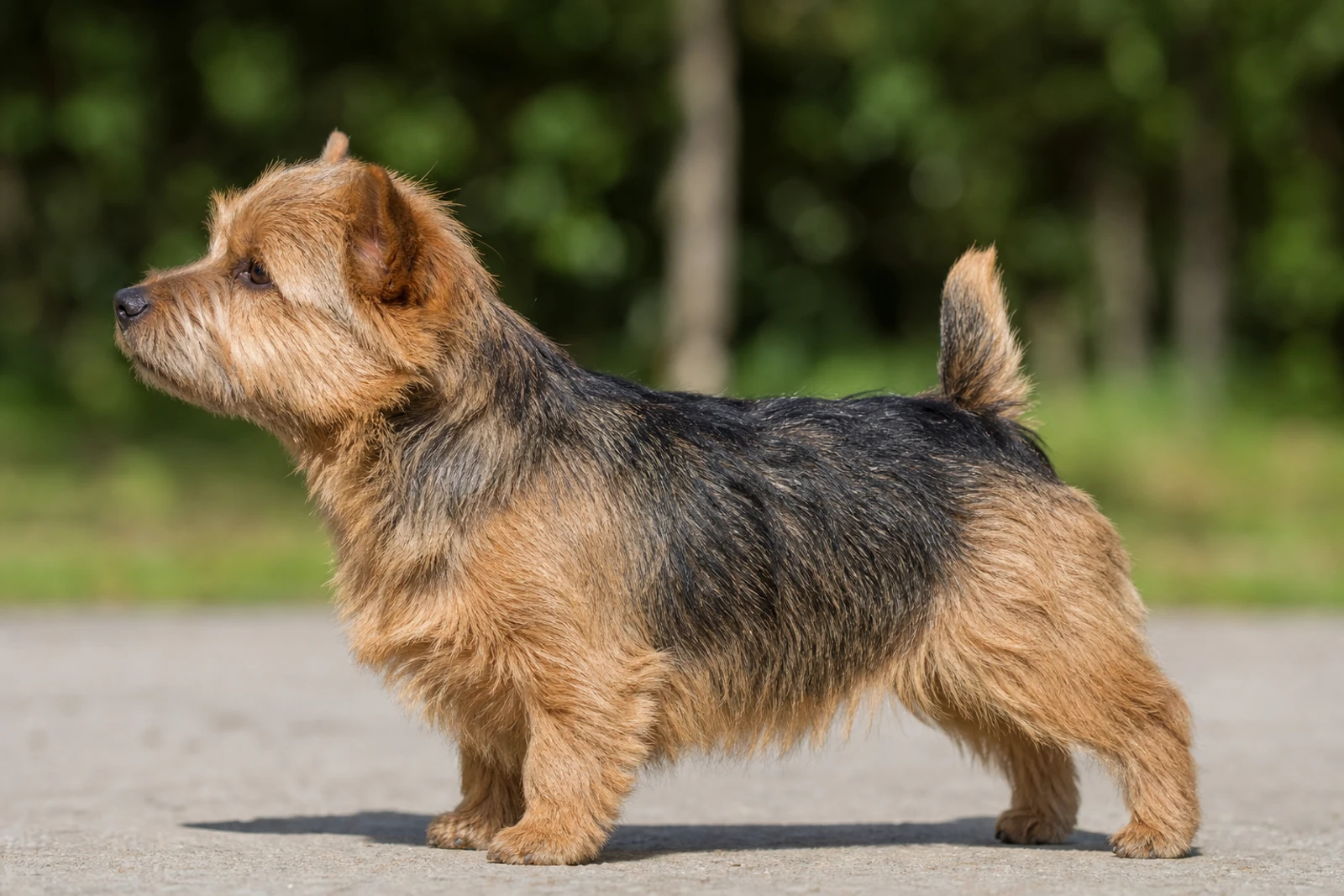
The Norwich Terrier is a small but sturdy dog with a big personality. One of the smallest working terriers, it was bred to hunt vermin in England. Today, this affectionate and plucky breed thrives as a devoted companion. It suits active families, singles, or seniors looking for a portable, spirited friend. With its expressive face and lively nature, the Norwich Terrier brings joy and entertainment. It's adaptable but needs mental stimulation and daily exercise.
At a glance
- Size
- Small
- Height
- 10 in
- Weight
- 11–13 lb
- Life span
- 12–15 years
- Coat colors
- red, wheaten, black and tan, grizzle
- Coat type
- short, wiry double coat
- Origin
- United Kingdom
How much does a Norwich Terrier cost?
Adopt / rescue
$75–$400
Usually includes spay/neuter, first shots, and a microchip.
Buy from a breeder
$700–$2,000
From a reputable, health-testing breeder.
Approximate USD. Prices vary widely by region, breeder, pedigree, age, and coat colour — adopting is the lower-cost and recommended route. Avoid suspiciously cheap “breeders”; they’re often puppy mills.
Estimate the full cost of a Norwich Terrier →Want the ongoing number? Estimate the monthly food bill for a Norwich Terrier with our dog food cost calculator.
Norwich Terrier photos
Views
Front, side, rear and top — the full silhouette.Poses
How the breed sits, lies, moves and plays.Puppy to senior
The breed across its whole life.Expressions
The breed’s range of moods.Close-up details
Eyes, ears, nose, paws, tail and coat.Coat colors
The breed’s recognized colors.Click any photo to enlarge. We show the Norwich Terrier from every angle — three views, poses, life stages, expressions, close-ups, coat and colors.
Appearance & size
The Norwich Terrier is the smallest terrier to sport naturally erect ears — a detail that gives it a permanently alert, foxy expression. That prick-eared silhouette is the first thing you notice, but the second is a compact, muscular body that looks far tougher than a dog barely over 10 inches tall. A healthy Norwich weighs in at 11 to 13 pounds, and it carries every ounce like a dog who’d rather work than cuddle.
Build and size
Under that shaggy coat is a body that’s slightly longer than tall, with a deep chest and well-sprung ribs that add real substance. The back is level, the loin short and strong, and the whole outline reads “working terrier.” The height rarely exceeds 10 inches at the shoulder, and the weight stays right around that 11–13 pound mark — stocky without being stubby, balanced without looking square. A Norwich moves like a dog with somewhere to go: legs are short but straight, hindquarters are muscular, and the feet point forward at a walk or trot. Elbows stay tight to the ribcage, which keeps the front end neat.
Coat and color
The double coat is one of the breed’s calling cards. On top, the hair is straight, hard, and wiry — almost harsh to the touch — and it stands slightly off the body. The soft undercoat provides insulation year-round. Around the neck and shoulders, the hair grows longer into a noticeable ruff that frames the face and gives the Norwich its iconic shaggy-but-deliberate profile. That coat shrugs off light rain and dirt, though it does demand regular hand-stripping if you want to keep the correct texture.
Colors are solid, with no large white patches (a small spot is a fault in the show ring):
- Red – a clear warm red
- Wheaten – pale gold to fawn
- Black and tan – jet coat with rich tan markings
- Grizzle – a salt-and-pepper blend of dark and light hairs
Hallmark features
The erect ears are medium-sized, set well apart, and always on high alert. Dark, oval eyes have a mischievous gleam, and the muzzle is strong and wedge-shaped, finishing in a tight lip line. The tail, whether docked short or left natural, is set high and carried perked or straight up; a natural tail is thick at the base, tapering to a point, and it never curls over the back.
From every angle
Head-on, you see a balanced wedge with ears that seem to catch every sound, dark eyes with real spark, and a slightly rounded skull. The expression is curious, never mean. From the side, the level topline, deep chest, and short, straight forelegs combine with the tail flagging behind to make a dog that looks ready to go. When viewed from the rear, the hind legs stand straight and parallel, with well-angled stifles and muscular thighs — a rear that hints at surprising power for a dog his size. The whole animal reads like a terrier who’d bolt down a hole at a moment’s notice, not a soft lap ornament.
History & origin
You’ll find the Norwich Terrier’s start in the barns and stables of East Anglia, in southern England, during the late 1800s. Farmers there didn’t want a soft lapdog—they needed a no-nonsense hunter that could slip into a rat-infested hayloft or bolt a fox from its den. That’s the job this little dog was built for. Barely 10 inches tall and weighing all of 11 to 13 pounds, it was small enough to go anywhere vermin hid, with the grit and stamina to work a full day.
For decades, these scrappy terriers were simply called Norwich Terriers, but breeders regularly saw two ear types in the same litters: sharp prick ears and folded drop ears. The debate over which was correct simmered for years, fueled by different local preferences. It finally boiled over in 1964 when the Kennel Club in the UK—and soon after, the American Kennel Club—split them into two distinct breeds. The prick-eared dogs held onto the name Norwich Terrier, while the drop-eared version became the Norfolk Terrier. That same year, 1964, is the official recognition date for the Norwich.
Even before the split, both types had begun hopping across the Atlantic. American sportsmen and families fell for their big-dog swagger in a suitcase-sized frame. After World War II, their numbers climbed steadily in the U.S., and AKC recognition in 1964 put them on solid footing. Today, most Norwich Terriers live as spirited family dogs rather than full-time ratters, but they’ve never lost that original terrier spark. You’ll see it the instant they lock eyes on a squirrel.
Temperament & personality
A Norwich Terrier packs more spirit per pound than dogs twice its size. At 11–13 pounds and barely 10 inches tall, this is a dog that wakes up every morning certain it’s the boss of the barnyard — even if the barnyard is an apartment living room. Bred to dispatch rats, the Norwich is curious, tenacious, and always scanning for something to investigate. A simple walk around the block barely registers; they need a solid 30- to 45-minute outing plus dedicated play, and more importantly, a job for their brain. Puzzle toys, hide-and-seek, and training sessions keep that busy mind from inventing its own entertainment (which often involves digging, chewing, or turning every noise into a public service announcement).
Affectionate, but not a pushover. These dogs bond fiercely with their people and thrive when they’re underfoot. You’ll rarely find a Norwich who doesn’t want to be part of whatever you’re doing — cooking, working, or unwinding on the couch. With familiar family, they’re warm and cuddly, though they can be possessive about food and special toys. Teach children to leave the dog alone during meals and not snatch things from its mouth, because a cornered Norwich will escalate to a snap. Around other dogs, most Norwiches hold their own politely, but that ratting instinct makes small pets like hamsters, rabbits, or cats a risky gamble. If a furry creature bolts, the chase is on.
Watchdog with an opinion. The Norwich is an enthusiastic alarm system. Mail carrier, delivery truck, squirrel, suspicious breeze — you’ll hear about all of it. Early training can dial back the racket, but you’ll never eliminate it. Their independent streak adds another layer: they’re smart and learn fast, but they’re not wired for blind obedience. They’ll pause to consider whether your command actually benefits them. Bullying or punishment makes them dig in their heels; respectful, consistent training with high-value rewards gets far better results. Housetraining sometimes requires extra patience, too. Intact males especially may urine-mark indoors to claim territory. Crate training and enzyme-based cleaners are your allies here — plain soap doesn’t break down the scent cue that draws them back.
The fine print. Left alone for long, empty hours, a Norwich often develops anxiety-driven behaviors: nonstop barking, destructive chewing, or frantic pacing. This is a breed that belongs in the thick of family life, not sequestered in a back room. They do well in homes with older kids who understand terrier boundaries and with adults who want a shadow that’s equal parts comedian and determined sidekick. If your version of a small dog is a quiet, low-maintenance lap accessory, look elsewhere. A Norwich Terrier brings the hustle.
Good with kids, dogs & other pets
With kids
A Norwich Terrier brings a steady, patient temperament to family life, and at 11–13 pounds, they’re small enough for apartments but sturdy enough to hang with respectful kids. The main rule: teach children to interact at the dog’s level instead of scooping them up. A fall from a three-year-old’s arms can injure a dog this size. Supervision is non-negotiable with toddlers—not because the Norwich will snap, but because kids can be clumsy. When kids understand quiet times during meals and naps, this little terrier becomes an enthusiastic, good-natured playmate who happily tolerates the day’s rumble and ruckus.
With other dogs
Norwich Terriers were bred to work in pack settings, which gives them a natural leg up in canine social skills. Most get along easily with other dogs if they learn the ropes early. The critical window is between 3 and 16 weeks of age—arrange structured puppy playdates and invite calm, vaccinated adult dogs over so your Norwich learns to read body language and back off when another dog says “enough.” Without that early exposure, a Norwich can lean bossy or reactive, especially toward same-sex dogs. Even a well-socialized adult benefits from spaying/neutering and short, supervised introductions when meeting new four-legged friends.
With cats and small pets
Terrier instinct is real, and it doesn’t take much. A running cat, a scurrying guinea pig, or a flick of a rabbit’s ears can flip the chase switch. A Norwich raised from puppyhood with a confident, dog-savvy cat often learns to coexist peacefully. Bring an adult Norwich into a home with free-roaming small animals, and you’re gambling. Always use baby gates for cats and keep pocket pets in secure enclosures behind a closed door when you can’t supervise. Reward your dog for calm, look-at-me behavior when the cat saunters by—that reinforcement builds a long-term truce.
A word about alone time
Norwich Terriers don’t do well as backyard ornaments or in empty houses. They thrive on companionship and can develop anxious barking, chewing, or housetraining slip-ups if left alone for long workdays. A crate, steady routine, and midday check-in help, but if your household is empty eight-plus hours daily, this breed’s emotional needs will be tough to meet. They’re happiest when someone is around more often than not, holding down the role of a fifteen-pound family heartbeat.
Trainability & intelligence
Your Norwich Terrier is fast, clever, and has the tenacity of a dog three times his size. That brain comes with an independent streak, though, so training is less about issuing commands and more about convincing him that doing what you want is actually his idea. Forget drill-sergeant routines: he'll shut down or dig in. Instead, treat every session like a short, upbeat negotiation where you pay generously for cooperation.
How they learn — Norwich Terriers pick up new behaviors quickly when there's something in it for them. Food rewards work, but don't underestimate the power of a squeaky toy or a quick game of tug. The catch? They bore fast. Repeating the same sit-stay five times straight will get you a blank stare and a dog who is mentally already halfway to the kitchen. Keep sessions to 5–10 minutes and stop while he's still eager.
The recall reality — Here's where you'll work hardest. A Norwich has a nose that seems hardwired to ignore you the moment it locks onto an interesting scent or a squirrel. Off-leash reliability doesn't come pre-installed. You're building a behavior that competes with generations of earthdog instinct, so start in a fenced area and reward every successful recall with something truly special—think real chicken, not a single dry biscuit. If the dog learns that coming to you ends the fun and means going inside, his selective hearing will get razor-sharp.
What works — Positive reinforcement with zero shortcuts. Immediate praise, high-value treats, or a quick romp with a favorite toy right when he gets it right. Harsh corrections or punishment erode trust and can turn that tenacity into outright defiance or anxiety. Consistency matters more with this breed than with many others; if you let a rule slide once, he'll remember for life. Start puppy kindergarten early, ideally before 16 weeks, and maintain calm, predictable routines.
Socialization is non-negotiable — Expose a Norwich puppy to a wide variety of people, friendly dogs, different surfaces, and household sounds between 3 and 14 weeks old. Keep every new experience gentle and rewarding. This prevents the kind of fear-based reactivity that can crop up later as barking and posturing. Don't stop once he's an adult. Ongoing, positive outings keep his confidence solid.
Common challenges — House training can be a sticking point. Small bladders and a stubborn personality mean you'll need to maintain a strict schedule, reward outdoor elimination immediately, and never rub his nose in accidents. He's also a master manipulator when he wants something—he'll test boundaries and then flash that foxy grin. Hold the line, keep it cheerful, and make the right choice pay off every single time.
Exercise & energy needs
Start with two 20-minute sessions a day, but don’t mistake that for a lazy lap dog’s quota. Norwich Terriers pack serious terrier firepower into 11–13 lb. The 20-minute mark is a solid floor — the real goal is a dog that’s physically unwound and mentally tired, not just leashed around the block.
A Norwich thrives on short, frequent bursts of activity that let him think and hunt. A brisk morning walk combined with a backyard flirt pole session, a game of hide-and-seek with a favorite toy, or a 15-minute sniffari where he gets to follow his nose will do more for his state of mind than an hour of plodding down the same sidewalk. He was bred to bolt after vermin, so he loves to chase, pounce, and dig — give him a sandbox or a designated digging spot and he’ll take the hint.
Mental exercise is not optional. Puzzle toys, scatter-feeding in the grass, scent work (hide a treat under a cup, let him figure it out), or 10 minutes of practicing tricks will take the edge off when the weather keeps you indoors. A Norwich who’s only physically exercised is like a smartphone at 15% battery — functional, but liable to shut down in annoying ways.
- Flirt pole: 5–10 minutes of high-speed chasing and pouncing, broken into short sets, burns energy fast.
- Off-leash romps in a securely fenced area let him sprint and zigzag at his own pace.
- Scent games — hiding kibble around the house or using a snuffle mat — satisfy his brain without adding joint stress.
- Short hikes are fine; just match the trail to a 10-inch-tall dog and lift him over obstacles that encourage repeated hard landings.
Keep an eye on leaping off furniture and play that involves sudden stops and twists. While Norwiches are generally sturdy for their size, responsible owners protect growing joints and avoid high-impact routines in puppyhood. If he’s panting hard or lagging, wrap it up — terriers won’t always self-regulate.
A Norwich without enough daily punch to his routine will find a job of his own, and you probably won’t like his resume. Digging, demand barking, mouse-hunting inside the sofa cushions — that’s boredom with a beard. Stick to two solid sessions and sprinkle in brain games, and you’ll have a content, tired buddy who’s ready to curl up after the work is done.
Grooming & coat care
A Norwich Terrier’s hard, wiry double coat is practically self-cleaning and sheds very little — but only if you treat it right. The outer guard hairs are meant to repel dirt and weather, while the soft undercoat insulates. Skip the grooming, and that dense undercoat builds up, mats form close to the skin, and the signature harsh texture goes woolly.
Brushing basics
Brush 2–3 times a week with a slicker brush or a pin brush to grab loose undercoat and any outdoor debris. Comb through the legs, chest, and behind the ears weekly with a metal comb — those spots mat fastest. During spring and fall, when the undercoat turns over, step it up to every other day.
Hand-stripping vs. clipping
Here’s the non-negotiable part: to keep the coat weather-resistant and correct in color (shades of red, wheaten, black and tan, or grizzle), you’ll need to hand-strip the dead outer hair rather than clip it. Plan on stripping every 8–12 weeks. Many owners learn to do it themselves or book a terrier-experienced groomer. Clipping is quicker, but it cuts the harsh tips and permanently softens the coat — the color fades toward a washed-out version, and you’ll start seeing more loose hair around the house.
Bathing and seasonal care
Bathe sparingly — every 6–8 weeks, or when your dog rolls in something foul. Over-washing strips the natural oils that keep that wiry coat doing its job. After a wet, muddy walk, a rinse with plain water and a towel dry is often enough. As the seasons change, a warm bath followed by a thorough blow-dry can help loosen the dead undercoat before a stripping session.
Nails, ears, and teeth
Trim nails every 3–4 weeks; Norwich feet are small and can quick-ouch easily if neglected. Check those prick ears weekly for wax or irritation, and wipe the outer ear with a damp cloth. Daily tooth brushing is ideal, but even 3 times a week goes a long way toward preventing the gunk that leads to early tooth loss in small dogs.
If you decide to go with clipping instead of hand-stripping, just know the coat will change — softer, lighter, and slightly less dirt-resistant. It’s a real trade-off, not a time-saver without consequences.
Shedding & allergies
If you’re looking for a dog that barely leaves a trace, the Norwich Terrier will surprise you. These little dogs shed a moderate amount year-round — not a constant blizzard, but enough that you’ll find wiry hairs on dark pants and couch cushions. A double coat is the culprit: a soft, dense undercoat for insulation and a harsh, straight outer coat that repels dirt.
The real hair event happens twice a year when the undercoat blows out. For a few weeks in spring and fall, dead fur comes out in tufts. A quick daily once-over won’t keep up; you’ll need a slicker brush or a greyhound comb every day during peak shed, plus a stripping knife if you’re keeping the coat in show shape. Many owners book a professional hand-stripping session seasonally to get the bulk of it out in one go.
Drool isn’t part of the Norwich Terrier package. These are dry-mouthed dogs, so saliva-related messes and allergens are minimal.
Now for the allergy question: no dog is truly hypoallergenic, and the Norwich is no exception. Allergy triggers come from dander (dead skin flakes) and proteins in saliva and urine, not just hair. Because they shed only moderately and don’t produce large clouds of loose hair, Norwich Terriers can be a touch easier for some allergy sufferers compared to heavy shedders — but they absolutely still produce dander. If you have dog allergies, spend time around adult Norwich Terriers before bringing a puppy home. A weekly brushing routine, wiping the dog down with a damp cloth, and washing bedding regularly helps keep dander accumulation low.
Diet & nutrition
A 11–13 lb Norwich Terrier burns through energy like a much bigger dog, so the first rule is quality over quantity. An adult usually needs between 350 and 450 calories a day, but listen to the dog in front of you — a terrier who spends an hour tearing around the yard needs more fuel than a couch potato. Split that into two measured meals. Free-feeding turns these food-driven little opportunists into pudgy beggars fast.
- Puppies: From weaning to 4 months, serve four small, evenly spaced meals a day. Drop to three meals until 6 months, then switch to the adult two-meal schedule. Introduce new foods gradually — lightly cooked and puréed meats, fish, fruits, and vegetables work well, or a high-quality puppy kibble softened with warm water. Raw chicken wings can come around 12 weeks, always under your eye.
- Skin and coat: That wiry double coat shines on omega-3 fatty acids. Include small amounts of fish (sardines, salmon) or a fish oil supplement. If your dog scratches or gets hot spots, rule out common allergens like chicken or grain — a limited-ingredient diet often clears things up.
- Weight watch: Norwich Terriers are built low and long. Extra pounds stress the back and joints, so measure exactly — a scant ½ cup to ¾ cup of dry food daily is typical, split across breakfast and dinner, then subtract for training treats. A pudgy Norwich loses that “ready for anything” silhouette in a hurry.
- Slowing the food gulpers: Puzzle bowls or snuffle mats turn meal time into a brain game and help prevent choking, bloat, and boredom.
- Home-cooked approach: If you skip commercial food, roughly 60% raw or gently cooked meat, 20–30% dog-safe fruits and vegetables, and 10% extras like eggs, plain yogurt, or soaked grains (pearl barley or white rice for sensitive stomachs) keeps it balanced. Blend or finely chop everything — a dog’s jaw moves vertically, and they lack salivary enzymes, so breaking down the food for them means they actually absorb the nutrients.
- Senior adjustments: As activity drops around 10–12 years, shrink the daily portion before you see weight creep upward. Older dogs with worn teeth do better with softer, puréed meals; you can use unsalted vegetable cooking water as the liquid. Smaller, more frequent meals three times a day can settle a cranky gut. There’s no good reason to slash protein — muscle mass still matters.
- Don’t: Vegetarian or vegan diets shortchange a terrier’s biology. Rich, fatty holiday scraps can trigger pancreatitis overnight. Skip them entirely.
Stick with a clean, species-appropriate diet that matches your dog’s daily output, and you’ll see it in the bounce of his step. When the vet’s scale says 13 pounds but your eyes say “furry sausage,” get the measuring cup back out.
Health & lifespan
At 11–13 pounds, a healthy Norwich Terrier can look forward to 12–15 years — and with solid care, many push past that. They’re a small, sturdy terrier, but a few breed-specific trouble spots are worth knowing about so you can catch them early or avoid them altogether.
What tends to pop up
- Skin allergies and atopic dermatitis show up more often than anyone would like. You might see licking at paws, recurrent ear infections, or itchy bellies. Environmental triggers (pollen, dust mites) and food sensitivities are common culprits. Managing it means playing detective with diet and sometimes using medicated baths or allergy medication. Responsible breeders can’t always eliminate this, but they avoid using dogs that are chronically miserable with it.
- Patellar luxation — a kneecap that slips out of its groove — is a classic small-dog issue. A vet can feel it in a puppy exam. Mild grades often stay comfortable with lean weight and joint supplements; a severe slip might need surgery. Look for breeders who have their adults evaluated through OFA patella screening.
- Primary lens luxation (PLL) is an inherited eye condition where the lens detaches and floats around, eventually causing glaucoma and pain. There is a DNA test for it, and good breeders test their breeding stock so they don’t produce affected pups. Annual eye checks with a veterinary ophthalmologist add another layer of safety, especially as they age.
- Dental disease hits hard in small mouths. Crowded teeth trap plaque, and by age three most Norwich already have some level of tartar. Daily brushing and a crunchy dental diet help, but plan on professional cleanings. Letting it slide doesn’t just hurt the teeth — bacteria can travel to the heart and kidneys.
Prevention that actually matters
Weight is a big deal for this breed. Norwich Terriers are enthusiastic eaters who will happily turn into 15-pound sausages if you let them. Extra weight punishes those knees and shortens their lifespan. Measure meals, keep treats tiny, and keep them moving — a brisk daily walk plus some off-leash sprinting in a secure area is perfect.
You’ll also dodge trouble with a harness instead of a collar, which protects the trachea from pressure, especially if your dog pulls. A dense wiry coat gives them good cold tolerance, but it also traps heat fast on warm days, so avoid mid-afternoon sun and always provide shade and water.
Like all dogs, they need monthly heartworm prevention during mosquito season (and one month after) and a current rabies shot by law. Tiny Norwich puppies can dip into hypoglycemia if they go too long without eating, so three or four small meals a day until they’re a few months old keeps blood sugar steady.
Early, positive handling lowers the stress that can aggravate skin flare-ups and anxious behaviors. A thorough vet check once a year — with an eye on those knees, eyes, and teeth — catches small problems before they get expensive or painful.
Living environment
A Norwich Terrier is a famously sociable little dog who hates being left behind. His 11–13 lb frame packs serious attachment, so solo workdays often trigger barking, chewing, or escape artistry. If your household is empty for eight-plus hours, plan for a midday walker or doggy daycare—otherwise stress behaviors will surface fast.
Despite that neediness, he’s a natural apartment dweller. At just 10 inches tall, he doesn’t need a lot of room indoors; what he needs is daily motion that matches his terrier drive. Two or three short, sniffy walks—20 minutes each—plus a rugged game of tug or fetch inside meet his physical quota. A securely fenced yard lets him rip around off-leash, but it’s not required as long as you give him those dedicated outings. Be warned: a yard with flimsy fencing gets redesigned by a busy digger.
His wiry double coat shrugs off chilly drizzle, so fair-weather walks are fine in cooler months. The flip side: he overheats easily when it’s muggy and hot. Move exercise to early morning or evening in summer, carry water, and watch him on asphalt.
And yes, he’ll bark. Norwich Terriers are keen, scrappy watchdogs who announce every door knock, squirrel, and passing skateboard. You can reduce the racket with early training and plenty of chew outlets, but you’ll never get a silent dog. In close-quartered buildings, that’s a real tradeoff.
To help him cope with alone time, start young with brief departures, frozen stuffed Kongs, and puzzle toys that make him hunt for his kibble. Ten minutes of scent work burns mental energy faster than a lap around the block. A Norwich who just solved a food puzzle and has a bully stick is usually content to nap—at least until you walk back through the door.
Who this breed suits
The Norwich Terrier suits you if you want a small dog with a big personality — not a pint-sized lap warmer. At 11–13 pounds and about 10 inches tall, this is a sturdy little firecracker built for action, not for dozing on the couch all day. He fits best in a home where someone is ready to be the clear, consistent leader and genuinely enjoys burning energy together.
Active singles and couples often hit it off with a Norwich. If long morning walks, weekend hikes, or spirited games of fetch in the yard sound like your routine, you’ll have an eager co-pilot. The breed also does well with families that have older children (say, 8 and up) who can respect a small dog’s space — Norwich Terriers can be snappy if they’re roughly handled or surprised during a nap. Their 12–15 year life span means they’ll be part of the family for the long haul, so think about what life looks like a decade from now.
Even first-time owners can make it work, but only if you’re ready for a dog who is whip-smart and has a terrier’s independent streak. Training classes are non-negotiable. A Norwich will test your consistency daily, and that stubborn “what’s in it for me?” attitude is just part of the deal.
- Seniors who stay active can be a wonderful match. The dog’s portable size and low drool factor are easy to manage, but he can’t be handed off to a dog walker for a casual 10-minute loop. You need to provide a solid 45–60 minutes of real exercise every day — off-leash running in a safely fenced area or a brisk, sniffy walk that gets his legs pumping. A sedate retirement lifestyle will frustrate him and lead to barking, digging, or other creative acts of destruction.
Think twice if:
- You have small pets like hamsters, rabbits, or birds. The Norwich was bred to hunt rats and has an intense prey drive. He may live with a cat he’s raised with, but a neighbor’s free-range chicken will trigger every instinct.
- You live in an apartment with thin walls and no direct yard access. These are alert, vocal watchdogs who will announce every delivery truck and squirrel. A short potty break on a leash isn’t enough — they need a secure spot to zip around and, yes, dig. A Norwich without a place to dig will redecorate your flowerbeds or your couch cushions.
- You want a quiet, low-energy lap dog. A Norwich will happily curl up next to you after a good romp, but he spends the majority of his waking hours looking for action. He’s not the breed for someone who wants a dog that sleeps through the mailman or is content with a stroll around the block.
- You prize a flawless lawn or garden. Digging is in his DNA. You can redirect it to a sandbox, but you won’t train it out entirely.
- Off-leash reliability is a dealbreaker. A high prey drive and a tendency to chase anything that moves mean a Norwich can never be trusted off-leash in an unfenced area, no matter how much you practice recall.
Cost of ownership
Purchase Price
A well-bred Norwich Terrier puppy from health-screened parents typically costs $2,000 to $3,500. The breed’s modest litter size and the cost of OFA hip, knee, and eye clearances keep prices up. A lower price tag almost always means skipped health testing. Show-prospect pups or those from top-winning lines may push closer to $4,000. Factor in an extra $200–$400 for a crate, bed, harness, leash, and initial puppy-proofing.
Monthly Upkeep
Once the gear is bought, expect to land between $130 and $200 a month, not counting surprise vet bills.
- Food: $25–$40. A high-quality dry kibble for an 11–13 lb dog goes a long way — a 15 lb bag often lasts two months.
- Grooming: $40–$80 averaged monthly if you use a groomer, or far less if you learn hand-stripping. The wiry double coat needs hand-stripping 2–4 times a year to keep texture and control shedding; each session runs $80–$150. In between, weekly brushing and ear cleaning are enough. Scissoring is cheaper short-term but softens the coat and ramps up shedding. Nail trims add $10–$20 a visit.
- Veterinary care: $35–$60 a month, annualized. Annual exams, core vaccines, heartworm testing, and year-round parasite prevention usually total $400–$700. Small mouths mean you’ll likely face a dental cleaning ($300–$600) every year or two. Norwich Terriers can be prone to luxating patellas, hip dysplasia, and cataracts; responsible breeders screen for all three, but any of those conditions can trigger steep bills.
- Pet insurance: $30–$50 a month for a solid accident-and-illness plan. With a 12–15 year lifespan, a policy helps absorb a multi-thousand-dollar knee surgery or lifelong eye medication.
Aim to park a few hundred dollars in a dedicated emergency fund right away — even a healthy Norwich can find trouble a terrier-sized hole in the fence.
Choosing a Norwich Terrier
A Norwich Terrier might stand just 10 inches and weigh 11 to 13 pounds, but finding one bred with real care makes all the difference in the 12 to 15 years you’ll have together. These are sturdy little dogs, but a cut-rate puppy can bring health and temperament troubles you don’t want to untangle.
Where to start: breeder or rescue
You’ll likely find more breeders than rescues simply because Norwich aren’t produced in large numbers. If you go the rescue route, check with the Norwich Terrier Club of America’s rescue arm — occasionally an adult dog needs rehoming, and you skip puppyhood chaos. A good rescue will give you a straight history of the dog’s health and quirks.
If you buy from a breeder, expect to be interviewed as thoroughly as you interview them. A serious breeder raises pups indoors with early socialization, doesn’t let them leave before 10 to 12 weeks, and will show you health paperwork without you having to ask twice.
Health clearances you actually need
Norwich Terriers can be prone to a handful of inherited issues. Responsible breeders screen dogs before breeding, not just guarantee a pup is “vet-checked.” Insist on seeing the following, ideally verifiable through the Orthopedic Foundation for Animals (OFA) or similar registries:
- Patellar luxation (OFA patella evaluation) — loose kneecaps are no joke in a dog this active.
- Hip dysplasia — less common in toy-sized dogs, but Norwich have enough leg under them that OFA hip radiographs are still the gold standard.
- Eye certification (CAER exam by a veterinary ophthalmologist within the past year) — checks for cataracts, lens luxation, and other inherited eye diseases.
- Primary Lens Luxation (PLL) DNA test — a specific genetic test for a condition that can cause sudden blindness. At least one parent should be clear.
- Cardiac evaluation — some lines carry mitral valve disease; ask about a board-certified cardiologist’s exam.
A breeder who waves off any of these or says “my line has never had problems” without paperwork to back it up is not doing the work.
Red flags that should send you elsewhere
- No health testing documents shared openly on the parents.
- Puppies available immediately with no waitlist — the best breeders often have a waiting list.
- Multiple breeds under one roof — a serious terrier person typically focuses on one or two.
- Pups raised in a kennel or outbuilding with minimal household exposure — a Norwich pup needs early noise, foot traffic, and handling to become a confident family dog.
- Seller pressures you, offers to ship a puppy sight-unseen on short notice, or won’t let you meet at least the dam.
Picking your puppy
If you’re visiting a litter, watch for a pup who is curious but not frantic. A well-bred Norwich should trot straight over to investigate you, not cower or hide in the corner. Pick the puppy up and run your hands over the body — you want a solid feel, no pot belly, clean ears, and a springy step. Don’t mistake “shy” for “sweet” in this breed; timidity can deepen into a fearful adult. The puppy that unties your shoelaces with cheerful intent and then flops in your lap for a quick nap is showing the real Norwich bone — equal parts spark and snuggle.
Pros & cons
Pros
- Perfectly portable size. At 10 inches tall and 11–13 pounds, a Norwich fits under an airplane seat, curls up on your lap, and won’t drag you down the street.
- Big-dog attitude in a small package. Fearless, curious, and always game for a romp – they bring terrier spirit without the bulk.
- Devoted family shadow. These dogs forge tight bonds and want to be wherever you are, whether that’s the sofa or the hiking trail.
- Alert watchdog with a sense of humor. A Norwich notices everything and announces visitors with enthusiasm, but usually dials it back once the greeting is over.
- Low-maintenance coat. The wiry double coat sheds minimally and repels dirt; regular brushing and an occasional hand-strip keep it tidy.
- Long-lived and generally hardy. With a lifespan of 12–15 years and a sturdy build, they stay active well into their senior years when responsibly bred.
Cons
- Prey drive written in capital letters. Squirrels, chipmunks, and even the neighbor’s cat trigger a chase instinct that overrides recall – a fenced yard is non-negotiable.
- Stubborn streak that earns the food. They’re smart and independent, so training feels more like a negotiation than a command. Consistency and creative rewards win the day.
- Bark first, ask questions later. A Norwich can be vocal about every delivery truck, leaf, and passing dog. Apartment dwellers will spend real time on quiet cues.
- Energy that outpaces their size. A short walk won’t cut it. Plan on daily sprint sessions, puzzle toys, and off-leash play in a secure area to keep them from inventing their own (destructive) fun.
- Digging is a feature, not a bug. Earthdog roots run deep – flower beds and lawns become excavation projects without an approved digging zone.
- Can be scrappy with strange dogs. Early socialization helps, but some Norwich Terriers never fully lose the terrier tendency to posture when meeting new canines.
Similar breeds & alternatives
If a Norwich Terrier is on your shortlist, you’re looking at a tiny, tough working terrier that acts twice its size. The breeds below share that scrappy British terrier lineage but differ in ways that may tip your decision.
Norfolk Terrier
The Norfolk is the Norwich’s drop-eared sibling—until the 1960s, the two were shown as one breed. The Norwich got prick ears and formal recognition in 1964; the Norfolk followed later with neatly folded ears. Height, weight (10 inches, 11–13 pounds), wiry coat, and bold, people-loving temperament are otherwise identical. If you want that unmistakably foxy, upright-eared expression, go Norwich. For a slightly softer look and a reputation for being marginally less bossy, the Norfolk is the nearest alternative.
Border Terrier
Slightly taller (11–16 inches) and weighing 11–15 pounds, the Border Terrier has a narrow, otter-shaped head and a more amiable, dog-social streak. While a Norwich can be scrappy with unfamiliar canines, Borders generally settle more easily into multi-dog homes and often have a better built-in off-switch indoors. They still need a solid daily run and secure fencing. Choose the Border if you want a terrier that’s a bit more forgiving in a pack.
Cairn Terrier
At 9.5–10 inches and 13–14 pounds, the Cairn is almost the same size but sports a bushier face with prominent eyebrows and a wider color card—any shade except white. Cairns are famously independent and spirited, but they’re less handler-focused than a Norwich. Where a Norwich tends to shadow you, a Cairn is often happier solving a puzzle toy on its own. If you appreciate terrier tenacity and don’t mind a touch more stubbornness, the Cairn fits.
West Highland White Terrier
The Westie is a heavier (15–20 pounds), always-white relative bred from the same Scottish rootstock. That brilliant coat demands regular stripping and stays clean only with frequent effort; skin allergies are a known concern. Norwich coats come in easy-to-maintain red, wheaten, black and tan, or grizzle, hiding dirt more kindly. Both dogs are alert and lively, but the 11–13-pound Norwich remains easier to scoop up and tuck under an arm.
Scottish Terrier
The Scottie packs more weight (18–22 pounds) onto a longer back, with a distinct profile and a reserved, dignified personality. While a Norwich will plaster itself against you, a Scottie keeps its affection more selective and can be aloof with strangers. Training a Scottie often takes more patience and a defter hand. If you want a terrier that feels substantial yet still small, and you’re comfortable with a more independent companion, the Scottie delivers—but the pocket-sized Norwich stays the more portable, people-glued option.
Fun facts
- They have naturally upright, pointed ears that give them an alert expression.
- The Norwich Terrier was once the same breed as the Norfolk Terrier, separated by ear carriage.
- They were popular ratters at Cambridge University, often kept by students.
- Despite their small size, they are fearless and make excellent watchdogs.
Frequently asked questions
- Are Norwich Terriers good with children?
- Norwich Terriers can be good family dogs and typically enjoy the company of respectful children. They are sturdy and energetic, so supervision is recommended with very young kids. Early socialization helps them get along well.
- Do Norwich Terriers shed a lot?
- Norwich Terriers have a wiry double coat that sheds minimally, making them a decent choice for some allergy sufferers. Regular brushing and occasional hand-stripping are needed to manage loose hair and maintain coat texture.
- How much exercise does a Norwich Terrier need?
- As an active small breed, the Norwich Terrier benefits from around 30–60 minutes of daily exercise. Brisk walks, play sessions, and mentally stimulating games help prevent boredom and potential mischief.
- Are Norwich Terriers easy to groom?
- Grooming a Norwich Terrier requires moderate effort. Their wiry coat needs weekly brushing and stripping several times a year to keep it healthy; many owners learn to do this themselves or use a professional groomer.
- Do Norwich Terriers bark a lot?
- Norwich Terriers tend to be alert watchdogs and may bark to announce visitors or unusual sounds. Training them to quiet on command can manage excessive barking, but they are not typically considered non-stop barkers.
Tools & calculators for Norwich Terrier owners
Quick estimates tailored to Norwich Terriers — pre-filled with this breed’s size where it matters.
Articles & stories about the Norwich Terrier
Sources & standards
This profile follows recognized breed standards from the American Kennel Club (AKC) and the Fédération Cynologique Internationale (FCI), along with established veterinary and breed-club guidance. These describe general breed tendencies — every dog is an individual.