

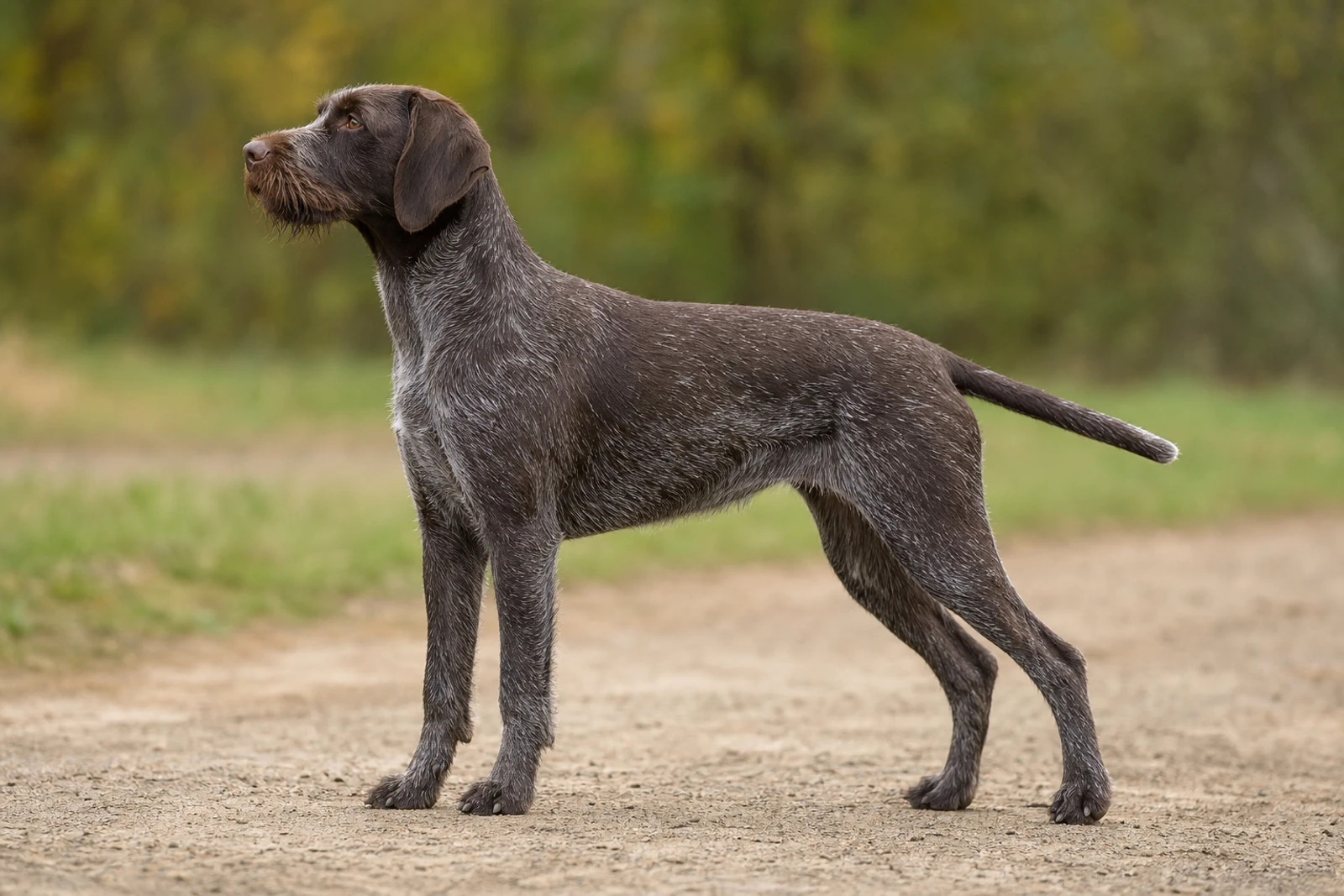
The Pudelpointer is a versatile German hunting breed, ideal for active owners who enjoy outdoor adventures. Developed from Poodles and Pointers, they are intelligent, loyal, and eager to please. With a wiry, low-shedding coat and moderate grooming needs, they thrive in homes with ample space and a job to do. They are affectionate with their families but have a high prey drive, making them less suitable for households with small pets. Best for experienced owners who can provide consistent training and plenty of exercise, the Pudelpointer excels in hunting, agility, and as a devoted companion.
At a glance
- Size
- Giant
- Height
- 22–27 in
- Weight
- 44–66 lb
- Life span
- 12–14 years
- Coat colors
- Liver, Black
- Coat type
- Dense, harsh, wiry outer coat with a softer undercoat
- Origin
- Germany
How much does a Pudelpointer cost?
Adopt / rescue
$75–$400
Usually includes spay/neuter, first shots, and a microchip.
Buy from a breeder
$700–$2,000
From a reputable, health-testing breeder.
Approximate USD. Prices vary widely by region, breeder, pedigree, age, and coat colour — adopting is the lower-cost and recommended route. Avoid suspiciously cheap “breeders”; they’re often puppy mills.
Estimate the full cost of a Pudelpointer →Want the ongoing number? Estimate the monthly food bill for a Pudelpointer with our dog food cost calculator.
Pudelpointer photos
Views
Front, side, rear and top — the full silhouette.Poses
How the breed sits, lies, moves and plays.Puppy to senior
The breed across its whole life.Expressions
The breed’s range of moods.Close-up details
Eyes, ears, nose, paws, tail and coat.Coat colors
The breed’s recognized colors.Click any photo to enlarge. We show the Pudelpointer from every angle — three views, poses, life stages, expressions, close-ups, coat and colors.
Appearance & size
The Pudelpointer looks like a dog built to work all day in rough cover and cold water — rugged, balanced, and nothing that doesn’t serve a purpose. This is a large, athletic gun dog, standing 22 to 27 inches at the shoulder and weighing between 44 and 66 pounds. You’ll see a range in size because the breed emphasizes performance over a cookie-cutter stamp, but the overall picture is a substantial, lean-muscled animal that covers ground effortlessly.
The coat is the first thing you notice up close: a dense, wiry outer layer with a thick undercoat that feels harsh to the touch. It’s water-repellent without being oily, shedding water with a quick shake after a retrieve. Coat color is solid liver — ranging from a deep, dark chestnut to a lighter roan–liver — or occasionally solid black. Small white markings on the chest or toes are allowed, but the face and body are typically uniform in color.
From the front, the chest is deep and moderately broad, with well-sprung ribs that give plenty of room for heart and lungs. Shoulders are muscled and laid back smoothly; forelegs are straight and strong with tight, round feet. The head is long and dry, no loose skin or jowls. Dark amber to brown eyes have an alert, intelligent expression under pronounced brows. A hallmark is the facial furnishings: a distinct beard and bushy eyebrows (the breed name tells you — Poodle influence added the wire coat and facial hair). Ears are set high, flat, and hang close to the head, about medium in length.
From the side the silhouette is slightly longer than tall, with a level topline and a solid loin. The tail is customarily docked in working dogs to about one-third its natural length, though you increasingly see undocked tails that are carried straight or slightly saber-like. The rear angulation matches the front — strong, muscular thighs and a well-turned stifle give the driving power for water entries and all-day trotting through marshes. From behind, the legs are straight and parallel, with no cow-hocks. The overall impression is an honest, no-frills hunting machine that looks like it could head out the door with you any hour of the day.
History & origin
Germany’s late-19th-century hunters needed a dog that could point birds with laser focus, crash into cold water for a retrieve, and track a wounded roe deer through thick brush without falling apart. No single breed ticked every box. So, starting in the 1880s, they built one: the Pudelpointer.
The recipe was deceptively simple. Cross a Poodle — not the powder-puff show variety, but the old-style working water retriever with a wiry, insulating coat and a problem-solving brain — with an English Pointer, prized for its tireless nose, sprint endurance, and rock-steady point. The goal was a versatile hunting dog that inherited the Pointer’s nose and prey drive, mixed with the Poodle’s love of water, natural retrieve, and protective low-shed jacket. Breeders weren’t chasing a uniform look. Every breeding decision was tested in the field. If a dog couldn’t handle an icy marsh or hesitated on a track, it didn’t get bred.
By the early 1900s, a small group of German enthusiasts had locked in the cross and formed a dedicated breed club. They drew up a standard that prioritized working ability above all else, and they kept the gene pool narrow to avoid losing the edge that made the Pudelpointer so effective. The result was a medium-to-large, 44–66 lb dog with a dense double coat, a calm but intense demeanor, and a nose you have to watch firsthand to believe.
For decades, the breed stayed quietly within European hunting circles. A handful of committed hunters brought the first Pudelpointers to North America after World War II, and the breed earned a reputation as a super-versatile gundog for people who hunt hard, not for people who want a casual weekend companion. Today, you still won’t see them at every dog park. The Pudelpointer remains squarely a working dog, prized by serious bird and big-game hunters who want a highly intelligent, low-maintenance partner that can do everything from pointing in dry uplands to breaking ice for a retrieve. If you spot one, you’re looking at a hunter’s secret weapon, not a pet trend.
Temperament & personality
A Pudelpointer is a do-it-all hunting dog that’s just as happy to curl up with you at the end of the day — provided you’ve given him a real job first. This isn’t a breed that thrives on a couple of short leash walks. He’s laser-focused, sharp as a tack, and burns with a work ethic that demands a serious outlet.
Energy & drive
Count on 44–66 pounds of coiled muscle that needs at least an hour of hard, off-leash running, swimming, or retrieving. Without that daily burn, you’ll see trouble: chewed drywall, nonstop pacing, and a level of nuisance barking that’ll fray your last nerve. A tired Pudelpointer is a calm, loose-bodied housemate; an underworked one will invent his own entertainment, and you won’t like it.
Affection & loyalty
He bonds deeply and wants to be where you are — not just in the next room, but at your elbow, possibly with his head in your lap. This velcro tendency makes him a poor match for a home where he’s left alone for long stretches. Neglect routinely triggers separation anxiety, leading to destructive chewing or howling. Early crate training and gradual alone-time practice are non-negotiable if you work away from home.
With the family
In his inner circle, he’s friendly, gentle, and surprisingly goofy. A well-socialized Pudelpointer is patient with children who treat him respectfully. But watch that forward-leaning body language when the doorbell rings. He’s alert and will bark to announce strangers, though actual aggression is rare. Stiff posture with a direct stare? That’s your cue to step in and redirect. More often, you’ll see a loose, wagging dog who just wants to investigate whoever’s at the door.
Quirks you’ll notice immediately
Water is an obsession — a legacy of his Poodle ancestry. Puddles, ponds, dripping hoses; he’ll find them all. You’ll also discover a talent for rolling in unmentionable things. This isn’t just a dog being gross. Some behaviorists theorize it’s a way to carry scent information back to the pack, like a prideful hunter showing off a find. Others compare it to us wearing perfume: maybe he simply enjoys reeking of dead earthworm. Either way, keep a strong stomach and plenty of shampoo on hand.
The strong-willed mind
This is a dog that meets heavy-handed training with passive resistance. He’s too intelligent to be muscled around. Clear, consistent boundaries delivered with loads of positive reinforcement get much better results than force. Respect his sharp mind, and he’ll return it tenfold — quick to learn, eager to please, and unflappable in the field. That balance of brains, biddability, and tireless drive is exactly what makes him a top-shelf versatile gundog and a steady, entertaining family companion when his exercise tank is finally empty.
Good with kids, dogs & other pets
The Pudelpointer’s non-aggressive, steady temperament makes them a surprisingly easy fit for families with kids. These are patient dogs — not edgy or reactive — and a well-socialized Pudelpointer tends to handle the noise, sudden movements, and occasional clumsy hugs of young children without drama. That said, this is a muscular 44–66 lb dog built for all-day hunting, so an excited 55-pound dog can easily knock over a toddler by accident. Supervise interactions, teach kids to respect the dog’s food and resting space, and you’ll have a loyal shadow who’d rather lean against a child on the couch than retreat to a quiet room.
High companionship needs are baked into the breed. Pudelpointers bond hard with their people and will suffer if left alone for long hours or banished to the backyard. They want to be in the middle of family life, not watching from a window. That devotion is a plus with kids — they’ll happily follow them around all day — but it also means they can develop serious loneliness-related distress if the house is empty most of the time. A home where someone is usually around, or one committed to doggy daycare and mid-day breaks, prevents the anxious chewing and barking that isolation can trigger.
With other dogs, the Pudelpointer is generally social, but early and ongoing exposure is the non-negotiable piece that determines whether you’ll have a relaxed, dog-friendly adult. The critical socialization window slams shut around 12–16 weeks. During that time, a puppy should gradually meet a wide variety of calm, vaccinated dogs, encounter different environments, hear traffic and thunder (at low volume), and walk on wobbly surfaces. Without that foundation, you risk a dog who becomes fearful, snappy, or over-aroused around other canines — and with a breed this energetic, that over-arousal can look like pushy, overwhelming play that other dogs don’t appreciate. Even after the window closes, consistent positive experiences keep that easygoing attitude intact.
Cats and small pets require caution. The Pudelpointer was bred to find, point, and retrieve game, and that prey drive doesn’t turn off automatically indoors. A puppy raised alongside a house cat from day one — with supervised meals and separate retreat spaces — can learn to coexist peacefully. But a squirrel darting across the yard or a neighbor’s free-roaming rabbit will likely switch on that hard-wired chase instinct. Never leave a Pudelpointer alone with small pets, and don’t expect guaranteed off-leash reliability around them, no matter how calm the dog seems inside.
If you’re bringing an adult Pudelpointer into a home with other animals, respect the dog’s existing comfort zone. Forcing meet-and-greets with strange dogs or shoving a cat in their face only raises stress and can trigger a fight, not friendship. An adult dog who’s perfectly content with just your family doesn’t need a bustling social life with every dog at the park. Start slow, reward calm behavior, and let the dog set the pace.
Trainability & intelligence
The Pudelpointer’s 2/5 trainability rating tells you straight up: this is not a dog who lives to take orders. He’s clever, quick to figure out patterns, and equally quick to decide you’re less interesting than the scent of a pheasant 40 yards away. Think of training less as obedience class and more as a negotiation where you prove, session by session, that you’re the best option in the room.
-
Motivation comes from raw drive, not eagerness to please. A tossed tennis ball or a piece of kibble rarely cuts it. Lean into what he was bred for — lunging after a retrieve dummy, shredding a real-meat treat, or a tug session that mimics the fight of a downed bird. The reward has to outgun whatever his nose is telling him.
-
Recall is the hill most owners wrestle with. A Pudelpointer who catches a scent will tune you out like a teenager with headphones. Build it in a fenced yard or on a 30-foot long line first, rewarding every check-in with a jackpot — a handful of meat, a round of high-energy play — so coming back never feels like the end of fun. Punishing a slow return backfires spectacularly; he’ll learn to keep his distance next time.
-
Start early — and we mean early. The window between 3 and 14 weeks is when you introduce him calmly to kids, traffic sounds, slick floors, and friendly stranger dogs. Without that, his natural wariness can harden into reactivity. A slow, positive drip of novel experiences now prevents the 60-pound dog who barks at every flapping tarp later.
-
Short, daily reps beat drilling. Five minutes of clean “sit” and “down” with zero nagging teaches more than 20 minutes of repeating yourself. End on a win, even if that means going back to something he nails.
-
Punishment undoes the trust you’re building. A harsh yank on a collar won’t reset his focus; it’ll make him anxious or hard. This breed reads your mood like a book, and he’ll shut down if he senses anger. Stick to mark-and-reward — clicker or a consistent “yes” — and you’ll get a dog who finds working with you rewarding, not threatening.
-
Real-world reliability comes from proofing, not pressure. Once a command is solid in your living room, layer in distractions one at a time: a quiet park bench, then a kid on a bike, then a distant squirrel. If he blows you off, you moved too fast. Back up, make it easier, and pay him handsomely for getting it right.
Common frustration: The Pudelpointer that will thread a complex puzzle toy in under a minute but then stare blankly at “down-stay” when a rabbit rustles the brush. That’s not stupidity; it’s a brain wired to prioritize environmental input over human instruction. Use it. Hide a dummy and send him to find it as a reward for holding a steady “wait.” Link obedience to the hunt, and you’ll unlock a level of focus that feels like a different dog.
Exercise & energy needs
A Pudelpointer who doesn’t get enough hard, daily work will find his own job — and you probably won’t like his choice. Expect to give this dog two solid 60-minute sessions each day, and that’s a baseline, not a ceiling. A leashed stroll around the neighborhood doesn’t come close to meeting his needs. He requires off-leash running, swimming, and mental challenges woven into the physical effort.
Split the day into morning and late-afternoon outings. One session might be a long off-leash hike with plenty of sniffing and quartering through cover; the other could be a swim in a pond, followed by retrieving dummies on land. Pudelpointers are bred to hunt all day in rough terrain, so you’re dealing with a full-throttle athlete. They thrive on vigorous activities that let them stretch their legs flat-out — think field work, canicross, or serious games of fetch spanning a football field, not a backyard.
Mental stimulation isn’t optional. These are smart, driven dogs and physical exercise alone won’t quiet their brain. Incorporate scent work, puzzle toys, and dummy retrieves with hidden articles. Hide a canvas dummy in thick brush, let him use his nose, and he’ll be far more satisfied than after a mindless run. Without that engagement, you risk a dog who digs, chews, and paces — a Pudelpointer with pent-up energy can dismantle a sofa in an afternoon.
- High-impact sports like dock diving, field trials, and tracking play right into his strengths.
- Swimming is especially good because it spares his joints while burning energy. Introduce it early and keep it low-pressure.
- Puppies and adolescents need careful handling: avoid repetitive jumping or forced pavement running until growth plates close, usually around 12–14 months. Responsible breeders can advise on this.
- Adjust output for the individual dog. An older Pudelpointer still benefits from two outings, but one may shift to a long, sniffy walk with brain games rather than all-out sprinting.
If you’re an active hunter or a runner who can commit to two intense daily workouts and plenty of nosework, the breed will keep pace without complaint. Skip a session and he’ll tell you — loudly and creatively.
Grooming & coat care
A Pudelpointer’s coat is one of the breed’s best features — dense, wiry, and practically waterproof — but it doesn’t groom itself. The harsh outer coat and dense undercoat trap dead hair, so plan on a thorough brushing 2–3 times a week with a metal slicker brush (look for rounded pins) followed by a greyhound comb to catch tangles. During spring and fall, when they blow their undercoat more heavily, bump that up to every other day to keep loose fur off your floors and prevent matting, especially around the longer furnishings on the chest, legs, and beard.
That signature beard, mustache, and bushy eyebrows collect water, food, and crud after every outing. A quick wipe with a damp cloth after meals and romps through the field stops musty smells and skin irritation before they start.
Bathing is a once-in-a-while thing — three or four times a year is plenty, unless your dog rolls in something memorable. Overwashing strips the natural oils that make the coat weather-resistant. Use a mild dog shampoo and rinse until the water runs clear; the dense coat hides suds easily.
For nails, aim for a trim every 3–4 weeks. If you hear clicking on hard floors, you’ve waited too long. Floppy, pendant ears mean air circulation is poor, so lift those ears weekly and clean with a vet-approved drying solution to head off infections. Teeth need daily brushing if you can swing it; a couple of times a week is the minimum for healthy gums into old age.
The wire coat holds its texture best when hand-stripped — pulling dead guard hairs by the root a few times a year — but most pet owners opt for clipping. It’s faster, though it will soften the coat over time and may cause more shedding. Either way, staying on top of the beard, feet, and leg furnishings with thinning shears every 6–8 weeks keeps your Pudelpointer looking tidy without ruining that rugged, functional coat.
Shedding & allergies
This is a breed that surprises people who assume “hunting dog” means tumbleweeds of hair. The Pudelpointer sheds very little — often less than many popular “hypoallergenic” crosses — but it’s not a zero-shed dog.
The coat is a key player. It’s a dense, wiry outer layer with a short, tight undercoat that acts like built-in rain gear. Dead hair tends to get trapped in that wiry texture instead of dropping onto your floors. You’ll notice loose fur mostly when you brush the dog, not floating through the air all day. A quick weekly once-over with a slicker brush or stripping comb takes care of it, and many owners describe the shed level as closer to a Poodle’s than a Pointer’s.
- Seasonal shifts: You’ll see a modest uptick in shedding as the undercoat blows out in spring and (sometimes) fall. It’s a short window — a couple of weeks — where daily brushing makes a visible difference, but it won’t fill a trash bag.
- Drool: Not a slobbery breed. Pudelpointers drool after a big drink or when eyeing a steak, but otherwise they keep a dry mouth. You won’t be wiping walls.
- The allergy question: People with mild allergies often tolerate this breed better than heavy shedders because less airborne hair and dander circulate. However, no dog is truly hypoallergenic. Puppies can also trigger different reactions than adults. If allergies are a dealbreaker, spend a couple of hours with an adult Pudelpointer before committing — don’t rely on a label.
Diet & nutrition
A Pudelpointer who puts in a full day hunting or training burns calories like a furnace. One who mostly relaxes at home will pack on soft weight in a hurry. Match the meal to the mileage, not the pleading eyes. Most adults in that 44–66 lb window thrive on a high-quality, animal-protein-rich diet—roughly 60% meat/fish, 20–30% dog-safe fruits and vegetables, and the remainder from eggs, grains, or plain yogurt. The exact kibble cup count matters less than the waistline. You want to feel ribs with a light touch, not see a buried spine.
- Puppies: Four evenly spaced meals a day until 4 months, then three meals until 6 months, then the adult rhythm of two meals. Transition new foods gradually over a week, starting with lightly cooked and puréed meats, fish, and produce. Raw chicken wings can join the menu around 12 weeks, always under direct supervision.
- Adults: Split the daily ration into morning and evening meals. If your dog inhales food, a puzzle bowl forces him to work for every bite—mental exercise and slower eating in one go. Blending or puréeing meals can aid nutrient uptake because a dog’s jaw moves purely vertical and lacks the digestive enzymes we have for breaking down plant matter in the mouth.
Pudelpointers can be seriously food-motivated, which means they’ll con you into second breakfast if you let them. Use a kitchen scale or a level measuring cup, not a scoop-and-guess. Treats and training rewards should steal no more than 10% of daily calories; take that portion from the day’s meals so you’re not overfeeding on accident. Resist rich table scraps—especially after holiday feasts—because a sudden fatty load can trigger pancreatitis even in an otherwise fit dog.
As your dog ages and naturally slows down, drop the total food a little at a time. Many seniors do well on three smaller meals instead of two, but there’s no need to slash protein. If teeth go missing, purée the meals to make every calorie count. Throughout all life stages, serve leftovers in his own bowl, never straight from the counter. Once a Pudelpointer learns that the table pays dividends, breaking the begging habit gets tough.
Health & lifespan
You can expect a healthy Pudelpointer to live 12 to 14 years — a solid run for a dog this size. The breed tends to be robust, but there are a few health concerns that crop up often enough to take seriously. Knowing them upfront helps you pick a good breeder and catch problems before they get expensive.
Joints and arthritis
These are high-energy, heavily muscled dogs, and all that drive can lead to wear and tear on joints over time. Arthritis shows up in middle age or later, especially in the hips and elbows. Keep your dog lean — every extra pound adds strain — and don’t let a young Pudelpointer overdo high-impact exercise on hard surfaces before growth plates close. Responsible breeders screen for hip and elbow dysplasia through OFA or PennHIP evaluations, so ask to see those results.
Eye disease
Several inherited eye conditions can appear, including cataracts and progressive retinal atrophy. A dog with PRA loses vision slowly, often with few early signs. Good breeders have their dogs’ eyes checked annually by a veterinary ophthalmologist and register results through CERF or OFA. Even if you bring home a pup from tested parents, an annual eye exam is smart — it catches changes early.
Skin trouble
Skin issues are the most common reason Pudelpointer owners end up at the vet. Allergies (environmental or food-related), hot spots, and yeast overgrowth on damp coats are all possibilities. A wiry, dense coat that holds moisture after a swim or a muddy hunt can set the stage. Dry your dog thoroughly after water work, and watch for persistent scratching, licking, or reddened skin. A diet with quality fatty acids helps, but stubborn cases may need allergy testing or a prescription food.
Day-to-day health upkeep
- Heartworm prevention is a monthly must during mosquito season and for one month after it ends. Skipping it isn’t worth the risk.
- Rabies vaccination is legally required — and fatal if contracted.
- Keep an eye on subtle changes: a Pudelpointer who slows down on walks, leaves food, or seems stiff after standing up is telling you something.
- Weight management isn’t just about looks. This breed loves food and will pack on pounds if you’re not careful, and that puts direct pressure on joints and skin.
Early socialization does more than shape temperament — it lowers lifelong stress, which can reduce anxiety-driven licking, chewing, and the skin breakdown that follows. A well-adjusted Pudelpointer who sees the vet as a friendly place is easier to examine regularly, and those checkups are where you catch joint, eye, or skin issues while they’re still manageable.
Living environment
A Pudelpointer doesn’t apartment-well. These are 44–66 lb athletes built to hunt all day in rough cover, and confining one to a small space without direct access to the outdoors sets you up for a restless, destructive dog. A house with a large, securely fenced yard is the realistic minimum. Even then, the yard is just a staging area — this breed needs daily off-leash running, swimming, or field work. Figure on a solid hour of hard exercise, not a leash stroll around the block. Without it, that sharp intelligence curdles into digging, chewing, and obsessive pacing.
The coat is dense and wiry, giving them good tolerance for cold, wet conditions — no surprise given the German waterfowling origin. They handle rain and chill far better than they handle heat. In warm climates, exercise shifts to early morning or late evening, and you need shade and water always available. They shed lightly but are not hypoallergenic.
Noise-wise, they’re typically quiet indoors when their needs are met, but boredom or a squirrel at the window can trigger a deep, carrying bark. This isn’t a yappy breed, but a bored Pudelpointer will tell the neighborhood about it.
Leaving one alone for long stretches is a bad plan. They bond tightly to their people and were never meant to be kennel ornaments. Hours of solitude can bring on anxiety and stress-related behaviors — digging at doorframes, howling, or obsessive licking. If you work long days away from home, this isn’t a fit unless you can arrange midday exercise and company. Crate training and gradual desensitization from puppyhood help, but this is a dog that wants to be part of your daily rhythm, not waiting for it to start. Realistically, securing a Pudelpointer in the US means working with a small handful of breeders and importing, so you’re committing to a dog that’s rare, demanding, and deeply owner-focused from day one.
Who this breed suits
You’re a runner who logs 20 miles a week, a hunter who spends October knee-deep in marsh water, or a hiker who bags peaks every other weekend—and you want a dog that matches that pace without flinching. The Pudelpointer is your kind of animal. At 44–66 pounds and 22–27 inches tall, they’re not a giant in the Great Dane sense, but their work capacity is enormous. This is a breed for someone who genuinely enjoys daily, high-energy output: a solid 90 minutes of off-leash running, swimming, or field work, not a couple of 15-minute leash walks. A fenced yard and a job—retrieving bumpers, scent work, trailing a mountain bike—keep their brain and body from short-circuiting.
First-time owners should look elsewhere, as should apartment dwellers or anyone who works eight-hour days away from home. The Pudelpointer is smart and biddable, but that intelligence comes with a stubborn, problem-solving streak that demands an experienced hand. You need to be comfortable setting clear boundaries and delivering consistent, creative training, or you’ll find yourself outmaneuvered. Seniors can thrive with this breed only if they’re the rare type who still rise before dawn to run dogs on the farm; otherwise, the physical demand will overwhelm.
Families with older children (8 and up) who can handle a muscular, rambunctious dog are a good fit—toddlers often get knocked over, and their small toys can trigger a retrieving drive that turns into a swallowed object. Mouthiness is part of the package, so you’ll need to channel that into structured fetch and chew toys, not just hope for the best. A bored Pudelpointer will methodically dismantle your sofa or dig a crater in the backyard. The 12–14 year lifespan means you’re committing to over a decade of serious daily effort, rain or shine. If the thought of that energy level feels less like a lifestyle and more like a chore, you’re not the right home.
Cost of ownership
A Pudelpointer puppy from a conscientious breeder typically costs $1,800 to $3,500, occasionally more if you want a started dog or a pup out of exceptional field-trial lines. The breed is rare in North America — only a handful of litters are registered each year — so you may wait a year or longer and travel some distance to pick up your puppy. A non-negotiable part of that price should be proof of health screenings: hips, elbows, and eyes at minimum. Never buy from someone who skips these.
Monthly expenses start with food. A 44–66 lb athletic dog needs quality fuel. Figure $50 to $80 a month for a nutrient-dense kibble (around 2.5 to 3 cups a day), with a bump during heavy hunting or training seasons.
Grooming costs are modest but real. The wiry, low-shedding coat needs hand-stripping or regular carding every 8 to 12 weeks to keep the texture weatherproof. A professional session runs $60 to $90, though many owners learn to do it themselves with a stripping knife and save the expense. At home, a quick weekly brush and an ear check handle the between-visit maintenance.
Routine veterinary care — annual exams, core vaccines, heartworm and flea/tick preventatives — averages $35 to $55 a month across the year. A Pudelpointer can be prone to hip dysplasia and certain eye conditions, so pet insurance (around $30 to $60 a month for a mid-range accident-and-illness plan with a reasonable deductible) turns a future surprise into a manageable bill. Altogether, budget $150 to $250 per month for the steady stuff, not counting training classes or replacing the occasional chewed-up gear.
Choosing a Pudelpointer
You have two paths to a Pudelpointer: a careful, preservation-minded breeder or, far less often, a breed-specific rescue. Pudelpointers are uncommon outside of Germany, so finding one through rescue is a waiting game. The North American Pudelpointer Alliance or regional hunting-dog rescues occasionally place adults, but most families will end up working with a breeder. Expect a waitlist — the best breeders plan litters only when they have enough serious homes lined up.
Health clearances you must see
Pudelpointers are a robust breed with a 12–14 year lifespan, but no line is free of every issue. Responsible breeders screen breeding stock and show you the paperwork. Ask for:
- Hip dysplasia evaluation — OFA or PennHIP, with results in the fair, good, or excellent range. Do not accept “the vet said they looked fine.”
- Elbow dysplasia evaluation (OFA) — less common, but still part of a thorough screen.
- Eye examination — a recent CERF or OFA Eye exam by a veterinary ophthalmologist. Pudelpointers can develop entropion or progressive retinal atrophy, so this matters.
- Thyroid panel — some breeders include it because autoimmune thyroiditis pops up in versatile gun dog breeds.
A breeder who shrugs off any of these or “hasn’t gotten around to it” is a red flag. Walk away.
Red flags in a breeder
Beyond missing health clearances, watch for:
- Multiple litters on the ground at once or a new litter always available. Pudelpointers are not mass-produced.
- No questions about your lifestyle, exercise plan, or hunting/activity goals. A good breeder wants these dogs in homes that can handle a 45–65 lb athlete who needs a solid hour of hard running, not just a couple walks.
- Willingness to ship a puppy sight-unseen to anyone with a credit card. Most reputable breeders will insist on a conversation, a deposit, and often an in-person visit.
- No mention of the puppy’s working aptitude. Pudelpointers were bred as all-around hunting dogs. Even if you never hunt, a breeder who breeds away from intense prey drive and field ability without careful thought is worth questioning.
Picking your puppy
The breeder will typically match puppies to homes by temperament, not by your favorite color. Trust that process. When you visit, watch for a puppy who is curious and recovers quickly from a startle — not the one hiding under a chair or bullying littermates relentlessly. A middle-of-the-road, biddable pup often becomes the easiest family companion. Ask to meet the dam, and the sire if he’s on-site. Look for dogs that are steady, trainable, and good-natured with strangers. A snappy or deeply aloof parent can signal temperament you don’t want in a family dog.
A Pudelpointer is a long commitment, and getting the source right saves you years of headaches.
Pros & cons
This breed is a high-octane hunting companion in a clean, low-shedding package — fantastic for the right owner, a furry tornado for the wrong one.
Pros
- Non-shedding, low-dander coat — wiry, tight, and practically drip-dry after a swim; a solid pick for many allergy sufferers.
- Sharp, willing brain — Poodle-pointer heritage means fast learning and reliable off-leash work when channeled into training or fieldwork.
- Hardy, all-weather athlete — 44–66 lb of lean muscle on a 22–27 in frame, built to hunt upland and water in any season.
- People-focused and even-tempered at home — forms close bonds with the family and typically settles indoors after real exercise.
- Long-lived for a large dog — 12–14 years with responsible breeding and good care.
- Generally dog-social and adaptable — with early socialization, gets along well with other dogs and travels easily.
Cons
- Serious exercise debt — needs a solid 60–90 minutes of hard running, retrieving, or field work daily; a couple of leash walks won’t cut it.
- Hunting drive runs deep — can be obsessive about birds, fur, and scent; off-leash reliability in unfenced areas requires consistent, proofed training.
- An underworked Pudelpointer is a destructive one — bored dogs will dig, chew, bark, or escape with impressive creativity.
- Independent problem-solver — the same intelligence can make him ignore a handler who isn’t clear or consistent; first-time owners often struggle.
- Not a suburban lawn ornament — does poorly in apartments or sedentary homes without a job; needs space, structure, and a purpose.
- Health watchpoints — hips, elbows, and eyes can be concerns; responsible breeders screen for hip dysplasia and inherited eye diseases.
Similar breeds & alternatives
If the Pudelpointer’s mix of sharp pointing instinct and a low-shed wiry coat has you looking for backup options, a few other breeds operate in the same world—each with a personality that can push your household in a very different direction.
-
Wirehaired Pointing Griffon – The closest comparison by a whisker. Griffon males run 22–24 inches and 50–60 pounds, right inside Pudelpointer territory, and both sport that rough, weather-resistant coat that leaves a light footprint on your furniture. The split is in temperament: Griffons often lean sensitive and goofy—they’ll make you laugh but can be slower to develop a solid off-switch. A Pudelpointer, with its Poodle foundation, tends to mature a shade faster and brings a more businesslike, eager focus to training, without the same tendency to worry over harsh corrections.
-
German Wirehaired Pointer – Think of this as the Pudelpointer’s bigger, more intense older brother. Males reach 50–70 pounds and 24–26 inches, with a similar wiry coat but a distinctly sharper guarding instinct and a hotter prey drive. Where a Pudelpointer is typically a family dog that hunts, the GWP is often a hunter that lives with the family—needing earlier, more thorough socialization to stay relaxed around strangers and other dogs.
-
Spinone Italiano – If you want the wiry coat but a drastically calmer indoor presence, the Spinone stands 22–27 inches and carries 65–85 pounds of dense, slower-moving bone. They’re patient to a fault, almost docile in the house—a stark contrast to a Pudelpointer’s alertness. The catch: you’ll trade ease of training for a sometimes stubborn, slower working style, and you’ll deal with drool and a thick coat that mats easily. Cerebellar ataxia is a known concern in the breed, so breeder screening matters.
-
German Shorthaired Pointer – Same relentless drive as a Pudelpointer, but in a short, fast-drying coat you can wash with a hose. They run 21–25 inches and 45–70 pounds. The shedding is significantly heavier, and the energy output is a full tier higher—plan on 90+ minutes of hard off-leash running daily, where a Pudelpointer frequently settles into a 60-minute routine without dismantling your house if you miss a day.
The decision point really comes down to how much edge, grooming, and goofiness you’re ready to manage. If a mid-sized, trainable bird dog with a practical coat and a people-oriented brain is the target, the Pudelpointer holds its ground. If you need a truly soft-natured couch partner or a high-octane field machine, one of the others fits the bill more cleanly.
Fun facts
- The Pudelpointer was developed in Germany by crossing Poodles and Pointers to create a versatile hunting dog.
- Their name combines 'Pudel' (Poodle) and 'Pointer.'
- They have webbed feet, making them excellent swimmers.
- They are known for their exceptional endurance and ability to work in various terrains.
Frequently asked questions
- How much exercise does a Pudelpointer need?
- Pudelpointers are high-energy hunting dogs that need plenty of daily exercise, typically 60 to 90 minutes of vigorous activity. They excel in running, swimming, and retrieving games, which help channel their drive. Without sufficient physical and mental stimulation, they can become restless or develop unwanted behaviors.
- Do Pudelpointers shed a lot?
- Pudelpointers have a wiry, dense coat that sheds minimally, making them a good option for some allergy sufferers. Regular brushing a few times a week helps remove loose hair and prevent matting. However, no dog is completely hypoallergenic, so individual reactions may vary.
- Are Pudelpointers good with children?
- Pudelpointers are generally affectionate and patient with children, forming strong bonds with their family. Early socialization and supervision are important, as their exuberance and size might accidentally knock over small kids. They tend to be gentle when raised with respectful children.
- Is the Pudelpointer easy for first-time dog owners?
- Pudelpointers are intelligent and trainable, but their high energy and strong hunting instincts can be challenging for first-time owners. They thrive with consistent, positive training and plenty of outlets for their drive. Novice owners committed to an active lifestyle can succeed, but they may need support from experienced trainers.
- Can a Pudelpointer live in an apartment?
- Pudelpointers are not well-suited to apartment living due to their size and high exercise needs. They do best in homes with large, securely fenced yards where they can run and explore. Without ample space and outdoor access, they may become frustrated and destructive.
- What are the grooming needs of a Pudelpointer?
- The Pudelpointer’s wiry coat requires weekly brushing to prevent tangles and occasional hand-stripping or trimming to maintain texture. Their beard and eyebrows may need cleaning after meals. Routine ear checks and nail trims should also be part of their care.
Tools & calculators for Pudelpointer owners
Quick estimates tailored to Pudelpointers — pre-filled with this breed’s size where it matters.
Articles & stories about the Pudelpointer
Sources & standards
This profile follows recognized breed standards from the American Kennel Club (AKC) and the Fédération Cynologique Internationale (FCI), along with established veterinary and breed-club guidance. These describe general breed tendencies — every dog is an individual.