

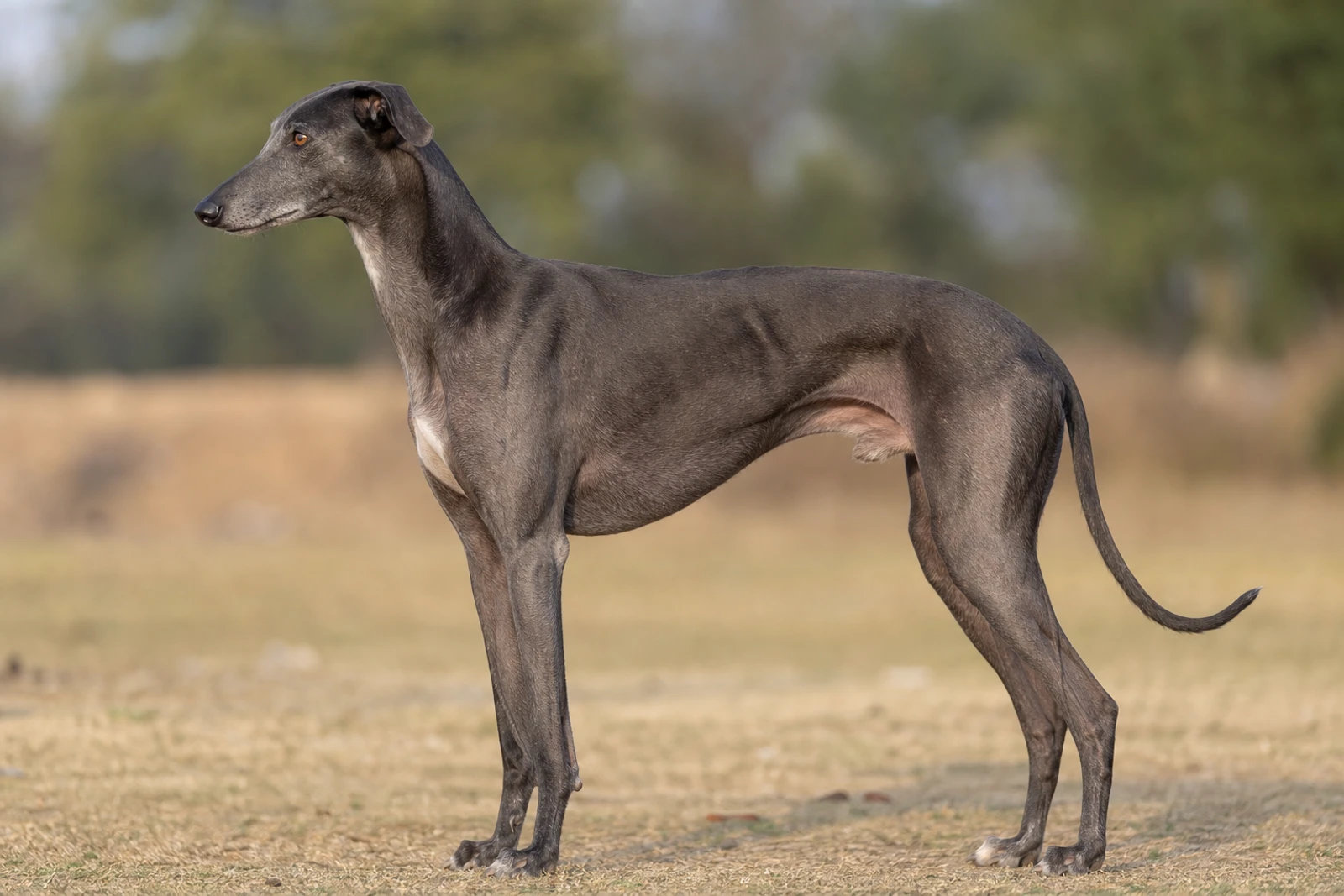
Powerful, rare sighthound from India, the Rampur Greyhound is a devoted protector and agile hunter. Standing up to 30 inches tall, this giant breed bonds deeply with its family but remains aloof with strangers. Ideal for experienced owners with ample space, they require consistent training and vigorous daily exercise. Not suited for apartments or first-time owners, their short coat sheds moderately and needs minimal grooming. Early socialization is crucial to manage prey drive around smaller animals.
At a glance
- Size
- Giant
- Height
- 22–30 in
- Weight
- 59–66 lb
- Life span
- 8–10 years
- Coat colors
- Fawn, Brindle, Black, Gray, White
- Coat type
- Short and smooth
- Group
- Sighthounds
How much does a Rampur Greyhound cost?
Adopt / rescue
$75–$400
Usually includes spay/neuter, first shots, and a microchip.
Buy from a breeder
$700–$2,000
From a reputable, health-testing breeder.
Approximate USD. Prices vary widely by region, breeder, pedigree, age, and coat colour — adopting is the lower-cost and recommended route. Avoid suspiciously cheap “breeders”; they’re often puppy mills.
Estimate the full cost of a Rampur Greyhound →Want the ongoing number? Estimate the monthly food bill for a Rampur Greyhound with our dog food cost calculator.
Rampur Greyhound photos
Views
Front, side, rear and top — the full silhouette.Poses
How the breed sits, lies, moves and plays.Puppy to senior
The breed across its whole life.Expressions
The breed’s range of moods.Close-up details
Eyes, ears, nose, paws, tail and coat.Coat colors
The breed’s recognized colors.Click any photo to enlarge. We show the Rampur Greyhound from every angle — three views, poses, life stages, expressions, close-ups, coat and colors.
Appearance & size
This is a tall, rangy sighthound with a silhouette that reads pure speed and endurance. A Rampur Greyhound stands 22 to 30 inches at the shoulder and tips the scale at just 59 to 66 pounds. That gives you a giant breed by height, but one that feels almost delicate when you run your hands over the ribs—you’ll find hard, flat muscle, not bulk. Males often push the upper end of that height range, while females stay lighter on their feet.
The coat is a single, short layer that lies flat and smooth, almost like satin. It’s an easy-care skin you can wipe down with a damp cloth, and it doesn’t hide much—which is exactly what a working sighthound wants in hot country. Colors are typical of the type: solid fawn and brindle are the most common, with black and occasionally grey-blue also showing up. Many have crisp white markings: a blaze up the face, a full white chest, white socks, and a white tip on the tail. You rarely see heavy patches or parti-color patterns; the coat stays uncomplicated.
The breed has a handful of features that set it apart from a standard Greyhound. The head is long and narrow, but the profile shows a distinctive Roman nose—a slight convex curve to the bridge that adds a hawkish look. The eyes are dark, almond-shaped, and set to give keen peripheral vision. Ears are rose-shaped, folding back and carried low against the neck when the dog is relaxed. From the front, you notice how deep and narrow the chest really is—a deep keel with well-sprung ribs that leaves the elbows riding close to the body. The forelegs are straight, with no coarseness of bone, and the feet are compact and hare-like.
In a side view, that deep chest flows into a sharply tucked-up belly and an arched loin. The topline rises slightly over the loin and then drops to a long, tapering tail that never works like a pump handle—it hangs in a gentle curve or rises only slightly when the dog is alert. From the rear, the stance is wide enough to power a flat-out gallop; the thighs are lean but well-muscled, and the hocks are set low and parallel. The whole animal looks built to cover ground at a steady lope, not just sprint in short bursts.
History & origin
Few sighthounds have a backstory as tied to a single royal court as the Rampur Greyhound. The breed emerged in the princely state of Rampur, in what is now Uttar Pradesh, India, during the 19th century. The Nawabs of Rampur — particularly Nawab Ahmad Ali Khan (reigned 1840–1865) — wanted a coursing dog that could do more than flat-out sprint. They set out to create a hound with the raw speed of an English Greyhound and the ruggedness to handle thorny, broken terrain and take down large, dangerous game like swamp deer, boar, and jackal.
To get there, the royal kennels crossed imported English Greyhounds with local Afghan Hounds — specifically the long-haired, hardier “Tazi” type that was already prized across Central Asia for endurance and courage. Some early accounts also mention a dash of Indian pariah dog blood to increase heat tolerance and disease resistance. The resulting dog was bigger and more muscular than a track Greyhound, standing 22 to 30 inches and carrying 59 to 66 pounds of dense, functional mass. The ears were set high and folded, the back slightly longer, and the coat short but weather-toughened.
By the late 1800s, the Rampur Greyhound had solidified into a distinct type, kept exclusively by the Nawabs and their nobles. These dogs worked in pairs or small packs, coursing by sight across open plains and scrub, and they were expected to catch and hold prey until the hunter arrived. The breed’s reputation for near-blind loyalty and lethal speed spread, but it rarely left the royal folds.
When hunting with dogs was banned in India after independence and the princely states dissolved, the Rampur Greyhound’s numbers crashed. No longer needed for its original job, it nearly vanished. Today, the breed is critically rare outside of a few dedicated preservation kennels in northern India. No major Western kennel club fully recognizes it, though efforts to keep the line pure and rebuild numbers continue quietly — mostly among old families who remember the dogs that once ruled the Rampur hunt.
Temperament & personality
A Rampur Greyhound often feels like two different dogs under one roof. Inside, you get a quiet, almost regal couch potato who’s perfectly happy to lounge for hours on a soft bed (or your sofa). Step outside, and the full sighthound emerges: explosive speed, intense focus, and a prey drive that can flip on in a heartbeat. That calm house demeanor makes them surprisingly manageable for a giant breed, but the outdoor rocket lives by sight and motion.
These dogs bond deeply with their own people. They’re not typically the tail-wagging, everybody’s-best-friend type. Expect a more reserved, dignified affection — a lean against your leg, a quiet shadow from room to room, and a steady, watchful presence. With strangers, they hold back and assess. You’ll get an alert bark if something seems off, but aggression isn’t the default. Learning to read their body language is key. A forward lean with a loose body signals curiosity; a backward lean or stiff freeze with hard staring means the dog is uncomfortable and may need space. Lip licking, yawning, and turning the head away are common stress signals this breed uses to say “back off.”
Their independent, strong-willed streak means training works best with short, respectful sessions and high-value rewards. Force or repetitive drilling just makes them stubborn. Because they bore easily, you’ll need to keep things upbeat and quit while you’re ahead. This isn’t a novice handler’s plug-and-play breed — they require calm consistency and the understanding that they’ll never be a robotically obedient retriever.
Inside the home, they’re generally gentle with their own family. Their size (a lean 59–66 pounds and up to 30 inches at the shoulder) doesn’t stop them from thinking they’re lap-sized, so watch out for accidental tail whips and the occasional elbow to the ribs during a cuddle. They can coexist with respectful, dog-savvy kids, but two rules are non-negotiable: never let a child disturb the dog while it’s eating, and never startle one awake — food guarding and a strong sleep-startle reflex are real possibilities. Around cats, small dogs, or any pocket-sized pet, their sighthound prey drive tends to override friendship; many are simply not safe with small animals.
A bored or isolated Rampur Greyhound can turn anxious quickly. Left too long alone, they may howl, chew destructively, or mark inside. That indoor marking isn’t random — it’s often tied to scent memory. They deposit a urine cue on a spot, then recognize it later and hit it again. Cleaning accidents with an enzymatic cleaner or a simple white vinegar solution breaks the scent trail, but preventing the habit through early, reward-based housetraining is much easier. A treat immediately after the dog eliminates outdoors locks in the right behavior.
Like many dogs, they have a puzzling taste for rolling in foul odors — dead things, decay, anything rank. It might be a scavenger-ancestry quirk or just their version of fine cologne. You’ll want to keep your sense of humor and a good shampoo on hand. Providing tough, safe chew objects channels their natural need to keep jaws strong and teeth clean, saving your furniture from a similar fate.
Good with kids, dogs & other pets
Rampur Greyhounds are often surprisingly patient and gentle with children, but their size and speed turn playtime into a hazard if nobody’s watching. A 60‑pound dog zooming across the yard can easily knock over a toddler without meaning to. Treat every interaction as supervised, and teach kids not to disturb the dog when it’s resting or eating. This breed bonds tightly with its family and can develop separation anxiety if left alone for long stretches — something to consider if the household is empty most of the day.
With other dogs, the Rampur tends to be reserved rather than aggressive. Early, ongoing socialization makes all the difference. Puppies need slow, positive introductions to well‑mannered dogs before 16 weeks, and those sessions should continue into adulthood. A Rampur raised with another dog often forms a strong sibling‑like bond, but bringing a strange adult dog into the home later can be tricky. Watch body language carefully; forced greetings often backfire and may trigger a sighthound’s chase instinct instead of play.
Cats, rabbits, and other small animals tap directly into the Rampur’s coursing drive. This prey instinct is hardwired and strong. An individual raised alongside a cat from puppyhood might learn to live indoors peacefully, but that truce can break the instant the cat scampers. Outdoor cats, squirrels, and even tiny dogs running across a park can all become targets. If you have small pets, be realistic — most Rampur Greyhounds are not safe around them without strict, permanent separation.
Start socialization before the puppy hits 4 months old, gently exposing it to new people, sounds, surfaces, and friendly dogs. Even with a solid foundation, the breed’s sensitive side means heavy‑handed methods backfire. If you adopt an adult Rampur who’s content with just you, don’t force dog‑park visits. Respect the dog’s comfort zone — a quiet home and long, leashed walks satisfy a sighthound far more than chaotic group play.
Trainability & intelligence
Training a Rampur Greyhound is less a matter of giving commands and more a matter of negotiating with a highly intelligent, independent partner. They learn fast — often after a single repetition — but they were bred to make split-second decisions while coursing, not to wait for human direction. That means motivation decides everything. A pocketful of high-value treats or a quick game with a flirt pole will get you miles further than endless drilling or a stern voice.
What works — and what backfires
- Positive reinforcement only. These dogs are sensitive in the extreme; punishment or even a sharp tone can erode trust overnight and turn them aloof. Reward desired behavior immediately with food, play, or calm praise, and ignore (or manage) mistakes.
- Patience over pressure. Rampurs are not willfully stubborn but they see no point in mindless repetition. Keep sessions short, 2–5 minutes, and quit while they’re still interested.
- Relationship before obedience. Before you ask for a reliable sit-stay at the door, spend weeks building a bond. Your dog needs to believe that checking in with you is always worth it — otherwise, a squirrel 100 yards away will always win.
The recall challenge
A rock-solid recall is the Everest of Rampur ownership. Their prey drive is hardwired, and once a sighthound locks on at full speed — hitting 35 mph — no amount of shouting will bring them back. Start recall practice inside with zero distractions, then in a fenced area using a long line. Never punish a dog for finally returning; you’d be training them to stay away longer next time. For many owners, a well-fenced yard and a long lunge line during off-leash training are non-negotiable safety tools, not training failures.
Socialization: the quiet confidence builder
Rampur puppies are often reserved by nature, not fearful, but they can tip into reactivity if early exposure skips a beat. Start socialization between 3 and 14 weeks, and keep it calm. Pair new people, varied surfaces, and household sounds with something good — a smear of peanut butter on a lick mat, a favorite toy. Controlled, positive meetings with cat-safe older dogs help, though their instinct to chase small animals rarely vanishes entirely. The goal isn’t a back-slapping social butterfly; it’s a stable adult who can ignore a barking dog on a sidewalk because you’ve made it clear that nothing exciting comes from reacting.
The single thread through all of it: trust. Build it with fairness and a good sense of humor, and you’ll have a dog that finally chooses to work with you — not just for you.
Exercise & energy needs
Exercise & energy needs
You’re living with a born sprinter who can hit 40 miles per hour in a few strides — so a couple of 15-minute leash walks and a little backyard time won’t even make a dent. Plan on at least 60–90 minutes of real movement every day, split into at least two sessions. Without it, that quiet, dignified house hound can turn anxious, destructive, or begin herding your kids around the living room.
The backbone of their routine is a hard, off-leash gallop in a safely fenced area. Think open fields, large securely fenced dog parks, or, ideally, a fenced lure-coursing setup where they can chase a mechanical rabbit. A flirt pole in a long yard can work in a pinch — just keep the turns wide to protect those long legs. Once they’ve burned off the top speed, a long, relaxed sniff walk does wonders for their mind.
Mental fatigue matters just as much. A flirt pole session doubles as training (wait, release, drop it), and most Rampurs get hooked on scent games. Hide a favorite tug toy or a treat-filled puzzle and let them track it — they’ll come back panting and deeply satisfied.
Watch the growth plates. Until 14–18 months, skip repetitive jumping, hard stops on pavement, or forced running on leash. Full-speed work on grass or dirt is much easier on developing joints. Also, that thin coat and deep chest don’t do well in extreme heat — shift hard exercise to early morning or evening during warm months. A tired Rampur is a calm, couch-curling companion, but you’ve got to give them a legit sprinting outlet, not just a stroll.
Grooming & coat care
The Rampur Greyhound’s coat is one of the easiest parts of living with this elegant sighthound. It’s a single, short, smooth coat — no undercoat to blow twice a year, no long feathering to mat. You’ll spend very little time on grooming, but the time you do spend pays off in a sleek, healthy shine.
Brushing: A once- or twice-a-week once-over with a soft bristle brush or a rubber curry mitt is plenty. This pulls out loose dead hair before it ends up on your sofa, distributes natural skin oils for that glassy sheen, and gives you a chance to check for nicks or scrapes. Because the skin is thin and the coat lies flat, skip metal slicker brushes or anything with sharp pins — they can scratch. During spring and fall you might notice a slight uptick in shedding, so add an extra brushing session or two.
Bathing: These dogs are naturally clean and lack the heavy “doggy” odor some breeds carry. Bathe only when they’re truly dirty — think every 2–3 months, or after a romp in something smelly. Use a mild, moisturizing dog shampoo. Over-bathing strips the coat’s oils and can leave the skin dry and flaky.
Trimming: There’s nothing to trim. The Rampur Greyhound’s coat is meant to stay as-is. Some owners tidy up stray whiskers, but it’s purely cosmetic and unnecessary.
Nails, ears, teeth: Nails grow fast on a giant breed that spends hours sprinting. Check them every 2–3 weeks; if you hear clicking on hard floors, it’s time for a trim. Ears are rose-shaped and drop forward, so moisture can get trapped. Lift each ear weekly, wipe away any dirt or wax with a damp cotton ball, and let them air out. Teeth need the same attention as any dog’s: brush 2–3 times a week to keep tartar at bay, and provide safe chews for natural scraping.
Seasonal coat care: There’s no massive seasonal shed to manage, just a minor increase in loose hair. However, that single coat and lean build mean zero insulation against cold. In chilly weather, skip the extra brushing and reach for a well-fitted dog coat instead — it’s not a grooming step, but it’s critical for keeping a short-haired sighthound comfortable outdoors.
Shedding & allergies
A short, single coat means a Rampur Greyhound sheds less than most dogs their size, but don’t mistake “less” for “none.” You’ll find fine, spare hairs on dark clothing and couch cushions — nothing like the tumbleweeds a double-coated breed produces, yet enough that a weekly lint roller becomes part of your routine.
The coat itself is tight, smooth, and lays flat against a 22–30 inch frame. There’s no insulating undercoat to blow out twice a year. What you get instead is a low-grade, year-round hair drop that ticks up slightly as the seasons change, but never peaks into a heavy molt. A quick once-over with a rubber curry or a hound glove grabs those loose hairs before they settle into your carpet, and it also spreads natural oils to keep the coat gleaming.
Drool is a non-issue. Sighthound anatomy — tight lips, a lean head — means you aren’t wiping ropes of slobber off the walls or your pant leg.
On the hypoallergenic front: no dog truly is. All dogs produce dander and saliva proteins that trigger reactions. Because the Rampur Greyhound has clean lines, scant body hair, and doesn’t drool, some people with mild allergies find them easier to live with. But the only reliable test is spending time with the individual dog indoors, not relying on coat type alone. A 59–66 lb dog still has plenty of skin surface shedding microscopic dander into the air.
For everyday maintenance, you’ll spend perhaps five minutes a week brushing, plus the occasional bath after a dusty sprint. Keep a hand vac handy for stray hairs on upholstery, and you’re set.
Diet & nutrition
A Rampur Greyhound is a lean, deep-chested athlete, so his diet needs to pack in quality animal protein without piling on extra pounds. He carries 59–66 lb on a frame that’s built to sprint — extra weight goes straight to the joints and spine. Keeping him ribby but not bony is the line you’re walking.
How much you feed an adult depends almost entirely on his daily workload. A dog that tears across a field for an hour needs twice the fuel of a mostly retired companion. Start with the kibble maker’s recommendation for his weight — often around 2½–3½ cups of a high-protein dry food split into a morning and evening meal — then watch his waist. If you can’t feel those rear ribs with a light fat pad, cut back. If he looks hollowed out, bump him up a little. For raw or home-cooked meals, a practical ratio is roughly 60% muscle meat, 20–30% dog-safe fruits and vegetables, and 10% extras like eggs, plain yogurt, or cooked pearl barley.
Weight management is non-negotiable here. Rampur Greyhounds aren’t notorious beggars, but some individuals will Hoover up everything in sight. For those dogs, a puzzle bowl slows the inhale and provides mental work. Measure every meal; free-feeding invites trouble. If your dog is food-obsessed, portion control and extra exercise are the only fix. Obesity in a giant sighthound accelerates arthritis and makes a serious running injury more likely.
Puppy feeding schedule
- 8–16 weeks: four evenly spaced meals a day
- 4–6 months: three meals a day
- 6+ months: switch to the adult two-meal rhythm
Around twelve weeks you can introduce raw meaty bones like chicken wings — always supervised, and always raw (cooked bones splinter). Transition puppies to solids gradually, starting with lightly cooked, puréed meats and soft fruits. Large-breed pups grow fast, so avoid pushing rapid weight gain; steady, lean growth protects developing joints.
Senior adjustments An older Rampur Greyhound who’s losing his edge needs fewer calories, not necessarily less protein. Switch to smaller, more frequent meals (two or three a day) if he’s slowing down or losing teeth. Purée tough ingredients to aid absorption — dogs lack salivary enzymes and their jaws only chew vertically, so pre‑processing helps. Monitor weight monthly and reduce food gradually as activity tapers off.
Breed‑specific notes
- This is not the dog for a vegetarian or vegan diet. His short, acidic gut and scissor‑like dentition are built for animal-based protein.
- For sensitive stomachs, a bland mix of white rice, poached flaked fish, and a spoonful of puréed pumpkin settles things fast. Pearl barley is another gentle, high‑fiber grain.
- Avoid greasy table scraps or rich holiday trimmings — a single fatty meal can trigger pancreatitis, a serious veterinary emergency.
- Canned fish (in water, no salt), hard‑boiled eggs, and cooked greens make quick, nutritious add‑ins. When you cook vegetables, save the unsalted water as a meal base.
Quick health check at home: Look straight down at his back — the waist should nip in behind the ribcage. From the side, his belly tucks up sharply. If you’re losing that hourglass, scale the feed back and get him moving.
Health & lifespan
A Rampur Greyhound typically lives 8 to 10 years — a compact span even for a giant breed. That means every preventive choice you make has real weight. Get to know what’s normal for your dog (energy level, appetite, resting breath rate) so you can flag small shifts early.
Preventive care that moves the needle
- Heartworm prevention is non-negotiable. Give a monthly medication during mosquito season and for one full month after it wraps. A missed dose risks a disease that’s far harder to treat than prevent.
- Rabies vaccination stays current — it’s legally required, and by the time symptoms show there is no effective treatment.
- Annual wellness exams are the baseline. Once your dog hits senior status (around 7), twice-a-year bloodwork and a hands-on vet check catch heart, kidney, or joint changes before they steal quality of life.
What can show up in this breed
Like many deep-chested, lean sighthounds, the Rampur can be prone to bloat (gastric dilatation-volvulus). A raised feeder, splitting meals into two or three portions, and avoiding hard exercise right after eating all lower the risk. Know the signs — restlessness, unproductive gagging, a drum-tight belly — and get to a vet immediately.
Joint trouble crops up in plenty of large breeds, and the Rampur Greyhound is no exception. Responsible breeders screen for hip dysplasia and elbow dysplasia before breeding. Ask to see the parents’ OFA or PennHIP results. Heart conditions like dilated cardiomyopathy can also appear, so a board-certified cardiologist’s echocardiogram on breeding stock is a strong green flag.
Those short, dense coats offer zero insulation. This is a dog that chills easily in cold or damp weather. A well-fitted jacket or sweater during winter walks isn’t a fashion statement — it prevents stress on the immune system that can open the door to respiratory bugs. In hot climates, exercise during cooler hours and watch for overheating.
Thin skin means scrapes and cuts are part of life. Keep a first-aid kit handy, and don’t ignore persistent itching or flaking — skin conditions can signal a food sensitivity or environmental irritant that a diet tweak or medicated wash can soothe.
The weight factor
These dogs hover around 59–66 pounds, with little body fat. Even an extra 3–5 pounds strains joints and makes a bloat episode more dangerous. Free-feeding is a bad idea. Measured portions, a body condition you can read from across the room (visible waist, easy-to-feel ribs), and daily run time — not just a walk — keep them at a working weight.
The stress-health link
A Rampur Greyhound that’s isolated or handled harshly can develop anxiety-driven behaviors that wear down the immune system. Early, positive socialization and consistent, calm handling lower the long-term health toll that chronic stress takes. A dog that feels safe is a dog that stays functionally healthier.
Living environment
A Rampur Greyhound is a terrible fit for apartment life. These are giant sighthounds built to cover serious ground, and they need a house with a securely fenced yard where they can stretch out and sprint flat-out daily. Plan on a fence at least six feet high — their jumping ability and hair-trigger prey drive make invisible fencing a dangerous gamble.
Inside, they’re generally calm and quiet couch potatoes, but that relaxed house manner only exists if they’ve been properly exercised. Count on a solid hour of hard, off-leash running every day, split into at least two sessions. A quick walk around the block won’t cut it; they need to open up and chase. Mix in mental work like scent games or a puzzle toy afterward, and you’ll have a much more settled dog.
Climate matters more than with many breeds. The Rampur’s thin skin, short coat, and lean build leave almost no insulation. They do well in warm weather, but they chill fast — below about 50°F, they’ll need a coat and limited outdoor time. In really cold or wet climates, they’re uncomfortable and prone to shivering, so consider whether your weather suits a desert-origin sighthound.
Noise is rarely a problem. They’re not yappy, and most Rampurs are quiet inside, though they may let out a sharp bark when something triggers their chase instinct. You won’t get nuisance barking, but you might get a vocal explosion if a squirrel tears across the fence line.
Leaving them alone all day is asking for trouble. These dogs bond deeply with their people and can slide into whining, pacing, or destructive chewing if left isolated for long stretches. Crate training, gradual alone-time practice from day one, and a second dog as a companion all help, but if your household is empty for eight-plus hours regularly, the Rampur Greyhound will struggle.
Who this breed suits
This is a dog built to run, and run hard. If your idea of exercise is a couple of walks around the block, the Rampur Greyhound will climb the walls. They need an owner who either has a large, securely fenced area where they can safely stretch out at full speed or the commitment to give them a solid hour of off-leash sprinting every day — not a jog, a genuine, leg-stretching gallop.
That single requirement immediately sorts good matches from mismatches. The ideal home is an active single person or couple with a house on acreage, a passion for lure coursing or canicross, and no other small pets. A Rampur is fiercely loyal, quiet indoors, and surprisingly gentle with his own people, but his prey drive is hardwired. Cats, rabbits, and even small dogs that bolt can trigger an instinct that overrides training. You’ll need to manage that for the dog’s entire life.
First-time owners should think twice. This breed combines the independence of a sighthound with the athletic demands of a giant high-energy dog. Training is doable — they’re sensitive and shut down with harsh correction — but recall off a running animal is notoriously unreliable. You need realistic expectations and a fanatical commitment to leash safety and secure fencing, not just optimism.
Active families can work, but the stars have to align. A Rampur weighing 59–66 pounds and standing up to 30 inches tall can be a bull in a china shop with toddlers. Kids who understand a dog’s body language and won’t run screaming (prey drive again) do better. It’s a calmer household that suits this breed, not a chaotic, high-noise environment.
Seniors and apartment dwellers will struggle. This is not a low-key giant breed content with a short stroll. Without an outlet, you get a stressed, destructive dog. The 8–10 year lifespan also means you’re committing to a serious physical routine for nearly a decade — something to be honest about.
What an ideal owner looks like:
- You already run, hike daily, or have access to safe, fenced open land.
- You have sighthound or high-prey-drive dog experience.
- You don’t keep free-roaming cats, chickens, or small dogs.
- You’re okay with a dog that is aloof with strangers but a velcro shadow at home.
If you can’t guarantee a controlled space to sprint and a life free of small furries, skip this breed and admire it from a distance. A Rampur Greyhound that isn’t run is a miserable, misunderstood animal — and that’s nobody’s fault but the owner’s.
Cost of ownership
Buying a Rampur Greyhound almost always means getting on a wait list with a specialized breeder, because these sighthounds are rare outside of India. A well-bred puppy from health-tested parents typically runs $1,500 to $3,000, and show- or working-line pups can push higher. The bigger early expense many people overlook is fencing. A lean, powerful dog that stands up to 30 inches at the shoulder needs a true 6-foot fence — a 4-footer is a suggestion, not a barrier. If your yard isn’t already secure, budget a few thousand dollars before the dog comes home.
Ongoing monthly costs
- Food: Plan on 3 to 4 cups of high-quality dry kibble daily for a 59–66 lb adult, plus decent treats. That’s about $60 to $80 a month.
- Grooming: The short, dense coat is wash-and-wear. Weekly brushing and the occasional bath are all you need. You can handle it at home for almost nothing, or pay a groomer $30–$50 every other month for a bath and nail trim. Factor in $10–$20 monthly if you outsource.
- Vet and preventatives: Annual checkups, core vaccines, and year-round heartworm/flea/tick medication run $350–$500 a year, or roughly $30–$40 a month. Don’t skip dentals; sighthounds can develop gingivitis if ignored.
- Insurance: For a giant breed with a short 8–10 year lifespan and conditions like bloat, cardiac issues, and osteosarcoma, a solid accident-and-illness plan averages $45–$65 a month. You might pay more for a rare breed with no pre-existing condition waivers.
Add a crate big enough for a 30-inch-tall dog, a few tough chew toys, and a bed that won’t flatten instantly, and your first year’s supply haul will run about $300–$500. Expect total ongoing costs in the $150–$280 a month range, not counting emergency surgeries. If the fence isn’t in place yet, that’s your real first-year big-ticket item.
Choosing a Rampur Greyhound
Rescue or responsible breeder?
You’re not likely to stumble on a Rampur Greyhound in rescue — this is a rare sighthound, virtually unknown outside its native India. That doesn’t mean you can’t find one through a breed-specific rescue network if you’re patient, but most families will end up working with a breeder. And with a giant breed that lives only 8–10 years, the stakes for getting a healthy, stable dog are high. A responsible breeder isn’t just someone who hands you a puppy; they’ll interview you just as hard as you interview them. They’ll want to know you have a tall, secure fence, a plan for off-leash running, and zero illusions about managing a 60‑lb sighthound’s prey drive in a house full of small fluffies.
Health clearances to ask for
The breed’s small gene pool means you can’t skip on documentation. Demand proof of these screenings — not just a vet check, but official evaluations where applicable:
- OFA or PennHIP hip evaluation: Hip dysplasia isn’t rampant, but with a 59–66 lb, 22–30 inch frame, you want hips scored fair or better. Never accept “my vet said they’re fine.”
- Cardiac exam: A board-certified cardiologist’s echocardiogram, especially if any cardiomyopathy has appeared in lines.
- ACVO eye exam: Annual CERF-type clearance rules out inherited eye diseases that can steal a sighthound’s vision early.
- Bloat awareness: No test exists, but a breeder should freely discuss torsion risk and the gastrointestinal tacking they may or may not recommend. Run from anyone who shrugs off a deep-chested breed’s tendency to bloat.
- Sighthound sensitivity: Responsible breeders prepare you for the fact that Rampurs, like all sighthounds, metabolize anesthesia differently and have thin skin that tears easily. They should hand you a written protocol for your vet.
Red flags that should send you walking
A lap of convenience doesn’t exist with this breed. Walk away if you spot any of these:
- No health testing on the parents — or test results “in progress” for years.
- Puppies released before 10 weeks: Giant sighthound puppies need that extra time with littermates to learn bite inhibition and body language; eight weeks is too early.
- “Rare color” markups: Rampurs are brindle, fawn, or occasionally black. Charging double for a “blue” or “apricot” coat is a cash grab, not a breeding priority.
- Multiple litters on-site or mixed breeds: Puppy-mill vibes, even if the kennel looks tidy.
- No questions for you: A breeder who doesn’t grill you about your yard, exercise plan, cat ownership, and past sighthound experience doesn’t care where that puppy lands.
Picking your puppy
You aren’t just picking a pet — you’re picking a high-octane athlete that will need a solid hour of sprint-worthy exercise every single day. Spend time with the whole litter. Watch how each pup reacts to new people and a squeaky toy rolled across the floor. The one who hangs back, trembling, will be an uphill socialization project. The one who body-slams the other pups and never lets up might overwhelm a home with kids. Aim for a middle-of-the-road pup: curious, quick to investigate but willing to pause and check in with you. Check for straight front legs, clean ears, and a puppy belly that isn’t distended. Ask the breeder what early handling and sound exposure they’ve done — a Rampur that’s been raised in a quiet barn stall with no household noises is a future liability. Expect to pay a deposit, wait months, and possibly travel for the right litter. That patience is what separates a decade-long partnership from a heartbreak you didn’t see coming.
Pros & cons
The Rampur Greyhound is a high-speed athlete that settles into a devoted, low-maintenance house dog — provided you can satisfy its need to run flat-out and you’re ready for a sighthound’s iron prey drive.
Pros
- Built to sprint: at 22–30 inches tall and 59–66 pounds, they’re light on their feet and an exhilarating running partner when you can safely open them up.
- Minimal grooming: a short, single coat needs only a quick rubdown; they stay remarkably clean and lack that typical doggy odor.
- Sweet with their own people: gentle, affectionate, and often surprisingly calm indoors once exercised.
- Alert without being barky or aggressive; they’ll let you know someone’s at the door but won’t start unnecessary drama.
- Heat-tolerant thanks to a lean frame, making them comfortable in warm climates.
Cons
- Hair-trigger chase instinct. Squirrels, cats, even a blowing leaf can launch a pursuit. They are never safe off leash in unfenced spaces.
- Must have a tall, sturdy fence (6 feet minimum) and walks are strictly on leash; their speed makes recall unreliable.
- Short lifespan of 8–10 years is a real heartbreak for such a loyal companion.
- Deep chests bring a serious bloat risk. Owners must manage feeding routines (small meals, no exercise right after eating) to reduce the chance of gastric torsion.
- Thin skin and almost zero body fat leave them miserable in cold weather — expect to use a coat in winter.
- Reserved with strangers and need thorough early socialization to prevent skittishness.
- Indoor zoomies can send a 60-pound dog flying across furniture; their exuberance around small children needs watchful management.
Similar breeds & alternatives
If a Rampur Greyhound catches your eye, you’re probably looking for a leggy sighthound with a bit more substance and a sharper watchdog edge than the typical racing dog. A few close relatives make natural alternatives, depending on which traits you prioritize.
- Greyhound – The most obvious comparison. Adult racing or show Greyhounds stand 27–30 inches and weigh 60–70 pounds, right in the Rampur’s range. They’re narrower through the chest and have a famously easygoing house temperament — often happy to sleep 18 hours a day. The key difference is guarding instinct: a Greyhound rarely alerts to strangers, while a Rampur is naturally more watchful and territorial, needing structured socialization from puppyhood so that wariness doesn’t tip into suspicion.
- Whippet – A scaled-down alternative. Whippets max out around 22 inches and 40 pounds, making them simpler to tote, cheaper to feed, and easier to exercise in a medium-sized yard. They share the couch-potato energy indoors and the explosive prey drive outdoors, but they lack the protective streak. If you want the sleek silhouette without the giant frame, a Whippet fits neatly.
- Borzoi or Scottish Deerhound – If the draw is sheer height and presence, these breeds stand 28–32+ inches and weigh 85–110 pounds. They’re dignified and usually calmer inside, but the jump in size means larger food bills, bigger doses of medication, and a heavier physical footprint. The Rampur splits the difference: tall like a Deerhound yet lean and manageable at 59–66 pounds, without the supersized feed and vet costs.
Every sighthound on this list demands safe, fenced ground to sprint and a soft place to crash afterward. Where the Rampur stands apart is its blend of moderate size and a more alert, protective temperament — more watchdog than welcome wagon.
Fun facts
- Originally bred by Indian royalty for hunting large game like deer and boar.
- This breed can reach speeds of up to 40 mph, making it a swift sighthound.
- Once on the brink of extinction, efforts are underway to preserve the Rampur Greyhound.
- They are known for their loyalty and protective instincts, often bonding closely with one family member.
Frequently asked questions
- Is a Rampur Greyhound good with children?
- They can be gentle and loyal companions, but their large size and strong chase instinct mean interactions with small children should always be supervised. Rampur Greyhounds tend to do best in homes with older, considerate kids who understand how to respect a dog’s boundaries.
- How much exercise does a Rampur Greyhound need?
- As a sighthound built for speed, this breed requires vigorous daily exercise, including opportunities to run safely off-leash in a securely fenced area. Without enough physical and mental stimulation, they may become restless or develop unwanted behaviors.
- Does the Rampur Greyhound shed a lot?
- Their short, smooth coat sheds minimally and is easy to maintain with occasional brushing. While not completely non-shedding, they are a low-maintenance breed in terms of grooming.
- Can a Rampur Greyhound live in an apartment?
- Apartment living is generally not ideal due to their size and high exercise needs, but they can adapt if provided with lengthy daily walks and regular sprinting chances. They are typically calm and quiet indoors when properly exercised.
- Is the Rampur Greyhound suitable for first-time dog owners?
- This breed’s independent and sometimes stubborn nature can make training a challenge for inexperienced owners. They respond best to patient, consistent, positive reinforcement methods, so they are often better suited to someone with prior sighthound or large-breed experience.
- What health issues are common in Rampur Greyhounds?
- Given their deep chest, they can be prone to bloat, a life-threatening emergency, so it is wise to avoid strenuous activity right after meals. As a giant breed, they may also be susceptible to joint issues like hip dysplasia, but overall they are a relatively hardy native breed.
Tools & calculators for Rampur Greyhound owners
Quick estimates tailored to Rampur Greyhounds — pre-filled with this breed’s size where it matters.
Articles & stories about the Rampur Greyhound
Sources & standards
This profile follows recognized breed standards from the American Kennel Club (AKC) and the Fédération Cynologique Internationale (FCI), along with established veterinary and breed-club guidance. These describe general breed tendencies — every dog is an individual.