

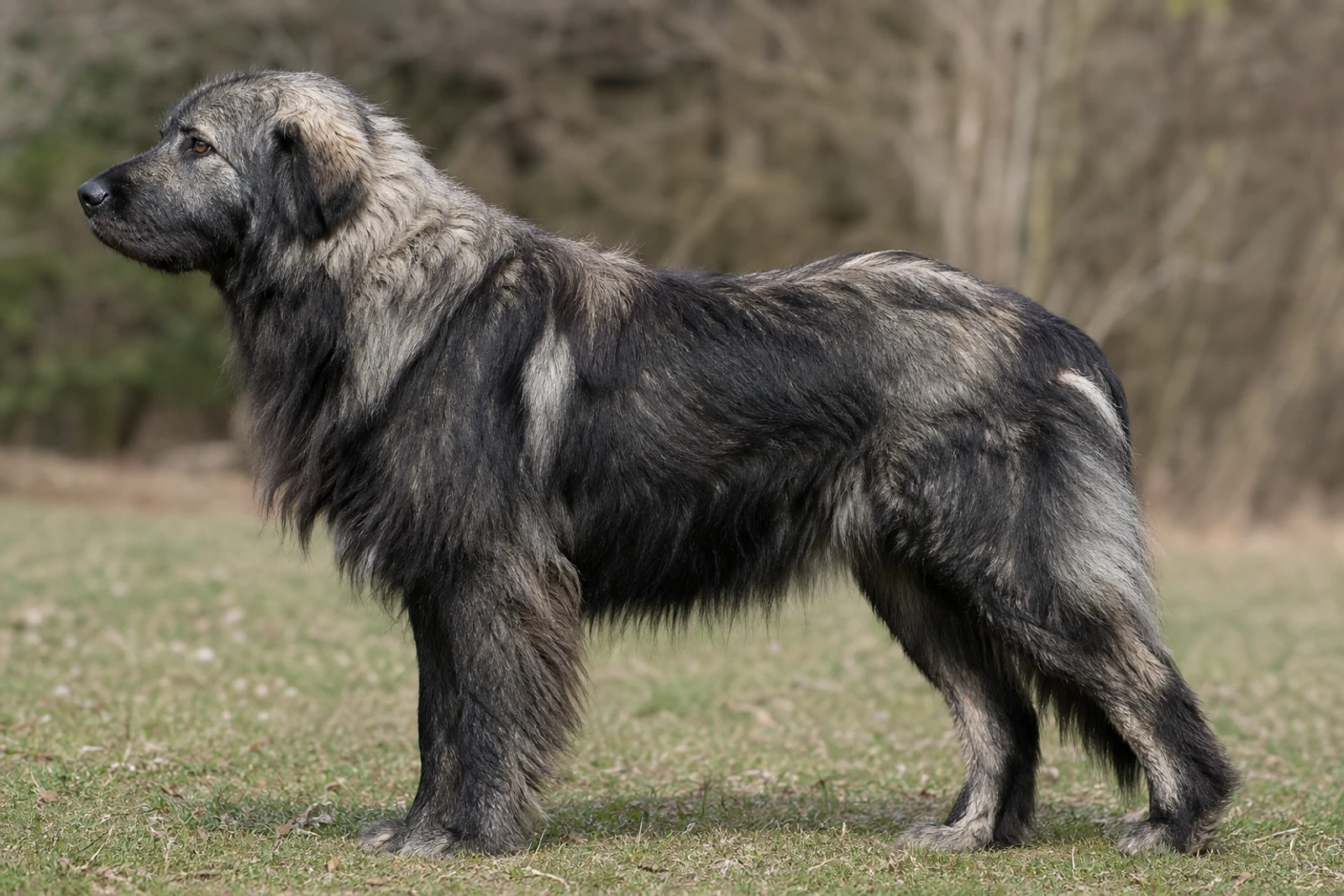
Romanian Shepherd Dogs are massive, fearless livestock guardians originating from the Carpathian Mountains. Bred to protect flocks from bears and wolves, they are loyal, calm, and independent. Suited to experienced, active owners with ample space, these gentle giants thrive with a job to do and form deep bonds with their families. They are not for novice handlers, as their strong will and protective instincts require consistent training. With a moderate energy level and impressive size, they excel in rural settings as devoted guardians.
At a glance
- Size
- Giant
- Height
- 23–31 in
- Weight
- 77–154 lb
- Life span
- 12–14 years
- Coat colors
- Fawn, Wolf-grey, Black, White, Cream, Brindle
- Coat type
- Double coat, medium to long, harsh and straight
- Group
- Working
How much does a Romanian Shepherd Dogs cost?
Adopt / rescue
$75–$400
Usually includes spay/neuter, first shots, and a microchip.
Buy from a breeder
$700–$2,000
From a reputable, health-testing breeder.
Approximate USD. Prices vary widely by region, breeder, pedigree, age, and coat colour — adopting is the lower-cost and recommended route. Avoid suspiciously cheap “breeders”; they’re often puppy mills.
Estimate the full cost of a Romanian Shepherd Dogs →Want the ongoing number? Estimate the monthly food bill for a Romanian Shepherd Dogs with our dog food cost calculator.
Romanian Shepherd Dogs photos
Views
Front, side, rear and top — the full silhouette.Poses
How the breed sits, lies, moves and plays.Puppy to senior
The breed across its whole life.Expressions
The breed’s range of moods.Close-up details
Eyes, ears, nose, paws, tail and coat.Coat colors
The breed’s recognized colors.Click any photo to enlarge. We show the Romanian Shepherd Dogs from every angle — three views, poses, life stages, expressions, close-ups, coat and colors.
Appearance & size
When you first see a Romanian Shepherd Dog, you’re struck by a single word: substantial. This is a giant working breed with a frame that balances raw power and surprising agility. Males stand 27 to 31 inches at the shoulder and typically weigh between 110 and 154 pounds; females come in a bit smaller at 23 to 27 inches and 77 to 110 pounds. That spread isn’t inconsistency — it’s the natural sexual dimorphism of a dog built to guard flocks in rugged terrain.
The body is rectangular and deep-chested. From the side, you’ll notice a level topline, a broad, well-sprung ribcage, and a muscular loin that gives the dog an almost rectangular silhouette. The chest reaches down to the elbows, and the belly tucks up slightly. Legs are straight, heavily boned, and end in large, tight paws with thick pads that handled rocky mountain paths for centuries.
The head is massive but not coarse. A broad skull, slightly rounded, tapers toward a strong, blunt muzzle. From the front, the eyes — almond-shaped, dark brown — look at you with a calm, assessing intelligence. The ears are set high, V-shaped, and folded down close to the cheeks, which softens the otherwise imposing expression. A slight stop and tight, dark lips complete a face that reads “I’ve got this handled.”
The coat is a double-layered survival tool. The outer guard hairs are straight, harsh, and weather-resistant; the undercoat is dense and soft. Length varies from medium to longer, with a generous ruff around the neck and thicker feathering on the backs of the thighs and tail. You’ll see the breed in a range of colors: solid white, pale cream, brindle, wolf-grey, or black — often with white markings on the chest and paws. A dark mask over the muzzle isn’t unusual.
Viewed from the rear, the hindquarters are broad and heavily muscled, with well-angled stifles that drive an effortless, ground-covering trot. The tail is moderately long, bushy, and carried low when the dog is relaxed — rising to a slight saber curve when it’s alert but never curling over the back.
History & origin
The Romanian Shepherd Dogs didn’t emerge from a tidy kennel club plan — they were shaped by centuries of real-world necessity in the Carpathian Mountains. Shepherds needed a dog that could stare down a wolf, intimidate a bear, and still have the judgment to work independently at distances far from any human. That’s exactly what these giant, clear-headed guardians became. Their ancestry traces back to ancient molosser-type dogs that migrating Indo-European peoples brought into the region thousands of years ago. Over time, the harsh climate and relentless predator pressure carved out a dog of remarkable resilience, ranging from 77 to 154 pounds and standing as tall as 31 inches at the shoulder.
Within Romania, three distinct regional types developed, each adapted to slightly different terrain and livestock management: the Carpathian Shepherd Dog, the Mioritic Shepherd Dog, and the Bucovina Shepherd Dog. While they share a common guarding purpose, the Carpathian type tends to be slightly leaner with a wolf-like head, the Mioritic carries a heavy bone structure and a long, shaggy coat, and the Bucovina is noted for its massive head and solidly brindled or white coat with distinct patches. All three were bred with an emphasis on function — a dog that could patrol flock borders all night without human backup, make split-second threat assessments, and put up a fight fierce enough to deter Europe’s largest predators. This isn’t a breed that was expected to take direction moment by moment; it had to be the one making the calls.
For most of their history, these dogs remained a well-kept secret outside the Carpathian basin. Romanian breeders formalized standards in the 20th century, and the FCI granted recognition to each type separately in the 2000s (the Carpathian Shepherd Dog in 2005, the Bucovina in 2009, and the Mioritic earlier). Even so, the Romanian Shepherd Dog population is still tightly tied to working farms and remote villages in its homeland. You won’t trip over them at a suburban dog park, but a growing number of guardians worldwide now appreciate what they bring: a 12-to-14-year partnership with a dog that is physically imposing, deeply loyal, and unshakably serious about its job. The breed’s journey from isolated mountain pastures to modern homes hasn’t diluted it into a soft show dog — responsible breeders still prioritize the steady nerve, weatherproof coat, and sober temperament that defined it from the start.
Temperament & personality
A Romanian Shepherd Dog doesn’t just live in your home — he guards it with every fiber of his being. These giant working dogs (77–154 lb) carry the calm, calculating air of centuries spent protecting flocks from wolves and bears. That heritage gives you a fiercely loyal family member, but it also means he’s hardwired to make independent decisions, often without waiting for your input. If you’re looking for a push-button retriever, this isn’t it. If you respect a dog with a mind of his own and a deep, steady devotion to his people, you’ll find a lot to love.
The Core Personality: Brave, Calm, and Very Sure of Himself
His default state is watchful and composed. A Romanian Shepherd doesn’t bounce off the walls; he settles in, ears pricked, tracking every sound. That loose, relaxed body language with soft eyes means he’s content. When he shifts to a forward lean, stiff-legged with a hard stare, he’s telling you — or a perceived threat — that he’s ready to act. You don’t need to override that guardianship, but you do need to channel it. Force ruins the partnership with a dog this strong-willed. Respectful, consistent handling works, leaning into the same calm confidence you want him to mirror.
With the Family: Bonded, Not Needy
Inside his trusted circle, he’s gentle — sometimes surprisingly so for a breed that can tower over 30 inches at the shoulder. He’ll lean into your leg for a scratch and shadow you from room to room, but he’s not a velcro dog begging for constant attention. Children he’s raised with become his flock, though his sheer size and low tolerance for roughhousing make supervision essential. One quirk: he often defines his territory by scent, so the smell of family members on furniture and bedding reinforces his sense of belonging. In little-used rooms, he might not fully register the space as “his” place, which can lead to accidents if housetraining wasn’t rock-solid. Reward outdoor elimination immediately with a high-value treat; punishment just confuses a breed that already prefers to make up its own mind.
Around Strangers and Other Animals
Reserved doesn’t begin to cover it. Wariness of unfamiliar people and dogs is a feature, not a bug, but without extensive early socialization it can skew into outright aggression. He may give classic calming signals — lip-licking, yawning, turning his head — when he’s uneasy. Respect those signs. Pushing him into a greeting before he’s ready can backfire. With same-sex dogs especially, you’ll see territorial posturing, urine marking (often after sniffing a spot he’s already checked countless times), and a stance that dares the other dog to test him. Off-leash dog parks are usually not a good match for this breed.
Quirks and Daily Rhythms
A Romanian Shepherd’s scavenger ancestry means he’s drawn to smells humans can’t stand. Rolling in something foul might be his way of carrying a scent story back to you, or maybe he just likes it — don’t overthink it, just plan for baths. He’ll also chew hard objects to keep his jaw strong, so invest in durable chews and redirect him firmly from furniture. A homemade citrus or vinegar spray on off-limits items can help, and the vinegar bonus: neutralizing urine odors indoors breaks the scent cue that invites repeat marking.
Raising one well demands time, space, and a leader who doesn’t confuse stubbornness with defiance. He’ll watch you, learn your habits, and decide whether you’re worth following. Earn that, and you’ll never sleep unwatched again.
Good with kids, dogs & other pets
A well-socialized Romanian Shepherd Dog is patient and remarkably gentle with children, but nobody should mistake low aggression for low risk around little ones. These are giant dogs — a male can top 150 pounds — and even a friendly hip-check can send a toddler flying. So constant supervision is non-negotiable. Teach kids to respect the dog’s space, never climb on it, and never interrupt meals or rest. In return, you’ll usually get a steady, devoted guardian who tolerates ear-tugs and clumsy hugs far better than many small breeds do. That said, a Romanian Shepherd who is isolated in the yard or left alone for long hours can develop anxiety-driven behaviors that spill over into child interactions, so keeping the dog integrated into daily family life matters as much as basic manners training.
With other dogs, the story depends heavily on early socialization. The critical window slams shut between 12 and 16 weeks, and what happens before then shapes everything. A puppy exposed gradually to friendly, well-behaved dogs in that window often grows into an adult who coexists peacefully with housemates. Without that, same-sex squabbles and aloofness toward unfamiliar dogs are real possibilities. Two intact males in one household can be a powder keg. Slow, positive introductions on neutral ground are the rule for any new dog, and you cannot force an adult Romanian Shepherd to make dog friends if it missed early socializing — that just adds stress and may trigger defensive aggression. Accept that some adults simply prefer their humans and a predictable routine.
Small pets and cats require careful management. The breed’s guarding and herding background doesn’t translate to a hardwired prey drive, but it does mean a fast-moving cat or a squeaky ferret can activate chase instincts. Raising the dog with a cat from puppyhood, using plenty of positive reinforcement, is your best shot at peaceful multispecies living. Even then, leave nothing to chance: separate them when you can’t supervise, and make sure small animals have safe zones where the dog can’t go. An adult with no prior cat experience is likely to view one as something to follow or corner, so introductions must be deliberate and never rushed. The same applies to pocket pets — use sturdy housing out of reach, and never test the dog’s “gentle” reputation by leaving a rabbit loose on the floor during a meet-and-greet.
Socialization is the backbone of everything here. Start between 3 and 14 weeks with controlled, upbeat exposures: new people, different dogs, kids of various ages, city sounds, slick floors. After 16 weeks, you’re playing catch-up, but consistent, reward-based work can still build confidence. A Romanian Shepherd Dog raised with thoughtful, ongoing socialization is a rock-steady family companion. One that grew up in isolation — in a kennel, a puppy mill, or simply an under-socialized home — will carry behavioral baggage you can’t always fully undo. In that case, manage the environment honestly; don’t force meetings, and respect that the dog may be happiest as the only pet.
Trainability & intelligence
Working with a Romanian Shepherd Dog means partnering with a fiercely intelligent mind that was shaped to assess threats and act on its own. These are not dogs that wait for step-by-step instructions. They learn quickly — often after just a few repetitions — but their motivation to obey depends entirely on the relationship you’ve built. If a command looks pointless or they don’t trust your judgment in that moment, they’ll simply make their own call. That independence, not a lack of smarts, is the core training challenge.
- Start early, go everywhere. Begin socialization between 3 and 14 weeks, and keep at it. A puppy who missed gradual, positive exposure to new people, sounds, surfaces, and animals can grow into a giant adult who defaults to suspicion. Ongoing, upbeat experiences outside the home are what keep that suspicion from hardening into fear-based reactivity.
- Ditch the heavy hand. Punishment, yelling, or intimidation don’t create respect — they kill trust. A breed this powerful and sensitive responds to fairness, not force. Use treats, praise, or a quick game of tug the instant you see the behavior you want. You’ll get far more reliability from a dog who sees you as a source of good things than one who’s simply avoiding a correction.
- Consistency outranks intensity. Short, daily sessions with crystal-clear criteria work better than drilling. The dog needs to know that “sit” means the same thing at the back door, on a walk, and when visitors arrive. Every family member has to follow the same playbook, or this quick study will find and exploit the loopholes.
- Recall will test your patience. A Romanian Shepherd Dog’s job was to patrol a flock out of sight, not to orbit a handler. Calling them away from something interesting — a neighbor’s dog, a suspicious rustle in the brush — demands a reward that beats the distraction. Build a “here” cue from puppyhood in low-stimulus settings, then slowly increase the difficulty, and never poison it by calling them only to end their fun or trim their nails.
What you see as stubbornness is often the dog weighing options. Earn their trust with clear, reward-based communication, and you’ll have an attentive partner who thinks before acting. Expect to work for their cooperation, not just demand it — and resist the urge to turn every moment into a battle of wills. When you give this breed a reason to choose you, that choice means something real.
Exercise & energy needs
Plan on giving this dog a real job every day, not just a quick lap around the block. Romanian Shepherd Dogs were built to patrol vast, rugged territory and make independent decisions about threats—so a gentle stroll won’t touch their physical or mental reserves. Aim for at least 90 minutes of purposeful daily exercise, split into two sessions. A brisk 45-minute morning hike off-leash (if safely contained) and an evening session that mixes training drills with a long walk keep them tired and level-headed.
This isn’t a high-speed sprinter, but a powerhouse with deep stamina. They thrive on steady, ground-covering activities: hiking steep trails, pulling a cart, canicross runs, or serious scent work. Herding or flock-guardian trials are ideal outlets for their natural wiring. Without a tangible task, they’ll invent one—often at the expense of your fence or furniture.
Mental stimulation is non-negotiable. A Shepherd Dog does more thinking than running when guarding a flock. Replicate that with nose-work games, puzzle toys, and long, variable obedience sessions where you teach new, practical commands. A bored Romanian Shepherd quickly becomes destructive, reactive, or excessively vocal.
Watch those growing joints. As a giant breed, forced pavement running, repetitive stair climbing, or high-impact jumping should be off-limits until growth plates close—typically around 18 months. Stick to soft surfaces (grass, dirt, trails) and let them set their own pace. In warm weather, respect their thick double coat: schedule hard exercise for early mornings or evenings, and always carry water. If you can’t commit to that level of daily engagement, this breed will let you know in ways you won’t enjoy.
Grooming & coat care
This dog wears a serious coat — thick, double-layered, and built to shrug off mountain weather. The outer guard hair feels coarse to the touch, while the undercoat is dense and insulating. That combination does an excellent job of protecting him outdoors, but it also means you’ll be dealing with a steady supply of shed fur, especially on your floors and furniture.
Brushing and the right tools
Contrary to what you might grab first, a soft bristle brush won’t do much here. Those brushes are meant to add shine to short coats. For a Romanian Shepherd Dog, a large slicker brush with rounded pins and a long-toothed metal comb are your daily drivers. The slicker pulls loose undercoat and debris out of the long outer coat. The comb then catches any small tangles before they harden into mats, which tend to form behind the ears, in the feathering on the legs, and around the tail.
During the twice-a-year blowout — spring and fall — brush every single day. Outside of those peak sheds, two or three solid sessions a week is enough to keep the coat manageable and your dog comfortable. This breed won’t tolerate a quick once-over. Spend 15 to 20 minutes on each session, working in sections down to the skin so you don’t miss the dead fur trapped underneath.
Bathing
Bathe only when the dog is truly dirty or has a strong odor. A full bath can strip the coat’s natural waterproofing, so plan on every six to eight weeks at most, unless he’s found something especially foul. Use a gentle dog shampoo and be prepared for a long dry time — that dense undercoat holds water like a sponge. Towel-dry thoroughly and then let him air out somewhere warm, or use a high-velocity dryer on a low heat setting to push moisture out.
Paws, nails, ears, and teeth
Nails grow quickly on a giant breed; trim them every three to four weeks. Letting nails get overlong places uncomfortable pressure on the toes and can change his gait. Check the ears weekly for wax, dirt, or signs of infection, especially after he’s been out in tall grass or brush. A quick wipe with a damp cotton ball usually suffices. Brush his teeth a few times a week — giant breeds can be prone to gum issues, and this is easier to keep up with than a dental scaling later.
The seasonal shed monster
When temperatures shift in spring and fall, you’ll wonder if there’s another dog hiding under the couch. This is normal. An undercoat rake becomes your best friend during these weeks, pulling out enormous handfuls of dead fluff in one pass. Regular outdoor exercise also speeds coat turnover naturally, so those long treks aren’t just tiring him out — they’re kicking loose fur out of the house. Don’t skip brushing here; a mat that forms deep in the undercoat can tug at the skin and lead to hot spots that are a nightmare to clear up on a dog this size.
Shedding & allergies
If you bring a Romanian Shepherd Dog home, accept a new reality: your house will be full of hair. This is a giant, double-coated working breed that sheds heavily all year round, not just during a brief seasonal molt. The undercoat is dense and woolly, while the outer coat is coarse and straight. Both layers drop constantly, and the sheer volume of a 100-plus-pound dog means you’ll be vacuuming daily, lint-rolling your clothes before leaving the house, and still finding tumbleweeds of fur under the furniture.
Twice a year, usually in spring and fall, the shedding escalates into a full blowout. For a few weeks, the undercoat comes out in fistfuls. You’ll need to brush the dog thoroughly every day during this period — think a serious undercoat rake, not a quick once-over with a pin brush — to keep the dead hair from matting and to reduce the carpeting on your floors. Even outside of blowout season, a thorough brushing three or four times a week is the minimum to stay ahead of the mess.
Drooling isn’t a breed hallmark the way it is with mastiffs, but it’s not zero either. Many individuals will drip after drinking water, and some get slobbery when they’re hot or anticipating food. You’ll want to keep a rag handy near the water bowl.
As for allergies, don’t let anyone sell you a fantasy. No dog is hypoallergenic, and a Romanian Shepherd Dog is about as far from allergy-friendly as you can get. The constant shedding spreads dander everywhere — on carpets, upholstery, bedding, and airborne dust. The heavy coat also traps pollen and outdoor allergens, which the dog then brings inside. If someone in your household has even mild pet allergies, this is not the breed for you. The realistic picture: you will be cleaning up hair and dander every single day, for the next 12 to 14 years.
Diet & nutrition
A Romanian Shepherd Dog can tip the scales anywhere from 77 to over 150 pounds, and every extra pound lands squarely on joints that already carry a massive frame. Treat this dog like an easy keeper until he proves otherwise — food motivation varies, but overfeeding a giant breed is a direct route to joint stress and obesity-related diseases. Match the day’s calories to real exertion, not bowl-emptying enthusiasm.
Portion control by activity level
An adult patrolling a flock for hours might burn 3,000 calories or more. That same dog on a quiet week needs roughly half that. Use a body condition score — you should feel ribs with light pressure, not see them, and he should have a visible waist from above. Adjust up or down in 10% increments and weigh him monthly. For a 130-pound dog, even a two-pound creep is a warning sign.
What a Romanian Shepherd’s bowl should look like
A practical target is about 60% raw or cooked meat, 20–30% dog-safe fruits and vegetables, and 10% extras like eggs, plain yogurt, or grains. Because dogs’ jaws move only up and down and they lack salivary amylase, blending or puréeing the meal can significantly improve nutrient absorption — especially helpful for dogs that gulp food. If yours inhales meals, a puzzle bowl or slow feeder keeps him mentally engaged and slows the intake.
Grains aren’t the enemy. Pearl barley adds digestible fiber, and white rice works as a bland base for sensitive stomachs. Batch-cook grains, vegetables, and lean proteins so you always have a healthy foundation ready in the fridge. Save the unsalted water from steaming vegetables — it’s a light, flavorful stock for wetting down dry food or mixing meals. Canned fish (in water, no salt added), scrambled eggs, and cooked vegetables combine into a quick, balanced dinner.
Puppy feeding schedule
- Up to 4 months: four evenly spaced meals a day.
- 4 to 6 months: three meals a day.
- 6 months and older: two meals a day, same as an adult.
When you bring a puppy home, transition slowly: start with lightly cooked and puréed meats, fish, fruits, and vegetables, or a high-quality commercial puppy food the breeder recommended. Around 12 weeks, raw chicken wings can be introduced under close supervision to build chewing strength — just be sure the pup can’t swallow them whole.
Senior adjustments
A 10-year-old Romanian Shepherd often moves less but still needs quality protein to preserve muscle. There’s no strong reason to slash protein; instead, monitor his weight weekly and cut total daily food gradually as activity drops. Split his ration into three smaller meals to ease digestion. If teeth are missing or gums are sensitive, purée everything — you’ll see the difference in his energy and coat.
Habits that keep weight in check
Never feed from the table. A dog this size learns fast that staring at your dinner works, and once begging is ingrained, breaking it is miserable. Serve any leftovers or add-ins in his own bowl, at his regular mealtime. Avoid rich, fatty foods (holiday drippings, bacon grease) — they can trigger pancreatitis in a breed that’s often stoic about pain until things are serious.
Stay consistent: feed the dog in front of you, not the label on the bag. A Romanian Shepherd that maintains a lean, athletic build throughout life dodges a lot of orthopedic trouble, and that starts with every scoop you pour.
Health & lifespan
A healthy Romanian Shepherd Dog can realistically reach 12 to 14 years—an impressive run for a giant breed. That kind of longevity doesn’t just happen. It depends on deliberate, lifelong care that respects the dog’s scale and working heritage.
What commonly comes up
This is a deep-chested, massive dog (77–154 lb), so bloat (gastric dilatation-volvulus, or GDV) is a life-threatening emergency you need to know about. A stomach that twists on itself can kill within hours. Some owners opt for a preventive gastropexy during spay or neuter surgery, especially if a close relative has bloated. Hip and elbow dysplasia can also appear—not a surprise in a breed that can stand 31 inches at the shoulder. Responsible breeders screen breeding stock through OFA or PennHIP to stack the odds in your favor. You might see eye conditions or heart issues crop up in certain lines, so ask the breeder about those results too.
Weight and the joints it rides on
Every extra pound hammers knees and hips. A lean dog consistently outlives a heavy one, no exaggeration. You should be able to feel ribs under a thin fat pad. Use a high-quality diet, measure meals, and never eyeball portions for a dog this food-motivated. If your dog starts slowing down or bunny-hopping up the stairs, don’t chalk it up to age alone—get those joints checked.
Daily habits that keep the vet bills down
- Tick and heartworm prevention: Monthly medication during mosquito season and one month past the first frost is the standard. Rabies vaccination is legally required, no exceptions.
- Skin and coat: Some individuals deal with environmental or food allergies. A raw, itchy coat or constant paw licking warrants a look at diet and bedding.
- Mental health matters: Isolation or harsh handling can push this guardian breed into anxiety-driven barking and stress. Early, positive socialization doesn’t just build a stable temperament—it lowers the chronic stress load that wears on the body.
Watching for the quiet signals
Schedule a thorough veterinary exam annually. Once a dog hits senior status around 8 or 9, go twice a year. Small changes often speak loudest: a shift in appetite, increased water consumption, stiffness after resting, or a disinterest in patrol duties. This is a stoic breed. By the time they complain, it’s been brewing. Catch it early, and you’ll share a lot more good years.
Living environment
A Romanian Shepherd Dog doesn’t downsize into apartment life. These are 77–154 lb guardians bred to patrol Carpathian mountain flocks; confining one to a few hundred square feet with shared walls is a recipe for frustrated barking and property destruction. You need a detached house with a large, securely fenced yard. A 6-foot fence is the bare minimum—these dogs can clear shorter barriers without a running start, and they’ll dig persistently if they spot a threat (real or imagined) on the other side. The yard isn’t a substitute for purposeful exercise; think of it as a patrol zone where the dog self-appoints a perimeter watch.
Daily movement starts with two solid 45–60 minute sessions, and leash walks around the block won’t cut it. This breed needs to cover ground and work its brain. Combine off-leash time in a safe, enclosed area with scent games, heavy chew puzzles, and training drills that mimic guarding chores. Without that outlet, you’ll see compulsive digging, fence-running, or destructive chewing. Short, high-impulse play is fine when young, but monitor joints—giant breeds shouldn’t pound pavement or engage in repetitive jumping until growth plates close.
The dense double coat laughs at snow and freezing wind. Romanian Shepherds thrive in cold climates and will happily sleep outside in a well-insulated shelter if given the choice. Heat is the real enemy. Above 80°F, limit activity to early morning or late evening, provide cool resting spots, and watch for heavy panting. This is not a dog you can run midday in a Southern summer.
Barking is non-negotiable. They sound the alarm for every delivery truck, unfamiliar scent, and wandering raccoon. Training can put a “enough” cue on it, but you’ll never silence the instinct. If close neighbors expect quiet, you’ll have a conflict on your hands. On the plus side, that same alertness makes them more tolerant of being left alone than you might expect from a bonded working breed. They won’t crumble the moment you leave, provided they’ve had sufficient exercise and mental work beforehand. A bored, under-exercised shepherd alone for eight hours, however, will dismantle door frames or excavate your garden. Gradual desensitization to departures and a job to do (like a long-lasting frozen Kong) keep the independent mind occupied. This is a dog who needs a home where its guarding presence is the point, not a compromise.
Who this breed suits
If you look at a Romanian Shepherd Dog and think, “I want a big, calm dog who’ll lie by the fire,” keep scrolling. This dog was built to patrol severe mountain terrain, make independent calls about threats, and cover miles overnight. He needs an owner who respects that — and has the setup to match.
This breed fits squarely with experienced owners who have already lived with or worked alongside a large, independent guardian breed. You must be comfortable with a dog who reads situations on his own and doesn’t wait for a command when he believes it’s time to act. Soft, permissive handling backfires here. A calm, consistent, fair leader gets this dog’s best.
Space is non-negotiable. A securely fenced, generous yard or acreage is the baseline. Romanian Shepherds can tip the scale anywhere from 77 to 154 pounds and stand up to 31 inches at the shoulder. That’s a lot of dog for a condo or a row house. Their natural drive to patrol and bark at anything out of place makes close neighbors a headache you don’t want.
Families who do best with a Romanian Shepherd are those where someone is home more often than not and the whole household is on board with a dog who views strangers, delivery trucks, and visiting friends with deep suspicion until you give the all-clear. Kids in the home need to be old enough to handle a dog who may not appreciate clumsy hugs and will not tolerate fence-running children on “his” property. The breed can be gentle with his own family, but his sheer mass and guarding reflexes mean you’re always managing the environment — not expecting a therapy-dog temperament.
Singles and couples who lead an active outdoor life and want a devoted hiking or homestead companion will click with this dog, provided they aren’t looking for an off-leash social butterfly. He works beside you, not for a crowd.
Who should think twice. First-time dog owners. Apartment dwellers. Anyone who plans to leave the dog alone for ten-hour shifts. If you want a dog who greets every guest with a wagging tail, you’ll be fighting genetics every single day. Seniors or anyone with mobility limits should also be realistic: a 130-pound guardian who lunges at a perceived threat on a leash is an athletic challenge even for a strong adult.
Before you commit to 12 to 14 years with this breed, ask yourself one question: do I truly need a dog who will treat my whole property as his responsibility, or do I just want a big, sweet dog? If it’s the latter, there are easier 150-pound giants. The Romanian Shepherd wants a job that never really ends. If you can offer that — and mean it — you’ll have a partner as steady as the mountains he hails from.
Cost of ownership
Bringing a Romanian Shepherd Dog home is a serious financial commitment, and the upfront price is just the beginning. Because the breed is still fairly rare in the US, a puppy from a responsible breeder who screens for hip and elbow dysplasia, tests for degenerative myelopathy, and proves working ability typically runs $1,800 to $3,000. You might see lower prices, but skimping here often means skipping crucial health clearances on parents—something you’ll pay for later. Adoption is possible but uncommon; expect fees under $500 if a rescue surfaces.
Monthly upkeep lands in heavyweight territory. A 100–150 lb athletic dog eats a lot. Count on 4 to 5 cups of high-quality kibble a day, which translates to roughly $80 to $120 a month. If you feed raw or add fresh toppers, push that closer to $150.
Grooming bills are driven by that dense, weatherproof double coat. The dog blows its undercoat seasonally, turning your house into a snow globe. A professional grooming every 6–8 weeks keeps the coat healthy and manages the shed, running $80 to $120 per visit—so budget $40 to $60 monthly. Between appointments, you’ll need a good undercoat rake and a high-velocity dryer to stay ahead of mats.
Veterinary care for a giant breed isn’t routine-size. Annual exams, vaccines, and heartworm prevention can easily hit $500 to $700 a year. Then there are the giant-breed risks: bloat, hip dysplasia, and osteosarcoma can be financially devastating without insurance. A solid accident-and-illness policy for a Romanian Shepherd Dog will cost $60 to $100 a month, depending on your deductible and location. Skipping it is a gamble with a dog that can rack up a $5,000 emergency surgery in the middle of the night.
All in, a realistic monthly budget sits between $200 and $350, not counting initial supplies, training classes (a non-negotiable for a strong guardian breed), or the occasional boarding stay.
Choosing a Romanian Shepherd Dogs
A 154-pound livestock guardian is not a starter dog. Finding a stable, well-built Romanian Shepherd starts with a breeder who views this as a serious working breed — not a novelty giant house pet.
Breeder or Rescue?
Both paths work, but they suit different homes. Because Romanian Shepherd Dogs are uncommon in the US, a responsible breeder often keeps you waiting for a planned litter. A rescue gives you a chance to adopt an adult whose temperament is already visible — a big plus with a breed that can range from aloof to hard-charging. Shelters and livestock-dog rescues occasionally get Romanians whose people underestimated the barking, roaming, and space requirements. An adult that has lived calmly with a family is gold for a first-time owner.
Health Clearances to Ask For
Giant-frame dogs can come with giant vet bills. A reputable breeder screens for joint disease and heart problems before pairing two dogs. Ask for:
- Hip and elbow clearances — OFA or PennHIP results on both parents, with scores that fall within the breed’s median or better. Simple vet-check x-rays are not enough.
- Cardiac exam — a yearly echocardiogram from a board-certified veterinary cardiologist. Dilated cardiomyopathy and other heart conditions show up in lines that are not screened.
- Eye exam — a current CAER exam from an ophthalmologist. Romanian Shepherds can inherit progressive retinal atrophy and other eye issues.
- Gastric dilatation-volvulus (bloat) history — no genetic test exists, but ask if close relatives have bloated or torsed. Smart breeders will discuss it openly.
Get proof in writing or online in an official database. A breeder who shrugs off clearances because their dogs “work all day and are fine” is skipping the work that prevents heartbreak later.
Red Flags When Searching
Some signs should send you straight out the gate:
- Litters always available, multiple breeds on the ground, or puppies shipped sight-unseen without several video calls.
- No access to see at least the dam interact with her people on her home turf. A livestock guardian raised in a sterile kennel misses early habituation, and you’ll be the one trying to convince a fear-biting 120-pound adolescent that the mail carrier isn’t a wolf.
- “King-sized” or “extra-large Romanian Shepherd” marketing. The standard already allows up to 154 pounds — pushing for more weight trashes joints and shortens life.
- Puppies offered before eight weeks. Giant-breed pups need every hour of that littermate time to learn bite inhibition and social cues.
- Zero questions for you. A conscientious breeder will grill you about fencing, livestock or dog experience, and how you’ll manage a territorial guarder who may top 30 inches at the shoulder.
Picking Your Puppy
When you visit, watch the whole litter, not just the one who flops into your lap. A well-bred Romanian Shepherd puppy should be curious and investigating new people after a moment of assessment, not bolting to a corner and barking, and not steamrolling everyone with frantic mouthing. The sweet spot is a pup that recovers quickly from a startle, accepts gentle handling all over, and follows you without gluing itself to your ankles.
Check the dam’s temperament — she’s your crystal ball. If she is a trembling, barking mess, her pups will inherit that anxiety along with her size. Ask how the breeder socializes: good ones start sound desensitization, handling exercises, and crate training before the pups reach eight weeks. Avoid puppies raised in a barn with minimal human contact; those dogs often struggle to live inside a home without a full-time job to absorb their mental drive.
Pros & cons
Pros
- Centuries-old guardian instinct means you get a protector who takes the job seriously — not a dog who mistakes the mailman for a threat, but one who reads situations with uncanny clarity.
- Despite an imposing 77–154 lb frame, these dogs are calm and gentle with their own family. Well-socialized pups are patient with children, though that giant body can accidentally knock over a toddler.
- 12–14 year lifespan is rare for a giant breed, and they bring a quiet, watchful presence rather than frantic energy. Inside, after their patrol, they settle into a surprisingly mellow groove.
- True low prey drive toward familiar livestock — if you have chickens, goats, or sheep, this dog’s default is to guard, not chase. That same steadiness often extends to smaller family pets raised with them.
- Built for Carpathian winters, they shrug off cold and mud. A weatherproof, low-maintenance coat (apart from shedding season) means you’re not wiping paws after every drizzle.
Cons
- Independent decision-making was a job requirement on remote mountainsides. It still is. They don’t wait for your cue, so training demands consistency and a leader who understands working dogs — this isn’t a “first-time owner” breed.
- Space is non-negotiable. A securely fenced yard and at least an hour of purposeful exercise daily (patrolling, long-line hikes, serious play) are the floor, not the ceiling. Apartment life is unfair to a dog who instinctively needs to survey a territory.
- Heavy seasonal shedding — the thick double coat blows twice a year, coating every surface, and moderate shedding continues year-round.
- Same-sex dog aggression can surface if early socialization is neglected. They mean a growl, and managing a 100+ pound dog who decides he doesn’t like another male is no small task.
- Wary with strangers. Expect to manage introductions for the dog’s entire life. Socialization from puppyhood is essential, but don’t expect a dog-park social butterfly — you’ll have a family guardian who prefers his inner circle.
- Like most giant breeds, they can be prone to hip and elbow dysplasia. Responsible breeders screen parents, but the risk is built into the size.
Similar breeds & alternatives
If you’re drawn to the Romanian Shepherd Dog’s size and guardian mindset, a few other giants pull from the same ancient livestock-protector script—but with important differences in day-to-day living.
-
Caucasian Shepherd Dog: Often heavier-boned and 130–200 lb, the Caucasian brings a harder, less forgiving temperament. Where a well-socialized Romanian can learn to read real threats from daily noise, a Caucasian tends to stay in high-alert mode, making it a riskier pick for a busy household. Coat blow-outs are epic for both, but the Caucasian’s mane can be even denser and needs more daily attention during shedding season. Life span runs shorter, typically 10–12 years.
-
Kangal (Anatolian Shepherd Dog): Standing 28–34 inches and 90–140 lb, the Kangal is leggier and faster, with a short, harsh coat that’s a breeze compared to the Romanian’s dense double undercoat. Both breeds are independent problem-solvers, but a Romanian Shepherd generally forms a closer, more overtly affectionate bond with its indoor family—once you put in the socialization work. Kangals often keep a little more emotional distance with their people, focusing harder on the herd.
-
Great Pyrenees: Weight stacks up similarly (85–160 lb), yet the Pyr’s default posture is patient and slow to escalate. A Romanian Shepherd stays more watchful and quicker to meet a perceived threat head-on. If you need a giant that’s naturally softer with kids and visitors, the Pyr wins. But if you want a dog that never truly clocks off its property patrol, the Romanian fits that brief better. Both shed enough white hair to fill a garbage bag weekly during coat blow, though Romanian coats often carry gray, fawn, or black patches that mask dirt between baths.
-
Maremma Sheepdog: Smaller at 66–100 lb, the Maremma keeps the white coat and guardian instinct but packages it in a more manageable body for a first-time LGD owner. The Romanian, at up to 154 lb, demands more physical control and dedicated early obedience to prevent its size from becoming a liability. Maremmas tend to be marginally more accepting of familiar strangers; a Romanian needs a handler who enforces clear, consistent boundaries without harshness.
If the Romanian’s blend of tight family loyalty and relentless guardian focus clicks, but the 150-pound silhouette gives you pause, the Maremma or Pyr may feel more livable. For raw, no-holds-barred protection where sheer size matters most, the Caucasian or Kangal can overshadow it. But the Romanian Shepherd occupies a unique slot: a dog that can fight off a bear at midnight and still press its head into your lap when the flock is safe.
Fun facts
- They have guarded flocks in the Carpathians for centuries, facing down wolves and bears.
- Their calm demeanor belies their fierce protective nature when threats arise.
- These dogs form unbreakable bonds with livestock and family alike.
- Despite their giant size, they are remarkably agile on mountainous terrain.
Frequently asked questions
- How much exercise do Romanian Shepherd Dogs need?
- Romanian Shepherd Dogs are high-energy working dogs that require at least 60–90 minutes of vigorous daily exercise. They thrive with tasks like herding, long hikes, or advanced obedience work. Without sufficient physical and mental stimulation, they may resort to destructive behaviors.
- Do Romanian Shepherd Dogs shed a lot?
- Yes, Romanian Shepherd Dogs have a dense double coat that sheds heavily, especially during seasonal changes. Regular brushing—ideally several times a week—helps manage loose fur and keeps the coat healthy. Be prepared for significant year-round shedding.
- Are Romanian Shepherd Dogs good with children?
- When properly socialized from puppyhood, Romanian Shepherd Dogs can be gentle and protective with family children. However, due to their large size and strong guarding instincts, interactions should always be supervised, especially with young or unfamiliar kids.
- Can Romanian Shepherd Dogs live in an apartment?
- No, Romanian Shepherd Dogs are generally unsuitable for apartment living due to their size, high energy, and need for a secure outdoor space. They do best in homes with large, fenced yards where they can patrol and exercise freely.
- Do Romanian Shepherd Dogs bark a lot?
- Yes, Romanian Shepherd Dogs tend to be vocal, as barking is part of their livestock-guarding heritage. They will alert to strangers or unusual sounds, making them excellent watchdogs, but this trait may need management in noise-sensitive neighborhoods.
- Are Romanian Shepherd Dogs good for first-time dog owners?
- Romanian Shepherd Dogs can be challenging for first-time owners due to their independent nature, strong will, and need for consistent training. They require an experienced handler who understands working breeds and can provide firm, positive guidance.
Tools & calculators for Romanian Shepherd Dogs owners
Quick estimates tailored to Romanian Shepherd Dogss — pre-filled with this breed’s size where it matters.
Articles & stories about the Romanian Shepherd Dogs
Sources & standards
This profile follows recognized breed standards from the American Kennel Club (AKC) and the Fédération Cynologique Internationale (FCI), along with established veterinary and breed-club guidance. These describe general breed tendencies — every dog is an individual.