

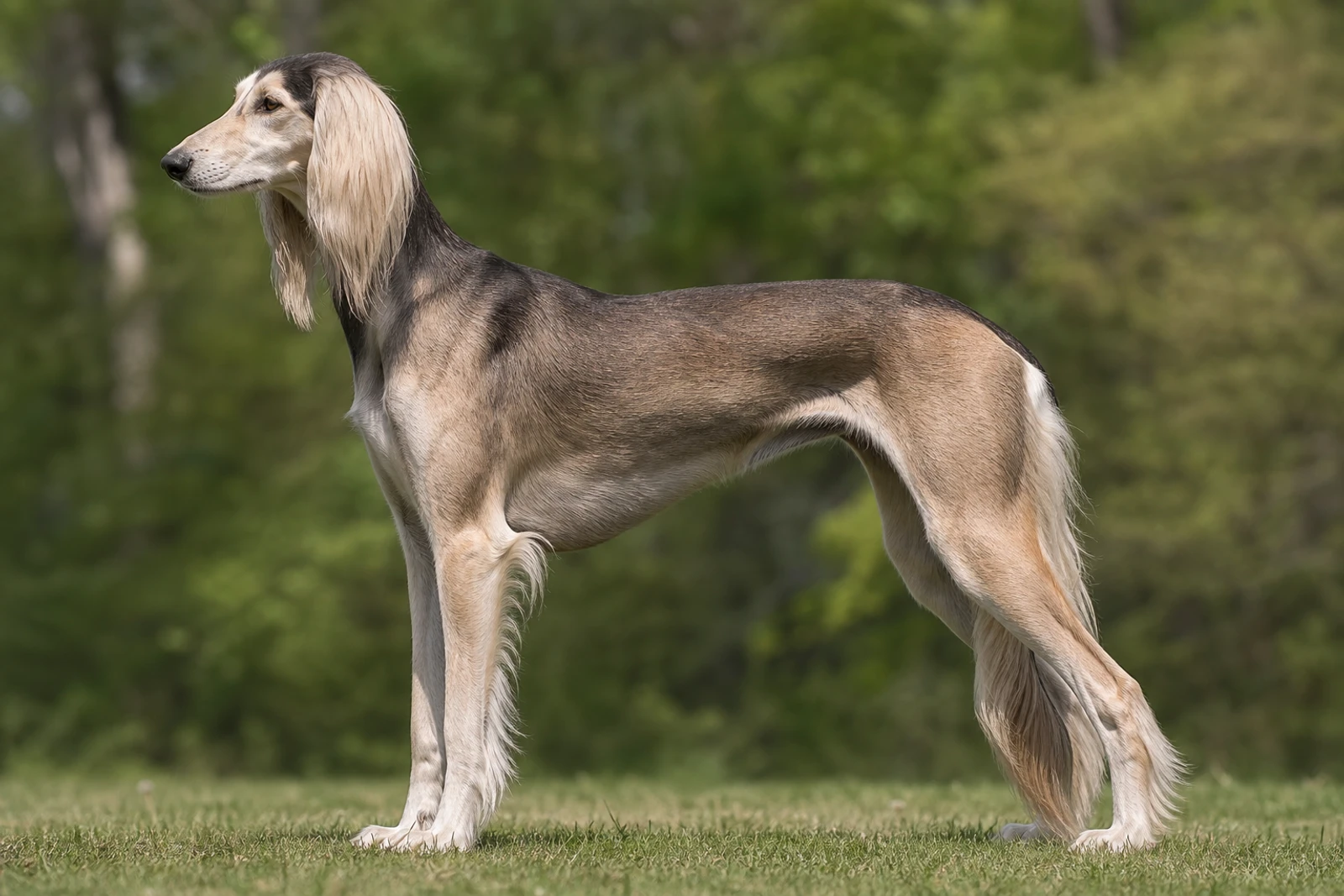
The Saluki, one of the oldest dog breeds, is a graceful and dignified sighthound originally bred for hunting in the deserts of the Middle East. With a gentle, independent nature, this breed is best suited for experienced owners who can provide consistent, positive training. Salukis are affectionate with their families but reserved with strangers. They thrive in homes with securely fenced yards where they can sprint, yet they are calm indoors. Their elegant, athletic build and low-maintenance coat make them a unique companion for those who appreciate their sensitive, cat-like personality.
At a glance
- Size
- Giant
- Height
- 23–28 in
- Weight
- 35–65 lb
- Life span
- 12 years
- Coat colors
- White, Cream, Fawn, Golden, Red, Grizzle, Black and Tan, Tricolor
- Coat type
- Short and silky, with feathered variety
How much does a Saluki cost?
Adopt / rescue
$75–$400
Usually includes spay/neuter, first shots, and a microchip.
Buy from a breeder
$700–$2,000
From a reputable, health-testing breeder.
Approximate USD. Prices vary widely by region, breeder, pedigree, age, and coat colour — adopting is the lower-cost and recommended route. Avoid suspiciously cheap “breeders”; they’re often puppy mills.
Estimate the full cost of a Saluki →Want the ongoing number? Estimate the monthly food bill for a Saluki with our dog food cost calculator.
Saluki photos
Views
Front, side, rear and top — the full silhouette.Poses
How the breed sits, lies, moves and plays.Puppy to senior
The breed across its whole life.Expressions
The breed’s range of moods.Close-up details
Eyes, ears, nose, paws, tail and coat.Coat colors
The breed’s recognized colors.Click any photo to enlarge. We show the Saluki from every angle — three views, poses, life stages, expressions, close-ups, coat and colors.
Appearance & size
A Saluki looks fast standing still. Everything about the build — lean muscle, long bone, deep chest — says this dog was shaped by centuries of open-desert running, and you see it whether they’re stacked in a show ring or stretched out on your sofa.
Build and size
Height runs 23 to 28 inches at the shoulder; weight typically falls between 35 and 65 pounds. That’s a wide spread, and it’s real. A fine-boned 23-inch female from strictly show lines might weigh a wispy 35 pounds, while a hard-bodied 28-inch male bred for coursing can top out near 65. The frame is rectangular, with the body noticeably longer than tall, and every ounce is functional muscle, not bulk. The chest is deep and narrow, the waist dramatically tucked, the legs long and straight with strong, low-set hocks. This is a greyhound-like silhouette, but with a bit more daylight underneath and a distinctly lighter, more elegant feel.
Coat and color
The breed comes in two coat types, both perfectly acceptable: feathered and smooth. In the more common feathered variety, the coat itself is short, silky, and close-lying over the body, with long, soft feathering on the ears, the backs of the legs, the underside of the tail, and sometimes the throat. The smooth variety lacks that extra length — same short silky body coat, no fringes. Neither coat gives much weather protection; this is a thin-skinned, heat-tolerant dog.
Color is an anything-goes affair. You’ll see solid white, cream, fawn, gold, red, grizzle, black-and-tan, and tricolor (white, black, and tan), plus every combination in between. Many Salukis have a dark mask or black tipping on the ears and tail. No color or pattern is disqualified.
The look, angle by angle
Approach a Saluki from the front and the word is narrow. The head is long and wedge-shaped, with a barely-there stop, large oval eyes, and long, drop ears that hang close to the skull, covered in silky fringe in feathered dogs. The chest is deep but surprisingly slim between the elbows; the forelegs drop straight and parallel.
From the side you read the full architecture: an arched, supple neck, a level topline over the loin, a brisket that reaches nearly to the elbow, and then that extreme tuck-up lifting the underline sharply into the flanks. The hindquarters stand well underneath the body, giving a coiled-spring look. The tail, set low, hangs in a gentle natural curve — never curled tight, never carried gaily — and is feathered on the underside.
From behind, the dog looks just as spare. The hips are wide, the thighs well-muscled but flat, the hocks set low to the ground. You see back legs that can drive a gallop over hardpan, and a tail that sweeps down and up in a quiet, unbroken line.
History & origin
The Saluki isn’t just old — it’s one of the few breeds that can trace its lineage back before recorded history. For at least 5,000 years, if not longer, desert tribes in the Middle East molded these dogs into the swift, durable hunters we recognize today. Carvings, tomb paintings, and mummified remains from ancient Egypt depict a leggy, deep-chested hound that’s unmistakably a Saluki, often shown coursing gazelle across open sand.
The breed developed in the Fertile Crescent and Arabian Peninsula, where Bedouin nomads relied on them to bring down meat in terrain that offered little cover or water. Unlike scent hounds that puzzle over a trail, a Saluki hunts purely by sight, accelerating to speeds near 40 mph and hanging on through the long chase until the prey tires. Bedouins bred them for this single-purpose athleticism, selecting for lungs, heart, and an almost cat-like foot that absorbed punishing ground. A successful hunter wasn’t just fast — it had to keep going for miles in brutal heat.
That symbiotic relationship gave the Saluki an unusual status. In Islamic tradition, dogs are often considered unclean, but the Saluki was “el hurr,” the noble one, permitted to live inside the family tent. They were never sold for money, only gifted as a mark of deep respect. This protected the breed’s purity for centuries, passing bloodlines through generations of tribal families.
Salukis reached Europe in piecemeal fashion. A few came to England in the 1840s, but the real foundation stock arrived after World War I. In 1919, the Honorable Florence Amherst imported a pair — a black-and-tan dog from the Euphrates and a cream bitch — and built a kennel that would anchor the breed outside its homeland. The Kennel Club recognized the Saluki in 1923, and the American Kennel Club followed in 1927. The Persian greyhound, as it was sometimes called, had officially settled into the Western show and sport scene.
Today, you can still see the ancient design in every silhouette: the 23- to 28-inch height, the slim waist, the 35- to 65-pound frame with just enough muscle to drive acceleration. Open-field coursing events keep that original instinct sharp, even as most Salukis now stretch out on sofas. The same dog that once chased down a desert meal still craves a full-tilt run — and turns heads with a build that’s barely changed since pharaohs put them on palace walls.
Temperament & personality
A Saluki is a quiet, gentle presence at home—right up until they spot something small and furry darting across a field. This is a dog built for blistering sprints, not mindless motion. Indoors they’re often described as cat-like: they seek out the softest spot on the couch, nap for hours, and may greet you with a slow tail wag rather than a frantic welcome. Affection is on their terms, which makes it feel earned. They form deep bonds with their family but rarely shower strangers with instant trust. Expect polite aloofness with visitors, not a wagging, slobbering greeting.
Independence runs deep in the breed. A Saluki won’t hang on your every word just because you said it. They think, evaluate, and sometimes decide that your suggestion isn’t worth the effort. This isn’t stubbornness for its own sake—it’s a self-possessed nature that responds far better to calm, consistent routines than to heavy-handed corrections. Force shuts them down. Short, positive training sessions and a sense of humor get you much further.
Watchfulness comes naturally, but a Saluki is no guard dog. They notice everything—a stiff-legged squirrel three backyards over, a car door closing two streets away—yet rarely feel the need to bark about it. Many live virtually silent lives indoors. That doesn’t mean they’re oblivious; a Saluki relaxing with soft eyes and a loose body is a content dog, while lip licking, yawning, or turning away often signal they need space. Learning their subtle language pays off, especially because they’re sensitive enough that isolation or a chaotic household can trigger anxiety-driven behaviors like destructive chewing or house-soiling.
With their own people, they’re calm and surprisingly tender. They’ll lean against your leg, rest a long nose in your lap, and shadow you from room to room without being needy. Most do well with respectful older children who understand not to interrupt a meal or crowd them when they’re resting. Small pets and outdoor cats, however, are a gamble. A Saluki’s prey drive is a genuine consideration—they were bred to chase, catch, and kill swift game over open ground. A fenced yard and a leash outside the house are non-negotiable, no matter how reliable you think their recall is. That forward-lean you see before a bolt isn’t defiance; it’s centuries of sighthound instinct kicking in. Embrace it, manage it, and you’ll have a soulful, steady companion who’s endlessly rewarding without ever being fawning.
Good with kids, dogs & other pets
A Saluki’s patient, non-aggressive temperament can make him a calm companion for families with respectful children, but he’s not a rugged playmate built for rough-and-tumble games. These dogs are sensitive and bond quietly; they’d rather stretch out next to you than be tugged or climbed on. Kids who learn to use gentle voices and soft hands will win his trust. A Saluki typically retreats rather than snaps when overwhelmed — still, never leave a young child unsupervised with any dog of this stature (23–28 inches, 35–65 pounds).
With other dogs, Salukis tend to be polite, especially with early and ongoing socialization. Many enjoy living alongside another sighthound or a similarly calm, leggy running partner. That said, they can be reserved or aloof with unfamiliar dogs. Chaotic dog parks often push a sensitive Saluki into avoidance or shut-down, so introduce new dogs in controlled, positive settings instead. Start puppy socialization early — expose him to a wide variety of calm, friendly dogs before that critical window closes around 16 weeks. Without it, he can become timid or fear-reactive as an adult.
Cats and small pets are where you really need to pause. Salukis were bred to spot, chase, and catch fast-moving prey over open ground. That instinct lives close to the surface. A cat that bolts or a rabbit in the yard can flip a switch, even in a dog raised alongside them. Some Salukis learn to peacefully coexist with indoor cats when introduced as puppies, but outdoor safety is never a guarantee. Many experienced breeders flat-out won’t place a Saluki in a home with small furry animals. If you must have both, strict separation when you aren’t actively supervising is not optional. Manage every interaction, use baby gates, and accept that the dog’s wiring may one day override your training.
Trainability & intelligence
A Saluki learns a new trick in minutes — and then decides whether you’ve made it worth their while. Sharp as they are, independence runs deep in this breed. They weren’t developed to take constant direction; they were bred to scan a desert horizon and make split-second chase decisions on their own. That means training has less to do with “obedience” in the typical sense and everything to do with a respectful, two-way partnership.
You won’t get far by asking for mindless repetition. Short, upbeat sessions with high-value rewards (think roasted chicken, not dry biscuits) keep their brain engaged. The moment it feels like a drill, they’ll turn off. You’ll see the best results when you work with their natural motivation, not against it.
Because of that free-thinking streak, recall is the single biggest training hurdle. A Saluki in full flight after a squirrel isn’t coming back — no matter how solid the kitchen practice was. Plan on a securely fenced yard and use a long line for off-leash work in open spaces. Any hint of a chase trigger overrides even a strong reward history for most individuals.
Punishment-based methods are a fast track to shutdown. These dogs are sensitive to tone and tension; a harsh correction can erode trust for days. Instead, reward what you want, ignore what you can, and manage the rest. Calm, consistent communication builds the reliability you’ll actually live with.
Early socialization is non-negotiable. Expose a Saluki pup to a wide range of people, sounds, and surfaces before 16 weeks, and continue through adolescence. Without it, their natural reserve can tip into skittishness. A well-socialized Saluki grows into a polite, clear-headed housemate — one who will still think for themselves, but will choose to check in with you.
Exercise & energy needs
A Saluki’s exercise requirement isn’t measured in steps — it’s measured in speed. These sighthounds are built to uncork breathtaking sprints, not to plod along on a leash for hours. If they only get walks, even long ones, you’re missing the point. A Saluki needs daily, all-out running in a safe place to stay sane.
Shoot for 60–90 minutes of movement a day, split across at least two sessions. A morning outing might be a 30‑minute leash walk or a jog beside a bike, but the evening should deliver what the morning can’t: a 20‑ to 30‑minute off-leash sprint in a securely fenced field, a dog park with high fences, or a private lure‑coursing run. These dogs hit 40 mph in a few strides and quit just as fast — it’s interval work, not a marathon. Without that release, you’ll see restlessness, obsessive pacing, or a couch cushion turned into confetti.
Mental exercise is just as important. A Saluki’s chase drive runs deep, so activities that mimic the hunt click perfectly. Lure coursing, open‑field coursing, and flirt poles give that instinct an outlet. Indoors, hide treats around the house or feed meals from puzzle toys to work the nose and brain. Avoid pounding pavement for long stretches with a growing puppy; soft grass or dirt fields protect developing joints.
The big caveat: a Saluki off‑leash anywhere unfenced is a dog you may not see again for miles. Prey drive overrides recall, and they can spot a squirrel at 800 yards. If your life doesn’t include regular access to an enclosed running area, this breed’s exercise needs will be a poor match. When you can deliver sprints and scent games, you get a calm, affectionate housemate who spends the rest of the day draped over your sofa.
Grooming & coat care
Salukis are naturally tidy dogs — they don’t carry that typical “doggy” odor, and their single, silky coat is more about light upkeep than heavy labor. You’ll still need a routine, but it’s refreshingly simple.
The first thing to know is that Salukis come in two coat types: smooth and feathered. Both have a single coat with no undercoat, so you’re not wrestling with the dense, shedding underlayer you’d find on a Husky or Golden. Smooth Salukis have short, close-lying hair all over. Feathered Salukis show longer, silky fringe on their ears, tail, backs of the legs, and sometimes the elbows.
Brushing frequency depends on which variety lives with you. A smooth Saluki does fine with a quick once-over every week or two using a soft bristle brush or a grooming mitt. The goal is less about detangling and more about spreading natural oils, removing loose hair, and giving the coat that characteristic sheen. Pig-bristle brushes are especially good for this — they polish the short hair and provide a gentle massage. Feathered Salukis need a bit more attention to keep those longer strands from matting. Twice a week, go through the feathering with a metal slicker brush or a wide-tooth comb, paying close attention behind the ears, the tail, and the leg fringe where tangles tend to hide. Use rounded pins so you don’t scratch that thin skin.
Bathing isn’t a frequent event. Salukis rarely smell, and over-washing strips the coat of its natural oils. A bath every three to four months — or when they’ve rolled in something unforgettable — is plenty. Always use a gentle, dog-specific shampoo and rinse thoroughly. Towel-dry and let them air-dry in a warm, draft-free spot; a blow dryer on low heat can help with the feathered parts if your dog tolerates it.
Trimming is minimal. You won’t need to clip body hair. The only trim most owners do is tidying up the feathering for a cleaner look or snipping excess hair between the paw pads for better traction on slick floors. Never shave a Saluki’s coat; that single layer provides temperature regulation and sun protection, and once shaved, it grows back oddly.
Nails, ears, and teeth are non-negotiable. Saluki nails grow fast and can get uncomfortable if left long, so trim them every two to three weeks or as soon as you hear clicking on hard floors. Those elegant, pendant ears trap air poorly, so check them weekly for wax buildup or redness, and clean gently with a vet-approved solution. Brush teeth at least three times a week to prevent periodontal disease, especially since deep-chested breeds can be more sensitive to anesthesia if a dental procedure becomes necessary.
Seasonal coat care is low-key. You’ll notice a mild increase in shedding as the weather warms, but it’s nothing like the twice-yearly blowout a double-coated breed delivers. Just add an extra brushing session during spring to capture the loose hair and keep the skin healthy. Outdoor sighthounds that run hard often shed less overall because exercise stimulates healthy coat turnover, so those daily sprints do double duty.
Shedding & allergies
Salukis wear a short, silky single coat that feels more like smooth fabric than fur. Because they lack an undercoat, there’s no dramatic seasonal blowout where clumps of hair blanket your home. Instead, you’ll notice a fine, minimal shed year-round — a light dusting of hair on furniture and clothes that’s easy to manage with a quick once-over from a rubber curry brush or a damp cloth.
Feathered and smooth varieties shed similarly; the longer feathering on the ears, tail, and legs may tangle if you neglect grooming, but it doesn’t increase overall hair fall.
Drool is essentially a non-issue. Salukis have tight lips, so you won’t find slobber trails on your walls or wet spots on your pants after a greeting. This, combined with the low shed, means less allergen-carrying saliva and dander floating around.
As for the realistic hypoallergenic picture: no dog is 100% allergen-free. Allergens come from skin cells (dander), saliva, and urine — not just hair. However, many people with mild dog allergies do well with Salukis precisely because they shed so little and don’t drool. Their fastidious, almost cat-like self-grooming habits also keep loose hair and dander to a minimum. If allergies are a dealbreaker, spend time with an adult Saluki in a home setting before committing to a puppy.
Diet & nutrition
Salukis burn hot and lean—keeping them that way is what matters most. Unlike many dogs, they often eat with a certain indifference. Don’t read a skipped meal as cause for alarm; pay attention to their body condition instead. You want to see a hint of rib and a sharp tuck behind the elbows. Let that be your gauge, not a hungry-staring act.
Puppy feeding
Puppies need four evenly spaced meals a day until four months old, then three meals until six months, then settle into the adult rhythm of two meals. Transition newcomers gradually: start with lightly cooked, puréed meats, fish, fruits, and vegetables, or a quality commercial puppy food designed for medium-to-large breeds. Raw chicken wings, under your eye, can appear around twelve weeks.
Adult portions and composition
An active adult Saluki (35–65 lb) usually does well on two meals a day. As a starting range, a 50-pound dog might take 2–3 cups of premium dry food daily, or the home-prepared equivalent of about 1,200–1,500 calories. The real number shifts with how much he runs. Build a species-appropriate bowl around roughly 60% animal protein (raw or gently cooked muscle meat and organs), 20–30% fruits and vegetables for fiber and micronutrients, and 10% extras like eggs, plain yogurt, or a digestible grain such as cooked pearl barley. White rice is a bland fallback for a queasy stomach. If you go raw, supervise any bones—deep chests don’t forgive a gulped chunk.
Because Salukis are deep-chested, bloat can be a risk. Serve meals at ground level, don’t use elevated bowls without a reason, and hold off on hard exercise for at least an hour after eating. Avoid dumping holiday ham trimmings or greasy leftovers into their bowl; fatty splurges are a fast track to pancreatitis.
Weight management and quirks
A Saluki’s fine bone and slender legs punish any extra weight. Even a few pounds of unnecessary padding can stress joints and shorten a life that already averages 12 years. If your dog is an outlier who wolfs down meals, a puzzle bowl adds mental work and slows him down. If he’s a delicate nibbler, resist the urge to doctor his food into a rich smorgasbord just to coax an appetite—pickiness rarely signals a problem. Always serve any leftovers in his own bowl, never from the table, to keep begging off the table permanently.
Older Salukis
Seniors may lose teeth or grow sensitive mouths; purée their food so nutrients absorb easily. Switch to three smaller meals if that suits them better, but there’s no solid evidence you need to drop protein. Do pull back on total calories as their daily sprint turns into a stroll—obesity in an old dog is a major, preventable hardship. Watch the scale, and adjust quarters of a cup at a time. A Saluki that stays light and tensile into his final years is a Saluki still able to run when he wants to.
Health & lifespan
A Saluki’s typical lifespan hovers around 12 years, and many live that long with few major issues — this is a breed with ancient roots and relatively sound genetics. But that doesn’t mean you can coast on wellness care. A Saluki’s lean, 35–65 lb frame and deep chest come with real things to watch.
Cardiac health tops the list. Some lines can be prone to dilated cardiomyopathy, so a yearly vet check that includes listening for murmurs or irregular rhythms is wise. Progressive retinal atrophy (PRA) and other inherited eye disorders also show up; responsible breeders screen breeding stock through OFA or CERF exams, and you’ll want to keep up with annual eye exams on your own dog.
Because they carry so little body fat — combined with a single coat — Salukis feel the cold hard. A winter walk without a coat can quickly turn into a shivering, miserable dog. Thin skin also tears more easily than you’d expect; even a tumble in the yard can result in stitches. You’ll learn to scan for cuts and scrapes after every off-leash sprint.
That deep chest puts them at risk for bloat (gastric dilatation-volvulus) . Feed two or three smaller meals a day instead of one large one, and enforce a rest period after eating — no zoomies for at least an hour. Know the signs: unproductive retching, restlessness, a distended abdomen. It’s a true emergency.
A less obvious sensitivity is anesthesia. Many sighthounds metabolize certain drugs differently, especially thiobarbiturates. If your Saluki ever needs surgery, the vet must be sighthound-savvy and use protocols that avoid these drugs.
Weight management here isn’t just about looks. Even an extra 5 pounds strains those long, fine legs and raises the risk of injury. Keep your Saluki hard-bodied and rib-visible — that’s the healthy look for this breed. Monthly heartworm prevention during mosquito season (and one month beyond) is non-negotiable, and rabies vaccination is legally required. These dogs live to run, which means they’re exposed to parasite carriers far more than a couch-potato breed.
Finally, a Saluki who is isolated or roughly handled can internalize that stress, sometimes manifesting as gut issues or withdrawn behavior. Early, positive socialization with people and handling at the vet’s office makes checkups safer and less traumatic for a breed that can be reserved. Ask your breeder for OFA cardiac and thyroid clearances on both parents, and don’t skip that first eye exam before your puppy turns one.
Living environment
A Saluki’s ideal home is one with direct access to a large, securely fenced area where it can stretch its legs at full gallop — think a yard with a 6-foot or higher physical fence, not an invisible boundary. These 35–65 lb sighthounds were bred for coursing game across open desert, and a couple of leashed walks a day won’t satisfy that drive. Plan on at least 60 minutes of off-leash sprinting twice daily, plus mental enrichment like scent games or lure coursing. Without it, boredom can spill into destructive chewing or anxious pacing.
An apartment can work, but only if you’re an extremely dedicated owner — one who will take the dog to a safe enclosed field or a fenced dog park every single day, rain or shine. Inside the home, a well-exercised Saluki is surprisingly calm and clean, often curling up on the softest piece of furniture like a cat. The breed is naturally quiet and rarely barks without a reason, making them an easy neighbor.
That brings us to the next point: alone-time tolerance is low. Salukis bond deeply with their people and can slide into isolation distress if left home alone for long stretches. A family where someone is around most of the day is far better than a household that’s gone 9–10 hours straight. You can ease a puppy into short separations with gradual desensitization, but this is not a dog that thrives on solitude. If your schedule won’t allow it, a Saluki will make its unhappiness known through whining, destruction, or refusal to eat.
Climate matters, too. Their thin skin and single coat offer almost no insulation, so they chill quickly. Below 50°F, a warm coat is non-negotiable, and you’ll often find them seeking out sunny patches or blankets. They handle heat reasonably well, but always need shade and water during summer outings. That delicate build also means they feel hard floors keenly — a plush dog bed in every room isn’t an indulgence, it’s a necessity.
Who this breed suits
A Saluki lands squarely with an owner who gets that partnership doesn’t mean obedience. You’re a good match if you have a securely fenced yard large enough for a tall, leggy dog to truly sprint—not just trot—and you’re fine with a dog that won’t fetch, heel on command, or care much about pleasing you. Experienced sighthound owners, runners who can clock a solid hour of daily free-running, and quiet households without small, scampering pets tend to click with this breed.
Singles and active couples often thrive with a Saluki. The dog’s indoors-off-switch (after exercise) and minimal shedding feel easy, and a sensitive, cat-like temperament suits adults who read body language well. A committed first-time owner can succeed if they’re willing to learn reward-based training and accept that a Saluki’s recall is never a guarantee; many experienced Saluki people will tell you the dog is managed, not trained, in open spaces. Seniors who still jog or walk fast and have a large fenced property might consider one, but the strength of a 60-pound dog hitting 40 mph means you need solid footing and a good leash grip for daily walks in unfenced areas. Families with older, dog-savvy kids who won’t maul or chase the dog can work, though a Saluki rarely tolerates clumsy handling and may retreat.
Think twice if you live in an apartment without private, fenced run space, or if you picture hiking off-leash with a dog that trots reliably beside you. A Saluki’s prey drive is hard-wired; a cat, squirrel, or small dog zipping across the path can trigger an instant, non-negotiable chase. Households with free-roaming rabbits, birds, or tiny dogs are a constant risk. You’ll also struggle if you want a Velcro dog that lives to obey—this breed offers loyalty, but on its own terms, often with a reserved affection that feels more “roommate” than lap dog.
Cost of ownership
A well-bred Saluki puppy from a responsible breeder who screens hearts, eyes, and does OFA testing usually lands between $1,500 and $3,000. Show-potential pups or those from heavily titled coursing lines can push toward $4,000. A retired racing or rehome adoption through a sighthound rescue is a gentler entry at $300–$500.
Monthly upkeep is moderate for a giant breed, but a few Saluki-specific points matter.
- Food: $60–$85 a month. These dogs are lean and efficient; most adults stay healthy on 3–4 cups of high-quality kibble a day. A raw or fresh-food diet can double that.
- Grooming: $20–$40 a month if you spread out a pro visit every 6–8 weeks. The coat is wash-and-wear — a weekly quick brush and the odd bath handles most of it at home.
- Routine vet and preventatives: $50–$80 a month. This covers an annual exam, vaccinations, heartworm/flea/tick prevention, and an annual blood panel once the dog hits senior years. Leptospirosis vaccination is wise if they run in open fields.
- Pet insurance: $50–$90 a month for a comprehensive plan. Salukis can be prone to bloat, certain heart conditions, and osteosarcoma later in life. Also, their lean build and low body fat make them exquisitely sensitive to anesthesia — an emergency surgery or even a dental can cost noticeably more because they need a careful drug protocol and extra monitoring.
One upfront cost a lot of first-time Saluki owners overlook: fencing. A four-foot fence isn't going to cut it. These dogs clear six feet from a standstill when they spot a squirrel. Budget a few thousand to install a six-foot, dig-proof perimeter if your yard isn’t already built like Fort Knox.
Choosing a Saluki
Where you get your Saluki matters more than with most breeds. This is an independent sighthound, not a Golden Retriever — a poorly bred or poorly raised one can develop serious fearfulness, sound sensitivity, or health problems that shorten its life well before the typical 12 years.
Breeder or Rescue?
You’ll find breed-specific rescues that rehome adult Salukis, often from situations where an owner underestimated the dog’s need to run or its intense prey drive. That’s a solid path if you’re open to an age gap, a possible unknown history, and a dog that may need extra patience around small animals. The rescue will know the dog’s quirks and whether it’s cat-safe. Skip the guilt — a good rescue match is just as valid as a puppy.
If you go the puppy route, you’re looking for a breeder who treats each litter as a deliberate attempt to improve the breed, not a money-maker. A responsible Saluki breeder typically competes in conformation, lure coursing, or open-field racing and can show you titles on both parents. They’ll raise puppies underfoot in the home, expose them to household sounds and handling, and send them home no earlier than 10–12 weeks, after crucial early socialization.
Health Clearances to Demand
Salukis are generally sound, but a few inherited conditions can show up. Any breeder you trust should provide proof of these screenings — not just a vet check, but board-certified evaluations:
- Heart: An annual echocardiogram by a veterinary cardiologist. Salukis can develop dilated cardiomyopathy or congenital heart defects.
- Eyes: A CERF or OFA Eye exam within the past year by a board-certified ophthalmologist, screening for progressive retinal atrophy and other inherited eye diseases.
- Thyroid: An OFA thyroid panel from an approved lab. Hypothyroidism, while not rampant, does appear in the breed.
Some breeders will also test hips via OFA or PennHIP, though hip dysplasia is far less common than in heavier giant breeds. Ask to see the actual certificates, not just a verbal “they’re healthy.”
Red Flags That Scream “Walk Away”
- No health testing, or tests that are five years out of date on a parent who was bred at age three.
- A breeder who can’t tell you the dam’s and sire’s adult weights within the standard 35–65 lb range, or whose dogs consistently tip the scale way above that. A heavy, coarsened Saluki that looks like a Wolfhound mix isn’t the breed’s intended silhouette.
- Multiple litters on the ground at once, puppies available year-round, or a website that lets you put one in a cart.
- Anyone who won’t let you meet at least the dam in person (or over video if you’re buying at a distance). An evasive breeder who hides kennels out back is a dealbreaker.
- No contract that includes a return clause — a responsible breeder will take back any dog they produced, at any age, no questions asked.
- Pushing puppies out the door before 10 weeks, when fear periods and vital bite inhibition lessons are still in play.
Picking Your Puppy
Once you’ve found a breeder you trust, let them guide the match. A good breeder knows each puppy’s developing personality. Tell them honestly about your household: cat, no cat, fenced acreage, apartment with a daily sprint routine. You’re not looking for the boldest pup in the box, just one with a stable, curious temperament — not cowering in corners or bulling littermates nonstop.
When you visit, check for the basics: clear, non-runny eyes; dry, clean ears; a smooth gait with no limping; firm stools. A Saluki puppy should be lean, leggy, and a little deer-like, not roly-poly. Expect a significant wait — many ethical breeders have wait lists — and a price tag that reflects cardiac and eye clearances, quality care, and a lifetime of breeder support. That wait is the price of a dog built to run flat-out, live with you for a decade, and stay structurally sound through it all.
Pros & cons
Pros
- Low-maintenance coat: a short, silky single layer that sheds little and stays clean with a quick weekly brush — no doggy odor.
- Quiet indoors: rarely nuisance-barks; many owners say they have a cat-like, dignified calm when their needs are met.
- Affectionate on their own terms: a Saluki bonds deeply and will lean on you for a scratch, then nap independently without shadowing you.
- Born to fly: 23–28 inches tall and 35–65 pounds of lithe muscle, they need a solid 45–60 minutes of real sprinting — a fenced field or lure-coursing session, not just a walk — to be happy.
- Long-lived athlete: well-cared-for Salukis regularly reach their 12-year lifespan, and responsible breeders screen for cardiac and eye conditions.
- Naturally fastidious: easy to housetrain and so clean they practically groom themselves.
Cons
- Prey drive on overdrive: they were bred to spot and run down game over miles, so a squirrel, cat, or blowing leaf can trigger a chase. Off-leash without a securely fenced area isn’t safe.
- Independent, not obedient: a Saluki doesn’t live to please you. Training takes patience, short sessions, and a soft hand — harsh corrections make them shut down.
- Reserved with strangers: early and ongoing socialization is a must, or visitors may be met with aloof suspicion rather than a wag.
- Escape artist potential: a 23–28-inch frame easily jumps or climbs; a 6-foot fence is the minimum, and they may dig near the base.
- Thin skin, thin coat: low body fat means they feel cold, overheat quickly in summer, and get cuts and scrapes easily.
- Not a casual setup: a bored Saluki is destructive. If you can’t offer daily flat-out running in a safe space, this breed will struggle.
Similar breeds & alternatives
If the Saluki’s remote, high-octane personality leaves you second-guessing, a few other sighthounds offer a better fit in one dimension or another—without losing that elegant, long-limbed silhouette.
-
Greyhound. The sprinter to the Saluki’s marathoner. A retired racing Greyhound commonly settles into 20–30 minutes of daily zoomies followed by serious couch time, whereas a Saluki will demand a solid hour of hard running and still be up for more. Greys tend to be more overtly affectionate and easier to handle off-leash in a controlled area. Height runs 27–30 inches and weight 60–70 pounds, so you get an even taller dog with a much lower endurance requirement.
-
Whippet. A downsized Saluki in many ways, standing 18–22 inches and 25–40 pounds. Whippets share the explosive speed and gentle indoor manner, but their smaller size makes them more practical for a modestly sized home or a yard that isn’t acres. They’re often a bit more biddable, though a solid recall still takes real work. If you want the sighthound personality in a package that curls up tighter on the sofa, this is it.
-
Afghan Hound. Similar height (25–27 inches) and the same aloof, sometimes regal independence. The key difference: coat. An Afghan’s long, silky hair demands hours of weekly grooming—bathing, drying, brushing—while the Saluki’s smooth or feathered coat is wash-and-wear. Afghan Hounds also carry a playful streak; they’re clowns behind the glamour, but they’re no less stubborn. Choose this if you love the “cat in a dog suit” vibe and don’t mind a serious grooming bill.
-
Borzoi. Think of the Saluki’s calm, quiet indoor demeanor, then scale it up to 28–32 inches and 60–105 pounds. Borzoi are extreme couch potatoes inside and breathtaking gallopers outside. They tend to be slightly more reserved with strangers and even gentler around children when properly socialized. The extra size means you’ll need a home with enough hallway real estate and a budget for big-dog feed. Shedding is heavier than the Saluki’s.
-
Sloughi. The North African cousin is so similar in build and temperament that even experienced eyes double-take. Sloughis stand roughly 24–29 inches and 35–65 pounds, with a short, fine coat and the same dignified reserve. The distinction is more a matter of subtle lineage than everyday life: Sloughis often bond intensely with one person and can be even more watchful. They’re a worthy alternative for someone seeking a rare, desert-bred sighthound without the feathering.
Fun facts
- One of the oldest known dog breeds, dating back to ancient Egypt.
- Capable of reaching speeds up to 42 mph, making them one of the fastest dog breeds.
- Often called the 'Royal Dog of Egypt' and were once mummified like pharaohs.
- They have a cat-like personality: elegant, clean, and somewhat aloof.
Frequently asked questions
- Are Salukis good with children?
- Salukis can be gentle and affectionate with respectful older children, but due to their sensitive and independent nature, they may not tolerate rough handling. Early socialization is crucial, and interactions should always be supervised, especially with toddlers.
- Do Salukis shed a lot?
- Salukis are low to moderate shedders, with a short, silky coat that produces minimal dander. Weekly brushing helps manage loose hair and keeps their coat healthy, making them a relatively low-maintenance breed in terms of grooming.
- How much exercise does a Saluki need?
- Salukis are athletic sighthounds that need daily opportunities to run in a secure, fenced area, alongside regular brisk walks. Without sufficient exercise, they can become bored and develop destructive behaviors, so a commitment to their physical activity is essential.
- Can Salukis live in apartments?
- While Salukis are generally calm indoors, apartment living can be challenging due to their need for off-leash sprinting and their sensitivity to noise. They can adapt if provided with ample daily exercise and a quiet environment, but a home with a fenced yard is ideal.
- Do Salukis bark a lot?
- Salukis tend to be quiet dogs that rarely bark without reason, making them less prone to nuisance barking. They may alert to strangers or unusual sounds, but excessive vocalization is not typical of the breed.
- Are Salukis easy to train for first-time owners?
- Salukis are intelligent but independent thinkers, which can make training a challenge for inexperienced owners. They respond best to positive reinforcement and patience, but their strong prey drive and selective listening may frustrate those expecting eager-to-please behavior.
Tools & calculators for Saluki owners
Quick estimates tailored to Salukis — pre-filled with this breed’s size where it matters.
Articles & stories about the Saluki
Sources & standards
This profile follows recognized breed standards from the American Kennel Club (AKC) and the Fédération Cynologique Internationale (FCI), along with established veterinary and breed-club guidance. These describe general breed tendencies — every dog is an individual.