

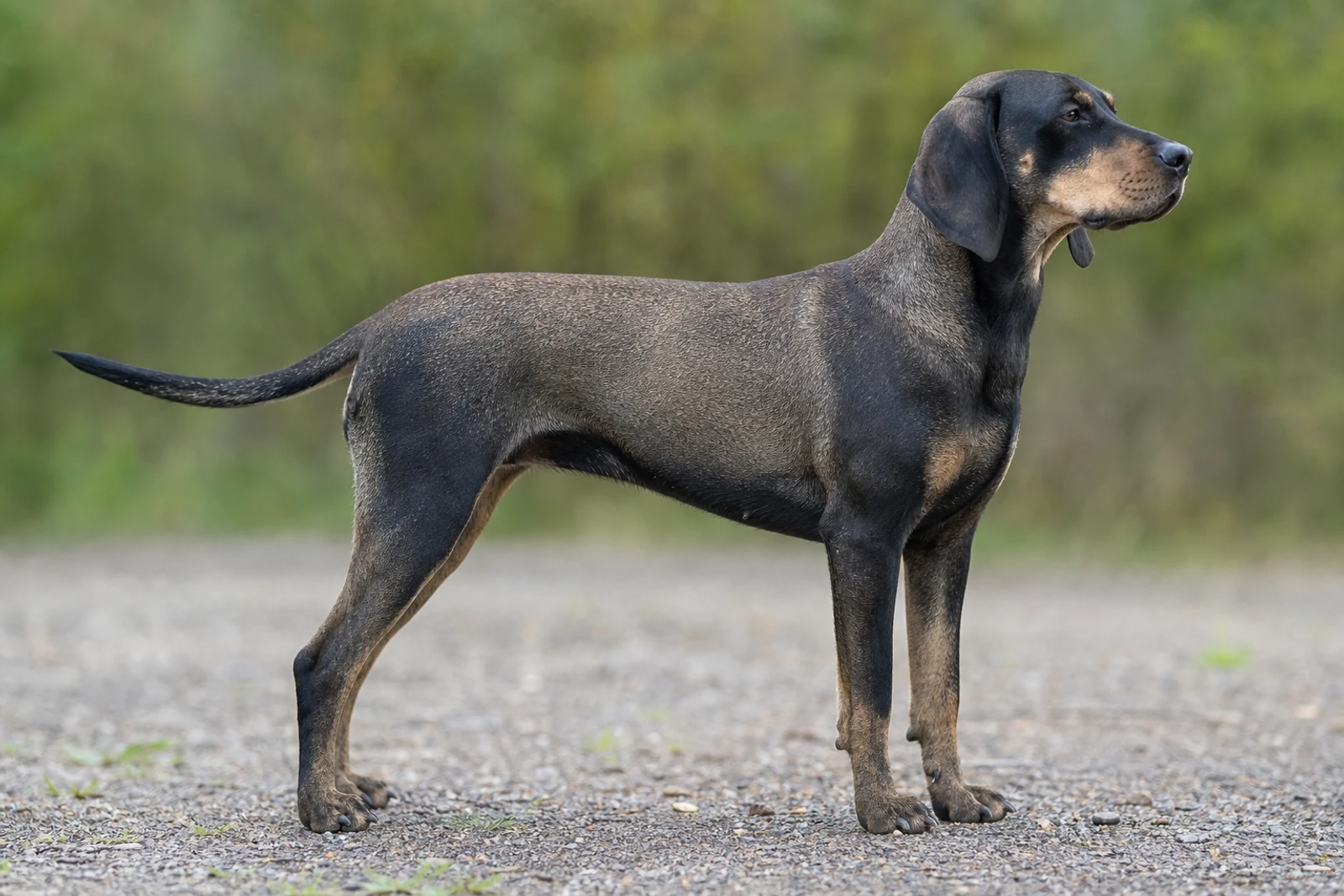
The Schillerstövare is a medium-to-large Swedish scent hound bred for hunting fox and hare. With a dense black-and-tan coat and an eager, musical bay, this rare breed thrives in active homes where it can put its nose and stamina to work. Schillerstövares are deeply loyal, friendly, and gentle, making them excellent companions for families who enjoy outdoor adventures. They suit owners with hunting experience or those who can provide vigorous daily exercise and mental challenges. Their short coat requires minimal grooming, but they shed moderately and need space to roam—apartment living is not ideal.
At a glance
- Size
- Large
- Height
- 19–24 in
- Weight
- 33–55 lb
- Life span
- 10–14 years
- Coat colors
- Black and tan, Black, tan, and white
- Coat type
- short, harsh, dense double coat
How much does a Schillerstövare cost?
Adopt / rescue
$75–$400
Usually includes spay/neuter, first shots, and a microchip.
Buy from a breeder
$700–$2,000
From a reputable, health-testing breeder.
Approximate USD. Prices vary widely by region, breeder, pedigree, age, and coat colour — adopting is the lower-cost and recommended route. Avoid suspiciously cheap “breeders”; they’re often puppy mills.
Estimate the full cost of a Schillerstövare →Want the ongoing number? Estimate the monthly food bill for a Schillerstövare with our dog food cost calculator.
Schillerstövare photos
Views
Front, side, rear and top — the full silhouette.Poses
How the breed sits, lies, moves and plays.Puppy to senior
The breed across its whole life.Expressions
The breed’s range of moods.Close-up details
Eyes, ears, nose, paws, tail and coat.Coat colors
The breed’s recognized colors.Click any photo to enlarge. We show the Schillerstövare from every angle — three views, poses, life stages, expressions, close-ups, coat and colors.
Appearance & size
A Schillerstövare reads like a lean, athletic running machine built for long days in the Scandinavian woods. Everything about the frame says endurance without bulk: a deep, moderately broad chest, well-sprung ribs, and a noticeable tuck-up through the loin. The build is distinctly rectangular — the body length from point of shoulder to point of buttock noticeably exceeds the height at the withers, giving the dog a low-slung, ground-covering silhouette. A level topline and a fairly long, well-muscled neck reinforce that profile from the side, while the tail is set high and carried in a gentle saber curve, never curled over the back.
Numbers put the size in perspective. Height at the shoulder runs 19–24 inches, with mature males typically falling at the taller end and females at the lower end. Weight settles between 33 and 55 pounds, so you end up with a hound that is substantial enough for a full day’s hunt but light enough to move nimbly through thick cover. There is no coarseness; bone is solid but clean, and the legs are straight and sinewy when viewed from the front or rear.
The coat is a no-nonsense working jacket: short, dense, and harsh, lying flat against the body with a natural gloss that repels light rain and melting snow. The color is a rich black and tan in a classic hound pattern. A black mantle covers the top of the neck, back, sides, and upper tail, while deep mahogany tan markings light up the cheeks, muzzle, throat, chest, lower legs, and the underside of the tail. Most individuals also sport a small, clean white patch on the chest, and white toes or a white tail tip aren’t unusual. What really catches the eye are the tan “pips” above each dark, almond-shaped eye — they give the dog an alert, slightly quizzical expression that’s pure hound.
From the front, the head tapers as a moderate wedge, with a well-defined stop, a straight muzzle, and tight-fitted lips. The ears are set high, hang flat, and reach just about to the corner of the mouth. The rear view shows strongly muscled thighs and well-let-down hocks, all set parallel and driving the effortless trot the breed is known for. In motion, you see the functional harmony of the whole package — a hunter that can cover big swaths of terrain without breaking down.
History & origin
Per Schiller didn’t set out to create a national icon; he just wanted a dog that could run a hare all day through deep Swedish snow and still have voice left to tell the tale. In the late 1880s, this farmer and avid hunter from Stenungsund, on Sweden’s west coast, began crossing local scenthounds with imported Swiss hounds — likely the smaller, tricolor Schweizer Laufhund — chasing a taller, faster hound that wouldn’t burn out in bitter conditions or tight forest cover.
The work took decades. Schiller selected for a leggy, light-boned frame and a near-obsessive drive to trail hare and fox over tough terrain. He also prized a distinctly musical bay that carries over long distances, a trait still bred into the Schillerstövare today. By 1907, the Swedish Kennel Club recognized the breed and locked in a standard built almost entirely around Schiller’s dogs. The first official studbook entry came that same year, naming the breed after the man who shaped it.
Unlike many European hounds that diversified into show lines and field lines, the Schillerstövare stayed remarkably honest to its original job. Sweden’s hunting culture kept the breed anchored: these dogs were — and still are — worked solo or in pairs, tracking fresh scent trails left by hare, and occasionally fox, through snow and dense undergrowth. The standard didn’t wander toward exaggeration. A Schillerstövare today stands 19–24 inches at the shoulder and runs between 33 and 55 pounds, numbers that reflect the practical, springy build of its early-1900s ancestors.
The breed never really caught fire outside Scandinavia. A handful of dedicated fanciers in Finland and Norway maintain lines, but the Schillerstövare remains overwhelmingly Swedish, a specialist for hunters who face long, cold winters and want a dog that can cover miles without being asked twice. If you see one outside a hunting context, you’re probably looking at someone’s deeply cherished — and loudly opinionated — household companion who still scans the treeline with purpose.
Temperament & personality
The first thing to know is that this dog runs on scent. A Schillerstövare’s world is built through his nose — and it’s a nose that rarely clocks out. If you’re walking and he hits a fresh trail, expect a sudden gear shift into full hound mode: head down, tail up, and a deep, ringing bay that tells the neighborhood something interesting just passed through. That nose also means he’ll remember scent cues long after you’ve forgotten which bush he sniffed. Marking on walks isn’t random; he’s writing a highly personal diary that he’ll reread tomorrow.
At home, the same dog who pulls on a scent like a freight train transforms into an affectionate, low-key companion. Schillerstövares tend to be gentle and polite with their own people — rarely clingy, but always pleased to be near you. They’re generally sound around children who know how to respect a dog’s space. One non-negotiable: never let kids interrupt this dog while he’s eating or chewing a favorite bone. Like any breed, a startled or cornered hound can develop guarding habits that are simpler to prevent than to fix.
Energy-wise, you’re looking at a genuine athlete in a lean, 33-to-55-pound package. A leisurely stroll won’t cut it. Plan on a solid hour of off-leash running or a long, snuffle-heavy hike every day, or you’ll be sharing your house with a restless, vocal coach potato. Mental work counts, too — scent games and puzzle feeders satisfy the tracking brain that’s always simmering. Left to his own devices without a job, he may invent one, and it’s rarely something you’d approve of (think redecorating the couch or testing your fence’s escape-proof rating).
Watchfulness comes naturally, but don’t mistake it for guard-dog instincts. A Schillerstövare will announce visitors with that signature bay, then likely greet them with a wagging tail once you give the all-clear. He’s a pack hound at heart, bred to work in close communication with his handler, so he’s not typically a one-person dog and generally gets along well with other dogs in the household.
Training calls for a light touch. These dogs are smart but independent; they shut down under heavy-handed corrections. You’ll get miles more cooperation with short, upbeat sessions and a treat pouch that always smells interesting. Watch his body language — a loose, wiggly posture and soft eyes mean he’s engaged. If you see stiffening, a direct stare, or a sudden head turn, back off and change your approach. Those are calm signals saying “I’m uncomfortable,” not stubbornness. With consistency and respect for that sensitive nose, you’ll have a cheerful, steady companion who can happily run for miles, then curl up beside you like he’s been part of the family for years.
Good with kids, dogs & other pets
The Schillerstövare’s patient, even-tempered personality gives him a head start in homes with kids who know how to respect a dog. He isn’t snappy or quick to guard resources, and his 33–55-pound frame means he’s sturdy enough to absorb the occasional bump without taking offense. Still, this is a large-breed hound with real athletic drive — a dog that can top out at 24 inches and thinks nothing of jumping, spinning, and pulling on a scent. Toddlers and unstable small children can easily get bowled over, so active supervision is non-negotiable whenever the dog and young kids share the room. Older children who can throw a ball, jog alongside, or hide for scent games will find a tireless, joyful playmate.
With other dogs, the Schillerstövare typically leans easygoing. Bred to hunt in packs, he carries a social, cooperative streak that often translates to dog-park diplomacy — provided he’s been properly introduced. Early and ongoing encounters matter enormously. The socialization clock ticks hardest between 3 and 14 weeks; pups who miss steady, positive exposure to different dogs and people tend to carry a fear-based reactivity that’s tough to rewrite later. Even a well-bred Schillerstövare can become timid or overexcited around unfamiliar dogs if he hasn’t learned the social ropes as a puppy. Keep those early meetings calm, one dog at a time, and watch for overly boisterous greetings that could ruffle a quieter dog.
Cats and small pets are a trickier proposition. The breed’s scent-hound heritage means high prey drive — not aggression, but deeply ingrained chasing and grabbing behavior triggered by a fleeing rabbit, a squirrel, or a cat that dashes. A Schillerstövare raised from puppyhood with a confident cat often learns to coexist, especially indoors where the cat sets the rules. But the instinct never fully evaporates, so never leave them unsupervised in the backyard or on walks where a cat or small dog might bolt. Indoor pocket pets like rabbits or guinea pigs need a securely latched enclosure and a door that stays closed; this dog’s nose and determination can dismantle flimsy barriers.
The breed craves companionship and does poorly when left alone for long stretches or relegated to an outdoor kennel. Separation distress can show up as howling, destruction, or anxiety, which in turn can make interactions with kids or other pets more strained. A Schillerstövare who gets daily mental work — scent trails, puzzle toys, training — and lives inside with the family is a steadier, safer companion. For adult rescue dogs with a shaky socialization history, don’t force meetings. Let the dog’s comfort level dictate the pace, and accept that a quiet walk with you may be all he needs.
Trainability & intelligence
A Schillerstövare is a sharp, problem-solving hound with a nose that can hijack a training session in a heartbeat. This is not a dog that struggles to understand what you want — it’s a dog that might weigh your request against the far more interesting scent trail left by a rabbit three hours ago. That independence isn’t stubbornness for its own sake; it’s a working drive bred into generations of hunters who needed the dog to think and act without constant human input. So the key to training one is building a partnership where listening to you genuinely competes with that nose.
Positive reinforcement is the only language that works here. Punishment or heavy-handed corrections shut this breed down fast — you’ll lose trust and end up with a dog that avoids you rather than one that chooses to check in. Use high-value treats, a quick tug session, or a burst of praise right when the behavior happens. Keep sessions short and dynamic; these dogs get bored with repetition, and boredom leads to creative disobedience. If you drill the same command ten times, expect a hound that suddenly “forgets” it. Three or four correct reps, then switch to something else or release to sniffing time.
Recall is the mountain you’ll climb together. A Schillerstövare on a fresh scent can ignore your most enthusiastic call. That’s not defiance — it’s a genetically hardwired instinct to follow a track to the end. Never let a puppy off leash in an unfenced area unless you’re prepared for a lengthy chase. Train recall with a long line and reward every single return as if the dog won the lottery. Practice in environments with gradually more tempting distractions, but accept that even a well-trained adult might blow you off when the scent picture is intense. A secure fenced yard is non-negotiable.
Start socialization early — between 8 and 16 weeks — and keep it going. Exposure to new people, sounds, surfaces, and other dogs prevents the wariness that can creep into a scenthound’s temperament. A nervous Schillerstövare can become vocal or reactive, so gentle, positive introductions matter. Because the breed can be reserved with strangers, let the dog approach at its own pace and reward calm curiosity. Clear, consistent communication and a patient hand will get you far more reliability than any obedience boot camp ever could. This is a thinking dog that works with you when the relationship feels worth it.
Exercise & energy needs
The Schillerstövare is a tireless scenthound built for hours of trotting through dense Scandinavian forest in pursuit of hare and fox. That heritage doesn’t vanish in a pet home — you’re signing up for a dog that needs a genuine physical and mental job every day. A couple of leashed walks around the block won’t cut it.
Plan on at least 60 to 90 minutes of daily exercise, split into two sessions. One of those sessions should give him a chance to really stretch his legs off-leash in a securely fenced area or on a long line in open country. He’s a galloper, not just a jogger, and he needs to pour on speed, change direction, and crash through underbrush to feel satisfied.
Don’t mistake a tired Schillerstövare for a happy one — mental fatigue matters just as much. This dog’s world runs through his nose. A walk that lets him sniff freely for 40 minutes will drain him more deeply than an hour of forced heeling. Turn mealtimes into scent hunts by hiding kibble in puzzle toys, a snuffle mat, or scattered around the yard. Formal nosework classes, tracking, or barn hunt are all gold for this breed. Without that outlet, you can expect a bored Schillerstövare to get creative — digging, howling, and obsessive pacing are common signs he’s underworked.
Intensity-wise, he’s no sprint-and-crash dog. He can sustain a moderate gallop for miles, then bounce back after a short rest. That said, avoid pounding pavement or repetitive high-impact exercise on hard surfaces until his joints are fully mature (around 18 to 24 months). Even as an adult, vary the terrain to protect his hips and elbows over the long haul.
Good activities: off-leash hiking, canicross, skijoring in winter, long-line tracking in a meadow, and scent-based games. Less ideal: dog parks with zero structure or fetch on asphalt. A pair of solid daily outings, plus 15–20 minutes of nosework inside, will keep him relaxed at home — and far less likely to serenade the neighborhood with his deep, carrying bay.
Grooming & coat care
Coat type
The Schillerstövare wears a flat, short coat that’s dense and harsh to the touch — no real undercoat to speak of. The stiff hairs shed a lot more than people expect from a “short-coated” dog, and they have a talent for weaving into car seats and couch fabric. That classic black mantle over rich tan masks dirt and loose fur surprisingly well, which is handy out in the field but means you can’t judge maintenance needs by eye alone.
Brushing
A weekly go-over with a natural bristle brush or a rubber curry mitt pulls dead hair before it ends up on your floor and spreads the skin’s natural oils for a glossy finish. During the two or three heavy shedding cycles a year — typically spring and fall — increase brushing to every other day, and do it outside. A quick session with a shedding blade or a hound glove loosens the tufts before they turn into tumbleweeds under the couch. Skip the slickers and pin brushes; they’re made for longer coats and won’t reach this dense, tight pelt.
Bathing
You’ll only need to bathe a Schillerstövare three or four times a year, or after a joyful roll in something dead. Use a mild dog shampoo that won’t strip away the coat’s natural water resistance. Between baths, a wipe-down with a damp cloth and a brisk brush out is usually enough to keep the doggy smell in check.
Nails, ears, and teeth
Those drop ears are a hound hallmark, but they’re also moisture traps. Lift the flaps once a week and wipe the visible outer ear with a damp cloth. If you catch a musty or yeasty odor, a vet check is smarter than home remedies. Nails get a lot of natural wear if your dog runs on pavement regularly, but you’ll still need to trim every few weeks — the clack of nails on hardwood is your cue. Brush those teeth several times a week with a dog-safe paste. A Schillerstövare that spends its day chewing and scenting isn’t magically self-cleaning, and tartar can build up fast on kibble-fed dogs.
Seasonal coat care
This breed was built to run in raw Scandinavian weather, so the coat handles cold and damp without much fuss. In spring you’ll notice loose clumps along the flanks as the winter density drops. A short outdoor session with a Zoom Groom or a shedding rake speeds the blowout and spares your vacuum cleaner. One natural perk: a Schillerstövare that gets the hard daily running it craves tends to shed in orderly cycles, so staying on top of exercise actually makes grooming feel lighter.
Shedding & allergies
This is a double-coated hound, not a hypoallergenic lapdog. The Schillerstövare’s short, dense fur was built to protect against Scandinavian cold and wet brush, and it does that job well — while depositing a steady supply of hair onto your floors and furniture.
Shedding is moderate and constant, then twice a year it gets heavy. Year-round, you’ll notice coarse guard hairs woven into rugs and stuck to pant legs. During the two- to three-week blowouts in spring and fall, the undercoat comes out in tufts, and daily brushing becomes non-negotiable. A rubber curry mitt or a hound glove works better than a bristle brush for yanking loose undercoat during these peaks. Off-season, a quick once-over with the same tool each week keeps the mess from becoming overwhelming.
Drool is not a feature of the breed. Expect a few drips after a long drink, maybe some stringers when food is in sight, but this is not a St. Bernard slobber-machine. Cleaning more than the occasional splash on the wall is rare.
If someone in the house has allergies, this is not a safe bet. No dog is truly hypoallergenic, but a short-haired double coat that sheds year-round means dander and dried saliva-carrying fur are constantly circulating through the home. Strict grooming and high-volume air purifiers can reduce the load, but they won’t eliminate it. A weekend visit with a friend’s Schillerstövare before you commit is a cheap insurance policy against chronic sneezing.
The upsides: you won’t deal with mats, complicated stripping, or expensive professional trims. A quick brush and a wipe-down with a damp cloth handle most of the daily dirt. But if the thought of dog hair on your black pants makes you twitch, this is not your breed.
Diet & nutrition
A Schillerstövare who inhales the bowl without blinking is not being dramatic — this breed often comes with a serious appetite. That food drive is handy for training, but it also makes them prime candidates for creeping weight gain if you don’t measure every meal. An adult runs 33–55 pounds, and even a couple of extra pounds can punish their joints over a 10- to 14-year life.
Puppy feeding schedule
Puppies need four evenly spaced meals a day until 4 months old, then three meals until about 6 months. After that, settle into the adult routine of two meals a day. When switching a pup to a new diet, go slowly with lightly cooked, puréed meats, fish, fruits, and vegetables, or a premium puppy kibble. Raw chicken wings (supervised) can come in around 12 weeks to give them something constructive to gnaw on.
Adult portions and what’s in the bowl
A moderately active adult usually does well on 2–3 cups of high-quality dry food per day, but your dog’s exact number depends on build, metabolism, and daily miles covered. If you’re building a home-prepared ration, think roughly 60% raw or cooked meat, 20–30% fruits and vegetables, and the remaining 10% from eggs, grains like pearl barley or white rice, or plain yogurt. Blend or process the mix — dogs lack the side-to-side jaw motion and salivary enzymes we rely on, so finer texture aids nutrient absorption. For speed-eaters, a puzzle bowl turns mealtime into a mental workout and puts the brakes on gulping.
Keeping weight in check
A Schillerstövare bred to hunt needs real exercise to stay lean. When activity drops, so should the food. Run your hands over the ribs weekly — you want to feel them easily without a fat pad. A visible waist tuck from above and a belly that slopes upward from the side tell you you’re on track. Obesity isn’t just a cosmetic problem; it sets them up for joint trouble and other issues that can shave years off their lifespan.
Seniors and special considerations
Older dogs often slow down. Switch to smaller, more frequent meals and gradually reduce the total daily ration before you notice pudge. There’s no solid evidence that healthy seniors need less protein, so keep the meat in the bowl. If teeth are missing or mouths are tender, purée the food. Skip the table scraps and rich holiday trimmings, which can trigger pancreatitis. Serve any dog-safe leftovers in their own bowl to avoid reinforcing begging that’s nearly impossible to unteach.
Health & lifespan
Lifespan
A Schillerstövare who stays lean and active will often reach 10 to 14 years. They’re built for endurance, not just speed — that 33–55 lb frame on a 19–24 inch body gives you a hardy dog without the extreme structural stress that plagues some giant breeds. How you manage food, joints, and preventive care makes the difference between a dog that slows down at nine and one that’s still crashing through brush at thirteen.
Health realities and prevention
- Drop-ear maintenance. Those long, low-set ears funnel scent to the nose but also trap moisture and debris. A quick sniff-and-wipe once a week helps you catch the first whiff of yeast or bacteria. If your dog suddenly resents having her ears touched, don’t wait — a vet check catches infections before they go deep.
- Bloat is a real concern. Like many deep-chested hounds, a Schillerstövare can suffer gastric dilatation-volvulus. Feed two smaller meals instead of one big one, and skip hard running or rough play for at least an hour before and after eating. Learn the early signs: restlessness, unproductive retching, a distended belly.
- Hip and joint health. The breed isn’t over-represented in dysplasia statistics, but responsible breeders still X-ray hips before breeding. Look for pups whose parents have clearance from OFA or PennHIP. At home, keep a puppy lean, avoid repetitive stair-running on young joints, and hold off on forced roadwork until growth plates close.
- Weight management is everything. This is a food-motivated scenthound. Without portion control, she’ll pack on pounds fast, straining hips and shortening that 10-to-14-year window. Use a measuring cup, not a scoop, and treat her like the athlete she is: daily walks plus off-leash sniffing time in a secure area keeps her body and brain happy.
- Parasite and disease prevention. Heartworm prevention needs to be given monthly during mosquito season and for one month after it ends — no skipping. Rabies vaccination is legally required and fatal once clinical signs appear. Combine that with an annual wellness exam, bloodwork for seniors, and a fecal check, and you’ll catch silent issues early.
- Coat and comfort. A short, dense coat doesn’t offer much insulation in freezing weather, so reach for a waterproof jacket on bitter days. In summer, provide shade and water; she’s not brachycephalic, but a hard-driven hound can overheat if you push her through midday heat.
- Listen to quiet signals. A Schillerstövare who suddenly refuses to jump into the car, turns up her nose at breakfast, or stops pulling toward the trailhead is telling you something. Subtle behavior changes often show up before a limp or lab result does. A respectful, positive handling history also lowers chronic stress — and that pays off in a steadier immune system and fewer anxiety-driven vet visits.
Living environment
A Schillerstövare is a working scent hound first, a house pet second. This shapes every part of the living environment. Apartment life is a poor fit—these dogs were built to cover miles of Scandinavian terrain, and confinement turns their keen drive into restlessness. They do best in a house with a securely fenced yard, preferably rural or suburban, where they can burn energy without constant leash restrictions.
Space and Fencing
A yard isn’t just nice to have; it’s a daily pressure-release valve. Expect a dog that follows its nose with single-minded intensity, so standard four-foot fencing often isn’t enough. A six-foot wood or privacy fence prevents escape, since they’ll track a scent right over or under a barrier. Digging is common, so burying chicken wire along the fence line or pouring a concrete footer can save you constant repairs. Indoors, they need room to move—a cramped layout amplifies pacing and whining.
Exercise Reality
Two long outings every day aren’t optional. Plan on 60 minutes of sustained movement per session: off-leash running in a safe area, a hard trail hike, or a bike ride at a trot. A walk around the block won’t take the edge off. Short, frequent backyard breaks can supplement, but they still need that deep, tiring exertion. If you can’t commit to the schedule, this isn’t the dog for you. Scent games and puzzle feeders blunt the mental boredom inside the house—hide a rabbit-scented dummy, use a snuffle mat, or scatter kibble in the grass.
Climate Tolerance
Their short, dense double coat shrugs off cold and damp—Swedish winters shaped that. They’ll happily patrol in snow and rain. Heat is the real enemy. Over 80°F, limit exercise to early mornings or evenings, and watch for heavy panting. Provide deep shade and a kiddie pool in summer if they’re outside for long.
Noise and Barking
Schillerstövares are not quiet dogs. When they catch a scent or spot a squirrel, they unleash a piercing, carrying bay that will travel several houses down. Training can shorten the outburst, but you’ll never extinguish the instinct. Close neighbors and thin walls are a recipe for complaints. If you live in a tight community, be upfront about the noise or consider a different breed.
Alone Time
This breed bonds hard and can slide into separation anxiety if left alone for full workdays. They’re not independent guardians; they want to be with their people. Start alone-time training early—crate in short intervals, pair departures with a long-lasting chew, and never punish the distress. A dog-proofed room with a frozen Kong and background radio helps, but if your household is empty eight hours daily, expect howling and destruction. A second dog sometimes buffers the loneliness, but the fix isn’t guaranteed.
Who this breed suits
An active, outdoor-centric home where someone is around most of the day, because this is a dog built to run and built to be with people. The Schillerstövare is a working scent hound that thrives on partnership — left alone too long with nothing to do, he’ll announce his boredom in a voice you can hear two blocks away.
A fantastic match for…
- Dedicated runners, hikers, and cyclists. This is not a “couple of walks around the block” dog. Plan on a solid hour or more of off-lead sprinting in a safe area or an equivalent long, steady jog every day. A tired Schillerstövare is a quiet, content one.
- Active families with older kids. The breed is famously gentle and friendly, but a 45-pound dog at full speed can unintentionally knock over a toddler. School-age kids who can join a woodland ramble and respect a dog who’s locked onto a scent will find an enthusiastic, tail-wagging companion.
- Singles and couples with a genuine outdoor passion. If your free time means trailheads, cross-country ski routes, or tracking classes, you’ll have a tireless buddy. Match that energy and you get a loyal shadow who’s up for anything.
- Homes with another dog (or two). Bred to work in packs, the Schillerstövare usually gets along beautifully with other canines. A playmate helps burn mental and physical steam when you can’t be the sole entertainment committee.
Think twice if…
- You’re a first-time owner who wants an easygoing family pet. This isn’t a Labrador. Schillerstövaren are clever but independent thinkers — bred to follow a scent first and ask questions never. Recall can be a project, and “because I said so” training flops. You’ll need patience, consistency, and a sense of humor.
- You have small pets like cats, rabbits, or chickens. Generations of instinct tell this dog that a fast-moving furry thing is a reason to give chase. Some individuals can learn to co-exist with a confident indoor cat, but never trust a Schillerstövare loose with a prey animal.
- You live in an apartment or lack a securely fenced yard. A predatory, nose-on-the-ground drive means an unfenced property is an open invitation to follow a scent straight into the road. Apartment life with a hound that needs to stretch his legs and use his considerable voice is a recipe for frustrated owners and furious neighbors.
- You’re away from home for a full workday. Separation can trigger howling, destructive chewing, and escape artistry. This breed does best when someone is around — a flexible work schedule, a dog-friendly workplace, or a stay-at-home family member tips the odds heavily in your favor.
- You’re a senior who prefers short, easy strolls or a low-key schedule. While the Schillerstövare has an off-switch indoors once properly exercised, getting to that point daily requires serious physical output. A younger dog in particular can be a steady 19–24 inch, 33–55 pound missile with a singular purpose: find the trail and run it.
If you can give this dog miles of safe, leashed-and-off-leash adventure and plenty of company, he’ll reward you with a deep-chested symphony and a warm spot on the sofa. If not, you’ll both be miserable.
Cost of ownership
A well-bred Schillerstövare puppy from a responsible breeder typically runs $1,500 to $2,500, but be ready for a wait. The breed is uncommon outside Scandinavia, so you’ll likely need to join a breeder’s waiting list, budget for possible transport, and ignore any “deal” that skips parent health screenings.
Once your dog is home, monthly costs settle into a predictable rhythm. Food is the main recurring expense. Plan on $40 to $70 for a high-quality dry kibble that supports a lean, 33 – 55 lb frame. This is an athlete built to cover ground in rough terrain — cheap fillers won’t keep condition on those muscles.
Grooming won’t dent the budget. The short, dense coat needs a weekly once-over with a hound glove or bristle brush and a bath when he rolls in something. Set aside $10 to $20 up front for a good nail clipper and ear cleaner, and you’re done. Professional grooming is strictly optional.
Routine vet care — annual exams, core vaccines, and year-round heartworm/flea/tick prevention — lands around $30 to $60 per month. Schillerstövares are generally hardy, but every deep-chested dog carries a bloat risk. A midnight GDV surgery can hit $3,000 to $7,000, so pet insurance (roughly $30 to $50 monthly) or a dedicated emergency fund isn’t a luxury. Altogether, a healthy adult costs about $130 to $200 a month to maintain. That number climbs fast if you count the jacket you’ll live in once you realize this hound’s definition of “bad weather” isn’t yours.
Choosing a Schillerstövare
Responsible Breeder vs. Rescue
The Schillerstövare is rare outside Scandinavia, so expect a waiting list for a well-bred puppy. That scarcity means you won’t trip over breed-specific rescue groups, but scenthound rescues occasionally get hounds that fit the bill. Going that route nets you an adult whose past may be sketchy—still, a stable ex-hunting dog can be a terrific family fit if your yard is fenced and you’re ready for a nose-driven housemate.
No serious breeder just produces puppies. They hunt or trial their dogs. The Schillerstövare was built to track fox and hare in Swedish winter, so a breeder who skips field work is bypassing the breed’s engine. Ask for field trial records or hunting titles right alongside health paperwork. A breeder worth your time will also grill you—they want to know you’re ready for a loud, independent scenthound that will bolt after a scent if the fence isn’t secure.
Health Clearances to Ask For
This is a hardy breed with a 10- to 14-year lifespan, but hips can be a weak point. Insist on OFA or PennHIP hip scores for both parents—anything below a passing grade (for PennHIP, look for a low distraction index) is a dealbreaker. Elbow dysplasia pops up in some lines, so elbow clearances add a layer of reassurance. Have the breeder produce a current eye exam from a veterinary ophthalmologist; inherited eye conditions aren’t common but exist. A breeder who hands over these results without prompting saves you the awkward dance.
Red Flags
- Puppies are always available, or multiple litters from different breeds share the same property.
- The breeder waves off health testing with “they’ve been vet-checked” but won’t show OFA or PennHIP reports.
- No proof of hunting, tracking, or scent work in the parents’ background.
- They don’t ask about your experience with high-prey-drive, vocal dogs, or whether your yard has a 6-foot fence.
- You can’t meet the dam on-site (and the sire, if he’s available). A fearful or skittish mother in her own home is a red flag.
- Pressure to send a deposit immediately, or the breeder offers to ship a puppy without a live interview.
Picking a Puppy
At 7–8 weeks, a Schillerstövare puppy should trot up to greet you, not hide behind furniture or steamroll its littermates. Confident curiosity is the sweet spot. Watch the dam’s behavior—she sets the tone for adult temperament. A calm, friendly hound who leans in for a scratch is what you’re after.
The litter should have been raised around household noise, handled daily, and possibly introduced to a collar. Ask the breeder which pup shows a sharp nose and a balanced personality for a home that will provide serious exercise but expects indoor calm. These pups grow into 19–24-inch, 33–55-pound adults built for stamina. The breeder should be able to describe each parent’s hunting style and energy level, so you can pick a puppy whose wiring aligns with your life.
Pros & cons
Pros
- Forms deep family bonds and is typically gentle and patient with children when socialized early. Expect a dog that wants to be part of the action indoors and out.
- Moderate stature (33–55 pounds, 19–24 inches) makes them a hardy hiking partner without overwhelming a smaller home or car.
- Short, dense coat is low-maintenance. A weekly brush handles seasonal shedding; no professional grooming needed.
- A top-tier nose and working drive turn tracking, nose work, and long off-leash trail runs into a joy for both of you.
- Naturally even-tempered with people; outright aggression is rare. They tend to be sociable with familiar faces and polite with strangers.
Cons
- Hardwired scent hound: prey drive is intense. Expect zero off-leash reliability around wildlife unless in a securely fenced area.
- Vocal by nature. Baying, howling, and alert barking are part of daily life—apartment or close-quarter living is a poor fit without serious training.
- Exercise demands are real. An hour of flat walking won’t cut it; they need hard running, long sniffy hikes, or equivalent mental work to stay sane. A bored Schillerstövare will dismantle your yard, furniture, or both.
- Independent problem-solvers. Training requires patience and a sense of humor; hound-style stubbornness means commands are requests, not guarantees.
- Escape artists with strong legs. Six-foot fences with dig-proof barriers are the minimum; unlatched gates are an open invitation.
- Can be prone to hip dysplasia. Insist on a breeder who screens breeding stock and shares hip scores.
Similar breeds & alternatives
Hamiltonstövare
Think of the Hamiltonstövare as the Schillerstövare’s slightly bigger, tricolor cousin. They share the same job — solo hunting hare and fox through Scandinavian forest — and a similar easygoing house manner once the day's run is done. The Schillerstövare stands 19–24 inches and weighs 33–55 lb, with a black-mantle over rich tan and crisp white markings. The Hamiltonstövare tips the scale a bit heavier (50–60 lb) and wears the classic black, tan, and white tricolor pattern. Both are friendly, steady hounds, but the Hamiltonstövare is noticeably more common, so you’ll have an easier time finding a breeder or connecting with other owners. If you want the same single-minded nose and calm-indoors demeanor but prefer a tri-colored coat, this is your closest alternative.
Finnish Hound
The Finnish Hound is the third musketeer of Nordic hare hounds. At 20–24 inches and 45–55 lb, it matches the Schillerstövare in size and build, with a tricolor coat that echoes the Hamiltonstövare. They tend to be a touch more vocal and driven — you’ll hear that rolling bay more often on a walk — so they’re a better fit if you don’t mind a louder house and want a hound that wears its enthusiasm on its sleeve. Their exercise needs are similar: a solid hour of off-leash running in a safe area, not just a leashed stroll. Both breeds are rare outside their home countries, but Finnish Hounds pop up more often in Nordic-breed rescues.
Smålandsstövare
If the Schillerstövare’s 55-pound frame feels like a little too much dog, the Smålandsstövare packs that same determined hare-hunting drive into a more compact, 33–40 lb body that rarely tops 20 inches. It’s a sturdy, short-legged scent hound with a natural bobtail and a coat that can be black and tan or, less commonly, has white markings. They were developed for rocky, rugged Småland terrain, so they’re nimble and built to work all day. The Smålandsstövare is more independent than many scent hounds and can be slower to warm up to strangers — a good match for an owner who values a dog with a bit of reserve and a lot of stamina in a smaller package.
Going outside Scandinavia
If you’re drawn to the Schillerstövare’s solo-hunting temperament but want a breed with a bigger network in the U.S., an American Foxhound or English Foxhound is worth a look. Be warned, though: these are pack hounds bred to work alongside dozens of other dogs, so they’re generally more dog-social and can struggle with being the only canine in the home. They’re also larger (40–60 lb for American, 50–75 lb for English) and harder to tire out. You’ll trade the Schillerstövare’s manageable off-switch for a dog that may need a second hound buddy and a full-time running partner. The Schillerstövare, rare as it is, remains the choice for a true solo hare hunter that quiets down indoors.
Fun facts
- Developed in Sweden by Per Schiller in the late 1800s, the breed was recognized by the Swedish Kennel Club in 1907.
- Schillerstövares are known for their 'singing' baying voice, which they use enthusiastically when tracking game.
- This breed remains relatively rare outside Scandinavia, with most dogs still working as hunting companions in Sweden.
- They have an exceptional sense of smell and incredible stamina, capable of tracking prey for hours in harsh climates.
Frequently asked questions
- Are Schillerstövares good family dogs, especially with children?
- They are generally gentle and affectionate with family members, including children, but they thrive best with early socialization. Their energy and hunting instincts mean supervision is recommended around very young kids. With proper training, they can be patient and playful companions.
- How much exercise does a Schillerstövare need?
- As a hunting breed, they have high stamina and require at least an hour of daily exercise, such as long walks, jogs, or off-leash running in secure areas. Mental stimulation through scent games is also important to prevent boredom. Without sufficient activity, they can become restless.
- Do Schillerstövares shed a lot?
- Schillerstövares have a short, dense coat that sheds moderately year-round, with heavier shedding during seasonal changes. Weekly brushing with a hound glove or bristle brush helps manage loose hair. They are not considered heavy shedders compared to double-coated breeds.
- Can a Schillerstövare live in an apartment?
- Due to their size and exercise needs, Schillerstövares are not typically suited for apartment living. They do best in homes with access to a fenced yard where they can safely explore. However, if provided with sufficient outdoor exercise daily, they might adapt, though barking could be an issue.
- Do Schillerstövares bark a lot?
- As scent hounds, Schillerstövares have a tendency to bark or bay when tracking, so they can be vocal. They may alert to unfamiliar sounds, but with consistent training, excessive barking can be managed. They are not ideal for noise-sensitive households.
- Is the Schillerstövare a good choice for first-time dog owners?
- They are intelligent and eager to please but can be independent and driven by scent, which may challenge novice owners. Experienced handlers who understand hound traits and provide consistent training will find them rewarding. First-timers might struggle with recall and channeling their energy.
Tools & calculators for Schillerstövare owners
Quick estimates tailored to Schillerstövares — pre-filled with this breed’s size where it matters.
Articles & stories about the Schillerstövare
Sources & standards
This profile follows recognized breed standards from the American Kennel Club (AKC) and the Fédération Cynologique Internationale (FCI), along with established veterinary and breed-club guidance. These describe general breed tendencies — every dog is an individual.