

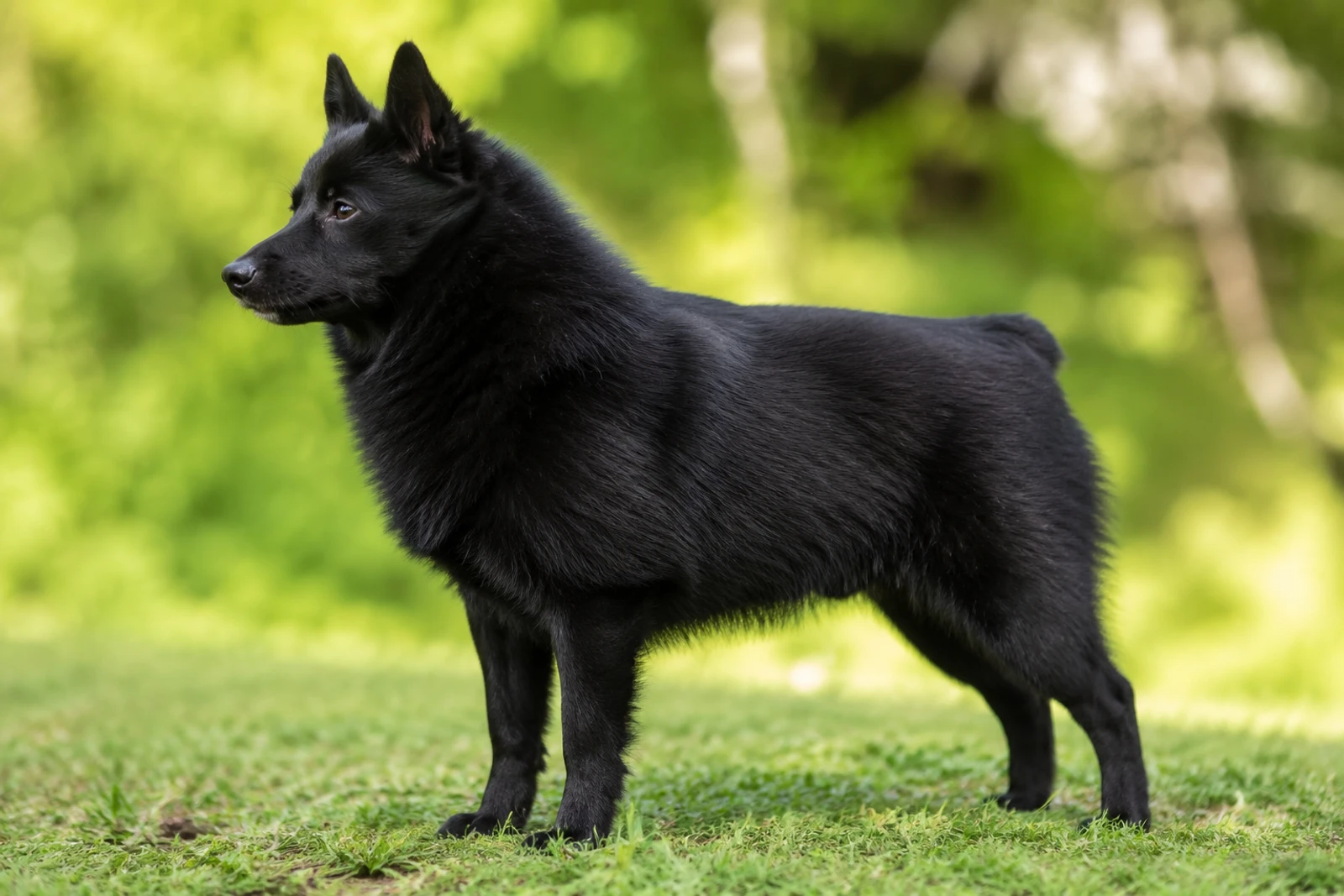
The Schipperke is a small Belgian watchdog with a foxlike outline, bright eyes, and a busy mind. It is compact enough for apartments, but the breed is energetic, vocal, and best for owners who enjoy training a mischievous little dog.
At a glance
- Size
- Small
- Height
- 10–13 in
- Weight
- 10–16 lb
- Life span
- 12–14 years
- Coat colors
- Black
- Coat type
- Medium double coat
- Group
- Companion
- Origin
- Belgium
How much does a Schipperke cost?
Adopt / rescue
$75–$400
Usually includes spay/neuter, first shots, and a microchip.
Buy from a breeder
$700–$2,000
From a reputable, health-testing breeder.
Approximate USD. Prices vary widely by region, breeder, pedigree, age, and coat colour — adopting is the lower-cost and recommended route. Avoid suspiciously cheap “breeders”; they’re often puppy mills.
Estimate the full cost of a Schipperke →Want the ongoing number? Estimate the monthly food bill for a Schipperke with our dog food cost calculator.
Schipperke photos
Views
Front, side, rear and top — the full silhouette.Poses
How the breed sits, lies, moves and plays.Puppy to senior
The breed across its whole life.Expressions
The breed’s range of moods.Close-up details
Eyes, ears, nose, paws, tail and coat.Coat colors
The breed’s recognized colors.Click any photo to enlarge. We show the Schipperke from every angle — three views, poses, life stages, expressions, close-ups, coat and colors.
Appearance & size
The Schipperke is built like a small, no-nonsense companion with a square silhouette and a coat that stands out before he even moves. At the shoulder, you’re looking at 10 to 13 inches of dense muscle and bone; weight settles around 10 to 16 pounds — sturdy, not fragile. His body length from prosternum to point of buttocks is almost exactly his height at the withers, giving him that boxy, balanced profile from every angle.
The coat is the first thing that catches your eye. It’s a true double coat: a harsh, straight outer layer that feels a bit like horsehair and a soft, thick undercoat that makes the whole thing stand away from the body. The hair doesn’t lie flat — it ruffles, fluffs, and forms a distinctive mane around the neck and shoulders, longer on the throat and ruff. On the backs of the thighs, the coat grows into culottes, heavy trousers that give the rear end a round, full look. Most Schipperkes are solid black, the reason you’ll hear the nickname “Little Black Devil” — that ink-black color and impish expression are hard to forget. You’ll also see chocolate, blue, cream, or fawn in some lines, but black is the classic. Responsible breeders aim for a jet-black coat with ample undercoat that holds its stand-off texture even when the dog is relaxed.
His head is wedge-shaped, with a flat skull, a moderate stop, and a muzzle that tapers smoothly without becoming snipey. Ears are small, triangular, set high, and carried dead upright — always alert. Dark brown, oval-shaped eyes sit slightly obliquely, giving him an expression that’s curious and deeply mischievous. From the front, that thick mane frames the face like a ruffled collar, making the neck look thick and powerful even on a small dog.
Look at him from the side and you’ll see a deep chest, a well-sprung rib cage, a short, straight back, and a moderate tuck-up. Legs are straight and of medium bone, ending in small, round, cat-like feet. From the rear, the muscled thighs are covered by those culottes, and you’ll notice the tail — or the lack of one. Many Schipperkes are born tailless (rumpy) or have just a knob; when a full tail is present, it’s set high and carried jauntily, sometimes curling over the back. A dog with a natural tail looks just as characteristic, especially when it wags.
Movement is brisk, almost prancing, with good reach in front and drive behind, which complements that square, self-possessed silhouette. The whole package — the stand-off coat, the fox face, the perky ears, and the compact body — makes him look like a little dog with a giant’s opinion of himself. That dense double coat and fox-like face are what you’ll recognize first, confirming you’re looking at a Schipperke before he makes a sound.
History & origin
You might hear someone call the Schipperke the “Little Black Devil,” and that nickname didn’t come from nowhere. The breed traces back to 17th-century Belgium, where these small, dark dogs earned their keep on the canals between Brussels and Antwerp. They were the barge dogs — sharp, tireless, and famously confident — tasked with two jobs: keeping the boat free of rats and sounding the alarm if anything (or anyone) unexpected came near. Their name, pronounced “SKIP-per-kee,” is Flemish for “little captain,” a nod to their role as the skipper’s constant shadow.
Schipperkes didn’t start that small. They were likely downscaled from the Leauvenaar, a larger, black Belgian sheepdog that also gave rise to the Groenendael and other native herders. By selecting for the smallest, most energetic pups, 19th-century breeders crafted a compact dog that could dart around a cramped barge or workshop but still had the guts of a much bigger guardian. Shoemakers, carpenters, and other tradesmen in the Saint-Géry quarter of Brussels kept them for the same reason barge captains did — ratting prowess and a bark that could make a stranger think twice.
The breed really came together in the 1880s. Queen Marie Henriette of Belgium took an interest after seeing one at a show, which lit a fire under local fanciers. The first breed standard was drawn up in 1888, the same year the Schipperke Club was founded in Belgium, making it one of the oldest breed clubs in the world. The original standard insisted on a solid black coat — any other color was a disqualification — and a naturally tailless or short-tailed dog was prized, though docking later became common in some countries.
From there, the Schipperke crossed the Channel to England and arrived in the United States around the same time. The American Kennel Club recognized the breed in 1904. Unlike some dogs that softened into lap-warmers, the Schipperke held onto its working-class edge: still a small dog with enormous presence, still ready to patrol a yard or a living room with the same intensity it once brought to a 19th-century canal boat.
Temperament & personality
If you’re looking for a lapdog, keep moving. The Schipperke packs the intensity of a working shepherd into a compact 10–16 lb body, and everything about their personality says “I’m in charge here.” Their nickname, “Little Black Devil,” isn’t just for show — it reflects a busy, curious mind that can turn mischievous the moment they’re bored. This is a breed that wants to know what’s happening on every square inch of their property, and they’ll announce it, too. Expect a sharp, relentless watchdog who won’t hesitate to sound the alarm at a delivery truck, a squirrel, or a leaf that moved the wrong way.
Confidence and independence
A Schipperke moves with a forward-leaning, self-assured posture that telegraphs pure confidence. They aren’t timid, and they don’t automatically defer to other dogs or strangers. Early, consistent socialization matters enormously here — without it, their natural reserve with unfamiliar people can harden into suspicion, and their bossiness with other dogs can tip into posturing. Because they’re so strong-willed, heavy-handed training typically backfires. You’ll get far more cooperation through respectful, positive engagement that makes them think the idea was theirs all along.
Energy and mental sharpness
Bred to patrol barges and hunt vermin, the Schipperke still needs a job — or a solid daily simulation of one. A slow walk around the block barely registers. They thrive on off-leash sprints in secure areas, puzzle toys, and training games that challenge their quick brain. When they don’t get enough to do, you’ll pay for it in creative destruction and near-constant barking. They chew not just as puppies to relieve teething discomfort, but as adults to work their jaws and alleviate boredom. A busy Schipperke is a quiet one; an ignored Schipperke will write their own agenda.
Quirks you’ll live with
- Territorial marker. Like many alert, property-focused dogs, they may urine-mark to define their space, especially if you haven’t thoroughly removed old accident odors with an enzyme cleaner. The scent of past soiling acts as a direct invitation to refresh it.
- Rolling in awful things. It’s not uncommon for a Schipperke to find the most stinky, decaying pile and dive in. Whether they’re masking their scent or just enjoying a pungent perfume, it’s a reminder of their scavenger ancestry and their idea of a good time.
- Small-dog physics. Watch their body language. A stiff, direct stare with a forward lean means they’re gearing up for a confrontation, while a loose, wiggly posture with soft eyes signals a relaxed, agreeable mood. Calming signals like lip licking or turning away are honest communication, not deceit.
Life with the household
Schipperkes bond deeply with their people and can be affectionate on their own terms — a snuggle is a privilege you earn, not a guarantee. They often do well with older, respectful kids who understand that interrupting a dog during meals can trigger a defensive response. With the right structure, they’re clean, engaging housemates. Without it, you’ll get a neurotic, barking shadow that marks the less-used guest room because it doesn’t smell enough like the family. Make every outdoor potty break a chance for a treat party, and you’ll shape reliable habits fast. Keep that devilish little brain busy, and you’ll have the kind of loyal, spirited companion that makes you glad you didn’t settle for a lapdog.
Good with kids, dogs & other pets
Schipperkes can be wonderful playmates for older kids who know how to respect a small dog’s space, but don’t let the cute face fool you — the “Little Black Devil” nickname didn’t come from nowhere. These are quick, intense little dogs who may snap if startled awake or handled roughly. Toddlers and young children who grab or stumble around can quickly overwhelm a 12-pound dog, so supervision is non-negotiable. Teach your kids that the Schipperke’s bed or crate is off-limits. A solid early socialization window (before 16 weeks old) with gentle, well-behaved children makes a big difference, but their patience has limits even with good breeding.
With other dogs, a Schipperke often acts like he’s 80 pounds. He can be bossy, will stand his ground, and may not back away from a scuffle — especially with two intact males. If raised with another dog from puppyhood, many coexist peacefully, but a dog park full of strangers isn’t his natural happy place. Slow, positive introductions on neutral territory matter a lot, and some adults simply prefer to be the only dog in the home.
Cats raised with a Schipperke from puppyhood can form an understanding, but that deeply ingrained prey drive means a sprinting cat inside the house can trigger a chase you didn’t invite. Small caged pets like hamsters, rabbits, or birds? Assume he’ll see them as vermin to be dispatched. This is the breed that earned its keep on Belgian barges as a relentless ratter, and that instinct doesn’t just go quiet because you bought a nice cage. Keep small pets behind a solid door, not just a baby gate, and never leave them out together unsupervised.
The real foundation work happens early. The critical socialization period slams shut around 12–16 weeks. If a puppy doesn’t get calm, positive exposure to new people, respectful kids, other canines, and everyday household chaos by then, you’re often playing catch-up with an adult who startles easily, guards resources, or barks himself hoarse at a neighbor’s cat. A poorly socialized adult Schipperke forced into dog-park greetings or relentless kid interactions can become more fearful, not less. Instead, manage the environment and respect the dog’s limits. Give him a quiet crate in a separate room when small children visit, and walk him at times when the neighborhood dogs aren’t out in force. Your job is to protect him from situations that set him up to fail.
Trainability & intelligence
Schipperkes are brainy, curious, and absurdly quick to learn — but they have zero interest in being bossed around. You’re not drilling a robot; you’re negotiating with a compact, black-furred free-thinker who will constantly test whether your request is worth his time. The “Little Black Devil” nickname didn’t come from nowhere: this breed mixes high intelligence with a bold, independent streak that rewards a trainer who works with the dog, not against him.
The training style that actually sticks
Forget force, loud corrections, or repetitive drilling. A Schipperke tunes out harshness and holds a grudge; heavy-handed methods damage trust and can spike anxiety or defensive snapping. What works is positive reinforcement delivered fast and in short, lively sessions. A treat, a squeaky toy, or a burst of excited praise the instant he gets it right — that’s your currency. Keep lessons under five minutes and stop while he still wants more. If you fall into yank-and-crank routines, he’ll outsmart you, then find his own entertainment, which usually involves redecorating something you value.
Because he’s so sharp, a Schipperke can ace obedience cues, trick training, and dog sports like agility and rally. He thrives when he has to puzzle things out on the move. Use that brain. Teach a hand target, a spin, a “go to mat” — then chain them together. The key is variety. Run the same boring set of commands day after day, and he’ll show you exactly how selectively deaf a 12-pound dog can be.
The non-negotiable: early and ongoing socialization
Don’t mistake his small size for a pet that automatically blends into every situation. Schipperkes were bred to be watchful barge dogs and tenacious ratters, and they carry a strong suspicion of anything unfamiliar. Left unguided, that suspicion curdles into fear-based reactivity, nonstop barking at guests, and posturing with strange dogs. Start positive socialization between 3 and 14 weeks old, exposing the puppy gently to a wide range of people, calm dogs, novel sounds, and different surfaces. Keep treats flowing so he builds the association that new = good things happen. Continue these experiences well into adulthood. Even a well-socialized Schipperke often remains aloof with strangers — that’s just breed standard — but early work gives you a dog who can recover and disengage instead of spiraling into alarm mode.
The recall riddle and other everyday challenges
A solid recall is the Mount Everest of Schipperke training. Flip a squirrel switch and years of selective breeding for chasing small vermin override your voice. Never punish a slow return; instead, make coming to you the most jackpot-worthy event of the minute — think rotisserie chicken, not a dry biscuit. Practice recalls in low-distraction spaces, then gradually add difficulty, and always reward even a hesitant arrival. Freedom off-leash in unfenced areas often remains a gamble. Accept it: a 99.9% recall is a unicorn in this breed, and management with a long line gives him a safety net.
House training can also test your patience. The breed sometimes decides that bad weather is a personal insult, or that the far corner of the living room is just more convenient. Stick to a strict schedule, lean heavily on crate training, and clean accidents with an enzymatic cleaner to erase the scent trail. Consistency and calm persistence move the needle — never scolding after the fact, which just teaches a Schipperke to hide future messes better.
- Motivation must-haves: tiny high-value treats, a squeaky toy he can chase, enthusiastic verbal praise.
- Session length: 3–5 minutes, multiple times a day. End on a win.
- Punishment to avoid: leash jerks, yelling, alpha-rolling — all poison trust and amplify stubbornness.
- Mental outlets: treat puzzles, nose work games, hide-and-seek inside the house, trick training.
Channel this dog’s huge brain and drive into structured challenges, and you’ll earn a nimble, responsive partner. Skimp on training or lean on intimidation, and you’ll live with a tiny despot who barks at shadows and rewrites the house rules. The difference comes down to earning his respect, not demanding it.
Exercise & energy needs
Plan on a solid 45–60 minutes of honest exercise every day, broken into two or three sessions—not just a lazy loop around the block. Schipperkes are dense little firecrackers bred to patrol barges, kill rats, and think on their feet. A bored one will invent its own jobs, and you probably won’t like them. Restlessness can turn into nonstop barking, shredding, or nipping heels.
Brain work is just as draining as a run. Rotate puzzle feeders, hide kibble for nose games, or work through a quick obedience or trick session before meals. They pick up new cues fast and stay saner when you make them use that clever head.
- Sprint and chase: Flirt poles, fetch, and safe off-leash zoomies in a fenced area let them burn gasoline.
- Walk, hike, or jog: Brisk 20-minute walks aren’t enough alone; layer in a longer hike or a couple of miles running once joints are mature. Soft trails beat pavement.
- Dog sports: Agility, rally, barn hunt, and even dock diving channel speed plus thinking. Many Schipperkes take to these with zero convincing.
- Weather smarts: That black double coat soaks up sun, so avoid midday heat and bring water. In winter, they’ll romp through snow happily.
Patellar luxation can show up in the breed—responsible breeders screen for it, but you still need to protect those knees. Don’t encourage constant leaping on and off high furniture, and build distance gradually. Swimming is a fantastic low-impact swap if your dog wades in willingly. A Schipperke who gets a daily rhythm of movement and mental puzzles settles into a sharp, affectionate companion, not the “Little Black Devil” you didn’t invite.
Grooming & coat care
Unofficially, Schipperkes have a third coat: the pile of black fluff that suddenly seems to cover every surface twice a year. You’re dealing with a true double coat — a harsh, stand-offish outer layer over a dense, insulating undercoat. When it blows seasonally, a 14-pound dog can produce a small trash bag of fur. During those few weeks in spring and fall, daily brushing is your best friend; a slicker brush with rounded pins pulls out loose undercoat and debris without scratching the skin, and an undercoat rake can speed up the process.
The rest of the year, a weekly session with the slicker is usually enough to keep shedding manageable and distribute natural oils that put a healthy shine on that solid black coat. Because the outer hair repels dirt and debris, baths are low-effort — once every two or three months, or when he rolls in something truly vile. There’s no functional need for a haircut; you might lightly trim the feathering on the back of the thighs and front legs if you want a cleaner outline, but never clip the body coat short — it messes with the coat’s insulation and regrowth.
Little-dog nails grow fast, so plan to trim every 10–14 days, and check those perky upright ears weekly for wax buildup or grit. Dental care deserves real consistency: brush his teeth several times a week to stay ahead of the tartar and gum issues that plague small breeds. One seasonal bonus: running him hard outdoors helps the old coat turn over, so that daily fetch session during shedding season does double duty. And if you can, groom him outside or invest in a high-velocity dryer — it’ll keep the black tumbleweeds from colonizing your entire house.
Shedding & allergies
If you wear a lot of black, the Schipperke might seem like a perfect accessory—until you realize every single shirt will carry a dusting of undercoat.
A Schipperke’s double coat works hard. A straight, harsh outer layer sheds dirt and moisture, while a dense, soft undercoat insulates him. That undercoat is the culprit. He’ll drop a light, constant snowfall of dark hair all year long, and twice a year—often spring and fall—the “Little Black Devil” stages a full-blown shedding rebellion. During a seasonal blowout, you can pull tufts of loose undercoat from his ruff and pants like pulling stuffing from a toy. Daily brushing with a slicker brush or undercoat rake during those periods keeps the worst of the fur tumbleweeds in check; a quick once-over a few times a week handles the rest of the year.
Drool isn’t part of the bargain. You might catch a stray drip after he’s had a long drink, but flat-out slobber won’t be a problem.
No dog is truly hypoallergenic, and this breed is no exception. The allergens come from dander (dead skin flakes) and saliva, and a Schipperke’s heavy seasonal shedding spreads those flakes throughout your home with impressive efficiency. Someone with mild allergies might manage with aggressive house-cleaning, high-quality air filters, and off-limit zones, but a person with significant reactions should spend time around adult Schipperkes before committing. If you’re looking for a dog that won’t coat your couch in tiny black fibers, this is not it—invest in a great lint roller and a vacuum you don’t hate using.
Diet & nutrition
A Schipperke will convince you they’re starving at every meal. That little black shadow in the kitchen is a food-motivated pro, and without firm boundaries, they’ll pack on ounces that quickly turn into pounds. For a dog that tops out at 10 to 16 pounds, even a single extra pound is significant — so measure portions with a real measuring cup, not your gut, and resist those theatrical begging eyes.
Feed a high-quality commercial diet formulated for small breeds, or a properly balanced fresh-food plan. A good baseline is a diet that’s predominantly meat-based, with cooked or puréed vegetables and fruits for fiber, plus small amounts of grains or eggs. If you lean toward raw feeding, chicken wings can be introduced around 12 weeks under supervision. Avoid rich, fatty scraps; a single holiday ham trimming can trigger pancreatitis in a tiny frame.
Puppies need four meals a day until four months, then three meals until six months, settling into the adult rhythm of two meals daily. Transition a new puppy slowly: lightly cooked, puréed meats and veggies for the first few days, then gradually work in their permanent food. Seniors keep the same two-meal schedule but may benefit from slightly smaller, more frequent portions if activity slumps. No evidence says you need to drop protein for an older dog — just keep a hawk-eye on the scale and cut back gradually if the waistline disappears.
This is a breed that inhales food if allowed. A puzzle bowl or snuffle mat slows them down, adds a little brain work, and prevents the bloat-like discomfort fast eaters can get. And never, ever slide a bite from your plate into their waiting mouth. Once that habit is set, you’ll have a tiny tyrant barking at every dinner party. Serve any healthy leftovers — plain cooked fish, vegetables, a spoonful of grain — in their own bowl, on their own mat, after you’re finished. That keeps begging where it belongs: extinct.
Health & lifespan
A well-bred Schipperke typically lives 12 to 14 years, and many stay spry and opinionated well into their teens. They’re a sturdy little dog without the extreme flattening or dwarfism that saddles some small breeds with daily struggles. That doesn’t mean they’re bulletproof. A few inherited issues pop up often enough that responsible breeders screen for them — and that you should know about before you fall in love.
Joints and mobility
Patellar luxation — a kneecap that slips out of its groove — is the most common orthopedic complaint in the breed. It can be mild (an occasional hop-skip you barely notice) or severe enough to require surgery. Ask whether both parents had their knees graded through OFA or a similar registry. Another less frequent but serious condition is Legg-Calvé-Perthes disease, a degeneration of the hip joint that shows up in young dogs as rear-leg lameness. Quick intervention, usually surgery, can get a Schipperke back to full-speed mischief.
Eyes and thyroid
Some lines carry hereditary eye diseases such as progressive retinal atrophy (PRA) or cataracts. A yearly exam by a veterinary ophthalmologist is the gold standard for breeding dogs, and it’s fair to ask to see current CERF or OFA eye clearances on the parents. Hypothyroidism crops up occasionally and is manageable with daily medication, but a sluggish Schipperke that’s packing on extra weight without eating more should have a thyroid panel run.
The weight conversation
Schipperkes live life at full throttle and eat like they’re three times their size. A 14-pound dog doesn’t need much food, but that doesn’t stop them from convincing you otherwise. Extra weight punishes those already-vulnerable knees and almost guarantees a shorter lifespan. Use a measuring cup, skip table scraps, and give them the hour of hard play and brain work they need — a fat, under-exercised Schipperke is a recipe for trouble. If you can’t feel ribs with light pressure, it’s time to rethink portions.
Mouth, skin, and overall upkeep
Small mouths mean crowded teeth. Dental disease is a major threat, not just to the mouth but to the heart and kidneys. Daily brushing (or at least several times a week) and regular veterinary cleanings under anesthesia make a real difference. Upright ears get good airflow and rarely cause problems, but check for wax and debris during your weekly once-over. Some Schipperkes deal with seasonal allergies that show up as itchy, red skin. A diet trial or environmental tweaks under your vet’s guidance usually sorts it out before a hot spot takes hold.
Standard preventive care applies: monthly heartworm prevention during mosquito season (and one month beyond), a current rabies vaccine, and annual wellness exams. As your dog heads into senior years, twice-a-year vet visits help catch subtle changes — a bit less pep, a slightly reduced appetite — that could signal a brewing thyroid or eye issue. Early socialization and calm, consistent handling also matter for physical health; an anxious, stressed Schipperke can bark itself hoarse and become harder to keep fit. When you’re talking to a breeder, the single best protection you can buy is proof that both parents were screened for patellar luxation and hereditary eye disease.
Living environment
Schipperkes can thrive in an apartment or a house, but their size is deceiving—this is a 10–16 lb dog with the engine of a much larger working breed. Quiet confinement won’t cut it. They need a solid 45–60 minutes of daily exercise, ideally split into two or three energetic sessions. Multiple short walks, a high-speed chase game, or a fenced romp work better than one marathon trot around the block. Mental calisthenics are non-negotiable: puzzle toys, scent work, and trick training burn the restless brain that earned them the nickname “Little Black Devil.”
A yard is a bonus, not a requirement, but if you have one, inspect every inch of fencing. Schipperkes are curious escape artists who can squeeze through surprisingly small gaps and will bolt after a squirrel without a second thought. A secure, dig-proof barrier is essential. If you rely on on-leash walks and indoor play, they adapt just fine—provided you deliver that daily energy outlet.
Now for the noise. This breed was a canal-barge watchdog, and the instinct is deeply ingrained. Your Schipperke will bark at knocks, unfamiliar sounds, passing dogs, and sometimes just because. In an apartment with shared walls, early training and a “thank you, that’s enough” cue are critical. Even then, expect some vocal commentary.
Climate-wise, they’re built for cold. The dense double coat laughs at snow. Heat is the real enemy: limit summer outdoor time to early mornings and evenings, and keep indoor spaces air-conditioned.
Leaving them alone for long stretches is asking for trouble. Schipperkes bond fiercely and can develop separation anxiety—howling, destructive chewing, or obsessive barking when you’re gone all day. Gradual desensitization, stuffed Kongs, and midday check-ins help, but a household where someone is around most of the time (or one that sends the dog to daycare) is ideal. If your weeks demand 9-to-5 absences with no break, this little shadow will make sure the whole block knows about it.
Who this breed suits
A Schipperke fits anyone who wants a big personality in a compact, 10–16 pound body and is willing to put in the work. These little black spitfires pack the brains, boldness, and exercise needs of a much larger working dog. If you’re looking for a quiet lap warmer who’s content with a potty stroll, you’ll be disappointed—and so will the dog. But if a smart, mischievous shadow that makes you laugh and keeps you moving sounds appealing, read on.
You’ll shine as a Schipperke owner if:
- You genuinely enjoy daily activity and can give a solid 45–60 minutes of real exercise, not just a walk around the block. A fenced yard is a huge plus, but it won’t replace dedicated running, hiking, or fast-paced play.
- Mental stimulation is part of your routine. Puzzle toys, hide-and-seek, trick training, or dog sports like agility and rally keep a Schipperke from inventing their own (destructive) entertainment.
- You handle a big bark in a small package. Schipperkes are alert watchdogs—your doorbell, passing squirrels, and suspicious leaves will be announced.
- You’re ready to manage a clever escape artist. Baby gates aren’t speed bumps; they’re puzzles to solve, and insecure fences turn into suggestions.
- You live alone, with a partner, or with older kids who can participate in training and respect the dog’s space. Singles and couples who can include the dog in daily adventures do wonderfully.
Think twice—or three times—if:
- Sedentary describes your household. Without enough to do, a bored Schipperke chews, barks nonstop, or climbs furniture like a parkour athlete.
- You have toddlers or expect a quiet, hands-off family dog. Schipperkes can be possessive of toys and food, and their energy may overwhelm small children.
- Small pocket pets (hamsters, rabbits) share your home. The breed’s ratting heritage means anything tiny and fast is a target.
- You’re gone for long hours. Separation boredom makes them lonely and loud; a midday walker or doggy daycare is often non-negotiable.
- You’re a first-time owner who just wants an easy, train-once-and-done companion. A first-timer with a passion for positive training, a sense of humor, and willingness to attend classes can absolutely succeed—but be honest about your tolerance for a dog who questions rules before obeying them.
Commit to meeting their physical and mental engine daily, and you’ll have a fiercely loyal, entertaining partner for the breed’s 12–14-year lifespan. Skimp on it, and that same intelligence turns into baseboard artistry and neighborhood noise complaints before you know it.
Cost of ownership
A Schipperke puppy from a responsible breeder who screens for luxating patellas, eye disease, and MPS IIIB typically runs $1,200–$2,500. Regional demand and whether you’re after a pet or a show prospect will push that figure up or down. Bargains under $600 almost always cut corners on health testing, and the “little black devil” temperament can be a lot when the foundation isn’t solid.
Monthly upkeep stays manageable for a 10–16 lb dog, but their sharp mind means skimping on enrichment will cost you in other ways.
Ongoing monthly costs
- Food: A high-quality small-breed kibble runs $20–$35. Treats for training and puzzle toys to tire out that busy brain add another $10–$15.
- Grooming: The double coat sheds in bursts. If you do the weekly slicker-and-rake work yourself, ongoing cost is near zero. A professional bath, blowout, and nail trim every 6–8 weeks typically runs $30–$50 per session. Ear cleaner rounds up to a few dollars a month.
- Routine vet care: Annual exams, vaccines, heartworm prevention, and flea/tick meds average $50–$80 per month when spread across the year. Dental cleanings often add a couple hundred dollars annually or biennially—these little dogs collect tartar.
- Pet insurance: Expect $30–$50 a month for a solid accident-and-illness plan. With a breed prone to luxating patellas (surgery can hit $1,500–$4,000 per knee) and scrappy instincts that can lead to bites or scuffles, coverage softens a big financial blow.
A realistic all-in range lands at $130–$230 a month before you hit the vet for anything unexpected. Over 12–14 years, that’s a $20,000–$40,000 commitment. Stash a couple hundred dollars upfront for a good puppy class, too—a bored, untrained Schipperke will find ways to make your life more expensive.
Choosing a Schipperke
Finding a Schipperke takes patience — this isn’t a breed you’ll stumble on in every shelter or online listing. Start by checking national and regional Schipperke rescue groups, even if you want a puppy. An adult through rescue lets you skip the baby-shark phase and see exactly what you’re getting with this quick, independent mind.
If you go the breeder route, expect a grilling — good breeders screen you harder than you screen them. They’ll want to know where the dog will live, how much time you can give, and whether you understand that “Little Black Devil” isn’t just a cute nickname. Demand the same transparency in return.
Insist on proof of these health clearances:
- MPS IIIB (mucopolysaccharidosis type IIIB) — a DNA test for this fatal lysosomal storage disease. Both parents should be clear or one a carrier bred to a clear dog; no affected puppies should be produced.
- Patellar luxation — an OFA or PennHIP evaluation, because wobbly kneecaps are common in small breeds.
- Eye exam — a current CAER evaluation by a board-certified veterinary ophthalmologist.
Some breeders also electively screen hips through OFA, and thyroid panels show up now and then. The more data, the better.
Red flags: a seller who won’t let you meet the mother on site, runs multiple litters year-round, or pressures a deposit before you’ve asked a single question. Puppies shouldn’t leave before 10–12 weeks — they need that extra time with littermates to learn bite inhibition and dog-to-dog manners.
When you meet the litter, camp out for a while. You want a pup that boldly investigates your shoes, startles briefly at a new noise, then shakes it off and trots back. A Schipperke puppy should be busy and curious, not skittish in the corner or bulldozing the whole pack. Ask the breeder how they’ve exposed the litter to vacuum cleaners, slick floors, car rides, and handling early — those first weeks cut years of rehab later.
A health-tested, well-socialized Schipperke can sail toward that 14-year lifespan with remarkably few vet surprises. Skip the homework, and you’ll pay for it in emergency clinics and behavior consults.
Pros & cons
Pros
- Compact and sturdy: At 10–13 inches tall and 10–16 pounds, they fit apartment life or a small house — but don’t mistake small for fragile. They’re solid, agile, and ready for anything.
- A big watchdog in a small package: The nickname “Little Black Devil” hints at their fearlessness. They’ll bark at anything suspicious, making you feel safer even if the intruder is just a squirrel.
- Fiercely loyal: A Schipperke bonds tightly with their person or family. Expect a shadow that follows you from room to room and insists on being part of every activity.
- Low-maintenance coat: The double coat is dirt-resistant and mostly wash-and-wear. A weekly brush keeps shedding manageable, though you’ll need a rake during blowing seasons.
- Brainy and athletic: These dogs excel in agility, rally, and trick training. They love to work — give them a puzzle toy or a job, and they’ll throw themselves into it.
- Long-lived: A lifespan of 12–14 years means a lot of good years together, provided you keep them fit and mentally engaged.
Cons
- Sheds like a much larger dog: That dense double coat blows heavily twice a year. You’ll find black fur on your clothes, furniture, and probably your food. A robot vacuum helps, but fur is a fact of life.
- High exercise demands: A stroll around the block isn’t enough. They need at least 45 minutes of real running, hard play, or off-leash romps (in a secure area) daily, plus mental challenges to tire their busy brain.
- Independent to a fault: Schipperkes have opinions. Training requires consistency, creativity, and a sense of humor. They’ll outsmart you if you’re not careful, and they’re not above selective hearing.
- Bark-first-ask-questions-later: The watchdog instinct is strong, but that means a lot of noise. They’ll alert you to every doorbell ring, passing dog, or weird-looking leaf. You can work on training, but expect to manage this forever.
- Escape artists: With cat-like agility, they can jump surprisingly high and squirm through small gaps. A securely fenced yard is non-negotiable, and you’ll learn to check gates twice.
- Prey drive and chase instinct: Small animals — squirrels, cats, rabbits — trigger a lightning-fast chase. Off-leash walks in unenclosed areas are generally a bad idea unless you’ve put in serious recall training.
- Wary of strangers: They’re not golden retrievers. Without early and frequent socialization, a Schipperke can become standoffish or nippy with unfamiliar people or dogs.
- Health considerations: Reputable breeders screen for luxating patella, eye conditions, and a genetic disease called MPS IIIB (which affects the nervous system). Not widespread, but it’s worth asking about. With a good breeder, most stay healthy into their teens.
Similar breeds & alternatives
If a solid-black spitzy sidekick with zero tail and an oversized personality sounds close but not quite right, a few other compact firecrackers might click better.
-
Pomeranian – The fluffy showstopper. Poms come in more colors, live for laps, and need daily brushing to keep that cloud coat tangle-free. A Schipperke skips the fluff and the grooming fuss; it’s built squarer and acts more like a sturdy farmhand than a decorative pillow. The bark factor is high in both, but the Schipperke’s watchfulness leans more independent, less frantic.
-
Miniature Pinscher – Sleek, high-stepping, and equally full of “I dare you” energy. Min Pins share the Schipperke’s confident cleverness and door-dashing speed. The key differences: Min Pins are often black-and-tan or red, not solid black, and their shorter, thinner coat offers less weather protection. A Schipperke feels more substantial in hand and has a thicker double coat that shrugs off cold rain.
-
Brussels Griffon – If you want a small dog who’s glued to your side and makes you laugh with a monkey face, a Griffon fits. They tend to be Velcro dogs; Schipperkes are equally attached but keep a little more self-reliant mischief in the tank. Schipperkes also shed less facial hair hassle and are notably sturdier during rough-and-tumble play.
-
Shetland Sheepdog – Consider a Sheltie if you love that alert, whip-smart brain but need a dog that folds easily into a quiet family rhythm. Shelties are larger, heavy seasonal shedders, and sensitive to tension. A Schipperke brings herding-dog smarts but delivers them in a tougher, lower-maintenance body that will absolutely test your recall when a squirrel zips across the street.
Fun facts
- Schipperkes are often nicknamed Little Black Devils.
- The breed has a dense black double coat.
- They are small, but they behave like serious watchdogs.
Frequently asked questions
- Are Schipperkes good family dogs, especially with children?
- Schipperkes can be good with children if properly socialized from a young age. Their lively and playful nature often makes them a fun companion for older kids, but supervision is recommended due to their small size and bold personality. They may not tolerate rough handling and do best in homes with respectful children.
- How much exercise does a Schipperke need?
- Schipperkes have high energy levels and need around 45–60 minutes of daily exercise. This can include brisk walks, playtime, and mental stimulation to prevent boredom. Without enough activity, they can become destructive or develop nuisance barking.
- Do Schipperkes shed a lot?
- Schipperkes have a moderate shedding level. They blow their undercoat seasonally, during which shedding increases. Regular brushing a few times a week helps manage loose fur and keeps their coat healthy.
- Are Schipperkes easy to groom?
- Yes, Schipperkes are relatively low-maintenance when it comes to grooming. Their double coat requires brushing once or twice a week to remove loose hair and prevent mats. They only need occasional baths unless they get into something messy.
- Can Schipperkes live in an apartment?
- Schipperkes can adapt to apartment living if given sufficient daily exercise and mental stimulation. However, they are alert and can be vocal, which may disturb neighbors. Consistent training and providing enough activity can help them thrive in smaller spaces.
- Are Schipperkes recommended for first-time dog owners?
- Schipperkes are intelligent and confident, which can be a challenge for first-time owners. They require consistent training and early socialization to channel their energetic and independent nature. Experienced owners may find them easier to handle, but dedicated beginners can succeed with time and patience.
Tools & calculators for Schipperke owners
Quick estimates tailored to Schipperkes — pre-filled with this breed’s size where it matters.
Articles & stories about the Schipperke
Sources & standards
This profile follows recognized breed standards from the American Kennel Club (AKC) and the Fédération Cynologique Internationale (FCI), along with established veterinary and breed-club guidance. These describe general breed tendencies — every dog is an individual.